BACKGROUND
Chronic heart failure is a disease with high morbidity and a substantial symptom burden that places great demands on family members (Stromberg & Luttik, Reference Stromberg and Luttik2015). Patients are often older and suffer from multiple symptoms accompanied by great physical and psychological burden (Janssen et al., Reference Janssen, Spruit and Uszko-Lencer2011) as well as additional complex comorbidities (Cleland et al., Reference Cleland, Mcdonagh and Rigby2011). Heart failure has a poor prognosis, a shifting disordered illness trajectory, and an often unpredictable decline toward the end of life and death (Gadoud et al., Reference Gadoud, Jenkins and Hogg2013).
The challenges of being the family member of a patient with heart failure have been described to include perceptions of stress, burden, depressive symptoms, and diminished quality of life (Dracup et al., Reference Dracup, Evangelista and Doering2004; Luttik et al., Reference Luttik, Jaarsma and Veeger2005; Reference Luttik, Jaarsma and Veeger2007; Pressler et al., Reference Pressler, Gradus-Pizlo and Chubinski2013). Family members are at risk of being worn out as a result of being constantly worried and burdened by responsibility 24 hours a day (Brännström et al., Reference Brännström, Ekman and Boman2007). They have expressed many concerns about delivering competent care and performing caregiving tasks correctly as well as about making appropriate decisions (Sullivan et al., Reference Sullivan, Marcuccilli and Sloan2016).
The Word Health Organization cautions that patients with such chronic diseases as heart failure should have access to palliative care with the purpose of improving quality of life for both themselves and their families. A comprehensive and interdisciplinary approach should be integrated into the management of the patient beginning at diagnosis and alongside treatment for the underlying disease (World Health Organization, 2002; Jaarsma et al., Reference Jaarsma, Beattie and Ryder2009; Morrison & Meier, Reference Morrison and Meier2011). Previous research has recognized that few patients with heart failure who would benefit from palliative care actually receive it (Jaarsma et al., Reference Jaarsma, Beattie and Ryder2009). However, a recent review of guidelines and pathways in Europe revealed a growing awareness of the importance of integrated palliative care for patients with chronic heart failure. The reviewers concluded that palliative care interventions should aim to reduce suffering through the provision of appropriate medication and psychosocial support (Siouta et al., Reference Siouta, Van Beek and Preston2016). They also acknowledged a need for standardized strategies to overcome existing barriers. Several barriers have been identified. Heart failure has an unpredictable illness trajectory, and healthcare professionals seem to have limited knowledge about what differentiates standard heart failure therapy from palliative care and about how to initiate collaboration (Kavalieratos et al., Reference Kavalieratos, Mitchell and Carey2014). Despite this, some interventions have been developed, but they sometimes fail to have any proven effects (Hopp et al., Reference Hopp, Zalenski and Waselewsky2016), while others result in reduced numbers of hospital readmissions and improvements in terms of depression, symptom burden, perceived control, and activation, as well as enhanced quality of life for patients (Evangelista et al., Reference Evangelista, Lombardo and Malik2012; Reference Evangelista, Liao and Motie2014; Wong et al., Reference Wong, Ng and Lee2016). However, relevant studies are still rare, and more knowledge is needed about the impact of palliative care interventions, not only from the perspective of patients with heart failure but, importantly, also from their family members, who often play a crucial role in caregiving.
AIM OF THE STUDY
Our aim was to describe family members' experiences of an intervention that integrated palliative advanced home care and heart failure care.
METHOD
Design and Study Context
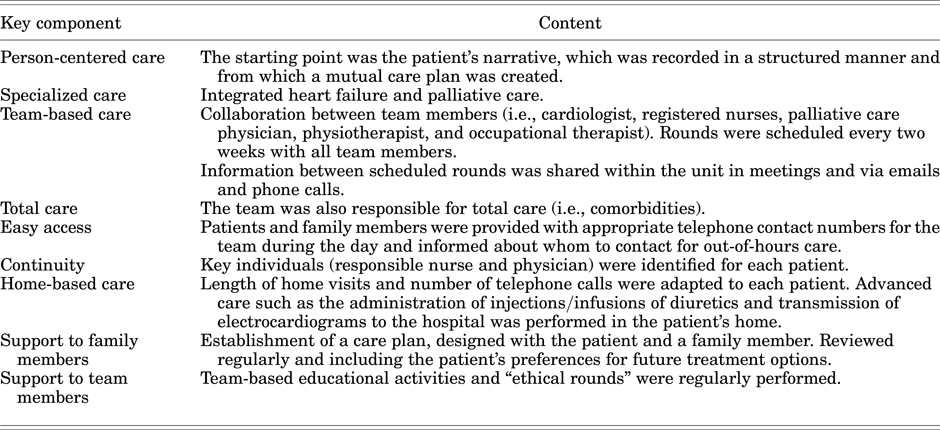
Our study had a qualitative descriptive design based on family member interviews. It was a prespecified post-hoc study of a randomized controlled intervention that integrated palliative advanced home care and heart failure care (PREFER) (Brännström & Boman, Reference Brännström and Boman2014). Patients in New York Hearth Association classes III–IV received person-centered care with a multidisciplinary approach involving collaboration between specialists in palliative and heart failure care. A holistic approach was used by all of our professionals to meet patients' physical, psychological, social, and existential needs. The context was an advanced home care unit providing services Monday through Friday during the day and based in a county hospital in northern Sweden. The frequency of home visits and phone calls varied substantially: from several times a day to every other week. The intervention proved to increase evidence-based drug treatments (Markgren et al., Reference Markgren, Brännström and Lundgren2016), reduce costs (Sahlen et al., Reference Sahlen, Boman and Brännström2016), improve quality of life, and reduce morbidity for patients (Brännström & Boman, Reference Brännström and Boman2014). One key component of the intervention involved providing support to family members, mainly by the palliative care nurses. Specifically, family members were invited to participate when a care plan was established with the patient, at which point family members were given telephone contact numbers for the team and informed about whom to contact for out-of-hours care. The intervention also included bereavement support (see Table 1). The focus of the present study was on the whole intervention, but from the perspective of family members.
Description of the key components of the PREFER intervention

Participants
Family members were asked to participate in the present study after the intervention was completed. A “family member” was defined as a person who the patient had reported was a member of his/her family. Of the 31 eligible family members, 15 were asked to participate. One interview was excluded due to communication difficulties. The final total number of participants was 14 family members (8 wives, 1 husband, 4 daughters, and 1 son). They ranged in age from 55 to 84 years, and all 9 spouses and the 1 son lived with the respective patient at the time of our study.
Data Collection
Data were collected through semistructured interviews and followed a short interview guide. The interviews were conducted by the last-named author (M.B.) and another two registered nurses who had extensive experience with interviewing. None of these researchers had participated in delivery of the intervention. The interviews began with an open-ended question: “Please tell me about your experiences of the intervention.” The following questions were also asked: “Please tell me about a situation when you received help and a situation when you did not receive help”; “What has the intervention meant for you?”; and “Please describe if you experienced differences between usual care and the intervention.” Probing questions were also asked, including: “Do you mean …?” and “Can you say more about that?” Interviews were conducted between 2011 and 2013, and each interview lasted between 30 and 60 minutes. They were conducted at participants' homes and were transcribed verbatim.
Data Analysis
Interviews were analyzed using content analysis (Patton, Reference Patton2002). Audiotapes were listened to again in order to confirm the transcribed text. Transcripts were then reread to obtain an overall impression of their content. Then, bearing in mind the aim of our study, texts were subdivided into units of text. These units were condensed without changing their central meaning and then coded. Codes were compared, and, finally, codes with similar content were gathered into three groups, presented here as themes. The analysis was mainly conducted by the first and last authors (A.A., M.B.), but codes and themes were continuously discussed and verified by all of our authors. Quotations from the interviews are used to illustrate the themes. Ethical approval was obtained from a regional ethical review board (reference no. 2010–294–31M).
FINDINGS
The results are presented in three themes representing family members' experiences of the PREFER intervention.
Happiness and Thankfulness as a Result of Witnessing Patients' Enhanced Well-Being
Family members experienced happiness from witnessing patients feeling better due to symptom relief and empowerment. They also felt thankful for the reduced suffering the patients experienced after enrollment in the intervention. They experienced that the patients finally received the appropriate medications and treatments, which contributed to a much improved health status. Some patients had daily visits just to ensure that medications were taken as prescribed and that the expected effects were being achieved. Family members actually credited the intervention with keeping patients alive. These are the words of a husband whose wife had been ill for many years:
In the beginning, she was really ill and had chest pain, and they came and helped her right there, and she received appropriate treatment with diuretics at home. A nurse came every day and gave her an injection. She was so sick when the intervention started. It was a blessing that she could participate, because she was very bad off when this started. So you could say that they saved her life. After inclusion in the intervention, she never needed to be cared for at the hospital anymore.
Likewise, a daughter said this about her father:
They came and give him medicine every day. When he took it by himself, he stopped taking it. Dad became significantly better. Before it was bad—we almost thought he would die.
Consequently, family members felt a sense of trust in the healthcare professionals' competence and the care they provided. They experienced that the healthcare professionals showed an interest in the whole person and also cared for symptoms related to health problems other than just the heart failure. In addition to providing correct medication and treatments, family members reported that the healthcare professionals' compassionate approach contributed to the well-being of patients. They felt that healthcare professionals were truly engaged in the care of the patient. They saw many advantages for the patient in meeting with the same health professional regularly and appreciated that the healthcare professionals took the time to sit down and talk with the patient. This was seen as important for patients' well-being, contributing to a feeling of safety and confirmation. Family members speculated that meeting the patient in his or her home environment greatly contributed to the quality of care provided because the patient became more of a person to the healthcare professionals. They also described how the patient felt a sense of safety. For example, one woman said the following of her husband:
I got a whole new husband, simply put. It made him calmer, and he saw things more positively. It is their doing. He was very depressed when he came home. My husband has been healthier if I … [laughs] … can say that. Healthier we shouldn't say, but he has been different. It was of course the sense of safety that he got from being at home—that's how it was.
Feelings of Relief and Shared Responsibility with Healthcare Professionals
The intervention contributed to feelings of relief among family members, and this relief had a multitude of aspects. Due to the patients' improved conditions, family members worried less. Some had never been able to leave the patient, even for a short time, and they also had worried during the night, which disturbed their own sleep. This relief was described by one wife thus:
Thanks to them, I didn't need to go out and be nervous, because he got better. Before the intervention, I had to follow him around everywhere. I couldn't leave him more than three meters away from me. He got the correct medication, and they were there and took tests and came home and gave him his medicine. Before we joined the intervention, I could lie awake. I was awake during the night and felt if he was breathing.
As a consequence of the intervention, family members' consciences were eased. Because the patient was cared for at home, they themselves did not have to take time off from work to drive the patient to the hospital or to a district healthcare center. Before the intervention, they felt as though they were expected to help, even if it was not expressed explicitly by the patient or someone else. When they at times had not been able to help, this contributed to feelings of guilt. There was also a feeling of joy related to being able to spend more time with the patient, as the amount of time spent at the hospital for the patient was decreased:
It was so much easier—less stress around everything. Otherwise, it could be a day's work to leave the house. She needs a lot of time to get ready.
Life at home and the practical care of the patient was also facilitated through different kinds of assist equipment, which was brought there on the initiative of healthcare professionals.
Family members felt safer and more in control during the intervention. They knew that the patient was being cared for properly, and they knew the times of day when healthcare professionals would come to visit, and they also knew which person would show up. These planned home visits, when healthcare professionals came and sat down and talked, even at times when the patient was stable in his/her disease, were much appreciated. The visits contributed to feelings of control and helped family members to understand and prepare:
I couldn't wish for more, because he got everything they could offer. They came, and we got to talk to them, and they explained a lot about how it was, and all of that. I knew, of course, the whole time what had happened and what would happen.
Importantly, family members themselves as well as patients knew where to phone if emergency care was needed, and that someone would come to help at any hour of the day or night. Once feeling solely responsible for the care of the patient, they now felt a shared responsibility with the healthcare professionals. As one daughter commented,
It has meant a lot. It has been a relief, especially since I am alone here and my siblings live in another town. I have never before had the opportunity to share anything. They have given me a sense of safety actually. I wish everyone could experience this. I have never experienced anything like this.
Living in the Shadow of Severe Illness
Family members described how they felt most supported because of the patient's increased well-being and the sense of relief and safety that the care of the patient brought and that the intervention contributed to. They felt that it was supportive for them to participate when healthcare professionals came to visit the patient's home. Just being there and listening to what was said between the healthcare professionals and the patient was beneficial and also gave them the chance to ask questions. They experienced that the conversations centered on the patient and the disease and not their own situation. As one wife put it,
I got to participate, and we spoke—all four of us. I got to explain what my husband didn't remember or what he didn't want to tell them. He was the type of person who didn't want to know that he was sick. He was like that, and then I got to explain what was what.
Family members reported that they did not need any support for themselves and that it was support enough for them that the patient received good care. There were some family members who did not participate in any of the home care visits. This could have been due to a variety of reasons. Some had never been invited to or informed about the visits, while in other cases patients thought it was unnecessary for family members to participate. Many had not actively sought support, although they knew they could have had individual conversations with the healthcare professionals if they had wanted to or needed. These family members experienced feelings about not wanting to disturb or take time away from the patient, who was the one most in need of support and care.
There were some family members who described individual support needs but felt that these needs were unmet by the intervention. One wife said that the intervention and the healthcare professionals clearly focused on the patient:
I am affected, of course, by my own opinion that it has been good for my husband, so in that way it has been good. But I can also say that I was frustrated, and at one time I told them that there is never anyone who has asked how I feel, and then I started to cry. That was my experience. All of the focus was of course on my husband and how it was for him and how he could be helped. But we are two people here, and it isn't always easy to be the second party.
Another wife wanted information about the patient's diagnosis and prognosis. This, however, was not heeded by the healthcare professionals:
I wrote to them that I really wanted to have information directly from them, but felt like I never got it. It would have been good to get some advice as a family member. It would have been good to receive information and be able to ask questions. You don't call unless there is something special.
Others had no expectations that the intervention would be supportive to them personally. They considered the intervention and the home care visits to be supportive for the patients and not for themselves.
DISCUSSION
Our study found several benefits for the family members who participated in the PREFER intervention, which combined palliative advanced home care with heart failure care. Family members very clearly expressed feeling happy and thankful to be able to witness the patient feeling better due to symptom relief and empowerment. They also felt relieved and less worried as they were reassured that the patient was being cared for properly and that their own responsibility for care was now shared with the healthcare professionals. These results align with the support theory developed by Öhlen et al. (Reference Öhlen, Andershed and Berg2007), who pointed out that enabling safety for family members includes affirmation that the patient live as good a life as possible. The theory has been suggested to be employed in order to facilitate health professionals in supporting family members in mastering the end-of-life situation. However, the theory also emphasizes the importance of enabling a good life for the family, guiding them to live the remaining time together as they preferred. This could be achieved by using an attitude of open-mindedness, which means observing family members and being receptive to their worries and thoughts.
Our family members felt as though they were living in the shadow of severe illness, without actually receiving any support of their own. The PREFER model goes beyond the traditional heart failure management provided at hospitals by including person-centered specialized palliative care. However, the model does not include the psychosocial care that would be provided by such professionals as social workers or psychologists, which is usually standard in most palliative care interventions. This must be considered as a potential weakness of the intervention and a possible reason for family members having experienced that the focus was placed solely on the patients. The intervention could have benefited from including psychosocial professionals and a structure that more actively included meetings with family members alone, not just together with the patient, during the care period, with the aim of having an opportunity to talk about their own situation and support needs. Interventions targeting family members of patients with heart failure remain rare in the literature, and a recent review (Evangelista et al., Reference Evangelista, Stromberg and Dionne-Odom2016) identified only eight studies with a randomized controlled design testing that type of intervention. Although the studies reported in that review were heterogeneous in relation to type of intervention, as well as their design and outcomes, positive effects on caregiver burden, depressive symptoms, stress mastery, and caregiver confidence and preparedness were found. Other interventions that have directly targeted the family members of patients with various diseases who are cared for in specialized palliative care have been found to contribute to feelings of safety and self-confirmation (Henriksson & Andershed, Reference Henriksson and Andershed2007; Holm et al., Reference Holm, Carlander and Fürst2015b) and have also led to increased preparedness and competence while at the same time enhancing the rewards of caregiving (Hudson et al., Reference Hudson, Quinn and Kristjanson2008; Henriksson et al., Reference Henriksson, Arestedt and Benzein2013; Holm et al., Reference Holm, Arestedt and Carlander2015a).
METHODOLOGICAL CONSIDERATIONS
It could be that family members felt grateful to the healthcare system because of their participation and therefore talked mostly about their positive experiences with the intervention. However, the interviewers did make an effort to maintain an atmosphere of openness and welcomed positive as well as negative feedback. During the interviews and the analysis, the authors strived for openness in order to reveal variations and thus provide a thorough description of family members' experiences. In addition, thorough descriptions combined with appropriate quotations enhance the transferability of our findings.
CONCLUSIONS AND IMPLICATIONS
It can be concluded that the PREFER intervention, which integrates palliative advanced home and heart failure care, resulted in feelings of relief, reassurance, thankfulness, and happiness for family members due to substantial improvements in patients' well-being. Despite several positive benefits for family members, some of them still experienced a lack of support for their own individual needs. To improve this intervention, psychosocial professionals should be included on the intervention team and should contribute by providing more attention and targeted support for family members. Importantly, family members should actively and on a regular basis be invited to discuss their own feelings and thoughts about their current situation.
ACKNOWLEDGMENTS
The authors sincerely thank all of the participants who took part in our study for kindly sharing their time and experiences. We are also grateful to the Swedish Association of Local Authorities and Regions, the Strategic Research Program in Health Care Sciences (SFO–V) “Bridging Research and Practice for Better Health, Sweden,” the Foundation for Medical Research in Skellefteå, the King Gustaf V and Queen Victoria Foundation, the Rönnbäret Fund, and the Skellefteå Municipality, and Capio Palliative Care for supporting this project.
FUNDING
The Swedish Association of Local Authorities and Regions, the Strategic Research Program in Health Care Sciences (SFO–V) “Bridging Research and Practice for Better Health, Sweden,” the Foundation for Medical Research in Skellefteå, the King Gustaf V and Queen Victoria Foundation, the Rönnbäret Fund, Skellefteå Municipality, and Capio Palliative Care funded this study.
CONFLICTS OF INTEREST
The authors hereby declare that they have no conflicts of interest to disclose.