Introduction
Nine million American adults, approximately 3.8% of the US population, identify as lesbian, gay, bisexual, or transgender (LGBT). 1 These patients share a common history of potential discrimination or mistreatment by elements of the health care system. 2 , 3 Some LGBT patients have described many types of negative health care experiences because of their sexual orientation or gender identity.Reference Makadon 4 , Reference Feinberg 5 Experiences reported range from inconsiderate and insensitive comments to outright discrimination and acts of intolerance. As a result, many LGBT patients avoid seeking medical care altogether, further placing them at risk for adverse outcomes.
Health care providers, including those who provide emergency medical care, are expected to treat all patients the same, regardless of race, gender identity, sexual orientation, or religion. However, this idealistic notion differs from what may occur realistically in everyday practice. Concerns for poor treatment, often derived from prior experiences, have made many LGBT patients reluctant to reveal their sexual orientation or gender identity to their care providers, even when the information is clinically relevant.Reference Eliason and Schope 6 Emergency providers who are uncomfortable, or poorly trained in working with LGBT patients, are at risk for managing such patients incompletely and possibly incorrectly.Reference Kalbfleisch and White 7 Providing optimal emergency medical care for LGBT patients requires providers to have an understanding of the health care risks this population faces, then to set aside any potential prejudices or biases and foster an environment of open communication, honesty, and equality.
During emergency situations, mistreatment can mean the difference between life and death.Reference Kenagy 8 Almost 20 years ago, Tyra Hunter, a transgender woman, was critically injured in a motor vehicle collision in Washington DC, USA. Upon discovering Tyra’s male genitalia, emergency medical personnel made derogatory comments rather than provide timely and lifesaving interventions.Reference Parlee 9 Her death had been attributed to negligence and the consequent delays in lifesaving care, both in the prehospital setting and the emergency department. Despite tragedies like this, and the years that have passed, there are still no clear standards for educating emergency health care providers on the appropriate approach and treatment of LGBT patients.
The medical literature contains references to the health care needs of the LGBT patient population in the settings of primary care, mental health, and other specialties, but less so in the emergency care environments. 2 , Reference Makadon 4 , Reference Eliason and Schope 6 In addition, research has shown that education and exposure to marginalized patient populations, including the LGBT community, positively impacted the impression and comfort level of medical students, helping them to feel more comfortable and better understand what barriers those patients might face in society.Reference Kelley, Chou and Dibble 10 , Reference Sanchez, Rabatin, Sanchez, Hubbard and Kalet 11
Emergency Medical Services (EMS) educational requirements listed in the National EMS Core Content, National EMS Scope of Practice Model, National EMS Education Standards, and EMT-Paramedic National Standard Curriculum contain no mention of the words “gay,” “lesbian,” “bisexual,” or “transgender.” 12 All of these documents reference consideration of gender, sexuality, or cultural differences, but these mentions are brief and without concrete recommendations. Of the four documents, the Paramedic National Standard Curriculum is the most specific. Although the curriculum lacks guidance on this population’s emergency health risks, and how to best approach them, it does acknowledge that taking a sexual history is a sensitive topic. The Paramedic National Standard Curriculum also suggests that paramedics assess one’s own prejudices related to cultural diversity and encourages acting as a patient advocate for all populations, despite any special needs or alternate lifestyles.
Published research and established educational materials contain little relating to this topic within the specialty of emergency medicine. This general paucity of information has direct implications for both prehospital personnel and emergency department staff. This study assessed the educational practices of EMS educators in the State of Maryland (USA) relating to LGBT patient care.
Methods
An anonymous survey consisting of 10 questions was distributed electronically to EMS educational program directors in Maryland. A comprehensive list of EMS educational programs in the State of Maryland was available readily on the web site of the Maryland Institute for Emergency Medical Services Systems (MIEMSS; Baltimore, Maryland USA), and served as the basis for inclusion. 13 Those programs listed as offering only Emergency Medical Technician (EMT) Refresher, Paramedic Refresher, or only Emergency Medical Responder training were excluded from the sample. Surveys with missing or incomplete data were not included in analysis. Program directors who oversee multiple programs only received one survey.
The survey was delivered electronically using internet-based survey software (SurveyMonkey Inc.; Palo Alto, California USA). The survey included descriptive questions such as the number of students trained per year and accreditation status. Participants were also asked if their program teaches cultural sensitivity, and if so, by what modalities. The remaining questions focused specifically on information about LGBT education, as well as related topics they would want included in an online training module, with suggested focus areas offered by the authors. Appendix 1 contains the survey instrument. Statistical analysis was performed using Microsoft Excel (Microsoft Corporation; Redmond, Washington USA). This study was approved by the Institutional Review Board of the Johns Hopkins University School of Medicine (Baltimore, Maryland USA).
Results
The survey was distributed in February 2014 to EMS educational programs in the State of Maryland. Of the 20 total programs that met inclusion criteria, 16 (80%) programs completed the survey. The majority (14, 88%) of programs were in existence for over 10 years.
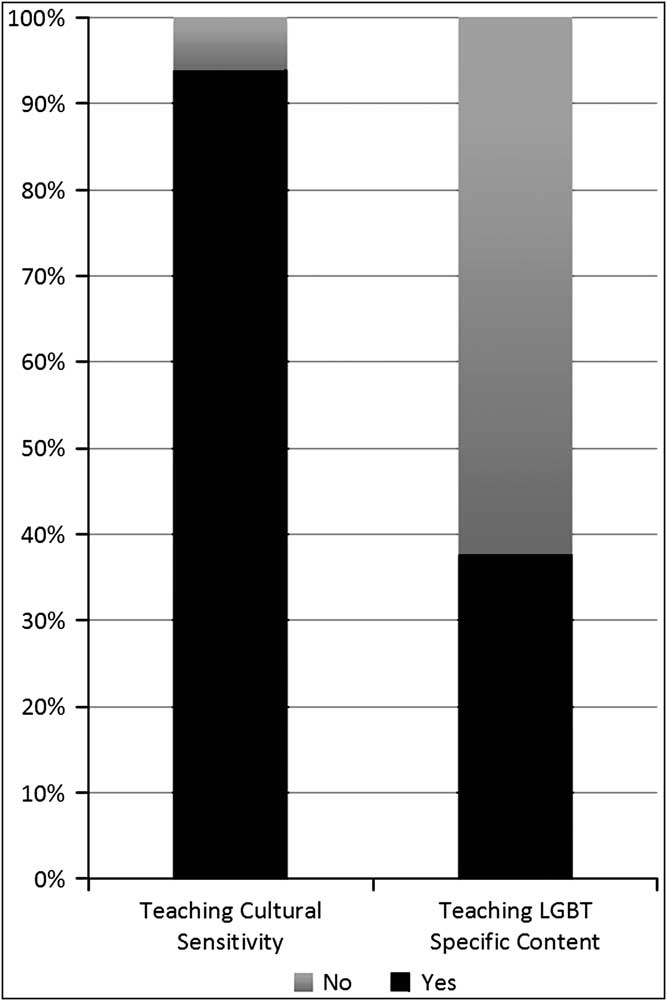
Nearly all of the programs (15, 94%) included cultural sensitivity training. Cultural sensitivity training was mostly delivered via lecture (14, 88%). Half of these programs (8, 50%) supplemented this training with simulation cases. Online methods were used by 5 (31%) programs to deliver this cultural sensitivity content.
Of the 16 programs that participated in this survey, approximately one-third (6, 38%) reported already teaching LGBT-related issues specifically, with a mix of lecture (4, 25%), simulation (3, 19%), and online (1, 6%). The duration of training ranged from 15 minutes to eight hours, and the majority of EMS educational programs (4, 25%) reported dedicating one to two hours of time for this training. Figure 1 compares EMS educational programs teaching general cultural sensitivity with those teaching LGBT-specific content.
Comparison of EMS Educational Programs Teaching General Cultural Sensitivity vs LGBT Specific Content. Abbreviations: LGBT, lesbian, gay, bisexual, or transgender.

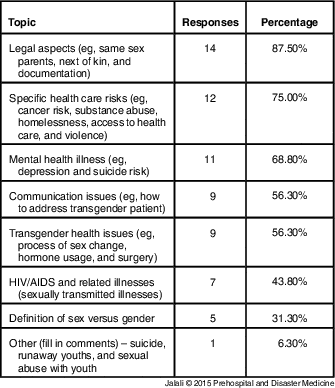
Three-quarters of the programs that responded (12, 75%) were willing to include LGBT-related material into their curriculum. All programs (16, 100%) identified specific aspects of LGBT-related emergency health issues they would be interested in having included in an educational module. Table 1 contains a ranking of the suggested content areas that survey respondents would like to see included in such an educational module.
Ranking of Content to be Included in a Proposed Educational Module

Discussion
Society has made great strides in the improvement of rights for all minorities, including the LGBT population. With ever increasing numbers of states legalizing marriage for same-sex couples, the development of more inclusive antidiscrimination laws, and the passage of the Affordable Healthcare Act, 14 more LGBT people are awarded the same rights and privileges as the rest of society. Despite these advancements, change is slow, and there are many challenges ahead.
Overall, LGBT-specific education in health care remains in evolution and is an under-researched topic within the prehospital and emergency medicine settings. Despite the expectation that all patients are treated equally, this may unfortunately not always be the case; substandard care still occurs, leaving many LGBT patients at risk for significant morbidity and mortality. These data reveal varied educational practices in the State of Maryland with regard to cultural sensitivity training and LGBT-related education amongst EMT and paramedic training programs.
Among the respondent programs, nearly two-thirds of programs reported not teaching LGBT issues. Reasons cited included lack of time in the curriculum, lack of resources, and the perception of an unsubstantiated need. Of the programs which reported unsubstantiated need, four of these five programs felt that their students were already taught to treat all patients equally. Those same four programs reported an unwillingness to incorporate LGBT-specific training into their curriculum if given resources. Still, the majority of programs surveyed demonstrated interest in the incorporation of LGBT-related education. The information gathered in this survey may help guide the development of a short, self-contained, open-access module for EMS educational programs.
Limitations
The greatest limitation of this study was its small sample size. Despite this, a strong response rate represented the population surveyed well. Another potential limitation was the survey’s brevity given the complexity of this subject matter. The survey’s length was intentionally kept to 10 questions to maximize response rate. While the results of this study represent the opinions of EMS educators in Maryland, it is possible these answers represent a regional bias and would differ on a national level.
Conclusion
Most EMS educational program directors in Maryland are receptive to including LGBT-specific education into their curricula. A small number of programs cited a lack of need for this training. Further research, on a larger scale and with greater geographic sampling, is needed to assess the practices of EMS educators on a broader level.
Author Contributions
SJ and MJL conceived the study and designed the trial. SJ deployed the survey instrument. MJL provided statistical advice on study design and analyzed the data. All authors drafted the manuscript and contributed substantially to its revision. SJ takes responsibility for the paper as a whole.
Appendix 1. An Assessment of Instructional Practices Amongst EMS Educators in the State of Maryland (USA) Regarding LGBT Patients.
Abbreviations: EMS, Emergency Medical Services; LGBT, lesbian, gay, bisexual, or transgender.
-
1. How many years has your education program been in existence?
-
○ 1-4 years
-
○ 5-9 years
-
○ 10-14 years
-
○ 15 or more years
-
-
2. How many graduates does your program produce per year?
-
○ Less than 10
-
○ 10-55
-
○ 26-49
-
○ 50 or more
-
-
3. Is your program accredited by a state or national body?
-
○ Yes
-
○ No
-
-
4. How does your program currently teach cultural sensitivity? (Select all that apply.)
-
○ Online
-
○ Lecture
-
○ Simulated patients
-
○ None
-
○ Other (please specify)__________________________________________
-
-
5. Does your program provide any education on caring for patients who identify as lesbian, gay, bisexual, or transgender (LGBT)?
-
○ Yes
-
○ No
-
-
6. How many hours does your program provide with education for patients who identify as lesbian, gay, bisexual, or transgender (LGBT)?
-
○ Please specify __________________________________________
-
-
7. If your program does provide education on LGBT patients, what methods are used? (Select all that apply.)
-
○ Online
-
○ Lecture
-
○ Simulated patients
-
○ None
-
○ Other (please specify)__________________________________________
-
-
8. If your program does not provide education on LGBT patients, why not? (Select all that apply.)
-
○ N/A (We do provide this education)
-
○ Time in curriculum
-
○ Unsubstantiated need
-
○ Moral conflict
-
○ Other (please specify)__________________________________________
-
-
9. If your program does not provide education on LGBT patients, would you be willing to incorporate this training?
-
○ Yes
-
○ No (please comment) __________________________________________
-
-
10. If you were given a simple educational module to use for educating your students on LGBT health care issues, what topics would you want included? (Choose all that apply.)
-
○ Specific risk factors or health care needs of this population (eg, cancer risk, substance abuse, homelessness, access to health care, and victimization/violence)
-
○ Definitions of sex versus gender
-
○ Mental health illnesses (eg, depression and suicide risk)
-
○ HIV/AIDS and related illnesses or other sexually transmitted diseases
-
○ Transgender health related issues (eg, the process of sex change, including hormone usage, and surgery)
-
○ Legal aspects (eg, same sex parents, next of kin, and documentation)
-
○ Communication issues (eg, how to address a transgendered patient)
-
○ Other (please specify) __________________________________________
-