1. INTRODUCTION
Unexploded ordnance (UXO) or munitions and explosives of concern (MEC) are a hazard to humans, especially when buried in areas of future economic development. In the USA and around the world, detection and remediation can be extremely inefficient because of the difficulty in distinguishing the buried MEC from clutter, defined as the geologic magnetic background noise, as well as anthropogenic non-MEC items (U.S. Army Corps of Engineers, 2006). Traditional methods based on detect-and-dig have a high false alarm rate and are costly. Therefore, improved discrimination performance in MEC detection is in strong demand.
A critical aspect of such discrimination is the precise positioning of MEC detectors for accurate signal characterization. The positioning requirements are described according to three levels of accuracy:
• At the screening level, general areas of interest are determined using airborne or ground-vehicle-based sensors with a position accuracy requirement of about 0·5 m (all values refer to the standard deviation of the error);
• For a more detailed area mapping, man-portable and towed-array systems require positioning precision of about 0·05 m;
• To characterize and discriminate located targets using high-accuracy and high-resolution data acquisition systems requires position error tolerance under 0·02 m.
The Global Positioning System (GPS) has been used widely for precise positioning in the geodetic and navigation communities. Under ideal conditions, differential GPS positioning based on measurements of the phase of the L1/L2 carrier signals (with 19 cm and 24 cm wavelengths) can meet most of the geolocation requirements for MEC detection. However, degraded GPS solutions occur in obstructed environments (such as wooded or urban areas), or because of strong electromagnetic interferences, or due to multipath sources. Alternative ranging systems, for example, ground laser, radio, and acoustic systems function using analogous positioning principles, and are subject to similar limitations. In addition, they usually have a much more limited range of operation (typically, 100–1000 m).
Besides precision, reliable characterization of MEC requires high spatial resolution in the positioning of the detector. For example, Bell (Reference Bell2005) noted that significant improvement and efficiencies could be realized “if a reliable, robust procedure were available for precisely determining the locations of the sensor readings without using the template [method].” GPS generally yields 1 Hz data, which is inadequate for detectors that may pass over putative MEC with speeds of several cm/s or more. One solution is to build a geometrically distributed array of detectors that simultaneously passes over an object (Nelson and McDonald, Reference Nelson and McDonald2001). Also, laser ranging can deliver up to several 10s Hz resolution (Leica GeosystemFootnote 1), but a ranging system aided by inertial measurement units (that provide high resolution, usually up to 250 Hz) was deemed in a recent study (U.S. Army Corps of Engineers, 2006) as offering the most efficient positioning system in terms of resolution and precision. This synergy of ranging and autonomous inertial sensor systems also mitigates various degrading effects caused by loss of line-of-sight, multipath, and electromagnetic interference.
Because of the general versatility of GPS and the complementary aiding capability of IMU, our analysis focuses on the integration of these systems, although IMUs could aid any other ranging system in similar ways. Developing optimal algorithms to integrate the data from ranging systems and inertial measurement units has occupied the navigation community for many years; and, the (Extended) Kalman Filter (EKF) has been the workhorse for IMU/GPS integration for several decades. However, new filters recently introduced and tested have the potential for significant improvements (Aggarwal, Reference Aggarwal, Gu and El-Sheimy2006) over conventional methods that must contend with linear approximations of intrinsically nonlinear dynamics. There are other processing stages needed to obtain precise detector positions, including data pre-processing and post processing. However, while these are extremely important aids to the central filtering operation, they are outside the present scope.
The new filters are the subject of the present investigation, applied to the precise geolocation of ground-based MEC detector platforms. Since the trajectories of MEC detectors can be highly dynamic with rapid changes in orientation and acceleration, filters that obviate any assumption of linearity should perform better. In addition, particle filters have recently been implemented that avoid the usual assumption of Gaussianity in the sensor errors (Haykin, Reference Haykin2001; Gustafsson et al., Reference Gustafsson, Gunnarsson, Bergman, Forssell, Jansson, Karlsson and Nordlund2002; Arulampalam et al., Reference Arulampalam, Maskell, Gordon and Clapp2001; Simon, Reference Simon2006). We also consider adaptations of these filters that allow for unknown variations in the sensor and observation noise statistics.
To analyze the integration of ranging systems and IMU using these modern filters, we simulate both GPS and laser ranging (“total station”) systems aided by tactical grade IMUs. To assess and validate the filtering techniques in terms of precision and temporal resolution, we simulate a typical local trajectory and test their sensitivity to various aspects: trajectory dynamics, GPS outages, GPS accuracy degradation, unscented transformation parameters, and non-Gaussian (asymmetrically distributed) sensor noise.
2. FILTERING TECHNIQUES FOR IMU/GPS INTEGRATION
The filter usually depends on the system or the sensor that is designed to obtain the desired information from noise-corrupted data (Haykin, Reference Haykin2001). There are various possible filtering approaches for GPS/IMU integration that have been proposed over the last few decades, such as the wave estimator (Salychev, Reference Salychev1999), the (extended) Kalman filter, the unscented Kalman filter, the particle filter, various adaptive filters, and methods of artificial intelligence. Some of the more recent filters, mostly investigated for navigation of ground vehicles or aircraft, are studied in this paper with particular application to high precision geolocation required for MEC characterization. Indeed, the nonlinear filtering methods may be even more applicable to the dynamics associated with detection platforms that must traverse rough terrain and experience frequent changes in heading, which is a significantly different environment than that encountered in typical navigation and positioning applications.
The three main filtering approaches to integrate IMU/ranging systems include traditional Kalman filtering (the extended Kalman filter (EKF) for a nonlinear model), filters based on sampling methods such as the unscented Kalman filter and the particle filter, and artificial intelligence estimation such as neural network and neural fuzzy information systems. We consider only the sample-based filters in comparison to the popular EKF and refer, e.g., to Shin (Reference Shin2005) for studies of artificial intelligence (AI) methods.
The Kalman filter is an optimal (minimum mean square error), linear, recursive estimation method and is amply treated in the literature, as is its extension to deal with non-linear models (Haykin, Reference Haykin2001; Kalman, Reference Kalman1960; Brown and Hwang Reference Brown and Hwang1992; Grewal and Andrews Reference Grewal and Andrews1993). Its application to the IMU/GPS integration problem is also well documented (Greenspan, Reference Greenspan, Parkinson and Spilker1996; Farrell and Barth, Reference Farrell and Barth1998; Rogers, Reference Rogers2000; Jekeli, Reference Jekeli2000; Titterton and Weston, Reference Titterton and Weston2004). The EKF is founded on two main assumptions: linearity in (or linearization of) the system dynamics and observation models and Gaussian noise excitation (Gordon et al., Reference Gordon, Salmond and Smith1993; Gelb, Reference Gelb1974; Grewal and Andrews Reference Grewal and Andrews2001). These two factors bring several limitations and implementation difficulties to the integration problem, such as the derivation of the Jacobian matrices for complicated non-linear systems and potentially unrealistic statistical models of the errors (Julier et al., Reference Julier, Uhlmann and Durrant-Whyte1995). Also, only relatively small error states are allowed in the EKF, otherwise the first-order approximations can lead to instabilities in the form of biased solutions and inconsistency in the covariance updates.
The basic linear model of a system of error states, x k, at epoch, t k, is


where Φ is the state transition matrix; G k is an appropriate scaling factor for the driving zero-mean Gaussian white noise w k; and y k is an observation linearly related through H k to the states and also includes zero-mean Gaussian white noise, v k. The Kalman filter has two steps: first, a prediction of the states from epoch t k−1 at epoch t k; and, second, an update at t k based on the observation at that epoch. In the prediction, the state estimate and its covariance propagate according to:


where Q k is the covariance of w k. Updating the states on account of the observations yields


where R k is the covariance of the observation noise and the Kalman gain is given by

For later use, we also define the innovation in Equation (5) as

2.1. Sampling Based Filters
The sampling-based filtering methods differ from other filters in that they propagate sample states rather than their statistics through the system model. As such, no linearization is required, nor is it required to formulate and compute the attendant derivatives of the system model. Depending on the statistical assumptions for the states, the propagated samples are analyzed to infer the propagated statistics. We consider two sampling-based filters, the unscented Kalman filter (UKF, also called sigma-point Kalman filter) and the particle filter (PF). The UKF avoids the linearization associated with the EKF, but still assumes Gaussian state variables, and the estimation of the propagated statistics is achieved on the basis of the unscented transformation (Wan and Van der Merwe, Reference Wan, Van Der Merwe and Simon2001). The PF obviates both the linearization and the Gaussianity assumption by propagating a sufficient number of samples based on the Monte Carlo approach to statistics estimation.
Unscented Kalman Filter (UKF)
The development of the unscented Kalman Filter was initiated by Julier and Uhlmann (Reference Julier and Uhlmann1996) and Julier et al. (Reference Julier, Uhlmann and Durrant-Whyte1995; Reference Julier, Uhlmann and Durrant-Whyte2000). The UKF is a recursive application of the unscented transformation (UT) of state variables through the nonlinear state dynamic model. The UT propagates a suitably chosen set of sample points (called sigma points) in the state space through the (nonlinear) system dynamics such that they accurately capture the transformed mean and covariance of the states. We use the more general scaled version of the UT given by Wan and Van der Merwe (Reference Wan, Van Der Merwe and Simon2001). For the random variable x (dimension, n x) with mean,  , and covariance, P x, the 2n x+1 sigma points are generated as follows
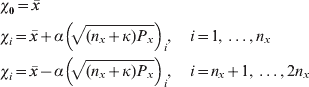
where α and κ are scaling parameters and  is the i th row or column of the matrix square root of (n x+κ)P x. Given a nonlinear function, g(x), it can be shown that the following weighted combinations of y i=g(χi) estimate the first two statistical moments (mean and covariance) of g at least up to second order in the non-linearities:

where the corresponding weights are given by

The sum of the weights for the mean is unity, while for the covariance they sum to (1−α2+β). The scaling parameter, α(10−4⩽α⩽1), controls the spread of the sigma points around and serves to maintain the positive semi-definiteness of the covariance (Wan and Van der Merwe, Reference Wan, Van Der Merwe and Simon2001). For Gaussian states, x, the estimation of the mean and covariance of g is accurate up to third order. The scaling parameter, β, in addition to α, is used to increase the accuracy of higher-order moments (for Gaussian variables, β=2 is optimal). The scaling parameter, κ, was set to κ=n x in our simulations, and we varied α.
The linear propagation and observation of states defined by Equations (1) and (2) are replaced by the more general non-linear forms; however, we still assume additive noise:


The Kalman filter using the unscented transformation, i.e., the UKF, then proceeds with the usual two-step, prediction and filter formalism, but the mean and covariance are determined from the sigma points.
Various studies have indicated different improvement levels of the UKF over the traditional Kalman filter in integrated navigation applications. Van der Merwe and Wan (Reference Van der Merwe and Wan2004) predicted up to 30% improvement on an unmanned airborne vehicle (UAV); while only slightly better results based on simulation analyses were reported by St. Pierre and Gingras (Reference St-Pierre and Gingras2004). Shin (Reference Shin2005) obtained mixed results from an analysis of an integrated IMU/GPS on a land vehicle. Similarly, Yi and Grejner-Brzezinska (Reference Yi and Grejner-Brzezinska2006) found improvement only during periods of free-inertial navigation (no GPS aiding).
Unscented Particle Filter (UPF)
The particle filter was introduced in the 1950s, but was forgotten due to the lack of computing power (Godsill et al., Reference Godsill, Doucet and West2000). However, with modern computational capabilities, the particle filter has also been applied to INS/ranging-system integration (Angermann, Reference Angermann, Khider, Robertson and Wendlandt2006) and to the problem of transfer alignment (Hao et al., Reference Hao, Xiong and Hu2006). The performance of the PF generally improves as the number of sample states (particles) used to capture their probability density function (pdf) increases, which, however, also increases the computational burden. There are three types of particle filter, the generic (or traditional) particle filter, the unscented particle filter (UPF, also called sigma-point particle filter), and the extended particle filter. We considered only the UPF.
Particle filters, also known as bootstrap filtering, the condensation algorithm, Monte Carlo filtering, and survival of the fittest methods, implement Bayesian estimation, which under the special case of Gaussian noise and linear models yields the familiar Kalman filter (Gordon et al., Reference Gordon, Salmond and Smith1993). The object is to determine the probability density of the state at time, t k, conditioned on the measurements up to that time, according to Bayes' Rule (Simon, Reference Simon2006, p.464)

where the conditional density, p(y k|x k), is presumed known (for example, but not necessarily Gaussian), and the other conditional densities on the right side, in principle, can be determined from the previous steps in the recursive algorithm.
In practice, the particle filter starts with the randomly generated particles, x 0,i, i=1,…, N, using their a priori mean and covariance and propagates them through Equation (12):

where w k,i is the noise realized according to its known pdf. From the measurement, y k, and its known pdf, the likelihood, q i=p(y k/x k−1,i), can be computed for each particle. These relative likelihood values, normalized to sum to unity, are then used to obtain a re-sampling of the particles, whose pdf (now conditioned on the observations) tends to the desired Bayesian density (Equation (14)). From this the mean and covariance can be computed in the usual ways. There are several re-sampling techniques and particle modifications available to improve the performance of the filter. We used the sequential importance sampling (SIS)) method (Haykin, Reference Haykin2001; Wan and Van der Merwe Reference Wan, Van Der Merwe and Simon2001).
Van der Merwe et al. (Reference Van der Merwe, de Freitas, Doucet and Wan2000) combined the PF with other filters such as UKF in order to refine the initially generated particles, and called it the unscented particle filter (UPF). Each randomly generated initial particle is propagated and updated by using the UKF (where the sigma points are computed using the particle). Then, the likelihood values are determined using these a posteriori particles and the measurement pdf, as before, followed by the re-sampling procedure (Haykin, Reference Haykin2001; Simon, Reference Simon2006). This approach can yield a better approximation for the conditional pdf of the states and has yielded improved accuracy for various positioning-related applications (Arulampalam et al., Reference Arulampalam, Maskell, Gordon and Clapp2001; Grewal and Andrews, Reference Grewal and Andrews2001; Van der Merwe et al., Reference Van der Merwe, de Freitas, Doucet and Wan2000).
Adaptive Unscented Particle Filter (AUPF)
One potential difficulty with any of the previously discussed navigation filters is the need for accurate statistics (the pdf) of the system and measurement errors. The errors in the navigation system may not be suitably described by the chosen statistics, especially in a highly dynamic environment such as may be encountered by UXO detection equipment. In the adaptive Kalman filter (AKF), the a priori information of the system and measurement noise (as represented by the covariance matrices, Q and R) can be adjusted according to the accuracy of estimation (Salychev, Reference Salychev1999). If covariance matrix, R k, is unknown or inaccurate, it can be estimated from the covariance matrix of the innovation sequence (υk, Equation(8)). Let

and let an estimate of this covariance be  , which satisfies the recursion
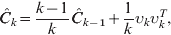
Substituted into Equation (16), it yields an estimate of the measurement covariance matrix:

In case the covariance of the system noise is unknown; we can write from Equations (1) and (5):

from which we find

Since the UPF employs the UKF to refine the randomly generated initial particles, it is affected by potentially inaccurate noise statistics, particularly during intervals of GPS outages and highly dynamic trajectories. Therefore, the adaptive Kalman filter methods can be combined with the UPF to mitigate these effects and improve the PF performance. This adaptive unscented particle filter (AUPF) is implemented and validated by the tests of the simulations in the following sections.
3. SIMULATION
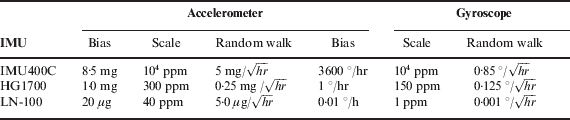
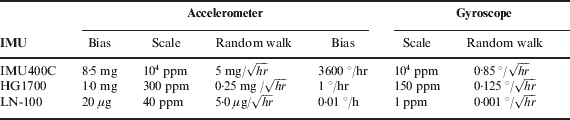
Without loss in generality, we select the loosely coupled INS/GPS integration scheme based on the decentralized filter architecture (Jekeli, Reference Jekeli2000). Aside from the different filtering methods, a number of system and environment factors were considered, including the IMU sensor quality, the dynamics of the detector platform (typical for either hand-held or cart-mounted deployment), and the ranging solution quality (concerning both precision and environmental degradation, as well as longer outages). The IMU sensor may be categorized as commercial grade (e.g., Crossbow IMU400C), tactical or medium grade (e.g., Honeywell HG1700), and navigation grade (e.g., Litton/Northrop-Grumman LN100). Table 1 offers representative specifications, as published by the corresponding vendors, for the most important errors associated with the accelerometers and gyroscopes for each grade of inertial unit.
IMU levels of accuracy.
The two levels of ranging precision are associated with either radar or laser ranging, exemplified by real-time kinematic (RTK), geodetic quality, differential GPS (e.g., Trimble 4700 receiver) and the geodetic total station (e.g., Leica TPS1100 total station). Each level of precision is affected by the distance, respectively, to the fixed GPS base station and to the total station (Clynch, Reference Clynch2001; Grejner-Brzezinska, Reference Grejner-Brzezinska2001; Kim, Reference Kim2004). Table 2 lists typical precision levels considered in our analysis. Further degradation in the ranging solution will occur primarily because of signal occlusions (although other factors, such as tropospheric and ionospheric delays, and the geometric configuration of the transmitters, also affect the signal and solution quality). Signal outages may occur because of intervening manmade structures or natural objects (usually a foliage canopy in the case of GPS; also rugged terrain in the case of the total station). We assume relatively short-lived outages in the order of several to tens of seconds. It should be emphasized that while our analyses address primarily the inertial sensor capability to aid the ranging solution in an operational setting, for this investigation the ranging solution is also viewed as the means to estimate inertial sensor errors.
The assumed precision of ranging solutions.

Four different filtering algorithms were implemented and compared in our simulations: the extended Kalman filter (EKF), the unscented Kalman filter (UKF), the unscented particle filter (UPF), and the adaptive unscented particle filter (AUPF). In order to assess these filters in typical dynamic environments for MEC detection and characterization, the accuracy of the integrated positioning system was determined separately for curved and straight sections of the trajectory. We also considered tuning the parameters of the unscented transformation, and evaluated the benefits of using the particle filters when the input noise is non-Gaussian.
The state vector for the IMU/ranging integrated solution comprises 21 states: three position (latitude, longitude, height) errors, (δφ, δλ, δh); three velocity errors, ( ); three orientation errors in a local north-east-down frame, (ψN, ψE, ψD); and a bias and scale factor error for each of the three accelerometers and three gyros. For the UKF and UPF, instead of the three orientation angle errors, the four corresponding quaternions were employed because the UT operates best in a Euclidean space (i.e., this avoids the transcendental functions) (Shin, Reference Shin2005; Kraft, Reference Kraft2003).
For a given trajectory, error-free IMU data were generated using the Matlab INSToolkit®. The input and output specifications of INSToolkit are described in (Jekeli and Lee, Reference Jekeli and Lee2007). The trajectory was defined for a platform following a planar path with 0·5 m/s velocity and meandering sweeps across a given area. The generated accelerometer data are velocity increments, Δv, and the gyro data are angle increments, Δθ. The temporal resolution of this control trajectory was 0·02 s.
The actual error-corrupted IMU data were then simulated using errors specified in Table 1 according to the models
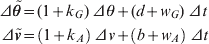
where d, k G, and w G are the bias, scale factor error, and random noise for the gyro; and b, k A, and w A, are corresponding quantities for the accelerometer. The time interval between the generated data is Δt=t k+1−t k (0·02 s in our simulations). Corresponding navigation equations for the IMUs were integrated using these corrupted data to generate the trajectory coordinates as indicated by an inertial navigation system.
In addition, the ranging solution for the trajectory was determined by simply adding random noise to the true coordinates. That is, we assumed the ranging system to be free of all systematic errors and the final solution corrupted only by white noise:

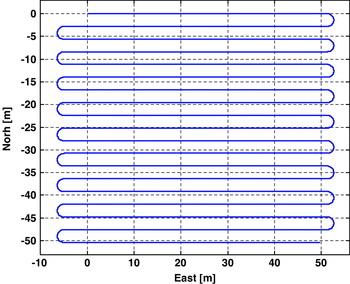
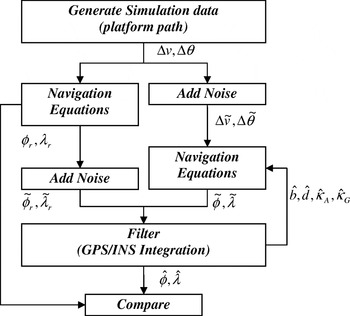
where ν is a random variable following the zero-mean, unit-variance Gaussian distribution, and σr is given in Table 2. The ranging solution coordinates are used in the filter to update the IMU position errors and to estimate the systematic errors in the inertial sensors. Figure 1 shows the simulated trajectory, designed for typical MEC mapping and detection, with 18 180° turns and 19 straight segments. The turns represent highly non-linear dynamics as modelled by the navigation equations and generally pose a challenge to linearized filters such as the EKF. The ranging updates in the filter can be introduced at longer intervals to simulate prolonged interruptions. Figure 2 shows the general simulation and analysis process.
The generated control path.

Flow chart of loosely coupled, decentralized ranging/IMU integration and simulation analysis.

4. TEST RESULT
The free-inertial navigation solutions just prior to external updates, incorporated using the EKF, UKF, and UPF, at intervals of 1 s, 10 s, and 30 s were compared with the control trajectory. The ranging solution updates are either GPS or total station observations and all three categories of inertial sensors were tested. Within each set of sensor/update tests, the position errors are a function of how well the filter estimates the systematic errors of the inertial sensor in the particular non-linear environment.
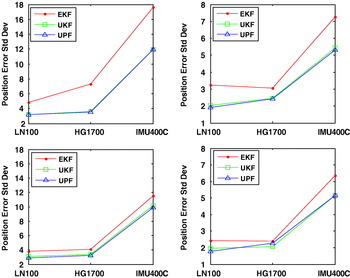
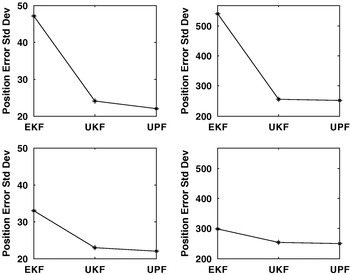
The comparison against the control was based on the total-distance errors, computed from the three coordinate errors, and their standard deviations for each of the curved and straight sections of the test trajectory (Figure 1) were averaged. Figure 3 (for 1 s updates only) shows that (as expected) more precise updates (total station vs. GPS) yield more accurate free-inertial solutions simply because the integration of the inertial sensor outputs begins with a smaller error. Interestingly, for this particular simulation, there is little difference between the high-end and the medium quality inertial sensors showing that either one will offer similar interpolation capability within 1 second. Clearly, the EKF does not perform as well as the UT-based filters, particularly along the curved segments of the trajectory. The UPF offers only slightly better performance than the UKF in these tests because the simulated noise processes for the inertial sensors and the observation updates are Gaussian. As the intervals before the next update increase, the inertial sensor errors accumulate, but the UKF and UPF still out-perform the EKF, as shown in Figure 4 for just GPS and the medium-grade IMU. We note that the position accuracy of the filters (no additional smoothing) is useful only for screening of MEC if the GPS outage reaches 10 s.
Standard deviation of errors of different IMU grades with 1 s ranging system updates using different filters (first row: curve segments, second row: straight segments, first column: GPS, second column: total station) (units: cm).

Standard deviation of errors for different filtering methods (first row: curve segments, second row: straight segments, first column: 10 s, second column: 30 s GPS updates of the medium-grade IMU) (units: cm).

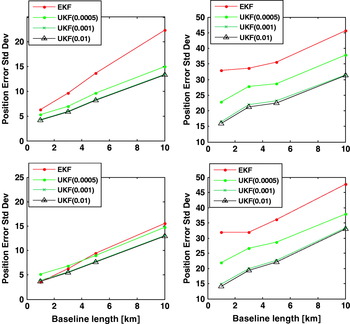
Besides outright interruptions in the ranging solution, it may also be degraded during several seconds of the survey. We consider only differential GPS solutions and assume that such degradation is a function of baseline length between the rover and the fixed base station. Using the corresponding increased observation noise, as shown in Table 2, Figure 5 compares the EKF and UKF performances with respect to the medium-grade IMU, free-inertial, positioning accuracy at the end of 1 s and 5 s prior to degraded GPS updates. Again, we find improved results for the UKF over the EKF, especially when both the degradation and the update interval increase.
Standard deviation of errors with medium-grade IMU and degraded GPS updates and with different scales in the unscented transformation (first row: curve segments, second row: straight segments, first column: GPS 1 s updates, second column: GPS 5 s updates).

The superiority of the UKF may be realized only with appropriate tuning of the scaling parameter, α (since the error states are excited by Gaussian noise, the optimal value β=2 was used for these tests). The results of Figure 3 and 4 were obtained with α=0·15, corresponding to sigma points within a range of ±1σ. Expanding this range did not improve the estimation, but significantly smaller values of α degrade the performance of the UKF, as also shown in Figure 5, which includes results for α=0·0005, α=0·001, and α=0·01.
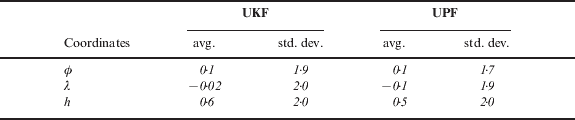
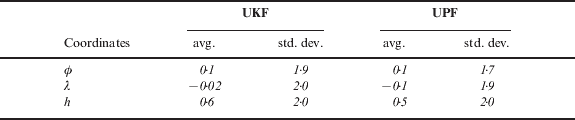
The foregoing tests assumed a system driven by Gaussian noise. We may expect similar results with other symmetrically distributed processes, and the UKF could also be tuned to deal with non-Gaussian symmetric distributions using the parameter, β. On the other hand, dynamic systems, besides being generally non-linear, may also be excited by non-symmetric processes (Kushner, Reference Kushner1967). Indeed, Reddy and Herr (Reference Reddy and Herr2006) investigated the skewness of IMU sensor errors. Julier (Reference Julier1998) and Naveaua (Reference Naveaua, Gentonb and Shenc2005) also proposed modelling the process noise with asymmetric probability densities. We considered both symmetric non-Gaussian as well as asymmetric distributions to determine the performance of the particle filter. In one test, sensor errors were generated from a uniform distribution with the same variance as in the Gaussian case. As seen in Table 3, the latitude and longitude standard deviations are slightly lower in value with the particle filter. There is very little or no difference with respect to the Gaussian case (not shown).
Statistics of errors (all segments) using nonlinear filters on data from a medium-grade IMU with uniformly distributed errors and with 1 hz GPS updates (units: cm).
Secondly, we considered the following asymmetric probability density (APD) (Komunjer, Reference Komunjer2007).
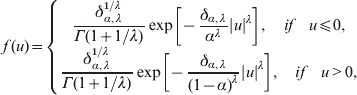
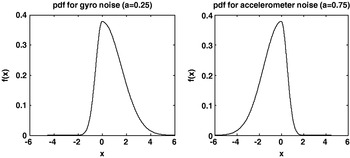
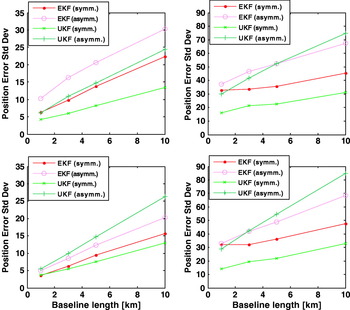
where 0⩽α⩽1, λ>0 and 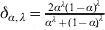 . If α=0·5, then the density is symmetric. If, in addition, λ=2, the APD is the Gaussian density. For our tests, we chose λ=2 and two values α=0·25,0·75 (Figure 6), one for the gyro noise, the other for the accelerometer noise. Figure 7 compares the statistics of the position error for the update rates and GPS degradation used in Figure 5, with and without the asymmetry in the IMU sensor noises. We find that both the UKF and EKF performances are significantly degraded in the presence of IMU noise asymmetry; and, moreover, the UKF is not consistently superior to the EKF, especially in the straight sections of the trajectory. Even in the curved sections, the advantage of the UKF seen earlier has been compromised in the case of longer ranging gaps and a degraded GPS solution.
Asymmetric pdfs used for gyro noise (λ=2,α=0·25) and accelerometer noise (λ=2,α=0·75).

Standard deviation of medium-grade IMU position errors with asymmetric sensor error distributions, for baseline-degraded GPS updates (first row: curve segments, second row: straight segments, first column: 1 s updates, second column: 5 s updates).

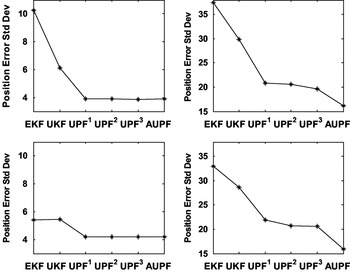
On the other hand, the particle filter was designed with non-Gaussian error sources in mind. We applied the UPF to the IMU data corrupted by the asymmetric noise and compared the position errors to those of the UKF and EKF for the same degraded GPS updates as in Figure 7. Figure 8 shows that the performance of the UPF consistently is superior, both for the curved and the straight segments of the trajectory. This is an interesting result because the UPF still uses the unscented Kalman filter before the re-sampling of the particles; yet, the results are better than for the UKF, alone.
Standard deviations of medium-grade IMU position errors (first row: curved segments, second row: straight segments) for EKF, UKF and UPF with 1 s GPS updates (first column) and for EKF, UKF, UPF1 (200), UPF2 (400), UPF3 (600), AUPF(200) with 5 s updates (second column). The number in parenthesis is the number of particles. GPS update accuracy is for the 1 km baseline (Table 2) and the IMU sensor noise is assumed to be asymmetric as in Figure 6 (units: cm).

Figure 8 also shows that increasing the number of particles does not yield significant improvements in the UPF. However, by incorporating the adaptive algorithms we further enhance the filter, at least for the longer GPS outage, because the AUPF compensates for the unfulfilled assumptions of the unscented transformation, specifically, that it assumes a Gaussian (at least symmetric) error distribution. The overall positioning accuracy deteriorates as the GPS update interval increases (e.g., 5 s). For example, the standard deviation in position using the UPF with asymmetric error distribution is worse than that of the UKF with symmetrically distributed errors. However, the UPF still performs better than the other filters when the sensor noise is asymmetric.
5. CONCLUSION
To satisfy precise positioning requirements for MEC detection and characterization, some form of integrated ranging/IMU geolocation system is usually considered (U.S. Army Corps of Engineers, 2006). In particular, we have studied the use of either a GPS or a local laser ranging system integrated with inertial sensors with various levels of accuracy. Based on simulated trajectories typical of MEC ground surveys, we focused our analysis on the improvements possible with new filters that avoid linearization of an inherently non-linear dynamics system. Moreover, the Gaussianity in the driving noise assumed by the Kalman filters can also be circumvented by filters based on more general Bayesian statistical propagation.
Our simulations showed that the unscented Kalman filter (based on the unscented transformation that bypasses a linearization of the error state dynamics and of the observation updates) performs consistently better than the standard extended Kalman filter, particularly along curved trajectories. These improvements in filter strategy were realized especially when the interval of the ranging solution update was several seconds (simulating an outage due to signal occlusions) and if the ranging solution was degraded (simulating various possible causes).
Using particle filters avoids the Gaussianity assumption and our tests showed that these filters are particularly useful if the driving noise of the system has an asymmetric distribution. In this case, the UKF and EKF perform comparably, but the UPF yields significantly improved position accuracy. The UPF results were generally insensitive to the number of particles, and improvement could be obtained (in the case of longer GPS outages) using adaptive techniques that compensated for the UT's assumption of symmetric noise probability densities.
From the various filters tested, we find that achieving a few centimetres of positioning accuracy in dynamic environments requires non-linear filters, such as the UKF or UPF. These filters cannot overcome the natural accumulation of IMU errors as the ranging solution update interval increases. However, in all cases the new non-linear filters performed better than the standard EKF. The best performance among all filters tested was obtained by the AUPF which accommodates non-symmetric sensor errors as well as highly dynamic trajectories.
ACKNOWLEGEMENTS
This study was supported by SERDP project MM-1565, contracts W912HQ-07-P-0013 and W912HQ-08-C-0044