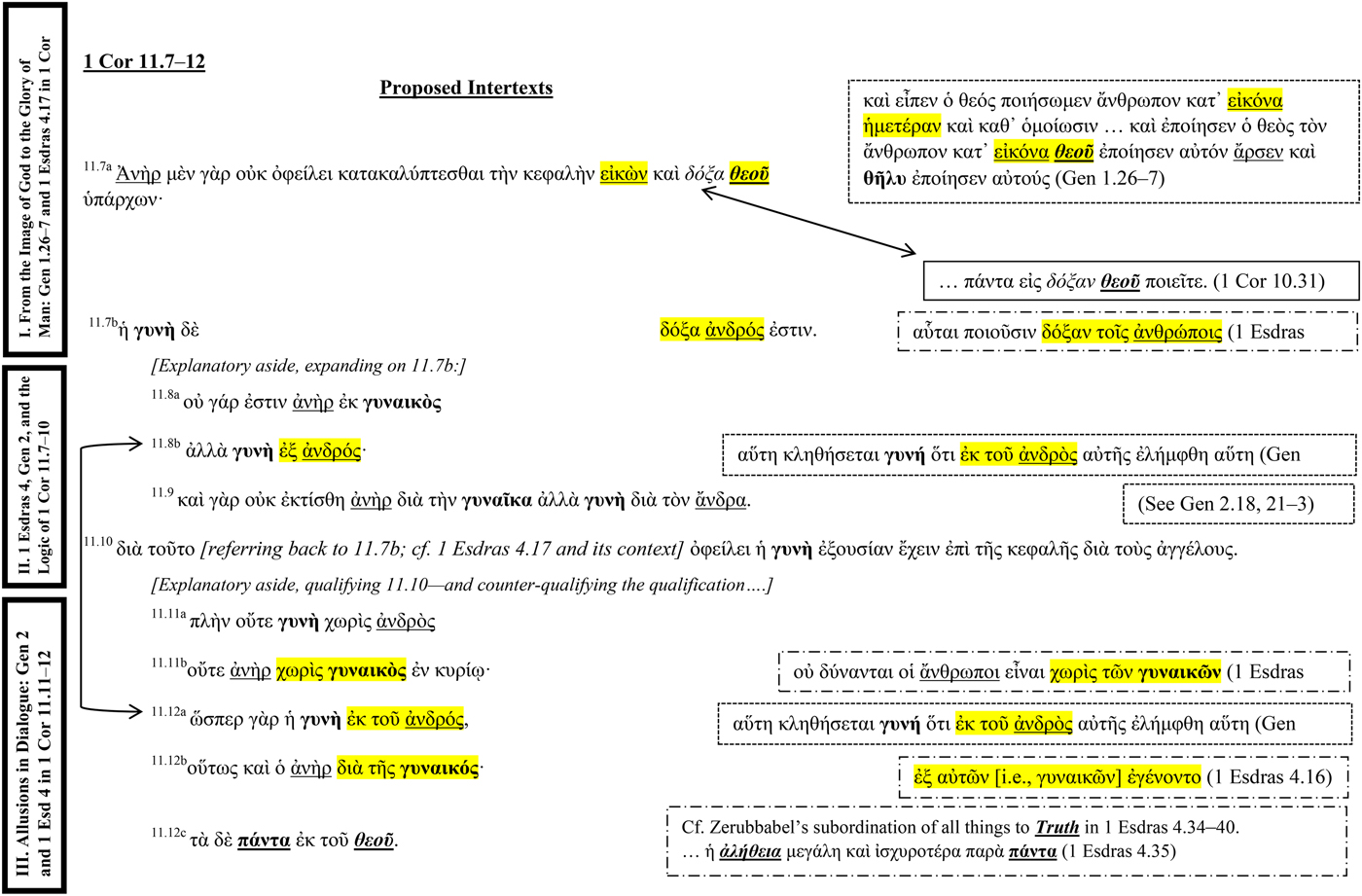
To say that Paul's instructions concerning head-covering practices in 1 Cor 11.2–16 have perplexed scholars would surely be an understatement. Without attempting to address all the difficulties associated with this passage,Footnote 1 I hope here to offer a few fresh insights through a close reading of Paul's use of allusion in 1 Cor 11.7–12.Footnote 2 Sandwiched between arguments from headship and shame (1 Cor 11.3–6) and a cluster of rapid-fire appeals to other authorities (11.13–16), Paul's allusive reasoning in 1 Cor 11.7–12 lies at the heart of his discussion of head-covering practices, yet many find these central verses inscrutable. As discussed below, some translations even resort to dubious renderings of 11.10, apparently in a last-ditch effort to bring some semblance of coherence to the passage. Happily, questionable glosses are not the only way to make sense of Paul's argument. While some puzzles may remain unsolved, these verses become considerably more intelligible when one attends to Paul's use of allusion. Scholars often discuss his interaction with Genesis 1 and Genesis 2,Footnote 3 but markedly little attention has been given to possible echoes of 1 Esdras 4.Footnote 4 Tracing Paul's engagement with this additional intertext makes it easier to follow his sometimes convoluted argument about the relationship between man and woman, an argument whose complexity arises partly from the multifaceted treatment of this topic in the tradition on which he draws.Footnote 5
Before I turn to the familiar if confusing text of 1 Cor 11.7–12, it may be useful briefly to review the basic content of the relevant passage from 1 Esdras, particularly since this material – the story of the bodyguards – has no parallel in the book of Ezra.Footnote 6 After recounting King Artaxerxes’ curtailment of the rebuilding of Jerusalem and its temple that had been begun under King Cyrus (1 Esdras 2; cf. Ezra 1.1–11; 4.7–24), 1 Esdras turns to the story of how a bodyguard, who turns out to be Zerubbabel (4.13), moved King Darius to renew reconstruction efforts (1 Esdras 3–4).Footnote 7 Following a great feast, three of King Darius’ bodyguards offer competing answers to the question of who is the strongest (3.5), with the understanding that the one whose answer the king and certain nobles favour will receive riches and honour (3.4–7). Each man first writes his answer down for the king (3.10–12) and then offers a more extended oral defence for it. The first man maintains that wine is strongest (1 Esdras 3.10, 17–24), the second makes a case for the king's superior might (3.11; 4.1–12), but the third competitor – Zerubbabel, who carries the day – argues that women are strongest (4.13–32), although Truth is above all (3.12; 4.33–41). As a reward for his wisdom, the victorious Zerubbabel receives not only riches and honour but also the opportunity to make a special request of Darius (4.42). Zerubbabel seeks and obtains royal support for restarting the rebuilding of Jerusalem (4.43–57).
For present purposes, however, the outcome of the contest matters less than Zerubbabel's discourse itself. As I will argue below, Paul's reasoning in 1 Cor 11.7–12 evokes Zerubbabel's (sort of) ‘pro-woman’ speech, interweaving allusions to this intertext with the more widely recognised echoes of Genesis 1 and 2. Ultimately, the particular way in which Paul sets Genesis 1, Genesis 2 and 1 Esdras 4 into conversation discourages divisive pretensions on the part of either sex,Footnote 8 albeit without abrogating the patriarchal hierarchy that undergirds this pericope.Footnote 9
1. From the ‘Image of God’ to the ‘Glory of Man’: Gen 1.26–7 and 1 Esdras 4.17 in 1 Cor 11.7
A first cluster of allusions occurs in 1 Cor 11.7. Further explaining his comments about head-covering practices in 11.3–6, Paul begins: ‘For on the one hand (μέν), man ought not (οὐκ ὀφείλει) to be covered with respect to his head, being the image and glory of God (εἰκὼν καὶ δόξα θεοῦ)’ (11.7a).Footnote 10 Though he will later comment on what the woman ‘ought’ (ὀφείλει) to do (11.10), Paul starts the second half of the μέν/δέ construction with a contrastive description of woman's status with regard to glory: ‘On the other hand (δέ), the woman is the glory of man (δόξα ἀνδρός)’ (11.7b).Footnote 11 The most obvious allusion in this verse involves the description of man as the εἰκὼν … θεοῦ (11.7a). Paul's language clearly evokes Gen 1.26–7, yet he departs from that passage in two notable ways.Footnote 12
One deviation from Genesis comes in Paul's further characterisation of man's relationship to God. According to Gen 1.26, God plans to create the human being (ἄνθρωπον) in the image and likeness of God (κατ᾽ εἰκόνα ἡμετέραν καὶ καθ᾽ ὁμοίωσιν). Paul, however, does not mention the ὁμοίωσις of God at all and instead pairs εἰκών with the ‘glory of God’ (δόξα θεοῦ, 1 Cor 11.7). It is perhaps significant that the expression δόξα θεοῦ recalls Paul's own words earlier in this letter. His discussion of idol-meat consumption (8.1–11.1), just prior to his treatment of head-covering practices, culminates in part with the general principle that believers should ‘do all things for the glory of God (εἰς δόξαν θεοῦ)’ (10.31). The verbal link to 10.31 in 11.7a may obliquely underscore that this principle applies to head-covering practices as well,Footnote 13 though Paul does not explain just how the expression of God's glory in man would be impeded by a head covering.Footnote 14
I will return to the possible connection between 10.31 and 11.7 below, but first it is worth noting a second divergence from Genesis 1 in 1 Cor 11.7 – this time in what Paul does not say. Gen 1.27 indicates with marked poetic force that both the male and the female are created ‘according to the image of God: and God made the human being; | according to the image of God he made him, | male and female he made them’ (κατ’ εἰκόνα θεοῦ: καὶ ἐποίησεν ὁ θεός τὸν ἄνθρωπον, | κατ’ εἰκόνα θεοῦ ἐποίησεν αὐτόν, | ἄρσεν καὶ θῆλυ ἐποίησεν αὐτούς, Gen 1.27). In contrast, perhaps under the influence of the singular ἄνθρωπον in Gen 1.27a and/or Gen 5.1 (LXX)’s reference to Ἀδαμ being made in God's image,Footnote 15 Paul only explicitly describes man (ἀνήρ) as the ‘image of God’ (1 Cor 11.7a). As often noted, he does not deny that woman is the image of God,Footnote 16 but he passes over that question in silence,Footnote 17 apparently in order to get to a claim that matters more for his argument: woman is the ‘δόξα of man’ (11.7b).Footnote 18
Why this particular, peculiar expression, though? If Paul simply wanted to underscore the distinction between man and woman (and perhaps the subordinate status of the latter), one might expect him to evoke Genesis 2 – as indeed he does in the following verses (11.8–9). Alternatively, he might have turned to Gen 3 and emphasised the different roles of the man and the woman in the primal sin, a tack taken elsewhere in the New Testament (1 Tim 2.11–14).Footnote 19 With these passages at his fingertips, why opt instead for the enigmatic description of woman as the ‘glory of man’?
As a handful of scholars have suggested,Footnote 20 Paul's description of woman may recall 1 Esdras 4.17, in which Zerubbabel defends his claim regarding women's surpassing strength by pointing out that women ‘make glory for men’ (ποιοῦσιν δόξαν τοῖς ἀνθρώποις).Footnote 21 Paul's portrayal of man as the ‘glory of God’ in 11.7a may have brought to mind the language of this earlier text, which also mentions men, women and glory.Footnote 22 In any case, since this intertextual connection has received little attention, it is worth pausing to highlight several indications that the echo may be more than coincidental.Footnote 23
Most basically, as evident from the brief summary of the bodyguards passage provided above, Zerubbabel's speech and 1 Cor 11.7–12 share a common theme: both passages discuss the relationship between the sexes. Beyond this general thematic connection and the aforementioned verbal similarity between 1 Esdras 4.17 and 1 Cor 11.7a, Paul's argument in 1 Cor 11.7–12 also echoes the wording and/or logic of Zerubbabel's speech at three additional points.Footnote 24 First, in 1 Cor 11.11, Paul states that in the Lord man is not ‘without woman’ (χωρὶς γυναικός). The same expression, in the plural and with the definite article (χωρὶς τῶν γυναικῶν), shows up in 1 Esdras 4.17, where Zerubbabel suggests that men's inability to exist ‘without women’ corroborates the greater strength of the latter.Footnote 25 Variations of this phrase occur a few times in the Septuagint and New Testament, but only in these two passages does it relate to man's/men's inability to exist ‘without woman/women’.Footnote 26 A second allusion occurs in 1 Cor 11.12, where Paul maintains that ‘the man [is (born?)] through the woman’ (ὁ ἀνὴρ διὰ τῆς γυναικός). Here Paul evokes Zerubbabel's claim – also with apparent reference to birth – that men ‘come to be from’ women: ἐξ αὐτῶν [i.e. γυναικῶν] ἐγένοντο (1 Esdras 4.16; cf. 4.15).Footnote 27 Finally, a third connection emerges in how each argument ends. As noted above, Zerubbabel ultimately concludes that women are of surpassing strength – but not greater than Truth, which surpasses all (1 Esdras 3.12; 4.33–41). This clever final twist in Zerubbabel's answer finds an echo, as will be seen, at the close of Paul's argument in 1 Cor 11.7–12 (1 Cor. 11.12c).Footnote 28
I will revisit each of these possible links below. Whether they prove compelling will depend on how well they illumine Paul's argument. At least initially, though, the repeated and sometimes distinctive echoes of 1 Esdras 4 increase the probability of a direct and not inadvertent connection between these passages.Footnote 29
At this point, however, an understandable reservation might be voiced. Even if 1 Esdras 4 and 1 Cor 11.7–12 both treat the relationship between men and women, do they not take rather different positions on the question? While 1 Esdras 4 is no feminist manifesto, its emphasis on women's surpassing strength (albeit androcentrically defined and ultimately subordinated to Truth) hardly seems compatible with Paul's portrayal of men and women in 1 Cor 11.7–12. For instance, in 1 Esdras 4.17, the fact that women ‘make glory for men’ is part of what makes women stronger than men, even stronger than a king. In contrast, when Paul calls woman the ‘glory of man’ (1 Cor. 11.7), he juxtaposes this to a description of man as the ‘glory of God’, which – at least on the face of it – seems to imply that woman is secondary relative to man.Footnote 30 It is tempting to conclude that, if Paul indeed alludes to 1 Esdras 4.16–17 in these verses, he must be unaware of – or else is actively subverting – the claims made about women in the broader context of 1 Esdras 4.
Paul's Allusive Reasoning in 1 Corinthians 11.7–12.

2. 1 Esdras 4, Genesis 2 and the Logic of 1 Cor 11.7–10
However, we should not be too quick to write off Paul's allusions to 1 Esdras 4 as merely reflexive or thoroughly subversive borrowings. As will be seen, Paul does seem to evince awareness of the wider context of 1 Esdras 4.13–32's defence of women's superior strength. Furthermore, the logic of his argument comes into sharper focus if one hears Paul as evoking that discourse and endorsing its emphasis on women's surpassing might – at least, like Zerubbabel, provisionally. In particular, the relationship between 1 Cor 11.10 and 11.7–9 becomes clearer if one recognises Paul's 1 Esdras allusion in 1 Cor 11.7b and takes it to be an instance of metalepsis.Footnote 31
The relationship between 1 Cor 11.10 and its immediate context is an interpretive crux. Scholars debate how to interpret διὰ τοῦτο at the beginning of 11.10, but it probably refers in the first instance (even if not exclusively) to the preceding verses, indicating that 11.10 stems from Paul's previous remarks.Footnote 32 This works well enough grammatically, but many find it difficult to discern the logical connection between Paul's insistence on woman's ἐξουσία over her head in 11.10 and his emphasis on her secondary status in 11.7–9. The apparent non sequitur, together with his unexpected failure to mention a head covering at all in 11.10,Footnote 33 may account for the questionable ways in which 11.10 is often translated. Paul's call for woman to ‘have authority over her head’ (ἐξουσίαν ἔχειν ἐπὶ τῆς κεφαλῆς) becomes an exhortation to have a ‘symbol’Footnote 34 of (man's?) authority on her head – a rendering that brings greater coherence to the passage at the cost of obscuring what Paul actually writes.Footnote 35 Nor is it necessary to have recourse to this problematic gloss: the logical connection implied by διὰ τοῦτο becomes more intelligible if the allusion to 1 Esdras 4.17 in 1 Cor 11.7b is read in light of 1 Esdras 4.13–32's discourse on women.
Before showing how this is so, it will be helpful to pause over Paul's directive in 1 Cor 11.10 itself. What does it mean that woman ought ἐξουσίαν ἔχειν ἐπὶ τῆς κεφαλῆς (11.10)?Footnote 36 Some have understood ἐξουσία ‘in a passive sense,’ so that the woman ‘has’ man/her husband ‘as authority “over” her’, but this interpretation is implausible because extant Greek literature provides no supporting evidence for a ‘passive’ usage of ἔχειν ἐξουσίαν ἐπί.Footnote 37 Others maintain that ἐξουσία here refers to a head covering as a symbol of authority, whether the authority under which woman standsFootnote 38 or the authority to pray/prophesy that woman exercises ‘in the Lord’.Footnote 39 Such metonymic interpretations of ἐξουσία, reflected in translations that insert ‘symbol’ in 11.10, make sense of Paul's surprising omission of any reference to head coverings in this verse. However, the passage does not provide sufficient grounds for interpreting the word ἐξουσία in such an unusual way.Footnote 40 More likely is the view that ἔχειν ἐξουσίαν ἐπί refers to the woman's own exercise of authority, either in controlling her head/hair by covering/binding itFootnote 41 or in having the right/authority to cover or uncover her head as she chooses (11.10).Footnote 42
This last interpretation – that woman has the right/authority to (un)cover her head as she chooses – has the merit of making clearer how Paul's instructions in 11.10 relate to his teaching about ἐξουσία in the rest of the letter. In keeping with that teaching, his insistence on the woman's ἐξουσία should be taken at face value … sort of. However, here as elsewhere in 1 Corinthians, the fact that people have the ἐξουσία to choose between multiple courses of action scarcely implies that they have no obligation to prefer one course over the other(s).Footnote 43 Women who have attended to Paul's treatment of the idol meat question should have no doubt about how he wants them to use their ἐξουσία in the present case. As noted above, Paul's description of man as the ‘glory of God’ in 11.7 recalls 10.31, where one of his concluding exhortations regarding the idol-meat controversy is that the Corinthians should ‘do everything for the glory of God’.Footnote 44 Particularly given that this earlier discussion about idol meat involves extended reflection on the appropriate use of ἐξουσία (8.9; 9.4, 5, 6, 12, 18), the mandate in 10.31 presumably also applies to woman's use of her ἐξουσία over her head: she should be guided by consideration for the glory of God (10.31). If 11.7 suggests that abandoning gender-specific head-covering practices would somehow impede the expression of God's glory in man, the implication is clear. Women may have the ἐξουσία to choose what to do with their heads during prayer/prophecy, but they ought to exercise this ἐξουσία by keeping their heads covered, for the glory of God.Footnote 45
With this interpretation of Paul's instructions in view, we return to διὰ τοῦτο in 11.10. One might expect this phrase to refer to the most immediately preceding verses, 11.8–9, but the content of those verses makes such a connection unlikely. Verses 8–9 arguably portray woman as having a secondary status, ontologically and teleologically dependent on man.Footnote 46 Even if Paul's affirmation of woman's ἐξουσία in 11.10 is somewhat tendentious, how could any such affirmation follow from 11.8–9? Perhaps it does not – at least, not directly. As Morna Hooker and others suggest,Footnote 47 11.8–9 may be best interpreted as an explanatory digression, expanding on 11.7's claim that woman is the ‘glory of man’.Footnote 48 Following this aside, διὰ τοῦτο in 11.10 points all the way back to 11.7, taking up again woman's status as the ‘glory of man’ (11.7b).
This might seem merely to relocate the problem, insofar as 11.7 also appears to be at odds with 11.10. Does not 11.7 in effect subordinate woman, as the ‘glory of man’, to man, the ‘glory of God’?Footnote 49 How could this be grounds for woman's ἐξουσία in 11.10? The link between woman being the ‘glory of man’ and her having ἐξουσία over her head makes more sense, however, if one hears an echo of 1 Esdras 4.17 in 1 Cor 11.7b. The allusion is especially illuminating if one takes it to be a case of metalepsis. Women, whose power is so emphasised in 1 Esdras 4.13–32, certainly ought to have ἐξουσία over their own heads!Footnote 50 If this interpretation is accepted, it seems that Paul not only is aware of the ‘pro-women’ perspective expressed in 1 Esdras 4.13–32 but also tacitly endorses it, at least for now. Bracketing his perplexing reference to ‘the angels’,Footnote 51 11.10 might be paraphrased: ‘On account of this – that is, because woman is ‘the glory of man’ (11.7b), with all this implies regarding her strength (cf. 1 Esdras 4.13–32) – the woman ought to have authority over her head.’
For reasons that will become more apparent below, it is important at this point to return to the digression in 11.8–9. As often noted, these verses expand on Paul's allusive comments in 11.7 through a further allusion, this time to Genesis 2.Footnote 52 Paul's phrase ἐξ ἀνδρός in 11.8 almost exactly echoes Adam's explanation in Gen 2.23 of why he named Eve ‘woman’ (γυνή, אשה): she was taken ἐκ τοῦ ἀνδρός (מאיש). Continuing the allusion, 1 Cor 11.9 uses creation language (ἐκτίσθη) and evokes the wider narrative of Genesis 2, in which ‘man was not created on account of the woman, but woman on account of the man’ (cf. Gen 2.18, 21–3). Having clarified one allusive claim (1 Esdras 4.17/1 Cor 11.7b) with another (Gen 2.18, 21–3/1 Cor 11.8–9), in 11.10 Paul picks up where he left off: woman, the ‘glory of man’ (11.7b), ‘ought to have ἐξουσία over her head’ (cf. 1 Esdras 4.13–32).
Admittedly, the foregoing interpretation of 11.7–10 is not without difficulties. Not least, it requires that the import of Paul's description of woman as the ‘glory of man’ quietly change over the course of these few verses. Initially, one hears ‘glory of man’ as the second-best counterpoint to man's status as the ‘glory of God’ (11.7). Woman's subordinate status then seems to be confirmed by the allusive exposition of ‘glory of man’ in 11.8–9. In 11.10, however, the context of the 1 Esdras passage evoked by ‘glory of man’ (1 Cor 11.7b) suddenly begins to influence Paul's argument. Unlikely though this may seem, there is corroborating evidence. As mentioned above and further discussed below, the other possible allusions to 1 Esdras 4 in 1 Cor 11 also seem to echo Zerubbabel's discourse, making it plausible that this context does lie in the background of 1 Cor 11.7b and 11.10. Paul's argument might be neater if it were otherwise, but as the passage stands, it appears that the implications of woman's status as the ‘glory of man’ simply do shift over the course of 11.7–10, generating substantial tension between 11.8–9 and 11.7b as (re)interpreted in 11.10.
3. Allusions in Dialogue: Genesis 2 and 1 Esdras 4 in 1 Cor 11.11–12
Perhaps recognising the conflicted position into which he has argued himself with his allusive discussion of woman as the ‘glory of man’, in 1 Cor 11.11–12 Paul returns to the question of the relationship between man and woman. Much as 11.8–9 makes most sense as a digression on the meaning of ‘glory of man’ (11.7b), 11.11–12 may be seen as another clarifying aside,Footnote 53 revisiting the intertexts that undergird Paul's reasoning in 11.7b–10. Through additional, carefully balanced echoes of Genesis 2 and 1 Esdras 4,Footnote 54 Paul places these texts into continued conversation in a way that relativises the question of man's and woman's comparative status, refocusing attention instead on their dependence on one another and on God.
Verse 11 begins with πλήν, an opening that, again, makes more sense once one recognises 1 Esdras 4 among Paul's interlocutors. As Gordon Fee and others argue, πλήν has an adversative force in 1 Cor 11.11, and together with the word order – which at first inverts the man–woman sequence more typical of this passage – it implies that Paul is qualifying his preceding affirmation of woman's ἐξουσία.Footnote 55 Such qualification might seem to be unnecessary, particularly in view of the patriarchal hierarchy implied in 11.7–9. However, as Cynthia Long Westfall also suggests, if 1 Esdras 4's discourse on women's dominance lies in the background of 1 Cor 11.10, it becomes more evident why Paul takes pains to qualify 11.10 as he does.Footnote 56 Woman, whatever ἐξουσία she has (1 Cor 11.10/1 Esdras 4.13–32), is ‘nevertheless’ dependent on man (1 Cor 11.11a).
In the next breath, however, Paul also affirms man's need for woman: ‘neither [is] man without woman (χωρὶς γυναικός) in the Lord’ (11.11b). The reference to life ‘in the Lord’ serves Paul's Christian (re)contextualisation of this affirmation, but as discussed above, the basic claim that man cannot be without woman may be another allusion to 1 Esdras 4.17, the very verse already echoed in 1 Cor 11.7b. Thus, while Paul's comment about woman's need for man in 1 Cor 11.11a qualifies his insistence on her ἐξουσία in 11.10, the allusive language of 11.11b counter-qualifies this qualification, again by echoing 1 Esdras 4.17.Footnote 57
Paul continues to reason about the relationship between man and woman dialectically – and allusively – in 1 Cor 11.12. He first reiterates his observation from 11.8 about woman having been created from man, echoing Gen 2.23 even more closely in 1 Cor 11.12a by adding the definite article that he previously omitted.Footnote 58 However, Paul now meets his own allusion to Genesis with the counterbalancing observation that ‘the man [is (born?)] through the woman’ (διὰ τῆς γυναικός, 1 Cor 11.12b) – a point that, again, is also made in 1 Esdras 4.16, albeit with a different preposition (ἐξ αὐτῶν ἐγένοντο).Footnote 59 Indeed, Paul's interaction with 1 Esdras may explain his somewhat puzzling decision to allude to childbirth at all in this context.
Finally, having countered and counter-countered his allusive claims about woman and man more than once in 1 Cor 11.11–12b, in 11.12c Paul strikes a decisive blow against the pretensions of both man and woman by pointing out their common origin, with everything else, in God. As suggested above, this final salvo may echo Zerubbabel's witty clinching argument in 1 Esdras 4.33–41. Subordinating all things (including women) to Truth, Zerubbabel concludes his speech by blessing ‘the God of Truth’ (4.40),Footnote 60 much as Paul finishes this movement in his argument by underscoring that man, woman and all things ultimately come ‘from God’ (1 Cor 11.12c).
Particularly in light of the echo of 1 Cor 11.8 in 11.12a and Paul's answering allusion to 1 Esdras 4.16 in 1 Cor 11.12b, it might seem that verses 11–12 correct the patriarchal perspective of 11.7–9, or at least clarify that patriarchy does not apply ‘in the Lord’. Indeed, even without noticing the echoes of 1 Esdras, some have advocated such an interpretation of 1 Cor 11.11–12.Footnote 61 However, this conclusion may be overly hasty. Verse 11 does emphasise man's and woman's interdependence ‘in the Lord’, but as Dale B. Martin points out, interdependence was not understood to entail equality in the ancient world: ‘slaves needed masters and masters needed slaves, but this did not mean that they were equal in ancient ideology’.Footnote 62 As for 11.12, this verse does underscore man's and woman's shared divine origin, but Paul's reference to ‘all things’ makes it hard to see this as an assertion of gender equality. If 11.12 means that man and woman are equal, it also implies that man and rocks or woman and squirrels are equal. Surely this is not Paul's point. Thus, while Paul's engagement with 1 Esdras 4 complicates his portrayal of the relationship between the sexes, the patriarchal perspective present in 1 Cor 11.7–9 (and elsewhere in this pericope) is not so much rejected in 11.11–12 as it is pushed into the background.Footnote 63
4. Conclusion
In view of the multiple allusions to Zerubbabel's speech in early Christian literature,Footnote 64 it is not inconceivable that the Corinthians knew the relevant passage of 1 Esdras – even, perhaps, that Paul's engagement with it was prompted by some Corinthians’ use of this passage to support (in his view) objectionable head-(un)covering practices. However, whether or not Paul's initial audience caught all the allusions highlighted here, the arguments mounted above strongly suggest that – for his part – Paul reasoned about head coverings by drawing on not only Genesis 1 and 2 but also 1 Esdras 4.Footnote 65 Though underappreciated in scholarship on 1 Corinthians 11, this connection to 1 Esdras 4 seems highly probable given the thematic affinity between these passages, the number of specific echoes of 1 Esdras 4 in 1 Cor 11.7–12, and the degree to which hearing these allusions contributes to a satisfying interpretation of Paul's (in)famously perplexing arguments about head coverings.Footnote 66
Of course, this is not to deny that the conversation Paul constructs between Genesis 1, Genesis 2 and 1 Esdras 4 leads to what may strike many today as a tension-fraught position,Footnote 67 seemingly both affirming and undermining woman's ἐξουσία.Footnote 68 To review: Paul's description of man as the ‘image and glory of God’ and of woman as the ‘glory of man’ (1 Cor 11.7) initiates a dialogue between Genesis (1.26–7) and 1 Esdras (4.17). Genesis 1 treats man and woman together, and 1 Esdras 4 emphasises the greater strength of the latter, yet Paul's contrastive descriptions of man and woman in 1 Cor 11.7 seem at first to subvert the ‘pro-woman’ perspective of Zerubbabel's discourse. Verses 8–9 apparently corroborate this suspicion, as Paul explains his description of woman in 11.7b through echoes of Genesis 2 that imply woman's secondary status. Nevertheless, in keeping with Zerubbabel's defence of women's strength, in 1 Cor 11.10 Paul affirms woman's ἐξουσία over her head, even if tendentiously. Though he could have addressed the tensions created by this allusive mixture of patriarchal and (sort of) ‘pro-woman’ statements by more strongly emphasising man's dominance in the remainder of the passage, Paul pursues another course. Through counterbalancing allusions to Genesis 2 and 1 Esdras 4 in 1 Cor 11.11–12, he emphatically redirects both man's and woman's attention away from the whole question of relative status, reminding them instead of their mutual interdependence ‘in the Lord’ and their common origin, together with ‘all things’, in God.Footnote 69