Introduction
Over the last few decades there has been rapid proliferation of artificial structures in the marine environment (Firth et al., Reference Firth, Knights, Bridger, Evans, Mieszkowska, Moore, O'Connor, Sheehan, Thompson and Hawkins2016a) to enable the exploitation of the ocean's energy and food resources. Novel structures include oil and gas platforms, marine renewable energy installations and aquaculture facilities (Chapman & Underwood, Reference Chapman and Underwood2011; Firth & Hawkins, Reference Firth and Hawkins2011). The term ‘ocean sprawl’ has been used to describe this expansion of coastal and marine infrastructure (Duarte et al., Reference Duarte, Pitt, Lucas, Purcell, Uye, Robinson, Brotz, Decker, Sutherland, Malej, Madin, Mianzan, Gili, Fuentes, Atienza, Pagés, Breitburg, Malek, Graham and Condon2012; Firth et al., Reference Firth, Knights, Bridger, Evans, Mieszkowska, Moore, O'Connor, Sheehan, Thompson and Hawkins2016a, Reference Firth, Browne, Knights, Hawkins and Nash2016b) and this is gaining recognition as one of the biggest threats to marine ecosystems (Airoldi & Beck, Reference Airoldi and Beck2007; Firth et al., Reference Firth, Thompson, White, Schofield, Skov, Hoggart, Jackson, Knights and Hawkins2013; Dafforn et al., Reference Dafforn, Glasby, Airoldi, Rivero, Mayer-Pinto and Johnston2015; Bishop et al., Reference Bishop, Mayer-Pinto, Airoldi, Firth, Morris, Loke, Hawkins, Naylor, Coleman, Chee and Dafforn2017; Heery et al., Reference Heery, Bishop, Critchley, Bugnot, Airoldi, Mayer-Pinto, Sheehan, Coleman, Loke, Johnston and Komyakova2017).
Specifically, the aquaculture industry has grown dramatically over the last 50 years to an all-time high of 101 million tonnes live weight in 2014 (FAO, 2016). Within the aquaculture sector, the cultivation of aquatic plants (dominated by marine macroalgae), is also expanding rapidly: by almost 8% per year over the past decade (FAO, 2016). Over 33% of the 27.3 million tonnes of global annual aquatic plant production came from just two kelp species (Laminaria japonica Areschoug (1851) and Undaria pinnatifida (Harvey) Suringar (1873)) (FAO, 2016). Kelp species are cultivated to produce biomass to supply the many traditional (e.g. food) and expanding uses (e.g. biofuels) of kelp (Guiry, Reference Guiry1989; Walls et al., Reference Walls, Kennedy, Fitzgerald, Blight, Johnson and Edwards2016). Observations of the artificial infrastructure associated with seaweed farms and the kelp biomass itself suggest that farms provide important ecosystem functions and services such as habitat provision (Park et al., Reference Park, Rho, Gong and Lee1990; Peteiro & Freire, Reference Peteiro and Freire2013; Førde et al., Reference Førde, Forbord, Handå, Fossberg, Ariff, Johnsen and Reitan2016; Walls et al., Reference Walls, Kennedy, Fitzgerald, Blight, Johnson and Edwards2016, Reference Walls, Edwards, Firth and Johnson2017), protection from predators, and farms may act as nursery grounds for juvenile fish species, similar to that of wild kelp forests (Smale et al., Reference Smale, Burrows, Moore, O'Connor and Hawkins2013; Walls et al., Reference Walls, Kennedy, Fitzgerald, Blight, Johnson and Edwards2016). However, cultivated kelps are grown suspended from ropes in the water column whereas wild kelps grow attached to the benthos, and this alteration of environments could modify the provision of these services (Walls et al., Reference Walls, Kennedy, Fitzgerald, Blight, Johnson and Edwards2016). Seaweed farms differ from other forms of artificial infrastructure in that the material placed in the sea already has marine organisms growing on it. This ‘priming’ of ropes with juvenile sporophytes may affect subsequent development of the fouling community by facilitating colonizing species or suppressing competitors. The intended consequence of seeding ropes with sporophytes is that a thick growth of harvestable kelp biomass develops. We term this process ‘ecological priming’ and define it as the practice of providing a biological platform that influences the successional development of specific communities. In this study, artificial structures (ropes), seeded with organisms, juvenile kelp (Alaria esculenta (Linnaeus) Greville (1830)) sporophytes, will be referred to as ‘primed’ structures and conversely artificial structures with no seeding will be referred to as ‘unprimed’ structures.
To date the majority of research on the role of kelp as a habitat has focused on the holdfast structure (Jones, Reference Jones1971; Moore, Reference Moore1973; Schultze et al., Reference Schultze, Janke, Krüß and Weidemann1990; Smith, Reference Smith1996; Thiel & Vásquez, Reference Thiel and Vásquez2000; Christie et al., Reference Christie, Jørgensen, Norderhaug and Waage-Nielsen2003; Blight & Thompson, Reference Blight and Thompson2008; Walls et al., Reference Walls, Kennedy, Fitzgerald, Blight, Johnson and Edwards2016; Teagle et al., Reference Teagle, Hawkins, Moore and Smale2017). This focus on holdfasts is due in part to the relative ease in collecting these discrete sampling units (Walls et al., Reference Walls, Kennedy, Fitzgerald, Blight, Johnson and Edwards2016) and because the holdfast is generally found to host the highest diversity of all kelp structures (such as kelp stipes and fronds) (Jones, Reference Jones1972; Thiel & Vásquez, Reference Thiel and Vásquez2000; Norderhaug et al., Reference Norderhaug, Christie and Rinde2002; Christie et al., Reference Christie, Jørgensen, Norderhaug and Waage-Nielsen2003; Arroyo et al., Reference Arroyo, Maldonado, Pérez-Portela and Benito2004). Within an individual holdfast, species richness typically reaches 30–70 macrofaunal species (Jones, Reference Jones1972; Thiel & Vásquez, Reference Thiel and Vásquez2000; Teagle et al., Reference Teagle, Hawkins, Moore and Smale2017), but in some cases, may reach up to 90 species (Christie et al., Reference Christie, Jørgensen, Norderhaug and Waage-Nielsen2003). This relatively high biodiversity is thought to reflect the complex physical structure provided by the holdfast, as the branched root-like shape of the holdfast provides a number of holes and crevices as living space (Christie et al., Reference Christie, Jørgensen, Norderhaug and Waage-Nielsen2003). This interstitial space may represent favourable habitat for colonizing fauna, potentially providing protection from predators and during periods of adverse environmental conditions (Norderhaug et al., Reference Norderhaug, Christie and Rinde2002). The holdfast functions as a sediment trap accumulating detritus, which acts as a food source for many of the organisms inhabiting the structure (Moore, Reference Moore1972). The holdfast also provides a stable environment which is persistent over seasons and years (Schaal et al., Reference Schaal, Riera and Leroux2009); with the lifespan of the holdfast being the same as that of the kelp individual (Kain, Reference Kain1963; Christie et al., Reference Christie, Jørgensen, Norderhaug and Waage-Nielsen2003). This stability contrasts with the seasonally fluctuating habitat experienced by stipe-associated epiphytes (Norderhaug, Reference Norderhaug2004) and to the temporally renewing frond habitat (Christie et al., Reference Christie, Jørgensen, Norderhaug and Waage-Nielsen2003, Reference Christie, Jørgensen and Norderhaug2007). It must be noted that, depending on cultivation practices, entire kelp individuals including the holdfast can be harvested from the farm thus the lifespan of cultivated holdfasts is only as long as the cultivation period.
A number of biotic and abiotic factors may influence the assemblages found on both seeded kelp droppers (ropes suspended vertically from seaweed farms which form substrate for cultivated kelps) and on submerged infrastructure like ropes. Where kelps form holdfasts, biotic factors include holdfast age, morphology and habitat volume. Wild holdfasts are perennial; Sheppard et al. (Reference Sheppard, Bellamy and Sheppard1980) found that species richness increased for three different age classes of Laminaria hyperborea (Gunnerus) Foslie (1884) holdfasts. Age is linked to habitat volume, as holdfasts continually grow through the addition of more haptera and more space is enclosed within. Here, habitat volume is defined as the space available for colonization by organisms within the holdfast (see Walls et al., Reference Walls, Kennedy, Fitzgerald, Blight, Johnson and Edwards2016). The volume and structure of these interstitial spaces have been shown to impact the diversity and abundance of associated assemblages (Jones, Reference Jones1971; Thiel & Vásquez, Reference Thiel and Vásquez2000; Blight & Thompson, Reference Blight and Thompson2008; Tuya et al., Reference Tuya, Larsen and Platt2011; Walls et al., Reference Walls, Kennedy, Fitzgerald, Blight, Johnson and Edwards2016). The distinct holdfast morphologies of wild and cultivated L. digitata (Hudson) Lamouroux (1813) were suggested as the cause of variations in species richness and community composition by Walls et al. (Reference Walls, Kennedy, Fitzgerald, Blight, Johnson and Edwards2016). Wild kelps tend to grow a characteristic flat or slightly conical holdfast when attached to rock (figure 1a in Walls et al., Reference Walls, Kennedy, Fitzgerald, Blight, Johnson and Edwards2016), whilst cultivated kelps are seeded onto ropes, resulting in a different morphology, formed by intertwined haptera around the rope substratum (figures 2a & 1b in Walls et al., Reference Walls, Kennedy, Fitzgerald, Blight, Johnson and Edwards2016). Alterations in abiotic conditions experienced by the holdfast can also cause variations in the assemblages inhabiting the holdfast (Smith, Reference Smith2000; Walls et al., Reference Walls, Kennedy, Fitzgerald, Blight, Johnson and Edwards2016). Smith (Reference Smith1996) found differences in community structure between holdfasts sampled at different depths (2 m and 6 m), however depth also influences sediment load, structural complexity and water turbulence (Smith, Reference Smith2000). Changing from a benthic to a suspended substratum can alter both the hydrodynamic environment and sedimentation rates experienced by fauna (Walls et al., Reference Walls, Kennedy, Fitzgerald, Blight, Johnson and Edwards2016). Shifts in other abiotic conditions that influence holdfast assemblages (and by extension, rope-attached assemblages) include hydrodynamic environment (Moore, Reference Moore1972), sedimentation rates (Schaal et al., Reference Schaal, Riera and Leroux2012), light availability and temperature (Scarratt, Reference Scarratt1961).
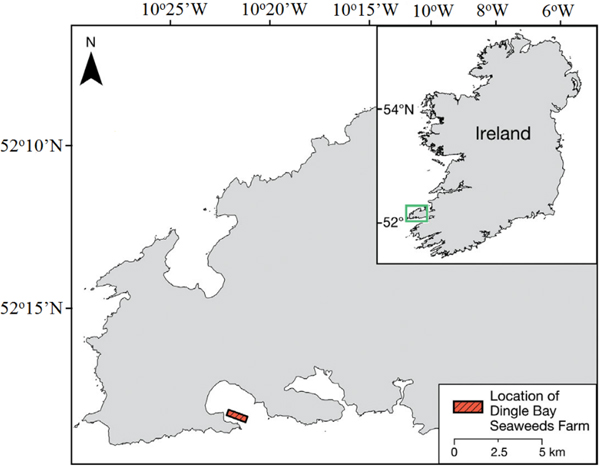
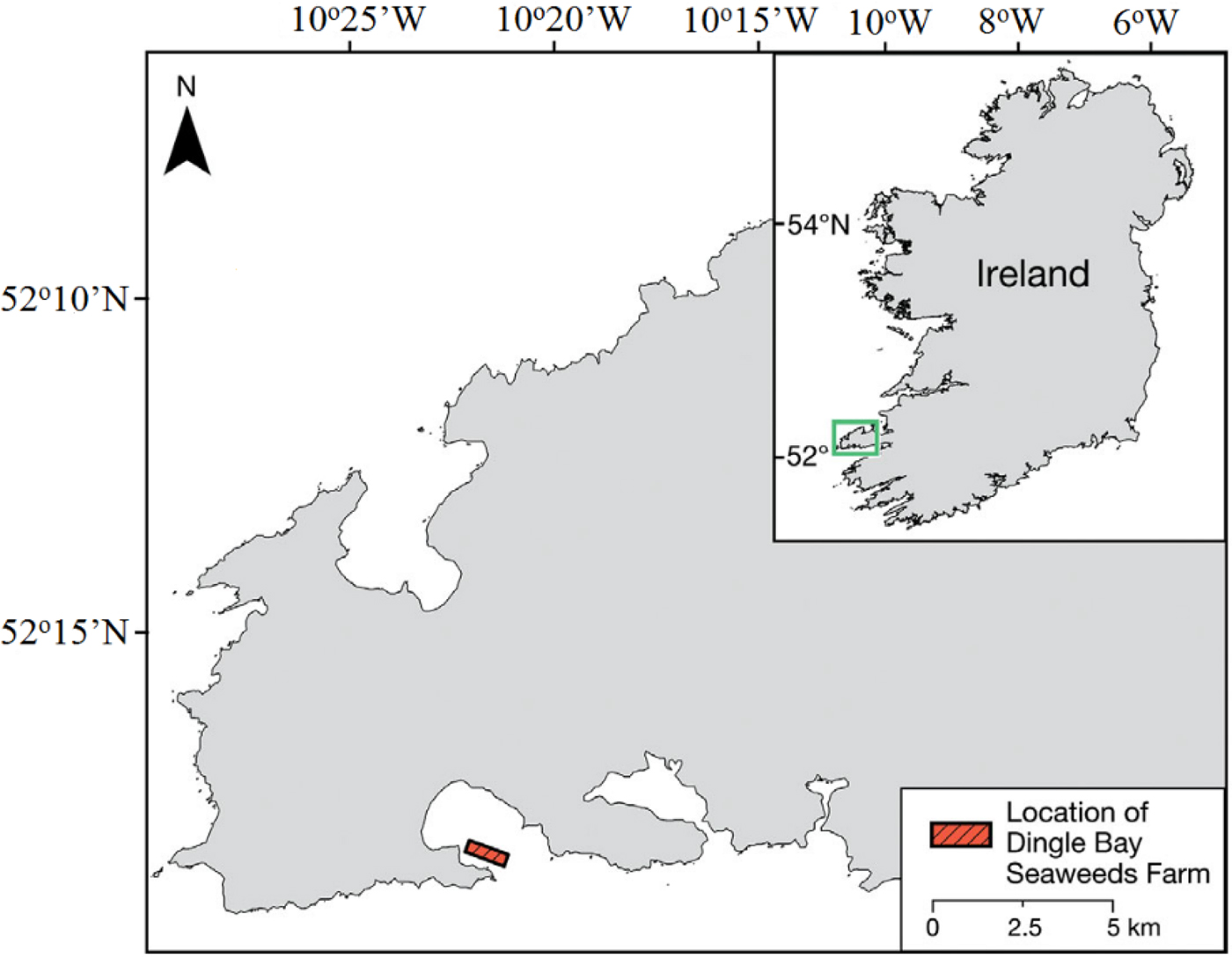
Location of Dingle Bay Seaweeds farm and sampling site at Ventry Harbour, Co. Kerry, Ireland.
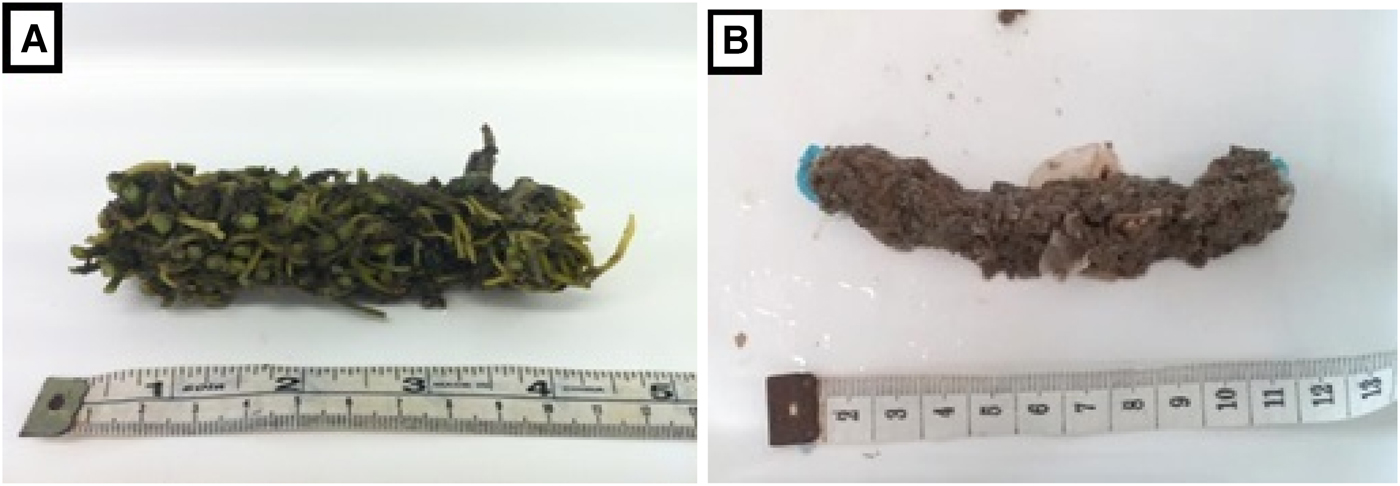
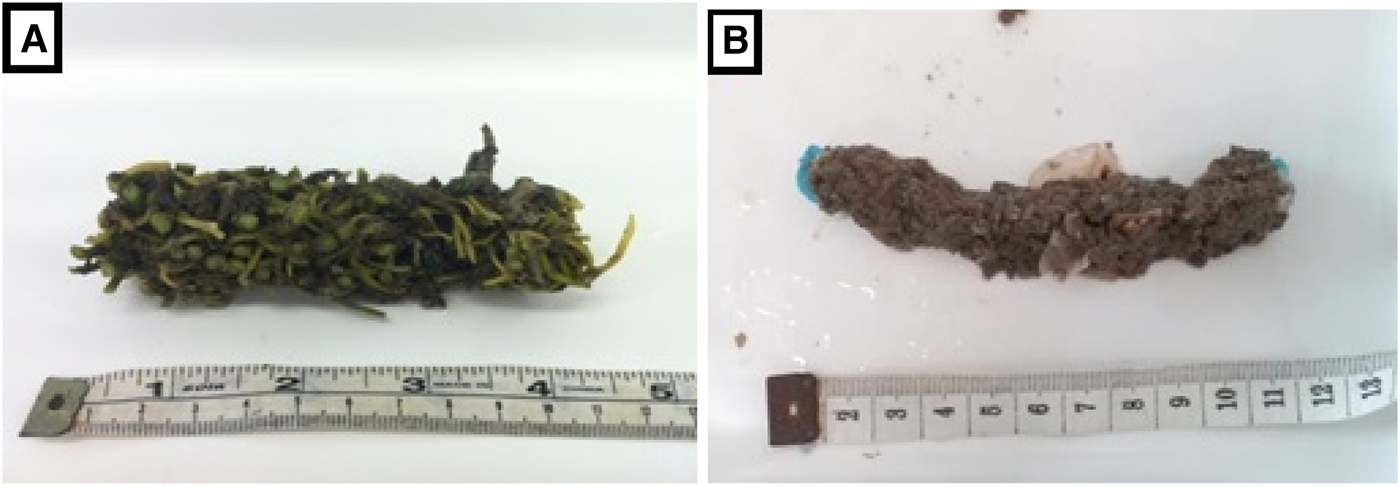
Morphology of 10 cm section (A) primed Alaria esculenta holdfast, (B) unprimed section.
In this study, we focus on the assemblage that develops on suspended ropes primed with the cultivated kelp Alaria esculenta. Kelp-associated holdfast epibionts were surveyed at different times during the two cultivation periods to track changes in community composition and development. We compared these primed rope communities with communities that developed on unprimed ropes. The comparison of primed and unprimed treatments allows for an estimation of the effect of ‘ecological priming’. We tested the hypothesis that a priming effect alters the development of assemblages differently across primed and unprimed treatments. An assessment of an ecological priming effect associated with cultivated kelps is novel and, if present, may have important implications for habitat restoration and enhancement of artificial structures. If the development of primed communities is predictable, this would increase the capacity for planning and management in the seaweed cultivation industry. Also, if cultivated holdfasts are found to have distinct assemblages when compared with unprimed treatments, this suggests they supplement the habitat service provided by artificial structures, such as mooring and anchor ropes, with the farm providing an alternative habitat for associated communities. This study builds on previous work conducted in Walls et al. (Reference Walls, Edwards, Firth and Johnson2017) on the ecological processes occurring on cultivated kelp farms. However, the data presented here are related to the communities associated with the holdfast material, while Walls et al. (Reference Walls, Edwards, Firth and Johnson2017) studied the frond fouling communities and their impact on commercial aspects of seaweed farming.
Materials and methods
Study site
This study was conducted in south-west Ireland in Ventry Harbour, County Kerry (52°06′49.45″N 10°21′20.17″W; Figure 1) at the largest operating commercial seaweed farm in Ireland (18 ha site). Ventry Harbour is a moderately sheltered and shallow embayment orientated towards the south-east, ~2.5 × 1.5 km (3.75 km2) with a wide mouth opening into Dingle Bay. The seagrass Zostera marina Linnaeus (1753) is extensively distributed throughout the sandy seabed, leading to a rocky boulder reef towards the mouth of the bay. Wild kelp populations are found at the mouth of Ventry Harbour and on the north-eastern shore of the bay, ~250 m–1 km from the farm site). The licensed seaweed farm is orientated north-west to south-east, and located to the westerly side of Ventry Harbour (Figure 1). The depth underneath the farm is ~6 m at the north-western end before gently sloping to 20 m at the eastern edge of the farm at mean low water spring tide (MLWS). The tidal range in Ventry Harbour is between 0.6 and 4.0 m. Monthly irradiance values, obtained from the nearby Valentia weather observatory (51°56′23″N −10°14′40″W), ranged from 5447–63,823 J cm−2 for 2014; equivalent to ~3356 to 40,364 mmol photons m−2 day−1 using the approximation suggested by Tett (Reference Tett1990). Sea surface temperature data were obtained from the M3 offshore weather buoy located ~56 km south-west of Mizen Head (51°13′0″N 10°33′0″W), and ranged from 10.1–17.6°C for 2014. Although offshore sea temperatures are less extreme than inshore waters, Ventry Harbour is a well-flushed bay so values are broadly representative. The longline set-up and design of the seaweed farm is described in detail in Walls et al. (Reference Walls, Edwards, Firth and Johnson2017). The farm cultivates the kelps Alaria esculenta and Saccharina latissima (Linnaeus) Lane, Mayes, Druehl & Saunders (2006) for human consumption, animal feed and use in cosmetic products.
Experimental set-up
Experimental treatments were based on 1 m polypropylene dropper ropes (10 mm diameter) with two initial set-ups. Treatment 1 ‘primed droppers’ consisted of ropes sprayed directly with juvenile A. esculenta sporophytes that had been developed from gametophyte cultures held in the seaweed hatchery at the NUIG Carna Research Station (County Galway), following standard industry protocols. The primed ropes were left to develop under controlled growth conditions (Edwards & Watson, Reference Edwards and Watson2011) for between 5–12 weeks. Sporophytes were ~10 mm at time of deployment. Treatment 2 dropper ropes consisted of clean polypropylene rope and will be referred to as ‘unprimed droppers’ hereafter. Unprimed droppers were submerged in tanks of seawater under the same laboratory conditions as the primed droppers for the same length of time prior to deployment. At deployment, all dropper replicates had a 1 kg concrete weight attached to the end of the rope and were deployed vertically on the longline header rope and spaced 1.5 m apart to mitigate against rubbing and tangling (Walls et al., Reference Walls, Kennedy, Fitzgerald, Blight, Johnson and Edwards2016). Dropper ropes were suspended at a depth of between 1.5–2.5 m below the surface of the water, which is a depth range experienced at commercial seaweed farms. Each dropper was randomly assigned to a location on the longline header rope prior to deployment. Primed (N = 35) and unprimed (N = 35) droppers were deployed on 18 February 2014 for the 2013/2014 growing season (Year 1); deployment was delayed in Year 1 due to winter storms in early 2014. The experiment was repeated for the 2014/2015 growing season (Year 2), when the primed (N = 35) and unprimed (N = 35) treatments were deployed on 15 December 2014.
Sampling protocol for primed and unprimed droppers
All samples were collected by scuba divers. In April, May and June 2014 and 2015 five droppers were randomly chosen and collected from the primed and unprimed treatments using open-ended mesh bags (150 × 55 cm, 0.5 mm mesh size). If a dropper was not uniformly covered in developing sporophytes (i.e. showed evidence of rubbing or entanglement), another dropper replicate was selected. The mesh bag was carefully slipped up over the dropper and tightly secured at top and bottom (just above the weight) using cable ties, enclosing the entire 1 m dropper and kelp biomass. The focus for the current study was to compare the assemblages associated most closely with the dropper rope. There are potential issues of habitat extent when comparing the assemblages of entire kelp sporophytes with organisms attached to unprimed rope (where large kelp blades did not develop in the experimental time period). We therefore compared the near-rope assemblages of the holdfast with those on unprimed droppers.
All samples were transferred back to nearby facilities at Dingle Oceanworld Aquarium for initial processing within 6 h. The sampling technique of bagging fronds and holdfast before separating the material on land potentially risks mixing species attached to the frond with those of the holdfast. However, fronds mainly host attached organisms such as hydroids and bryozoans and fewer mobile species (Walls et al., Reference Walls, Edwards, Firth and Johnson2017) so this form of contamination is likely to be minimal. The alternative, of cutting fronds in situ, risks dislodging loosely attached species on one treatment (primed ropes), but not the other (unprimed ropes). The mesh bags were untied before randomly pre-selected 10 cm sections (N = 3) of each dropper were excised from the 1 m dropper (Figure 2A, B). In the rare event that any randomly selected section of primed dropper was not entirely covered in holdfast structures, an alternative section was chosen. The frond and stipe material of primed samples were cut just above the holdfast and stored in sealed plastic bags containing 100% ethanol for a separate study. The 10 cm primed and unprimed rope sections were stored in separate sealed plastic bags containing 100% ethanol. All samples were transported back to the laboratory for further processing.
Sample processing
The 10 cm replicate primed A. esculenta and unprimed sections were removed from the plastic bag and all material (i.e. kelp holdfasts, epiphytes and fauna) was cleaned from the substratum. Due to the morphology of cultivated kelp holdfasts, individual holdfasts could not be removed as the haptera grow intertwined with each other (Figure 2A, also see Walls et al. (Reference Walls, Kennedy, Fitzgerald, Blight, Johnson and Edwards2016) for comparison of morphology of wild and cultivated kelp holdfasts). All collected epibionts from primed and unprimed samples were washed over a 0.5 mm sieve and stored in 100% ethanol for later identification. All collected flora and fauna were identified to species level where possible (using Hayward, Reference Hayward1988; Hayward & Ryland, Reference Hayward and Ryland2002; Bunker et al., Reference Bunker, Maggs, Brodie and Bunker2012). Taxonomy was cross-checked using web resources (WoRMS Editorial Board, 2016) and samples were stored in 100% ethanol.
Statistical analysis
The impact of priming ropes with kelp sporophytes was examined using univariate tests of diversity, multivariate tests of assemblage composition and regressions of mean occurrence days for different treatment and year combinations. To compare functional diversity between primed and unprimed treatments, species were grouped into categories based on morphology (algae): thin filamentous algae, foliose algae and leathery macrophyte (Steneck & Dethier, Reference Steneck and Dethier1994; Eriksson et al., Reference Eriksson, Johansson and Snoeijs2002); and feeding strategies (fauna): suspension feeder, detritivore, carnivore, omnivore or herbivore. Where species spanned these categories, their predominant model of feeding was recorded (Sheppard et al., Reference Sheppard, Bellamy and Sheppard1980). Occurrences of functional groups were pooled by treatment/month combinations and tested using a two-way sampling date × treatment model with functional group number as a response variable. Univariate analysis of variance (ANOVA) was used to examine temporal differences in species richness of dropper communities (N = 3 10 cm sections pooled) between primed and unprimed treatments using the model of month (fixed factor) crossed with treatment (fixed factor) for years 2014 and 2015 separately. Dropper sections were pooled to make droppers rather than 10 cm sections the basic unit of replication. The pooling was carried out as variation within droppers and between sections was not part of the hypothesis of interest.
The differences between community composition from different months and years for the primed and unprimed treatments were compared using multivariate tests. A Simpson's dissimilarity matrix was generated from the presence/absence data for pooled dropper communities from years 2014 and 2015 separately for the 3 primed and 3 unprimed treatments and different months (April, May and June). Simpson's dissimilarity values are 0 when assemblages from separate samples are identical and scaled to 100 when there are no species in common between separate samples. Simpson's dissimilarity has the advantage that it only measures the compositional turnover and is not affected by the relative difference in species richness between samples (Baselga, Reference Baselga2010). This makes dissimilarities measured by Simpson's index easier to interpret than is the case for indices that mix turnover and species richness components of dissimilarity (e.g. Sørensen's index). The PRIMER software used for multivariate analysis does not calculate Simpson's dissimilarities, so these were calculated from species presence/absence data in EXCEL using the PopTools add-on (Hood, Reference Hood2014) and dissimilarity matrices were subsequently imported into PRIMER. All samples were ordinated using a multidimensional scaling plot (MDS) (Shepard, Reference Shepard1962; Kruskal, Reference Kruskal1964a, Reference Kruskal1964b) in PRIMER V6®, giving the position of each dropper community (N = 3 sections pooled) in two-dimensional space based on its species composition for years 2014 and 2015 separately.
Permutational multivariate analysis of variance (PERMANOVA, Anderson et al., Reference Anderson, Gorley and Clarke2008) was used to test for differences in multivariate species assemblages among primed and unprimed communities using the model of month (fixed factor) crossed with treatment (fixed factor) for years 2014 and 2015 separately, based on 9999 unrestricted permutations of raw data. PERMDISP routine revealed that the variation in multivariate dispersion (around the centroid) was not significant (P > 0.5) for all factors (month and treatment).
Where significant differences between sampling dates and treatments were detected, a variation on SIMPER analysis was conducted to highlight the species that contributed most to the observed differences. The SIMPER programme in PRIMER could not be used as Simpson's dissimilarity is not compatible with the algorithm used in the programme. Instead, we conducted a SIMPER-like analysis, hereafter referred to as a test of species influence (Walls et al., Reference Walls, Edwards, Firth and Johnson2017), by comparing the observed dissimilarity within and between samples when all species were included to the dissimilarities generated by excluding each species individually. The average between-group and within-group dissimilarities were compared to see whether omitting a species made the groups appear more or less similar. In summary, if a species makes groups more similar when excluded from the matrix, it suggests that the species makes a contribution to the observed differences between groups. Ratios of between to within group dissimilarities were normalized to facilitate comparisons. Any species greater than one standard deviation of the mean normalized score was identified as having an above average contribution to the overall dissimilarity between the groups.
To test the predictability of the presence of species on primed and unprimed droppers from Year 1 (2014) to Year 2 (2015), we used day of year to calculate the central tendency of species occurrence. Day of year is the number assigned to a whole solar day that starts at 1 on 1 January and finishes at 365 on 31 December (non-leap year), e.g. sampling took place on 7 April 2015 which is day of year 97. Central tendency is the average day when a species was observed, weighted by the frequency of occurrence. For example, if a species has high occurrence in the first sampling date, lower occurrence in the middle sampling date and does not occur in the final sampling date then the mean occurrence day will be somewhere between the first and second sampling date. The central tendency method as described by Colebrook (Reference Colebrook1979) can identify changes in the timing of seasonal cycles (Edwards & Richardson, Reference Edwards and Richardson2004; Moore et al., Reference Moore, Thompson and Hawkins2011). To test if species arrival times were similar between the different treatment droppers within the same year the mean species arrival times were compared between treatments within years 2014 and 2015 separately. Regression analysis was conducted using Minitab v16 to test if arrival times of commonly occurring species were significantly related. A slope close to 1 is expected if the timing of species presences is the same from year to year. If the relationship between occurrence days is significant, but the slope is not close to 1, this implies that the order of species occurrence is similar between sets of samples, but the rate of species arrival varies between years.
Results
In total, we recorded 81 species inhabiting the primed and unprimed 10 cm dropper sections. Fifty-four species were recorded on 2014 primed sections and 63 species were recorded on the 2015 primed sections. Twenty-eight per cent of all taxa were unique to primed samples including the lumpsucker Cyclopterus lumpus Linnaeus (1758), the ascidian Ciona intestinalis Linnaeus (1767), and the polychaete Nereimyra punctata Müller (1788). Only 6% of taxa (5 species) were unique to the unprimed ropes, 4 of these were algal species including the kelps Saccorhiza polyschides (Lightfoot) Batters (1902) and Saccharina latissima, the brown algae Desmarestia viridis (O.F. Müller) J.V. Lamouroux (1813) and the green algae Ulva sp. Linnaeus (1753). The only faunal species unique to unprimed samples was the gastropod Patella pellucida Linnaeus (1758) which is usually associated with the kelp fronds on which it exclusively feeds (Hayward, Reference Hayward1988). As only one individual was recorded, the occurrence of this species is not particularly informative. Variation in sample depth along the 1 m dropper ropes or location of the droppers within the farm did not cause any differences in the species richness or community composition of primed and unprimed 10 cm sections. A full list of species sampled on both primed and unprimed samples can be found in Table S1 in supplementary material.
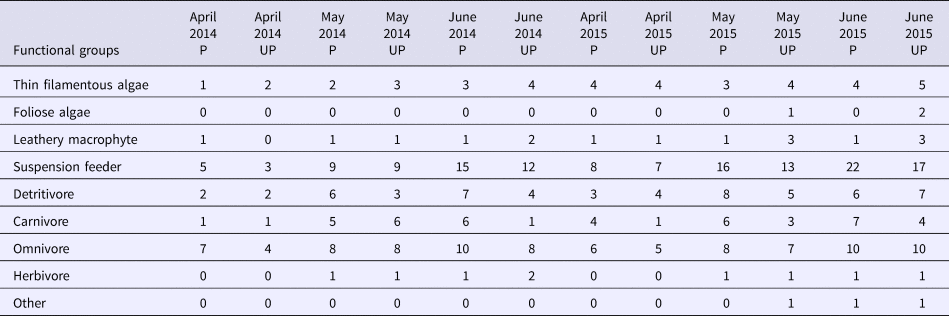
Thin filamentous algae were the most dominant algal functional group for both treatments, with algal diversity higher (4/6 dates) in unprimed treatments when compared with primed treatments in the same month. The suspension feeders were the most common faunal groups for both treatments, followed by omnivores and detritivores (Table 1). A full list of species recorded and their abundance is provided in Supplementary Material (Table S1). Functional group richness increased with time since deployment (F 2,6 = 5.7, P < 0.05), but there were no effects of treatment.
Number of species in each functional group for primed (P) and unprimed (UP) dropper treatments sampled in April, May and June 2014 and 2015

Community composition and development of epibionts on primed Alaria esculenta 10 cm holdfast sections and unprimed sections.
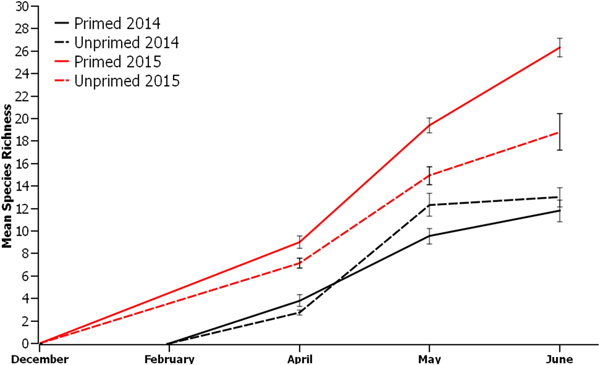
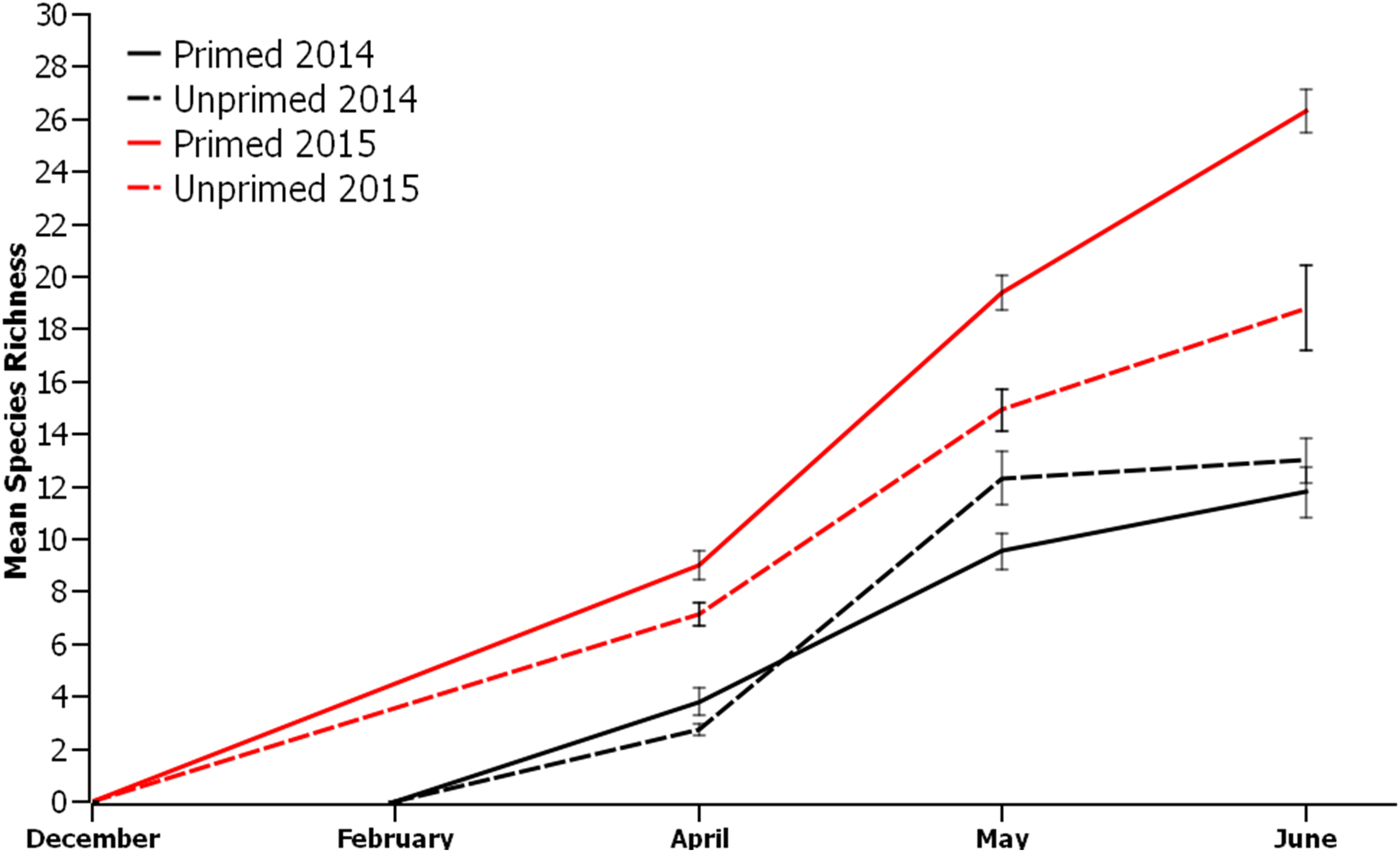
Species richness at the seaweed farm site in Ventry increased from time of deployment until the end of the study, for both primed and unprimed treatments. Apart from the accumulation of species with time, the patterns of species richness were not consistent across factors (Treatment 2014 F 1,24 = 0.126, P = 0.725, Treatment 2014 × Months 2014 F 2,24 = 1.433, P = 0.258; Treatment 2015 × Months F 2,24 = 0.088, 2015 P = 0.914). Significant differences in species richness were recorded for month for both years (Months 2014 F 2,24 = 34.608, P = < 0.001; Months 2015 F 2,24 = 91.555, P = < 0.001), and treatment is significant for 2015 from the ANOVA (Figure 3, Treatment 2015 F 1,24 = 16.796, P = < 0.001). Species richness within 2015 was higher in the primed treatment than in the unprimed treatment for each sampling month. For 2014 primed species richness was higher than unprimed species richness for April samples, however, richness was lower for primed samples from May and June than unprimed samples (Figure 3).
Species richness (mean ± SE) on primed Alaria esculenta holdfast sections and unprimed sections sampled in April, May and June 2014 and 2015. Species richness represents the number of taxa identified on 10 cm section (N = 3) from each dropper (N = 5).
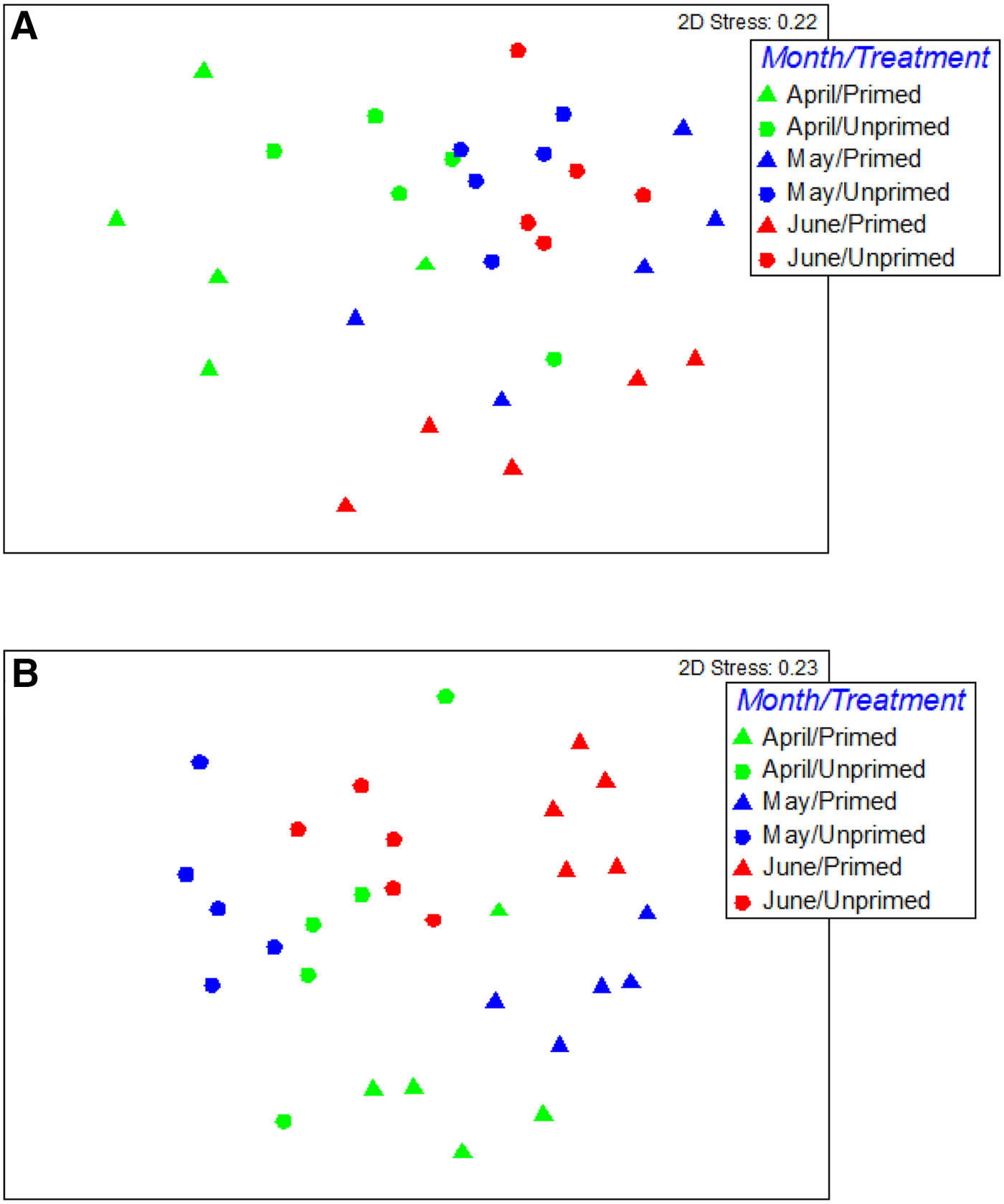
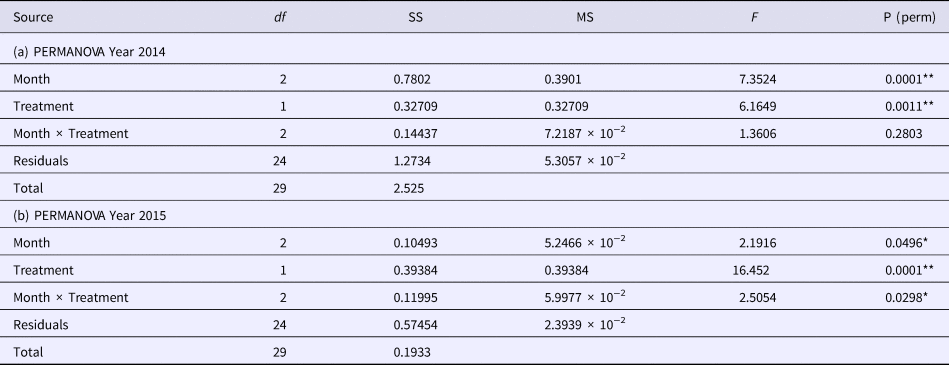
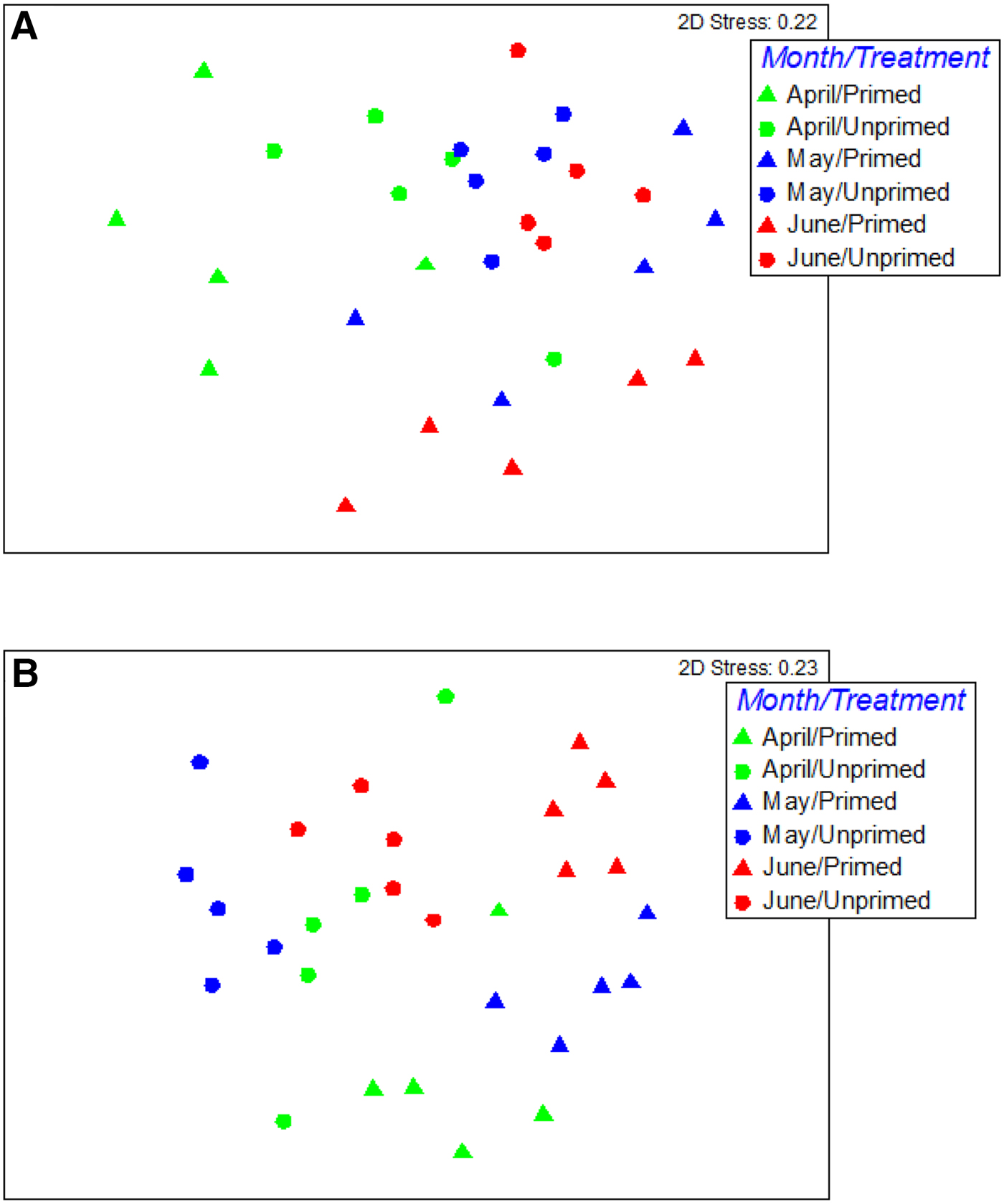
Due to the high stress values of the MDS plots for year 2014 (0.22, Figure 4A) and for year 2015 (0.23, Figure 4B) patterns of differences among assemblages from separate months and treatments were difficult to examine. A stress value of >0.20 indicates the data are only partially represented by the two-dimensional plot and little reliance should be placed on the finer detail of the plot (Clarke & Warwick, Reference Clarke and Warwick1994). However, the broad-scale pattern shows a separation of early April communities to later May and June communities which show little separation, with month also being significant from the PERMANOVA analysis for both years 2014 and 2015 (Table 2, P < 0.05). There is also a separation of community assemblages between primed and unprimed treatments. This pattern is evident from the PERMANOVA analysis with species assemblage composition differing between treatment (primed and unprimed) from the analysis again for both years 2014 and 2015 (Table 2, P < 0.01). Interestingly, the month crossed with treatment interaction was significant for year 2015 only (Table 2, P < 0.05). The pairwise tests reveal that this significant interaction is not due to whether treatments are different in one particular month, but the interaction implies that months within a treatment are sometimes different and sometimes not.
Two-dimensional multidimensional scaling plot of 30 primed and unprimed dropper samples (N = 3 pooled): 15 from primed treatment and 15 from unprimed treatment, based on presence/absence Simpson's dissimilarity matrix of species collected from each primed and unprimed section. (A) Samples from year 2014 (stress = 0.22). (B) Samples from year 2015 (stress = 0.23).
Permutational multivariate analyses of variance based on Simpson's dissimilarity matrix based on presence/absence data for dropper community (N = 3 10 cm rope sections pooled) sampled over months (April, May and June) on different treatments (primed and unprimed) for (A) year 2104 and (B) year 2015. All tests were conducted using unrestricted permutation of raw data with 9999 permutations

df, degrees of freedom; SS, sum of squares; MS, mean squares,.
F-ratio of within-group variation to between-group variation, P (perm) permutational probability value, * P < 0.05, ** P < 0.001.
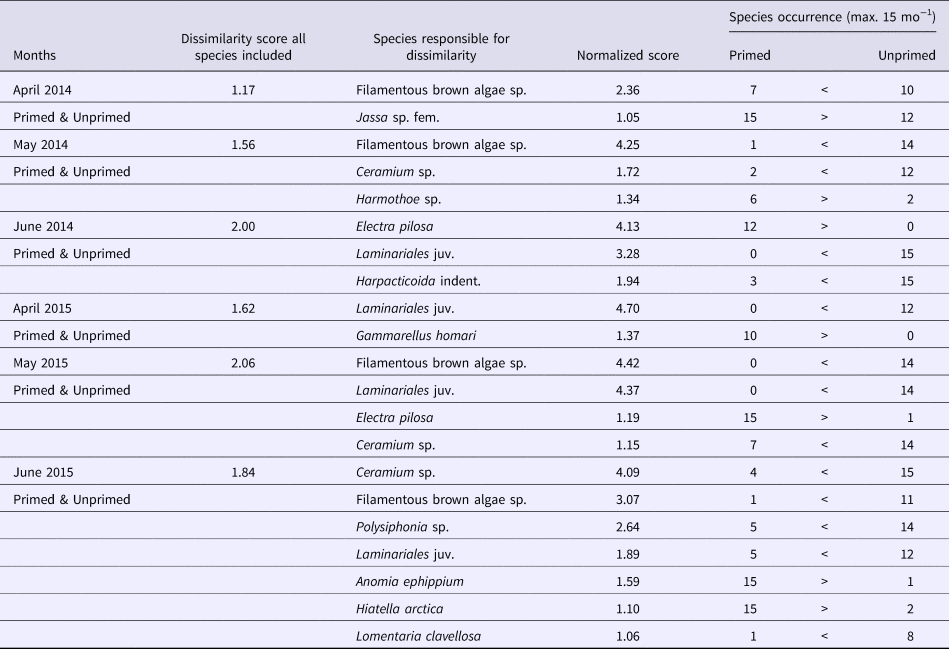
A test of species influence was conducted to determine which taxa were the major contributors to the observed dissimilarity in assemblage structure between primed and unprimed treatments within the same sampling months (Table 3). Most of the species responsible for dissimilarity between treatments were algae and sessile faunal species. The species with higher occurrence on the primed samples were from a variety of different phyla and dissimilarities were not characterized by any specific group. These included the amphipod Jassa fem. Montague (1808) present in April 2014 samples, and the polychaete Harmothoe sp. Kinberg (1856) present in May 2014 samples, the bryozoan Electra pilosa Lamouroux (1816) which contributed to differences between treatments in both June 2014 and May 2015, the amphipod Gammarellus homari Herbst (1793) present in April 2015 and the bivalve molluscs Anomia ephippium Linnaeus (1758) and Hiatella arctica Linnaeus (1767) which were responsible for some of the differences observed in June 2015. The unprimed treatment was generally characterized by a higher occurrence of algal species during each sampling month. The filamentous brown algae sp. and the red alga Ceramium sp. Wiggers (1780) were major contributors to the observed differences between treatments and were present in April 2014 (filamentous brown algae sp. only), May 2014 and 2015 and June 2015. Laminariales juveniles Migula (1909) were present in higher occurrence in all sampling months except May 2014 when they did not contribute to observed dissimilarities. The red algae Polysiphonia sp. Greville (1823) and Lomentaria clavellosa Lyngbye (1819) were present in June 2015. The only non-algal species which contributed to the dissimilarity between treatments with higher occurrence in the unprimed treatment was Harpacticoida indent. Sars (1903) present in June 2014. From the dissimilarity scores May 2014 and April 2015 treatments are less dissimilar than June 2015, however primed and unprimed treatments sampled in June 2014 and May 2015 are the most dissimilar (>2.00 dissimilarity score, Table 3).
Test of species influence to determine the species contributing to observed differences in the structure of assemblages between primed and unprimed treatments

Dissimilarity scores are the ratio of average between-group dissimilarities to within-group dissimilarities for each pairwise comparison. Normalized score is the reduction in dissimilarity score when excluding the species of interest, normalized to mean = 0, SD = 1 using the mean and standard deviation of all individual species’ scores. A higher loss in dissimilarity indicates that a species is important in distinguishing the dates compared.
Predictability of holdfast assemblages on primed and unprimed treatments
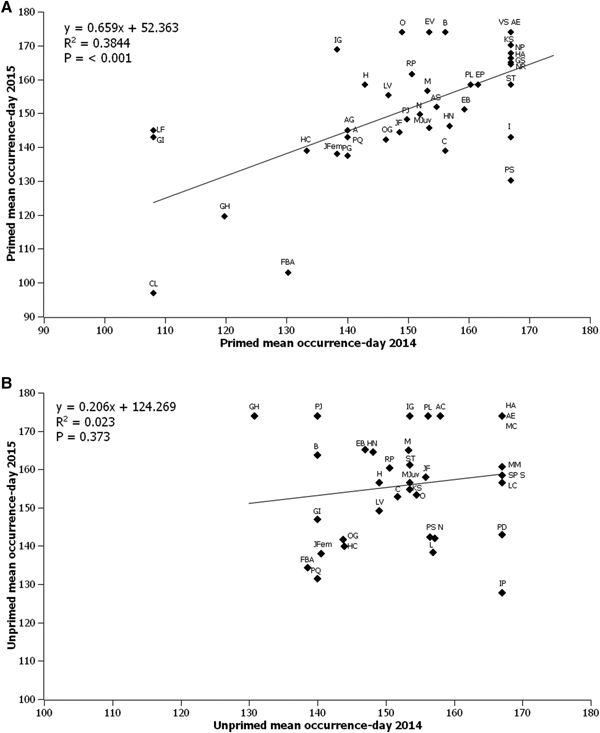
Shared species between and within treatments included algal species and both sessile and mobile faunal species. The temporal pattern of shared holdfast species was consistent between years for the primed treatment; however, this pattern was not the same in the unprimed treatment. The regression of mean species occurrence in 2014 and 2015 was significant in primed treatments (P < 0.001; Figure 5A). In contrast, patterns of mean species arrival on unprimed treatments were not consistent between 2014 and 2015 (P > 0.05; Figure 5B).
The relationship between mean day of year occurrences for all shared species in 2014 and 2015 on primed holdfast samples. CL, Cyclopterus lumpus; LF, Laomedea flexuosa; GI, Gammarus insensibilis; GH, Gammarellus homari; FBA, filamentous brown algae sp.; HC, Harpacticoid copepods; JFem, Jassa sp. female; IG, Idotea granulosa; PG, Pycnogonida indent.; A, Aora sp.; AG, Aora gracilis; PQ, Polycera quadrilineata; H, Harmothoe sp.; OG, Obelia geniculata; LV, Lacuna vincta; JF, Jassa falcata; O, Ostracoda indent.; PJ, Parajassa pelagica; RP, Rissoa parva; N, Nematoda indent.; M, Myrianida sp.; EV, Eulalia viridis; MJuv, Mytilus sp. juvenile; AS, Asterias sp.; B, Balanus sp.; C, Ceramiales sp.; HN, Hardametopa nasuta; EB, Eusyllis blomstrandi; PL, Pisidia longicornis; EP, Electra pilosa; ST, Spirobranchus triqueter; NR, Nereiphylla rubiginosa; NP, Nereimyra punctate; GS, Gitana sarsi; KS, Kellia suborbicularis; HA, Hiatella arctica; I, Idotea sp.; PS, Polysiphonia sp.; AE, Anomia ephippium; VS, Vesicularia spinosa.

Recruitment by shared species to both treatments was similar within a year. The timing of species occurrence was consistent across treatments within the same year for both 2014 and 2015. The regression slope relating mean day of year of shared species occurrence samples was significant within both years (P < 0.05; Figure S1A & S1B Supplementary Material).
Discussion
Community composition and development of epibionts on primed Alaria esculenta 10 cm holdfast sections and unprimed sections
Diverse assemblages developed on both primed Alaria esculenta sections and unprimed sections. The assemblage developed from unfouled material at deployment to 63 individual taxa sampled on the primed treatment and 54 taxa sampled on the unprimed treatment in 2015 which had higher species richness than 2014. This general build-up of species over sampling months followed a seasonal pattern of development from time of deployment in February (2014) and December (2015) until harvest in June for both growing seasons. The species identified on our primed samples have all been previously recorded on wild or cultivated kelp holdfasts (Jones, Reference Jones1971; Christie et al., Reference Christie, Jørgensen, Norderhaug and Waage-Nielsen2003; Blight & Thompson, Reference Blight and Thompson2008; Tuya et al., Reference Tuya, Larsen and Platt2011; Schaal et al., Reference Schaal, Riera and Leroux2012; Walls et al., Reference Walls, Kennedy, Fitzgerald, Blight, Johnson and Edwards2016). Although we did not record species abundance directly, the dominant faunal groups based on species occurrence in our primed samples were amphipod crustaceans, polychaetes and molluscs. This agrees with previous studies of wild kelp holdfasts from European waters including Blight & Thompson (Reference Blight and Thompson2008), Christie et al. (Reference Christie, Jørgensen, Norderhaug and Waage-Nielsen2003) and Walls et al. (Reference Walls, Kennedy, Fitzgerald, Blight, Johnson and Edwards2016), the latter of which is the only previous study of cultivated holdfast assemblages to our knowledge.
Functional diversity was dominated by suspension feeders, omnivores and detritivores for both our primed and unprimed samples. However, algal diversity was higher on unprimed samples with 4 of the 5 unique species on unprimed samples being algae, i.e. the kelps Saccorhiza polyschides and Saccharina latissima, the green algae Ulva sp. and Desmarestia viridis, a filamentous brown alga. Consistently higher species richness in primed samples during early sampling suggests that habitat availability is very important for the colonization of species during early successional stages (April). This importance lessens as communities develop, leading to less consistency in the treatments with higher species richness. The rapid colonization of this novel habitat suggests that the species have either planktonic larval settlement or if they have direct development, species are highly mobile (Walls et al., Reference Walls, Kennedy, Fitzgerald, Blight, Johnson and Edwards2016). Fouling epibionts such as bryozoans, hydroids, molluscs and crustaceans begin to settle in spring and early summer, which coincides with deployment and the cultivation period for kelps (Walls et al., Reference Walls, Edwards, Firth and Johnson2017). The sources of these colonizing species remain unknown. The nearest wild kelp populations are between 250 m (mouth of Ventry Harbour opening up to Dingle Bay) and 1 km (north-east direction from farm in Ventry Harbour) away from the farm site. Cultivation practices are not harmonized within the sector or even between years at the same site, however at Ventry Harbour over the duration of this study, the header and dropper ropes were taken in from the sea and cleaned after each harvest season, also anchor chains are cleaned in situ by divers at irregular intervals. Thus, over-wintering of fauna on the farm and re-colonization of the growing kelp and infrastructure in spring is unlikely to occur.
Analysis of the community composition of primed and unprimed treatments revealed several important patterns, which remained constant between years. Communities were distinct between treatments and also between months, with primed samples showing more separation during community development than unprimed samples. The dissimilarity results imply that species are not simply accumulated over time; there are compositional differences between early and later samples. Change in community composition was through addition of new species and replacement of early colonizers. This pattern was more evident in primed samples: with the filamentous brown algae sp. showing higher occurrence in April samples with much reduced occurrence in later May and June samples.
Algal species were revealed to be the main cause of variation between community composition of treatments from the test of species influence. Filamentous brown algae sp., Ceramiales sp., Laminariales juveniles, Polysiphonia sp. and Lomentaria clavellosa were more closely associated with the unprimed treatment. The presence of A. esculenta from the beginning of colonization may pre-empt other algal species from settling and dominating the primed droppers. Benedetti-Cecchi (Reference Benedetti-Cecchi2000) studied the effect of disturbance on turf and canopy-forming algae in Italy. He found that canopy-forming algae dominated cleared patches of substratum during their main recruitment period; even though turf-forming algae were initially present they were replaced by canopy-forming algae. However, turf-forming algae would characterize early stages of colonization and mature assemblages in patches that were cleared outside of the main recruitment period of the canopy-forming algae. In our study, unprimed samples were dominated by filamentous and ephemeral algae species, which seemed unable to colonize primed samples potentially because of the presence of A. esculenta. Furthermore, the bryozoan Electra pilosa was only present on primed samples late in the sampling period with very low occurrence in the unprimed treatment. Electra pilosa settles in early spring (Ryland & Hayward, Reference Ryland and Hayward1977) and is found to be out-competed by Membranipora membranacea Linnaeus (1767) on kelp fronds (Førde et al., Reference Førde, Forbord, Handå, Fossberg, Ariff, Johnsen and Reitan2016; Walls et al., Reference Walls, Edwards, Firth and Johnson2017); however, because M. membranacea is highly selective in habitat (Ryland, Reference Ryland1962) it does not thrive in other habitats, thus E. pilosa is the dominant bryozoan on these samples. Additionally, in the absence of M. membranacea, E. pilosa is also selective and was unable to settle on the unprimed samples. The polychaete Harmothoe sp., the amphipod Gammarellus homari, and the bivalves Anomia ephippium and Hiatella arctica, were all more closely associated with the primed treatment and have all been previously recorded on kelp holdfasts (Christie et al., Reference Christie, Jørgensen, Norderhaug and Waage-Nielsen2003; Blight & Thompson, Reference Blight and Thompson2008; Walls et al., Reference Walls, Kennedy, Fitzgerald, Blight, Johnson and Edwards2016) and are suggested to utilize the crevices provided by the structurally complex holdfast morphology.
Predictability of primed and unprimed communities from one year to the next
Between growing seasons, the mean occurrence-days of common species on primed samples were found to be predictable. This consistent pattern for primed samples was significant despite variation in deployment date and sampling date between years and factors such as water temperature, turbidity, irradiance and salinity presumably also varying from one year to the next (Walls et al., Reference Walls, Edwards, Firth and Johnson2017). This pattern was not replicated for shared species on unprimed samples between years (Figure 5B). However, the colonization of shared species between treatments within the same year was shown to be predictable (Figure S1A & S1B in Supplementary Material). This informs us that treatment did not affect arrival and colonization of shared epibionts within years and suggests that primed A. esculenta ropes are habitat to a specific assemblage whereas the unprimed habitat had more loosely associated assemblages. Interestingly, a predictable pattern was also observed between shared frond epibionts on cultivated A. esculenta (Walls et al., Reference Walls, Edwards, Firth and Johnson2017), but patterns of mobile fauna from the same site sampled at the same time were not predictable (unpublished data). Walls et al. (Reference Walls, Edwards, Firth and Johnson2017) suggested that the predictability of organism arrival times observed on their frond samples could be attributed to flushing times within the bay affecting local larval pools; this could also be a probable explanation for our primed holdfast assemblages (Herben, Reference Herben2005; Jessopp et al., Reference Jessopp, Mulholland, McAllen, Johnson, Crowe and Allcock2007). Ecological priming with juvenile A. esculenta sporophytes provides a biological platform that influences the development of predictable communities whereas the unprimed substratum leads to the development of unpredictable communities. This is an important consideration from a management perspective and the ability to understand the timing of occurrence of organisms and predict their arrival has significant benefits for the seaweed cultivation industry and management (Walls et al., Reference Walls, Edwards, Firth and Johnson2017). With this knowledge, seaweed farmers can exert some control over the quality of their crop by being able to decide on a date-by-site basis when the optimum time to harvest is, to avoid detrimental fouling species attaching to their crop. This study was only conducted over a two-year period and analysis of communities over longer durations would be required before definitive conclusions can be made.
Ecological priming using kelp sporophytes provides the complex physical structure that is the holdfast, which has many interstitial spaces for epibionts to colonize. The holdfast also offers protection from predators and adverse environmental conditions (Norderhaug et al., Reference Norderhaug, Christie and Rinde2002), accumulates food sources (Moore, Reference Moore1972) and increases the area of substratum and volume of habitable space available for colonization (Ojeda & Santelices, Reference Ojeda and Santelices1984; Teagle et al., Reference Teagle, Hawkins, Moore and Smale2017). Cultivated kelp holdfasts likely provide similar resources to colonizing communities as wild kelps (Walls et al., Reference Walls, Kennedy, Fitzgerald, Blight, Johnson and Edwards2016). Hauser et al. (Reference Hauser, Attrill and Cotton2006) experimentally altered the complexity of artificial holdfast mimics and found significantly lower diversity on low complexity mimics in comparison to those with higher complexity. The organisms inhabiting low complexity habitats need to be highly mobile to escape predation as there is less physical structure for refuge and food may be more difficult to find as it is not concentrated within the structure (Hauser et al., Reference Hauser, Attrill and Cotton2006). Hauser et al. (Reference Hauser, Attrill and Cotton2006) also suggests that higher complexity habitats offer a greater surface area for attachment of species, in addition to providing a larger surface area to catch organisms floating in that water column. The latter point is especially interesting in the context of our droppers which are suspended within the water column, and thus are more likely to attract larvae and pelagic organisms drifting in the water. As a consequence of ecological priming our primed samples are more predictable than unprimed samples potentially due to the foundational structure provided by kelp holdfasts.
Succession of epibiont assemblages of primed Alaria esculenta holdfasts
There appear to be no published descriptions of succession on cultivated holdfasts so comparisons must be drawn from wild holdfast studies and successional studies from alternative systems. Kelp successional studies used holdfast volume rather than holdfast age to analyse succession, due to difficulties in determining the age of holdfasts partly because of the indistinct nature of growth rings and the lack of comparative data using age rather than volume in other studies (Smith et al., Reference Smith, Simpson and Cairns1996). Interestingly, several studies suggest that successional processes do not involve species replacement but rather an additive progression (Ojeda & Santelices, Reference Ojeda and Santelices1984; Smith et al., Reference Smith, Simpson and Cairns1996; Smith, Reference Smith2000; Teagle et al., Reference Teagle, Hawkins, Moore and Smale2017). Smith et al. (Reference Smith, Simpson and Cairns1996) found that while early colonists on Ecklonia radiata (Agardh) Agardh (1848) holdfasts generally had a shift in dominance in larger holdfasts, all species that were recorded in smaller holdfasts were also present in larger samples. This was evident in Macrocystis pyrifera (Linnaeus) C. Agardh (1820) holdfasts that had a shift in dominance of polychaetes in smaller samples to a more diverse community in larger samples in which echinoids and decapod crustaceans were dominant (Ojeda & Santelices, Reference Ojeda and Santelices1984). Ojeda & Santelices (Reference Ojeda and Santelices1984) suggested that this form of succession may be more characteristic of habitats that grow, such as corals and sponges. This type of successional process is dissimilar to many other habitats where succession has been studied, including our cultivated kelp holdfasts, in which community change involved the replacement of early colonists with later species (Connell & Slatyer, Reference Connell and Slatyer1977; Dean & Connell, Reference Dean and Connell1987; Platt & Connell, Reference Platt and Connell2003; Cifuentes et al., Reference Cifuentes, Krueger, Dumont, Lenz and Thiel2010). In rocky shore and artificial habitats, the timing of disturbance or the creation of free-space can influence richness and abundance of initial colonizers which in turn affects succession (Sousa, Reference Sousa1979; Dayton et al., Reference Dayton, Currie, Gerrodette, Keller, Rosenthal and Tresca1984; Benedetti-Cecchi & Cinelli, Reference Benedetti-Cecchi and Cinelli1993; Underwood & Chapman, Reference Underwood and Chapman2006; Cifuentes et al., Reference Cifuentes, Krueger, Dumont, Lenz and Thiel2010; Valdivia et al., Reference Valdivia, Buschbaum and Thiel2014). This is partly due to seasonality in organisms’ reproductive patterns and/or growth and seasonal variation in environmental conditions (Jenkins & Martins, Reference Jenkins, Martins, Dürr and Thomason2010). This effect of timing was observed in the initial differences between early primed samples. However, as clearly evident from our primed samples and a number of other successional studies, varying successional trajectories subsequently converge towards a local climax community (Underwood & Chapman, Reference Underwood and Chapman2006; Cifuentes et al., Reference Cifuentes, Krueger, Dumont, Lenz and Thiel2010; Antoniadou, Reference Antoniadou2014; Evans et al., Reference Evans, Firth, Hawkins, Morris, Goudge and Moore2016; Walls et al., Reference Walls, Edwards, Firth and Johnson2017). One such study, Cifuentes et al. (Reference Cifuentes, Krueger, Dumont, Lenz and Thiel2010), proposed that initial and intermediate successional stages can be highly variable, while late stages are highly deterministic if a dominant species is present that uses the available energy efficiently. This leads to a convergence of communities with different start points. As our study followed succession over the first 4–7 months of development of primed and unprimed communities we do not know if these communities will converge into one climax state dominated by a superior competitor(s), either within the individual treatments or between treatments. However, from previously conducted studies it is highly probable that they could converge to similar end-point communities.
Outlook
This study identifies a unique habitat provided by the ecological priming of droppers with A. esculenta sporophytes, creating a complex physical structure with a distinct community when compared with unprimed ropes. This distinct community may be attracted to the habitat and refuge provided by the interstitial spaces between the holdfast haptera and its ability to accumulate food. The effect of primed ropes may reflect suppression of algal species that would otherwise colonize suspended ropes, and the facilitation of species that have a particular association with kelps. The restoration of kelp forests (Carney et al., Reference Carney, Waaland, Klinger and Ewing2005; Yu et al., Reference Yu, Zhang, Tang, Zhang, Lu, Chu and Tang2012; Marzinelli et al., Reference Marzinelli, Leong, Campbell, Steinberg and Vergés2016) and the transplantation of habitat-forming species (Perkol-Finkel et al., Reference Perkol-Finkel, Ferrario, Nicotera and Airoldi2012; Ferrario et al., Reference Ferrario, Iveša, Jaklin, Perkol-Finkel and Airoldi2016; Strain et al., Reference Strain, Morris, Coleman, Figueira, Steinberg, Johnston and Bishop2017a, Reference Strain, Olabarria, Mayer-Pinto, Cumbo, Morris, Bugnot, Dafforn, Heery, Firth, Brooks and Bishopb) onto artificial structures have gained increased interest recently with attempts to mitigate the potential negative anthropogenic impacts of ocean sprawl (Airoldi & Beck, Reference Airoldi and Beck2007; Firth et al., Reference Firth, Knights, Bridger, Evans, Mieszkowska, Moore, O'Connor, Sheehan, Thompson and Hawkins2016a, Reference Firth, Browne, Knights, Hawkins and Nash2016b; Strain et al., Reference Strain, Morris, Coleman, Figueira, Steinberg, Johnston and Bishop2017a, Reference Strain, Olabarria, Mayer-Pinto, Cumbo, Morris, Bugnot, Dafforn, Heery, Firth, Brooks and Bishopb). Rope has even been used as a method for enhancing productivity and biodiversity enhancement on pier pilings (Paalvast et al., Reference Paalvast, van Wesenbeeck, van der Velde and de Vries2012), and its physical structure mimicked on pre-cast concrete habitat enhancement units (Perkol-Finkel & Sella, Reference Perkol-Finkel and Sella2015). Deployment of seaweed lines may aid in habitat restoration by supplying spores and gametophytes to wild kelp beds that have been damaged by anthropogenic impacts, or by transplanting seeded kelp juveniles directly onto artificial structures (Marzinelli et al., Reference Marzinelli, Zagal, Chapman and Underwood2009). Ecologically priming the substratum with kelp seems likely to lead to the development of particular predictable associated communities. Colonization onto kelps can occur from settlement of larvae or migration by mobile fauna (Walls et al., Reference Walls, Kennedy, Fitzgerald, Blight, Johnson and Edwards2016, Reference Walls, Edwards, Firth and Johnson2017). The duration of the ‘seeding’ effect remains to be defined. Communities may become more similar over time (depending on successional processes and dominant species), or the influence of a kelp-dominated habitat may increase the longer the longlines are left in the water column. The cultivation practices for kelps are subject to change and development. Harvesting practices may be adjusted so that holdfasts, stipes and small fronds remain in place for more than one growing season, however the applicability of these techniques depends on culture species. Another area for future research is the impact of primed ropes on primary and secondary productivity associated with these communities. An assessment of productivity could increase the importance of primed communities through quantification of the ecosystem services they provide (Beaumont et al., Reference Beaumont, Austen, Atkins, Burdon, Degraer, Dentinho, Derous, Holm, Horton, van Ierland, Marboe, Starkey, Townsend and Zarzycki2007). The importance of priming effects may depend on the case-by-case details of cultivation practice, and there is a need for further research to fully understand the novelty of habitats created by seaweed cultivation.
Supplementary material
The supplementary material for this article can be found at https://doi.org/10.1017/S0025315418000723.
Acknowledgements
The authors acknowledge Dr Benoît Quéguineur, Mr David Moran and Mr Brendan Walls for their assistance in field sampling. In addition, they thank Dr Adrian Patterson and Dr Jack O'Carroll from NUI Galway's Benthic Ecology Laboratory for taxonomic support, Mr Michael Murphy and Mr Paul Flannery of Dingle Bay Seaweed for boat work and assistance at Ventry Harbour and staff at Dingle Oceanworld Aquarium for providing laboratory space. The authors also acknowledge Martin Thiel and two anonymous reviewers for their comments that greatly improved the manuscript.
Financial support
This work was supported by the Energetic Algae project (EU Interreg IVB NWE Strategic Initiative; http://www.enalgae.eu). A.M.W. is currently funded by the Dr Tony Ryan Research Trust, NUI Galway.