INTRODUCTION
When children acquire their first language, they have to figure out how this language signals who does what to whom. That is, they have to recognize which clues utterances provide to the semantic roles of their referents. The languages of the world have different strategies for marking this distribution of roles (combinations of word order, case and agreement, animacy, stress) so children cannot approach the task with universal expectations about the expression of this type of information. On the contrary, they have to develop appropriate processing strategies by attending to the specific expression strategies of their target language. Comprehension experiments in a host of languages have shown that the degree to which children rely on a specific cue (such as first noun for agent or accusative for patient) at different points in development is determined by four measures in the target language: availability (the ratio of clauses in which a specific cue points to a specific meaning over the total number of clauses where that same meaning is expressed), reliability (the ratio of clauses in which a specific cue leads to the correct interpretation over the number of clauses in which it is present), overall validity (the product of cue availability and cue reliability, i.e. the ratio of clauses in which a specific cue is present and leads to the correct interpretation over the total number of clauses), and conflict validity (the ratio of conflict clauses in which a specific cue leads to the correct interpretation over the total number of conflict clauses it occurs in, i.e. clauses in which it co-occurs with at least one other cue pointing to a different interpretation) (Bates & MacWhinney, Reference Bates, MacWhinney, MacWhinney and Bates1989).
Initially, children appear to rely not on single cues, but on clusters of cues pointing towards the same interpretation. Thus, children develop stable strategies for comprehending prototypical clauses where cues like word order, case, and animacy coalesce to mark role distribution, while persistently having trouble with clauses with conflicting cues (Chan et al., Reference Chan, Lieven and Tomasello2009; Dittmar et al., Reference Dittmar, Abbot-Smith, Lieven and Tomasello2008). In coping with conflict clauses, children appear to stick with a non-adult strategy of relying on the cue with the highest availability, in opposition to adults who typically rely on the cue with the highest conflict validity even if that cue is far less available (Bates & MacWhinney, Reference Bates, MacWhinney, MacWhinney and Bates1989; McDonald, Reference McDonald, MacWhinney and Bates1989).
A well-known example of this is children's understanding of object-first clauses in languages where the first-noun-phrase position (N1) is a highly available and mostly reliable cue for agent, but where the order of subject and object in NVN or NNV sequences may be switched for pragmatic purposes. This is, for instance, the case in Dutch, German, Japanese, and what was formerly known as Serbo-Croatian, where adults rely instead on the more reliable cue case in assigning semantic roles because it has high conflict validity. In these same languages, children interpret the object-first clauses as subject-first clauses, favouring the more available word-order cue over the more reliable case cue up to at least age 3;11 in Serbo-Croatian (Slobin & Bever, Reference Slobin and Bever1982), age 6;2 in Japanese (Hakuta, Reference Hakuta1982), age 7 in German (Dittmar et al., Reference Dittmar, Abbot-Smith, Lieven and Tomasello2008), and even age 16 in Dutch (McDonald, Reference McDonald, MacWhinney and Bates1989).
Various plausible explanations for these findings of children's slow development of adult-like strategies with conflict clauses have been suggested:
1. Children first attend to the cue that allows them to interpret most exemplars (i.e. the cue with highest overall validity, calculated as the product of availability and reliability) and only after mastering this cue free their attention to the rarer conflict utterances and learn how to cope with them (McDonald, Reference McDonald, MacWhinney and Bates1989).
2. Children's initial linguistic generalizations are so low-scope that case marking on pronouns does not help them to attend to case as a cue because it is lexically bound (Dittmar et al., Reference Dittmar, Abbot-Smith, Lieven and Tomasello2008). So, if a child knows that high-frequency case-marked pronouns such as German ich (1sg.nom) and dich (2sg.acc) indicate the agent and patient role, respectively, this knowledge is not necessarily generalized to case-marked lexical NPs and might therefore not help the child attend to the case-marking determiners and suffixes disambiguating German OVS clauses such as den (acc) Bären (acc) schubst der (nom) Tiger (‘the bear (O) pushes the tiger (S)’).
3. The use of clauses with conflicting cues is typically discourse-pragmatically motivated, and children do not yet have the pragmatic skills and the discourse-global scope to understand them when they encounter them (Chan et al., Reference Chan, Lieven and Tomasello2009, p. 295). This lack of ‘functional readiness’ (Bates & MacWhinney, Reference Bates, MacWhinney, MacWhinney and Bates1989) has been hypothesized from early reports of child miscomprehension of object-first clauses (Hakuta, Reference Hakuta1982; Slobin & Bever, Reference Slobin and Bever1982) up until now (Chan et al., Reference Chan, Lieven and Tomasello2009), but has remained a hypothesis.
As for this last hypothesis of pragmatic immaturity, there are, however, two important objections to be made. First of all, it is not unproblematic to presume that children lack context sensitivity on the background of previous experiments which have all presented children with object-first clauses without context. If children were indeed sensitive to the discourse-pragmatic demands of specific linguistic constructions, then they should actually be expected to behave poorly when meeting these constructions without the context that would support them. Second, even if the literature on children's acquisition of the basic transitive construction has not paid much attention to the possible roles of different aspects of context, children's sensitivity to features of both visual and discourse context has been examined extensively in studies on ontogenetic development of other phenomena, especially argument realization (see, e.g. Allen, Skarabela & Hughes, Reference Allen, Skarabela, Hughes and Behrens2008) and prepositional-phrase attachment (e.g. Hurewitz, Reference Hurewitz2001). To be sure, these studies show that children do not in general integrate contextual information in an adult-like manner in all linguistic tasks from the beginning, but they certainly also reveal that from the very early stages of linguistic development, children do pay attention to context – though in different tasks, to different features and to different degrees at different age stages. Thus, we cannot in advance explain children's miscomprehension of object-first clauses as symptoms of a general inability to take the context into account without having examined children's context sensitivity in the specific task of interpreting transitive clauses.
This allows us to put forth a fourth hypothetical explanation for previous findings of children's slow development of adult-like strategies with conflict clauses:
4. Children are sensitive to discourse context in the assignment of semantic roles. They miscomprehend highly context-dependent clauses with conflicting cues when these are presented in isolation in experiments because this lack of supportive context makes the clauses discourse-pragmatically infelicitous.
This explanation draws on findings from experiments examining adults' use of context in on-line processing. That adults can be expected to be sensitive to discourse context in the assignment of agent–patient roles has been demonstrated by reading-time studies testing comprehension of locally ambiguous clauses with object-first structure in Dutch (Kaan, Reference Kaan2001) and Finnish (Kaiser & Trueswell, Reference Kaiser and Trueswell2004). These studies manipulated the discourse status of the referents, presenting them as either new or given information in the target sentences. Both studies found slower reading times for object-initial clauses than for subject-initial clauses. But, importantly, this disadvantage for the OS clauses nearly disappeared if they were presented in an appropriate context (Kaiser & Trueswell, Reference Kaiser and Trueswell2004), or if the types of NPs used for expressing the object and subject indicated such a discourse status for the referents as would follow a felicitous context (Kaan, Reference Kaan2001). Kristensen, Engberg-Pedersen, and Poulsen (Reference Kristensen, Engberg-Pedersen and Poulsen2014) found similar results for Danish in a reading-time study with clauses disambiguated by subtle word-order signals. The adults were at chance when answering comprehension questions for OVS clauses presented without a supportive context (51·1% correct answers), but improved significantly when the OVS clauses were provided with a supportive context (75% correct answers). Response accuracy for SVO clauses, on the other hand, showed no sensitivity to contextual manipulation and was equally high in both conditions (90·6%). As will be explained in more detail later, the discourse-contextual features required for making OVS felicitous in Danish appear to be topicality (both referents as given topics) and contrast (Boeg Thomsen & Kristensen, Reference Boeg Thomsen and Kristensen2015).
But what about children still in kindergarten? Is there any reason to suspect that their assignment of semantic roles should also be affected by cues from the discourse context, such as topicality and contrast? As for the assignment of basic agent and patient roles, there are as yet no reports of studies aimed specifically at examining the effects of contextual cues. However, in an experiment investigating reliance on prosodic cues for semantic role assignment in German preschoolers (age range 4;6–5;3), Grünloh, Lieven, and Tomasello (Reference Grünloh, Lieven and Tomasello2011) presented OVS and SVO clauses in contrastive contexts to make their prosodic cue (contrastive intonation: stress on first NP) more natural. German children were much better at comprehending case-marked OVS clauses with contrastive intonation in contrastive contexts in this experiment than the German children in the Dittmar et al. (Reference Dittmar, Abbot-Smith, Lieven and Tomasello2008) study presenting OVS clauses in isolation. Further, Grünloh et al. (Reference Grünloh, Lieven and Tomasello2011) also presented another experiment with contrastive intonation, but without contrastive context. In comparing results from the two experiments, Grünloh et al., did not measure directly the effect of context on its own, but the much higher comprehension rate in the experiment with contrastive context strongly suggests an effect of discourse context (here: presence of contrast) on German preschoolers' OVS comprehension.
Turning to the development of sentence-comprehension strategies for other constructions, Hurewitz (Reference Hurewitz2001) presented evidence of sensitivity to contrast as a feature of the discourse context in preschoolers' PP attachment (i.e. their interpretation of prepositional phrases) in English. In this experiment four- to five-year-olds heard stories with two referents of the same kind and two locations and subsequently had to correct a wrong sentence about the story, such as the turtle tickled the cat on the fence, where the final PP could be interpreted either as a locational VP modifier or as an NP modifier. If the sentence followed a contrast question (Which cat did the turtle tickle?), children treated the structurally ambiguous PP (on the fence) as an NP modifier twice as often as after a general question about the story (Hurewitz, Reference Hurewitz2001). These comprehension studies indicate that kindergarten-aged children are able to integrate cues from the discourse context in their interpretation of single sentences, and, more specifically, that children are sensitive to the contextual feature contrast.
As for children's abilities to track referents' topicality status and use this information for linguistic tasks, these have been most carefully investigated within the tradition of argument-realization studies, focusing on children's developing sensitivity to the appropriateness of different referential expressions (e.g. pronoun or full NP), depending on a referent's role in the overall flow of discourse. Allen et al. (Reference Allen, Skarabela, Hughes and Behrens2008) sum up studies investigating context factors influencing children's own spontaneous productions, and already from around two years of age, topicality appears to exert some influence, though it has mostly been examined in combination with other contextual features. Attention to topicality in sentence comprehension has been less studied, but with a preferential-looking paradigm, Song and Fisher (Reference Song and Fisher2005) found effects of topicality (in a set-up with competitor referents) in three-year-olds' referent identification.
All in all, there is a variety of evidence suggesting that children do monitor features of the discourse context and use this information when solving linguistic tasks such as interpreting prepositional phrases and choosing and interpreting referring expressions, probably with an increasing attention to contextual features with age during the preschool years. These findings appear to go against the hypothesis previously put forward to explain the numerous experimental findings of child miscomprehension of isolated object-first clauses with conflicting cues, i.e. that children lack the ‘functional readiness’ for understanding such discourse-pragmatically motivated constructions. To be sure, since children's abilities to integrate discourse-contextual cues with sentence-internal cues could easily differ between linguistic tasks, we do not know if they are able to use the sensitivity to discourse context evidenced in PP interpretation and argument realization also in comprehension of transitive clauses. Nevertheless, German preschoolers' successful use of contrastive intonation with contrastive context as a cue to the interpretation of OVS clauses (Grünloh et al., Reference Grünloh, Lieven and Tomasello2011) does make studies of contextual influence seem a very promising next step in coming to understand children's miscomprehension of transitive clauses with conflicting morphosyntactic cues.
We therefore ask: Can sensitivity to features of the discourse context such as contrast and topicality play a role in something as fundamental as assigning the basic semantic roles of agent and patient? In investigating this question, we can also come closer to understanding whether children miscomprehend transitive clauses with conflicting cues because they are discourse-pragmatically immature and insensitive to context, or because they are indeed sensitive to context and only trust certain formal cues when they do not violate discourse demands.
Below, we report two studies investigating Danish children's sensitivity to word order, case, and discourse context. Study 1 examines the balance in four- to six-year-olds' reliance on the morphosyntactic cues word order and case by means of an act-out experiment presenting active transitive NVN clauses in isolation. Study 2 tests whether five- to six-year-olds' comprehension of case-marked OVS clauses is facilitated if these conflict clauses are nested in contexts that support them discourse-pragmatically. To this end we use an act-out task and compare the interpretation of OVS clauses in supportive contexts with OVS clauses in isolation as well as unsupportive contexts. As a starting point, we present a brief survey of the cues that are available to Danish children in child-directed speech (CDS).
CUE VALIDITY IN DANISH CHILD-DIRECTED SPEECH
Expectations for Danish children's reliance on the morphosyntactic cues word order and case and the semantic cue animacy were calculated on the basis of 532 utterances extracted by hand from a subpart of the Odense Twin Corpus, a longitudinal corpus of spontaneous speech (see Basbøll et al., Reference Basbøll, Bleses, Cadierno, Jensen, Ladegaard, Madsen, Millar, Sinha and Thomsen2002). The 532 utterances comprise all non-elliptic transitive declarative main clauses, including complex clauses, directed to their children by fathers and mothers in two families, during 10·5 hours in total when the twin pairs were aged 2;3–2;5 and 2;0–2;6, respectively. All utterances were coded for configuration (SVO, OVS, XVSO) and for presence of the cues case (either nominative-subject, accusative-object or both vs. no case-marking), animacy (coded as present if there was an animacy contrast between the arguments: animate–inanimate vs. animate–animate and inanimate–inanimate), and two different measures for word order: pre- vs. postverbal position and argument order (first vs. second NP). Danish is a verb-second language, which allows the configurations SVO (hun slår ham ‘she hits him’), OVS (ham slår hun ‘him hits she’ (lit.)), and XVSO (så slår hun ham ‘then hits she him’ (lit.)) in transitive declarative main clauses. Therefore a child depending on word order as a cue for semantic role assignment could either attend to pre- and postverbal position (possible only with NVN sequences) or to the absolute order of two noun phrases (N1 always points to the agent in VNN strings, but only in SVO versions of NVN strings). Among the two word-order cues we expect the cue ordering of verb arguments (100% available, 71% reliable) to play a more central role in children's language comprehension since it is both more available and more reliable than the other cue, preverbal position (77% available, 63% reliable). The calculations below refer to word order only in the sense of the ordering of verb arguments. Although the CDS analysis is based on only two families, we believe the findings to be generalizable because the two families show similar configuration proportions and cue measures, which further correspond to the patterns in Danish adult–adult speech in the spoken subpart of the corpus compiled in Boeg Thomsen and Kristensen (Reference Boeg Thomsen and Kristensen2015).
Individual cues
Table 1 presents measures of availability, reliability, and validity for the three cues word order, case, and animacy in Danish CDS.
Cues to semantic role assignment in Danish CDS

Word order is the most available cue, present in 100% of the utterances, since verb arguments are obligatorily expressed in Danish. Therefore a transitive sentence almost always contains both a first and a second NP. However, word order is not a very reliable cue since the first NP only pointed correctly to the agent in 71% of the cases where it was present. Reliance on N1 as agent cue led to the right interpretation in 258 SVO clauses and 118 VSO clauses. But in 154 OVS clauses (29% of the utterances), this word-order strategy would lead to misinterpretation. Counting only NVN sequences, the word-order cue was even less reliable, since 63% of the utterances had SVO structure, but 37% OVS structure.
Case, on the other hand, was a perfectly reliable cue, signalling the right role assignment in 100% of the 470 utterances where it was present. Since Danish only marks nominative and accusative case on a small number of personal pronouns, this morphological cue could have been expected to have low availability. Nevertheless, CDS appears to be so rich in pronouns that case becomes a cue with almost as high availability as word order (88% vs. 100% of the utterances).
It is worth noting, however, that case marking occurs more frequently with first and second person pronouns (50% and 30% of the utterances) than with third person pronouns (25% of the utterances). Overall, there are more utterances with third person pronouns in the corpus (55% of the utterances), but only four of those pronouns have distinct case forms for nominative and accusative (han/ham ‘he/him’, hun/hende ‘she/her’, de/dem ‘they/them’, and man/en ‘one’ (generic pronoun)), whereas, e.g. the most frequently occurring third person pronouns (den ‘it’ (common) and det ‘it’ (neuter)) carry no case-marking information. As for the balance between nominative and accusative in CDS, accusative marking (8%) is generally much less used than nominative marking (97%), and the majority of accusative forms occur with third person pronouns (see Table 2).
Case-marked clauses (distribution on person and case)

The semantic plausibility cue animacy was less frequent than both word order and case, with 73% of the utterances displaying an animacy contrast. Being reliable in 99% of the cases where it was present, its dependability far surpassed that of word order, and equalled that of case.
Comparing overall validity (the ratio of clauses where a cue leads to the right interpretation over all corpus clauses), case came out as the most valid cue, correctly classifying 88% of the 532 clauses, followed by animacy (72%) and word order (71%). Interestingly, Danish CDS validities resemble the ones Dittmar et al. (Reference Dittmar, Abbot-Smith, Lieven and Tomasello2008) found in German CDS (case: German 86%, Danish 88%; word order: German 68%, Danish 71%), even if case could be expected to be a much more valid cue in German, where not only pronouns but also full NPs are case marked. This points to the importance of case-marked pronouns in early language acquisition also in languages with restricted case marking (cf. Ibbotson, Theakston, Lieven & Tomasello (Reference Ibbotson, Theakston, Lieven and Tomasello2011) on English acquisition).
Coalitions and conflicts: predictions for acquisition
Word order, case, and animacy often converged to point out semantic roles: In 60% of the utterances (317 utt.) the agent was expressed with a nominative-marked animate pronoun as the first of two NPs. Such ‘coalitions-as-prototypes’ have been hypothesized to play an important role in children's development of stable interpretation strategies (Chan et al., Reference Chan, Lieven and Tomasello2009, p. 291), and for Danish children they should also be expected to be readily comprehended from the earliest development of a transitive schema.
It is more difficult to predict the strategy of Danish children for interpreting object-first clauses with conflicting cues. Earlier findings (Dittmar et al., Reference Dittmar, Abbot-Smith, Lieven and Tomasello2008; Hakuta, Reference Hakuta1982; McDonald, Reference McDonald, MacWhinney and Bates1989; Slobin & Bever, Reference Slobin and Bever1982) suggest that children into the school years would overgeneralize the most available cue, here word order, ignoring the fact that another cue, here case, was the more reliable one. It is, however, questionable whether the advantage of word order over case in availability (100% vs. 88%) should be decisive when children are so frequently presented with OVS structures that expose the unreliability of word order (37% of all NVN sequences, 29% of all transitives). Indeed, if children are in fact disposed to acquire first the most valid cue, the cue that will allow them to categorize most exemplars correctly (Bates & MacWhinney, Reference Bates, MacWhinney, MacWhinney and Bates1989; McDonald, Reference McDonald, MacWhinney and Bates1989), they should be expected to understand case-marked OVS clauses well, since case was by far the most valid cue in the input. But if preschool children do understand these conflict clauses correctly, another uncertainty concerns their ability to single out case as an independent cue, since it appears to be almost always supported by animacy: in 121 OVS clauses with inanimate object and animate subject, case and animacy together ‘win the conflict’ against word order by pointing out semantic roles, whereas case alone does so in only 15 clauses, animacy alone in 8.
STUDY 1
Study 1 investigated whether Danish preschool children exhibit difficulties with interpreting contextless OVS clauses, where word-order and case cues conflict. The study used an act-out paradigm to compare the interpretation of transitive sentences where the structure was unambiguously determined as either SVO or OVS by means of case. The question was whether the children would use the case cue to overcome the word-order cue outside a context that supports the OVS structure.
METHOD
Participants
Fourteen children from a kindergarten north of Copenhagen were tested (mean age: 5;6, range 4;6–6;5). Six were girls, eight boys. All children were L1 speakers of Danish, but one girl also spoke Faeroese.
Design
This experiment compared subjects' performance in two conditions:
1. SVO: NVN clauses where the nominative pronoun, N nom, is the first NP, N1
2. OVS: NVN clauses where the nominative pronoun, N nom is the second NP, N2
Our dependent variable was the proportion of correct, adult-like responses, i.e. choice of referent of the nominative pronoun, Nnom, as agent.
Materials
Two sets were constructed, each consisting of eight reversible transitive declarative main clauses with eight verbs denoting physical non-reciprocal actions that can be acted out with dolls in a manner that will make the child's choice of agent and patient readily readable. In all sentences, the referents were a boy and a girl, expressed with the case-marked pronouns han (m.nom.sg), ham (m.acc.sg), hun (f.nom.sg), and hende (f.acc.sg). All sentences were grammatical, containing one nominative pronoun and one accusative pronoun. In each sentence, the child could thus rely on two case cues supporting the same assignment of semantic roles. Stress was controlled: all sentences were pronounced with stress on the first pronoun and on the verb. This is a legitimate stress pattern for both structures, though more typical for OVS than for SVO.
Each of the eight verbs was presented once in each of the two sets. For a specific verb, the predication in which it participated (e.g. skubbe (han, hende) ‘push (he, her)’) was kept constant across the two sets, whereas structure was varied so that one set presented the SVO structure: han skubber hende ‘he pushes her’; the other the OVS structure: hende skubber han ‘her pushes he’. Half of the predications had a female agent, the other half a male agent, balancing degrees of patient affectedness and agent aggression: e.g. hende sparker han ‘her kicks he’, but ham slår hun ‘him hits she’. The SVO and OVS versions of each predication were distributed equally on the two sets, giving four SVO clauses and four OVS clauses in each set (see ‘Appendix A’). For each set, a pseudo-random presentation order was generated. All children were tested on both sets, and half of the children saw set A first, the other half saw set B first. When a set was presented as the second set, presentation order was reversed.
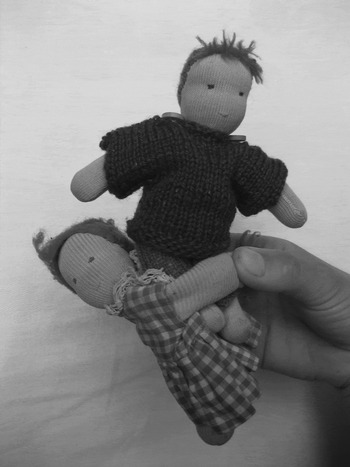
The props were two soft 13 cm tall Waldorf dolls with moveable limbs (see Figure 1).
Waldorf dolls used as act-out props in Study 1.

Procedure
All children were tested individually by the first author in a secluded room in their kindergarten. The experimenter (E) introduced the two dolls as Morten and Lisa and let the dolls shake hands with the children and introduce themselves. E explained that she would tell the child what Lisa and Morten were doing, and that the task for the child was to show this with the dolls. E demonstrated this with three example sentences, one intransitive and two transitive. Then the child tried four intransitive practice sentences, which tested understanding of the act-out task as well as mastering of the relevant personal pronouns. To make sure that the practice sentences would not prime the children to follow an order-, case-, or referent-based strategy, preverbal position signalled agent in two sentences, nominative case signalled agent in two sentences, and the two referents played the agent role twice each. All children acted out the practice sentences without problems and received their first set of target sentences immediately afterwards. E read the target sentences out loud while holding the dolls in her hand so that the children could not begin acting out the sentence meaning before having heard the whole sentence. Positive feedback was given for all responses. Between the sets there was a break of 15–90 minutes. Altogether, the two sessions, including instruction and practice, lasted 3·5–4·5 minutes. All practice and experimental sessions were video-recorded, and after each session E took notes of the children's choices.
Coding and reliability
For every trial, we coded transitive responses as correct if the child made the Nnom-referent perform the action designated by the verb on the Nacc-referent and as reversed if the child made the Nacc-referent perform this action on the Nnom-referent. All trials were coded as either correct or reversed since all clauses were acted out as transitive scenarios, and since it was possible in all trials to decide whom the child chose as agents and patients. Verbs designated actions with easily interpretable agent–patient relationship (‘hit’, ‘kick’, ‘tickle’, ‘stroke’, ‘push’, ‘tip over’, ‘lift’, ‘carry’). For ‘hit’ and ‘kick’, a response was also counted as correct/reversed if children moved the whole doll forcefully towards the other. A few responses with ‘lift’ and ‘carry’ (3 out of 56) were difficult to code because both dolls were in a vertical position at almost the same height with their arms around each other. In these cases, the agent was interpreted as being the one whose arms were under the other's arms and/or whose feet touched the ground. To test coding reliability, 29% of the 224 trials (data from 4 out of 14 children) were independently recoded by a blind second coder who followed a coding manual and saw the videos with sound turned off, thus making agent–patient decisions without knowing which sentences were being acted out. The coders agreed on 100% of the trials.
RESULTS
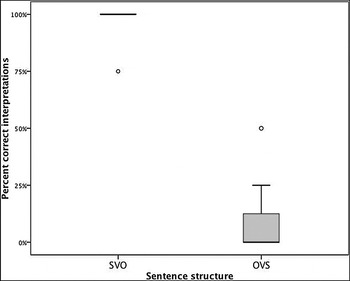
For each child we computed the percentage of correct responses under the two experimental conditions: Nnom as first NP (SVO) and Nnom as second NP (OVS). The results are summarized in a box plot in Figure 2.
Boxplot of individual children's percentage of correct interpretations in the two conditions of Study 1. There was limited variation within the conditions. This shows as identity between several of the quartiles, e.g. between the first, second, and third quartiles in the SVO condition.

Figure 2 shows that the children were more likely to correctly interpret SVO (Mdn = 100%) than OVS structures (Mdn = 0%). There was little variation in the two conditions. Only one child had less than 100% correct interpretations in the SVO condition. In the OVS condition, ten out of fourteen children had no correct interpretations, three children had 1–2 correct interpretations out of 8, and a single child had 4 (50%). The difference between the conditions proved significant in a Wilcoxon signed rank test (T (n = 14) = 0, Z = –3·4, p < ·001). All incorrect responses were reversed act-outs: 104 (93%) out of 112 OVS clauses were performed as SVO clauses; 2 (2%) out of 112 SVO clauses as OVS clauses. It thus appeared that case information made little difference to the choice of agent.
DISCUSSION
Danish four- to six-year-olds appeared to rely exclusively on word order as a cue to agent–patient identity in semantically reversible transitive declarative NVN clauses with pronominal arguments, and they ignored case even though this cue is almost as available and far more reliable in CDS. These preschoolers thus appeared to follow the expected cross-linguistic pattern of overgeneralizing a highly available word-order strategy. This is, however, also a surprising finding. The classical Competition Model explanation that children first attend to the cue that allows them to interpret most exemplars correctly (i.e. the cue with highest overall validity; cf. McDonald, Reference McDonald, MacWhinney and Bates1989) does not account for the comprehension data here since case is a more valid cue than word order in Danish CDS: it would allow children to classify correctly 88% of all transitive clauses in the input, whereas word order would only do the same in 71% of the same material. Study 1 thus replicates a puzzling finding from a German experiment where children aged 4;10 were found to rely more on word order than on case in the comprehension of transitive sentences with conflicting cues, even though case has a higher overall validity than word order (Dittmar et al., Reference Dittmar, Abbot-Smith, Lieven and Tomasello2008, p. 1163). The same finding goes unexplained for Dutch children who in experiments favour word order over case all through childhood and adolescence even though case is a more valid cue in their input (McDonald, Reference McDonald, MacWhinney and Bates1989, pp. 382ff.). Various plausible explanations can be given. One is that children's knowledge of case is not completely abstract, but operates at a lower level, being bound to, e.g. the most frequent pronouns, specific predicate classes, or events with animacy asymmetry. As Dittmar et al., also touch upon (2008, p. 1163), even if children hear many clauses with case, most of these contain first and second person pronouns. Since there is no overlap in Danish between the phonetic marking of accusative in first and second person pronouns vs. third person pronouns, masculine and feminine, the frequent encounters with jeg/mig ‘I/me’ and du/dig ‘you-nom/-acc’ might not count as evidence of a morphological marking of semantic roles also relevant for han/ham ‘he/him’ and hun/hende ‘she/her’, but purely as word-specific role-meaning. A similar reason could be that children's experience with case outcompeting word order was limited to a specific group of predicates such as non-actional experiencer verbs and possession verbs. Such experience might not help them to interpret the constructions with highly actional transitive predicates tested in both our Study 1 and the studies in Dittmar et al. (Reference Dittmar, Abbot-Smith, Lieven and Tomasello2008) and McDonald (Reference McDonald, MacWhinney and Bates1989). Further, children might consider OVS structure to be legitimate only in inanimate–animate clauses where case is supported by animacy, since this was the case in the majority of OVS clauses found in children's input in all three languages.
However, given that OVS at least in Danish is a highly context-demanding structure that even adults have trouble understanding out of context (cf. Kristensen et al., Reference Kristensen, Engberg-Pedersen and Poulsen2014), it is also possible that the difficulties the Danish four- to six-year-olds in this study had with comprehending OVS clauses were actually due to the children's context sensitivity. If children this age are sensitive to discourse constraints, they should indeed be expected to behave poorly when presented with OVS clauses in isolation, since the lack of context makes them discourse-pragmatically infelicitous. The fact that Danish children do not understand OVS clauses in an adult-like manner out of context thus makes those clauses an ideal medium for investigating preschoolers' capacities for integrating morphosyntactic and contextual information in sentence comprehension. Study 2 was therefore devised to test whether children's understanding of these context-sensitive clauses will improve when they are provided with a felicitous context.
STUDY 2
Study 1 showed that Danish preschoolers overgeneralized a highly available word-order strategy and misinterpreted all OVS clauses as SVO clauses. Study 2 investigated whether Danish five- to six-year-olds' comprehension of conflict clauses with OVS structure was facilitated if these challenging clauses were presented in contexts that supported them discourse-pragmatically. The study thus probed preschool children's ability to integrate contextual information with clause-internal morphosyntactic cues in sentence interpretation. To this end, Study 2 examined the comprehension of transitive clauses in four conditions: Two conditions were identical to the ones from Study 1, i.e. OVS in isolation and SVO in isolation, while two new conditions, OVS in supportive context and OVS in unsupportive context, were devised to examine the potential effect of different contexts on OVS comprehension. In summary, Study 2 was aimed at answering the following questions:
1. Do children have more difficulties comprehending OVS clauses in isolation than SVO clauses in isolation (i.e. can we replicate the findings from Study 1)?
2. Is children's comprehension of OVS clauses enhanced by the presence of a suitable context that supports the discourse requirements of OVS?
3. Is children's comprehension of OVS improved by a supportive context compared to an unsupportive context?
As in Study 1, the act-out paradigm was used.
METHOD
Participants
Sixteen monolingual Danish children from the kindergarten north of Copenhagen where Study 1 was conducted were tested (mean age: 5;7, range 5;0–6;3). Half were girls, half boys. None of the children had participated in Study 1.
Design and materials
This experiment employed a 1 × 4 within-subjects design to test children's comprehension of transitive clauses in four conditions:
1. SVO in isolation
2. OVS in isolation
3. OVS in supportive context
4. OVS in unsupportive context
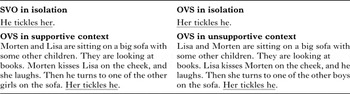
The dependent variable was the number of correct, adult-like responses, i.e. choice of referent of the nominative pronoun, Nnom, as agent. Table 3 shows examples of the stimuli.
Examples of stimuli in the four conditions in Study 2 (translated)

Each child was tested with sixteen experimental items, four from each of the four conditions. The target clauses in all four conditions consisted of a causative present-tense verb and two case-marked third person pronouns (nominative-marked subject pronoun, accusative-marked object pronoun), with stress kept constant, falling on N1 and the verb.
The two isolation conditions, SVO in isolation and OVS in isolation, were similar to the ones in Study 1 and reused their sixteen experimental clauses, i.e. one predication for each of eight causative verbs, presented in two versions: as SVO structure and as OVS structure, again balancing gender and degrees of patient affectedness and agent aggression.
For the two new context conditions, OVS in supportive context and OVS in unsupportive context, eight experimental items were designed, each consisting of a small story and a target sentence. The 23–37 words long context stories related plausible everyday events from Danish children's kindergarten and early school life (playing in the playground sandbox, playing football, etc.), and they all had the same two characters, Morten and Lisa, as main characters. The contexts contained no OVS structures, but intransitive and transitive sentences with SV, XVS, and SVO configurations where the verb arguments were expressed with proper names, full noun phrases, and case-marked pronouns. The target sentences all had OVS structure and were identical to the ones used in the OVS in isolation conditions in both Study 1 and 2 and had the same stress pattern. Each of the eight combinations of context story and target OVS clause were presented in two versions, manipulating topicality and contrast structures between conditions (see below). Supportive and unsupportive versions were distributed on subjects so that each child only heard each story once.
Context manipulation
The central question was whether children have less trouble interpreting an OVS sentence such as ham kilder hun ‘him tickles she’ when it is presented in a supportive context than when it is presented in isolation or in an unsupportive context. Previous studies (Boeg Thomsen & Kristensen, Reference Boeg Thomsen and Kristensen2015; Harder & Poulsen, Reference Harder and Poulsen2001) have suggested that a felicitous context for OVS in Danish:
1. establishes both participants in the OVS clause as given topics: the agent as a stable main discourse topic, the patient as a newly introduced local topic,
2. presents a contrast set (there are exceptions to this requirement, e.g. highly frequent pronominal constructions with mental verbs).
Both topicality and contrast are defined quite differently in different acquisition studies of context effects (cf. Allen et al., Reference Allen, Skarabela, Hughes and Behrens2008). Here, we follow Dik (Reference Dik and Hengeveld1997) in defining as topics all entities that a specific piece of discourse is ‘about’ (i.e. both new topics and given topics) and in regarding topicality as a hierarchical phenomenon: discourses typically contain more discourse topics, which are first introduced and then maintained, e.g. by anaphoric reference, and what is the main discourse topic is interpreted relative to a specific stretch of discourse (1997, pp. 312ff.). In Danish – as in many other languages (1997, p. 316) – new topics are generally avoided in initial position, and the preverbal object-referent in OVS must therefore be an already introduced given topic (or subtopic). So must the postverbal subject-referent, and OVS appears to be felicitous only if the topicality balance between these two given topics sees the postverbal subject-referent as a more stable overall discourse topic than the preverbal object-referent.
As for contrast, we define it as the presence of a set of potential competitor referents in the linguistic or visual context (cf. Allen et al., Reference Allen, Skarabela, Hughes and Behrens2008, p. 112), and the specific type of contrast focus used in our study is Parallel Focus (cf. Dik, Reference Dik and Hengeveld1997, pp. 331–332), where different entities are presented as participating in parallel, but contrasting situations (e.g. A being kissed by X, B being tickled by X).
For each of the eight verbs, a story was therefore constructed with the following discourse-pragmatic structure. Pre-story: Main discourse topics 1 and 2 (two named referents introduced during training and recurring as main characters in all eight stories) participate in a joint activity. Main discourse topic 1 acts on Main discourse topic 2. Main discourse topic 2 leaves the scene or is left by Main discourse topic 1. Main discourse topic 1 encounters/turns to new Local topic (a nameless referent of the same gender as Main discourse topic 2). Target clause: Main discourse topic 1 acts on Local topic in an event paralleling the action performed on Main discourse topic 2, thus giving Local topic the contrast role of Parallel Focus. An example of an OVS clause with kilde ‘tickle’ in supportive context can be seen in (1), and the seven other stories can be found in ‘Appendix B’.
(1) OVS in supportive context
Morten og Lisa sidder i en stor sofa med nogle andre børn. De kigger i bøger. Morten kysser Lisa på kinden, og hun griner. Så vender han sig om til en af de andre piger i sofaen. ‘Hende ‘kilder han.
‘Morten and Lisa are sitting on a big sofa with some other children. They are looking at books. Morten kisses Lisa on the cheek, and she laughs. Then he turns to one of the other girls on the sofa. Her tickles he.’
To compare OVS comprehension in supportive and unsupportive contexts, we constructed another set of unsupportive context stories for the exact same target sentences. The unsupportive context stories were syntactically identical to the supportive versions, and the wordings changed only minimally: if the male character Morten had been the main discourse topic in the supportive version (as in (1)), the female character Lisa would be the main discourse topic in the unsupportive version, and if the new local topic had been a nameless female figure, it would be switched to a nameless male figure, as in (2):
(2) OVS in unsupportive context
Lisa og Morten sidder i en stor sofa med nogle andre børn. De kigger i bøger. Lisa kysser Morten på kinden, og han griner. Så vender hun sig om til en af de andre drenge i sofaen. ‘Hende ‘kilder han.
‘Lisa and Morten are sitting on a big sofa with some other children. They are looking at books. Lisa kisses Morten on the cheek, and he laughs. Then she turns to one of the other boys on the sofa. Her tickles he.’
Except for the gender alteration, which was balanced across items, the only difference between the supportive and the unsupportive contexts was discourse-pragmatic: in the unsupportive versions, it was the patient of the OVS predication that was the main discourse topic of the story, whereas the agent was the newly introduced local topic. Further, the OVS patient was presented as part of a contrast set in the supportive version, but not in the unsupportive version.
Experimental sets and presentation
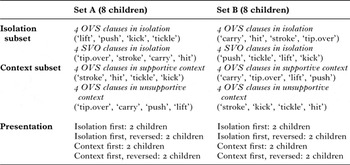
In all four conditions, the eight causative verbs from Study 1 were reused, each child encountering each verb twice: once in a context condition and once in an isolation condition. For the isolation conditions, the eight target predications were presented as both OVS and SVO clauses, and the resulting sixteen items were distributed in two sets (A and B), balancing agent gender set-internally. For the context conditions, the eight target OVS clauses were presented in both supportive and unsupportive context, and the resulting sixteen items were distributed in set A and B, balancing agent gender set-internally. The children were assigned to two groups of eight receiving either set A or B. Table 4 schematizes the two sets and the distribution of children on different presentation lists.
The two experimental sets and the number of children receiving each type of presentation list (within each subset the eight clauses are mixed)

For each subset, a pseudo-random presentation order was generated, and within a group, half of the children received the experimental items in reversed order. We were worried that mixing items from the context and isolation conditions would blur out any potential effect of context because encountering isolated target clauses in among the longer narratives would be artificial and might prevent children from treating the stories as coherent wholes and employing their natural comprehension strategies. The subset with isolation conditions and the subset with context conditions were therefore presented separately with a 45-min. break in between. Since children this age are known to be prone to syntactic priming effects (Savage, Lieven, Theakston & Tomasello, Reference Savage, Lieven, Theakston and Tomasello2003), it was possible that receiving the isolated conditions first would induce children to follow a word-order strategy (as the children in Study 1 had done in the same conditions), which might prime them to attend more to word order than to case in the rest of the experiment. Conversely, receiving the context conditions and thus experiencing OVS in appropriate discourse contexts first might induce children to attend more to case also in the rest of the experiment. We therefore gave half of the children in each group (A and B) the subsets with isolation conditions first, the other half the subsets with context conditions first. The mean age of the two groups receiving either condition first was the same (context-first: 5;7; isolation-first: 5;7). All in all, distributing children in each of the two sets A and B and balancing item order (half: reversed order) and subset order (half: context-first) meant that two children (a boy and a girl) received each specific presentation list.
The props were the same two dolls as in Study 1, supplemented with two dolls of the same kind, differing from the first pair by colour of hair and clothes.
Procedure
Study 2 was conducted under the same conditions as Study 1. For the first subset, all sixteen children were given the same presentation, demonstration, and training as in Study 1. Again, all children performed the training sentences without problems. For the context-condition subset, an additional presentation including a training sentence was added: the two new dolls were pointed out after the presentation of Lisa and Morten, but they were not presented with names, and they did not say hello to the children because they were not allowed to compete with the two main characters for being ‘the ones the stories were about’. E then explained that she would now tell some small stories that she would perform with the dolls, but that she would not act out the last sentence. Instead, she would hand over the dolls to the child who was then supposed to act out this last sentence. Then all children heard and saw one single training story that resembled the experimental stories in involving both of the two main characters and an anonymous third person, but where the target sentence that the child was to perform was an intransitive clause with XVS structure. No child exhibited any difficulties with training items so all children proceeded to the experimental eight-item set immediately after.
All together, the two subset sessions, including instruction and practice, lasted 5·75 minutes on average (range: 4·75–6·50 minutes), and no child displayed signs of fatigue. This time, however, some children asked questions such as “Who am I supposed to push?” or “Is he the one who lifts her?”, in answer to which E just repeated the target clause (“him pushes she” and “her lifts he”). If children's responses to clauses with bære ‘carry’ or løfte ‘lift’ were difficult to interpret immediately, E said “Put the arms well around so that one can see it”. Again, the children got encouraging feedback in response to all performed sentences. All practice and experimental sessions were video-recorded, and after each session E took notes of the children's choices.
Coding and reliability
For every trial, we coded transitive responses as correct if the child made the Nnom-referent perform the action designated by the verb on the Nacc-referent, and as reversed if the child made the Nacc-referent perform this action on the Nnom-referent. Again, all trials were coded as either correct or reversed since all clauses were acted out as transitive scenarios, and since it was possible in all trials to decide whom the child chose as agent and patient. Decisions were made on the same criteria as in Study 1. A blind second coder recoded 25% of the 256 trials (data from 4 out of 16 children), and the two coders agreed on 97% of the trials.
RESULTS
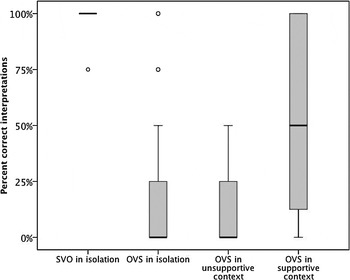
The main questions were whether children would again show impaired comprehension of isolated OVS structures, and whether embedding these structures in a suitable context would make children more likely to follow an adult-like strategy of correctly assigning agent role to the referent of the nominative-marked second NP, Nnom. For each child under each condition we computed the percentage of correct interpretations, i.e. choices of the Nnom referent as the agent. Figure 3 presents a box plot of these scores for each condition. All incorrect responses were reversed act-outs.
Boxplot of individual children's percentage of correct interpretations in the four conditions of Study 2. There was limited variation within most of the conditions. This shows as identity between several of the quartiles, e.g. between the first and the second quartiles in the OVS in isolation and unsupportive context conditions.

Our first question was whether children would have more difficulties comprehending OVS clauses in isolation than SVO clauses in isolation. As can be seen in Figure 3, this was the case: the children gave significantly more correct responses in the SVO in isolation condition (Mdn = 100%) than in the OVS in isolation condition (Mdn = 0%) (Wilcoxon signed rank test: (T (n = 15) = 0, Z = 3·50, p < ·001). Since all incorrect answers were reversed act-outs, this means that the children predominantly relied on word order for semantic role assignment. Children acted out the majority of isolated clauses as SVO clauses whether they were case-marked as SVO clauses or as OVS clauses, ignoring case cues and depending on ordering of arguments for semantic role assignment.
Having established that the children in Study 2 also had trouble comprehending isolated OVS clauses, we examined whether children's comprehension of OVS clauses would be enhanced by the presence of a suitable discourse context. This turned out to be the case. The children were significantly more likely to correctly interpret OVS clauses in the supportive context condition (Mdn = 50%) than in the isolation condition (Mdn = 0%) (T (n = 9) = 0, Z = 2·69, p = ·007). Thus, hearing the OVS structure in a supportive context facilitated OVS interpretation.
Next, we compared the children's performance in the OVS in supportive context and OVS in unsupportive context conditions to determine whether the children were sensitive to the specific contextual requirements of the OVS construction or whether context in general facilitated OVS interpretation. The children made significantly more correct OVS interpretations in the supportive context condition (Mdn = 50%) than in the unsupportive context condition (Mdn = 0%) (T (n = 10) = 0, Z = 2·83, p = ·005). This result indicates that the five- to six-year-olds in Study 2 are sensitive to the specific contextual topicality and contrast structures that make OVS structures felicitous, not just to the presence of a discourse context per se.
We might ask whether the unsupportive contexts which directly privileged SVO interpretation even made children attend less to case and have more difficulties understanding OVS clauses correctly that in isolation. Our results do not yield clear answers to this question. Many children were equally poor at comprehending OVS clauses in these two non-supportive conditions, a few were more successful in the isolation condition, and a few more so in the unsupportive-context condition.
As can be seen in the box plot in Figure 3, there was substantial variation in the supportive-context condition. We suspect that much of this variability was due to experiment-internal priming effects. We gave half of the children the subset with the two isolation conditions first and the other half the subset with the two context conditions first to control for possible ordering effects. It turned out that the order of presentation made a difference. The children made significantly more correct answers to OVS sentences when context was presented first compared to last in both isolation (Mdn = 25% vs. 0%) (U = 10·5, Z = 2·51, p = ·012) and supportive context (Mdn = 88% vs. 13%) (Mann–Whitney U = 10·5, Z = 2·34, p = ·02). A possible explanation is that for the ‘context-first’ children the attention to case cues furthered by encountering OVS clauses in their appropriate contexts spilled over to the isolation condition. Conversely, ‘isolation-first’ children may have been primed to attend to word order and ignore case by first acting out inappropriate isolated OVS clauses as SVO clauses.
Finally, it should be noted that even if the presence of an appropriate discourse context facilitates OVS comprehension in five- to six-year-olds, it does not generally make them perform at the same level as with SVO clauses. Comparing OVS in supportive context with SVO in isolation, the children gave significantly fewer correct responses in the former condition (T (n = 11) = 0, Z = –2·98, p = ·003). Even allowing for experiment-internal priming effects, this suggests that context-sensitivity does not explain all children's difficulties with conflict clauses where word order and case compete.
Individual differences
In the SVO condition, all children gave the maximum of four correct answers, except for one subject who gave three. In the three OVS conditions, on the other hand, there was much variability in children's responses. Much of this response variability apparently stemmed from the experiment-internal priming effects suggested above. With only four items per condition per child, the data are not suited for reliable analyses of individual differences, but to provide an overview of tendencies in the variable response patterns, we sort subjects into three groups:
No context effect. Six children evidenced no sensitivity to contextual modulation, giving an equal number of correct responses (0–2) in each of the three OVS conditions. Four of these children did not give a single correct OVS response, and they had all received the isolation conditions before the context conditions.
All of the ten remaining children followed the predicted pattern of being better in the supportive-context condition than they were on average in the two other conditions. No child performed better in any other OVS condition than in the supportive-context condition. The ten context-sensitive children can be divided in two groups:
Positive effect of supportive context. Five children all gave 1–3 more correct responses in the supportive-context condition than in each of the other two OVS conditions, i.e. they evidenced sensitivity to the contextual modulation. However, they still evidenced some uncertainty in the supportive condition, giving 1–3 SVO responses even here.
Ceiling performance with supportive context. Five children were at ceiling in the supportive-context condition, interpreting four out of four OVS clauses correctly, and thus performing equally well with OVS clauses in supportive context as with SVO clauses. Four of these five children had received the context conditions first.
DISCUSSION
Like the four- to six-year-olds in Study 1, the five- to six-year-olds in Study 2 had severe problems understanding doubly case-marked OVS clauses in isolation. The vast majority of these clauses were performed as SVO clauses, indicating that children followed a word-order strategy and ignored case. When OVS clauses were presented in a supportive context, however, children's comprehension was significantly enhanced. Preschoolers thus appear to be able to integrate morphosyntactic cues with cues from the discourse context in the task of assigning semantic roles in sentence comprehension. This finding also makes it plausible that part of the explanation for children's poor performance with OVS clauses in isolation is that lack of an appropriate discourse context decidedly counts as a cue against OVS interpretation. That children are sensitive to the specific discourse demands of the Danish OVS structure (the agent ranging higher than the patient on a topicality scale, presence of a contrast set) and do not just take the presence of any discourse context as a support for OVS interpretation is also supported by Study 2: children were significantly better at understanding OVS clauses in the supportive contexts than in the unsupportive contexts which contained exactly the same words and sentence structures, and where only topicality and contrast structures differed between the conditions.
In general, Study 2 revealed much variability in children's responses to different conditions, and six out of sixteen children did not evidence sensitivity to contextual modulations in their interpretations of OVS clauses. It is possible that these children were also less attentive to context in their daily lives, but for four of these children, giving no correct OVS responses at all, it is also possible that experiment-internal priming effects account for their absolute adherence to a word-order strategy.
GENERAL DISCUSSION
In languages that allow both subject-first and object-first structures, with the first being more frequent, children have been found to misinterpret object-first clauses as subject-first clauses (Chan et al., Reference Chan, Lieven and Tomasello2009; Dittmar et al., Reference Dittmar, Abbot-Smith, Lieven and Tomasello2008; Hakuta, Reference Hakuta1982; McDonald, Reference McDonald, MacWhinney and Bates1989; Slobin & Bever, Reference Slobin and Bever1982).
Study 1 replicates these findings with Danish children: The four- to six-year-olds misinterpreted virtually all OVS clauses as SVO clauses, following an order strategy and ignoring case, in spite of the fact that OVS is no rare structure in their input: it occurs in 37% of NVN sequences in CDS. An explanation in terms of word order being a more valid cue, the one allowing children to interpret most exemplars (McDonald, Reference McDonald, MacWhinney and Bates1989), is untenable, for in Danish CDS case is by far the most valid cue even though it is only marked on a handful of personal pronouns.
Danish OVS is a highly context-sensitive structure (Boeg Thomsen & Kristensen, Reference Boeg Thomsen and Kristensen2015; Harder & Poulsen, Reference Harder and Poulsen2001). The results from Study 1 could therefore be explained by different models of children's discourse capacities: either preschoolers do not yet have the pragmatic skills to understand the OVS clauses when they encounter them, whether in experimental settings or in real life, or, on the contrary: children are sensitive to discourse context and miscomprehend OVS clauses when they are presented in isolation exactly because lack of supportive context makes the clauses discourse-pragmatically infelicitous.
Study 2 demonstrated that Danish preschoolers were significantly better at interpreting OVS clauses in supportive contexts than in both isolation and unsupportive contexts. That is, five- to six-year-olds proved to be able to override their strong preference for assigning agent role to the accusative-marked first NP only if the preceding discourse established both referents as given topics (the agent of the OVS clause as a stable discourse topic, the patient of the OVS clause as a new local topic) and presented a contrast set. Since children were thus able to choose the nominative-marked second-NP referent in supportive contexts, they must be aware of case as a cue to semantic role assignment – which is unsurprising given its high cue validity in CDS. However, their knowledge of case as an independent morphosyntactic cue appears to be in a weak initial state of development where they are only able to utilize it in the specific discourse contexts where it could be expected to play a disambiguating role in their input. This sensitivity to contextual modulation makes it plausible that it is the combination of children's still fragile representation of case and the discourse-pragmatic infelicity of OVS clauses in isolation that accounts for children's immature responses in Study 1 – possibly in combination with other features such as lexical bias and animacy expectations.
Together, the two studies support the hypothesis that five- to six-year-olds integrate contextual and morphosyntactic information in assigning semantic roles in transitive clauses. At the same time, these findings challenge the traditional hypothesis that children's difficulties with clauses with conflicting cues are due to their immature discourse-pragmatic skills, specifically to their poor ability to take the context into account (Bates & MacWhinney, Reference Bates, MacWhinney, MacWhinney and Bates1989; Chan et al., Reference Chan, Lieven and Tomasello2009; Hakuta, Reference Hakuta1982; Slobin & Bever, Reference Slobin and Bever1982). In the many earlier experiments where children have overgeneralized a word-order strategy and misunderstood object-first clauses, the presentation of clauses in isolation may not have counted as a neutral presentation context, but as one categorically disfavouring context-demanding structures (cf. Altmann & Steedman, Reference Altmann and Steedman1988, on the problems with assuming null contexts to be neutral).
That preschoolers can generally be expected to be able to monitor features of the discourse context at this age is supported by studies of children's development of strategies for other linguistic tasks, such as argument realization (Allen et al., Reference Allen, Skarabela, Hughes and Behrens2008), pronoun interpretation (Song & Fisher, Reference Song and Fisher2005) and prepositional-phrase attachment (Hurewitz, Reference Hurewitz2001). Here, children have already been found to attend to, e.g. contrast and topicality and to utilize their global understanding of the discourse context in sentence comprehension. Our results extend these findings by indicating that five- to six-year-olds are also able to use such understanding in the complex and fundamental task of assigning the basic semantic roles of agent and patient, as also made likely by a study of German preschoolers' OVS comprehension (Grünloh et al., Reference Grünloh, Lieven and Tomasello2011). Whether children are only able to utilize cues from the discourse context for semantic role assignment in clauses with conflicting cues, or whether they can also find support in the visual context, is unclear from our study where we have only examined discourse effects. Many comprehension experiments have shown that kindergarteners have poorer abilities than adults to use cues from the visual context in decisions on PP attachment (e.g. Kidd & Bavin, Reference Kidd and Bavin2005; Trueswell, Sekerina, Hill & Logrip, Reference Trueswell, Sekerina, Hill and Logrip1999), and also for choices of argument realization young children appear to be able to use discourse cues in a mature manner before they are able to do so with perceptual cues (Matthews, Lieven, Theakston & Tomasello, Reference Matthews, Lieven, Theakston and Tomasello2006).
Further, our single-age experiment does not reveal when the ability to use a supportive discourse context in comprehending clauses with conflicting formal cues emerges. We will thus need experiments with younger children to test whether this ability is a new developmental achievement for the five- to six-year-olds or whether it plays a stable part in semantic role assignment from children's first encounters with object-first clauses.
In any case, our results suggest that Danish children only begin to rely on the highly important formal cue case, independent of its usual cue-convergence companion animacy, when they comprehend the specific type of context where it could be expected to play a disambiguating role. That is, context-pragmatic skills do not just come into the picture as refinement on top of a perfect system of formal cues, and they are not just something that mature language users draw on when ambiguity is in the offing. On the contrary, the ability to monitor, e.g. topicality and contrast structures may be central to language users' acquisition of morphosyntactic signals in the first place.
APPENDIX A
Test items for Study 1

(' indicates stress)
APPENDIX B
Test items for Study 2 (only supportive context-condition)
Lisa og Morten går en tur. Lisa løfter Morten og giver ham en svingtur. Så går Morten hjem, og Lisa går videre. Lidt efter møder hun en anden dreng, der driller og spærrer vejen for hende. ‘ham ‘skubber hun.
‘Lisa and Morten go for a walk. Lisa lifts up Morten and swings him around. Then Morten goes home, and Lisa walks on. Shortly afterwards, she meets another boy who teases and blocks her way. Him pushes she.’
Morten og Lisa leger fangeleg på legepladsen. Morten løber efter Lisa og fanger hende. Så springer han efter en af de andre piger. ‘hende ‘vælter han.
‘Morten and Lisa are playing tag in the playground. Morten runs after Lisa and catches her. Then he jumps after one of the other girls. Her tips he over.’
Lisa og Morten tumler rundt på madrassen med deres venner. Lisa triller Morten ud over kanten. Så kravler hun over til en af de andre drenge. ‘ham ‘løfter hun.
‘Lisa and Morten are romping about on the mattress with their friends. Lisa rolls Morten over the edge. Then she crawls over to one of the other boys. Him lifts she.’
Morten og Lisa løber rundt i skoven. Morten trækker Lisa med hen til sin hemmelige hule og sætter hende der. Så finder han en af de andre piger. ‘hende ‘bærer han.
‘Morten and Lisa are running around in the wood. Morten pulls Lisa along to his secret den and puts her there. Then he finds one of the other girls. Her carries he.’
Lisa og Morten leger i sandkassen. Lisa kaster sand på Morten. Han bliver sur, så Lisa går hen til en anden dreng, der sidder i sandkassen. ‘ham ‘aer hun.
‘Lisa and Morten are playing in the sandbox. Lisa throws sand on Morten. He gets angry so Lisa walks over to another boy sitting in the sandbox. Him strokes she.’
Morten og Lisa sidder i en stor sofa med nogle andre børn. De kigger i bøger. Morten kysser Lisa på kinden, og hun griner. Så vender han sig om til en af de andre piger i sofaen. ‘hende ‘kilder han.
‘Morten and Lisa are sitting on a big sofa with some other children. They are looking at books. Morten kisses Lisa on the cheek, and she laughs. Then he turns to one of the other girls on the sofa. Her tickles he.’
Lisa og Morten skændes om en cykel. Lisa river Morten i håret, han råber av, og Lisa løber væk. En af Mortens venner styrter efter hende. ‘ham ‘slår hun.
‘Lisa and Morten are fighting over a bike. Lisa pulls Morten's hair, he shouts ouch, and Lisa runs away. One of Morten's friends races after her. Him hits she.’
Morten og Lisa spiller fodbold på engen. Morten maser sig forbi Lisa med bolden. Så står en af de andre piger i vejen. ‘hende ‘sparker han.
‘Morten and Lisa are playing football on the meadow. Morten pushes his way past Lisa with the ball. Then one of the other girls stands in his way. Her kicks he.’