

Introduction
Does resource wealth affect civil society? If so, how? Does it lead to complacency and political inactivity or does it provoke popular protests? So far, these questions have mainly been addressed in single-case studies only. Larger-scale comparative analyses instead tend to focus on the effects of resource wealth on either high-level violent conflict, or on different aspects of socioeconomic development and poor governance (Collier and Hoeffler, Reference Collier and Hoeffler2004; Pendergast et al., Reference Pendergast, Clarke and Van Kooten2011; Ross, Reference Ross2001).Footnote 1 While this literature advanced explanations on the actions of violent rebel groups or corrupt politicians, the “ordinary” population is often either sidelined or portrayed as merely reactionary. In particular, several studies argue that resources lead to the depoliticization of society and the appeasement of civil conflict as the windfalls associated with resource wealth improve local services while reducing the tax burden and, in effect, citizens’ demand for the democratic accountability of their politicians (Girod et al., Reference Girod, Stewart and Walters2016; Karl, Reference Karl2007; McGuirk, Reference McGuirk2013).
This paper, in contrast, draws attention not to an instance of depoliticization and appeasement of contention but of politicization, specifically, local mobilization and protest. In a highly disaggregated statistical analysis we study local protest dynamics in Bolivia and argue for a political conditioning of the so-called resource curse, in the sense that resource wealth sparks disputes over extraction and rent redistribution at the local level, especially where the population is split into a variety of political interests. In contrast, where the population is relatively united in their political views, significantly fewer protests occur.Footnote 2
The paper's contributions are threefold. First, it develops our theoretical argument of contentious politicization and local collective action in the context of natural resource extraction. Second, it engages in a detailed subnational analysis, which, in contrast to cross-country studies, does not conceal regional variation and hence allows for a more accurate representation of the resource–protest link. At the same time, third, the paper complements the descriptive detail from qualitative studies on Bolivia by developing a more general understanding of the factors that shape local resource-related protest dynamics.
Bolivia is a well-suited and interesting context for such an analysis. The country is highly dependent on the production and export of natural resources. Natural gas presents the most important export commodity of the national economy and, in absolute numbers, gas production has increased from 11.9 billion cubic meters in 2005 to 20.8 in 2013 (British Petroleum Company, 2014). In addition, Bolivia has experienced a high degree of political mobilization in the recent past (for example, Moseley, Reference Moseley2015; Webber, Reference Webber2011), but the level of protests has varied substantially across communities. For example, in the gas-producing department of Santa Cruz, the province of Cordillera saw 18 conflicts in 2008, while only one conflict was recorded in the province of Ñuflo de Chavez (for details about the conflict measurement, see below). That is, factors other than resource occurrence are likely to shape protest dynamics.
The paper is structured as follows. Section two critically reviews the literature on the political determinants of the resource curse and presents the central theoretical arguments and hypotheses examined in this paper. The third section provides a short descriptive overview of the dynamics of resource extraction and local contentious collective action in Bolivia and outlines our methods and variables. Section four presents the results of our empirical analysis and discusses these findings against the backdrop of previous research. The conclusion highlights several contributions of these new insights for the broader debate on natural resources and contentious collective action.
Resource Wealth and Local Contentious Action
The consequences of resource wealth have been extensively discussed in both economic and political terms, and the observation that resource wealth coincides with low levels of economic development, poor governance and violent conflict has been termed “resource curse.” Recent studies on the resource curse have begun to systematically analyze the impact of contextual factors that potentially condition the impact of (high-value) natural resources on conflict—or its absence (Le Billon, Reference Le Billon2012; Ross, Reference Ross2012; Sorens, Reference Sorens2011). The vast majority of these studies focuses on civil wars and other types of high-level violent conflict but neglects a more fine-grained analysis of political factors beyond the broad effects of national democratic institutions.
Another strand of literature, drawing on arguments of rentier state theory (Beblawi and Luciani, Reference Beblawi and Luciani1987; Mahdavy, Reference Mahdavy and Cook1970), does touch upon the effect of resource wealth on civil society, and argues that in the presence of resource rents, governments are able to appease the broader population by increasing spending on patronage and public goods while decreasing the tax burden on the population (Karl, Reference Karl2007; Ross, Reference Ross2001). As a consequence, citizens are less likely to hold their politicians accountable, either at the ballot box or through protests in the streets. To date, only a few studies have examined this depoliticization hypothesis empirically. McGuirk (Reference McGuirk2013) uses Sub-Saharan African survey-level data to show that resource rents are associated with perceptions of smaller tax burdens, which in turn are associated with decreased demands for democratic accountability—and possibly fewer local protests. In an Indonesian field experiment, Paler (Reference Paler2013) finds that taxation, but not windfall from resource extraction, motivates participants to monitor public spending and hold government accountable over wasted revenues. Accordingly, resource wealth should be associated with a depoliticized civil society and hence with fewer local protests.
Such findings are not uncontested, however. Recent studies argue that resource wealth does not always lead to depoliticization but may instead result in politicization in the sense of increased local contentious collective action. First, local communities might protest explicitly against resource extraction as they are suffering from the direct negative externalities associated with it, in particular, ecological damages, health problems or human rights violations. The existence of such externality-related grievances as a driver of local protest is detailed in various single-case studies on resource-producing areas in Bolivia and beyond (Bebbington and Bury, Reference Bebbington and Bury2013; Perreault, Reference Perreault2008; Watts, Reference Watts2008). For example, Perreault (Reference Perreault2008) finds that particularly water and air pollution have played an important role in triggering local indigenous protests against natural gas extraction activities. Similarly, Bebbington and Bury (Reference Bebbington and Bury2013) explain indigenous contentious mobilization in gas extracting regions with local dispossession, mainly concerning land and water resources.
Second, local communities may protest in order to make their demands for rent redistribution heard. This “greed” argument is particularly prevalent in the literature on violent conflict, where militant groups mobilize strategically to obtain access to resource revenues (for example, Basedau et al., Reference Basedau, Mähler and Shabafrouz2014; Collier and Hoeffler, Reference Collier and Hoeffler2004), but it may also be translated to low-level contentious action. Local interest groups consider the government as a “honey pot” of rents (Di John, Reference Di John2007; Karl, Reference Karl2007) and mobilize strategically to pressure politicians into spending higher shares of the resource revenues in their region or on their interests. Protests arise in different regions independently of whether the resources are exploited in these regions or not. This kind of local contention should be especially high when a large part of the resource revenues is allocated to the local governments and these local governments play a role in the governance of the resources. This is indeed the case in Bolivia, where under the government of president Evo Morales, today around 55 per cent of the gas revenues are directly transferred to subnational governments and to universities (Haarstad, Reference Haarstad2014).Footnote 3
Externality-related grievances and rent-induced greed are not mutually exclusive in driving contentious action. Arellano-Yanguas (Reference Arellano-Yanguas2011) as well as Ponce and McClintock (Reference Ponce and McClintock2014) show that in Peru, both the negative externalities of resource extraction and demands over revenue redistribution provoke protests. Similarly, Schilling-Vacaflor and Kuhn (Reference Schilling-Vacaflor, Kuhn and Foundation2015) show that Bolivian indigenous communities in consultation processes over new gas projects are rarely opposed outright to the projects, but rather aim to secure benefits such as compensation or employment. We can summarize these arguments with two related hypotheses on the effect of high-value resources.
H1:
High-value resource extraction increases local conflict.
a. The presence of gas extraction sites leads to a higher number of contentious events as the local population protests against negative externalities of resource extraction.
b. Resource revenues redistributed to the provinces—no matter whether each province “produces” these revenues itself or not—are associated with higher numbers of local protest events where protesters voice their demands for these revenues.
Resource wealth and interest heterogeneity
Recent studies in the Peruvian context go a step further, suggesting that when and where greed or grievances escalate into contentious action, it is mediated by political factors, specifically by the local government itself. Rather than working to decrease political participation, as in the depoliticization hypothesis outlined above, corrupt or incompetent governments draw the scorn of the population. For example, Ponce and McClintock (Reference Ponce and McClintock2014) show that where revenues are not used for the public good but wasted due to incompetence or fraud, protest activity is high. Where, however, local administrations spend the available revenues effectively to meet citizens’ demands, protests are rare or inexistent. This argument is supported by Bland and Chirinos (Reference Bland and Chirinos2014), who find that dissatisfaction with government performance is a major driver of contentious action in Peru. Arce (Reference Arce and Foundation2015) holds that where local legislative fractionalization is higher and hence accountability and responsiveness to collective demands lower, levels of conflict are higher than in localities with lower levels of fractionalization. That is, local administrations' government performance directly affects the number of protests in the locality.
We follow these recent studies and argue that political factors must be taken into account when considering the link between high-value natural resources and protest behaviour. However, in contrast to these studies, we argue that it is not only the local administrations’ ability—or indeed willingness—to distribute the revenues that mediates the relationship between resource wealth and contentious action, but that diverging interests among the local population drive protest.
While previous studies focus on the relationship between local communities as a whole and their politicians, we argue that local communities are rarely homogenous: internal differences and disputes are common, especially between community members of different cultural or socioeconomic backgrounds and political values. In the context of resource extraction, some may be more interested in the preservation of land while others may seek to benefit from associated jobs or revenues (Bebbington et al., Reference Bebbington, Bebbington, Bury, Lingan, Muñoz and Scurrah2008; Conde and Le Billon, Reference Conde and Billon2017). And even where communities are widely in favour of resource extraction, they may disagree on the question of how the revenues should be spent. Hence, the more interests diverge, the more groups of actors may be motivated to engage in demonstrations, strikes or even riots to get their demands heard, either in proactive protests directly aimed at politicians or in counter-protests to other interest groups. This theoretical argument is exemplified with numerous instances in our dataset on local contention in Bolivia, where demonstrations of one interest group evoke the protest of multiple other, politically opposed groups, such as protest marches for and against the resignation of local political actors, or simply demonstrations for or against municipal political projects. Contentious collective actions should hence increase the more interest groups are present.
The argument itself is by no means novel; literature on political action more generally highlights the importance of political values and preferences for political action and related conflict dynamics at the individual level (for example, Chong, Reference Chong1996; Inglehart, Reference Inglehart, Dalton and Kuechler1990), while literature on social movements emphasizes that different values and principles promote the formation of different movements (for an overview, see Della Porta and Diani, Reference Della Porta and Diani2006). However, the vast majority of political action studies focus on micro-level attributes that may drive individuals to participate in protest action, such as their position on the left–right scale or the extent of their postmaterialist values (Inglehart, Reference Inglehart, Dalton and Kuechler1990; Jakobson and Listhaug, Reference Jakobson, Listhaug, Dalton and Welzel2014). Existing social movement studies, in turn, tend to focus on common sets of motives in the sense of ideological values or interests that bring groups together for collective action (Oberschall, Reference Oberschall1993; Zald, Reference Zald2000). To our knowledge, no study, especially in the context of resource extraction, has examined the higher-level attribute of differences in interests for the occurrence of contentious action in a large-n analysis. We endeavour to do so here. We use the fortunate coincidence of municipal elections just prior to our period of analysis in Bolivia to obtain a novel measure of interest diversity at the local level. The 2004 municipal elections had a very low registration threshold, assuring that many, if not all, latent interests were represented on the ballot, not only through political parties, but also through community organizations and different local interest groups.Footnote 4
While differences in political interests and values in themselves might not be enough to overcome the collective action problem (see Della Porta and Diani, Reference Della Porta and Diani2006), they may exacerbate protest where other motives for mobilization are already present. In summary, we hypothesize that:
H2
The link between resource revenues and contentious action is particularly pronounced in provinces where the number of interest groups is higher, as the interaction adds further individual-level motive for protest participation.
Methods and Operationalization
Subnational analysis
To test our hypotheses we engage in a highly disaggregated subnational comparative analysis. Using subnational rather than national-level data offers several advantages (Snyder, Reference Snyder2001). First, subnational analysis increases the number of available observations and hence the reliability of statistical inference (King et al., Reference King, Keohane and Verba1994). To illustrate, examining the political resource curse in 112 Bolivian provinces offers more observations than doing so in, for example, 20 Latin American countries. Second, subnational units are embedded in the same political socioeconomic and demographic context. Macro-level context conditions that may affect the risk of local conflict can be held constant, which allows for a more precise isolation of the explanatory variables. Third, subnational analysis offers more reliable data because it can account for the spatially uneven occurrence of phenomena that are often concealed in national-level data. This is especially important in the analysis of the political resource curse since both natural resource wealth and protest behaviour tend to be rare and unevenly distributed (Buhaug, Reference Buhaug2005). Using national averages runs the risk of committing an ecological fallacy (see also Lujala, Reference Lujala2010). Finally, subnational data offer greater comparability. Protest events but also resource occurrence and in particular interest heterogeneity are difficult to measure, especially if many different types of activities or different interests and values need to be aggregated at the national level. In contrast to national-level data that are often compiled from a variety of sources using different methodologies in data collection, subnational data are available from a single source, which reduces non-random measurement error (Jones, Reference Jones1997).
Bolivia is well-suited to test the hypotheses due to the high importance of resources, the high levels of internal conflicts and—methodologically—the existence of highly disaggregated data on interest heterogeneity. First, natural resource extraction plays an important role in the Bolivian economy: since the end of the 1990s, natural gas production and export has become increasingly important. Gas production now accounts for 46 per cent of the total Bolivian exports (United Nations Statistics Division, 2016). Of Bolivia's nine departments, the central areas of natural gas exploitation are in Tarija and Santa Cruz and in several provinces in Chuquisaca and Cochabamba. Moreover, especially after the re-nationalization of the hydrocarbon sector in 2006 by the Morales government, revenues from the gas sector have risen significantly.
Second, Bolivia has been experiencing high levels of local conflicts in the past decades, despite its profitable resource extraction industry. Evia and colleagues (Reference Evia, Laserna and Skaperdas2008) report that social conflicts in Bolivia skyrocketed from the late 1990s, more than tripling between 1998 and 2005. The actions were initiated by a variety of actors, from indigenous organizations to construction workers and public employees, and are now more disruptive than before, taking the forms of sit-ins, strikes or blockades. Two presidents were forced to resign, one in 2003 and 2005, respectively. In 2006, Morales became the first indigenous president in the history of the country. His presidency, which is characterized by political and economic transformation, has likewise been accompanied by a high level of internal conflicts, particularly in the form of protests, strikes and (road) blockages, as well as different forms of local anti-governmental collective action, though, fortunately, so far at rather low levels of violence. There are some valuable qualitative, mostly subnational conflict analyses within the country-specific literature (Barndt, Reference Barndt2012; Humphreys Bebbington and Bebbington, Reference Humphreys Bebbington and Bebbington2010; Eaton, Reference Eaton2007), which present evidence that natural resources, especially gas, might be a major driver of social conflicts in Bolivia. However, due to the lack of comprehensive empirical data on local conflicts in Bolivia, the conflict dynamics have hardly been analyzed in a systematic disaggregated manner.
Finally, Bolivia provides a methodologically useful context for the analysis of local political interest heterogeneity. Shortly before our period of interest (2006 to 2009), it held local elections with unprecedented low registration hurdles: entering the electoral race required signatures equivalent to only 2 per cent of the valid votes in the previous elections, or a minimum of five signatures (Congreso Nacional de Bolivia, 2004). That is, any potential interest group existing in each municipality was likely to register, giving us access to unrivalled data on political interest heterogeneity at the local level. In Bolivia's 326 municipalities, 415 different political organizations entered the elections in 2004, with up to 21 organizations per municipality (raw data from Romero Ballivián, Reference Romero Ballivián2005).
The dependent variable
As outlined above, detailed data on internal conflicts in Bolivia are rare. To fill this gap, we rely on a new comprehensive data set, created by one of the authors and colleagues (for more details see Mähler and Pierskalla, Reference Mähler and Pierskalla2015). Data sources of the conflict dataset are the narrative “conflict chronologies” of CLACSO, the Latin American Council of Social Sciences. Through the Observatorio Social de América Latina (OSAL), and based on a scanning of major national newspapers as well as one or two press agencies, CLACSO draws on a detailed monthly chronology of social conflicts in Bolivia and other Latin American countries.Footnote 5
The basic entry of our dataset is a province conflict event, which is defined as the occurrence of a (violent or non-violent) collective activity—beyond formal governmental institutions—stating incompatibility with government parties, employers or other (identity) groups of society, and which takes place through a continuous period of time at one specific geographic location. Common forms of such contentious action are protest marches, strikes, (road) blockages or turmoil. The level of spatial disaggregation is the province level, the second administrative division in Bolivia.
We consider various forms of local contentious mobilization in our analysis, not only events explicitly related to natural resource extraction. We do so because at the centre of our analysis is a comparison of provinces with and without natural resources. If we were to exclude conflict events not related to natural resources, we would not be able to determine whether the level of contention in provinces with natural resources is indeed higher than in a province without. Moreover, as detailed in our theoretical arguments, we assume that the effect of gas extraction and specific (local) political determinants on conflict dynamic has more general implications concerning the probability of contentious action beyond the very narrow resource extraction issue. Lastly, any framing of a protest issue may be a tactical move by the protest organizers rather than reflect the actual content of their protest.
As our dependent variable, we use the frequency of conflict events per province-year for the first Morales administration from the beginning of 2006 to the end of 2009. Since this period coincides with a contested constitutional reform (for example, Flesken, Reference Flesken2013), we exclude all conflicts explicitly referring to the national political arena, as our analysis focuses on the local determinants of communal protest. In doing so we may also exclude conflicts linked to resource governance; for example, the protests arising out of autonomy demands in the department of Santa Cruz may be linked back to their fear of losing out during resource redistribution (Eaton, Reference Eaton2007). However, doing so should, if at all, weaken rather than strengthen the effects we find. In addition, we exclude those provinces that host the respective department's capital city since protests located in these provinces may not be motivated by the local socio-economic environment but by the proximity to seats of government. This leaves us with 396 province-years. Given that the dependent variable is a count of conflict events, we use an event-count model for our estimations. Tests for overdispersion and goodness of fit show that a negative binomial model is a more appropriate method of estimation for our data than the Poisson model.
Independent variables
Our main explanatory variables of interest are the presence of resource extraction sites (H1a), local revenues (H1b) and interest heterogeneity (H2), for which we compiled data from a variety of sources.
To measure the presence of direct negative externalities arising from resource extraction (H1a), we use information on the presence of gas extraction sites derived from the PETRODATA data set (Lujala et al., Reference Lujala, Rød and Thieme2007). Although many aspects of our argument could also apply to other types of natural resources, we focus on natural gas because gas is the most important natural resource for Bolivia. Moreover, we have comprehensive geospatial data on the location of gas reserves, which we can match to the conflict data.Footnote 6 We use a binary indicator of the presence of gas extraction per province. Of the 99 provinces included in the analysis, extraction sites are located in 57. The variable is time-invariant.
To test whether protests are motivated by countrywide rent-seeking behaviour (H1b), we use data on the amount of local government revenues, as reported by the Ministerio de Economía y Finanzas Públicas (nd). Local government revenues are allocated to municipalities, which are nested within provinces. We base our calculations on the total yearly amount of allocated revenues to municipalities in the respective provinces per capita, using its natural log since we expect that a budget's marginal effect on the number of conflicts decreases the larger it gets. The allocated revenues range from BOB$6.68 to BOB$12,960.
Beyond these resource-related factors, our main variable of interest is local interest heterogeneity (H2). As already outlined, we derive our measure from the 2004 municipal election data, using the number of parties, organizations and interest groups formed and registered for the elections and calculating the municipal mean per province. With this measure we are able to capture a wide range of different interests and values manifested in political interest groups and movements. It is, moreover, a more nuanced measure than the classic measurement of left–right political ideology, which due to historical reasons is not as salient in most Latin American countries as they are in other parts of the world (Colomer and Escatel, Reference Colomer and Escatel2004). The average number of interest groups ranges from 1 in the province of Enrique Baldivieso to 13.97 in the province of Quillacollo.
Control variables
Previous studies, discussed earlier, point to several further factors that may affect the frequency of protest events in the context of resource extraction, and we include these as control variables in our models. To account for the argument that incompetent political resource redistribution or fraud lead to higher levels of politiciziation (Bland and Chirinos, Reference Bland and Chirinos2014; Ponce and McClintock, Reference Ponce and McClintock2014), we include local administrative bureaucratic efficacy in public spending. We measure this with the efficacy index elaborated by the Bolivian Ministry of Autonomy (Ministerio de Autonomía, 2010) at the municipal level, averaged to the provincial level. The index includes measures of spending efficiency, fiscal effort, financial independence and investment per capita and ranges from 0 to 100, with higher values indicating greater efficacy. We lag this variable by one year since information about misspending is unlikely to reach local actors simultaneously. According to prior research, efficacy should affect the number of conflicts negatively. Efficacy values vary from 6.15 to 47.11.
In addition, we control for further factors that may affect the local populations’ capacity to organize for conflictive collective action. The introduction of these control variables is motivated by social movement theory, which argues that for collective action to arise, not only the motive and the broader political opportunity but also the organizational resources or capacity for mobilization need to be given (Della Porta and Diani, Reference Della Porta and Diani2006). The motives are outlined in our hypotheses, whereas the political opportunity is held constant in the subnational design. While capacity may also be addressed in our main independent variable of interest heterogeneity, we cannot be certain that capacity for interest group formation and protest event organization equate: the former only required a relatively small number of signatures, while the latter requires the participation of a substantial number of protesters if it is to be reported even in local newspapers. Hence, we first also control for population size: a larger population may be more likely to organize collective actions that are picked up by the press. We include population size as listed in the 2001 census (Instituto Nacional de Estadística, 2001), with 1,542 to 478,000 inhabitants per province. We use the value's natural log in order to reflect a decreasing marginal effect of population size once a certain threshold has been reached.
Second, we further control for more sustained organizational capacity at the local level with the municipal participation index elaborated by the Bolivian Ministry of Autonomy (Ministerio de Autonomía, 2010). This measure includes voter turnout rates, the number of women in municipal councils, the municipality's participation in an association of municipalities (mancomunidad) and the number of territorial organizations (organisaciones territoriales de base, OTB) per municipality. The latter indicates the strength of grassroots organizations in peasant, indigenous and urban neighbourhood committees (Altman and Lalander, Reference Altman, Lalander and Hadenius2003). If unobserved variables affect the organizational capacity of the local population, the effect would also be reflected in such other indicators of political participation. We again average the values of the index at the provincial level, obtaining values between 27.37 and 68.46.
Third, organizational capacity may be hampered by socioeconomic factors: inhabitants of poorer provinces may be less likely to be able to afford participation in collective action. To gauge this, we use the social vulnerability index, which measures development at the municipal level in 2005, including standards of education, health, demographic structure and housing (Ministerio de Autonomía, 2009), at a scale from 0 to 1. Low numbers indicate low levels of social vulnerability, that is, if anything it should be negatively correlated with the number of conflicts. In our provinces, social vulnerability ranges from 0.29 to 0.70.
As a further robustness check, we control for indigenous population size. While the potentially diverging interests of different ethnic group should be accounted for in our measure of interest heterogeneity—the low registration hurdles also allowed for the creation of indigenous parties (Flesken, Reference Fleskenforthcoming)—we include indigenous population size since the Bolivian indigenous population is traditionally highly mobilized and hence potentially more likely to organize for conflictive events. We measure indigenous population size with the share of people per province identifying themselves as belonging to any indigenous people in the national census of 2001 (Instituto Nacional de Estadística, 2001).Footnote 7 Indigenous population share ranges from 4 to 96.55 per cent. As a further check, we also calculate the ethno-linguistic fractionalization index (for example, Posner, Reference Posner2004), taking into account both the number and size of the major ethnic groups identified in the census (non-indigenous, Aymara, Quechua and Guaraní). Finally, to capture so far unobserved temporal and spatial variation, we include year and department dummy variables, with the year 2006 and Beni as respective base category.
Results
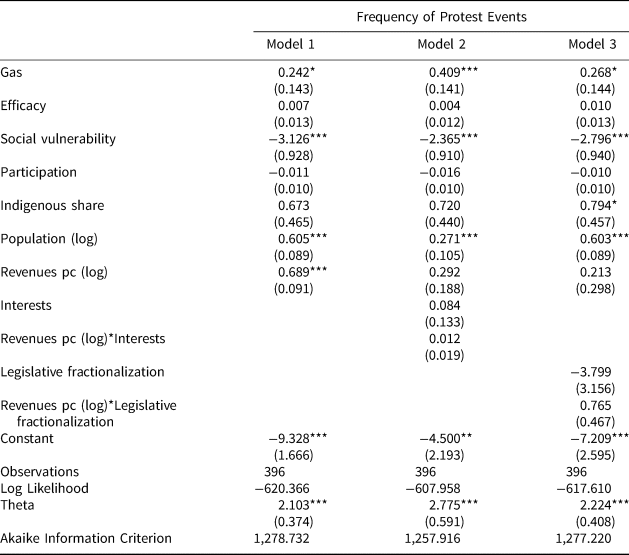
Table 1 presents the results of a number of negative binomial event-count models estimating the frequency of conflicts per province-year with different specifications: in addition to the control variables, Model 1 includes the resource-related factors presence of gas extraction site and revenues per capita. Model 2 presents the result of an interaction between revenues and interest. Finally, Model 3 presents an alternative hypothesis that it is not interest but legislative fractionalization driving protest events, as further described below.
Negative binomial regression results for the frequency of protest events, 2006–2009

Note: *p < 0.1; **p < 0.05; ***p < 0.01. pc = per capita.
Model 1 confirms our hypothesis on the conflict-inducing and hence politicizing, rather than depoliticizing, effect of resource extraction: both the coefficients for the presence of gas projects and for resources revenues available to each province at a per capita basis are significantly positive. That is, first, the presence of a gas extraction increases contentious action, lending support to the Bolivian case study literature which argues that local community protest is substantially driven by motives of grievances related to direct negative externalities associated with resource extraction, for example, through ecological damages, health problems or human rights violations. Second, the positive association between revenues and contentious action provides empirical support to our argument that civil society actors or local entrepreneurs may mobilize for strategic reasons to pressure local politicians into spending higher shares of the resource revenues for personal or group-specific benefit. Of the control variables, population size drives and social vulnerability depresses contentious action, as expected by social movement theory.
Model 2 tests the hypothesis that the effect of revenues on contentious action is moderated by local interest heterogeneity. Adding the interaction of revenues with interest heterogeneity to the model indeed results in a better model fit, confirming that both factors play an important role; the Akaike Information Criterion is substantively and significantly (Vuong's p = 0.016) smaller than that of Model 1. Neither the main nor the interaction effects are significant here, but note that these results are substantively uninformative as the underlying model is not a linear but a negative binomial count mode with a log link function: generalized linear models with such non-linear link functions may induce partial effects that are significant even though the estimated coefficients themselves are not (Berry et al., Reference Berry, DeMerritt and Esarey2010; Tsai and Gill, Reference Tsai and Gill2013).
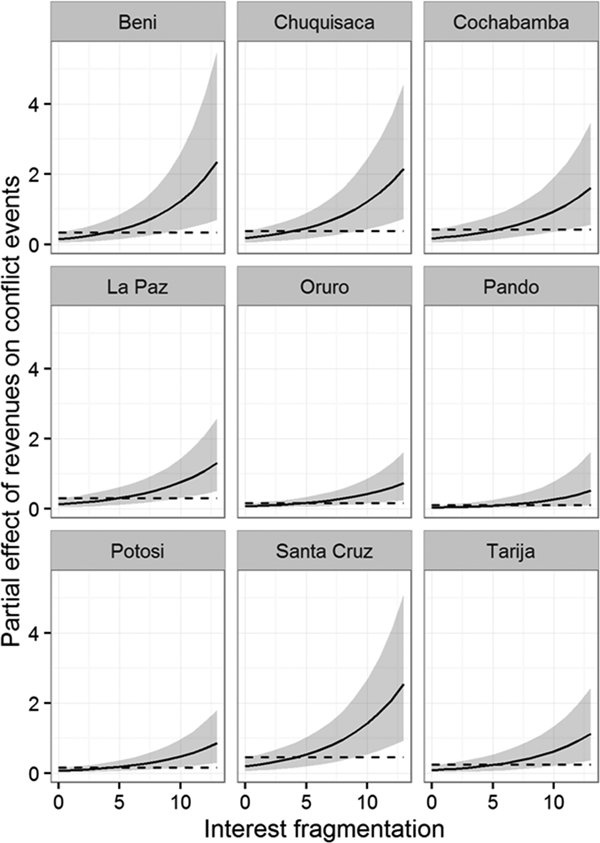
Instead, to detect whether revenues interact with interest heterogeneity, it is necessary to calculate the partial effect of revenues dependent on interest fragmentation.Footnote 8 In generalized linear models, these partial effects are also dependent on the levels of all the other covariates (Tsai and Gill, Reference Tsai and Gill2013). Figure 1 presents the partial effects of revenues by interest fragmentation for every department, marginalizing out the variables denoting year and the presence of gas, and with all other covariates set to the department-level mean values. It shows that the partial effect of revenues is significant for all departments except Pando:Footnote 9 the higher bound of the 95%-confidence interval at low interest fragmentation and the lower bound of the 95%-confidence interval at high interest fragmentation do not overlap. Moreover, the partial effect seems strongest in the departments of Beni, Chuquisaca, La Paz and Santa Cruz.
Partial effect of revenues per capita on the number of conflict events by interest fragmentation

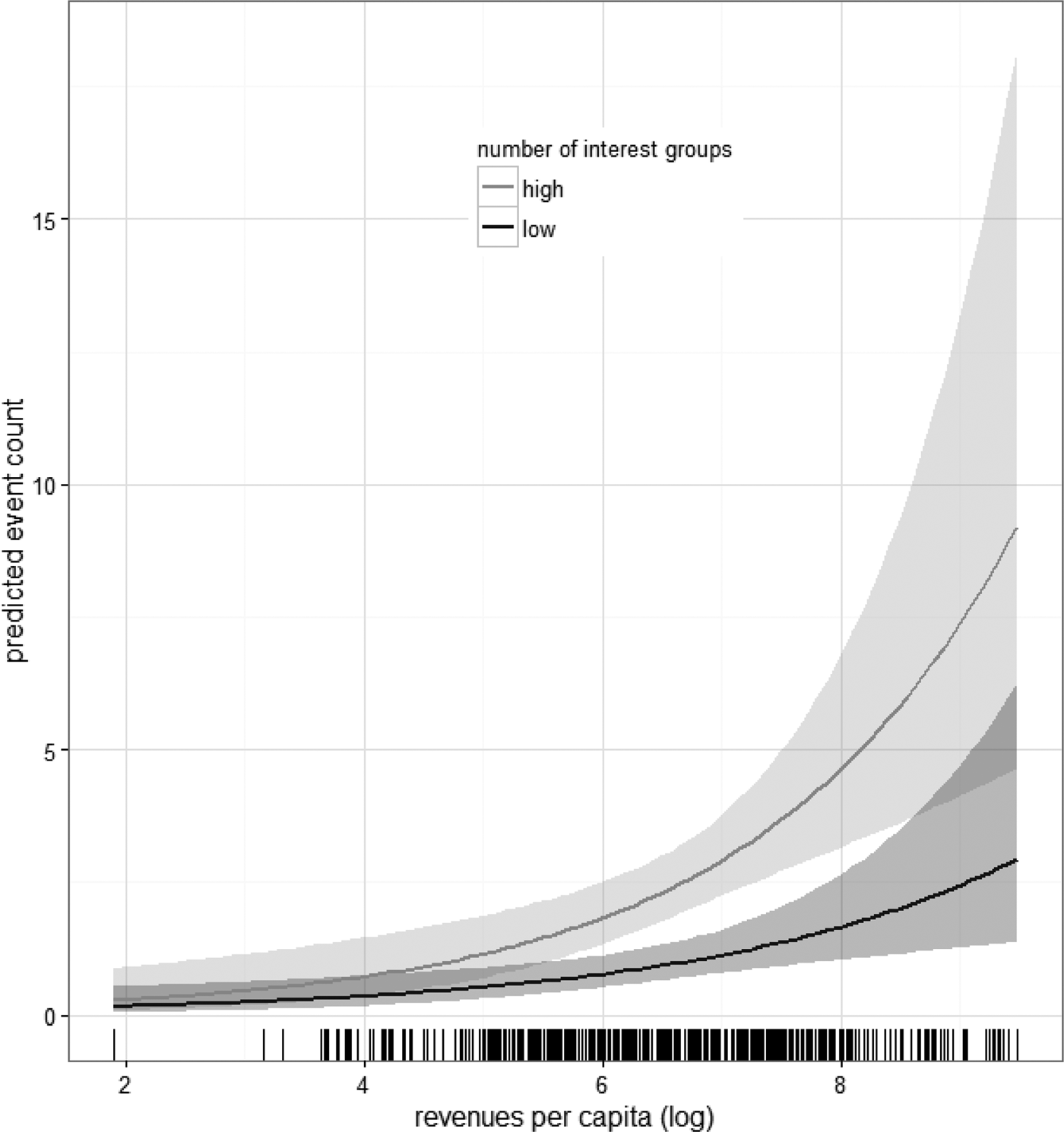
The plots show that the number of conflict events indeed increases more strongly when revenues and interest fragmentation act together and that this relationship is robust in the vast majority of departments. Yet they also qualify the hypothesis in that they show that, in Bolivia, the partial effect of revenues differs significantly only between sufficiently low and sufficiently high levels of interest fragmentation. To more clearly illustrate the direction and magnitude of the effect, we simulate the expected number of conflict events according to revenues for two scenarios: for a province with low levels of interest heterogeneity and for an identical province with high levels of interest heterogeneity (Figure 2).
Expected numbers of conflict events according to interest fragmentation and revenues

Figure 2 shows that the number of expected protest events increases with resource revenues per capita for all provinces. However, the increase is markedly and significantly steeper for a province with the highest level of interest heterogeneity than for those with the lowest: confidence intervals only overlap for provinces with either rather small and large amounts of revenues per capita, which are rarer in number, as the rug plot shows. These results support our argument that the interaction of high resource revenues and heterogenous local political interests, essentially hampering the reaching of compromises, significantly fuel local protest behaviour.
The results are robust to various changes to the model. We obtained substantively similar results when including all, rather than only non-political protest events; when also including the provinces with departmental capitals; and when using an ethno-linguistic fractionalization index instead of indigenous population share.
In addition, we tested the possibility that it is not interest heterogeneity but rather legislative fractionalization that drives the number of conflict; legislative fractionalization diminishes the mechanisms of accountability and responsiveness, which increases citizen dissatisfaction and hence the number of conflicts (Arce, Reference Arce and Foundation2015). We account for this alternative explanation in Model 3. Using the R package SciencePo (Marcelino, Reference Marcelino2015), we calculated the local seat allocation in the municipalities according to the method used in Bolivia to translate votes into seats, the d'Hondt method. We then calculated legislative fractionalization similar to the ethno-linguistic fractionalization index above, taking both number of parties and their vote shares into account and again averaged the municipal data to the provincial level. Legislative fractionalization ranges from 0 to 0.80. In Model 3, the AIC is similar to that of Model 1 with only resource-related factors and considerably, and significantly (Vuong's p = 0.019), larger than that of Model 2. Similar plots to those in Figure 1 do not show signs of an interaction (not reported). In contrast to the findings from the Peruvian case, we hence conclude that more agency is located within the rank-and-file population than conventionally hypothesized, rather than merely within the local political elite.
Conclusion
While several studies on the “resource curse” suggest that natural resource wealth is detrimental to democratic governance, the focus is most often on political elites or institutions and only rarely on the general population or civil society. Studies that do look at the demand side of democracy describe a “rentier effect” in which voters are appeased through patronage spending on lower taxes, leading to a depoliticization of the population. This paper, in contrast, examines a context of local contentious politicization and finds support for our argument that local political interest heterogeneity needs to be taken into consideration.
Our findings suggest that, first, resource extraction substantially engenders contentious action because it fosters socioeconomic disputes over the local (re-)distribution of resource income, countrywide, and thus independently of whether the resources are exploited in that specific region or not. While this relationship has previously been shown for high-level violent conflict, we show that it also applies to local protest dynamics.
Second, we also find support for the hypothesis that local communities within gas regions mobilize against resource extraction as they are suffering from the direct negative externalities of resource extraction. Taken together this confirms various more recent (and especially small-n studies), which have shown that greed and grievance explanations for contentious actions are by no means mutually exclusive.
This paper, third, presents evidence for the interaction of revenues and local interest heterogeneity as drivers of contentious action: the number of conflicts increases when resource revenues allocated to the local governments are especially high, which suggests that these local governments may be considered as a kind of “honey pot” for local rent-seeking actors (as argued by Karl, Reference Karl2007), and thus become the central addressees of local mobilizations. In addition, the more heterogenous political interests and values are, the less likely the local population is to reach a compromise, thus motivating the different local actors to engage in demonstrations, strikes and further types of protest in order to get their interests heard. We suggest that it is particularly the interaction of both conditions which is of importance: when the population is politically divided, resource revenues add fresh fuel to local quarrels. On the other hand, where the local population is relatively united in their political interests and values, less redistributive conflicts arise. This also holds when controlling for a range of additional factors. The insights of our paper contribute to a more nuanced understanding of the resource curse, particularly at the local level.
However, the present paper has its limitations. While we did consider all factors included in similar studies on the resource–protest link, particularly in Peru, and aimed to address all covariates of contentious action as mentioned in social movement theoretical literature more generally, some measures are suboptimal. For example, we were not able to find a more fine-grained measure for the negative externalities in resource regions, such as air or water pollution, in order to more precisely differentiate between these specific local externalities and rent-seeking mechanisms within resource-extraction regions. While we are confident that this does not influence the main effects found in this paper, we leave the challenges of even more comprehensive measurement and analysis to future research on the resource–protest link.
Like other observational data in comparable studies, our data do not allow us to actually draw causal inferences on the link between resource wealth and contentious action. The application of causal inference methods such as matching or regression discontinuity design is unfortunately not possible in this context since all Bolivian provinces receive the “treatment” of revenue allocation and there are no discontinuities in the allocation itself. Due to strong temporal correlation within both protest and revenue levels and temporal invariance for other factors, a lagging of either variable does not provide additional information on causality. However, we trust that our theoretical explanation, which is also backed by numerous examples of contentious collective action in our dataset, is convincing. Where there are diverging political opinions on an issue, more contentious collective activity can be expected to occur.
Despite these shortcomings, we believe that the associational patterns we identify are important for a better understanding for local contentious collective action in Bolivia and beyond. Overall, our findings have a number of wider implications for such future research. First, in contrast to the work by Ponce and McClintock (Reference Ponce and McClintock2014) and Arce (Reference Arce and Foundation2015) on Peru, this paper suggests that while political factors, such as administrative efficacy or political responsiveness, are undoubtedly important, they are only part of the picture, both likely influenced by local interest heterogeneity. Future research may look more closely at this mechanism, also in countries beyond the Latin American Andes. Second, and more broadly, our findings imply that the population in resource-extracting countries is not as strongly depoliticized as previously argued by several authors in line with rentier state theory (see Beblawi and Luciani, Reference Beblawi and Luciani1987). Finally, similar to recent studies such as Buhaug and Rød (Reference Buhaug and Rød2006) and Basedau and Pierskalla (Reference Basedau and Pierskalla2014), our results reiterate that local factors have to be taken into account in future research, particularly for low levels of contention.