There is an increasing consensus among historians of archaeology that there are benefits to be gained from studying the impact that socio-political and economic frameworks have had on the development of archaeological theory and practice at particular times in history. Among authors supporting this growing trend, there has been a great deal of interest in such grand ideologies as nationalism and colonialism, and even internationalism, an interest we have shared.Footnote 1 There is, however, a less grandiose scale that looks at how particular scholars may be affected by ideas in their immediate environment and by the social networks of their academic milieu and beyond. By the same token, scholars’ social practices may have consequences for the development of their discipline and beyond the academic realm. Whatever the scale, historians of archaeology have used this approach to break with their previous obsession of explaining changes in theory as an exclusively epistemological process. Importantly, however, this adjustment to new perspectives in the writing of histories of archaeology – from an internalist to an externalist focus – has required them to go beyond thematic content; it has become apparent that additional types of sources are required to answer these new questions.
In this paper we argue that, in order to achieve a more critical and balanced account of the development of archaeology in its socio-political, economic and academic contexts, historians of archaeology should broaden their sources to include not only the publications of the persons being studied, but also oral history and information stored in archives. The results of our own work in recent years have convinced us of the value of the latter for the history of archaeology,Footnote 2 and this paper summarizes the results of our six-month British Academy project ‘Beyond Hawkeseye: a pilot examination of the potential of the Christopher Hawkes archive for the study of British archaeology in its European context’.Footnote 3 This project aimed to provide an overview of a sample of the documentation of the Hawkes Papers archive, kept in Oxford’s Bodleian Library. The present study re-examines the key role of Professor Christopher Hawkes in the development of British and European prehistoric archaeology, and in particular his contribution to the development of Bronze and Iron Age studies, in the decades before and, especially, after World War ii. An analysis of the content of this archive, and especially of a sample of 532 files in the general correspondence section, is also undertaken with the view of assessing the potential of this documentation for future studies.
Recovering hawkes: his life and work
There are various sources for the life of Christopher Hawkes. These include a biography about his early years up to 1939 published by Diana Bonakis Webster.Footnote 4 Despite its shortcomings,Footnote 5 Webster’s book is a valuable source of information for many aspects of his childhood, university education and early professional years. Another major source of information is his own ‘Retrospect’, written for Antiquity,Footnote 6 and his account of the early years of the Oxford Institute of Archaeology.Footnote 7 At the time of his death, several obituaries were published.Footnote 8 In addition, the facts of his life can be found in the Oxford Dictionary of National Biography and in the encyclopaedias of archaeology edited by Murray.Footnote 9 Christopher Hawkes’s son, Nicolas, also provided helpful information in an article published on the occasion of the presentation to the Institute of Archaeology in Oxford of Paul Nash’s lithograph in memory of Christopher and Sonia Hawkes.Footnote 10 As well as biographies, obituaries and remembrances, a list of his publications was also included in a volume published in his honour by John Boardman.Footnote 11 Information about him is also included in publications about his first wife, Jacquetta,Footnote 12 and his second wife, Sonia.Footnote 13 Finally, there are some thoughts about his role in Bronze Age studies,Footnote 14 as well as in Iron Age archaeology,Footnote 15 and the importance of Hawkes’s concept of the ‘ladder of inference’ was also the focus of an article by Evans.Footnote 16
From the published literature, some biographical facts are well known. Charles Francis Christopher Hawkes (b London, 1905; d Oxford, 1992) read Classics at New College, Oxford, from 1924 to 1928. In September 1928 he joined the British Museum (BM) as an Assistant Keeper (‘First Class’ from 1938), where a colleague was Tom Kendrick, also Oxford-educated. Hawkes worked for the BM for almost twenty years.Footnote 17 During World War ii he worked for the Ministry of Aircraft Production. In 1946 he was appointed the first Professor of European Archaeology at Oxford, in this way becoming a member of the so-called ‘golden generation’, that group of prehistorians who began their careers in the 1920s and 1930s and who, in turn, were responsible for the training of the next generation. In Oxford he taught both undergraduates and post-graduates.Footnote 18 Under the terms of his chair, Hawkes had to give a number of lectures, ‘not less than thirty-six lectures, or classes, in each academical [sic] year, of which not less than twenty-eight shall be lectures. His lectures, or classes, shall extend over a period not less in any Term than six weeks and not less in the whole than twenty weeks, and two of the three Terms he shall lecture, or hold classes, at least twice a week in each of six weeks’.Footnote 19
In 1961 he managed to persuade the Oxford University authorities to create an Institute of Archaeology. This meant moving his main centre of operations from his rooms in Keble College to Beaumont Street, next to the Ashmolean Museum. The building was, to start with, shared with the Department of Oriental Studies and its library. The move to Beaumont Street also meant the possibility of expansion, and the inclusion of new lecturers, something that, however, did not happen immediately.Footnote 20 Hawkes retired from his post in 1972 and was succeeded in the Chair by Professor Barry Cunliffe, FSA (and more recently by Chris Gosden, FSA).
As regards his personal life, Hawkes married the young archaeologist Jacquetta Hopkins in 1933.Footnote 21 Their marriage ended in divorce in 1953. In 1959 he married Sonia Chadwick, another young archaeologist, whose interest lay in Anglo-Saxon studies.Footnote 22 Hawkes’s own main field of study was Iron Age Britain, about which he published extensively in the 1920s and 1930s.Footnote 23
In 1932, in collaboration with his colleague in the British Museum, Tom Kendrick, Hawkes published his first major book, Archaeology in England and Wales 1914–1931.Footnote 24 This publication ‘nourished generations of Cambridge undergraduates’.Footnote 25 A decade later Hawkes also wrote The Prehistoric Foundations of Europe to the Mycenaean Age Footnote 26 and, together with his wife Jacquetta, Prehistoric Britain.Footnote 27 The first book competed in the market with Childe’s easier-to-follow work, The Dawn of European Civilization, and this may explain why The Dawn went through four editions from 1939 to 1957, and was translated into other languages such as French,Footnote 28 while Hawkes’s volume was never revised. Prehistoric Britain (a book mainly written by Jacquetta) seems to have been better received, for it went through several editions and reprints (first published in 1943, it had a second edition four years afterwards, was reprinted in 1948 and had another edition in 1958), which suggests that it was used by many students in the 1940s and 1950s. The success of Prehistoric Britain can be compared with that of similar volumes, such as The Personality of Britain by Cyril Fox.Footnote 29 The latter had originally been written as a discourse, and in the following years went through several editions (the fourth being published in 1943).Footnote 30 Another similar volume was the one produced by the newly appointed Professor of Prehistoric Archaeology in Edinburgh, Stuart Piggott, on British Prehistory,Footnote 31 and the very original book by Grahame Clark, Professor of Archaeology at Cambridge, Prehistoric Europe: the economic basis.Footnote 32
After 1943 Hawkes produced no further books, perhaps because his priority, as with other Oxford professors, especially those who were not responsible for an undergraduate course, was to undertake research, the results of which were published as papers, rather than books. Books suggested an element of popularization, and were a task undertaken by museum curators, amateurs and some of the first independent archaeologists with archaeology degrees, among whom we could include Jacquetta Hawkes and, indeed, some of Hawkes’s own students. University professors might write a general book for undergraduate teaching, but Hawkes had already done this prior to his appointment to Oxford. Those who did publish general archaeological books, such as Childe, have to be treated as exceptional.
Hawkes’s contribution to knowledge
Christopher Hawkes’s major contribution to knowledge was in the field of Iron Age studies. In his early publications he explained the appearance of iron as a result of the invasion of the Belgae. In this he was following authors such as Arthur Evans.Footnote 33 In the early 1930s Hawkes produced three papers that were fundamental for the development of Iron Age studies.Footnote 34 According to Cunliffe, these ‘totally altered the direction of thought on the Iron Age and paved the way for the next three decades of constructive study’.Footnote 35 From the three papers, the most influential was that on ‘Hillforts’, published in Antiquity, in which he divided the Iron Age into three periods, in the so-called ‘ABC system’. Despite the relatively scant data on which this was built, and some early challenges to the concept, this system became the widely accepted chronological basis for the classification of Iron Age material in Britain for the next thirty years.Footnote 36 Hawkes made some subsequent amendments. The first update was made at the fourth CISPP conference, held in Madrid in 1954,Footnote 37 and the second at a meeting on ‘The Problems of the Iron Age in Southern Britain’ organized by the Council for British Archaeology, held in December 1958.Footnote 38 His revised scheme was followed by many.Footnote 39
Concerns, however, were also raised. The first to confront Hawkes was Roy Hodson, who, although maintaining a cultural approach, demonstrated that the scheme was based on very poor-quality dataFootnote 40 and this critique was followed by others, including Barry Cunliffe.Footnote 41 As John Collis puts it, ‘the breakdown of the Hawkes system in the 1960s provided an enormous liberation in which new ideas and approaches could flourish’.Footnote 42 Collis further explains that by the time of the next major conference, at Southampton, in honour of Sir Mortimer Wheeler, the paradigm had shifted.Footnote 43 Not merely was this through the inclusion in the conference, at Wheeler’s insistence, of the younger generation of scholars (Peacock, Guilbert, Bradley and Collis), but also because of a shift on the part of older scholars, such as Hogg, who wanted ‘to seek new ways of viewing their data’.Footnote 44 After some years of confrontation, the 1970s saw a certain ‘rapprochement between the two parties’.Footnote 45 In later life Hawkes’s interest turned to the contacts between the proto-historic peoples of Europe and their civilized counterparts, on which subject he edited two volumes: Greeks, Celts, and Romans: studies in venture and resistance Footnote 46 and Celtic Art in Ancient Europe.Footnote 47
In addition to his role in Iron Age studies, Hawkes had a tremendous impact on Bronze Age studies in the 1950s and 1960s. In the 1950s, Hawkes’s influence was mainly due to his involvement with a major European project, the Inventaria Archaeologica. Founded by the Belgian Professor Marcel Edouard Mariën (1918–91) and encouraged by the CISPP,Footnote 48 this was an illustrated card inventory of important associated finds in archaeology. It flourished during the 1950s and 1960s, although some countries continued their involvement with this project well until the 1990s.Footnote 49 The resulting publications became vital for the culture-historical understanding of the Bronze and Early Iron Age in Europe, and Hawkes was the leader of the British team. According to Colin Burgess, the Council for British Archaeology (CBA) collaborated in this project, drawing on information from the British Association Metalwork Card Catalogue maintained at Oxford and the British Museum.Footnote 50 Hawkes’s participation in the project resulted in the publication of two catalogues – one on Grave-groups and Hoards of the British Bronze Age,Footnote 51 and another, written with his research assistant, Margaret Smith, on Bronze Age Hoards in the British Museum.Footnote 52 Margaret Smith subsequently published four more catalogues.Footnote 53 Letters kept in the Pericot archive indicated that Hawkes also involved Smith in another CISPP project, the English Dictionary of Prehistoric Terminology (Pericot Archive, Hawkes, 3 Mar 1955), a work that does not seem to have been completed.Footnote 54 Hawkes’s interest in cataloguing led him to finish off the work of others, including the Corpus of Ancient Brooches in Britain, mainly produced by the Curator of the Colchester and Essex Museum, Mark R Hull, but left unfinished at his death.Footnote 55
In 1960, at the December CBA Bronze Age Conference in London, Hawkes presented a then unpublished – but seemingly widely circulated and influential – periodization of the Bronze Age, which ‘essentially has lasted ever since’.Footnote 56 With modifications it was adopted by John Coles.Footnote 57 Hawkes’s overwhelming influence on Bronze Age studies in the 1960s and 1970s was partly due to the move from Britain to the Netherlands in 1957 of Jay Butler,Footnote 58 one of the major experts of the day; according to Colin Burgess, ‘between 1957 and 1970 a whole series of studies emanated from Christopher Hawkes and his pupils at Oxford: Margaret Smith (subsequently Brown), Dennis [Harding],Footnote 59 and, later, Sabine Gerloff. Their papers should be essential reading for anyone hoping to understand the Bronze Age’.Footnote 60 Hawkes’s intellectual influence was, therefore, extremely positive, but his authority could also represent a limit to some developments in the field. As Burgess puts it, ‘Hawkes exerted a fearsome grip on the period. Newcomers were very aware of what they could and could not say, especially about chronology, and this baneful influence was to last throughout the ’60 s and ’70s’.Footnote 61 He then explains that only those living outside Britain – such as Jay Butler – or those – such as Burgess himself – raising their voices on the basis of comparisons with other European chronologies dared to contradict Hawkes’s ideas.Footnote 62
Hawkes also made an incursion into archaeological theory, a field that was then in its infancy and that expanded later with the appearance of New Archaeology from the late 1960s. In his address to the Wenner Gren Foundation on ‘Archaeological theory and method: some suggestions from the Old World’,Footnote 63 Hawkes was concerned with the differences in methods and interpretation between ‘text-free archaeology’ – the archaeology of periods from which no written information existed – and ‘text-aided archaeology’ – that of periods with textual information. He proposed the concept of the ‘ladder of inference’, which was reviewed with worldwide acclaim but which was widely misread, according to Evans.Footnote 64 Hawkes’s argument was that there were several degrees of difficulty in interpreting archaeological data, especially for periods without textual information:
1. To infer from the archaeological phenomena to the techniques producing them I take to be relatively easy … 2. To infer to the subsistence-economics of the human groups concerned is fairly easy … 3. To infer to the social/political institutions of the groups, however, is considerably harder … 4. To infer to the religious institutions and spiritual life may seem superficially, perhaps, to be easier … In general, I believe, unaided inference from material remains to spiritual life is the hardest inference of all … You have there a climax of four degrees of difficulty in reasoning. What is this climax? It is a climax leading up from the more generally animal in man to the more specifically human.Footnote 65
As Evans points out, similar reactions towards the limitations of inferences can be found in ChildeFootnote 66 and in Clark’s restructuring of chapter 7 of his Archaeology and Society.Footnote 67 In a way, despite Binford’s critique of Hawkes’s ideas,Footnote 68 New Archaeology’s lack of involvement with what they called the ‘ideological sub-system’ was in broad agreement with Hawkes’s original suggestion. In fact, New Archaeology went much further than Hawkes, with scholars such as Fritz scornfully arguing that attempts to recover religion from archaeological data should be considered ‘palaeopsychology’.Footnote 69
The hawkes archive: an overview of the general correspondence
Hawkes was a prolific writer of letters. After his death in 1992, the bulk of his correspondence was given to the Bodleian Library by his widow, Sonia Hawkes, and other material was later added by his son, Nicolas Hawkes (the last donation occurring in 2006). The ‘Beyond Hawkeseye’ project aimed to provide an initial overview of the information contained in the Hawkes Papers, which are held by the Department of Special Collections and Western Manuscripts of the Bodleian Library, at the University of Oxford.Footnote 70 Initially, 167 boxes were deposited, including a brief inventory of their contents, and several albums of photographs. The inventory showed that these were classified into ten groups: general correspondence, personal letters, correspondence with publishers, subject files, documents related to societies, committees and clubs, lectures and conferences, publications, notebooks, offprints and typescripts from other people and personal documents. An analysis of the extensive amount of information contained in all the many boxes will obviously only be possible after a future detailed examination. In this section our discussion will refer to the first thirty-one boxes of general correspondence. It is worth mentioning before we start our analysis that many of the documents have retrospective comments added by Hawkes himself in a variety of coloured pens (although he did not seem to have used a systematic colouring code). This appears to indicate that Hawkes went through much of the documentation at a later stage, possibly thinking about an autobiography, about which there seems to be references in box 91.
The general correspondence in the Hawkes archive consists of 1,065 different files, broadly organized in alphabetical order. Each file may refer to either a person or an institution and contains a variable number of documents, from one to more than one hundred. These documents can be of different types, and include letters, greeting cards and obituaries, photographs of objects, sites and archaeologists, abstracts of publications, sketches and plans of sites and drafts of articles, and copies of student reports and diploma theses.Footnote 71 There are also many copies and drafts of his letters. He would often respond to particular enquiries with an eloquent three- or four-page letter, typed or handwritten, giving his opinions on a site or object, backed up with numerous references.
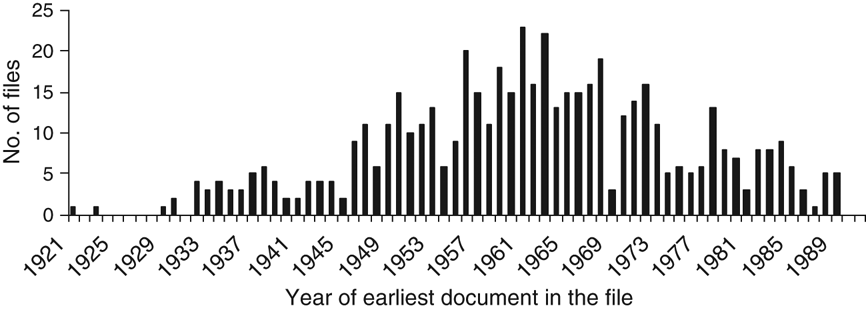
Although there is material from the 1920s to the 1980s, an examination of the earliest date of the documents in each file in a sample of 532 files (all those from boxes 1 to 15 and all those with more than twenty documents from boxes 15 to 31) (fig 1) clearly indicates that the chronological distribution is uneven. This is not a surprising result if we are to assume a normal curve in the recognition of successful academics. The number of individuals willing to communicate with them will increase in line with their growing reputation in the field. It is to be expected, also, that interest in them will be maintained once they reach the peak of their eminence, but decrease after several years, once a younger generation emerges to challenge the ‘outmoded’ paradigms of their predecessors.
Year of earliest document in a selection of 532 files. Graph: Margarita Díaz-Andreu

In interpreting the graph shown in Figure 1, however, it is important to be aware of the possibility of other factors that may be relevant to our case study. In our sample, the percentage of letters dating from before Hawkes’s arrival in Oxford as a professor in 1946 is only 10.21 per cent, and this low figure may result from several causes. One is the British Museum’s policy of cataloguing letters received by staff within its own archives (and one of us has studied some letters received by Hawkes that are now kept in the archive of the Department of Prehistory and Europe at the British Museum).Footnote 72 Secondly, when Hawkes had to empty his office in the British Museum to move to Oxford, he may well have used the occasion to discard whatever he then considered unnecessary. Also, as the correspondence by British archaeologists in the Pericot archive shows, the amount exchanged by scholars showed a marked and understandable decrease during World War ii.
Out of the 1,065 files from boxes 1 to 31, 1,002 of them contain correspondence from individuals. The remaining sixty-three consist of correspondence with institutions such as museums, councils, societies and trusts, and also other bodies not directly connected with archaeology, such as the Oxfordshire police. The documentation from box 31 – two files recorded as being a series of unidentified letters and academic references – has also been included in the category of ‘various’. From the 1,002 entries for individuals, thirty-seven have double authors – usually husbands and wives, but, in the case of the Myres, the correspondents are father and son. This makes a total of 1,039 individuals who corresponded with Hawkes. More than 22.33 per cent of the correspondents are women, and 16.84 per cent are from outside the UK (women and men). These came from the Irish Republic, France, Germany, Switzerland, Belgium, The Netherlands, Scandinavia, Portugal, Spain, Italy, Czechoslovakia, Poland, Hungary, Russia and Yugoslavia, as well as the US. If not writing in English, correspondents used their mother tongues (French, German, Italian or Spanish), while those writing from Poland, Hungary, Portugal or Russia wrote in French or German. Hawkes normally replied in the language used by the correspondent.
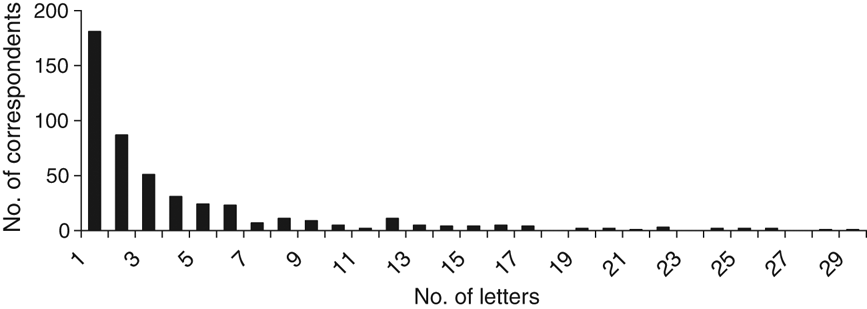
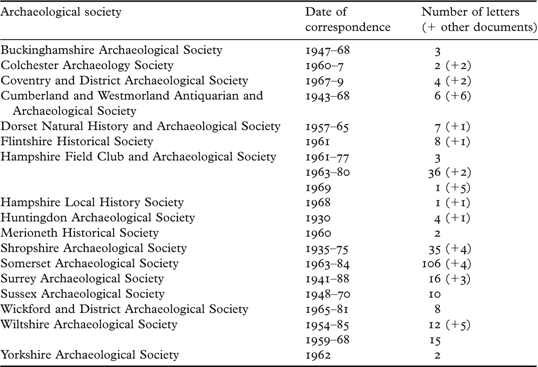
This general correspondence reveals that Hawkes continued to exchange information about contemporary excavations throughout the UK and Europe, the provenance and identification of artefacts and relevant publications. This demonstrates that he was well aware of the work undertaken and published by many of his fellow archaeologists. Throughout Hawkes’s professional life he had many correspondents who wrote only a small number of letters (fig 2). Hawkes sought and gave information, thanked or was thanked for comments on a particular publication or for some other kindness. There are many enquiries from potential students, letters of condolence and congratulation, and thanks for hospitality. Many of the individuals who wrote only once or twice to Hawkes were from archaeological societies (table 1). Others were archaeologists working in museums and universities and some were British students. From those correspondents with a single letter, about 87 per cent wrote in English, 6 per cent in French, 4 per cent in Spanish, and 3 per cent in German. They are all from individuals (there are no letters from couples) and in this group there were only two of his own Oxford students (Holaubek and Walker).
Number of letters by correspondents in boxes 1 to 15. Correspondents with more than 30 letters (20 in total) have not been included. Graph: Margarita Díaz-Andreu

Correspondence from members of societies in our sample

In contrast with the description of correspondents given above, an examination of the files containing twenty or more letters and thirty or more letters (with fifty-seven and thirty-nine correspondents respectively) shows a very different picture. Many correspondents in this group were life-long friends, including such couples as Glyn and Ruth Daniel, Gerhart and Maria Bersu, Stuart and Peggy Piggott (while still together), Alexander and Gabrielle Keiller and Cyril and Aileen Fox. Often the exchange of letters became both general and personal. Hawkes, for example, wrote to his friends to congratulate them or express condolences, and they often reciprocated in like manner. Most of this correspondence (82.46 per cent) was in English. The six correspondents from Germany and Austria wrote in German but some also in English. As far as we can tell from the data available, forty-four of the fifty-seven correspondents were from Great Britain, seven from Germany, two from Northern Ireland and one each from the Republic of Ireland, Austria and the US respectively. There are no correspondents from France or Spain, nor from other parts of Europe or the world in this group of frequent correspondents but letters from scholars of other nationalities may be classified in other boxes, especially those relating to international congresses. Our work in the Pericot archive, in Barcelona, shows that, for example, there are forty-four letters from Hawkes to Professor Luis Pericot, compared with only two letters from the first thirty-one boxes of the Hawkes archive. These include one written by Nicolas Hawkes as a child and another by Jacquetta on behalf of Christopher, and do not only discuss issues relating to the CISPP. These letters reflect a sincere appreciation of Hawkes as a person and as a scholar that does not seem to correspond with the limited record of Pericot letters in the general correspondence in the Bodleian Library. As suspected, however, a cursory inspection of box 59 has revealed that there are more letters from Pericot: this initial overview is therefore bound to need revision once the contents of the entire archive have been documented.
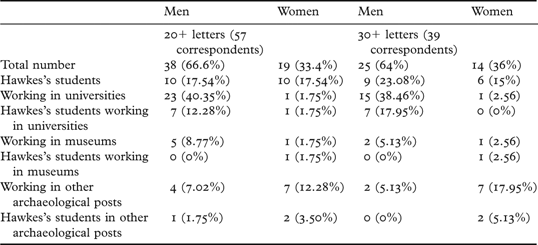
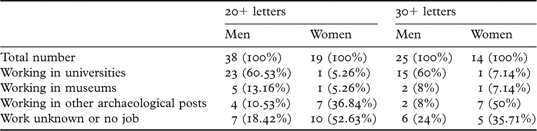
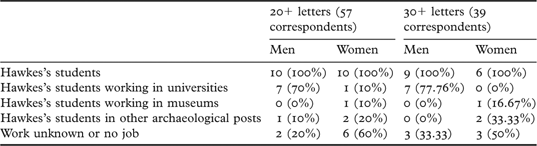
Among the correspondents with twenty or more and thirty or more letters/documents, it is worth noting that there is a high proportion of Hawkes’s former students. In fact, the higher the number of letters, the higher the percentage of (male) students corresponding with Hawkes (table 2a). Professionally, there is a marked distinction in the careers of those corresponding with Hawkes. Male correspondents were mainly working in universities; those working in museums or other jobs related to archaeology are far smaller in number (table 2b). Many of the women corresponding with Hawkes appear to have had no jobs in archaeology (they could have worked in fields other than archaeology, about which we do not yet have information). A smaller number worked in archaeology, but not in universities or museums. This trend is even more evident in the case of Hawkes’s former students, among whom the men were mainly employed in universities, rather than in museums, whereas only one woman worked in a university and one in a museum (table 2c). Nine women in the twenty-plus group (47.37 per cent of the total) were married to fellow archaeologists and eight (57.14 per cent) in the thirty-plus group. It is fair to assume that, at least in some cases, Hawkes may have kept in frequent communication with them because they were married to professional archaeologists, this adding to the already marked bias in the number of men corresponding with Hawkes.
Male and female correspondents and Hawkes’s former male and female students with more than twenty and thirty letters

The working environment of men and women corresponding with Hawkes with more than twenty and thirty letters
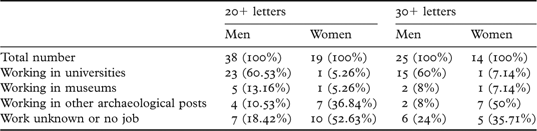
The working environment of Hawkes’s former male and female students corresponding with Hawkes with more than twenty and thirty letters

The context of hawkes’s network: the golden generation and the professionalization of british archaeology
This section discusses the results emerging from our overview of the general correspondence in the light of the academic context in which the documents under study were produced. To start with, it is important to stress that the general correspondence in the Hawkes archive contains only a few letters dated before his arrival in Oxford. This makes it impossible for us to cover his first professional period in the British Museum. Most of our discussion, therefore, will refer to his Oxford period (from 1946). We will focus our attention on the networks that dominated prehistoric archaeology in the post-war period. Our intention is to consider how a particular scholar – in this case, Christopher Hawkes – could be situated at the interface between several networks of individuals and communities of interest, all of them concerned with archaeology.
From the analysis undertaken in the previous section, one fact stands out: the striking contrast in the nature of correspondents between those writing fewer than twenty letters and those writing more. The first group consisted mainly of non-academic individuals and differs from the second one in which professional archaeologists predominate. This clearly points to the latter group as being the main circle in which Christopher Hawkes moved and it is with them that we will start our analysis. Among professional archaeologists who were frequent correspondents, however, we will highlight two main groups. The first is formed by members of what we are going to designate as the ‘golden generation’, within which we are going to distinguish between the old and the young guards, and the second group by his own students.
The golden generation became a power group in academia that dominated the university field of prehistoric archaeology in the inter-war years and after World War ii. It was made up of a group of prehistoric archaeologists born between the late 1880s and the first years of the twentieth century who were responsible for the professionalization of the teaching of prehistoric archaeology in Britain. Two subgroups can immediately be distinguished on the basis of age: the oldest group included O G S Crawford (1886–1957), Alexander Keiller (1889–1955), Miles C Burkitt (1890–1971), Mortimer Wheeler (1890–1976), V Gordon Childe (Reference Childe1892–1957) and Dorothy Garrod (1892–1968).Footnote 73 The youngest were born in the first years of the twentieth century, and were, in addition to Christopher Hawkes (1905–92), his colleagues Charles W Phillips (1901–85), Grahame Clark (1907–95) and Stuart Piggott (1910–96).Footnote 74
The process of the professionalization of prehistoric archaeology in Britain has some key dates: 1926 was the year in which Miles Burkitt became a salaried university lecturer;Footnote 75 in 1927 Crawford, the first Archaeology Officer of the Ordnance Survey from 1920, founded the journal Antiquity, over which he exerted a considerable influence, taking writers away from Man, one of the journals to which they had until then been frequent contributors. Gordon Childe became Abercromby Professor of Archaeology in Edinburgh in 1927 (in 1946, Childe went to the Institute of Archaeology in London, and his Edinburgh chair was filled by Stuart Piggott). Mortimer Wheeler and his wife Tessa (1893–1936) instigated the foundation of the Institute of Archaeology within the University of London, formally opened in 1937. In Cambridge, Grahame Clark was appointed Faculty Assistant Lecturer in 1936 and Dorothy Garrod was made Disney Professor of Archaeology in 1939. This first phase in the establishment of university chairs would result in the creation of the Chair of European Archaeology filled by Christopher Hawkes in 1946.
This group of scholars, therefore, formed a close-knit network; they also became important members of many of the key archaeological institutions of the time, starting with the Society of Antiquaries where, for example, Crawford was elected to the Council in 1928 and Hawkes became a Fellow in May 1931. Importantly, in 1935, mainly through the work of Grahame ClarkFootnote 76 (and also of Christopher Hawkes), they managed to unite the many societies dealing with prehistory into a single influential body, the Prehistoric Society, with its journal, the Proceedings of the Prehistoric Society.
In the golden group there were differences in how close some felt to others, and age seems to have been an important factor. The large number of letters in the Stuart Piggott file (91) places him as Hawkes’s closest ally. In the number of letters, Piggott is followed a long way back by Alexander (and Gabrielle) Keiller (38), whose letters deal mostly with the Avebury records. After them we find Grahame Clark (29) and O G S Crawford (26). Other members of the golden group have fewer letters, although these differences may be explained. For example, the relatively low number of letters from Gordon Childe (16) may be explained by his early death (1956), and by the possibility of some correspondence being placed among the documentation related to the International Congress (CISPP). Mortimer Wheeler (15) represents a similar case, and here his correspondence may be located in the section of the archive dealing with the Society of Antiquaries. In addition, Wheeler was sometimes considered to be a problematic colleague and had had difficulties with many of the other members of the group, including Keiller (and Bersu).Footnote 77 This may have affected his relationship with Hawkes as well, although Hawkes had excavated with him and Tessa in the 1920s.Footnote 78 The absence of letters from Burkitt should not come as a surprise, mainly because of the lack of interest in archaeological research by this Cambridge lecturer.Footnote 79 Finally, the two letters from Professsor Garrod may be related to the short period of six years she and Hawkes coincided as professors because of her early voluntary retirement in 1952. Strangely enough, Charles W Phillips’s file only had six letters. In the files related to the small group of four golden scholars with frequent correspondence – Crawford, Clark, Keiller and Piggott (7.02 per cent) – the total number of letters represents 8.21 per cent of the total (184 out of 2,242).Footnote 80
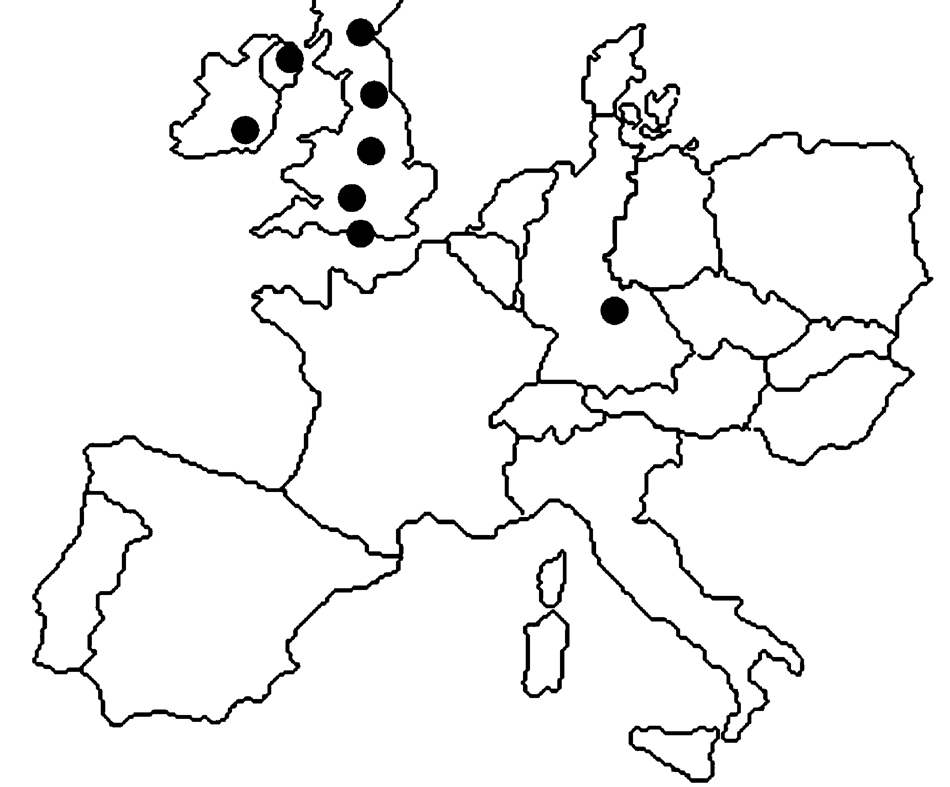
Regarding the second group of professionals, the one formed by his own students, a great deal of the correspondence concerns the personal support Hawkes gave to them as students, and then more especially as recent graduates and throughout their academic careers. Despite the fact that they represent only 20 per cent of the total of frequent correspondents (see table 2a), their letters represent 46.57 per cent of the total (1,064 out of 2,242). This signifies Hawkes’s willingness to care for his former students, and help them to succeed, but also to make sure that he created allies in those universities where his students obtained jobs (fig 3).
Map indicating the university placements of the sample of Hawkes’s students who were in frequent correspondence with him. Map: Margarita Díaz-Andreu

It would be fair to say that Christopher Hawkes was the originator of an Oxford school of proto-historic archaeology and was, in this, a parallel figure to Grahame Clark in Cambridge.Footnote 81 Although further studies are needed on this period, it is arguable that neither Piggott in Edinburgh, nor Gordon Childe and his successors in the Institute of Archaeology in London, could compete with Oxford and Cambridge in the 1950s, 1960s and 1970s in terms of the influence of their professors.Footnote 82 Hawkes and Clark saw several of their students placed in the increasing number of other universities teaching prehistoric archaeology in Britain. In the university networks of British prehistoric archaeology in the post-war period, Oxford and Cambridge were therefore two prominent nodes. Yet, the chronological span of Hawkes’s interest in prehistoric archaeology – mainly the proto-historic period – prevented him from having the world impact that Clark had, and, in contrast with Cambridge, few Oxford graduates obtained positions elsewhere in the world (the exception being Michael Walker in Australia). Hawkes’s natural expansion area would have been into Europe. However, as Clark observed, Europe was not a place to conquer, for it had its own researchers already in place. As he put it, ‘the situation for British prehistorians was very different in the rest of Europe [with the exception of Greece and some of the Mediterranean islands]. There were no colonial outposts and no British Institutes or Schools to prepare the ground. Field-work and excavation were very much in the hands of the various national authorities and Britons could take part only in close conjunction with colleagues in the several nations’.Footnote 83 Only one of Hawkes’s students, Sabine Gerloff, managed to find a position in Europe (in this case in Germany).
The third network – or group of networks, to be more precise – among Hawkes’s correspondents was composed of amateur archaeologists. In contrast with the two previous groups, however, Hawkes did not form part of the interest group; instead he served as a point of contact between it and the others. The high number of amateur archaeologists in touch with Hawkes may well be connected with the control that the first network (the golden generation, and its young guard) managed to exert over the local archaeological societies from 1935. As Pamela Jane Smith, FSA, has explained, Clark, Phillips, Piggott and Hawkes were brought together by the formation of the Fenland Committee in 1932 to promote inter-disciplinary research among archaeologists and natural scientists looking at change in the prehistoric Fenlands.Footnote 84 She says that ‘it was during their close participation as fellow members of the Fenland Research Committee that … [they] had the opportunity to engineer their 1935 “take-over” of the Prehistoric Society of East Anglia’ and convert it into the leading force of a new Prehistoric Society, with a remit for the whole of Britain. This was the move that enabled the young guard of the golden group to take influential control of amateur archaeology in Britain.
The political circumstances of the events leading to World War ii, and the situation during that confrontation, led Hawkes to participate, together with most members of his generation, in the debates promoted by the Congress of Archaeological Societies (founded in 1898) regarding the role of archaeology in contemporary society. Two conferences on ‘The Future of Archaeology’ were organized in 1943Footnote 85 and 1944Footnote 86 by the Institute of Archaeology in London.Footnote 87 One of the results of these conferences was the decision to dissolve the Congress and create the Council for British Archaeology (CBA). The CBA was formed in 1943 in the midst of World War ii to promote the archaeological study of areas devastated by the war and awaiting redevelopment. Local excavation committees were formed and information about reconstruction projects sought. In this context Hawkes and Piggott organized ‘A Survey and Policy of Field Research’ which aimed:
to consider briefly the present state and future direction of British field research in archaeology … It is hoped that both as a survey and a policy it will form a convenient starting-point and directive for the resumption of field research now that the war is over; and in particular, that it will be found of use for action in the period of national re-planning and reconstruction now beginning, in which many sites and antiquities throughout the country may require investigation, protection, and excavation for the preserving of their value for the public interest.Footnote 88
Among the presidentsFootnote 89 and secretaries of the CBA (none of them amateurs per se) we find, once again, some of Hawkes’s most frequent correspondents, but only from 1958: Nowell Myres (President of the CBA 1958–60: 92 letters to HawkesFootnote 90), Richard Atkinson (Secretary 1964–9: 22 letters) and Charles Thomas (President 1970–2: 31 letters). It is interesting to note here the absence of Cambridge scholars among the CBA presidents and secretaries. Much of the correspondence that Hawkes maintained with members of the various archaeological societies dates from the 1960s and Hawkes himself was President of the CBA from 1961 to 1963, by which time his alliance with Clark had been considerably eroded.
Discussion
Archives such as the Hawkes Papers in the Bodleian Library are an extremely valuable source for the study of the history of archaeology. They have several key advantages over other sources. In the first place, they provide information that has not been selected by memory, one of the limitations of the otherwise very informative oral history method. They contain written proof of the process of events as they were experienced and felt by the individuals who were living through them. Documents kept in archives do not present a linear history but provide a nuanced picture, allowing historians to get a better understanding of the fuzziness of daily practice. They may help historians to comprehend contemporary routines and traditions within a discipline as well as the negotiations which led to their change through time. When referring to a single individual, they may also reflect the many social personae of that individual, manifested as a response to different factors including, amongst others, the identities of their interlocutors. In addition, archives are extremely effective in providing insights into the numerous complex processes and negotiations that generate knowledge in archaeology. Finally, archives are useful for reconstructing the interactions between the different actors, and groups of actors, that have influenced and made archaeology possible during their particular time.
The results of our six-month investigation of the Hawkes archive show the multiple aspects of Professor Christopher Hawkes. They show him as a young radical, as a faithful ally, a caring teacher and a supportive professional. These different ‘personalities’ formed the personal background from which he conceived and proposed theories that were at the time extremely influential, mainly in the development of Bronze and Iron Age archaeology in Britain. Hawkes represents, with others, the first steps in the professionalization of prehistoric archaeology in Britain. The analysis of the general correspondence has allowed us to examine the social base of the different power groups in which Hawkes conducted his research and offered highly valued proposals for the study of the Bronze and Iron Ages in Britain. He can be situated at the interface of many networks: that of his peers in academia – the so-called golden group of archaeologists who were in charge of the professionalization of prehistoric archaeology in Britain; that of his own students and, in some cases, later colleagues; and that of amateur archaeologists. The examination of the eight remaining sections in the archive will surely add many other networks to the three highlighted here, including the interest groups in Oxford University and also those involved in European archaeology, in which we know Hawkes played an important role.Footnote 91
This emphasis on networks in our examination of the general correspondence of the Hawkes archive is only one of the potential angles of examination of the wealth of data contained within it. We have alluded to issues of gender but much more could be said concerning the women who studied archaeology under Hawkes, their motivations and the difficulties faced by those who attempted to enter the professional sphere. Other possible fields of study might include the relationship between British and German academia during World War ii and its aftermath, or the links between the CBA and British universities. These, and many others, are themes for future research.
Acknowledgements
This paper is the result of the British Academy project SG-46727 ‘Beyond Hawkeseye: a pilot examination of the potential of the Christopher Hawkes’s archive for the study of British archaeology in its European context’, applied for by Dr Margarita Díaz-Andreu, FSA, and Professor Chris Gosden, FSA, with Dr Megan Price as research assistant. Work for this project was undertaken from October 2007 to March 2008. We have also received support from the AREA (Archives of European Archaeology) iv Culture 2000 project funded by the EU (no. 2005-0841/001-001 CLT CA 22). For his assistance we would like to thank Colin Harris, Superintendent, Special Collections Reading Rooms, Research Support, Department of Special Collections and Western Manuscripts at the Bodleian Library, University of Oxford, as well as Simon Bailey, the Keeper of the Archives. We are also extremely grateful to Dr Nicolas Hawkes, the son of Professor Christopher Hawkes, for his active support of this project. Thanks also to Colin Burgess, Debi Harlan, Colin Haselgrove, Dan Hull and Sabine Gerloff for their advice on different aspects of this article.