1. Introduction
Many studies have been devoted to the phenomenon of Faraday waves, which appear at the free surface of a fluid when the container is submitted to periodic vertical oscillations (Faraday Reference Faraday1831; Benjamin & Ursell Reference Benjamin and Ursell1954; Miles & Henderson Reference Miles and Henderson1990). The interest of this set-up is that it gives rise to the formation of various patterns. According to the forcing amplitude, frequency and fluid viscosity, the free surface can exhibit standing solitary waves (Wu et al. Reference Wu, Keolian and Rudnick1984; Arbell & Fineberg Reference Arbell and Fineberg2000; Rajchenbach et al. Reference Rajchenbach, Leroux and Clamond2011) or patterns of different symmetry, such as stripes, squares, hexagons, quasicrystalline ordering or star-shaped waves (Ciliberto & Gollub Reference Ciliberto and Gollub1985; Douady & Fauve Reference Douady and Fauve1988; Christiansen, Alstrøm & Levinsen Reference Christiansen, Alstrøm and Levinsen1992; Edwards & Fauve Reference Edwards and Fauve1994; Kudrolli & Gollub Reference Kudrolli and Gollub1996; Rajchenbach et al. Reference Rajchenbach, Clamond and Leroux2013). This symmetry breaking results from the nonlinear couplings between surface waves. For larger forcing, spatio-temporal chaotic structures are observed (Kudrolli & Gollub Reference Kudrolli and Gollub1996), giving insights into couplings between wave turbulence and bulk turbulence (Francois et al. Reference Francois, Xia, Punzmann and Shats2013). Thus, the study of Faraday waves constitutes an advantageous way to explore complex nonlinear phenomena by means of a simple experimental device.
Despite notable advances in the theoretical understanding of Faraday waves (e.g. Milner Reference Milner1991; Kumar & Tuckerman Reference Kumar and Tuckerman1994; Kumar Reference Kumar1996; Müller et al.
Reference Müller, Wittmer, Wagner, Albers and Knorr1997; Zhang & Viñals Reference Zhang and Viñals1997; Miles Reference Miles1999; Mancebo & Vega Reference Mancebo and Vega2004), some of their fundamental properties remain obscure (Skeldon & Rucklidge Reference Skeldon and Rucklidge2015). For instance, to the best of our knowledge, the dispersion relation (relating angular frequency
 ${\it\omega}$
and wavenumber
 $k$
) of parametrically forced water waves has astonishingly not been explicitly established hitherto. Indeed, this relation is often improperly identified with that of free unforced surface waves, despite experimental evidence showing significant deviations (see figure 7 in Edwards & Fauve (Reference Edwards and Fauve1994)). However, the knowledge of the exact dispersion relation is of crucial importance, for instance, to explore the possibility of multiwave couplings and therefore to predict the surface pattern symmetries, since the couplings between waves of wavevectors
 $\boldsymbol{k}_{i}$
and angular frequencies
 ${\it\omega}_{i}$
require the simultaneous fulfilment of (Phillips Reference Phillips1981; Hammack & Henderson Reference Hammack and Henderson1993)
 $$\begin{eqnarray}\boldsymbol{k}_{1}\pm \cdots \pm \boldsymbol{k}_{N}=\mathbf{0}\quad \text{and}\quad {\it\omega}_{1}\pm \cdots \pm {\it\omega}_{N}=0.\end{eqnarray}$$
Faraday waves are often analysed in analogy with the parametric excitation of a pendulum (Fauve Reference Fauve, Godr\`eche and Manneville1998). Although this simple model presents an obvious pedagogical interest, in particular to introduce the Mathieu equation and to show that the first resonance corresponds to half of the forcing frequency, use of the parametric pendulum analogy is often misleading. Indeed, a major difference is that the eigenfrequency of a freely oscillating pendulum is unique, whereas free unforced water waves exhibit a continuous spectrum of mode frequencies. Therefore, for water waves, there always exists an angular eigenfrequency
 ${\it\omega}(\boldsymbol{k})$
corresponding exactly to half of the forcing angular frequency
 ${\it\Omega}$
, while, for the parametric pendulum, the resonance phenomenon can occur only if the forcing frequency is sufficiently close to the resonance frequency
 ${\it\omega}_{0}$
, i.e. if
 $n{\it\Omega}=2{\it\omega}_{0}$
,
 $n$
being an integer (Landau & Lifschitz Reference Landau and Lifschitz1976). This drastically changes the way in which these systems should be analysed and interpreted physically.
The first aim of this paper is to establish the actual dispersion relation of Faraday waves for non-zero forcing and dissipation. As shown below, the dispersion relation of free unforced waves is significantly altered in the case of parametrically forced excitations: two different wavenumbers then correspond to the same angular frequency. The second aim of this paper is to perform a stability analysis, taking into account the specifics of water waves and the differences from a pendulum. Our third aim is to discuss the nature of the bifurcation giving rise to the wavy surface state from the rest state when the forcing is increased. The threshold of the Faraday instability is established as well as the selected wavenumbers in cases of both short and long waves.
The paper is organised as follows. In § 2, we recall the standard model equations and the main previous results. In § 3, we derive the exact dispersion relation resulting from the model equations. As this dispersion relation is hardly tractable analytically, a simplified version is derived in § 4 for small forcing and small damping. Thus, we show that the wavenumber is not unique for a given frequency of the wave. We then turn to a weakly nonlinear model, introducing an amplitude equation in § 5 and deriving its stationary solutions in § 6. A stability analysis and the wavenumber selection are subsequently performed in § 7.
2. The Mathieu equation for surface waves
We consider a container partly filled with a Newtonian fluid, moving up and down in a purely sinusoidal motion of angular frequency
 ${\it\Omega}$
and amplitude
 $\mathscr{A}$
, so that the forcing acceleration is
 ${\it\Omega}^{2}\mathscr{A}\cos ({\it\Omega}t)$
. In the (non-Galilean) reference frame moving with the vessel, the fluid experiences a vertical acceleration due to the apparent gravity
 $G(t)\equiv g-{\it\Omega}^{2}\mathscr{A}\cos ({\it\Omega}t)$
,
 $g$
being the acceleration due to gravity in the laboratory (Galilean) frame of reference and
 $t$
being the time.
Let
 $\boldsymbol{x}=(x_{1},x_{2})$
and
 $y$
be respectively the horizontal and upward vertical Cartesian coordinates moving with the vessel. The ordinates
 $y=-d$
,
 $y=0$
and
 $y={\it\eta}(\boldsymbol{x},t)$
correspond respectively to the horizontal impermeable bottom, the liquid level at rest and the impermeable free surface. The Fourier transform of the latter is
 ${\it\zeta}(\boldsymbol{k},t)\equiv \iint _{-\infty }^{\infty }{\it\eta}(\boldsymbol{x},t)\exp (-\text{i}\boldsymbol{k}\boldsymbol{\cdot }\boldsymbol{x})\,\text{d}^{2}\boldsymbol{x}$
, where
 $\text{i}^{2}=-1$
and
 $\boldsymbol{k}$
is the wavevector, with
 $k=|\boldsymbol{k}|$
.
For parametrically driven infinitesimal surface waves,
 ${\it\zeta}$
is described by a damped Mathieu equation (Benjamin & Ursell Reference Benjamin and Ursell1954; Ciliberto & Gollub Reference Ciliberto and Gollub1985),
 $$\begin{eqnarray}{\it\zeta}_{tt}+2{\it\sigma}{\it\zeta}_{t}+{\it\omega}_{0}^{2}[1-F\cos ({\it\Omega}t)]{\it\zeta}=0,\end{eqnarray}$$
where
 ${\it\sigma}={\it\sigma}(k)$
is the viscous attenuation,
 ${\it\omega}_{0}={\it\omega}_{0}(k)$
is the angular frequency of linear waves without damping and without forcing, and
 $F=F(k)$
is a dimensionless forcing. For pure gravity waves in finite depth, we have
 $$\begin{eqnarray}{\it\omega}_{0}^{2}=gk\tanh (kd),\quad F=g^{-1}{\it\Omega}^{2}\mathscr{A},\end{eqnarray}$$
while for capillary–gravity waves of surface tension
 $T$
 $$\begin{eqnarray}{\it\omega}_{0}^{2}=(gk+{\it\rho}^{-1}Tk^{3})\tanh (kd),\quad F={\it\rho}{\it\Omega}^{2}\mathscr{A}({\it\rho}g+Tk^{2})^{-1}.\end{eqnarray}$$
In (2.1), the damping coefficient
 ${\it\sigma}$
originates from the bulk viscous dissipation and the viscous friction with the bottom in the case of shallow water. For free gravity waves in the limit of small viscosity, we have (Hough Reference Hough1896; Hunt Reference Hunt1964)
 $$\begin{eqnarray}{\it\sigma}={\it\nu}k^{2}\left[2+\frac{\coth (2kd)}{\sinh (2kd)}\right]+\sqrt{\frac{k{\it\nu}\sqrt{gd}}{8d^{2}}}\frac{2kd}{\sinh (2kd)},\end{eqnarray}$$
where
 ${\it\nu}$
is the fluid kinematic viscosity. The first term on the right-hand side of (2.4) represents the bulk dissipation, while the second one models the friction with the bottom. For infinite depth, the dissipation
 ${\it\sigma}$
reduces to the bulk term
 $2{\it\nu}k^{2}$
, while the bottom wall term becomes prominent in the case of shallow water. More sophisticated dissipation terms could of course be considered, but the simple model (2.4) is sufficient here.
It should be noted that the damped Mathieu equation (2.1) holds only for infinitesimal waves. For steep waves, nonlinear effects play a crucial role, but the exact treatment is far beyond existing mathematical methods. Nonetheless, as shown below, the simple model (2.1) allows some fundamental physical properties of Faraday waves to be recognised.
3. Periodic solutions of the damped Mathieu equation
It is well known that systems obeying a Mathieu equation with excitation angular frequency
 ${\it\Omega}$
exhibit a series of resonance conditions for response angular frequencies
 ${\it\omega}$
equal to
 $n{\it\Omega}/2$
,
 $n$
being an integer (Abramowitz & Stegun Reference Abramowitz and Stegun1965).
Indeed, on introducing the change of independent variable
 $t\mapsto {\it\tau}\equiv {\it\Omega}t/2$
and of dependent variable
 ${\it\zeta}\mapsto {\it\xi}\equiv {\it\zeta}(\boldsymbol{k},t)\exp ({\it\sigma}t)$
, (2.1) becomes the undamped Mathieu equation
 $$\begin{eqnarray}{\it\xi}_{{\it\tau}{\it\tau}}+[p-2q\cos (2{\it\tau})]{\it\xi}=0,\quad p\equiv 4({\it\omega}_{0}^{2}-{\it\sigma}^{2}){\it\Omega}^{-2},q\equiv 2F{\it\omega}_{0}^{2}{\it\Omega}^{-2}.\end{eqnarray}$$
According to the Floquet theorem, (3.1) admits solutions of the form
 $$\begin{eqnarray}{\it\xi}({\it\tau})=\exp (-\text{i}{\it\mu}{\it\tau})P({\it\tau};p,q),\end{eqnarray}$$
where
 $P$
is a
 ${\rm\pi}$
-periodic function and the (generally complex) parameter
 ${\it\mu}={\it\mu}(p,q)$
is the so-called Floquet exponent which depends on the parameters
 $p$
and
 $q$
, themselves depending on the wavevector
 $\boldsymbol{k}$
via
 ${\it\omega}_{0}$
,
 $F$
and
 ${\it\sigma}$
.
Since we are interested in periodic solutions of (2.1), they correspond to aperiodic solutions of (3.1). From (3.2) and the relation
 ${\it\zeta}={\it\xi}\exp (-2{\it\sigma}{\it\tau}/{\it\Omega})$
, these solutions are obviously such that
 $\text{Re}({\it\mu})=2{\it\omega}/{\it\Omega}=n$
(
 $n$
an integer) and
 $\text{Im}({\it\mu})=2{\it\sigma}/{\it\Omega}$
, i.e.
 $$\begin{eqnarray}{\it\mu}(p,q)=n+2\text{i}{\it\sigma}/{\it\Omega}.\end{eqnarray}$$
Equation (3.3) is transcendent and cannot be expressed in a simpler form, in general. This is the (implicit) dispersion relation relating the wavenumber
 $k=|\boldsymbol{k}|$
and the angular frequency
 ${\it\omega}=n{\it\Omega}/2$
via
 ${\it\omega}_{0}(k)$
,
 $F(k)$
and
 ${\it\sigma}(k)$
. A key point here is to recognise that the wave angular frequency is
 ${\it\omega}=n{\it\Omega}/2$
and not
 ${\it\omega}_{0}$
, as is so often assumed in the literature. Actually,
 ${\it\omega}_{0}$
is the angular frequency only for unforced undamped waves, i.e. only if
 $F={\it\sigma}=0$
. Therefore, for Faraday waves, taking the equation
 ${\it\omega}_{0}(k)=n{\it\Omega}/2$
for the dispersion relation has led, in the past, to miscalculations of the wavenumber and to incorrect physical interpretations.
The parameters
 ${\it\Omega}$
,
 $n$
,
 $F$
and
 ${\it\sigma}$
being given, the dispersion relation (3.3) generally admits up to two solutions for
 ${\it\omega}_{0}$
. This means that several (two or more depending on how
 ${\it\omega}_{0}$
,
 $F$
and
 ${\it\sigma}$
depend on
 $k$
) wavenumbers are solutions of the dispersion relation for each response frequency
 $n{\it\Omega}/2$
. As the dispersion relation (3.3) involves higher transcendent functions, this multivaluation can be seen only via intensive numerical computations. However, as shown below, the exact dispersion relation (3.3) can be approximated by tractable closed-form expressions in the limit of weak forcing and dissipation.
4. Approximate dispersion relation
For weak forcing and damping, the exact dispersion relation (3.3) can be approximated by simple closed-form expressions using a standard perturbation scheme (see appendix A for details). Assuming
 $F\ll 1$
and
 ${\it\sigma}\sim O(F)$
, an approximate dispersion for the subharmonic response (
 $n=1$
) is
 $$\begin{eqnarray}{\it\omega}_{0}/{\it\omega}\approx 1\pm \sqrt{(F/4)^{2}-({\it\sigma}/{\it\omega})^{2}},\quad {\it\omega}={\it\Omega}/2,\end{eqnarray}$$
where
 ${\it\omega}_{0}$
is related to
 $k$
via (2.2) or (2.3). One condition to obtain stationary waves is that
 ${\it\omega}$
is real, thus defining a threshold – i.e.
 $F>F_{\downarrow }$
with
 $F_{\downarrow }\equiv 4{\it\sigma}/{\it\omega}$
– for the forcing in order to obtain time-periodic waves. Interestingly, we note that there are two wavenumbers
 $k$
corresponding to the same wave angular frequency
 ${\it\omega}$
(for
 ${\it\Omega}$
,
 $F$
and
 ${\it\sigma}$
given), whatever the relation
 ${\it\omega}_{0}={\it\omega}_{0}(k)$
.
Assuming now
 $F\ll 1$
and
 ${\it\sigma}\sim O(F^{2})$
, an approximate dispersion for the harmonic response (
 $n=2$
) is
 $$\begin{eqnarray}{\it\omega}_{0}/{\it\omega}\approx 1+F^{2}/12\pm \sqrt{F^{4}/64-({\it\sigma}/{\it\omega})^{2}},\quad {\it\omega}={\it\Omega}.\end{eqnarray}$$
The condition of reality for
 ${\it\omega}$
defines the threshold
 $F^{2}\geqslant 8{\it\sigma}/{\it\omega}$
to obtain harmonic surface waves. Similarly, analogue approximations for all
 $n$
can be easily derived. All of these approximations show that there is more than one
 ${\it\omega}_{0}$
(and therefore more than one
 $k$
) for each response frequency
 ${\it\omega}=n{\it\Omega}/2$
.
Despite a limited range of validity, these approximate relations clearly demonstrate that two wavenumbers (i.e. two
 ${\it\omega}_{0}\equiv {\it\omega}_{0}^{\pm }$
) correspond to the angular frequency
 ${\it\omega}=n{\it\Omega}/2$
. Equations (4.1) and (4.2) result from a linear model, hence their validity is restricted to waves of infinitesimal amplitude. However, nonlinearities play a significant role for waves of finite amplitude, so we look now at the nonlinear effects in an amplitude equation.
5. Weakly nonlinear model
Seeking an approximation in the form
 ${\it\eta}(\boldsymbol{x},t)=\text{Re}\{A(t)\}\cos (\boldsymbol{k}\boldsymbol{\cdot }\boldsymbol{x})+O(A^{2})$
, assuming
 $|kA|\ll 1$
together with a weak forcing and dissipation – i.e.
 $F\sim O(|A|^{2})$
and
 ${\it\sigma}\sim O(|A|^{2})$
– an equation for the slowly modulated amplitude
 $A$
can be derived in the form (Meron Reference Meron1987; Milner Reference Milner1991; Zhang & Viñals Reference Zhang and Viñals1997)
 $$\begin{eqnarray}\frac{\text{d}A}{\text{d}t}+({\it\sigma}-\text{i}{\it\omega}_{0})A+\frac{\text{i}F{\it\Omega}}{8}\text{e}^{\text{i}{\it\Omega}t}A^{\ast }+\frac{\text{i}K{\it\Omega}k^{2}}{2}|A|^{2}A=0,\end{eqnarray}$$
a star denoting the complex conjugate. It is obvious that the sign of the nonlinear term in (5.1), via the sign of
 $K$
, plays a key role in the stability of the solutions. For pure gravity waves in finite depth, we have (Tadjbakhsh & Keller Reference Tadjbakhsh and Keller1960)
 $$\begin{eqnarray}K=\frac{2-6s-9s^{2}-5s^{3}}{16(1+s)(1-s)^{2}},\quad s\equiv \text{sech}(2kd).\end{eqnarray}$$
It is noteworthy that
 $K$
changes sign with the depth:
 $K>0$
for short waves (
 $K\approx 1/8$
if
 $kd\gg 1$
),
 $K<0$
for long waves (
 $K\approx -9/64(kd)^{4}$
if
 $kd\ll 1$
) and
 $K=0$
for
 $kd\approx 1.058$
(with
 $\tanh (1.058)\approx 0.785$
).
Introducing
 $B\equiv A\exp ((\text{i}/4){\rm\pi}-(\text{i}/2){\it\Omega}t)$
, (5.1) is recast into the autonomous equation
 $$\begin{eqnarray}\frac{\text{d}B}{\text{d}t}=\left(\text{i}{\it\omega}_{0}+\frac{{\it\Omega}}{2\text{i}}-{\it\sigma}\right)B+\frac{F{\it\Omega}}{8}B^{\ast }+\frac{K{\it\Omega}k^{2}}{2\text{i}}|B|^{2}B,\end{eqnarray}$$
which is a more convenient form for the subsequent analysis.
6. Stationary weakly nonlinear solutions
We focus now on two solutions of (5.3) that are of special interest here: the rest solution
 $B=0$
and the standing wave of constant amplitude. The first one is trivial and we investigate its stability below. The second one is obtained by seeking solutions of the form
 $B=a\exp ((\text{i}/4){\rm\pi}-\text{i}{\it\delta})$
,
 $a$
and
 ${\it\delta}$
being constant. Equation (5.3) yields thus
 $$\begin{eqnarray}\frac{{\it\omega}_{0}}{{\it\omega}}=1+K(ka)^{2}\pm \sqrt{\frac{F^{2}}{16}-\frac{{\it\sigma}^{2}}{{\it\omega}^{2}}},\quad \sin (2{\it\delta})=\frac{4{\it\sigma}}{{\it\omega}F},\end{eqnarray}$$
with
 ${\it\omega}={\it\Omega}/2$
. As
 $a\rightarrow 0$
, the approximate dispersion relation (4.1) is recovered. As before, we denote
 ${\it\omega}_{0}^{\pm }$
the two solutions of (6.1a
). If
 $F={\it\sigma}=0$
, the dispersion relation of weakly nonlinear unforced standing waves in finite depth is recognised too. Therefore, compared with free nonlinear waves, the dispersion relation of parametrically forced waves is characterised by the shift in angular frequency
 ${\rm\Delta}{\it\omega}=\pm \sqrt{(F{\it\omega}/4)^{2}-{\it\sigma}^{2}}$
. It should be noted that this shift is independent of the wave amplitude
 $a$
.
In the subsequent discussion, we consider that the parameters
 $F$
,
 ${\it\sigma}$
,
 ${\it\omega}={\it\Omega}/2$
and
 $K$
are fixed. We also limit our study to the case
 $K>0$
(for
 $K<0$
the analysis is similar, replacing
 ${\it\omega}_{0}-{\it\omega}$
by
 ${\it\omega}-{\it\omega}_{0}$
). According to (6.1a
), we have
 $$\begin{eqnarray}K(ka)^{2}={\it\omega}_{0}/{\it\omega}-1\mp \sqrt{(F/4)^{2}-({\it\sigma}/{\it\omega})^{2}},\end{eqnarray}$$
with the constraint that
 $K(ka)^{2}$
must be real and positive. As the last term on the right-hand side of (6.2) is real, the forcing
 $F$
must exceed a minimum value
 $F_{\downarrow }=4{\it\sigma}/{\it\omega}$
to generate at least one stationary non-zero-amplitude wave, as already mentioned in the previous section. The condition
 $F>F_{\downarrow }$
being fulfilled, we have moreover
-
(i) if
 ${\it\omega}_{0}-{\it\omega}>\sqrt{({\it\omega}F/4)^{2}-{\it\sigma}^{2}}$
, or equivalently (6.3)there are two stationary solutions of non-zero amplitude of the dispersion relation (6.1a ) (in addition to the solutions with the opposite phase and to the rest solution
$$\begin{eqnarray}F<F_{\uparrow }\quad \text{with}~F_{\uparrow }\equiv 4{\it\omega}^{-1}\sqrt{({\it\omega}_{0}-{\it\omega})^{2}+{\it\sigma}^{2}},\end{eqnarray}$$
$B=0$
);
-
(ii) if
${\it\omega}_{0}-{\it\omega}<-\sqrt{({\it\omega}F/4)^{2}-{\it\sigma}^{2}}$
there are no solutions of the dispersion relation; -
(iii) if
$-\sqrt{({\it\omega}F/4)^{2}-{\it\sigma}^{2}}<{\it\omega}_{0}-{\it\omega}<\sqrt{({\it\omega}F/4)^{2}-{\it\sigma}^{2}}$
(i.e.
$F>F_{\uparrow }$
), there is only one solution of (6.1a
) (the one with the minus sign).


An important question to address now is whether or not these stationary solutions are stable.
7. Stability analysis
In order to perform a stability analysis of the stationary solutions of the amplitude equation (5.3), we introduce a small perturbation to the solutions, and we look for the eigenvalues of the linearised system of the dynamical equations obeyed by the perturbation. The stability analysis that we conduct below resembles that carried out by Fauve (Reference Fauve, Godr\`eche and Manneville1998) for the parametric pendulum. Nonetheless, the relevance of this comparison is limited. Indeed, a major difference is that the eigenfrequency of a freely oscillating pendulum is unique, whereas free unforced water waves exhibit a continuous spectrum of mode frequencies. Moreover, and contrary to the case of the pendulum equation where the nonlinear terms merely proceed from the series expansion of the sine function, the sign of the nonlinear terms in the water wave equation depends on the depth.
7.1. Bifurcation from rest
First, we study the bifurcation from rest (i.e., the stability of the trivial solution
 $B=0$
). The linearised equation (5.3) has two eigenvalues
 ${\it\lambda}_{1}$
and
 ${\it\lambda}_{2}$
such that
 $$\begin{eqnarray}{\it\lambda}_{j}=-{\it\sigma}+(-1)^{j}\sqrt{(F{\it\omega}/4)^{2}-({\it\omega}-{\it\omega}_{0})^{2}}.\end{eqnarray}$$
If
 $(F{\it\omega}/4)^{2}<({\it\omega}-{\it\omega}_{0})^{2}+{\it\sigma}^{2}$
, the real parts of both eigenvalues are negative. Therefore, the rest state is stable. If
 $(F{\it\omega}/4)^{2}>({\it\omega}-{\it\omega}_{0})^{2}+{\it\sigma}^{2}$
, the eigenvalue
 ${\it\lambda}_{2}$
is real and positive. Therefore, the rest state is unstable and
 $$\begin{eqnarray}F_{\uparrow }=4\sqrt{(1-{\it\omega}_{0}/{\it\omega})^{2}+({\it\sigma}/{\it\omega})^{2}}\end{eqnarray}$$
corresponds to the minimal forcing necessary to destabilise the rest state and to generate surface waves.
7.2. Stability of stationary solutions
Second, we analyse the stability of the permanent solutions of finite amplitude
 $a>0$
of the amplitude equation (5.3). We consider, for simplicity, small perturbations in the form
 $B=[a+b(t)]\exp \text{i}({\rm\pi}/4-{\it\delta})$
,
 $a$
,
 ${\it\delta}$
and
 ${\it\omega}_{0}$
being given in (6.1), and
 $b$
being a complex amplitude to be determined such that
 $|b|\ll a$
. To the linear approximation, the eigenvalues of the resulting equation are (with
 $j=1,2$
)
 $$\begin{eqnarray}{\it\lambda}_{j}=-{\it\sigma}+(-1)^{j}\sqrt{{\it\sigma}^{2}-K(2{\it\omega}ka)^{2}[1-{\it\omega}_{0}^{\pm }/{\it\omega}+K(ka)^{2}]}.\end{eqnarray}$$
The criterion for having both eigenvalues real and negative is, obviously,
 $1-{\it\omega}_{0}^{\pm }/{\it\omega}+K(ka)^{2}>0$
. This inequality is to be coupled with (6.2). Thus, it appears clearly that, for the case
 $K>0$
, the two eigenvalues are both negative if
 ${\it\omega}_{0}={\it\omega}_{0}^{-}$
. The corresponding stationary solution is therefore stable. The other stationary solution
 ${\it\omega}_{0}={\it\omega}_{0}^{+}$
, existing in the range
 $F_{\downarrow }<F<F_{\uparrow }$
, namely
 $$\begin{eqnarray}\frac{{\it\omega}_{0}^{+}}{{\it\omega}}=1+K(ka)^{2}+\sqrt{\frac{F^{2}}{16}-\frac{{\it\sigma}^{2}}{{\it\omega}^{2}}},\end{eqnarray}$$
corresponds to
 ${\it\lambda}_{1}<0$
and
 ${\it\lambda}_{2}>0$
and is therefore unstable.
It should be noted that the neutrally stable limiting case
 ${\it\lambda}_{2}=0$
is obtained for
 $F=F_{\downarrow }$
,
 $ka=0$
or
 $K=0$
. The two first cases correspond to the rest state (i.e. no waves), while the third one requires a higher-order equation to conclude on the stability. It should be noted also that the opposite conclusions hold for
 $K<0$
: the stable solution corresponds then to
 ${\it\omega}_{0}={\it\omega}_{0}^{+}$
(i.e.
 ${\it\omega}_{0}>{\it\omega}$
).
7.3. Wavenumber selection and nature of the transition from rest
We are now in a position to determine the wavenumbers selected at the instability onset. The minimal forcing required to destabilise the free surface from rest is given by (7.2), where
 ${\it\omega}_{0}$
is related to the wavenumber
 $k$
by (2.2), the dissipation factor
 ${\it\sigma}$
being given by (2.4). The first wave to emerge from rest is the one requiring the smaller value of
 $F_{\uparrow }$
, i.e. this wave corresponds to the wavenumber such that
 $\partial F_{\uparrow }/\partial k=0$
, i.e.
 $$\begin{eqnarray}\frac{\partial F_{\uparrow }}{\partial k}=\frac{16}{{\it\omega}^{2}F_{\uparrow }}\left[({\it\omega}_{0}-{\it\omega})\frac{\partial {\it\omega}_{0}}{\partial k}+{\it\sigma}\frac{\partial {\it\sigma}}{\partial k}\right]=0,\end{eqnarray}$$
together with
 ${\it\omega}={\it\Omega}/2$
.
In the limiting case of deep water (i.e.
 $d=\infty$
,
 ${\it\omega}_{0}=\sqrt{gk}$
,
 ${\it\sigma}=2{\it\nu}k^{2}$
), the most unstable wavenumber
 $k$
given by (7.5) is, after some elementary algebra, defined by the equation
 $$\begin{eqnarray}2{\it\omega}_{0}={\it\omega}+\sqrt{{\it\omega}^{2}-16{\it\sigma}^{2}}.\end{eqnarray}$$
In the opposite limit of shallow water (i.e.
 $kd\ll 1$
,
 ${\it\omega}_{0}=\sqrt{gd}k$
,
 ${\it\sigma}=(gd)^{1/4}\sqrt{k{\it\nu}/8d^{2}}$
), the most unstable wavenumber corresponds to
 $$\begin{eqnarray}{\it\omega}_{0}={\it\omega}-16{\it\nu}/d^{2}.\end{eqnarray}$$
In both cases, the first mode emerging from rest is such that
 ${\it\omega}_{0}<{\it\omega}$
(since
 ${\it\nu}>0$
). The same conclusion arises for arbitrary depth and with surface tension under quite general assumptions. Indeed, if
 ${\it\omega}_{0}$
and
 ${\it\sigma}$
are both increasing functions of
 $k$
(as is the case with gravity–capillary surface waves), their derivatives with respect to
 $k$
are both positive. As the definition (7.2) of
 $F_{\uparrow }$
and the condition
 $\partial F_{\uparrow }/\partial k=0$
yield
 $$\begin{eqnarray}{\it\omega}_{0}={\it\omega}-{\it\sigma}\frac{\partial {\it\sigma}}{\partial k}\left(\frac{\partial {\it\omega}_{0}}{\partial k}\right)^{-1},\end{eqnarray}$$
we conclude that the critical mode
 $k$
selected at the destabilisation threshold
 $F_{\uparrow }$
of the rest state fulfils the inequality
 ${\it\omega}_{0}(k)<{\it\omega}={\it\Omega}/2$
, in cases of both short and long waves. Thence, the selected mode corresponds to the solution
 ${\it\omega}_{0}^{-}$
, whatever the sign of
 $K$
.
As mentioned above, the sign of the nonlinear term in (5.1) depends on the depth,
 $K$
being positive for short waves (so the solution
 ${\it\omega}_{0}^{-}$
is stable) and negative for long waves (so the solution
 ${\it\omega}_{0}^{-}$
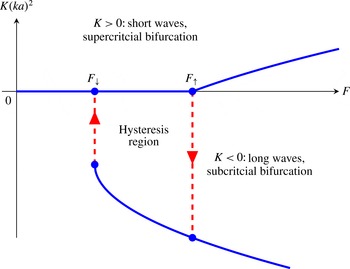
is unstable). Therefore, we conclude that the transition from rest to the wavy state is supercritical (i.e. smooth) for short waves, while it is subcritical (i.e. has hysteresis) for long waves (figure 1).
It should be noted that, according to this theoretical model, the hysteresis (observed experimentally by Rajchenbach et al. (Reference Rajchenbach, Leroux and Clamond2011, Reference Rajchenbach, Clamond and Leroux2013)) exists only because
 ${\it\omega}_{0}\neq {\it\omega}$
, i.e. because the frequency of a Faraday wave is not that of a free wave. Indeed, if
 ${\it\omega}_{0}={\it\omega}$
then, from (6.3),
 $F_{\uparrow }=4{\it\sigma}/{\it\omega}=F_{\downarrow }$
, so the hysteresis region vanishes. Therefore, consideration of the correct dispersion relation not only leads to quantitative corrections but, more importantly, also yields qualitatively different behaviours.
The bifurcation diagram from rest. (Only the stable branches are displayed by thick blue lines.)

It should be noted also that, at the instability threshold
 $F_{\uparrow }$
, the relative deviation between
 ${\it\omega}_{0}$
and
 ${\it\omega}$
can be written from (6.3) as
 $$\begin{eqnarray}|{\it\omega}_{0}-{\it\omega}|{\it\omega}^{-1}={\textstyle \frac{1}{4}}(F_{\uparrow }^{2}-F_{\downarrow }^{2})^{1/2},\end{eqnarray}$$
which is practically convenient because
 $F_{\downarrow }$
and
 $F_{\uparrow }$
are easily measured experimentally in the subcritical regime. In the experiments by Rajchenbach et al. (Reference Rajchenbach, Clamond and Leroux2013) this deviation is approximately 10 %. In the supercritical regime, the deviation seems to be up to the order of 5 % according to the experiments by Edwards & Fauve (Reference Edwards and Fauve1994, figure 7).
7.4. Summary
The results of this section are summarised in figure 1. This plot corresponds to (6.2). According to Tadjbakhsh & Keller (Reference Tadjbakhsh and Keller1960),
 $K$
is positive for short waves (or deep water, i.e.
 $kd\gtrsim 1$
) and negative for long waves (i.e.
 $kd\lesssim 1$
). This yields the following conclusions.
For short waves, the positivity of
 $K$
,
 ${\it\omega}$
,
 ${\it\omega}_{0}$
and
 $F^{2}/16-{\it\sigma}^{2}/{\it\omega}^{2}$
in (6.2) implies that (i) the only stable solution is rest for
 $F<F_{\uparrow }=4\sqrt{(1-{\it\omega}_{0}/{\it\omega})^{2}+({\it\sigma}/{\it\omega})^{2}}$
; (ii) the rest state becomes unstable for
 $F>F_{\uparrow }$
through a supercritical transition.
For long waves: (i) the rest state is the only possible state for
 $F<F_{\downarrow }=4{\it\sigma}/{\it\omega}$
; (ii) there are two stable states (one being the rest state) and one unstable state in the interval
 $F_{\downarrow }<F<F_{\uparrow }$
; (iii) for
 $F>F_{\uparrow }$
, the rest state becomes unstable through a discontinuous subcritical transition. In the interval
 $F_{\downarrow }<F<F_{\uparrow }$
, the system displays hysteresis, i.e. the observed state depends on the path taken in the
 $(F,{\it\Omega})$
-plane to reach the desired
 $F$
and
 ${\it\Omega}$
.
8. Discussion
Concerning Faraday waves, a widespread misconception, already present in the seminal article of Benjamin & Ursell (Reference Benjamin and Ursell1954), is that a necessary condition to observe a parametric resonance of waves is that
 $n{\it\Omega}/2$
coincides with one of the frequencies of a free unforced wave mode in the tank (i.e.
 ${\it\omega}_{0}=n{\it\Omega}/2$
). Of course, such solutions depend on the shape and size of the tank, and correspond to standing waves, with node and antinode positions fixed in space and time. Therefore, according to this viewpoint, the resonance wavenumbers are quantised and depend on the geometry of the container (Benjamin & Ursell Reference Benjamin and Ursell1954, § 4). More precisely, Benjamin & Ursell (Reference Benjamin and Ursell1954, end of § 3) wrote the following.
‘When the frequency of a free vibration of the liquid coincides with a subharmonic of the applied vibration, the parameter
 $p$
takes the value
 $n^{2}$
, where
 $n$
is an integer, and figure 2 shows that instability can then occur for small values of
 $q$
(i.e. small values of
 $f$
). In particular, waves with half the frequency of the vessel are excited for small values of
 $f$
when
 $p$
is approximately 1, and
 $(p,q)$
lies in the unstable region nearest the origin; and synchronous waves are excited when
 $p$
is approximately 4, and
 $(p,q)$
lies in the second unstable region.’
For instance, figure 3 of the cited paper is related to the parametric resonance (in a cylindrical vessel) of the standing mode corresponding to two nodal circles and one nodal diameter.
This viewpoint is actually incorrect and contradicts experimental evidence, as can be seen in the movie given as supplementary material to the paper by Rajchenbach et al. (Reference Rajchenbach, Clamond and Leroux2013). In this movie, it is clear that the parametrically forced mode oscillates at half of the forcing frequency, but corresponds there to two contra-propagative waves and not to an eigenmode of the tank. One can realise, therefore, that the possible wavenumbers of resonating Faraday waves are not quantised by the container, but rather display a continuous spectrum. The excited mode is not necessarily the standing wave corresponding to the container eigenmode with the frequency closest to
 $n{\it\Omega}/2$
, but oscillates exactly at
 $n{\it\Omega}/2$
with the wavenumber given by the dispersion relation including forcing and dissipation (and not by the dispersion relation of free unforced waves).
In the present study, we have partly revisited the theoretical description of Faraday waves. We have recognised that the dispersion relation of Faraday waves is modified compared with that of free unforced waves: the forcing amplitude and the dissipation play a key role in the dispersion relation. This result changes the conditions required to obtain multiwave couplings (1.1) and hence modify the criterion aimed at predicting the geometry of surface patterns.
We have also determined the value of the forcing at the instability onset, in cases of both short and long waves, as well as the selected wavenumbers. Last, we have also studied the nature of the bifurcation at the instability threshold, and we have shown that the transition is supercritical for short waves and subcritical for long waves. Until now, this transition was always considered to be supercritical, but recent experiments (Rajchenbach et al. Reference Rajchenbach, Clamond and Leroux2013) show that subcritical transitions can occur, and the present study provides a theoretical explanation for this phenomenon.
Our analysis is limited to linear and weakly nonlinear waves. It is also limited to waves whose wavelength is not large compared with the water depth. This class of theoretical models involves the Airy and Stokes waves (Wehausen & Laitone Reference Wehausen and Laitone1960), as well as the nonlinear Schrödinger equation. These theories are valid for deep water and intermediate depths, i.e. not for shallow water. The experiments of Rajchenbach et al. (Reference Rajchenbach, Clamond and Leroux2013) are highly nonlinear but, more importantly, are carried out in shallow water, i.e. the wavelength is much longer than the depth. Shallow water theoretical models involve cnoidal and solitary waves, the Korteweg–deVries and Boussinesq equations, for example. It is well known that ‘intermediate depth’ and ‘shallow water’ theoretical models have separate validity domains (Littman Reference Littman1957). (In the present paper, we carefully used the term ‘long wave’ and not ‘shallow water’ to refer to the case
 $K<0$
, in order to avoid confusion in the validity range of the theoretical model.) Derivation of a satisfactory theory for highly nonlinear waves in shallow water is a challenge left for future theoretical investigations.
Appendix A. Derivation of approximate dispersion relations
For
 $n=1$
, the wave angular frequency is
 ${\it\omega}={\it\Omega}/2$
. The magnitude of the forcing and dissipation can be characterised by introducing a small parameter
 ${\it\epsilon}$
and writing
 $F={\it\epsilon}\bar{F}$
and
 ${\it\sigma}={\it\epsilon}\bar{{\it\sigma}}$
. Approximate solutions of the damped Mathieu equation (2.1) can be obtained by expanding
 ${\it\zeta}$
and
 ${\it\omega}_{0}$
in power series of
 ${\it\epsilon}$
as
 $$\begin{eqnarray}{\it\zeta}={\it\zeta}_{0}+{\it\epsilon}{\it\zeta}_{1}+{\it\epsilon}^{2}{\it\zeta}_{2}+\cdots \,,\quad {\it\omega}_{0}={\it\omega}+{\it\epsilon}{\it\omega}_{1}+{\it\epsilon}^{2}{\it\omega}_{2}+\cdots \,.\end{eqnarray}$$
By substituting these series into (2.1) and solving the resulting equation for each power of
 ${\it\epsilon}$
independently, one obtains a cascade of simpler equations providing the approximation.
At order
 ${\it\epsilon}^{0}$
, we have
 $\ddot{{\it\zeta}}_{0}+{\it\omega}^{2}{\it\zeta}_{0}=0$
, thence
 ${\it\zeta}_{0}=A_{0}\cos ({\it\omega}t)+B_{0}\sin ({\it\omega}t)$
. At order
 ${\it\epsilon}^{1}$
, we have after some algebra
 $$\begin{eqnarray}\displaystyle \ddot{{\it\zeta}}_{1}+{\it\omega}^{2}{\it\zeta}_{1} & = & \displaystyle {\textstyle \frac{1}{2}}{\it\omega}^{2}\bar{F}A_{0}\cos (3{\it\omega}t)+{\textstyle \frac{1}{2}}{\it\omega}^{2}\bar{F}B_{0}\sin (3{\it\omega}t)\nonumber\\ \displaystyle & & \displaystyle +\,[({\textstyle \frac{1}{2}}{\it\omega}\bar{F}-2{\it\omega}_{1})A_{0}-2\bar{{\it\sigma}}B_{0}]{\it\omega}\cos ({\it\omega}t)\nonumber\\ \displaystyle & & \displaystyle -\,[({\textstyle \frac{1}{2}}{\it\omega}\bar{F}+2{\it\omega}_{1})B_{0}-2\bar{{\it\sigma}}A_{0}]{\it\omega}\sin ({\it\omega}t).\end{eqnarray}$$
The most general solution of (A 2) is unbounded due to linear terms in
 $t$
. Physically acceptable solutions are obtained by cancelling these secular terms that are generated by the square brackets in (A 2), as one can easily check. The non-secularity condition is thus obtained by setting to zero the square brackets, i.e.
 $$\begin{eqnarray}B_{0}=({\it\omega}\bar{F}-4{\it\omega}_{1})A_{0}/4\bar{{\it\sigma}},\quad {\it\omega}_{1}=\pm {\textstyle \frac{1}{4}}\sqrt{{\it\omega}^{2}\bar{F}^{2}-16\bar{{\it\sigma}}^{2}}.\end{eqnarray}$$
The dispersion relation (4.1) is obtained from the approximation
 ${\it\omega}_{0}\approx {\it\omega}+{\it\epsilon}{\it\omega}_{1}$
and returning to the original parameters
 $F$
and
 ${\it\sigma}$
. Similarly, the dispersion relation (4.2) can be obtained with the same perturbation scheme with
 ${\it\omega}={\it\Omega}$
and
 ${\it\sigma}={\it\epsilon}^{2}\bar{{\it\sigma}}$
. It should be noted that this procedure is independent of the way in which the parameters
 ${\it\omega}_{0}$
,
 $F$
and
 ${\it\sigma}$
depend (or not) on the wavenumber
 $k$
.