Callous–unemotional (CU) traits include lack of guilt and empathy, as well as shallow affect. Adults with a combination of CU traits and antisocial behavior (AB) are labeled psychopaths within the criminal justice system (Hare & Neumann, Reference Hare, Neumann and Patrick2006). Although no one would suggest that children are psychopaths, CU traits can be used to distinguish a subgroup of children who are capable of premeditated AB and violence (AB/CU+; Frick & Viding, Reference Frick and Viding2009) and who are at an elevated risk for developing psychopathy when they reach adulthood (Lynam, Derefinko, Caspi, Loeber, & Stouthamer-Loeber, Reference Lynam, Derefinko, Caspi, Loeber and Stouthamer-Loeber2007). CU traits are currently being considered as a subtyping criterion for the fifth edition of the Diagnostic and Statistical Manual of Mental Disorders of the American Psychiatric Association (Frick & Moffitt, Reference Frick and Moffitt2010; Scheepers, Buitelaar, & Matthys, Reference Scheepers, Buitelaar and Matthys2011). A number of clinical and community studies suggest that children who have early-onset AB are more likely to have elevated levels of CU traits than those in the adolescent-onset group, but both groups include AB/CU+ individuals (Dandreaux & Frick, Reference Dandreaux and Frick2009; Silverthorn, Frick, & Reynolds, Reference Silverthorn, Frick and Reynolds2001; Vizard, Hickey, & McCrory, Reference Vizard, Hickey and McCrory2007). In line with this, the proposed inclusion of “with CU traits” as a conduct disorder diagnostic specifier in the next edition of the DSM applies to any child with a conduct disorder diagnosis, regardless of the age of onset (Frick & Moffitt, Reference Frick and Moffitt2010).
Longitudinal data show that children with AB/CU+ present with a more severe behavioral profile and more long-term problems than children who have AB but lower levels of CU (AB/CU–; Fontaine, McCrory, Boivin, Moffitt, & Viding, Reference Fontaine, McCrory, Boivin, Moffitt and Viding2011; Frick & Viding, Reference Frick and Viding2009). Even in the absence of AB, CU traits are associated with poorer outcomes, including risk for developing delinquent behaviors and other types of psychosocial maladjustment (e.g., Barker, Oliver, Viding, Salekin, & Maughan, Reference Barker, Oliver, Viding, Salekin and Maughan2011; Frick, Cornell, Barry, Bodin, & Dane, Reference Frick, Cornell, Barry, Bodin and Dane2003; Kumsta, Sonuga-Barke, & Rutter, in press; Rowe, Costello, Angold, Copeland, & Maughan, Reference Rowe, Costello, Angold, Copeland and Maughan2010). Longitudinal data also show that CU traits add to the prediction of serious and persistent criminal behavior in boys (Pardini & Fite, Reference Pardini and Fite2010). In short, the core affective characteristics of psychopathy (CU traits) can be delineated in children and may be a risk index for later psychopathy, as well as other forms of poor outcome.
Cognitive experimental data suggest that children with AB/CU+ are poor at modulating their behavior in response to punishment in conditioning paradigms (for a review, see Frick & Viding, Reference Frick and Viding2009). In addition they have difficulties in processing other people's fearful and sad facial expressions, vocal tones, and body postures (e.g., Blair & Viding, Reference Blair, Viding, Rutter, Bishop, Pine, Scott, Stevenson and Taylor2008; Marsh & Blair, Reference Marsh and Blair2008; Muñoz, Reference Muñoz2009), which may at least partially derive from failure to orient to the affectively salient aspects of stimuli (Dadds et al., Reference Dadds, Perry, Hawes, Merz, Riddell and Haines2006; Dadds, Jambrak, Pasalich, Hawes, & Brennan, Reference Dadds, Jambrak, Pasalich, Hawes and Brennan2011; Dadds & Rhodes, Reference Dadds and Rhodes2008; Sylvers, Brennan, & Lilienfeld, Reference Sylvers, Brennan and Lilienfeld2011). Children with AB/CU+ also appear to have an impoverished personal experience of fear and guilt, which suggests that their difficulty in processing others’ distress may partly stem from an inability to feel normative levels of distress themselves (de Wied, van Boxtel, Mathys, & Meeus, Reference De Wied, van Boxtel, Matthys and Meeus2011; Jones, Happé, Gilbert, Burnett, & Viding, Reference Jones, Happé, Gilbert, Burnett and Viding2010; Marsh et al., Reference Marsh, Kozak, Wegner, Reid, Yu and Blair2010). Theoretical accounts of AB/CU+ propose that normal socialization is disrupted in these children because they do not form adequate associations between their transgressions and punishment outcome and because they do not find other people's distress aversive and consequently have difficulties in developing empathy (Blair, Reference Blair2010; Blair & Viding, Reference Blair, Viding, Rutter, Bishop, Pine, Scott, Stevenson and Taylor2008). This affective profile is in contrast to that commonly found for children with AB/CU–, who are often hypervigilant to threat emotions, are capable of showing empathy, and can appear emotionally overreactive (Frick & Viding, Reference Frick and Viding2009; Jones, Happé, Gilbert, Burnett, & Viding, Reference Jones, Happé, Gilbert, Burnett and Viding2010).
The aim of this paper is to provide an overview of recent genetically informative and magnetic resonance imaging (MRI) studies of AB/CU+ and discuss how these data have furthered our understanding of developmental vulnerability to psychopathy. We use examples of our own and others’ research to illustrate how a developmental psychopathology approach, employing multiple levels of analyses and considering concepts such as equi- and multifinality, is essential for garnering a better understanding of how psychopathy develops and how it can be prevented. We also discuss the potential treatment implications of the existing genetic and neurocognitive research. Although there is now a substantial body of behavioral and cognitive experimental studies attesting to the distinct nature of AB/CU +, evidence from genetic and neuroimaging research remains preliminary. We will finish by outlining the necessary directions for future research.
Etiology of CU Traits
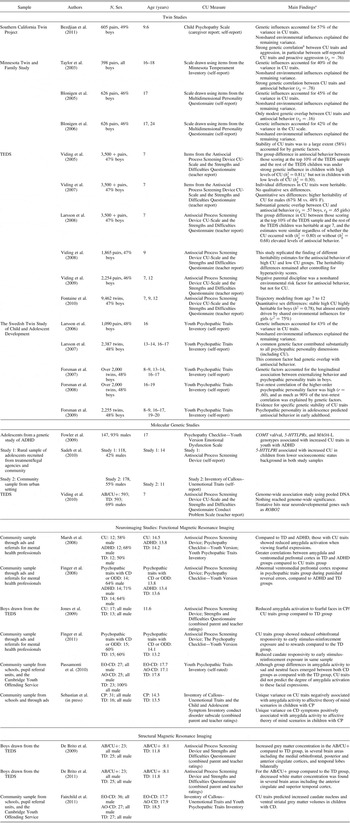
A number of twin studies have examined the etiology of CU traits in children and youth. These studies come from the United States, Sweden, and the United Kingdom. The samples used in these studies vary in size from moderate (398 twin pairs) to large (3,687 twin pairs), represent different age groups (7–24 years old), and have used a range of instruments that have relied on both self- and other (parent or teacher) ratings (see Table 1 for details of the samples, ages, and measures). We will concentrate specifically on genetically informative data on CU traits or AB/CU+ , because CU traits represent the core affective features of psychopathy (Frick & Viding, Reference Frick and Viding2009).
Summary table of twin, molecular genetic, and neuroimaging studies of child/adolescent CU or AB/CU+

Note: CU, callous–unemotional; AB/CU+, antisocial behavior with CU traits; TEDS, Twins Early Development Study; COMT, catechol-O-methyltransferase; 5-HTTLPRs, short allele of the serotonin transporter linked polymorphic region; 5-HTTLPRl, long allele of the serotonin transporter linked polymorphic region; MAOA-L, low activity allele of monoamine oxidase A gene; ROBO2, roundabout 2 gene; ADHD, attention-deficit/hyperactivity disorder; TD, typically developing; ODD, oppositional defiant disorder; EO-CD, early onset conduct disorder; AO-CD, late onset conduct disorder; CP, conduct problems.
aFor ease of reading, CU traits in the Main Findings column refer to scales that have measured lack of empathy and guilt, shallow affect, and similar traits (although individual authors have at times used a different label for their scale, e.g., “detachment”). The CU Measure column lists the specific CU measure. Interested readers should consult the individual papers for further details of the measures.
br g is the genetic correlation (the degree of genetic overlap).
ch g2 is the group heritability (the degree of group differences due to genetic influences).
Twin studies estimate heritability by establishing the degree to which identical twins (who effectively share 100% of their polymorphic genes) compared to nonidentical twins (who on average share 50% of their polymorphic genes) are similar to each other. If identical twin similarity exceeds nonidentical twin similarity, then heritable influences on a trait are inferred. The existing studies have reported remarkably consistent results of moderate to strong heritability for CU traits in children and youth. These studies, conducted across different age groups and using different measures of CU traits, estimate that 40% to 78% of the variation in CU traits across the population is attributable to genetic influences (Bezdjian, Raine, Baker, & Lynam, Reference Bezdjian, Raine, Baker and Lynam2011; Blonigen, Hicks, Krueger, Patrick, & Iacono, Reference Blonigen, Hicks, Krueger, Patrick and Iacono2005, Reference Blonigen, Hicks, Krueger, Patrick and Iacono2006; Fontaine, Rijsdijk, McCrory, & Viding, Reference Fontaine, Rijsdijk, McCrory and Viding2010; Larsson, Andershed, & Lichtenstein, Reference Larsson, Andershed and Lichtenstein2006; Taylor, Loney, Bobadilla, Iacono, & McGue, Reference Taylor, Loney, Bobadilla, lacono and McGue2003; Viding, Frick, & Plomin, Reference Viding, Frick and Plomin2007). Our own data from the Twins Early Development Study (TEDS) has also indicated that at age 7 the group difference between those scoring at the high end for CU traits (top 10%) and other children is also largely driven by genetic influences (h g2 = 0.67; Viding, Blair, Moffitt, & Plomin, Reference Viding, Blair, Moffitt and Plomin2005). These group heritability estimates appear very similar regardless of whether the CU occurs with (h g2 = 0.80) or without (h g2 = 0.68) elevated levels of AB (Larsson, Viding, & Plomin, Reference Larsson, Viding and Plomin2008).
Twin studies are also important for documenting the extent to which environmental factors influence individual differences or group differences in CU traits. The shared environment in twin studies refers to environmental factors that make the members of the twin pair more similar than would be expected by genetic relatedness alone (this can be crudely inferred if nonidentical twin similarity exceeds 50% of identical twin similarity). The nonshared environment in twin studies refers to environmental factors that make members of the twin pair dissimilar to each other (this can be crudely inferred if identical twin similarity is less than 100%). Shared environmental influences were detected in only few cases for CU (Fontaine et al., Reference Fontaine, Rijsdijk, McCrory and Viding2010; Viding, Frick, & Plomin, Reference Viding, Frick and Plomin2007), but our longitudinal data (described more fully below) indicate that such influences may be particularly important for a handful of girls who have stable and high levels of CU. All studies, including our own, have demonstrated that nonshared environmental influences are particularly important for the development of CU. This does not mean that family or neighborhood environments are not relevant for development of CU. Rather it suggests that environmental risk factors, including those experienced within the family context, are likely to promote differences between members of the same family (nonshared environment in the twin models). The magnitude of the heritability and environmental estimates for CU traits from child and adolescent samples are in line with previous adult twin data on psychopathic personality traits (Blonigen, Carlson, Krueger, & Patrick, Reference Blonigen, Carlson, Krueger and Patrick2003) as well as other personality dimensions (Bouchard & Loehlin, Reference Bouchard and Loehlin2001).
Are There Sex Differences in the Etiology of CU Traits?
Four studies to date (Bezdjian et al., Reference Bezdjian, Raine, Baker and Lynam2011; Fontaine et al., Reference Fontaine, Rijsdijk, McCrory and Viding2010; Larsson et al., Reference Larsson, Andershed and Lichtenstein2006; Viding et al., Reference Viding, Frick and Plomin2007) have incorporated dizygotic opposite-sex twin pairs in their analyses and formally explored the potential role of qualitative sex differences (i.e., different genes and environments influencing phenotypic variation for males and females). None of these studies have reported qualitative sex differences for CU traits. A number of studies have also assessed the possibility of quantitative sex differences (i.e., the same genetic and environmental influences affecting males and females to a different degree). Two studies found little evidence of quantitative sex differences for CU traits (Blonigen et al., Reference Blonigen, Hicks, Krueger, Patrick and Iacono2006; Larsson et al., Reference Larsson, Andershed and Lichtenstein2006), but there is also some support for a higher heritability of CU for males (Bezdijan et al., Reference Bezdjian, Raine, Baker and Lynam2011; Fontaine et al., Reference Fontaine, Rijsdijk, McCrory and Viding2010; Viding et al., Reference Viding, Frick and Plomin2007). For instance, using data from 9,462 youths from the TEDS, Fontaine and colleagues found that strong heritability (h 2 = 0.78) was observed for boys on a stable high CU trajectory (between 7 and 12 years old). Stable and high levels of CU in girls, however, appeared to be almost entirely driven by shared environmental influences (c 2 = 0.75). Replication of this finding is needed given the small number of children who followed the stable and high CU trajectory and the even smaller proportion of this already small group who were females (<1% of the total sample).
Stability of CU Traits: Genetic and Environmental Contributions
A few twin studies to date have explored the genetic and environmental contributions to the stability of CU traits in childhood and adolescence. Blonigen et al. (Reference Blonigen, Hicks, Krueger, Patrick and Iacono2006) focused on two time points 7 years apart, when the twins were 17 and 24 years old. Their results indicate that the heritability of CU traits remained consistent across time and 58% of the stability of CU traits was due to genetic influences. This finding indicates that the stability in CU traits is substantially influenced by genetic factors. Using the TEDS sample, Fontaine and colleagues (Reference Fontaine, Rijsdijk, McCrory and Viding2010) reported that a stable high trajectory of CU in childhood (between 7 and 12 years) was strongly heritable in boys (h 2 = 0.78) but not in girls (h 2 = 0.00). This finding suggests that at least in childhood/early adolescence, genetic influences may drive the stability of high levels of CU traits for boys in particular. Forsman, Lichtenstein, Andershed, and Larsson (Reference Forsman, Lichtenstein, Andershed and Larsson2008) measured CU traits (as well as impulsivity and grandiosity) and examined genetic and environmental contributions to the stability of these traits between ages 16 and 19. The authors focused on a hierarchical model of psychopathic personality in which a higher-order general factor substantially explained the variation in the three psychopathic personality dimensions in mid- and late adolescence. The results showed that the observed test–retest correlation of the higher-order psychopathic personality factor was high (r = .60). In addition, as much as 90% of the test–retest correlation was explained by genetic factors. However, they also found evidence for specific genetic stability in CU. Thirteen percent of the unique genetic effects in the CU dimension at age 19 were shared with the corresponding effects at age 16. Thus, their model provides evidence for etiologic generality (together with other aspects of psychopathic personality) and etiologic specificity for the stability of CU traits between mid- and late adolescence. Note that for a subset of children, CU traits are malleable in childhood, increasing or decreasing with age, rather than remaining persistently high or low (see Fontaine et al., Reference Fontaine, Rijsdijk, McCrory and Viding2010). This may reflect environmental factors interacting with genetic risk to either promote or moderate the development of CU traits, leading to increasing or decreasing CU trajectories, respectively (Fontaine et al., Reference Fontaine, Rijsdijk, McCrory and Viding2010). The challenge for researchers and clinicians is to identify the key environmental factors that are most influential in this regard and to develop interventions that can promote the reduction of CU traits, thereby reducing the risk of later maladaptive outcomes.
Etiological Overlap Between CU Traits and AB
Twin models have also been important in exploring the etiologic overlap between CU traits and AB. Multivariate genetic models can be used to estimate the extent of genetic/environmental correlation, which refers to the degree of overlap between genetic/environmental influences on different traits or behaviors. Three multivariate twin studies to date have demonstrated a moderate to high genetic correlation between CU traits and AB/aggression when covariation is measured in the whole population (range of r g = .41–.74; Bezdijan et al., Reference Bezdjian, Raine, Baker and Lynam2011; Taylor et al., Reference Taylor, Loney, Bobadilla, lacono and McGue2003; Viding et al., Reference Viding, Frick and Plomin2007), whereas one study to date has reported a modest genetic correlation between CU traits and AB (r g = .16; Blonigen et al., Reference Blonigen, Hicks, Krueger, Patrick and Iacono2005). The genetic overlap may be slightly stronger at the extreme high end of both CU and AB distributions (Viding et al., Reference Viding, Frick and Plomin2007). Larsson et al. (Reference Larsson, Tuvblad, Rijsdijk, Andershed, Grann and Lichtenstein2007) explored the genetic commonality between three psychopathic personality dimensions (grandiose–manipulative, CU, and impulsive–irresponsible) and AB measured at age 13–14 and age 16–17 years. A common genetic factor loaded substantially on both psychopathic personality traits and AB. This was not the case for environmental factors. Forsman, Larsson, Andershed, and Lichtenstein (Reference Forsman, Larsson, Andershed and Lichtenstein2007) found that externalizing behavior in childhood (age 8–9) was associated with higher levels of psychopathic personality traits in adolescence (age 13–14) among boys but not in girls. Genetic factors were responsible for this association. Another study by Forsman, Lichtenstein, Andershed, and Larsson (Reference Forsman, Lichtenstein, Andershed and Larsson2010) showed that a psychopathic personality in adolescence (16–17) predicted AB in early adulthood (19–20), over and above both concurrent and preexisting levels of AB. The association between adolescent psychopathic personality and adult AB was mainly explained by genetic effects, a result that can be interpreted as a genetically influenced personality-driven process, where individuals are predisposed to higher risk of involvement in AB because of their psychopathic personality. Finally, a recent study by Bezdjian et al. (Reference Bezdjian, Raine, Baker and Lynam2011) demonstrated that CU traits shared genetic influences with both reactive and proactive aggression. The genetic correlation was particularly strong between self-rated CU traits and proactive aggression (r g = .76).
With regard to environmental influences, modest to moderate nonshared environmental correlations have been demonstrated between CU traits and AB/aggression (e.g., Bezdijan et al., Reference Bezdjian, Raine, Baker and Lynam2011; Viding et al., Reference Viding, Frick and Plomin2007). This means that, although some child-specific environmental factors promote the development of both CU and AB/aggression, the child-specific environmental influences for the two constructs also have substantial independence. We recently conducted a longitudinal monozygotic twin differences study to examine negative parental discipline (e.g., shouting and harsh discipline) as a nonshared environmental factor for CU and AB (Viding, Fontaine, Oliver, & Plomin, Reference Viding, Fontaine, Oliver and Plomin2009). Although negative parental discipline at age 7 had a phenotypic association with both CU traits and AB at age 12, negative parental discipline emerged as a nonshared environmental factor for AB alone. In other words those members of the monozygotic twin pair who received more negative parental discipline at age 7 were also more likely to manifest ABs at age 12, even after controlling for baseline differences in the level of AB. This was not true for CU traits; and we speculated that the phenotypic association between negative parental discipline and CU traits may reflect the genetic endowment within those families with CU+ children, rather than an environmentally driven parenting process that increases risk for CU traits.
Etiology of AB With and Without CU Traits
Finally, twin studies have also been helpful in exploring the utility of CU traits as a subtyping factor for individuals with AB. Viding et al. (Reference Viding, Blair, Moffitt and Plomin2005) used information from the TEDS sample to investigate whether the etiology of teacher rated AB differs as a function of teacher rated CU at age 7. The authors separated children with elevated levels of AB (in the top 10% for the TEDS sample) into two groups based on their CU score (in the top 10% or not). AB in children with CU was under strong genetic influence (h g2 = 0.81) and no influence of shared environment. In contrast, AB in children without elevated levels of CU showed moderate genetic influence (h g2 = 0.30) and substantial environmental influence (c g2 = 0.34, e g2 = 0.26). Viding, Jones, Frick, Moffitt, and Plomin (Reference Viding, Jones, Frick, Moffitt and Plomin2008) replicated the finding of different heritability estimates for the AB/CU+ and AB/CU– groups using the 9-year teacher data from the TEDS. In addition, they demonstrated that the strong heritability of AB in the AB/CU+ group was not driven by co-occurring hyperactivity.
Molecular Genetic Studies
Despite the substantial literature demonstrating the heritable component of CU traits, we know of only three published molecular genetic studies of child/adolescent CU traits (see Table 1 for details of these studies). The first of these was carried out on a relatively small sample of adolescents with attention-deficit/hyperactivity disorder (ADHD) and reported associations between “emotional dysfunction” scores of psychopathy (CU) and each of the following allelic variants: the valine allele of the cathechol-O-methyltransferase gene, the low activity allele of the monoamine oxidase A gene (MAOA-L), and the short allele of the serotonin transporter linked polymorphic region gene (5-HTTLPRs; Fowler et al., Reference Fowler, Langley, Rice, van den Bree, Ross and Wilkinson2009). The latter two of these associations were unexpected given that imaging genetic data suggesting that MAOA-L and 5-HTTLPRs are associated with heightened amygdala activity to emotional stimuli (e.g., Meyer-Lindenberg et al., Reference Meyer-Lindenberg, Buckholtz, Kolachana, Hariri, Pezawas and Blasi2006; Munafo, Brown, & Hariri, Reference Munafo, Brown and Hariri2008), in contrast to the reduced amygdala activity to emotional stimuli typically seen in adults with psychopathy and children with AB/CU+ (reduced; e.g., Birbaumer et al., Reference Birbaumer, Veit, Lotze, Erb, Hermann and Grodd2005; Jones et al., Reference Jones, Laurens, Herba, Barker and Viding2009; Kiehl et al., Reference Kiehl, Smith, Hare, Mendrek, Forster and Brink2001; Marsh et al., Reference Marsh, Finger, Mitchell, Reid, Sims and Kosson2008). It is possible that the findings of Fowler and colleagues are specific to the selected group of adolescents that they studied, all of whom had high levels of ADHD symptoms but relatively low levels of CU traits. A more recent study reported that the long allele of the 5-HTTLPR (5-HTTLPRl), which is the allele conferring low amygdala reactivity, was associated with CU traits in adolescents from low socioeconomic status backgrounds (Sadeh et al., Reference Sadeh, Javdani, Jackson, Reynolds, Potenza and Gelernter2010). This is an extremely interesting finding, because it tentatively suggests that vulnerability to low emotional reactivity may only manifest as high CU traits under disadvantageous socioeconomic conditions.
Finally, new technologies, such as DNA pooling, are enabling genome-wide association studies that search for novel single nucleotide polymorphisms (SNPs), which may be associated with AB/CU+. DNA pooling refers to a genetic screening method that combines DNA from many individuals in a single molecular genetic analysis to generate a representation of allele frequencies. A DNA pool can thus be generated for all cases and all controls and allele frequencies can be compared between these pools. We recently conducted such a study and, although no SNPs reached genomewide significance, there were some potential candidates near neurodevelopmental genes (Viding et al., Reference Viding, Hanscombe, Curtis, Davis, Meaburn and Plomin2010). If these findings are replicated, these novel SNPs could be assessed in relation to psychopathy in several existing cohorts. They could also be incorporated into imaging genetic investigations of psychopathy. The latter avenue is particularly interesting, because we have recently used twin design to document that aberrant structural development in certain brain areas in AB/CU+ reflects genetic, rather than environmental, vulnerability (Rijsdijk et al., Reference Rijsdijk, Viding, DeBrito, Forgiarini, Mechelli and Jones2010).
Summary of Genetic Research
Numerous twin studies from different laboratories suggest that both individual and group differences in CU traits are moderately to strongly heritable. Child-specific (nonshared) environmental factors are also important in accounting for individual and group differences in CU traits. However, environmental factors that make children growing up in the same family similar to each other (termed shared environmental factors in twin models) do not typically play a role in individual and group differences in CU traits. Girls with stable high CU traits represent a possible exception, because shared environmental factors appear to be important for the development of CU traits in this group.
Twin studies can go beyond answering questions about the relative importance of heritable and environmental influences. To date such studies have advanced our knowledge about CU traits in several important ways. First, they have demonstrated that the stability of CU traits is typically driven by genetic influences (particularly in boys), but there are substantial child-specific environmental influences that may contribute to an increasing or decreasing trajectory of CU trait development. Second, monozygotic twin differences data suggest that negative parental practices do not act as a child-specific environmental risk factor for CU, but they may instead reflect genetic vulnerability within families. However, aspects of positive parenting are yet to be investigated within this framework and could be a promising environmental modulator of CU traits. Third, a number of studies have shown that CU and AB share a degree of genetic risk and (to a modest extent) child-specific environmental risk factors. Fourth and finally, AB in the presence (but not absence) of CU traits appears strongly heritable, suggesting that CU traits are a useful subtyping index for children with disruptive behaviors.
Research into specific polymorphisms that increase risk of CU traits or AB/CU+ is still in its infancy. Furthermore, as far as we are aware, there have been no independent replications of any of the reported findings. Research in this area is likely to advance greatly in the coming decade, including novel epigenetic approaches that may help us uncover mechanisms of gene–environment interaction, studies of rare copy number variants that may affect smaller subsets of individuals at risk for developing psychopathy, or investigations of possible sex-specific genetic risk factors. It is useful to consider the following pointers with regard to current but in particular future molecular genetic investigations. First, there are no genes for psychopathy. Genes code for proteins that influence characteristics such as neurocognitive vulnerabilities that may in turn increase risk for developing psychopathy. Second, genetic risk for psychopathy may only manifest itself under unfavorable environmental circumstances (e.g., Sadeh et al., Reference Sadeh, Javdani, Jackson, Reynolds, Potenza and Gelernter2010) and genetic variants implicated in CU and AB/CU+ are likely to include several common polymorphisms that confer advantages, as well as disadvantages, depending on the environmental context. Third, we know that the neurocognitive vulnerabilities associated with psychopathy (or risk for development of psychopathy) are at least partially distinct from those associated with AB in general. This suggests that the risk alleles for psychopathy may not be the same risk alleles as those for AB in the absence of CU traits. (For a review of this in relation to 5-HTTLPR, see Glenn, Reference Glenn2011; for a more general proposal of differential genetic vulnerability in AB/CU+ and AB/CU–, see Viding & Jones, Reference Viding and Jones2008.) The study by Sadeh and colleagues (Reference Sadeh, Javdani, Jackson, Reynolds, Potenza and Gelernter2010) is in line with this possibility, because it demonstrated not only that the long allele of the 5-HTTLPR predisposed individuals to CU traits in low socioeconomic status environments but also that the short allele of the same gene predisposed individuals to impulsive AB. Buckholtz and Meyer-Lindenberg (Reference Buckholtz and Meyer-Lindenberg2008) have also speculated that the MAOA-L allele, which has received a lot of attention as a risk allele for AB, may predispose to threat reactive and impulsive, rather than psychopathic AB. The MAOA-L genotype is associated with a pattern of hyperreactivity of emotion processing areas of the brain (Meyer-Lindenberg et al., Reference Meyer-Lindenberg, Buckholtz, Kolachana, Hariri, Pezawas and Blasi2006), which is in direct contrast to the pattern typically reported for individuals with psychopathy (e.g., Birbaumer et al., Reference Birbaumer, Veit, Lotze, Erb, Hermann and Grodd2005; Kiehl et al., Reference Kiehl, Smith, Hare, Mendrek, Forster and Brink2001). It is interesting to note that some studies have reported increased vulnerability to AB in the presence of the high activity MAOA allele (e.g., Manuck, Flory, Ferrell, Man, & Muldoon, Reference Manuck, Flory, Ferrell, Mann and Muldoon2000). These may reflect false positive findings, but they could also reflect the relative composition of CU+ and CU– individuals in different studies.
Functional and Structural MRI Studies
As outlined in the introductory section, children with AB/CU+ share an affective profile with adult psychopaths, showing reduced sensitivity to visual or vocal displays of distress emotions and poor modulation of behavior in response to punishment (Blair & Viding, Reference Blair, Viding, Rutter, Bishop, Pine, Scott, Stevenson and Taylor2008). In line with the behavioral and experimental neuropsychology data, functional MRI findings for children with AB/CU+ indicate functional deficits consistent with low emotional responsiveness to others’ distress and poor ability to learn from reinforcement information. Aberrant neural functioning (compared to typically developing children or children with ADHD) has been observed for children with AB/CU+ in the amygdala, ventromedial prefrontal cortex (vmPFC), orbitofrontal cortex (OFC), and caudate, which are brain areas involved in processing basic emotional salience, reinforcement learning, and emotion regulation (see Table 1 for details of these studies).
Two recent studies have reported reduced amygdala activity to others’ distress (fearful facial expressions) in children with AB/CU+ compared to typically developing children or children with ADHD (Jones et al., Reference Jones, Laurens, Herba, Barker and Viding2009; Marsh et al., Reference Marsh, Finger, Mitchell, Reid, Sims and Kosson2008). Marsh et al. also reported reduced functional coupling between the amygdala and OFC in children with AB/CU+ when they viewed fearful facial expressions. A recent study from our group explored the differential contributions of CU traits and conduct problems to amygdala activity in children with conduct problems (Sebastian et al., in press). The unique variance associated with CU traits was related to decreased amygdala activity, whereas the unique variance associated with conduct problems was associated with increased amygdala activity to affective theory of mind scenarios. One study to date has reported abnormal vmPFC response to punishment in adolescents with AB/CU+ (Finger, Marsh, & Mitchell, Reference Finger, Marsh and Mitchell2008). In this study, the participants had to choose the “correct” stimulus from a pair of items. From time to time the reinforcement associations reversed and a previously rewarded stimuli became unrewarded, whereas the previously unrewarded stimuli became rewarded. Finger et al. (Reference Finger, Marsh and Mitchell2008) reported that typically developing children and children with ADHD showed a reduction in vmPFC activity following an unexpected punishment. Such reduction in vmPFC activity has been shown to co-occur with prediction error (Mitchell, Reference Mitchell2011). In contrast, youth with AB/CU+ did not show this reduction in vmPFC activity. Using a passive avoidance paradigm, where participants had to learn which stimuli were “good” (rewarded) and which were “bad” (unrewarded), Finger et al. (Reference Finger, Marsh, Blair, Reid, Sims and Ng2011) also demonstrated that children with AB/CU+ showed less OFC and caudate responsiveness to early stimulus-reinforcement exposure and less OFC responsiveness to rewards. These neural differences are likely to index compromised sensitivity to early reinforcement information in the OFC and caudate and generally compromised sensitivity to reward outcome information in the OFC in adolescents with AB/CU+. The functional MRI findings in AB/CU+ are in line with those typically reported in studies of adult psychopaths (e.g., Birbaumer et al., Reference Birbaumer, Veit, Lotze, Erb, Hermann and Grodd2005; Kiehl et al., Reference Kiehl, Smith, Hare, Mendrek, Forster and Brink2001) and suggest functional neural bases for why individuals with AB/CU+ appear abnormally unaffected by other people's distress and often make and repeat disadvantageous decisions.
To date there have been only two studies that report on structural MRI correlates of AB/CU+ in children. De Brito et al. (Reference De Brito, Mechelli, Wilke, Laurens, Jones and Barker2009) found that compared to typically developing boys, boys with AB/CU+ had increased grey matter concentration (GMC) in several brain areas implicated in decision making, moral processing, and self-reflection. These included the OFC, insula, anterior cingulate cortex (ACC), posterior cingulate cortex (PCC), and superior temporal cortex. Subsequently, De Brito et al. (Reference De Brito, McCrory, Mechelli, Wilke, Jones and Hodgins2011) showed that compared to typically developing boys, those with AB/CU+ exhibited decreased white matter concentration in a subset of the brain areas where increased GMC was previously found in this group, including the ACC and superior temporal cortex. These findings indicate that children with AB/CU+ are characterized by atypical neural structures in many of the same areas where gray and white matter abnormalities have also been reported in adults with psychopathy (Gao, Glenn, Schug, Yang, & Raine, Reference Gao, Glenn, Schug, Yang and Raine2009; Yang & Raine, Reference Yang and Raine2009). However, it is somewhat puzzling that the direction of the effect (at least for gray matter) is different in the child compared with adult studies. Note that De Brito et al. (Reference De Brito, Mechelli, Wilke, Laurens, Jones and Barker2009, Reference De Brito, McCrory, Mechelli, Wilke, Jones and Hodgins2011) studied children who were between 10 and 13 years of age. Recent brain imaging evidence in normative samples suggests that gray matter decreases and white matter increases in several of the brain areas implicated in AB/CU+ during this period of early adolescence (Gogtay et al., Reference Gogtay, Giedd, Lusk, Hayashi, Greenstein and Vaituziz2004). This is contrary to the pattern observed for the 10- to 13-year-old boys with AB/CU+, possibly indicative of aberrant brain maturation for this group in early adolescence. These data are not necessarily at odds with the findings from adult studies, which clearly represent a very different developmental stage. Distinct developmental disorders can follow markedly different patterns of structural brain development (Shaw, Gotay, & Rapoport, Reference Shaw, Gogtay and Rapoport2010) and future longitudinal studies should probe the exact developmental pattern characteristic of AB/CU+.
A number of functional and structural MRI studies have focused on children with AB without subtyping on CU traits (e.g., see reviews of Rubia, 2011; and Sterzer & Stadler, 2010; see also Fairchild et al., Reference Fairchild, Passamonti, Hurford, Hagan, von dem Hagen and van Goozen2011; Passamonti et al., Reference Passamonti, Fairchild, Goodyer, Hurford, Hagan and Rowe2010; Rubia et al., Reference Rubia, Smith, Halari, Matsukura, Mohammad and Taylor2009), but these are difficult to interpret in the context of AB/CU+ because the relative composition of those individuals who are high versus low on CU traits is unclear. Passamonti et al. performed dimensional analyses of CU traits on their sample of adolescents with conduct disorder, who viewed emotional facial expressions in the scanner. They did not find that CU predicted variance in brain activity, over and above conduct problems. However, the stimuli used in this task were sad rather than fearful faces and the authors did not assess possible suppressor effects between conduct problems and CU, which are known to occur at both the behavioral (e.g., Frick, Lilienfeld, Ellis, Loney, & Silverthorn, Reference Frick, Lilienfeld, Ellis, Loney and Silverthorn1999; Hicks & Patrick, Reference Hicks and Patrick2006) and neural levels (Sebastian et al., in press). In line with data from adults with psychopathic traits (Buckholtz et al., Reference Buckholtz, Treadway, Cowan, Woodward, Benning and Li2010), Fairchild and colleagues found that CU traits predicted increased caudate nucleus and ventral striatal grey matter volumes in children with conduct disorder.
Summary of MRI Research
The sparse MRI evidence base suggests that AB/CU+ is associated with atypical patterns of brain structure and function, particularly in the areas critical for affective processing, affective decision making, and moral emotions. The findings are broadly in line with those reported in studies of adult psychopaths and suggest neural bases for the types of traits and behaviors associated with AB/CU+. Specifically, children with AB/CU+ show lower amygdala reactivity to fearful faces than typically developing children or children with ADHD. They also show abnormal activity in the vmPFC, OFC, and caudate; these are areas associated with prediction error and monitoring of reward outcomes during affective decision making and reversal learning.
Unfortunately none of the studies to date have involved an explicit comparison of children with AB/CU+ and AB/CU–, and such studies are clearly needed in the future. A recent study by our group explored the specific contributions of CU traits and conduct problems on amygdala activity to complex emotional scenes in children with AB (Sebastian et al., in press). We found that whereas CU traits (free from variance shared with conduct problems) predicted lower amygdala activity, conduct problems (free from variance shared with CU traits) predicted the opposite pattern, that is, increased amygdala activity. These data are in line with effects reported in behavioral studies of emotional reactivity in adults (Hicks & Patrick, Reference Hicks and Patrick2006) and children (Frick et al., Reference Frick, Lilienfeld, Ellis, Loney and Silverthorn1999) with AB and suggest that the heterogeneity in previous reports of amygdala response in children with AB may be partly accounted for by a child's level of CU traits. In addition, extant studies have only utilized a limited number of paradigms. To date these have included a simple gender decision task when viewing facial stimuli of emotional and neutral content, passive avoidance learning, reversal learning, and affective and nonaffective theory of mind cartoons. In the future it would be of interest to investigate neural responses in children with AB/CU+ to stimuli related to empathy, morality, and emotion regulation. Possible sex differences in structural and functional brain correlates of AB/CU+ are also yet to be explored. Finally, it would be interesting to assess functional and structural brain development longitudinally, including the identification of possible “brain biomarkers” that might predict future behavioral outcomes for children with AB/CU+. Combining imaging methodologies with genotyping and study of environmental risk is similarly likely to prove informative, particularly as we try to understand the multifinality of outcomes for children with AB/CU+. Although this group of children are at an increased risk of developing psychopathy, not all of them do so. By combining different levels of analyses longitudinally we will be able to develop an integrated model of AB and its relation to CU traits that can better inform approaches to prevention and intervention.
Integrating Genetic and Neuroimaging Findings
Genetic vulnerability to CU+ may contribute to some of the neural vulnerabilities characteristic of AB/CU+, and integration of genetic and neuroimaging approaches may yield novel information important for understanding the development of psychopathy. We recently conducted a twin study that investigated whether GMC on those areas that differentiated children with AB/CU+ from typically developing children were heritable (Rijsdijk et al., Reference Rijsdijk, Viding, DeBrito, Forgiarini, Mechelli and Jones2010). We also investigated whether common genetic influences were important for GMC and AB/CU+ status and whether such common genetic influences were responsible for the phenotypic association between higher GMC and AB/CU+. Of the brain areas that showed group differences and heritable influences, the PCC and ACC shared a moderate degree of genetic influences with AB/CU+. These common genetic influences were entirely responsible for the phenotypic association between GMC and AB/CU+. These findings provide preliminary evidence that the PCC and ACC may constitute intermediate phenotypes for the development of psychopathy. Both PCC and ACC are involved in empathy for pain, moral judgments, and self-referential thinking (including judgments and obligations) and as such represent logical intermediate phenotype markers for the development of psychopathy. It is premature to speculate regarding the putative mechanism by which genes could increase GMC and in turn lead to increased levels of AB/CU+. However, future imaging genetic studies could investigate the role of specific neurodevelopmental genes in explaining GMC differences between AB/CU+ and typically developing children. It is also of interest to investigate the genetic contributions to functional brain differences using both twin and candidate gene imaging approaches. For example, it would be important to explore the role of 5-HTTLPR in modulating neural activity to emotional stimuli in children with high levels of CU traits and different levels of social adversity.
Treatment Implications
Children with AB/CU+ would be conceptually hypothesized to respond to treatment in a different way than children with AB/CU– given their distinct pattern of etiological and neurocognitive vulnerability. For example, we have considered evidence that children with AB/CU+ have genetic vulnerability to AB and show functional and structural neural abnormalities that may predispose them to deviant development of emotion processing, reinforcement learning, and empathy. However, few treatment studies have been conducted that have either (a) examined how treatment outcome might vary in relation to a child's level of CU traits or (b) examined whether different forms of intervention may be more or less effective in promoting change in children with high CU traits.
Parenting studies conducted with young children are an exception in the literature. They have provided preliminary evidence for two conclusions regarding the nature of CU traits in preadolescent children. First, children with high levels of CU traits appear to respond less well to some aspects of typical parenting interventions. Following a 10-week standardized parenting program for 3- to 8-year-old children with conduct problems, it was found that high CU traits uniquely predicted poor response to treatment, even after controlling for family characteristics (Hawes & Dadds, Reference Hawes and Dadds2005). Observational data relating to the parent–child interactions in the home indicated that high-CU children differed only in their response to the “time-out” procedure. This suggests differential responsiveness to a traditional treatment component, consistent with the evidence from the experimental literature that these children may be relatively punishment insensitive (Frick & Viding, Reference Frick and Viding2009). Second, high levels of CU traits appear malleable in a subset of children. In a subsequent study Hawes and Dadds (Reference Hawes and Dadds2007) examined the malleability and stability of CU traits in this sample including at 6-month follow-up. They found that CU scores in a subset of the sample dropped significantly following treatment. Although this change may reflect problems in measuring CU traits accurately (e.g., parents overreporting these traits at presentation), it seems likely that the effect is consistent with genuine malleability of CU traits in some children. This finding is in line with that reported for older preadolescent children (Pardini, Lochman & Powell, Reference Pardini, Lochman and Powell2007). A sample of 120 aggressive children in the fifth grade was followed over a 1-year period; those exposed to lower levels of physical punishment and reporting greater levels of parental warmth and involvement showed decreases in CU traits over time.
These findings are at least suggestive that parenting practices, which in theory are amenable to change through intervention, may influence levels of CU traits over time. However, the nature of any relationship between parenting and CU traits is likely to be complex. A recent study by Hawes, Dadds, Frost, and Hasking (Reference Hawes, Dadds, Frost and Hasking2011) examined the relationship between CU traits and parenting in a large community sample of children aged between 3 and 10 years of age. CU traits predicted change in relation to inconsistent discipline, corporal punishment, and parental involvement with the latter two factors moderated by child age and sex. It is possible therefore that CU traits may serve to elicit escalating levels of harsh and inconsistent discipline by parents. The authors also investigated what predicted change in CU traits over time. They found that positive parenting (mainly in girls) and parental involvement (mainly in boys) were associated with CU change over time, consistent in part with the findings of Pardini, Lochman, and Powell (Reference Pardini, Lochman and Powell2007). These findings suggest a complex set of bidirectional parent–child dynamics that need to be better understood if effective family based interventions are to be tailored to children with conduct problems and high levels of CU traits.
A separate line of research that may have treatment implications has investigated the atypical pattern of eye gaze and eye contact in children with high CU traits. As outlined earlier in this paper, children with high levels of CU traits have deficits in fear recognition and do not automatically orient to the eye region of the face (Dadds & Rhodes, Reference Dadds and Rhodes2008; Frick & Viding, Reference Frick and Viding2009; Sylvers et al., Reference Sylvers, Brennan and Lilienfeld2011). However, when these children were asked to “look at the eyes” of the stimulus faces the recognition deficits disappeared (Dadds et al., Reference Dadds, Perry, Hawes, Merz, Riddell and Haines2006; Dadds & Rhodes, Reference Dadds and Rhodes2008). It has also been shown that 5- to 15-year-old children with high CU traits show consistent impairments in their eye contact with their parents (Dadds et al., Reference Dadds, Jambrak, Pasalich, Hawes and Brennan2011). This finding has been replicated in a younger sample in a task requiring a “loving” interaction between the child and their mother (Dadds et al., Reference Dadds, Jambrak, Pasalich, Hawes and Brennan2011). Understanding deficits in these domains is potentially critical to intervention in two ways. First, deficits in basic social interaction processes may be relevant in informing targets for parenting and child based interventions. Second, given that most psychologically based intervention relies on establishing an effective therapeutic alliance, it will be important to reconsider traditional approaches to establishing rapport when engaging therapeutically with children with high CU traits.
Behavioral interventions are also being increasingly delivered in school settings (Viding, McCrory, Blakemore, & Frederickson, Reference Viding, McCrory, Blakemore and Frederickson2011). Given that children with AB/CU+ often come from families characterized by multiple difficulties (where parents are also likely to have genetic and neurocognitive vulnerabilities), school settings may provide an important context for delivering consistent intervention. One of the most commonly studied problem behaviors in the school setting is bullying, and CU traits and a combination of CU traits and AB are associated with increased rates of bullying behavior (e.g., Crapanzano, Frick, Childs, & Terranova, Reference Crapanzano, Frick, Childs and Terranova2011; Muñoz, Qualter, & Padgett, Reference Muñoz, Qualter and Padgett2011; Viding et al., Reference Viding, Fontaine, Oliver and Plomin2009). Neuroscience findings (e.g., Finger et al., Reference Finger, Marsh, Blair, Reid, Sims and Ng2011; Marsh et al., Reference Marsh, Finger, Mitchell, Reid, Sims and Kosson2008; Sebastian et al., in press) indicate there is a growing case for developing tailored approaches to reduce bullying behavior in children with AB/CU+ because they are unlikely to be well served by the most commonly implemented approaches (Smith, Pepler, & Rigby, Reference Smith, Pepler and Rigby2004). For example, educative approaches often aim to elicit empathy in the bully and focus on the distress they cause other children as a means to engender in them a motivation to change. The second commonly used intervention approach, exemplified by zero-tolerance policies, is essentially punitive and involves exclusion from school and other high-level disciplinary sanctions. The research we have reviewed above indicates that neither of the above approaches is likely to work as effectively in children with CU conduct problems because they have difficulties empathizing and are less responsive to punishment. A more successful approach could involve, for example, the establishment of a system of rewards for behavior incompatible with bullying; in parallel there would be a need to ensure that rewards for bullying behavior (e.g., gaining peer dominance, status, and goods) were minimized, for example, through close supervision by adults or peer mentors. Currently, however, schools rarely implement systemic and peer-supported approaches to bullying (Sherer & Nickerson, Reference Sherer and Nickerson2010).
Genetic and neuroscience research is helping to inform a model of developmental vulnerability to adult psychopathy. Although this research suggests that children with high CU traits or AB/CU+ are genetically and neurocognitively vulnerable, existing research also strongly endorses that CU traits are malleable during childhood. Longitudinal, genetically informative data suggest that environmental influences account for a substantial proportion of variance in CU traits and are important for change in these traits. Phenotypic data demonstrated that positive parenting and parental involvement can reduce CU traits over time (Hawes et al., Reference Hawes, Dadds, Frost and Hasking2011). These data are in line with the notion that, despite genetic risk for AB/CU+ (or later psychopathy), there are no genes that directly code for psychopathic behavior. As we have outlined, genes code for proteins that influence characteristics such as neurocognitive vulnerabilities that may in turn increase risk for developing psychopathy. This risk may only manifest itself under unfavorable environmental circumstances and genetic variants implicated in CU and AB/CU+ are likely to confer advantages, as well as disadvantages, depending on the environmental context.
A particularly important implication from the neuroscience research is that interventions for children with AB/CU+ may need to be tailored such that they take into account their distinct pattern of neurocognitive vulnerability. Specifically, it may be fruitful to avoid punishment-oriented or explicit empathy induction strategies. Preliminary evidence from behavioral studies suggests that enhancing positive parenting and parental involvement, as well as applying consistent rewards, may represent promising foci for future treatment research.
Development of Psychopathy: Where Do We Go From Here?
Integrating information across multiple levels of analysis and combining different methodologies within a single study, while keeping in mind multiple possible developmental pathways to AB (equifinality) and different possible outcomes following childhood CU traits (multifinality; Cicchetti & Rogosch, Reference Cicchetti and Rogosch1996), is important if the field of developmental psychopathology in general is to advance. In relation to psychopathy this approach is already bearing fruit (Blair & Viding, Reference Blair, Viding, Rutter, Bishop, Pine, Scott, Stevenson and Taylor2008; Frick & Viding, Reference Frick and Viding2009). The current evidence base suggests that AB is associated with a number of different developmental trajectories, consistent with the notion of equifinality. Different etiological pathways can lead to high levels of AB; as we have seen, children with AB/CU+ appear to be the most genetically vulnerable to persistent antisocial behavioral problems and in some cases psychopathy. However, the current data also clearly indicate that there are no genes for AB or psychopathy, not even in this group with a stronger genetic predisposition. Rather, variation in genes is likely to code for variation in information/affective processing styles. The information processing style of children with AB/CU+ is characterized by low emotional reactivity to others’ distress and difficulty in learning from sanctions. We have also reviewed neuroimaging evidence that this group of children show related atypical patterns of neural function and structure. Yet these patterns are unlikely to be fixed and determinate. Multifinality characterizes outcomes for children with AB/CU+ as with all children showing AB. For example, twin studies suggest that environmental factors can influence both the level of CU traits and AB. The data from clinic and community studies are consistent with this notion with preliminary data, indicating that these children with AB/CU+ may be particularly responsive to warm parenting practices and reward based strategies.
Because neurobiological research on CU traits and AB/CU+ is in its infancy, several important questions remain. First, what genes are involved in vulnerability to AB/CU+? In the coming years we are likely to discover that some of the polymorphisms we thought were important may simply represent false positive findings and others, which at first sight appeared less intuitive, may represent true genetic risk. Second, are genetic or neural biomarkers predictive of long-term outcome and treatment response? Because our diagnostics systems are based on behavioral criteria, we can comfortably predict that there will not be a single basis to any given disorder (genetic or otherwise); but we may be able to isolate specific biomarkers that can provide clues to developmental risk. Third, how do both genetic and environmental risk factors pertinent for psychopathy manifest at the neural level across development? Most current research has been cross-sectional in nature. We need a much better picture of how atypical patterns of neural function develop over time in children with AB/CU+ if we are to tease apart which effects reflect developmental immaturity or delay and which reflect an abnormal pattern of development.
Fourth and finally, although children with CU+ can be found both in early- and adolescent-onset conduct disorder groups, do these groups share common etiological factors for their CU traits? It is possible, for example, that the biological vulnerability associated with CU traits is similar across the groups, but the timing and nature of environmental influences may differ. It is also conceivable that at least partly distinct biological vulnerabilities could account for manifestations of CU traits in early- and adolescent-onset conduct disorder groups, consistent with the notion of equifinality.
Addressing these questions effectively represents a challenge to basic science research, but further advances in this field will help us better understand how risk factors in childhood may lead to the development of psychopathy in adulthood. We believe that a better delineation of (even putative) causal mechanisms has the potential to inform more effective approaches to prevention and treatment for at-risk children.