Introduction
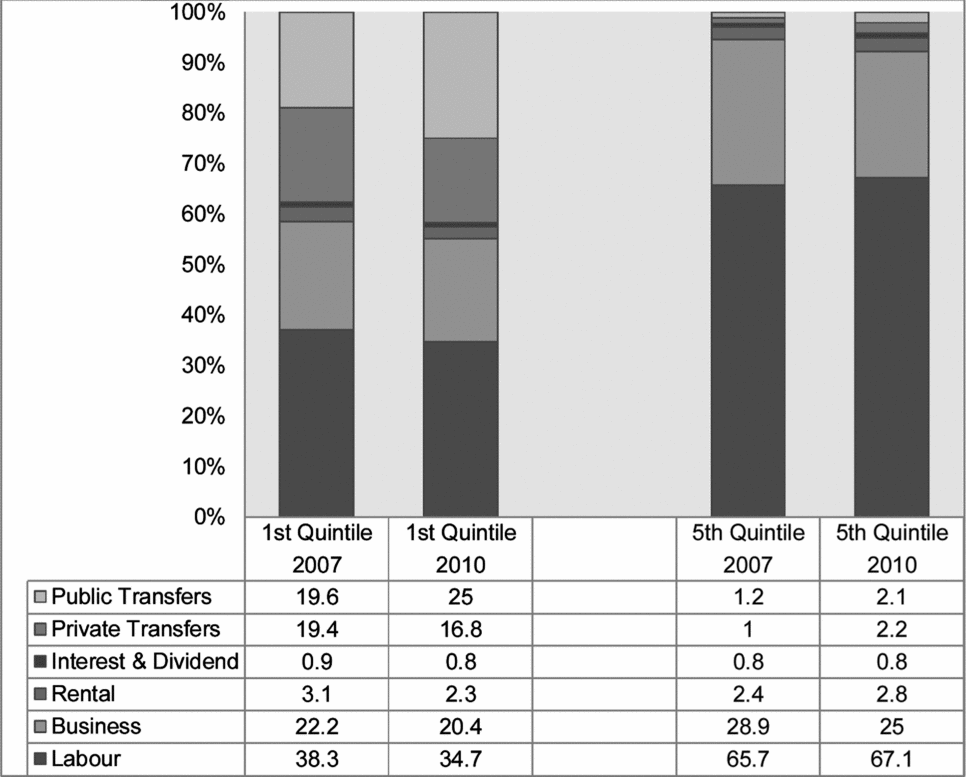
Literature on income redistribution in East Asia has identified the relative importance of private transfers over public transfers in reducing poverty and income inequality (for example, Kwon, Reference Kwon2001; Hwang, Reference Hwang2004; Kim and Choi, Reference Kim and Choi2011). However, an increasing volume of literature suggests that East Asia is in transformation from its long-standing growth-orientated strategies to a more inclusive one, emphasising redistribution (Kwon, Reference Kwon2005a, Reference Kwonb; Peng and Wong, Reference Peng and Wong2008). South Korea (hereafter Korea) sits at the heart of this debate, not least because most dramatic changes have taken place (Hwang, Reference Hwang2012). Not only has it achieved remarkable economic growth from one of the poorest to one of the richest countries within half a century (International Monetary Fund, 2013; World Bank, 2013), it also has increased its welfare spending faster than any other OECD country over the last decade (OECD, 2013d). Indeed, the longitudinal trends of household income and expenditure suggest that government transfers have become much more visible, especially for the lowest income groups (Figure 1). Albeit small, Korea's growth pattern also suggests that public transfers are likely to have an increasingly important role in the future. The fact that Korea has one of the fastest growing ageing populations adds extra weight to this claim. As Kwon (Reference Kwon2005a) and Kim (Reference Kim2008) argue, Korea seems to be becoming a fully fledged welfare state.
The composition of household annual income by income group (%).

Despite this remarkable growth in the economy and welfare spending, one of the most comprehensive studies on inequality reports that Korea has performed rather poorly in reducing inequality through household taxes and government transfers (OECD, 2008). The fact that the overall size of its welfare state remains one of the smallest in the OECD may explain why the redistributive effect of the Korean welfare state remains meagre. Yet it is not straightforward to establish a positive relationship between the size of the welfare state and its redistributive outcomes. In fact, the institutional design of the welfare state is more important than its sheer size (see Esping-Andersen and Myles, Reference Esping-Andersen, Myles, Salverda, Nolan and Smeeding2009).
This article aims to account for why the redistributive effect of the Korean welfare state remains meagre. Given the fact that its small size is already a well-known factor, it directs its attention to the design and structural features of key social provisions and their distributional profile. Any design flaws in the system may lead to a limited redistributive impact. Yet neither the size nor the design features may be the best indicators to determine the redistributive profile of the welfare state. This is because even the progressive design features of social provisions may be undermined by other factors, such as the structural conditions within which those social provisions operate. As Figure 1 demonstrates, the single largest source of income for all income groups is labour income. The extent to which the labour market interacts with the redistributive profile of social provision is central to our understanding of the redistributive effect of the welfare state.
The article is organised into six sections. The next section sets out the theoretical framework of the following analysis. After a brief discussion of the data available and used in this research, the section that follows examines specific system designs of old-age pensions, health insurance and social assistance in order to identify how robust they are in their design, and the crucial issues that may undermine their redistributive profiles. The following section discusses the impact of labour market change on the operation of social provisions in relation to their design features. The final section outlines the policy implications of the discussion.
Theories of welfare state redistribution
As an explicit redistributive mechanism, the redistributive profile of social provision is often seen as a defining characteristic of the welfare state (Esping-Andersen and Myles, Reference Esping-Andersen, Myles, Salverda, Nolan and Smeeding2009). Although not all social provisions are necessarily associated with redistribution and, indeed, the balance and priority given to each of a variety of social objectives vary across both countries and between programmes, redistribution is clearly one of the core objectives of the welfare state (Titmuss, Reference Titmuss1958; Ringen, Reference Ringen1987; Barr, Reference Barr2001; Hills, Reference Hills2004). Indeed, early scholarship provided a fairly credible claim of cross-national correlation between the growth of the welfare state and equality (Cutright, Reference Cutright1967; Ringen, Reference Ringen1987; Smeeding, Reference Smeeding1997).
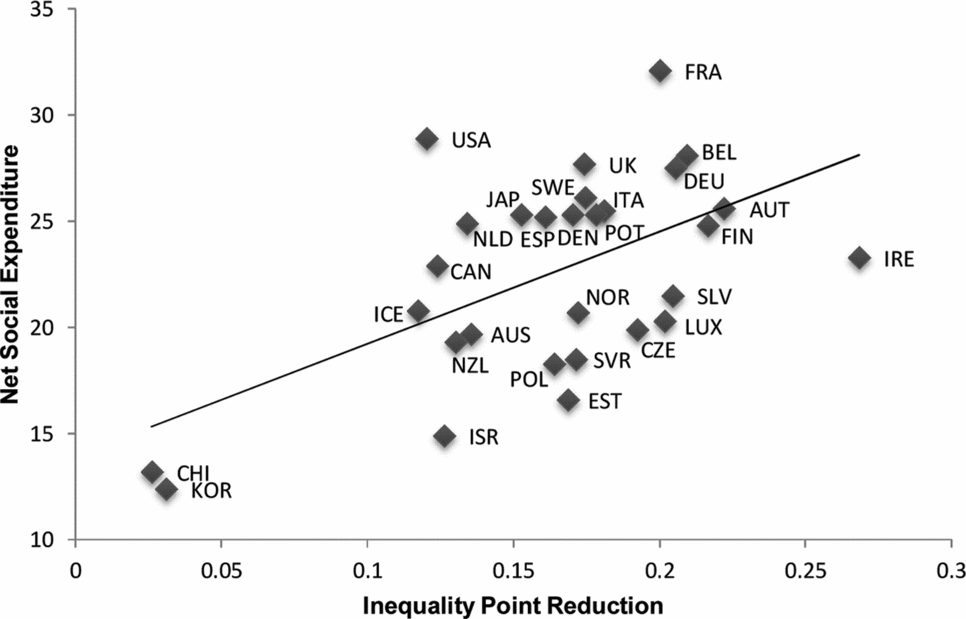
However, this size-redistribution thesis that assumes the straightforward link between social spending and income distribution has been challenged on many grounds. To start with, the growth of the welfare state, with a higher level of universalisation by implication, has been criticised on the grounds that it results in diminished redistribution (LeGrand, Reference LeGrand1982; Goodin and LeGrand, Reference Goodin and LeGrand1987; Pampel and Williamson, Reference Pampel and Williamson1989). Using 2009 data, Figure 2 presents the association between net social expenditure and the percentage reduction of income inequality in the Gini-coefficent, after taxes and transfers. Here, the link is by no means straightforward. Instead, a more convincing account suggests that the institutional design matters more than the sheer size of welfare states (Esping-Andersen, Reference Esping-Andersen1990, Reference Esping-Andersen1999; Moene and Wallerstein, Reference Moene and Wallerstein2001, Reference Moene and Wallerstein2003; Palme, Reference Palme2006). However, it is still not clear what institutional design is likely to lead to more effective redistribution. For a while, the paradox of the redistribution thesis that advanced an argument of a targeted benefit system achieving less redistribution than a universal one gained momentum (Korpi and Palme, Reference Korpi and Palme1998). This has been recently challenged as no longer valid because there is simply no general relationship between targeting, universalism and redistribution (Marx et al., Reference Marx, Salanauskaite and Verbist2013).
The size of the welfare state and redistribution, 2009.

The possible conflict between various core functions of the welfare state could complicate this further. For instance, the redistributive, or Robin Hood, function of the welfare state may be obstructed by the insurance or income maintenance, or piggy bank, function (Barr, Reference Barr2001). More often than not, these roles of the welfare state are embedded in most social insurance provisions, and as they are not necessarily complementary to each other a priority given to one might undermine the functioning of the other. As will be examined in the cases of national pensions and national health insurance, a particular social provision may be highly progressive in design yet at the expense of weakened insurance function. For this reason, the equalising impact of redistribution is likely to be determined by the balance between these two functions (Esping-Andersen and Myles, Reference Esping-Andersen, Myles, Salverda, Nolan and Smeeding2009).
Despite the fact that no clear formula exist, social provisions that are uniformly distributed over the income deciles and large enough to cover the defined target groups are likely to be effective in reducing income inequality. The size of the welfare state does not necessarily determine its effective functioning. Yet redistribution is often assumed to be more strongly related to the size of social programmes than to their target efficiency (Jesuit and Mahler, Reference Jesuit and Mahler2004). Universal education is a good example here. Although it is not usually regarded as social policy (see Esping-Andersen and Myles, Reference Esping-Andersen, Myles, Salverda, Nolan and Smeeding2009), it plays the largest and most important role in reducing income inequality in Korea, greater than income tax or other in-kind benefits, precisely because it is larger than any other social programmes and it is universal (Sung and Park, Reference Sung and Park2011: 357; OECD, 2013c).
If this comprehensive and universal social provision is to be an exception rather than the norm, then an effectively targeted system may offset the low level of spending. For instance, the case of Australia, where a highly targeted system of redistribution is at work, demonstrates that even though the overall level of social spending remains below the OECD average, it ‘redistributes more to the poor than any other OECD country’ (Whiteford, Reference Whiteford2006: 46). Yet it is often more difficult to have a system that redistributes resources fairly and efficiently than to have a system that pays out more. In conventional terms, social provisions based on selectivity, which is often operationalised on the basis of flat-rate, means-tested benefits, tend to redistribute more. But the mere existence of selectivity tells us very little about whether the system is progressive and redistributive. This is because while targeting is either used as a means of determining eligibility for benefits or determining the level of entitlements for those eligible, progressivity is concerned with the question of whether the poor receive more than the rich from the transfer system (Whiteford, Reference Whiteford2006). So, the resulting profile of benefits when compared to market or disposable incomes matters more than targeting per se. As Rawls’ famous difference principle suggests (Reference Rawls1972), the extent to which the system manifests great concern for the least advantage in society can be reflected in the operationalisation of progressivity. For this reason, whether the change in the distribution of income as a result of transfer systems is progressive or regressive should be of more concern than the mere determination of whether to have selective or universal methods.
International, national and scheme-specific data on redistribution
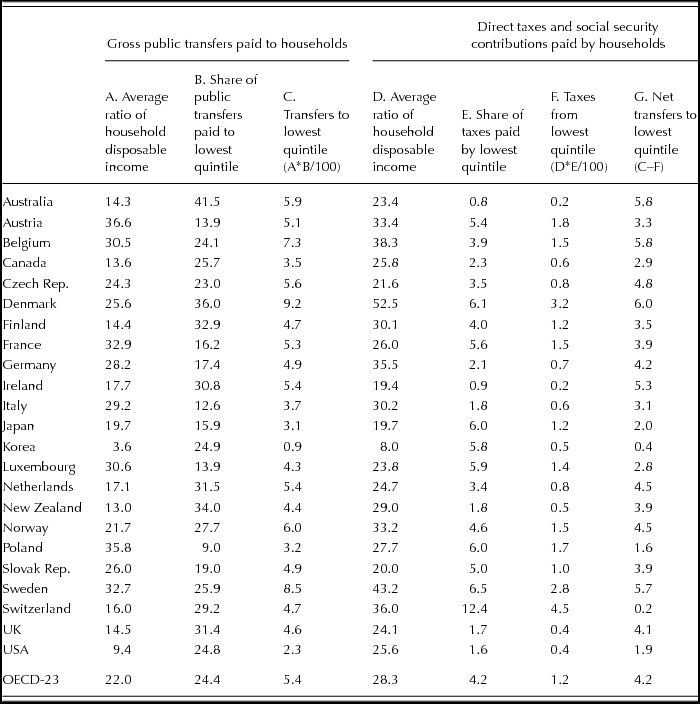
At first, Korea seems to have the worst of both worlds in the sense that its welfare state is very small and at the same time its welfare systems are not effectively targeted. As Figure 2 demonstrates, net social expenditure of the Korean welfare state is by far the smallest, while its inequality reduction is minimal. According to the OECD (2013a: 74), this may be because of a poorly targeted system where ‘barely a fifth of total cash benefits from the government go to the poorest 20 per cent of the working-age population, while the richest 20 per cent receive almost 30 per cent (among the total population, the poorest 20 per cent receive about a quarter of total cash benefits, while the same share goes to the richest 20 per cent)’. A closer look into the different effects of public cash transfers and household taxes on the lowest income groups tells us a more interesting story. Table 1 provides a measure of the redistribution towards people in the lowest income quintile, separately for gross public transfers and household taxes. From the left-hand panel, Korea is undoubtedly the smallest in its size of public transfers paid to households. Yet the figure for the share of public transfers paid to lowest quintile indicates 24.9, which is higher than the OECD average (B). From here, it is notable that the gross figure of transfers to lowest quintile is lowest (C) not necessarily because of lack of progressivity, but because of the small size. The right-hand panel tells another interesting story, where direct taxes and social security contributions remain small for households with a comparatively high share of taxes paid by them, resulting in the smallest net transfers to lowest quintile (G).
Redistribution through cash transfers and household taxes towards people at the bottom of the income ladder, mid-2000s

Source: OECD (2008: Table 4.7).
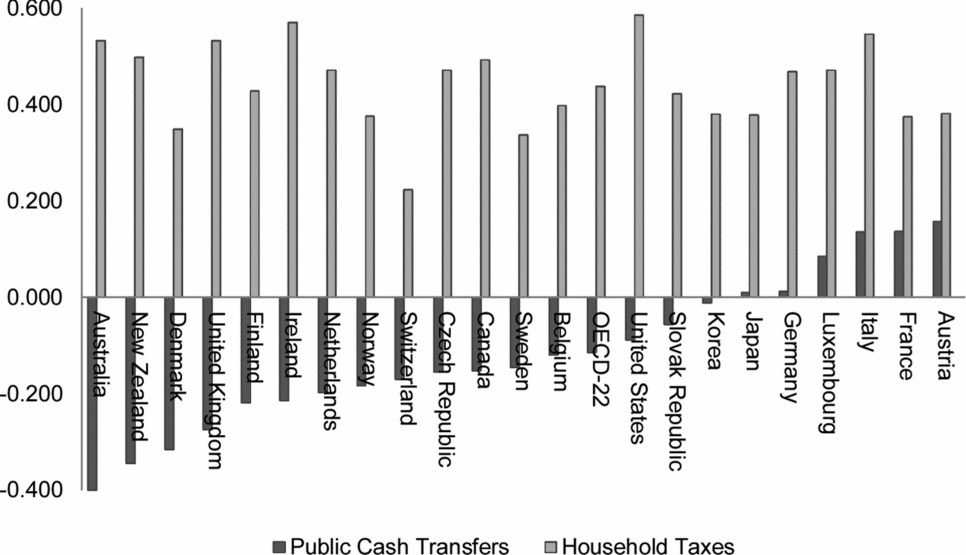
The same OECD report (2008: Table 4.6) presents the net cash transfers to the lowest income quintile. As a measure of the progressivity of the system, the figure for the concentration coefficient of public cash transfers for Korea in the mid-2000s is ‒0.012 while the OECD average is ‒0.114. The lower and more negative values imply greater progressivity (i.e. poorer income groups receive a higher share of transfers than their richer counterparts). The logic is reversed for the progressivity of household taxes where the higher and more positive values imply greater progressivity. Based on this, Figure 3 presents the rank order of the progressivity of public cash transfers. Australia tops the chart while Korea sits towards the right end of the spectrum. In fact, Korea scores the lowest negative number, meaning that its public cash transfers are progressive but not very.
Progressivity of cash transfers and household taxes.

Although the OECD has made these comparative figures available, more programme-specific analyses are absent from the scene. For instance, while the OECD (2008) presents progressivity of cash transfers by programme for twenty-seven OECD countries, Korea is excluded from this. The overall score for system progressivity in Korea is low. Yet this overlooks the fact that the progressivity of transfers varies significantly across benefit schemes, and various structural factors in play may influence the progressivity embedded in the system design. In methodological terms, lack of scheme-specific data available from the OECD makes it difficult to analyse what is happening in each scheme. Hence, while OECD data are chosen to position Korea in a comparative context, national statistics, mainly from the Household Income and Expenditure Survey by Statistics Korea, are used to find out how various schemes operate (KOSTAT and KOSIS). It is also this Household Income and Expenditure Survey that the OECD uses to compute its income distribution and poverty indicators for Korea (see OECD, 2012c). In order to maintain consistency, income distribution analyses will be drawn from this dataset while other figures and secondary analyses of the existing literature will play a complementary role.
All in all, as a wealth of literature written from the historical institutionalist tradition reminds us (for example, Hall and Soskice, Reference Hall and Soskice2001; Pierson, Reference Pierson2001), specific social provisions have their own unique characteristics and the features specific to them are intertwined with the structural conditions within which they operate. For this reason, any investigation of the system design requires close attention to the key structural features of the welfare system. This would not only take us beyond the size and the system design binary, it would also help us to better understand whether or not the system design is sustainable.
How redistributive are the welfare systems in Korea?
The argument that the Korean welfare system is lagging behind many other countries with a similar level of industrialisation is predominantly associated with its limited financial commitment. Although some authors refer to the poorly designed welfare system, this only receives a passing mention at most (for example, Song, Reference Song2003). A comprehensive examination of all social provisions would not be practical here, but at least it would be useful to investigate how redistributive some of the big spending items are, especially in order to find out whether it is the system design itself or something else that needs attention. Old-age pensions and healthcare are identified as such: not only are they most expensive, they are also the first two social provisions that achieved (nominal) universal coverage. Together with these two, this section also discusses the key design features of Korea's flagship redistribution programmes: social assistance and the recently introduced old-age basic pensions.
Among OECD countries, old-age pensions are often the largest single item. In Korea, they are the second biggest and likely to be the first as the population is ageing very fast and the system is maturing (OECD, 2013d). By definition, the countries with flat rate and universal public pensions without second-tier schemes (for example, New Zealand and Ireland) have the most progressive pension system (Jourmard et al., Reference Joumard, Pisu and Bloch2012: 8–9). Indeed, the progressivity index of these two countries is 100, as ‘pure-basic’ pension systems which pay the same benefit regardless both of their earnings history and other sources of income (OECD, 2011d). Other countries with highly progressive pension systems outside this arrangement include Canada (88.0), the United Kingdom (82.8), Israel (74.5), Korea (69.3) and the Czech Republic (68.4). Indeed, the Korean pension system is one of the most progressive in design. This is due to the in-built redistributive mechanism where the earnings that are used to compute the national pension benefits are the average of the A value (i.e. average earnings of the total insured) and the B value (the participant's own life-long average earnings). Hence a person whose earned income is less than A value can get greater benefit. This implies that, at least as far as old-age pensions are concerned, the lack of progressivity is not caused by its design but perhaps more by its low level of spending. As they were first introduced in 1988, public pensions are yet to mature to be fully effective.
However, the redistributive impact of public pensions is likely to weaken in due course for the following two reasons. First, compared to the initial 70 per cent replacement rate, the projection of fund exhaustion has led the 1999 pension reform to cut the rate down to 60 per cent. The 2007 pension reform allowed for the rate to be reduced to 50 per cent for 40 years of contributions, and it will thereafter fall 0.5 per cent every year between 2009 and 2028 until reaching 40 per cent (Hwang, Reference Hwang, Fu and Hughes2009). In other words, public pensions are being retrenched even before reaching maturity. Second, this massive replacement rate reduction is in stark contrast to other occupational pension schemes with no redistributive functions. The civil service pension programme, for instance, despite the fact that the further reform is currently being discussed, remains on average 2.6 times more generous than national pensions even after the 2009 reform, while its fund has been in deficit since 2001 (Donga Ilbo, 28 May 2014). In Mesa-Lego's words on the redistributive functions of pensions (2004: 193), ‘public pensions with virtual universal coverage tend to have a progressive effect on income distribution if solidarity is properly applied’ (emphasis added). In the Korean context, the gaps that currently exist seem too big to be easily justified, resulting in undermining the level of solidarity. Koreans already have a very low level of trust towards the efficient use of public money on welfare. Less than 12 per cent of Koreans agree with the statement that the ‘welfare budget is effectively executed without waste’, while around 58 per cent disagree with it (Noh and Jeon, Reference Noh and Jeon2011: 107). The greater coverage is critical in improving the redistributive profile of the public pension. Lack of solidarity is of little help, if not damaging, in creating de facto universality.
The second item to consider is the relatively high level of social spending on service provisions. As of 2011, public social expenditure for in-kind transfers as a percentage of GDP was 5.4 per cent (OECD, 2013d). The total figure is one of the lowest amongst the OECD. Yet compared to the amount of cash transfers, which were 3.4 per cent of GDP, this is substantial (OECD, 2013d). As service provisions typically reduce inequality less than cash transfers are able to do (OECD, 2011a), ‘the low level of social spending combined with the larger share of the social spending budget used in the provision of services rather than cash transfers, provides much of the explanation of the lower reduction in income inequality and poverty achieved through income taxes and cash transfers in Korea’ (OECD, 2013a: 77).
However, this does not mean that service provisions are of little use. In fact, the OECD (2011a: 322) reports that the inequality-reducing effect of health care services is generally higher than that of other services. Of the total spending on the provision of services in Korea, health is the area that attracts the lion's share (OECD, 2013d), and National Health Insurance (NHI) is designed to benefit the poor more than the rich. Its progressivity is typically measured by the ratio of health insurance contributions paid by various income groups compared to the amount of benefits they receive. The bottom 20 per cent of income groups receive over five times more than they have contributed, while the figure sits at around 1.2 for the top 20 per cent (NHIC, 2009). Given the fact that NHI is based on the earning-related contributory principle, its progressivity is due to the built-in redistributive mechanisms specifically designed to promote equality.
However, the current level of progressivity is increasingly challenged by the growing sustainability problem. This is partly because 49.2 per cent of entire households receive more services than they pay for them, 30.9 per cent of which receive 5 times or more than their insurance contribution (NHIC, 2009). As the elderly tend to pay the least contributions while benefitting the most, the financial balance of health insurance funds is likely to be pressured with the current speed of population ageing too. Out-of-pocket medical spending as a share of final household consumption in Korea is already the highest in the OECD (OECD, 2013b). And as this particular spending is regressive (Song et al., Reference Song, Kim and Shin2010), its further increase is likely to risk the insurance and redistributive function of the NHI.
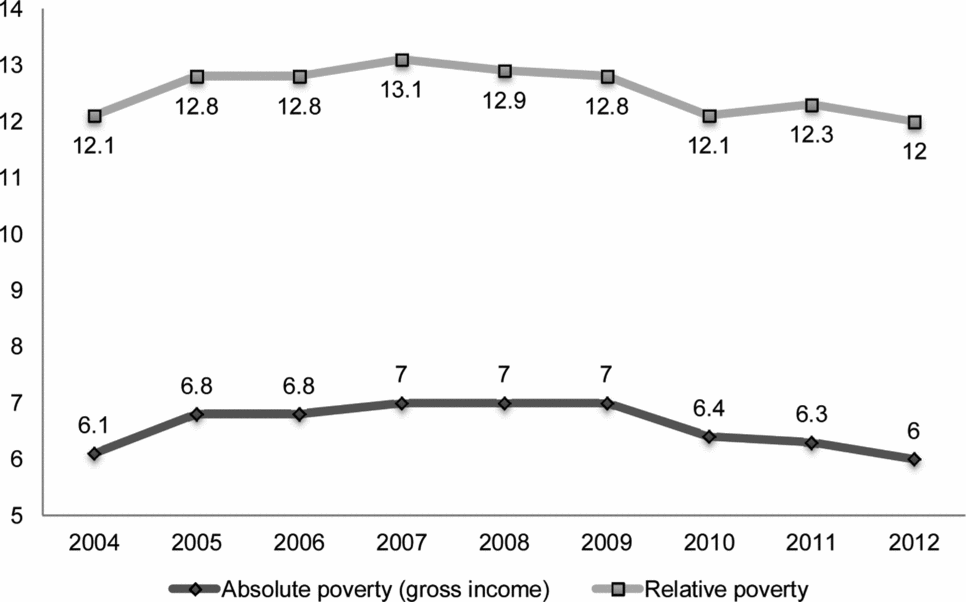
Thirdly, social assistance is meant to have high redistributive impacts (cf. Korpi and Palme, Reference Korpi and Palme1998). This is indeed the case in Korea too (Yeo, Reference Yeo2008; Kim et al., Reference Kim, Yeo, Kim, Oh, Shin and Ki2010). As a last resort safety-net measure, the National Basic Livelihood Security Programme (NBLSP) targets the poor and fills the gap between the official poverty line (the Minimum Cost of Living) and the recognised income (assessed income + converted property income) of each household. So, in principle, no one should be left to fall below this absolute poverty line. Figure 4 shows the poverty trends in Korea both in absolute and relative terms based on the Household Income and Expenditure Survey (KOSIS, n.d.; KIHSA, various years). As a nation-wide survey (excluding agricultural, fishery and one-person households), absolute poverty is determined by those who fall below the MCL, while relative poverty is defined as those with less than 50 per cent median household gross income (market income + public transfer income).
Poverty in Korea.

In 2010, 3.2 per cent of the population were under the NBLSP (MOHW, 2010). This is about half of those below the MCL, and far less than those below the relative poverty line. The primary reason for this is because the NBLSP is subject to strict eligibility criteria. These include household's combined income and assets tests, and the availability of potential support from family members. Those who can work should demonstrate that they are actively seeking work. Yet the fact that the majority (i.e. 82.8 per cent as of 2011) of beneficiaries are economically inactive casts doubt on the effectiveness of this conditionality. In fact, 23.7 per cent of the recipients have been unable to move out of social assistance for over ten years, suggesting that the provision is far from effective (MOHW, 2011: 20).
More challenges exist to further undermine the NBLSP that is already ineffective in preventing the vulnerable from falling into poverty. First, there exists a situation where potential recipients who are ineligible for the NBLSP, either because of the availability of legal supporters or because of the higher recognised income, become worse off than those receiving social assistance. Defined as the potential poor whose recognised income sits somewhere between 100 and 120 per cent of the MCL, they are estimated to be around 3.8 per cent of the population and are situated in the marginal area of welfare system (KIHSA, 2012). On top of strict eligibility criteria, another contributing factor to this reverse income redistribution is related to the ‘all or nothing’ method. The benefits the NBLSP provides are numerous and include small but not insignificant discounts. Moving out of the NBLSP would mean losing all of these all at once, while their being in the marginal area would make them worse-off. In order to resolve this, a reform proposal is being devised under the current government to individualise the benefit system while restructuring the notion of official poverty from absolute to relative (OGPC, 2013). Despite its intention to include more of the vulnerable at the margin, the introduction of relative poverty is to be coupled with the removal of the minimum income guarantee which the current NBLSP offers, albeit with a range of problems. In other words, the proposal has been made to replace the official poverty line (MCL) with a discretionary standard of ‘minimum security’. This would mean that the individualised benefit system would have to fit within the administratively predetermined budget capacity. Similarly, the introduction of the Earned Income Tax Credit (EITC) in 2008 had been expected to be particularly effective in reducing inequality and poverty (OECD, 2013a). So far, however, it has neither been able to capture its intended target group (i.e. the potential poor). Nor has it been effective in reducing poverty (Yun, Reference Yun2012). The OECD (2013a) points out that the EITC remains too tightly targeted to capture more low-earning households, even after the 2012 extension.
Finally, the latest addition of a mean-tested, tax-financed basic old-age pension is meant to improve the redistributive profile. Introduced in 2007 as a result of the larger pension reform, it was targeted to cover 70 per cent of the entire elderly population, the maximum benefit of which was set at 5 per cent of the mean income of all national pension members. This was then to increase gradually to 10 per cent by 2028 (Hwang, Reference Hwang, Fu and Hughes2009). Yet, the intention to increase its benefit level to 10 per cent to all old people has recently been withdrawn as the newly introduced basic pension in May 2014 is now linked to national pensions so that those who have contributed to national pensions longer will receive a reduced amount rather than flat-rate (Yonhap News, 2 May 2014). Effective from July 2014, more people will receive maximum basic pensions, but for the most people in the future, the amount of basic pension they receive will be closer to the minimum rate. For this reason, the newly proposed basic pension is effectively the retrenched version of the one that was introduced in 2007.
Of the four provisions examined in this section, the inadequacy of social assistance and its embedded flaws can be ameliorated, at least in part, as street-level welfare bureaucrats can apply their own discretion to the cases where strict eligibility rules disadvantage those in genuine need. However, there is a clear case of capacity overload. For instance, around 11,710 welfare officers were handling 1,469,254 social assistance clients (i.e. NBLSP recipients) in 2011. Given the fact that social assistance clients are only a fraction of the entire service users (around 10,170 thousand) under these officers’ jurisdiction (KOSIS, n.d.), it is unrealistic to expect any meaningful discretion to be exercised in a positive way, administratively speaking. For old-age pensions and national health insurance, the redistributive mechanisms built into the system seem undermined by the underpinning sustainability problems. Central to this is the two-tier insurance levy structure where there exist two separate memberships, one for workplace members and the other for regional members. For workplace members, the amount of insurance contribution is determined by salary incomes alone. Other assets, including land, property, vehicles and other assets are excluded from the calculation. For regional members, however, all these count towards their insurance premium. For the genuinely asset rich, this is not a problem. Rather, the problem has been that they exploit the system by unlawfully declaring their employment status. In fact, this has led a member of the National Assembly to propose a reform bill to tighten the rules by substantially increasing the penalty (Yonhap News, 20 September 2013). For people with irregular income (for example, daily, temporary workers), they may end up paying more than their salaried counterparts. In the case of health insurance, one's benefits can become restricted if s/he fails to pay insurance levy over six months. Yet, because of it being health insurance, many receive benefits nonetheless while their debt accumulates. Indeed, around a quarter of all households that belonged to regional members in 2010 failed to pay health insurance contributions for over three months (Lee, Reference Lee2011). In essence, this not only results in perverse redistribution as the better off become exempted while the worse off accumulate debt, it also undermines the risk pooling effect largely due to the low coverage of the system despite their claimed nominal universality. Why this low coverage occurs is discussed in the next section.
Do labour market structures undermine the redistributive design of social provision?
Defined as those earning two thirds of median earnings, Korea has the highest incidence of low pay in the OECD (OECD, 2012b). While this contributes to the incidence of poverty, this is also linked to the lack of tax collected, as lower income earners will pay lower taxes. Literature suggests that social benefits tend to have a much stronger redistributive impact than taxes or social contributions (Immervoll and Richardson, Reference Immervoll and Richardson2011; Wang et al., Reference Wang, Caminada and Goudswaard2012). But the fact that Korea's tax burden is very low and that direct taxes on households are particularly low indicate that the taxing power of the state is not particularly strong, especially under the conditions of a diminishing tax base (OECD, 2011e). The OECD (2012a: 11) points out that only 60 per cent of workers pay personal income tax due to generous deductions and exemptions. A claimed reason for this is to create a level playing field with the self-employed, the rate of which out of total employed, albeit decreasing over time, was 28.8 per cent in 2010, fourth highest in the OECD (OECD, 2011b). While self-employment per se may not be a problem, double the OECD average of self-employed in Korea raises some significant issues, particularly in relation to the configuration of welfare provision. Firstly, the self-employed tend to report their income downwards, thereby paying less tax than they should. Secondly, the sheer number of self-employed means severe competition between them, leading to a lower standard of labour conditions and incomes. Of the total wage workers, for instance, the poorest 20 per cent tend to be heavily populated in the temporary and daily work categories, while the vast majority of the self-employed also belong to the bottom 20 per cent (Kim et al., Reference Kim, Yeo, Kim, Oh, Shin and Ki2010).
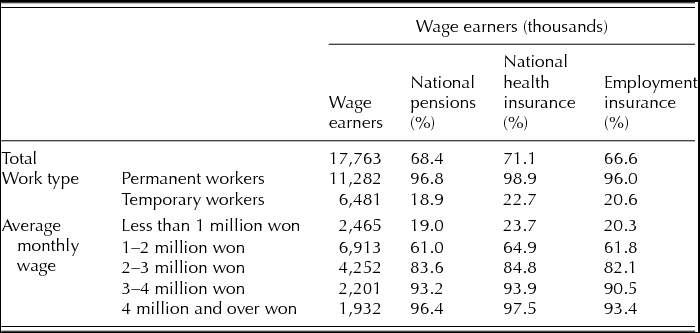
The issue of a higher percentage of self-employed workers is also related to the overall structure of the labour force. Korea has one of the highest rates of temporary employment (OECD, 2012b). Compared to permanent workers, temporary workers with a pre-determined termination date tend to have a lower social insurance coverage rate, not least because they tend to earn less (Table 2). So, although social insurance schemes in Korea have nominal universal coverage, too many people are outside of coverage, making the system incomplete.
Social insurance coverage for wage earners (December 2012)

Notes: For National Pensions and National Health Insurance, workplace insurance only. For national pensions, occupational pensions included.
Source: KOSTAT (2013).
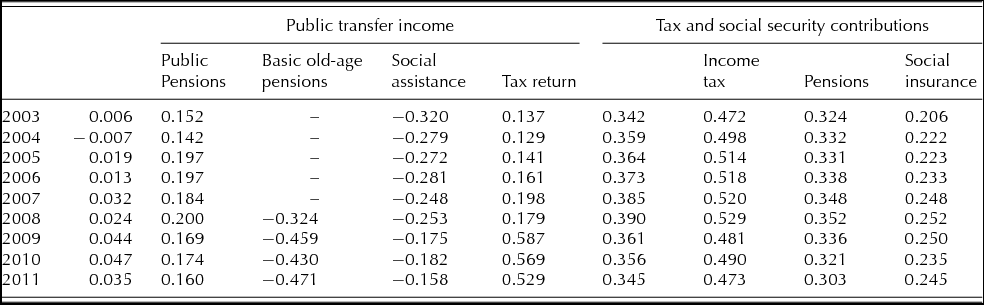
All in all, despite the fact that social insurance provisions do have built-in redistributive mechanisms and social assistance is designed to target the most needy, social insurance is severely undermined by low coverage and low replacement rates while social assistance seems ineffective in serving its primary function. This can be further demonstrated by examining the concentration coefficient of public transfers and household taxes (Ban, Reference Ban2013: 70). Calculated from the Household Income and Expenditure Survey, the data for which are collected on a monthly basis, the concentration coefficient of public transfers can be negative in the case where poorer income groups receive a higher share of transfers than their share of disposable income (Table 3). So, the lower and more negative its values are, the greater its progressivity is. For the concentration coefficient regarding household taxes, higher values imply a more progressive distribution as taxes are deducted from household incomes. It is notable that tax-based means-tested benefits tend to be more progressive compared to contributory-based social insurance. And the progressivity of the basic old-age pension is higher than that of social assistance primarily because its coverage is wider. What is interesting here is the fact that public pensions remain regressive, which is contradictory to the earlier discussion. This is because while the public pension is designed to be progressive, its actual performance is severely undermined by lack of coverage, the issue that is often overlooked in the discussion of system design. In short, the system design per se does not explain why public transfers in Korea are regressive. The answer to this question requires us to look beyond the progressivity measure alone, and at more than just the design features of each provision to which this article seeks to make a contribution.
The concentration coefficient of public transfers and household taxes

Source: Ban (Reference Ban2013: 70).
Conclusion: policy implications
Although the relationship between the size of welfare state and redistribution is by no means straightforward (Figure 2), much of the discussion presented here suggests that Korea's increasing welfare commitment in spending terms, if maintained, is likely to result in better redistributive outcomes. This argument can be further reinforced by our findings that social provisions in Korea are mostly designed to be progressive. Even social insurance programmes that are deemed less likely to be redistributive due to their earnings-related contributory principles have proven progressive. For the actual redistributive profiles, however, a range of other interlocking factors are at work, the closer examination of which has helped us account for the redistributive functions of the welfare state in Korea.
Firstly, the issue of sustainability has affected the effective functioning of social provisions. In the case of national pensions, the generous replacement rate promised at the outset had never been realistically sustainable, especially without a substantial increase in contribution rates. Yet the attempt to make them more sustainable has led to the reduction of their insurance function, increasingly challenging whether the current progressive structure can be maintained. A similar issue applies to national health insurance, where the fast ageing population puts pressures on its sustainability. Secondly, the flagship redistributive provision has a big problem in its coverage. In theory, social assistance guarantees that those who fall into poverty will be lifted up. Yet this is far from the case, essentially due to strict eligibility rules. Thirdly, there is a problem of an inadequate level of benefits. For national pensions, the proposed reduction casts serious doubt about whether it would indeed provide an adequate retirement income. This is particularly so as this replacement rate is based on forty years of contributions, which is rather unrealistic for most people to meet. If the lifetime contribution to old-age pensions return only this much, while some specific occupational categories are openly privileged, it is very unlikely to attract public support. For national health insurance, the out-of-pocket payment is already one of the highest while it spends more than it collects (as of 2010). For social assistance, a strict eligibility rule with the low poverty line provides the inadequate safety net for a small number of the population.
Cutting across these issues is the changing pattern of labour market structure. Primarily imposed by the International Monetary Fund's intervention, the now very much liberalised labour market reduces the number of workers who are able to pay taxes and social security contributions on a sustainable basis. The near universal social insurance coverage of permanent workers, compared to the around 20 per cent coverage rate of temporary workers, indicates that the system solidarity is yet to be established (Table 2). Social insurance, by definition, requires the public's maximum possible participation to be effective. For this reason, all social insurance provisions are compulsory for wage earners in Korea while non-wage earners can opt in if they wish. Yet the reality is that there are too many people who are excluded from the system. This makes the system less solidaristic while leaving many uninsured very vulnerable against social contingencies.
In an environment where economic austerity is increasingly the norm, being one of the lowest taxing countries is perhaps politically appealing. The problem is that the welfare system in Korea is not particularly well targeted while expenditure remains low. In crude terms, the welfare state in Korea is for the workers who have permanent jobs. For the rest, a last resort safety net is there to provide a very basic minimal protection. All this indicates that the welfare state in Korea, albeit growing in recent years, is highly stratified, if not practically absent. In fact, unlike most rich countries where the welfare state is the largest single component of public spending, the welfare state in Korea is not the main determinant of how much tax income needs to be collected (OECD, 2011c). For this reason, the Korean welfare state is likely to be more present if its spending levels continue to rise. However, the fact that the design features of social provisions are progressive, while their distributional profiles are not, invites us to examine the relationship between the two and the presence and nature of other interlocking factors that may have undermined the seemingly progressive design of the welfare system in Korea. In short, in order to establish a fair and efficient welfare state, it is not only the increase in size that is important but also the correction of the factors that diminish the progressivity of the welfare system and their relations to the fast-changing structure of the labour market.