Introduction
Military life can be challenging for the entire family and it is increasingly recognised that the families of military personnel are impacted by the problems which can affect military personnel both during and after service (Cozza et al. Reference Cozza, Chun and Polo2005; McFarlane, Reference McFarlane2009). Armed Forces health policy in both the US and the UK has shifted in recent years from focusing solely on military personnel to incorporating the wider military family (Ministry of Defence, 2011; Shelton et al. Reference Shelton, Ondra and Levin2015). Similarly, research is increasingly exploring the needs of military families (Rowe et al. Reference Rowe, Keeling, Wessely and Fear2014; Tasso et al. Reference Tasso, Whitmarsh and Ordway2016; Verey et al. Reference Verey, Keeling, Thandi, Stevelink and Fear2016).
Research has suggested that aggression and violence is prevalent among military personnel, especially following return from deployment (MacManus et al. Reference MacManus, Dean, Al Bakir, Iversen, Hull and Fahy2012, Reference MacManus, Dean, Jones, Rona, Greenberg and Hull2013, Reference MacManus, Rona, Dickson, Somaini, Fear and Wessely2015; Elbogen et al. Reference Elbogen, Johnson, Wagner, Sullivan, Taft and Beckham2014; Kwan et al. Reference Kwan, Jones, Hull, Wessely, Fear and MacManus2016). Much of this aggression and violence is likely to be acted out in the family home. Indeed, US research has established that domestic violence and abuse [with a focus on intimate partner violence (IPV)] is prevalent among military populations (McCarroll et al. Reference McCarroll, Thayer, Liu, Newby, Norwood and Fullerton2000; Bradley, Reference Bradley2007; Foran et al. Reference Foran, Slep and Heyman2011; Schmaling et al. Reference Schmaling, Blume and Russell2011). Research has suggested a strong association between military factors, including combat exposure, and IPV perpetration as well as highlighted the role that mental health problems can play in IPV perpetration among military personnel (Marshall et al. Reference Marshall, Panuzio and Taft2005). However, it is important to note that violence against an intimate partner is only a subset of family violence. Other family members may be victims of violence. One study in the US has examined and compared family v. stranger violence by military personnel (Sullivan & Elbogen, Reference Sullivan and Elbogen2014). They found that in a national sample of 1090 veterans, 13% reported aggression towards a family member and 9% towards a stranger during the 1-year study period. Factors associated with family violence in this sample included being younger, female, having higher levels of combat exposure and having anger symptoms of PTSD (Sullivan & Elbogen, Reference Sullivan and Elbogen2014).
There has yet to be a study that has examined family-directed violence, or the factors associated with it, among a UK military population. Previous studies have examined violent behaviour by UK military personnel, and found that it is associated with exposure to combat and post-deployment mental health problems (MacManus et al. Reference MacManus, Dean, Al Bakir, Iversen, Hull and Fahy2012, Reference MacManus, Dean, Jones, Rona, Greenberg and Hull2016; Elbogen et al. Reference Elbogen, Johnson, Wagner, Sullivan, Taft and Beckham2014). However, these studies did not differentiate between family and stranger violence. There is no published data from UK military personnel on how the characteristics of perpetrators of family violence and perpetrators of stranger violence differ and if the risk factors for each type of violence differ.
The main aim of this study was to compare the prevalence of and risk factors for ‘family’ violence (violence against any family member) and ‘stranger’ violence among a representative sample of UK military personnel following return from deployment in Iraq or Afghanistan. The associations between both types of violence and post-deployment mental health problems were also examined.
Methodology
Study design and participants
This study utilised data from a large representative sample of the UK Armed Forces. Participants were identified by the UK Ministry of Defence's (MoD) Defence Analytical Services and Advice (DASA) and a random stratified sampling strategy was used. Special Forces and high-security personnel were excluded.
Data were collected by questionnaire in two phases. During phase 1, between 2003 and 2005, 17 000 UK Armed Forces personnel were selected, and sent a questionnaire. The response rate was 61% (Hotopf et al. Reference Hotopf, Hull, Fear, Browne, Horn and Iversen2006) and the main reason for non-response was inability to contact participants (Iversen et al. Reference Iversen, Fear, Simonoff, Hull, Horn and Greenberg2007). Participants were classified into two groups: those who were deployed to Iraq (TELIC1) and those who were trained, but not deployed (ERA). Details of this study have been previously described (Hotopf et al. Reference Hotopf, Hull, Fear, Browne, Horn and Iversen2006).
During phase 2, between 2007 and 2009, participants from phase 1 were followed up and two other randomly selected samples were added. The first additional sample (HERRICK) consisted of personnel who were deployed to Afghanistan from April 2006 to April 2007 (Fear et al. Reference Fear, Iversen, Meltzer, Workman, Hull and Greenberg2007). The second additional sample (replenishment group) consisted of personnel who had joined the military since 2003 and would have had the opportunity to be deployed to either Iraq or Afghanistan during the study period. During this phase, 9986 personnel completed the questionnaire and the response rate was 56% (Fear et al. Reference Fear, Jones, Murphy, Hull, Iversen and Coker2010).
The total sample consisted of 8276 regulars and 1710 reserves and was shown to be a representative of the UK military population at the time of phase 2 data collection (Fear et al. Reference Fear, Jones, Murphy, Hull, Iversen and Coker2010). Questions about violent behaviour were asked of participants who had been deployed to Iraq or Afghanistan. Only personnel who had been deployed were included in our study. The final sample consisted of 6711 participants (5741 regulars and 970 reserves).
Data collection
Data collection was conducted using a self-report questionnaire containing questions on socio-demographic characteristics, pre-military antisocial behaviour (ASB), service history, experiences prior to and during deployment and measures of post-deployment physical and mental health. Participants were sent a letter with instructions and details of the study and were assured that participation was voluntary and research was independent of the MoD.
Outcome variable
Participants were asked to agree or disagree with statements related to experiences after returning from their most recent deployment. These began with the stem statement ‘In the weeks after I came home…’ and included ‘I was involved in physical fights outside my family’ (defined subsequently as ‘stranger violence’) and ‘I was physically violent towards a family member’ (defined subsequently as ‘family violence’).
Pre-military ASB
Participants were asked to answer true or false to a series of statements beginning with the stem ‘When I was growing up…’ (Iversen et al. Reference Iversen, Fear, Simonoff, Hull, Horn and Greenberg2007). Participants were categorised as having engaged in pre-military ASB if they answered ‘true’ to ‘I used to get into physical fights at school’, plus any one of the following statements: ‘I often used to play truant at school’, ‘I was suspended or expelled from school’ or ‘I did things that should have got me (or did get me) into trouble with the police’ (MacManus et al. Reference MacManus, Dean, Iversen, Hull, Jones and Fahy2011). These questions were selected from a previously used questionnaire on childhood adversity (Iversen et al. Reference Iversen, Fear, Simonoff, Hull, Horn and Greenberg2007).
Main duty during deployment
Personnel were asked about their main duty during deployment. They were then classified as having been deployed in either a combat role (those who were involved in direct combat with enemy forces) or a non-combat role [those who were involved in either a combat support role (i.e. operational support) or in combat support services (e.g. logistical support, medical services and engineering)].
Mental health variables
Symptoms of PTSD were measured in the month prior to questionnaire completion by using the validated National Centre for PTSD checklist (PCL-C) (Blanchard et al. Reference Blanchard, Jones-Alexander, Bucley and Forneris1996). Participants were categorised as being a PTSD ‘case’ if they scored 50 or above. Alcohol misuse was measured in the year prior to questionnaire completion by the validated World Health Organization's Alcohol Use Disorders Identification Test (AUDIT) (Babor et al. Reference Babor, Higgins-Biddles, Saunders and Monteiro2001; Fear et al. Reference Fear, Iversen, Meltzer, Workman, Hull and Greenberg2007) and participants were categorised as being a ‘case’ if they scored above 15. Symptoms of common mental health disorders were measured in the month prior to questionnaire completion by using the validated General Health Questionnaire-12 item (GHQ-12) (Goldberg, Reference Goldberg1972; Goldberg et al. Reference Goldberg, Gater, Sartorius, Ustun, Piccinnelli and Gureje1997) and participants were categorised as being a ‘case’ if they scored four or above. A validated measure of aggressive behaviour (Bliese et al. Reference Bliese, Wright, Adler and Thomas2004) was used to score frequency of reported verbal, property or physical aggression or the number of threats of violence in the past month. Questions began with the common stem ‘During the past month, how often did you…’, and included: get angry at someone and yell or shout at them; get angry with someone and kick or smash something, slam the door, punch the wall, etc.; get into a fight with someone and hit the person; and threaten someone with physical violence. Participants were given the options of never, once, twice, three to four times or five or more times. The frequency scores were totalled and categorised into three levels of aggression: low (score of 0–2), moderate (score of 3–5) and high (score of 6 or more).
Statistical analyses
Descriptive statistics were used to compare the socio-demographic characteristics of participants who had only reported family violence and those who had only reported stranger violence. Participants who reported both were not included in this comparison. Univariable and multivariable regression analyses (logistic) were used to examine the independent association of a range of socio-demographic, pre-military and military variables, including combat exposure, with both family and stranger violence. Univariable and multivariable logistic regression analyses were also used to examine the associations between both measures of violence and post-deployment mental health factors while adjusting for confounding variables. To account for the potential confounding effect of stranger violence in the analyses of risk factors for family-directed violence, the variable ‘stranger violence’, which included participants who had reported both family and stranger violence, was added as a covariate in the final adjusted models. Similarly, the variable ‘family violence’ was added to the final risk factor models for stranger violence to account for those participants who had reported both family and stranger violence. Analyses were conducted using the statistical software program STATA, version 11.2 (StataCorp., 2009). Results have been expressed using odds ratios (ORs) with 95% confidence intervals (CIs) and statistical significance was defined as p < 0.05. Weighted percentages and ORs were presented to allow for response and sampling weights, along with unweighted cell counts.
Results
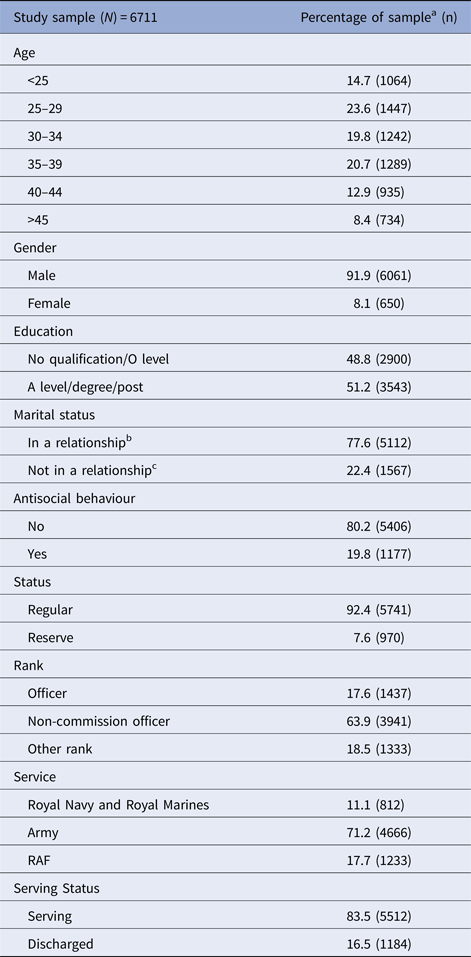
The sample consisted of 6711 deployed UK military personnel (Table 1). The majority of the sample was male (96.4%) and in a relationship (72.5%). The median age of the participants was 33.2 years (IQR 27.2–40). Just over half of the sample had continued their education into their A-levels (or equivalent) or higher, i.e. a degree, or post-graduate degree (51.2%). Of the sample, 92.4% were regular personnel and 71.2% were in the army. Twenty-five per cent of the sample reported being deployed in a combat role.
Characteristics of study sample

a Percentages are weighted to account for sampling strategy and non-response and numbers may not add up to totals because of missing data.
b In a relationship consisted of those who reported being married, living together or in a long-term relationship at the start of the study.
c Not in a relationship consisted of those who were single, divorced or widowed.
Family v. stranger violence following return from deployment
The prevalence of individuals who reported family violence following return from deployment was 3.6% (n = 217). This included any participants who reported perpetrating family violence only (1.3%, n = 66), and those who reported perpetrating both family and stranger violence (2.3%, n = 150). The prevalence of individuals who reported perpetrating violence against strangers in the weeks immediately following return from deployment was 7.6% (n = 455). This included participants who reported perpetrating stranger violence only (5.5%, n = 294) and those who reported perpetrating both family and stranger violence (2.3%, n = 150) (numbers do not add up due to missing values, n = 368 for participants who did not answer the question on family violence, and n = 301 for participants who did not answer the question on stranger violence).
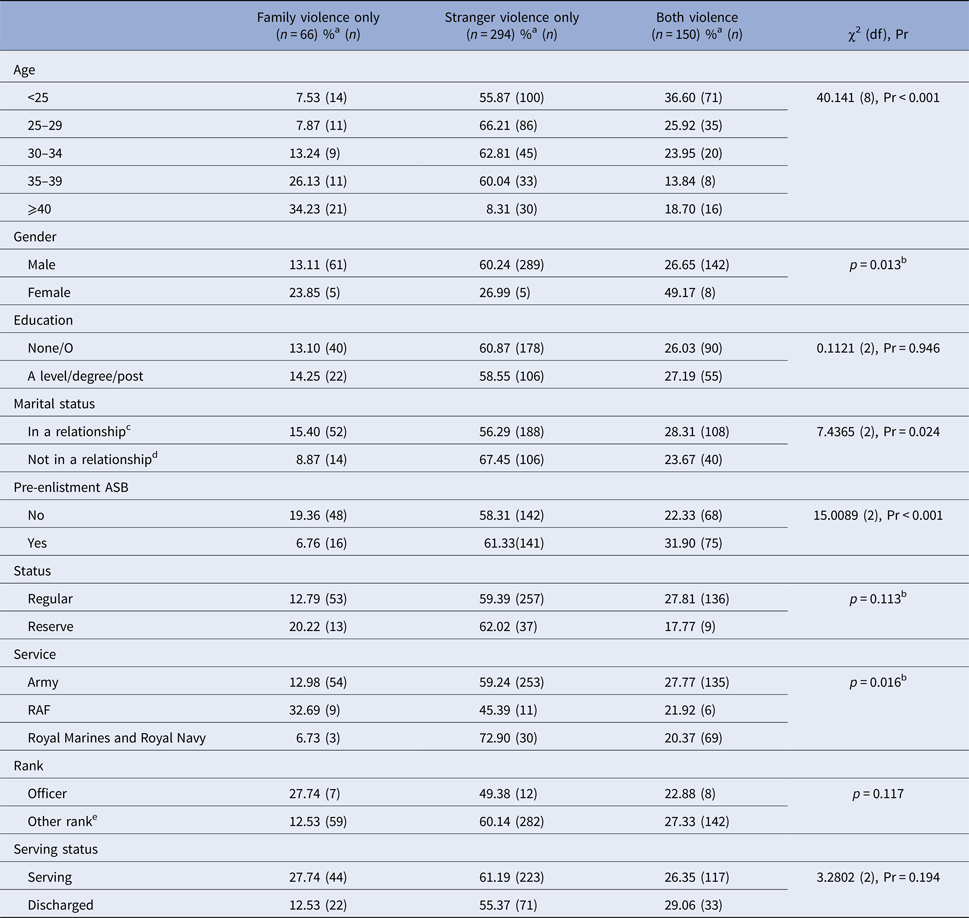
The characteristics of participants who reported perpetrating only family violence (n = 66) were compared with those of participants who reported only stranger violence (n = 294) and those who reported both family and stranger violence (n = 150) (Table 2). Participants who reported only family violence tended to be older and were more likely to be in a relationship than those who reported stranger violence only. Most violence was perpetrated by men (99.1% of stranger violence and 96.4% of family violence). Indeed, a higher proportion of men than women reported stranger violence (8.3% of men v. 1.9% of women) and family violence (3.7% of men v. 1.6% of women). However, while men who reported perpetrating violence were much more likely to have perpetrated stranger violence (82.1%) than family violence (17.9%), a different pattern was seen among women who reported being violent. Of women who reported perpetrating violence, the proportion who reported family violence was much higher (45.9%).
Characteristic profile comparison of family and stranger violence

a Percentages are weighted to account for sampling strategy and non-response.
b Fisher's exact test for n < 10.
c In a relationship consisted of those who reported being married, living together or in a long-term relationship at the start of the study.
d Not in a relationship consisted of those who were single, divorced or widowed.
e Other ranks include non-commission officers and other ranks.
Those who reported stranger violence were more likely to have a history of pre-enlistment ASB (50.86%) than those who reported family violence only (25.6%). Although those in the Army were more likely to report being violent to either family or strangers than those in the RAF or Navy, similar proportions of family (87.8%) and stranger violence (89.6) were reported by Army personnel. RAF personnel were more likely to report being violent to family members (9.0%) than strangers (2.8%), but Royal Navy/Royal Marines were more likely to report the opposite, with stranger violence (7.6%) more prevalent than family violence (3.1%). Both family and stranger violence was more likely to be reported by personnel of lower ranks than officers, but a higher proportion of family violence (10.9%) than stranger violence (4.3%) was reported by officers. Among personnel who had left service, 6.7% reported family violence compared with 12.5% who reported stranger violence. The characteristics of participants who reported both family and stranger violence were similar to those who reported stranger violence only.
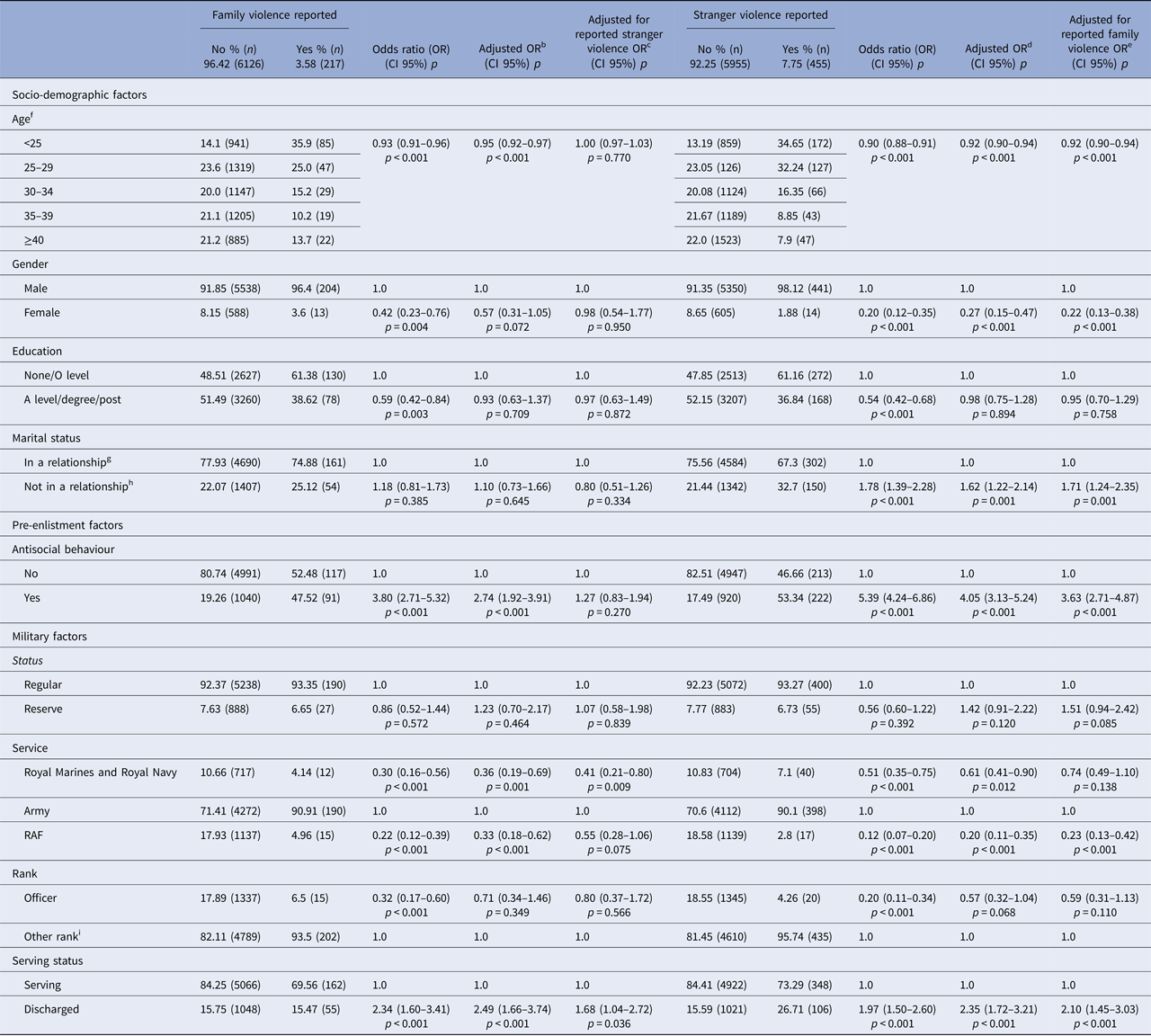
In regression analyses adjusted for sociodemographic and military confounding variables, both family-directed and stranger violence were strongly associated with pre-enlistment ASB [adjusted OR (aOR) = 2.74 (1.92–3.91), p < 0.001; aOR = 4.05 (3.13–5.24), p < 0.001, respectively]. Both types of violence were associated with younger age, being a member of the Army, and having left service (Table 3). Higher odds of stranger violence were also seen among men (compared with women) and those who were not in a relationship (compared with those who were) (Table 3).
Socio-demographic, pre-enlistment and military factors associated with stranger violencea

CI, confidence interval.
a Data are weighted to account for sampling strategy and non-response.
b Adjusted for age, sex, education, pre-enlistment antisocial behaviour, rank, service and serving status.
c Adjusted for confounders (b) as well as those who reported stranger violence.
d Adjusted for age, sex, education, marital status, pre-enlistment ASB, service, rank and serving status.
e Adjusted for confounders (d) as well as those who reported family violence.
f Odds ratios and adjusted odds rations are reported for continuous measures.
g In a relationship consisted of those who reported being married, living together or in a long-term relationship at the start of the study.
h Not in a relationship consisted of those who were single, divorced or widowed.
i Other ranks include non-commission officers and other ranks.
In the final model for family violence, adjusted for ‘stranger violence’, the odds of family violence were significantly higher among those who had left service compared with those who were still serving. The odds of family violence were significantly lower among Royal Navy/Royal Marines compared with Army personnel. After adjustment for ‘family violence’, the odds of stranger violence continued to be statistically significantly higher among younger personnel, males, those not in a relationship, those with a history of pre-enlistment ASB, and among those who have left service. The odds of stranger violence were significantly reduced among RAF personnel compared with Army personnel.
Main duty during deployment
Those in combat roles were more likely to be violent than those in non-combat roles, even after adjusting for socio-demographic and military factors (Table 4). Combat experience also continued to be significantly associated with both family and stranger violence in the final models, adjusted for stranger and family violence, respectively.
Association between role during deployment and both family and stranger violencea

CI, confidence interval.
a Data are weighted to account for sampling strategy and non-response.
b Adjusted for age, sex, education, pre-enlistment ASB, rank, service and serving status.
c Adjusted for confounders (b) as well as those who reported stranger violence.
d Adjusted for age, sex, education, marital status, pre-enlistment ASB, rank, service and serving status.
e Adjusted for confounders (d) as well as those who reported family violence.
Post-deployment mental health and aggression
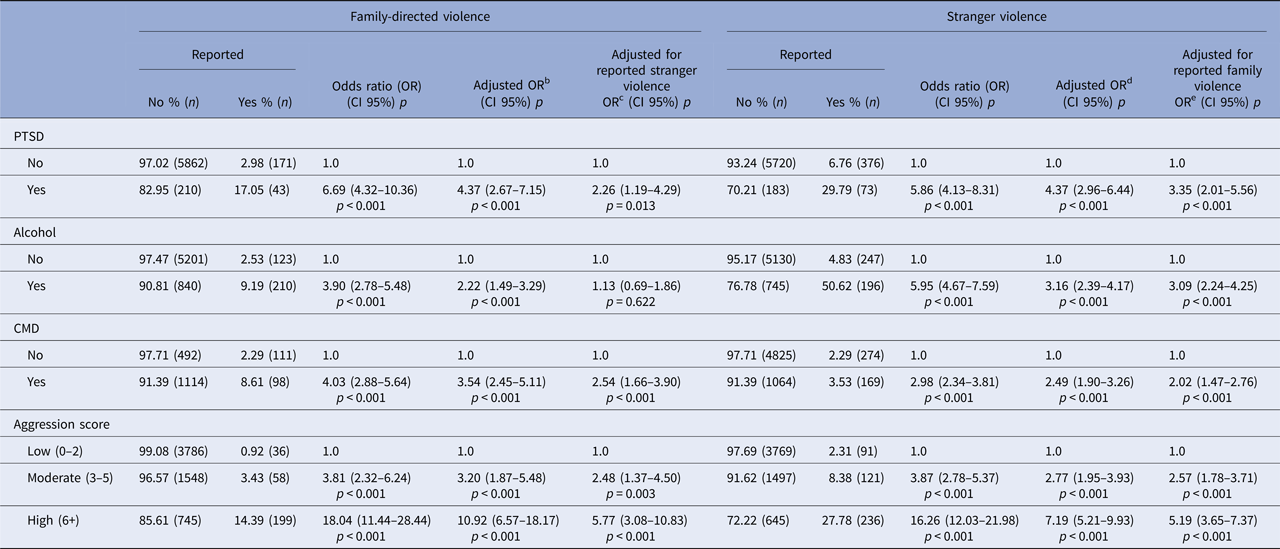
Both types of violence were found to be strongly associated with symptoms of PTSD, symptoms of common mental disorder, aggression and alcohol misuse after adjusting for socio-demographic and military factors (Table 5). In the final risk model, while all mental health risk factors and aggression scores continued to be associated with stranger violence, alcohol was no longer statistically significantly associated with family violence.
Post-deployment mental health and both family and stranger violencea

CI, confidence interval.
a Data are weighted to account for sampling strategy and non-response.
b Adjusted for age, sex, education, pre-enlistment ASB, rank, service and serving status.
c Adjusted for confounders (b) as well as those who reported stranger violence.
d Adjusted for age, sex, education, marital status, pre-enlistment ASB, rank, service and serving status.
e Adjusted for confounders (d) as well as those who reported family violence.
Discussion
This study found that among a sample of UK military personnel who had been deployed to Iraq or Afghanistan, self-reported perpetration of violence against both family members and non-family members was common. The prevalence of violence against family members in the weeks following return from deployment was 3.6% compared with 7.8% for stranger violence. Stranger violence was found to be associated with the risk factors that we have observed for general violence in military populations (MacManus et al. Reference MacManus, Dean, Al Bakir, Iversen, Hull and Fahy2012; Kwan et al. Reference Kwan, Jones, Hull, Wessely, Fear and MacManus2016) and in the general population (Prime et al. Reference Prime, White, Liriano and Patel2001; Ministry of Defence, 2013; Department of Defense, 2014), such as early ASB and sociodemographic factors, such as younger age, male gender, lower rank (a proxy for lower social class and level of educational attainment). However, family violence was not found to be associated with many of these usual risk factors. It was more likely to have been reported by those who served in the Army and those who had left service, but no other sociodemographic characteristics were shown to be risk factors for perpetrating family violence in the weeks following return from deployment. Both family and stranger violence were strongly associated with having been deployed in a combat role, and post-deployment mental health problems.
In a recent US study comparing past year family and stranger physical violence among veterans from the Iraq and Afghanistan conflicts, the prevalence of family and stranger violence was 13% and 9%, respectively (Sullivan & Elbogen, Reference Sullivan and Elbogen2014). Although the period of prevalence measured was different to our study (past year v. in the weeks following return from deployment), it is notable that the prevalence of family violence was higher than stranger violence in the US sample, whereas in our study of UK personnel stranger violence was twice as commonly reported as family violence. However, this difference may be partially explained by reporting bias. There may be cultural differences in attitudes to disclosure of family violence in the US and UK and requires further exploration in future research.
Family v. stranger violence: characteristics of perpetrators
The sociodemographic profile and military characteristics of those who committed only stranger violence were different to those who committed family violence only. Overall, and not surprisingly, both family and stranger violence were more commonly reported by male participants than females in keeping with results from the US (Sullivan & Elbogen, Reference Sullivan and Elbogen2014). However, of the men who reported violence, a much higher proportion reported stranger violence (82.1%) than family violence (17.9%), whereas of the females who were violent, family violence was almost as prevalent as stranger violence (45.9% v. 53.1%, respectively). This may be explained by more gender-specific roles and coping styles with females stereotypically being more likely to spend time in the home environment where tensions may be more likely to be manifest (Matud, Reference Matud2004; Olff et al. Reference Olff, Langeland, Draijer and Gersons2007). While the results of our study found that a higher proportion of men reported family violence compared with women, this is in contrast with studies comparing IPV perpetration among men and women in the general population which have suggested that men and women are almost as likely to report perpetrating violence against an intimate partner (Archer, Reference Archer2002).
Those who reported stranger violence, both stranger violence only and along with family violence, tended to conform to the profile of violent offenders in both the general population (Prime et al. Reference Prime, White, Liriano and Patel2001) and the military (MacManus et al. Reference MacManus, Dean, Al Bakir, Iversen, Hull and Fahy2012; Elbogen et al. Reference Elbogen, Johnson, Wagner, Sullivan, Taft and Beckham2014), i.e. younger single men with a history of early ASB. In comparison, we found that those who reported only family violence tended to be older, in a relationship and less likely to have a history of ASB compared with those who reported stranger violence. It was also noteworthy that those who reported family violence only were more likely to be officers and in the RAF than those who reported stranger violence. Not surprisingly, officers are at lower risk of violence in general (Elbogen et al. Reference Elbogen, Wagner, Fuller, Calhoun, Kinneer and Beckham2010; Gallaway et al. Reference Gallaway, Fink, Millikan and Bell2012; MacManus et al. Reference MacManus, Dean, Al Bakir, Iversen, Hull and Fahy2012). Rank is a proxy measure for social class, income and level of educational attainment, all of which are associated with violent behaviour in the general population (Ministry of Defence, 2013; Department of Defense, 2014). It may not be surprising that when officers are violent, it is more likely to be towards family than strangers as officers tend to be older and more likely to be in a relationship (and therefore have a family). This could also be partially explained by the lower levels of alcohol misuse among officers and other ranks (Fear et al. Reference Fear, Iversen, Meltzer, Workman, Hull and Greenberg2007).
Family v. stranger violence: risk factors
Post-deployment violence against strangers was associated with younger age, being single, having a history of pre-enlistment ASB and having left service consistent with previous research (MacManus et al. Reference MacManus, Dean, Al Bakir, Iversen, Hull and Fahy2012, Reference MacManus, Dean, Jones, Rona, Greenberg and Hull2016; Elbogen et al. Reference Elbogen, Johnson, Wagner, Sullivan, Taft and Beckham2014; Kwan et al. Reference Kwan, Jones, Hull, Wessely, Fear and MacManus2016). Family violence was not associated with these sociodemographic and military characteristics, except for being in the army and having left service. Those who were no longer serving were more likely to report having perpetrated family-directed violence in the weeks following return from deployment compared with those who were still in service. This could be a product of reporting bias as those who have left service no longer have the same concern about the impact that reporting violence might have on their military career and we see a similar association with stranger violence. It is also possible that violent behaviour perpetrated in the weeks following return from deployment was a predictor of subsequently leaving service. More research is necessary to examine this further. The US study that also compared family violence with stranger violence found that, among US Veterans, severe family aggression was associated with younger age and female gender (Sullivan & Elbogen, Reference Sullivan and Elbogen2014). Our study did not measure severity of violence. We did not find an association between relationship status and family violence after adjustment for confounding variables. This may be because family violence may be directed at other family members as well, not just spouses and/or partners.
Being in the Army was associated with perpetration of both stranger violence and family-directed violence. This is consistent with previous research into both general violence (MacManus et al. Reference MacManus, Dean, Al Bakir, Iversen, Hull and Fahy2012; Kwan et al. Reference Kwan, Jones, Hull, Wessely, Fear and MacManus2016) and IPV in military populations (Zamorski & Wiens-Kinkaid, Reference Zamorski and Wiens-Kinkaid2013). This may reflect several factors including sociodemographic and military factors, such as lower SES and higher exposure to combat. In our study being a member of the Royal Navy/Royal Marines or RAF was associated with reduced risk of family violence compared with the Army, although this did not reach significance for the RAF. This may be due to the residual confounding effect of rank or education as members of the RAF tend to have higher levels of education compared with Navy personnel (data not shown). It is however also noteworthy that, while overall percentage reporting violence perpetration is low among participants, a higher percentage of family violence only than stranger violence only was perpetrated by RAF personnel. By comparison, a higher percentage of stranger violence only than family violence only was reported by Navy personnel. This is an important difference in behaviour between service branch that has not been identified before to our knowledge and which warrants further exploration.
Combat exposure
This study found that deployment in a combat role was strongly associated with perpetration of violence against both family and strangers. This is consistent with previous research in both the UK and US that has shown that among deployed personnel, exposure to combat increased the risk of violence (Killgore et al. Reference Killgore, Cotting, Thomas, Cox, McGurk and Vo2008; Booth-Kewley et al. Reference Booth-Kewley, Larson, Highfill-McRoy, Garland and Gaskin2010; MacManus et al. Reference MacManus, Dean, Al Bakir, Iversen, Hull and Fahy2012, Reference MacManus, Rona, Dickson, Somaini, Fear and Wessely2015, Reference MacManus, Dean, Jones, Rona, Greenberg and Hull2016; Elbogen et al. Reference Elbogen, Johnson, Wagner, Sullivan, Taft and Beckham2014; Sullivan & Elbogen, Reference Sullivan and Elbogen2014). These results provide new evidence of the impact of combat exposure on the risk of perpetration of family violence. Exposure to combat may affect military personnel's propensity to violence through a number of mechanisms. Persistent exposure to threat can result in difficulty switching off when back home leading to ongoing hypervigilance to threat, hyperarousal, increased irritability and tendency to react disproportionately aggressively in the home environment (Elbogen et al. Reference Elbogen, Wagner, Fuller, Calhoun, Kinneer and Beckham2010; MacManus et al. Reference MacManus, Dean, Jones, Rona, Greenberg and Hull2013). Exposure to traumatic events can result in mental health problems associated with violence (Taft et al. Reference Taft, Vogt, Marshall, Panuzio and Niles2007). It is also possible that this finding may be partly explained by the character traits required to be deployed in a combat role which predispose to aggressive behaviour in civilian life (MacManus et al. Reference MacManus, Dean, Jones, Rona, Greenberg and Hull2013) and which may not have been completely adjusted for in our analyses.
Mental health and aggression
Consistent with US research (Sullivan & Elbogen, Reference Sullivan and Elbogen2014), we found mental health problems and aggression to be significantly associated with both family and stranger violence. We found higher risk of family violence among personnel who reported symptoms of PTSD and among those who scored higher on our aggression scale. This adds to previous research into mental health risk factors for IPV perpetration among military personnel in both the US and Canada (Taft et al. Reference Taft, Weatherill, Woodward, Pinto, Watkins and Miller2009; Zamorski & Wiens-Kinkaid, Reference Zamorski and Wiens-Kinkaid2013), which also found higher risk of IPV perpetration among personnel with PTSD compared with those without. Aggression is often comorbid with PTSD (Elbogen et al. Reference Elbogen, Wagner, Fuller, Calhoun, Kinneer and Beckham2010; Elbogen et al. Reference Elbogen, Johnson, Newton, Straits-Troster, Vasterling and Wagner2012) and so risk of family violence in the home could be increased further in the presence of both.
We found that while alcohol misuse was strongly associated with stranger violence, consistent with the wealth of literature on the link between alcohol and violence (Zoričić et al. Reference Zoričić, Karlović, Buljan and Marušić2003; Foran et al. Reference Foran, Heyman, Slep and Snarr2012; Wright et al. Reference Wright, Foran, Wood, Eckford and McGurk2012), it was not associated with family violence. Sullivan & Elbogen (Reference Sullivan and Elbogen2014) also found that alcohol misuse was associated with stranger aggression and severe stranger violence, but not family aggression or severe family violence (Sullivan & Elbogen, Reference Sullivan and Elbogen2014). However, this is in contrast to previous research in US and Canadian military populations which suggested that alcohol is a risk factor for IPV (Fonseca et al. Reference Fonseca, Schmaling, Stoever, Gutierrez, Blume and Russell2006; Zamorski & Wiens-Kinkaid, Reference Zamorski and Wiens-Kinkaid2013). The role of alcohol misuse in stranger violence appears to be more clear cut than its role in violence within the family.
Strengths and limitations
This is the first study to examine the prevalence of and factors associated with family violence by UK military personnel and to compare to stranger violence following return from deployment. A main strength of this study was that it utilised a large representative sample. However, although this was a large-scale study, and participants were encouraged to respond, family and stranger violence may be under-reported and could have resulted in a lack of power. The use of a self-report measure of family-directed violence meant that the study was more sensitive than those using conviction data as many incidents of family violence may not be officially recorded (Auty et al. Reference Auty, Farrington and Coid2015). A limitation of this study, however, was that we did not use a validated measure of family violence, for reasons of space in our questionnaire, and likewise we did not specifically ask if the violence was directed towards a spouse/partner or another family member (i.e. child, sibling or parent). This makes our results difficult to compare to other research that has focused on IPV only. Another limitation was the inability to adjust for family violence prior to deployment. Participants who perpetrate family violence prior to deployment would be more likely to engage in this behaviour post-deployment. It is also important to note the relatively small number of females in this study. This study was therefore limited in its ability to explore violence among women and the findings should be considered carefully. Future research should examine violent behaviour using a larger sample of female military personnel.
Implications
There is a wealth of research into violence against strangers perpetrated by military personnel. There has also been research into IPV perpetration by military personnel, but there is still a dearth of research into violence against wider family members other than spouses/partners. Our findings confirm that family violence is prevalent among military families and that the sociodemographic and military characteristics associated with perpetration of family and stranger violence are different. Such information could be used to inform violence risk assessment of military personnel. Currently risk for different types of violence is often not considered separately. In particular, this study highlights that the risk factors for family and stranger violence differ. Absence of the sociodemographic risk factors for stranger violence may not also indicate lower risk of family violence, while combat exposure, mental health symptoms and problems with aggression management are common risk factors for both. Violence reduction programmes increasingly also consider the risk of partner and family violence and more research to better understand the different risk factors and profiles of perpetrators is vital to the success of such programmes.
Acknowledgements
The analysis was undertaken by JK as part of a PhD fellowship funded by the Medical Research Council.
Declaration of Interest
The UK Ministry of Defence funded the cohort study data collection. The analysis was undertaken by JK as part of a PhD fellowship funded by King's College London and the Medical Research Council. DM, SW, NF, MJ and LH are currently employed by King's College London. The authors’ work was independent of the UK Ministry of Defence, which had no role in the analysis, interpretation or decision to submit this paper. SW is a trustee of the Veteran charity Combat Stress.