INTRODUCTION
The alarming increase of Plasmodium falciparum resistance to routinely used antimalarial drugs represents a major public health threat (Bjorkman and Bhattarai, Reference Bjorkman and Bhattarai2005). Chloroquine-resistant P. falciparum first emerged in the late 1950s in both South America and Southeast Asia. In Colombia, the chloroquine (CQ) resistance case was reported in 1961 (Moore and Lanier, Reference Moore and Lanier1961; Rodriguez, Reference Rodriguez1961) and subsequently cases have spread rapidly (Wellems and Plowe, Reference Wellems and Plowe2001).
Great efforts have been made to understand the mechanism of CQ resistance in P. falciparum, and 2 proteins, P-glycoprotein homologue 1 (Pgh1) and P. falciparum chloroquine resistance transporter (PfCRT), have been identified as candidates associated with this phenotype. The P. falciparum multidrug resistance 1 gene (pfmdr1) codes for Pgh1 and the P. falciparum chloroquine resistance transporter gene (pfcrt) codes for PfCRT. These genes are located on chromosomes 5 and 7, respectively (Fidock et al. Reference Fidock, Nomura, Talley, Cooper, Dzekunov, Ferdig, Ursos, Singh Sidhu, Naude, Deitsch, Su, Wootton, Roepe and Wellems2000; Reed et al. Reference Reed, Saliba, Caruana, Kirk and Cowman2000).
Point mutations in pfmdr1 and Pfcrt have been associated with changes in parasite susceptibility to CQ, quinine (QN), mefloquine (MQ), amodiaquine (AQ), desethylamodiaquine (DAQ), artesunate (AS) and dihydroartemisinine (DHA), in both in vitro lines and clinical isolates, but analysis of these mutations as molecular markers for epidemiology studies on drug resistance have produced contradictory results. Amplification of pfmdr1 has also been implicated in multi-drug resistance (MDR) in both in vitro and clinical studies, but the results have also been conflicting (Sidhu et al. Reference Sidhu, Uhlemann, Valderramos, Valderramos, Krishna and Fidock2006).
Genetic cross-analysis of laboratory-maintained parasite lines confirmed that point polymorphisms in the pfmdr1 gene may modulate sensitivity to CQ, MQ and artemisinin (ASN) in P. falciparum (Duraisingh et al. Reference Duraisingh, Jones, Sambou, Von Seidlein, Pinder and Warhurst2000). Furthermore, previous work suggested that amino acid substitution in Pgh1 at 5 distinct positions: 86, 184, 1034, 1042, and 1246, may be associated with resistance to CQ and/or amino alcohol drugs such as MQ. In earlier studies, the A-to-Y substitution at position 86 of Pgh1 was hypothesized to be the major change accounting for the CQ-resistant phenotype in P. falciparum strains originating from Asia and Africa, while the substitution at positions 1034, 1042, and 1246 was suggested to be a potential CQ-resistant marker for P. falciparum strains in South America (Duraisingh et al. Reference Duraisingh, Jones, Sambou, Von Seidlein, Pinder and Warhurst2000; Reed et al. Reference Reed, Saliba, Caruana, Kirk and Cowman2000). The presence of the mutant allele D1246Y in the pfmdr1 gene, which was initially thought to be associated with CQ resistance, may also modulate sensitivity to QN, MQ, halofantrine (HF), and ASN derivatives (Basco and Ringwald, Reference Basco and Ringwald2002). We have confirmed the presence of N86 (wild) in 97% and D1246Y (mutant) in 23% of 141 samples studied in Colombia (Montoya et al. Reference Montoya, Tobón, Blair, Carmona and Maestre2007). Mutant alleles were detected regardless of the treatment administered. In addition to the existence of mutant forms of the gene, laboratory and field analysis have demonstrated that changes in amplification or over-expression of pfmdr1 may occur in association to MQ resistance, with possible modulation of response to other antimalarials, in a complex phenotype involving multiple genetic determinants which may be geographically distinct (Price et al. Reference Price, Uhlemann, Brockman, McGready, Ashley, Phaipun, Patel, Laing, Looareesuwan, White, Nosten and Krishna2004).
Some authors reported on the lack of correlation between the mutant pfcrt and mutant pfmdr1, confirming that another gene was the determinant of resistance (Foote et al. Reference Foote, Kyle, Martin, Oduola, Forsyth, Kemp and Cowman1990). Markers in a 40 kb region of chromosome 7 showed clear co-segregation with resistance among progeny clones, and subsequent detailed sequencing of this region revealed the presence of the pfcrt gene (Walliker, Reference Walliker2005). Many studies have shown that mutation of the pfcrt gene increases the resistance of parasites to CQ and modulates the sensitivity to other antimalarial drugs (Wellems et al. Reference Wellems, Panton, Gluzman, Rosário, Gwadz, Walker-Jonah and Krogstad1990; Duraisingh, Reference Duraisingh and Refour2005). In this case, an acquired efflux system of CQ and/or an increased acidity in the digestive vacuole is assumed to play a role in the reduced accumulation (Sanchez et al. Reference Sanchez, McLean, Rohrbach, Fidock, Stein and Lanzer2005). A lysine to threonine change at position 76 (K76T) has been found in every in vitro chloroquine-resistant parasite from around the world (Fidock et al. Reference Fidock, Nomura, Talley, Cooper, Dzekunov, Ferdig, Ursos, Singh Sidhu, Naude, Deitsch, Su, Wootton, Roepe and Wellems2000; Wootton et al. Reference Wootton, Feng, Ferdig, Cooper, Mu, Baruch, Magill and Su2002). Many studies have confirmed the presence of the K76T mutation in vivo in relation to CQ resistance, but this mutation was not the sole requirement (Babiker et al. Reference Babiker, Pringle, Abdel-Muhsin, Mackinnon, Hunt and Walliker2001; Djimde et al. Reference Djimde, Doumbo, Cortese, Kayentao, Doumbo, Diourte, Dicko, Su, Nomura, Fidock, Wellems, Plowe and Coulibaly2001a; Vinayak et al. Reference Vinayak, Biswas, Dev, Kumar, Ansari and Sharma2003), suggesting that host factors may affect the clearance of CQ-resistant parasites (Djimde et al. Reference Djimde, Doumbo, Cortese, Kayentao, Doumbo, Diourte, Dicko, Su, Nomura, Fidock, Wellems, Plowe and Coulibaly2001a, Reference Djimde, Doumbo, Steketee and Ploweb). Nevertheless, this codon has been considered as a highly reliable genetic marker for surveillance of CQ resistance (Djimde et al. Reference Djimde, Doumbo, Cortese, Kayentao, Doumbo, Diourte, Dicko, Su, Nomura, Fidock, Wellems, Plowe and Coulibaly2001a). In African or Southeast Asian isolates, the K76T mutation in pfcrt does not stand alone, but is accompanied by mutations in other codons (72, 74, 75, 220, 271, 326, 356 and 371). South American isolates may carry, besides K76T, mutations in codons 72, 74, 75, and 220 (Howard et al. Reference Howard, Zhang and Roepe2002; Wernsdorfer and Noedl, Reference Wernsdorfer and Noedl2003).
In Colombia, the decline in the efficacy of CQ as monotherapy has led to the use of combined therapy with other antimalarials, such as antifolates, but parasite resistance has threatened malaria control in the country. As a result, the national Colombian health authorities are proposing different drugs, as combined therapy, to be used throughout the country in order to reduce the frequency of treatment failure. Currently, new treatment schemes are being proposed after several years of administration of AQ and antifolates as first line drugs against P. falciparum.
In the present study, we explored the frequency of mutations in the pfcrt and pfmdr1 genes, as a baseline characterization of the molecular background of P. falciparum from malaria endemic regions of Colombia within the framework of new recommended schemes.
MATERIALS AND METHODS
Patients and blood samples
The study was conducted from 2004 to 2005 as part of an ongoing research on in vivo efficacy to antimalarials, in subjects living in regions of North-western Colombia where malaria is highly endemic (Uraba region: Turbo and Necocli municipalities; Bajo Cauca region, El Bagre and Zaragoza municipalities) (Fig. 1). After confirmation of P. falciparum infection by microscopy, samples were collected from uncomplicated malaria patients who gave fully informed written consent. Ethical clearance was granted by the Ethics Committee of the Centro de Investigaciones Medicas, Faculty of Medicine, Universidad de Antioquia (Medellin-Colombia) according to national ethical guidelines. A total of 77 P. falciparum samples were included in the study, of which 18 were collected in Bajo Cauca, 18 were from Turbo and 41 were from Necocli.
Geographical location of the areas of sample collection.

Peripheral parasitaemia was determined from capillary blood. A parasite count was obtained using field-stained thick blood films and defined as the number of asexual parasites per 200 white blood cells, based on a mean count of 8000 leukocytes per microlitre of blood. A slide was considered negative after examination of microscopic fields corresponding to at least 500 leukocytes.
In vitro parasite phenotyping
In vitro culture was carried out when parasite density was >0·02% of infected red blood cells (geometric mean, 0·27%). The conditions were described previously (Noedl et al. Reference Noedl, Attlmayr, Wernsdorfer, Kollaritsch and Miller2004). In brief, fresh P. falciparum parasite isolates were cultured in the presence of serial dilutions of the antimalarial drugs DHA, AS, MQ, QN, CQ, AQ and DAQ at 1·5% haematocrit in RPMI 1640. After 72 h of incubation, samples were harvested and stored at −20°C before further processing.
An HRP2 double-site antigen capture ELISA was performed according to Noedl et al. (Reference Noedl, Bronnert, Yingyuen, Attlmayr, Kollaritsch and Fukuda2005). For this, 2 commercial monoclonal antibodies (Immunology Consultants Laboratory Inc., Newberg, OR) directed against P. falciparum-specific HRP2 were used: MPFM-45A (MPFM-55A), and MPFG-45P (MPFG-55P), an immunoglobulin M (IgM) antibody was used as the capture antibody and a horseradish peroxidase-conjugated IgG antibody was used as the indicator antibody (Noedl et al. Reference Noedl, Bronnert, Yingyuen, Attlmayr, Kollaritsch and Fukuda2005). Spectrophotometric analysis was performed at 450 nm using an ELISA plate reader BioRad 680. Tests were considered invalid if poor schizont maturation in control wells, rupture of schizonts or contamination of wells, were detected.
Molecular analysis
Blood for molecular analysis was collected on day 0 before antimalarial treatment. A volume of 100 μl of blood was placed on Whatman 3 MM filter paper and stored at −20°C until DNA extraction with Chelex®. Briefly, a piece of filter paper was soaked overnight in 10% saponin in PBS and subsequently washed in PBS. Afterwards, genomic DNA from each sample was obtained by boiling in Chelex-100, followed by ethanol precipitation, according to established procedures (Plowe et al. Reference Plowe, Djimde, Bouare, Doumbo and Wellems1995). A similar method was used to extract genomic DNA from the reference P. falciparum strains 3D7, Dd2 and Hb3.
Frequency of polymorphisms N86Y and D1246Y of the pfmdr1 gene was analysed by nested PCR. Primers were specifically designed and the sample was processed following previously described methodology (Lopes et al. Reference Lopes, Nogueira, Ferreira, Gil, do Rosário and Cravo2002). Polymorphism of codon 76 of the pfcrt gene (K76T) was analysed by PCR-RFLP by applying protocols described elsewhere (Lopes et al. Reference Lopes, Nogueira, Ferreira, Gil, do Rosário and Cravo2002).
Analysis of the polymorphism N75E was performed according to Ferreira et al. (Reference Ferreira, Lopes, Martinelli, Ferreira, do Rosário and Cravo2007). Polymorphisms C72S and M74I in the pfcrt gene were analysed by nested PCR-RFLP as described by Djimde et al. (Reference Djimde, Doumbo, Steketee and Plowe2001b). All products were assessed by polyacrylamide (13%) gel electrophoresis.
Statistical analysis
Individual inhibitory concentrations (50% inhibitory concentration IC50) for the assays were determined by non-linear regression analysis. The software used was based on a polynomial regression model and is freely available from http://malaria.farch.net. The results (IC50) closely paralleled those obtained with other non-linear estimation programmes or log-probit analysis (Noedl et al. Reference Noedl, Wernsdorfer, Miller and Wongsrichanalai2002).
Standard correlation analysis was used to establish linear associations between inhibitory concentrations obtained from different assays with the drugs. In addition, non-parametric procedures were used. Correlation of the IC50 values for different drugs (2 by 2) was calculated using Spearman's rank-order correlation test. The significance level was fixed at P<0·05.
RESULTS
In vitro phenotyping
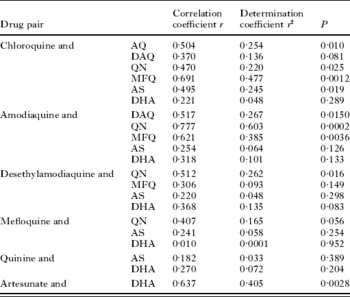
Successful in vitro culture and phenotyping was achieved in 23 out of the 41 samples from Necocli, Data obtained from the in vitro tests are summarized in Table 1. In general, the proportion of resistance to CQ, DSA, MQ and QN was high. A positive correlation (P<0·05) was observed between the IC50 of some paired drugs, these included CQ-AQ, CQ-QN, CQ-MQ and CQ-AS. Details on IC50s and their relationship among the different antimalarials are provided in Table 2.
Mean IC50 and proportion of in vitro resistant isolates (n=23) against different antimalarials
(Resistance thresholds were based on Pradines et al. (Reference Pradines, Mabika Mamfoumbi, Parzy, Owono Medang, Lebeau, Mourou Mbina, Doury and Kombila1998).)

Paired drug correlation, determination coefficients and P value in 23 isolates from Necocli
(AQ: amodiaquine; DAQ: desethylamodiaquine; QN: quinine; MFQ: mefloquine; AS: artesunate; DHA: dihydroartemisinin.)

Prevalence of single nucleotide polymorphisms
The status of Pfcrt and pfmdr1 was determined in all 77 samples. In the pfmdr1 gene the wild allele N86Y was fixed (100%) while the mutant D1246Y was detected in a major proportion (92%) of isolates. In the pfcrt gene, mutant alleles K76T and N75E were found in all samples. Meanwhile, the C72S mutant was detected in 9% of the isolates and the wild form of codon 74 (M74) was observed in all of them.
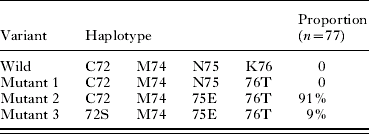
Global analysis of the 4 codons (72, 74, 75 and 76) in pfcrt confirmed the presence of the haplotype CMET in 91% and of SMET in 9% of the samples (Table 3).
Observed frequency of the different haplotypes for the gen Pfcrt
No significant association was found between the mean IC50 against any antimalarial and the presence of any pfmdr1 or pfcrt mutant form. Similarly, correlation analysis between the presence of specific pfcrt and pfmdr1 haplotypes failed to confirm association.
DISCUSSION
Resistance of malaria parasites has emerged to all groups of antimalarial drugs, except the artemisinins, and is responsible for a recent increase in malaria-related mortality in several endemic areas. Monitoring the epidemiology and dynamics of drug resistance is needed to implement effective control measures. The identification and validation of easy and rapid molecular markers of drug resistance would greatly facilitate monitoring of the resistance problem, and would make it possible to overcome difficulties in the use of traditional methods for assaying drug sensitivity.
In Colombia, during the past decade, the recommended treatment regimen for uncomplicated falciparum malaria was AQ (25 mg/kg in 3 days) and sulfadoxine/pyrimethamine (S/P) (25 mg/kg-1 mg/kg). Other antimalarials, such as MQ and QN, are available for resistant or severe malaria. However, as a result of local reports of treatment failure to CQ (Blair et al. Reference Blair, Lopez, Piñeros, Alvarez, Tobon and Carmona2003), this same treatment scheme (AQ plus S/P) has been administered since 1985 in the regions studied herein. Treatment failure to all the antimalarials historically used in the country was confirmed in the donor patients of this study (Blair et al. Reference Blair, Carmona-Fonseca, Piñeros, Ríos, Alvarez, Alvarez and Tobón2006). During 2007, the national Colombian health authorities proposed a major change in the recommendation, and within the coming years, artemisinin derivatives ought to be administered as the first line medication.
The objective of this work was to characterize at the molecular level, the isolates of P. falciparum originating from 2 endemic regions (Uraba and Bajo Cauca) of Colombia by correlating the presence of mutations in the pfmdr1 and pfcrt genes in clinical isolates and the in vitro sensitivity to several antimalarials including new compounds such as AS and DHA.
Our in vitro observations confirmed a high level of chloroquine resistance (74%) compared to other antimalarials, a result that is in agreement with previously published work (Blair et al. Reference Blair, Lopez, Piñeros, Alvarez, Tobon and Carmona2003) carried out in the regions. The mean antimalarial in vitro resistance was high for DAQ (30%), for QN (22%) and AQ (13%). Some authors have reported on the lack of correlation between in vitro resistance and in vivo treatment failure (Warhurst, Reference Warhurst2003), particularly for AQ, using the argument that sensitivity to the main metabolite, DAQ, explains the in vivo success of the antimalarial. However, this hypothesis could not be confirmed by us since the rates of resistance to the metabolite were higher than to the original compound.
DHA and AS resistance rates were low (4% each). This was a surprising finding considering that artemisinin derivatives were not available in the country by the time the samples were collected. The contribution of resistance to other antimalarials on the emergence of resistance to artemisinin-related drugs has been proposed by other authors, and might explain this finding (Afonso et al. Reference Afonso, Hunt, Cheesman, Alves, Cunha, Rosário and Cravo2006).
We observed a significant positive association between in vitro responses to artesunate, amodiaquine, quinine and chloroquine, a phenomenon also described by other authors (Pradines et al. Reference Pradines, Mabika Mamfoumbi, Parzy, Owono Medang, Lebeau, Mourou Mbina, Doury and Kombila1998). Afonso et al. (Reference Afonso, Hunt, Cheesman, Alves, Cunha, Rosário and Cravo2006), raised the possibility that the AS resistance phenotype is expressed only in CQ-resistant clones. For Colombia, this hypothesis has major relevance to the practical life-time of a drug since resistance to other drugs (and specifically chloroquine) is highly prevalent.
Very interesting is the positive correlation detected by us, between the artemisinin derivates IC50 and other drugs, particularly CQ, which confirms the need to find a rational partner compound with which artemisinin derivates can be administered in order to further extend the potentially useful life, and this, before and not after resistance has emerged (Menard et al. Reference Menard, Djalle, Manirakiza, Yapou, Siadoua, Sana, Matsika-Claquin, Nestor and Talarmin2005; Tinto et al. Reference Tinto, Rwagacondo, Karema, Mupfasoni, Vandoren, Rusanganwa, Erhart, Van Overmeir, Van Marck and D'Alessandro2006).
The correlation between pfmdr1 genotypes and quinoline resistance has often generated conflicting results. It has been suggested that the mutant allele N86Y can be correlated with increased CQ resistance in parasites from different regions of the world (Foote et al. Reference Foote, Kyle, Martin, Oduola, Forsyth, Kemp and Cowman1990). Other field studies in South America showed that both the wild allele N86Y and the mutant allele D1246Y are widely distributed and related them to susceptibility to MQ and AQ (Zalis et al. Reference Zalis, Pang, Silveira, Milhous and Wirth1998; Cortese et al. Reference Cortese, Caraballo, Contreras and Plowe2002). Our present results do not implicate pfmdr1 in CQ resistance since N86 was detected in 100% of samples and mutant D1246Y in 93%. The presence of both alleles was largely independent of their drug response This might confirm that the mechanism of chloroquine resistance might depend on the presence of alternative genes, as it has been proposed by other authors (Duraisingh and Refour, Reference Duraisingh and Refour2005).
We confirmed the presence of mutant alleles pfcrt 76T and 75E in each of the 77 isolates studied, indicating complete selection of this polymorphism by the antimalarial drug(s). This is in agreement with reports from other authors with parasites from different geographical regions worldwide (Lopes et al. Reference Lopes, Nogueira, Ferreira, Gil, do Rosário and Cravo2002; Nsimba et al. Reference Nsimba, Jafari-Guemouri, Malonga, Mouata, Kiori, Louya, Yocka, Malanda, Durand and Le Bras2005) and explains the high treatment failure rates to CQ and, probably, to AQ (Blair et al. Reference Blair, Carmona-Fonseca, Piñeros, Ríos, Alvarez, Alvarez and Tobón2006). A possible explanation for the persistence of the 76T mutant phenotype after over 2 decades of being withdrawn for falciparum malaria, might be that in Colombia, in contrast to Africa, P. vivax malaria is more frequent (approximately 60% of the reported cases). The current treatment scheme for this infection is CQ plus primaquine and, as a consequence, regular selective pressure of CQ in infections with P. falciparum may go undetected (Mita et al. Reference Mita, Kaneko, Lum, Bwijo, Takechi, Zungu, Tsukahara, Tanabe, Kobayakawa and Bjorkman2003).
Global analysis of codons 72, 74, 75 and 76 in pfcrt confirmed the presence of only 2 haplotypes being more frequent CMET (91%), this haplotype have been associated, by other authors, with treatment failure to MQ (Duraisingh and Refour, Reference Duraisingh and Refour2005). The observation of SMET in 9% of the isolates is a novel finding for this region of the country. No significant association could be confirmed between a particular haplotype and the place of residence of the patients.
The Pfmdr1 copy number has a pronounced effect on the response of P. falciparum to a number of drugs currently used against malaria (Sidhu et al. Reference Sidhu, Uhlemann, Valderramos, Valderramos, Krishna and Fidock2006). Future work should include copy number assessment as well as the presence of over-expression of this gene.
To our knowledge, this is the largest study on the molecular characterization of the pfcrt and pfmdr1 genes carried out in a representative number of clinical isolates from endemic regions of Colombia. We observed the mutations K76T and N75E in pfcrt in all samples and predominance of the haplotype CMET.
The authors are grateful to the local health personnel, the participating patients, and Dr Silvia Blair for assistance during the field work. This work was supported by Programa Alßan (European Higher Education Area to Latin Americans, Alßan scholarships) and Santander Group; Centro de Malária e Outras Doenças Tropicais/IHMT/UEI Biologia Molecular/UEI Malária, Lisbon, Portugal; Grupo Malaria from Universidad de Antioquia and COLCIENCIAS contract RC 156-2002, code 1115-04-11948. Durley Eliana Restrepo carried out the molecular typing and analysis of all samples and prepared the manuscript. Eliana Arango phenotyped the parasite isolates, Amanda Maestre coordinated sample collection, the study design and prepared the manuscript and Pedro Cravo and Virgilio E. do Rosario supervised the development of laboratory work and reviewed the manuscript.