***
In her Three Persian Dialects, the late Ann K. S. Lambton (1912–2008) provides us with texts and glossaries of the dialects of Meyma and Jowshaqān, two villages located in central Persia, and Velātru, a central Alborz village lying off east of the highway connecting Tehran to Chālus on the Caspian Sea.Footnote 1 In the chapter on Velātru Lambton includes some materials on the vernaculars of the neighboring Gachsar (a short text and some words) and six other villages (lexical items only). Lambton's documentation of Velātruyi and Gachsari is important not only for its uniqueness but also because the dialects have become moribund or even extinct in the socio-politically eventful past three-quarters of a century that has lapsed since their collection.
Lambton collected the linguistic data during five days of sojourn in Velātru in September 1936. Her chapter titled “Velātrū” introduces the economy and administration of the village (pp. 78–81), followed by the Velātruyi texts, which consist of five accounts and thirteen sentences, totalling 673 words (pp. 81–86): a short text of seventy words in Gachsari (p. 86), and a collective glossary for these two and six more dialects (pp. 86–92). Lambton provides no meta-linguistic data on her documentation or informants other than on the first text, which “was dictated to me by a muleteer in Velātrū, who thus described his return from Teheran to Velātrū the previous week”.Footnote 2 The composition of the other Velātruyi texts suggests different informants who spoke varients of the same dialect. As contents of some of the texts are similar to those narrated in the other two chapters of Lambton's book, one may infer that she would read out the texts in Persian to her informants and would ask them to translate each sentence. The translation of many sentences, even if semantically sound, is thus inaccurate with respect to grammatical terms.
Lambton's transcription incorporates the IPA symbols, at a nearly phonetic level, but without stress marks. This has resulted in highly diverse forms such as biɔmi, bīmumi, bīmūmi, bimi, and bimumi “we came”, within the first text, and the postposition -ra, with variants -rɔ, -ro, -re, râ, -a, -ɛ, -e, -i, and -o. In reproducing the texts I have remained loyal to Lambton's transcription save for replacing some symbols with those commonly used in Iranian philology, e.g. /č/ for /tʃ/. This change, as well as hyphenation of enclitic morphemes, are expected to have improved the legibility of the texts, which are now punctuated and numbered as well. The English translation is meant to remain as close as possible to the words and grammar of the texts. Each text is titled according to its contents.
Former studies. Lambton's chapter on Velātruyi has been used in the following comparative studies. (1) In the multi-volume compendium on Iranian languages, Osnovy iranskogo jazykoznanija, Rastorgueva and Èdel'man have written a chapter on the Caspian languages of Gilaki and Māzandarāni, and the dialects of Shahmirzād and Velātru as Māzandarāni offshoots.Footnote 3 Albeit a thorough treatment of Lambton's materials in this chapter of Osnovy, there are multiple instances of misreading (originated from Lambton's non-literal translation of the texts) that have led to a largely hollow morphology and syntax which defeats the purpose of delineating Velātruyi from general Māzandarāni. Their handling of the etymology is disappointingly trivial and is devoid of characteristic words. Some words marked as Velātruyi belong to other dialects that Lambton collected in her chapter titled “Velātru”. Some of the discrepancies in the Osnovy are mentioned in the footnotes of this article. (2) In a short chapter on the Caspian dialects, Lecoq has incorporated the Velātruyi materials as treated in the Osnovy.Footnote 4 (3) Donald Stilo, in his methodic article on the Māzandarāni languageFootnote 5 group makes incidental use of Lambton's materials, along with a dozen other dialects, mostly employing his own documentation.
Typology
The dialects studied here are spoken in the valleys situated on the affluents of the Karaj River, which flows from the heights of Central Alborz southwards to the plain of Karaj (west of Tehran) and runs along a major highway that connects Tehran to the Caspian Sea. A major tributary of the Karaj River flows in the valleys of Velāru and Vārangarud, which joins at Gachsar the affluent coming from Kandovān. Another tributary is the river Shahrestānak running from east to west on the north side of the Towchāl, which separates the upper Karaj River from the plain of Tehran. The upper Karaj valley became a popular summer resort for the residents of Tehran after the opening in 1938 of the Tehran-Caspian highway and tunnel of Kandovān.
When Lambton visited Velātru village—two years before the opening of the Kandovān tunnel on the Tehran-Caspian highway—central Alborz was not yet considered the commercial backyard of the capital. The villages were still largely untouched by the modern civilisation, as were their dialects, and they were economically linked to littoral Māzandarān, rather than being exclusively dependent on Tehran. In wintertime most inhabitants would travel across mountains to the Caspian plains to work in rice fields or construction. Only a minority would stay in the valley, where some were engaged in turning the forest into coal and selling it in Tehran, as did Lambton's informant who related the first text, below. This explains why the vernacular of Velātru, in spite of its location, is not radically different from Māzandarāni proper and why, as Lambton statesFootnote 6, the villagers could also speak Persian without difficulty.
Besides Velātru and Gachsar, six other settlements contributed to Lambton's glossary. They are situated within the upstream of the Karaj river except for Nesen, a village of a hundred households, located north across a lofty mountain chain on a tributary of the river Nur, on the lower course of which rests Yush village.Footnote 7 Lambton describes Velātru (Velāyat-rud on the maps) as a relatively large village with around a hundred households, to the vicinity of which lie the hamlets of Vārangarud (north), with twelve to fifteen households, and Lower and Upper NesārFootnote 8 (west), with forty to fifty households. These must have been among the settlements whose speech did “not differ substantially from Velātrū; but the vocabulary of more southern villages does not appear to be as full as that of the villages on the borders of Mazandaran”.Footnote 9 On the other hand, on west of the Tehran-Chālus highway, where Gachsar rests, there were also Shāhpol (with nine households), Margevālis,Footnote 10 and Kushkak, whose dialects, we may thus suppose, were close to that of Gachsar.
The upper tributories of the Karaj and Jājrud rivers (also called Rudbār-e Qasrān),Footnote 11 fall outside of the province of Māzandarān,Footnote 12 but in the linguistic terms alone they should be considered as the southwestern corner of the Māzandarāni speech area. These valleys, as Donald Stilo proposes tentatively, are bound within four language groups: Mazandarani on the north and east, Persian on the south, Tāleqāni (a semi-Tatic dialect group) on the west and Central Caspian (from Chālus to Rāmsar, including Kalārdasht and Tonekābon districts) on the northwest. Gachsari appears to be a blend of all these language groups, as demonstrated in the section on Gachsari, below. Velātruyi, however, despite its proximity to Gachsar (10 km) and its transitional location at the very southwestern corner of Māzandarāni linguistic province, is by and large Māzandarāni, though not without obvious influences from Persian and other aforementioned language groups. The following outlines the defining features.
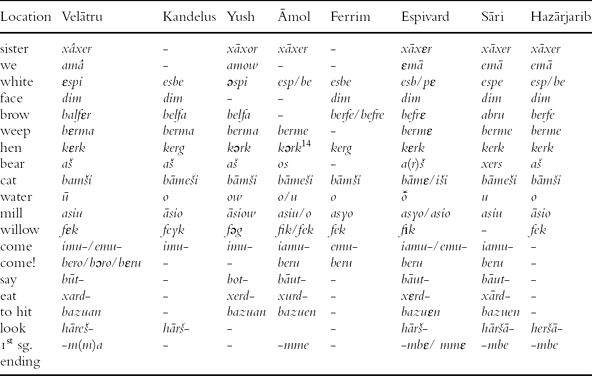
Vocabulary. Velātruyi shares its basic vocabulary with other Mazandarani (Maz.) varieties, as demonstrated in Table T1. Absent, however, is Maz. əttə (cf. Kopari ata) “one”, a word of high frequency which serves also as an indefinite article. The stems of the verb “sleep” (§D6) show an unusual historical development.
Lexical Features among Māzandarāni DialectsFootnote 13

Phonology. In spite of the superfluous symbols used in Lambton's text, the vocal system of Velātruyi (§1.2) is in close agreement with general Maz.
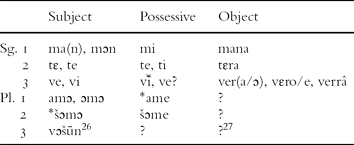
Nouns. Notable Maz. characteristics are the preponderance of postpositions (§2.3), used together with the oblique marker (§2.2), thus drawing a sharp contrast with Gachsari which is devoid of Caspian syntax. Nevertheless, the Velātruyi texts suggest that the dialect is shedding the oblique marker in favour of Persian ezāfa construction. The three main classes of Caspian personal pronoun are attested in Velātruyi (§2.4, Table 1). An outstanding difference is the reflexive, which functions as the possessive pronoun as well (§2.4). The Maz. plural ending -ún is absent in the Velātruyi texts (§2.1.1), nor is there a trace of Kalārdashti -šón.
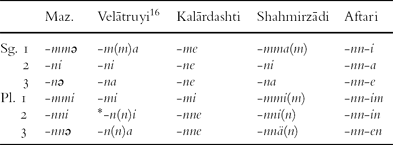
Verbs. Velātruyi carries general Maz. features in terms of the past-stem marker in regular verbs (§3.1.1), the preverbs (§3.2), the modal prefix (cf. the Kalārdashti imperfect infix -(i)mi-) (§3.3), and the three sets of personal endings (Table 2a). As the present endings have typological significance, Table T2 compares the verb endings for the present indicative in Velātruyi, general Maz., Shahmirzādi (an outlying Maz. dialect near Semnān), Aftari (a Komisenian dialect near Semnān), and Kalārdashti of the Central Caspian group. See §3.4.2 for the weakening of this feature in Velātruyi, demonstrating its transitional character par excellence. Moreover, Velātruyi conforms to general Maz. in the simple, periphrastic, and progressive tenses (§§3.5, 3.7, Table 3), even if the past subjunctive is not attested in Lambton's texts. The texts are too limited to show full paradigms for the substantive verbs and the forms and usage of the modals and verbal nouns (§§3.6, 3.8, 3.10); yet the existing data, incomplete as it is, confirms the Maz. character of the Velātruyi verb.
Verb Endings, Present IndicativeFootnote 15

Diachronics
§D1. The Caspian provenance of Velātruyi within the Northwest (NW) family of Iranian languages is evident in the following characteristic sound changes, which also illustrate profound Perside reflex.
§D2. From the oldest Iranian strata the words that bear the NW-SW differentiation are just a few. (1) ɛspi “white” (NW /sp/ < proto-Ir *św < IE * ḱw). (2) asiyu “water-mill” (SW /s/ < OIr. *θr). (3) heme “firewood”, if an original word, is SW (< *aidma-, not *aizma). (4) aŋgīs “finger” (< *angušta-), with the outstanding SW st < *-št- (see §D8 on /s/ < st).
§D3. Within the Middle West Iranian split the dialect sides with the NW branch but poorly. (1) PIE *k(w) > OIr. *-č- > /j/: paj- “cook”, jīr “under” (also Gch. juar “above” cf. Pers. zabar), -jɔ “form” (< *haca), and probably kījɔ “girl” (see Glossary) and sɔjɛ “broom” but SW rūz “day”. — (2) Retention of OIr. *j (< PIE *g(h)) has no example; rather we find SW zanɔ “woman” (< *jani- + fem. *-ā?), zan- ː zu- “hit”. — (3) OIr. *wy- has possibly not developed to SW /j/ in kuɔ “where” (← ku + *yɔ “place” cf. Pth. wyāg, MP gyāg) although it has in ījɛ “here”. — (4) A reflex of OIr. *-g- > SW w > /ø/ may be seen in dɔru “lie” (cf. MP drō(w), Pth. drōγ < OIr. *drauga-). — (5) Retention of OIr. *rd in pardi “bridge beam, roof rafter” (cf. Kpr. palvar “id.” Gilaki purd, Cent. Kd. pird “bridge”, but Maz. pəl “id.”) is an exception; the norm is SW /l/: dela “in” (< *zŗd- “heart”, if not from *dar), gali “*throat”.
§D4. Regular retention of MWIr. *w-, as in vača “child”, valk “leaf”, vara “lamb”, vārɛš, vārūn “rain”, varf “snow”, vašno/ɔ “hungry”, vɛni “nose”, vɛrk “wolf”, vīša “forest”, vīštar “more”, vīn- “see”, zarde-vi “kind of willow-tree” (but fɛk “willow”, common among Maz. dialects); thereby bɛhtar “better” is a loanword.
§D5. Cluster reduction: (1a) *-xr- > *hr > /r, l/: čɛl “spinning-wheel” (< *caxra-), čapɛr “wheeling” (see Glossary; hence, čarx in čarx-ɛ-tu should be loan); rūt- “sell” (< OIr. *fra-waxta-). (1b) *-fr- is retained in varf “snow” (< *OIr. *wafra-). (1c) *fr- > /h/ in preverb hā-/hɛ- (< *fr -). — (2) *xt, *ft > /t/: pɛt- “cook”, rūt- “sell”, Shp. dɛtar “daughter” (hence luxt “naked” should be Persian; so is mɛft(i)/mɔfti Footnote 17 “free of charge”); kat- “fall”, and possibly fɛt- “sleep” (see §D6).
§D6. *hw/xw- is reduced to /x/, e.g. xɔxɛr “sister”, xū “sleep”, and the reflexive xɛ-. However, for fɛs- ː fɛt- “sleep” (cf. Kandelus [in the neighbouring Kojur district] (da-)fes- ː fet-, Karingāni fes- ː het-, NP xufs-/xusp- ː xuft- < *hwap-s-a- ː *hwafta-) there are two possibilities: (a) *hw/xw- > /f/, a Median-type development, and subsequent loss of *p/f in the medial cluster *-ps- (un-etymological) and in *-ft- (§D5.2); (b) more realistically, a total loss of the initial cluster *hw-, retention of the medial clusters -fs- and -ft- (as implied in Osnovy, p. 523) with the epenthesis -ɛ-.
§D7. Postvocalic stops *t *p *k (> MWIr. /d b g/) are lost. (1) Medial and final dental: barɔr “brother”, muɔr “mother”, piyar “father”, roxuna/e “river” (also in the toponyms Vɔraŋgɛrū and Velātru), šu- “go”, and the reflexive xɛ-; thus xɔd- “self” is loan. — (2) Old labials are absorbed into the preceding vowel, which is rounded as a result (*p > /ū/): ū “water” (also in asiyu “water-mill”), xū “sleep”, š  “night” (also in ɛmšu “tonight”; < *xšap-), tu “*twist, *shine” (also in âfto “sun”), tūr “axe”, “wood”, kūk “partridge”, kūtɛr “pigeon”, lūša “lip”, ūsāl “halter”. Note also veni, vɛse “must” (cf. MP abāy-ist-), tāvɛsūn “summer” (< *tap-), gu “cow” (< OIr. *gv-), and secondary developments of this kind in bavɔ “father” (< bābā), devɔre “again”, var- ː vard- (< *bara- ː *bŗta-; cf. Shp. bard-) “carry”, *vand- “shut” in the toponym Darvunɛsar. Note also γabexʌna “cafe”, jīf “pocket”. (3) Medial palatal is lost in šɔl “jackal”, diyar “other” (< *dvitīya-kara-, cf. MP didīgar). For morphonological rules on /d b g/, see §1.9.2.
§D8. Assimilation (often with subsequent degemination): (mb > mm > m) hamūm “lamb-skin”; (nd > n(n)) ganam “wheat”, kannīl “beehive”, Darvunɛsar (toponym); (st > ss > s) aŋgīs “finger”, tāvɛsūn “summer”, zɛmɛsūn “winter”, hɛrɛs-, perɛsi- “stand” (see §3.1.1), but ɛstɔ- “stand”, hastɛkɔ “bone”; (zd > zz > z) dɛzi “theft”, mɛzīr “labourer”, azɔl “plough”; (sp > s) gɛsan/gosan “sheep” (< *gau-spanta-), but ɛsbi “white”.
§D9. Other secondary developments include: (1) loss of the final consonant: či “*thing”, ču “stick”, da “village”, fɛttammu “loincloth”, kɛlī “key” — (2) r > /l/ in valk “leaf”, γalvɔl “sieve”, ūsāl “halter”, čɛl “spinning wheel” (see also §D5.1) — (3) loss of *r (oddly) in gahm “warm” (< *garma-) — (4) reduction of *šm in čœš “eye”Footnote 18 (but čɛšma “source”) — (5) loss of *x (via *h) might be found in pɛrɛz- ː perɛsi- “stand”, cf. NP ba pā xēz/xāst “stand up!/he stood up” — (6) *k- > /g/ in ge “that, which” — metathesis in raxif < rafiq “friend”.
§D10. Vowels. (1) *āN > /uN/, an outstanding characteristic of Tabari since early on, is the norm in Velātruyi as well: dūna “rice”, dunɛrīr “yawn”, juma “shirt”, kɔlum “stable”, nūn “bread”, šum “supper”, šūnak “shoulder”, un “that”, zɛmɛsūn “winter”, Darvunɛsar (toponym). Note the cluster /om/ in domūn/dɔmūn “skirt” (cf. Pers. dāman, dialect duman) is split between syllables. Exceptions, as in other Maz. dialects, are bāmši “cat”Footnote 19 and xɛna/xana/xʌna “house”, found also in the compounds γabexʌna “cafe” and Kamarxānī (lit. mountain-spring) but not in roxuna/e “river”, which obviously follow a different diachronic path. — (2) Rounding of /ā/ is treated synchronically in §1.7. — (3) Terminal *-ā > /a/ is the norm in loanwords: hala “now”,dɛta “two”, īnja/injâ/ījɛ “here”, kɔja “where”, -ra “(postp.)”, rūbâ/a “fox”, ta “until”, hɛvɛ-hɛve “quickly”. — (4) The front majhul vowel is retained in vɛni “nose” (cf. MP vēnīg), heme “firewood” and is lost in -pīč “front”, Kpr. dīm “face”, Nsr. sīf “apple”. — (5) The back majhul is lost: bu “odour”, dɔru “lie”, gušt “flesh”, cf. rūšan “bright”. — (6) Fronting of the higher back vowels is the norm: aŋgīs “finger”, dī “smoke”, gali “*throat” (in galibɛni (see Glossary); cf. MP galōg “throat” < *gar-), mɛzīr “labourer”, mī “hair”, mīrkɔ “bracelet” (see Glossary), šī “husband”, xī “pig”, zɛnni “knee”, eti (<? in-tawr/towr) “(in) this way”. — (7) The Caspian trait of turning the original diphthongs to monophthongs is attested scantily: -dūr “around”, Migūn “Meygun”, but (Pers.) xeili “very”, meil “*desire”. — (8) As do other Maz. dialects, Velātruyi tends to neutralise various vowels to [ɛ] or [ə]; see §§1.2, 1.4.
§D11. OIr. *-aka-, via MWIr. -ak/-ag, yields mostly a terminal /-a/ but also /-e/ in a considerable number of inherited words of the dialect. No pattern could be identified for this dichotomy. The following is a list of such words and also contains comparable forms which are not necessarily inherited from MWIr. but may have been generated later in the dialect.Footnote 20 (1) Nominals in /-a/: bena “ground”, bɛrma “crying”, čaka “clap”, čɛšma “spring”, čūγa “instrument for weaving”, darīja “smoke-hole”, dehkada “village”, fia “wooden spade”, kaša “spoon”, kīla “ditch”, kɔisa “bowl”, kūčila “fuel”, lūša “lip”, mɔrγɔna “egg”, vara “lamb”, xɛna “house”, sardama “descent”, the past participle aɔfto-bazua “at sunrise”, and probably bɛndɛrma “ascent”. Note also sɔjɛ “broom”, with the middle vowel /ɛ/ and roxuna/e “river”, documented in either terminal. (2) Words in /-e/: devɔre “again”, heme “fuel”, māše “tongs”, nālɛje “gutter” (cf. darīja, above), pɔre/i “*partly” (< *pārag), and the past participles batɛrkie “cracked”, dast-base “hand-touched”, (< Ar.) mɛhle “camp”, and the loans from Persian pɔrče “cloth”, be-andāze “as much as”. The ending vowel in darvāzi “gate” and kaši “girth” (< kaš- “pull” + *-aka-) appear to have further risen to /i/, and balfɛr “brow” and ɛšnɔfɛr “sneeze” carry a non-etymological /-r/, probably due to hypercorrection. — Note also šūnak “shoulder” and mardi “man”, a common Maz. word, with the ending /i/ possibly from *-aka-. — Other words ending in /-a/ or /-e/, e.g. dela “in”, da “village”, and če “what”, have etymologies irrelevant to this discussion.
Phonology
§1.1. Vowels. In her Velātruyi texts Lambton has employed the symbols <i i: e ɛ a ɑ ɑ: ɔ ɔ: o u u: œ ʌ> but defines only the last one, as the vowel in English but [bʌt]. The rest should also be the phonetic symbols Lambton defined in her description of Jowshaqāni and Meyma'i dialects in the same volume. In this article we shall use the set i ī e ɛ a â ā ɔ  o u ū œ ʌ (thus â is a short ā) to comply with the long-standing tradition of Iranian dialectology.
§1.2. Lambton's symbols are phonetic, with considerable variation in vowel qualities even within the same text. It is impossible therefore to establish a one-to-one correlation between the phones and phonemes. The phonemes of the dialect are probably no more than /i e ɛ a â o u/, as shown in the diagram below. Length should not be distinctive since many words listed in the Glossary appear in both short and long vowels (but see

§§D10.7, D7.2). ʌ and œ, used in no more than a couple of words each, should be allophones of /ɛ/ (see §§1.3, 1.4). /ɛ/ might be more realistically rendered as [ə], as shown below in §1.4; it forms a minimal pair with /e/ in vɛni “nose” ≠ veni “must”; otherwise, the contrast between the two phonemes is vague (§§1.4, 1.5). This is also the case with ɔ, which in all likelihood is not an independent phoneme in Velātruyi but an allophone of /â/ and /o/ (§1.7). Not only these two vowels but almost every other vowel may pass freely to its immediate phonetic neighbours or even to those farther away, making a continuum of overlapping vowel sounds: i ↔ e ↔ ɛ ↔ a ↔ â/ā ↔ ɔ ↔ o ↔ u. The following paragraphs attempt to elucidate on the phonemic distinction between these sounds.
§1.3. œ, used only in čœš “eye” and kœčɛk “carrion kite”, is left undefined in Lambton's chapter on Velātruyi, while her use of the same symbol for Jowshaqāni and Meyma'i suggests the rounded mid-front [ø], a vowel foreign to the Caspian dialects per se.
§1.4. The symbol ɛ is defined by Lambton as the “neutral vowel” (p. 81). This should be taken seriously, not only because Lambton was familiar—as her documentations reveal—with the phonetic qualities of the IPA symbols but also because the forms <xɛna, xana, xʌna>, the only word carrying the symbol ʌ, supports the argument that if ɛ and ʌ were sufficiently close to have been used interchangeably in the aforementioned word, then ɛ cannot be the front vowel [ɛ], midway between [a] and [e] but should be a central-back vowel that might best be approximated by the neutral [ə]. This conjecture is further supported by the free alternation between ɛ and the back vowels o and ɔ in several words: dɛkkun/dɔkkun “shop”, gɛsan/gosan “sheep”, mɛfti/mɔfti “free of charge”, pɛlɔ/pɔlo “pilaf”.
On the other hand, there are several examples which demonstrate the free variation between ɛ and the neighbouring front vowels a and e, implying a front position for ɛ: tɛ/te “you”, xaši/xɛši/xeši “his”, xana/xɛna “house”, vera/vɛre (3rd sg. pron. acc.) and the verb endings Set II -ama/-ɛma (1st sg.), -ami/-ɛmi/-emi (1st pl.), -ana/-ɛna/-enɔ (3rd pl.). Therefore, as our investigation of the phonemic value of ɛ remains inconclusive, we will retain the symbol as used by Lambton, assuming a broad range for the vowel.
§1.5. /a/ is a stable phoneme but still passes to ɔ in man/mɔn “I”, amɔ/ɔmɔ “we”, buarda/buɔrda “he went”. See §D10.3 for the correlation between /a/ and /ā/ in loanwords.
§1.6. There seem to be a vague borderline between mid and high front vowels, as shown in pɔre/pɔri “*partly”, and the verb endings Set I -ɛna/-inna (3rd pl.) and Set II -ɛmi/-emi/-imi (1st pl.), -ɛma/-ima (1st sg.). Lambton's symbols, however, lack an expected midway vowel [i].
§1.7. [ɔ] is unlikely to be an independent phoneme in Velātruyi but rather representing an allophone of /â/ or /o/, as shown in verrâ/verɔ/vɛro (3rd sg. acc. pron.). — ɔ alternates freely with â in âfto/aɔfto “sun”, yār-/yɔr- “bring”, dɔr/dār “tree”, and in many other words it stands for the low back vowel of the general Maz.: barɔr “brother”, bavɔ “father”, bɔ “with”, bɔhɔr “spring”, bɔl “forearm”, devɔre “again”, dīfɔr “wall”, gɔz “tooth”, -jɔ “form”, kījɔ “girl”, nɔhɔr “lunch”, rīkɔ “boy”, šɔl “jackal”, sɔz “musical instrument”, sɛvɔr(i) “mounted”, tɔrik “dark”, xɔxɛr “sister”, zanɔ “woman”, and the toponym Nɔrmak. — The interchangeability of ɔ with o is evident in dɔkkun/dukkun “shop”, domūn/dɔmūn “skirt”, hɔ/ho-de “give!” dɔru “lie”, nɔ/no “no”, vašno/ɔ “hungry”, and most likely also in šɔme “your” and xɔd- “self”.
§1.8. Notable also is the shift from /â/ to /u/ in biyɔrdɛna/biurdɛna “they brought” (see Glossary, under the stems yār- ː (y)ɔrd-), probably also reflected in čurbā “donkey” (with Maz. čār “four”).
§1.9. Consonants are similar to those of colloquial Persian save (1) absence of the glottal plosive /q/ and /k g/ are not palatalised before front vowels, features common among the Caspian dialects. — (2) The voiced plosives /g b d/ at the initial position of certain stems are lost when the stem is preceded by a verbal prefix (i.e. the preverbs, be-, and na-), e.g. gɛnɛ “he says” ~ bue “that he say”, bu “say!” nu “say not!”; gɔz gīta “he bit” ~ baita “he took”, hɔita “he bought”; bave “it became” ~ nave (neg.); dɔrma “I have” ~ nɔr-ma (neg.). In baimi “we saw”, nauma “I don't know”, bâuɔšti “you milked”/nâuɔšti (neg.) the past stem is surmised to be (by analogy with other Maz. dialects) di- “see’, dun- “know”, and duɔšt- “milk”, respectively. See also §D7. — (3) /h/ tends to drop after consonants: sar ɛšt-ɛmi “we set free”, cf. be-hɛšt-a “he put”.
Noun Morphology and Syntax
§2.1. Number and definition. (1) The only plural forms in the texts are īnhɔ “these” and īnjɛhɔ “these whereabouts”; it is impossible, therefore, to tell whether the dialect employs the Maz. plural suffix -un.Footnote 21 (2) The definite marker -a is modelled on the colloquial Persian -é, as in šɔgɛrda “the apprentice”, ârbāba “the master”. (3) Indefiniteness is marked with ye/ya(k) “one” (not Maz. əttə) that precedes the noun, and/or the suffix -i, as in xūb kār-i “a good deed”, yak xar/rūba “a donkey/fox”, ya xʌna-i “a (certain) house”, ye γadr-i asal “some amount of honey”, ya kɔisa-i “a (particular) bowl”. The same suffix appears as -e in vaxt-e (lit. “a time”) “when”. In ye pīrzana “an old woman” the terminal vowel /a/ can be either part of the noun or the suffix introduced in (2), above. See also §D11 on the lexical units ending in /a/ or /e/.
§2.2. Case, The oblique marker -e/-i (or the reverse ezāfa-like connector)Footnote 22 is suffixed to the head noun, in (1) possessives: tɔrik-e šū “dark night”, (2) adjectives: xarâb-e γabexʌna “ruined cafe”, and (3) objects of postpositions: taxt-e sar “on the bed”, bena-i sar “on the floor”, γanāt-e sar “at/by the qanāt”, dɔkkun-i dela “in the shop”, dɔmūn-i dela “in the skirt”, xar-i pīš “in front of the donkey”. The oblique marker may vanish after vowels: yak mardi xɛna “a man's house”.
Notes: (1) The possessive set in Table 1 and the reflexives (§2.5) have absorbed the oblique marker into their forms. (2) The compound word dɔkkun-e-pīš “market place” employs an original oblique marker that is integrated into the compound;Footnote 23 the meaning would have changed if we hyphenised it as dɔkkun-e pīš “in front of shops/the shop”, probably with a different stress pattern, which is nonetheless unknown. Similar construction is found in the toponyms Darvunɛsar, Vɔraŋgɛrū, Γalγɔl-e-čɛšma; cf. Pers. póšt-e kuh “across the mountain” and Poštekúh (toponym) “id.”
Personal Pronouns

Aside from its firm position in the postpositional phrases, the oblique marker in Velātruyi is a moribund morpheme which is contested by the Persian ezāfa construction, in loans such as rūz-e rūšan “bright day”, dɛkkun-i pɛloupazi “cooking shop”, pɔrče-ye atlas “satin fabric”, bu-ye xɛrɛš o xɛrāk “the smell of food and fine cuisine”. The Persian ezāfa is found also in pɛlɔ-i xūb-i mɔfti “free, good meal”, pɔlo mɛft “free meal” (without the marker) and even with prepositions: nazdīk-i raxif “near the friend”. unvar-e xɛna “the other end of the house”.
§2.3. Adpositions
§2.3.1. Postpositions are the norm: dɛla/dela “in”, jɔ “from”, pīč/pīš “ahead”, sar “at, on”, sari “above”, dūr “around”. For postpositional phrases, see §2.2.3.
§2.3.2. The postposition -(r)a appears in various forms (see Glossary) and marks (a) the definite direct object (DO): rūbâ kɛrk-ɛ gɔz gīta “the fox took the hen in its teeth” (II.4)Footnote 24 and (b) indirect objects (IO): pɛlopaj vɛro būta “the cook told him” (V.6; also in V.10), vɛre xabar baitɛma “I asked him” (I.2), vera pɛlo-mɛlo biurdɛna “they brought him some food” (V.4), xɛš bimu vera “it was pleasant to him” (V.2). When both DO and IO are present, the latter succeeds the verb and the object marker appears to be omitted from the DO:Footnote 25 kɛrk[-ɛ] hɔde mana “give the hen (DO) to me (IO)” (II.3), šɔl kɛrk[-ɛ] hɔdo vera “the jackal gave the hen (DO) to him (IO)” (II.3). Velātruyi seems to have lost the common Māzandarāni syntactic structure that employs -rā instead of the verb “have”, e.g. man pūl nârma “I have no money” (V.8), instead of *mana pūl nia (lit. “for me there is no money”).
§2.3.3. Prepositions are ta “until”, bɔ “with”, nazdīk-i “near”, unvar-e “the other side of”. All these except ta are usually expressed by postpositions in Maz. proper.
§2.4. Personal Pronouns. These have three basic forms, as shown in Table 1, which also contains also reconstructed forms preceded by asterisks. The object/accusative forms appear to be coalescence of the subject/nominative forms and the accusative marker -ra (§2.3.2). Joining of the object set with the ablative postposition -jɔ yields the set *mijɔ, tijɔ, *vijɔ “for me, etc.”. It is not known whether the dialect has other sets, such as *te-vɛse/*tesse “for you”, as do core Māzandarāni dialects, for which a six-case system is proposed for personal pronouns.Footnote 28 For the possessive/oblique forms, see §§2.2, 2.3.2. Demonstrative pronouns are in “this”, un “that”.
§2.5. The Reflexive. The forms xɛmi (1st sg.) and xɛši (3rd sg.) suggest an invariable component xɛ- suffixed by the enclitic set -mi, *-ti, -ši, etc.,Footnote 29 which appear to be kin to the Persian reflexives xwod-am, -at, -aš, etc. The Velātruyi system, therefore, stands in contradistinction to the proper Maz. še “self” used invariably for all persons. Moreover, both xɛmi and xɛši are used also as possessives; xɛmi “my” is used (V.14,17) without a clear reflexive implication and thus can be replaced with mi (Table 1) with no change in meaning; xɛši, however, does have a reflexive sense: xaši dɔkun da. . . xaši dɔkkun behɛšta “he was in his (own) shop. . . he put [it] in his (own) shop” (IV.2), xeši šāgɛrdun-a būte “he told his (own) helpers” (V.10). Insufficient data obstructs other possible functions of this form, such as emphatics or reflexive pronouns.
We may thus infer that xɛši might be the original form (based on Maz. ši), to which xɛmi, *xɛti, etc. are derivatives. The ending /i/ is likely to be the oblique marker (§2.2) absorbed into the enclitic ending.
Besides this, we find the Persian xɔd-ɛš “himself” (IV.2), used as emphatic. Note also the Persian enclitic pronoun in vazn-ɛš “its weight” (II.1), muɔr-am “my mother” (VI.12), otherwise absent in Māzandarāni.
Verb Morphology and Syntax
§3.1. Stems. (1) In regular verbs the past stem is obtained by suffixing to the present stem the marker -i-: *ras- ː rasi- “arrive”, tars- ː tarsi- “fear”, pɛrɛz- ː perɛsi- “get up”;Footnote 30 or -as-: fahm- ː fahmas- “understand”, *gɛr- ː gɛrɛs- “turn”. (2) Stem vowel may vary depending on position of the stress: ba-fát bena “they had slept”, bá-fɛt-imi “we slept”, bá-fs-ɔna “that he sleeps”. (3) The verb “go” has two present stems, the indicative šu- and the subjunctive buar-; the past stem bua(r)d- in the preterit might have been supplemented by the imperfect stem *ši- had the data been sufficient. (4) The causative formant -ɔn- is added to the intransitive present stem: fɛs- “sleep”, fɛsɔn- “put to sleep”.Footnote 31
§3.2. Preverbs are hɔ-/hɛ-, da-,Footnote 32 and probably ve-, if it is not a variant of the modal prefix be- (§3.3.1):
hɔ-/hɛ-: hɔ/ho-de- ː do- “give”, hɔ-r-ɛš-Footnote 33 “look”, hɔ-(g)it- “seize”, hɛ-gɛr- ː gɛrɛs- “return”, hɔ-kɔn- ː kɛrd- “do”, hɛ-niš- ː ništ- “sit”;
da-: da-kɔn- ː kɛrd- “put on; put into”, da-vɛn- ː vɔs- “bake”;
ve-: ve-kɔn- ː kɛrd- (aux.).
§3.2.1. The verbs hɛrɛs- “stand up” and perɛz- ː perɛsi- “id.,”Footnote 34 both carrying the epenthesis -r- between their preverb and stem, appear to share a stem with ɛstɔ- “stand”. Lack of sufficient examples makes it unclear whether the preverbs hɛ- and pe- are integrated into the stems or they function when needed as modal affixes (see below). Moreover, the status of pe- as a preverb or an adverb is not clear, though the latter is more plausible when compared with the neighbouring Margevālisi pā bez “stand up!”
§3.2.2. Preverbs have two functions. (1) Lexically, they may expand or specify the stem, as in hɔ-kɛrdame “I did” ≠ da-kɛrdɛma “I placed”. (2) Morphologically, preverbs replace the modal prefix ba-/be- (§3.3.1). Nonetheless, preverbs tend to stay on the verb in the durative forms (§3.5)—which do not otherwise take a prefix—when the meaning is at stake; for instance, the imperfect dakɛrda “he was pouring” (V.5) still carries the preverb (thus also means “he poured”) because without the preverb the meaning would have changed: kɛrda “he was doing”.
For stability of the preverbs in compound verbs and negative forms, see §§3.3.1.1–2.
§3.3. Modal Affixes
§3.3.1. The prefix ba-/be- or the preverb (when one exists) specifies the subjunctive (e.g. bafsɔna “that he sleeps”), the imperative (bero “come!”) and the preterit (baitɛma “I took”), but it is excluded when the verb is in the negative (see §3.3.2). Lack of this prefix implies duration, e.g. eišɛma “I look, I am looking”, xɛrda “he would eat, he was eating”. The tense/aspect marker ba-/be- is the only means to distinguish between the preterit and the imperfect (cf. §3.5). “Have” is irregular in this respect (see §3.9). See also §3.2.2.
§3.3.1.1. In compound verbs, the modal prefix may (1) stay or (2) drop: (1) râh bademe (pres. or past?) “I set off (?)”, xabar baitɛma “I asked”, yād baitī “you learned”, banâ baitɛnâu “they made a start”, xu bakatinima “I fell asleep”, γɛrūb bakɛrda “the sun set”, tamāšâ bakɛrda “he watched”, vašno vekɛrda “he was hungry”, čaka bazana/bazuna “they clapped”, luxt/sɛvɔr hakɛrdana “they stripped/mounted [him]”; (2) peidɔ kɔnam/kɔni “that I/you find”, sar ɛštɛmi “we set free”, ben ɔitima “I fell down”, gɔz gīta “he bites”, bana kɛrda “he began to”. The preterit forms may thus be understood as imperfect should the context allow such interpretation.
§3.3.2. The negative marker na- precludes the modal prefixes ba-; as a result, the distinction between the preterit and imperfect disappears. There is no example to show the stability of the preverbs in the negative forms. Here are the occurrences: nu ‘say not!” naxɛri “that you eat not”, natama “I cannot”, nauma “I know not”, nakɛninna “they do not”, namɛrdama “I died not”, nâuɔšti “you milked not”, nave “it became not”. The copula has special forms for the negative (§3.6). For “have”, see §3.9.2.
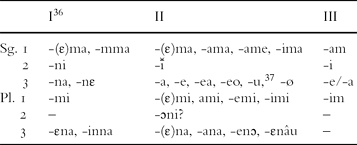
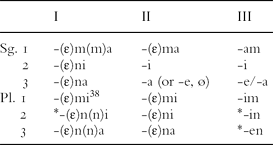
§3.4. Personal endings. Three sets of personal ending can be identified in Velātruyi, as shown in Tables 2 and 2a. Table 2 embraces all forms that occur in the texts, from which the idealised forms of Table 2a are deduced. Set I is used for the indicative present, II for the preterit and the imperfect and for the present of the substantive verbs (§3.6), and III for the subjunctive present.
Personal EndingsFootnote 35

Personal Endings (normalised)

§3.4.1. The imperative ending for the 2nd person singular is normally zero save for -i in bafɛsi “sleep!” and the irregular forms listed in §3.5.1. For “be”, see §3.6.
§3.4.2. As seen from Table 2, Sets I and II are identical for the 1st sg. and 3rd pl. (except one instance for each, where Set I is geminated) and the 1st pl. Otherwise, Set I = N + Set II, where N is the nasal /m/ or /n/. This attests to the fact that Velātruyi has consistently kept the nasal element (derived from the Old Iranian participle *-ant-) only in those personal endings which are free of nasals, that is the 2nd and 3rd sg. As for other person endings, which already possess an /m/ or /n/, the doubling of the nasal is optional. This trait is justified by the fact that the distinction between the present and the imperfect is already made by the distinct stems incorporated in them. Moreover, the inconsistent use of the nasal element in Velātruyi and some other Māzandarāni dialects supports the notion that it should be assumed as an integral part of Set I endings rather than a present indicative tense marker. The question is that if gemination is optional in Set I, then how are the endings for the 2nd and 3rd singular distinguished from their plural counterparts? Insufficient data makes it impossible to provide an answer, except the contrast between nɔr-na “he has not” and nɔr-ɛna “they have not”, which is inconclusive as the one and only example found in the texts. This contrast may indeed be related to the fact that the stem ends in /r/. Syncretism, where one form in a paradigm shares the ending of another form in the paradigm, may very well be the case here.
§3.4.3. The rules for Set I personal endings that govern the Maz. stems in /-r/ or nasalsFootnote 39 cannot be verified for Velātruyi on the grounds that the data is too limited (but see §3.9.1). The only stems in neither /-r/ nor nasals that have received a present indicative conjugation are eiš- “look”, ɛšnu- “listen”, and šu- “go” (see §3.5.2).
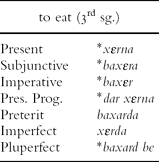
§3.5. Simple tenses. There are five basic forms, as formulated below, with examples in the following subsections. The dialect appears to lack the present perfect, as do many other Māzandarāni dialects.

§3.5.1. Imperative. hɔ-de-ø “give!” hɛ-niš-ø “sit down!” hɔ-r-ɛš-ø “look!” pɛ-r-ɛz-ø “get up!” bu-ø “say!” nu-ø “say not!” ba-fɛs-i, bafasdi “sleep!” bua “go!” (irr.), bero, bɔro, bɛru “come!” (irr.).
§3.5.2. Present indicative
1st sg.: dɔr-ma “I have”, nɔr-ma “I have not”, na-u-ma “I know not”, eiš-ɛma “I look”, ɛšnu-mma “I hear”, kɛn-ma “I do”, na-ta-ma “I cannot”, dara var-ma “I am carrying”.
2nd sg.: nɔr-ni “you have not”, ɛšnu-ni “you hear”, mīr-ni “you die”, ba-tan-ni “you can”
3rd sg.: dɔr-na “it has”, nɔr-na “has not”, ɛstɔ “is standing” (irr.?), gɛ-nɛ “she says”
1st pl.: šū-mi “we go”, xɛr-mi “we drink”.
3rd pl.: nɔr-ɛna “they have not”, na-kɛn-inna “they do not”. and possibly xarinna (VI.10).
§3.5.3. Present subjunctive
1st sg.: hɔ-kɔn-am “that I do”, peidɔ kɔn-am “that I find”, da-kɛn-am “that I put on”, ba-mīr-am “that I die”, ba-vīn-am “that I see”, be-yār-am “that I bring”, ba-fsɔn-a[m] “that I put them to sleep”.
2nd sg.: peidâ kɔn-i “that you find”, na-xɛr-i “that you eat not”.
3rd sg.: b-u-e “that she say”, hɔ-kɔn-a “that he does”, ba-vɛr-e “that he carries”, buare “that he goes”.
1st pl.: da-vɛn-im “that we bake”.
§3.5.4. Imperfect
3rd sg.: xɛrd-a “he would eat”, šīvaŋgo kɛrd-a “she would lament”, da-kɛrd-a “he would pour” (for presence of the preverb, see §3.2.2).
3rd pl.: xande kɛrd-ɛna “they would laugh”, čarx gīt-ɛna “they would go round”.
§3.5.5. Preterit
1st sg.: râh ba-deme (pres. or past?) “I set off”?, xabar ba-it-ɛma “I asked”, na-mɛrd-ama “I died not”, ben ɔit-ima “I fell down”?, xu bakatinima “I fell (not?) asleep”?, hɔ-kɛrd-ame “I did”, da-kɛrd-ɛma “I placed into”, perɛsi-ma “I got up”, ba-tarsī-ma (=ba-tarsi-ima) “I feared”, ba-xard-ɛma/-ama “I ate”.
2nd sg.: bâuɔšt-i “you milked”, nâuɔšt-i “you milked not”, yād ba-it-ī “you learned”, hɔ-kɛrd-i “you did”, ba-xard/xɛrd-i “you ate”.
3rd sg.: dɔšt-a/-e “it had”, hɔ-do “he gave”, b-imu/emu(-a) “he came”, be-fahmas-a “he realised”, ba-fɛt-a “he slept”, ba-it-a “he took”, hɔ-it-a “he took/bought”, gɔz gīt-a “he bit”, b-ūt-a/-e, buta “he said”, be-hɛšt-a “he put”, hɔ-kɛrd-a “he did”, bana kɛrd-a “he began to”, γɛrūb ba-kɛrd-a “it set”, tamāšâ ba-kɛrd-a “he watched”, peidâ na-kɛrd-a “he found not”, da-kɛrd-a “he poured”, vašno ve-kɛrd-a “he was hungry”, hɛ-ništ-a “he sat”, ba-rasi-a “it arrived”, ba-rūt-a “he sold”, bua(r)da/buɔrda “he went”, ba-vard-a “he carried”, ba-i-ya/-yu “he saw”, ba-xard-a “he ate”, aɔfto ba-zu-a “the sun rose”.
1st pl.: b-imu/īmū/īmu-mi, biɔmi, bimi “we came”, ba-fɛt-imi “we slept”,hɛ-gɛrɛs-imi “we returned”, sar ɛšt-ɛmi “we set free”, xu *ba-kɛt-ɛmi “we fell asleep”, bua(r)d-emi/-ami/-ɛmi “we went”, ba-i-mi “we saw”, ba-xɛrd-ami/-ɛmi/-emi “we ate”, bi-yɔrd-ɛmi “we brought”.
2nd pl.: da-vɔs-ɔni “you (pl.?) baked”.
3rd pl.: ba-it-ɛnɔ “they took”, banâ ba-it-ɛnâu “they began”, hɔ-kɛrd-ɛna “they did”, luxt/sɛvɔr ha-kɛrd-ana “they stripped/mounted [him]”, ba-pɛt-ɛna “they cooked”, bi-/be-yɔrd/urd-ɛna “they brought”, čaka bazana/ba-zu-na “they clapped”.
§3.6. Be and Become. The following stems occur in the material on hand.

(1) The copula is formed by suffixing Set II endings (which otherwise belong to the past stem) to nominals or to the stem has-, e.g. (has)-ama/-ɛma/-ema “I am”, (niy)-a “is (not)”, -ɛna “they are”. Therefore, -and “they are” (V.1) must be a mere Persianism. The past stem appears to be b- (in b-ama “I was”, b-e “it was”, b-ena “they were”). The form bebovi (V.13) is not identified. “Be” functions as the auxiliary verb in the pluperfect (see §3.7.1).
Verb Forms

(2) The existential verb has the present:past stems dar- ː da-. Similar to the copula, the present and past tenses share Set II endings. The occurrences are dar-a “it is there”, dar ni-a “is not in”, da “it was in”, and probably dav-e “id.” (I.1). This verb is used as an auxiliary in progressive tenses (see §3.7.2).
(3) “Become” has the past stem bav-, as in bav-e/-ea/-eo “it became”, nav-e “it did not become”, bav-enɔ “they became”. It is used in passive constructions: sīr bavea “he was satiated”.
§3.7. Periphrastic and progressive tenses
§3.7.1. The pluperfect is formed by the past participle (see §3.10.2) of the main verb followed by the past tense of “be”: ništ b-ama “I was sitting”, bafat b-ena “they had gone to bed”. No past subjunctive or pluperfect subjunctive occur in the texts.
§3.7.2. The only occurrence of the progressive formation is dar-a var-ma “I am carrying” and perhaps dar šumi “we are going”Footnote 40 (VI.2). Apparently, the existential verb (§3.6.2), functioning as the auxiliary, is fixed in the 3rd person singular, while the main verb conjugates.
§3.8. Modals. The only occurrences of the widely used Māzandarāni impersonal vénɛ and vésse “must, ought to” are veni pul-o hɔde (hɔdi?) “you must give the money” (V.8), xɔd-ɛš har kɛja vɛse buare “he himself must go somewhere” (IV.2). In view of the ambiguity of the latter sentence within the text the possibility of vɛse being a postposition should not be ruled out.Footnote 41
§3.9. Irregular verbs. (1) “Can” is irregular in that the present indicative takes the verbal prefix (ba-tan-ni “you (sg.) can”, ba-tan −am “I can”) and that the stem is reduced (na-tan −ma “I cannot”). — (2) “Have” takes no prefix dɔr-ma “I have”, dɔšt-a “it had”. See §1.9.2 on morphonology. — (3) Irregularity shows also in the only occurrence of “stand”: ɛstɔ “it is standing”.
§3.10. Verbal nouns. (1) The infinitive is the past stem plus -an, as in bazwan, i.e. ba-zu-an “to play”. — (2) The past participle (p.p.) is formed by the past stem optionally suffixed by -e or -a: ba-pɛt “cooked”, ba-tɛrk-e (ba-tɛrki-e?) “cracked”, dast-bas-e “hand-touched”, aɔfto-ba-zu-a “at sunrise”. p.p. is the invariable component of the pluperfect (§3.7.1). — (3) The present stem occurs in the compounds pɛlo(u)-paj “cook”, dɔru-zan “liar”, xamīr-kɔn (-kɔni, a gerund, as in Persian) “kneading”.
§.4. Word Formation. Peculiar endings are (1) -im in bɛn(n)īm “below, down” (from bɛn “id.,” bena “ground”), pɛštīm “above, up”,Footnote 42 (2) -da(r)ma in bɛndɛrma “ascent” (from bɛn “down”), sardama “descent” (from -sar “on”), (3) -ɛn in tīlɛn “muddy” (cf. Maz. til “mud”), (4) -sar in the toponym Darvunesar.
The Texts


Glossary
âfto, aɔfto sun (I.5,7)
aγūz walnut
alak sieve
-am (enclitic pron.) my (VI.12)
amɔ (pers. pron.) we (I.2,9, VI.13) — variant: ɔmɔ (I.3)
amrūz today (VI.1)
aŋgīs finger
asiyu water-mill
aš bear (< OIr. *arša- (*ŗša-), cf. Kd. hirč, Pers. xers)
azɔl wooden plough
balfϵr eyebrows
bamši cat
barɔr brother
bavɔ father
bϵhtar better (V.15)
bϵlϵsk tongs
ben, bϵn below, down (I.6, gloss.) — also bϵn(n)īm (gloss.)
bena ground (I.6)
bϵndϵrma ascent, ascending — cf. sardama
bϵŋj rice
bϵrma weeping, crying (< OIr. *bram-, cf. Pth. bram-, Gil., Zaza bram-)
bϵtīm stomach
bīlīl duck
bɔ (prep.) with (VI.13)
bɔhɔr spring
bɔl forearm
čaka clap (V.12)
čapϵr revolving, wheeling, flywheel? (čar(x) “wheel”+ par(ra) “paddle”) — cf. čεl
čarx-ϵ-tu (lit. spin and twist) wandering? (III.1) (cf. Pers. čarx o tāb)
če what (II.2, V.13) ‖harče whatever (III.1)
čϵl spinning-wheel: a wooden peg held in hand to spin wool on (Pers. čarxa)
čϵšma spring (I.7)
či *thing — hame či everything (V.1)
čœš eye
čɔšt one hour before mid-day
ču stick, wood?
čūγa instrument used in weaving
čun because (V.2)
čurbā donkey (cf. Pers. čārpā)
da village (I.10)
dāl kind of bird (eagle?) (cf. Pers. āl “eagle”)
dār, dɔr tree (< *dāru-)
darīja smoke-hole in the roof
darvāzi gate (I.1)
Darvunϵsar (toponym) Darbandsar (I.7)
darzϵn needle
dehkada village
dϵhɔz hatchet, axe
dela (adv.) inside (V.3)
-dϵla, -dela (postp.) in (III.1, IV.2–3., V.1–2,14)
dϵta, dϵtâ two (VI.13, V.11)
devɔre again (I.3)
dϵz thief ‖~i theft (IV.7)
dī smoke
dīfɔr wall
dīrgɔ (adv.) out (I.1, V.6, gloss.)
diyar other, anymore (V.9,13)
dīzϵnɔ tripod
dɔk(k)un, dukkun, dϵkkun shop (IV.1–2, V.1,8) ‖~-e-pīš market (V.1,12)
domūn, dɔmūn skirt (V.5,14)
dɔru lie (II.2)
duāj quilt
dūna rice
dunϵrīr yawn (cf. Pers. dahan-darra)
-dūr around (V.12)
-e, -ye  -i, -ra
ϵmšu tonight (VI.7)
ϵspi white
-ϵš (enclitic pron.) xɔd-
ϵšnɔfϵr sneeze
eti (in) this way (V.13) (cf. Pers. in-towr)
fahlgarī working for wages (< Pers. fa‛la-gari)
fϵk willow — cf. zardevi
fϵttammu loin-cloth worn in the bath (cf. Pers. futa-ye hammām)
fia wooden spade (cf. common Maz. xia)
gahm warm
gahra cradle (a general Maz. form of Pers. gahvāra)
galibϵni locket worn at the neck (< gali “*throat”+ bϵn “below” + suffix -i; but also cf. Pers. geribān, galu-band)
ganam wheat
gat big, large
ge that, which (IV.7, V.3,6–10,13–14, 16–17) — variant ke (1.1, passim)
gϵlīč kilim (cf. Pers. gelim)
gϵrdϵš wander (VI.8
gϵsan, gosan sheep (VI.5, gloss.)
gɔhn a thorny shrub (Pers. gavan)
gɔrϵs millet
gɔz tooth
gu cow
γabexʌna coffee-house (I.3) (< Pers. qahva-xāna)
Γalγɔle-čϵšma (toponym; lit. bubbling spring) (I.7)
γalvɔl sieve
γamtar bridle
hala now, yet (IV.8) (< Ar.-Pers. hālā)
ham also (V.15)
hamūm dried lamb skin (Pers. anbān)
har-vaxt any time (V.17)
hastϵkɔ bone
hϵči, h č(i) nothing (III.1,2, V.14- 15,17) — hīč-kas nobody (V.8)
heme firewood
hϵvϵ-hϵve (adv.) in large amounts (V.5) (< coll. Pers. havā-havā)
hūrϵs fir-tree (Pers. kāj)
-i, -e (ezāfa marker) (V.1,4,14–15, VI.12, V.13) — variant: -ye (V.2)
-i (oblique marker) (I.6, III.1, IV.2, V.1-2,11,14) — variant: -e (I.1,6, III.2, V.1) — see also man, tε, ve, šɔme
-i (indefinite marker) (IV.2, V.9,14)
i-dϵta (lit. one-two?) a couple (VI.13) — (cf. Pers. yek(i)-dotā)
īn (demonstrative pron.) this (III.2, IV.3, V. 8,15–17, VI.11) ‖accusative īnrâ (V.14)‖īnhɔ these (V.17)
īnj(a), īnjâ, injâ, ījϵ (adv.) here (I.4–6, VI.8–9, gloss.) — īnjϵhɔ round here (V.15)
-ja place — see īnja, unj, kɔja
jīf pocket
jīr underneath
-jɔ (postp.) form (IV.8)
juma shirt
kalan pickaxe
kalɔj crowFootnote 67
kamar mountain
Kamarxānī (toponym; lit. mountain-spring) (I.5)
kannīl beehive (cf. Pers. qandil “suspended lantern”)
kaša spoon (VI.13)
kaši girth (Pers. tong)
ke ge
kϵhϵr cough
kϵlgɔ hearth: open fireplace, with a raised mud-wall on three sides, for cooking (< *kεlε “hearth; fire under the ash”Footnote 68 + suffix -gāh “place”) — cf. Kopari klēn “ashes” < OIr. *kār, cf. Pers. zoγāl “coal” < OIr. *uz-kāra-
kϵlī key ‖~gūša keyhole (sic! for Pers. qofl) seems to have the Pers. present stem/participle gošāy “opener”, whose Maz. form is vεšā
kϵlo hat: a disc or ornament worn by women, especially Māzandarāni women, on their heads underneath the rūsarī (< Pers. kolāh)
Kϵrd/kϵrd Kurd, shepherd (V.1 ff.) — In the Caspian provinces kεrd or il “nomad, shepherd” stand in contradistinction with gēl “villager, farmer”.
kϵrg, kϵrk hen (II.1–4, V.1, VI.10)
kϵvi one-year old ewe
kījɔ girl (VI.9) (< *kijjā < *kēnjā <? OIr. *hanya-ča-)
kīla ditch, irrigation stream (Pers. juy/jub)
kɔisa bowl (IV.2–3)
kišt sleeve
kœčϵk carrion-kite (Pers. lāšxwor “vulture”)
kɔja where (VI.7) — har kϵja somewhere, anywhere (IV.2)
kɔlϵpar a desert plant
kɔlum stable
kūčila firewood
kūk partridge
kuɔ, ko where (IV.6, VI.4)
kūp reed matting (Pers. kup, hasir)
kūtϵr pigeon
lampo lamp (< Russian лампа)
laŋg leg
lavi pot (Pers. lavid, dig)
lɔk wooden bowl in which bread is kneaded
lūša lip (cf. Pers. lowča)
lūšū up, above
luxt naked (V.16)
man (pers. pron.) I (II.3, III.2, IV.8, V.7–8) variants: ma (I.6), mɔn (I.2)‖accusative mana (II.3)‖possessive m my (I.1, II.2, V.14, gloss.)
mard(i) man (III.2, IV.3, V.3,13,16, VI.13)
mardan people (V.12,17) — cf. EMaz. mardənum “people”)
marji lentil
māše tongs (Pers. māša, anbor)
mazϵnɔ price (II.3_ (< Ar.-Pers. mazanna)
mϵft(i), mɔfti free of charge (V.9,14–15)
mϵhle summer camp, village (I.8)
mϵhmun guest (VI.7) ‖mehmni banquet (V.3,8)
meil *desire — ~ dɔrma/nɔrεna I want/he wants not (V.17)
mϵzīr hired labourer, servant (cf. Pers. mozdur “mercenary”)
mi man
mī hair
Migūn (toponym) Meygun (I.6)
mīlak poker (Pers. mil + diminutive suffix -ak)
mīrkɔ bracelet (lit. “blue bid”; mīr < Pers. mohr(a) + kɔ, cf. Pers. kabud “(dark) blue”)
mīškâ sparrow
mɔčϵki she-mule (cf. pers. māča “female domestic animal”) — cf. narεki
mɔl front and behind? (I.4, gloss.) — de mɔl (demɔl? “following, behind”) (V.17)
mɔrγɔna egg
muɔr mother (VI.12)
nālϵje gutter
narϵki mule — cf. mɔčεki
niya not? (VI.5)
nɔ, no no (I.2, gloss.)
nɔhɔr lunch (I.5)
Nɔrmak (toponym) Nārmak
nūn, nun bread (IV.4–5, VI.1,2)
ohīl kind of bean
ɔmɔ amɔ
ɔrt flour
ɔš soup (VI.13)
pardi *bridge (beam): small sticks or pieces of wood laid in the ceiling at right angles to the larger beams
pϵlo(u), pϵlɔ, pɔlo pilaf, meal (V.1,4,6,9,14)
pero day after tomorrow
pϵštīm up, above
-pīč (postp.) in front of, before (I.1, gloss.) — variant: pīš (V.11)
pīlak water vessel
pīr(e)zan(ɔ) old woman (II.1–3) — cf. zanɔ
-pīš pīč
piyar father
pɔre, pɔri *partly — ye ~ some, partly (I.8)
pūlak button (Pers. pulak, dogma)
-ra (postp.) (V.6) — variants: -a (I.2, IV.4,5, V.10,11), -ϵ (II.4), -e (VI.10), -i (II.1), -o (V.8) — see also man, tε, ve
raxif friend (V.13) (< Ar.-Pers. rafiq)
rīkɔ boy
roxuna/e river
rūbâ/a fox (II.2–4)
rūšan bright (III.2)
rūz day (III.2)
-sar (postp.) at, on (I.1,6) — also in Darvunεsar
sardama descent, descending (Pers. sarāšib) — cf. bεndεrma
-sari (postp.) top (VI.13)
sϵb morning (I.10) (< Ar.-Pers. sobh)
sϵvɔr(i) mounted (V.10,15–16)
sɔjϵ broom for sweeping out a room
sɔz musical instrument, probably the tār (V.11,15)
sɔzϵnči musician (V.11)
suɔl forehead
šād maybe (II.3)
šāliki hand-loom
šī husband
šīvaŋg(o?) wail, lament (II.1, gloss.) (the ending /g/ is found in other Maz. dialects; < OIr. *xšaiwanaka-; cf. Pers. šēvan, Kd. šīn)
šɔl jackal (II.1–3)
šɔme (pers. pron., oblique) your (V.7)
š night (I.7, II.1, III.2) — nεsfe-~ midnight (III.1)
šum supper (I.9)
šūnak shoulder
ta (prep.) until (V.4)
talâ cock
taš fire
tašnɔ thirsty
tāvϵsūn summer
tϵ, te you (I.2, III.2, V.6, VI.6) ‖te your (V.9)‖accusative tϵra (V.13,16)‖ti-jɔ from you (IV.8)
tϵhϵn frying pan (Pers. nāva)
tϵrϵŋg pheasant
tīlϵn muddy (← tīl “mud” + suffix -εn < MWIr. -ēn)
tɔrik dark (III.2)
tu *twist čarx-ε-tu
tūr axe, hatchet
ū water
un (demonstrative pron.) that (V.16) — (adv.) ~-var-e to the other side of (VI.12)
unj (adv.) there (VI.9)
ūsāl halter (Pers. afsār)
vača child (V.14, gloss.) — also vači (V.5)
valk leaf
vara lamb
vārϵš rain
varf snow
vārūn rain
vašno/ɔ hungry (V.2, gloss.)
ve, vi (pers. pron.) he, she (IV.1, V.9) ‖ve he/his? (V.13), v his, her (II.2, V.12,13)‖accusative ver(a) (II.3, V.2,4,10), verrâ (II.1), verɔ (I.1), vϵro (V.6), vϵre (I.2, gloss.)
vϵni nose
veni (modal verb) must (V.8, gloss.) — See also §3.8.
vϵrk wolf
vϵse (modal verb) must (IV.2) — See also §3.8.
vīša wood, forest
vīšɔr awake (I.8, III.1, gloss.)
vīštar more
Vɔraŋgϵrū (toponym) (VI.3)
xalar beans (for Pers. bāqelā)
xϵ- (possessive/reflexive pron.) — xϵmi my (V.14,17), xaši, xeši, xϵši his (IV.1,2, V.5,10, gloss.)
xϵna, xana, xʌna house (VI.12–13, gloss.)
xϵrjīn sack (I.3)
xϵš pleasant (V.2)
xeili very (IV.8, V.2,12–13)
xī pig
xɔd- self — ~-εš himself (IV.2)
xɔxϵr sister
xū sleep (I.1,6) — cf. verb stem fεs-
ya(k), ye one (passim)
zanɔ woman — see also pīr(e)zan(ɔ)
zardevi kind of willow tree (lit. yellow willow) (Pers. zard-bid) — fεk
zϵmϵsūn winter
zϵnni knee
Verbs
bav- become — bav-e it became (I.7,10), bav-ea he became, he has become? (III.1, V.4), bav-eo id. (V.6), nav-e it became not (I.3), jam bav-enɔ they gathered (V.12) — See also §3.6.3.
dar- ː da- be in — dar-a it is there (I.3, IV.3, gloss.), dar ni-a is not there (IV.6, gloss.); da it/he was in (I.1, IV.1) — See §3.6.2., and §3.7.2 for the position of this verb as auxiliary in the progressive formation.
de- ː do- aux. — râh ba-de-me (pres. or past?) I set off? (I.4)‖hɔ-~ give — hɔ/ho-de give! (II.3, V.6,8, gloss.); hɔ-do he gave (II.3)
dɔr- ː dɔšt- have — dɔr-ma I have (II.4, V.17, VI.7), nɔr-ma I have not (V.7,8), nɔr-ni you (sg.) have not (I.2), dɔr-na it has (II.2), nɔr-na has not (II.2, V.9,17), nɔr-ɛna they don't have (V.17); dɔšt-a it had (II.1), dšt-a id. (I.1), dɔšt-e id., it has had? (II.1) — See also §3.9.2.
*dun- know — na-un-ma I know not (VI.7)
*duɔš- ː -uɔšt- milk — bâuɔšt-i you milked (VI.5), nâuɔšt-i you milked not (VI.5)
e- ː imu- come — bero, bɔro come! (V.3, VI.3) bɛru id. (gloss.); b-imu-(a) he came (I.2, IV.6,7, V.2,3,6), b-emu-(a) id. (II.1, VI.8), b-m-mi we came (I.1–2,5–10), biɔmi id. (I.1), bimi id. (I.5)
e(i)š- ‖hɔ-~ look — hɔrɛš look! (gloss.); eiš-ɛma I look (V.17)
ɛstɔ- stand — ɛstɔ is standing (VI.6) — Cf. hɛrɛs-, pɛrɛz-
ɛšnu- hear, know — ɛšnu-mma I hear (V.15), ɛšnu-ni you (sg.) know (II.2)
fahm- ː fahmas- understand — be-fahmas-a he realised (V.9)
fɛs- ː fɛt- sleep — ba-fɛs-i, bafasdi sleep! (gloss.); bafat bena (pluperfect) they had slept (I.8), ba-fɛt-a he slept (IV.5), ba-fɛt-imi we slept (I.9)
fɛsɔn- put to sleep — ba-fsɔn-a[m] that I put them to sleep (VI.7),
gɛ-/-u- ː -ūt- say — bu say! (gloss.) nu say not! (V.14), gɛ-nɛ she says (II.2), b-u-e that she say (II.3); b-ūt-a he said (II.2–4, II.2, IV.3,7, V.6,8–9,13–14,16–17), būte id. (I.2, V.7,10), buta id. (V.3)
*gɛr-: gɛrɛs- *turn‖hɛ-~ return — hɛ-gɛrɛs-imi we returned (I.3)
*gir- ː -it- seize (and aux.) — xabar ba-it-ɛma I asked (I.2), yād ba-it-ī you learned (VI.6), ba-it-a he took (IV.4), xabar baita he asked (IV.6), gɔz gīt-a he bit (II.4), ba-it-ɛnɔ they took (V.11), banâ ba-it-ɛnâu they began (V.11), čarx gīt-ɛna they would go round (V.12)‖hɔ-~ seize, buy (and aux.) — hɔ-it-a he seized (II.1), he bought (IV.2,4), ben hɔ-it-ima I fell down? (I.6)
(has)- ː b- be — has-ama I am (V.15), -ɛma id. (IV.8), -ema id. (V.7), -a is (II.2, V.8,14,16), ni-y-a is not (V.15,17), -ɛna they are (V.17), -and they are (V.1); ništ b-ama (pluperfect) I was sitting (I.6), b-e it was (I.11), vīšɔr b-ena they were awake (I.8), bafat bena (pluperfect) they had gone to bed (I.8); bebovi he would have been? had been? (V.13) — See also §3.6.
hɛrɛs- stand up — hɛrɛso he stood (V.2) — cf. ɛstɔ-, pɛrɛz-
(h)ɛšt- put — be-hɛšt-a he put (IV.2), sar ɛšt-ɛmi we set free (I.1)
kat- fall — xu *ba-kɛt-ɛmi we fell asleep (I.1), xu bakatinima I fell asleep? (I.6)Footnote 69
kɔn- ː kɛrd- ‖(hɔ-)~ do (or aux.) — xamīr-kɔn (cf. Pers. -koni) kneading (VI.6), kɛn-ma I do (V.15), hɔ-kɔn-am that I do (II.3, VI.11), peidɔ kɔn-am that I find (III.2), peidâ kɔn-i that you find (III.2), hɔ-kɔn-a that he do (VI.8); na-kɛn-inna they do not (V.8); hɔ-kɛrd-ame I did (V.7), hɔ-kɛrd-i you did (V.13), hɔ-kɛrd-a he did (II.4, IV.7, V.13), bana kɛrd-a he began to (V.2,4), γɛrūb ba-kɛrd-a it (= the sun) set (I.7), tamāšâ ba-kɛrd-a he watched (V.2), peidâ na-kɛrd-a he found not (III.1), hɔ-kɛrd-ɛna they did (V.13,16), luxt hakɛrd-ana they stripped [him] (V.10), sɛvɔr ha-/hɔ-kɛrd-ana they mounted [him] (V.10,16); šīvaŋgo kɛrda (šīvaŋg hokɛrda?) she would lament (II.1), xande kɛrd-ɛna they would laugh (V.12)‖da-~ put on; pour — da-kɛn-am that I put on (shoes) (VI.4); da-kɛrd-ɛma I placed into (V.14), da-kɛrd-a he would pour (V.5)‖ve-~ (aux.) — vašno ve-kɛrd-a he was hungry (V.2)
mīr- ː mɛrd- die — mīr-ni you (sg.) die (IV.3), ba-mīr-am that I die (IV.8); na-mɛrd-ama I died not (IV.8)
niš- ː ništ- ‖hɛ-~ sit — hɛ-nš sit down! (V.3, gloss.), hɛ-ništ-a he sat (V.3), ništ bama (pluperfect) I was sitting (I.6)
paj- ː pɛt- cook — pɛlo(u)-paj (pres. part.) cook (V.3,6,9), pɛlou-paz-i (Pers. form) restaurant (V.1); ba-pɛt (p. p.) cooked (V.1, gloss.), ba-pɛt-ɛna they cooked (VI.13)
pɛrɛz- ː perɛsi- stand — pɛrɛz get up! (gloss.), perɛsi-ma I got up (I.7). Cf. ɛstɔ-, hɛrɛs-
ras- ː rasi- arrive, reach — ba-rasi-a it arrived (II.2, V.1,13)
rūt- sell — ba-rūt-a he sold (IV.4, VI.10) — note Pers. loan pɛlou-fɛrūši restaurant (V.7)
šu-, buar- ː bua(r)d- go — bua go! (gloss.); buare that he go (IV.2); šū-mi we go (VI.3), dar šu-mi we are going (VI.2); buard-a he went (V.13, VI.12), buɔrda id. (V.1), buarda id. (III.1, IV.3,4), buard-emi/-ami we went (I.19, VI.13), buard-ɛmi id. (I.3) — See also §3.1.3.
tan- can — ba-tan−am I can (VI.11), na-tan−ma I cannot (III.2), ba-tan-ni you (sg.) can (III.2) — See also §3.9.1.
tars- ː tarsi- fear — ba-tarsī-ma (or ba-tarsi-ima) I feared (IV.8)
tɛrk- ː *tɛrki- crack— ba-tɛrk[i]-e (p. p.) cracked (gloss.)
var- ː vard- carry — dara var-ma I am carrying (V.14), ba-vɛr-e that he carry (V.5); ba-vard-a he carried (II.1, IV.7)
vɛn- ː vɔs- ‖da-~ bake — da-vɛn-im that we bake (VI.2); da-vɔs-ɔni you (pl.?) baked (VI.1)
vīn- ː d (?)i- see — ba-vīn-am that I see (V.17); ba-i-ya he saw (V.1), ba-i-yu id. (IV.6), ba-i-mi we saw (I.3)
*xar- ː xari-? xarin-? buy — xarinna (VI.10) can be scanned as xar-inna “they buy”, xari(n)-na “they would buy”, xarinn-a “he would buy”
xɛr- ː xɛrd- eat, drink — xɛr-mi we are drinking (I.10); na-xɛr-i that you eat not (V.9); xɛrd-a he would eat (V.5); ba-xard-ɛma/-ama I ate (IV.8, V.14), ba-xard-i you ate (IV.3), ba-xɛrd-i id. (V.6), ba-xard-a he ate (V.4), ba-xɛrd-ami/-ɛmi/-emi we ate (I.4–6,9, VI.13)
yār- ː (y)ɔrd-Footnote 70 bring — be-yār-am that I bring (V.9); bi-yɔrd-ɛmi we brought (I.4), bi-yɔrd-ɛna they brought (V.10), be-yɔrd-ɛna id. (V.11), biurd-ɛna id. (V.4)
zan- ː zu- hit (aux.) — dɔru-zan (pres. part.) liar (II.2); aɔfto ba-zu-a the sun rose (or) aɔfto-bazua (p. p.) at sunrise (I.5); čaka bazana/ba-zu-na they clapped (V.12); bazwan = ba-zu-an to play (music) (V.11) — note also dast-base (bazue?) (p. p.) hand-touched (I.3)
GACHSARI
Gachsar (or Gachesar) is a central Alborz village at an altitude of 2,210 m, situated at 110 km northwest of Tehran and 7 km south of the Kandovān Tunnel on the highway to the Caspian coast. Its population of thirty families as recorded by Lambton probably remained unchanged half a century later, i.e. 166 souls according to the 1986 census.Footnote 71 The village's farmlands are on both sides of the Tehran-Chālus highway and are irrigated by the Karaj River. Gachsar owes its name to a nearby gypsum mine.
Of the Gachsari dialect Lambton documented one text, seventy words in length, in addition to a handful of words in her glossary; these are reproduced below after a sketch grammar. The following analysis of the text revels that Gachsari is syntactically Persian with a basic Māzandarāni vocabulary and a mixed verb conjugation, chiefly Mazandarani in the past forms.
§G1. The basic vocabulary is essentially Māzandarāni, e.g. ve/vi “it”, šo “night”, mīšgɔ “sparrow”, kalla “hearth”, tɛk “lip”, vāzī “game”, and juar “above” (not attested in other dialects documented by Lambton), but note Pers. šaγāl “jackal”. Notable is bāmšī “cat”, a Maz. word that delineates Gachsari from Tāleqāni and Kalārdashti, both of which use pičā.Footnote 72 On the other hand, yāl “child” is an idiosyncratic isogloss that unites Gachsar and adjoining hamlets with those of the Rudbār-e Qasrān. Gachsari verb stems are Māzandarāni, especially perɛs- “stand”, niš- “sit”, and xɔs- “sleep”, while gu- ː gut- “say” and kɔn- ː kɔrd- “do” are shared with both Persian and Māzandarāni.Footnote 73
§G2. Syntax. (1) The indefinite marker is -i: pīrezan-i “an old woman”, rather than Maz. *əttə pīrezan. (2) The accusative marker (from Pers. -rā) is found in kɛrg-e bit “it took the hen” but not in kɛrg bīta “id.,” kɛrg hāde “give [me] the hen!” kɛrk. . . hāda “it gave the hen [to. . .]”.Footnote 74 (3) Persian ezāfa construction and enclitic pronouns seem to be the norm: kɛrg-e vi = kɛrg-ɛš (cf. Vel. vi kɛrk) “her hen”. (4) Postpositions, characteristic of Māzandarāni, are non-existent in this short text. (5) The only preposition attested is used as in Persian: be ve hāda (cf. Vel. hɔdo vera) “he gave [it] to him”.
§G3. Verbs. (1) The past stem marker is the common Maz. -i: ras- ː rasi- “reach”. (2) The only preverb attested is hā-, in hāde “give!” hāda “it gave”, but not with the stems kɔn- ː kɔrd- “do” and niš- “sit”.Footnote 75 — (3) The present indicative endings are Persian: dār-am (cf. Vel. dɔr-ma) “I have”, ø-ɔišnav-i (cf. Vel. ɛšnu-ni) “you know”. We may conclude, therefore, that Gachsari has lost in its present forms the nasal element (from OIr. *-ant-), an outstanding feature of Māzandarāni. The form mikɔnam “that I do” (sic!) can be neither present indicative nor subjunctive (see below). It remains unclear whether the present 2nd and 3rd sg. (and pl.) merge as they do in Kalārdashti. — (4) The preterit forms are largely Māzandarāni: ba-g t-a “he said”, ba-rasi-a “it reached”, ba-kɔrd-a/bɔkɛrda “it did”, b-īt-a/bete “it seized”. However, we find zero ending in bit “it seized”, dāšt “she had”, and hā-da (hā-da-a?) “it gave”, and the 3rd sg. Persian ending in dār-ɛd “it has”. — (5) The only occurrence of the present subjunctive is be-gu-a “that she says”. — (6) All imperative forms are with zero ending except perɛsi “get up!” But this might be a plural form. — (7) No imperfect form is attested. — (8) The only example of the substantive verb is -a “is”.
The Text

Glossary
āsīn sleeve
bāmšī cat
bɛrɔr brother
čandi how much (2)
dɛndun tooth (1)
dīfār wall
dɔrūzan liar (2)
-e (accusative marker < Pers. -rā) (4)
-e (ezāfa marker) (1)
gɛsan sheep
hīmɛ wood, firewood?
jāri husband's brother's wife
juar above, up
kalla hearth
kɛrg/kɛrk hen (1–5)
man (pers. pron.) *I, me (3)
mīšgɔ sparrow
rūbah/rūbāh/rūbâh fox (2–4)
šaγāl/šɔγāl jackal (1–3)
šāyada perhaps (3)
šo night
tandi oven
tɛhɛr frying pan
tɛk lip
vāzī game, playing
vɛlat lamb
ve/vi it (1,3)
ya(k) one (2,4)
yāl child
yaxdun box
zɔndi knee
dār- ː dāšt- have (and aux.) — dār-am I have (4), (na-)dār-ɛd it has (not) (1–2); dāšt she had (1)
de- ː da- ‖hā-~ give — hā-de give! (3); hā-da it gave (3)
gu- ː gut- say — bo say! (gloss.); be-gu-a that she say (3); ba-gt-a he said (2–4)
-it- seize — bete it seized (1), bit id. (4), bīta id./has seized? (1)
kɔn- ː kɔrd- *do (aux.) — mi-kɔn-am (sic!) that I do (3); ba-kɔrd-a it did (1), bɔkɛrda id. (4)
niš- sit — ba-niš sit! (gloss.)
ɔišnav- (hā- preverb?) know, *hear — ɔišnav-i you know (2)
perɛs- stand — perɛsi get up! (2nd pl.?) (gloss.)
ras- ː rasi- reach — ba-rasi-a it reached (2)
xɔs- sleep — ba-xɔs sleep! (gloss.)
OTHER DIALECTS
Aside from Velātru and Gachsar, Lambton includes in her glossary some words from the neighbouring Kopar, Margevālis, Nesār, Shāhpol, and Vārangarud and from Nesen, located north across a mountain range in the Māzandarāni district of Nur. See also above, under Typology. Notwithstanding the scanty nature of the data, it remains unique, for no more has been published on these idioms to date.
As seen from the glossaries below, these dialects share much of their vocabulary with Velātruyi and Gachsari. The preverb hā-/hɛ-, used in most dialects, and the verb stems are Caspian, even if in Nsn. the stem dɔr-, in nadɔrma “I have not”, has uncharacteristically retained its initial consonant. Interesting is the present stem kɛr- “do” (in Vrg. lɔkɛran “scraper”), found also in other compound words in other Maz. dialects, such as taš-kar “one who makes fire [for the oven]”, vačɛ-kar “one who does [bear] a child”.Footnote 76 Otherwise, the present stem of “do” is Maz. kən- (general), cf. Velātruyi kɔn-.
The syntax remains obscure without texts. The verb forms in the glossary are mostly imperative, which is not distinctive so far as the provenance of the dialects is concerned. Other conjugations are Nsn. nadɔrma “I have not”Footnote 77, Shp. babarda “he took”, both morphologically Māzandarāni. So are the past participles: Kpr. ništa “sat”, pɛta “cooked”, Shp. hɔita “taken”.
Glossary
Kopari
ata one
bɔmši cat
čīnɛkɔ chicken
čuɛ cold
dāj quilt
de two
dīm face
gɛsan sheep
gɔhra cradle
hɛma wood, firewood?
jinɔr harvest (for Pers. xerman)
kalla up, above
kalɛ hearth — see Velāt. kɛlgɔ
kân dark blue (Pers. kabud)
katɔr chin
kɔ: game, playing
kīš stitch in knitting
klēn ashes
lu on, upon (cf. Pers. lab)
maja veil (< Ar.-Pers. me‛jar?)Footnote 78
palvar rafter in the roof
pehro day after tomorrow
sanɛx wooden partition in a room (cf. Pers. sanduq “box”)
siyu black
sɔl forehead
talâ-kɛlɔ chicken
taniyo alone
varda quailFootnote 79
varzā ox
vɔrna rain
vɔšūn (pers. pron.) they
*niš- ː ništ- sit — ništ-a (p. p.) sat
pɛč- ː pɛt- cook — ba-pɛč-a cook! pɛt-a (p. p.) cooked
vīn- see — ba-vīn see!
zan- *hit (aux.) — do bazan run!
Margevālisi
bāmšī cat
kɛlu stable
tuar axe, hatchet
yāl child
de- ‖hā-~ give — hā-de give!
-ir- ‖hɔ-~ seize — hɔ-ir take!
niš- sit — ba-niš sit down!
Nesāri
āhīl kind of bean
bāl *arm bāl-mīrka
bāl-mīrka bracelet — see Velāt. mīrkɔ
bɛrɔr brother
čal-dik spinning-wheel — see Velāt. čɛl
dik *spindle čal-dik
gandɔm makɛ maize
gɔrz straw used as fodder for sheep
hamrū wild pear
joz walnut
kānūn straw (for Pers. kāh)
kɛlɛr hearth — see Velāt. kɛlgɔ
kɔmah straw used as fodder for sheep
lovak, lāk wooden bowl in which bread is kneaded
lūtɛ tarantula (for Pers. roteyl)
mār mother
*mī cloud mīvāre
mīrka *bead bāl-mīrka
mīvāre precipitationFootnote 80 (← *mī “cloud” + *vāreš “rain”)
piyar father
sāje broom
sīf apple
ši-mār husband's mother
ši-piyar husband's father
šiyar husband
tandīr oven
yāl child
-ɛz- stand — pā bɛz get up!
niš- sit — ba-niš sit down!
rij- pour — ba-rij pour out!
Neseni
doāj quilt
go cow
kɛlɔr hat — see Velāt. kɛlo
kɔlɔm stable
lūše stable
madzi (maji?) lentil
māša tongs
mɔrsak copper vessel for water (←mɔrs “*copper” + diminutive suffix -ak)
o water
rīkɔ boy
tanūre funnel used to draw up the fire in a brazier or samovar
tɔr power, strength (Pers. tir, qovvat)
ūjɛ there
dɔr- have — na-dɔr-ma I have not
*e- come — bɛr come! (irr.)
-ir- seize — ba-ir take!
niš- ‖hɛ-~ sit — hɛ-niš sit down!
pɛrɔz- stand — pɛrɔz get up!
vin- see — be-vin see!
Shāhpoli
dɛtar daughter
gal throat
γalvāš sieve
γɔram elbow
γuzɛxīš kind of insect
kalvɛni locket worn at the neck
kârtanak, kartanak spider
kɔlū stable
kɔpak dog
kūčila firewood
mɛjīle ant
mīšgɔ sparrow
tuar axe, hatchet
yāl child
bard- carry — ba-bard-a he took
-it- ‖hɔ-~ seize — hɔ-it-a (p.p.) taken
Vārangarudi
čɛl-dīk spinning-wheel — see Velāt. čɛl
doāj quilt
gosant sheep
hīmɛ (fire)wood
kūš shoe
lɔkɛran scraper used to move dough off the sides of the bowl in which it is kneaded (← *lɔ “residual” + pres. stem kɛr- + suffix -an)
loše lip
lɛŋg leg
lɛŋg-e-panje foot
nar-tɔkɔli young ram (for Pers. nar-barra)
talār stable
tandīr oven
tɛšnɔi thirsty (thirst?)
varda quail — cf. Kop. varda
vašnɔi hungry (hunger?)
xɔxɛ sister
hɛrɛs- stand — hɛrɛs get up!
*ker- do lɔkɛran
English-DialectsFootnote 81
above lūšū; pεštīm; Gch. juar; Kpr. kalla
again devɔre
alone Kpr. taniyo
also ham
ant Shp. mεjīle
apple Nsr. sīf
arm Nsr. bāl — cf. forearm
around -dūr
arrive ras- ː rasi-
ascent bεndεrma
ashes Kpr. klēn
at -sar
awake vīšɔr
axe dεhɔz; tūr, Mrg., Shp. tuar
bake da-vεn- ː vɔs-
banquet mehm ni
be (has)- ː b-
be in dar- ː da-
beans (kind of) xalar; ohīl, Nsr. āhīl
bear aš
because čun
become bav-
beehive kannīl
below ben/bεn, bεn(n)īm
better bεhtar
big gat
black Kpr. siyu
blue Kpr. kân
bone hastεkɔ
bowl kɔisa; lɔk, Nsr. lovak/lāk
box Gch. yaxdun
boy rīkɔ, Nsn. rīkɔ
bracelet mīrkɔ, Nsr. bāl-mīrka
bread nūn/nun
bridge-beam rafter
bridle γamtar; halter
bright rūšan
bring yār- ː (y)ɔrd-
broom sɔjε, Nsr. sāje
brother barɔr, Gch., Nsr. bεrɔr
brow balfεr
button pūlak
buy xar- ː xari-? xarin-?; hɔ-*gir- ː (g)it-
camp mεhle
can tan-
carrion kite kœčεk
carry var- ː vard-; Shp. bard-
cat bamši, Gch. bāmšī, Kpr. bɔmši
chicken Kpr. čīnεkɔ; Kpr. talâ-kεlɔ
child vača; Gch., Mrg., Nsr., Shp. yāl
chin Kpr. katɔr
clap čaka
cock talâ
coffee house γabexʌna
cold Kpr. čuε
come e- ː imu-; Nsn. *e-
cook paj- ː pεt-; Kop. pεč- ː pεt-
copper vessel Nsn. mɔrsak
corn maize
cough kεhεr
cow gu, Nsn. go
crack tεrk- ː *tεrki-
cradle gahra, Kpr. gɔhra
crow kalɔj
dark tɔrik
daughter Shp. dεtar
day rūz
day after tomorrow pero, Kpr. pehro
descent sardama
die mīr- ː mεrd-
ditch kīla
do (hɔ-)kɔn- ː kεrd-; Gch. kɔn- ː kɔrd-
dog Shp. kɔpak
donkey čurbā
down ben/bεn/bεn(n)īm
duck bīlīl
eagle? dāl
eat xεr- ː xεrd-
egg mɔrγɔna
elbow Shp. γɔram
ewe (young) kεvi
eye čœš
face Kpr. dīm
fall kat-
father bavɔ; piyar, Nsr. piyar
father-in-law Nsr. ši-piyar
fear tars- ː tarsi-
finger aŋgīs
fire taš
firewood kūčila; heme; Shp. kūčila; Gch., Vrg. hīmε, Kpr. hεma
fir-tree hūrεs
foot Vrg. lεŋge-panje
forearm bɔl — cf. arm
forehead suɔl, Kpr. sɔl
forest vīša
form -jɔ
fox rūbâ/a, Gch. rūbah/rūbāh/rūbâh
free of charge mεft(i)/mɔfti
friend raxif
front -pīč
funnel (on fire) Nsn. tanūre
game Gch. vāzī; Kpr. kɔ:
girl kījɔ
girth kaši
give hɔ-de- ː do-; Gch. hā-de- ː da-; Mrg. hā-de-
go šu-, buar- ː bua(r)d-
ground bena
guest mεhmun
gutter nālεje
hair mī
halter ūsāl
harvest Kpr. jinɔr
hat kεlo, Nsn. kεlɔr
have dɔr- ː dɔšt-; Gch. dār- ː dāšt; Nsn. dɔr-
he ve/vi
hear εšnu-; Gch. ɔišnav-
hearth kεlgɔ, Gch. kalla, Kpr. kalε, Nsr. kεlεr
hen kεrg/kεrk, Gch. kεrg/kεrk
here īnj(a)/īnjâ/injâ/ījε
his vī; xaši/xeši/xεši
hit zan- ː zu-; Kop. zan-
hive beehive
house xεna/xana/xʌna
how much Gch. čandi
hungry vašno/ɔ, Vrg. vašnɔi
husband šī, Nsr. šiyar
I ma(n)/mɔn, Gch. man
in -dεla/-dela; dela
insect (kind of) Shp. γuzεxīš
it Gch. ve/vi
jackal šɔl, Gch. šaγāl/šɔγāl
key kεlī
keyhole kεlīgūša
kilim gεlīč
knee zεnni, Gch. zɔndi
know *dun-; εšnu-; Gch. ɔišnav-
labour fahlgarī
labourer mεzīr
lamb vara, Gch. vεlat
lament šīvaŋg
lamp lampo
leaf valk
leg laŋg, Vrg. lεŋg
lentil marji, Nsn. madzi (maji?)
liar Gch. dɔrūzan
lie dɔru
lip lūša, Vrg. loše; Gch. tεk
locket galibεni, Shp. kalvεni
loincloth fεttammu
look hɔ-r-eš-/-eiš-
loom šāliki
lunch nɔhɔr
maize Nsr. gandɔm makε
man mard(i)
marketplace dεkkun-e-pīš
maybe šād
milk *duɔš- ː -uɔšt-
mill asiyu
millet gɔrεs
more vīštar
morning sεb
mother muɔr, Nsr. mār
mother-in-law Nsr. ši-mār
mountain kamar
mounted sεvɔr(i)
muddy tīlεn
mule narεki (m.), mɔčεki (f.)
musician sɔzεnči
must veni, vεse
my m , xεmi
naked luxt
necklace locket
needle darzεn
night š , Gch. šo
no nɔ/no
noon (before) čɔšt
nose vεni
not niya
nothing hεči/hiči/hīč(i)
now hala
old woman pīr(e)zan(ɔ)
on -sar; Kpr. lu
one ya(k)/ye, Gch. ya(k); Kpr. ata
other diyar
out dīrgɔ
oven Gch. tandi, Nsr., Vrg. tandīr
ox Kpr. varzā
pan tεhεn, Gch. tεhεr
partition in a room Kpr. sanεx
partridge kūk
pear Nsr. hamrū
people mardan
perhaps Gch. šāyada
pheasant tεrεŋg
pickaxe kalan
pig xī
pigeon kūtεr
pilaf pεlo(u)/pεlɔ/pɔlo
place -ja
plant (kind of) kɔlεpar
pleasant xεš
plough azɔl
pocket jīf
poker mīlak
pot lavi
pour da-kɔn- ː kεrd-; Nsr. rij-
precipitation Nsr. mīvāre
price mazεnɔ
purlin rafter
put (h)εšt-
put on (shoes) da-kɔn- ː kεrd-
quail Kpr., Vrg. varda
quickly hεvε-hεve
quilt duāj, Kpr. dāj, Nsn., Vrg. doāj
rafter pardi, Kpr. palvar
rain vārūn, vārεš, Kpr. vɔrna; precipitation
ram (young) Vrg. nar-tɔkɔli
reach ras- ː rasi-; Gch. ras- ː rasi-
reed matting kūp
return hε-*gεr-ː gεrεs-
revolving čapεr
rice bεŋj; dūna
river roxuna/e
sack hamūm; xεrjīn
say gε-/-u- ː -ūt-; Gch. gu- ː gut-
scraper Vrg. lɔkεran
see vīn- ː i-; Kop. vīn-; Nsn. vin-
seize (hɔ-)*gir- ː (g)it-; Gch. -it-; Mrg. hɔ-ir-; Nsn. -ir-; Shp. hɔ-it-
self xɔd-
sell rūt-
sheep gεsan/gosan, Gch., Kpr. gεsan, Vrg. gosant; ewe, ram, lamb
shepherd kεrd
shirt juma
shoe Vrg. kūš
shop dɔk(k)un/dukkun/dεkkun
shoulder šūnak
shrub (a kind) gɔh n
sieve alak; γalvɔl, Shp. γalvāš
sister xɔxεr, Vrg. xɔxε
sister-in-law Gch. jāri
sit hε-niš- ː ništ-; Gch. niš-; Kop. *niš- ː ništ-; Mrg. niš-; Nsr. niš-; Nsn. hε-niš-
skirt domūn/dɔmūn
sleep fεs- ː fεt- (intrans.); f εsɔn- (transitive); Gch. xɔs-
sleep xū
sleeve kišt; Gch. āsīn
smoke dī
smokehole darīja
sneeze εšnɔfεr
snow varf
soup ɔš
spade fia
sparrow mīškâ, Gch., Shp. mīšgɔ
spider Shp. kârtanak/kartanak
spindle Nsr. dik
spinning wheel čεl, Nsr. čal-dik, Vrg. čεl-dīk
spoon kaša
spring bɔhɔr
spring čεšma
stable kɔlum, Mrg. kεlu, Nsn. kɔlɔm, Shp. kɔlū; Nsn. lūše; Vrg. talār
stand εstɔ-; hεrεs-; pεrεz- ː perεsi-; Gch. perεs-; Nsr. pā εz-; Nsn. pεrɔz-; Vrg. hεrεs-
stitch Kpr. kīš
stomach bεtīm
straw Nsr. gɔrz; kɔmah; kānūn
strength Nsn. tɔr
summer tāvεsūn
sun âfto/aɔfto
supper šum
tarantula Nsr. lūtε
that un
theft dεzi
there unj, Nsn. ūjε
these īnhɔ
they Kpr. vɔšūn
thief dεz
thirsty tašnɔ, Vrg. tεšnɔi
this īn
this way eti
throat Shp. gal
today amrūz
tongs bεlεsk; māše, Nsn. māša
tonight εmšu
tooth gɔz, Gch. dεndun
top -sari
tree dɔr/dār
tripod dīzεnɔ
turn *gεr-ː gεrεs-
twist tu
two dεta/dεtâ, Kpr. de
under jīr
understand fahm- ː fahmas-
until ta
up lūšū; Gch. juar; pεštīm; Kpr. kalla
veil Kpr. maja
very xeili
vessel pīlak
village da, dehkada; mεhle
vulture carrion-kite
wall dīfɔr, Gch. dīfār
walnut aγūz, Nsr. joz
wander gεrdεš
warm gahm
water ū, Nsn. o
we amɔ/ɔmɔ
weeping bεrma
what če
wheat ganam
where kuɔ/ko, kεja/kɔja
which ge/ke
white εspi
willow fεk; zardevi
winter zεmεsūn
with bɔ
wolf vεrk
woman zanɔ
wood ču
yawn dunεrīr
you tε/te
your te; šɔme
Abbreviations
aux. = auxiliary
Gch. = Gachsari
gloss. = Lambton's “Vocabulary”
Ir. = Iranian
Kpr. = Kopari
Maz. = Māzandarāni
MP = Middle Persian
Mrg. = Margevālisi
MWIr. = Middle West Iranian
NP = classical New Persian
Nsn. = Neseni
Nsr. = Nesāri
OIr. = Old Iranian
OP = Old Persian
p. p. = past participle
Pers. = modern Persian
pl. = plural
postp. = postposition
prep. = preposition
pron. = pronoun
Pth. = Parthian
sg. = singular
Shp. = Shāhpoli
Vel. = Velātruyi
Vrg. = Vārangarudi
> = diachronic change
→ = synchronic change/borrowing
= see