By the late 1920s, Fred A. Moss, a professor of psychology at George Washington University, had formed a theory that unhealthy vibrations in automobiles were causing fatigue in drivers and passengers. To test his theory, he drove test subjects on circuitous routes around Washington, DC. He drove some for three hundred miles over smooth roads, others he drove for one hundred and fifty over rough, unfinished country roads. When the route was complete, he brought the test subjects back to his laboratory and ran tests on them. In the course of his research on riding fatigue, Moss increasingly focused on the correlation between fatigue and a lack of bodily stability. Moss believed stability, or the lack thereof, could act as a proxy for fatigue. The question then was how to measure stability, but Moss had a tool just for this task. When the test subjects entered his lab, he had them stand on the Wabble-Meter, a device designed by a scientist at the National Bureau of Standards (Figure 1). The Wabble-Meter measured how steadily subjects could hold themselves as they stood on the board; it recorded curves of stability and instability on paper tape. Over a dozen companies, including the Chrysler Corporation, the Firestone Tire and Rubber Company, General Motors, and the Studebaker Corporation of America, paid for Moss’s research through the Society of Automotive Engineers. The Wabble-Meter experiments brought together academia and industry, but at its core sat a device built by a government agency.
The Wabble-Meter was created by scientists at the National Bureau of Standards. Psychological researchers used it to examine how vibrations in automobiles affected “bodily stability,” which was thought to be a proxy for fatigue.

Four years earlier, Moss had taken part in a research endeavor of the National Research Council (NRC) known as the Committee of the Psychology of the Highway, which had a subcommittee called the Committee on the Causes of Accidents. It was a strange hybrid. It functioned both as a subcommittee within the NRC and as a committee within the National Conference on Street and Highway Safety, the first federal initiative to work on the problem of auto accidents in the United States. The committee itself contained individuals who represented a wide variety of interests, including public schools, automobile clubs, taxi companies, insurance firms, police departments, state motor vehicle commissions, and federal agencies. One of the members was George K. Burgess, the Director of the National Bureau of Standards. The Committee on the Causes of Accidents did not focus on creating standards or even on technical issues; yet, here was the head of the federal government’s key agency dedicated to developing standards for science and technology.
When examining the published and archival record from the 1910s to the 1930s, the historian faces a puzzle—the near ubiquity of the National Bureau of Standards (NBS). NBS staff members conducted a wide variety of activities beyond setting technical standards in an attempt to tame negative aspects of the capitalist economy, including consumer safety hazards. Previous scholarship has not fully recognized or acknowledged the broad scope of the agency’s quasi-regulatory activities during this period. This essay seeks to rectify this situation. It argues that during this period the NBS was a fundamentally entrepreneurial enterprise that attempted to shape markets, scientific practices, and technologies through a wide variety of methods.
This paper is divided into three sections. The first section places this essay in historiographical and theoretical context. The second section then examines the thoughts of the director of the NBS during the 1920s, George Kimball Burgess (Figure 2). Burgess was a member of several leading engineering societies and standards bodies during this period, including the American Engineering Standards Committee (AESC), which later, after a series of name changes, became the American National Standards Institute, the name it retains today. During his time as a member of the AESC, Burgess wrote and distributed a number of semi-philosophical papers that promoted his vision of the NBS’s role in society. These essays, and other pieces of his published work, articulate Burgess’s desire to influence markets, a desire that often goes unacknowledged in other sources. Finally, the third section describes the NBS’s work on problems related to the automobile, especially research on fuel, safety technologies (brakes and headlights), and, to a lesser degree, human factors, like the work embodied in the Wabble-Meter. Here, the essay relies on monthly reports from the heat division, the part of the NBS most focused on the automotive industry, to explore the kinds of activities the bureau initiated to shape the automotive market.
As Director of the National Bureau of Standards, the physicist George K. Burgess strongly shaped the agency’s mission, including by deciding that it should use federal purchasing certification to influence national markets. Source: Smithsonian Institution Archives. Image #SIA2008-0070.

Historiography and Theory
This paper aspires to make contributions to a few historical discussions. On the narrowest level, it addresses the history of automotive regulation during the first half of the 20th century. The history of auto regulation has experienced a boom in recent years, and the approach here has been greatly influenced by several works in this growing literature. Footnote 1 These works are an improvement over earlier texts, but they underestimate the influence of the NBS and, thus, misrepresent the role of the federal government in safety and other issues related to the automobile during this period.
At least part of this misrepresentation arises because these early works frequently make use of the literature on Hooverian Associationalism. In his classic essay, “Herbert Hoover, the Commerce Secretariat, and the Vision of an ‘Associative State,’” Ellis Hawley argues that, as Secretary of Commerce, Herbert Hoover addressed thorny problems in capitalism not by promulgating federal regulations but by drawing together various interests who would, it was hoped, solve issues through collaboration, voluntary consensus, and “self-regulation.” Hawley calls this form of collaborative self-regulation “associationalism.” Recent scholars have adopted this view in their interpretations of auto governance. For example, of Hoover’s National Conference on Street and Highway Safety, Arwen Mohun writes, “Hoover . . . advocated a form of business progressivism called ‘associationalism,’ which emphasized using the power of the state to help business interests self-regulate.” Footnote 2 In a similar vein, Peter Norton writes, “The conference reflected Hoover’s associational tenets and the National Chamber [of Commerce]’s related principle of business self-government.” Footnote 3 These accounts do not adequately consider the NBS’s quasi-regulatory efforts to shape the auto market. Their misinterpretations partly stem from a heavy reliance on published sources, which do not capture many of the NBS’s activities. Similarly, when Sally Clarke writes, “During the 1920s, the SAE [Society of Automotive Engineers] and the [US Department of Agriculture’s] FPL [Forest Products Laboratory] stepped up their efforts to raise quality standards and were assisted by the Bureau of Standards,” she fails to account for the NBS’s entrepreneurial spirit and vitality during this period. Footnote 4 Often, the NBS was not assisting; it was leading.
At a broader level, then, this essay revises a long-dominant picture of American regulation during the interwar period. At least since A. Hunter Dupree’s Science in the Federal Government: A History of Policies and Activities (1957), historians of business, science, and technology have recognized that the US federal government, especially through the work of its laboratories, played an active role in smoothing out industrial society’s rougher edges. Footnote 5 But industry self-regulation—as formulated in Hawley’s Hooverian Associationalism—remains a prominent framing of business-government relations during the 1920s and 1930s. It is true that Hoover rarely pushed for federal regulation via codes and legislation. But parts of Hoover’s Department of Commerce, including the NBS, were making concerted efforts to influence markets and business practices directly, although they were also simultaneously members of associative initiatives, like standards bodies and conferences. In other words, we must recognize that Hoover’s associational vision included a diversity of activities that fall somewhere between formal regulation and business self-regulation.
In this way, this essay responds to recent calls to broaden our understanding of governance, both in terms of where power is located and how it is exercised. Footnote 6 In part, this shift in focus involves changing the level of analysis. Hawley’s analyses, for instance, rely on Hoover’s personal papers and upper-level records from the Department of Commerce. But, to examine the NBS’s role in taming capitalism’s vagaries, much can be gained by training our eyes down the organizational ladder, to the level of—what scholars variously call—mechanisms, practices, routines, and capabilities. A great deal of work in many academic subfields, including cultural anthropology and the history of science and technology, has converged on the importance of practices. Footnote 7 For the purposes of this essay, some of the clearest and most helpful expositions of this analytical focus come out of economics and management studies. The literature on organizational routines and capabilities can be traced back to Richard R. Nelson’s and Sidney G. Winter’s work, An Evolutionary Theory of Economic Change. In later articles, Winter clarified his model in which organizational capabilities emerge through a concatenated structure, which rises from habits to routines, and finally, to capabilities: the habits of individual humans form a chain, known as a routine, as they hand work from one to another, and bundles of linked routines form organizational capabilities, which are an important basis of an organization’s strategy. Footnote 8 A crucial analytical focus then becomes how organizations choose to develop routines and capabilities, especially in the face of always-limited resources. Similarly, in their influential article, “Beyond Markets and Hierarchies: Toward a New Synthesis of American Business History,” Naomi Lamoreaux, Daniel Raff, and Peter Temin put forward a general theory of business that focuses on the mechanisms that organizations create to coordinate efforts and overcome information asymmetries. Thus, this essay argues that, in the 1920s and 1930s, the NBS (metaphorically) appears to have been an R&D lab dedicated to creating, experimenting with, and proliferating new routines and coordinating mechanisms, which had different means and ends. As examined below, the monthly reports of the NBS’s heat division offer a glimpse into the enormous diversity of experiments, practices, and mechanisms that the agency developed to influence industry and make it more virtuous. First, however, we must examine how leaders at the NBS hoped to exert influence.
Burgess’s Vision
The National Bureau of Standards was founded in 1901, though it built upon the US Treasury’s Office of Standards Weights and Measures, which went back to 1830. In its first decade and a half, the NBS focused primarily on metrology. Footnote 9 But its founding director, Samuel Wesley Stratton, who led the agency from 1901 to the end of 1923, had grander visions for the bureau. Stratton, who had worked as a professor at the University of Illinois and the University of Chicago before becoming head of the Office of Weights and Measures in 1899, saw opportunities for the organization in Progressive era debates about fraud in business, the same debates which gave birth to laws like the Pure Food and Drug Act of 1906. Footnote 10 Representatives of the US federal government worried about fraud and defective products not only because of their illegality and harm to consumers but also because the government itself purchased an enormous quantity of goods. Bad products hurt government. As Cochrane writes, “Incandescent lamps, bought by the Government at a rate of million a year, were burning out at a fearful rate in Federal offices.” Footnote 11 Under Stratton’s guidance, the NBS moved from solely testing weights, measures, and scales—which NBS representatives did throughout the United States—to testing products and creating specifications for items purchased by the federal government. In this way, the NBS built additional capacities that went beyond metrology and were more akin to testing laboratories, such as the Underwriters Laboratory (formed in 1894), that were emerging during this period. For the NBS, the theme of government as (wary) consumer would remain a constant during this period and, to some degree, continues to this day. Many organizational questions remained in the balance. One of them was to what ends would the government use its purchasing power?
Stratton continued to expand the NBS’s mission from 1901 to 1920. By the early 1920s, the NBS was a part of the Department of Commerce which lacked a strong sense of mission during this period. Many regarded it as a Cabinet-level organization without prestige. Its secretaries were said to spend less than two hours a day administering it. Footnote 12 This all changed when US President Warren G. Harding offered a cabinet position to the “Great Humanitarian” Herbert Hoover, who had originally run against Harding for the presidency. Hoover, sensing an opportunity, asked for Commerce secretariat. After taking the position, Hoover set an ambitious agenda for the agency. Footnote 13 He commissioned a study, eventually published as Waste in Industry, which criticized the lack of efficiency in US manufacturing and production and advocated standards as one way to decrease wasted materials and effort. Throughout his time as Commerce secretary, Hoover also held a series of conferences on technical problem in US society, including in aviation, radio, and the automobile. In 1924, 1926, and 1930, Hoover’s staff members organized the National Conference on Street and Highway Safety, the first federal efforts to reduce mounting deaths and injuries from auto accidents.
The role of the NBS in Hoover’s expanded vision remained in question, however. In his autobiography, Hoover explains that when he first arrived at the Department of Commerce he divided the agency’s departments among a few of his key assistants, but he also kept a few departments for himself, including the NBS, “which I took under my own wing.” Footnote 14 Hoover continues, “Most of the Bureaus in the Department were of technical character and should have been free from politics. However, we found that the directorships of five of them had been filled with politicians, strangers to the real problems. These we promptly removed, promoting men from the technical staffs.” Footnote 15 It is hard to imagine that Stratton fit Hoover’s image of a politicized, technically-unaware appointee. Nevertheless, soon after Hoover assumed the secretariat, Stratton departed the NBS, becoming the president of the Massachusetts Institute of Technology (MIT). And Hoover did appoint someone from the technical staff—George K. Burgess, the NBS’s chief physicist—to replace Stratton.
Burgess arrived at the NBS in 1903, where he started working in the heat division. In 1913, when the NBS began working on the materials testing of railroad tracks, Burgess organized a new division of metallurgy and remained its head until he came to lead the bureau eight years later. Why Hoover chose Burgess is unclear, but, interestingly, archival records in Hoover’s private papers show that a large trade association lobbied for Burgess’s appointment. William H. Barr, the President of the National Founders Association, wrote to Hoover, “On behalf of several hundred manufacturers interested in the scientific application of metallurgy, we urgently request your favorable consideration of the appointment of George K. Burgess to replace S. W. Stratton, Director of the Bureau of Standards.” Footnote 16 When Burgess was appointed, he was the president of the American Society of Testing Materials. By the late 1920s, he had become head of the National Research Council.
As the new head of the NBS, Burgess’s ambitions fit Hoover’s. In a series of articles, Burgess evangelized the mission of the NBS to broader publics, including scientific and engineering communities, and cataloged the bureau’s societal benefits. Often, he cast the NBS as a part of the development of industrial research and development laboratories that was underway during that period, and he defended the bureau’s place in that movement. For instance, in 1920, Burgess published a review of The Organization of Industrial Scientific Research by C. E. Kenneth Mees, the head of research at the Eastman Kodak Company. On the whole, Burgess saw Mees’s book in a positive light—“The pages teem with words of sound advice regarding the relation of the scientific man to his problem . . .”—but Burgess felt that Mees underestimated both the role of government in industrial research and the promise of that role. He pointed to the efforts of the British Department of Scientific and Industrial Research as well as the US Department of Agriculture and the NBS in staking his claim that government played an important part in the solving of technical and scientific problems. Footnote 17 He also espoused the virtues of working as a government researcher both because the research resulted in public, rather than private, benefit and because government nearly always shared its scientific findings openly, whereas corporate science was contained in secrecy and proprietary limbo. Footnote 18 Burgess recognized that the NBS was already involved in a wide variety of activities. He desired to increase that scope.
One area in which Burgess envisioned expanding the power of the NBS was in using the relationship between government procurement and the establishment of technical specifications in order to benefit the private sector. Burgess fully realized the power that the federal government could bring to bear through its consumption. Footnote 19 As he wrote in one of his articles on R&D, “Again, one should not lose sight of the fact that our government is the largest business organization in the country, the most important buyer, and also maintains several types of industrial or manufacturing plant of a highly technical nature.” Footnote 20 In 1921, Hoover—likely through an act of fiat—had decided to create a body in the federal government, known as the Federal Specifications Board, that would systematize all of the federal specifications and, as much as possible, harmonize them. Organizationally, the head of the NBS was always to head the board, so Burgess stepped into this role. What began to interest Burgess, however, was how the government’s specifications and quality standards might influence other consumers, both large and small. As he wrote in another article a few years later:
A great deal of effort is spent in improving standards of quality of materials of technological and engineering importance; determining standards of performance of machines and devices such as automotive engines and elevator interlocks; and developing standards of practice, as illustrated by safety and service codes for industry and public utilities. Much of this work leads to the formulation of purchase and operating specifications for use not only by the government but also by states and municipalities as well as in commercial transactions and industrial operations. Footnote 21
As the head of the NBS, Burgess was a member of many engineering and other technical societies. Footnote 22 Burgess was actively involved in the work of the American Engineering Standards Committee (AESC), the leading private consensus standard-making body in the United States during that time. Footnote 23 During the 1920s, Burgess gave a series of papers before the AESC—apparently never published—that were focused on the government’s role as a consumer in the standardization process. Burgess’s reflections fit within a larger discussion in standards organizations about what was known as the “producer-consumer problem”: producers (and the engineers who worked for them) traditionally set technical standards, but standards could be just as important to purchasers of products. Yet, the standards that were best for consumers were not necessarily best for producers, and vice versa. Conflicts resulted, and standards bodies had to think about how to create fair standards.
In a paper titled, “Promoting the Use of Specifications Certification Plan,” Burgess weighed in on the debate around the producer-consumer problem by describing his hopes that federal specifications would be widely adopted by other parties. Everyone involved in the standards world realized that Burgess’s plan was an attempt to influence the market and the goods produced in it. As Burgess recounted in the paper, Albert Whitney, the former chairman of the AESC and an influential actor in the world of safety and safety education, had replied to Burgess’s idea, writing, “It seems to me your plan of gradually building up lists of manufacturers who will agree to manufacture according to specifications is most clever and is likely to be very effective in producing results. It seems to me decidedly worth trying and I cannot see if it is used intelligently how it could have adverse effects.” Footnote 24
Not everyone shared Whitney’s enthusiasm, however. Burgess wrote that “one of our good friends in the trade association line” thought that most producers “would consider such a plan an interference on the part of government with private industry and private initiative.” The “friend” wrote to Burgess, “The plan should be applied only to purchases for government uses, and should not be advocated for use by private individuals.” Burgess pushed back against such objections. While the list he and his staff members were building primarily included specifications used for government purchasing, hypothetically, the list could just as easily have been based on the standards put out by the AESC, which was a private body. If the list of specifications was based on the standards of the AESC or an engineering association, “would the manufacturers look upon that activity as ‘an interference on the part of government with private industry and initiative’? Would the manufacturers consider that the AESC . . . was interfering with their industry and initiative?” Burgess asked his friend, who weakly replied, “I think you have put forward some very good points for consideration.” Footnote 25 Burgess also argued that “several periodicals are operating ‘proving plants,’ ‘testing institutes,’ or ‘institutes of standards,’ such as the Modern Priscilla, Good Housekeeping, and Popular Science Monthly. Each of these has set up specifications for various lines of commodities and issues upon its own responsibility the equivalent of a certificate of approval for trade-brand articles meeting these specifications.” Furthermore, he argued, the Underwriters Laboratory had been issuing such certificates for over a quarter of a century. Given all of these activities by other actors, Burgess implicitly asks how could the government’s plan be untoward.
Yet, producers and trade and engineering associations continued to resist Burgess’s plans. In an earlier paper that was circulated to different member groups of the AESC but which seems not to be contained in the NBS’s archival papers, Burgess had divided the NBS’s work into five forms of standardization: standards of measurement, constants, quality, performance, and practice. Standards of practice under this definition included the use of codes and regulations to set criteria for “construction, installation, and operation,” and safety was one of the stated goals of such standards. Footnote 26 When the AESC circulated Burgess’s specifications plan, the members of the Electrical Manufacturers Council met to discuss it, eventually producing a reply. The members argued that the proper domain of the NBS was standards of measurement and constants and that the government should not become involved in these other activities, because the NBS lacked the requisite expertise, because premature standardization would freeze progress and development, and because it was an unnecessary intervention in the market. “The government may well collect and weigh facts upon which such opinions [which form the basis of quality, performance, and practice standards] may be based, but should not formulate or circulate such opinions as a standard,” the members wrote. Footnote 27 Burgess wrote, in “Promoting the Use of Specifications Certification Plan,” “It seems evident enough that [my] plan will be fully endorsed by consumer organizations, and opposed, more or less, by organizations not truly in favor of real effective standardization.”
Perhaps the most interesting unanswered question is how Burgess’s activities and plans fit within Hoover’s overall vision and whether Hoover was fully aware and supportive of Burgess’s attempts to influence markets. Hoover famously espoused free market ideals, and it is unclear how the NBS’s activities fit within such a philosophy. After all, during the period that Burgess’s papers were circulated within the AESC, two papers by P. G. Agnew, the most influential actor in the development of that organization, were similarly circulated. Their titles were “Can Industry Make Its Own Law?” and “How Business is Policing Itself.” Footnote 28 Perhaps Hoover used either the rhetoric of free markets to achieve his own ends, ends that typically involved government planning, or did not see the NBS’s activities as conflicting with free market principles. What is clear, however, is that Hoover believed that government, through agencies like the NBS, could channel private enterprise towards the greater good. When Agnew and other members of the AESC asked Hoover to make it so that the NBS and other parts of government made their standards through the AESC process instead of making their own, Hoover more or less gave the AESC the cold shoulder. He did not want to relinquish that power. It is also clear that Hoover was proud of the work of the Federal Specifications Board. As he wrote in his autobiography, “A specification directory containing references to 27,000 items relating to 6,600 commodities was published, which served the buying agencies of the country as a guide in securing the best developed specifications. These specifications not only were used by the government and public institutions, but also came into large use by consumers. As they called for simplified or standardized articles, they reinforced that whole program.” Footnote 29 The view that Hoover talked one way but acted in another—regardless of whether he would or could have recognized this difference—also fits other cases. For instance, Hoover often used free market rhetoric around his radio conferences, but in the end, the division of radio spectrum was an act of rather heavy-handed government action. Footnote 30
The NBS Heat Division as an R&D Lab for the Production of Coordination Mechanisms
While George Burgess’s vision for the NBS can be examined through his writings, the question remains how to connect these high-level thoughts to actual, street-level practices and routines of the agency. To make this connection, this essay focuses on one domain the NBS worked on during this period. The NBS worked on numerous different industries and scientific fields, typically with a different division handling each area, though at times there was overlap and collaboration between divisions. This essay focuses on the NBS’s work on automobiles because it captures the diversity of practices in and the experimental spirit of the agency during this time.
When the NBS began working on automotive problems in the late 1910s, it entered a complex and chaotic space of individuals and groups working on reshaping the automobile, its users, and the entire automotive system, including roadways, signs, signals, street-lighting, railway grade crossing warnings, and many others. Localities had begun passing speed and traffic laws around 1900, generally independent of one another, leading to a confusing and contradictory patchwork of rules and police regimes. Footnote 31 Engineering societies also began working extensively on the automobile. The Society of Automotive Engineers (SAE), which was originally formed in 1905, reached full swing around 1910 (as the famous Selden Patent, which split automotive firms, was beginning to fall apart). The SAE began an impressive program of standardization, for instance, reducing the number of automotive steel tubing on the market from 1,100 to 150. Footnote 32 Similarly, in the early 1910s, the Illuminating Engineering Society (founded in 1906) began working on the epidemic of glare coming from new electric lights and focused on electric headlights just coming into the automotive market as one of its cases. Footnote 33 Electric headlights blinded oncoming drivers, leading to nighttime accidents. The Illuminating Engineering Society and a number of states and localities created headlight standards, which were enforced by limiting which lights could be bought in a given jurisdiction and through annual inspections to ensure that lamps were properly adjusted. Footnote 34 The NBS was a participating member in all of the engineering societies working on automotive issues. The staff members of the NBS, then, were but one group of actors among many working on problematic aspects of the automobile, but the staff members did not take their cues from others. Rather, they addressed issues and problems that they found compelling that others within the federal government may have first identified, but which NBS staff members themselves chose and believed they might resolve.
The vast majority of the NBS’s work on the automobile took place in its heat and power division. Since its beginning, the NBS had worked on heat and thermometry but its efforts around the automobile took off during World War I. Footnote 35 Hobart C. Dickinson, a physicist, led the heat division (Figure 3). He had known Burgess since at least 1904, when both men worked on heat and thermometry. Footnote 36 Dickinson had been one of a handful of young men who came to the NBS while working on his graduate studies. Samuel Wesley Stratton, the first director of the NBS, began offering graduate courses at the bureau in hopes that universities would accept the classes as credit, allowing students to complete their graduate studies while working as bureau staff members. Dickinson was one of the men who completed his graduate work in this way, earning a degree from Clark University. Footnote 37 By the time Burgess took over the directorship of the NBS, Dickinson had risen to lead the heat division and was apparently happy under Burgess’s rule, saying that under Burgess the NBS “became a democracy.” Footnote 38
The physicist Hobart C. Dickinson (right), head of the National Bureau of Standards’ Heat Division, led the organization into increasingly broad research on driving safety, including studies of the psychology of driving. The physicist and bureau staff-member Ferdinand Brickwedde, who played an important role in discovering deuterium, stands at left. Source: Smithsonian Institution Archives. Image #SIA2008-0030.

The core of the heat division’s work on automobiles—and the first area in which it took a leading role—was research on fuels, lubricants, and combustion. This research had begun during World War I when a gasoline shortage had led some to worry about the availability of fuel in the future. The NBS led the formation of the Cooperative Fuels Research Committee, a public-private partnership that included representatives from the American Petroleum Institute, National Automobile Chamber of Commerce, and the Society of Automotive Engineers. The committee’s goals were explicit: the aims were to design automobiles to use lower quality gasoline—grades of fuel previously thought too poor for automotive use—and to increase fuel economy. Poorer fuel grades had a tendency to ignite too early, leading to a phenomenon known as “knock.” The central problem of fuels research during these years, therefore, was how to overcome knock. Yet, observers of the committee knew that the ultimate issue at hand was trust. As an unsigned article in the journal Chemical and Metallurgical Engineering explains:
In a problem of this sort where the results are of such far-reaching importance both to the petroleum and automotive industries, it is of vital importance that the results be accepted at their true value when the program is completed. It is believed that the representation of both industries throughout the entire program of tests will greatly facilitate this acceptance of results because at all times both industries were entirely familiar with what is being done and how it is being done. Besides, these tests have been conducted by an impartial agency. Footnote 39
Perhaps the most famous development related to the Cooperative Fuels Research Committee was Charles Kettering’s and Thomas Midgley’s discovery that tetraethyl lead was an effective antiknock fuel additive. Footnote 40
By the late 1920s, members of the committee realized that Cooperative Fuels Research required not only coordination but also a standard instrument that could be used to regularize results of fuel and engine testing across space and time. In response to this perceived need, Harry L. Horning, the President of Waukesha Motor Company, and Arthur W. Pope, Jr., the firm’s Chief Research Engineer, designed the CFR Fuels Research Engine, which became the standard instrument for studying combustion thereafter. The Fuels Research Engine became a “boundary object” between several communities of inquiry. Footnote 41 Its standard configuration produced comparable results. Although the NBS played only a supporting role in the creation of the engine, the instrument fit a general model of many of the agency’s efforts: by building and diffusing the engine, the members of the Cooperative Fuels Research Committee aspired to create a kind of “mechanical objectivity” that would rise above interests and possible moral weakness.
News about anti-knock, fuels, and lubricant testing dominated the monthly reports of the heat division during the 1920s and 1930s, but what is more interesting is how far afield the division went from inquiries that fit its name. Perhaps it is best to say that part of the division was simply dedicated to problems of the automobile, regardless of whether those problems had anything to do with combustion, heat, or power. Rexford Cochrane, the official historian of the NBS, claims that Dickinson was an “automobile enthusiast,” which may have partly explained his passion for auto-centric research. Most of the inquiries that were furthest afield arose from the NBS’s role as a kind of service organization for the rest of the federal government. If another agency or service in the federal government came across a technical problem in a material or technology it was purchasing, it could come to the NBS and ask for testing and guidance.
For instance, in January 1920, the earliest month for which monthly reports exist, H. C. Dickinson mentions that the division had “a number of problems . . . In progress for the Motor Transport Corps,” a part of the US Army in charge of the adoption and maintenance of automobiles. Those problems in progress included the “development of standard test for brake linings.” Footnote 42 Within a few months of this initial report, these problems had combined into a “series of special tests” conducted “in cooperation with the Motor Transport Corps.” Footnote 43 Brakes during this period were famously bad and failed often. The brakes on the Model T—introduced in 1908 but still produced until 1927— “shrieked like Banshees” and burnt out quickly because Ford used cotton rather than asbestos liners. Footnote 44
These tests on brake linings continued throughout 1920 and 1921. In July 1921, the division completed a set of blueprints of the special brake lining testing equipment it had constructed and sent them to “lining manufacturers desiring these, for purpose of building identical equipment for their own use.” Footnote 45 In December 1921, the monthly report noted, “Constantly increasing interest is being shown by manufacturers of brake linings and it was necessary to give considerable time during the month to consultation with the manufacturers at the Bureau and answering inquiry.” Footnote 46 In January 1922, one of the division’s staff members read a paper titled, “Developing a Method for Testing Brake-Linings,” at the annual conference of the Society of Automotive Engineers. Footnote 47 A month later, the division received even more attention from brake lining manufacturers, and “a member of this division devoted some time to conferring” with the manufacturers “in connection with the operation of testing equipment specifications and the improvement of lining materials.” Footnote 48
The monthly reports do not record what was motivating the brake lining manufacturers to visit, whether it was simply out of a desire to improve their product, whether it was because they had always desired a good means of testing their products but had lacked the technical knowledge to develop one, whether they feared or had been warned that the tests would eventually be used to set specifications for government purchases, or whether it was for some other reason entirely. Headlight standards created by engineering societies and adopted by state governments as regulations had already shut light makers out of some markets. Brake lining manufacturers may have known and worried about that precedent. Yet in the late 1920s, NBS divisions began keeping lists of visitors, and those visitors included influential people from major corporations and governmental agencies, including Charles Kettering. In other words, “having a visit” was an important mechanism for the NBS’s attempts to distribute findings and to discuss best practices.
Representatives of brake lining firms would occasionally come to stay for several days with NBS staff members to better learn how to use the testing instruments and the visits sometimes had significant consequences for the representatives’ home firms. For instance, H. Lamont of the Asbestos Manufacturing Company spent a week with the bureau and later reported to NBS staff members, “as a result of his experience here the company proposes to arrange facilities for experimental work on a larger scale than previously contemplated.” Footnote 49 In other words, the NBS’s efforts and instruments were influencing not only manufacturing processes within firms but also companies’ decisions around developing organizational capabilities, like R&D.
While the inquiry into brake linings may have begun as work for the Motor Transport Corps, the NBS soon began using other government auto fleets to conduct research on the matter and still other government agencies came to the NBS asking about the brake lining studies. The March 1922 monthly report states, “Arrangements have been made with the Post Office Department to keep records of results of service with brake linings on Post Office trucks in Washington, beginning with 12 one ton trucks, and to be extended to all Post Office trucks later.” Footnote 50 The use of fleets to conduct research became central to the NBS’s work on automobiles. Fleets, pools of cars owned by some part of the government, enabled the NBS to conduct fairly orderly longitudinal studies of how a part or system on the car functioned over time and to study reliability. Opportunities for such studies were hard to come by. General Motors did not open its Milford Proving Ground, the first facility of its kind in the auto industry, until 1924; so long term data on autos was a rare commodity.
The NBS ran regular investigations of brake linings, but it also constantly experimented with new tests and testing equipment. By April 1922, however, the heat division had to set aside its experiments with new procedures. “Routine tests only are being made at present in order to meet the ever increasing demand for information from branches of the government service to enable them to intelligently place their orders for brake linings.” Footnote 51 The report a month later stated that the routine testing continued and that “results secured on a number of linings are being added to the test data furnished to the various branches of the government.” Footnote 52 This data the NBS gave to other branches may have formed a nascent system of specifications. That is, the specifications that later hardened into official government policy may have arisen out of these kinds of less formal routines. The NBS performed tests and gave the raw data to other branches of government whose purchasing agents then used the information to improve buying practices.
A few months later still, the monthly reports put the test data in quotation marks— “Brake Lining Test Data”—as if it was a semi-official publication, “which is prepared for use of the government service branches,” the report noted. Footnote 53 By October 1922, the division had gone even further issuing the test data “both for government departments and manufacturers, and also for public information.” Footnote 54 The NBS went beyond having visitors in and sent its staff members to educate other organizations and individuals about its findings. In September 1923, “A trip was made to New York City by a member of the staff for the purpose of acquainting the authorities responsible for automobile brake inspection with the accelerometer method of testing.” Footnote 55 Nothing in the archival records suggests that Dickinson and his staff members were ordered to make such trips. If anything, heat division records betray an enthusiasm amongst staff members for publicly demonstrating their accomplishments and shaping discourse about technological change, especially within expert communities, like engineering societies.
These public demonstrations connected the NBS’s specification efforts with the associational activities characteristic of Hoover’s Commerce Department. In October 1923, the division mentioned that a “brake testing decelerometer” had been taken to New York and “the possibilities of a similar instrument for municipal inspection of brakes [was] presented to the Society of Automotive Engineers through their committee on brakes.” Footnote 56 In the months that followed, staff members toured around the United States demonstrating the potential of the brake testing instrument at conferences and before other gatherings of engineers, including the SAE Sub-Division on Brake Linings and the Asbestos Brake Lining Association. Footnote 57 One way of viewing this development is to say that the division’s organizational routines created three primary products during this period: the communication of findings, which others could use to inform decisions; the distribution of instruments and procedures, which the staff members believed undergirded the best possible science and engineering; and, eventually, the creation and dissemination of specifications, or standards, which brought together the instruments, procedures, and findings into a kind of tool, or filter, that could be used to discriminate between the good and the inferior. By March 1924, NBS staff members were touring the country with members of the SAE, holding “public demonstrations of the automobile brakes of both the two and four wheel types,” no doubt showing that four wheel braking systems were far superior to their two wheel counterparts. The NBS’s brake testing instrument had pride of place in these demonstrations.
In the following years, the NBS continued testing brake linings, creating new instruments and procedures, and developing new mechanisms to produce and distribute knowledge. For instance, the heat division began traveling to local drivers’ licensing facilities in nearby states and testing brakes on the cars of drivers who were hoping to get licenses. This way the NBS was able to gain knowledge about how brakes were functioning not only on new cars or on well-maintained fleets, like those the government owned, but also on the general population of vehicles used by the public. The end result of all of the NBS’s efforts on brake linings was that its tests and specifications became the core of the American Engineering Standards Committee’s Safety Code for Brakes and Brake Testing. By 1927, the NBS reported, “The type of decelerometer developed at the bureau is being produced commercially, and the bureau’s advice is frequently sought by manufacturers interested in developing other types. It is estimated that nearly a thousand decelerometers of various makers are now in service. They are employed for brake testing by police officers, service stations, automobile clubs, etc., in some thirty eastern cities. Massachusetts and the District of Columbia have been pioneers in the adoption of the scientific method of brake testing.” Footnote 58 The NBS’s brake specifications were also formalized as the basis for government purchasing.
There are other stories of the NBS’s work that closely mirror its efforts around auto brakes. For example, the NBS also tested “gasoline improvers,” fuel dopes, and other typically fraudulent products and devices sold on the automotive aftermarket with promises that they would improve fuel economy or other factors. Footnote 59 The NBS’s efforts most symmetrical to its work on brakes involved headlights and this was entirely fitting because brakes and headlights were the first automotive technologies to come under regulatory standards. Footnote 60 The heat division’s April 1923 report announced, “Screens were placed in the automobile shed in front of the Industrial Building for the public tests on headlights.” Footnote 61 The next month, “Headlight tests occupied the first half of May and several articles for outside publications have been prepared and sent out.” Footnote 62 One of those articles appeared as “Automobile Headlighting Equipment in Service” in the July 12th, 1923 issue of Automotive Industries. Footnote 63 It appears that the heat division had learned from its work with brake linings. Experiments with headlights began in April 1923, and attempts to publish the results began almost immediately. It had taken the NBS a few years before it put out information on brake linings, but by 1923, publicizing findings and attempting to influence markets through this route had become a routine.
The headlight experiments were mostly set aside until 1927 when a new project was developed in conjunction with the Society of Automotive Engineers and the Illuminating Engineering Society. NBS staff members equipped a car with “test equipment, consisting of four special head-lamps mounted side by side on a bar so that they can be aimed individually or collectively . . . And preliminary night runs have been made.” Footnote 64 In the following months, a set of staff members conducted a series of experiments at night on the roads around Washington, DC. In one experiment, “Runs have been made to determine the distance at which a dummy essentially the size and shape of a full grown man could be distinguished. This means that the dummy must be recognized clearly for what it is and not merely visible as some object seen but not definitely identified.” Footnote 65
Some of the NBS’s experimental apparatus used for studying headlighting were quite complex. For example, in one study, “a Bureau test car has been equipped with one of the special (4 head-lamp) test sets and other special devices. The 4 head lamps are mounted at the rear of this car but are controllable from the driver’s seat so that he can precede the other test car and, by stopping at any desired point, simultaneously present the lights of an opposing car and expose a dummy (representing a pedestrian) to the right of and beyond said lights. The driver of the second car comes on until he can distinguish the dummy and determines the visibility distance by means of an Army aiming circle mounted on his wind shield.” Footnote 66 Because headlight standards had already been established by engineering societies and adopted as law in several states by this time, it is harder to attribute direct influence of the NBS’s work on headlights than it is in the case of brakes. Yet, importantly, the NBS used similar mechanisms to do the work of conducting and promoting its research and instrument invention.
To some degree, these mechanisms also held for the heat division’s forays into the psychology of driving, which is seemingly even further afield from where it started in the study of thermometry and thermodynamics. Yet, the heat division’s move into “human factors” research was deeply interconnected with its invention and distribution of the brake testing apparatus and its research into headlights. The October 1923 monthly report noted, “The [brake lining apparatus] instrument is being fitted with an additional pen to obtain records of the time elapsing between the occurrence of a mental reflex of the driver to stop and the time when actual braking occurs.” Because consensus during this period held that the cause of accidents was ultimately rooted in human psychology, the NBS moved into the study of the “human factors” of auto safety.
In November 1924, the heat division reported that it has completed some studies on the psychology of braking: “Tests of reaction time have been made on between 50 and 60 persons in a car being driven at speeds of 10, 15, 20, 25, and 30 miles per hour . . . . Numerous correlations based on age, sex, race, general intelligence as indicated by the Army Alpha Intelligence tests, driving experience, etc., have been made and the results of these tests have been incorporated in a paper which is now in the hands of the [NBS’s] Editorial Committee.” Footnote 67 During this period, the NBS also began studying riding comfort, first using an inflatable cushion in road tests before developing a vibrating chair for laboratory experiments on subjects. Footnote 68 The heat division continued its studies of vibration for several years. In 1929, a monthly report noted, “Under the direction of the SAE Research Committee, Dr. Moss of George Washington University is attacking the riding quality problem from the point of view of measuring fatigue. During the month, a tilting stand was designed and constructed at the Bureau for use by Dr. Moss in the measurement of steadiness.” Footnote 69 The Wabble-Meter, then, fit a broader pattern of the NBS creating devices that fit the image of “mechanical objectivity.” In this case, it was an objective image of the human subject.
Perhaps the most startling psychological study that the NBS conducted is recorded both in the monthly reports of the heat division and in the papers of the National Research Council’s Committee on the Psychology of the Highway. Footnote 70 In the early 1930s, after receiving some money from Congress, the committee was considering new research projects. One of the projects that committee members discussed would have reproduced a study already tried by Dickinson and his NBS staff members. Working under the notion of “accident proneness,” wherein some percentage of the population was more likely to cause accidents than others, Dickinson and his men tried to develop a method for identifying accident-prone drivers. Footnote 71 As the members of the National Research Committee described, “This method consists in having a corps of observers in a limited area make notes of the license numbers of cars that they see from time to time doing one or more of a short list of reprehensible acts. Numbers that appear frequently on the record slips indicate habitually reckless or perhaps accident prone operators.” Footnote 72
At this point, we can see how very far we have traveled from the practices described at the beginning of this section: we began with collaborative research project on fuels and moved through ever widening experiments, routines, and mechanisms dealing with automotive systems, like brakes and headlights; we found ourselves considering the heat division’s work on psychology and end with a corps of observers positioned around a city, marking down the license plate numbers of bad drivers. Unsurprisingly, the National Research Council decided not to pursue this path that Dickinson and his men had already taken, perhaps because the study could not be made to fit scientific method, perhaps because it so obviously conflicted with long-standing American concerns about power, expertise, and privacy.
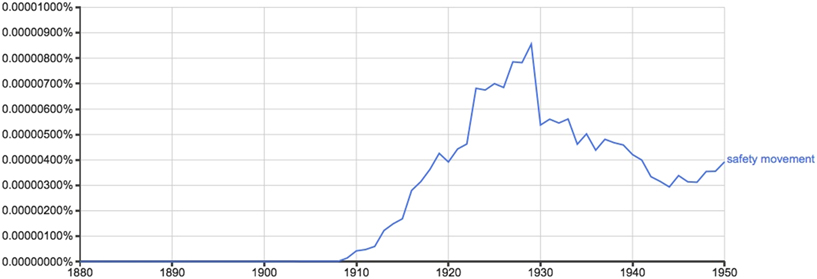
The NBS’s work on automotive and auto safety issues decreased considerably in the early 1930s. To some degree, this drop was, as Cochrane suggests, a product of the automakers developing their own laboratories and no longer needing the bureau’s assistance. Another important factor, however, was the Great Depression’s dampening of efforts around safety. This dampening effect can be seen in a number of organizational and institutional histories. For example, the Hoover auto safety conferences, which were sites of tremendous intellectual vitality in the mid-1920s, hardened around a narrow set of issues, especially establishing uniform traffic laws throughout the country, when it met again in 1930. The fate of work on safety can even be seen by running a Google N-Gram on “safety movement”: predictably, use of the term spiked in the early 1910s, when the National Safety Council was first established, and then falls dramatically with the onset of the Great Depression (Figure 4). Footnote 73
Google Ngram of the Exact Phrase “Safety Movement.”

In other words, the “field of auto safety” contracted temporarily after 1929. It would not return to its pre-Depression levels until the mid-1950s, and by then it was known by a different name, not the “safety movement.” Since the NBS responded in part to “markets for ideas,” it moved away from automotive issues in the early 1930s and expanded into other spaces, especially emerging issues in aviation. Other scholars have found that the NBS fell into an organizational slump during the Great Depression, and only after World War II did leaders try to reawaken its earlier vitality. Footnote 74
Perhaps the symbolic end of the heat division’s entrepreneurial foray into auto safety came in between late 1930 and late 1931. In October 1931, bureau staff members held a meeting with representatives from automobile associations, insurance companies, state motor vehicle commissioners, the National Safety Council, and the Society of Automotive Engineers to consider revising the national safety standard for automotive brakes. Footnote 75 They decided to go ahead with the project, and the American Automobile Association (AAA) began soliciting funds for the project from multiple sources, primarily brake lining companies, asking $10,000 from each organization. But by October 1931, AAA had only received one offer of $1,000 “and no other favorable replies as yet.” Footnote 76 While the NBS continued to do brake testing for the federal government for years, its period of experimentation and leadership around the automobile, especially in terms of safety, had come to an end. Moreover, these efforts did not move to some other part of the federal government. Not until the US military began contributing to the field of impact biomechanics and crash safety—around 1950—would the federal government again play a leading role in these areas.
Conclusion
This essay has attempted to revise a basic picture of business-government relations during the 1920s and 1930s, known Hooverian Associationalism, by examining the activities of the National Bureau of Standards. The essay began by showing how scholars had recently applied this picture to the history of automotive regulation, and it suggested that our image of governance might become more complex, nuanced, and accurate if we shifted our perspective to focus on the everyday activities of the federal agency. The literature on Hooverian Associationalism has typically focused on business “self-regulation,” but the essay demonstrated that George Burgess, the leaders of the NBS, while embracing associational organizations and efforts, considered ways of coercing firms to make better products. Burgess’s chief tool to this end was the use of federal specifications to set high standards, and he hoped that others—both state and local governments and private organizations—would also adopt these specifications. The essay then turned to the activities of the NBS’s heat division, which carried out a wide variety of activities aimed at improving the automobile, including vehicle safety. Again, specifications and the testing instruments that sat at the heart of standards and specifications were the division’s primary method for influencing the market. While the division enjoyed a heyday during the 1920s—along with many other parts of the agency—it fell into a slump during the Great Depression, and never again was a leader in shaping automotive technologies.
Still, the NBS’s achievements before this decrease were impressive, and they have been inadequately recognized in the historical literature. The NBS’s expansion and multiplication of organizational routines coordinating mechanisms fit with bureau chief George Burgess’s activist vision of what place the agency should have in government, economy, and society, as he articulated in a series of both published and unpublished essays during this period. The experimentation with creating and distributing coordination mechanisms can be seen in the work of the NBS’s heat division, which built a number of novel routines around the automobile and which influenced industrial practice and state governance. Both Burgess’s vision and the heat division’s practices were “associational” in certain senses of that word. They emphasized the importance of collaborative research, and they especially worked through engineering societies and standards bodies. At the same time, they did not especially prize industry “self-regulation” as in the classic Hawleyian definition of Hooverian associationalism. Perhaps, then, we must gently revise Hawley’s insights to give an adequate account of the Department of Commerce under Hoover.
Finally, this essay has attempted to demonstrate that business history must offer symmetrical accounts of the work of business and government as well as other kinds of organizations. In the case of this essay, this means that we must apply the perspective of organizational routines and coordination mechanisms developed for examining businesses to government, to see how agencies build and develop practices and capabilities for achieving their ends. The methodological benefit of this perspective is that we must turn our gaze from focusing solely on the ideas and plans of upper-level leaders to examining the actual work done on the lowest levels. Only then can we hope to have an adequately rich picture of the complex business-government relations that we find in activities such as “regulation.”