INTRODUCTION
Feedback-seeking inquiry has been defined as a conscious effort to ask others for information concerning work behavior and performance (Ashford & Cummings, Reference Ashford and Cummings1983; Ashford, Blatt, & VandeWalle, Reference Ashford, Blatt and VandeWalle2003; Chen, Lam, & Zhong, Reference Chen, Lam and Zhong2007). Such behavior has been identified as playing an important role in employees’ work outcomes, specifically the quality of their performance, creativity, high quality relationship with supervisors and job satisfaction (Ilgen, Fisher, & Taylor, Reference Ilgen, Fisher and Taylor1979; Judge, Thoresen, Bono, & Patton, Reference Judge, Thoresen, Bono and Patton2001; Chen, Lam & Zhong, Reference Chen, Lam and Zhong2007; Lam, Huang, & Snape, Reference Lam, Huang and Snape2007; de Stobbeleir, Ashford, & Buyens, Reference De Stobbeleir, Ashford and Buyens2011). In light of this, the past three decades have provided insight to the antecedents, motives and patterns of seeking feedback (Ashford, Blatt & VandeWalle, Reference Ashford, Blatt and VandeWalle2003; Anseel, Beatty, Shen, Lievens, & Sackett, Reference Anseel, Beatty, Shen, Lievens and Sackett2015).
Among these efforts, the majority of studies have focused on front-line employees’ feedback seeking (VandeWalle, Ganesan, Challagalla, & Brown, Reference VandeWalle, Ganesan, Challagalla and Brown2000; Chen, Lam & Zhong, Reference Chen, Lam and Zhong2007; Qian, Lin, & Chen, Reference Qian, Lin and Chen2012). As Ashford and colleagues note (Ashford, Blatt, & VandeWalle, Reference Ashford, Blatt and VandeWalle2003: 78), ‘performers are performers’; employees at different levels within the organizational hierarchy are all in need of feedback. For example, Ashford and Tsui (Reference Ashford and Tsui1991) found that mid-level executives seeking feedback about performance inadequacy could enhance their supervisors’, subordinates’ and peers’ perceptions about the executives’ effectiveness. Stoker, Grutterink, and Kolk (Reference Stoker, Grutterink and Kolk2012) suggest that top management teams’ feedback seeking could help achieve desirable organizational results even their CEO’s leadership is in absence or not ideal. Despite these benefits, however, individuals in management positions are generally reluctant to seek feedback and may not be open to the formal feedback received via Human Resources nor the informal feedback voiced by peers and subordinates (Devloo, Anseel, & De Beuckelaer, Reference Devloo, Anseel and De Beuckelaer2011). Given the need to please multiple constituencies, the potential costs of not detecting errors or making timely and ethical decisions and the concerns embedded in management positions, it is essential to have a clear understanding of front-line managers’ feedback source preferences and patterns, as well as which factors might influence such patterns. Little empirical attention has been given to the feedback-seeking dynamics of those in management positions, which lead Ashford, Blatt, and VandeWalle (Reference Ashford, Blatt and VandeWalle2003) to call for more studies investigating such issues. In response to their call, the first objective of this study is to focus on front-line managers’ feedback-seeking behavior.
Although it has long been recognized that individuals simultaneously seek feedback from various sources (e.g., Stoker, Grutterink, & Kolk, Reference Stoker, Grutterink and Kolk2012), the phenomenon of employing subordinates as feedback sources for managers has been rare. While the current literature offers some preliminary information about seeking feedback from various sources, a ‘variable-centered’ approach has been adopted in which seeking feedback from supervisors, coworkers or peers has been treated separately (e.g., Callister, Kramer, & Turban, Reference Callister, Kramer and Turban1999; Whitaker, Dahling, & Levy, Reference Whitaker, Dahling and Levy2007; de Stobbeleir, Ashford, & Buyens, Reference De Stobbeleir, Ashford and Buyens2011). In addition, the focus has been on testing the correlations of antecedents or motives with seeking feedback from each separate source. Although such an approach provides valuable information about the direct and unique links between various variables and seeking feedback from each source, it ignores the possibility that (a) distinct constellations of seeking feedback from different sources (we label this ‘feedback source profiles’) exist in the population and (b) these feedback source profiles may correspond to differences in other variables. To avoid such drawbacks, we rely on model-based cluster analysis (Fraley & Raftery, Reference Fraley and Raftery2002), a person-centered approach, to complement the existing variable-centered approach. This allows for the detection of naturally occurring groups or in our case, distinct feedback source profiles. Investigating these profiles might reveal unique insight into the ways in which front-line managers make decisions about whom to ask for feedback and the correlations of these profiles with various variables. Thus, a key distinction between the two approaches is that the variable-centered approach identifies studied variables with a purpose to investigate how these variables relate with each other across individuals, whereas a person-centered approach identifies individuals with common attributes through profiling techniques with a purpose to describe how individuals of each group think and behave (Aldenderfer & Blashfield, Reference Aldenderfer and Blashfield1984). To our knowledge, no feedback-seeking research has applied a person-centered approach despite a growing interest, demonstrated recently via organizational behavior studies (e.g., Moran, Diefendorff, Kim, & Liu, Reference Moran, Diefendorff, Kim and Liu2012; Stanley, Vandenberghe, Vandenberg, & Bentein, Reference Stanley, Vandenberghe, Vandenberg and Bentein2013; Van de Broeck, Lens, De Witte, & Van Coillie, Reference Van den Broeck, Lens, De Witte and Van Coillie2013). As such, the second objective of this study is to tap into this issue by identifying feedback source profiles in our sample of front-line managers.
In light of the benefits of seeking feedback, both for individuals and their organizations, scholars have devoted considerable effort to understanding the causes or motives of such behavior. The perceived instrumental value of feedback (i.e., the beliefs about the instrumental value of feedback) and the perceived image cost (i.e., the belief that asking for feedback may damage the image) are the two most studied motives. In other words, the motive to obtain valuable information and the motive to protect one’s image have been applied as underlying mechanisms guiding the identification of new antecedents of feedback seeking (e.g., Ashford, Reference Ashford1986; VandeWalle et al., Reference VandeWalle, Ganesan, Challagalla and Brown2000; Ashford, Blatt, & VandeWalle, Reference Ashford, Blatt and VandeWalle2003; Hays & Williams, Reference Hays and Williams2011; Qian, Lin, & Chen, Reference Qian, Lin and Chen2012). It has been consistently demonstrated that perceived instrumental value is positively associated with feedback seeking, whereas perceived image cost is negatively associated with feedback seeking (e.g., VandeWalle et al., Reference VandeWalle, Ganesan, Challagalla and Brown2000; Anseel et al., Reference Anseel, Beatty, Shen, Lievens and Sackett2015). In line with this insight, we suggest both motives could be associated with front-line managers’ feedback source profiles. The third objective of the present study, therefore, is to examine the associations between the two motives and front-line managers’ feedback source profiles.
Aside from the motivational factors that likely influence front-line managers’ feedback-seeking patterns, individuals’ emotional factors might also be pivotal in making such decisions. Asking for self-related information, no matter of its nature (positive, negative or neutral), can be emotionally charged. Differences in ability to regulate emotion may relate to managers’ feedback source profiles (Ashford & Cummings, Reference Ashford and Cummings1983; Valcea, Hamdani, Buckley, & Novicevic, Reference Valcea, Hamdani, Buckley and Novicevic2011). Existing research suggests that managers regulate their emotions as frequently as those who work in jobs that are considered emotionally laborious jobs, such as sales and service workers (Brotheridge & Grandey, Reference Brotheridge and Grandey2002). Unlike many occupations where only positive emotions are encouraged to be expressed, such as in customer-service professions, the emotional requirements of those working in management positions are more complex (Humphrey, Reference Humphrey2008). This is especially true when these emotional requirements are further complicated by the stressful working conditions leaders often face, such as budgetary constraints, performance targets and competition (Avolio & Gardner, Reference Avolio and Gardner2005; Humphrey, Reference Humphrey2008). Nonetheless, the role of emotion regulation in seeking feedback has not been addressed in current literature. Gross (Reference Gross1998) proposed two types of emotion regulation strategies: cognitive reappraisal and expressive suppression. Whereas Gross and John (Reference Gross and John2003) found evidence that people differ in their habitual use of emotion regulation strategies. A final objective of this study is to explore the associations between front-line managers’ emotion regulation strategies and their feedback source profiles.
THE PRESENT STUDY
In the present investigation, we measured feedback-seeking from two different sources, supervisors and subordinates, in a sample of front-line managers from China. We then applied model-based cluster analysis to identify distinct feedback source profiles in our sample, and we aimed to explore whether such profiles differ in individuals’ perceived instrumental value, perceived image cost and emotion regulation strategies. The present study specifically examines the following questions: (1) How many types of feedback seeking profiles exist in a sample of Chinese front-line managers? Because we utilized a model-based cluster analysis that generated clusters based on the characteristics of the current sample, no specific hypothesis was put forth. (2) Do managers with different feedback-seeking profiles differ in their motives to seek feedback? It was hypothesized that people who perceived more instrumental value and less image cost would be more likely to have active feedback-seeking profiles (e.g., seeking more feedback from both supervisors and subordinates), and vice versa. (3) Do managers with different feedback-seeking profiles differ in their emotion regulation strategies? It was hypothesized that people who tend to adopt more antecedent-focused regulatory strategies (i.e., cognitive reappraisal) and less response-focused regulatory strategies (i.e., expressive suppression) would have more active feedback-seeking profiles.
METHOD
Research setting, sample and procedures
Participants in this study were front-line managers and their direct supervisors from a hotel group located in a major city in North China. All participants voluntarily participated in this study and all procedures have been approved by the authors’ institution review board. Two types of survey questionnaires were designed and collected. The front-line manager questionnaires were distributed to 269 managers by one of the authors with the assistance of the human resource management department. The 269 front-line managers were instructed to complete the manager questionnaire and forward the supervisor questionnaire to their direct supervisors. To ensure confidentiality, the respondents were instructed to complete the questionnaires, seal them in a return envelope provided and return them via ‘research boxes’ placed in the employees break area within 2 weeks. Each of the questionnaire was assigned an identification number so the responses of the front-line managers could be matched with the evaluations of their immediate supervisors. Text messages were sent to the participants 1 day, 1 week and 2 weeks after the questionnaire was distributed.
Of the 269 front-line manager–supervisor questionnaires distributed, 231 manager and 217 subordinate questionnaires were returned, representing response rates of 85.87 and 80.67%, respectively. The final sample in this study consisted of 209 matched front-line manager–supervisor dyads (valid response rate=77.7%). Front-line manager respondents were predominantly male (61.9%) and reported an average age of 35.56 years (SD=8.67). The average organizational tenure was 9.84 years (SD=8.04). They came from various units; most of them were in customer service (60.5%) or food service and catering (16.2%), but supporting departments such as sales/marketing and public relations (7.2%), accounting/finance (4.3%), IT (3.8%), human resource/administration (2.9%), technical units (2.4%) and others (2.7%) were also represented.
Measures
The commonly used translation and back-translation procedure (Brislin, Reference Brislin1990) was applied to verify the questionnaire in Chinese. According to Behling and Law (Reference Behling and Law2000), this technique is necessary because creating a translation from one language to another that maintains the conceptual equivalence is very difficult due to cultural and linguistic differences.
Feedback-seeking from supervisors
The immediate supervisors’ perceptions of the frequency with which front-line managers sought feedback were measured with a 5-item scale validated by VandeWalle et al. (Reference VandeWalle, Ganesan, Challagalla and Brown2000). Each supervisor was asked to provide his or her own ratings of how frequently each of the five aspects of feedback (i.e., the inadequacies of overall job performance, technical aspects of the job, values and attitudes of the firm, role expectations and social behaviors) was sought by the corresponding front-line manager. Response options ranged from 1=‘never’ to 5=‘always.’ The α reliability for the scale was 0.89.
Feedback-seeking from subordinates
Measured with a 5-item scale validated by VandeWalle et al. (Reference VandeWalle, Ganesan, Challagalla and Brown2000), each front-line manager participant provided his or her own ratings of how frequently he or she asked his or her subordinates for each of the five aspects of feedback (i.e., the inadequacies of overall job performance, technical aspects of the job, values and attitudes of the firm, role expectations and social behaviors). Their scores were averaged to rate feedback-seeking from subordinates. Response options ranged from 1=‘never’ to 5=‘always.’ The α reliability for the scale was 0.76.
Perceived instrumental value of feedback-seeking
We measured the perceived feedback-seeking value using Ashford’s (Reference Ashford1986) 6-item scale. Participating front-line managers rated the extent to which they agreed with the statements on a five-point response format (from 1=‘strongly disagree’ to 5=‘strongly agree’). An example item is, ‘It is important to me to receive feedback on my performance.’ The scales’ α reliability was 0.83.
Perceived image cost of feedback-seeking from supervisors
Front-line managers’ perceived image cost of seeking feedback from supervisors was measured with a 4-item scale developed by Ashford (Reference Ashford1986). Response options ranged from 1=‘strongly disagree’ to 5=‘strongly agree.’ A sample item is, ‘It is not a good idea to ask my supervisor for feedback; he/she might think of me as incompetent.’ The α reliability for the scale was 74.
Perceived image cost of feedback-seeking from subordinates
Front-line managers’ perceived image cost of seeking feedback from subordinates was measured with the same 4-item scale created by Ashford (Reference Ashford1986). Response options ranged from 1=‘strongly disagree’ to 5=‘strongly agree.’ A sample item is, ‘I think my subordinates would think worse of me if I asked him/her for feedback.’ The α reliability for the scale was 72.
Emotion regulation strategy
Front-line managers’ emotion regulation strategy was measured with the 10-item scale developed by Gross and John (Reference Gross and John2003). Six items measured antecedent-focused emotion regulation strategies (i.e., cognitive reappraisal); the remaining four items measured response-focused emotion regulation strategies (i.e., expressive suppression). Response options ranged from 1=‘strongly disagree’ to 5=‘strongly agree.’ A sample item for reappraisal is, ‘When I’m faced with a stressful situation, I make myself think about it in a way that helps me stay calm.’ A sample item for suppression is, ‘I control my emotions by not expressing them.’ The Cronbach’s α coefficients were 0.91 and 0.71 for cognitive reappraisal and expressive suppression, respectively.
Control variables
In keeping with other feedback-seeking research (e.g., Ashford, Reference Ashford1986; Gupta, Govindarajan, & Malhotra, Reference Gupta, Govindarajan and Malhotra1999; VandeWalle et al., Reference VandeWalle, Ganesan, Challagalla and Brown2000), we controlled the participants’ ages, genders, levels of education and company tenure. Age, education and company tenure were measured in number of years. Gender was coded 0 for ‘female’ and 1 for ‘male.’
ANALYTIC PLAN
First, preliminary analyses evaluating the descriptive statistics, correlations among study variables and possible group differences in study variables based on demographic characteristics were performed. Next, model-based cluster analysis was used to identify individuals’ feedback-seeking source profiles based on their feedback-seeking behaviors from supervisors and from subordinates. The number and composition of clusters were determined by using the Mclust program developed for R software (Fraley & Raftery, Reference Fraley and Raftery2002). This analysis tests how many clusters, as well as which distribution, shape, volume and orientation of clusters, fit the data best. The resulting profiles were used in a series of ANOVA tests and post-hoc analyses to identify whether and how individuals’ feedback-seeking source profiles were associated with the variables of interest: individuals’ motives (perceived values and cost) and emotion regulation strategies (cognitive appraisal and expressive suppression).
RESULTS
Preliminary analyses
The descriptive statistics and zero-order correlations of the study variables were presented in Table 1. In general, participating managers who sought feedback from their supervisors also sought feedback from their subordinates; these managers perceived high instrumental values of such behaviors, low image cost of such behaviors and practiced cognitive reappraisal as opposed to practicing expressive suppression. The preliminary analyses evaluating demographic differences on study variables showed that front-line manager’s gender, age, year of tenure was not significantly associated with any study variables.
Means, standard deviations and bivariate correlations of study variables
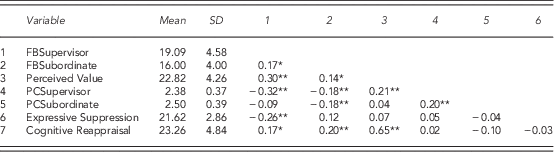
Note. FBSupervisor=individual’s feedback seeking from their supervisor; FBSubordinate=individual’s feedback seeking from their subordinate; PCSupervisor=perceived image cost when seeking feedback from supervisor; PCSubordinate=perceived image cost when seeking feedback from subordinate.
*p<.05, **p<.01.
Model-based cluster analysis: cluster results
Model-based cluster analysis was conducted on two measures of individual feedback-seeking sources to identify patterns/profiles of front-line managers’ feedback-seeking source profiles. The selection of this method is primarily because model-based cluster analysis avoids some common problems in traditional cluster analysis. Specifically, the traditional clustering procedure may impose a multi-cluster structure upon the data even if there are no actual clusters in the sample, and the cluster solution may be distorted when there are outliers in the data (Mun, Windle, & Schainker, Reference Mun, Windle and Schainker2008). The model-based cluster approach can reduce these biases and provide the Bayesian Information Criteria (BIC; Milligan & Cooper, Reference Milligan and Cooper1985) as an index to assess the appropriateness-of-fit of the classification solution. The analysis tests how many clusters, as well as which cluster characteristics (i.e., distribution, shape, volume and orientation) fit the data best (Fraley & Raftery, Reference Fraley and Raftery2002).
Higher BIC values indicate better fit of the model. When comparing models, a difference in BIC values greater than six is considered strong support of improvement in fit between the two models (Raftery, Reference Raftery1995). In the present study, the best-fitting model (BIC value=−2279.357) yielded a six-class solution with ellipsoidal clusters of equal shape but with variable volume and orientation. The next best-fitting model (BIC value=−2270.621) yielded a two-class solution with diagonal clusters of varying volume, varying shape and coordinate axes. According to the rule of thumb in interpreting the BIC value difference proposed by Raftery (Reference Raftery1995), the best-fitting model is positively supported (Δ BIC=8.836). Thus, the six ellipsoidal clusters with equal shape but variable volume and orientation were chosen as the model of best fit.
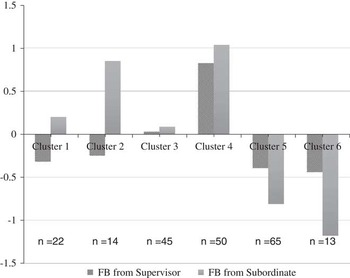
The results of six clusters were presented in Figure 1, which displays the deviation of the cluster mean from the overall sample for front-line managers’ feedback-seeking source profiles. The profiles of managers in Cluster 1 (n=22) and Cluster 2 (n=14) were characterized by being lower than the sample mean on feedback-seeking from supervisors, but higher than the sample mean on feedback-seeking from subordinates, whereas managers in Cluster 2 reported more feedback-seeking behaviors from subordinates than managers in Cluster 1. These profile characteristics reflected that managers in Cluster 1 and Cluster 2 sought more feedback from subordinates than from their supervisors. In contrast, the profiles of managers in Cluster 3 (n=45) and Cluster 4 (n=50) were characterized by being higher than the sample mean for seeking feedback from both supervisors and from subordinates, whereas managers in Cluster 4 reported much higher feedback-seeking from both sources than managers in Cluster 3. Their profile characteristics suggested that managers within Cluster 3 sought slightly more feedback from both sources and managers within Cluster 4 sought the most feedback from both sources. Based on the characteristics of their profiles, managers in Cluster 4 seemed to be the most active feedback seekers. Additionally, the profiles of managers in Cluster 5 (n=65) and Cluster 6 (n=13) were characterized by being lower than the sample mean on seeking feedback from both supervisors and from subordinates, whereas managers in Cluster 6 reported fewer feedback-seeking behaviors than managers in Cluster 5. Their profile characteristics suggested that managers within Cluster 5 sought less feedback from both sources and managers in Cluster 6 sought the least feedback from both sources. Based on the characteristics of their profiles, managers in Cluster 6 seemed to be the most inactive feedback solicitors.
Standard deviations from the overall sample mean of each cluster for all measures on managers’ feedback seeking profiles from the best fitting model with six-cluster solution

The six profiles were correlated with potential demographic covariates (i.e., manager gender, age and year of tenure). The results showed that the group did not differ concerning manager gender, c 2 (5, N=209)=4.86, p=.434; manager age, F(5, 203)=0.41, p=.842; or manager year of tenure, F(5, 203)=1.88, p=.100.
ANOVA analyses
The ANOVA analyses examined whether manager feedback-seeking profiles associated with the two important motives (i.e., perceived instrumental value and perceived image cost) as well as emotion regulation strategies of cognitive appraisal and expressive compression. The results showed that the front-line managers’ feedback-seeking profiles were significantly associated with their perceived image cost when facing their supervisors, F(5, 203)=7.17, p<.000; perceived image cost when facing their subordinates, F(5, 203)=5.91, p<.000; perceived instrumental value, F(5, 203)=2.66, p=.024; cognitive reappraisal, F(5, 203)=3.12, p=.010; and expressive suppression, F(5, 203)=2.34, p=.043. Post-hoc examinations on perceived image cost in front of their supervisors demonstrated that managers in Cluster 6 reported significantly more perceived image cost than managers with other feedback-seeking profiles. Additionally, managers in Clusters 3 and 4 reported significantly less perceived image cost than managers in Cluster 5. Concerning the results for perceived image cost in front of their subordinates, managers in Cluster 4 reported significantly less concern than managers in other clusters, and managers in Cluster 1 reported more concern than managers in Cluster 3. As for post-hoc analyses with perceived instrumental value, managers in Cluster 4 reported significantly more perceived instrumental value than managers in Clusters 5 and 6. Pertaining to post-hoc analyses with cognitive reappraisal, managers in Cluster 4 reported using more cognitive reappraisal strategies with emotion regulation than managers in other clusters, except for those in Cluster 2. Finally, as for the post-hoc examination with expressive suppression, managers in Cluster 6 reported using more expressive suppression strategies with emotion regulation than managers in all five other clusters.
DISCUSSION
The purpose of this study is to extend recent theoretical developments regarding how front-line managers make decisions about which source to seek feedback and shape feedback source profiles. We also investigate how these profiles associate with two important feedback motives (perceived instrumental value and perceived image cost) as well as their emotion regulation strategies. Findings from the model-based cluster analysis and ANOVA tests suggest several conclusions, which provide important theoretical and practical contributions to front-line managers’ feedback-seeking behaviors.
Theoretical contributions
The present research has a number of theoretical implications. First, we identified front-line managers’ feedback source profiles by incorporating feedback-seeking behaviors from supervisors and subordinates. By focusing on front-line managers’ feedback seeking, we answered the call from Ashford, Blatt, and VandeWalle (Reference Ashford, Blatt and VandeWalle2003) to move beyond the feedback-seeking behavior of front-line employees. By adopting a person-centered quantitative approach, we were able to examine patterns about the managers’ feedback-seeking behaviors in terms of variations in frequency as well as variations in sources (not limited to any one source indicator on its own) pertaining to their decisions to seek feedback upward and downward within the organization.
Additionally, model-based cluster analysis also identified the number of managers in each cluster/profile, which could give the big picture about front-line managers’ feedback-seeking patterns. This treatment represents a relatively new and promising advancement in theorizing and empirically testing the phenomenon about seeking feedback from various sources. Specifically, the feedback-seeking profiles that emerged depicted a range of managers’ feedback-seeking patterns. Some managers (Profile 4) actively sought feedback both from their supervisors and from their subordinates. Some (Profile 3) seemed to be average in seeking feedback from both sources. Others demonstrated a moderate (Profile 1) to strong (Profile 3) preference to seek such information only from people who held a lower position than they were. There were also managers (Profile 5) who seemed equally uninterested in seeking feedback from any sources. The rest (Profile 6) inactively sought feedback from both sources but were more reluctant to ask such information from people who ranked below them. Interestingly, in this group of Chinese front-line hotel managers, we did not find managers who only sought feedback from people who ranked higher than them. This is surprising given that the majority of feedback-seeking studies have chosen immediate supervisors as the dominant source for individuals seeking feedback.
Model-based cluster analysis also identified the number of managers in each classification, thus providing information about which profiles represent more common feedback-seeking patterns for this sample group. We found people who simultaneously actively sought feedback from both sources (Profile 4) and those who were equally uninterested in seeking feedback from any source (Profile 5) represented the majorities in our sample. This suggested that most people seemed consistent in their feedback-seeking trend. Specifically, about half the people in our sample were either an active feedback-seeker or an ‘independent’ type; the active seekers seemed to be interested in gathering information from people who worked closely with them, including those who ranked higher and lower than them in the organization, whereas the ‘independent’ type seemed to be indifferent to information from anybody in their workplace.
The current study aimed to understand whether front-line managers’ perceptions of value and cost toward seeking feedback could influence their feedback source profiles. Consistent with the well-applied cost-value framework (the perceived instrumental value is positively associated, whereas perceived image cost is negatively associated with feedback seeking) (e.g., VandeWalle et al., Reference VandeWalle, Ganesan, Challagalla and Brown2000; Anseel et al., Reference Anseel, Beatty, Shen, Lievens and Sackett2015), our results showed that front-line managers who perceived less image cost of seeking feedback from supervisors seemed to more likely to seek feedback from them, whereas those who perceived less image cost when seeking feedback from their subordinates seemed to more likely initiate feedback-seeking behaviors from subordinates. Additionally, front-line managers who perceived more instrumental values were more likely to be the active feedback seekers (Profile 4) than to be the inactive feedback seekers (Profiles 5 and 6). Perhaps more interesting is that the results revealed that when front-line managers perceive more image cost of seeking feedback from supervisors, they not only inhibit the feedback seeking from this source, but they also seek feedback less frequently from subordinates. This is the same case for perceived image cost of seeking feedback from subordinates and its negative effect on feedback seeking from both subordinates and supervisors. This is consistent with the current cost-value framework; although the results highlight the importance of the sources’ influence in one’s overall practice of seeking feedback at work, the perception of seeking feedback from one source may influence one’s feedback-seeking from other sources as well.
The feedback-seeking process is emotionally charged and previous researchers have called for more studies to explore the role of individuals’ emotion in the feedback-seeking process (e.g., Ashford, Blatt, & VandeWalle, Reference Ashford, Blatt and VandeWalle2003). We have answered this call by identifying the influence of front-line managers’ emotion regulation strategies of cognitive reappraisal and expressive suppression on their feedback source profiles. Cognitive reappraisal has been referred to as an antecedent-focused emotion regulation strategy, conceptualized as an individual’s efforts to construct a potentially emotion-eliciting situation in a way that changes its emotional impact (John & Gross, Reference John and Gross2004; Liu, Prati, Perrewé, & Brymer, Reference Liu, Prati, Perrewé and Brymer2010). As an example, an employee might view a company presentation as an opportunity to impress his or her supervisors rather than as a test of his or her own worth (Gross & John, Reference Gross and John2003). By contrast, expressive suppression has been referred to as a response-focused emotion regulation strategy, defined as the conscious inhibition of one’s ongoing emotionally expressive behaviors (John & Gross, Reference John and Gross2004; Liu et al., Reference Liu, Prati, Perrewé and Brymer2010); for instance, this occurs when supervisors maintain neutral expressions when they feel angry about an employee’s mistakes. The results suggested that those who were able to manage their emotions positively (those who tended to regulate their emotions with cognitive reappraisal strategies) seemed to seek more feedback from both supervisors and subordinates (Profile 4). In contrast, people who tend to manage their emotions negatively (those who often regulated their emotions with expressive suppression strategies) seemed to seek less feedback from their supervisors and even less from their subordinates.
Practical implications
The present study provides some interesting implications for feedback-seeking practices. It serves as a reminder that, given the dynamic nature of front-line managers’ work, they do seek feedback. It should be noted that, in this group of Chinese front-line managers in a hotel group, we did not find managers who only sought feedback from people who ranked higher than them, as suggested by the current literature; they continually choose both supervisors and subordinates as sources of feedback. As such, while promoting the solicitation of feedback by front-line managers’ at work, organizations should emphasize the value of seeking feedback from various sources, such as supervisors (upward source) as well as subordinates (downward source). This may avoid inadvertently implementing some interventions (e.g., leadership behaviors or managerial practice) focused on promoting a single source of feedback (i.e., feedback seeking from supervisors) at the potential sacrifice of other sources that may be of value (e.g., feedback seeking from subordinates in the current study and potential other sources in the future research).
Our results also highlight the associations between perceived value and perceived image cost of feedback-seeking behaviors and profiles. When promoting managerial solicitation of feedback, organizations could increase their perceived value while decreasing their perceived image cost. Importantly, the findings about the negative associations between the perceived cost of damaging one’s image in front of supervisors and one’s feedback-seeking from both supervisors and subordinates create cause to believe that one’s perceptions about feedback seeking from one source has a spillover effect. In other words, one’s negative perception about seeking feedback from one source may influence his or her frequency of seeking feedback from other sources as well. This finding warns that training one single source to promote feedback-seeking at work is not enough. Given that everyone in the organization could serve as a source of feedback, interventions could be designed to target the entire population. For example, aside from training separate feedback sources, such as supervisors, to improve their ability to serve as a valuable and trustworthy source of feedback, organizations may also promote an overall climate of feedback-seeking (e.g., Steelman, Levy, & Snell, Reference Steelman, Levy and Snell2004; Whitaker, Dahling, & Levy, Reference Whitaker, Dahling and Levy2007).
Limitations and future research
Although the results are encouraging, our study is not without its limitations that point to the need for further research. From these results, several interesting routes for future research emerge. First, future studies may tap into the dynamics of profiling other feedback sources. For example, seeking feedback from peers and customers could also be incorporated to detect the more complete feedback source profiles and to investigate the associations with other variables of interest. Second, the cross-sectional design makes it difficult to determine the causality of the relationships we examined. Given that this was the first attempt to link feedback source profiles with feedback-seeking motives and emotion regulation strategies, we believe the cross-sectional results are of value. Nonetheless, additional experimental or longitudinal designs would be useful to test the underlying causality of the relationships examined. Finally, the data used in the present study was only collected from China within one industry, thus the extent to which the results are applicable to other cultures or industries can only be speculated. For example, culture may be influential in shaping the feedback source profiles. The general applicability of the present findings should therefore be examined in other cultures and/or industries in future research.
CONCLUSION
Front-line managers often face the challenge of employing feedback-seeking to make balanced and ethical decisions and to achieve work goals. Given the dynamic nature of front-line managers’ work, we adopted a person-centered approach by simultaneously examining their feedback-seeking practices from both supervisors and subordinates. Our findings suggested that front-line managers varied in their preference in seeking feedback from the two sources, and such preference seemed to be linked not only to their perceived image cost and instrumental value but also to their emotion regulation strategies. In doing so, we extend the current literature in terms of adopting a person-centered approach to draw a clearer picture of individuals’ feedback-seeking patterns (i.e., feedback source profiles). It is our hope that the findings of this study will encourage future research on this important perspective and advance our knowledge of the complicity of feedback-seeking behavior.
Acknowledgments
This research was supported by the National Natural Science Foundation of China (project 71302022) and the Fundamental Research Funds for the Central Universities (project SKZZX2013032).