Introduction
There is no doubt that once adults sustain a moderate to severe traumatic brain injury (TBI), they require timely, acute care to limit their primary head injury and prevent secondary complications. This is often followed by ongoing rehabilitation to maximise functional return. Indeed, there are many published national and international clinical care guidelines that stipulate appropriate standards of rehabilitation throughout the healthcare journey of adults with TBI (e.g., Accident Rehabilitation and Compensation Insurance Corporation & National Health Committee, 1998; British Society of Rehabilitation Medicine & Royal College of Physicians, 2003; Turner-Stokes, Disler, Nair, & Wade, Reference Turner-Stokes, Disler, Nair and Wade2005; Youse, Le, Cannizzaro, & Coelho, Reference Youse, Le, Cannizzaro and Coelho2002). The aim of clinical care guidelines in defining standards of care is to improve the quality of services provided, by assisting health professionals to make decisions regarding treatment based on the best available research evidence (Frattali et al., Reference Frattali, Bayles, Beeson, Kennedy, Wambaugh and Yorkston2003).
Although clinical care guidelines have the potential to improve the quality of health services, their creation does not ensure equitable delivery of services for all clients who need services. Equity in health is a concept arising from ethics and is concerned with the fair distribution of healthcare services (Carr-Hill, Reference Carr-Hill1994). Equity in health encompasses three guiding principles: that healthcare services are available to all people who choose to access them, that all people have equal access to the services provided and that the quality of the service provided is consistent (Harris, Harris, & Roland, Reference Harris, Harris and Roland2004). For services to be equitable they must first be available, therefore a service needs to have adequate resources (e.g., funding, staff, infrastructure) allocated to ensure that it is created and maintained. However, simply having services available does not necessarily mean they are accessible.
Accessibility in this context refers to services being available wherever and whenever a person requires them (Humphreys & Rolley, Reference Humphreys and Rolley1991). Consequently, access can be defined as the opportunity or ease with which individuals or communities are able to use appropriate services in proportion to their need (Harris et al., Reference Harris, Harris and Roland2004). Equity in healthcare is also based on the principle of making high-quality healthcare services available to all people, and assumes that all clients can expect the same high standard of professional care for equal need (Whitehead & Dahlgren, Reference Whitehead and Dahlgren2007). Variations in the availability and accessibility of health services may contribute to differences in the quality of health care provided, and subsequently lead to inequities in the treatment outcomes achieved (Whitehead & Dahlgren, Reference Whitehead and Dahlgren2007).
The World Health Organisation defines inequity as differences in healthcare provision that are not only unnecessary and avoidable, but are also considered unfair and unjust when examined in the context of what is occurring in the rest of society (Whitehead & Dahlgren, Reference Whitehead and Dahlgren2007). With equity in health care involving the pursuit of equal access for equal need, inequity in health care arises when resources and facilities are unfairly distributed throughout the country and barriers preventing fair access to healthcare services for all who need them are evident (Whitehead & Dahlgren, Reference Whitehead and Dahlgren2007).
Many authors have identified examples of inequity in the provision of TBI health services, both within Australia and around the world. These inequities arise from the (in)ability of consumers to access health services as a result of geographical isolation (Foster, Tilser, & Fleming, Reference Foster, Tilser and Fleming2004; Johnstone, Nossaman, Schopp, Holmquist, & Rupright, Reference Johnstone, Nossaman, Schopp, Holmquist and Rupright2002; Sample, Tomter, & Johns, Reference Sample, Tomter and Johns2007), the provision of inadequate service delivery options (Kelly, Reference Kelly1999; Muus, Cogan, Offutt, & Medalen, Reference Muus, Cogan, Offutt and Medalen2006), inappropriate service delivery models which do not meet consumer need (Ylvisaker & Feeney, Reference Ylvisaker and Feeney2000), restrictive health policies and funding arrangements (Health Department of Victoria, 1991) and problems with the recruitment and retention of specialist TBI health professionals (Harradine et al., Reference Harradine, Winstanley, Tate, Cameron, Baguley and Harris2004).
The inequities of access to TBI rehabilitation, particularly for those residing outside metropolitan areas, have been studied internationally (Foster et al., Reference Foster, Tilser and Fleming2004; Murphy, Reference Murphy2004; Newberry, Reference Newberry2001; Sample & Darragh, Reference Sample and Darragh1998). Johnstone et al. (Reference Johnstone, Nossaman, Schopp, Holmquist and Rupright2002) conducted a comparative study of services and supports available to TBI patients in Missouri, to investigate the issue of health differentials dependent on patients’ degree of rurality. They found that fewer than 20% of the state's rehabilitation professionals practised in rural regions, where one-third of the state's population resided. Moreover, they found that only 13 of the state's 33 outpatient facilities were located in rural regions, requiring many rural patients to travel long distances to access basic rehabilitation.
From this research, it might be thought that adults with TBI in the USA who reside outside of metropolitan centres have access to fewer rehabilitation services (Johnstone et al., Reference Johnstone, Nossaman, Schopp, Holmquist and Rupright2002). Muus et al. (Reference Muus, Cogan, Offutt and Medalen2006) investigated this issue in an attempt to delineate the barriers to accessing health and social services among adults with TBI. They hypothesised that the geographical location of residence, ethnicity and functional limitations of adults with TBI would be the main barriers to access. A convenience sample of 117 North Dakotans with TBI were asked to complete a questionnaire that solicited information such as demographics, nature of TBI, service needs and perceived barriers to accessing health and social services. The results showed that the most commonly cited barriers to accessing and using health and social services were shortages of strong TBI advocates, inadequate knowledge of services available for adults with TBI, no centralised source for TBI information, inadequate financial resources and lack of individualisation of TBI services. In terms of geographical location, rural respondents cited long travel distances as a barrier to accessing services. By race, indigenous Americans were more likely to cite lack of transportation and inadequate support from family members as obstacles (Muus et al., Reference Muus, Cogan, Offutt and Medalen2006).
Australia's vast distances between its centralised, specialist care centres have resulted in questionable equity of access to appropriate acute and rehabilitation services. Considerable debate continues in the literature surrounding the perceived inequities of health care experienced by rural TBI clients compared to those living in metropolitan areas. According to Kelly (Reference Kelly1999), Newberry (Reference Newberry2001) and the Victorian Head Injury Impact Project (Health Department of Victoria, 1991), TBI health services in Australia are centralised in metropolitan and large regional centres, meaning that country residents with moderate to severe TBI were usually transferred to metropolitan trauma centres for specialist care. Furthermore, their access to services on discharge is often severely limited (Fagen, Reference Fagen1996; Health Department of Victoria, 1991; Honey & McCubbery, Reference Honey and McCubbery1991; Newberry, Reference Newberry2001).
The focus of this paper is to further explore research investigating consumers’ experiences of care following acute brain injury in Victoria, Australia. The aim of this paper is to report recollected experiences of care and the factors that impacted upon participants’ ability to access services over time. Previous publications have been written outlining the results of this larger study, yet none of these papers have touched on participants’ perceptions of the impact of lack of information, presence of an advocate and funding on their ability to access services. This paper focuses specifically on these three factors.
Methods
The data presented in this paper were derived from a larger investigation of the continuum of care experienced by Victorian adults with moderate to severe TBI and their significant others (O'Callaghan, McAllister, & Wilson, Reference O'Callaghan, McAllister and Wilson2009, Reference O'Callaghan, McAllister and Wilson2010, Reference O'Callaghan, McAllister and Wilson2011, Reference O'Callaghan, McAllister and Wilson2012a). Briefly, this larger investigation involved two stages. The data presented in this paper were derived from both stages of this research; therefore the methods for both stages will be briefly outlined.
The first stage of the project employed a state-wide survey sent to all adults with TBI admitted to the two major Victorian metro trauma hospitals between July 2001 and June 2005. Two hundred and two participants returned the survey. This quantitative survey asked participants to recall healthcare journeys they received after sustaining a TBI. The second stage of the project used qualitative research interviewing techniques with 23 participants (participants with TBI and/or their significant others) in 17 interviews. By employing mixed-methods research, the authors of this paper collected different, yet complementary, data to best understand and interpret why TBI healthcare consumers act in certain ways, by attempting to see things through their eyes (Grbich, Reference Grbich, Minichello, Sullivan, Greenwood and Axford1999; Schwandt, Reference Schwandt, Denzin and Lincoln2000). Triangulation of the results of both stages (i.e., data from the surveys and interviews) enabled comparison, confirmation and corroboration of the findings. The data presented in this paper are drawn from both stages of this project.
Stage One
The first stage of this research project involved the dissemination of a survey, which was specifically formulated to collect information on, and survey opinions of participants with regard to their recollected continuum of care they experienced. The survey was broken into six sections representing each stage of an optimal continuum of care, as outlined in clinical guidelines; that is: ‘Acute medical care’, ‘Rehabilitation in hospital’, ‘Leaving hospital-based rehabilitation’, ‘Rehabilitation outside hospital’, ‘What are you doing now?’ and ‘Personal Information’. The survey was made up of 69 items and was 21 pages in length. Survey questions included both open- and closed-ended forms (e.g., multiple choice and yes/no questions), and some questions contained visual analogue scales to obtain data about degree of satisfaction with services. All items included within this survey were researched in order to determine their purpose, necessity and accuracy. The survey was piloted first with allied health therapists working within two specialised TBI units in Australia, and then with ex-clients with TBI and their families within their homes. The first author was present on all piloting occasions to receive feedback and modify the questions as needed. The items probed participants’ experiences based on recommendations of care as set out in clinical care guidelines (British Society of Rehabilitation Medicine & Royal College of Physicians, 2003; New Zealand Guidelines Group, 2007). In this way the research tool demonstrated internal consistency and content validity.
Given the page length of the survey and time required for its completion, in addition to the potential cognitive-communication and/or literacy impairments experienced by participants secondary to their TBI, participants were provided with the option to complete questionnaires with the assistance of a significant other. Participants were also prompted to take regular breaks throughout the survey completion, in order to manage fatigue.
As stated above, the participants who took part in the first stage of this study had been admitted to either one of the two Victorian major metro trauma hospitals for acute care between 1 July 2001 and 30 June 2005. June 2005 was selected as the latest acute admission date to ensure that all participants had had an opportunity to complete their continuum of care and to experience life back in the community before taking part in this research. All adults received their surveys between 2 and 5 years post onset of their TBI. The major metro trauma hospitals were approached to assist with participant recruitment because, according to the Health Department of Victoria (1991), it is common practice for people with brain injuries to be admitted to specialist trauma centres for acute care regardless of where they live. Therefore, by approaching these hospitals, the majority of people who had sustained moderate to severe TBI in Victoria, requiring hospitalisation between 1 July 2001 and 30 June 2005, were able to take part in this study.
Stage Two
Participants who completed the surveys indicated their interest in being interviewed in the second stage of the research by responding ‘yes’ to the last question on the survey, ‘Would you like to participate in a follow-up interview to discuss these issues further?’ If yes, they were asked to provide their name, phone number and address for future contact. The first author then provided participants with an additional information sheet and consent form detailing the aims of interviewing, its benefits, issues of confidentiality and the estimated time taken to complete the interview. The first author travelled to a place of each participant's choosing (i.e., home or a local café) to conduct the interviews.
Fourteen adults with TBI and nine significant others took part in this stage of the study. Each interview took the form of a guided oral history (Minichiello, Madison, Hays, Courtney, & St John, Reference Minichiello, Madison, Hays, Courtney, St John, Minichiello, Sullivan, Greenwood and Axford1999), in that a face-to-face interview was conducted, allowing participants to talk in depth about the continuum of care they experienced. During these interviews, the significant other of the adult with TBI was invited to take part. The time taken to complete interviews varied from 45 minutes to 2.5 hours, depending on participants’ levels of engagement and fatigue. Interviews were audio recorded, with participants’ permission. Interviews were then transcribed verbatim for later analysis.
Participants
Individuals targeted for inclusion in this project were those of working age (i.e., 18–65 years) with a moderate to severe TBI, who had undergone initial acute trauma care at one of two major Victorian trauma centres. Of the 1771 eligible individuals invited to take part in this research, 202 participants responded (response rate = 11.4%). While it is acknowledged that the response rate is low, of the possible 1771 questionnaires distributed 256 were returned to the author unopened, perhaps because people had moved. Assuming the remaining 1515 were delivered successfully, this means a response rate of 13.3%, comparable to the 15% response rate noted by Narbors, Seacat and Rosenthal (Reference Nabors, Seacat and Rosenthal2002, p. 1043) as typical of clinical populations.
The mean age range of the 202 individuals with TBI who returned the survey was 36–45 years (range: 18–66 years or older). The majority (23%) were adults aged between 26 and 35 years, while 22% were aged 18–25 years, 17% were 36–45 years, 21% were 46–55 years and 13% were 56 years or older. Sixty-eight per cent were male. With respect to education, 44% had a high school or primary school education, 27% had some kind of technical college certification, while 27% had graduated from university with at least a bachelor degree. Educational data were missing for 4% of participants.
Participants self-reported their injury severity range, with 83% stating this was in moderate, to severe–very severe range. The majority of participants sustained their TBI in a car or motor bike accident (54%), while 17% reported sustaining their TBI in a fall; a further 7% reported being assaulted. Thirty-five per cent of participants were younger than 25 years of age when they sustained their head injury, 36% were aged between 26 and 45 years, while 28% were 46 years or older.
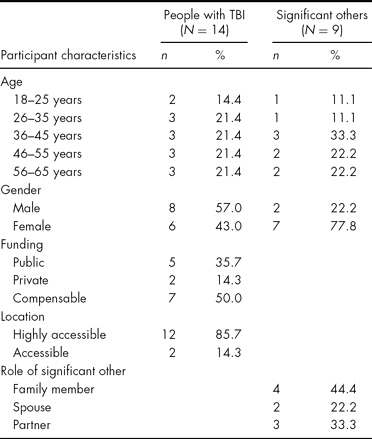
Ninety people indicated their interest in being interviewed, and purposive sampling (Schofield & Jamieson, Reference Schofield, Jamieson, Minichiello, Sullivan, Greenwood and Axford1999) was used to select 14 adults with TBI and 9 significant others for interview. These participants were selected on the basis of their degree of rurality according to the Accessibility Remoteness Index of AustraliaFootnote 1 (Department of Health, 2001) as well as on the basis of the level and type of healthcare funding allocated to finance their rehabilitation (i.e., public, private or compensable fundingFootnote 2). Patton (Reference Patton2002) described such a sampling strategy as ‘maximum variation sampling’, which purposively selects a wide range of cases to obtain variation in the dimensions of interest (see Table 1). No more than 23 participants were recruited to be interviewed as data saturation had been achieved.
Characteristics of Participants from Stage 2

Data Analysis
Numerical and categorical data arising from the survey were entered into a spreadsheet and analysed using the Statistical Package for the Social Sciences (SPSS). Comments from open-ended questions were analysed using content analysis and were stored in QSR NVivo 7. Data from closed-ended questions were stored in SPSS and were analysed using descriptive statistics (i.e., frequency and percentage distributions, measures of central tendency and cross tabs) to profile the recollected continuum of care experienced by adults with TBI.
Data arising from the interviews were thematically analysed (Attitride-Stirling, Reference Attitride-Stirling2001; Morse & Field, Reference Morse and Field1995). This initially involved a process of identifying, coding and categorising patterns and then reducing the number of categories by selecting, ordering and clustering data until overarching themes were identified. First, digital recordings from all interviews were listened to and key ideas expressed were noted by the first author. Interviews were then transcribed and hand-coded. Initial coding involved segmenting slabs of text relating to specific concepts and ideas which emerged from participants. These segments ranged from a single conversation turn to pages of text. Initial coding in this way reduced data fragmentation (Attitride-Stirling, Reference Attitride-Stirling2001).
After initial hand-coding was completed, transcripts were uploaded on to NVivo and were then re-coded. NVivo was used in this study to aid with data management, organisation and storage. Following coding, first-level codes were then collapsed and larger, overarching categories were formed. Following this first stage of data reduction, second-level categories were reorganised into overriding themes. These themes encapsulated the data coded within categories.
Once themes were formed, participants’ interviews were reviewed to ensure that the meaning of the data had not been lost through the coding process. Case summaries, including a synopsis of the interview and key themes derived, were then sent out to each participant for validation. Upon receiving their summaries participants were instructed to read through their interview summary and confirm the summary was accurate, fill out the summary confirmation sheet and send it back to the researchers in a stamped envelope provided. All interview summaries were returned to the researchers and all participants agreed that the summary they were sent was an accurate synopsis of the issues they had spoken about in their interview.
Results
Continuum of Care Experienced
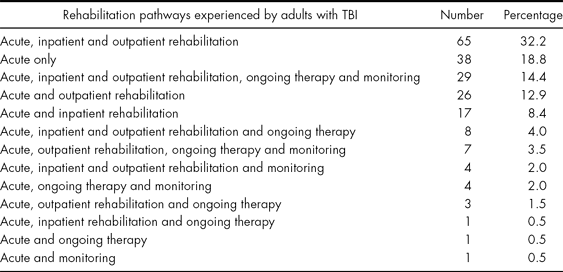
According to the recollections of participants in this study, only 41 adults with TBI (20% of the 202 surveyed) received care in line with clinical care guidelines (i.e., received acute care, inpatient and/or outpatient rehabilitation, and either ongoing therapy or monitoring). Other rehabilitation pathways recollected by participants are listed in rank order in Table 2.
Rank Order of Rehabilitation Pathways Experienced by Adults with TBI (N = 202)
While clinical care guidelines stipulate that not all adults with TBI require all stages of care (i.e., acute care, inpatient rehabilitation, outpatient rehabilitation, ongoing therapy or monitoring), of interest from these data was the small number of participants who continued to access therapy once discharged from the hospital-based stages of their care. Forty-four of the 202 participants reported receiving monitoring and only 50 participants reported accessing services at the time they answered the survey (between 2 and 5 years following their TBI). This is of concern, given that over time the needs of adults with TBI have been shown to change and, in some instances, significantly increase as they adjust to altered occupational roles and life circumstances (Brooks, Campsie, Symington, Beattie, & McKinlay, Reference Brooks, Campsie, Symington, Beattie and McKinlay1987; Marsh, Kersel, Havill, & Sleigh, Reference Marsh, Kersel, Havill and Sleigh2002). According to TBI rehabilitation guidelines (British Society of Rehabilitation Medicine & Royal College of Physicians, 2003; New Zealand Guidelines Group, 2007), adults with TBI require information, practical support, continued education and easy access to health and social services to combat isolation, emotional distress and stress, which may develop over time. Ongoing support is reportedly required following discharge from formal services in order to maximise the independence and quality of life for adults with TBI, for what may be the next 50 or more years of their lives (British Society of Rehabilitation Medicine & Royal College of Physicians, 2003).
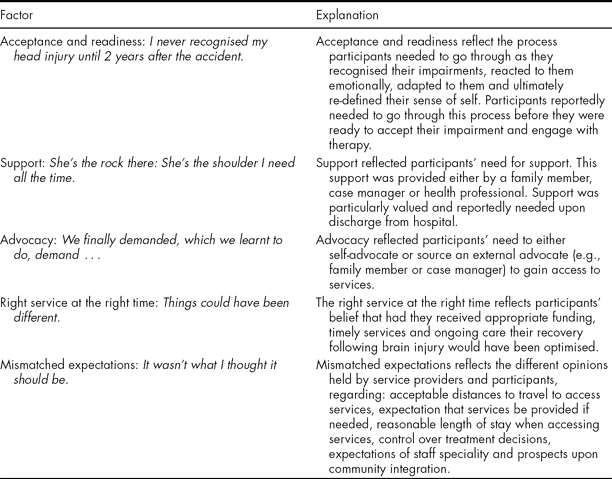
Factors that impacted upon the services that participants experienced were explored in interviews. Five factors were uncovered. These included: acceptance of impairments and readiness for therapy, access to support, advocacy, right service at the right time and mismatched expectations (see Table 3 for further explanation).
Participant-related Factors Affecting Access to Care Following Brain Injury
The impacts of acceptance and readiness for therapy, access to support and matched expectations on engagement with therapy have been explored elsewhere in the literature (LeFebvre, Pelchat, Swaine, Gelinas, & Levert, Reference LeFebvre, Pelchat, Swaine, Gelinas and Levert2005; O'Callaghan, McAllister, & Wilson, Reference O'Callaghan, McAllister and Wilson2012b; Sample & Darragh, Reference Sample and Darragh1998). However, the impacts of an advocate and accessing what participants perceived to be the right service at the right time have not been previously discussed in the literature and therefore discussion of these factors in relation to the distribution of TBI services will be the focus of the remainder of this paper.
Advocacy
The factor advocacy reflects the need expressed by participants to push for access to services. An advocate in this study was a person with belief in and support for the needs of the adult with TBI, an ability to campaign on behalf of and provide monetary sponsorship when necessary in order to ensure access to services. This advocate role extended beyond just ensuring a service was available, to ensuring that services were accessible, appropriate, well-timed and of consistent quality.
Advocacy had two dimensions; the first reflected participants’ need to research and advocate on their own behalf, while the second dimension reflected the need to have an external person available to advocate on behalf of the person with TBI (PWTBI). This external person could be a significant other or healthcare professional, such as a case manager.
The self as an advocate
Many participants spoke about the need to independently research their brain injury in order to understand its nature and the nature of secondary impairments experienced. Participants reported a need to do this before they knew which services they should access. The need to independently research TBI was demonstrated when KarenFootnote 3 (mother of participant with TBI (PWTBI)) reflected: ‘I started reading everything I could on the internet and books that I borrowed from the library on brain injury’. Derek (PWTBI) reiterated the need for research. However, he ‘. . . only really looked into it and read a bit about it on the internet after leaving hospital, but I still didn't fully understand what was happening to me’. Melinda (PWTBI) similarly spoke of the need to research when she reflected: ‘I went to the local library, grabbed books on the brain and understanding the brain, understanding the surgery and understanding why I felt the way I felt’.
Once these participants came to understand their injuries, they reported a need to find appropriate services to help them cope with their impairments. For example, David (PWTBI) reported: ‘This [access to services] came about by me. I basically did the deal myself. I got on the internet and looked up to see what was around’. Timothy (PWTBI) and Bernice (Timothy's wife) expressed similar sentiments: ‘We have to find what's available to us and then go to them [funding body and general practitioner] and ask if we can go to the service. We have to approach them [funding body] and ask them to fund services’.
Many participants reported that it was a battle and that they constantly needed to push to get the services they needed. For example, Trish (PWTBI) initially reported: ‘They just won't do anything. It's a real battle to get the doctor to do anything’. Melinda (PWTBI) reiterated this point, reflecting her need to organise her own neurosurgery reviews: ‘So these appointments were in 2002, then 2003 and 2004 but they were pushed by me. I asked for them. I called the hospital’. Oscar (PWTBI) reported a similar need to self-advocate: ‘I asked a lot of questions. I delved. I persisted. I argued. I often got my way, but that's through a lot of persistence and a lot of battling red tape and administration’.
Self-advocacy was not the only form of advocacy evident in this study. In some cases an external advocate was able to take on this role and advocate for services on behalf of the participant with TBI.
External advocate
An external advocate in this study took the form of either a significant other or healthcare worker in a formal service, such as a case manager. Significant others reported that their role in advocating was particularly important in the absence of any formal advocacy service (i.e., case management) or when individuals’ secondary TBI impairments (i.e., impaired awareness, cognitive–communication or behavioural impairments) hampered their ability to self-advocate. Liza (mother of PWTBI) demonstrated her need to advocate when she reflects on the need to demand attention while her son was under acute care: ‘We finally demanded, which we learnt to do, demand. My sister said “You have got to start to demand things.” Well, you realise that no one is going to offer’. Dominic (PWTBI) made a similar point when he recalled his partner's experience while he was in acute care: ‘Naomi said the [health professionals] were terrible. Horrible people. If she wasn't there hassling them, I don't know what would have happened to me’. Melinda (PWTBI) also reported the need for an external advocate when she reflected on her husband's role in facilitating her transfer from a regional hospital to a specialist acute trauma centre:
I was airlifted from the regional hospital to a specialist hospital by my husband's pushing. I could have died in the regional area. My husband forced the doctors. He told them, ‘look, she was pulling her hair out when she fainted, you know she's got something wrong with her head’. They were keeping me in intensive care in the emergency department in the regional hospital waiting for a doctor to come and see me. They had no idea what was wrong with me. They didn't even go and find out. So my body started to shut down bit by bit. By that time, my husband pulled them aside and shook them up. ‘Hey she is dying you know.’ So I could have died if my husband didn't push hard enough to get me transferred. I would have died in the regional hospital.
When formal services, such as case management, played a service-enhancing role they were seen as extremely beneficial. For example, Karen (mother of PWTBI) reflects:
We were very fortunate, she was so lucky things fell into place. She would not have recovered had she not had people pushing for her. I had no knowledge of what went on. I was terrified that I would hinder her, I would hurt her, you know. If we had not got the [formal case-management support] which was put in place by the [sub-acute hospital] we would have been in trouble. Everybody just did things for us, you know. I didn't do it! I didn't know what I could do. I didn't know where I could go, my life was just distressing being with Katrina. I didn't know what help we could get.
Other participants receiving case-management services reported a very different experience from that reported by Karen and Katrina. Repeated staff changes were often a problem: ‘It makes it very difficult because you get close to somebody or you start talking to somebody. Actually, we went down there, we met her once and then she left a couple of weeks later’ (Timothy, PWTBI). The same sentiments were expressed by Peter (PWTBI): ‘I have a case manager. I don't know their name. But I think they changed hands. They all swapped around. I couldn't tell you their name’.
Dominic (PWTBI) reflected on the merits of having a central person to coordinate and advocate for the care of people with TBI: ‘If someone actually knew, I guess the medical side, the illness and then they could say, “okay, how about we give you something to do like this, try that”. They could give you options and chances, rather than you tripping yourself up’.
Interestingly, data from the surveys suggested that only 86 (43%) participants in this study reported accessing case-management services following discharge from hospital-based rehabilitation. Of these participants, only 17 (20%) reported that their case manager was a source of support upon discharge.
Right service at the right time
In addition to participants’ belief that the presence of an advocate facilitated their ability to access appropriate and quality health services, participants also discussed their need for the right service at the right time. This need encompassed participants’ perceptions that their outcome would have been different had they been allocated the right kind of funding, received the right service at the right time, or had access to ongoing services to meet their changing needs.
Participants in this study believed their eligibility for services and the length of attendance in services following TBI was dependent on the type and amount of funding that was allocated to them to pay for their care. In this study, the belief that funding restricts services is reflected in Trish's (PWTBI) discussion of her ability to access counselling sessions: ‘They [funding body] said “Well we'll pay for five appointments” and she [counsellor] said “It's going to take a lot more than that”, so she's going to write out a treatment report to send to them so they'll approve more appointments’. Similarly, Karen (mother of PWTBI) reflected on the services Katrina received as a result of the funding she was allocated: ‘Katrina had a case manager who organised a carer for her. That was with the financing from the [federally funded] programme that Katrina had. There was funding there for Katrina to have a carer’.
Bettina (PWTBI) reported the opposite experience, as she reflected on her poor access to services, which she speculates resulted from her lack of allocated funding: ‘I've probably fallen between the boards, haven't I, because I wasn't [list of compensable funding providers], I wasn't any of those. There weren't any dollars there. So I'm cynical. If there's no dollars, people don't worry’.
Participants with allocated funding to pay for their health services considered they were lucky. Pauline (PWTBI) stated:
I was so lucky. My private health insurance covered all aspects of my stay at the [rehabilitation centre]. It covered all the therapists, it covered my specialists. Whenever I went back to see Dr [name of consultant] I didn't have to pay a thing. That would have cost an absolute fortune, so I was so lucky. I had to get a taxi to rehab because I couldn't drive. I put that on my tax. It came to about $1200 or something. I kept all the receipts and I put that on my tax.
Those who did not have funds allocated but needed to access care reported self-funding their care. For example, Melinda (PWTBI) reported: ‘I didn't have private insurance but I privately paid. I paid the full charge for the MRI tests. I paid the full charge for the brain surgeon. I paid full price for a psychologist to see me all the time’. Pauline (PWTBI) also stated that she needed to take out a loan to self-fund the final outpatient appointments needed for her care. She took out this loan because she wanted to make as good a recovery as possible. She believed that the risk of her impairments worsening due to her lack of therapy necessitated meeting the cost of care herself: ‘So in the end, I had to borrow $10,000 [to cover my expenses]. I didn't want to risk not being allowed out of bed and not being able to walk. You want to be independent. I don't know what the specialists’ fees were, but it was quite costly’.
Those who were allocated compensable funding to cover their care felt they were lucky because ‘. . .it would have taken longer going through my recovery [without compensable funding], I'd only be half way to where I am now’ (Peter, PWTBI). However, Karen (mother of PWTBI) who did not receive compensable funding for her daughter's care reported:
We've been waiting for a year and a half. We've been waiting for Katrina to go to transitional living care which has now come up, thank goodness. So for 5 years it's sort of been waiting for the next step and the next step. If Katrina had been compensable, I think there would have been a lot of difference. She would have probably gone to a better rehabilitation centre where she would have had more intense rehabilitation. It also would have happened sooner.
Data compiled from surveys indicated the majority of participants (57%) in this study were allocated compensable funding at the time of their injury. Other participants had their services paid for by public facilities (32%) or through private health insurance (7%). Four per cent of participants were unsure of who paid for their care.
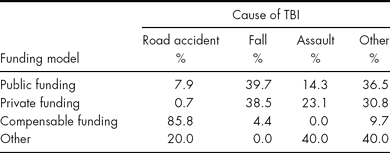
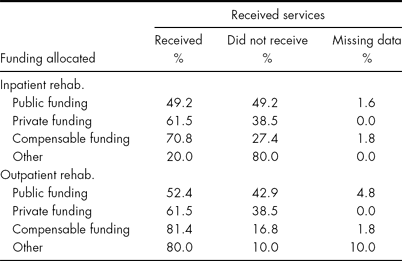
Cross-tabulations were undertaken to compare associations between funding and services received. A number of trends were noted (see Tables 4 and 5). Not surprisingly, allocation of compensable funding appeared related to the initial cause of the TBI. For example, 86% of participants who sustained their TBI in a road accident were allocated compensable funding. This is not surprising, given the Transport Accident Commission's (Traffic Accident Commission, 2003) commitment to funding care following head injuries sustained either on a Victorian-registered road or in a Victorian-registered car.
Relationship Between Cause of TBI and Funding Allocated
Funding Allocation by Reported Rehabilitation Services Received
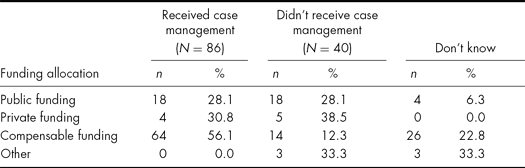
Associations between funding allocation and ability to access rehabilitation and case-management services were also noted. For example, allocation of compensable funding appeared to be related to increased rates of receiving services in inpatient and outpatient rehabilitation settings. Indeed, 71% and 81% of participants with compensable funding reported accessing inpatient rehabilitation services and outpatient rehabilitation services, respectively. Those who were allocated public funding appeared the least well served: only 49% of publicly funded participants reported accessing inpatient rehabilitation, with 52% reporting being able to access outpatient services (see Table 5). Likewise, over 56% of compensable participants recollected receiving case-management services compared to 31% of participants allocated private funding and 28% of those allocated public funding (see Table 6).
Funding Allocation by Reported Case-management Services Received
Discussion
As was stated in the introduction to this article, in order for TBI services to be considered equitable they need to be available, accessible and of consistent quality. Clinical care guidelines have been created internationally to guide improvements in the quality of TBI services. These guidelines can assist health professionals to make decisions about the management of their clients, based on the best available research evidence. However, recommending services based on the best available evidence does not ensure equity. As was shown in this study only 20% of participants recollected experiencing care in line with best practice; that is, receiving hospital and community-based services. The reasons given by participants for variations in access to care included variable access to advocacy and the provision, or not, of the right service at the right time.
When reflecting on their ability to access services, participants in this study reported needing to push for services, which they felt were in part constrained by the funding they were allocated at the time of their injury. Australia is not the only country where the impact of funding on access to needed health care has been identified by adults with TBI and their significant others. It has been recognised in qualitative and quantitative research in the United States of America (Barnes, Frank, Montgomery, & Nichols, Reference Barnes, Frank, Montgomery and Nichols2005; Sample et al., Reference Sample, Tomter and Johns2007) and Canada (LeFebvre et al., Reference LeFebvre, Pelchat, Swaine, Gelinas and Levert2005). Barnes et al. (Reference Barnes, Frank, Montgomery and Nichols2005) reviewed the medical records of 712 adults who had sustained a TBI as a result of a motor vehicle accident. They found that although funding was not a predictor of Intensive Care Unit (ICU) admission or length of stay in ICU, it was predictive of access to allied health services following acute care. Lefebvre et al. (Reference LeFebvre, Pelchat, Swaine, Gelinas and Levert2005) found that allocated funding similarly affected access to services, as perceived by adults with TBI, their families, and the health professionals and physicians who provided their care. Lefebvre et al. identified that access to services during critical care and rehabilitation was adequate; it was during community integration that most adults with TBI and their families felt that resources were more accessible if they were compensable clients. Canadian physicians and professionals in this study also agreed, stating that services were easier to access if a person was compensable.
Aside from limited access to health care due to restrictions in funding, participants in our study felt that access to needed services was limited by their lack of knowledge of available services and need to independently access and push for services. The need for consumers to independently organise their care is not unique to the Australian context. A qualitative phenomenological study of the perceptions of care of 21 women with acquired brain injury in rural and urban Colorado identified the same issue (Sample & Darragh, Reference Sample and Darragh1998). In that study, consumers identified that the lack of professional care coordination slowed down their rehabilitation as they had to independently find out about systems, services and their rights by relying on friends, family and word of mouth. Sample and Darragh (Reference Sample and Darragh1998) identified that the gaps in care experienced by participants, resulting from missed appointments, problems with paperwork completion and difficulties with care coordination, could have been avoided through the provision of a case manager or external advocate.
Participants in the present study spoke strongly about the benefits of having an external advocate. However, only 86 (43%) participants reported having access to a case manager, and only 17 of those reported they were offered support upon discharge. One of the biggest barriers participants reported in effectively utilising case-management services was staff turnover. In a study of New Zealand consumers’ perceptions of access to TBI care (New Zealand Guidelines Group & Accident Compensation Corporation, 2004), the presence of an external advocate (such as a case manager) often meant that participants perceived they received a ‘good deal’ with regard to TBI rehabilitation. Consumers in that study reported that the rehabilitation they received had been good, but they knew of others who had not been so lucky. They reported that their care was good as long as they had someone to advocate for them and as long as they knew what to ask for (New Zealand Guidelines Group & Accident Compensation Corporation, 2004).
Sample et al.'s (Reference Sample, Tomter and Johns2007) findings from their qualitative study of providers’ perspectives of the systems of care for individuals with brain injury support the perceptions of healthcare consumers in our study. Healthcare providers in the study by Sample et al. (Reference Sample, Tomter and Johns2007) identified that the lack of linkage between services, poor care coordination and absence of external advocacy meant that services and resources available to people with TBI were rarely used. The professionals in that study considered that the outcomes of many individuals with TBI were compromised by the ‘painstaking and inefficient ways they had to find out about and access services and participate in activities’(Sample et al., Reference Sample, Tomter and Johns2007, p. 714).
Overall, the present paper identified that very few adults with TBI recollected receiving the recommended number and level of healthcare services recommended in clinical care guidelines. According to participants a number of factors limited their access, including their degree of acceptance of their impairments and readiness to engage in therapy, their access to support, the presence of an advocate, accessing the right service at the right time and matched expectations. Of the factors listed, the two of which appeared to impact most upon the equitable provision of TBI services included the presence of an advocate and the ability of participants to access the right service at the right time. In this study participants reported that had they received the appropriate funding to pay for their care, more timely services and ongoing care, their recovery following brain injury could have been improved.
The findings from this study have several implications for current clinical practice. This study highlights the inequities that exist in consumers’ experiences of TBI service provision in Australia. One tool that can be used to alleviate inequity is advocacy. Advocacy for both consumers and services need to be undertaken. Adults with TBI and their significant others should to be empowered to play the role of self-advocate. In order to do this they must be given the tools of self-advocacy. Healthcare consumers need to have access to up-to-date, accessible information in order to effectively advocate. They need to know what services are available and how to access them. If for some reason consumers are unable to take on the role of self-advocate, an external advocate should be put in place. This external advocate could be provided by a formal service (e.g., a case manager) or a consumer advocacy group. In addition, services must be responsive to consumers’ changing needs. Although guidelines exist recommending a continuum of care that is widely recognised as best practice (British Society of Rehabilitation Medicine & Royal College of Physicians, 2003; New Zealand Guidelines Group, 2007) for intervention following TBI, this intervention may not be what is wanted, needed and useful for adults with TBI and their families. Services providers must be open to the possibility that, if recommendations for intervention are not timely for consumers, then the services need to be adapted regardless of the time pressures imposed by funding bodies or service managers.
Limitations
While the findings of this study indicate that consumers’ access to services is, in part, dependent on either their ability to push for services, their access to an external advocate and/or the funding model they were allocated at the time of their injury, and that consumers’ engagement with a service is dependent on whether they perceive that the service they are receiving is the right service at the right time, when interpreting the findings the weaknesses of this study must be acknowledged.
The findings reported in this study reflect the experiences of adults with TBI when accessing health care following head injury in Victoria. These experiences reported are participants’ perceptions of the events that occurred following their TBI. They do not necessarily reflect the reality of the services that were provided. They do, however, reflect the participants’ experiences of care, their satisfaction with care and the barriers to access they experienced when engaging with care. Implementing improvements in health care based on consumers’ experiences are essential if available services of a high quality are to be accessible.
The benefits of clinical care guidelines to improve the quality of health services are undeniable. However, as is shown in this study, their existence does not ensure that the services provided are accessible. In order for available health services to be accessed and utilised efficiently, the experiences, need and barriers of consumers must be considered in service planning. Given the findings of the research and its limitations, there are several directions for future research. In the current study, only 23 adults with TBI and their significant others were interviewed in depth about their perceptions of health care following TBI. Further research could attempt to ascertain the views of a wider group of TBI healthcare consumers about the same topic. Reflection on healthcare providers’ perceptions of the experiences of adults with TBI and their significant others following TBI would also be beneficial. An investigation of the degree of alignment between healthcare consumers’ perceptions of experience and the reality of service provision following TBI would also be interesting. Matching the reality of service provision in Australia with international clinical care guidelines would also be a useful exercise. Further research could allow current services to be benchmarked against a gold standard and, from that, recommendations for future funding and service allocation could be made.