The current conceptualization of drug use and disorder provides the field with general drug classes based on their chemical and pharmacological properties (e.g. opioids, stimulants, anxiolytics, hallucinogens). This has proven invaluable in understanding the biological and pharmacokinetic mechanisms of action of these substances. However, such an approach to understanding drug use removes the behavior from the social and cultural contexts in which it is inextricably and meaningfully embedded (Ciccarone, Ondocsin, & Mars, Reference Ciccarone, Ondocsin and Mars2017; Cicero, Ellis, Surratt, & Kurtz, Reference Cicero, Ellis, Surratt and Kurtz2014; Daniulaityte, Falck, & Carlson, Reference Daniulaityte, Falck and Carlson2012; Netherland & Hansen, Reference Netherland and Hansen2016; Szalavitz & Rigg, Reference Szalavitz and Rigg2017; Williams & Latkin, Reference Williams and Latkin2007). This becomes a particular issue when examining substances such as opioids and stimulants, which include widely available prescription forms that are frequently misused [i.e. used without a prescription, used not as prescribed (at a higher frequency or dose, for a longer period than prescribed), or for the feelings of the drug rather than its medical indication; Votaw, Geyer, Rieselbach, and McHugh, Reference Votaw, Geyer, Rieselbach and McHugh2019] as well as illicitly manufactured forms that are often viewed as ‘hard’ drugs with particularly high-risk potential whose use tends to carry stigma (Brown, Reference Brown2015; Daniulaityte et al., Reference Daniulaityte, Falck and Carlson2012; Lord, Brevard, & Budman, Reference Lord, Brevard and Budman2011; SAMHSA, 2019).
The divergence in rates of use, social attitudes and perception of risk, method of acquisition, route of administration, and dosing and adulteration issues across prescription and illicit drug forms foster distinct implications of risk and potential for drug-related health, legal, and social problems; this is particularly salient in the case of opioids (Compton & Volkow, Reference Compton and Volkow2006; Daniulaityte et al., Reference Daniulaityte, Falck and Carlson2012; Keyes, Cerdá, Brady, Havens, & Galea, Reference Keyes, Cerdá, Brady, Havens and Galea2014; McHugh, Nielsen, & Weiss, Reference McHugh, Nielsen and Weiss2015). Importantly, such factors may impact the expression of genetic risk for substance use (Dick & Kendler, Reference Dick and Kendler2012; Kendler & Eaves, Reference Kendler and Eaves1986). Kendler, Gardner, Jacobson, Neale, and Prescott (Reference Kendler, Gardner, Jacobson, Neale and Prescott2005) introduced the positive and negative correlation hypotheses about the relationship between substance prevalence/availability and use heritability (i.e. variance in use liability due to additive genetic effects). The former posits that heritability ‘will be low when availability and use are low because genetic liability to use will remain unexpressed in a large proportion of the population who have not come into contact with the substance.’ The latter posits that heritability of drug use will be high when a drug is more difficult to acquire because ‘high levels of heritable ‘risk-taking’ traits are needed to seek out and use a rare and potentially stigmatized drug,’ with such ‘deviance’ becoming increasingly unnecessary as a drug's use becomes more acceptable (Kendler, Aggen, Tambs, & Reichborn-Kjennerud, Reference Kendler, Aggen, Tambs and Reichborn-Kjennerud2006). Neither hypothesis has received clear support in the substance use literature (Kendler et al., Reference Kendler, Gardner, Jacobson, Neale and Prescott2005). While one study found significant heritability of illicit drug use in a sample with low rates of use (supporting the negative correlation hypothesis; Kendler et al., Reference Kendler, Aggen, Tambs and Reichborn-Kjennerud2006), alcohol outlet density has been found to moderate genetic influence on the frequency of alcohol use, such that heritability is up to seven times higher in neighborhoods with higher outlet densities (supporting the positive correlation hypothesis) (Slutske, Deutsch, & Piasecki, Reference Slutske, Deutsch and Piasecki2019a, Reference Slutske, Deutsch and Piasecki2019b). Similarly, another study found that smoking heritability was higher when prevailing attitudes toward smoking were more permissive, while shared environmental influence was dominant when prevailing attitudes were less tolerant (supporting the positive correlation hypothesis; Mezquita et al., Reference Mezquita, Sánchez-Romera, Ibáñez, Morosoli, Colodro-Conde, Ortet and Ordoñana2018). Given that the negative correlation hypothesis seems to apply to illicit drugs, and the positive correlation hypothesis seems to apply to licit substances, it remains unclear how these hypotheses apply to prescription misuse and illicit use of pharmacologically similar drugs.
Disaggregating opioid use
Despite the notable divergence in drug availability and use prevalence across prescription v. illicit opioid forms, the literature on their potentially differential heritability is extremely limited (Gillespie et al., Reference Gillespie, Bates, Hickie, Medland, Verhulst, Kirkpatrick and Benotsch2019). Behavior genetic studies most commonly aggregate prescription misuse and illicit use into a single ‘opioid use’ phenotype. As such, varying proportions of prescription misuse and illicit use within aggregated opioid use variables may be contributing to mixed findings regarding the relative influence of genes and environment on opioid use. For example, one study found that a model positing zero genetic influence fits approximately as well as one that estimated heritability at 79% (Kendler et al., Reference Kendler, Aggen, Tambs and Reichborn-Kjennerud2006). Studies in male twins have found heritability estimates ranging from 37% to 67% (Kendler, Jacobson, Prescott, & Neale, Reference Kendler, Jacobson, Prescott and Neale2003; Van den Bree, Johnson, Neale, & Pickens, Reference Van den Bree, Johnson, Neale and Pickens1998), and a study of female twins reported a heritability estimate of 52% (Kendler, Karkowski, & Prescott, Reference Kendler, Karkowski and Prescott1999). However, multiple other studies of female twins have found zero or near-zero heritability estimates (Karkowski, Prescott, & Kendler, Reference Karkowski, Prescott and Kendler2000; Van den Bree et al., Reference Van den Bree, Johnson, Neale and Pickens1998), Such patterns suggest that disaggregating prescription and illicit opioids may help to more effectively explicate the etiology of related use behaviors.
Disaggregating stimulant use
Evidence suggests that exposure to prescription stimulants via a legitimate prescription does not increase the risk for later drug abuse to the same degree as exposure to prescription opioids (Ciccarone, Reference Ciccarone2011; Miech, Johnston, O'Malley, Keyes, & Heard, Reference Miech, Johnston, O'Malley, Keyes and Heard2015; Via, Reference Via2019). As such, stimulants provide a useful foil against which to compare opioid (mis)use and to help identify factors underlying vulnerability to prescription opioids in particular. Stimulants also represent the only other drug class whose subsumed substances represent a wide spectrum of drug intensity and reflect distinct levels of drug involvement (Darke, Reference Darke2013; Darke, Torok, & Ross, Reference Darke, Torok and Ross2017; Reid, Elifson, & Sterk, Reference Reid, Elifson and Sterk2007); that is, stimulants represent the only other drug class for which there are both prescription and illicit forms differentially associated with various risk factors such as route of administration and legality (Chen et al., Reference Chen, Strain, Alexandre, Alexander, Mojtabai and Martins2014). Thus, they make a useful backdrop against which to examine opioids and to examine potential distinctions between (mis)use of prescription and illicit drug forms.
Present study
The present study aimed to identify the extent to which prescription misuse and illicit use are explained by genetic and environmental influences and to identify sources of shared liability across prescription misuse and illicit use. Because few studies have delineated specific effects of prescription opioid misuse v. illicit opioid use, it is difficult to form hypotheses meaningfully informed by relevant evidence. One study found that prescription analgesic misuse is substantively influenced by unique environmental factors (54%; Gillespie et al., Reference Gillespie, Bates, Hickie, Medland, Verhulst, Kirkpatrick and Benotsch2019) and illicit drug use is often substantially attributable to genetic influences, though these findings are inconsistent (Agrawal, Neale, Jacobson, Prescott, & Kendler, Reference Agrawal, Neale, Jacobson, Prescott and Kendler2005; Kendler et al., Reference Kendler, Jacobson, Prescott and Neale2003). In light of this, it was hypothesized (1) that the relative influence of genes and environment would align with the negative correlation hypothesis, such that prescription opioid misuse would be more strongly influenced by environment and illicit opioid use would be more strongly influenced by genes, and (2) that, given the identified distinctions between individuals who misuse prescription opioids and those who use illicit opioids (e.g. Rigg & Monnat, Reference Rigg and Monnat2015), there would be minimal etiological overlap between prescription opioid misuse and illicit opioid use.
Methods
Participants and procedure
Participants were 2410 individual twins from the Australian Twin Registry [Mage = 31.77 (s.d. = 2.48), range = 27–37 (one twin pair was age 40); 67% women]. The sample consisted of 169 monozygotic (MZ) male pairs, 396 MZ female pairs, 116 dizygotic (DZ) male pairs, 299 DZ female pairs, and 225 opposite-sex pairs; see Lynskey et al. (Reference Lynskey, Agrawal, Henders, Nelson, Madden and Martin2012) for more information about participants. Participants were surveyed by computer-assisted telephone interview in 2005–2009 (participation rate = 76%). Original data collection was approved by the Institutional Review Boards at Washington University and the QIMR Berghofer Medical Research Institute; secondary analysis of these data was determined to be exempt by the University of Missouri Institutional Review Board.
Measures
Drug use
Participants were provided with a respondent booklet containing lists of specific drugs described by name and by common slang terms, where relevant. Drugs were grouped by the class to which they belonged (i.e. ‘List P’ displayed stimulant drugs, ‘List Q’ displayed opioid drugs.). Participants were asked ‘Have you ever used any of the items in List P/Q?’ If the participant endorsed use, they were asked which drug(s) on the list they had used, with instruction as to circumstances under which use of medically-indicated drugs should be reported (‘when not prescribed or more than prescribed’). Prescription opioids included codeine, codeine/acetaminophen (Panadeine Forte), pethidine (Demerol), methadone (Physeptone), morphine, and other major pain killers (e.g., Vicodin)). Illicit opioids included heroin and opium. Prescription stimulants included Ritalin, dextroamphetamine, and other prescription amphetamines. Illicit stimulants included methamphetamine and ecstasy. Responses were coded as a binary use variable (yes/no).
Analytic plan
Standard biometric genetic model fitting was conducted in Mplus Version 8 (Muthén & Muthen, Reference Muthén and Muthen2017). These models partitioned the total variance of each observed variable into additive genetic (A), shared environmental (C), and unique environmental (E) variance. Because MZ co-twins are genetically identical, the A correlation among these pairs is fixed to 1; because DZ co-twins share, on average, 50% of their genetic material, the A correlation among these pairs is fixed to 0.5. Biometric twin models assume that shared environmental effects correlate equivalently in MZ and DZ pairs, such that the C correlation is fixed to 1.0 among both MZ and DZ pairs. Unique environmental effects are assumed to be uncorrelated within pairs and also include measurement error. Separate univariate models were fit for (1) prescription opioid misuse, (2) illicit opioid use, (3) prescription stimulant misuse, and (4) illicit stimulant use. Thresholds (prevalences) were allowed to differ across sex. Sex differences were examined within supplementary biometric models but were not the focus of the present study due to low power (see online Supplementary Materials for model results).
Next, a series of bivariate models were fit to examine differences in the magnitude of additive genetic, shared environmental, and unique environmental variation across prescription misuse and illicit use. This was accomplished by constraining each variance component to equality across prescription misuse and illicit use. A significant deterioration in model fit under such constraints would indicate differences in the magnitude of the variance component.
Bivariate models were also fit to estimate correlations between the genetic (r G), shared environmental (r C), and unique environmental influences (r E) on pairs of phenotypes to determine the extent to which they share etiologic liability (Loehlin, Reference Loehlin1996). Models were fit for (1) prescription and illicit opioid (mis)use, (2) prescription and illicit stimulant (mis)use, (3) opioid and stimulant prescription misuse, and (4) illicit opioid and stimulant use.
All biometric models were fit by the method of robust weighted least squares directly to the raw twin data with age included as a covariate. Bias-corrected bootstrapped confidence intervals were estimated. Model comparisons were conducted with Wald tests.
Results
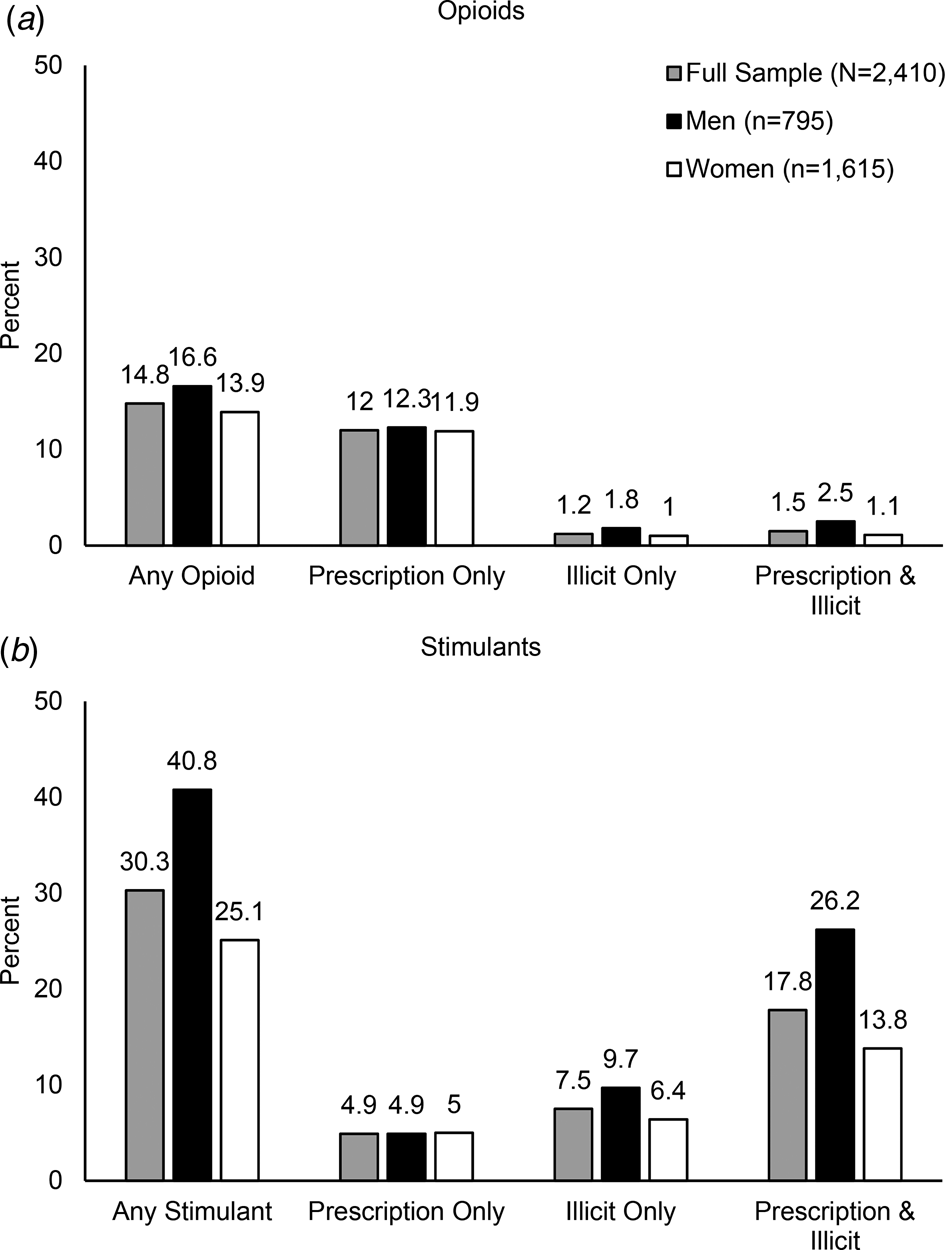
Prevalence of prescription misuse and illicit use for opioids and stimulants is presented in Fig. 1a and b (see online Supplementary Fig. S1 for prevalence by specific drug). Prescription opioid misuse (14%) was nearly 5 times as prevalent as illicit use (3%). Approximately half (55%) of individuals who reported illicit opioid use also reported prescription opioid misuse, though only 11% of individuals reporting prescription opioid misuse reported illicit opioid use. Prescription stimulant misuse and illicit stimulant use were of nearly equal prevalence (23% and 25%, respectively). Of the total, 70% of individuals who reported illicit stimulant use also reported prescription stimulant misuse and 78% of individuals who reported prescription stimulant misuse also reported illicit stimulant use.
Prevalence of opioid use (a) and stimulant use (b) in the full sample, men, and women.
Note: The three groups from the left are mutually exclusive; illicit opioids = heroin, opium; illicit stimulants = methamphetamine, ecstasy.

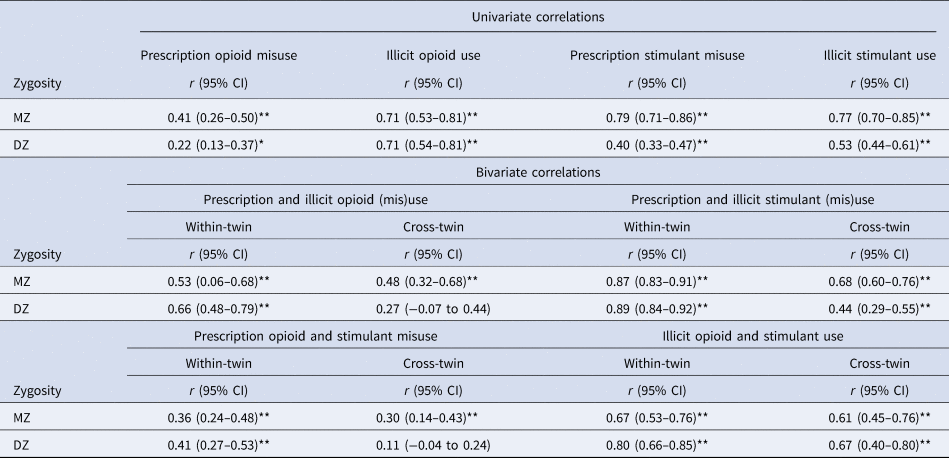
Twin correlations
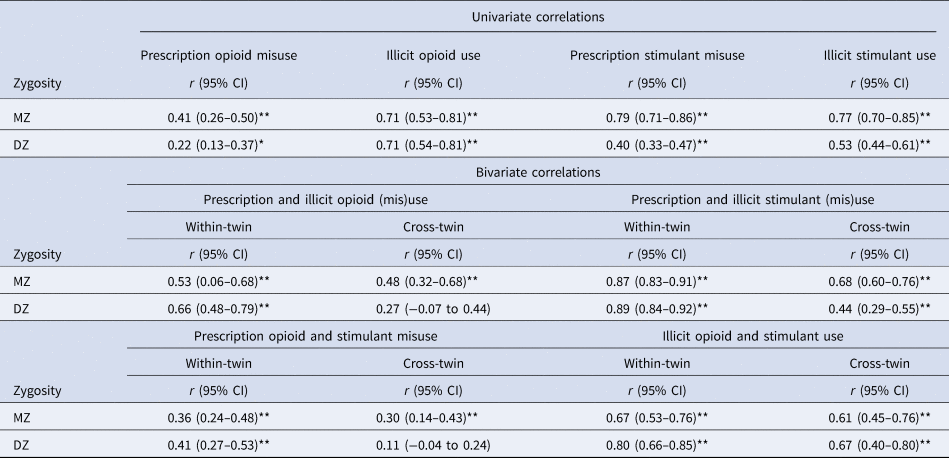
Twin correlations are presented in Table 1 (see Tables S1 and S2 in the online Supplementary Materials for correlations by sex and correlations specific to ecstasy and methamphetamine use, respectively). The pattern of correlations for opioids suggests that prescription misuse is influenced by genetic effects, but that illicit use is not. The pattern of correlations for stimulants suggests that both prescription misuse and illicit use are influenced by genes. Phenotypic (within-twin) bivariate correlations suggest that prescription misuse and illicit use are more strongly associated with stimulants (r = 0.87–89) than for opioids (r = 0.53–0.66).
Twin correlations of prescription misuse and illicit use
MZ, monozygotic; DZ, dizygotic.
**p < 0.001, *p < 0.05.
Opioids
Univariate model-fitting
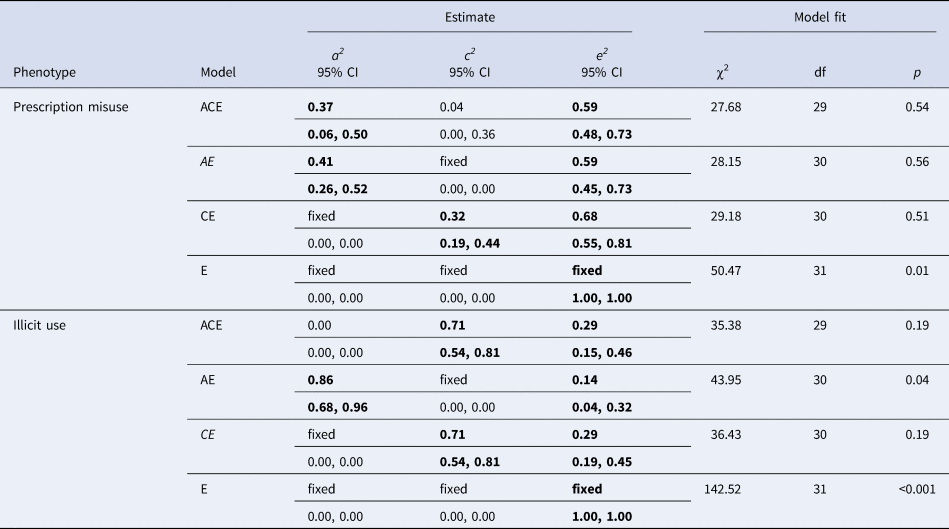
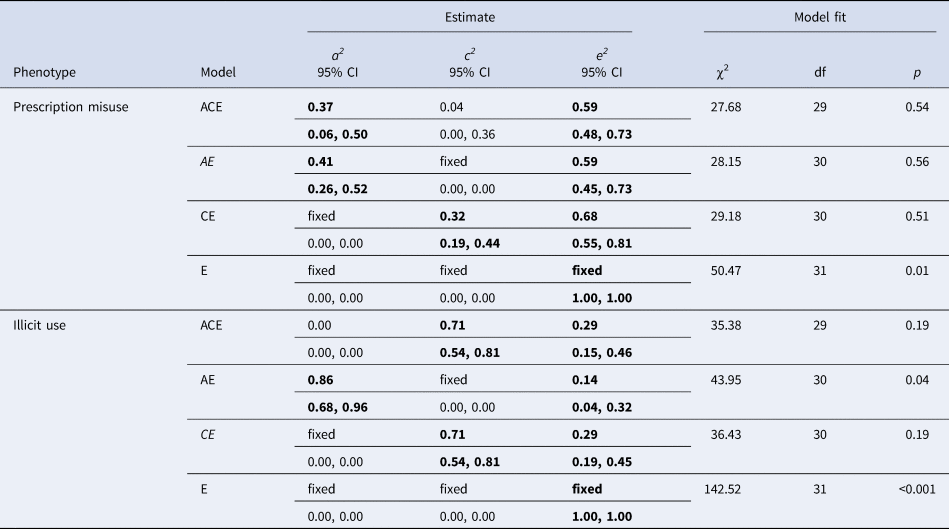
Results of univariate models of opioid (mis)use are presented in Table 2 (see Table S3 in the online Supplementary Materials for models testing sex differences). For prescription misuse, the freely estimated model reflected the significant influence of genes (37%) and unique environment (59%); the shared environmental parameter (4%) was nonsignificant and could be constrained to zero [Wald χ2(1) = 0.03, p = 0.87]. Under the AE model, heritability was estimated at 41%, with unique environmental influence accounting for the remainder of the variance. For illicit use, the freely estimated model reflected the significant influence of shared (71%) and unique (29%) environment; the heritability estimate (0%) was nonsignificant and could be constrained to zero [Wald χ2(1) = 0.00, p = 0.96]. Under the CE model, shared environmental effects were estimated at 71%, with unique environmental influence accounting for the remainder of the variance. Taken together, these results provide tentative support for the positive correlation hypothesis, such that the more prevalent behavior (prescription misuse) seemed to present with more genetic influence than did the less prevalent behavior (illicit use), which was most strongly influenced by shared environment.
Variation in opioid use propensity attributable to additive genetic (a 2), shared environmental (c 2), and unique environmental (e 2) factors
fixed, constrained to zero; CI, confidence interval; A, additive genes; C, shared environment; E, unique environment.
Bold indicates significant parameter estimate; italics indicate best-fitting model.
Bivariate model-fitting
In comparing the magnitude of variance accounted for by each component across prescription misuse and illicit use, constraining the shared environmental parameter to equality across opioid types significantly deteriorated model fit [Wald χ2(1) = 4.21, p = 0.04] and such a constraint neared significance for unique environmental influence, as well [Wald χ2(1) = 3.47, p = 0.06]. Additionally, in no case did the confidence intervals of the variance component estimates overlap for genetic, shared environmental, or unique environmental influence. It is generally accepted that non-overlapping confidence intervals correspond to statistically significant differences (though it should be noted that overlapping intervals do not necessarily correspond to a lack of statistically significant differences, as is often erroneously inferred; Cumming, Reference Cumming2009; Julious, Reference Julious2004), suggesting that the analysis may have been underpowered to detect apparent differences in the magnitude of genetic influence. Under a freely estimated model [χ2(53) = 61.75, p = 0.19], none of the bivariate correlations reached significance [r G = 0.39, 95% CI (0.00–0.59); r C = 0.08, 95% CI (−0.11 to 0.56); r E = 0.06, 95% CI (−0.14 to 0.18)].
Stimulants
Univariate model-fitting
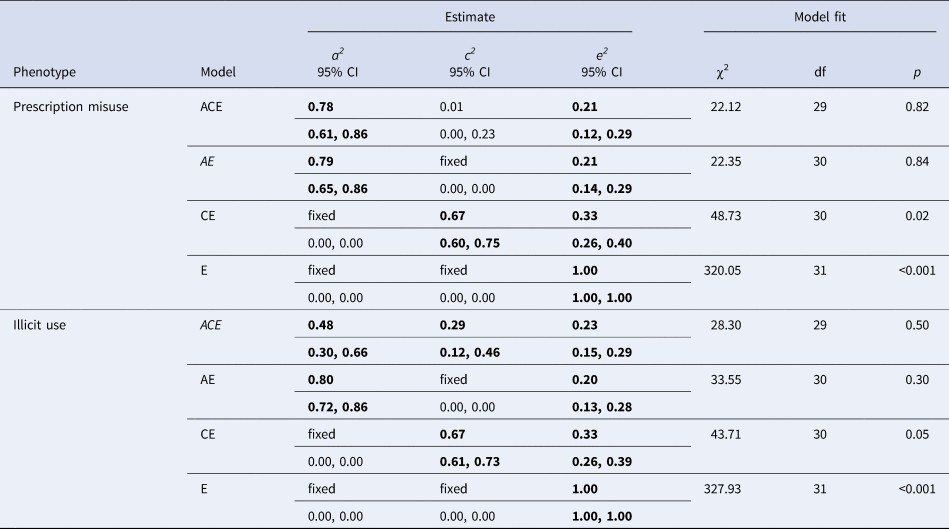
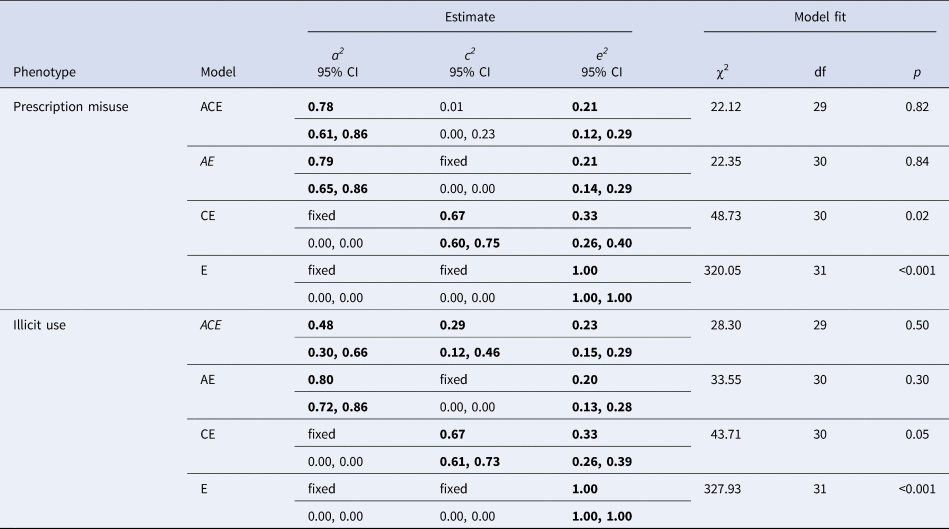
Results of univariate models of stimulant (mis)use are presented in Table 3 (see Table S4 in the online Supplementary Materials for models testing sex differences). For prescription misuse, the freely estimated model reflected the significant influence of genes (78%) and unique environment (21%); the shared environmental parameter (1%) was nonsignificant and could be constrained to zero [Wald χ2(1) = 0.00, p = 0.95]. Under the AE model, heritability was estimated at 79% with the remainder of the variance accounted for by unique environmental effects. For illicit use, the freely estimated model reflected the significant influence of genes (48%), shared environment (29%), and unique environment (23%). Neither the genetic [Wald χ2(1) = 21.26, p < 0.0001] nor the shared environmental parameter [Wald χ2(1) = 10.55, p = 0.001] could be constrained to zero, indicating the significant influence of genes, shared environment, and unique environment.
Variation in stimulant use propensity attributable to additive genetic (a 2), shared environmental (c 2), and unique environmental (e 2) factors
fixed, constrained to zero; CI, confidence interval; A, additive genes; C, shared environment; E, unique environment.
Bold indicates significant parameter estimate; italics indicate best-fitting model.
Bivariate model-fitting
In comparing the magnitude of variance accounted for by each component across prescription misuse and illicit use, constraining neither the genetic [Wald χ2(1) = 0.33, p = 0.57] nor shared environmental [Wald χ2(1) = 1.35, p = 0.25] parameter to equality across stimulant types significantly deteriorated model fit. Consistent with the degree of similarity across the prescription misuse and illicit use models, parameters could be constrained to equality simultaneously [Wald χ2(2) = 4.06, p = 0.13], suggesting that prescription misuse and illicit use display highly similar etiologies. It is difficult to interpret these results in terms of the positive and negative correlation hypotheses, as this sample had an unusually high rate of illicit stimulant use that was approximately equivalent to that of prescription stimulant misuse. These findings may reflect an idiosyncrasy of the present sample, as Australia has particularly high rates of illicit stimulant (and particularly ecstasy) use (Degenhardt, Barker, & Topp, Reference Degenhardt, Barker and Topp2004; Degenhardt et al., Reference Degenhardt, Roxburgh, Dunn, Campbell, Bruno, Kinner and Topp2009). In sum, the high degree of overlap between prescription stimulant misuse and illicit stimulant use may account for the similarity observed in these models.
Under a freely estimated bivariate model [χ2(53) = 45.18, p = 0.77], the genetic [r G = 0.68, 95% CI (0.06–0.79)] and unique environmental [r E = 0.20, 95% CI (0.13–0.27)] correlations were significant. The shared environmental correlation was nonsignificant, though highly imprecise [r C = 0.00, 95% CI (−0.01 to 0.71)], likely due to the lack of shared environmental influence on prescription misuse. This pattern suggests that common familial influences on prescription misuse and illicit use are attributable to genetic factors and that unique environmental influence also plays a role in their overlap. Again, such findings may reflect the substantial overlap between prescription stimulant misuse and illicit stimulant use in the present sample.
Bivariate model fitting of opioid and stimulant phenotypes
Prescription opioid and stimulant misuse
Under a freely estimated bivariate model of prescription misuse [χ2(53) = 46.68, p = 0.72], the genetic correlation was significant [r G = 0.35, 95% CI (0.00–0.53)], though marginally (p = 0.05). The shared and unique environmental correlations were not significant [r C = −0.05, 95% CI (−0.20 to 0.30); r E = 0.11, 95% CI (−0.04 to 0.14)].
Illicit opioid and stimulant use
Under a freely estimated bivariate model of illicit use [χ2(53) = 62.04, p = 0.19], there was a small but significant correlation in unique environmental influence across illicit opioid and stimulant use [r E = 0.09, 95% CI (0.03 to 0.22)]. The genetic and shared environmental correlations were nonsignificant [r G = 0.51, 95% CI (−0.10 to 0.68); r C = 0.11, 95% CI (−0.02 to 0.62)].
Discussion
The present study provides a novel examination of genetic and environmental contributions to opioid and stimulant use, with disaggregated effects of prescription misuse and illicit use. The results presented here support the idea of disaggregation by demonstrating potentially distinct etiologies across prescription opioid misuse and illicit opioid use. In line with hypotheses, prescription opioid misuse was most substantively influenced by unique environmental effects, though there was also evidence for genetic influences; contrary to expectation but in line with the positive correlation hypothesis, the propensity to use illicit opioids could not be attributed to genetic effects. Both stimulant types were influenced by genetic and unique environmental effects, and, in contrast to opioids, evidenced substantial overlap in genetic and environmental influence.
Shared environmental influence appeared to be unique to illicit drug use, emerging for illicit use of both opioids and stimulants. This is in line with previous findings that shared environmental influence predominates when social acceptability and prevalence are lower (Mezquita et al., Reference Mezquita, Sánchez-Romera, Ibáñez, Morosoli, Colodro-Conde, Ortet and Ordoñana2018). Shared environmental effects for illicit drug use have also been explained by drug availability (Gillespie, Neale, & Kendler, Reference Gillespie, Neale and Kendler2009). Relatedly, growing up in a neighborhood with more substance use opportunity both amplifies risk factors of parental and peer use and attenuates protective factors such as the perceived risk of use (Zimmerman & Farrell, Reference Zimmerman and Farrell2017). Perhaps such factors are a uniquely sustained influence in the context of illicit drug use.
The sources of variation in liability for prescription and illicit stimulant (mis)use were more similar to each other than they were for opioids. Parallel to the pattern observed for opioids, prescription stimulant misuse appeared more heritable (78%) than was illicit use (48%), though this difference was not statistically significant. Interestingly, illicit stimulant use presented with a far higher heritability estimate (48%) than did illicit opioid use (0%). This is in line with the positive correlation hypothesis, as this sample was characterized by a surprisingly high prevalence of illicit stimulant use and a comparably low rate of illicit opioid use (Fig. 1). Relatedly, rates of illicit use among people who misuse prescriptions were far higher for stimulants (78%) than for opioids (11%). This aligns with the substantial overlap of genetic and environmental influence across stimulant types and the contrastingly divergent influences across opioid types. These distinctions may help explain the differences across people who misuse prescription opioids and those who use illicit opioids observed in past research (Fischer et al., Reference Fischer, Fischer, Patra, Fischer, Patra, Firestone Cruz and Gittins2008; Rigg & Monnat, Reference Rigg and Monnat2015).
The low heritability estimate for illicit opioid use was surprising, though it is difficult to contextualize these findings within greater literature that almost uniformly includes prescription and illicit opioid (mis)use within a single category and estimates the role of genetic and environmental influence on this aggregate phenotype (though it should be noted that this is often due to prevalence limitations). Discrepancies in findings regarding the relative influence of genes and environment on opioid use (Kendler et al., Reference Kendler, Karkowski and Prescott1999, Reference Kendler, Jacobson, Prescott and Neale2003, Reference Kendler, Aggen, Tambs and Reichborn-Kjennerud2006; Van den Bree et al., Reference Van den Bree, Johnson, Neale and Pickens1998) may be attributable to the operationalization of opioid use as a single behavior encompassing both prescription misuse and illicit use, an explanation that may also help account for multiple findings of near-comparable fit of AE and CE models for aggregate opioid use phenotypes (Gillespie et al., Reference Gillespie, Bates, Hickie, Medland, Verhulst, Kirkpatrick and Benotsch2019; Kendler et al., Reference Kendler, Karkowski and Prescott1999, Reference Kendler, Aggen, Tambs and Reichborn-Kjennerud2006). The results of the present study reflected that an AE model best-captured prescription opioid misuse while a CE model best captured illicit opioid use, indicating that these previously equivocal findings in model fitting procedures may be attributable to combining discrepant phenotypes into a single variable, whose opposing effects then compete for variance.
Bivariate modeling reflected that there may be minimal genetic overlap across prescription opioid misuse and illicit opioid use. Such findings have important implications for genome-wide association studies (GWAS), which increasingly use drug-exposed case controls for studying subjects with opioid use disorder. Recent GWASs of opioid use disorder that has compared disorder cases to opioid-exposed controls have done so without specification of whether exposure or disorder was related to prescription or illicit opioids (Zhou et al., Reference Zhou, Rentsch, Cheng, Kember, Nunez, Sherva and Polimanti2020). This may be problematic in light of the potentially distinct sources of etiological influence across prescription opioid misuse and illicit opioid use, such that ‘mismatches’ in opioid type between subjects and case controls could confound gene discovery for opioid use disorder. That is, disaggregating prescription misuse and illicit use in gene discovery efforts, and particularly when defining control groups, may prove to be critically important if prescription misuse and illicit use are in fact genetically distinct.
Limitations
This study presents limitations. First, it is unclear how results from this Australian sample will generalize to other countries. Of particular note is that some opioids that are now prescription status in Australia were available over-the-counter during the period of data collection (e.g. Panadeine Forte), potentially limiting generalizability. Second, prescription misuse is a broadly defined construct and it may be important to further deconstruct this behavior into subtypes that more clearly reflect misuse of prescription medication (e.g. taking one's own prescription at a dose or for a purpose other than that for which it was prescribed) v. those that more clearly resemble illicit drug use (e.g. purchase and use of diverted medications on the black market; intravenous use of medications intended for oral administration). This may be particularly critical given that individuals who misuse prescription opioids in such an ‘illicit’ manner are more likely to progress to illicit opioid use (Carlson, Nahhas, Martins, & Daniulaityte, Reference Carlson, Nahhas, Martins and Daniulaityte2016). Additionally, illicit opioid use included both heroin and opium; though the latter represented a minority of illicit opioid users, it is less relevant to current opioid-related public health concerns. Relatedly, in line with population-level prevalence, the rate of opioid use in this sample was quite low and the models presented here may have been underpowered to detect genetic variance and genetic correlations between phenotypes (Neale, Eaves, & Kendler, Reference Neale, Eaves and Kendler1994; Verhulst, Reference Verhulst2017).
Conclusions
The differences observed across misuse of prescription opioids and illicit opioid use provide evidence of a divergence in risk factors, including in the role of genetic vulnerability to use. These differences in source and magnitude of liability may shed light on epidemiologic trends in the prescription opioid and heroin crises. Given that substance use is influenced by social, contextual, and procedural processes that vary in associated substance-specific risk, it may be important to characterize pharmacologically similar drugs by factors other than their chemical properties in research and in the development of public health approaches (Rigg & Monnat, Reference Rigg and Monnat2015). Tests of gene × environment interactions will be particularly valuable in this regard. Future research in samples with higher rates of prescription opioid misuse and illicit opioid use will be critical to further elucidate potentially unique etiologies of distinct opioid use typologies.
Supplementary material
The supplementary material for this article can be found at https://doi.org/10.1017/S0033291720005267.
Acknowledgements
This work was supported by the National Institute on Alcohol Abuse and Alcoholism (GFD, grant number T32AA013526) and the National Institute on Drug Abuse (AA, grant number K02DA32573; MTL, grant number R01DA18267).
Conflicts of interest
None.
Ethical standards
The authors assert that all procedures contributing to this work comply with the ethical standards of the relevant national and institutional committees on human experimentation and with the Helsinki Declaration of 1975, as revised in 2008.