Incentive-based policies and media coverage
Among the many policy tools that governments have at their disposal, behavioural nudges have recently been popularised as a way to encourage ‘responsible’ behaviour from citizens (Thaler and Sunstein, Reference Thaler and Sunstein2008; Selinger and Whyte, Reference Selinger and Whyte2011; Sunstein, Reference Sunstein2014). Nudges have come to be widely (and controversially) known as a type of ‘libertarian paternalism’ that curates citizens’ choices to produce positive outcomes (see Thaler and Sunstein, Reference Thaler and Sunstein2008: 6). By providing incentives to encourage ‘good behaviour’, governments can ostensibly nudge citizens toward self-help and problem prevention, alleviating the need for the state to step in and fix social ills later on. One area where nudge theory has taken hold is the incentivisation of savings behaviour; examples include tax-deferral or tax-free incentives around retirement, education or other long-term savings.
The Canadian government has instituted three publically available financial incentive programmes in the form of RRSPs (Registered Retirement Savings Plans), RESPs (Registered Education Savings Plans), and TFSAs (Tax-Free Savings Accounts). All three can be viewed as nudging citizens toward saving money for future goals by either deferring or eliminating the need to pay taxes on some portion of the savings or interest earned. While the design of these programmes pre-dates the vocabulary around nudges, each is a good example of a non-coercive, financial ‘self-help’ programme that is presumed to enhance household savings behaviour. These policies, while believed to provide successful incentives to save, have yet to be (a) explored as a unique policy instrument that encourages a particular set of behaviours around saving, (b) measured in terms of their success in securing the desired outcomes (i.e., the promotion of savings), and (c) studied as a potential outcome of the media-public policy reinforcement relationship.
The literatures on public policy and personal economic behaviour separately suggest that we should see incentives play a formidable role in shaping individuals’ habits (Stone, Reference Stone2002; Hilgert et al., Reference Hilgert, Hogarth and Beverly2003; Thaler and Sunstein, Reference Thaler and Sunstein2008). However, these literatures have only recently started to speak to one another, and when they do, they still lack a clear framework for understanding how external factors can mediate the impact of incentives on behaviour. In most cases, they all but miss the critical intervening relationship media play in their role of reminding and encouraging individuals to access incentive programmes. This paper helps to remedy this oversight by introducing media as a vehicle for nudge promotion or the framing of an individual's ‘choice architecture’ (Thaler and Sunstein, Reference Thaler and Sunstein2008: 6) in a way that encourages a path towards savings for late-life financial security.
The following is a theoretical examination of incentive-based policies and an empirical test of the real-world outcome of one particular policy, Canada's Registered Retirement Savings Plan. Using aggregate province-level RRSP contribution data from 2000 to 2013 measured against quarterly media data, I demonstrate that media impact the relationship between incentives and the propensity to save. To further explore the relationship at the individual level, I use the Canadian Financial Capability Survey (2009) to establish links between individual-level media use and incentivised savings. Results suggest that incentives should be carefully considered as profitable, but ultimately limited, in their influence among the many policy tools available to governments (see Rowlingson and Connor, Reference Rowlingson and Connor2011 for a similar argument in other areas of social policy). If behaviour toward RRSP contributions is an indication of general personal economic behaviour, then financial incentives such as tax-deferral or tax exemptions may not be as strong as intended by policymakers. Indeed, the success of these policies may be more reliant on a series of smaller, but more routine, media cues that serve to reinforce incentives over time. These reinforcements, however, appear to disproportionately benefit some groups over others, and are contingent on the type of media that individuals absorb. Governments, consequently, should examine the lack of adherence to incentive programmes in greater detail, and take into consideration what role media can and already do play in encouraging the use of incentives. To the extent that retirement is considered a necessity with age, we might expect the impact of less-essential incentive-based savings programmes (e.g., rainy day funds or future educational savings) to be less compelling, and therefore more of a government promotional tool than a productive mechanism for social policy change.
Incentives as Policy Instruments
Scholars have pointed to a wide array of tools available to and used by policymakers to promote outcomes, ranging from capacity-building to carrot and stick policies that reward and punish certain behaviours (Hood, Reference Hood1983; Howlett et al., Reference Howlett, Ramesh and Perl1995; John et al., Reference John, Cotterill, Moseley, Richardson, Smith, Stoker and Wales2011). Throughout the vast amount of literature that looks at policy tools, various studies have pointed to incentives as a meaningful way to structure behaviour, although few go into great depth on their application or utility. According to Schneider and Ingram (Reference Schneider and Ingram1990: 515), incentives provide ‘tangible payoffs, positive or negative, [that] induce compliance or encourage utilisation’, and are therefore useful tools in encouraging compliance without overt force. Though the policy literature often refers to tools that address both positive (e.g., credits) and negative (e.g., sanctions and force) actions, incentives provide a promise of reward that motivates individuals to behave differently than they might otherwise. Examples of incentives in this context include cash bonuses, tax exemptions, grants, or credits for reducing energy usage.
Pre-dating Thaler and Sunstein's nudge argument, Deborah Stone's account of incentives or ‘positive inducements’, suggests that government has within its toolbox a set of non-coercive tools that can, when applied correctly, encourage cooperation and engender goodwill from citizens (Reference Stone2002: 273). When applied as voluntary programmes, incentives are low-cost, low-manipulation tools that require little of government officials outside of initial policy development. Should citizens decide not to take up incentives, the policymaker does not lose out on resources (only opportunity) and is not responsible for further action (Smith et al., Reference Smith, Marsh and Richards1993; Howlett, Reference Howlett2013). Typically, even where these policies fail to take hold, the outcome is the preservation of the status quo.
Incentives, of course, have drawbacks insofar as they rely on various assumptions about human behaviour that may be inaccurate and inconsistent. The use of incentives requires that individuals are rational (even accepting that rationality may be bounded), goal-oriented, have clear, fixed preferences, adaptable, and have an orientation toward the future. These types of programme make assumptions about individuals’ willpower to stick with incentive programmes (typically those that pay off down the road) and their capabilities to determine optimal levels of involvement in incentive programmes (Thaler and Sunstein, Reference Thaler and Sunstein2008: 104). Of course, as policymakers will suggest, assumptions of rationality are often flawed, thereby limiting the practical application of non-coercive policies.
Incentives have contextual drawbacks as well. First, individuals have different sets of preferences and may only attend to incentives that are salient at that moment. Individual perspectives are activated differently, depending on the way people interpret their surrounding context, estimate their personal longevity, or rely on future luck or success to pay off debts incurred in the present. Inducements also suffer from temporal effects; those incentives that pay off down the road are likely to have a smaller impact on behaviour than those that pay off immediately, placing a discount rate on future penalties and rewards (Stone, Reference Stone2002: 268). Similarly, the ‘novelty’ of the incentive may impact behaviour insofar as recently introduced incentives are more likely to be advertised or receive promotion than those that have been around for decades.
While the prospect of personal payoff may incentivise behaviours, the literature also suggests that there may be duty-oriented motivations behind individuals’ decisions to access policy incentives. The literature on personal responsibility and self-governance (Etzioni, Reference Etzioni1996; Rimke, Reference Rimke2000; Foucault, Reference Foucault, Rabinow and Rose2003), renewed by the Blair government's Third Way policies (Giddens, Reference Giddens2000; Dwyer, Reference Dwyer2002; Such and Walker, Reference Such and Walker2005), suggests that the neo-liberal state can use incentives to cultivate ‘governable persons’ who will align their personal goals with the larger goals of the state (Miller and O’Leary, Reference Miller and O’Leary1987). Incentives therefore become opportunities for citizens to promote their own well-being while benefitting the state, although this motive is not often prioritised, if even recognised, by citizens. In some interpretations, incentives give people a role to play in the efficiency of government operations, and the denial of this role may be perceived as the deprivation of agency (Hyde and Dixon, Reference Hyde and Dixon2009: 121). Incentives should, according to this line of thought, ideally encourage citizens to become reflexive in their decisions and behave in a way that promotes personal responsibility for social well-being (Rose and Miller, Reference Rose and Miller1992: 174; Hoggett, Reference Hoggett2001).
As this strain of thought relates to retirement savings, there has been a recognition that incentivising planning and saving contributes to, and is spurred on by, a government-led discourse that describes the (ideal) individual first as a ‘thrifty and industrious worker’, and then an ‘efficient retiree’ who contributes to the economy by minimising consumption of government resources (Dwyer, Reference Dwyer2002; Graham, Reference Graham2010: 25). This view argues that governments use incentives in retirement savings to promote a ‘self-help’ or ‘do-it-yourself’ approach to late-life financial security, where the individual saves voluntarily and is able to improve their future financial well-being, thereby enhancing their autonomy through greater financial freedom than might be gained through state pensions alone (Klein and Millar, Reference Klein and Millar1995; Rimke, Reference Rimke2000: 62; Rowlingson, Reference Rowlingson2002). The value to policymakers in encouraging this perspective is obvious: if the citizen believes that she has a responsibility to provide for her own retirement (either through personal or private sector workforce pensions), the state's burden around retirement security is relaxed. This approach has become particularly salient in the face of governments realising that they cannot provide full social support to citizens in all aspects of health and social welfare (Giddens, Reference Giddens2000; Ring, Reference Ring2005).
Incentives have the most value to government and citizens when they are in use. An ignored incentive tends to result in the preservation of the policy status quo. Promotion, therefore, is essential to incentive-based policies. To a certain extent, governments are able to promote or advertise incentive policies over time to ensure they are well known to the public. However, there is a risk of governments being viewed as backing away from their social policy commitments if they promote personal savings at the expense of government social security provision. In many cases, governments may not have the resources or inclination to promote incentive-based policies; therefore, it may benefit government more to create an incentive and leave promotion to other sectors.
Incentives and Media Promotion
Media, the largest and most consistent provider of policy information, are some of the main providers of free-advertising that government incentive programmes need to succeed. In liberal market media environments, where the press and the state are unaligned (Hallin and Mancini, Reference Hallin and Mancini2004), media can rarely be accused of doing government's job for them. In fact, there is considerable evidence that media tries to distance itself from government to ensure credibility, particularly with respect to policy (Graber, Reference Graber2003; Norris et al., Reference Norris, Kern and Just2013). However, media, with their formidable volume of reporting dedicated to business and the market, play a particular role in information supply and influence on personal investment and financial management (Dyck and Zingales, Reference Dyck and Zingales2003; Tetlock, Reference Tetlock2007).
There is considerable evidence that media attentiveness impacts savings and investment behaviours as well as perceptions of the economy, financial markets and the purchase or sale of assets (Hester and Gibson, Reference Hester and Gibson2003; Vickerstaff, Reference Vickerstaff2006; Engelberg and Parsons, Reference Engelberg and Parsons2011; Soroka, Reference Soroka2012). Similarly, the volume of reporting or salience of a topic in the news also impacts investor behaviour, often encouraging bullish financial behaviour (Barber and Odean, Reference Barber and Odean2008: 288), as do messages that confirm long-standing priors, such as the benefits of savings (Mullainathan and Shleifer, Reference Mullainathan and Shleifer2002). Of course, in finance, just as in every other field, media is prone to report the sensational. This typically translates into punctuations in the normal news cycle, with a higher volume of reporting on panics and crashes (Kindleburger, Reference Kindleburger1989) or what Shiller (Reference Shiller2000) refers to as the ‘irrational exuberance’ of speculation. This suggests that an attentive (and reactive) intake of news may result in erratic financial decision-making or, more likely, decision-making that is less sensitive to short-term fluctuations and more susceptible to media movement in the aggregate (Barber and Odean, Reference Barber and Odean2008; Lusardi and Mitchell, Reference Lusardi and Mitchell2008).
Despite the considerable evidence that media impact personal financial decision-making, we are left without a clear picture as to how this relationship has evolved. Research by Clark (Reference Clark2000) and Clark et al. (Reference Clark, Thrift and Tickell2004) suggests that, from the late 1980s onward, government, media and the finance industry jointly created the right conditions for individual investors to participate in the market. Through increasing consumer protections and banking regulations, governments provided an adequate regulatory framework; through supplementary advertising, media increased financial literacy and access to financial products (Greenfield and Williams, Reference Greenfield and Williams2001, Reference Greenfield and Williams2007). The consequence of these changes was that the vocabulary of investment, once largely restricted to professionals in the finance industry, became sufficiently ‘middle class’, largely because of its introduction through the mainstream media (Clark et al., Reference Clark, Thrift and Tickell2004: 292). A cottage industry built up around personal financial management: day trading, personal brokerage accounts, and individual investment management gained traction, feeding ‘self-help’ and DIY approaches to personal financial management. Personal retirement savings grew substantially in this time (Clark, Reference Clark2000). This shift, coupled with existing government programmes, encouraged individual savings through tax incentives and resulted in a culture where individuals were given a larger number of tools to take control of their future savings.
If we assume that media in liberal democracies are not a wing of the government and also independent of the financial industry, both of whom stand to gain from investment in RRSPs (through the reduction of social policy burden for the former, and increased use of the financial products for the latter) it is almost curious that media would bother promoting this incentive-based policy. Media's motives may be benign (media are simply informing Canadians of their ability to cash in on a worthy incentive-based programme) or purposive (media are responding to lucrative financial industry advertising). Motives aside, tracking the content and tone of media reporting on retirement savings permits a test of the hypothesis that an increase in media advertising should prompt individuals to save more.
Personal retirement savings: The Canadian case
Canada, noted for its combination of liberal market economic policies and a social democratic welfare state is a clear case of the state-led and media-accentuated trend toward personal financial responsibility. The Canadian pension system, similar to other Western nations, is comprised of universal benefits (Old Age Security and the Guaranteed Income Supplement for low-income seniors), earning-based contributions (the Canada / Quebec Pension Plans), and private savings (employer pension plans and personal savings). In 1957, the federal government instituted a tax-deferral incentive-based programme, the Registered Retirement Savings Plan (RRSP), which allows individuals to direct a portion of their yearly income into tax-deferred retirement savings, subject to a maximum based on their income. Though the programme was initially underutilised (Frenken, Reference Frenken1990), changes to the Income Tax Act in 1971 gave investors greater freedom to seek out various financial products to invest their savings (Graham, Reference Graham2010). Further policy changes in 1986 allowed investors greater freedom to withdraw income in retirement in any combination of annuity or lump sums. Ostensibly, the intention of this policy intervention was an increase in the incentive for individuals to save for their own retirement.
The advantage to RRSP holders is that contributions to the account are subtracted from yearly income and therefore not taxed in that tax year. Rather, taxes are deferred to the time when the individual chooses to withdraw the money for retirement purposes (usually after the age of 60)Footnote 1. The incentive is two-fold: contributions in the current tax year reduce the individual's tax burden in their earning years, and withdrawals taken in retirement are usually subject to a lower tax rate (since retirees typically require and have access to less income than they might in their working years). Though the financial incentive is clear, the programme has been criticised for favouring high-income earners, reproducing wage-based inequalities that are evident both in the employment system and in the earning-related component of government pensions (e.g., CPP/QPP) (Rice and Prince, Reference Rice and Prince2013: 163).
Adherence to the RRSP programme also has advantages for governments in reducing the number of low-income Canadians qualifying for Guaranteed Income Supplement (GIS) (Little, Reference Little2008). The declaration of personal retirement savings on income taxes also benefits the state by clawing back retirees’ government-funded Old Age Security (OAS) benefit. As evidenced in their proposal of the Pooled Registered Pension Plans (PRPPs) – a collective RRSP-like option for those lacking workplace pensions – Conservative Minister of State (Finance) Ted Menzies contextualised the advantages of personal savings in the language of self-actualisation of long-term goals: ‘Canadians work hard to realise their retirement dreams, PRPPs will offer [Canadians] a new, low-cost and accessible pension option to help meet their goals’ [CPC 2011–119].
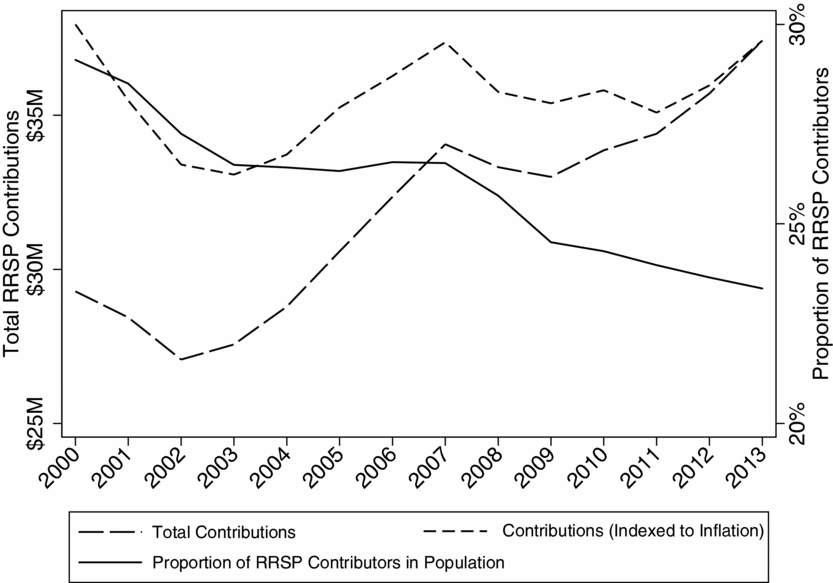
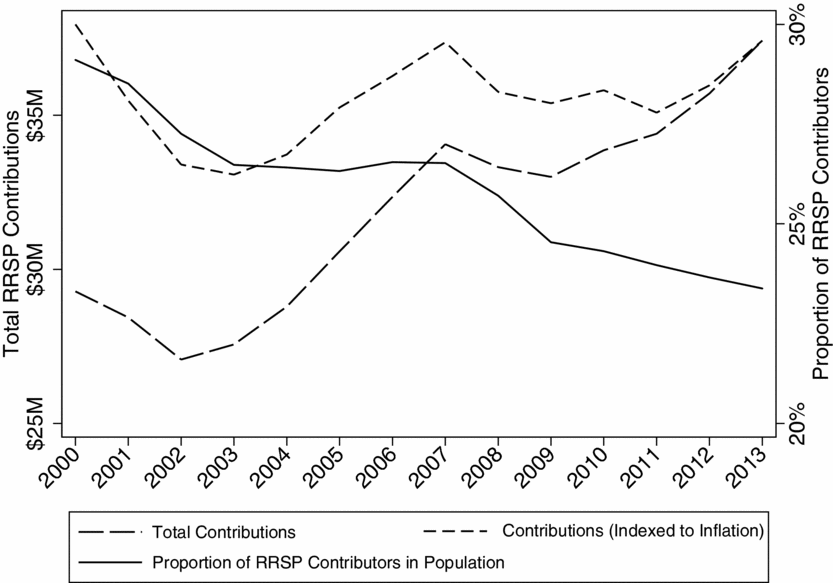
Over the 14 years (2000–2013 inclusive) Canada has seen two opposing trends take hold with respect to RRSPs. First, the total volume of contributions has remained strong (increasing, in real numbers, from less than $30 million to over $35 million) (see Figure 1). Even with the economic downturn of 2008–2011, contributions were resilient (accounting for inflation). Second, the proportion of RRSP contributors as a proportion of total taxpayers (i.e., eligible contributors) has decreased in this time frame from over 29 per cent to fewer than 24 per cent. Trends are consistent across Canadian provinces.
RRSP Landscape, Canada 2000–2013
Data & Methods
The following analysis has two components: aggregate and individual-level analysis. The aggregate analysis compares print media content (which would have significant cross-over with their companion online websites) to RRSP contribution levels. The dependent variable is the median RRSP contribution per year (collected from Statistics Canada) from 2000–2013, by province (territories are grouped together) (N = 154). Since savings are known to vary between men and women (Lusardi and Mitchell, Reference Lusardi and Mitchell2008), a supplementary analysis looks at contribution rate by gender. Media data are obtained from national news sources; regional news is excluded, as it is not expected to vary widely in reporting on issues such as personal finance. Since yearly contributions are calculated as of 60 days into the following tax year, media data from Canada's two national newspapers, The Globe and Mail and the National Post are obtained from Dow Jones’ Factiva from 1999 to 2013 (a one-period lag from the starting point of the RRSP data). The database contains both articles released in print, most of which are reproduced on the newspapers’ websites. The media database contains articles that mention the terms ‘RRSP’ or ‘retirement savings plan’ in the headline or lead paragraph of the article. This amounts to a total of 7165 articles once duplicates are removed.
Media data are coded for topic and tone using the text analysis programme Lexicoder, which takes a simple bag-of-word approach to text analysis, counting the frequency of term mentions from a user-defined dictionary. This analysis focuses on two types of mentions in the larger body of RRSP-related news: those that refer to the incentive aspect of RRSPs and those that refer to the complex financial or investment aspect of RRSPs. I hypothesize that an increase in incentive mentions will encourage contributions, but that an increase in complex financial or investment-related language will have a dampening (but not necessarily a fully discouraging) effect on contributions.
To measure these mentions, I create two categorical dictionaries – each corresponding to the frequency of mentions for each topic. The incentive dictionary includes words and phrases such as ‘tax benefit’ or ‘retirement security’ that signal the positive aspects of accessing the RRSP programme. The financial dictionary contains terms such as ‘hedge fund’ or ‘money markets’ that signal the complexity of the investment market.Footnote 2 Finally, I use a separate dictionary to measure the tone of each article. A negatively toned article should have a discouraging effect on contributions, while a positively toned article should encourage contributions. The tone dictionary used is the Lexicoder Sentiment Dictionary, which has been tested to show high levels of inter-coder reliability with human coders (Young and Soroka, Reference Young and Soroka2012).
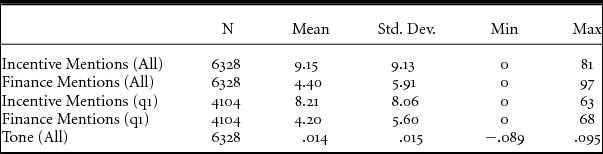
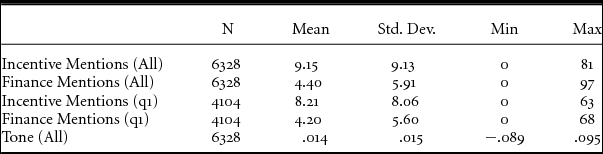
Descriptive statistics of the media data show that the incentive score (measured as the number of incentive terms used per article) ranges from 0 to 92, while the financial score ranges from 0 to 97 (see Table 1). Because using a raw score may be impacted by cyclical effects (i.e., because there is a yearly, fixed contribution deadline of 60 calendar days into the new year and the number of mentions are expected to increase in the quarter leading up to that time), I also include mean number of mentions for first quarter reports only, which is 8.02 for incentive mentions and 4.40 for finance mentions. Using the media data and financial data obtained from StatsCan on yearly contribution rates by province, I suggest the following model to account for the influence of media content and tone on savings:
News Media Descriptive Statistics
Data Source: Globe and Mail and National Post 2000–2013.
Savt = α1 + ßInct-1 + ßFint-1 + ßTonet-1 + ßUEt-1+ ßDowt-1+ e
where: Savt represents the median RRSP contribution per year as a total of income, (unit of analysis is median RRSP contribution per province); ßInct-1 is the number of incentive mentions in media content in the quarter leading up to the contribution deadline (recall that the contribution deadline for a given year is 60 days after the beginning of that calendar year); ßFint-1 is the number of finance mentions in media content in the quarter leading up to the contribution deadline; ßTonet-1 represents the tone of media coverage of RRSPs in the quarter leading up to the contribution deadline; ßUEt-1 is the provincial rate of unemployment in the previous quarter (assuming that real-world variables, particularly employment status, may impact individuals’ drive to save), and; ßDowt-1 is the change in the Dow Jones Market Return from the previous quarter (assuming that news of positive returns on investments may further incentivise individuals to save). While the model is not a fully nuanced picture of the many contextual factors that may influence use of the savings programme (i.e., it is unable to account for personal factors such as knowledge of the savings programme, available discretionary income, family size or existing debts), it does go a long way toward accounting for media as a dynamic measure of influence.
The second component of the analysis looks at individual-level relationships between media intake and RRSP contributions through survey data using the Canadian Financial Capability Survey (2009). The dependent variable is the amount contributed to an RRSP. The survey samples a total of 15,519 Canadians, asking questions related to financial literacy, financial management, investments (since size of contribution may be influenced by returns on other investments held by contributors), and household management dynamics. The data also include measures of media intake (newspaper, magazine, internet, television, etc.). Because response rates for the media questions were contingent on the respondent answering ‘yes’ to a series of questions that asked whether they ‘personally keep an eye on’ any aspect of finance in the media, the sample is reduced to just under 5000 respondents, a smaller, but still robust, sample. Weights are used in all analyses to adjust for sampling biases in the data that may occur as a result of telephone surveying.
One caveat bears mentioning before proceeding with analysis. While contributions to retirement plans are not compulsory and there is currently no legal framework that governs or even encourages auto-enrolment (though this idea has been considered by the Conservative government as a part of their proposed Pooled Retirement Pension Plan), some individuals who contribute to RRSPs are enrolled in personal or workplace-matched monthly contributions. Individuals who are locked into these types of monthly contributions may be less likely to be impacted by media advertising of the incentive of contributing to RRSPs in the months leading up to the contribution deadline. Unfortunately, the data provided by Statistics Canada does not differentiate between regular contributors and sporadic contributors. While this fact may diminish the effectiveness of the media-contribution relationship posited here, it remains true that it has become a common practice for individuals to make a last minute or pre-deadline supplementary contribution to decrease their taxable income. Therefore, it is plausible that even these individuals may be influenced to some degree by media.
Results
Aggregate RRSP contribution data
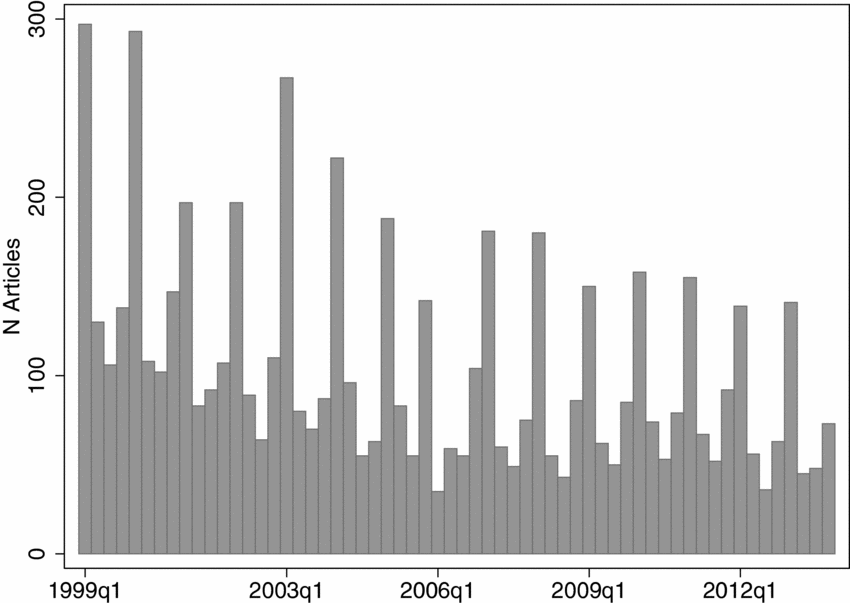
The volume of news stories that feature coverage of the Registered Retirement Savings Plan has dropped substantially in the past fifteen years (see Figure 2). This may be on account of a broader decrease in the overall volume of print reporting (even though the database does account for online news as well) and the reduction in the size of print newsrooms in the past two decades. Despite overall decreases, the cyclical nature of the RRSP contribution cycle is mirrored in the media. Looking at the aggregate number of stories featured in major newspapers, first quarter reporting is always substantially higher than the two quarters that follow it. Fourth quarter reports also tend to show a slight increase in RRSP coverage leading up to year-end when media start to prompt the importance of contributions. Even when we take into account larger systemic declines in print media reporting, we can still find evidence that media tends to increase their mentions of the RRSP programme just before the deadline approaches.
Total RRSP Stories Over Time

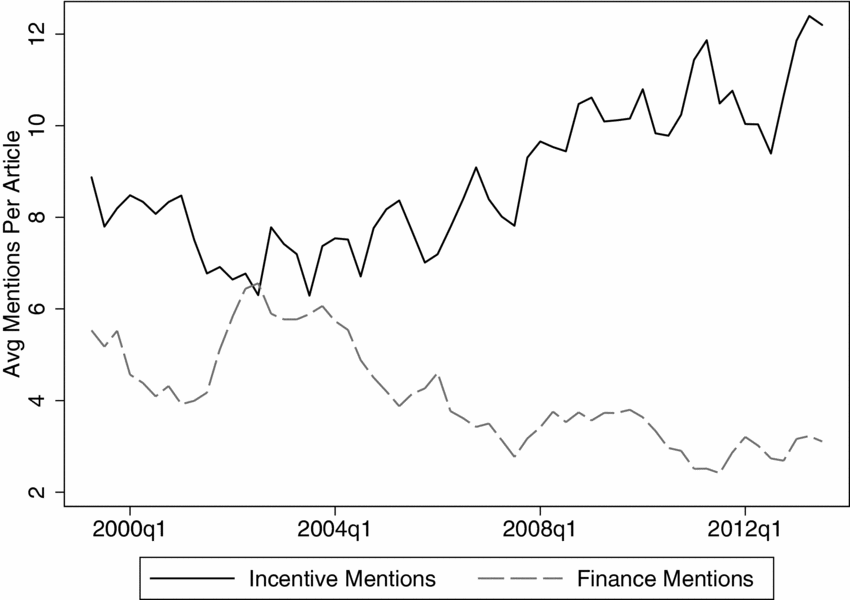
While the change in the volume of stories is relevant to this discussion, so is their content. Figure 3 illustrates the quarterly moving average of the number of incentive and finance mentions per article. If we believe that an increase in coverage of the incentive aspects of the RRSP programme may further nudge individuals to make use of this programme, there is evidence to suggest that media has taken up the cause of making this incentive-based programme more attractive to savers in the years covered here. Simultaneously, we see a steady decrease in reporting using complex financial language (e.g., investment, market-oriented) in RRSP news stories from 2004 onwards.
Incentive Mentions vs. Finance Mentions
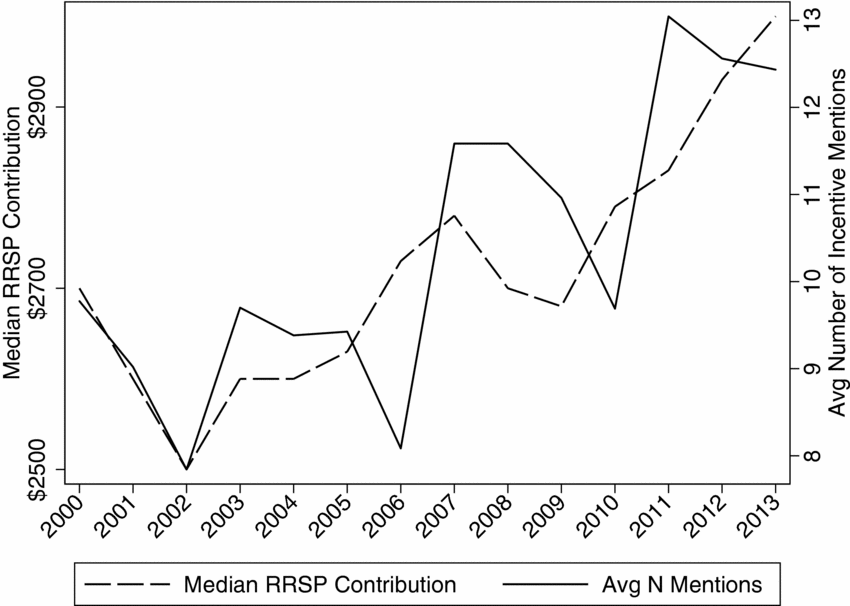
Might these media trends have any relationship to aggregate RRSP savings trends? Figures 4 and 5 suggest that the relationship between media and contributions may be a plausible explanation for contribution rates. Figure 4 tracks the average number of incentive mentions (per article) using first quarter media data only, alongside the median RRSP contribution in Canada. While the relationship is imperfect, there appears to be some similarity between the frequency with which media reference incentives in the quarter leading up to the contribution deadline and the median contribution rate. In particular, both take a sharp dive in 2002, rebounding by 2004. While there is some incongruence around 2006 and 2010, both instances appear to get back on track in the following year.
Median RRSP Contribution, Tracking Number of Incentive Mentions
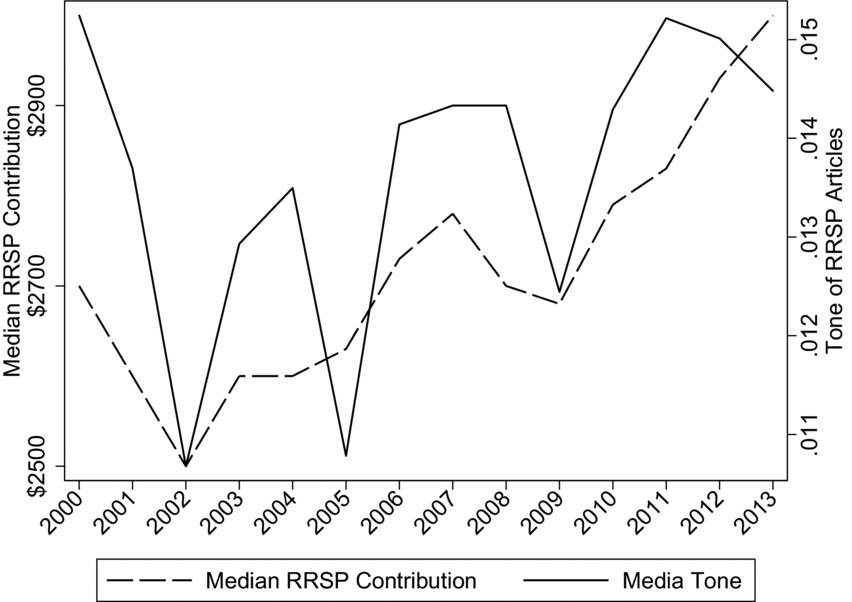
Median RRSP Contribution, Tracking Tone of RRSP Articles
If we consider the tone of these articles (e.g., whether the reporting was, on balance, more positive or negative), we again see some similarities in movement (see Figure 5). News reporting becomes less positive in 2002, coinciding with a drop in median savings rates, rebounding in 2003. This downward spike coincides with reports of ‘rockier markets’ (Marron, Reference Marron2002) and an emphasis on safer investments over riskier tools (Chevreau, Reference Chevreau2002). A similar cautionary tale is forwarded in 2005 by media reports but, from 2006 onwards, positive reporting in the quarter leading up to the contribution deadline tends to co-occur with higher median contribution rates.
To summarise: since 2000, there has been an increase in the volume of money that Canadians have saved for retirement using the RRSP incentive programme. The overall number of Canadians who are saving, however, has declined, suggesting that fewer people are saving more money using the RRSP incentive programme. At the same time, media coverage on the subject of RRSPs is declining overall, but mentions of the incentive aspects of the programme are on the rise. The tone of these mentions is also becoming more positive, suggesting that the media characterisation of the programme is largely focused on the positive benefits of the incentive aspect of the programme. Over time, it appears that media are becoming more positive and increasing the number of mentions of incentives in the period leading up to the contribution deadline, but this correlation can be subjected to further scrutiny using cross-provincial time series data.
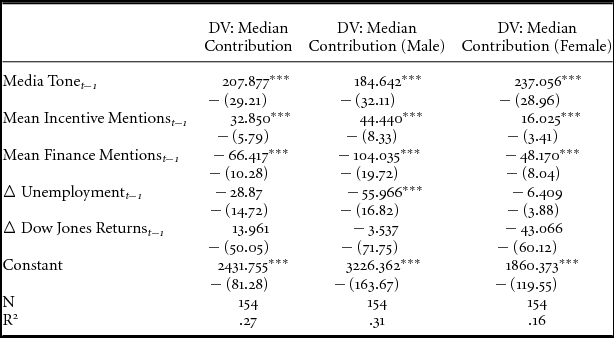
Recall the above model that suggests that savings is a function of media content (i.e., positively impacted by the number of incentive mentions, potentially negatively impacted by the number of finance mentions), controlling for the real-world impact of unemployment and market returns (using the change in Dow Jones returns). The results in Table 2 further support the connection between media tone and content and median RRSP contribution. On average, a one unit increase in quarterly media tone accounts for a $207 increase in the contribution rate (p <.001). A single unit increase in incentive mentions in the first quarter is related to a $32 increase in contributions (p <.001). As predicted, the relationship between the intensity of finance mentions is negatively associated with contributions, decreasing contributions on average by $66.
Median RRSP Savings and Media Content (By Province)
***p<0.001, **p<0.005, *p<0.01
These relationships hold when separating out median contributions by gender, with some interesting variation (contact author for other socio-demographic breakdowns). Women appear to be influenced more by the tone of media, and substantially less by the number of incentive mentions. Men appear to be more negatively impacted by the number of finance mentions – a somewhat counterintuitive result if we consider the volume of literature that suggests that women are more turned off investing by complex financial language. However, this finding could equally suggest that financial language turns men away from using the RRSP as a savings vehicle toward using risker investment vehicles in unregistered accounts that are more accessible in the short term. Finally, neither the unemployment rate nor the change in the Dow Jones market returns appear to have a significant relationship with investment for either gender suggesting that RRSP contributions (among the proportion of the population who contribute) are not as reliant on real-world economic and financial indicators as anticipated.
Individual-Level Data
The relationship between media and RRSP contributions appears to be tenable when looking at aggregate data. But is there an observable link between participation in the RRSP and news media consumption? The Canadian Financial Capability Survey (CFCS), fielded in 2008 and released in 2009, asked questions related to the type of media that individuals consume as well as their investment history, including the value of their RRSP. While these data cannot provide a meaningful look at trends over time, they do allow a glimpse at whether or not there appears to be a link between the amount that an individual saves and whether they use media as a source of advice for financial investments.
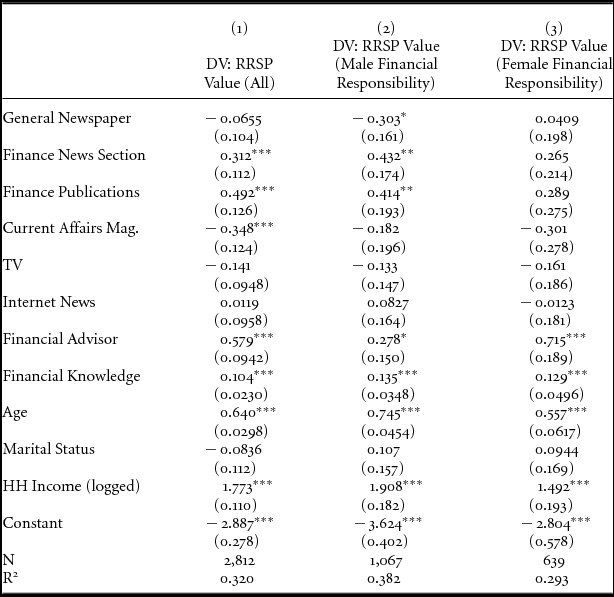
Table 3 shows Ordinary Least Squares (OLS) regression coefficients for all respondents who reported that they have an RRSP. To get at media consumption, I use the CFCS’ questions on which information sources the individual uses to get financial advice; these are a series of binary indicators asking whether an individual relies on the newspaper, the financial section of the paper, financial publications (e.g., Canadian Report on Business), television, the internet, etc., for their financial advice. The three models presented here look separately at (a) all respondents, (b) respondents who live in a household where a man has predominant financial responsibility, and (c) respondents who live in a household where a woman has predominant financial responsibility. All models include controls for age, marital status, household income (logged), whether the individual consults a financial advisor, and personal financial knowledge (constructed as a scale of correct answers to a series of financial knowledge questions in the survey).
Personal Savings and News Exposure
***p<0.001, **p<0.005, *p<0.01; Robust standard errors in parentheses
Results suggest that media exposure does appear to impact the amount that an individual puts aside in an RRSP, but moreover that consumption of certain media types has a profound effect on savings, whereas others have none. In the first model, general newspaper reading has no perceptible impact on savings level. On the other hand, reading the financial section of the newspaper and/or speciality finance publications has positive and significant impacts (.31 and .49, respectively, p<.001) on the amount an individual has saved in their RRSP (controlling for relevant socio-demographic factors). Interestingly, television and internet news access has no effect on savings, and reading current affairs magazines (e.g., Macleans, Newsweek) actually has a negative impact on savings. This potentially signals the negative effects that ‘pop financial advice’ may have on long-term investing skills. These findings notwithstanding, traditional socio-demographic variables such as income and age in particular, have a much stronger overall impact (1.73 and .64, respectively, p<.001), as does having a financial advisor. Therefore, the role of media in impacting RRSP savings is certainly contributory, but the traditional explanatory variables around savings are still predominant.
Gender is known to be a critical variable in understanding long-term savings habits. Men are known to be more risky and overconfident in their financial decision-making, whereas women are known to be more financially conservative and risk-averse (Barber and Odean, Reference Barber and Odean2001). Models 2 and 3 break down the relationship between news consumption and RRSP value, looking separately at households where one individual is responsible for long-term investment and financial decision-making. In households where men have financial responsibility, we see the same patterns as above replicated with some slight variation. Reading the financial news section of the paper appears to have a stronger impact in households with men making financial decisions. Interestingly, however, reading the general news (e.g., non-finance sections) has a negative and significant impact on these households. The same patterns with respect to age, income, financial knowledge and the impact of having a financial advisor also hold.
In households where women have financial responsibility, the media effect disappears. All forms of media from general newspapers to financial news and television appear to have no impact on level of savings. Given what the existing literature reports on gender divisions in household financial management (Woolley et al., Reference Woolley, Hui and Vincent2013), this may not be surprising. Indeed, model 3 shows an interesting finding when compared to its counterpart for male financial households: the retirement savings impact of having a financial advisor is three times that of their male counterparts. Women who take care of financial decision-making appear to rely on the advice of their professional financial advisor and not the media to any discernable degree. This is particularly interesting in light of the fact that 39 per cent of female respondents report having a professional financial advisor as opposed to only 34 per cent of male respondents.
The 2009 CFCS points to a connection between news consumption and higher RRSP savings investments, but one that is highly gendered. Lacking experimental data that exposes subjects to a treatment and then observes the changes in their contribution rate makes causality hard to obtain. Not only would this design be very difficult to carry out since contribution deadlines come about only once a year, but the connection would be very hard to substantiate since the act of contributing would have to occur outside the lab setting. Observational data may only be able to confirm a correlation, but having correlations at both the aggregate and individual level certainly suggests media play some role in influencing the decision to contribute.
Discussion
The combination of aggregate and individual-level data point to an interesting story about the relationship between media and retirement savings, one of the most widely used type of financial incentive-based policies. But caution should be taken in interpreting the findings – the relationship clearly has some correlational merit, but firm causal statements require further research.
The advantages of the study should not, however, be overlooked. First, the aggregate data analysis is the first of its kind to look at how the creation of a financial incentive shapes savings trends across a country. Second, this study opens up the field of personal financial economics to include a variable (media) that is very often missing from accounts of when people save for the long-term. Given that we acknowledge the role of media in communicating information that is critical to a variety of important life decisions (e.g., voting, selecting a community to live in), we should anticipate that the information offered by media on saving will have an impact on financial decision-making. Finally, this study brings together a variety of sources – real-world economic indicators, financial data, media coverage and personal level information on financial decision-making, to attempt to put together a more robust account of why people engage in certain financial behaviours, and when people make use of financial incentives.
These data point to a complex relationship where media play a role, one which is not insignificant. However, media are not the only, nor are they the primary, indicator of savings for late-life financial security. Factors that account for ability to save (e.g., having a higher income), proximity to retirement (e.g., age), and having a direct plan for savings (e.g., hiring a financial advisor) are all strong indicators of RRSP savings. Yet, results show that increasing the number of media mentions of incentives, or the benefits of incentives, influences the amount that is put aside into savings accounts in the aggregate. Equally, when media are more positive about RRSPs in the quarter leading up to the contribution deadline, contributions increase. Moreover, these effects do not appear to be attenuated by real-world factors such as the unemployment rate and market returns.
The individual-level data strengthen these findings. Respondents report that media do impact the way that they save for retirement. However, the impact of media varies substantially with media type. It is not enough to say that reading the news increases one's likelihood of contributing to a retirement fund. Rather, reading the newspaper in general has no perceptible effect (possibly even a negative effect on men), while reading the financial news section has a positive effect (though not for women). Reading specific financial publications (financial weeklies or monthlies) has a positive effect on savings, but these media are typically read by those with an abiding interest in financial matters.
Further survey-based work should look at how individuals believe they should structure their savings patterns over time, and to disaggregate savings by lifecycle effects. From the results of the CFCS, it appears, unsurprisingly, that Canadians closer to retirement are more attentive and sensitive to media reporting and tone toward RRSPs. That said, these programmes are so heavily advertised in media, many forward-thinking thirty-somethings are equally as attentive even if they are not in a position to contribute as much of their discretionary income. Finally, these results also point to interesting gender dynamics embedded in the findings that are in line with existing research that points to strong gendered findings in personal financial investments and decision-making.
In examining retirement savings as an example of incentive-based policies, some broader policy questions come to the forefront. How successful are incentives as a policymaking tool? Should governments more explicitly try to leverage media to advertise these programmes? The findings from this study suggest that media do play a powerful role both in terms of the frequency of policy advertising and the intensity of these advertisements as measured through tone. Indeed, media may be one of the few voices reminding the public of the benefits of these incentives. While the goal of saving is extolled to citizens from a young age by parents, teachers and banks, adult responses to incentivised programmes such as the RRSP is influenced by financial professionals, governments, and the often-overlooked media.
Yet, retirement savings are not the only financial incentive policy geared toward individuals. Similar programmes exist for educational savings and tax-exemption incentives also exist for long-term savings accounts. The question remains: can these findings be extended to other incentive programmes in other contexts? While few policy areas have such a clearly defined and well-organised constituency as future retirees, one measure of the success of incentive-based programmes is measured by how much of the public choose to adopt them and, by using such savings, how individuals indirectly assist the government by being financially self-reliant. Programmes that target educational savings might not receive the same media boost as RRSPs since paying for a child's university tuition is often a luxury that parents cannot afford, or do not want to, preferring to have their child learn industrious saving techniques to pay for their own education. On the other hand, recent research has pointed to the increasing use of incentivisation and nudges in health policy through creating health savings accounts, or rewarding positive health behaviours (Blumenthal-Barby and Burroughs, Reference Blumenthal-Barby and Burroughs2012; Verweij and can den Hoven, Reference Verweij and can den Hoven2012). This may be an area where incentives have greater success given the unavoidable nature of the need to maintain health (similar to the need to maintain a basic standard of living in late-life). What remains to be considered more fully is why media have taken up the mantle of promoting these programmes, and how their input functions as an intermediary between government and the ‘socially responsible’ citizen more broadly.