INTRODUCTION
The Rwandan genocide was the violent apex of a country history marked by sporadic eruptions of ethnic violence as a consequence of the struggle over power (and wealth) in the course of time,Footnote 1 a struggle grafted on the Hutu–Tutsi ethnic bipolarity that marks the Rwandan socio-political landscape. The Hutu are the majority ethnic group with approximately 84% of the population, while 14% are Tutsi and 1% are Twa.
In the years following the 1994 genocide, retributive justice and reconciliation were seen as mutually exclusive objectives by the Rwanda government. Trials and tribunals seemed the only option to come to terms with the problems of the past. Several years after the genocide, the UN Commission on Human Rights (2000: §180) observed a shift in the stated objectives: ‘After five years of refusing to talk of reconciliation until justice is seen to be done, Rwandans now accept that reconciliation must be a national goal in its own right.’ The objectives of accountability and reconciliation were to find their most tangible embodiment for the ordinary Rwandan during the numerous Gacaca meetings in every local community (hill).
Since the idea surfaced of using the Gacaca tradition to deal with the genocide, dozens of works have been devoted to this so-called traditional justice and reconciliation mechanism. Waldorf (Reference Waldorf2006) offers a comprehensive overview of the existing literature and an insightful analysis. Ingelaere (Reference Ingelaere, Huyse and Salter2008) situates the Gacaca practice historically, maps changes during its implementation in the recent period, and evaluates its strengths and weaknesses. Early publications provide a critical review of the inception and invention of the ‘new’ Gacaca system, and an analysis of the build-up of its legal and institutional framework (Ntampaka Reference Ntampaka, De Lespinay and Mworoha2003; Sarkin Reference Sarkin2001; Vandeginste Reference Vandeginste, Marysse and Reyntjens2000). The model of justice emerging in these early stages solicited further reflection, mostly from a normative or theoretical point of view, for example related to the assumption that the decentralised nature of the court system would instigate a culture of deliberation and dialogue (Wierzynska Reference Wierzynska2004), could complement national and international judicial orders (Betts Reference Betts2005; Uvin & Mironko Reference Uvin and Mironko2003), or could enrich purely judicial approaches (Clark Reference Clark2007; Longman Reference Longman, Roht-Arriaza and Mariezcurrena2006; Meyerstein Reference Meyerstein2007). Other studies assessed the feasibility of the introduction of the Gacaca system at the request of donor agencies or foreign governments (Uvin n.d.), or analysed the popular expectations of the Rwandan population (Gasibirege & Babalola Reference Gasibirege and Babalola2001; Longman et al. Reference Longman, Phuom, Weinstein, Stover and Weinstein2004; LIPRODHOR 2000). The framework of international support and domestic (human rights) intervention related to the introduction of the Gacaca system also received attention (Chakravarty Reference Chakravarty2006; Oomen Reference Oomen2005). The potential use of the Gacaca system was especially evaluated using judicial criteria (AI 2002). A few studies went further than the typical judicial preoccupations and also analysed the socio-political context of the inception of the Gacaca process and its potential impact on the social tissue (Corey & Joireman Reference Corey and Joireman2004; Ntampaka Reference Ntampaka, De Lespinay and Mworoha2003; Zorbas Reference Zorbas2004). In the initial stages of the Gacaca process there were very few studies based on in-depth and continued field research, with the notable exception of the reports of NGOs monitoring the Gacaca activities in pilot sites.Footnote 2 But these had primarily a policy-oriented goal. Other studies based on extensive field research have become available in the meantime (Brouneus Reference Brouneus2008; Burnet Reference Burnet2008; Rettig Reference Rettig2008). These studies show that a thorough understanding of the nature and functioning of the Gacaca system and the social process it generates only became possible after its nationwide implementation in 2005.
Buckley-Zistel (Reference Buckley-Zistel2005, Reference Buckley-Zistel2006), on the basis of fieldwork conducted before this nationwide implementation, had already touched on an important theme that remained largely a blind spot in previous publications on the Gacaca, but would take a prominent place in the popular experience when the Gacaca courts became operational nationwide: the dynamic of ‘truth’-telling and social forgetting.
Although the ‘surfacing of the truth’ is predominantly not even considered as an objective to rank with accountability and reconciliation, we argue that this is the cornerstone of the entire transitional justice framework in post-genocide Rwanda. It urges us to explore the scope of the Rwandan proverb that ‘the “truth” passes across the fire without burning’ (Ukuli guca mu ziko ntigushya), signifying that the ‘truth’ always triumphs.Footnote 3 We start our analysis with the experience of a problematic reconciliation process reflected in the result of nationwide surveys on social cohesion and reconciliation. We argue that the decline in mutual trust, the distorted experience of reconciliation, and the lack of active popular participation in the Gacaca process, are mainly the consequence of a problematic quest for the ‘truth’. The article then explores the reasons why ‘the truth is (seen to be) burning’. We identify a ‘crisis’ emerging from the popular practices of the Rwandan peasantry accompanying the state-sanctioned installation of the Gacaca system,Footnote 4 and locate two frictions mutually reinforcing each other.Footnote 5 One friction operates at the heart of the Gacaca activity. Another involves a tension between different models of communication at work in Rwandan society since the country started dealing with its violent past. We seek however to move beyond the ‘frictions’ between global and local models, to gain insight into matters short-circuiting the Rwandan transitional justice architecture in general and the Gacaca court system in particular.
Our analysis is based on twenty months of fieldwork between 2004 and 2009. We followed Gacaca proceedings in ten locations (hills) in different areas (over 2,000 trials), spoke to numerous ordinary Rwandans (about 1,300 peasants) through a survey, focus groups discussions (FGD), individual and life story interviews, and informal encounters. We lived in the local communities selected for study for several months in order to understand the Gacaca activities in their economic and socio-political context. Throughout our text we include some exemplary excerpts from interviews and focus group discussions to support and elucidate our argument.
SETTING THE STAGE: RECONCILIATION IN JEOPARDY
The peculiar course of the Gacaca process is discernible in the results of large-scale surveys conducted on behalf of the National Unity and Reconciliation Commission (NURC) (RoR 2003, 2007, 2008).Footnote 6 The 2006 survey has 8,719 respondents all over Rwanda, and the sampling procedure also takes the prison population and the group of genocide survivors into account. It assesses the level of progress made in the domain of reconciliation since the arrival of the Gacaca courts, and its results can be compared with similar surveys conducted in 2002 (n=4813) and 2005 (n=10185).
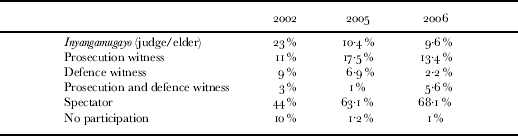
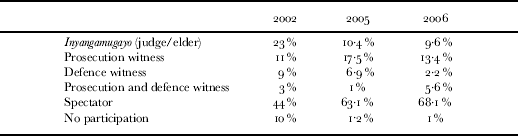
A first element that sheds light on the nature of the experience of Gacaca process is captured in Table 1 on the nature of participation. The fact that there are fewer Inyangamugayo, local judges, in 2006 (9·6%) than in 2002 (23%) is due to changes in the design of the Gacaca system over the years, with a steady reduction in the number of judges. In general a decrease in the active participation is evident. More people situate the nature of their participation in the domain of ‘spectatorship’. Gacaca is compulsory: attendance is required, but this does not mean that most of the population is actively involved. There is also a noteworthy decrease in respondents intervening in defence of an accused. Social norms reduced the number of potential defence witnesses, as we explain below in our exploration of the ‘truth’ problem. Other findings are presented in Table 2.

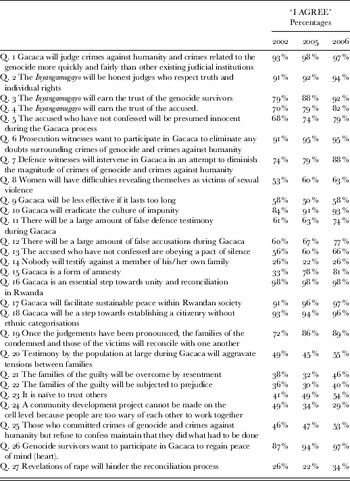
Compared with 2002, the results for 2006 indicate some positive evolution with regard to the perceived efficiency and equity of the Gacaca process (Q. 1–5). This is reflected in, for example, the level of trust in the judges and the satisfaction with the Gacaca courts compared with other judicial institutions. A deteriorating trend on some more crucial aspects related to the establishment of the ‘truth’ and the potential to foster reconciliation is nevertheless remarkable, despite the fact that most respondents agree with the most general statements accompanying the Gacaca process (Q. 16–18): it is a step towards reconciliation, it will facilitate sustainable peace and establish a citizenry without ethnic categorisation. These general statements are propagated during awareness-raising campaigns with authorities. The population has very well understood and internalised these discourses. But when asked to reveal opinions on the actual practice, experience or expected outcomes, respondents portray less optimism. The level of fear increased with the introduction of the Gacaca system.Footnote 7 A question related to whether families of condemned and victims would reconcile after Gacaca is positively appraised by the general population, with 89% of positive answers. However, this may be due to the fact that the question refers to better relationships after Gacaca, not necessarily because of Gacaca, since other responses to questions related to social cohesion, interpersonal and family trust reveal a perceived or experienced decrease in social well-being. Prejudice and resentment against families of convicted persons increased compared with 2002 (Q. 21–2).
More people think that those who committed crimes of genocide still harbour those ideas and intentions (Q. 25), the so-called genocide ideology. The observation that 53% of the population replies affirmatively to the proposition that ‘it is naïve to trust others’ (Q. 23) after more than a year of Gacaca activities in 2006 is revealing, almost shocking. This is 13% more than in 2002. Remarkably, these high levels of distrust do not affect the willingness to cooperate (Q. 24). Only 29% of the general population feels that distrust impedes shared labour activities, compared with 49% in 2002. This is partly due to the dissimulation and hypocrisy that has always characterised the Rwandan social universe, but increasingly so since the arrival of the denunciation policy in Gacaca. Inner feelings of distrust do not necessary correspond to outward signs of distrust, as we further argue below. Cooperation in distrust seems possible, even though it makes the social fabric extremely fragile. And finally, when comparing the results for 2002, 2005 and 2006, there is a steady increase in the general opinion that testimonial practices in Gacaca are false, whether false accusations (60%–67%–77%) or false defence testimonies (61%–63%–74%).
Not only survey results but also popular narratives collected during fieldwork indicate that testimonial activity has become important in the functioning of the Gacaca system, but is highly problematic and creates social animosity and tensions:
[Q: What are the positive aspects of the Gacaca proceedings according to you?] (1) Positive is the fact that – and we need to thank the Rwandan state for it – when someone tells the ‘truth’ the heart is soothed, the heart is calmed down. When someone tells the ‘truth’, you can do work together […] (2) If people tell the ‘truth’ and ask for forgiveness, one can pardon and afterwards collective labour is possible again.Footnote 8
[Q: How do you experience the Gacaca process?] (1) Gacaca will solve the problems of Rwandans. For everyone. Even if there are people that did not testify as of yet, they will do so in the future. (2) What is even better is the fact that a great number have accepted their role [in the genocide]. A lot of people have been liberated from prison. People are not afraid anymore to testify if others do. It can lead to reconciliation. (All) But if there are no confessions and no ‘truth’, it will be a big obstacle to achieve reconciliation. (3) If someone does not accept his role and another accuses him during the trial phase and he is found guilty it will create serious tensions between testifier and the convicted. (4) Yes, the current obstacle [to achieve reconciliation] is the fact that people do not tell the ‘truth’. There are hesitations while awaiting the trial phase. It will be an obstacle.Footnote 9
The general perception of the absence of the ‘truth’ by the Rwandan population seems to be one of the most problematic aspects of the court system. In what follows we analyse the different dimensions of the ‘truth’ and the ‘truth’-telling practice related to the Gacaca process in the socio-political context of post-genocide Rwanda. We start with a reflection on the intricate connection between speaking the truth and exploring the heart of oneself and others also captured in the above narratives. It gives an insight into what is at stake to achieve interpersonal reconciliation for ordinary people.
‘TRUTH’-TELLING AND RECONCILIATION: THE HEART OF THE MATTER – A MATTER OF THE HEART
In the ten years between the genocide and the start of the Gacaca trials, victims and those who were involved in the violence but had no leading role during the genocide lived together again on their respective hills – not always as neighbours now, since survivors have often been grouped into resettlement sites, but still in the same vicinity. They therefore had to develop a way of life and ways in which to interact with each other. It is important to understand these strategies and tactics employed in daily life in the decade before the state-sanctioned installation of the Gacaca courts. This allows us to verify whether their arrival facilitated or disturbed a natural process of ‘dealing with the past’. Living together was not a personal choice, but a simple necessity.
This cohabitation was initially marked by mutual fear, diminishing progressively with the passing of time. Out of necessity, life returned to a form of normality and cohabitation. Life in the hills is highly pragmatic. Tensions and conflicts are kept in the dark, because neighbours and villagers depend upon each other in their daily activities and their fight for survival in conditions of shared impoverishment. ‘Thin’ reconciliation differs from the ‘thick’ version, in Rwanda as elsewhere. Cohabitation – kubana – is a matter of necessity, which may become less intimidating for those directly involved as time passes, but interpersonal reconciliation – ubwiyunge – is a matter of the heart and a state of feeling in a social relation. Rwandans, and especially genocide survivors, often refer to the ‘heart’ when talking about the events of the past and expressing the nature and level of trust and confidence they have in their neighbours, fellow villagers or members of the other ethnic group. In the Rwandan context, the heart is the force unifying the human being. It is the centre of reception of outward impulses and the locus of interior movement. Emotions, thoughts and will are interconnected and unified in the heart. The heart is inaccessible to others but is where the truth lies (Crepeau Reference Crépeau1985: 154–5). Due to the violence experienced in their midst, ‘the hearts have changed’.
People have lost good manners and habits due to the war. The education given to children has changed. I don't know what one ought to do to restore confidence between people, even on the radio they talk of unity and reconciliation, but I don't see anything changing, the hearts of people have become like those of animals.Footnote 10
[Q: How do you see the Gacaca process?] The Gacaca is equally a road to achieve reconciliation. You have to keep in mind that it is hard to relieve the sorrow of the heart, but on the level of cohesion, Gacaca might be able to do something. The wounded heart can be cured when people tell the ‘truth’ to each other. When one knows well what happened there is a bit of an ease of mind (heart).Footnote 11
The heart has changed because of the crimes committed, the violence experienced or the dehumanising acts observed. Living conditions, the social universe and daily interactions have changed to a form of normality again, but this outward appearance of normality reveals little about someone's heart. Outward appearances are deceptive, as popular expressions acknowledge: ‘the mouth is not always saying what resides in the heart’, or ‘the rancorous stomach, you give it milk and it vomits blood’. Daily actions and interactions had become a way of dealing with the past, positively or negatively: the crossing on the pathway to the fields, the offer and sharing of banana beer in the local cabaret (pub), the invitation to a wedding or the helping hand when transporting a sick person to the hospital may have been catalysts in restructuring emotions and relationships. Meanwhile accusations of witchcraft, threats or suspicions of poisoning, the (interpretation of the) blink of an eye or the failure to invite someone to a ceremony are enough to increase distrust. Alliances have been struck between victims and perpetrators, sometimes from necessity, but sometimes also from choice. Exploring and engaging in these practices was a means of inspecting the humanity of oneself and the other, crystallised in the heart.
Engaging the past in these daily practices and encounters had developed over the years. What one labels truth-telling, rendering justice, fostering reconciliation or providing compensation had taken root in the ambiguities of local life. Engaging the past became enmeshed in the web of a tightly knit face-to-face community, difficult to understand from the perspective of an outsider who is used to different preconceived categories of what is taken for granted. In any case, silence about the past was the order of the day. Things ‘from before’ were known or suspected but not spoken out aloud. The heart of the other person was only tacitly explored. The arrival of the Gacaca courts changed this situation significantly. They did not come as catalysts of a natural, if very difficult, process of cohabitation that had already started. They came to alter it in substance: speaking, revealing or hearing the truth is the cornerstone of the court system.
THE ‘FORENSIC TRUTH’ IN A LOCAL SETTING
The Gacaca courts are based on a traditional conflict resolution mechanism that existed in Rwanda before colonial rule. Conflicts between families were settled by the old and wise men of the community – the Inyangamugayo – bringing together the parties in the dispute. In order to facilitate the process, three fundamental principles – cornerstones – were incorporated in the Gacaca legislation. In the modernised system, suspects of genocide crimes and crimes against humanity are prosecuted in parallel courts through a categorisation according to the crime committed. Ordinary courts try those identified as top responsibles and orchestrators, while the Gacaca courts judge others – the majority of the cases – on their respective collines (hills). A second principle is the popularisation or decentralisation of justice by installing numerous courts in every administrative unit of the state. This procedure is loosely modelled on the traditional Gacaca, with lay persons presiding as judges and the (active) involvement of the entire population as ‘General Assembly’. A final cornerstone is the principle of confession/denunciation to increase the evidence and available information. Gacaca trials take place not with evidence gathered by police and judicial authorities, but through the testimonial practices of perpetrators, victims and bystanders during the trial. It is the discursive encounter in the Gacaca sessions that functions as catalyst of the transitional justice process. These cornerstones need to facilitate the surfacing of the ‘truth’ from the bottom-up. The ‘truth’ is the source of information available to identify (the nature of) guilt or innocence, to conduct trials of the accused, to disclose locations to exhume victims, to identify reparation modalities, to generate knowledge on the past in general, and to reconfigure and re-establish social relations.Footnote 12
But the question arises, what kind of ‘truth’ surfaces in the actual Gacaca practice at the local level, in small face-to-face communities? In the report of the South African Truth and Reconciliation Commission four notions of ‘truth’ are identified (TRC 1998: 110–7). The ‘forensic truth’ entails answers to the basic questions of who, where, when, how and against whom, and possibly the context, causes and patterns of violations. Other dimensions of the ‘truth’ – narrative, social and restorative – go beyond this factual delineation of actions by incorporating the meaning attached to these facts by victim and perpetrator through interaction, discussion and debate, and not as arguments. Factual knowledge is accompanied by the acknowledgement of events and acceptance of accountability in the context of restoring the dignity of victims and survivors.
Our observations indicate that the actual trial proceedings in the Gacaca tribunals establish at best the ‘forensic truth’. We have often heard testimonies indicating who, where, when, against whom and how something happened, almost never ‘why’.Footnote 13 This results from the fact that the Gacaca courts function according to the logic of criminal trials, and not as small ‘truth’ commissions, or as a sort of customary reintegration ritual. The Gacaca court system as it currently functions in Rwanda is often referred to in terminology and descriptions as if it were identical, or at least similar, to the ‘traditional’ conflict resolution mechanism known as the Gacaca.Footnote 14 It therefore often carries the connotation of a customary and quasi non-judicial mechanism with primarily a restorative objective. The image of palavers under the oldest tree in the village is never far away. However, the relation between the ‘old’ and the ‘new’ Gacaca is not one of identity, or even of gradual continuity. There is a difference in kind. An essential change marks the installation of the Gacaca courts after the genocide. The ‘new’ Gacaca courts are in the truest sense an ‘invented tradition’. A key feature of the ‘new’ Gacaca is its prosecutorial logic, the fact that it functions according to typical (Western) trial proceedings.Footnote 15
The prosecutorial logic of the modern Gacaca process limits the restorative aspects connected with the system as it functioned previously: the quasi-ritualistic purification of the social order by bringing parties in conflict together and re-creating harmony between families in dispute. The ancient Gacaca was no ritual, nor is the modern version. But the traditional Gacaca had the objective to restore social harmony. Fieldwork indicates that the ritualistic coming together in the weekly sessions in the current Gacaca practice has a similar transformative influence: a non-discursive activity in line with the pragmatic and tacit exploration of the heart already developed over time. But the content of the meetings is handled in a purely prosecutorial fashion, limiting the non-discursive aspects of ritual or the dialogical aspects of truth-telling activities. Hayner (Reference Hayner2002: 100–1) is very sceptical about ‘truth’ coming from trials: ‘The purpose of criminal trials is not to expose the “truth”, however, but to find whether the criminal standard of proof has been satisfied on specific charges.’ Moreover, trials create an ‘us versus them’ dynamic. We often heard the remark that the own group – Hutu or Tutsi – was ready to embrace the procedures installed by the state to foster reconciliation and live by the principles of unity propagated from above, but that the other party – Tutsi or Hutu – did not understand these ideas or was not ready or willing to do so.
(1) The persons liberated from prison underwent a formation [in reintegration camps] to tell the ‘truth’, but they don't. (2) They were sanctioned by the state and now they refuse to speak the ‘truth’. So the state needs to intervene. The state has deployed a lot of effort so that they can acknowledge their wrongdoing but they do not accept it. That's a problem. If you have seen them with your own eyes and they don't accept it. But you have seen them!Footnote 16
(1) The Gacaca will help to determine the guilty and the innocent. For the moment words are cried out on the pathways saying: ‘that one has done this’. (2) There is no ‘truth’ in the collection of information. There is no ‘truth’. Things that we haven't done are added to our testimonies. Notes are taken against our will. (1) When someone has lost a family member, that person wants that someone else dies as well on the condition that it is someone from the other ethnic group.Footnote 17
Living together again is a practice forged locally, and the state can either facilitate or hinder these processes (Theidon Reference Theidon2006: 456). The survey results and narratives presented above signal a crisis brought about by the introduction of the Gacaca court system. So far, we have located a tension at the heart of the Gacaca activities, a short circuit emerging from a clash between established practices and traditions on the one hand and state-sanctioned and modern procedures on the other.Footnote 18 In the remainder of the paper, we highlight how this tension is reinforced by an additional friction operating at another level – a clash between two communication models ‘at work’ in Rwandan society at large.
COMMUNICATION IN (ANCIENT) RWANDA: A CULTURE OF DISSIMULATION
The setting in which the search for the ‘truth’ in the Gacaca courts takes place is twofold. On the one hand there is a new political regime that came into place after the genocide in 1994. This regime is the outcome of military victory and the total defeat of the incumbent regime. It entails that the victor usurped power and has thus all political space available to manoeuvre its transitional justice policies and vision of the past and the future. We identify below the general vectors of the ‘truth’ emanating from this new power constellation. But contextualising the ‘truth’ and ‘truth’-telling activities also implies an exploration of the historical and cultural roots of communication in the Rwandan universe. We start with the latter, but it will become clear that the function of communication and thus ‘truth’-telling has an intrinsic link with the former, power and politics.
A ‘cult of secrecy’ and the ‘consensus of the subjects’ are two intertwined aspects of Rwandan culture (de Lame Reference de Lame2005: 289). They function as remnants of the traditional organisation of Rwandan society. To better understand the (problematic) nature of state-sanctioned ‘truth’-telling in contemporary Rwanda, we first depict the ethics of communicating in ancient Rwanda.Footnote 19 Speech acts did not only or even primarily correspond to reality. What one said did not necessarily correspond to what one thought, but needed to serve the status connection between the interlocutors or the broader relationship with the socio-political environment surrounding them. The word was a means to an end, not so much an end in itself. From a Judeo-Christian and Western perspective, the latter is the ‘truth’ and the former a lie. But in the Rwandan context ‘truth’ and lies stood in a dialectical relationship. The moral value of a word depended not on its correspondence to reality, but on its usefulness in a complex socio-political context.
The Rwandan system of communication was (and is) esoteric: statements at the same time reveal and conceal. This is paradigmatically captured in the proverb: ‘What is in the belly of the drum is only known to the ritualist and the owner.’ While the drumbeat sends a message to the outside world, the interior of the communication vehicle (its secret) remains unknown. This proverb refers in the first place to the fact that no one is totally able to gain insight into someone else's interior and motives. Since the drum symbolises power in Rwandan custom, the saying refers on another level to the fact that communication is used by the ruler(s) to convey and conceal what is useful for him/them to stay in power. The communication system was a function of the social organisation in a hierarchical society and supported the power structure.
Every Rwandan was socialised into this system and thus learned a specific communication code in order to tune into the diverse interests and needs of different authority figures. This code provided a means to maintain one's position or to move up to another level. Language and communication were thus neither a vehicle to ventilate personal thoughts, opinions and preferences, nor an instrument to describe reality. The authority figure possessed the ‘truth’; the governed could only accept this ‘truth’, and adjusted their communication strategies in order to tap into or align with the ‘truth(s)’ of the chief(s). Diverging or personal opinions existed but were not ventilated and were thus tolerated.
This ‘ancient’ practice still has force in contemporary Rwanda. Pottier (Reference Pottier1989: 475) documented how the nature of communication, including silence, highlights existing social hierarchies in the context of a development intervention in the 1980s. A recent example observed during fieldwork on the Gacaca in Rwanda illustrates the continuation of this link between communication and broader organisational structures. It is the case of Boniface.Footnote 20 Boniface used to be a local authority in a remote village in central Rwanda during the former regime and also in the genocidal months of 1994. He is considered one of the ringleaders of the local genocide. He resigned from his post after the genocide but he is still a wealthy merchant. He influences the Gacaca proceedings. Not many want to testify against him. Although it is unclear whether he also uses overt coercion to manipulate the proceedings, his position as wealthy person controlling food distribution and employment makes direct pressure unnecessary. Some released prisoners managed to accuse him in the information collection phase, but during his actual trial he was acquitted simply because nobody testified against him, not even the genocide survivors. One does not (easily) confront the powerful, even if they are only slightly higher up in the social organisation. Communications – accusations in the context of Gacaca – depend on their usefulness and not necessarily the ‘truth’ (in the Judeo-Christian sense).
This political universe defined the nature of social navigation in society, a specific code of conduct. A central element in these Rwandan ethics was (and still is) the concept of ubwenge. This is a complex notion incorporating a range of elements. In the broadest sense, it refers to intelligence resulting in self-controlled public acts. But it also refers to elements of wisdom and trickery, caution, cleverness, prudence. It is the capacity to gain a clear understanding of situations and the capability to surround oneself with a network of profit generating social relations.
An example can be found in the following excerpt from an interview with a prisoner accused of participation in the genocide. He appeared as a free man before the Gacaca court in his village, together with another man accused of similar offences. The other was acquitted, he himself received one year of incarceration, although he is apparently convinced that the other is guilty as well. His statements touch on the complex connection between intelligence, ‘truth’-telling, lying and forging alliances. It is a phenomenon related to the localised setting of the Gacaca tribunals, but also a consequence of the specific nature of communication in Rwanda.
[Q: During your trial, there was also another man who was acquitted although he had been in attacking groups (chasing persons during the genocide). What is the difference between you and him?] Even when he has been declared innocent, he is not innocent before God, maybe in front of human beings. […] [Q: But why did you receive a prison sentence and the other man was acquitted?] It depends on the approach [of the trial], the intelligence (ubwenge). I could have received a sentence much higher than one year. I looked for people that could give testimonies in my favour. He has done the same. It depends upon the relations. One can ask someone to come and testify in favour of your innocence, but even better is to approach the victims. [Q: So you give them something?] It varies according to the type of relationship; you share something with them in order to make them participate in the debate. [Q: Even if what they come to say is not true?] Well the idea is to diminish the sentence, even if it means deflecting the ‘truth’. The people you try to persuade in your favour try to direct the trial, even if it means bending the ‘truth’ […] [Q: So for that other man that was acquitted, did part of the ‘truth’ related to his case not surface?] The ‘truth’ between Rwandans is something that is not close [not easily forthcoming]. It is far. No matter what situation you are confronted with: if you end up in the judicial services, on the level of the ordinary justice system, for the unity and reconciliation between families, even within households, there is no ‘truth’. [Q: Why?] Between Rwandans, before there can be ‘truth’? A Rwandan being satisfied with another Rwandan: impossible and therefore you bend the ‘truth’ in order to defend your own interests. [Q: So for the case of the person that was tried together with you, has the ‘truth’ been spoken or not?] Difficult question, I'll think about it. [Silence] ……. Ok, he, it is a person that participated [in the genocide], I am absolutely sure […].Footnote 21
A NEW POLITICAL REGIME, A NEW REGIME OF ‘TRUTH’
The communication system stemming from ancient times still has its influence in current Rwanda. Cultural sensibilities make communication a service to power holders. This is however not solely a Rwandan phenomenon. Foucault (Reference Foucault1980: 131) argues that ‘each society has its regime of “truth”, its “general politics” of “truth”: that is, the types of discourse which it accepts and makes function as true; the mechanisms and instances which enable one to distinguish true and false statements, the means by which each is sanctioned; the techniques and procedures accorded value in the acquisition of “truth”; the status of those who are charged with saying what counts as true’.
The present government takes care of the general ‘Truth’ (with capital) about the past. Important in that regard is the fact that the genocide ended with a military overthrow of the former regime by the RPF. The alternation of power was not the result of compromise or internal reform. Therefore, the RPF managed to assert its dominance in the post-genocide era, and the regime brought about is authoritarian in nature and (perceived as) being Tutsi-dominated, considering its origin (Reyntjens Reference Reyntjens2004: 103). We briefly identify the vectors of this general ‘Truth’ based on observations of sensitisation campaigns, commemoration ceremonies and speeches, and ideological writings by dignitaries (RoR 2006a: 167–85),Footnote 22 and by analysing the manual used in so-called ingandos, ‘re-education camps’, in which all members of Rwandan society have to participate (RoR 2006b).Footnote 23
The first element in this ‘Truth’ is the idea or ideology of ‘Rwandanicity’ or ‘Rwandanness’, meaning that Rwandans were one before the arrival of colonialism. Colonial powers ‘created’ ethnic groups out of a harmonious and equal society to rule on the basis of these divisions.Footnote 24 The creation of these divisions was the starting point of the genocide culminating in the 1994 mass slaughter of Tutsi. The international community is guilty because it installed divisions in Rwandan society and failed to take action against them, especially in 1994. A second element is the idea of ‘liberation’. The RPF stopped this divisionism not only in its deadly manifestation during the actual killings in 1994, but also through its policies in the post-genocide period. The RPF saved the Tutsi inside Rwanda and made a return of ‘old case load’ refugees possible.Footnote 25 The RPF further ‘liberated’ all Rwandan people from the whims of a dictatorial and genocidal regime, created one big ‘family’ for all Rwandans and installed ‘good governance’ instead of the ‘bad governance’ of the past. The third vector and cornerstone of the general ‘Truth’ is the concept of ‘genocide ideology’. Negative forces are still present within and outside Rwanda, continuing to embrace the old and long-standing genocidal tendencies. People can be consulted on general issues in society, but in the end need some guidance from above and from within the RPF, in order to fully embrace the newly regained order of ‘Rwandanicity’, free from the perils of ethnicity and bad governance. Not all are ready yet and enlightened control is necessary (RoR 2006a: 17).Footnote 26
This framework is widely propagated in the countryside during awareness campaigns, and meetings with authorities and military commanders, and has instilled a far-reaching degree of self-censorship in the population with regard to elements not fitting in the official ‘public transcript’.Footnote 27De Lame (Reference de Lame2005: 303) conducted fieldwork in the late 1980s and notes that meetings in the Rwandan socio-cultural universe – festive communions, ritualised public drinking activities, ‘politico-private’ gatherings – ‘serve to transmit meaning, provide the instruments of memorization, and create consensus’.Footnote 28 All utterances and claims not in harmony with this tightly controlled framework are considered to be instances of genocide ideology and/or meaningless. As a consequence, ‘other crimes’ and their victims especially are eclipsed from view in the Gacaca process.
(1) We are talking now about the genocide, the genocide against the Tutsi. Don't you hear talking about it on the radio all the time? In that period, there were Tutsi killed and Hutu killed. But on the radio there is only talk of the Tutsi killed, the genocide against the Tutsi. Did you hear talking about a Hutu killed? I don't think so. What is ambiguous is the fact that during Gacaca reunions one only talks of the Tutsi that were killed. (2) When you mention that Hutu were killed as well, they reply that the Hutu were killed because of the war. But the Tutsi as well, they were also killed because of the war! When you hear these things, you start doubting: ‘are the Hutu not the same human beings as the others?’ (1) They say that Tutsi were killed by the Hutu and the Hutu by the war. So, they started the war. Were there two different wars?Footnote 29
A speech by President Kagame during the 2007 genocide commemoration illustrates the continuing influence of the revealing and concealing dimension of communication and its intricate connection with the circuits of power. Irritated by preceding skirmishes with France related to the shooting down of the plane of former president Habyarimana, Kagame scorned the international community and blamed foreign nations for their involvement in the 1994 tragedy. But he equally sent a concealed message to the Rwandan (Hutu) population with the following words:
It is inconceivable that foreigners should judge Rwandans. The only regret is that events evolved so fast that those who committed genocide escaped scot-free. We had neither the opportunity nor the means to effectively bring these criminals to book. We were not able to punish these criminals that were here in ‘Zone Tuzrqouise’ and those who were assisting them to murder Rwandans in this area. Had we had enough opportunity, we would have unleashed enough wrath for them to leave with something to remember Rwanda by. As for those who fled across the border, and have now returned, who we have welcomed and restored to normal life like other Rwandans, we missed the opportunity to stop some of them from escaping and crossing over to the other side from where they continue their destructive work.Footnote 30
Large numbers of Hutu civilians left Rwanda in July 1994 when the genocide came to an end and the RPF took power. Several ordinary Hutu I spoke to in the days after this speech was broadcast on the radio interpreted this message as if the current power holders regretted the fact that they had been unable to kill all (Hutu) fleeing the country in 1994, and that the violent use of force promoted in the speech would become a new policy again: no more incarcerations of genocide suspects nor trials in the Gacaca tribunals.
The statement is ambiguous. It makes a clear distinction between within and outside Rwanda, the situation then and now. Nevertheless, the use of force is stressed. This particular interpretation of the speech by (large) parts of the Hutu population partly originated in the fact that the security forces had resorted to a practice of extra-judicial executions to address the increasing number of killings and harassments related to the Gacaca activities in the months preceding the speech – a policy apparently adopted after orders from high places and unknown to outside observers, but very well known to ordinary Rwandans living in the hills.Footnote 31 The communication underscored the nature of power in current Rwanda, and the fear resulting from its interpretation supported a docile inclination to the policies emanating from the power household, especially related to what counts as true and false, for example crimes committed by RPF soldiers during the years of civil war and after the takeover of power.
The killers finished their murderous work and left. After that some people came to defend them, claiming that the RPF also killed. I would like to state clearly that had the RPF killed, millions of killers who fled would not have escaped. The RPF had the will and the heart to stop what was happening, but my regret is that we did not have the means to save many more people. RPF should be the one to judge the killers and those that assisted them. Others are trying to distort history by changing the facts of what happened but they know very well that they have no authority to judge RPF.Footnote 32
The speech explicitly and exceptionally addresses this issue but the overall regime of Truth resulting from the power constellation takes de facto and largely implicitly the communication related to these elements out of the air.Footnote 33
CONCLUSION: A ‘CRISIS OF TRANSPARENCY’?Footnote 34
Popular practices and narratives show that previously, before the state-sanctioned installation of the Gacaca courts, the past was primarily tacitly explored without much discursive content. The amnesia discernable in the years preceding the installation of the Gacaca courts was the result of a natural process of cohabitation. The Gacaca courts substantially altered this non-discursive process of cohabitation, due to the fact that ‘truth’ had to be spoken. As a consequence, ‘truth’-telling replaced non-discursive activities to deal with the past, and became an important prerequisite to re-establish social relationships and evolve towards interpersonal reconciliation. Speaking the truth could turn out to be the avenue par excellence to understand the heart of oneself and others, a crucial step to achieve interpersonal reconciliation. But what it facilitated for some, it disturbed or destroyed for others. The arrival of Gacaca and the necessity to speak the ‘truth’ created an overall ‘crisis of transparency’, a tension worsening social cohesion and attitudes towards the ‘other group’ – a crisis due to a clash between an imposed model with forensic ‘truth’-telling as cornerstone on the one hand, and different communication principles informed by cultural sensibilities and political circumstances on the other.
We analytically distinguish features of the observed ‘truth’ intricately entangled in reality. The ‘truth’ is in the first place curtailed by the a priori defining parameters of what the ‘truth’ can be. The historical roots of communication in the Rwandan universe differ from the Judeo-Christian model of (forensic) ‘truth’-telling underlying the Gacaca activities and the entire transitional justice architecture in Rwanda. But the truth-generating activities also encountered ideological resistance. The specific functioning of the Gacaca courts in the socio-political constellation of post-genocide Rwanda reveals that amnesia on certain aspects related to the past is not only chosen, as Buckley-Zistel (Reference Buckley-Zistel2005, Reference Buckley-Zistel2006) argues, but also imposed top-down. Dissonance between popular embodied experiences and understandings of the conflict, and the government-controlled and produced version of the ‘Truth’ with regard to the past, creates a volume of unexpressed grievance under the surface of daily life and the assiduous Gacaca activities fermenting in the ‘hidden transcript’ (Scott Reference Scott1990). These are emotions and opinions unexpressible through the installed transitional justice architecture. Facts and perceptions, claims and convictions seek refuge in the ‘underneath of things’ (Ferme Reference Ferme2001), a second world constituted in relation to the first world of social reality and rooted in the collective social imaginary. Rumours – as for example the idea of a machine accompanying the Gacaca courts to destroy all Hutu (The New Times 27.3.2005),Footnote 35 or the widespread belief in the existence of a double genocide (a genocide against the Hutu as well) – offer an existential window on that popular social imagination.
The overarching sentiment of an absence of the ‘truth’ by victims, perpetrators and bystanders shows that factual knowledge on the past is largely missing, and also that a rehumanisation and resocialisation of the other – the healing dimension of ‘truth’-telling – is not easily forthcoming. The question is then: what can this type of ‘truth’ still accomplish in the following stages of the transitional justice process and post-conflict reconstruction in general? And where does it fail, and what are, subsequently, the consequences? Ariel Dorfman (Reference Dorfman1994: 48–9) raises similar questions in the afterword to Death and the Maiden: ‘How to heal a country that has been traumatized by repression if the fear to speak out is still omnipresent everywhere? And how do you reach the ‘truth’ if lying has become a habit?'