Recently, scholars have begun to look systematically at authoritarian political institutions such as parties, legislatures and elections.Footnote 1 In this article, we explore how authoritarian parties and legislatures affect the survival of authoritarian regimes, distinguishing between two types of authoritarian failure: transition to a subsequent dictatorship and democratization. Further, we analyse legislatures and parties as distinct institutions that can affect authoritarian survival through different mechanisms. Importantly, we examine how these institutions affect authoritarian elites under both dictatorship and democracy.
Legislative institutions in authoritarian regimes can help sustain the dictator in power by making the dictator's promises – to both potential authoritarian rivals and would-be democrats – more credible. Accordingly, these institutions might preserve authoritarian power by decreasing both the likelihood of being replaced by a rival dictator and the chances of democratization. However, authoritarian parties may also affect the likelihood of democracy by influencing the distribution of power in a subsequent democracy. Relative to other types of regimes, party elites in dominant party regimes are more likely to participate in and win competitive post-authoritarian elections, preserving some modicum of power for themselves in a new democracy. In military regimes, elites use parties to guarantee that their corporate interests are protected after a transition to democracy. Because authoritarian party systems can guarantee at least some of the interests of the outgoing elites, these institutions make a transition to democracy more likely, all else equal. To test these expectations about how legislative institutions and party systems influence survival, we model the effect of legislatures and parties on transitions to both a subsequent dictatorship and a new democracy.
The argument that authoritarian parties can help protect the interests of authoritarian elites in a subsequent democracy via an ‘exit guarantee’ builds on recent research on comparative democratization.Footnote 2 Incorporating the insights of the Meltzer and Richard model, this literature posits that structural characteristics of the economy, such as income inequality or asset mobility, limit the ability of the enfranchised poor to tax the rich in a democracy.Footnote 3 When relatively high equality or dependence on mobile assets constrains taxation of the rich in a democracy, elite interests are better protected and democratization is more likely. This article expands on this notion by suggesting that party legacies can play a similar role of protecting elite interests in a subsequent democracy. The central interest of authoritarian elites may not simply be to protect themselves from taxation under democracy. Political institutions are thus relevant when considering the wide range of interests outgoing authoritarian elites may want to protect.
There are numerous cases of democratization in countries with both high income inequality and low asset mobility – for example, the transitions from military rule in many Central American countries. To understand democratization in these countries, we might consider that military elites may not always view guarantees of modest taxation as the necessary condition for ceding power to democrats. Rather, their chief concern may be to protect the military's corporate interests, such as securing ample military budgets or immunity from human rights prosecution.Footnote 4 In so far as authoritarian parties can influence the distribution of power in a post-authoritarian democracy to help protect these interests, these institutions should make democratization more likely.
By considering the role of parties in protecting authoritarian elites’ interests, we expand the purview of authoritarian elites beyond simply the ‘rich’ to incorporate authoritarian regimes with diverse political coalitions of support where, for example, elites have represented ethnic majorities (United Malays National Organization, UMNO, in Malaysia) or labour (Institutional Revolutionary Party, PRI, in Mexico) for many decades. In doing so, we move beyond the redistributive focus of the models in Acemoglu and Robinson and in Boix without losing its key implication: authoritarian elites are more likely to transition to democracy when their interests are better protected in a new democracy.Footnote 5 In this formulation, ‘interests’ no longer need be constrained to ‘low taxes’, but can encompass a diverse array of concerns, from military immunity to the preservation of ethnic group priorities.
In the first section, we discuss how authoritarian parties and legislatures influence two distinct types of authoritarian failure: transition to a subsequent dictatorship and democratization. We outline hypotheses that link these institutions to autocratic survival. We then discuss the types of dictatorships that are likely to have political parties that are sufficiently strong to exert influence over the distribution of power in a new democracy. In the third section, we discuss the data and methods used to test the main hypotheses, and then present the results of simultaneous equation duration models. We also test one implication of the ‘exit guarantee’ argument by examining how institutions affect the post-exit fate of the dictators themselves. We conclude with a brief discussion of the implications of our findings for future research.
Parties, legislatures and authoritarian survival
In this section, we discuss the distinct channels through which authoritarian parties and legislatures influence the survival of dictators. In doing so, we distinguish how these institutions affect two types of authoritarian regime failure: (1) being replaced by a rival dictator and (2) democratization.
Many influential models of democratization articulate logics of strategic interaction between two (or sometimes three) actors – typically circumscribed as the regime/dictator/elite/rich and the opposition/citizens/insurgents/poor.Footnote 6 These models help us specify how various factors affect the payoffs to the actors under different scenarios in a game of democratization. For example, they can help distinguish how particular factors (in our case, political institutions) affect the cost of democratization for the dictator and the payoffs to the opposition under dictatorship. Understanding how political institutions affect payoffs to different players under both dictatorship and democracy provides insight into their effect on the stability of authoritarian regimes.
One view of authoritarian legislatures argues that these institutions neutralize threats from groups outside the regime by incorporating them into the governing structure of the regime itself.Footnote 7 One way of mapping this intuition onto models of democratization is to suggest that legislative institutions can increase the probability that the dictator does not renege on promises made to those who can credibly threaten to destabilize the regime. In Acemoglu and Robinson's model, the promise of redistribution is not credible because the dictator can renege in future periods.Footnote 8 The view of legislatures as broadening the basis of regime support is consistent with the logic that these institutions provide a credible guarantee that the regime will not renege on promises to forgo predation, permit policy concessions to the opposition, or redistribute away from the elite in the future. In this scenario, these institutions raise the cost (to the dictator) of reneging and, therefore, increase the payoffs regime opponents receive under dictatorship. So to the extent that legislative institutions in dictatorships lend credibility to the dictator's promises, they should reduce the likelihood of democratization. If the regime opponents are not interested in democratization but simply want to replace the incumbent dictator with a new dictatorship,Footnote 9 and if legislative institutions can increase the credibility of promises made to these opponents, then the same logic suggests that legislative institutions should decrease the likelihood of transition to a subsequent authoritarian regime. Whether the opponents are would-be democrats or not, the effect of legislative institutions should be the same. These arguments focus on the payoffs to (potential) regime opponents under dictatorship but say nothing about the payoffs to either actor under democracy.
The prevailing view of authoritarian parties also suggests that they are a stabilizing factor in dictatorships for a number of reasons: they can increase the credibility of promises made to party insiders, provide a buffer against military power, help co-opt relatively powerful opponents, or help the dictator split moderate opponents from radical opponents. One avenue through which parties might stabilize authoritarian rule is to increase the credibility of the dictator's promise to groups that can threaten to replace the dictator. These would-be opponents may be party insiders, as Magaloni suggests, or powerful groups outside the regime, as Gandhi and Przeworski posit.Footnote 10 This should decrease the likelihood of the dictator being replaced by a subsequent authoritarian ruler. Similar to the logic for stabilizing legislative institutions, these arguments suggest that parties increase the payoffs to regime opponents when they choose not to mobilize against the dictator. Secondly, parties might increase the costs of mobilizing against a dictator, perhaps by countering military threats to the dictator or by splitting the moderate opposition from the extremist opposition by raising the moderate opposition's cost of joining the radical opposition in conflict against the dictator.Footnote 11 These arguments focus on the payoffs to potential regime opponents from pursuing a strategy that includes conflict with the dictator. To the extent that party insiders, the military, powerful outside groups or moderate opponents press for democratic rule, these arguments suggest that parties should decrease the likelihood of democratization as well. Again, these theories say nothing about how institutions might affect the payoffs of various actors under democracy.
An alternative view of parties, derived from the standard theories concerning the origins of parties in democracies, is that they reduce collective action costs for party members, which in an authoritarian context might include potential regime opponents.Footnote 12 In Acemoglu and Robinson's account of democratization, the necessary starting point is a period when there exist sufficiently low collective action costs that those demanding democracy can successfully mobilize. They suggest economic crisis as one of these fleeting moments when the poor can overcome their collective action costs and credibly threaten the dictator with a fight. If parties, even authoritarian support parties, lower the collective action costs of would-be regime opponents (who at various times may be nominal regime allies), then parties may decrease the cost of fighting against a dictator, and therefore increase the likelihood of both democratization and transition to a subsequent dictatorship.Footnote 13 Even in dominant party regimes that are typically thought to be the most resilient, successful challengers frequently organize themselves first within the structure of the dominant party and then defect. For example, leaders of challenger parties in Mexico (Cuauhtémoc Cárdenas's Party of the Democratic Revolution, PRD), Kenya (Kibaki's National Alliance Party of Kenya and Odinga's Liberal Democratic Party, which formed the Rainbow Coalition in 2002), and Malaysia (Anwar's People's Justice Party, PKR) all organized support while they were members of the dominant party, before defecting and establishing opposition parties.Footnote 14
This argument about parties and collective action costs for regime opponents highlights one way in which parties and legislatures may differ: a dictator may more easily observe the activities of a legislature than the activities of political parties simply because legislatures typically meet in a central location at specific times. Party activities, on the other hand, can take place throughout the country and can occur without the full knowledge of the dictator. Thus, because a dictator has less ability to monitor all party activities, they should be more likely to be the institution where potential opponents can incubate collective action. This logic says nothing about whether regime opponents seek democratic change or simply want to replace the current dictator with another; thus, the most general implication is that parties can increase the likelihood of either type of transition.
Another reason why parties may destabilize focuses on a second avenue through which authoritarian parties can affect the interaction between dictators and their opponents: authoritarian parties might influence the distribution of power in a subsequent democracy, and in doing so lower the cost of democratization for incumbent authoritarian elites. In dominant party regimes, such as Mexico's PRI, the incumbent party often has deep distributional networks and large-scale mass support, which should translate into more effective voter mobilization and a larger claim on power in a new democracy. Because of the electoral success of former authoritarian parties in new democracies, the interests of these elites are better protected after a transition than if the former authoritarian elites had no party structure.Footnote 15 This logic highlights another potential difference between parties and legislatures: parties are the actual organizations that can potentially win power even after democratization.Footnote 16
Further, many military regimes strike bargains with civilian elites during a transition in an attempt to guarantee their interests with political parties that are likely to do well in a subsequent democratic election.Footnote 17 The institutionalization of an authoritarian party system under military rule can make these bargains more credible by increasing the chances that an ally of the military will be elected as president in the subsequent election, particularly if the military uses the authoritarian party to influence the selection of electoral rules in an ensuing democracy. Thus, parties may increase the likelihood of ‘exit guarantees’ for the military and their allies.Footnote 18 If authoritarian parties can help protect the interests of authoritarian elites in a new democracy, then they should increase the likelihood of democratization. The actual organizations capable of possibly protecting elite power are parties, not simply the existence of a legislature during the authoritarian period. This logic of exit guarantees has implications for democratization, but says nothing about transitions to subsequent authoritarian regime.
To summarize briefly, because authoritarian legislatures increase the credibility of bargains between the dictator and potential threats, legislatures should decrease the likelihood of both a transition to a subsequent dictatorship and a transition to democracy. If the prevailing view of authoritarian parties is correct, these too should decrease the probability of transition to a subsequent dictatorship and perhaps transition to democracy as well. An alternative hypothesis regarding parties argues that authoritarian parties may actually be destabilizing, as they can both increase the likelihood of democratization by helping protect the interests of the incumbent elites in a new democracy and increase the likelihood of being deposed by a rival dictator by reducing the collective action costs of those organizing to overthrow the incumbent dictator. The discussion so far, however, presumes that parties and legislatures are sufficiently strong to alter the incentives of the various actors involved. For example, the arguments rely upon the assumptions that legislatures credibly restrain the dictator in some fashion and that parties can influence the distribution of power after a transition to democracy. In the next section, we discuss when these assumptions are more or less likely to be true by examining these institutions in different types of authoritarian regimes.
This discussion suggests a number of testable hypotheses:
HYPOTHESIS 1: Legislatures decrease the likelihood of an authoritarian regime being replaced by a subsequent (rival) dictatorship.
HYPOTHESIS 2: Legislatures decrease the likelihood of democratization.
HYPOTHESIS 3: Parties increase the likelihood of an authoritarian regime being replaced by a subsequent (rival) dictatorship.
HYPOTHESIS 4: Parties increase the likelihood of democratization.
A further implication is suggested by the argument that authoritarian parties increase the likelihood of democratization by protecting the interests of the outgoing authoritarian elites. Parties should protect dictators themselves after leaving power. Thus, dictators exiting from power in regimes that have parties should be better off than dictators in regimes with no (or fewer) parties.
HYPOTHESIS 5: Parties should reduce the likelihood of exile, arrest or assassination (relative to staying in the country unharmed) for exiting dictators.
Parties and legislatures in different types of authoritarian regimes
While thus far we have discussed the effects of party and legislative institutions, much of the literature on authoritarianism distinguishes between different types of regimes, such as personalist (or sultanistic) and military regimes.Footnote 19 These regime types have important consequences for how elites survive in power.Footnote 20 In addition to being important controls, the fact that authoritarianism has many faces that can be usefully circumscribed by regime type may provide insight into the relevant scope of the main hypotheses. Thus far we have assumed that legislatures and parties are sufficiently strong to (1) credibly constrain the dictator, in the case of legislatures, and (2) exert influence over the distribution of power in a new democracy, as suggested by our argument about parties.
In this section, our discussion of different authoritarian regime types serves two purposes. First, by exploring the regimes where institutions are likely to have sufficient strength to alter the preferences of regime incumbents and potential challengers, we gain purchase on the sample of dictatorship where our expectations about authoritarian institutions are most likely to ring true. Secondly, we provide historical examples that illustrate the causal mechanisms outlined above. Specifically, we show that authoritarian parties can protect the interests of outgoing dictators in a new democracy directly, by building and winning electoral support, or indirectly, by shaping the governing institutions for a new democracy.
Personalist regime
Scholars have distinguished amongst different types of authoritarian regimes and frequently acknowledge that personalist regimes differ from other types of authoritarian rule, such as: military, dominant party, totalitarian or corporatist.Footnote 21 Researchers have also found that distinguishing amongst different types of dictatorships has been useful for understanding how and when dictatorships transition to democracy and when and with whom dictatorships initiate conflict.Footnote 22 The theoretical underpinnings of these empirical findings focus on institutional differences amongst regimes. For example, Reiter and Stam show that personalist dictators are more likely to initiate a war with democracies because they are institutionally unconstrained and therefore ‘unlikely to lose power if they launch an unsuccessful diplomatic challenge or even a losing war short of catastrophic defeat’.Footnote 23 Summing up these differences, Geddes argues that the institutional feature that distinguishes personalist regimes from others is that ‘although personalist regimes have parties and militaries, these organizations have not become sufficiently developed or autonomous to prevent the leader from taking personal control of policy decisions and selection of regime personnel’.Footnote 24 Distinct from other types of authoritarian regimes where dictators build mass political support through the provision of targeted public goods (dominant party regimes) or govern by repression (military regimes), the basic method of rule in personalist regimes is simply the exchange of particularistic material rewards (private goods) to a select group of regime insiders in return for mobilizing political support.Footnote 25 Here we argue that, because legislatures and party systems typically depend on the dictator in personalistic regimes, they are less likely to provide a credible constraint on the dictator and less likely to influence the distribution of power after a transition to democracy than these same institutions in other types of regime.Footnote 26
In personalist regimes, the dictator does not create a legislature to share power with strong, organized parties or to constrain himself, but to manage elites who challenge him.Footnote 27 The dictator can use the legislature to sanction a legislator who reneges on supporting the dictator, which can deter others. On the flip side, the legislature also gives the dictator a forum publicly to resuscitate a former member of the inner circle. In the Dominican Republic, Rafael Trujillo used the legislature routinely to sanction and reward potential rivals. Any cabinet member whom he suspected of becoming too powerful or obstinate was sent to Congress to demonstrate his loyalty to Trujillo.Footnote 28 Over time, increasing turnover in the legislature weakened this accountability mechanism. As Trujillo's power weakened, he shuffled legislators through the door at a hyper-inflationary pace, needing more turnover to placate fewer rivals. Wiarda notes that during Trujillo's first term, only 2 out of twelve senators and 19 out of thirty-three deputies ‘resigned’.Footnote 29 In his second term, the Senate saw 12 resignations for thirteen seats and 46 resignations for thirty-five lower house seats. In his third term, 32 senators (nineteen seats) and 122 Deputies (forty-two seats) ‘resigned’. Dr Hastings Banda similarly used his legislature in Malawi, even resuscitating his once imprisoned (and popular) former vice president when it became apparent that Banda was going to face competitive multiparty elections in 1994. Decalo describes Banda's penchant for rotating legislators in and out of the legislature: ‘every year between 1970 and 1980 an average of seven Malawi constituencies remained unrepresented in Parliament due to expulsions; and of the 150 members expelled during 1964–1981, forty ended up in prison.’Footnote 30 These leaders used legislatures to pit potential rivals, who at various times were also crucial supporters, against each another in competition for blandishments from the dictator. Dictators in these regimes typically did not incubate political constituencies or strong parties with enough lasting power to exert influence over the distribution of power in a subsequent democracy. Because elites in these regimes use institutions to manage elite conflict, they may help neutralize threats from rival elites within the regime, but may be of little use in defending the regime against threats from powerful groups that stand outside elite circles.Footnote 31 Therefore, institutions in personalist regimes may have little effect on the likelihood of democratization, but may help defend against rival authoritarian threats.
Elites in institutionalized, dominant party regimes, however, frequently participate and win power in post-transition elections. Political parties in these regimes help build mass support and long-term electoral constituencies which can help protect the interests of authoritarian elites after a transition to democracy. In contrast, elites in military regimes rarely directly participate in post-transition electoral politics. But the institutionalization of a party system during the period of military rule can nonetheless help preserve the military's corporate interests in a new democracy because these institutions can both increase the likelihood that military allies will be elected in a new democracy and help shape the new electoral rules – often through constituent assemblies.
Dominant party regimes
An important feature of dominant party regimes is their extensive patronage networks, which help the party mobilize votes. Most dominant party regimes have legislatures (92 per cent of country-years), and those that do not are less likely to have the mass party organizations that reach large segments of the population and penetrate many civil society organizations characteristic of most dominant party regimes.Footnote 32 While regimes that fall into this category but lack competitive parties may exert just as much centralized power over the state and citizens as dominant party regimes with multiple parties, the contention here is that those with multiple parties have larger distributional networks and hence more mass support. These features of the authoritarian party system should translate into more effective voter mobilization if the regime democratizes.
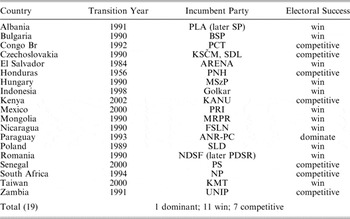
When dominant party regimes democratize, former authoritarian parties frequently participate in elections in the subsequent democracy and often do quite well. In Table 1, we list all the independent dominant parties (or party-hybrid regimes) in the dataset that democratized. All former dominant parties were competitive, winning at least the second largest share of seats in at least one lower house legislative election after the transition to democracy, and a majority (12 out of 19) won at least once.Footnote 33 The Colorado party in Paraguay (ANR-PC) has been dominant in lower house elections since the transition to democracy.
The Fate of Former Dominant Party Regimes after Democratic Transition

Notes: Dominant = Win a plurality of votes in all legislative elections since transition. Winner = at a minimum, the party with the highest (plurality) share of seats in a lower house election during the democratic period. Competitive = at a minimum, party with the second largest share of votes in at least one lower house election.
This strategy of building electoral support during authoritarian rule is not exclusive to dominant party regimes. In Brazil, for example, the military used the party system to foster electoral support through patronage in a manner similar to what we observe in many dominant party regimes. In response to a poor electoral showing for the military-backed party (National Renewal Alliance, ARENA) in 1974, the Brazilian military substantially increased public spending to win back electoral support.Footnote 34 This patronage system would prove useful in electing candidates sympathetic to the military, guaranteeing military prerogatives such as funding for the military, after the transition to democracy.Footnote 35 Thus, the mobilizing effect of parties in dominant party regimes may also influence the distribution of power in military regimes.
Military Regimes
Military regimes may stand apart from other types of authoritarian regimes because military elites may not necessarily want to maximize their stay in power. Rather, their highest priorities are often: maintaining military unity, maximizing military budgets, keeping civilian leaders from interfering in their internal affairs, and guaranteeing immunity from human rights prosecution.Footnote 36 Thus, unlike other types of regimes, they may not be averse to democratization if they can guarantee their corporate interests in the subsequent democracy.
Many militaries make bargains with civilian elites which lead to democratization.Footnote 37 These deals are more credible when the military regime has a party system that permits semi-competitive elections, for three reasons. First, the military can pinpoint which parties are likely to win subsequent democratic elections. This ensures that the military bargains with the right people. Many militaries in Central and South America made bargains with parties they expected to win the first round of elections.Footnote 38
Secondly, permitting a semi-competitive party system during the authoritarian period increases the likelihood that an ally of the military will be elected as president in the subsequent election. The military can form a close alliance with an existing political party during the authoritarian period, as was the case in Guatemala in 1985 with the election of the Christian Democratic candidate Cerezo Arévalo. Or the military can stand up a candidate from its own ranks, as the South Korean and Venezuelan militaries did in 1987 and 1958, respectively. South Korean General Roh Tae-woo won the presidency when the opposition split their vote, while Venezuelan Admiral Larrazábal narrowly lost an election he expected to win.Footnote 39 Without the previous authoritarian party system, the military would not have had knowledge of the likely success of their candidate in a relatively free and fair election. In South Korea, therefore, the multiparty election of Roh Tae-woo allowed the military to both democratize and preserve its institutional interests.Footnote 40
A third mechanism through which parties in military regimes can preserve their power after a transition is by influencing the composition of constituent assemblies. Post-authoritarian electoral rules are often chosen in constituent assemblies elected before the transition (Guatemela, Honduras) or by the first democratic legislature acting as a constituent assembly (Brazil). When the military has permitted prior party activity and especially when military-backed patronage parties have developed under military rule, these constituent assemblies are more likely to have significant representation from parties allied with the military.
For example, in Guatemala in 1984, the military oversaw the election of a Constituent Assembly which wrote the new constitution under which subsequent elections have been conducted. The military-allied Christian Democrats won the largest share of seats in the Constituent Assembly, while the Social Democrats sat out the election entirely. In this case, opposition parties were banned from participating in the Constituent Assembly elections, and the military succeeded in using an elected Constituent Assembly to write the new electoral rules in its favour.
The Thai military transitioned to democratic rule three times between 1973 and 1992. Previous to two of these transitions (1988 and 1992), the military had allowed political parties to compete in elections. The Constituent Assemblies that wrote the electoral rules used in the subsequent democratic periods were dominated by military-backed parties and the military came very close to getting their preferred candidate in office during the subsequent democratic periods.Footnote 41 Preceding the democratic transition in 1973, however, the military had mostly functioned without parties. They banned all political parties for nearly ten years (1958–68) and only stood up a legislature for less than three years (1968–71) after the Constitution had sat untouched in the Constituent Assembly for nearly eight years.Footnote 42 Far from giving the generals confidence that relatively free and fair elections would not endanger their corporate interests, these parties prompted the military to shut down the legislature in 1971. The military did not cede power to civilians until nearly half a million protesters had flooded the streets of Bangkok and over 1,000 deaths brought down the regime in 1973.Footnote 43 To resolve the ensuing political crisis in late 1973, the king picked a constitutional assembly which in turn selected the first legislature – one largely without any parties backed by the military. After mostly opposing the legislature (1958–68, 1971–73) and otherwise abusing it (1969–71), the military had very little say in the ensuing democracy after the transition in 1973. The Thai case suggests that military regimes with parties may end in democracy more quickly, but with considerably less violence. Having a functioning party system in place during military rule eases the transition to democracy by assuring military elites that their interests will be better represented in the ensuing democracy.
Distinguishing the effect of legislatures from parties may be particularly difficult in military regimes, especially those that use constituent assemblies to help write electoral laws that are eventually implemented in the ensuing democracy. However, the mere presence of a legislature does not guarantee that military elites can successfully do this, nor does the absence of a legislature prevent the military from writing the electoral rules in its favour (see Pinochet's 1980 Constitution). However, the presence of a legislature with sufficient teeth to circumscribe the power of the military, we argue, may be necessary to help co-opt groups that press for democratization, whereas parties may be a by-product of this process. Concerning the distribution of power in new democracies, however, the presence of parties during military rule may be more helpful than legislatures in influencing the outcome of constituent assemblies and gauging the future electoral support of would-be military allies in a new democracy.
This discussion of political institutions in different types of regimes suggests that our hypotheses merit an important qualification: Because parties and legislatures in personalist regimes may be weaker than in other types of regimes, the evidence for Hypotheses 1–5 should be weaker for personalist regimes. We examine below the evidence for all authoritarian regimes and then separately for personalist and non-personalist regimes.
Data and methods
To test the preceding hypotheses we use an updated version of Geddes's data on authoritarian regimes, which codes two types of regime failure: transition to a subsequent dictatorship and a democratic transition.Footnote 44 We use regime data instead of authoritarian spells or leader data for two reasons. First, empirical models that estimate the likelihood of transition between dictatorship and democracy or changes in the level of ‘democraticness’ (e.g. Polity scores) do not capture transitions from one dictatorship to another. For example, a variable that only marks a transition from dictatorship to democracy cannot model the regime failure that occurred during the Iranian Revolution in 1979, when Shah Reza Pahlavi was deposed. Further, graded measures of democracy, such as changes in the Polity score, can conflate changes in the level of ‘democraticness’ with regime transition. For example, the Iranian Revolution is coded as an increase in the Polity score from −10 to 0, while Mobutu Sese Seko's introduction of multipartyism in 1992 is coded as an increase in the Polity score from −8 to 0. Chile's democratic transition in 1989 is coded as an increase from −1 to 8. The Polity scale treats these changes as roughly equivalent (10, 8 and 9 point increases, respectively). However, the first of these changes is transition to a subsequent dictatorship (Iran); the second entails no transition whatsoever (former Zaïre); and the last is a democratic transition (Chile).
Secondly, empirical models that estimate the likelihood of leadership turnover in dictatorships capture both regular and irregular transfers of power.Footnote 45 For example, using leader failure as the dependent variable assumes that exit from a coup or transition to democracy follows the same data-generating process as regularized leadership turnover within an authoritarian regime spell, as occurs in many dominant party regimes such as Mexico's PRI, Tanzania's Party of the Revolution (Chama cha Mapinduzi or CCM), and the last few decades of Communist rule in China. A leader failure variable cannot distinguish between term-limited leadership change in Mexico under PRI rule (Salinas to Zedillo) and the electoral defeat of the PRI in 2000 (Zedillo to Fox). To include regularized turnover within the authoritarian regime spell (Salinas to Zedillo) could bias our estimates because regimes which tend to have regularized turnover also tend to be those that last longest. To circumvent this issue of regular leadership turnover within an authoritarian regime, one might look only at irregular turnover (excluding regular failures). However, this strategy excludes many democratic transitions – some of which are coded as regular leadership turnover.
The data on authoritarian parties and legislatures are from Gandhi.Footnote 46 The legislature variable measures whether a legislature exists in a given year. As Table 2 shows, legislatures are most common in dominant party regimes (92 per cent of regime-years) and least common in military regimes (37 per cent of regime-years). All regime types, with the exception of monarchies, are more likely to have legislatures after the Cold War, perhaps reflecting greater international pressure to set up democratic-looking institutions in this period. The ‘parties’ variable can take one of three values: 0 for no parties; 1 for one party only; and 2 for more than one party.Footnote 47 As with legislatures, parties are more likely to exist during the post-Cold War period than previously.
Political Institutions in Authoritarian Regimes

Notes: Years covered: 1946–2002. Totals in cells describe country-year observations. Party-based regimes include single-party hybrids; and military regimes include military-personalist hybrids. *Column percentages reported.
The lower panel of Table 2 shows the cross-tabulations for parties and legislatures. Not all regimes that lack a legislature are devoid of de facto parties. Consider, for example, Pinochet's rule in Chile, where parties formed during the long democratic period that preceded his rule continued to operate even though Pinochet ruled without the help of a legislature. In El Salvador during the early 1980s, the military allowed some political parties to operate and began a negotiated transition with the leader of the Christian Democratic party, even though the legislature did not meet.Footnote 48 Further, not all regimes with legislatures have parties. This most often occurs in monarchies or highly personalistic regimes, such as Qaddafi's in Libya where the dictator rules with a legislature, but there are no identifiable political parties. When there is no legislature, 45 per cent of the regime-years also have no parties, but 20 per cent have one party, and 35 per cent have more than one de facto party. In regimes with a legislature, 6 per cent have no parties (mostly monarchies), 44 per cent have only one party, and 50 per cent have more than one party. Thus, authoritarian legislatures and parties do not always appear in the same place at the same time, giving us meaningful variation to test the predictions outlined above. To model regime survival, we employ a time-series, cross-section probit model with controls for time dependence; we include polynomial transformations of duration time (duration and duration 2).Footnote 49
We test two dependent variables: transition to a democracy and transition to a subsequent authoritarian regime. Previous works on democratization, which models transitions between non-democracies and democracies, do not examine transitions between authoritarian regimes.Footnote 50 Earlier research on the authoritarian regime survival, which focuses only on the survival of particular regimes, groups democratization and transition to a subsequent autocracy in the dependent variable.Footnote 51
Addressing Simultaneity
Authoritarian elites may choose to allow multiple parties as part of the transition process, particularly a transition to democracy. To code the dependent variables (transition to democracy and subsequent dictatorship), we mark the year of the event that ends the authoritarian regime. However, the decision to begin a democratic transition may take place in a year (or years) prior to the regime failure event. Thus, the process we are attempting to model, regime transitions, may in part determine the number of parties. One way to address this simultaneity issue is to lag the parties variable by two or more years. However, this entails an assumption (1) about how long ‘transition’ periods last and (2) that all countries which allowed multiple parties prior to the actual transfer of power did so because elites had committed to democratization. In some cases, such as Benin (1990) or Malawi (1993), the introduction of multiple parties was part and parcel of the democratization process. However, in other cases, such as Argentina (1979), this was probably not the case. The Argentine military retreated to the barracks in 1983 because of declining political support resulting from a military defeat in the Malvinas conflict in 1982.Footnote 52 In that case, the decision to allow multiple parties appears to have occurred prior to the event that tipped the military towards democratization.
Further, some countries that introduced multiparty systems in the wake of the Cold War did not in the end democratize – even though they faced the same international ‘pressure to democratize’ as many countries that did democratize. For example, Mobutu Sese Seko (former Zaïre) opened up the party system in the early 1990s, allowing dozens of opposition parties to participate in the Sovereign National Conference in 1992.Footnote 53 However, multipartyism was not a prelude to democratic transition. Rather, Mobutu used multipartyism to manipulate and divide the opposition without ever making a serious movement towards democratization. Therefore, we cannot assume that all transitions to multipartyism necessarily lead to democratization. That said, the introduction of multiple parties is often a strategy used to placate or co-opt the opposition groups that can credibly threaten the power. Thus, the incumbent's perception of instability can influence the decision to allow multiple parties, creating a simultaneity problem.
To address the simultaneity issue without making assumptions about the length of transition periods or the determinism of introducing multipartyism, we estimate simultaneous equations where the dependent variable in one equation is the number of parties and the dependent variable in a second equation is regime transition (either to democracy or to dictatorship). For the transition to democracy equation, for example, we test the following structural equations:


Before we estimate (1) and (2), we estimate first stage equations using all the explanatory variables (X 1, X 2) from both equations to obtain fitted values of both dependent variables to use as instruments for Parties* and Democ*:


We then substitute  and
 from (3) and (4) for Parties* and Democ* in (1) and (2). This strategy yields unbiased estimates of γ 1 and γ 2 that account for simultaneity bias. However, the standard errors may be incorrect.Footnote 54
We follow the same procedure to estimate the effect of legislatures, substituting Legislature for Parties in (1) and (3). In equations where we test the effect of both parties and legislature on the likelihood of transition to democracy (or subsequent dictatorship), we estimate the following system of equations (omitting the subscripts).


We then calculate the fitted values for both  and
 from (5) and (6) to use as instruments in the following second-stage equation.

In this system of equations, we use the same set of explanatory variables (X 1) for both Parties and Legislature. If we assume that the decision to create a legislature is exogenous to transition likelihoods and treat Legislature as an exogenous control variable, the estimates we report below do not substantively change. To err on the side of caution, though, we report results that use an instrument for Legislature in (7).
We estimate (1) and (3) with an ordered probit and (2) and (4) with a probit. To save space, we only report the results of the outcome equations where the dependent variable is the likelihood of transition to Democracy or to Dictatorship. The outcome equations for the institutional variables (3) are available in Appendix A1. We correct the standard errors in the second-stage equations – (2) and (7) – according to the method suggested by Maddala.Footnote 55
The explanatory variables in the first stage equations (X 1) include: Ethnic fractionalization, Per cent Islamic, former French colony, former Spanish colony, Time, Time 2, and Time 3 where Time = Calendar Yeari−1945.Footnote 56 We also include the control variables in the outcome equation (X 2, described below) as explanatory variables. To save space we do not report the results of the first stage models (A1), but note that ethnic fractionalization, former Spanish colonies, higher growth rates, and higher neighbouring country democracy all increase the likelihood of parties, while higher per cent Islamic, former French colonies, higher GDP per capita, and the Cold War period all reduce the likelihood of parties. The results from the first stage Legislature equation mirror those of the Parties equation, except that growth has no effect on legislatures, level of development is positively correlated with legislatures, and Spanish colony has a negative effect while French colony has a positive effect.
The control variables in the outcome equation (X 1) include: LogGDPpc, Growth, Cold War, NeighbourDemocracy, and a dummy variable for Military regimes.Footnote 57 We include Cold War because international pressure on authoritarian regimes to appear democratic by holding elections and standing up legislatures increases in the post-Cold War world, as does pressure to democratize. Also, superpower states were more likely to tolerate and subsidize authoritarian regimes during the Cold War. Economic growth in most of the developing world has also been much slower in the post-Cold War period than in the 1960s and 1970s, and the probability of regime failure is higher in the post-Cold War period. Thus, we do not want the institution variables to simply proxy for a change in the international environment. The level of development (LogGDPpc) controls for the fact that richer countries may be more likely to democratize (a version of modernization theory) and may be more likely to have a legislature. Neighbour Democracy controls for the diffusion effects of democratic institutions in neighbouring countries.Footnote 58 It is measured as the share of countries with capital cities within 2,000 km of the target country that are democracies. We include a control for military regimes because they are less likely to have institutions than dominant party regimes, and previous research finds that military regimes are the most unstable regime type.Footnote 59
Results
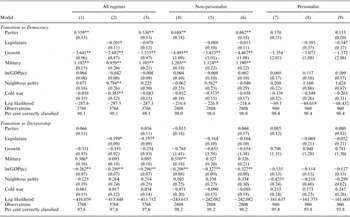
The first three columns of Table 3 look at the samples of all regimes. The first model includes Parties, the second Legislature, and the third both. The coefficients for Parties are positive and statistically significant for transitions to democracy but not for transitions to a subsequent dictatorship. The coefficients for Legislature are negative for both types of regime failure, but only statistically significant for a transition to a subsequent dictatorship. This suggests that parties increase the likelihood of democratization but have little effect on transitions to a subsequent authoritarian regime, while legislatures decrease the likelihood of transitions to dictatorship but have little effect on democratization.Footnote 60
Authoritarian Institutions and Transitions to Democracy and Dictatorship

Notes: Second stage probit with time polynomials to control for time dependence (not reported). Standard errors are clustered on regime. **p < 0.01, *p < 0.05, †p < 0.10.
Next, we separate non-personalist regimes from personalist regimes. The results in columns 4–6 for non-personalist regimes mirror those of the first three columns, but are slightly stronger: Parties increase the likelihood of democratization while legislatures decrease the chances of a subsequent authoritarian regime taking power, though this latter effect is not statistically significant. The results in the final three columns are quite different. In personalist regimes, parties have little effect on the likelihood of either type of transition, while legislatures are associated with a lower likelihood of democratization.
Table 4 reports the predicted probabilities of transition for three types of regimes under different institutional settings.Footnote 61 The first pattern to note is that parties increase the likelihood of democratization in military and party regimes, but have little effect on democratization in personalist regimes. In party regimes, which have a low baseline likelihood of transition to democracy, parties increase the chances of democratization from 0.1 per cent to 0.5 per cent with one party and again to 2.3 per cent with multiple parties. In military regimes, the effect of parties is much stronger, increasing the likelihood of democratization from less than 1 per cent to nearly 4 per cent with one party and to almost 12 per cent with multiple parties. This pattern is consistent with the first hypothesis, though the effect of parties is strongest when there are multiple parties. One interpretation of the finding that multiple parties have a stronger effect on the likelihood of democratization is that incumbent parties must build broader and deeper support coalitions during the authoritarian period, which in turn could help preserve power for the authoritarian elite in a new democracy.
Predicted Probabilities of Transition

Notes: Probabilities of transition from columns 6 and 9 (Table 3). ‘Zero parties’ is understood as the median  within the subsample
 's that fall below the first cut point in the first stage ordered probit (Parties ∈ (0, 1, 2)). ‘Two parties’ is understood as the median
 within the subsample of
 that fall above the second cut point in the first-stage ordered probit (Parties ∈ (0, 1, 2)).
Secondly, we expected legislatures to decrease the likelihood of democratization. This pattern is only observed in personalist regimes, however. Given the paucity of dominant party regimes with no legislature (see Table 2), we cannot conclude that legislatures in these regimes substantively affect the likelihood of democratization. Thus, the only regime type where legislatures really appear to deter democratization is personalist.
Thirdly, parties decrease the likelihood of transition to a subsequent authoritarian regime in non-personalist regimes, but increase this transition likelihood in personalist regimes. The finding that parties destabilize personalist regimes by increasing the likelihood of a transition to a subsequent dictatorship is consistent with Hypothesis 3. However, the negative (in non-personal regimes) and the positive effects (in personalist regimes) of parties on the likelihood of transition to another autocracy are relatively small. Finally, legislatures decrease the likelihood of transition to a subsequent authoritarian regime in all regimes, but this finding is strongest for military and dominant party regimes. In the latter, this effect is quite large (decreasing the likelihood by 50 per cent below the baseline), but this is driven by only a handful of very unstable party regimes that were not sufficiently institutionalized to even stand up a legislature. In military regimes, legislatures cut the likelihood of transition to another dictatorship by slightly less than one half.
In short, parties increase the prospects of democratization in military and dominant party regimes and may actually increase the likelihood of transition to a subsequent authoritarian regime in personalist dictatorships. This suggests that, on the one hand, parties may increase the likelihood of regime transition – albeit in different directions for distinct types of regimes. Legislatures, on the other hand, decrease the likelihood of transition to a subsequent dictatorship in all regimes, perhaps as a mechanism to co-opt and deter authoritarian rivals.Footnote 62 In personalist regimes, legislatures appear to decrease the prospects for democratization as well. In sum, there is some evidence to suggest that parties destabilize authoritarian regimes while legislatures help them survive in power.
A number of other findings are worth noting. First, military regimes are more likely to democratize than other types of regimes, a finding consistent with previous research.Footnote 63 While there is some evidence that military regimes are more susceptible to falling to a subsequent authoritarian regime, their instability relative to other regimes is most evident in the democracy equations. Secondly, higher GDP per capita lowers the likelihood of transition to a subsequent dictatorship. If most of these transitions are coups, this finding is consistent with Londregan and Poole's findings.Footnote 64 However, this finding is only robust for non-personalist regimes, suggesting that a coup trap may only be the province of party and military regimes. Finally, short-term economic growth appears to be a factor that stabilizes authoritarian regimes, but this effect is strongest in the democracy equations. This finding may reflect the fact that economic crisis is associated with democratization.Footnote 65
Robustness
We conducted several robustness checks, the results of which are available in an online Appendix. First, we included random effects in the second stage equation to address unit heterogeneity (A2). Secondly, to ensure that monarchies were not driving the results, we tested models that included a dummy variable for monarchies and models that excluded monarchies from the analysis (A3 and A4). Thirdly, we controlled for oil rents in all equations (A5); this reduced the sample size, mostly by omitting years before 1960. Fourthly, we tested models that exclude economic growth from the analysis, because it is possible that this variable is not exogenous considering that political instability may affect growth outcomes (A6). Fifthly, we tested models in which we lagged the number of parties by two years to address the possibility that multipartyism is endogenous to democratization (A7). The results reported in Table 3 are robust to all of these alternative specifications. Finally, we tested models without control variables for military regimes (A8). Without controlling for military regimes, the results show that in non-personal regimes, parties increase the likelihood of democratization and legislatures decrease the likelihood of democratization. This evidence is consistent with Hypotheses 2 and 4. Military regimes are less likely to have legislatures than party-based regimes and are also more likely to democratize, perhaps for reasons that are unrelated to political institutions.Footnote 66 Thus, we view this variable as an important control. In short, including the control for Military does not alter the results for parties but it does for legislatures – in a direction that works against Hypothesis 2.
We conducted three additional empirical tests to understand better how parties and legislatures affect democratization. First, we explored the empirical relationship between parties and democratization by estimating the effect of one party and more than one party separately (A9). To do this, we constructed separate instruments for one-party only and multiple parties using Equation 5.Footnote 67 We found that even having only one party increases the likelihood of democratization, though the effect for multiple parties is much stronger, as suggested by the predicted probabilities in Table 4. For example, in models similar to columns 1 and 3 in Table 3, the coefficients for one-party are 0.32 and 0.50 (neither statistically significant, though),Footnote 68 while the coefficients for more than one-party are 0.77 and 0.86 (both statistically significant at the 0.01 level). This suggests that the bulk of the parties’ effect on democratization lies in multiple parties. One interpretation of this result is that incumbent parties must develop deeper support networks when there is at least nominal political competition than when it is absent. If the main argument for parties is correct, deeper support coalitions should be more likely to protect elite interests after a transition to democracy.
Secondly, we explored the interaction between  and
 to understand if the democratizing effect of parties is only present in regimes that also stand up a legislature (A10). To do this, we calculated an interaction term from the instruments derived in Equations 5 and 6 above. These models are the same as those in columns 6 and 9 in Table 3, but with the addition of an interaction between
 and
 . The interaction term is small and indistinguishable from zero in the personalist-only sample. In the sample of non-personalist regimes, however, the coefficients for both
 and
 are positive and statistically significant. With no legislature, the coefficient for
 is 0.65 and when a legislature is also in place this coefficient increases to 0.85. This finding is consistent with Hypothesis 4, though the presence of a legislature appears to increase the democratizing effect of parties.
Last, we tested models that allow the effect of institutions to vary by regime type in the non-personalist sample by including interactions between Military and  and Military and
 (A11).Footnote 69 We find that
 increases the likelihood of democratization in both military and party regimes; however, the magnitude of the effect is larger in party regimes. The coefficient for
 , reflecting the marginal effect in party regimes, is 0.98 and statistically different from zero at the 0.01 level. The coefficient for
 , reflecting the marginal effect in military regimes, is 0.38 and is statistically different from zero at the 0.10 level.Footnote 70 This suggests that while parties increase in the likelihood of democratization in both types, the effect is stronger in party regimes. One interpretation of this finding is that parties in non-military regimes have larger coalitions and deeper support networks than parties in military regimes.
Authoritarian leaders’ post-exit fate
In this section, we examine how authoritarian parties and legislatures affect the post-exit fate of dictators. If the theory outlined above is correct, then parties in military and dominant party regimes should help protect the well-being of dictators themselves after an exit from power, while these institutions should have little effect on the welfare of dictators leaving personalist regimes. We use a dataset of authoritarian leaders that codes both the year of their exit from power and the post-exit fate of the leader.Footnote 71 The data are almost identical to the commonly used Archigos data, except that the unit of observation is the country year and thus only codes one leader per country per year.Footnote 72 The fate variable can take four values: the leader (1) remains in the country with impunity; (2) is in exile or lives abroad; (3) is arrested, in jail or on trial; or (4) has been assassinated or murdered.
We analyse these data in two ways. First, we look only at authoritarian leaders who have left power; thus, we have one observation for a leader-exit. Using a multinomial logit model and controlling for level of development, economic growth and civil war, we estimate how parties and legislatures affect the probabilities of the bad outcomes (exile, arrest, death) relative to the category of ‘remains in the country with impunity’. Civil wars might be expected to increase the likelihood of leader assassination or murder; and economic growth during the leader transition often influences the bargaining capacity of the outgoing leader.Footnote 73 Secondly, we analyse the exit data using survival analysis. Controlling for time dependence, economic growth, logged GDP per capita, civil war and military regimes, we estimate how parties and legislatures affect different types of leader failure, where the leader failure types are the post-exit tenure categories (1–4). Here, observations are leader-years, and the base outcome is not exit/right-censored.
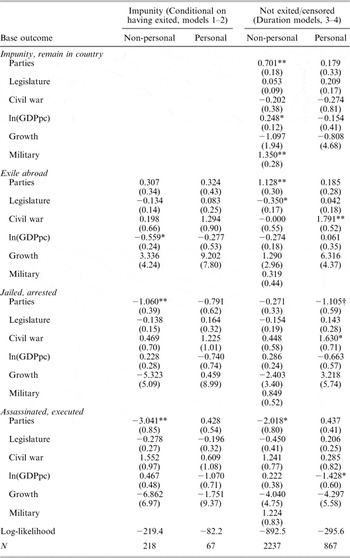
The results in the first column of Table 5 indicate that, conditional on having exited, parties in non-personalist regimes reduce the likelihood of all the bad outcomes (from the perspective of the dictator) relative to the best outcome (remain with impunity in the country). This result is consistent with the logic suggesting that parties protect the interests of authoritarian incumbents after they leave power. Legislatures in these regimes, however, have little effect on the type of exit, conditional on having exited. The results in the second column suggest that in personalist regimes, neither parties nor legislatures reduce the risk of bad types of exit. In short, these models indicate that, conditional on having left power, only parties in non-personalist regimes protect exiting dictators against particularly nasty outcomes.
Authoritarian Parties and Leaders’ Post-Exit Fate

Notes: Dependent variable is post-exit fate of the dictator in the first two columns, failure type in the last two columns. Multinomial logit estimation; duration polynomials included but not reported in the last two columns. Included regime type in column 3 is Military (not reported). Monarchies excluded from the analysis. Years covered: 1946–2002. **p < 0.01, *p < 0.05, †p < 0.10.
The first two models only examine dictators who have left power, which may bias the results because these models exclude dictators who remain in power or who died in office (censored dictators). So in the last two columns we run similar specifications using survival analysis (with unreported controls for time dependence) with multiple failure outcomes.Footnote 74 These results suggest that parties increase the likelihood of exiting power but remaining in the country with impunity and the likelihood of being exiled, but decrease the likelihood of exit by death or assassination. Legislatures in general have no effect on different types of exit, except in one case, slightly decreasing the likelihood of exile. These findings are consistent with the expectation that parties in non-personalist regimes protect the interests of exiting dictators. In personalist regimes, parties reduce the likelihood of being arrested and jailed after leaving power, but increase the likelihood of death or assassination. Legislatures again have little effect on exit in personalist regimes. Overall, these results, particularly the finding which suggests that parties decrease the likelihood of death after exit in non-personalist regimes but increase this probability in personalist regimes, are consistent with the argument that parties can protect elite interests, but only in non-personalist regimes.
Discussion
The results in this article provide further evidence for the growing consensus that authoritarian institutions matter.Footnote 75 The main contribution of the present study is to help us understand the channels through which authoritarian institutions affect authoritarian regime survival. By separating out the mechanisms through which parties and legislatures influence the payoffs for both authoritarian incumbents and potential regime opponents, and by modelling democratization as a separate failure outcome from transition to subsequent dictatorship, we have uncovered some revealing patterns. The finding that legislatures in non-personalist regimes are correlated with a lower likelihood of being replaced by a subsequent authoritarian regime is consistent with much of the literature which posits that institutionalization is stabilizing. Our interpretation of this finding is that legislatures in these regimes increase the credibility of promises made to potential regime opponents.
The finding that parties can destabilize dictators by making democratization more likely stands at odds with some of the literature which argue that authoritarian parties stabilize dictators.Footnote 76 The logic underlying this finding, we suggest, reflects the fact that political parties, even when devised to quell threats from authoritarian rivals, can be strong enough to exert influence over the distribution of power in a subsequent democracy. This point echoes Dahl's reasoning to explain why economic equality should make democracy more likely: higher equality means that the median voter in a democracy will be less likely to prefer redistribution from the rich to the poor, making the rich more amenable to democratization.Footnote 77 The basic insight, which we argue is applicable to parties, is that when the elite are less threatened by democratization, they are more likely to adopt it. Some of the most influential theories of comparative democratization in recent years make this intuition central to their explanation of democracy.Footnote 78
The present article expands on this notion by suggesting that party legacies can play a similar role of protecting elite interests in a subsequent democracy. The central interest of authoritarian elites may not simply be to protect themselves from taxation under democracy, particularly for military elites who may be more concerned about military budgets and avoiding prosecution for human rights violations. Political institutions are thus relevant when considering the wide range of interests outgoing authoritarian elites may have. This logic of exit guarantees invites a more careful analysis of other types of authoritarian political institutions that can exert influence over the distribution of power in a new democracy. While this article focuses on legislatures and party systems, judicial institutions merit systematic examination as well.Footnote 79
The argument for why parties can help protect the interests of outgoing elites in a post-transition democracy has further testable implications. In Table 1, we noted that some former dominant parties meet with electoral success in new democracies.Footnote 80 We underscored this point in a crude way by showing how former parties performed in post-transition elections. However, some former regime elites start new parties that propel them to electoral success in post-transition democracies, as the 2004 and 2009 presidential victories for Susilo Bambang Yudhoyono in Indonesia illustrate. Yudhoyono was a high-ranking general in the Suharto regime that collapsed in 1998, but now leads the Democratic party which defeated the former ruling party, Golkar, in the 2009 parliamentary elections. Thus, the task of tracking the electoral success of a former regime elite is more difficult than the tallies reported in Table 1. Future research might take up this question by exploring the relationship between political leaders (not simply parties) in a post-transition democracy and the former ruling elite. In addition, this argument suggests that parties should help to protect the interests of former military rulers. This implication might be tested by examining how parties affect military budgets and the likelihood of human rights prosecution of former military leaders in post-transition democracies.
By distinguishing political institutions in personalist regimes from those in other types of regimes, this research also contributes to the small but growing literature which utilizes variation among different types of authoritarian regimes to help us understand phenomena as distinct as economic growth, investment, international conflict, civil conflict and infant mortality.Footnote 81 While students of comparative politics were the first to note and systematically disaggregate personalistic rule from other types of authoritarian polities, it has mostly been international relations scholars who have thought through how variation among different types of regimes might affect their theories.Footnote 82 Other important questions in comparative political economy might be fruitfully explored by distinguishing personalist rule from other types of authoritarianism – for example, the literature on the human capital benefits of democratization, the trade consequences of democratization or the resource curse.
We find empirical support for the argument that political parties can increase the likelihood of a democratic transition. Our interpretation of this evidence is that parties help guarantee the interests of autocratic elites – either in the form of greater access to power under a new democracy or by securing particular interests of the outgoing elite. This interpretation finds further support when we analyse how parties affect the likelihood of particularly bad post-tenure fates of authoritarian leaders. We attempt to delineate when the democratizing effects of parties outweigh the potential stabilizing effects by separating personalist regimes from non-personalist regimes. To do this, we simply used a dummy variable to capture the former. Future research will benefit from thinking more carefully about when party features that contribute to ‘exit guarantees’ are stronger than the stabilizing factors of parties. In doing so, we might also unpack the specific features of personalist regimes, such as the size of the support coalition or the relationship between the leader and the party, that may vary over time and appear to make them distinct from other dictatorships.
 ) is a continuous variable, so we take the median
 from the distribution of
 's that lies below the first cut-point (zero parties); the median between the cut-point (one party); and the median
 from the distribution of
 's that lies above the second cut-point (two parties). For
 , we use the median
 for the subset of
 's that lie below the mean predicted value as ‘no legislature’ and the median
 for the subset of
 's that above below the mean predicted value as ‘legislature’. These latter values are close to the 25 percentile and the 75 percentile of the distribution of
 's.