INTRODUCTION
Mangrove ecosystems have experienced widespread deforestation and degradation throughout the tropics and subtropics. The exact losses are difficult, if not impossible, to determine owing to inaccurate recent surveys or historical estimates not based on empirical measurements (Spalding et al. Reference Spalding, Blasco and Field1997; Valiela et al. Reference Valiela, Bowen and York2001). Loss of at least 35% of the world's mangrove area since the early 1980s, corresponding to an annual loss rate of 2.1%, exceeds the loss rates for tropical rainforests and coral reefs, two other threatened environments (Valiela et al. Reference Valiela, Bowen and York2001). Major reasons for mangrove destruction are urban development, diversion of freshwater flows, overharvesting of fuelwood and timber, as well as conversion to developments like aquaculture, agriculture, mining and salt extraction (Saenger et al. Reference Saenger, Hegerl and Davie1983; Valiela et al. Reference Valiela, Bowen and York2001; Alongi Reference Alongi2002). The establishment of shrimp ponds has been the main cause behind mangrove loss in many countries, and in some locations it has accounted for all of the conversion (see for example Primavera Reference Primavera and de Silva1998; Rönnbäck Reference Rönnbäck2001). Kenya has lost about 20% of its mangrove forests, mainly due to the conversion into ponds for salt extraction (Abuodha & Kairo Reference Abuodha and Kairo2001). The remaining forests are in many locations also degraded by unsustainable extraction of fuelwood and timber.
In recent years, there has been an increasing awareness that mangroves provide many valuable functions free of charge. They generate a wide range of ecosystem services like protection against floods and storms, reduction of riverbank and coastal erosion, and water quality maintenance (see Saenger et al. Reference Saenger, Hegerl and Davie1983; Ewel et al. Reference Ewel, Twilley and Ong1998; Moberg & Rönnbäck Reference Moberg and Rönnbäck2003). These services are key features that sustain economic activities in coastal areas in many countries. In addition to the multiple services, a variety of natural resources from mangroves are vital to subsistence economies and provide a commercial base to local and national economies (Hamilton & Snedaker Reference Hamilton and Snedaker1984; Bandaranayake Reference Bandaranayake1998; Rönnbäck Reference Rönnbäck1999).
A number of countries have initiated mangrove rehabilitation programmes in degraded mangrove systems or abandoned shrimp ponds (Field Reference Field1996, Reference Field1998; Spalding et al. Reference Spalding, Blasco and Field1997; Stevenson Reference Stevenson1997). More than 100 countries harbour mangroves, but extensive replanting of these forests (areas > 100 km2) has been achieved only in Bangladesh, India, Indonesia, the Philippines, Thailand and Vietnam (Field Reference Field1998). The worldwide coverage of rehabilitated mangroves was some 3000 km2 in the late 1990s (Field Reference Field1998), corresponding to less than 2% of all the world's mangrove habitats (Spalding et al. Reference Spalding, Blasco and Field1997). Annual loss rate of mangroves thus exceeds the total rehabilitated area, stressing the urgent need to launch more extensive rehabilitation programmes.
Three major criteria can be used to evaluate the success of mangrove rehabilitation (Field Reference Field1998). First, effectiveness of planting, in other words the extent to which the objectives of the rehabilitation programme are met. Second, rehabilitation efficiency in terms of labour, resources and so on. Third, the recruitment rate of associated flora and fauna, indicating the recovery of ecosystem structure and function. The first two criteria are sometimes assessed, whereas the recruitment aspect rarely receives attention in mangrove rehabilitation (Field Reference Field1998; Crona & Rönnbäck Reference Crona and Rönnbäck2005; Crona et al. Reference Crona, Holmgren and Rönnbäck2006). Effectiveness of rehabilitation is best measured against the original objectives, which in most cases revolve around three main goals: (1) conservation of natural system and landscaping; (2) sustainable production of natural resources; and (3) protection of coastal areas (Field Reference Field1998, Reference Field1999). The most common objective of most mangrove rehabilitation programmes is silviculture, followed by coastal protection (Field Reference Field1996, Reference Field1998; Alongi Reference Alongi2002). Sustainable production of natural resources as a rehabilitation goal thus focuses on commercial extraction of forest products, especially timber and sometimes charcoal. The wide variety and immense importance of subsistence and small-scale commercial products as well as services apart from coastal protection is seldom acknowledged.
The success of mangrove rehabilitation programmes in populated areas, especially in developing countries, will largely depend on the inclusion of local communities as an integral component of the mangrove system. Diverging views on plantation goals and ensuing conflicts may otherwise hamper the process (Field Reference Field1998). Walters (Reference Walters2000, Reference Walters2003) studied the initiatives of local communities to plant (monoculture Rhizophora stylosa) and manage mangroves for coastal protection, establishment of tenure claims and access to construction material. However, to our knowledge there are few studies that include local users' perspectives, whether prior to, during or after the implementation of a rehabilitation programme (Walters Reference Walters2004; Walton et al. Reference Walton, Samonte-Tan, Primavera, Edwards-Jones and Le Vay2006). Nor has there been any scientific assessment of how resource users value natural versus planted mangroves with regards to provision of ecosystem goods and services. These are serious shortcomings, and it could be questioned whether the success of most rehabilitation programmes in developing countries can be measured at all without such work.
This study set out to evaluate how local communities perceive and value ecosystem goods and services associated with both natural and replanted mangroves in southern Kenya. Resource users in two coastal communities were interviewed to assess the local dependence on mangrove ecosystem goods and services, and to describe the views and attitudes of local communities with respect to threats, regulations, plantations and community management of mangroves. The results are analysed and discussed in the context of local communities' ecological knowledge, mangrove dependence and attitude to natural versus planted mangroves, as well as the potential for community management. Patterns of resource valuation are also compared among users groups based on occupation, gender and village background. Through interviews with managers and researchers responsible for mangrove management and existing plantations, we also outline the institutional framework surrounding management of mangrove forests and plantations to provide a historical background and context against which community perceptions can be analysed.
METHODS
Study area
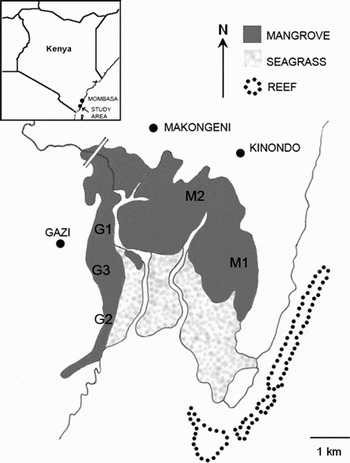
The study area is located approximately 50 km south of Mombasa (Kenya), and comprises two rural communities: Gazi and Makongeni (Fig. 1). The majority of inhabitants in both villages are involved in subsistence livelihoods, although these differ such that close to 90% of the men in Gazi village are involved in fisheries, while a large portion of the households in Makongeni are full-time farmers. This is partly because Gazi is located closer to the sea, while Makongeni lies in the vicinity of more arable land. Women in both communities earn most of their income from either weaving makuti (roof thatches made from coconut fronds) or mats, or from collection of firewood, molluscs and crustaceans, and from preparing and selling food. Gazi has approximately 1000 inhabitants, while Makongeni hosts approximately 400. The history of the villages differs slightly. Gazi dates back to colonial times, while Makongeni was founded in the late 1980s, when a large sugar company operating in the area closed down and former employees decided to remain and settled in the area.
Map of the study area (location 4°25′S and 39°50′E) showing the coastal seascape with the distributions of mangroves, mudflats, seagrass beds, reefs and plantations (G1, G2, G3, M1 and M2) near the villages of Gazi and Makongeni.

Natural mangroves
The seascape of the area is characterized by mangroves covering approximately 5 km2 (Mwashote & Jumba Reference Mwashote and Jumba2002) with mudflats and seagrass meadows in the shallow part of the bay. The lagoon is sheltered from intense wave impact by shallow reefs at the mouth of the bay (Fig. 1). Mangrove species occurring in Kenya are Rhizophora mucronata, Ceriops tagal, Bruguiera gymnorrhiza, Avicennia marina, Sonneratia alba, Lumnitzera racemosa, Xylocarpus granatum, X. moluccensis, Heritiera littoralis and Pemphis acidula. Of these, the last three are very rare or non-existent in the study area (Dahdouh-Guebas et al. Reference Dahdouh-Guebas, van Pottelbergh, Kairo and Koedam2004).
The mangroves in Kenya were legally declared a government reserve forest by proclamation number 44 of 1932, and later by legal notice in 1964 (Kairo & Kivyatu Reference Kairo and Kivyatu2000). In Kenya, the chief conservator of forests (CCF) is the primary forest authority, followed by the provincial forest officer (PFO) and a district forest officer (DFO) under whose charge a number of forest guards and extension staff operate and patrol the area. At the time of the study there was currently only one forest guard working in the area.
Historically the main threat to mangroves has been excessive timber extraction and to some degree extraction of fuelwood. In response to this, several bans on mangrove-related product exports have been issued over the years. In 1997, the first ban on national exploitation of any type of mangrove forest product was issued and has since been enforced, with only periodic local exceptions.
Plantations
The first experimental mangrove plantations in the area commenced in the early 1990s. The main objective then was to test the suitability of different species in relation to inundation. After three years of monitoring, larger plantations were established in 1994. The main objective of these plantations was to restore areas degraded by timber extraction in the 1970s, which had shown no signs of natural regeneration, using only species occurring naturally. These included Rhizophora mucronata, Ceriops tagal, Bruguiera gymnorrhiza, Avicennia marina and Sonneratia alba. The planting project was conducted through the Kenya Marine and Fisheries Research Institute (KMFRI) with the help of external funding.
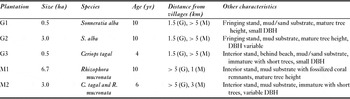
Five plantations were included in the present analysis, three located close to Gazi village (G1, G2, G3), and two located closer to Makongeni (M1, M2) (Fig. 1, Table 1). Planted species are C. tagal, R. mucronata and S. alba, and the size of the plantations ranges from 0.5 to 6.7 ha (Table 1). The plantations were 4–10 years old at the time of data collection. Plantations were chosen based on availability. Only a limited number of plantations exist in the area, and consequently, it is worth noting that their distribution and availability is limited in relation to the natural forest.
Summary of mangrove plantation characteristics (in 2004) around Gazi (G) and Makongeni (M) villages, Gazi Bay (Kenya). DBH = diameter at breast height. See Kairo (Reference Kairo1995) and Bosire et al. (Reference Bosire, Dahdouh-Guebas, Kairo and Koedam2003) for additional information.

Interviews
During April–June 2004, 48 semi-structured interviews were conducted with resource users in the two target communities, corresponding to approximately 3% and 5% of the entire population in Gazi and Makongeni, respectively. An inventory was made of all the people in each village who use the mangrove regularly and respondents were randomly selected from this list. Mangrove use was defined as any activity closely related to the mangrove habitat, such as fishing and harvesting of forest products.
In each village at least 10 men and 10 women were interviewed. In Gazi, there were 10 female and 18 male respondents, the men being further subdivided into fishermen (n = 10), pole cutters (n = 5) and other occupations (n = 3) based on the respondents' primary income source. In Makongeni, there were 10 female and 10 male respondents, and again the men were subdivided into pole cutters (n = 7) and other occupations (n = 3). At the time of study, some pole cutters had other income sources due to the ban on exploitation of the mangrove forest, but still identified themselves as pole cutters. Respondents were 25–70 years old, and no major difference in age structure existed between user groups (average age of both groups was 39–49 years).
Interviews with villagers were conducted in Kiswahili, in the homes of the respondents. The questionnaire was divided into qualitative and quantitative sections. Qualitative questions were partitioned into four themes: (1) ecological knowledge about the mangrove forest and related threats; (2) knowledge of the plantations and local community participation in the planting projects; (3) goods and services of natural mangroves and plantations; and (4) regulations for mangrove forest use and extraction. Quantitative questions classified mangrove goods and services into 22 and seven different categories, respectively, based on personal observations and previous documentations of mangrove importance (see Saenger et al. Reference Saenger, Hegerl and Davie1983; Hamilton & Snedaker Reference Hamilton and Snedaker1984; Rönnbäck Reference Rönnbäck1999). Respondents were asked if they, or someone else, used/enjoyed (or had used/enjoyed) the good/service and if the planted mangroves provided this resource. We also asked about the relative importance of each type of good and service (rated on a three-point scale: low importance, important and very important). Acknowledgement of ecosystem services was followed up by questions about the supportive function(s) of mangroves supplying these to assess the respondents' ecological knowledge behind the reasoning.
Two licensees, a forest guard, two researchers and the Kwale district forest officer (DFO) were also interviewed to better understand the institutional framework around the management of the mangrove forests and plantations, as well as to investigate future possibilities for community management. Interviews with the researchers and DFO were conducted in English and took place in their offices.
Data analysis
The transcripts from the 48 interviews with resource users and six interviews with managers and researchers resulted in more than 400 pages of text. Each individual interview transcript was incorporated into an extensive matrix for further analysis. The total number of identified ecosystem goods and services, and the relative proportions (%) of resource users acknowledging their provision from natural and planted mangroves were estimated. Ecosystem goods were grouped into commodities (such as food, fuel and construction materials) and services grouped into functions (regulating, reproduction and cultural) (see de Groot et al. Reference de Groot, Wilson and Boumans2002; Rönnbäck et al. Reference Rönnbäck, Kautsky, Pihl, Troell, Söderqvist and Wennhage2007). The relative importance of products and services was estimated according to the ranking assigned by the majority of users. The qualitative section of the questionnaire was analysed by categorizing answers into themes and subsequent coding to assess ecological knowledge and perspectives on mangrove species, number of plantations, threats, regulations and community management, as well as the relative value of plantations in comparison to natural mangroves.
Both qualitative (after coding) and quantitative answers given by respondents were evaluated with the help of multivariate analysis to distinguish group specific features and differences. Two principal component analyses (PCAs) were performed for this purpose to explore patterns among respondents based on occupation, gender and village membership. Multivariate analysis was conducted using Canoco 4.5.
The number of goods and services according to respondents originating from natural and planted mangroves were compared using t-tests. Prior to t-tests, the distribution of paired differences was checked for normality. Univariate statistics were performed using Statistica 7.0.
RESULTS
The most common definitions of mangroves among respondents was ‘trees that grow in the sea’, followed by ‘good building material’. Knowledge of mangrove species in the area was good, and as many as 77% recognized 4–6 species of trees. Most respondents thought mangroves were beautiful: ‘Of course, they are beautiful. If possible they should be planted in the village, but it is impossible since they need seawater.’
Mangrove ecosystem goods
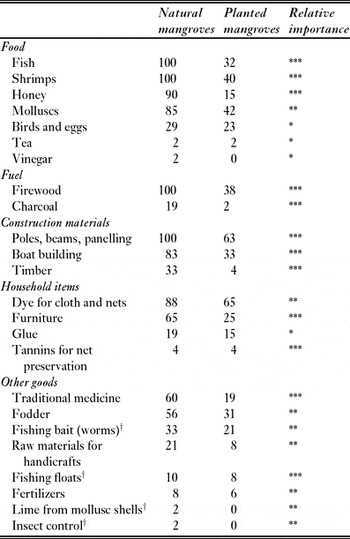
Local resource users acknowledged 24 different types of mangrove goods (Table 2). Some goods (mammals, fur, skin, fruit, cooking oil, alcohol, wax and fish poison) were not recognized, whereas some respondents suggested additional goods (fishing bait, fishing floats, lime and insect control) to those specified in the questionnaire. Most resources (16 out of 24) could be classified as major goods (acknowledged by at least 20% of users and ranked as important or very important). Products of significant importance and recognized by all users included fish, shrimp, firewood and poles (Table 2). Honey, boat building material, furniture and traditional medicine were other very important resources widely acknowledged. One respondent stated that without furniture from mangroves ‘we would not have any place to sleep, no beds’. Traditional medicine was derived from all tree components (leaves, fruits, bark and roots) and used for stomach problems, fever, removal of hookworms and fly eggs, as well as warding off evil spirits.
Ecosystem goods provided by natural and planted mangroves according to local resource users (% of all respondents) in Gazi Bay (n = 48). Relative importance: *low importance, **important, ***very important. †Mangrove support probably underestimated as resource not specified by interviewer.

Charcoal was ranked as very important, but only recognized by 19% of users, probably owing to the fact that production is located in other villages. Mangrove bark is used for colouring of cloth and nets (dyes), net preservation (tannins) and glue production. Handles of the traditional colourful fan were the most common handicraft use of mangrove wood, but other items like tree carvings (from Xylocarpus granatum), traditional drums, cooking sticks, handles for axes and spades, shoes and earrings were also produced. Mangrove leaves (Avicennia marina and Ceriops tagal) were used as animal fodder, and mixing mangrove leaves with sand produced fertilizers. Sonneratia alba roots (pneumatophores) were used as fishing floats. Vinegar (produced from honey residues), tea (Ceriops tagal leaves), lime from mollusc shells and leaves for insect control (flies are attracted and then stick to A. marina leaves) were items of limited importance.
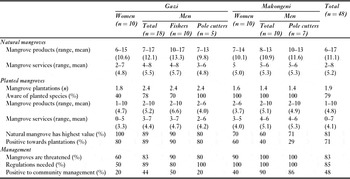
The number of mangrove products acknowledged by each respondent differed substantially within user groups (Table 3). Fishermen identified most goods (10–17) and were the only group to acknowledge tannins, vinegar and tea. In contrast, only two pole cutters from Gazi recognized ten products or more. The ecological knowledge among women from Gazi varied markedly, and some women could only identify six goods. Men generally had a better knowledge compared to women, apart from four resources (molluscs, fodder, raw material for handicraft and fishing bait) in Gazi and two resources (molluscs and dyes) in Makongeni. The main differences between the two villages were the acknowledgement of goods such as birds/eggs, fodder and traditional medicine. No respondents in Makongeni recognized birds or eggs as a mangrove resource, compared to 50% in Gazi. The majority (75%) of users in Gazi acknowledged fodder compared to less than one third in Makongeni. The opposite applied for traditional medicine, recognized by 80% and less than 50% in Makongeni and Gazi, respectively.
Number of mangrove goods and services identified (given as a range with mean in brackets), together with perceptions of plantations, threats and management among local communities in Gazi Bay (expressed as % of respondents). Male respondents are further identified as fishers or pole cutters.

Mangrove ecosystem services
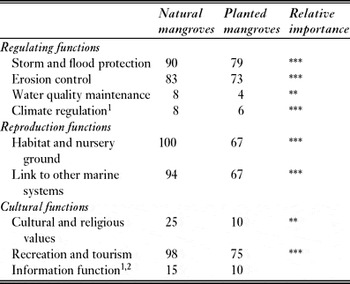
In total, local resource users acknowledged nine different types of mangrove ecosystem services (Table 4). Protection against storms, floods and erosion as well as reproductive functions and recreational values were identified by a vast majority of users, and ranked as very important services. Storm and flood protection were explained by respondents as mangroves providing a mechanical wall offering wind protection as well as preventing high tides from reaching the village. Erosion control was explained by tree canopies reducing the movement of heavy rains and mangrove roots holding the soil firmly, preventing erosion by rain, waves and high tides. Less than 10% of the respondents indicated that mangroves can maintain water quality if exposed to sewage. Only two respondents mentioned ability of mangroves to clean water, and two others mentioned nutrients in the sewage as potential fish food or mangrove fertilizers. Some respondents mentioned the ecosystem service of local climate regulation, which was not specified in the questionnaire. The underlying explanation for this was that mangroves attract rain and protect from cold winds.
Ecosystem services provided (% of all respondents) by natural and planted mangroves according to local resource users in Gazi Bay (n = 48). Relative importance: *low importance, **important, ***very important. 1Mangrove support probably underestimated, as service not specified by interviewer; 2relative importance not asked for.

A variety of mechanisms and mental models were used by respondents to explain the reproduction functions of mangroves. The use of mangrove habitat as nursery, breeding and feeding ground was based on the provision of food, shelter/protection, shade and cool water. Mangroves were often referred to as a ‘good house’ for fish, shrimps, crabs, molluscs and birds. The majority of resource users also exhibited some knowledge of the biophysical links between mangroves and other ecosystems in the seascape, namely seagrasses and coral reefs. Fish were recognized as migrating substantially between these coastal systems, following daily tidal dynamics or seasonal life history migrations, illustrated by comments such as: ‘. . . coral reef fish come to feed and lay eggs [in the mangroves] and then return. Eggs hatch, then the fish go to the corals.’
Religious values were associated with sacred areas (kayas) holding ‘shrines in old mangroves’. These kayas were visited to cure and reduce susceptibility to diseases and evil spirits. All respondents acknowledged aesthetic values of mangroves by always referring to the system as beautiful, or even very beautiful. Recreational values for tourists were also evident and explained by the attractions of fresh air, good air flow, shade and shelter, as well as opportunities to photograph birds. Some respondents touched upon the information function of mangroves when describing the reasons behind tourists visiting the area: ‘tourists don't know about mangroves’, ‘. . . [tourists] have no mangroves in their country’ and ‘. . . [tourists] come to learn’. This information function can also be viewed as an ecosystem service. Most respondents stated that the revenues from tourism went primarily to people outside the villages. However, 50% of Makongeni men expressed personal benefits working as tourist guides, compared to only 17% of people from Gazi recognizing this as a potential income to the village.
Only two respondents could identify any negative aspect of having mangroves close to the village. Disservices mentioned included problems with mosquitoes and wild animals such as baboons.
Fishermen acknowledged more services than pole cutters, and men more than women (Table 3). Answers also differed substantially between villages. Services such as water-quality maintenance, climate regulation and information functions were almost exclusively recognized by Gazi respondents. The appreciation of religious values was also more pronounced in Gazi.
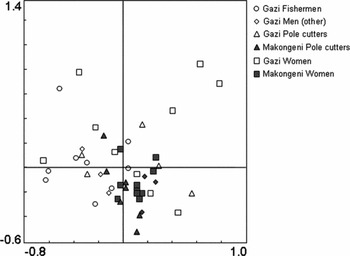
Everybody from Makongeni recognized storm and flood protection as well as erosion control, compared to only 60% of the women from Gazi. The detail in recognition of goods and services was more heterogeneous among respondents in Gazi (Fig. 2), where some women and pole cutters could, for example, only identify 2–3 services, than at Makongeni (tighter clustering in Fig. 2). All Makongeni users acknowledged 5–6 services, while Gazi users listed a broader range of 2–8 services (Table 3).
Principal component analysis (PCA) of respondents with respect to their views on goods and services provided by natural mangroves (n = 47). One marked outlier (a Gazi fisherman who recognized tea and vinegar products) was excluded. Cumulative variance accounted for by axis 1 (9.8) and axis 2 (9.0) is 18.8%.

There is a clear distinction between the two villages concerning the historical change in mangrove importance. Most users from Makongeni (90%) argued that mangroves were more important today based on an increased population more dependent on mangrove resources. In the past they relied on terrestrial forest for house constructing material, but those forests were now gone, so they relied increasingly on mangroves. Another reason given was that they were now more educated about mangrove planting and the potential use of this in the area. In Gazi, more than 70% of interviewed users were of the opinion that there was no historical change in mangrove importance or that mangroves were more important in the past. The perceived reduction in importance of mangroves was motivated by the fact that more people were better off today and could thus afford to buy manufactured substitutes for some mangrove resources.
Natural versus planted mangroves
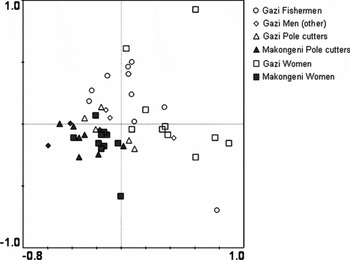
Most respondents identified two out of five plantations (Table 3). Everyone was aware of at least one plantation, but no one knew more than three. Furthermore, most respondents only knew about the plantations in the vicinity of their village, and consequently Gazi villagers identified more plantations. All men and women from Makongeni knew the name of planted mangrove species in at least one of the plantations, while only pole cutters from Gazi shared this level of knowledge. The closer resemblance between Gazi pole cutters and respondents from Makongeni in many respects is seen by their overlapping distributions (Figs 2 and 3). In Gazi, men had better knowledge of the number of plantations and planted species than women.
Principal component analysis (PCA) of respondents with respect to their views on mangrove management, plantation initiatives and goods and services provided by mangrove plantations (n = 48). Cumulative variance accounted for by axis 1 (11.4) and axis 2 (7.6) is 19.0%.

The majority of respondents (81%) thought natural mangroves were more valuable than the plantations (Table 3), however, more than one-third of Makongeni respondents argued that the plantations were more valuable. The main reason given was that the plantations would produce more poles of good quality, outweighing the fact that natural mangroves generate more products.
Significantly fewer products (p < 0.001) were recognized from the plantations (mean 4.8 ± SD 2.7) than from natural mangroves (11.1 ± 2.5) when compared across all groups of respondents (n = 48). One-third of respondents only recognized one or two products supported by the plantations. Poles and bark for dye production were the only resources acknowledged as produced by plantations by more than 50% of interviewed users (Table 2). Only 15–40% of respondents thought plantations could provide very important resources such as fish, shrimp, honey, firewood and traditional medicine. Honey production was said to be strongly associated with the natural forest, explained through the preference of bees for old hollow trees to build their hives. Fishermen generally acknowledged more goods from the plantations than pole cutters, and men more than women. Men from Makongeni were most positive to the ability of plantations to support the same resources that they identified from the natural forest.
Significantly fewer services (p < 0.001) were also recognized from the plantations (4.1 ± 1.6) than from natural mangroves (5.2 ± 1.1) (n = 48). Respondents from Makongeni were most positive to the potential of plantations to provide services and all thought the plantations attracted tourists and provided storm, flood and erosion protection, compared to only 40–78% of Gazi respondents. The latter spoke of reduced wind protection provided by plantations owing to less developed forest canopies, and sacred areas were mainly associated with old and mature mangroves. The plantations' limited support to reproductive functions (Table 4) negatively affected fisheries catches in terms of productivity as well as quality (species composition and catch size of fish and shellfish). Respondents explained this by saying that the environment was better in the natural mangrove, which offered more food, better shelter, muddier substrate and encompassed holes and channels that always held water, even at low tide.
The majority of users (92%) thought the plantations would be more beneficial in the future. Many argued that the plantations were still too young to have any old and dry branches to collect for firewood. The trees were also too young and small to support the production of charcoal, timber and boat building material. One-fifth of the respondents even believed that the plantations would be more beneficial than the natural mangroves in the future, based primarily on the presence of large poles of very good quality. They also argued that fish and shellfish would return to the plantations in the future. Most respondents expressing this view came from Makongeni village.
Attitudes towards the plantations, regulations and community management
Most people interviewed (71%) had a positive attitude towards the plantations (Table 3), based on the possibility of harvesting more products from them in the future. In spite of this, half of the Makongeni villagers held negative views of the plantations. Although generally positive about the concept of planting mangroves, their view was that current plantations were initiated without informing them beforehand. Most argued that they were not informed (65%) and some could not remember (10%). In Gazi, more than 60% of the users verified direct sharing of information beforehand.
Interviewed scientists involved in the initiation and implementation of the planting programmes maintained that the goal was to restore the type of forest that had originally grown in the degraded areas. Although the ultimate objective of this was the continued provision of goods and services to the community, the plots were too small in size to support any large-scale extraction of wood products and thus only ecosystem services and non-forest products were available to the community at present. The planted areas were viewed as strictly research plots, a status reinforced by the fact that they were planted on government land and considered by the Forest Department as permanent sample plots for investigation. According to scientists involved, information meetings were held with the village (Gazi) before planting, focusing on the ecological aspects of conservation and reforestation, and the village gave their approval. However, the concept of indirect uses (i.e. ecosystem services) was not introduced until 10 years later during a national awareness programme.
There was a unanimous view among researchers and officials interviewed that the local community was well aware of the purpose of the plantations and the necessity for reforestation. However, our interviews with local residents showed diverging perceptions of the information given to, and involvement of, the community in the replanting, perceptions that also differed between villages.
Asked about their views on the choice of species, one-third of respondents argued that they would not have made the plantations any different. However, 25% stated that they would have planted species that were more valuable as building material or firewood in the plantations they knew, and 15% would have mixed many species in the plantations instead of having monocultures.
Most users (83%) recognized that mangroves in the area could be threatened, although many women in Gazi had no opinion (Table 2). Unsustainable extraction of forest resources (such as timber, poles and firewood) by locals and a calcium factory in the 1970s and 1980s have historically caused deforestation, according to respondents. More than one-third of interviewed users had no suggestion on how to combat threats, whereas others called for protection of the mangroves (31%), closure of cutting (27%) or replanting of mangroves once cut (4%). When asked directly about existing regulations, all respondents were aware of the ban on cutting mangroves for firewood or construction material. With the exception of Gazi women, almost all resource users acknowledged the need for regulating the extraction of forest products (Table 4). However, most users were highly critical of the current ban and suggested alternative regulations. Pole cutters experienced major income losses, and many other users complained about the lack of good quality firewood and the inability to build or repair their houses. The majority (73%) emphasized that the ban should be lifted more frequently in time as well as space (shifting of protected areas). Four out of 10 Gazi fishermen argued that they had not been negatively affected by the ban, and consequently had no suggestion for management alternatives.
In summary, men were generally more positive to community management than women (Table 3). Makongeni men were especially positive and wanted to plant mangroves in the future. They suggested establishing a committee and setting up their own regulations, although some called for government support concerning guards to avoid kinship problems. Only one-third of respondents from Gazi, mainly men, were positive to community management. The negative views were primarily based on concerns regarding the inability of the community to control corruption and disrespect of set regulations, which could lead to conflicts in the village.
Interviewed resource users from Makongeni were very homogeneous in their attitude to threats, mangrove management, plantation initiatives and ecosystem goods and services provided by mangrove plantations (Fig. 3). The attitudes among Gazi respondents were more heterogeneous, especially among women, reflected in the scattered pattern of these respondents (Fig. 3).
DISCUSSION
Mangrove dependence and ecological knowledge
This study confirms previous interview-based studies (Rasolofo Reference Rasolofo1997; Kovacs Reference Kovacs1999; Dahdouh-Guebas et al. Reference Dahdouh-Guebas, Mathenge, Kairo and Koedam2000; Kaplowitz Reference Kaplowitz2001; Glaser Reference Glaser2003; Walters Reference Walters2004) of the importance of mangrove life-support functions to local communities in developing countries. In Gazi Bay, the majority of recognized ecosystem goods and services were ranked as very important by at least 20% of the respondents. Most products were not marketed, rather they provided direct subsistence inputs to the household economy and therefore could not readily be accounted for in cost-benefit analyses of mangroves. Failure to consider these non-marketed direct use values has often been behind policy decisions leading to mangrove deforestation and conversion into alternative uses such as shrimp pond aquaculture (see Barbier Reference Barbier1994, Rönnbäck Reference Rönnbäck1999). Furthermore, manufactured substitutes for mangrove construction materials, such as concrete blocks, were usually viewed by respondents in this study as prohibitively expensive. The loss of terrestrial forest resources in the surrounding areas has further increased the dependence of local communities on natural capital from the mangroves.
In this study, many respondents testified to a general importance of mangroves and the majority recognized most of the mangrove tree species existing in the area. Twenty-four different types of ecosystem goods and nine services were acknowledged, including the identification of three goods and three services not specified in the questionnaire. Many respondents also showed a fairly detailed understanding of the mangrove ecosystem functions supporting these services, for example, the role of mangroves in supporting migratory fish species. This was also supported by ecological studies in the area showing fish communities in natural and planted Sonneratia alba to be dominated (65%) by species associated to coral reef systems as adults (Crona & Rönnbäck Reference Crona and Rönnbäck2007).
Learning and cognitive development are largely influenced by the cultural context in which a person lives (Rogoff Reference Rogoff2003). In this sense, learning is the process of shaping understanding, perception, thinking, problem solving, planning and so on together with other people, building on the cultural practices and traditions of communities (Rogoff Reference Rogoff2003). Close social relations thus have a strong influence on an individual's ideas, attitudes and perceptions (Homans Reference Homans1950) and can be expected to determine these in such a way that groups of peers or co-workers exhibit similar views (Cross et al. Reference Cross, Borgatti and Parker2001; Reagans & McEvily Reference Reagans and McEvily2003; Crona & Bodin Reference Crona and Bodin2006). Furthermore, in settings where experiential learning takes precedence over formal education, such as extraction of natural resources, knowledge is often unevenly distributed among groups depending on extraction methods as well as subject to memory loss (Neis et al. Reference Neis, Schneider, Felt, Haedrich, Fisher and Hutchings1999; Crona Reference Crona2006). The homogeneity in terms of perceived ecosystem values and attitudes towards plantations seen in this study coincides with groups defined by occupation, gender and village membership, for example. Such similarities may be at least partially attributed to the factors outlined above.
Generalizations about mangrove dependence and ecological knowledge among stakeholder groups in any community have to be made with caution. Knowledge is difficult to quantify and may be expressed differently depending on language, formal schooling and thought habits defined by narrative structures, in turn related to culture (Rogoff Reference Rogoff2003). However, some distinct patterns could be identified among resource users in Gazi Bay (Table 3, Figs 2 and 3). Although pole cutters had a more detailed understanding of planted species, fishermen identified more types of resources and services. For resources directly linked to fisheries activities such as fish, shellfish, tannins, fishing floats and fish bait this is expected. Women only surpassed men in identifying resources that by tradition and cultural convention were only harvested by females, such as molluscs, fodder and bark for dye production. The level of knowledge of mangrove species, threats and goods and services in general was markedly heterogeneous among women from Gazi (Figs 2 and 3), with some women exhibiting poor understanding of these issues. Crona (Reference Crona2006) also found that women from the same village lacked holistic perspective on the coastal seascape and did not recognize links between mangroves and other ecosystems. Based on the arguments about learning made above, a possible explanation for this pattern is that women are, by tradition, confined to certain specific tasks (such as juvenile shrimp fishing along mangrove fringes and mollusc and firewood collection), which limits their movement and time spent in the natural system compared to other groups such as male fishermen and pole cutters.
Another observed pattern was the distinct difference between villages in their stated dependence on some mangrove products (Fig. 2). As an example, traditional medicine was rated more important in Makongeni, potentially because Gazi villagers perceived themselves as generally better off, thus affording pharmaceutical drugs. Higher numbers of ecosystem goods and services were identified in Gazi, which is a larger and longer established village, with a larger variety of extractive activities associated with mangroves and a higher proportion of fishermen. As Gazi is closer to the ocean than Makongeni, Gazi is less likely to be dependent on terrestrial ecosystems, presumably also affecting the range of mangrove goods and services perceived by villagers. In contrast to Gazi, the level of knowledge among Makongeni men and women was quite homogeneous, especially for mangrove ecosystem services. Again, the terrestrial location of the village may play a part in this pattern, as the range of activities available to resource users is linked to the range of zones and diversity of the mangrove and linked coastal systems. In Makongeni, pole cutting was more common as an occupation, fewer men being fishermen, while women would have to travel larger distances to mudflats for mollusc collection. These factors likely all contributed to a stronger focus on forest-related products and services while also streamlining the perceptions of goods and services of both genders. This is supported by the overriding importance placed by many Makongeni respondents on high quality poles in plantations, in spite of the greater range of goods and services provided by natural mangroves.
Relative importance of replanted areas
Natural mangroves were perceived as significantly more valuable than the plantations in terms of the number (p < 0.001) and quality of ecosystem goods provided. On average, natural mangroves supported 11 goods compared to less than five from the plantations. Only 15–40% of interviewed users thought that the plantations could support food, fuel and medicinal resources (Table 2). Natural and planted mangroves also differed significantly in recognized ecosystem services (p < 0.001), and most users perceived the quality of the services provided by the plantations to be lower. In spite of this, more than one-third of Makongeni males viewed the current plantations as more valuable compared to the natural forest and aside from the explanations related to pole extraction, many Makongeni men reported receiving personal benefits by working as tourist guides to the plantations. Furthermore, they were also positive about community management and thus associated plantations with future benefits to the community. These attitudes all separated them from Gazi respondents (Fig. 3).
Many respondents believed the plantations could serve as a habitat for fish and shellfish, although the support from natural mangrove was considered much better in terms of fisheries production. However, Crona & Rönnbäck (Reference Crona and Rönnbäck2005, Reference Crona and Rönnbäck2007) found that replanted Sonneratia alba mangroves in Gazi Bay harboured a significant number of commercially important juvenile shrimp and fish at high tide, while the difference in fish and shrimp abundance pointed out by the local people mainly occurred at low tide. In fact, respondents also stated that the fish swam in both environments during high tide and the low tide differences recognized by respondents suggest that microhabitat structure (for example existence of tidal pools and small channels where fish and shrimp can reside, size of mangrove roots creating habitat complexity) may differ between replanted and natural areas. To date there is no extensive survey of these variables for all types of mangroves in the area but habitat complexity, measured as root density, differs between planted and natural S. alba (Crona & Rönnbäck Reference Crona and Rönnbäck2005; Crona et al. Reference Crona, Holmgren and Rönnbäck2006) supporting the respondents' claims.
In discussing the differences in valuation of planted and natural forests, it must be noted that the plantations' maturity of tree growth differs. Some plantations (G1, G2 and M1; Table 1) approximated mature tree height, but as discussed tree height was not a sole predictor of stand value for example with respect to availability of microhabitat or dead wood. As all plantations were generally less valued by respondents, maturity in this sense did not appear to be the determining factor. The relatively more sparse distribution, and subsequently lower availability, of plantations may also have affected respondents' perceptions of their value, but selectively identifying effects of distribution patterns on perceived value was not possible in this study.
The positive views of plantations among interviewed subjects were largely related to the idea that these benefits will eventually be enjoyed by local communities. However, according to the scientists in charge, the project was not established for large-scale pole and forest product extraction. The institutional framework surrounding the plantations makes the issue of extraction complicated. While the planting was initiated by individual scientists through KMFRI, the ownership, and ultimate responsibility, of the planted areas lies in the hands of the government, through the Forestry Department. Any permission to extract forest products therefore has to be given by the government. As interviewed scientists and government representatives considered the plantations to be permanent research plots, such extractive permits are unlikely in the near future. Such mismatches in goals and perceptions between restoration programmes and local users have been identified in other areas (for example see Field Reference Field1998) and can be potential sources of conflict or discontent in future community collaboration initiatives.
Mangrove rehabilitation programmes
There are substantial economic benefits to be derived from rehabilitating mangroves. In developing countries, the one-time cost of planting mangroves is hundreds of US$ per hectare (Tri et al. Reference Tri, Adger and Kelly1998) and annual costs for maintenance and, if needed, thinning are marginal. In Vietnam, the benefit to cost ratio (for a range of discount rates) estimated by comparing mangrove rehabilitation cost with the benefits from timber, some fisheries and only one ecosystem service (avoidance of sea dyke maintenance cost) was 4–5 (Tri et al. Reference Tri, Adger and Kelly1998). The annual market value of mangrove-associated fisheries may be US$ 3000 ha−1 (global average) in developing countries, if all ecological and bioeconomic links to mangroves are accounted for (reviewed by Rönnbäck Reference Rönnbäck1999). The annual market value for one single type of good, namely fisheries production, thus exceeds the total rehabilitation cost once the habitat function of the rehabilitated site has been restored.
However, the success of mangrove rehabilitation programmes cannot solely be measured against secured growth of planted trees nor by the return of some organisms and ecosystem functions. The spectrum of benefits enjoyed by local communities from these ecosystems is commonly much wider and more complex. If equity issues are to be addressed, the valuation of goods and services by local users should also be taken into consideration. The perspectives of local communities provide potentially critical inputs to any evaluation of rehabilitation success as they have a daily and direct contact with the resource, enabling them to monitor the status continuously over time.
It is evident that resource users in Gazi Bay view natural mangroves as more valuable than plantations, especially concerning their ability to support resources other than mangrove poles. The value of the plantations will likely increase in the future, but even after 10 years a perceived difference in importance is present and noteworthy. Despite differences in valuation, most respondents were currently positive about existing plantations, and some revealed having changed to this positive attitude after observing that mangroves could be successfully planted. Resource users from Makongeni were most positive in terms of the goods and services provided by the plantations and saw limited difference between the value of natural and planted mangroves, when compared to Gazi villagers. Nonetheless, at the same time, negative attitudes towards the plantations were particularly pronounced among Makongeni women and especially men; these attitudes were entirely based on their perception that very limited or no information was given to them before the plantations were started. These findings suggest that communication of goals and objectives may be crucial in creating respect and support for planting programmes among local stakeholders. Although poaching does not seem to be widespread in the current plantations, primarily as a result of their limited size (stated by several government and research representatives), locally anchored consensus around natural mangroves and plantation management is likely to reduce enforcement and monitoring costs (Ostrom Reference Ostrom1990). Property rights regimes, including revenue distribution and constraints imposed on local users, are naturally also of critical importance for successful management (see Adger & Luttrell Reference Adger and Luttrell2000).
From an equity perspective, community participation should constitute a central component of mangrove rehabilitation programmes, as in the Kenya Forestry Master Plan (Government of Kenya 1994). However, community involvement by no means guarantees success. In Thailand, a mangrove management and rehabilitation programme with community participation experienced problems (Field Reference Field1998) similar to those identified in this study, namely communication between local stakeholders and programme officials. Communication thus appears to be a fundamental issue to address in future planting initiatives, but other factors surely affect success as well. Documenting the perspectives of resource users from a variety of rehabilitation programmes around the world could provide essential information on such factors, which could feed into analyses of driving forces and triggering mechanisms underlying different attitudes among local communities. It is the respect, interest and participation of local communities that will largely determine the future of mangrove resources worldwide, especially in developing countries where dependence on these ecosystems for livelihoods is strongest.
ACKNOWLEDGEMENTS
This study was funded by the EU (INCO-DC contract no. 510863), the Swedish International Development Cooperation Agency (Sida), and the MASMA programme of the Western Indian Ocean Marine Science Association. The study was conducted under affiliation to Kenya Marine and Fisheries Research Institute (KMFRI) in Mombasa. We thank field assistants and interpreters H. Kirauni, A. Rashid and Obinga, as well as all respondents contributing to the study.