1. Introduction
Our paper is part of a larger program to improve the control of a reserves/risk process X. The rough idea is that when below low levels a, the reserves should be replenished at some cost, and when above high levels b, the reserves should be invested to yield dividends; see for example [Reference Albrecher and Asmussen1]. The low levels first considered historically were those of X, but one may equally consider low levels of the drawdown/regret process reflected at the maximum, defined by
 \begin{equation*} D_t=\overline { X}_t-X_t , \quad \overline X_t \,{:}\,{\raise-1.5pt{=}}\, \sup_{0 \leq s\leq t} X_s ,\end{equation*}
which have turned out to be of interest in several problems in statistics, mathematical finance, and risk theory [Reference Albrecher, Borst, Boxma and Resing5, Reference Avram, Kyprianou and Pistorius8, Reference Avram, Vu and Zhou9, Reference Carr12, Reference Landriault, Li and Li16–Reference Lehoczky18, Reference Li, Vu and Zhou20–Reference Taylor24]. The book [Reference Zhang25] summarizes most of the recent developments on drawdown. Several control problems for (X, D) are known to reduce to the study of the process
 $\overline X_t$
with all its negative excursions excised, which turns out to be a deterministic process, killed at a random time [Reference Albrecher, Avram, Constantinescu and Ivanovs4, Reference Albrecher, Borst, Boxma and Resing5, Reference Avram, Grahovac and Vardar-Acar7]. This supports the parallel fundamental idea of [Reference Landriault, Li and Zhang17] to base the study of (X, D) on the existence of two differential parameters.
To understand the joint dynamics of two-dimensional process
 $t\mapsto (X_t,D_t)$
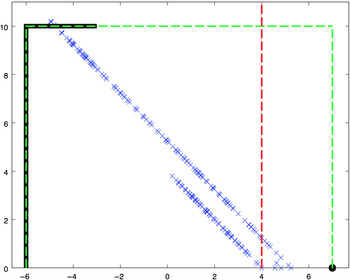
, it is useful to look at Figure 1, reproduced from [Reference Avram, Grahovac and Vardar-Acar7], which depicts a sample path of (X, D), where X is chosen to be the standard Brownian motion and the exit region is
 $R=[-6,7]\times[0,10]$
. As is clear from the figure and from its definition, the process (X, D) has very particular dynamics on R: away from the boundary
 $\partial_1 \,{:}\,{\raise-1.5pt{=}}\, \{(x,d) \in {\mathbb R} \times {\mathbb R}_+\;\colon\; d = 0 \}$
it oscillates on the line segment
 $L_{\overline{X}_t}$
where, for
 $c \in {\mathbb R}$
,
 $L_c \,{:}\,{\raise-1.5pt{=}}\, \{(x,d) \in {\mathbb R} \times {\mathbb R}_+\;\colon\; x+d = c \}$
. These oblique lines each represent a negative excursion. On
 $\partial_1$
, we observe the evolution of the process
 $\overline X_t$
with all its negative excursions excised; as
 $\overline {X}_t$
increases, the line segment
 $L_{\overline{X}_t}$
on which (X, D) oscillates during a negative excursion advances continuously to the right. To fully specify the process
 $\overline X_t$
with its negative excursions excised, we must give a rule for killing a negative excursion. Two classic choices are
 $X_t <a$
(ruin stopping) and
 $D_t >d$
(drawdown stopping), which are the left and upper boundaries, respectively, in Figure 1. A linear combination of these, translating into an oblique upper boundary, was studied in [Reference Avram, Vu and Zhou9].
A sample path of (X, D) (sampled at time step
 $\Delta t = 0.1$
) when X is a standard Brownian motion with
 $X_0 =a+d=4$
, and the region R with
 $d=10$
,
 $a=-6$
, and
 $b=7$
; the dark shaded region shows the possible points of exit of (X, D) from
 $R=[-6,7]\times[0,10]$
.

In this paper we aim to study a more general drawdown stopping rule for general time-homogeneous Markov processes. Consider an underlying process X, with initial value
 $X_0=x_0$
, which is assumed to be time-homogeneous, strong Markovian, and upward skip-free. Without loss of generality, we assume X can reach any value in
 $\mathbb{R}$
. There is no essential difference to our proofs if the range of X is an interval. The first passage times of X across a level
 $x\in\mathbb{R}$
are denoted by
 \begin{equation*}\tau_{x}^{+}=\inf \{ t\geq0\;\colon\; X_{t}>x \} \quad\text{and}\quad \tau_{x}^{-}=\inf \{ t\geq0\;\colon\; X_{t}<x \}.\end{equation*}
Here and thereafter, we follow the convention that
 $\inf\emptyset=\infty$
. We assume X to be regular, in the sense that
 \begin{equation}\tau_x^+=0 \quad\text{and}\quad X_{\tau_x^+}=x, \quad \mathbb{P}_{x} \mbox{-a.s. for all }x\geq x_0.\end{equation}
Instrumental in achieving control of one-dimensional risk processes are the distributions of the two-sided smooth and non-smooth first passage times from a bounded interval [u, v]. For upward skip-free processes, it turns out to be easier to study the corresponding Laplace transforms:
 \begin{align} B^{(q)}(x ;\, u,v) & \,{:}\,{\raise-1.5pt{=}}\, \mathbb{E}_{x}\bigl[ {\mathrm{e}}^{-q\tau_{v}^{+}}1_{\{ \tau_{v}^{+}<\tau_{u}^{-}\} }\bigr] ,\, \qquad\quad\end{align}
 \begin{align} C^{(q,s)}(x ;\, u,v) & \,{:}\,{\raise-1.5pt{=}}\, \mathbb{E}_{x}\bigl[ {\mathrm{e}}^{-q\tau_{u}^{-}-s(u-X_{\tau_{u}^{-}})}1_{\{ \tau_{u}^{-}<\tau_{v}^{+}\} }\bigr] ,\end{align}
where
 $q,s\geq0$
, and
 $u\leq x\leq v$
. In (1.2), (1.3), and thereafter, we follow the convention that
 $1_{\{\infty<\infty\}}=0$
. The two-sided exit quantities are sometimes available semi-explicitly; for spectrally negative Lévy processes, it holds that
 \begin{equation*} B^{(q)}(x ;\, u,v) =\dfrac{W^{(q)}(x-u)}{W^{(q)}(v-u)},\end{equation*}
where
 $W^{(q)}(x)$
is called the scale function [Reference Bertoin11, Reference Kyprianou14]. A similar formula holds for some non-homogeneous spectrally negative Markov processes [Reference Czarna, Pérez, Rolski and Yamazaki13],
 \begin{equation*} B^{(q)}(x ;\, u,v) =\dfrac{W^{(q)}(x ;\, u)}{W^{(q)}(v ;\, u)} ,\end{equation*}
where now the newly defined scale function naturally depends on the two variables x, u. For jump diffusions, the two functions B and C can also be characterized as the solution of integro-differential equations by Itô’s formula.
Let
 $f\;\colon\; [x_0,\infty)\rightarrow\mathbb{R}$
be a so-called drawdown function, which is continuous, non-decreasing, and satisfies
 $f(m)<m$
for all
 $m\in[x_0,\infty)$
. Following [Reference Li, Vu and Zhou20], we define the general drawdown time as
 \begin{equation}\tau_{f}=\inf \{ t\geq0\;\colon\; X_{t}<f(\overline X_{t}) \} =\inf\{t\geq0\;\colon\; Y_{t}>0\},\end{equation}
where
 \begin{equation}Y_{t}=f(\overline X_{t})-X_{t}=D_t- \overline f(\overline X_t), \quad {t\geq0},\end{equation}
will be called the general drawdown process with
 $\overline f(m)\,{:}\,{\raise-1.5pt{=}}\, m-f(m)$
. It is worth mentioning that the general drawdown time (1.4) emerged in [Reference Lehoczky18] and was used by Azéma and Yor [Reference Azéma and Yor10] to provide a solution of the Skorokhod problem of stopping a Brownian motion to obtain a given desired centered marginal measure.
Parallel to [Reference Landriault, Li and Zhang17], we make the following assumption on B and C.
Assumption 1.1. For all
 $q,s\geq 0$
and
 $y\geq x_{0}$
, we assume the following limits exist and identities hold:
 \begin{align*}b_{f}^{(q)}(y) &\,{:}\,{\raise-1.5pt{=}}\, \lim_{\varepsilon \downarrow 0}\dfrac{1-B^{(q)} ( y ;\, f(y+\varepsilon ),y+\varepsilon ) }{\varepsilon }\\ &=\lim_{\varepsilon\downarrow 0}\dfrac{1-B^{(q)}(y ;\, f(y),y+\varepsilon )}{\varepsilon } \\&= \lim_{\varepsilon \downarrow 0}\dfrac{1-B^{(q)}(y-\varepsilon ;\, f(y),y)}{\varepsilon }\\ &=\lim_{\varepsilon \downarrow 0}\dfrac{1-B^{(q)}(y-\varepsilon;\, f(y-\varepsilon ),y)}{\varepsilon }\end{align*}
and
 \begin{align*}c_{f}^{(q,s)}(y) &\,{:}\,{\raise-1.5pt{=}}\, \lim_{\varepsilon \downarrow 0}\dfrac{C^{(q,s)}(y;\, f(y+\varepsilon ),y+\varepsilon )}{\varepsilon }\\ &=\lim_{\varepsilon \downarrow 0}\dfrac{C^{(q,s)}(y;\, f(y),y+\varepsilon )}{\varepsilon } \\&= \lim_{\varepsilon \downarrow 0}\dfrac{C^{(q,s)}(y-\varepsilon ;\, f(y),y)}{ \varepsilon }\\ &=\lim_{\varepsilon \downarrow 0}\dfrac{C^{(q,s)}(y-\varepsilon;\, f(y-\varepsilon ),y)}{\varepsilon } .\end{align*}
Note that, by (1.1), for any
 $u<y$
,
 \begin{equation}B^{(q)}(y ;\, u,y)=1 \quad\text{and}\quad C^{(q,s)}(y ;\, u,y)=0. \end{equation}
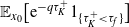
Remark 1.1. The non-decreasing assumption of f is essential in our later analysis (see Proposition 2.1). Note that [Reference Li, Vu and Zhou20] does not assume f is non-decreasing as it focuses on spectrally negative Lévy processes and utilizes excursion theory. The assumption
 $f(m)<m$
is necessary to ensure that one of the main quantities of interest
 $\mathbb{E}_{x_{0}}\bigl[{\mathrm{e}}^{-q\tau _{K}^{+}}1_{\{\tau _{K}^{+}<\tau _{f}\}}\bigr] $
is not trivially zero. Otherwise, if
 $f(x_{1})> x_{1}$
for some
 $x_{1}\in \lbrack x_{0},K)$
, we will have
 $\mathbb{E}_{x_{1}}\bigl[ {\mathrm{e}}^{-q\tau _{K}^{+}}1_{\{\tau_{x_{1}}^{+}<\tau _{f}\}}\bigr] =0$
, and further, by the strong Markov property,
 \begin{equation*}\mathbb{E}_{x_{0}}\bigl[ {\mathrm{e}}^{-q\tau _{K}^{+}}1_{\{\tau _{K}^{+}<\tau _{f}\}}\bigr] =\mathbb{E}_{x_{0}}\bigl[ {\mathrm{e}}^{-q\tau _{x_{1}}^{+}}1_{\{\tau_{x_{1}}^{+}<\tau _{f}\}}\bigr] \mathbb{E}_{x_{1}}\bigl[ {\mathrm{e}}^{-q\tau_{K}^{+}}1_{\{\tau _{x_{1}}^{+}<\tau _{f}\}}\bigr] =0.\end{equation*}
The continuity of f will be used in the proof of Theorem 2.1 and it also ensures
 $f(y+\varepsilon)\leq y$
and
 $f(y)\leq y-\varepsilon$
, for sufficiently small
 $\varepsilon$
, so that the terms in Assumption 1.1 (e.g.
 $B (y;\, f(y+\varepsilon ),y+\varepsilon )$
and
 $B(y-\varepsilon ;\, f(y),y)$
) are well-defined.
Remark 1.2. We provide an explicit sufficient condition for Assumption 1.1. Assumption 1.1 holds if the following two conditions hold.
-
(1) The drawdown function f(y) is differentiable for all
 $y\geq x_{0}$
.
-
(2)
$B^{(q)} ( x ;\, u,v ) $
and
$C^{(q,s)} ( x ;\, u,v ) $
are differentiable (as multivariable functions with three real variables) at point
$(x,u,v)=(y,f(y),y)$
for all
$y\geq x_{0}$
, and satisfy
(1.7)where the subscripts are used to denote the partial derivatives of
\begin{equation}B_{x}^{(q)}(y ;\, f(y),y)=-B_{v}^{(q)}(y ;\, f(y),y)\quad\textrm{and}\quad C_{x}^{(q,s)}(y ;\, f(y),y)=-C_{v}^{(q,s)}(y ;\, f(y),y), \end{equation}
$B^{(q)} ( x ;\, u,v ) $
and
$C^{(q,s)} ( x ;\, u,v ) $
with respect to x, u, or v. Given (1.7), we denote
\begin{equation*} b_{f}^{(q)}(y)\,{:}\,{\raise-1.5pt{=}}\, B_{x}^{(q)}(y ;\, f(y),y)\quad\text{and}\quad c_{f}^{(q,s)}\,{:}\,{\raise-1.5pt{=}}\, -C_{x}^{(q,s)}(y ;\, f(y),y).\end{equation*}





We use Taylor’s theorem at point (y,f(y),y) to verify the sufficient condition. By (1.6), which further implies
 $B_{u}^{(q)}(y ;\, f(y),y)=0$
, we obtain
 \begin{align}& B^{(q)} ( y ;\, f(y+\varepsilon ),y+\varepsilon ) -1 \notag \\ &\quad = B^{(q)} ( y ;\, f(y+\varepsilon ),y+\varepsilon ) -B^{(q)} (y ;\, f(y),y ) \notag \\&\quad = B_{u}^{(q)}(y ;\, f(y),y)(f(y+\varepsilon )-f(y))+\varepsilon B_{v}^{(q)}(y ;\, f(y),y)+{\mathrm{o}} ( \vert (f(y+\varepsilon )-f(y),\varepsilon) \vert ) \notag \\ &\quad = -\varepsilon b_{f}^{(q)}(y)+{\mathrm{o}} ( \vert (f(y+\varepsilon)-f(y),\varepsilon ) \vert ) , \end{align}
where
 $\vert (\cdot ,\cdot )\vert $
denotes the standard Euclidean norm, i.e.
 $|(a,b)|\,{:}\,{\raise-1.5pt{=}}\, \sqrt{a^{2}+b^{2}}$
, and
 ${\mathrm{o}}(z)$
means that
 ${{\mathrm{o}}(z)}/{z}\rightarrow 0$
when
 $z\rightarrow 0$
. Since f is differentiable at y, we have
 \begin{equation}\lim_{\varepsilon \downarrow 0}\dfrac{{\mathrm{o}} ( \vert (f(y+\varepsilon)-f(y),\varepsilon ) \vert ) }{\varepsilon }=\lim_{\varepsilon\downarrow 0}\dfrac{{\mathrm{o}} ( \vert (f(y+\varepsilon )-f(y),\varepsilon) \vert ) }{ \vert (f(y+\varepsilon )-f(y),\varepsilon) \vert }\dfrac{ \vert (f(y+\varepsilon )-f(y),\varepsilon) \vert }{\varepsilon }=0, \end{equation}
which implies
 ${\mathrm{o}} ( \vert (f(y+\varepsilon )-f(y),\varepsilon) \vert ) ={\mathrm{o}}(\varepsilon )$
. It follows from (1.8) and (1.9) that
 \begin{equation*}\lim_{\varepsilon \downarrow 0}\dfrac{1-B^{(q)} ( y ;\, f(y+\varepsilon),y+\varepsilon ) }{\varepsilon }=b_{f}^{(q)}(y)+\lim_{\varepsilon\downarrow 0}\dfrac{{\mathrm{o}} ( \vert (f(y+\varepsilon )-f(y),\varepsilon) \vert ) }{\varepsilon }=b_{f}^{(q)}(y),\end{equation*}
that is, the first relation of Assumption 1.1. All the other relations can be verified in a similar manner.
General drawdown times include many important particular subcases that have been extensively studied in the literature.
-
(1) If
$f(m)=c$
, with
$c<x_0$
,
$\tau_f=\tau_{c}^{-}$
is the exiting time of a fixed barrier c, in particular when
$c=0$
,
$\tau_{0}^{-}$
is the ruin time. -
(2) If
$f(m)=m-d$
, with
$d>0$
,
$\tau_f=\inf\{t\geq 0 \;\colon\; D_t>d\}$
is the classic drawdown time. -
(3) If
$f(m)=\xi m$
, with
$\xi\in(0,1)$
and
$x_0>0$
,
is the proportional drawdown time.
\begin{equation*}\tau_f=\inf\{t\geq 0 \;\colon\; X_t <\xi \overline X_{t}\}\end{equation*}
-
(4) If
$f(m)=\xi m - d $
, with
$\xi\in {(0, 1)}$
,
$d>0$
, and
$x_0\geq0$
,
is the ‘affine drawdown’ studied in [Reference Avram, Vu and Zhou9].
\begin{equation*} \tau_f=\inf \{t\geq 0\;\colon\; X_t \leq \xi\overline {X}_t-d \} =\inf \{t\geq 0\;\colon\; D_t > (1-\xi)\overline {X}_t+d \} \end{equation*}








Note that in some of the above cases, we restrict the initial value
 $x_0$
so that f is non-decreasing and
 $f(m)<m$
for all
 $m\in[x_0,\infty)$
.
The main contributions of this paper are summarized below. First, we develop the methodology in [Reference Landriault, Li and Zhang17] for classical drawdown to general drawdown functions. Second, previous works in this field focus mainly on spectrally negative Lévy processes and utilize excursion theory. As many underlying models in finance and insurance are not in the Lévy framework, our work fills this gap by providing a unified method to study (general) drawdown for more general Markov processes (than spectrally negative Lévy processes). Third, we show that this method can be further extended to study general drawdown for tax/refracted processes, which is currently a very active research topic. Fourth, new examples (Ornstein–Uhlenbeck processes with exponential jumps) are included.
Contents. Below, we first extend the general drawdown results of [Reference Li, Vu and Zhou20] from spectrally negative Lévy processes to spectrally negative time-homogeneous Markov processes; see Section 2. Then in Section 3 we also allow for the possibility of general taxation. The method of proof involves a non-trivial use of the ‘differential exit problems’ of Landriault, Li, and Zhang [Reference Landriault, Li and Zhang17]. The results in Section 2 are applied in particular cases in which the ‘differential exit parameters’ are analytically computable: spectrally negative Lévy processes and diffusions. A third example illustrated here is that of Ornstein–Uhlenbeck-type processes with exponential jumps.
2. Main results of general drawdown in the time-homogeneous Markov process
The following pathwise inequalities are central to the construction of tight bounds for the joint law of the triplet
 $(\tau_{f},\overline X_{\tau_{f}},Y_{\tau_{f}})$
.
Proposition 2.1. For
 $q,s\geq 0$
,
 $x\geq x_0$
and
 $\varepsilon >0$
, we have
 $\mathbb{P}_{x}$
-a.s.
 \begin{align} {\mathrm{e}}^{-q\tau _{f}-sY_{\tau _{f}}}1_{\{\tau _{f}<\tau _{x+\varepsilon }^{+}\}}&\geq {\mathrm{e}}^{-q\tau _{f(x)}^{-}-s(f(x+\varepsilon )-X_{\tau_{f(x)}^{-}})}1_{\{ \tau _{f(x)}^{-}<\tau _{x+\varepsilon }^{+}\}}, \end{align}
 \begin{align} {\mathrm{e}}^{-q\tau _{f}-sY_{\tau _{f}}}1_{\{\tau _{f}<\tau _{x+\varepsilon }^{+}\}}&\leq {\mathrm{e}}^{-q\tau _{f(x+\varepsilon )}^{-}-s(f(x)-X_{\tau _{f(x+\varepsilon)}^{-}})}1_{\{\tau _{f(x+\varepsilon )}^{-}<\tau _{x+\varepsilon }^{+}\}}. \end{align}
Proof. We first prove (2.1). Since f is non-decreasing, we know that,
 $\mathbb{P}_{x}$
-a.s.,
 \begin{equation}\tau _{f}=\inf \{ t\geq 0\;\colon\; X_{t}<f(\overline{X}_{t}) \} \leq \inf \{ t\geq 0\;\colon\; X_{t}<f(x) \} =\tau _{f(x)}^{-}\text{.} \end{equation}
It follows that
 \begin{equation}(\tau _{x+\varepsilon }^{+}<\tau _{f})\subset (\tau _{x+\varepsilon}^{+}<\tau _{f(x)}^{-})\quad \text{and equivalently}\quad 1_{\{\tau _{f}<\tau_{x+\varepsilon }^{+}\}}\geq 1_{\{\tau _{f(x)}^{-}<\tau _{x+\varepsilon}^{+}\}}. \end{equation}
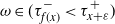
For any path
 $\omega \in (\tau _{f(x)}^{-}<\tau _{x+\varepsilon }^{+})$
, by (2.3),
 $\mathbb{P}_{x}$
-a.s., we have
 \begin{equation*}\overline{X}_{\tau _{f}}(\omega )\leq x+\varepsilon \quad\text{and}\quad X_{\tau_{f}}(\omega )\geq X_{\tau _{f(x)}^{-}}(\omega ),\end{equation*}
By the non-decreasing property of f, we further have
 \begin{equation}Y_{\tau _{f}}(\omega )=f(\overline{X}_{\tau _{f}}(\omega ))-X_{\tau_{f}}(\omega )\leq f(x+\varepsilon )-X_{\tau _{f(x)}^{-}}(\omega ).\end{equation}
Then it follows from (2.4), (2.3), and (2.5) that,
 $\mathbb{P}_{x}$
-a.s.,
 \begin{align*}{\mathrm{e}}^{-q\tau _{f}-sY_{\tau _{f}}}1_{\{\tau _{f}<\tau _{x+\varepsilon }^{+}\}}&\geq {\mathrm{e}}^{-q\tau _{f}-sY_{\tau _{f}}}1_{\{\tau _{f(x)}^{-}<\tau_{x+\varepsilon }^{+}\}} \\ &\geq {\mathrm{e}}^{-q\tau _{f(x)}^{-}-s(f(x+\varepsilon )-X_{\tau_{f(x)}^{-}})}1_{\{\tau _{f(x)}^{-}<\tau _{x+\varepsilon }^{+}\}},\end{align*}
which proves (2.1).
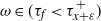
We then prove (2.2). By the definition of
 $\tau _{f}$
and the non-decreasing property of f, for any
 $\omega \in (\tau _{f}<\tau_{x+\varepsilon }^{+})$
, we know that,
 $\mathbb{P}_{x}$
-a.s.,
 \begin{equation}\tau _{f(x+\varepsilon )}^{-}(\omega )\leq \tau _{f}(\omega ), \end{equation}
which implies
 \begin{equation}(\tau _{f}<\tau _{x+\varepsilon }^{+})\subset (\tau _{f(x+\varepsilon)}^{-}<\tau _{x+\varepsilon }^{+})\quad \text{and equivalently}\quad 1_{\{\tau_{f}<\tau _{x+\varepsilon }^{+}\}}\leq 1_{\{\tau _{f(x+\varepsilon)}^{-}<\tau _{x+\varepsilon }^{+}\}}. \end{equation}
Moreover, for any
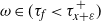 $\omega \in (\tau _{f}<\tau_{x+\varepsilon }^{+})$
, again by the non-decreasing property of f, we have,
 $\mathbb{P}_{x}$
-a.s.,
 \begin{equation}f(x)-X_{\tau _{f(x+\varepsilon )}^{-}}(\omega )\leq f(\overline{X}_{\tau_{f(x+\varepsilon )}^{-}}(\omega ))-X_{\tau _{f(x+\varepsilon )}^{-}}(\omega)=Y_{\tau _{f(x+\varepsilon )}^{-}}(\omega )\leq Y_{\tau _{f}}(\omega ),\end{equation}
where the last inequality is because
 $Y_{\tau _{f(x+\varepsilon)}^{-}}(\omega )\leq 0\leq Y_{\tau _{f}}(\omega )$
if
 $\tau_{f(x+\varepsilon )}^{-}(\omega )<\tau _{f}(\omega )$
, and
 $Y_{\tau_{f(x+\varepsilon )}^{-}}(\omega )=Y_{\tau _{f}}(\omega )$
if
 $\tau_{f(x+\varepsilon )}^{-}(\omega )=\tau _{f}(\omega )$
. In summary, by (2.6), (2.8), and (2.7), we have that,
 $\mathbb{P}_{x}$
-a.s.,
 \begin{align*}{\mathrm{e}}^{-q\tau _{f}-sY_{\tau _{f}}}1_{\{\tau _{f}<\tau _{x+\varepsilon }^{+}\}}&\leq {\mathrm{e}}^{-q\tau _{f(x+\varepsilon )}^{-}-s(f(x)-X_{\tau _{f(x+\varepsilon)}^{-}})}1_{\{\tau _{f}<\tau _{x+\varepsilon }^{+}\}} \\ &\leq {\mathrm{e}}^{-q\tau _{f(x+\varepsilon )}^{-}-s(f(x)-X_{\tau _{f(x+\varepsilon)}^{-}})}1_{\{\tau _{f(x+\varepsilon )}^{-}<\tau _{x+\varepsilon }^{+}\}},\end{align*}
which proves (2.2).

Remark 2.1. The non-decreasing property of f has been invoked many times in the proof of Proposition 2.1, but the proof does not depend on the continuity of f or the other assumption
 $f(x)<x$
. In other words, the proof and result are still valid if
 $f(x)\geq x$
. In particular, if
 $f(x)>x$
, we have that,
 $\mathbb{P}_{x}$
-a.s.,
 \begin{equation*}\tau _{f}=\tau _{f(x)}^{-}=\tau _{f(x+\varepsilon )}^{-}=0\quad \text{and}\quad Y_{\tau _{f}}=f(x)-x>0.\end{equation*}
Further, (2.1) and (2.2) reduce to the following trivial relations:
 \begin{align*}{\mathrm{e}}^{-s(f(x)-x)}1_{\{0<\tau _{x+\varepsilon }^{+}\}} &\geq {\mathrm{e}}^{-s(f(x+\varepsilon )-x)}1_{\{0<\tau _{x+\varepsilon }^{+}\}}, \\ {\mathrm{e}}^{-s(f(x)-x)}1_{\{0<\tau _{x+\varepsilon }^{+}\}} &\leq {\mathrm{e}}^{-s(f(x)-x)}1_{\{0<\tau _{x+\varepsilon }^{+}\}}.\end{align*}
By Proposition 2.1, we immediately obtain the following estimates. Note that the first line of inequalities in Corollary 2.1 follows on setting
 $q=s=0$
in (2.1) and (2.2).
Corollary 2.1. For
 $q,s\geq0$
,
 $x\ge x_0$
, and
 $\varepsilon>0$
,
 \begin{equation*}B^{(q)}(x ;\, f(x+\varepsilon),x+\varepsilon)\leq\mathbb{E}_{x}\bigl[ {\mathrm{e}}^{-q\tau_{x+\varepsilon}^{+}}1_{\{\tau_{x+\varepsilon}^{+}<\tau_{f}\}}\bigr] \leq B^{(q)}(x ;\, f(x),x+\varepsilon),\end{equation*}
and
 \begin{align*}\mathbb{E}_{x}\bigl[ {\mathrm{e}}^{-q\tau_{f}-sY_{\tau_{f}}}1_{\{ \tau_{f}<\tau_{x+\varepsilon}^{+}\} }\bigr] & \leq{\mathrm{e}}^{s(f(x+\varepsilon)-f(x))}C^{(q,s)}(x ;\, f(x+\varepsilon),x+\varepsilon),\\ \mathbb{E}_{x}\bigl[ {\mathrm{e}}^{-q\tau_{f}-sY_{\tau_{f}}}1_{\{ \tau_{f}<\tau_{x+\varepsilon}^{+}\} }\bigr] & \geq{\mathrm{e}}^{-s(f(x+\varepsilon)-f(x))}C^{(q,s)}(x ;\, f(x),x+\varepsilon).\end{align*}
Next we present our main results for general drawdown.
Theorem 2.1. Under Assumption 1.1 for the underlying Markov process X and drawdown function f, for any
 $q,s\geq 0$
and
 $K>x_{0}$
, we have
 \begin{align}\mathbb{E}_{x_{0}}\bigl[ {\mathrm{e}}^{-q\tau _{K}^{+}}1_{\{\tau _{K}^{+}<\tau _{f}\}}\bigr] & ={\operatorname{exp}}\biggl\{{-\int_{x_{0}}^{K}b_{f}^{(q)}(z)\,\mathrm{d}z}\biggr\}, \qquad \qquad \end{align}
 \begin{align} \mathbb{E}_{x_{0}}\bigl[ {\mathrm{e}}^{-q\tau _{f}-sY_{\tau _{f}}}1_{\{\overline{X}_{\tau _{f}}\leq K\}}\bigr] &=\int_{x_{0}}^{K}{\operatorname{exp}}\biggl\{{-\int_{x_0}^{y}b_{f}^{(q)}(z)\,\mathrm{d}z}\biggr\} c_{f}^{(q,s)}(y)\,\mathrm{d}y. \end{align}
Proof. We define
 \begin{equation*}g(y)\,{:}\,{\raise-1.5pt{=}}\, \mathbb{E}_{y}\bigl[ {\mathrm{e}}^{-q\tau _{K}^{+}}1_{\{\tau _{K}^{+}<\tau _{f}\}}\bigr] ,\quad y\in \lbrack x_{0},K].\end{equation*}
In particular, we have
 $g(K)=1$
by (1.1). For any
 $y\in \lbrack x_{0},K)$
and sufficiently small positive constant
 $\varepsilon $
(
 $\varepsilon <K-y$
), by the strong Markov property of X at
 $\tau _{y+\varepsilon }^{+}$
,
 \begin{equation*}g(y)=\mathbb{E}_{y}\bigl[ {\mathrm{e}}^{-q\tau _{y+\varepsilon }^{+}}1_{\{\tau_{y+\varepsilon }^{+}<\tau _{f}\}}\bigr] g(y+\varepsilon ).\end{equation*}
By using Corollary 2.1, we obtain
 \begin{equation*}B^{(q)}(y ;\, f(y+\varepsilon ),y+\varepsilon )g(y+\varepsilon )\leq g(y)\leq B^{(q)}(y ;\, f(y),y+\varepsilon )g(y+\varepsilon ).\end{equation*}
It follows that
 \begin{equation}\begin{cases}g(y+\varepsilon )-g(y)\leq [ 1-B^{(q)}(y ;\, f(y+\varepsilon),y+\varepsilon ) ] g(y+\varepsilon ), \\g(y+\varepsilon )-g(y)\geq [ 1-B^{(q)}(y ;\, f(y),y+\varepsilon ) ]g(y+\varepsilon ).\end{cases}\end{equation}
By Assumption 1.1, we deduce that g is right-continuous, and further right-differentiable at all
 $y\in \lbrack x_{0},K)$
with right derivative
 \begin{equation*}g_{+}^{\prime }(y)\,{:}\,{\raise-1.5pt{=}}\, \lim_{\varepsilon \downarrow 0}\dfrac{g(y+\varepsilon)-g(y)}{\varepsilon }=b_{f}^{(q)}(y)g(y).\end{equation*}
By adopting the same argument and replacing y with
 $y-\varepsilon $
in (2.11), for any
 $y\in (x_{0},K]$
,
 \begin{equation*}\begin{cases}g(y)-g(y-\varepsilon )\leq [ 1-B^{(q)}(y-\varepsilon ;\, f(y),y) ]g(y), \\g(y)-g(y-\varepsilon )\geq [ 1-B^{(q)}(y-\varepsilon ;\, f(y-\varepsilon),y) ] g(y).\end{cases}\end{equation*}
By Assumption 1.1, we deduce that g is left-continuous and further left-differentiable at all
 $y\in (x_{0},K]$
with left derivative
 \begin{equation*}g_{-}^{\prime }(y)\,{:}\,{\raise-1.5pt{=}}\, \lim_{\varepsilon \downarrow 0}\dfrac{g(y)-g(y-\varepsilon )}{\varepsilon }=b_{f}^{(q)}(y)g(y).\end{equation*}
Thus g is differentiable at all
 $y\in (x_{0},K)$
and satisfies the following ordinary differential equation (ODE),
 \begin{equation*}g^{\prime }(y)=b_{f}^{(q)}(y)g(y),\quad y\in (x_{0},K),\end{equation*}
with boundary condition
 $g(K)=1$
. Solving the ODE, we obtain
 \begin{equation*}g(x_{0})={\operatorname{exp}}\biggl\{{-\int_{x_{0}}^{K}b_{f}^{(q)}(z)\,\mathrm{d}z}\biggr\}.\end{equation*}
To prove (2.10), we define
 \begin{equation*}h(y)\,{:}\,{\raise-1.5pt{=}}\, \mathbb{E}_{y}\bigl[ {\mathrm{e}}^{-q\tau _{f}-sY_{\tau _{f}}}1_{\{\overline{X}_{\tau _{f}}\leq K\}}\bigr] ,\quad y\in \lbrack x_{0},K].\end{equation*}
By (1.1), we have the boundary condition
 $h(K)=0$
. For any
 $y\in\lbrack x_{0},K)$
and sufficiently small positive constant
 $\varepsilon $
(
 $\varepsilon <K-y$
), by the strong Markov property of X at
 $\tau_{y+\varepsilon }^{+}$
,
 \begin{equation*}h(y)=\mathbb{E}_{y}\bigl[ {\mathrm{e}}^{-q\tau _{f}-sY_{\tau _{f}}}1_{\{ \tau_{f}<\tau _{y+\varepsilon }^{+}\} }\bigr] +\mathbb{E}_{y}\bigl[{\mathrm{e}}^{-q\tau _{y+\varepsilon }^{+}}1_{\{\tau _{y+\varepsilon }^{+}<\tau _{f}\}}\bigr] h(y+\varepsilon ).\end{equation*}
By Corollary 2.1, we obtain
 \begin{equation*}\begin{cases}h(y)\leq {\mathrm{e}}^{s(f(y+\varepsilon )-f(y))}C^{(q,s)}(y ;\, f(y+\varepsilon),y+\varepsilon )+B^{(q)}(y ;\, f(y),y+\varepsilon )h(y+\varepsilon ), \\h(y)\geq {\mathrm{e}}^{-s(f(y+\varepsilon )-f(y))}C^{(q,s)}(y ;\, f(y),y+\varepsilon)+B^{(q)}(y ;\, f(y+\varepsilon ),y+\varepsilon )h(y+\varepsilon ).\end{cases}\end{equation*}
It follows that, for any
 $y\in \lbrack x_{0},K)$
,
 \begin{equation} \begin{cases} h(y+\varepsilon )-h(y)\geq \\ \quad -{\mathrm{e}}^{s(f(y+\varepsilon)-f(y))}C^{(q,s)}(y ;\, f(y+\varepsilon ),y+\varepsilon )+ [1-B^{(q)}(y ;\, f(y),y+\varepsilon ) ] h(y+\varepsilon ), \\ h(y+\varepsilon )-h(y)\leq \\ \quad -{\mathrm{e}}^{-s(f(y+\varepsilon)-f(y))}C^{(q,s)}(y ;\, f(y),y+\varepsilon )+ [ 1-B^{(q)}(y ;\, f(y+\varepsilon),y+\varepsilon ) ] h(y+\varepsilon ).\end{cases}\end{equation}
By adopting the same argument and replacing y with
 $y-\varepsilon $
in (2.12), for any
 $y\in (x_{0},K]$
,
 \begin{equation*}\begin{cases} h(y)-h(y-\varepsilon )\geq \\ \quad -{\mathrm{e}}^{s(f(y)-f(y-\varepsilon))}C^{(q,s)}(y-\varepsilon ;\, f(y),y)+ [ 1-B^{(q)}(y-\varepsilon ;\, f(y-\varepsilon ),y) ] h(y), \\ h(y)-h(y-\varepsilon )\leq \\ \quad -{\mathrm{e}}^{-s(f(y)-f(y-\varepsilon))}C^{(q,s)}(y-\varepsilon ;\, f(y-\varepsilon ),y)+ [ 1-B^{(q)}(y-\varepsilon ;\, f(y),y) ] h(y).\end{cases}\end{equation*}
By Assumption 1.1 and the continuity of f, we deduce that h is differentiable at all
 $y\in (x_{0},K)$
and satisfies the ODE
 \begin{equation*}h^{\prime }(y)=-c_{f}^{(q,s)}(y)+b_{f}^{(q)}(y)h(y),\quad y\in (x_{0},K),\end{equation*}
with boundary condition
 $h(K)=0$
. By solving the ODE, we obtain
 \begin{equation*}h(x_{0})=\int_{x_{0}}^{K}\,{\operatorname{exp}}\biggl\{{-\int_{x_{0}}^{y}b_{f}^{(q)}(z)\,\mathrm{d}z}\biggr\} c_{f}^{(q,s)}(y)\,\mathrm{d}y.\end{equation*}
This ends the proof.
3. Extension to the general loss-carry-forward taxation model
The loss-carry-forward taxation model was first proposed by Albrecher and Hipp [Reference Albrecher and Hipp2] under the compound Poisson model. It was extended to the spectrally negative Lévy model by Albrecher, Renaud, and Zhou [Reference Albrecher, Renaud and Zhou6], the time-homogeneous diffusion model by Li, Tang, and Zhou [Reference Li, Tang and Zhou19], and the Markov additive model by Albrecher [Reference Albrecher, Avram, Constantinescu and Ivanovs4].
In this section we will further incorporate the general taxation proposed by Kyprianou and Zhou [Reference Kyprianou and Zhou15]. As our underlying model is upward skip-free Markov processes, our results will generalize [Reference Albrecher, Renaud and Zhou6], [Reference Kyprianou and Zhou15], and [Reference Li, Tang and Zhou19]. It is worth mentioning that the methodologies adopted in these previous works are quite different, while this paper utilizes a unified and also more direct approach.
Consider a loss-carry-forward type tax strategy, where the tax payment is made whenever the surplus process reaches a new running maximum (e.g. Kyprianou and Zhou [Reference Kyprianou and Zhou15]),
 \begin{equation}\mathrm{d}U_{t}=\mathrm{d}X_{t}-\gamma (\overline{X}_{t})\,\mathrm{d}\overline{X}_{t}, \end{equation}
with initial value
 $X_{0}=U_{0}=x_{0}$
, where
 $\gamma \colon\; [x_0,\infty)\rightarrow \lbrack 0,1)$
is a measurable function satisfying the following condition:
 \begin{equation}\int_{x_{0}}^{\infty }(1-\gamma (s))\,\mathrm{d}s=\infty .\end{equation}
The first passage times of U are defined in the same manner, that is,
 \begin{equation*}\tau _{y}^{U,+}=\inf \{ t\geq 0\;\colon\; U_{t}>y \} \quad\text{and}\quad \tau_{y}^{U,-}=\inf \{ t\geq 0\;\colon\; U_{t}<y \} .\end{equation*}
The general drawdown process of the tax model U is denoted by
 $Y^{U}=(Y_{t}^{U})_{t\geq 0}$
, with
 \begin{equation}Y_{t}^{U}=f(\overline{U}_{t})-U_{t}, \end{equation}
where
 $\overline{U}_{t}=\sup_{0\leq s\leq t}U_{t}$
and f is a drawdown function satisfying the same conditions as in the last section, that is, continuous, non-decreasing, and
 $f(m)<m$
for all
 $m\in \lbrack x_{0},\infty )$
. Hence
 $Y_{0}^{U}=f(\overline{U}_{0})-U_{0}<0$
. The time of general drawdown is defined by
 \begin{equation*}\sigma _{f}=\inf \{ t\geq 0\;\colon\; Y_{t}^{U}>0 \} =\inf \{ t\geq0\;\colon\; U_{t}<f(\overline{U}_{t}) \} .\end{equation*}
In fact, from the general drawdown results for a general model X in Theorem 2.1, by noting the pathwise connection between X and
 $U$
, one can easily find the general drawdown results for a general tax model U associated with the time-homogeneous Markov process X.
Conditional on
 $X_{0}=U_{0}=x_{0}$
, it follows from (3.1) that
 \begin{equation}U_{t}=X_{t}-\int_{0}^{t}\gamma (\overline{X}_{u})\,\mathrm{d}\overline{X}_{u}=X_{t}-\int_{x_{0}}^{\overline{X}_{t}}\gamma (z)\,\mathrm{d}z=X_{t}-\gamma_{x_{0}}(\overline{X}_{t}), \end{equation}
and further
 \begin{equation}\overline{U}_{t}=\overline{X}_{t}-\gamma _{x_{0}}(\overline{X}_{t})=\overline{\gamma }_{x_{0}}(\overline{X}_{t}), \end{equation}
where we define, for
 $y\geq x_{0}$
,
 \begin{align*}\gamma _{x_{0}}(y) &\,{:}\,{\raise-1.5pt{=}}\, \int_{x_{0}}^{y}\gamma (z)\,\mathrm{d}z, \\ \overline{\gamma }_{x_{0}}(y) &\,{:}\,{\raise-1.5pt{=}}\, y-\gamma_{x_{0}}(y)=y-\int_{x_{0}}^{y}\gamma (z)\,\mathrm{d}z=x_{0}+\int_{x_{0}}^{y}(1-\gamma (z))\,\mathrm{d}z.\end{align*}
Since
 $\gamma $
is valued in [0,1), we know that
 $\overline{\gamma }_{x_{0}}$
is strictly increasing and continuous with
 $\overline{\gamma }_{x_{0}}(x_{0})=x_{0}$
, and
 ${\gamma }_{x_{0}}$
is non-decreasing and continuous. Note that (3.2) is equivalent to
 $\overline{\gamma }_{x_{0}}(\infty )=\infty $
.
In the following, we first provide some time correspondences between processes U and X. Suppose that
 $X_{0}=U_{0}=x_{0}$
.
-
(i) By (3.5), for any
$b\geq x_0$
,
(3.6)This is consistent with equation (10.44) of Kyprianou [Reference Kyprianou14].
\begin{equation}\tau _{b}^{U,+}=\tau _{\overline{\gamma }_{x_{0}}^{-1}(b)}^{+}\quad \text{a.s.} \end{equation}
-
(ii) By (3.4), we have
$ \{U_{t}<0\}=\{X_{t}<\gamma _{x_{0}}(\overline{X}_{t})\}$
and thus
(3.7)Note that
\begin{equation} \tau _{0}^{U,-}=\tau _{\gamma _{x_{0}}}\quad \text{a.s.}\end{equation}
$\gamma _{x_{0}}$
satisfies the conditions as a drawdown function, namely, it is continuous, non-decreasing, and
$\gamma_{x_{0}}(y)=\int_{x_{0}}^{y}\gamma (z)\,\mathrm{d}z<y$
for all
$y>x_{0}$
, provided
$x_{0}\geq 0$
.
-
(iii) By (3.4) and (3.5), we have
which implies
\begin{equation*} \{ U_{t}<f(\overline{U}_{t}) \} = \{ X_{t}<f(\overline{\gamma }_{x_{0}}(\overline{X}_{t}))+\gamma _{x_{0}}(\overline{X}_{t}) \} = \{ X_{t}<f^{\ast }( \overline{X}_{t}) \} , \end{equation*}
(3.8)where we define
\begin{equation}\sigma _{f}=\tau _{f^{\ast }}\quad \text{a.s.,} \end{equation}
(3.9)Note that
\begin{equation}f^{\ast }(z)\,{:}\,{\raise-1.5pt{=}}\, f(\overline{\gamma }_{x_{0}}(z))+\gamma _{x_{0}}(z),\quad z\geq x_{0}.\end{equation}
$f^{\ast }$
also satisfies the conditions as a drawdown function, namely, it is continuous, non-decreasing, and
\begin{equation*} f^{\ast }(z)<\overline{\gamma }_{x_{0}}(z)+\gamma _{x_{0}}(z)=z\quad \text{for all }z\geq x_{0}.\end{equation*}








Theorem 3.1. Under Assumption 1.1 for the underlying Markov process X and the drawdown function
 $f^{\ast}$
defined in (3.9), for any
 $q,s\geq 0$
and
 $K>x_{0}$
, we have
 \begin{align}\quad\, \mathbb{E}_{x_{0}}\bigl[{\mathrm{e}}^{-q\tau _{K}^{U,+}}1_{\{\tau _{K}^{U,+}<\sigma_{f}\}}\bigr]& ={\operatorname{exp}}\biggl\{{-\int_{x_{0}}^{\overline{\gamma }_{x_{0}}^{-1}(K)} b_{f^{\ast }}^{(q)}(z)\,\mathrm{d}z}\biggr\}, \quad\ \ \ \ \qquad\ \ \qquad\end{align}
 \begin{align}\mathbb{E}_{x_{0}}\bigl[ {\mathrm{e}}^{-q\sigma _{f}-sY_{\sigma _{f}}^{U}}1_{\{\overline{U}_{\sigma _{f}}\leq K\}}\bigr] & =\int_{x_{0}}^{\overline{\gamma}_{x_{0}}^{-1}(K)}\,{\operatorname{exp}}\biggl\{{-\int_{x_{0}}^{y}b_{f^{\ast }}^{(q)}(z)\,\mathrm{d}z}\biggr\} c_{f^{\ast }}^{(q,s)}(y)\,\mathrm{d}y. \end{align}
Proof. Using time correspondences (3.6) and (3.8), as well as equation (2.9), we find
 \begin{equation*}\mathbb{E}_{x_{0}}\bigl[{\mathrm{e}}^{-q\tau _{K}^{U,+}}1_{\{\tau _{K}^{U,+}<\sigma _{f}\}}\bigr]=\mathbb{E}_{x_{0}}\bigl[{\mathrm{e}}^{-q\tau _{\overline{\gamma }_{x_{0}}^{-1}(K)}^{+}}1_{\{\tau _{\overline{\gamma }_{x_{0}}^{-1}(K)}^{+}<\tau _{f^{\ast }}\}}\bigr]={\operatorname{exp}}\biggl\{{-\int_{x_{0}}^{\overline{\gamma }_{x_{0}}^{-1}(K)}b_{f^{\ast}}^{(q)}(z)\,\mathrm{d}z}\biggr\},\end{equation*}
which proves (3.10).
By (3.3), (3.4), (3.5), (3.9), and (1.5), it is interesting to find the following relationship between two drawdown processes:
 \begin{equation*}Y_{t}^{U}=f(\overline{U}_{t})-U_{t}=f(\overline{\gamma }_{x_{0}}(\overline{X}_{t}))-X_{t}+\gamma _{x_{0}}(\overline{X}_{t})=f^{\ast }(\overline{X}_{t})-X_{t}=Y_{t}.\end{equation*}
Here and in the rest of this proof, the drawdown process Y corresponds to the drawdown function
 $f^{\ast }$
. Thus we have
 \begin{equation*} \{ \sigma_{f},Y_{\sigma _{f}}^{U},\overline{U}_{\sigma _{f}} \} \overset{\mathrm{d}}{=} \{ \tau _{f^{\ast }},Y_{\tau _{f^{\ast }}},\overline{\gamma }_{x_{0}}(\overline{X}_{\tau _{f^{\ast }}}) \} .\end{equation*}
This together with (2.10) implies that
 \begin{align*}\mathbb{E}_{x_{0}}\bigl[ {\mathrm{e}}^{-q\sigma _{f}-sY_{\sigma _{f}}^{U}}1_{\{\overline{U}_{\sigma _{f}}\leq K\}}\bigr] & =\mathbb{E}_{x_{0}}\bigl[{\mathrm{e}}^{-q\tau _{f^{\ast }}-sY_{\tau _{f^{\ast }}}}1_{\{\overline{\gamma }_{x_{0}}(\overline{X}_{f^{\ast }})\leq K\}}\bigr] \\ & =\mathbb{E}_{x_{0}}\bigl[ {\mathrm{e}}^{-q\tau _{f^{\ast }}-sY_{\tau _{f^{\ast}}}}1_{\{\overline{X}_{f^{\ast }}\leq \overline{\gamma }_{x_{0}}^{-1}(K)\}}\bigr] \\ & =\int_{x_{0}}^{\overline{\gamma }_{x_0}^{-1}(K)}\,{\operatorname{exp}}\biggl\{{-\int_{x_{0}}^{y}b_{f^{\ast }}^{(q)}(z)\,\mathrm{d}z}\biggr\}c_{f^{\ast }}^{(q,s)}(y)\,\mathrm{d}y.\end{align*}
Remark 3.1. In a special case when
 $\gamma (\!\cdot\!)$
is a constant, for
 $y\geq x_{0}$
, we have
 \begin{equation*}\overline{\gamma }_{x_{0}}(y)=y-\gamma (y-x_{0}),\quad \overline{ \gamma }_{x_{0}}^{-1}(y)=\dfrac{y-\gamma x_{0}}{1-\gamma },\end{equation*}
and
 \begin{equation*}f^{\ast}(y)=f ( \overline{\gamma }_{x_{0}}(y) ) +y-\overline{\gamma }_{x_{0}}(y)=f ( y-\gamma (y-x_{0}) ) +\gamma (y-x_{0}).\end{equation*}
By change of variable, we can rewrite (3.10) as
 \begin{align*}\mathbb{E}_{x_{0}}\bigl[ {\mathrm{e}}^{-q\tau _{K}^{U,+}}1_{\{\tau _{K}^{U,+}<\sigma_{f}\}}\bigr]& ={\operatorname{exp}}\biggl\{{-\int_{x_{0}}^{\overline{\gamma }_{x_{0}}^{-1}(K)}b_{f^{ \ast }}^{(q)}(z)\,\mathrm{d}z}\biggr\}\\ &={\operatorname{exp}}\biggl\{{-\frac{1}{1-\gamma }\int_{x_{0}}^{K}b_{f^{\ast }}^{(q)}(\overline{\gamma }_{x_{0}}^{-1}(y))\,\mathrm{d}y}\biggr\}.\end{align*}
Introducing
 \begin{equation*}W_{f^{\ast }}^{(q)}(z)\,{:}\,{\raise-1.5pt{=}}\, {\operatorname{exp}}\biggl\{{\int_{x_{0}}^{z}b_{f^{\ast }}^{(q)}(\overline{\gamma }_{x_{0}}^{-1}(y))\,\mathrm{d}y}\biggr\},\quad z\geq x_{0}{,}\end{equation*}
it follows that
 \begin{equation*}b_{f^{\ast }}^{(q)}(\overline{\gamma }_{x_{0}}^{-1}(z))=\dfrac{W_{f^{\ast }}^{(q)\prime }(z)}{W_{f^{\ast }}^{(q)}(z)},\end{equation*}
and we may further rewrite (3.10) as
 \begin{equation*}\mathbb{E}_{x_{0}}\bigl[ {\mathrm{e}}^{-q\tau _{K}^{U,+}}1_{\{\tau _{K}^{U,+}<\sigma_{f}\}}\bigr] ={\operatorname{exp}}\biggl\{{-\frac{1}{1-\gamma }\int_{x_{0}}^{K}\frac{W_{f^{\ast}}^{(q)\prime }(y)}{W_{f^{\ast }}^{(q)}(y)}\,\mathrm{d}y}\biggr\}=\biggl( \dfrac{W_{f^{\ast }}^{(q)}(x_{0})}{W_{f^{\ast }}^{(q)}(K)}\biggr) ^{{1}/{(1-\gamma )}}.\end{equation*}
Thus the multiplicative structure is still present with generalized drawdown times, and tax introduces an extra power; see e.g. [Reference Albrecher and Hipp2] and [Reference Albrecher and Ivanovs3].
In the following proposition we provide the results relating to the expected present value of tax up to some certain stopping times. We denote
 $\eta (\!\cdot\!)>0$
as a general tax payment function, which depends on the surplus level at the moment of paying tax.
Proposition 3.1. For any
 $K>x_{0}$
and tax payment function
 $\eta (\!\cdot\!)$
such that
 \begin{equation*}\int_{x_{0}}^{\overline{\gamma }_{x_{0}}^{-1}(K)}\eta (y)\,\mathrm{d}y<\infty ,\end{equation*}
the expected present value of tax until general drawdown or reaching level K is
 \begin{equation*}\mathbb{E}_{x_{0}}\biggl[ \int_{0}^{\tau _{K}^{U,+}\wedge \sigma_{f}}\,{\mathrm{e}}^{-qu}\eta (\overline{X}_{u})\,\mathrm{d}\overline{X}_{u}\biggr]=\int_{x_{0}}^{\overline{\gamma }_{x_{0}}^{-1}(K)}\eta (y)\,{\operatorname{exp}}\biggl\{{-\int_{x_{0}}^{y}b_{f^{\ast }}^{(q)}(z)\,\mathrm{d}z}\biggr\}\,\mathrm{d}y,\end{equation*}
and the expected present value of tax until reaching level K before general drawdown is
 \begin{align*}& \mathbb{E}_{x_{0}}\biggl[ \int_{0}^{\tau _{K}^{U,+}}\,{\mathrm{e}}^{-qu}\eta (\overline{X}_{u})\,\mathrm{d}\overline{X}_{u}1_{\{\tau _{K}^{U,+}<\sigma _{f}\}}\biggr]\\[5pt] &\quad = \int_{x_{0}}^{\overline{\gamma }_{x_{0}}^{-1}(K)}\eta(y)\,{\operatorname{exp}}\biggl\{{-\int_{x_{0}}^{y}b_{f^{\ast }}^{(q)}(z)\,\mathrm{d}z}\biggr\}\,{\operatorname{exp}}\biggl\{{-\int_{y}^{\overline{\gamma }_{x_{0}}^{-1}(K)}b_{f^{\ast }}^{(0)}(z)\,\mathrm{d}z}\biggr\}\,\mathrm{d}y.\end{align*}
Proof. Let
 $e_{q}$
be an exponential random variable with mean
 $1/q$
and independent of the process X. Thanks to the path and time correspondences in (3.6)–(3.8), we have
 \begin{align*}\mathbb{E}_{x_{0}}\biggl[ \int_{0}^{\tau _{K}^{U,+}\wedge \sigma_{f}}\,{\mathrm{e}}^{-qu}\eta (\overline{X}_{u})\,\mathrm{d}\overline{X}_{u}\biggr] & =\mathbb{E}_{x_{0}}\biggl[ \int_{0}^{\tau _{\overline{\gamma }_{x_{0}}^{-1}(K)}^{+}\wedge \tau _{f^{\ast }}\wedge e_{q}}\eta (\overline{X}_{u})\,\mathrm{d}\overline{X}_{u}\biggr] \\[5pt] & =\mathbb{E}_{x_{0}}\biggl[ \int_{x_{0}}^{\overline{X}_{\tau _{\overline{\gamma }_{x_{0}}^{-1}(K)}^{+}\wedge \tau _{f^{\ast }}\wedge e_{q}}}\eta (y)\,\mathrm{d}y\biggr] \\[5pt] & =\int_{x_{0}}^{\infty }\int_{x_{0}}^{z}\eta (y)\,\mathrm{d}y\mathbb{P}_{x_{0}}\bigl( \overline{X}_{\tau _{\overline{\gamma }_{x_{0}}^{-1}(K)}^{+}\wedge \tau _{f^{\ast }}\wedge e_{q}}\in \mathrm{d}z\bigr) .\end{align*}
By changing the order of integration for the variables y and z, we obtain
 \begin{align*}\mathbb{E}_{x_{0}}\biggl[ \int_{0}^{\tau _{K}^{U,+}\wedge \sigma_{f}}\,{\mathrm{e}}^{-qu}\eta (\overline{X}_{u})\,\mathrm{d}\overline{X}_{u}\biggr] &=\int_{x_{0}}^{\infty }\eta (y)\mathbb{P}_{x_{0}}\bigl( \overline{X}_{\tau _{\overline{\gamma }_{x_{0}}^{-1}(K)}^{+}\wedge \tau _{f^{\ast }}\wedge {e}_{q}}>y\bigr) \,\mathrm{d}y \\[5pt] & =\int_{x_{0}}^{\overline{\gamma }_{x_{0}}^{-1}(K)}\eta (y)\mathbb{P}_{x_{0}}\bigl( \overline{X}_{\tau _{f^{\ast }}\wedge e_{q}}>y\bigr) \,\mathrm{d}y \\[5pt] & =\int_{x_{0}}^{\overline{\gamma }_{x_{0}}^{-1}(K)}\eta (y)\mathbb{P}_{x_{0}}\bigl( \tau _{y}^{+}<\tau _{f^{\ast }}\wedge e_{q}\bigr) \,\mathrm{d}y\\[5pt] & =\int_{x_{0}}^{\overline{\gamma }_{x_{0}}^{-1}(K)}\eta (y)\mathbb{E}_{x_{0}}\bigl[ {\mathrm{e}}^{-q\tau _{y}^{+}}1_{\{\tau _{y}^{+}<\tau _{f^{\ast }}\}}\bigr] \,\mathrm{d}y \\[5pt] & =\int_{x_{0}}^{\overline{\gamma }_{x_{0}}^{-1}(K)}\eta(y)\,{\operatorname{exp}}\biggl\{{-\int_{x_{0}}^{y}b_{f^{\ast }}^{(q)}(z)\,\mathrm{d}z}\biggr\}\,\mathrm{d}y,\end{align*}
where the last step is due to (2.9).
Similarly, by invoking (3.6), one can show that
 \begin{align*}& \mathbb{E}_{x_{0}}\biggl[ \int_{0}^{\tau _{K}^{U,+}}\,{\mathrm{e}}^{-qu}\eta (\overline{X}_{u})\,\mathrm{d}\overline{X}_{u}1_{\{\tau _{K}^{U,+}<\sigma _{f}\}}\biggr]\\ &\quad =\mathbb{E}_{x_{0}}\biggl[ \int_{0}^{\tau _{\overline{\gamma }_{x_{0}}^{-1}(K)}^{+}\wedge e_{q}}\eta (\overline{X}_{u})\,\mathrm{d}\overline{X}_{u}1_{\{\tau _{\overline{\gamma }_{x_{0}}^{-1}(K)}^{+}<\tau _{f^{\ast}}\}}\biggr] \\&\quad =\mathbb{E}_{x_{0}}\biggl[ \int_{x_{0}}^{\overline{X}_{\tau _{\overline{\gamma }_{x_{0}}^{-1}(K)}^{+}\wedge e_{q}}}\eta (y)\,\mathrm{d}y1_{\{\tau _{\overline{\gamma }_{x_{0}}^{-1}(K)}^{+}<\tau _{f^{\ast }}\}}\biggr] \\ &\quad =\int_{x_{0}}^{\infty }\int_{x_{0}}^{z}\eta (y)\,\mathrm{d}y\mathbb{P}_{x_{0}}\Bigl( \overline{X}_{\tau _{\overline{\gamma }_{x_{0}}^{-1}(K)}^{+}\wedge e_{q}}\in \mathrm{d}z,\tau _{\overline{\gamma }_{x_{0}}^{-1}(K)}^{+}<\tau _{f^{\ast }}\Bigr) .\end{align*}
Again, by changing the order of integration and using (2.9),
 \begin{align*}& \mathbb{E}_{x_{0}}\biggl[ \int_{0}^{\tau _{K}^{U,+}}\,{\mathrm{e}}^{-qu}\eta (\overline{X}_{u})\,\mathrm{d}\overline{X}_{u}1_{\{\tau _{K}^{U,+}<\sigma _{f}\}}\biggr]\\ &\quad =\int_{x_{0}}^{\infty }\eta (y)\mathbb{P}_{x_{0}}\Bigl( \overline{X}_{\tau_{\overline{\gamma }_{x_{0}}^{-1}(K)}^{+}\wedge e_{q}}>y,\tau _{\overline{\gamma }_{x_{0}}^{-1}(K)}^{+}<\tau _{f^{\ast }}\Bigr) \,\mathrm{d}y \\&\quad =\int_{x_{0}}^{\overline{\gamma }_{x_{0}}^{-1}(K)}\eta (y)\mathbb{P}_{x_{0}}\bigl( \tau _{y}^{+}<e_{q},\tau _{\overline{\gamma }_{x_{0}}^{-1}(K)}^{+}<\tau _{f^{\ast }}\bigr) \,\mathrm{d}y \\&\quad =\int_{x_{0}}^{\overline{\gamma }_{x_{0}}^{-1}(K)}\eta (y)\mathbb{P}_{x_{0}} ( \tau _{y}^{+}<\tau _{f^{\ast }}\wedge e_{q} ) \mathbb{P}_{y}\bigl( \tau _{\overline{\gamma }_{x_{0}}^{-1}(K)}^{+}<\tau _{f^{\ast}}\bigr) \,\mathrm{d}y \\&\quad =\int_{x_{0}}^{\overline{\gamma }_{x_{0}}^{-1}(K)}\eta (y)\mathbb{E}_{x_{0}}\bigl[ {\mathrm{e}}^{-q\tau _{y}^{+}}1_{\{\tau _{y}^{+}<\tau _{f^{\ast }}\}}\bigr] \mathbb{P}_{y}\bigl( \tau _{\overline{\gamma }_{x_{0}}^{-1}(K)}^{+}<\tau _{f^{\ast }}\bigr) \,\mathrm{d}y \\ &\quad =\int_{x_{0}}^{\overline{\gamma }_{x_{0}}^{-1}(K)}\eta(y)\,{\operatorname{exp}}\biggl\{{-\int_{x_{0}}^{y}b_{f^{\ast }}^{(q)}(z)\,\mathrm{d}z}\biggr\}\,{\operatorname{exp}}\biggl\{{-\int_{y}^{\overline{\gamma }_{x_{0}}^{-1}(K)}b_{f^{\ast }}^{(0)}(z)\,\mathrm{d}z}\biggr\}\,\mathrm{d}y,\end{align*}
which completes the proof.
4. Examples
In this section we consider as specific examples spectrally negative Lévy processes, time-homogeneous diffusion processes, and Ornstein–Uhlenbeck processes with exponential jumps. These processes are of particular interest thanks to their various applications in insurance and finance.
4.1. Spectrally negative Lévy processes
Consider a spectrally negative Lévy process X. Let
 \begin{equation*}\psi (s)\,{:}\,{\raise-1.5pt{=}}\, \dfrac{1}{ t}\log \mathbb{E}[{\mathrm{e}}^{sX_{t}}],\quad s\geq 0,\end{equation*}
be the Laplace exponent of X. Further, let
 $W^{(q)}\,:\ \, \mathbb{R}\rightarrow \lbrack 0,\infty )$
be the well-known q-scale function of X. The second scale function is defined as
 $Z^{(q)}(x)=1+q\int_{0}^{x}W^{(q)}(y)\,\mathrm{d}y$
. We assume the scale functions are continuously differentiable, which holds under mild conditions (see Section 8.3 of [Reference Kyprianou14]). For
 $p=q-\psi (s)$
, let
 $W_{s}^{(p)}$
(
 $Z_{s}^{(p)}$
) be the (second) scale function of X under a new probability measure
 $\mathbb{P}^{s}$
defined by the Radon–Nikodým derivative process
 $ {\mathrm{d}\mathbb{P}^{s}}/{\mathrm{d}\mathbb{P}}\vert _{\mathcal{F}_{t}}={\mathrm{e}}^{sX_{t}-\psi (s)t}$
for
 $t\geq 0$
. Recall that
 \begin{equation}B^{(q)}(x ;\, u,v)=\mathbb{E}_{x}\bigl[ {\mathrm{e}}^{-q\tau _{v}^{+}}1_{\{ \tau_{v}^{+}<\infty ,\tau _{v}^{+}<\tau _{u}^{-}\} }\bigr] =\dfrac{W^{(q)}(x-u)}{W^{(q)}(v-u)} \end{equation}
and
 \begin{align*}C^{(q,s)}(x ;\, u,v) &= \mathbb{E}_{x}\bigl[ {\mathrm{e}}^{-q\tau _{u}^{-}-s(u-X_{\tau_{u}^{-}})}1_{\{ \tau _{u}^{-}<\infty ,\tau _{u}^{-}<\tau_{v}^{+}\} }\bigr] \notag \\ &= Z_{s}^{(p)}(x-u)-Z_{s}^{(p)}(v-u)\dfrac{W_{s}^{(p)}(x-u)}{W_{s}^{(p)}(v-u)}. \end{align*}
By the chain rule and differentiability of
 $W^{(q)}$
, it is clear that
 $W^{(q)}(x-u)$
and
 $W^{(q)}(v-u)$
are differentiable (as multivariable functions) at any point (x,u,v) with
 $u<x\leq v$
. Further, by (4.1), we know that
 $B^{(q)}(x ;\, u,v)$
is differentiable at (x,u,v), and so is
 $C^{(q,s)}(x ;\, u,v)$
by the same argument. For (1.7), direct computation shows that
 \begin{equation*}B_{x}^{(q)}(y ;\, f(y),y)=-B_{v}^{(q)}(y ;\, f(y),y)=\dfrac{W^{(q)\prime }(y-f(y))}{W^{(q)}(y-f(y))}\,{:}\,{\raise-1.5pt{=}}\, b_{f}^{(q)}(y),\end{equation*}
and
 \begin{align*}-C_{x}^{(q,s)}(y ;\, f(y),y) &= C_{v}^{(q,s)}(y ;\, f(y),y) \\ &= -Z_{s}^{(p)\prime }(y-f(y))+Z_{s}^{(p)}(y-f(y))\dfrac{W_{s}^{(p)\prime}(y-f(y))}{W_{s}^{(p)}(y-f(y))} \\ &\,{:}\,{\raise-1.5pt{=}}\, c_{f}^{(q,s)}(y).\end{align*}
Thus, for any differentiable drawdown function f, we deduce from Remark 1.2 that Assumption 1.1 is satisfied.
By Theorem 2.1, we obtain
 \begin{align*}\mathbb{E}_{x_{0}}\bigl[ {\mathrm{e}}^{-q\tau _{K}^{+}}1_{\{\tau _{K}^{+}<\tau _{f}\}}\bigr] & ={\operatorname{exp}}\biggl\{{-\int_{x_{0}}^{K}\dfrac{W^{(q)\prime }(\overline{f}(z))}{W^{(q)}(\overline{f}(z))}\mathrm{d}z\biggr\}} , \\ \mathbb{E}_{x_{0}}\bigl[ {\mathrm{e}}^{-q\tau _{f}-sY_{\tau _{f}}}1_{\{\overline{X} _{\tau _{f}}\leq K\}}\bigr] & = \int_{x_{0}}^{K}\,{\operatorname{exp}}\biggl\{-\int_{x_{0}}^{y}\dfrac{W^{(q)\prime }(\overline{f}(z))}{W^{(q)}(\overline{f}(z))}\mathrm{d} z\biggr\}\, \\ & \quad \biggl(Z_{s}^{(p)}(\overline{f}(y))\dfrac{W_{s}^{(p)\prime }(\overline{f}(y))}{W_{s}^{(p)}(\overline{f}(y))}-Z_{s}^{(p)\prime }(\overline{f}(y))\biggr)\,\mathrm{d}y,\end{align*}
which are consistent with Proposition 3.1 in [Reference Li, Vu and Zhou20]. Note that, to check the consistency, one needs the identity
 $W^{(q)}(x)={\mathrm{e}}^{sx}W_{s}^{(p)}(x)$
for
 $p=q-\psi (s)$
, which gives
 \begin{equation*}\dfrac{W^{(q)\prime }(x)}{W^{(q)}(x)}=\dfrac{ ({\mathrm{e}}^{sx}W_{s}^{(p)}(x) ) ^{\prime }}{{\mathrm{e}}^{sx}W_{s}^{(p)}(x)}=x+\dfrac{W_{s}^{(p)\prime }(x)}{W_{s}^{(p)}(x)}.\end{equation*}
In particular, if
 $\gamma (\!\cdot\!)=\gamma \in \lbrack 0,1)$
and
 $f(z)=\xi z-d$
with
 $\xi \in (0,1)$
and
 $d>0$
, we have
 \begin{equation*}b_{f^{\ast }}^{(q)}(y)=\dfrac{W^{(q)\prime }(\overline{f^{\ast }}(y))}{W^{(q)}(\overline{f^{\ast }}(y))}\quad\text{and}\quad c_{f^{\ast}}^{(q,s)}(y)=Z_{s}^{(p)}(\overline{f^{\ast }}(y))\dfrac{W_{s}^{(p)\prime }(\overline{f^{\ast }}(y))}{W_{s}^{(p)}(\overline{f^{\ast }}(y))}-Z_{s}^{(p)\prime }(\overline{f^{\ast }}(y)),\end{equation*}
where
 $\overline{f^{\ast }}(z)=(1-\xi )(z-\gamma z+\gamma x_{0})+d$
. It follows that
 \begin{equation*}\overline{\gamma }_{x_{0}}^{-1}(z)=\dfrac{z-\gamma x_{0}}{1-\gamma }\quad\text{and}\quad \overline{f^{\ast }}(\overline{\gamma }_{x_{0}}^{-1}(z))=(1-\xi )z+d\quad\text{for $z\geq x_{0}$.}\end{equation*}
By change of variable
 $s=\overline{f^{\ast }}(z)$
, for
 $y\geq x_{0}$
, we have
 \begin{align}\exp \biggl\{ -\int_{x_{0}}^{\overline{\gamma }_{x_{0}}^{-1}(y)}b_{f^{\ast}}^{(q)}(z)\,\mathrm{d}z\biggr\} &= \exp \biggl\{ -\int_{x_{0}}^{\overline{\gamma }_{x_{0}}^{-1}(y)}\dfrac{W^{(q)\prime }(\overline{f^{\ast }}(z))}{W^{(q)}(\overline{f^{\ast }}(z))}\,\mathrm{d}z\biggr\} \notag \\ &= \exp \biggl\{ -\int_{\overline{f^{\ast }}(x_{0})}^{\overline{f^{\ast }}(\overline{\gamma }_{x_{0}}^{-1}(y))}\dfrac{W^{(q)\prime }(s)}{W^{(q)}(s)}\,\mathrm{d}(\overline{f^{\ast }})^{-1}(s)\biggr\} \notag \\&= \exp \biggl\{ -\dfrac{1}{(1-\xi )(1-\gamma )}\int_{(1-\xi )x_{0}+d}^{(1-\xi)y+d}\dfrac{W^{(q)\prime }(s)}{W^{(q)}(s)}\,\mathrm{d}s\biggr\} \notag \\ &= \biggl( \dfrac{W^{(q)}((1-\xi )x_{0}+d)}{W^{(q)}((1-\xi )y+d)}\biggr) ^{{1}/{((1-\xi )(1-\gamma ))}}. \end{align}
It follows from Theorem 3.1 and (4.2) that
 \begin{equation*}\mathbb{E}_{x_{0}}\bigl[{\mathrm{e}}^{-q\tau _{K}^{U,+}}1_{\{\tau _{K}^{U,+}<\sigma_{f}\}}\bigr]=\exp \biggl\{ -\int_{x_{0}}^{\overline{\gamma }_{x_{0}}^{-1}(K)}b_{f^{\ast }}^{(q)}(z)\,\mathrm{d}z\biggr\} =\biggl( \dfrac{W^{(q)}((1-\xi )x_{0}+d)}{W^{(q)}((1-\xi )K+d)}\biggr) ^{{1}/{((1-\xi)(1-\gamma ))}},\end{equation*}
which recovers Theorem 1.1 of [Reference Avram, Vu and Zhou9].
If further
 $\eta (\!\cdot\!)=1$
, by Proposition 3.1, (4.2), and change of variables, we obtain
 \begin{align*}\mathbb{E}_{x_{0}}\biggl[ \int_{0}^{\tau _{K}^{U,+}\wedge \sigma _{f}}\,{\mathrm{e}}^{-qu}\,\mathrm{d}\overline{X}_{u}\biggr] &= \int_{x_{0}}^{\overline{\gamma }_{x_{0}}^{-1}(K)}\exp \biggl\{ -\int_{x_{0}}^{y}b_{f^{\ast }}^{(q)}(z)\,\mathrm{d}z\biggr\} \,\mathrm{d}y \\ &= \int_{\overline{\gamma }_{x_{0}}(x_{0})}^{K}\exp \biggl\{ -\int_{x_{0}}^{\overline{\gamma }_{x_{0}}^{-1}(s)}b_{f^{\ast }}^{(q)}(z)\,\mathrm{d}z\biggr\}\,\mathrm{d}\overline{\gamma }_{x_{0}}^{-1}(s) \\ &= \dfrac{1}{1-\gamma }\int_{x_{0}}^{K}\biggl( \dfrac{W^{(q)}((1-\xi )x_{0}+d)}{W^{(q)}((1-\xi )s+d)}\biggr) ^{{1}/{((1-\xi )(1-\gamma ))}}\,\mathrm{d}s\end{align*}
and
 \begin{align*}& \mathbb{E}_{x_{0}}\biggl[ \int_{0}^{\tau _{K}^{U,+}}\,{\mathrm{e}}^{-qu}\,\mathrm{d}\overline{X}_{u}1_{\{\tau _{K}^{U,+}<\sigma _{f}\}}\biggr] \\ &\quad = \int_{x_{0}}^{\overline{\gamma }_{x_{0}}^{-1}(K)}\exp \biggl\{-\int_{x_{0}}^{y}b_{f^{\ast }}^{(q)}(z)\,\mathrm{d}z\biggr\} \exp \biggl\{-\int_{y}^{\overline{\gamma }_{x_{0}}^{-1}(K)}b_{f^{\ast }}^{(0)}(z)\,\mathrm{d}z\biggr\} \,\mathrm{d}y \\&\quad = \int_{\overline{\gamma }_{x_{0}}(x_{0})}^{K}\exp \biggl\{ -\int_{x_{0}}^{\overline{\gamma }_{x_{0}}^{-1}(s)}b_{f^{\ast }}^{(q)}(z)\,\mathrm{d}z\biggr\}\exp \biggl\{ -\int_{\overline{\gamma }_{x_{0}}^{-1}(s)}^{\overline{\gamma }_{x_{0}}^{-1}(K)}b_{f^{\ast }}^{(0)}(z)\,\mathrm{d}z\biggr\} \,\mathrm{d}\overline{\gamma }_{x_{0}}^{-1}(s) \\ &\quad = \dfrac{1}{1-\gamma }\int_{x_{0}}^{K}\biggl( \dfrac{W^{(q)}((1-\xi )x_{0}+d)}{W^{(q)}((1-\xi )s+d)}\dfrac{W^{(0)}((1-\xi )s+d)}{W^{(0)}((1-\xi )K+d)}\biggr) ^{{1}/{((1-\xi )(1-\gamma ))}}\,\mathrm{d}s,\end{align*}
which recover Theorem 1.2 of [Reference Avram, Vu and Zhou9].
4.2. Time-homogeneous diffusion processes
Consider a linear diffusion process X of the form
 \begin{equation*}\mathrm{d}X_{t}=\mu (X_{t})\,\mathrm{d}t+\sigma (X_{t})\,\mathrm{d}B_{t},\end{equation*}
where
 $(B_{t})_{t\geq 0}$
is a standard Brownian motion, and the drift term
 $\mu (\!\cdot\!)$
and local volatility
 $\sigma (\!\cdot\!)>0$
satisfy the usual Lipschitz continuity and linear growth conditions. The infinitesimal generator of X is given by
 \begin{equation*}\mathcal{L}_{X}=\dfrac{1}{2}\sigma ^{2}(x)\dfrac{ \mathrm{d}^{2}}{\mathrm{d}x^{2}}+\mu (x)\dfrac{\mathrm{d}}{\mathrm{d}x}.\end{equation*}
It is well known that, for any
 $q>0$
, there exist two independent, positive, and second-order continuously differentiable solutions, denoted
 $\phi_{q}^{\pm }(y)$
, to the Sturm–Liouville equation
 \begin{equation*} \mathcal{L}_{X}\phi _{q}^{\pm }(y)=q\phi _{q}^{\pm }(y),\end{equation*}
where
 $\phi _{q}^{+}(\!\cdot\!)$
is strictly increasing and
 $\phi_{q}^{-}(\!\cdot\!)$
is strictly decreasing. Moreover, we have
 \begin{align*}B^{(q)}(x ;\, u,v) &= \mathbb{E}_{x}\bigl[ {\mathrm{e}}^{-q\tau _{v}^{+}}1_{\{ \tau_{v}^{+}<\tau _{u}^{-}\} }\bigr] =\dfrac{\Phi _{q}(u,x)}{\Phi _{q}(u,v)}, \\ C^{(q,s)}(x ;\, u,v) &= \mathbb{E}_{x}\bigl[ {\mathrm{e}}^{-q\tau _{u}^{-}}1_{\{ \tau_{u}^{-}<\tau _{v}^{+}\} }\bigr] =\dfrac{\Phi _{q}(x,v)}{\Phi _{q}(u,v)},\end{align*}
where
 $\Phi _{q}(x,y)\,{:}\,{\raise-1.5pt{=}}\, \phi _{q}^{+}(x)\phi _{q}^{-}(y)-\phi _{q}^{+}(y)\phi_{q}^{-}(x)$
. Note that
 $C^{(q,s)}(x ;\, u,v)$
does not depend on the argument
 $s$
since the diffusion process has
 $X_{\tau _{u}^{-}}=u$
a.s. Similarly to the last section, Assumption 1.1 can be verified by Remark 1.2. First, it is seen from the differentiability of
 $\phi_{q}^{\pm }$
that both
 $B^{(q)}(x ;\, u,v)$
and
 $C^{(q,s)}(x ;\, u,v)$
are differentiable at (x,u,v). Define
 \begin{equation*}\Phi _{q,1}(x,y)\,{:}\,{\raise-1.5pt{=}}\, \dfrac{\partial }{ \partial x}\Phi _{q}(x,y)\quad\text{and}\quad\Phi _{q,2}(x,y)\,{:}\,{\raise-1.5pt{=}}\, \dfrac{\partial }{\partial y}\Phi _{q}(x,y).\end{equation*}
For (1.7), direct computation shows that
 \begin{equation*}B_{x}^{(q)}(y ;\, f(y),y)=-B_{v}^{(q)}(y ;\, f(y),y)=\dfrac{\Phi _{q,2}(f(y),y)}{\Phi_{q}(f(y),y)}\,{:}\,{\raise-1.5pt{=}}\, b_{f}^{(q)}(y)\end{equation*}
and
 \begin{equation}-C_{x}^{(q,s)}(y ;\, f(y),y)=C_{v}^{(q,s)}(y ;\, f(y),y)=\dfrac{\Phi _{q,2}(y,y)}{\Phi _{q}(f(y),y)}\,{:}\,{\raise-1.5pt{=}}\, c_{f}^{(q,s)}(y), \end{equation}
where we have used
 $\Phi _{q}(y,y)=0$
and
 $\Phi _{q,2}(y,y)=-\Phi _{q,1}(y,y)$
in (4.3).
By Theorem 2.1, we obtain
 \begin{align*}\mathbb{E}_{x_0}\bigl[ {\mathrm{e}}^{-q\tau_{K}^{+}}1_{\{\tau_{K}^{+}<\tau_{f}\}}\bigr] & ={\operatorname{exp}}\biggl\{{-\int_{x_0}^{K}\dfrac{\Phi_{q,2}(f(z),z)}{\Phi_{q}(f(z),z)}\,\mathrm{d}z}\biggr\}, \\ \mathbb{E}_{x_0}\bigl[ {\mathrm{e}}^{-q\tau_{f}}1_{\{\overline{X}_{\tau_{f}}\leq K\}}\bigr] & =\int_{x_0}^{K}\,{\operatorname{exp}}\biggl\{{-\int_{x_0}^{y}\dfrac{\Phi_{q,2}(f(z),z)}{\Phi_{q}(f(z),z)}\,\mathrm{d}z}\biggr\}\dfrac{\Phi_{q,2}(y,y)}{\Phi_{q}(f(y),y)}\,\mathrm{d}y.\end{align*}
With suitable choices of q and
 $x_0=0$
, we can recover equations (20) and (21) in [Reference Lehoczky18].
4.3. Ornstein–Uhlenbeck processes with exponential jumps
Consider a generalized Ornstein–Uhlenbeck process X with negative jumps, where
 \begin{equation*}\mathrm{d}X_{t}=\theta (\mu -X_{t})\,\mathrm{d}t+\sigma \,\mathrm{d}B_{t}-\mathrm{d}\biggl( \sum_{i=1}^{N_{t}}P_{i}\biggr) ,\end{equation*}
where
 $\theta >0$
,
 $\mu \in \mathbb{R}$
, and
 $X_{0}=x_{0}$
. Also,
 $(B_{t})_{t\geq 0}$
is a standard Brownian motion and
 $\sum_{i=1}^{N_{t}}P_{i}$
is an independent compound Poisson process. In particular, we assume the Poisson process
 $(N_{t})_{t\geq 0}$
has intensity
 $\lambda $
, and the jumps follow the exponential distribution with mean
 $1/\eta $
. Note that one could rewrite the process X as
 \begin{equation*}X_{t}=x_{0}\,{\mathrm{e}}^{-\theta t}+{\mathrm{e}}^{-\theta t}\int_{0}^{t}\,{\mathrm{e}}^{\theta s}\,\mathrm{d}K_{s},\end{equation*}
where
 $K_{t}=(\theta \mu )t+\sigma B_{t}-\sum_{i=1}^{N_{t}}P_{i}$
is a Brownian perturbed Cramér–Lundberg process with Laplace exponent
 \begin{equation*}\psi (s)\,{:}\,{\raise-1.5pt{=}}\, \dfrac{1}{t}\log \mathbb{E}[{\mathrm{e}}^{sK_{t}}]=\theta \mu s+\dfrac{\sigma^{2}}{2}s^{2}+\lambda \biggl(\dfrac{\eta }{\eta +s}-1\biggr).\end{equation*}
From Lemmas 2.1 and 2.2 in [Reference Zhou, Wu and Bai26], where the occupation times of Ornstein–Uhlenbeck processes with two-sided exponential jumps are examined, we have the following results:
 \begin{align}\mathbb{E}_{x}\bigl[ {\mathrm{e}}^{-q\tau _{u}^{-}}1_{\{X_{\tau _{u}^{-}}=u\}}\bigr] &=\dfrac{C_{2}^{q}(u)F_{1}^{q}(x)-C_{1}^{q}(u)F_{2}^{q}(x)}{C_{2}^{q}(u)F_{1}^{q}(u)-C_{1}^{q}(u)F_{2}^{q}(u)}\,=
\!:\, I_{1}(x,u), \qquad\ \, \, \, \, \end{align}
 \begin{align}\mathbb{E}_{x}\bigl[ {\mathrm{e}}^{-q\tau _{u}^{-}-s(u-X_{\tau _{u}^{-}})}1_{\{X_{\tau_{u}^{-}}<u\}}\bigr] & =\dfrac{F_{1}^{q}(u)F_{2}^{q}(x)-F_{2}^{q}(u)F_{1}^{q}(x)}{C_{2}^{q}(u)F_{1}^{q}(u)-C_{1}^{q}(u)F_{2}^{q}(u)}\dfrac{\eta }{\eta +s}\,=
\!:\, I_{2}(x,u)\dfrac{\eta }{\eta +s}, \end{align}
 \begin{align} \mathbb{E}_{x} [ {\mathrm{e}}^{-q\tau _{v}^{+}} ] & =\dfrac{F_{3}^{q}(x)}{F_{3}^{q}(v)}, \qquad\qquad\qquad\qquad\qquad\quad\ \ \, \, \end{align}
where
 \begin{align*}\phi _{q}(x)&\,{:}\,{\raise-1.5pt{=}}\, |x|^{({q}/{\theta })-1}\,{\mathrm{e}}^{-({\sigma ^{2}}/{4\theta })x^{2}+\mu x}|x-\eta |^{{\lambda }/{\theta }},\\ C_{i}^{q}(x)&\,{:}\,{\raise-1.5pt{=}}\, -\int_{ \Gamma _{i}}\dfrac{\eta }{z-\eta }\phi _{q}(z)\,{\mathrm{e}}^{-xz}\,\mathrm{d}z, \\ F_{i}^{q}(x)&\,{:}\,{\raise-1.5pt{=}}\, \int_{\Gamma _{i}}\phi _{q}(z)\,{\mathrm{e}}^{-xz}\,\mathrm{d}z,\end{align*}
with
 $\Gamma _{1}=(0,\eta )$
,
 $\Gamma _{2}=(\eta ,\infty )$
, and
 $\Gamma_{3}=(-\infty ,0)$
.
Using the strong Markov property and (4.4)–(4.6) (noticing that the deficit in (4.5) has an exponential density), we obtain
 \begin{align*}B^{(q)}(x ;\, u,v) &= \mathbb{E}_{x}\bigl[ {\mathrm{e}}^{-q\tau _{v}^{+}}1_{\{ \tau_{v}^{+}<\tau _{u}^{-}\} }\bigr] \\ &= \mathbb{E}_{x} [ {\mathrm{e}}^{-q\tau _{v}^{+}} ] -\mathbb{E}_{x}\bigl[{\mathrm{e}}^{-q\tau _{u}^{-}}1_{\{X_{\tau _{u}^{-}}=u,\tau _{u}^{-}<\tau _{v}^{+}\}}\bigr] \mathbb{E}_{u} [ {\mathrm{e}}^{-q\tau _{v}^{+}} ] \\&\quad\, -\int_{0}^{\infty }\mathbb{E}_{x}\bigl[ {\mathrm{e}}^{-q\tau _{u}^{-}}1_{\{u-X_{\tau_{u}^{-}}\in dy,\tau _{u}^{-}<\tau _{v}^{+}\}}\bigr] \mathbb{E}_{u-y}\bigl[{\mathrm{e}}^{-q\tau _{v}^{+}}\bigr] \\&= \dfrac{F_{3}^{q}(x)}{F_{3}^{q}(v)}-\mathbb{E}_{x}\bigl[ {\mathrm{e}}^{-q\tau_{u}^{-}}1_{\{X_{\tau _{u}^{-}}=u,\tau _{u}^{-}<\tau _{v}^{+}\}}\bigr]\dfrac{F_{3}^{q}(u)}{F_{3}^{q}(v)} \\ &\quad\, -\int_{0}^{\infty }\mathbb{E}_{x}\bigl[ {\mathrm{e}}^{-q\tau _{u}^{-}}1_{\{u-X_{\tau_{u}^{-}}\in dy,\tau _{u}^{-}<\tau _{v}^{+}\}}\bigr] \dfrac{F_{3}^{q}(u-y)}{F_{3}^{q}(v)},\end{align*}
where
 \begin{align*}& \mathbb{E}_{x}\bigl[ {\mathrm{e}}^{-q\tau _{u}^{-}}1_{\{X_{\tau _{u}^{-}}=u,\tau_{u}^{-}<\tau _{v}^{+}\}}\bigr] \\ &\quad = \mathbb{E}_{x}\bigl[ {\mathrm{e}}^{-q\tau _{u}^{-}}1_{\{X_{\tau _{u}^{-}}=u\}}\bigr]-\mathbb{E}_{x}\bigl[ {\mathrm{e}}^{-q\tau _{u}^{-}}1_{\{X_{\tau _{u}^{-}}=u,\tau_{v}^{+}<\tau _{u}^{-}\}}\bigr] \\&\quad = \mathbb{E}_{x}\bigl[ {\mathrm{e}}^{-q\tau _{u}^{-}}1_{\{X_{\tau _{u}^{-}}=u\}}\bigr]-\mathbb{E}_{x}\bigl[ {\mathrm{e}}^{-q\tau _{v}^{+}}1_{\{\tau _{v}^{+}<\tau _{u}^{-}\}}\bigr] \mathbb{E}_{v}\bigl[ {\mathrm{e}}^{-q\tau _{u}^{-}}1_{\{X_{\tau _{u}^{-}}=u\}}\bigr] \\ &\quad = I_{1}(x,u)-B^{(q)}(x ;\, u,v)I_{1}(v,u)\end{align*}
and
 \begin{align*}& \mathbb{E}_{x}\bigl[ {\mathrm{e}}^{-q\tau _{u}^{-}}1_{\{u-X_{\tau _{u}^{-}}\in dy,\tau _{u}^{-}<\tau _{v}^{+}\}}\bigr] \\ &\quad = \mathbb{E}_{x}\bigl[ {\mathrm{e}}^{-q\tau _{u}^{-}}1_{\{u-X_{\tau _{u}^{-}}\in dy\}}\bigr] -\mathbb{E}_{x}\bigl[ {\mathrm{e}}^{-q\tau _{u}^{-}}1_{\{u-X_{\tau _{u}^{-}}\in dy,\tau _{v}^{+}<\tau _{u}^{-}\}}\bigr] \\&\quad = \mathbb{E}_{x}\bigl[ {\mathrm{e}}^{-q\tau _{u}^{-}}1_{\{u-X_{\tau _{u}^{-}}\in dy\}}\bigr] -\mathbb{E}_{x}\bigl[ {\mathrm{e}}^{-q\tau _{v}^{+}}1_{\{\tau _{v}^{+}<\tau_{u}^{-}\}}\bigr] \mathbb{E}_{v}\bigl[ {\mathrm{e}}^{-q\tau _{u}^{-}}1_{\{u-X_{\tau_{u}^{-}}\in dy\}}\bigr] \\ &\quad = ( I_{2}(x,u)-B^{(q)}(x ;\, u,v)I_{2}(v,u) ) \eta \,{\mathrm{e}}^{-\eta y}\,\mathrm{d}y.\end{align*}
Therefore
 \begin{equation*}B^{(q)}(x ;\, u,v)=\dfrac{F_{3}^{q}(x)-I_{1}(x,u)F_{3}^{q}(u)-I_{2}(x,u)\int_{0}^{\infty }\eta \,{\mathrm{e}}^{-\eta y}F_{3}^{q}(u-y)\mathrm{d}y}{F_{3}^{q}(v)-I_{1}(v,u)F_{3}^{q}(u)-I_{2}(v,u)\int_{0}^{\infty }\eta\,{\mathrm{e}}^{-\eta y}F_{3}^{q}(u-y)\mathrm{d}y}\,{:}\,{\raise-1.5pt{=}}\, \dfrac{\Psi _{q}(x,u)}{\Psi _{q}(v,u)}.\end{equation*}
Furthermore,
 \begin{align*}C^{(q,s)}(x ;\, u,v)& =\mathbb{E}_{x}\bigl[ {\mathrm{e}}^{-q\tau _{u}^{-}-s(u-X_{\tau_{u}^{-}})}1_{\{ \tau _{u}^{-}<\tau _{v}^{+}\} }\bigr] \\ & =\mathbb{E}_{x}\bigl[ {\mathrm{e}}^{-q\tau _{u}^{-}-s(u-X_{\tau _{u}^{-}})}\bigr] -\mathbb{E}_{x}\bigl[ {\mathrm{e}}^{-q\tau _{v}^{+}}1_{\{ \tau _{v}^{+}<\tau_{u}^{-}\} }\bigr] \mathbb{E}_{v}\bigl[ {\mathrm{e}}^{-q\tau_{u}^{-}-s(u-X_{\tau _{u}^{-}})}\bigr] \\ & =I_{1}(x,u)+I_{2}(x,u)\dfrac{\eta }{\eta +s}-\dfrac{\Psi _{q}(x,u)}{\Psi_{q}(v,u)}\biggl( I_{1}(v,u)+I_{2}(v,u)\dfrac{\eta }{\eta +s}\biggr) .\end{align*}
Again one can verify Assumption 1.1 by Remark 1.2. Let
 \begin{equation*}\Psi _{q,1}(x,y)\,{:}\,{\raise-1.5pt{=}}\, \dfrac{\partial }{\partial x}\Psi _{q}(x,y) \quad\text{and}\quad I_{i,1}(x,y)\,{:}\,{\raise-1.5pt{=}}\, \dfrac{\partial }{\partial x}I_{i}(x,y)\quad \text{for $i=1,2$.}\end{equation*}
We have
 \begin{equation*}B_{x}^{(q)}(y ;\, f(y),y)=-B_{v}^{(q)}(y ;\, f(y),y)=\dfrac{\Psi _{q,1}(y,f(y))}{\Psi_{q}(y,f(y))}\,{:}\,{\raise-1.5pt{=}}\, b_{f}^{(q)}(y)\end{equation*}
and
 \begin{align*}-C_{x}^{(q,s)}(y ;\, f(y),y) &= C_{v}^{(q,s)}(y ;\, f(y),y) \\ &= -\biggl( I_{1,1}(y,f(y))+I_{2,1}(y,f(y))\dfrac{\eta }{\eta +s}\biggr) \\&\quad\quad\, +\dfrac{\Psi _{q,1}(y,f(y))}{\Psi _{q}(y,f(y))}\biggl(I_{1}(y,f(y))+I_{2}(y,f(y))\dfrac{\eta }{\eta +s}\biggr) \\ &\,{:}\,{\raise-1.5pt{=}}\, c_{f}^{(q,s)}(y).\end{align*}
Acknowledgements
The support of grants from the Natural Sciences and Engineering Research Council of Canada is gratefully acknowledged by Bin Li (grant number 04338) and Shu Li (grant number 06219). Shu Li also acknowledges the support of a start-up grant from Western University.