Introduction
The majority of terminally ill patients prefer to die at home (Gomes et al., Reference Gomes, Calanzani and Koffman2015). While most of these patients are well taken care of by generalist palliative home care (GPHC), numerous patients suffer from a high symptom burden or have complex needs that require specialist palliative home care (SPHC) (Nauck and Jansky, Reference Nauck and Jansky2018). In North Rhine, Germany, a total of 60,632 (out of 7,456,854) people received palliative home care (PHC) in 2018 of which 40.9% were cared for by GPHC and 19.4% by SPHC (Kassenärztliche Vereinigung Nordrhein, 2019). Patients suffering from an incurable, advanced, progressive disease — such that instead of a curative approach the focus of care is symptom relief and psycho-social care — are entitled to SPHC (Gemeinsamer Bundesausschuss, 2007). In Germany, the legal directive was introduced in 2007 stating that SPHC aims to improve the quality of life and self-determination of these patients with complex symptoms and problems and potentially limited life expectancy of days, weeks, or months and their family caregivers (carers) in their home environment by addressing physical symptoms, psycho-social and spiritual problems (Gemeinsamer Bundesausschuss, 2007; Higginson and Evans, Reference Higginson and Evans2010; Jansky et al., Reference Jansky, Lindena and Nauck2011). Herein, a symptom complex is defined as either pronounced pain, neurological, psychiatric, psychological, respiratory, cardiac, gastrointestinal, urogenital symptomology, or pronounced ulcerating, exuding wounds or tumors (Gemeinsamer Bundesausschuss, 2007). Importantly, individual needs and wishes of the patient and concerns of the carers (unit of care) are the focus of care (Gemeinsamer Bundesausschuss, 2007). It requires an interdisciplinary team specifically trained in palliative and hospice care (i.e., further training in palliative medicine) comprised of qualified palliative care physicians, nursing staff, and other specialists including social workers and psychologists (Higginson and Evans, Reference Higginson and Evans2010) and compliments existing care services, especially those offered by hospitals and nursing services (Gemeinsamer Bundesausschuss, 2007). In Germany, SPHC is especially characterized by a holistic assessment and management of patient and carers. Teams coordinate care (done by a case manager or coordinator), relieve symptoms through the use of medications or other treatment measures, offer 24/7 availability and preventive crisis management, advise patients, carers, as well as generalist services, and conduct regular patient conferences (Gemeinsamer Bundesausschuss, 2007). In contrast, a legal directive for GPHC in North Rhine, Germany is lacking thus far. It is, however, known that it involves primary care providers including general practitioners (GP), specialized doctors, as well as home care services who have basic palliative medical qualifications but are not exclusively concerned with specialist palliative care so cannot have the necessary capabilities or resources to treat patients with complex needs. Therefore, in Germany, SPHC shall be considered whenever GPHC cannot offer satisfactory symptom control or relief due to a particularly complex care situation that exceeds the capacities of GPHC. Both GPHC and SPHC thus complement each other to allow for effective PHC in Germany.
However, knowledge about which components contribute most to effective PHC from patients’ perspectives is still limited, mainly due to ethical concerns about the inclusion of terminally ill patients in research (Higginson and Evans, Reference Higginson and Evans2010; Johnston et al., Reference Johnston, Milligan and Foster2012). It thus remains challenging to define high-quality PHC and get a better understanding of what it entails for patients. As carers are directly involved in the patient's care and the decision-making process and can also function as patient advocates (Foley, Reference Foley2018), it is vital to include them as accompaniment to patients in the evaluation of PHC (Hov et al., Reference Hov, Bjørsland and Kjøs2020).
In a first attempt to evaluate SPHC and comparing it to GPHC on a regional level in Germany, Schneider et al. (Reference Schneider, Eichner and Thoms2015) conducted a study involving patients, carers, and healthcare providers, and developed a three-factor model for effective PHC including symptom control, sense of security, and normality of everyday life. International studies evaluating PHC have shown that in addition to symptom control, patients also value 24/7 availability, continuity of care, staff communication, sharing responsibilities (Milberg et al., Reference Milberg, Strang and Carlsson2003; Boström et al., Reference Boström, Sandh and Lundberg2004; Goldschmidt et al., Reference Goldschmidt, Schmidt and Krasnik2006; Sarmento et al., Reference Sarmento, Gysels and Higginson2017; Oosterveld-Vlug et al., Reference Oosterveld-Vlug, Custers and Hofstede2019), all of which contributes to feeling secure. This vastly coincides with patients’ priorities with respect to primary health care and family medicine (Wensing et al., Reference Wensing, Jung and Mainz1998; Coulter and Magee, Reference Coulter and Magee2003; Droz et al., Reference Droz, Senn and Cohidon2019). It is thus not surprising that this also applies to a PHC situation. A recent meta-ethnography identified the teams’ competence and presence as two key components of PHC contributing to the sense of security (Sarmento et al., Reference Sarmento, Gysels and Higginson2017). However, there is still a limited number of studies focusing on the most important components for patients (Milberg et al., Reference Milberg, Friedrichsen and Jakobsson2014), carers (Öhlén et al., Reference Öhlén, Andershed and Berg2007; Funk et al., Reference Funk, Allan and Stajduhar2009; Krevers and Milberg, Reference Krevers and Milberg2014; Milberg et al., Reference Milberg, Liljeroos and Krevers2019), or both (Milberg et al., Reference Milberg, Wåhlberg and Jakobsson2012; Klarare et al., Reference Klarare, Rasmussen and Fossum2017; Sarmento et al., Reference Sarmento, Gysels and Higginson2017; Oosterveld-Vlug et al., Reference Oosterveld-Vlug, Custers and Hofstede2019; Hov et al., Reference Hov, Bjørsland and Kjøs2020) to feel secure within SPHC and GPHC. This is surprising as a terminal illness typically triggers fears, uncertainties, and therefore a strong need of trust toward healthcare providers (Strang et al., Reference Strang, Koop and Peden2002). Such trustful relationships are often associated with receiving competent high-quality care and support, which is encompassed in the idea of security (Funk et al., Reference Funk, Allan and Stajduhar2009). While the concept of trust in healthcare providers is well-known (Heyland et al., Reference Heyland, Dodek and Rocker2006), the concept of security and contributing factors seems broader and needs more elaborate research to further improve PHC, especially after introduction of SPHC, for patients and carers who are already in a state of fundamental insecurity (Funk et al., Reference Funk, Allan and Stajduhar2009).
Our aim was to evaluate the effectiveness of SPHC and GPHC in Germany by interviewing patients and a subset of carers complementing the patients’ perspectives after initiation of PHC following a three-factor model (Schneider et al., Reference Schneider, Eichner and Thoms2015). Confirming models and concepts is crucial to increase generalizability and transferability (Polit and Beck, Reference Polit and Beck2010). We were particularly interested in how patients but also carers perceive the team's work and how this contributed to feeling secure at home. Feeling secure in one's home environment in the terminal stage of a disease is of international relevance.
Methods
Setting
The study was conducted at three hospital sites across a region in North Rhine, Germany including the Departments of Palliative Medicine in Cologne, Aachen, and Bonn. The study was approved by all three research ethics boards, the North Rhine Medical Chamber, registered at the German Clinical Trials Register and in accordance with the declaration of Helsinki (World Medical Association, 2014). All study participants provided written informed consent. This sub-study is part of a larger 2-year, three-phase study (“Evaluation of the efficiency of SPHC in North Rhine” — APVEL).
Participants
A total of 256 patients of at least 18 years of age in either SPHC or GPHC were recruited with the help of multiple PHC teams, qualified palliative care physicians, and GPs in and outside the three study regions. They had to be diagnosed with an advanced, incurable disease but considered well enough by a respective palliative care team member to participate in an interview and give informed consent. We aimed for a large, heterogeneous sample, also with regard to diagnoses, totaling approximately 86 patients from each study site from urban or rural regions with a broad range of experiences with SPHC or GPHC in line with the quantitative sub-study (unpublished data). This allowed for an in-depth understanding of their experiences beyond saturation (Saunders et al., Reference Saunders, Sim and Kingstone2018).
Carers were defined as persons (relative or closely related person) directly involved in the patient's care and of special importance for the patient, i.e., living with the patient or having personal contact with the patient at least twice a week, e.g., spouse and child. They also needed to be 18 years or older and able to give informed consent. As mentioned above, we were particularly interested in a comprehensive evaluation from the patients’ perspectives as this has not yet been done to this extent but also consider the carers’ perspectives essential. We thus opted for the inclusion of a subset of carers from each study region to complement the patients’ narratives.
Data collection
Research staff visited patients and carers in their homes. They were interviewed using two separate semi-structured interview guides that were developed and pre-tested by research staff following the results of a self-initiated focus group (Krumm et al., Reference Krumm, Stumm and Dillen2018) and inspired by a three-factor model (Schneider et al., Reference Schneider, Eichner and Thoms2015). Standard starting questions included “In terms of symptom control, what has changed for you by introduction of PHC compared to before?,” “What is particularly important for you about the work of the PHC team?,” “To what extent does the PHC team factor in your everyday life?.” These allowed participants to describe and express their experiences relating to each of the three factors in the home context. Probing questions were used to get more specific and in-depth information when answers were vague or ambiguous or whenever particular aspects of interest were not mentioned by the interviewee, e.g., “what has been done to relief your symptoms?,” “what did you find most beneficial?,” “what does feeling secure mean to you?,” “have you experienced a situation when you have not felt secure? If so, to what extent did the PHC team support you?,” “did the PHC consider your personal needs and preferences regarding your everyday life? If so, can you give me an example?.” Each interview ended with an open-ended question for additional remarks not mentioned previously: “Is there anything else we have not talked about that you would like to add about your experiences with the PHC team?.” The interview guide for family caregivers was derived from the one for patients. All interviews were performed by qualified research staff who were all trained in conducting qualitative interviews, recorded using digital voice recorders and transcribed verbatim.
Data analysis
Interviews were first analyzed using deductive qualitative content analysis (Mayring, Reference Mayring2017; Mayring and Fenzl, Reference Mayring, Fenzl, Baur and Blasius2019) with the factor sense of security as primary theory-based concept. Each interview was read thoroughly and repeatedly to get a sense of all narratives and experiences with the PHC team allowing for the creation of a categorization matrix. Interviews were re-read to identify and code relevant text segments that corresponded to the concept sense of security. All coded segments were then compared for differences and similarities and summarized in a multi-level process. Whenever relevant text segments could not be classified according to the existing concept and corresponding subcategories, new subcategories were created (Kuckartz, Reference Kuckartz2010). We thus strived to undiscover latent themes inductively ensuring that all relevant text segments were assigned to a category. Re-coding was mainly done by the first and second author (46.5% of interviews) for coding accuracy and to strengthen the interpretive process of coding. Categorization of ambiguous text segments and the codebook were regularly discussed between all research staff involved in an iterative, reflexive process until a consensus was found and thus optimized upon each discussion. A peer debriefing was additionally conducted to enhance the validity and credibility of the qualitative content analysis.
Next, two document sets were created comparing SPHC against GPHC. For exploration and visualization, the Code Matrix Browser was used. Due to the amount of data, we applied quantitative content analysis using weighted frequency analysis. This added explorative and heuristic value and allowed for an exploration of differences and similarities between the two groups (Kuckartz, Reference Kuckartz2010), concomitantly revealing an order of priority. We thus used a quantitative-qualitative-content analysis approach (Kuckartz, Reference Kuckartz2010; Mayring, Reference Mayring2017). Last, the Code Relations Browser was used to find co-occurences of subcategories allowing for the development of common domains.
Data were analyzed using MAXQDA 18 (VERBI, 2018). Descriptive statistics were calculated using SPSS (v.25, SPSS, Inc., Chicago, IL).
Results
Out of 215 patients who agreed to participate in the study, 18 were unable to complete the interview at the time of the home visit, resulting in 197 complete patient interviews (Figure 1). While we intended to interview a heterogeneous collective also with respect to diagnoses, the majority of patients were diagnosed with an oncological disease (79.1%) (Table 1). Ten eligible carers were identified by the PHC team or qualified palliative care physician of the patient, all of whom agreed to be interviewed. Interviews were conducted between December 2017 and April 2019. Demographical characteristics can be found in Table 1.
Participant and attrition flowchart. GP, general practitioner; GPHC, generalist palliative home care; PHC, palliative home care; SPHC, specialist palliative home care.

Characteristics of both patients and family caregivers in either SPHC or GPHC

GPHC, generalist palliative home care; SPHC, specialist palliative home care.
a Categories following Murtagh et al. (Reference Murtagh, Preston and Higginson2004).
b Other diagnoses include primary osteoarthrosis, multimorbidity, hemolytic anemia, and senility.
Quantitative content analysis
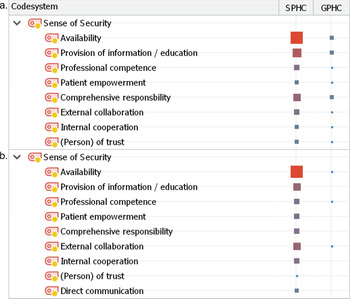
The factor sense of security was mentioned particularly often by SPHC (96.4%) and GPHC (94.7%) patients compared with symptom management and normality of everyday life suggesting its high relevance. Comparative weighted frequency analysis showed that (1) all subcategories were reported more frequently by SPHC patients (Figure 2a) and carers (Figure 2b) and (2) the subcategories availability and provision of information/education were mentioned most often by patients and carers, irrespective of the type of care (Figure 2).
Code Matrix Browser showing the weighted assignment of coded text segments to every subcategory of the main code sense of security for both SPHC and GPHC patients. The larger the cluster, the greater the number of segments that were assigned to this particular code.

Co-occurences of subcategories
The Code Relations Browser revealed the highest co-occurrences between availability-professional competence (SPHC), availability-comprehensive responsibility (SPHC), professional competence-provision of information/education (SPHC, GPHC), comprehensive responsibility-external collaboration (GPHC) for patients, and availability-direct communication (SPHC) and professional competence-external collaboration (SPHC) for carers.
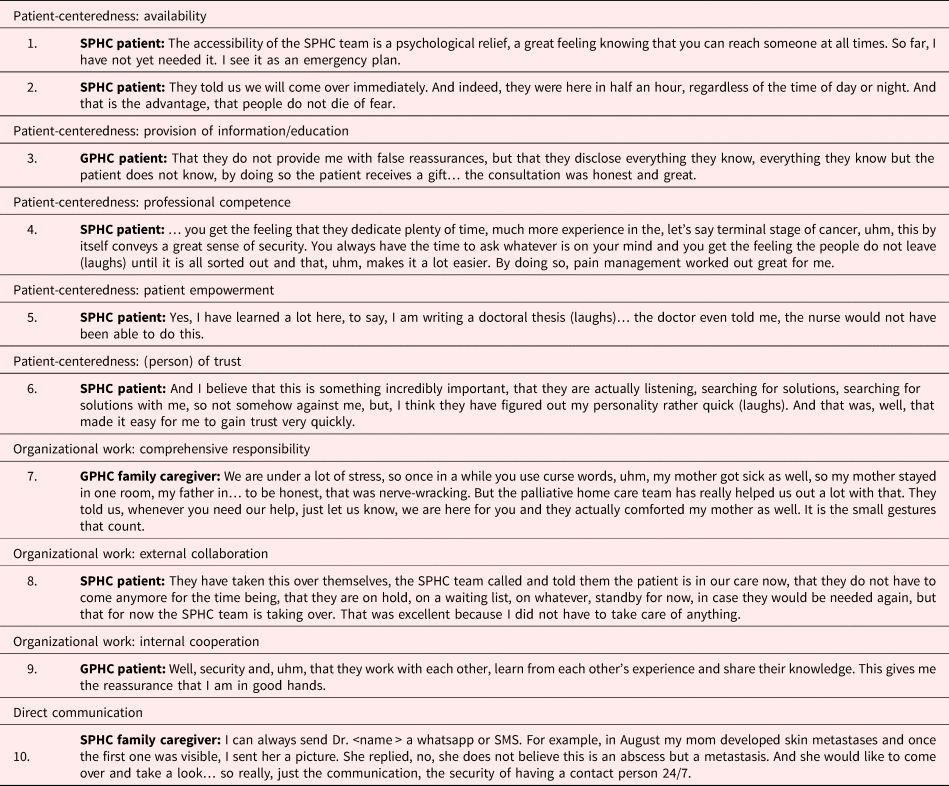
Supporting participants‘ quotes

GPHC, generalist palliative home care; SPHC, specialist palliative home care.
Qualitative content analysis
Patients and carers specifically mentioned the relevance of a sense of security suggesting that the situation at home can be handled successfully with the support of the team. SPHC recipients in particular emphasized the importance of a “security-net,” knowing they are not alone but surrounded by competent, kind staff who help manage the situation (Table 2).
Interviews with patients and carers were analyzed separately. However, there was great overlap of experiences, except for one category, direct communication, which emerged from interviews with carers only. The other eight subcategories were identified from both perspectives.
Patient-centeredness: availability, provision of information/education, professional competence, patient empowerment, and (person of) trust
Availability was most important for SPHC and GPHC informants. Being able to contact the team at night, on weekends and holidays was not taken for granted, irrespective of whether or how often this service has been used (quote 1), even though both teams declared they wanted to be contacted if any problems arose. Organizationally, SPHC recipients in particular emphasized the quick telephone or written response by qualified personnel and that a professional was always available for a home visit (quote 2). Conversely, if telephone accessibility and staff availability was not certain, interviewees got discouraged and refrained from calling. Content-related, especially SPHC recipients valued the provision of information/education by phone along with the high level of professional competence enabling them to manage critical and everyday medical situations by themselves.
SPHC teams stood out by devoting ample time to meticulously explain everything including new symptoms, treatment options, medications, and related non-medical issues. For both groups, staff communication and interpersonal skills were particularly important in the process of being informed, i.e., a transparent, genuine communication characterized by empathy and understanding, with information provided in a way that laypersons can understand (quote 3). In contrast, when the team did not dispose sufficient information, this triggered fears and insecurities. Consequently, some GPHC patients felt the need to self-educate.
GPHC patients explained that the team was always up-to-date on medical treatment options and possessed detailed knowledge, which conveyed a greater sense of security than any medications. SPHC patients commended the teams’ competence on difficult, complex symptomology and rare conditions allowing them to anticipate, identify, and resolve disease-relevant problems. Their sense of security increased with the teams’ efforts to approach a problem with their expertise and experience until it got resolved (quote 4).
Provision and instruction of pro re nata medication and non-medical interventions helped patients manage their situation autonomously. For carers, it was important to partake in the patients’ care, facilitated by staff guiding and instructing them in specific care/nursing tasks and explaining pro re nata medication for self-directed administration (quote 5). In contrast, when they were not actively involved in caring for the patient, this induced feelings of helplessness.
It was crucial for SPHC patients to trust their team, especially since the team was visiting them at home and late at night. A multitude of soft skills contributed to building trust, including reliability, dependability, and communication skills. A prerequisite was continuity in staff contacts, in particular the regular contact with a physician, whose opinion patients strongly relied on. Interviewees considered both professional (not giving up but trying multiple therapeutic trials and more progressive treatment options) and soft skills (interpersonal skills, reliability, and dependability) of the team to gain trust. They often mentioned trust related to an advocacy, i.e., mutual decisions about treatments and medical procedures that were in the patient's best interest (quote 6).
Organizational work: comprehensive responsibility, external collaboration (network), and internal cooperation
Comprehensively responsible were teams if they were accessible for all sorts of problems, even if these were not part of their usual remit. This list of additional duties included organizing/joining leisure activities, searching for assisted living, mediating disputes with families, and giving medical advice for non-palliative-relevant diseases (quote 7). Many informants appreciated that the SPHC team did basic/day care, helped with household chores and sent someone from their honorary office, so that carers got time-off, none of which is listed as obligations in the legal directive.
When asked about the teams’ network, cooperation with hospices, pharmacies, and medical supply stores, negotiations with sickness funds as well as referrals to and co-treatments with other specialists were named particularly often. GPHC patients also mentioned collaborations with qualified palliative care physicians in case of medical difficulties. SPHC patients were impressed with the ease of transfer from hospitals or GPHC (quote 8). Conversely, when the cooperation between GPHC and former SPHC was not given, this led to feelings of insecurity.
The involvement of the GP was deemed crucial. Even though the GP was fading into the background, there was a high willingness to cooperate. In cases of poor collaboration, GPHC carers stayed in contact with the GP themselves.
Interviewees frequently mentioned the teams’ outstanding internal cooperation, both within each profession and multiprofessional, mainly between physicians and nurses. It was highly valued that home visits are done by multiple team members who consult with each other (quote 9). Team meetings and detailed documentations were recognized and appreciated. Informants were aware that staff read documentation entries before each visit ensuring they were up-to-date on the patients’ current status.
Direct communication
Carers appreciated a direct, open, honest communication, in particular after an examination, upon medical consultation and in cases of any medical changes. They also valued the direct communication with physicians by cell phone, which was crucial in cases of uncertainty (quote 10).
Discussion
This study represents a comprehensive evaluation of the key components contributing to the concept sense of security as perceived by palliative care patients and carers in either SPHC or GPHC following a previously developed model (Schneider et al., Reference Schneider, Eichner and Thoms2015). We have confirmed the importance of the factor sense of security of the three-factor model (Schneider et al., Reference Schneider, Eichner and Thoms2015) and have extended it by additional subcategories, eight of which we combined into two core domains, patient-centeredness and organizational work. Both patients’ and carers’ experiences with an SPHC team are in good agreement with SPHC objectives (Gemeinsamer Bundesausschuss, 2007) and support previous research on the significance of security provided by PHC (Öhlén et al., Reference Öhlén, Andershed and Berg2007; Funk et al., Reference Funk, Allan and Stajduhar2009; Milberg et al., Reference Milberg, Wåhlberg and Jakobsson2012, Reference Milberg, Friedrichsen and Jakobsson2014, Reference Milberg, Liljeroos and Krevers2019; Krevers and Milberg, Reference Krevers and Milberg2014; Schneider et al., Reference Schneider, Eichner and Thoms2015; Klarare et al., Reference Klarare, Rasmussen and Fossum2017; Sarmento et al., Reference Sarmento, Gysels and Higginson2017; Oosterveld-Vlug et al., Reference Oosterveld-Vlug, Custers and Hofstede2019; Hov et al., Reference Hov, Bjørsland and Kjøs2020).
Our results suggest that 24/7 availability is most important for patients and carers in SPHC and GPHC, as similarly shown in previous studies (Goldschmidt et al., Reference Goldschmidt, Schmidt and Krasnik2006; Milberg et al., Reference Milberg, Wåhlberg and Jakobsson2012; Milberg et al., Reference Milberg, Friedrichsen and Jakobsson2014; Klarare et al., Reference Klarare, Rasmussen and Fossum2017; Oosterveld-Vlug et al., Reference Oosterveld-Vlug, Custers and Hofstede2019). This is not surprising given the patients’ progressing life-limiting disease and threatening life situation. However, despite the proven effectiveness of 24/7 availability, GPHC teams in Germany and many other countries are not officially required to offer this. While there were a few isolated negative annotations, our results suggest the staffs’ self-motivation by handing out personal cell phone numbers for constant availability. Of crucial importance while being available was the provision of information coinciding with patient empowerment and professional competence (Milberg et al., Reference Milberg, Strang and Carlsson2003, Reference Milberg, Wåhlberg and Jakobsson2012; Goldschmidt et al., Reference Goldschmidt, Schmidt and Krasnik2006; Oosterveld-Vlug et al., Reference Oosterveld-Vlug, Custers and Hofstede2019). Per definition, the level of expertise is one of the key differences between SPHC and GPHC, which might explain the higher level of satisfaction concerning patient empowerment and professional competence in SPHC patients. For them, this is extremely important since they suffer from a terminal disease associated with high, complex symptom burden that requires specialized knowledge exceeding that of other medical specialists. However, both patients and carers, irrespective of the type of care, ascribed less weight to professional competence than to 24/7 availability and provision of information. This is an interesting finding suggesting that patients and carers consider professional competence a prerequisite for palliative care professionals (Gamondi et al., Reference Gamondi, Larkin and Payne2013) not as worthy of note. Our results indicate that patients have accepted being terminally ill and facing impending death instead of relating hope to a treatment or cure, so accessibility to 24/7 care for all possible needs and concerns including but not exclusively concerned with receiving access to competence and information for satisfactory pain and symptom control, seems to be of pivotal importance during end-of-life care. Previous studies have evaluated pain management by SPHC teams (Hearn and Higginson, Reference Hearn and Higginson1998; Strömgren et al., Reference Strömgren, Groenvold and Petersen2004) resulting in an improved understanding of patients’ experiences. While our findings suggest that specialized knowledge to manage physical pain is essential for patients and carers, they are also and even more indicative of the cognitive dimension to develop coping strategies (McGuire, Reference McGuire1992). Instead of worrying about the progression of the disease, they feel sufficiently educated relieving them of their fears and allowing them to manage the situation by themselves (Milberg et al., Reference Milberg, Wåhlberg and Jakobsson2012). The teams’ excellent communication and interpersonal skills are supporting factors. In addition to concentrating on the physical dimension of pain control, it is thus important to also focus on its cognitive dimension as expressed by a sense of security (Boström et al., Reference Boström, Sandh and Lundberg2004; Milberg and Strang, Reference Milberg and Strang2007).
Some GPHC patients talked about the difficulties of getting adequate information, which they often attributed to insufficient external collaboration. In contrast, SPHC teams are required to collaborate with external partners (Gemeinsamer Bundesausschuss, 2007), which is beneficial for patients and carers, as they do not need to burden themselves with the allocation of responsibilities of relevant healthcare providers. Notably, both GPHC and SPHC recipients are generally satisfied with the involvement of their GP. SPHC interviewees do, however, consider the team's physician their trusted physician. Continuity thus not only concerns the organizational level of having only one team involved but also the staff level with one trusted physician. GPs and qualified palliative care physicians, therefore, complement each other to allow for a patient-centered level of care (Schwabe et al., Reference Schwabe, Ates and Ewert2017). There was high overlap between external collaboration and comprehensive responsibility (Schneider et al., Reference Schneider, Eichner and Thoms2015). Especially SPHC teams act as one contact point attending to all possible needs, relieving carers of this task. This worked particularly well in participating SPHC teams since they have a dedicated case manager. While a case manager is crucial to plan/coordinate patient care, evaluate processes within the team and external collaborators, such an employee is typically not part of GPHC. Our results highlight the importance of integrating comprehensive case management for more effective PHC (Meier et al., Reference Meier, Thar and Jordan2004; Spettell et al., Reference Spettell, Rawlins and Krakauer2009) and a greater sense of security for patients and carers on a national and international level.
As per regulation, SPHC teams primarily consist of qualified palliative care physicians and nurses (Gemeinsamer Bundesausschuss, 2007), who collaborate extremely well. Even when a new team member is visiting the patient, that person is already adequately informed about the patients’ medical history, which has been considered preeminent for patients and carers in recent research as well (Oosterveld-Vlug et al., Reference Oosterveld-Vlug, Custers and Hofstede2019). Staff being familiar with the patient's history provides a comforting feeling fostering the sense of security (Milberg et al., Reference Milberg, Wåhlberg and Jakobsson2012; Klarare et al., Reference Klarare, Rasmussen and Fossum2017). Evidently, physicians and nurses possess specific knowledge and skills and are considered equally important in the care of a patient, thus are described as a united front. Staff credibly conveys that individual patient needs are addressed in a multiprofessional way.
Our findings illustrate that the aforementioned components not only contribute to a sense of security but also provide relief to carers as it allows them to regenerate. Carers wish to participate in the patients’ care despite their inexperience, so the team does not only support the patient but also carers (Gemeinsamer Bundesausschuss, 2007). Therefore, there is need for emotional and psychological support for carers (Gallagher and Krawczyk, Reference Gallagher and Krawczyk2013).
Feasibility/trustworthiness/strengths/limitations
PHC patients are a highly vulnerable patient population who are often sheltered from research by their physicians by professional gatekeeping (Higginson and Evans, Reference Higginson and Evans2010; Johnston et al., Reference Johnston, Milligan and Foster2012), although qualitative research in PHC patients has been deemed acceptable (Gysels et al., Reference Gysels, Shipman and Higginson2008). Nonetheless, we were able to recruit a large sample size into our study allowing for representational generalizability and transferability. To further indicate trustworthiness of our results, representative quotations are presented for each subcategory (Polit and Beck, Reference Polit and Beck2012). To enhance credibility, the interview guide was pre-tested and meticulously discussed with all research and clinical staff involved in the study. We also ensured all research staff had the required knowledge and training to perform the study and had regular peer debriefing sessions as well as investigator meetings, concomitantly enhancing confirmability. Dependability was assured by the iterative and reflexive process of re-coding by research staff.
There are a number of limitations that need to be discussed. First, eligible patients were identified by their physicians which may have biased our results toward positive narrations, although there were isolated negative annotations as well. Second, in Germany, GPHC structures are not clearly defined as there is a lack of legal directives, which limits a fair evaluation and comparison with SPHC structures in terms of services offered, their duties, indication for engagement and personnel. In our study, GPHC patients were either being cared for by GPs or home care teams, while SPHC patients were cared for by SPHC services including qualified palliative care physicians and nurses. All patients were thus recruited from multiple teams and physicians in and outside three different regions living in urban and rural areas. Yet, their experiences were in good agreement allowing for a sound evaluation across one German region. Our results might thus be transferable toward other regions and countries, even when SPHC and GPHC are organized differently elsewhere, which we consider a strength of this study. The last caveat relates to the heterogeneity of our sample eventually resulting in different needs and priorities for patients and carers. However, their experiences with both teams coincided and the vast majority of patients was diagnosed with an oncological disease. Though this might concurrently have biased our results as oncological patients are often integrated into PHC at an earlier stage and are better informed, so they might therefore express their expectations of effective PHC in a more differentiated matter than other patient groups. This imbalance of patient groups was expected and reflects the disproportion of non-oncological diseases in palliative and hospice structures in Germany and on an international level, despite the gradual shift toward integrating patients other than cancer patients into palliative care (Murtagh et al., Reference Murtagh, Preston and Higginson2004).
Conclusion
The work of both SPHC and GPHC was perceived as very effective and beneficial, with more positive remarks for SPHC. This is not surprising, as per legal directive, SPHC teams are more comprehensive and shall therefore fulfill patient's expectations to a greater extent than GPHC is able to do. Our results highlight the importance of a sense of security for PHC patients wishing to remain at home for their end-of-life care and their carers and confirm the previously developed three-factor model (Schneider et al., Reference Schneider, Eichner and Thoms2015) allowing for transferability and generalizability which is of international relevance. Positive experiences of security are fostered by the teams’ 24/7 availability which has been identified as utmost important. PHC teams should, therefore, have the necessary resources to provide constant availability. For the greatest possible level of security, we, therefore, recommend the inclusion of 24/7 availability but also treatment planning by a case manager and continuity of care into the current health care policy so that patients’ expectations and needs are met to the fullest extent. To further improve the quality of PHC, strategies to improve a sense of security should be implemented into daily clinical practice. Common documentation tools and outcome measures used in the clinical routine ought to capture the concept of security. Future work is warranted to corroborate our results on a national and international level and evaluate its potential for the development of legal directives for GPHC and standardized outcome measures for the identification of patients and carers at-risk of feeling insecure and lost in the healthcare system.
Acknowledgments
We thank all patients and carers who have cordially welcomed research staff into their homes to share their experiences. Special thanks to all clinical staff at participating PHC teams for their generous help with recruitment. Thanks are extended to Thilo Dietz, Hank Hermans, Verena Gräfe, and Carola Janßen for transcribing the interviews, as well as to Verena Stumm, Vera Hennings, and Catherine Letcher for their valuable support and advice.
Funding
The study was supported by a grant of the Innovation Funds of the Federal Joint Committee (G-BA #01VSF16007).
Conflict of interest
There are no conflicts of interest.
APVEL consortium:
Prof. Dr. Roman Rolke
Department for Palliative Medicine, Medical Faculty RWTH Aachen University, Aachen, Germany
Prof. Dr. Raymond Voltz
Department of Palliative Medicine, Faculty of Medicine and University Hospital, University of Cologne, Cologne, Germany
Center for Integrated Oncology Aachen Bonn Cologne Duesseldorf (CIO ABCD), Faculty of Medicine and University Hospital, University of Cologne, Cologne, Germany
Clinical Trials Center (ZKS), Faculty of Medicine and University Hospital, University of Cologne, Cologne, Germany
Center for Health Services Research, Faculty of Medicine and University Hospital, University of Cologne, Cologne, Germany
Prof. Dr. Lukas Radbruch
Department of Palliative Medicine, University Hospital Bonn, Bonn, Germany
Centre for PC, Malteser Hospital Bonn/Rhein-Sieg, Bonn, Germany
Prof. Dr. Holger Pfaff & Dr. Nadine Scholten
Institute of Medical Sociology, Health Services Research and Rehabilitation Science (IMVR), Faculty of Human Sciences and Faculty of Medicine, University of Cologne, Cologne, Germany
Prof. Dr. Martin Hellmich
Institute of Medical Statistics and Computational Biology (IMSB), University of Cologne, Cologne, Germany.
Prof. Dr. Christian Rietz
Department of Educational Science, Faculty of Educational and Social Sciences, University of Education Heidelberg, Heidelberg, Germany
Ingo Meyer
PMV Research Group, Faculty of Medicine and University Hospital Cologne, University of Cologne, Cologne, Germany
Robin Fink
AOK Rheinland/Hamburg, Germany