Introduction
The genus Stephanostomum Looss, 1899, is a group of digenean found as parasites of marine teleost fish, with worldwide distribution (Bray Reference Bray, Jones, Bray and Gibson2005). It is one of the most diverse genera in the family Acanthocolpidae Lühe, 1906, with 144 valid species (WoRMS 2022). The species of Stephanostomum are characterized by two rows of enlarged circumoral spines and strongly spined tegument; the number, shape, and arrangement of the circumoral spines are key to specific determination (Madhavi & Bray Reference Madhavi and Bray2018).
In the western Atlantic Ocean, 24 species of Stephanostomum have been recorded, of which 17 species have been reported from the Gulf of Mexico, parasitizing both pelagic and benthic marine fish (Overstreet et al. Reference Overstreet, Cook, Heard, Felder and Camp2009). Four of them were recorded for the Yucatan Peninsula: S. casum (Linton Reference Linton1910), S. dentatum (Linton Reference Linton1940), S. ghanense (Fischthal & Thomas Reference Fischthal1968), and S. trompeteri (Zhukov Reference Zhukov1983). All of these species were identified based on morphological and morphometric data.
Application of nucleotide analysis in taxonomy studies of marine fish parasites (Padial et al. Reference Padial, Miralles, De la Riva and Vences2010) has contributed to a more accurate identification based on molecular detailed descriptions of confirmed species (Martínez-Aquino et al. Reference Martínez-Aquino, García-Teh, Ceccarelli, Aguilar-Aguilar, Vidal-Martínez and Aguirre-Macedo2020) and the discovery of new species and even subfamilies (Soler-Jimenez et al. Reference Soler-Jiménes, Hernández-Mena, Centeno-Chalé and Vidal-Martínez2021). In this context, Stephanostomum-like digeneans were found in dusky flounder Syacium papillosum from the Southeast of the Gulf of Mexico. At first look under the light microscope, specimens consistently show no circumoral spines, which casts doubts about its identification on the Stephanostomum. Thus, the objective of this study was to describe and characterize the specimens found by applying the combination of morphological (internal and external) and molecular analysis, taking into consideration the steps proposed by Pante et al. (Reference Pante, Schoelinck and Puillandre2015) for a proper description.
Materials and methods
Fishes and specimen collection
From 2016 to 2018, three oceanographic research cruises were carried out on the Yucatan shelf onboard an oceanographic vessel: Gomex-4 (April 2016), Gomex-5 (October 2016), and Gomex-6 (August 2018). The study area included 18 sampling points between 50 and 200 m in depth (Figure 1). The dusky flounder Syacium papillosum were collected using trawl nets. Morphometric measurements, total length (cm), and weight (gr) were obtained for each fish. They were immediately labeled and isolated individually in plastic bags, stored at -20 °C for transportation to the Aquatic Pathology Laboratory at CINVESTAV-Merida. Once in the lab, the fish were defrosted and identified prior to dissection by the Necton Laboratory, following the methodology proposed by Vega-Cendejas and Hernández de Santillana (Reference Vega-Cendejas and de Santillana2019). Afterwards, a parasitological examination of the collected fish was carried out under a stereoscope microscope (National Optical & Scientific Instruments, Texas, USA). Adult Stephanostomum specimens were collected from the defrosted fish and preserved directly in 4% formalin and 70% ethanol for morphological study, and in absolute ethanol for molecular analysis. The specimens for morphological studies were stained with Carmín-Mayers, dehydrated in an ascending ethanol series (70%, 80%, 96%, and 100%), cleared in clove oil of different concentrations (10%, 50%, 90%, and 100%), and mounted in Canada balsam (Vidal-Martínez et al. Reference Vidal-Martínez, Aguirre-Macedo, Scholz, González-Solís and Mendoza-Franco2002). Some specimens were mounted only between coverslips to allow dorsal and ventral observation. Measurements and drawings were made on an Olympus DIC Nomarski-BX50 microscope (Olympus Corporation, Tokyo, Japan). For the study of external morphology by scanning electron microscopy (SEM), the specimens were fixed in Glutaraldehyde 2.5%, dehydrated in gradual ethanols (30%, 50%, 70%, 90%, and 100%), and dried at a critical point with CO2 in a K850 Critical Point Dryer (Quorum Technologies, East Sussex, United Kingdom). The specimens were placed in a sample holder, covered with a layer of gold, and subsequently observed on a Philips XLE30 ESEM microscope (FEI Company, Oregon, USA). The infection parameters (prevalence and mean abundance) proposed by Bush et al. (Reference Bush, Lafferty, Lotz and Shostak1997) were calculated for each cruise and overall. All measurements are given in micrometres (μm), unless otherwise noted, and presented with minimum and maximum values, with the arithmetic mean (±SD) in parentheses. In addition, morphological measurements from adult Stephanostomum n. sp. were compared with 25 congeneric Stephanostomum species (Supplementary Table S1). Voucher specimens were deposited in the Colección Nacional de Helmintos (CNHE), Instituto de Biología, Universidad Nacional Autónoma de México, and paratypes were deposited in the Colección Helmintológica del CINVESTAV Mérida (CHCM), Centro de Investigación y de Estudios Avanzados del Instituto Politécnico Nacional, Unidad Mérida.
Study area and sampling points: ●-stations with fish infected with Stephanostomum minankisi n. sp.: o-stations where no infected fish were collected. Isobath line corresponds to the 200 m, which delimits the Yucatan continental shelf.

DNA extraction, PCR amplification and sequencing
The total genomic DNA of 4 adult specimens of Stephanostomum was fixed in absolute ethanol and extracted individually from each one using the DNeasy® Blood & Tissue Kit (QIAGEN, Hilden, Germany) following the manufacturer’s instructions. The 28S gene of the ribosomal region was amplified using the forward primer 391 (5′–AGCGGAGGAAAAGAAACTAA–3′) (Nadler & Hudspeth Reference Nadler and Hudspeth1998) plus the reverse primer 536 (5′–CAGCTATCCTGAGGGAAAC–3′) (Stock et al. Reference Stock, Campbell and Nadler2001). The PCR mix contained 12.5 μl of Green GoTaq Master Mix (Promega, Madison, WI, USA), 1 μl of each primer (10 μl), 8.5 μl of distilled water, and 2 μl of gDNA for a final volume of 25 μl. All PCR reactions were run in an Applied Biosystems Veriti™ Thermal Cycler (Applied Biosystems, California, USA) according to the following amplification conditions: initial denaturation at 94 °C for 5 min, followed by 35 cycles of denaturation at 94 °C for 1 min, annealing at 50 °C for 1 min, extension at 72 °C for 1 min, and finally, an extension cycle at 72 °C for 10 minutes. The PCR products were analyzed by electrophoresis in 1% agarose gel using TAE 1× buffer, stained with RedGel (Biotium, San Francisco, USA), and observed under UV light using BioDoc-It2™ (Analytik Jena US LLC, California, USA). Sequencing of the PCR products was performed using the same pair of amplification primers plus two additional internal primers, the reverse 503 (5′–CCTTGGTCCGTGTTTCAAGACG–3′) (Stock et al. Reference Stock, Campbell and Nadler2001) and the forward 504 (5′–CGTCTTGAAACACGGACTAAGG–3′) (García-Varela & Nadler Reference García-Varela and Nadler2005). Sanger sequencing of the PCR products was carried out by Genewiz, South Plainfield, NJ, USA (https://www.genewiz.com/). The sequences were reviewed and analyzed in Geneious Pro 4.8.4 software (Biomatters Ltd., Auckland, New Zealand), with which the 28S consensus sequences were obtained for each extracted specimen. The consensus sequences were published in the GenBank (https://www.ncbi.nlm.nih.gov/genbank/).
Phylogenetic study
To carry out the molecular determination and the phylogenetic relationships of the sequenced specimens, a database was first built in Mesquite 3.62 (https://www.mesquiteproject.org/) with the new sequences and sequences of the 28S gene of other species of the families Acanthocolpidae Luhe, 1906 and Brachycladiidae Odhner, 1905 that are available at the Genbank. Using previous phylogenies as a reference, Cableia pudica was chosen as the outgroup to root the phylogenetic tree obtained. Subsequently, the alignment of the sequences of our data set was carried out using ClustalW (Thompson et al. Reference Thompson, Higgins and Gibson1994) at http://www.genome.jp/tools/clustalw/, with the following parameters: ‘SLOW/ACCURATE’ and weight matrix ‘CLUSTALW (for DNA)’. The genetic distances (uncorrected p distances = p distance and number of different nucleotides = nt) in each data set were calculated with MEGA v.6 (Tamura et al. Reference Tamura, Stecher, Peterson, Filipski and Kumar2013). Next, the nucleotide evolution model was estimated for the data set aligned with jModelTest v2 (Darriba et al. Reference Darriba, Taboada, Doallo and Posada2012). Finally, the phylogenetic relationships were inferred using the maximum likelihood method (ML) in RAxML v. 7.0.4 (Stamatakis Reference Stamatakis2006) with 1,000 Bootstrap (Bt) repetitions. The resulting phylogenetic tree was visualized in FigTree v.1.4.3. (Rambaut Reference Rambaut2006).
Results
Stephanostomum minankisi n. sp. (Figures 2 and 3)
A total of 331 specimens of S. minankisi n. sp. were collected from 284 dusky flounder. The total length of the fish was 13.4 cm to 31.0 cm, and no significant differences were found in total fish length between oceanographic research cruises (Kruskal-Wallis, H [2, 282] = 0.99, p = 0.61). The prevalence was 19.40%, and the mean abundance was 0.95 ± 6.35. The meristic values of the fish captured and the infection parameters of S. minankisi n. sp. by oceanographic research cruise are presented in Table 1.
Meristic values of the dusky flounder Syacium papillosum and infection parameters of Stephanostomum minankisi n. sp. within the Yucatán peninsula

No. = number total; x̄ = mean of; ±SD = standard deviation
Description
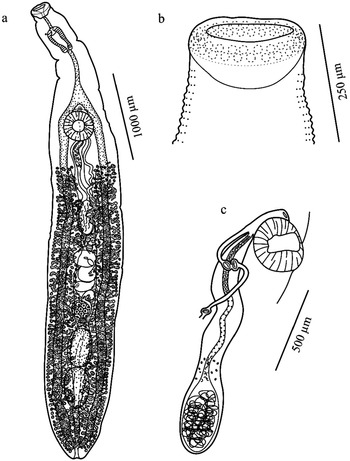
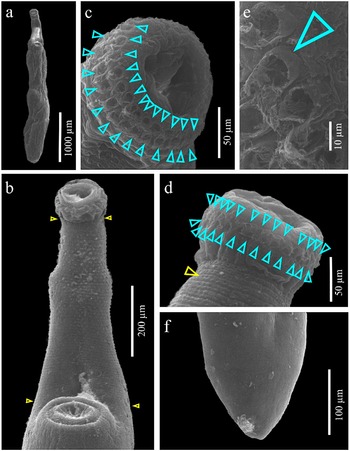
Based on 24 mature specimens. Body elongated, expanded from ventral sucker forward, 4,750–6,625 (5,519±494) long, maximum width 575–1,100 (819±123) at testicular level. Forebody 840–1,400 (1,115±159) long. Hindbody 3,420–5,145 (4,027±455) long. Forebody–hindbody ratio 1:2.5–5.7 (3.7±0.7). Tegument slightly spined to level of forebody (Figure 3b) and without spines on hindbody (Figure 3f). Eyespot pigment present. Oral sucker terminal, wide, 60–150 (99±17) long and 180–350 (269±39) wide. No spines observed, only pits (Figures 2b and 3c–e), 52 in two uninterrupted rows (26 pits per row), alternating with each other. Ventral sucker oval, slightly protruding, 250–470 (377±52) long, 270–450 (365±42) wide, located in the first third of the body. Sucker–length ratio 1:2.7–5.3 (3.9±0.7); Sucker–width ratio 1:1.1–1.6 (1.4±0.1). Prepharynx long and narrow, 100–500 (252±113) long, 10–80 (38±17) wide. Pharynx pyriform, 200–370 (298±48) long, 80–260 (186±36) wide. Esophagus similar length to pharynx, 120–550 (295±120) long, 30–80 (49±11) wide. Intestinal bifurcation anterior to ventral sucker, at 660–1,270 (919±144) from anterior end of body. Caeca long, narrow, extending to posterior end of body, opening to the excretory vesicle to form uroproct.
Stephanostomum minankisi n. sp. from Syacium papillosum. A: entire ventral view of holotype; B: Oral sucker without circumoral spines; C: terminal genitalia.

Stephanostomum minankisi n. sp. seen from scanning electron microscopy (SEM). a) ventral view; b) forebody showing the area with tegumental spines (yellow arrowhead); c) oral sucker showing pits of circumoral spines (blue arrowhead); d) oral sucker and neck showing pits of circumoral and tegumental spines (blue and yellow arrowhead, respectively); e) pits of circumoral spines (blue arrowhead); f) terminal posterior end of the body without tegumental spines.

Testes 2, ovoid, smooth, asymmetric (anterior testis slightly smaller than posterior testis), in tandem, in contact or slightly overlapping, located near posterior end of body; anterior testis 450–770 (575±89) long, 300–650 (431±89) wide; posterior testis 470–860 (683±112) long, 310–630 (476±83); post-testicular region short, 220–650 (408±131) long. Cirrus-sac elongate and sinuous, 1,016–1,870 (1,358±230) longitudinal extent, 120–230 (173±33) wide. Seminal vesicle saccular, oval, undivided, 220–440 (335±49) long, 112–220 (158±31) wide. Pars prostatica narrower distally, lined with a nuclear cell-like bodies, surrounded by gland-cells, 212–620 (419±124) long. Ejaculatory duct similar in length to pars prostatica, presents closely packed small cupolas, with round bases seen as circles on wall of duct, 350–740 (454±103) long. Genital atrium elongated, behind and reaching anterior half of ventral sucker, 76–460 (145±114) long (Figure 2c). Genital pore slit-like in midline of body, at anterior margin of ventral sucker (Figures 2c and 3b). Ovary oval, entire, located in last third of body and well separated from anterior testis, 200–350 (258±43) long, 130–380 (248±65) wide. Mehlis’ gland and pore of Laurer’s canal not observed. Uterus narrow, intercaecal, extending between ventral sucker and ovary. Metraterm short, slightly longer than ejaculatory duct. Vitellaria formed by numerous small follicles covering posterior two thirds of body, 49.5%–76.3% (68.2%±5%), from posterior half of cirrus-sac to body’s posterior end; in 75% of specimens, arranged mainly in two lateral stripes, slightly confluent dorsally at uterus region, between ovary and anterior testis, and in post-testicular region, in remaining specimens (25%), vitellaria cover entire space, overlapping internal organs. Eggs ovoid, operculate, 60–80 (66±7) long, 40–60 (45±6) wide. Excretory vesicle tubular 1,150–2,250 (1,588±285) long; excretory pore terminal.
Taxonomic summary
Type host. Syacium papillosum (Linnaeus, 1758), Paralichthydae; dusky flounder
Site. Stomach and intestine
Type locality. Southern Gulf of Mexico, Yucatan Peninsula shelf.
Type material. Holotype CNHE No. 11669; 5 paratype CNHE No.11670; and 7 paratype CHCM No.586, 667, 667.2, 668, 668.2, 669, and 669.2.
Etymology. the name of minankisi comes from the Mayan term. Mina’an = without or these is not, and Ki’ix = spine, to say a Stephanostomum without spines.
Synonym. Stephanostomum sp.7 (in Vidal-Martínez et al. Reference Vidal-Martínez, Velázquez-Abunader, Centeno-Chalé, May-Tec, Soler-Jiménez, Pech, Mariño-Tapia, Enriquez, Zapata-Pérez, Herrera-Silveira, Hernández-Mena, Herzka, Ordoñez-López and Aguirre-Macedo2019).
Zoobank Life Science Identifier: urn:lsid:zoobank.org:pub:889DD7F4-7DE1-45EC-8F51-C76830C8A53A
Representative DNA sequences: 28S rDNA (OQ867997-OQ867998-OQ867999)
Remarks
Although oral spines were not observed in the studied specimens, the presence of pits in the oral sucker allows us to infer that Stephanostomum minankisi n. sp. does have two rows of oral spines, which have been lost for reasons that are still unknown. Therefore, the presence of a double row of oral spines allowed us to identify the trematodes as part of the genus Stephanostomum, in addition to the presence of other morphological characters such as terminal oral sucker, body elongated (not particularly extensile), and ventral sucker in the first third of the body.
Considering as taxonomic data the number of circumoral spines and according to our records, only three species have a similar circumoral spine number (Supplementary Table S1): S. baccatum described by Wolfgang (Reference Wolfgang1955), parasitizing Atlantic halibut Hippoglosuss hippoglosuss, which present a smaller body (1,400–4,500 μm long), covered full of spines, esophagus very short, vitellaria may extend posteriorly to posterior margin of ventral sucker to slightly posterior to the cirrus-sac, ovary well separated from anterior testis, and uroproct absent; S. lineatum, originally described by Manter (Reference Manter1934), parasitizing deep-sea fishes, ‘shortbeard codling’ Laemonema barbatulum, and fishes of the genus Urophycis characterized by having a body elongate and very narrow (126–370 μm wide), prepharynx much longer than pharynx, genital atrium spined, seminal vesicle bipartite, cirrus spined, ovary and testis widely separated from each other by vitelline follicles, the testes elongate-oval, post-testicular space very long and metraterm spined; and S. promicropsi first described by Manter (Reference Manter1947), parasitizing Jewfish Epinephelus itajara (Syn. Promicrops itaira) in Tortugas, Florida which presents a sucker ratio 1: 2, prepharynx longer than pharynx, and esophagus short, vitellaria at level of the posterior margin of ventral sucker, testes elongated and widely separated from each other by vitelline follicles. S. minankisi n. sp. differs from the mentioned species in having a more robust body, forebody spined and rest of the body without spines, sucker ratio 1:1.3 (1.1–1.5), seminal vesicle non-bipartite, testes rounded and continuous (in some overlapping), vitellaria at level of the posterior cirrus-sac and uroproct present.
In comparison with other Stephanostomum species described in the Yucatan Peninsula (Supplementary Table S1): S. casum parasitizing grey snapper Lutjanus griseus (Argáez-García et al. Reference Argáez-García, Guillén-Hernández and Aguirre-Macedo2010) has the body strongly spined, oral sucker funnel-shape with 37 circumoral spines distributed in two rows of spines (19 spines in the upper row and 18 in the lower one), vitellaria from the posterior margin of ventral sucker, uroproct absent; S. dentatum from red grouper Epinephelus morio recorded by Aguirre-Macedo and Bray (Reference Aguirre-Macedo and Bray1996), is smaller (1,637–2,639 μm) and densely spined, with 52–54 circumoral spines, testes and ovary are small and slightly equal in size, vitellaria follicular from posterior border of ventral sucker, uroproct absent; S. ghanensis reported in the Florida pompano Trachinotus carolinus (Sánchez-Ramírez & Vidal-Martínez Reference Sánchez-Ramírez and Vidal-Martínez2002) is smaller (1,950 μm), with tegument spined to posterior level of testis, with 34 circumoral spines, sucker–width ratio 1:1.08, prepharynx longer than pharynx, ovary and anterior testes in contact; finally, S. trompeteri parasitizing Cornetfish Fistularia tobacaria (Zhukov Reference Zhukov1983) from Campeche contains 36 circum-oral spines, body fully spined, suckers of nearly equal size (sucker ratio 1:1.09). In contrast, S. minankisi n. sp. has 52 circumoral spines and the tegument spined only in the forebody, prepharynx, pharynx and esophagus similar length, sucker ratio 1:1.1–1.5, testes larger than the ovary, in contact, uroproct present and vitellaria anteriorly reaching the posterior half of the cirrus-sac.
To date, only S. casum (Syn. S. casus) and S. dentatum have been reported with spines lost, referred to as spines evanescent by Linton (Reference Linton1910; Reference Linton1940). S. casum was recorded from Epinephelus striatus, Lutjanus griseus, L. analis, and Ocyurus from Dry Tortugas (Linton Reference Linton1910). In contrast with our specimens, this species is characterized by the presence of 36 circumoral spines, a sucker ratio of 1:1.5–2.0, a short esophagus, the vitelline follicles extended to the middle of the length of the ventral sucker, and the ovary and testis large and continuous. In the case of S. dentatum, it was recovered from the summer flounder Paralichthys dentatus in Woods Hole (Linton Reference Linton1940). This species has a small body size (2,302 μm) covered entirely with spines, 54 circumoral spines, the testes begin in the middle of the total of the body, and the vitelline follicles extend to mid-level of the ventral sucker. We include in the comparison S. tantabiddii, described by Bray and Crib (Reference Bray and Cribb2004), parasitizing yellowspotted trevally Carangoides fulvoguttatus from Western Australia because it resulted nested in the phylogenetic analysis (Figure 4). In this case, the species was characterized by having an average of circumoral spines of 42 (38–45), a body very elongate (12,230–14,874 μm) with the tegument spined to the level of posterior testis, the testes being well separated, the pars prostatica longer than ejaculatory duct, the ovary well separated from anterior testis, the vitellaria follicular from posterior border of cirrus-sac to the posterior end of the body. Our new species differs from those mentioned above by presenting a body size medium (5,519 μm) and wide, with tegumental spines only in the forebody, 52 circumoral spines, pars prostatica and ejaculatory duct similar in length, ovary slightly separated from anterior testy, but testis in contact or overlapping.
Metacercariae. Stephanostomum sp. 4
Description. Cyst spherical, 366–413 in diameter (n = 2). Body clavate, 1,652–2,706 (1,986±247) long, maximum width at posterior part of body 268–669 (465±14) (Supplementary Figure S1). Forebody 647–942 (792±103) long. Tegument slightly covered with spines in forebody. Two eye-spots present. Oral sucker funnel-shape, 102–152 (130±25) long, 130–206 (167±25) wide, with double row of 21 spines, 23–25 (24±1) spine long. Ventral sucker 141–193 (167±27) long, 116–180 (150±32) wide, in middle of body length. Sucker ratio 1: 1–1.10 (1.06±0.16). Prepharynx 195–557 (386±115) long. Pharynx 60–135 (94±27) long, 30–65 (46±13) wide. Oesophagus very short or absent. Caeca narrow extending to posterior end of the body. Caeca bifurcation just preacetabular. Genital primordia barely developed. Two testis median, in tandem, 60–90 (75±15) long, 20–45 (28±10) wide. Ovary pretesticular, 35–45 (40±5) long, 35–50 (43±8) wide.
Taxonomic summary
Host. Syacium papillosum (Linnaeus, 1758), Paralichthydae; dusky flounder
Site. Encysted in gill base, intestine, and muscle.
Locality. Southern Gulf of Mexico, Yucatan Peninsula shelf.
Material. CNHE 11076.
Representative DNA sequences: 28S rDNA (OQ868000-OQ868001)
Phylogenetic affinities and genetic distances
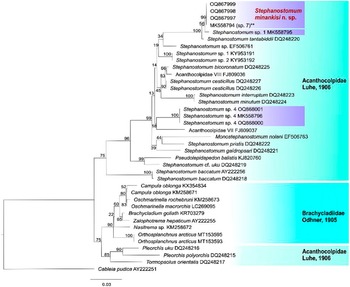
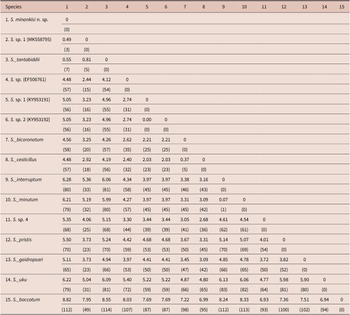
A total of five new 28S DNA sequences were obtained, three belonging to the new species and two from specimens identified as Stephanostomum sp. 4 (metacercariae from S. papillosum). Sequence lengths were 1,275 bp and 372–1,208 bp, respectively. The Blast results indicated that the four specimens of the new species have a percentage of identity with Stephanostomum sp. 1 (metacercariae from S. papillosum) and adults of S. tantabiddii of 99.51% and 99.19%, respectively. The aligned data set used for the phylogenetic analysis was 1,400 bp long and had a representation of 39 taxa. The nucleotide frequencies for this data set were: A = 0.213, C = 0.222, G = 0.323, T = 0.242. The ML tree had a likelihood value of -6,179.20. The phylogenetic tree showed two non-monophyletic groups at two different taxonomic levels. On the one hand, at the family level, Acanthocolpidae was not monophyletic because Brachycladiidae species nested within it. On the other hand, at the genus level, Monostephanostomum and Pseudolepidapedon species nested within the Stephanostomum clade, so this last genus also appears as non-monophyletic (Figure 4). The phylogenetic tree showed that the three species found as parasites of dusky flounder were grouped into two different clades. On the one hand, Stephanostomum sp. 4 was grouped with a specimen identified as Acanthocolpidae VII with low values of bootstrap support (Bt = 18). On the other hand, S. minankisi n. sp. was the sister species of Stephanostomum sp. 1 (Bt = 56) and formed a clade with S. tantabiddii supported by high bootstrap values (Bt = 100). The latter species was found as an adult parasite in the intestine of the fish Carangoides fulvoguttatus in Ningaloo, Australia (Figure 4). It is important to note that although S. minankisi n. sp., Stephanostomum sp. 1 and Stephanostomum sp. 4 are parasites in the dusky flounder, only the new species we are describing here is parasitic as an adult in the digestive system of the fish. In contrast, the other two species of Stephanostomum are found as metacercariae, encysted in organs such as muscle and fins. Regarding genetic distances, the new species has very low percentages of divergence with its congeneric species: 0.49% (nt = 3) from Stephanostomum sp. 1 and 0.55% (nt = 7) from S. tantabiddii. Additionally, it has a 5.35 % (nt = 68) difference from Stephanostomum sp. 4, and finally, from the rest of the species of the genus Stephanostomum, the genetic difference ranged from 4.48 to 8.82% (57 to 112 nt) (Table 2).
Phylogenetic tree of the 28S gene showing the relationships of Stephanostomum minankisi n. sp. and the other species of the genus that were found parasitizing Syacium papillosum and that were sequenced in this study (framed in purple rectangles). The numbers in bold type represent the new sequenced specimens. The tree represents the single best tree obtained from maximum likelihood analysis. Numbers near internal nodes indicate bootstrap support values. ** is the accession number that belongs to the species identified as Stephanostomum sp. 7 by Vidal-Martinez et al. (2019).

Genetic distances in the 28S gene between Stephanostomum minankisi n. sp. and the other species of the genus Stephanostomum. Uncorrected p distance values are in percentages and the number of different nucleotides is in parentheses

Discussion
Stephanostomum minankisi n. sp. is identified and described as new species using morphological and molecular data. These specimens were first considered as species belonging to Acanthocolpus, due to the absence of oral spines and the poor visibility of tegumental spines (Figure 2a). Madhavi and Bray (Reference Madhavi and Bray2018) mentioned that a characteristic that separates Acanthocolpus from Stephanostomum is the absence of circumoral spines for members of the Acanthocolpus and the presence of a double row of circumoral spines for those of Stephanostomum. Data obtained from SEM revealed that our material indeed belongs to the genus Stephanostomum, as the presence of pits in the oral sucker and a fine spination of the tegument were observed (Figure 3b–e). Moreover, molecular analysis determined that, despite the absence of circumoral spines, our specimens belonged to the genus Stephanostomum and that it was related to S. tantabiddii (Figure 4). The presence of pits indicates that our specimens at some point had a double row of circumoral spine that may consistently be lost during the parasite manipulation. The SEM treatment of the sample allowed us not only to see the pits but to clearly determine the number of circumoral spines lost (52) in the specimens of S. minankisi n. sp. (Figure 3).
The loss of circumoral spines in members of the genus Stephanostomum spp. has been poorly documented and mentioned only by Linton a couple of times. The first was when he described S. casum (Syn. S. casus) from Dry Tortugas, where he mentions that the specimen did not present spines, which he called spines evanescent (Linton Reference Linton1910). Later, when collecting specimens of S. dentatum from Woods Hole, Massachusetts, he mentioned specimens with spines evanescent (Linton Reference Linton1940). Since then, nothing on this matter has been mentioned for the rest of the species described for North America (Wolfgang Reference Wolfgang1955; Overstreet et al. Reference Overstreet, Cook, Heard, Felder and Camp2009) or South America (Fischthal Reference Fischthal1977; Nahhas & Cable Reference Nahhas and Cable1964; Kohn et al. Reference Kohn, Fernandes and Cohen2007).
The loss of the circumoral and tegumental spines of our specimens may be due to the freezing and thawing of the fishes. Normally, when these fishes are captured, they spend several days frozen at -40 °C while they are transported from the sea to CINVESTAV, where they are stored at -20 °C. They are then thawed for identification, dissection, and extraction of Stephanostomum specimens. However, sometimes after fish identification, the fishes are frozen again for days or weeks until their parasitological examination. The idea of circumoral spines loss due to thawing and refreezing of fish specimens has not been documented for this genus. Still, it has been documented for other species such as echinostomes and heterophyids (Sepulveda & Kinsella Reference Sepulveda and Kinsella2013); even the loss of tegumental spines in lepocreadiids can occur (Bray & Gibson Reference Bray and Gibson1991).
Concerning the phylogenetic position of the new species, we observed that S. minankisi n. sp. is the sister species of Stephanostomum sp. 1, which was found as a metacercaria in the same host and the same geographic region (Vidal-Martinez et al. 2019). Previously, it has been recorded that at least 7 species of Stephanostomum are parasitizing the same fish species as metacercaria (Vidal-Martínez et al. Reference Vidal-Martínez, Velázquez-Abunader, Centeno-Chalé, May-Tec, Soler-Jiménez, Pech, Mariño-Tapia, Enriquez, Zapata-Pérez, Herrera-Silveira, Hernández-Mena, Herzka, Ordoñez-López and Aguirre-Macedo2019), but unfortunately, molecular data are available only for metacercariae of Stephanostomum sp. 1. The fact that Stephanostomum sp. 1 appears as metacercariae in dusky flounder indicates that this species develops as an adult in the digestive tract of some other fish that feeds on this flatfish, whereas for the new species, the dusky flounder is the definitive host; therefore, the intermediate host of the new species is still unknown. Additionally, S. minankisi n. sp. plus Stephanostomum sp. 1 were grouped with S. tantabiddii that is distributed in Australia and parasitizes Carangoides fulvoguttatus (Carangidae). This fish belongs to a completely different fish order than the dusky flounders. The inferred genealogical relationships indicate that the phylogenetic affinities of the new species do not obey either the geographic distribution because it was not grouped with sequenced species collected in the Gulf of Mexico (i.e. S. interruptum) or host specificity, as the species found in the dusky flounder were not grouped in a single clade (Figure 4). Finally, the definitive hosts of the sister species belong to a different fish order.
The genetic distances calculated between the species most closely related to S. minankisi were very low (0.49% with Stephanostomum sp. 1 and 0.55% with S. tantabiddii). There was also a low genetic difference (0.1%) with available sequences of S. interruptum and S. minutum collected from different hosts and in different regions of the world (in Menticirrhus americanus from the Gulf of Mexico and in Uranoscopus scaber from Corsica, respectively) (Bray et al. Reference Bray, Webster, Bartoli and Littlewood2005). The low values observed may be the result of the 28S gene having a low rate of substitution in this group of parasites, which is reflected in little variability. Although, in general, the 28S gene is a good marker to differentiate trematode species, it has been observed that it may have less variation with respect to other genes such as the internal transcribed spacer (ITS) or the cytochrome oxidase subunit 1 (cox 1), which are more variable due to a higher mutation rate (Vilas et al. Reference Vilas, Criscione and Blouin2015). Unfortunately, at the moment, there are not enough ITS and cox 1 sequences to make a good comparison or a complete phylogenetic analysis among the different species of Stephanostomum. In other groups of trematodes, new species have also been described when there are clear morphological differences even though the percentage of genetic difference is not greater than 1% in the 28S gene (Curran et al. Reference Curran, Tkach and Overstreet2013; Kasl et al. Reference Kasl, Fayton, Font and Criscione2014; Hernández-Mena et al. Reference Hernández-Mena, Lynggaard, Mendoza-Garfias and de León G2016). In our study, we found important morphological differences to support the description of a new species.
In conclusion, this new description increases the known diversity of digenean parasites of marine fishes in the area, expanding to five the species of Stephanostomum described for the Yucatan Peninsula and to 18 for the Gulf of Mexico (Supplementary Table S1). This is the first record of a species of Stephanostomum using flounder as definitive hosts, particularly parasitizing the intestine of dusky flounder S. papillosum in this area. To conclude, we emphasize that the differentiation of S. minankisi n sp. with the species already described is not only based on the absence of circumoral and tegumental spines, but also the description of this new species follows the path of integrative taxonomy since the identification is supported by morphological, host, genetic differences, and phylogenetic analysis.
Supplementary material
The supplementary material for this article can be found at http://doi.org/10.1017/S0022149X23000263.
Acknowledgements
We are grateful to Gregory Arjona-Torrres and Francisco Puc-Itza for collecting the fish. We thank the staff of the Aquatic Pathology Laboratory, especially Clara Vivas-Rodríguez, Arturo Centeno-Chále, Francisco Puc-Itza, Nadia Herrera-Castillo, Efraín Sarabia-Eb, and German Lopez-Guerra for the parasitological examination of the fish. JGGT thanks Wendy Padron for her support with the photographs of the SEM and Zita Arriaga-Piñón for the advice in drawing making.
Financial support
This study has been supported by CONACYT and the Mexican Ministry of Energy through the Hydrocarbon Fund (project 201441). This is a contribution of the Gulf of Mexico Research Consortium (CIGoM). We acknowledge PEMEX´S specific request to the Hydrocarbon Found to address the environmental effects of oil spills in the Gulf of Mexico.
Competing interest
None.
Ethical standard
The authors assert that all procedures contributing to this work comply with the ethical standards of the relevant national and institutional guides on the care and use of laboratory animals.