

%20--%3e%3c!DOCTYPE%20svg%20PUBLIC%20'-//W3C//DTD%20SVG%201.0//EN'%20'http://www.w3.org/TR/2001/REC-SVG-20010904/DTD/svg10.dtd'%3e%3csvg%20version='1.0'%20id='Layer_1'%20xmlns='http://www.w3.org/2000/svg'%20xmlns:xlink='http://www.w3.org/1999/xlink'%20x='0px'%20y='0px'%20width='64px'%20height='64px'%20viewBox='5.5%20-3.5%2064%2064'%20enable-background='new%205.5%20-3.5%2064%2064'%20xml:space='preserve'%3e%3cg%3e%3ccircle%20fill='%23FFFFFF'%20fill-opacity='0'%20cx='37.785'%20cy='28.501'%20r='28.836'/%3e%3cpath%20fill='%23595959'%20d='M37.441-3.5c8.951,0,16.572,3.125,22.857,9.372c3.008,3.009,5.295,6.448,6.857,10.314%20c1.561,3.867,2.344,7.971,2.344,12.314c0,4.381-0.773,8.486-2.314,12.313c-1.543,3.828-3.82,7.21-6.828,10.143%20c-3.123,3.085-6.666,5.448-10.629,7.086c-3.961,1.638-8.057,2.457-12.285,2.457s-8.276-0.808-12.143-2.429%20c-3.866-1.618-7.333-3.961-10.4-7.027c-3.067-3.066-5.4-6.524-7-10.372S5.5,32.767,5.5,28.5c0-4.229,0.809-8.295,2.428-12.2%20c1.619-3.905,3.972-7.4,7.057-10.486C21.08-0.394,28.565-3.5,37.441-3.5z%20M37.557,2.272c-7.314,0-13.467,2.553-18.458,7.657%20c-2.515,2.553-4.448,5.419-5.8,8.6c-1.354,3.181-2.029,6.505-2.029,9.972c0,3.429,0.675,6.734,2.029,9.913%20c1.353,3.183,3.285,6.021,5.8,8.516c2.514,2.496,5.351,4.399,8.515,5.715c3.161,1.314,6.476,1.971,9.943,1.971%20c3.428,0,6.75-0.665,9.973-1.999c3.219-1.335,6.121-3.257,8.713-5.771c4.99-4.876,7.484-10.99,7.484-18.344%20c0-3.543-0.648-6.895-1.943-10.057c-1.293-3.162-3.18-5.98-5.654-8.458C50.984,4.844,44.795,2.272,37.557,2.272z%20M37.156,23.187%20l-4.287,2.229c-0.458-0.951-1.019-1.619-1.685-2c-0.667-0.38-1.286-0.571-1.858-0.571c-2.856,0-4.286,1.885-4.286,5.657%20c0,1.714,0.362,3.084,1.085,4.113c0.724,1.029,1.791,1.544,3.201,1.544c1.867,0,3.181-0.915,3.944-2.743l3.942,2%20c-0.838,1.563-2,2.791-3.486,3.686c-1.484,0.896-3.123,1.343-4.914,1.343c-2.857,0-5.163-0.875-6.915-2.629%20c-1.752-1.752-2.628-4.19-2.628-7.313c0-3.048,0.886-5.466,2.657-7.257c1.771-1.79,4.009-2.686,6.715-2.686%20C32.604,18.558,35.441,20.101,37.156,23.187z%20M55.613,23.187l-4.229,2.229c-0.457-0.951-1.02-1.619-1.686-2%20c-0.668-0.38-1.307-0.571-1.914-0.571c-2.857,0-4.287,1.885-4.287,5.657c0,1.714,0.363,3.084,1.086,4.113%20c0.723,1.029,1.789,1.544,3.201,1.544c1.865,0,3.18-0.915,3.941-2.743l4,2c-0.875,1.563-2.057,2.791-3.541,3.686%20c-1.486,0.896-3.105,1.343-4.857,1.343c-2.896,0-5.209-0.875-6.941-2.629c-1.736-1.752-2.602-4.19-2.602-7.313%20c0-3.048,0.885-5.466,2.658-7.257c1.77-1.79,4.008-2.686,6.713-2.686C51.117,18.558,53.938,20.101,55.613,23.187z'/%3e%3c/g%3e%3c/svg%3e)
%20--%3e%3c!DOCTYPE%20svg%20PUBLIC%20'-//W3C//DTD%20SVG%201.0//EN'%20'http://www.w3.org/TR/2001/REC-SVG-20010904/DTD/svg10.dtd'%3e%3csvg%20version='1.0'%20id='Layer_1'%20xmlns='http://www.w3.org/2000/svg'%20xmlns:xlink='http://www.w3.org/1999/xlink'%20x='0px'%20y='0px'%20width='64px'%20height='64px'%20viewBox='5.5%20-3.5%2064%2064'%20enable-background='new%205.5%20-3.5%2064%2064'%20xml:space='preserve'%3e%3cg%3e%3ccircle%20fill='%23FFFFFF'%20fill-opacity='0'%20cx='37.637'%20cy='28.806'%20r='28.276'/%3e%3cg%3e%3cpath%20fill='%23595959'%20d='M37.443-3.5c8.988,0,16.57,3.085,22.742,9.257C66.393,11.967,69.5,19.548,69.5,28.5c0,8.991-3.049,16.476-9.145,22.456%20C53.879,57.319,46.242,60.5,37.443,60.5c-8.649,0-16.153-3.144-22.514-9.43C8.644,44.784,5.5,37.262,5.5,28.5%20c0-8.761,3.144-16.342,9.429-22.742C21.101-0.415,28.604-3.5,37.443-3.5z%20M37.557,2.272c-7.276,0-13.428,2.553-18.457,7.657%20c-5.22,5.334-7.829,11.525-7.829,18.572c0,7.086,2.59,13.22,7.77,18.398c5.181,5.182,11.352,7.771,18.514,7.771%20c7.123,0,13.334-2.607,18.629-7.828c5.029-4.838,7.543-10.952,7.543-18.343c0-7.276-2.553-13.465-7.656-18.571%20C50.967,4.824,44.795,2.272,37.557,2.272z%20M46.129,20.557v13.085h-3.656v15.542h-9.944V33.643h-3.656V20.557%20c0-0.572,0.2-1.057,0.599-1.457c0.401-0.399,0.887-0.6,1.457-0.6h13.144c0.533,0,1.01,0.2,1.428,0.6%20C45.918,19.5,46.129,19.986,46.129,20.557z%20M33.042,12.329c0-3.008,1.485-4.514,4.458-4.514s4.457,1.504,4.457,4.514%20c0,2.971-1.486,4.457-4.457,4.457S33.042,15.3,33.042,12.329z'/%3e%3c/g%3e%3c/g%3e%3c/svg%3e)
%20--%3e%3c!DOCTYPE%20svg%20PUBLIC%20'-//W3C//DTD%20SVG%201.0//EN'%20'http://www.w3.org/TR/2001/REC-SVG-20010904/DTD/svg10.dtd'%3e%3csvg%20version='1.0'%20id='Layer_1'%20xmlns='http://www.w3.org/2000/svg'%20xmlns:xlink='http://www.w3.org/1999/xlink'%20x='0px'%20y='0px'%20width='64px'%20height='64px'%20viewBox='5.5%20-3.5%2064%2064'%20enable-background='new%205.5%20-3.5%2064%2064'%20xml:space='preserve'%3e%3cg%3e%3ccircle%20fill='%23FFFFFF'%20fill-opacity='0'%20cx='36.924'%20cy='28.403'%20r='28.895'/%3e%3cpath%20fill='%23595959'%20d='M37.442-3.5c8.99,0,16.571,3.085,22.743,9.256C66.393,11.928,69.5,19.509,69.5,28.5c0,8.992-3.048,16.476-9.145,22.458%20C53.88,57.32,46.241,60.5,37.442,60.5c-8.686,0-16.19-3.162-22.513-9.485C8.644,44.728,5.5,37.225,5.5,28.5%20c0-8.762,3.144-16.343,9.429-22.743C21.1-0.414,28.604-3.5,37.442-3.5z%20M12.7,19.872c-0.952,2.628-1.429,5.505-1.429,8.629%20c0,7.086,2.59,13.22,7.77,18.4c5.219,5.144,11.391,7.715,18.514,7.715c7.201,0,13.409-2.608,18.63-7.829%20c1.867-1.79,3.332-3.657,4.398-5.602l-12.056-5.371c-0.421,2.02-1.439,3.667-3.057,4.942c-1.622,1.276-3.535,2.011-5.744,2.2%20v4.915h-3.714v-4.915c-3.543-0.036-6.782-1.312-9.714-3.827l4.4-4.457c2.094,1.942,4.476,2.913,7.143,2.913%20c1.104,0,2.048-0.246,2.83-0.743c0.78-0.494,1.172-1.312,1.172-2.457c0-0.801-0.287-1.448-0.858-1.943l-3.085-1.315l-3.771-1.715%20l-5.086-2.229L12.7,19.872z%20M37.557,2.214c-7.276,0-13.428,2.571-18.457,7.714c-1.258,1.258-2.439,2.686-3.543,4.287L27.786,19.7%20c0.533-1.676,1.542-3.019,3.029-4.028c1.484-1.009,3.218-1.571,5.2-1.686V9.071h3.715v4.915c2.934,0.153,5.6,1.143,8,2.971%20l-4.172,4.286c-1.793-1.257-3.619-1.885-5.486-1.885c-0.991,0-1.876,0.191-2.656,0.571c-0.781,0.381-1.172,1.029-1.172,1.943%20c0,0.267,0.095,0.533,0.285,0.8l4.057,1.83l2.8,1.257l5.144,2.285l16.397,7.314c0.535-2.248,0.801-4.533,0.801-6.857%20c0-7.353-2.552-13.543-7.656-18.573C51.005,4.785,44.831,2.214,37.557,2.214z'/%3e%3c/g%3e%3c/svg%3e)
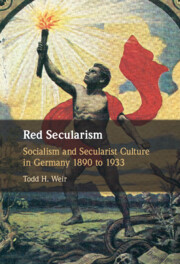
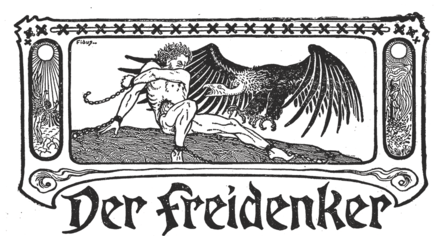
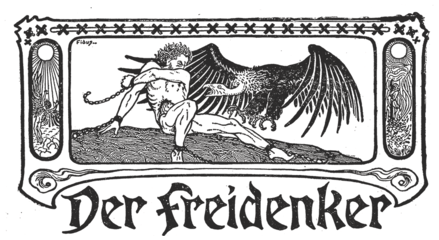
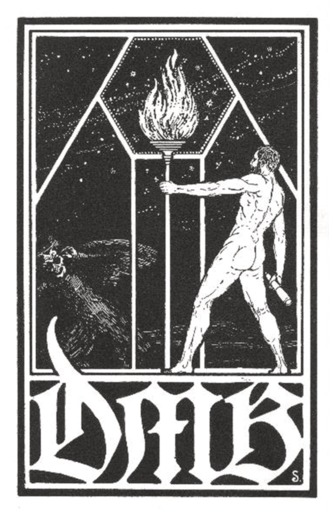
The Prometheus myth offered several points of identification for red secularists. As a young man active in socialist-secularist cultural circles in Leipzig, Walter Ulbricht, the later leader of the German Democratic Republic, gave an impassioned recitation to his socialist youth group of Goethe’s “Prometheus” on the eve of the First World War.Footnote 1 In this poem, the titan challenges the Olympian gods and their need for continual worship and bloody sacrifice. Prometheus celebrates instead his own autonomy and rootedness in nature, and fashions new humans from clay in his own likeness, who will scorn Zeus. Another moment in the myth that appeared more frequently in the iconography of socialism and secularism alike, was when Prometheus brings fire stolen from the gods to earthbound mortals. Numerous posters showed him striding, naked but for a red cloth and torch in hand, bringing the light of knowledge to the working class and standing on the symbols of the church, whether a smashed cross, Moses’ tablets or the Bible. The message was clear: salvation can take place in this world through social revolution and personal enlightenment. Secularists often depicted a third scene of the myth, in which Prometheus is a sacrificial figure, chained to a rock in the Caucasus by angry Zeus, where each day his liver is torn out by an eagle. The cover of Der Freidenker, the national newspaper of German freethinkers that Bruno Wille edited from 1893 to 1921, shows naked Prometheus angrily swinging his broken chain not at an eagle (a symbol for Zeus), but at a black vulture. The reason for preferring the vulture is made clear by a poster for the Monist League from 1914, which shows a black-clad priest fleeing the light of the Promethean fire (see Figure 3.1).
Images of Prometheus. Top: masthead of Der Freidenker; Bottom: German Monist League (Ernst Haeckel Haus).

Socialists and secularists understood the myth as an allegory for the revolutionary intellectual, who, like Prometheus, had stolen scientific truth from university elites and the upper class and brought its light to the masses. Wilhelm Bölsche later referred to his generation of science popularizers as the Promethides, the children of Prometheus.Footnote 2 Refusing compromises with the dark powers of authority and dogmatic religion, they imagined that they, like Prometheus, had risked their own well-being for the cause of enlightenment.
Yet, like Goethe’s Faust, the figure of Prometheus is an ambivalent one. He is a lonely figure, alienated from the gods and mortals alike. Reflecting on the position of intellectuals in communist East Germany, playwright Heiner Müller created a new version of Prometheus to describe the often pitiful role that intellectuals had played in the history of state socialism. Müller’s Prometheus was a weak character in a position of double dissent, scorned by the old elites as a failed thinker, but unable to connect with the working class in whose name he undertook his class betrayal. Ultimately, he was shunned by both. The chains had grown into his flesh, a condition that could not be rectified even after his liberation by Herakles, who in Müller’s telling served as a metaphor for the victorious working-class state.Footnote 3
In this chapter and the next, I engage with the ambiguous and sometimes weak positions of those self-styled sons and daughters of Prometheus who operated in the intersection of socialist and secularist cultures. I do this via a group of intellectuals, who first made their appearance as speakers and leading figures in the Berlin Free Religious Congregation in the period between 1887 and 1891. Most entered socialist politics at roughly the same time. They are well suited to a group biography because many went on to become national leaders of the German secularist organizations and some also played important roles in the history of Social Democracy and early German communism. They left behind a voluminous paper trail in party newspapers, memoirs and police files, and some have been the subject of significant scholarly study. As such, they provide a thick node for historical reflection on the relationship of religion and the radical intelligentsia.
Socialist intellectuals provided crucial material for early sociological theories of intellectuals. In fact, these theories originated, in part, out of the debates within the SPD sparked by the role of party intellectuals in heretical deviations. This chapter opens by re-examining a locus classicus in the literature, the rebellion against the party leadership in 1890, which came to be known as the revolt of the Jungen, “the young ones.” By exploring the hitherto largely overlooked fact that key figures in this revolt were organized secularists, who engaged simultaneously in political and anticlerical actions, we open a window onto the secularist imprint on socialist dissent, a recurring theme of this book. In the second half of the chapter, I turn to the contradictory role played by the secularist intellectual as party “heretic.” While some of the Free Religious speakers active around 1890 exited the party following the Jungen episode, others became city councilors and even members of the Reichstag and the Prussian Diet. Their popularity with voters rested on their ability to cast themselves as Promethean heroes on the stage of socialist politics, in which secularism rather than Marxism often provided the dramatic narrative. Thus, although heretical actions caused friction with the party hierarchy, they were also a successful strategy for intellectuals seeking to claim charismatic leadership in the socialist milieu.
Theorizing the Socialist Intellectual
Around 1890 leading theorists within the SPD began to wrestle with an apparent contradiction in the Marxist theory of economic determinism. How could workers develop an accurate class consciousness, when they were dispossessed of the scientific knowledge necessary for this task?Footnote 4 Karl Kautsky, the party intellectual most associated with the dissemination of Marxist thought at this time, theorized that the proletariat could not create socialism “out of itself, it must be brought to it by thinkers, who, with all the tools of bourgeois science, place themselves on a proletarian standpoint and develop a new, proletarian social orientation.”Footnote 5 Class consciousness emerged, in other words, in the dialectical interaction of the knowledge possessed by bourgeois intellectuals and the experience and revolutionary drive of the working class. To succeed, this interaction required intellectuals to betray their class of origin and integrate themselves into the proletariat as “workers of the head” (Kopfarbeiter), which is how Kautsky identified himself upon his entrée into the socialist movement in 1875.Footnote 6 Yet, experience showed that intellectuals had a propensity to betray the party, as well. The revolt of the Jungen was not the first nor last schismatic movement within the party whose leadership was identified as “half-grown students and overly clever Doctores,” as Marx had quipped in 1875.Footnote 7 For Kautsky, the unreliability of intellectuals stemmed from their predicament as a class segment that was subject to downward mobility in the overall process of class polarization. Here, he referred to a much-discussed phenomenon of the 1890s, the production of more university graduates than the market could absorb. Unable to enter the traditional professions, this so-called “academic proletariat” was opportunistically drawn to the socialist milieu as a source of income and influence, yet it maintained an ambivalent relationship to the working class.
This socialist theory of the intellectual as class alien fed into the emerging theory of intellectuals within the new discipline of sociology. A bridge figure in this transition was Robert Michels, a former apostle of socialism turned ironic observer, who described intellectuals, in all their contradictions, not as an external element, but as an intrinsic structural component of the modern socialist party.Footnote 8 Utilizing the work of Michels, and enriching it with Max Weber’s typology of religious leaders, late twentieth-century historians Thomas Welskopp and Ingrid Gilcher-Holtey argued that intellectuals occupied not one but multiple roles in the party, as “priests” defending the orthodoxy or as charismatic “prophets” at its margins.Footnote 9
Moving beyond the context of socialism, Alfred Weber and Karl Mannheim famously named intellectuals a new sociological type, whose education gave them a universal perspective semi-independent of their class position. Sociologists have since correlated the emergence of these “free-floating” intellectuals to the structural transformations of the public sphere in late nineteenth-century European metropoles.Footnote 10 According to historian Gangolf Hübinger, it was specifically the “double caesura of 1887 and 1890” marked by the end of the anti-Catholic Kulturkampf and the fall of the Socialist Laws, that first made “German society fully competitive in the intellectual mass market.” This was the public debut of a generation of “unpolitical” intellectuals, who embraced life and cultural reform projects as alternatives to traditional political liberalism. The first modern artistic avant-gardes were also emerging at this time, in which the repudiation of the taste of the milieu of origin was announced in manifestoes.Footnote 11 A typical early example is the manifesto read out to the literary club “Through” (Durch) in 1887, in which Wilhelm Bölsche connected the aesthetic project of literary naturalism to Darwinism, anticlerical secularism and social reform.Footnote 12
Both early sociological theories of intellectuals and the Marxist polemics are functionalist: they explain the habitus, attitudes, and political behavior of the radical intelligentsia out of their location in a field of social or class relations. While not losing sight of the relevance of class dynamics, I propose another explanation of the propensity of socialist intellectuals to inner-party dissent, which has been essentially overlooked in the existing literature. Many intellectuals had dual loyalties, not just to the liberal public sphere and the socialist movement, but also to the two cultures of socialism and secularism. In other words, many specific hallmarks of the new generation of self-styled Prometheans, and hence the party heresies they are associated with, were in large measure manifestations of secularist culture and its interactions with socialism.
The Revolt of the Young Ones
The Socialist Laws were not renewed in 1890 because they had failed to hinder the SPD’s growing numbers of members and Reichstag deputies. Yet, a decade of repression had altered party culture. Electioneering had become an ersatz for forbidden street politicking and had strengthened the power of the elected deputies within the party. Looking forward to the pending end of the repressive laws, this parliamentary faction opted to continue their strategy of focusing on elections and of widening the party base to include also rural and religious voters. They were opposed by younger party members who wanted to use growing party strength to launch strikes and other radical actions. After the parliamentary faction thwarted grassroots efforts to organize work stoppages for the first international May Day and to launch a beer boycott in the summer of 1890, an opposition emerged and used its editorial control of leading socialist papers to voice its concerns.Footnote 13 In July 1890, one of these papers, the Sächsische Arbeiterzeitung, published an article by Bruno Wille, the group’s ringleader, entitled “The First of October” (the day after the Socialist Laws were due to expire). In it, Wille claimed that the party had become subject to deformation and “corruption” under those Socialist Laws. It had become too hierarchical and “authorities” had emerged who demanded “subordination.”Footnote 14 Personally affronted by these charges, party co-chairman August Bebel took his case to the rank-and-file at mass rallies in Magdeburg, Dresden and Berlin, the centers of the opposition, where he successfully got resolutions passed that repudiated the Jungen and called for a purge of oppositional newspaper editors. In front of a rowdy audience of 4,000 in Berlin, one of the largest socialist meetings ever reported, Bebel mustered his skills as an orator to demolish Wille, whose attempts to justify his actions were met by ongoing jeering from the floor.
Party toleration ended a year later,Footnote 15 after the leading voices of the Jungen renewed their struggle with an attack on the chief of Bavarian Social Democracy, Georg von Vollmar, who had recently called on socialists to reject revolution in favor of a reformist path. The leaders were expelled from the party at the October 1891 Party Congress in Erfurt. They responded by founding the Association of Independent Socialists, for which Wille, Paul Ernst and Paul Kampffmeyer co-authored a manifesto and served in the executive committee. This “party” never grew beyond 450 members and split in 1894, when Gustav Landauer, who edited their journal Der Sozialist, pushed it in an anarchist direction.Footnote 16 Wille preferred the “individual anarchism” of John Mackay, a German-Scottish poet and fellow habitué of the Friedrichshagen community. But within the space of a few years, Wille had left partisan politics behind in favor of cultural reform activism.
The Jungen sought to portray their struggle as one between the proletarian salt of the earth and an elite party leadership. They accused the Reichstag faction of “distancing itself more and more from purely proletarian ground” and slowly “descending into the camp of the petty bourgeoisie.”Footnote 17 However, the counternarrative provided by party grandees stuck: Engels had branded this a “revolt of the literati and students,” who falsely believed that their academic education entitled them to an “officer’s rank with right to employment in the party.”Footnote 18 Franz Mehring wrote this interpretation into his history of the SPD, concluding that the working-class members of the Jungen had been honest but confused, which had allowed them to be misled by the “young literati,” who eventually “returned to the bourgeois world.”Footnote 19 Mehring also took aim at the artistic ambitions of the Jungen, particularly those of Wille, who used his leading positions in the Free People’s Theater (Freie Volksbühne) to promote plays written by fellow members of the literary avant-garde. Applying Kautsky’s view of class instability, Mehring read such works as products of the “mental world of a declining class.” The later trajectory of this coterie of naturalist writers into neo-romanticism was proof for Mehring that, unable to “endure capitalist reality,” naturalism had no choice but the “flight into a dreamland, which gave it a feeling of illusionary freedom.”Footnote 20
The Jungen and the Friedrichshagener attracted scholarly interest in the late 1960s and early 1970s, when their rebellion against the SPD of the 1890s resonated with New Left opposition to the party’s post-Godesberg course. Most of these studies confirmed the class-based analyses made by Engels, Kautsky and Mehring, and described the combination of ultraradicalism, moralism and aesthetic posturing as functional expressions of idealistic yet alienated, ambitious yet threatened middle-class intellectuals. A study of Bruno Wille, for example, concluded in an orthodox Marxist vein that “Wille’s crisis of consciousness reflects the situation of the politically, economically and intellectually powerless petty bourgeois in an environment determined by the interests of capital.”Footnote 21
With such functionalist explanations backed up by the opinions offered by partisan observers in the day, historians have largely overlooked the role of religion and secularism in the “revolt of the Jungen.” One exception was historian Vernon Lidtke, who placed this episode in the context of party efforts to enlarge its voting base in Catholic regions of Germany.Footnote 22 To this end, Bebel and Liebknecht believed the SPD should distance itself from secularist sectarianism, and, at the same Halle Party Congress in October 1890 that condemned the Jungen, Wilhelm Liebknecht delivered his repudiation of the anticlerical agitation of Freethinker Phillip August Rüdt. Yet, as this chapter revisits the events of 1890 to 1892, it will become clear that the political radicalism of the Jungen and the anticlerical agitation of the period were intimately connected, and that atheism was central to the ethical-moral critique of the party made by the dissenters.Footnote 23
Secularism, Anticlericalism and the Jungen
The files of the Berlin police reveal that anticlerical activism among Social Democrats had restarted in 1887 after an eight-year lull caused by the Socialist Laws. The leading agitators were, with few exceptions, socialist members of the Free Religious Congregation (Heinrich Peus, Ewald Vogtherr) or Jungen (Carl Wildberger, Paul Ernst) or both (Bruno Wille, Conrad Schmidt). Their efforts were initially directed at party officials, whom they called upon to formally register their exit from the state churches (Kirchenaustritt), but by 1888 this expanded into a wider public campaign in which blank petition forms for church-leaving were often circulated. In March 1889 the conservative Protestant Neue Preußische Zeitung (Kreuzzeitung) noted that police were dissolving an increasing number of Free Religious and atheistic meetings. In one, Vogtherr closed his speech to metalworkers on “Ulrich von Hutten, a freethinker of the Middle Ages” by urging those present to leave the churches. In a meeting of lithographers, former theology student Paul Ernst called religion the lynchpin of the authoritarian state: “only religion deadens a person spiritually to the point that he finally renounces his own rights,” hence “only the elimination of religion can prepare … the elimination of today’s rulers.”Footnote 24
In June 1890, the crowd at a public rally passed a resolution favoring church-leaving and calling on socialists to support the Free Religious congregations, which led to a debate in the Sächsische Arbeiterzeitung between Bruno Wille and Dr. Franz Lütgenau, a socialist grammar school teacher and later Reichstag deputy, who wrote on behalf of the party. Wille followed this with a speech on “man as a member of the mass” (Der Mensch als Massenglied) delivered on August 9, 1890 in the Free Religious Congregation and a week later in the Ethical Society, in which he argued that when organized in masses, individuals fell prey to the dehumanizing machinations of authoritarian leaders whether in the military, party, state or school.Footnote 25 “If the leader of a mass is bad, so too the closed mass [turns bad]. We contribute to the autonomy of the masses, when we attempt to remove our children from mass membership,” which was an allusion to church control of moral education. At the same time, Wille argued that the mass could not be trusted to make wise choices, so that democracy was no solution and anyway led to an “authority of the majority.” He referred to the followers of the SPD as “herd animals,” a designation that Bebel effectively turned against him in their public confrontation on August 25. Two weeks later Carl Wildberger declared in a meeting in Berlin that “the plank: ‘Religion is a private matter’ must be struck from the program. It must be clearly stated that ‘every comrade has to exit the state church.’” And just days before the expiration of the Socialist Laws on October 1, Vogtherr and Peus addressed a crowd of 2,000 gathered to promote church-leaving.Footnote 26 Such agitation had some effect: police noticed a significant increase in the number of church-leavers starting in August.Footnote 27
After they were forced out of their positions as editors of socialist papers, leading Jungen left Dresden and Magdeburg and concentrated their journalistic efforts in Berlin. Paul Ernst, like fellow naturalist writer Wille, found a mouthpiece in the journal Freie Bühne, edited by Bölsche, while two former editors of the Sächsische Arbeiterzeitung, Bruno Sommer and Hermann Teistler, founded the new journal Lichtstrahlen (Light Rays) in September 1890. Lichtstrahlen connected political radicalism and secularist agitation and bore the subtitle “Popular Science and Atheist Worldview.” Members of the Jungen and speakers of the FRC were among its chief contributors.Footnote 28 The editors underlined the centrality of radical religious criticism to Lichtstrahlen by opening the first issue with a polemic by Sommer against “The Bourgeois ‘Freethinkers’” and a religious-historical investigation of “The Origin of the Idea of God” by Teistler.Footnote 29 Lichtstrahlen repeatedly attacked the SPD party plank of “religion as a private matter,” and in the April 1892 issue, the Independent Socialist Wilhelm Spohr interpreted Liebknecht’s recent repudiation of his earlier anticlericalism as a sign of the inner corruption of the party. Liebknecht had once said that “every committed socialist must necessarily also be an atheist.”
Of course, that was ‘back then,’ when one still allowed oneself to attack parliamentarism with the sharpest weapons. Today, admittedly, we are dealing with hauling in the masses as a quantity at the cost of quality; the idea of socialism as worldview is abandoned, and the Social Democratic Party is thus degraded to a purely political one, which essentially cannot rise above the diplomatic dealing of the other parties. Whoever sees things in this light and does not protest, acts as a deserter to the cause of freedom.Footnote 30
By 1892 this chief journalistic enterprise of the Jungen was publishing regular announcements for the Berlin Free Religious and the rival Humanist Congregations. Having established the intimate connection between socialist-anarchistic opposition and secularism, we need to now offer a plausible explanation for it.
The Intellectual Content of the Jungen
Divergent assessments exist as to the theoretical inspiration of the Jungen. Some party observers at the time, like Eduard Bernstein, identified the movement with anarchism,Footnote 31 while later scholars, such as Hans Manfred Bock and Vernon Lidtke, placed it within the context of deepening Marx reception promulgated by Kautsky; they found that the Jungen Conrad Schmidt, Paul Ernst and Paul Kampffmeyer were among the best readers of Marx in the party at the time. Peter Wienand saw in the movement an eclectic mix of radical Marxists and “ethical socialists” like Wille.Footnote 32 Interpretations have been strongly colored by the various intellectual and political paths taken by the members of this group after their marginalization from the SPD. Wille, Ernst and Landauer drifted between anarchism, neo-idealism and cultural criticism; while others, such as Hans Müller, came to support German colonialism. Franz Mehring read these trajectories as proof of the charlatanism of the Jungen, discounting them as “bourgeois-anarchist counselors of confusion [Konfusionsräte].”Footnote 33 Some latter-day historians have had more positive assessments. Stanley Pierson saw in the Jungen a prefiguration of all the major theoretical stances on the relationship of workers, intellectuals and class consciousness that would dominate party debates for the next twenty years: revisionism, radicalism and orthodox Marxism. Manfred Bock placed the Jungen in a series of recurrent party oppositions, from Johann Most’s radical opposition in 1880, to the debates over council communism during the German revolution of 1918 to 1922, to the extra-parliamentary opposition to the SPD during the late 1960s.Footnote 34
Thus far, religious considerations have been missing from the accounts of the intellectual inspirations and fractious behavior of the socialist intellectuals in 1880, 1890 or 1919. Yet, the political visions raised by dissenting intellectuals in opposition to the party leadership ran parallel to the visions for new forms of spiritual community that secularists were putting forward in the realm of religion and culture. The Jungen defined socialism as an ethical community of individuals united in worldview and engaged in a struggle with the authoritarian state through democratic action and, above all, through moral development and education. They extended this anti-authoritarian struggle to the SPD itself, which they claimed had violated the essence of socialism through parliamentary cooperation, bureaucratization and hierarchization. The critique was a moral one, which focused on the degradation of the members of the socialist community. When Wille accused the SPD of having become a hierarchical party that relegated action to the voting booth and turned the workers into “herd animals” and “chain links in the mass” in August 1890, it was essentially the same critique he made of the state church for inculcating obedience rather than spiritual freedom in children in his keynote at the Jugendweihe nine months later. Wille’s alternative program of the “individualization of the worker” was summed up by Hans Müller in 1892: “we do not want to educate the workers to be will-less admirers and tireless applauders of our speakers, but to [be] men, who are clear about all their steps and frankly criticize themselves and others. What makes our movement into a powerful cultural movement? … the masses that think and act for themselves.”Footnote 35
The ethical project of raising the worker to autonomy was connected to the repeated claim made by the Jungen that they were defending socialism “as a worldview” from the party leadership’s efforts to water down the revolutionary doctrine to make it appeal to middle-class voters. Although Paul Ernst was accused by Engels of applying Marx’s thought in a dogmatic fashion to everything, Marxism was increasingly not the core doctrine of the worldview of the Jungen. As Kampffmeyer later recalled, for them socialism was intimately connected to “modern currents in art and science” and thus “more than merely a direction in party politics.”Footnote 36
The connection between sectarianism and claims to moral purity came out clearly in the founding declaration of the Association of Independent Socialists in November 1891, which stated that the SPD represented a large but indistinct mass of workers. It failed to rescue the workers from the pernicious effects of “barracks-like” life in tenements and factories, which were spiritual degeneration and an inability “to react critically to new impressions.”Footnote 37 By contrast, the Independents considered themselves a small group united in strength of conviction and consciousness, who offered the workers a path to independent thought. Although it affirmed “class struggle,” the declaration gave primacy to the propagation of worldview, which was best advanced through total freedom of intellectual competition. Mixing the language of political liberalism and Darwinian selection, Teistler argued in October 1891 that the worldview “more fit for existence at the time will be victorious.”
Thus, we lead the struggle against the church and clergy with the certainty that atheism will ultimately fully destroy the rotten edifice of religion. … Progress is born in struggle. Thus, we want to know nothing of a freedom of thought that removes the struggle of opinions, even if this were possible. What we demand most forcefully is that the state and authorities do not get involved in the conflict of opinions.Footnote 38
The primacy of worldview helps explain the apparently paradoxical combination of communitarian democracy and intellectual elitism. As bearers of worldview, intellectuals took precedence over the masses of workers. In October 1890 Wille stated in a literary journal that “one hundred spiritually independent individuals are incomparably more valuable for the progress of humanity than one hundred times one hundred well-disciplined, blindly faithful, party-philistine Social Democrats.”Footnote 39 The implication was that intellectuals should rule. In 1892, the predominantly Social Democratic members of the Freie Volksbühne voted to oust Wille from his post as chairman, in part because he refused to allow them any input into the artistic direction. Wille quickly founded a rival organization, the Neue Freie Volksbühne with an undemocratic structure that essentially gave the founding board the ability to reappoint itself.Footnote 40 One of the new board members was the socialist-anarchist Gustav Landauer, who later stated that “there exists no communism in spiritual and literary matters.”Footnote 41
Key figures of the Jungen took their concern with worldview, science, ethics and art into the revisionist movement. Following the demise of Lichtstrahlen in 1894, many of its writers joined the new journal for socialist intellectuals: Der Sozialistische Akademiker, founded in 1895 and which in turn became the Sozialistische Monatshefte in 1897. The Monatshefte became the chief journal of the revisionists in the decades prior to the First World War. Among the members of the cohort of Free Religious Congregation speakers, Heinrich Peus and Conrad Schmidt became leading figures in the revisionist wing of the party after 1900. Another area of dissent, in which the secularist political imaginary appeared, was the struggle between “localists” and “centralists” for control of the national labor unions. Whereas the localists wanted to save strike decisions for the local organizations of the unions, the centralists favored control and coordination by central instances. The leader of the localists was the former Freethinker Gustav Kessler, and Free Religionist Theodor Metzner was a key supporter. After Kessler’s death in 1903, conflict between localists and the SPD leadership led to schism of the labor unions. In 1905, one of the leading localists, Raphael Friedeberg, rejected what he called the “social-democratic worldview.” He decried the central tenet of historical materialism that “not the consciousness of men determines their being, but rather their social being determines their consciousness” as a disempowering view and “symptom of rot on the body of the proletariat.” Instead, he called for a philosophy of “historical psychism” that targeted the psychological pillars of class domination: the church, the legal system and patriotism. The localist union members were forced out of the SPD in 1908 and drifted towards anarcho-syndicalism.Footnote 42
Heretics on the Socialist Stage
Our reopening of the archives on the Jungen has shown that the position of its leaders at the juncture of socialist and secularist cultures was crucial to explaining this party schism. Yet, the friction experienced at this location did not lead all secularist intellectuals to marginal positions in the socialist culture. In fact, heretical acts often proved to be a successful strategy for rapid ascent within the party. The confessional order of Wilhelmine Germany, which protected the representative power of the churches through blasphemy laws, created the ingredients for a drama on the stage of public opinion. It was easy for the secularist intellectual to step into the role of Prometheus, by claiming in a public meeting that scientific truth required the negation of Christianity and church privilege. The result could be a thrilling drama, particularly if the police intervened. Although not per se socialist, these dramas were particularly attractive for left-leaning workers, who recognized that secularist agitators struggled against the same authorities – church, state, monarchy, social elites – that were arrayed against the SPD. Heretics on this stage did not have to justify their leadership by turning their intellectual work into a form of exploited labor – though some did follow Kautsky and refer to themselves as “Kopfarbeiter.” They could take the stage in their own names, as Promethides, to gain a following and even elected positions. Using the theater as a metaphor, this section examines how secularists staged themselves as a specific type of socialist intellectual. The various roles, scripts, performances of the intellectuals and the audience reactions to them will be analyzed through a group biography of fifteen secularist intellectuals in the Berlin in the early 1890s, all of whom were active at the Free Religious Congregation or one of its satellite organizations and were identified by party membership or police record as having sought to gain positions of influence within socialist circles. The cohort comprises speakers in the Free Religious Congregation and members of the SPD: Ida Altmann, Ewald Vogtherr, Conrad Schmidt, Waldeck Manasse, Heinrich Peus and Fritz Kunert; speakers who worked closely with socialist organizations without becoming members: Titus Voelkel, Bruno Wille, Wilhelm Bölsche and Carl Pinn; and SPD members who spoke at the smaller secularist societies, and appear as discussants in the FRC meetings: Adolph Hoffmann, Agnes Wabnitz, Ottilie Baader, Theodor Metzner and Georg Ledebour.
One can begin to sort these individuals by their professional and educational differences. Only a minority could be identified as working-class. These were autodidacts with primary school education, who rose through the congregation to attain positions of intellectual leadership in the FRC, including the shoemaker Theodor Metzner, the gilder Adolph Hoffmann, and the seamstresses Agnes Wabnitz and Ottilie Baader. Yet, notably, these figures did not have the educational capital to lecture in the FRC itself. Lack of formal education relegated them to the status of discussants. As shown in the previous chapter, their speaking appearances took place in second-tier secularist organizations, such as the Ethical Society or the Workers’ Education Association North.
Most of the new Free Religious speakers that entered the ambit of social democracy in the years 1887–1891 came from modest middle- and lower-middle-class backgrounds. Among them were former salesmen and white-collar workers with secondary school degrees (Realschule or Realgymnasium), such as Ewald Vogtherr, Georg Ledebour and Waldeck Manasse, as well as the trained teachers Fritz Kunert and Ida Altmann. A significant number had begun but not completed university studies, such as Heinrich Peus, Carl Pinn and Wilhelm Bölsche. A few had achieved the coveted doctorate, usually in the humanities, such as Bruno Wille, Conrad Schmidt and Titus Voelkel. The majority were in their mid-to-late twenties when they debuted as speakers at the FRC (Ledebour and Voelkel were somewhat older), and for many of them this step coincided with social and familial ruptures. They broke with their religious confession of origin, shifted political affiliations from liberalism or republicanism to socialism, and reoriented their professional horizons. About the time of their first speaking engagement, most began to write articles, dramas and books, or become editors or publishers, and they listed their profession henceforth as “Schriftsteller.” Several joined Bohemian literary circles with avant-garde aspirations and some entered into experimental community formation in Friedrichshagen on the outskirts of Berlin.
Several of these men and women attracted police attention as speakers in the various workers’ and trades associations, which formed the building blocks of German social democracy in the late nineteenth century. These meetings provided the clearest model workers had of the socialist utopia, which led historian Thomas Welskopp to call them “mini-republics.”Footnote 43 Electing the meeting chairman and the debating on and voting upon resolutions were rituals of democracy that allowed for consensus formation and the affirmation or the criticism of the leadership. Spice was added to the spectacle by the presence of the observing police officer with whom the speakers played a cat and mouse game of provocation. When the speakers veered too far into politics, or engaged in blasphemy or lèse-majesté, or if a brawl occurred, the police officer would dissolve the meeting. Even this could be a satisfying outcome for the participants.
The informative lecture by a guest speaker was a key ingredient in workers’ meetings around 1890 and the new crop of Free Religious lecturers was well placed to assume this task. Their struggle against the confessional Christian state gave them a topic popular among the workers, and support from the FRC and its 4,000 “souls” meant they already had a following in the socialist milieu. It was easy to shift from sermonizing on popular science, morality and religious history to making claims on political leadership. Once they committed themselves in public to the party, some Free Religious speakers rose quickly. Success in workers’ meetings opened the path to other socialist stages, such as the party press. They were made newspaper editors (Ledebour, Kunert, Peus, Schmidt) and allowed to form new cultural and educational institutions under the umbrella of the party (Wille, Vogtherr). Some entered the management of the unions, such as Ida Altmann, while other became candidates for political office. Fritz Kunert was elected to the Berlin City Council in 1888 and soon followed by Ewald Vogtherr and Theodor Metzner. They were joined at the turn of the century by Adolph Hoffmann and Waldeck Manasse (see Table 3.1). Kunert, Hoffmann, Vogtherr and Ledebour also won Reichstag seats and in 1908 Hoffmann become one of the first seven socialists elected to the Prussian Landtag.
If quick assent to leadership positions was common among secularist intellectuals, so too was the tendency to confront the top party brass. These traits were often linked. Locally renowned as a “social democratic fighting cock,” Fritz Kunert’s anticlerical and antinationalist speeches helped get him elected to City Council, but also got him into hot water with his party.Footnote 45 Shortly after taking office, Kunert gave a scandalous speech opposing construction of a church in the interest of the “anticlerical” inhabitants of the Lausitzer Platz, who would have their “light and air” cut off and suffer from the noise pollution of church bells that “produce a nerve-wracking din [greater than] nearly any machine.”Footnote 46 Party officials were displeased and the Berliner Volksblatt, the official party organ and predecessor of Vorwärts (re-founded 1891), called a public meeting in August 1889 to discuss Kunert’s behavior and his position at the FRC. In the heated discussion, shoemaker Max Baginski, a local radical and soon-to-be member of the Jungen, accused Kunert of having “no clue” about “historical materialism,” otherwise he would have known, “that the capitalist economy has long ago doomed the efforts of the Free Religionists, who aim at world improvement through moral means.” Baginski earned cheers and jeers for denouncing Free Religious efforts to “ride on the coattails of Social Democracy.”Footnote 47
Resolutions for and against Kunert were tabled at the meeting, but it never came to a vote. When the Volksblatt editor demanded the dissociation of the SPD from the FRC, Kunert shoved him, triggering a tumult that led police to close the meeting. Despite this inconclusive outcome, the paper still published the anti-Kunert resolution in its entirety, indicating that it represented the position of the paper and hence the party leadership:Footnote 48
The assembly resolves … that, thanks to his entire way of thought and orientation, Councilor Kunert does not stand on the foundation of purposeful Social Democracy, and … that his views are not clear enough to allow him to represent Social Democracy in public and thus [the assembly] recommends to comrades in all locales to refrain from [offering him] a candidacy, until the Berlin comrades are convinced that Mr. Kunert is not just using Social Democracy as a tool for his own ambition.Footnote 49
This publication amounted to a party sanction. Several days later, Kunert announced that he was resigning from the City Council and moving to Breslau to accept the editorship of a party paper there.Footnote 50
The Charisma of the Prophet
One of Berlin’s leading naturalist writers, Arno Holz, applied his intimate knowledge of the milieu to send up the Jungen in the 1896 play Die Sozialaristokraten. The term “social aristocrats” had been brought into circulation by Alexander Tille, an intellectual with connections to Wille and the Friedrichshagener, who proposed in 1893 that all political parties were essentially bankrupt and that only a radical libertarianism in the field of culture paired with a merciless application of Darwinian survival of the fittest in the social sphere would allow spiritually higher-standing individuals to advance the general welfare of the country.Footnote 51 The chief social aristocrats satirized in Holz’s drama were Bruno Wille, recognizable in Dr. Bruno Gehrke, and the poet John Mackay, who appears as the stuttering snob Frederick Bellermann. The typesetter Wilhelm Werner appears under his own name and Holz openly referenced Werner’s failed joint venture with Wille of 1891, the secularist youth journal Die Jugend. Wille’s elitism is ridiculed throughout the piece. For example, when Werner oversteps his bounds and tries to philosophize, Gehrke responds sharply, “you will leave that to us spiritual proletarians, won’t you?”Footnote 52
This damning portrait of Wille had been preceded by the expulsion of his allies from the party, a ban on advertising his publications in Vorwärts, and the collapse of his Independent Socialist movement. Thus, it might be surmised that Wille was persona non grata in the socialist movement.Footnote 53 Yet, this was not the case. The FRC leadership reprimanded him in January 1892 for “engaging in politics” but kept him on as youth instructor.Footnote 54 The socialist press continued to report frequently on Wille’s activities and he continued to be engaged as a popular public speaker in workers’ associations, despite the following warning from the party leadership that appeared in Vorwärts on August 30, 1894:
It is our opinion that if one engages a speaker for a meeting, then one should not only consider if he is a good lecturer, but above all whether one is dealing with a man who has at all times operated in an open and honest fashion. We leave it up to party comrades to decide if they are willing to pay an entrance fee of 10 pfennig to listen to Herr Dr. Bruno Wille speak about the “ennoblement of humanity.”
Even Vorwärts was not consistent and a year later reported sympathetically on Wille’s anticlerical actions, and in 1896 it again began running ads for his publications.Footnote 55
Wille’s unusual ability to cross political lines was linked to his public persona, something observed by Alfred Kerr, one of Wilhelmine Germany’s most acclaimed raconteurs, in 1895: “In Berlin, where everything is slandered and dragged through the amply abundant dirt, the figure of this idealist enjoys a simply astonishing respect among the most varied parties. One cannot get too close to him, he is nearly – as today’s feuilleton style compels us to say – taboo, i.e., untouchable.”Footnote 56 Kerr’s description evokes the combination of moral integrity, personal autonomy and distance that comprises the charisma of the free-floating intellectual. Wille quite consciously cultivated each of these elements. He defended the claim to moral purity throughout his conflict with Social Democracy. Against charges that he only turned to socialism after failing to land a job at a grammar school, Wille insisted that he consciously rejected a “Brotstudium” (degree path leading to a stable job as teacher or pastor) at the university and became a writer despite all its financial risks. When ridiculed by the audience in his confrontation with Bebel in August 1890, Wille responded with moral indignation:
The saddest part of the conflict is the filth that gets hurled. I once believed that such a thing didn’t happen in our party; you are hurling it at me without pause; my faith in the morality of the party has taken a blow. … But there is still a place where one doesn’t get touched by this filth. The refuge to which each person can retreat is the inner core of the soul [Gemüth]. That is where I will go if you continue to abuse me.Footnote 57
By attacking the leadership as corrupt and the socialist masses as “herd animals,” Wille underscored his independence as an intellectual. This echoed the way the rising cultural avant-gardes of his day cultivated their own autonomy through the anti-authoritarian gesture of épater les bourgeois. The appeal of antagonizing the masses as a means of proving the autonomy of the avant-garde intellectual was captured in John Mackay’s poem “In the Society” published by Titus Voelkel in a Free Religious journal in 1891:
In the Society
In der Gesellschaft
Despite the social aristocratic sentiment expressed here, John Mackay remained one of the most popular poets of the socialist culture associations well into the twentieth century.
A further element constituting Wille’s charisma was his lack of an official position. In 1892 he declared that refusing a socialist candidacy for parliament “was one of my few acts that I consider clever.” As a party man, he might have become an “enslaving slave of the infallible dogma.”Footnote 59 The rejection of office in favor of charisma was an essential part of the sociological construction of the modern intellectual as an ideal type. Rather than appearing as a “priest” of socialist orthodoxy like Kautsky, Wille portrayed himself as a “prophet” of worldview and ethics. Attesting to his success, Kerr wrote that “a bit of the inherited radiance of the church minister still sits on this officer of the most unchurchly congregation.”Footnote 60
Blasphemy as Public Theater: Bruno Wille and Adolph Hoffmann
If the “prophet” represented one role available to secularist intellectuals, the “heretic” was another. The stage for this drama was set by government and clerical agents of the confessional German state, who defended the state churches from the symbolic violence contained in acts of blasphemy. By giving public voice to their atheism, Free Religionists brought out the inherent contradiction between public order and the freedom of conscience that was prized in the Prussian tradition of “Protestant freedom.” Once found guilty in court, a blasphemer could become a martyr to freedom. Many of the socialist speakers of the Berlin FRC spent time in jail for blasphemy; however, the true masters of its use for self-promotion at this time were Bruno Wille and Adolph Hoffmann. Hoffmann was an entirely self-educated, working-class intellectual, who built his public persona, small publishing house, and his political career around his atheism.Footnote 61 He became nationally known as “Ten Commandments Hoffmann” following the bestselling success of his pamphlet The Ten Commandments and the Propertied Class, in which he satirized the hypocritical morality of the ruling classes.Footnote 62 Hoffmann took evident pleasure in waging public war against the monarchic bureaucracy over the injustices of the confessional order, and made sure that each of his battles received sufficient media attention. He officially left the Protestant Church in 1887 and for ten years thereafter challenged the state’s right to force his dissident children to attend mandatory religious instruction at school. He brought this struggle to the public by publishing the resulting court rulings and bureaucratic correspondence along with humorous commentary in Chamber Court versus Chamber Court. After he was silenced in the Prussian parliament in 1908 for repeated anticlerical remarks during a debate on the church budget, Hoffmann reprinted the parliamentary protocols in a brochure, Los von der Kirche! (Away from the Church!) calling for a mass desertion from the state churches.Footnote 63
Hoffmann partnered up with Wille to respond creatively to the Prussian state’s closure of Free Religious Sunday school classes between 1893 and 1894. These classes, which had been offered since 1859, had become the object of increasing state repression following revelations by the Reichsbote in 1888 that Fritz Kunert had been giving “religious instruction” to dissident children in rooms provided by the city administration. Rather than outright sanction, the state applied bureaucratic means to achieve its goals. The Royal School Collegium first requested and then summarily rejected the pedagogical credentials of Wille and Ida Altmann, the other teacher.Footnote 64
Having calculated the costs, Wille and the congregation decided to disobey the injunction and continue his instruction. In December 1893, the Collegium imposed a fine of 100 marks or ten days in jail for each violation and turned the matter over to the police, who sent an undercover policeman to gather evidence from pupils in a “discrete” manner. Wille was finally arrested in November 1894 after he had accumulated fines of 2,000 marks or 200 days in jail. Having anticipated this move, Wille signed over all his property to his wife to prevent its confiscation, and then reported to the police. The FRC was also prepared, and within four days of Wille’s arrest had printed his protest letter from prison with a claimed run of 500,000 copies.Footnote 65 This jeremiad against absolutism and arbitrary justice closed by interpreting his act as a sacrifice for the nation: “I did it for you, compatriots, because I feel the duty to defend my and your rights against a bureaucracy that threatens our constitution, and to demonstrate to you, as a prisoner, what sad circumstances we have.”Footnote 66
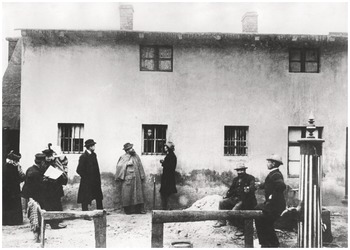
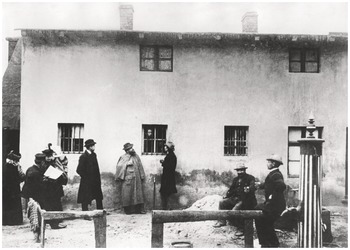
The protest letter called for signatures of support and included an advertisement for a book about his experiences that Wille had yet to write but for which he had already selected a title: Siberia in Prussia. Hoffmann reproduced and sold postcard photographs that frame Wille in the window of his improvised jail in the back room of the Friedrichshagen police station. One such image shows Wille’s friends standing outside his “jail,” some with drinks in hand, toasting perhaps his clever manipulation of the Prussian police state (see Figure 3.2). Having served only thirty-five days of his sentence, Wille was released pending appeal. The FRC quickly organized a public rally at which Wille spoke to the question, “Is there Freedom of Religion and Conscience in Prussia?”Footnote 67
The opportunity for a second martyrdom arrived two years later. Wille had been on his way home from the Vienna congress of the German Freethought League, when he stopped on July 2, 1897 in Graz to give a speech entitled “The Religion of Joy” to the local Association of the Confessionless. He was arrested on charges of blasphemy.Footnote 68 From his Austrian prison cell, Wille began to mobilize his connections back in Berlin to help create a public scandal that would speed his release from prison. He penned a letter to his fellow Friedrichshagener, Julius Hart, with a list of various newspapers and publicists to contact.Footnote 69 After his release from prison in February 1898, Wille capitalized on his momentary notoriety and, on a slow homeward journey, gave ten speeches in Southern Germany, including four in Munich alone. In March, Wille made his triumphal return to Berlin and managed to draw a crowd of 1,500 to the Friedrichshain Brewery to hear his “forbidden” talk, “The Religion of Joy,” copies of which had already been printed by Hoffmann and were available for sale at the event.Footnote 70 A trace of the impression that Wille made in Austria is found in a letter to the satirical journal Die Fackel from a Miss Nobody (“Frl. Niemand”), who wrote that she was not one of those sentimental girls who wish “to die a martyr, if possible with Bruno Wille.”Footnote 71
Hoffmann and Wille shared a love of theater and both wrote, directed and produced plays. They were also masters at self-staging, beginning with their own appearance. In a feuilleton on the opening of the Experimental Stage (Versuchsbühne) in Berlin in 1896, Alfred Kerr reported to readers in Breslau on this latest theatrical venture of that “sanctified club-lion and salon-tiger” Bruno Wille. Kerr predicted that, irrespective of artistic quality, Wille’s personality would make it a success. “A playwright can fail,” he wrote, but someone like Wille “needs merely to show a pronounced physiognomy and it is more useful to him than two moderately good book successes.”Footnote 72 Hoffmann and Wille each cultivated his own “physiognomy” – Hoffmann with his shock of white hair, Henri Quatre goatee, and jokes in Berlin dialect, Wille with his preacher’s allures and his slouch hat.Footnote 73 Both understood the rules of the dissident market and were skilled at casting themselves as victims of authority. Whereas Wille liked to appear in tragic roles, Hoffmann preferred comedy, and he was not above playing the clown. For example, to demonstrate the absurdity of the state refusal to excuse his dissident children from Christian moral instruction, Hoffmann attempted to enroll them in Jewish religious lessons.
To say that secularist intellectuals “staged” their public personas is not merely metaphor. They gave themselves leading roles in the plays that they wrote, directed or produced. For the second production of the Freie Volksbühne, Wille chose Gerhart Hauptmann’s Before Sunrise, which revolves around the sympathy and revulsion felt by a radical university graduate as he descends into the poverty of rural society. In 1901, Vorwärts published a drama entitled Maifeier (May Day) centered on the heroic actions of a young socialist newspaper editor modeled closely on the playwright Ernst Däumig, himself a recent convert to socialism, who later went from editing a socialist newspaper in Halle to playing a leading role in the Berlin Free Religious Congregation.Footnote 74
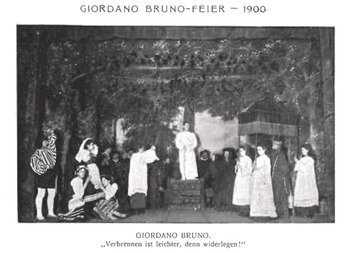
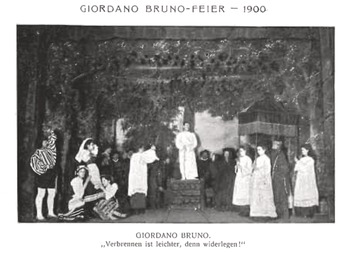
Drama also figured prominently in the event in 1900 that launched Germany’s first self-consciously monist organization, which was named the Giordano Bruno League for Unified Worldview in honor of the Italian monk, whose monistic theories led to his execution by the Vatican in 1600. The Giordano Bruno League was the brainchild of Wille and Bölsche, and included Rudolf Steiner and several secularist personalities. At a large public celebration marking the three hundredth anniversary of Bruno’s auto-da-fé, they organized a series of tableaux vivants (lebendige Bilder), in which mute actors staged the persecution of famous religious leaders. In addition to Bruno on the funeral pyre, the series featured Buddha, Jesus, Socrates, Johann Huss and Martin Luther. The final tableau showed the triumph of humanity as an apotheosis, in which the goddesses of Freedom, Justice, Human Love, Peace and Reason lift up Humanity, and the powers of darkness (clergy and state officials) are driven from the stage. Tableaux vivants worked well with the technological constraints of late nineteenth-century photography, which required motionlessness. This series was photographed and published by Adolph Hoffmann as postcards and as a book containing fitting rhymes to these “martyrs of truth” (see Figure 3.3). Portions of the book were reproduced in Der Atheist in 1905 with the recommendation that workers’ associations restage the living pictures to recitations of this poetry.Footnote 75
Postcard of Giordano Bruno celebration in 1900. Caption: “Burning is easier than disproving!”
Conclusion
Such staging indicates that the association of socialist intellectuals with heretics and sectarian prophets went quite deep. Socialist secularists cultivated their images as heretics because it provided them with a unique claim to leadership that was often validated by their working-class audiences, who took pleasure in their acts of blasphemy and the ensuing threat of martyrdom. Yet, as we will see in this following chapter, secularist intellectuals were not always as autonomous as they depicted themselves to be in their dramas.

 Open access