What difference do new actors and new institutions make to gender justice outcomes? Do new actors working with new institutions have greater opportunities for advancing change in terms of advancing gender equality? Does a lack of incumbency of actors and the provision of new “formal” codified rules provide a clean slate for advancing gender equality claims? This article explores these questions through an examination of the objectives and influence of “new” international feminist legal actors on the design and implementation of the “new” victims' rights and gender justice provisions contained in the 1998 Rome Statute of the International Criminal Courts (ICC). The article argues that during its first decade in operation, the ICC has produced mixed outcomes for victims, especially of conflict-related sexual violence. While the influence of new actors and new rules has been reflected positively in some areas, there are also signs that “old” informal gender legacies, arising from the temporal context in which the ICC is “nested” are still in operation, and these have combined to undermine and distort attempts to challenge gender injustices. The article suggests that newness matters as well as “oldness” and “nestedness” and that understanding the interaction between them is key to understanding gender justice outcomes.
Part one of this article outlines the concepts of “newness” and “oldness” and the broader feminist institutionalist analytical framework used in this article. It also sets out a matrix for examining newness in terms of both actors and institutions to be applied in the analysis. Part two provides a brief orientation to the ICC, its victims, and gender justice mandates and the objectives of gender justice actors through which these provisions can be assessed. The third part analyzes the implementation of the victims mandate through the ICC Registry, a key (but often overlooked) organ charged with administering many of the victims' provisions. Part four critically assesses the value of the newness matrix for explaining victims' gender justice outcomes in the first decade of ICC operation and argues that institutional “oldness” and “nestedness” have been as important as “newness” for explaining gender justice outcomes in victims' rights during the Court's first decade.
The analysis is based on interviews with key personnel within the ICC Registry, including the ICC's second registrar, Silvana Arbia, and members of the outreach unit and victims' participation reparations section. It also relies on official ICC publications including annual reports to the ICC Assembly of States Parties and court transcripts. The ICC's Assembly of States Parties 2012 Revised Victims Strategy and publications of civil society entities, especially the Victims Working Group, the Women's Initiatives for Gender Justice (“Women's Initiatives”) and Redress, have also been consulted along with secondary literature on the ICC's gender justice and victims' redress frameworks.
“NEWNESS” AND “OLDNESS” OF ACTORS AND OF INSTITUTIONS
Feminist political scientists, especially those working within a nascent feminist institutionalist paradigm (see Krook and Mackay Reference Krook and Mackay2011; Mackay and Waylen Reference Mackay and Waylen2009), have become interested in understanding the intersection of gender, “newness,” and gender just outcomes (see other papers this volume; Chappell Reference Chappell2010; Waylen Reference Waylen2010). This interest is prompted by a curiosity about whether a temporal element makes any difference to the way agents and structures interact to produce outcomes.
To date, the feminist institutionalist literature has used newness in two independent senses: first, in relation to actors, and, second, in relation to institutions. Interest in new actors has focused on incumbency: the entry for the first time of a woman—usually understood as a self-identified feminist—pursuing gender equality goals into political, bureaucratic, or judicial positions through an electoral or appointment process. Karen Beckwith (Reference Beckwith2007) has pioneered work in this area. Focusing on legislative contexts, but not focusing on the “rules of the game” per se, Beckwith argues that the “newness” of female legislators operates in conjunction with numerical representation as a variable shaping opportunities for policy influence and substantive gender justice outcomes. She hypothesizes that, in legislative settings, newness combined with a “tokenistic” presence can have a negative effect; newly elected women may be less likely than existing legislative members to push forward a reformist agenda, especially where they are in a minority (Beckwith Reference Beckwith2007, 42). For Beckwith, “new” women—“those who have been elected for the first time”—are constrained by the need to learn the (gendered) rules and fit in and are often met with circumspection by incumbents. As a result, newness as an attribute can contribute to “uncertainties and unpredictabilities” (Beckwith Reference Beckwith2007, 43) in an actor's ability to influence gender equality outcomes within an institutional setting.
Beckwith's analysis confirms the argument of leading institutionalists March and Olsen (Reference March and Olsen1989; Olsen Reference Olsen2009) about the operation of a “logic of appropriateness” within institutional contexts. As Olsen points out, rule following is one of the key characteristics of institutional actors, resulting from the “internalization of accepted ways of doing things” (2009, 13). Paying attention to these arguments, feminists have demonstrated that the logic of appropriateness is also highly “gendered” (Chappell Reference Chappell2006a); the familiar taken-for-granted rules and norms within institutional contexts are often imbued with gender biases that present a barrier to those seeking to undermine the existing gender “regime” (Beckwith Reference Beckwith2007; Chappell Reference Chappell2006a; Connell Reference Connell2002; Mackay Reference Mackay2014).
But these negative examples do not capture the full story. As the “institutional turn” in political science has demonstrated, actors do not determine outcomes on their own but are profoundly influenced by and are, in turn, able to help constitute the structural environment in which they operate. Terry Lynn Karl (Reference Karl1997) suggests that to understand institutional outcomes, one must pay attention to the historical interaction between both actors and structures that together create a “structured contingency.” This relationship demarcates “the types of problems that arise” and the possible “alternative solutions” (Karl Reference Karl1997, 10–11) in an institutional setting. Karl's analysis accords with the work of other sociological (Olsen Reference Olsen2009) and historical institutionalists (Mahoney and Thelen Reference Mahoney and Thelen2010) who demonstrate that actors, including those new to an organization, are constrained by the rules but can trigger institutional change through their interpretation or instantiation of them. They can institute change by exploiting ambiguities that exist between the design and implementation of the rules or through expansive (or restrictive) rule interpretation (Mahoney and Thelen Reference Mahoney and Thelen2010, 12–14; and on the ICC, see Oosterveld Reference Oosterveld2014).
Feminist actors, too, are capable of instigating institutional change toward gender equality. According to Beckwith, institutions are not only gendered, but they can also be “gendered” (2005): actors “can work to instate practices and rules that recast the gendered nature of the political” (Beckwith Reference Beckwith2005, 132–33). A range of studies now exists to demonstrate that new feminist actors can challenge gender-biased institutional logics including military and church hierarchies (Katzenstein Reference Katzenstein1998), state bureaucracies (Chappell Reference Chappell2002), legislatures (Lovensuki Reference Lovenduski2005), and judiciaries (Kenney Reference Kenney2012).
The newness of institutional “outsiders” may also make a difference to outcomes. The interaction between “old” institutional actors with new external “critical friends,” and vice versa, can also (re)politicize the other, providing essential ideas, resources, and ballast for pursuing new gender agendas. Banaszak's (Reference Banaszak2010) study of women in the U.S. federal bureaucracy shows how the engagement of “old” insiders—those with long-term careers in the U.S. federal civil service—with an emergent women's movement shaped the ideas and actions of insiders, encouraging them to push, with some success, for reform on women's equality issues.
The newness of actors may make a difference to outcomes, but actors do not operate independently of context: structure and agency both matter. Feminist institutionalists are also interested in exploring what difference institutional newness makes. Specifically, whether and how the design, implementation, and operation of new rules can promote or frustrate gender justice outcomes (Chappell Reference Chappell, Rai and Waylen2008; Waylen Reference Waylen, Rai and Waylen2008). In these analyses rules are understood in two senses. First, as formal institutions, which are codified (Lauth Reference Lauth2000, 24) and are “consciously designed and clearly specified” (Lowndes Reference Lowndes2005, 292). Formal institutions can vary in their form, from constitutions, statutes, and bylaws to individual contracts and operational guidelines (North Reference North1990, 47) and are usually distinguished by being formally sanctioned (Helmke and Levitsky Reference Helmke and Levitsky2004). Informal institutions, by contrast, are harder to identify because they “shy away from publicity” (Lauth Reference Lauth2000, 26) and are hidden and embedded in the everyday practices. They are disguised as standard and taken-for-granted practices and norms. In Helmke and Levitsky's oft-quoted definition, informal institutions are understood as “socially shared rules, usually unwritten, that are created, communicated, and enforced outside of officially sanctioned channels” (2004, 727). According to feminist institutionalists, both formal and informal institutions are gendered, and they interact to shape asymmetric power relations (Kenny Reference Kenny2007) and gendered processes and policy outcomes (Chappell and Waylen Reference Chappell and Waylen2013).
New formal institutions relate to newly codified rules that are in the process of being implemented. They sit in contrast to old formal institutions with their codified, embedded rules and practices that have become “congealed” over time and through which generations of actors have moved. New informal institutions are harder to detect but relate to practices that are not codified but are repeated over time; there is a difficulty in capturing new informal institutions, as they may not be identifiable until they are settled and have already become “old.”
New institutions may potentially offer both opportunities and constraints for the advancement of gender equality goals. In assessing the effect of new formal global governance institutions, Waylen argues that “the creation of new institutions can offer opportunities for gender concerns to be incorporated more easily and fundamentally at the outset of an institution's life than it is to “add them in at a later stage” (2008, 273). Research has shown that in moments of constitutional renewal (see Kantola Reference Kantola2006; Mackay Reference Mackay2014) or “crises” (Beckwith Reference Beckwith2010; Connell Reference Connell2002; Hughes and Paxton Reference Hughes and Paxton2008) it is possible to push forward new ideas and practices that challenge—and sometimes change—old informal rules, including those that form the foundation for the gender status quo.
It would be wrong to assume that from a gender justice perspective “new” rules are the best, or most progressive or reformist. In the course of the past two decades, the adoption by many western states of new institutions based on market principles and the associated retreat from welfare state institutions have had distinct and deleterious outcomes in terms of gender equality, pushing the burden of care back to the private sphere, primarily to women (Brennan Reference Brennan2012; Sawer Reference Sawer and Abu-Laban2008). Furthermore, there may be contradiction between different new rules—some of which may be gender equality “friendly” while others are not.
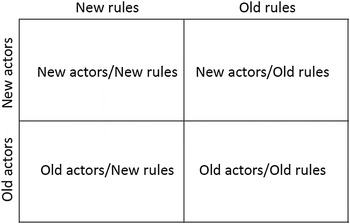
The literature indicates that the newness of actors and the newness of rules may affect gender justice outcomes. Based on existing research, it is possible to hypothesize that new (feminist) actors working with new institutions (where there is less likelihood of there being an entrenched gender-biased logic of appropriateness) will offer the most positive opportunity structure for advancing gender justice claims, whereas new or old actors working with old institutions are more likely to experience resistance due to the “congealment” of gender biases. These hypotheses are captured in Figure 1.
Old and new actors and rules.

The ICC is an interesting institutional arena to examine the newness and to test whether “new actors/new institutions” enable gender justice outcomes. The Court provides a new set of formal rules, the 1998 Rome Statute of the International Criminal Court (Rome Statute), which includes progressive gender justice provisions (detailed below), which were influenced by external feminist legal advocates and were expected to be implemented by those with gender expertise.
In this article, the measure by which gender justice outcomes are measured are those advocated by feminist legal actors who came to be incorporated in the Rome Statute. This is not because these rules represent the most advanced gender justice measures—indeed, coming as a result of compromises at the 1998 Rome conference negotiations, they are not as comprehensive as these advocates would have wished or as other advocates would have demanded (Chappell Reference Chappell2015; Oosterveld Reference Oosterveld2014). Nevertheless, in line with social theorist Nancy Fraser's conception of gender justice (Reference Fraser2009), they do seek to better recognize gender power relations, represent women's voices, and achieve a degree of redistribution of resources in postconflict environments (Chappell Reference Chappell2015).
INTERNATIONAL CRIMINAL COURT BACKGROUND
The Rome Statute, which provides the foundational rules for the ICC, is unique in many respects. Two of its innovative features are its merging of an “old” retributive justice model with a “new” victims-centered justice paradigm (Schiff Reference Schiff2008, 86–88) and its gender justice provisions, aimed at redressing a range of preexisting gender biases under international criminal law.
The inclusion in the statute of the victims-centered approach is considered a “stunning” development (Schabas Reference Schabas2011, 346), given the long-standing retributive focus of international criminal law. Its designers, including states and nonstate actors, drew negative lessons from the preexisting UN ad hoc tribunals for Rwanda and for the Former Yugoslavia (ICTR and ICTY), where victims' voices had been excluded and incorporated in the ICC's rules provisions allowing victims' “views and concerns to be presented and considered at stages in the proceedings” (Article 68). Together the Rome Statute and the court's Rules of Procedure and Evidence (2002) establish the court's victims-centered mandate covering the pretrial, trial, and appeal phases. Victims may appear as witnesses with their testimony considered as evidence, but there is also scope for victims to give testimony without it being considered as evidence. Drawing on experiences in common law jurisdictions, victims' statements are a way for the Court to recognize their experiences and to improve its understanding of the context in which atrocities are committed. Further, victims are able to seek “restitution, compensation and rehabilitation” (Article 75) at the completion of a trial.
State and nonstate actors also influenced the design of the Rome Statute's gender provisions, especially the Women's Caucus for Gender Justice (the Caucus) (see Chappell Reference Chappell2006b). The Caucus was an umbrella organization encompassing feminist legal activists that could “accurately claim to be representative of a global audience” with women from every region and different legal codes represented (Glasius 2006, 80). The Caucus' priorities were strongly influenced by the context in which it was operating. This included important jurisprudential developments stemming from the UN ad hoc tribunals—for instance, the recognition of sexual violence as a crime against humanity and as a war crime (Ni Aolain, Haynes, and Cahn Reference Ni Aolain, Haynes and Cahn2011), but also the failure of these tribunals on many fronts to address longstanding gender-biased rules of international law. These informal rules have been well documented by feminist legal scholars and include the historical failure of international criminal law to recognize “the gendered and sexualized forms of harm experienced by women and men in armed conflict” and “the fact that women experience wartime violence in ways particular to them as women” (Buss Reference Buss2011, 413). Other gender legacies include misconceptions about the extent, nature, and grievous harm of sexual violence in conflict; biased and inadequate investigation techniques; and inappropriate courtroom proceedings (Ni Aolain, Haynes, and Cahn Reference Ni Aolain, Haynes and Cahn2011).
The Caucus entered negotiations at Rome with three central aims: (1) to have the court recognize a range of sexual and gender-based crimes commonly experienced by women in war and conflict that had hitherto been ignored under international law and to recognize the victims of these crimes; (2) to have the court represent women and gender experts across all its organs; (3) and to give the Court the capacity to redistribute through reparations measures to address the needs of women and girls and of victims of sexual and gender-based crimes (see Chappell Reference Chappell2015).
In the face of some strong state opposition (Chappell Reference Chappell2006b), many of these priorities came to be reflected in the Statute. Working with sympathetic states, gender justice actors were able to embed in the substantive rules, under Articles 7 and 8, recognition of sexual violence as crimes against humanity and as war crimes. Gender justice concerns are also “mainstreamed” throughout the Statute, with gender included for the first time under international law as a ground for persecution (alongside political, racial, religious, and other such categories) (Article 6);Footnote 1 and importantly, Article 21 prohibits discrimination based on gender in the application and interpretation of the statute.
Specifically in relation to victims, due to the intense lobbying efforts by feminist activists in the Caucus supported by some state delegations, the ICC's statute also came to include rules to give victims standing in proceedings and to guard against the mistreatment in the courtroom of women who have been victims of sexual violence (Ni Aolain, Haynes, and Cahn Reference Ni Aolain, Haynes and Cahn2011; SaCouto Reference SaCouto2012), which had been on display at the ad hoc tribunals.
Both the new victims' redress and gender justice regimes of the Rome Statute exist in parallel, but they also overlap at critical points, such as under Article 68.Footnote 2 In the following analysis, the focus rests on the implementation by the Registry and associated bodies on gender justice aspects of key elements of the ICC's victims' rights mandate.Footnote 3 The Registry's victims' machinery has largely gone unremarked in ICC scholarship (for an exception, see Pena and Carayon Reference Pena and Carayon2013). In assessing developments at the Court, the focus rests on the extent to which the codified rules aimed at securing better recognition and protection of women and girl victims—especially of those experiencing sexual and gender-based violence—have been implemented in practice.
NEW ACTORS IMPLEMENTING NEW RULES AT THE ICC
On commencing operation in 2002, the ICC was staffed by entirely “new” actors in the sense that all appointees were the first incumbents. It is hard to say how many of these came from backgrounds in similar institutions—such as the UN ad hoc tribunals—and carried across legacies from these institutions. Also unknown is how many committed feminist actors were included, but the statute stipulates dedicated positions for gender experts across all organs of the Court, including, under Article 43, in the Registry. At the time of the ICC's formation, there also emerged a new external organization, the Women's Initiatives for Gender Justice (Women's Initiatives), the heir to the Women's Caucus, whose raison d'etre is to advocate for the incorporation of all the Rome Statute gender justice provisions. The question here is whether these new actors succeeded in implementing the substantive and procedural gender justice aspects of the ICC's victims' mandate through the key Registry victims' agencies of the Victims and Witnesses Unit, the Victim Protection and Reparations Service, the Outreach Unit, and the Office of Public Counsel for Victims.Footnote 4
The Victims and Witnesses Unit
The Victims and Witnesses Unit (VWU) is directed under the Rome Statute (Article 43) to provide protection, support, and assistance to both prosecution and defense witnesses and victims appearing before the court and who are at risk as a result of their testimony, including victims of sexual violence. It provides victims with psycho-social support, crisis intervention, information, and debriefings before and after testimony, and access to medical care. In line with the Rome Statute, the VWU is mandated to include staff with expertise in sexual violence trauma.
There is some evidence that the VWU has worked to promote gender justice. It has assisted in orientating victims and witnesses to courtroom proceedings and has offered “guidance to judges on how to question vulnerable witnesses in a sensitive manner” (ICC 2010a, 5). The Unit's sexual violence trauma expert has worked with the chambers to ensure victims and witnesses of these crimes are given specific protection (Women's Initiatives for Gender Justice 2010). In a number of cases, victims of sexual violence have been granted voice and image distortion to protect their identities (Women's Initiatives for Gender Justice 2010). In the long-running Bemba case in which the accused is charged with a range of sexual violence crimes in the Central African Republic, VWU staff, including a psychologist, has assisted sexual violence victims during their testimony (ICC 2012a). These measures go some way to challenging the problems evident in other international tribunals and have been extensively criticized by feminist legal scholars (Mertus Reference Mertus2004; Mouthaan Reference Mouthaan2011, 775) about the lack of procedural safeguards in the courtroom that result in the retraumatization of victims of sexual violence.
The work of the VWU has also been beset by a number of problems. For instance, the unit has only one sexual violence trauma expert, employed on a temporary basis, which, given the number of victims and witnesses of sexual violence currently and potentially to come before the court, fails to meet demand for this expertise.Footnote 5 Further, despite its best efforts and the ICC's formal rules, the VWU has been unable to completely protect victims of sexual violence from facing the same hostile questioning experienced by their counterparts in other international tribunals. Feminist legal expert Susana SaCouto (Reference SaCouto2012, 345) has documented how some female sexual violence victims continue to face interruption during their testimony, such as inappropriate questions, and are unable to narrate their own story in their own terms.
Victim Protection and Reparations Section
The Rome Statute mandates the Victims Protection and Reparations Section (VPRS) to facilitate victim participation in proceedings before the court by providing victims with information on their rights, assisting in their application for participation in proceedings and for reparations, and organizing their legal representation. The work of the VPRS has grown exponentially with the court's increasing caseload. According to 2011 Registry figures, between 2006 at the commencement of the ICC's first trial and 2011, 9,910 victims applied to participate in ICC proceedings, with 5,639 of these applications lodged in 2011. During the same period, the Registry received 6,896 applications for reparations (Victim's Rights Working Group 2011, 7). These figures can be seen as a sign of success; they are an indication that victims are aware of and willing to take advantage of the ICC's victim redress provisions.
In May 2012, in a first at the ICC, the trial chamber in the Bemba case, based on the Central African Republic (CAR) situation, heard for the first time from victims authorized to present their views without their testimony being considered as evidence. The first testimony came from a woman who was a victim of pillage and rape and who had witnessed rape and murder allegedly committed by the militia over which Bemba had command. The victim provided the court with a detailed account of her experiences without the usual interruptions from prosecution and defense counsel. Most importantly, she had the opportunity to explain the extent of harm of the crimes within the cultural context in which they occurred. The victim explained:
In my community, I'm no longer considered a human person, and by extension in the whole of the CAR I'm not considered a human being. You know I was a human being, but I was treated like an animal … and that is why I cannot live normally. Before these events I was a woman with dignity, I could have a family with dignity, but I lost my dignity… (ICC 2012a, 53–54).
She also attested to the value, from her perspective, of being able to express these views to the court:
I do not feel at ease each time I have to give an account of the acts that I was subjected to, but for the time being I feel relieved … I have told you what happened to me. If I did not do that, I would not feel comfortable (ICC 2012a, 29).
An important component of this victim's testimony, as well as other witnesses in the Bemba trial, was that it included accounts of the use of sexual violence against men. Testimony about the removal of penises and male-on-male rape (ICC 2012a, 33) helped bring to light gender-based crimes that have largely been left uncovered under both national and international law (Ni Aolain, Haynes, and Cahn Reference Ni Aolain, Haynes and Cahn2011, 51).
The beneficial work of the VPRS includes developing reports for the judiciary about the context in which victims experience crimes. Where victims' experiences fall outside the scope of the charges and are therefore not able to be tended as evidence, VPRS reports at least provide the court with some account of the range of victim experience in a manner that assists it to put the events in a wider context (SaCouto Reference SaCouto2012, 334).
As with the Victims and Witnesses Unit, the VPRS faces some significant constraints in fulfilling its core functions. The number of applications to the VPRS has threatened to overwhelm it. In 2010, there was a reported backlog of more than 900 applications for victims' access, a figure that by 2011 had skyrocketed to 6,000 (Women's Initiatives for Gender Justice 2010, 57; 2011, 276). As of June 2012, the section had a total staff of 15 —10 of whom were located at headquarters and the remaining five in the field, across seven situation countries (ICC ASP 2012, 11).
There are costs to all victims in not having their applications processed expeditiously. It leaves them open to reprisals in their communities, especially where the perpetrators or their supporters remain at large. Women and victims of sexual violence are particularly vulnerable in such situations because of the “pervasive stigma they may face in their homes and communities, as well as the specific types of trauma they may have suffered” (Victim's Rights Working Group 2011, 6).
A significant sex imbalance has been apparent in the victims coming before the ICC through the VPRS across all cases. In 2010, the figures were worst for the Sudan/Darfur situation, where 14% of the victims were female and 86% male, and best in relation to the situation in CAR, where 42% of the recognized victims were female and 58% male.Footnote 6 Figures from 2013 show a more even sex balance emerging in victim representation, with male victims still better represented in the Democratic Republic of the Congo (DRC), Uganda, and Darfur situations, but a more equal balance in the others (WIGJ 2013). This shift may reflect the success of VPRS efforts to reach out to international, national, and local women's groups working in situation countries to encourage more female participation at the ICC (see De Brouwer Reference De Brouwer2007, 223).
These discrepancies in the VPRS figures also reflect a deeper gender bias, specifically the stigma attached to sexual and gender-based crimes. Fiona McKay noted: “[O]ne of the issues we [have] had, actually, from the victims [of sexual violence] coming forward to apply to participate is that, as in almost every culture, people might not want to say actually … in detail what happened.”Footnote 7 It is not only women who are silenced by these norms. Men who are victims of sexual violence are also reluctant to come forward. McKay continued:
The question of sexual violence against boys and men is a really difficult issue and it's something that is so rarely raised … I would expect that it is a greater issue than we're aware of. They don't even put it in their applications [for victim status], you know. We just don't see people coming forward and saying that they were submitted to sexual violence as boys or men. It's just so rare.
Strong gender biases around sexual violence where victims of sexual transgressions are left to feel a mix of shame, personal responsibility, and fear continue to limit both women and men's access not only to the VPRS, but also across the entire victim redress framework, including ICC outreach programs.
Outreach Unit
The Outreach Unit is responsible for ensuring that the court is “public and transparent with respect to the populations concerned by the crimes being prosecuted” (Schabas Reference Schabas2011, 360). It seeks to provide outreach to the communities affected by the court's activities, media, and the legal community as well as engaging universities to broaden knowledge about the court.Footnote 8 The Outreach Unit provides communities with knowledge about ICC proceedings and attempts to manage expectations and address misunderstandings of its role (ICC ASP 2006, 5).
Staff in the Outreach Unit have identified the need to involve women in all their activities at the local level but also experience constraints resulting from community-level gender biases. As the Outreach Director explains, “[I]n many countries in which the ICC operates, women require permission from husbands or other male figures to participate in outreach forums.” Women also face particular challenges in accessing public information due to illiteracy, social isolation, and powerlessness. They also have difficulty accessing the usual means of communication, including household radios, which are a major form of communication used by the unit.Footnote 9
The Outreach Unit has attempted to address informal gender rules through sex-segregated outreach activities and running sessions at convenient times, taking into account women's childcare and other responsibilities. The Unit has also sought to engage local women's organizations, and where this has occurred there are signs that this partnership has helped “women and girls break through the social, physical, and psychological barriers that often hinder their access to the ICC” (ICC 2010b, 95). To improve access to ICC broadcasts, the Outreach Unit has created women-only radio clubs.Footnote 10
Despite these efforts, the Outreach Unit still has much work to do. The ICC's 2010 Review Conference stocktaking report found victims in general, and women and children in particular, still lacked sufficient information about the court (ICC 2010a, 80). The Women's Initiatives agrees; in its annual review of the ICC it has repeatedly called for an increase in Registry staff numbers to “ensure effective programs are developed to reach women and diverse sectors of communities” (Women's Initiatives for Gender Justice 2010). In 2011, women comprised 26% of the total participants in the Outreach Unit's interactive sessions. These figures varied by cases, with only 7% of women participating in Uganda and 17% in Sudan (Women's Initiatives for Gender Justice 2011, 35). Like other Registry agencies, the Outreach Unit is hampered by resource constraints. According to the ICC's 2012 victim review (see below), the Outreach Unit was working in seven situations with the same human resources it had when there were three (ICC ASP 2012, 12).
Office of Public Council for Victims
The Office of Public Council for Victims (OPCV) is an element of the Rome Statute victims-centered framework, which is administered by but is independent of the Registry. It has been established to provide “legal advice and research, and, where deemed appropriate by Chambers, representing victims, as well as appearing before the Chambers in respect of specific issues” (ICC OPCV 2010, 3).Footnote 11 The OPCV aims to ensure the “effective participation of victims in the proceedings before the court” (ICC OPCV 2010, 3), including through advice to external counsel representing victims.
In its first six years in operation, the OPCV has contributed to challenging the gender legacies of international law. For instance, in its representations in the ICC's first trial concerning DRC warlord Thomas Lubanga, it sought to ensure that the experiences of girl soldier victims, many of whom had experienced sexual violence, were included in proceedings despite the prosecutor not including sexual violence in the charges (Chappell Reference Chappell2014; ICC 2011; SaCouto Reference SaCouto2012). While these interventions were rejected both by Lubanga's defense counsel and the majority of judges (Sa Couto Reference SaCouto2012, 345–46), these issues were taken up at the verdict and sentencing stage by self-identified feminist Judge Elizabeth Odio Benito (Odio Benito Reference Odio Benito2014).Footnote 12 In her dissenting opinion, Odio Benito expressed similar views to the arguments advanced by the OPCV and the Women's Initiatives, strongly asserting victims' rights, specifically of girl soldier victims of sexual violence (ICC 2012b). While neither the views of the OPCV nor Judge Odio Benito altered the outcome of Lubanga's verdict, they nevertheless helped represent the certain experiences of these victims in proceedings (see Chappell Reference Chappell2014).
The OPCV also faces a number of challenges. These include managing lengthy trials that have hundreds if not thousands of victims in distant remote locations as well as language barriers (ICC 2012b, 9). It too confronts a growing workload and inadequate resources. Between 2005 and 2010, the OPCV assisted 2000 victims and submitted approximately 300 formal submissions (ICC 2012b, 8). In 2011, it had 10 permanent staff, working with more than 2,100 victim applicants (Women's Initiatives for Gender Justice 2011, 83), a figure that is expected to escalate with the caseload of the court. The ICC's 2012 victims' report noted the problem of inadequate OPCV staffing levels (ICC ASP 2012, 18).
In line with other victims' rights agencies, the Office's client base is overwhelmingly male. According to the Women's Initiatives, in 2011, 63.5% of the total victims represented or assisted by the OPCV were men (WIGJ 2011, 83). Notably, official OPCV documents, including its 2010 handbook on its achievements (ICC ASP 2012, 74), offer no strategies to address the skewed ratio of male to female clients or broader issues of gender bias.
It appears that gender discrepancies across Registry agencies have a compounding effect. By not registering as victims through the VPRS, women lose the opportunity to express their “views and concerns” in proceedings; they miss the chance to assist the judges and the international community more broadly in understanding the extent and nature of crimes committed against them (Women's Initiatives for Gender Justice 2011, 76). Such participation is critical to the achievement of the gender justice goal objectives of the Rome Statute, including calling perpetrators into account and ultimately ending impunity for these crimes.
Sparked by strong criticisms of its treatment of victims at the 2010 ICC Review Conference, the Court, through the Assembly of States Parties (ASP) undertook a review of all its victim programs. The 2012 review report paid specific attention to the call to mainstream gender concerns across all victim activities, recognizing “[g]ender is a cross-cutting issue with significant impact on victims and on the work of the ICC system with victims and affected communities,” and it called for greater coordination across victims' agencies (ICC ASP 2012, 1). Importantly, the report recommended all aspects of the ICC's victims' framework engage men and boys, both to encourage them to support women's participation and also to better understand the impact of gender on men and women within community contexts (ICC ASP 2012, 4).
UNDERSTANDING THE ROLE OF “NEWNESS,” “OLDNESS,” AND “NESTEDNESS”
In its first decade of ICC operations, new actors have used new rules to advance the Rome Statute's gender justice victim mandate through Registry agencies. New actors in and outside of the ICC pushed to have women incorporated into the ICCs victim's framework, with the result that the court has started to develop a more nuanced understanding of the impact of war and conflict on their lives and their specific needs in overcoming the devastation caused by these events. Similarly, new possibilities at the ICC for testimony about male experiences of sexual violence is broadening the understanding of the use of such violence as a tactic of war and the power of gender inequalities and biases within different cultural settings. Adding these new voices contributes to dismantling existing substantive and procedural gender biases in the law, one of the central objectives of the Rome Statute's gender justice mandate. However, even with “new” new rules aimed at addressing implementation hurdles, such as those arising from the 2012 victim's review process, significant problems remain: women remain the minority subjects of the victims' redress system, and, despite some breakthroughs, they have often found it difficult to express (and make central) their stories of victimhood and survival. A similar problem exists for male victims of sexual violence.
Resource constraints partly explain these outcomes. The ICC's Assembly of States Parties' “zero-growth” budget position in the years immediately following the global financial crisis placed the Court under considerable financial pressure at a time when it had a rapidly growing case load (CICC 2011). In the view of (former) Registrar Silvana Arbia (and her colleaguesFootnote 13 across the victims agencies), the ASP's budget position “almost paralysed the operations of the court.”Footnote 14 Financial strain has been acute in the Registry, which has experienced exponential growth in the number of claimants but without a concomitant increase in resources (ICC ASP 2012).
These budgetary constraints have not impacted all victims equally. They interfere with securing justice for victims of sexual violence because these victims require highly resource-intensive services, more intimate engagement with skilled agency staff, and more flexible timing. For those men exposed to conflict-related sexual violence, the situation is equally troubling: the court seemingly has no capacity to devise the innovative strategies or services required to recognize or redress their experiences.
However, budgetary challenges only go so far in explaining variable gender justice outcomes of the Registry's victims' agencies. These outcomes also arise from the “structured contingency” facing new institutional actors, most obviously distortions created by old gendered informal rules operating within the new institutional framework of the ICC.
Operating within ostensibly the most promising scenario—“new” internal and outside actors working with “new” expansive gender justice rules—outcomes for women and sexual and gender violence victims through the ICC Registry are underwhelming. This is not because other ICC actors are deliberately resisting the implementation of gender justice principles. Indeed, there is plenty of evidence—such as the commitment by individual Registry personnel and the 2012 victim review—to suggest the contrary. Rather, it is to recognize that new formal rules do not operate independently of the “old,” specifically in this case, where gender legacies of international law are “sticky” and have been carried over into this new institution.
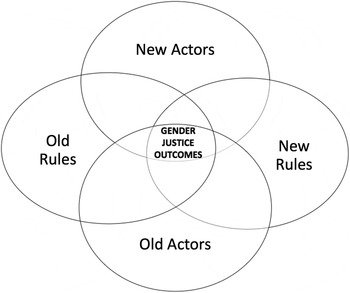
The findings here nullify the hypotheses outlined in part one, that new actors working in new institutions offer the strongest potential for achieving gender justice goals, and old actors working with old institutions offer the weakest. Rather, this single case study of the ICC's gender justice victim rules suggests, in line with Figure 2, that gender outcomes arise from a much messier and more complex picture: that is, newness—of actors and of rules—overlaps and intersects with oldness to influence outcomes.
Gender justice outcomes: oldness and newness.

Such a finding questions the value of looking to newness (at least as a variable operating on its own) as an explanation for institutional gender justice outcomes—whether positively or negatively. Instead, it points to the importance of the work of Mackay (Reference Mackay2014) and other neoinstitutionalists (Goodin Reference Goodin and Goodin1996) who understand the way in which new institutions are “nested” within a temporal context—and how this “nestedness,” where the old and new coexist and interact—shapes the operations and outcomes of new institutional contexts. As Mackay (Reference Mackay2014) reminds us in her analysis of the Scottish Parliament, the stickiness of gender legacies means seemingly new institutions do not offer a clean slate to pursue gender justice claims. New rules are founded in part on old “informal” rules and practices, and new actors often absorb old ways of operating, adopting former “logics of appropriateness” rather than creating new ones. The task and challenge for new gender justice actors, working in and outside new institutional areas, is to continually remember to assert new rules and practices. Without the ongoing vigilance of these actors, old norms and practices can easily slip in to fill in the gaps between the formal design and rule implementation and prevent gendered change (see Chappell and Waylen Reference Chappell and Waylen2013; Mahoney and Thelen Reference Mahoney and Thelen2010).
At the ICC, older informal rules have slipped through via inappropriate questioning of sexual violence victims; difficulties in addressing the stigma related to sexual and gender based crimes; and underrepresentation of women across all activities. These gender legacies have filled the lacunae between the Rome Statute's innovative and expansive victims' gender rules and their implementation; they have distorted, diluted, and displaced the efforts of Registry and civil society actors to instate a new “gender justice logic of appropriateness of international law.” The outcome of the ICC's gender justice and victims mandate during the ICC's first decade is due in part to new actors and rules, but it is also due to oldness and the temporal, nested environment in which it operates.
CONCLUSION
Feminist legal advocates could rightly claim a major achievement in embedding new gender justice victims rules in the Rome Statute, rules that were even more notable because of strong opposition to their inclusion. Nevertheless, as feminist institutionalists suggest, the establishment of formal rules only goes so far in bringing about change; it is the challenge of implementing these new rules and the interaction between formal and older informal rules—in this case, gender biases—that also influence outcomes. This has indeed been the case in relation to the gender justice aspects of the ICC's victims' rights system.
The newness of actors and the institutional rules and context can make a difference to gender justice outcomes. Actors who are unencumbered by a history in or outside an organization and who have a commitment to reform can use institutional innovations in gender justice to advance their claims. But this is possible only up to a point. Newness does not exist in distinction to the old, but overlaps and is nested within it; even when new rules are codified, legacies of rules and practices continue to “stick” and operate to influence the interpretation and implementation of those rules, often distorting and diluting them. In this case, gender-biased informal rules of international law interfered with the implementation of new Rome Statute victim provisions, undermining the best intentions of gender advocates and other actors.
This effect of oldness and nestedness on outcomes does not mean newness is unimportant, but it complicates any analysis of it. As this study has illustrated, newness requires a multilayered approach, which takes into account the intersection of the new and old in influencing gender justice outcomes. Further, newness and oldness are certainly not the only factors that influence gender outcomes. For instance, Beckwith (Reference Beckwith2007) demonstrates that a “critical threshold” in terms of numbers can combine with incumbency to enhance the influence of new actors (Beckwith Reference Beckwith2007), while Mackay (Reference Mackay2014) and Chappell (Reference Chappell2002) argue that it is not just temporal “nestedness” that matters, but also the corresponding relationships between institutions within its broader institutional environment that shape opportunities for change. Determining how and when newness—of structure and agency—matters to gender justice continues to be an important research question, but as this article has demonstrated, it is one that can be answered only alongside an assessment of institutional “oldness” and “nestedness” over time.