INTRODUCTION
Information about below-ground biomass in tropical savannas is important for understanding global carbon cycling. Tropical grasslands, savannas and savanna woodlands together account for about half as much annual carbon fixation as is attributed to tropical forests and at least 80% of savanna organic carbon resides in the soil (Grace et al. Reference GRACE, SAN JOSÉ, MEIR, MIRANDA and MONTES2006, Scurlock & Hall Reference SCURLOCK and HALL1998). Although savannas are highly dynamic, they have the potential to be a net carbon sink through long-term carbon immobilization deep in the soil (Bates & Sombroek Reference BATES and SOMBROEK1997, Grace et al. Reference GRACE, SAN JOSÉ, MEIR, MIRANDA and MONTES2006). Because fine-root annual carbon input to the soil may exceed that from leaves (Chen et al. Reference CHEN, HUTLEY and EAMUS2003, Jackson et al. Reference JACKSON, MOONEY and SCHULZE1997), variation in seasonal abundance and spatial distribution of fine roots is of especial interest.
Eucalyptus tetrodonta F. Muell. savannas cover 51 787 km2 of coastal and sub-coastal regions of Australia's Northern Territory where annual rainfall exceeds 1000 mm (Wilson et al. Reference WILSON, BROCKLEHURST, CLARK and DICKINSON1990). Despite their seasonally dry, invariably hot climate, evergreen plant species predominate within them. For example, near Darwin three-quarters of the common woody species are evergreen, including all canopy species (Williams et al. Reference WILLIAMS, MYERS, MULLER, DUFF and EAMUS1997). Most shed some leaves during the dry season, and a third are classified as semi-deciduous because they lose more than half their foliage (Williams et al. Reference WILLIAMS, MYERS, MULLER, DUFF and EAMUS1997). Retained leaves, however, are active in photosynthesis throughout the dry season (Eamus et al. Reference EAMUS, MYERS, DUFF and WILLIAMS1999). Moreover, nearly all species studied by Williams et al. (Reference WILLIAMS, MYERS, MULLER, DUFF and EAMUS1997) flushed new leaves before the first substantial (> 25 mm) wet-season rainfall. This suggests that fine roots might be present and active throughout the year.
Data concerning fine roots in northern Australian savannas are sparse and conflicting. Eamus et al. (Reference EAMUS, CHEN, KELLEY and HUTLEY2002) excavated to 1.5 m depth, and recovered 0.098 kg m−2 dry weight per ground area of fine roots (≤ 2 mm). Chen et al. (Reference CHEN, EAMUS and HUTLEY2002) reported a wet-season peak abundance of 6 m m−2 (vertical) fine roots, but did not compare this with the report by Eamus et al. (Reference EAMUS, CHEN, KELLEY and HUTLEY2002). Subsequently, Chen et al. (Reference CHEN, EAMUS and HUTLEY2004) found a peak fine-root biomass of 2.63 kg m−2 to 50 cm depth, which greatly exceeded the value reported by Eamus et al. (Reference EAMUS, CHEN, KELLEY and HUTLEY2002). Chen et al. (Reference CHEN, EAMUS and HUTLEY2004) used two different methods to estimate net primary production of fine roots as 14.3 Mg ha−1 y−1 and 34.7 Mg ha−1 y−1, and Chen et al. (Reference CHEN, HUTLEY and EAMUS2003) used the first of these values to predict that annually, northern Australian savanna is a net carbon sink.
Notwithstanding the importance of fine roots, all ways of measuring them are laborious and imperfect (Pierret et al. Reference PIERRET, MORAN and DOUSSAN2005, Vogt et al. Reference VOGT, VOGT and BLOOMFIELD1998). Trenches, monoliths and cores that are used most commonly (Jackson et al. Reference JACKSON, CANADELL, EHLERINGER, MOONEY, SALA and SCHULZE1996) may underestimate root biomass because of the difficulty of recovering fine roots (Atkinson Reference ATKINSON, Fitter, Atkinson, Read and Usher1985). In contrast, root-tracing techniques which constrain root growth along a transparent viewing surface may overestimate root abundance (Glinski et al. Reference GLINSKI, KARNOK and CARROW1993). Nevertheless, several studies have reported a good correlation between traced root abundance and root density away from rhizotron viewing panes (Atkinson Reference ATKINSON, Fitter, Atkinson, Read and Usher1985, Taylor & Klepper Reference TAYLOR and KLEPPER1971, Taylor et al. Reference TAYLOR, HUCK, KLEPPER and LUND1970). Rhizotrons may be the best choice for study of changes in root abundance over time because high spatial variability confounds the use of destructive sampling (Atkinson Reference ATKINSON, Fitter, Atkinson, Read and Usher1985). We chose to use rhizotrons to examine temporal and spatial changes in fine-root abundance in an E. tetrodonta savanna.
METHODS
We constructed six rhizotrons in an Eucalyptus tetrodonta savanna within the grounds of the Territory Wildlife Park at Berry Springs (12°42′06″S, 130°59′55″E), 40 km south of Darwin, Australia. The site is an area of near level terrain, about 10 m asl. Bowman & Minchin (Reference BOWMAN and MINCHIN1987) provide a description of the vegetation of this area. High densities of large marsupial herbivores (Macropodidae) have resulted in heavy grazing of the herbaceous understorey which fire suppression (Chen et al. Reference CHEN, EAMUS and HUTLEY2002) also has minimized.
We positioned rhizotrons at the midpoint of and perpendicular to straight lines connecting large trees selected to reflect species relative abundances (70% E. tetrodonta, 21% E. miniata A. Cunn. ex Schauer, 7% Acacia auriculiformis A. Cunn. ex Benth., and 2% Corymbia latifolia (F. Muell.) K.D. Hill & L.A.S. Johnson) of trees over 10 cm diameter in the vicinity of the rhizotrons. We mechanically excavated 1-m-deep to an impenetrable ferricrete layer. Nearest-neighbour rhizotrons averaged 15 m apart, with the most distant separated by 39 m and the closest separated by 9 m. The nearest large tree in a semi-circle behind the rhizotrons' viewing panes was 3.5 m to 5.5 m distant, and its average diameter was 31 cm. For Rhizotron 1, the nearest tree was A. auriculiformis, for Rhizotrons 2, 3, and 4, E. tetrodonta, and for Rhizotrons 5 and 6, E. miniata. In addition, the rhizotrons probably were affected by small trees, shrubs and the herbaceous layer in their vicinity, so we consider them to approximate root abundance of the plant community rather than that of any single species.
For each rhizotron, stacks of concrete blocks at each edge held in place a 1-m-square, 6-mm-thick pane of toughened glass against a carefully hand-smoothed, vertical soil face. The firm, clay soil was nearly root-free and did not crumble, so there were few narrow (< 3 mm) gaps to be filled between the glass and the soil face. Where fill was needed, screened (2 mm) subsoil was tamped firmly into place. A 2.5-cm-thick, removable panel of styrofoam placed against the glass provided thermal insulation and blocked light. Corrugated metal and an opaque plastic sheet served as a removable, weatherproof cover which was placed across the excavation so that it did not interfere with the herbaceous layer immediately behind the glass pane.
We finished constructing the rhizotrons early in the first week of September 1997 after which we weekly checked for root growth. We did not find roots until the sixth check on 14 October 1997 (1 wk after the first wet-season rainfall of 30 mm on 7 October 1997), at which time we began regular data collection. For the first 10 wk of the wet season, we censused roots weekly. Subsequently, we censused fortnightly until the middle of June 1998 when very few roots remained visible.
At each census, we made tracings of roots on clear plastic overlays of 33 sample areas which together covered 33.9% of each rhizotron. In order to consistently relocate the sample areas, we used wooden templates of 33 11.4-cm-diameter holes. The holes were in rows of three at 11 different depths with 3.1 cm depth overlap between successive rows. Each row of holes was laterally offset from that immediately beneath, with no vertical overlap between successive rows.
We traced all roots that appeared against the rhizotron glass panes. We neither attempted to differentiate woody from herbaceous roots, nor did we distinguish diameter or vitality classes. Diameters of the roots we traced ranged from less than 1 mm to as much as 5 mm. For simplicity, we shall refer to these fine and small roots collectively as ‘fine’.
Among 4554 potential tracings (6 rhizotrons × 33 sub-samples per rhizotron × 23 censuses between October 1997 and June 1998), 885 were not traced. Among those, 809 mostly from the initial three and final three fortnightly censuses had few if any roots visible against the glass pane. Those were recorded as zero root length. The remaining 76 samples (1.7%) were missing, but were bracketed by prior and subsequent tracings of the same area from which we linearly interpolated root length. We digitized the 3669 root tracings with a desktop scanner. Six tracings made at different times within a single sample area at 33.4 cm depth in Rhizotron 6 are shown in Figure 1.
Fine roots (≤ 5 mm diameter) in selected vertical tracings of one 11.4-cm-diameter sample area at 33.4 cm depth in Rhizotron 6 on six census dates: 28 October 1997 (a); 27 November 1997 (b); 5 January 1998 (c); 27 March 1998 (d); 30 April 1998 (e); 28 May 1998 (f) that represent different proportions (33.7%, 47.3%, 48.6%, 89.5%, 67.5% and 28.2%, respectively) of the area's peak traced root abundance (102.5 m m−2 vertical), which occurred on 2 April 1998. Traced root abundance is shown as cm (i.e. cm per 0.01 m2 = m m−2) for each date. The scale bar in (f) represents 5 cm; all panels are at the same scale.

Initially, we used ARCINFO to automatically measure the total length of lines within each digitized tracing. Manual checks, however, suggested that the automated measurements were in error. An occasional problem was that worn pens failed to ink the centre of roots, producing two parallel lines representing the edges of a single root that both ARCINFO and the program RootEdge (Kaspar & Ewing Reference KASPAR and EWING1997) measured as two roots. No automated digital editing (‘opening’ and ‘closing’ algorithms) prior to skeletonization could correct this problem. So, we measured all digitized tracings manually by re-tracing them in a bright, contrasting colour in ARCVIEW. A linear regression (A = 0.191 + 1.092 M; r2 = 0.999) showed that the automated ARCINFO measurements (A) on average were 9.3% in excess of the manual measurements (M). We expressed fine-root abundance based upon the manual re-tracing as total length of fine roots per m2 vertical section of soil.
We investigated correlates of fine-root abundance by examining scatterplots and calculating Pearson product-moment correlation coefficients and associated Bonferroni significance levels using SPSS 11.5. In order to keep the time interval between censuses relatively uniform, we used only fortnightly census data. We examined correlations between fine-root abundance and natural log-transformed total rainfall between successive fortnights + 0.5, or that variable from one to four fortnights prior to root abundance assessment, which is similar to an analysis by Sánchez-Gallén & Alvarez-Sánchez (Reference SÁNCHEZ-GALLÉN and ALVAREZ-SÁNCHEZ1996).
To compare the vertical distributions of fine roots, we estimated the parameter β for the model:

by performing non-linear regression with ProStat (v. 3.01, Poly Software International, Pearl River, New York, USA). In this model, Y is the cumulative root fraction from the soil surface to depth d (cm; Gale & Grigal Reference GALE and GRIGAL1987), and β is a simple index of root vertical distribution, with high values corresponding to a large proportion of roots at depth (Jackson et al. Reference JACKSON, MOONEY and SCHULZE1997). We assessed fit of the model by calculating the coefficient of determination (r2) for the regression.
We approximated specific root length (m g−1) from a single sample of 1.2 m of small and fine roots opportunistically collected from rhizotron excavation sidewalls at all depths during the period of decline in root abundance. We determined the total length of these roots after dividing them into one-third portions by spreading the portions separately on a photocopier and producing images with contrasting backgrounds for scanning and measurement. These roots were dried to constant weight at 60 °C before weighing.
RESULTS
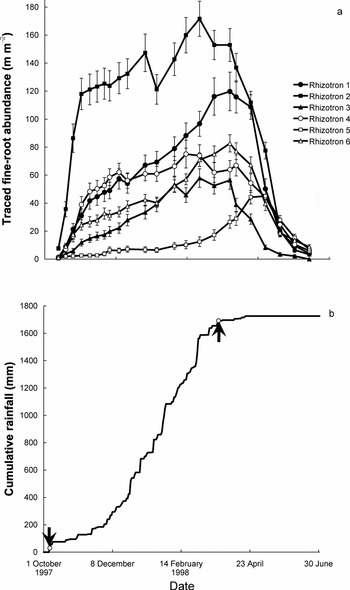
We did not see fine roots in any rhizotron until after the first wet-season rain on 7 October 1997, when 30 mm of rain fell (Figure 2). Fine-root abundance increased throughout the wet season and did not begin to decline until 98% of cumulative wet-season rainfall had been received, at which time 11 consecutive days without measurable rainfall occurred. When we considered census data taken at approximate fortnightly intervals throughout the study, average fine-root abundance for all rhizotrons was not significantly (n = 17 fortnights, Bonferroni P ≥ 0.05) correlated with days since the first rainfall (r =−0.010), or cumulative total rainfall (r = 0.185), but was significantly correlated with total rainfall between successive fortnights for the same fortnight and for the previous three fortnights (same: r = 0.723, Bonferroni P = 0.005; one fortnight prior: r = 0.874, Bonferroni P < 0.001; two fortnights prior: r =0.836, Bonferroni P < 0.001; three fortnights prior: r = 0.614, Bonferroni P = 0.045; all n = 17 fortnights).
Mean traced fine-root (≤ 5 mm diameter) abundance (± SE; m m−2 vertical) for each of six rhizotrons characterized by number in the text (a), and cumulative rainfall for the 1997–1998 wet season (b). Arrows and open circles (b) mark the first and last rainfall to exceed 15 mm.

By the first tracing of roots on 14 October, all six rhizotrons had fine roots visible against the glass pane, although the rhizotrons differed substantially in mean fine-root abundance both then and throughout the study (Figure 2). Notwithstanding differences in mean abundance, throughout the period of censuses fine-root abundance was strongly correlated among all rhizotrons except Rhizotron 5. Pearson correlation coefficients ranged from 0.774 to 0.939 (n = 23 censuses, all Bonferroni P < 0.001) for all possible pairwise combinations of rhizotrons excluding Rhizotron 5. In contrast, fine-root abundance in Rhizotron 5 was not significantly correlated with that in any other rhizotron (maximum r = 0.467, n = 23, Bonferroni P = 0.375) even though root decline was simultaneous among all rhizotrons (Figure 2).
In all rhizotrons except Rhizotron 5, fine roots appeared quickly at every depth. The average number of days (± SD) after the first wet-season rain until roots were visible at every sample depth for all except Rhizotron 5 was 20 ± 8 d. Fine roots were not visible at every depth in Rhizotron 5 until 90 d. Fine roots took the longest to appear at the 58.3-, 66.6- and 91.5-cm sample depths in different rhizotrons, but were present at the uppermost three sample depths (25.1 cm and above) at the first census in all except Rhizotron 1.
Overall, two phases of relatively linear increase in fine-root abundance were apparent. The first, brief phase from October through mid-November was characterized by a very rapid increase in abundance (1.66 m m−2 d−1; calculated by linear regression, r2 = 0.994, n = 4 observation times, all rhizotrons) reflecting spread throughout the soil of long roots that eventually become penultimate or lower than penultimate-order axes (Figure 1a & b). The second, slower phase (0.33 m m−2 d−1, r2 = 0.976, n = 14 observation times) primarily reflected production of relatively short, ultimate branch roots, which tended to fill the soil volume (Figure 1c & d). Root decline from peak abundance through the final census was rapid (−1.15 m m−2 d−1, r2 = 0.964, n = 7 observation times; Figure 1e & f). The coefficient of variation of fine-root abundance averaged across the six rhizotrons declined from 126% at the first census, to 44% on 14 May 1998, and was just 55% at peak abundance.
Peak fine-root abundance (Figure 2) ranged from 45.0 m m−2 in Rhizotron 5 to 171.6 m m−2 in Rhizotron 2 (mean ± SD = 92.0 ± 46.6 m m−2). Peak fine-root abundance was attained by all rhizotrons except Rhizotron 5 within a relatively narrow 1.5-mo period between 13 February and 27 March 1998 (151 ± 19 d after the first rainfall). Peak fine-root abundance among rhizotrons was not significantly (n = 6 rhizotrons, Bonferroni P ≤ 0.05) correlated with distance to nearest large tree (r = 0.060), diameter of the nearest large tree (r =−0.593), mean distance to the nearest three large trees (r =−0.021), or their mean diameter (r =−0.478).
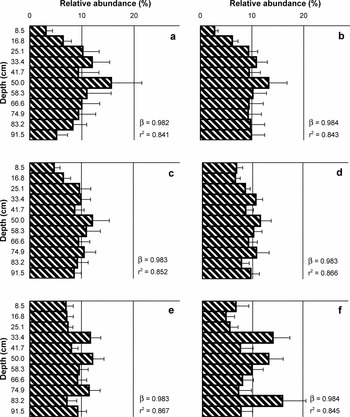
At their respective times of peak fine-root abundance, Rhizotrons 1, 2, 5 and 6 had a relatively uniform distribution of fine roots versus depth in soil, but fine roots predominated at intermediate depths in Rhizotrons 3 and 4. Maximum relative abundance of fine roots occurred at sample depths of 33.4 cm to 74.9 cm for all rhizotrons except Rhizotron 6 (55.0 ± 15.1 cm depth excluding Rhizotron 6). Although the maximum relative abundance of fine roots in Rhizotron 6 occurred at the uppermost, 8.5-cm sample depth, four of the other five rhizotrons had their lowest proportion of fine roots (5.1% or less) at that depth. Fitted β values for individual rhizotrons at peak fine-root abundance ranged from 0.981 to 0.985 (0.983 ± 0.002) with coefficients of determination (r2) from 0.824 to 0.918.
Fitted β values for relative abundance of fine roots averaged across all six rhizotrons at times representing different proportions of peak abundance (Figure 3) were more consistent than were β values among individual rhizotrons at their peak abundance. For six dates spanning a range of average abundance from 29.8% of peak abundance on 28 October 1997 as root abundance was increasing, through 11.5% of peak abundance on 28 May 1998 as root abundance declined, fitted β values ranged from 0.982 to 0.984 (0.983 ± 0.001) with coefficients of determination from 0.841 to 0.867. Average fine-root abundance initially was greatest at the 50.0 cm sample depth (Figure 3a), and persisted at this depth through 30 April (Figure 3e). At peak abundance (Figure 3d), fine roots were relatively uniformly distributed over depth. As root abundance declined (Figure 3e & f), root distribution showed several peaks below 25 cm that reflected the persistence of relatively large-diameter (up to 5 mm) roots.
Average depth distribution of fine roots (≤ 5 mm diameter) for all rhizotrons on six census dates: 28 October 1997 (a); 27 November 1997 (b); 5 January 1998 (c); 27 March 1998 (d); 30 April 1998 (e); 28 May 1998 (f) selected to represent different proportions (29.8%, 55.6%, 71.3%, 100%, 52.8%, and 11.5%, respectively) of mean peak traced root abundance (83.7 m m−2) which occurred on 27 March 1998. Each bar shows mean abundance relative to total abundance for all depths + SE (n = 18 sample areas at each depth) within 5.7 cm above and below the indicated depth. β values for the model of Gale & Grigal (Reference GALE and GRIGAL1987) and coefficients of determination (r2) for the fitted model are shown for each depth distribution.

In order to convert traced root abundance to root-length density per soil volume and root length per soil surface area, we estimated that 2 mm was the average distance behind the rhizotron glass at which fine roots could be traced. For that distance, the peak average root abundance for all six rhizotrons of 83.7 m m−2 is equivalent to a fine-root length to 1 m depth in soil of 41.9 km m−2 ground surface. The 1168.5 cm of fine roots that we collected had a dry weight of 1.1 g, equivalent to a specific root length of 10.6 m g−1. Therefore, we estimate total fine-root dry weight to 1 m depth on 27 March 1998 at peak root abundance to be 3.9 kg m−2 (39.4 Mg ha−1). If we use the lowest and highest peak abundances for individual rhizotrons to bound this average value, then our estimates of peak fine-root dry weight range from 2.1 kg m−2 to 8.1 kg m−2. Annual average fine-root dry weight is 1.7 kg m−2 (calculated by using the final mean traced root abundance, 4.8 m m−2, to represent each of the eight dry-season fortnights that were not censused).
DISCUSSION
The most striking features of our fine-root data are the extreme temporal changes that we observed, especially the rapid, nearly complete disappearance (a 94.2% decline from peak abundance) of fine roots from the top 1 m of soil during the early dry season. Other than work by Chen et al. (Reference CHEN, EAMUS and HUTLEY2002) who used our rhizotrons, we know of no studies of tropical savannas or tropical deciduous forests that have found a similar paucity of fine roots during the dry season. The relatively few studies of seasonal variation of fine-root abundance in such biomes (Arunachalam et al. Reference ARUNCHALAM, PANDEY, TRIPATHI and MAITHANI1996, Cavelier et al. Reference CAVELIER, WRIGHT and SANTAMARÍA1999, Chen et al. Reference CHEN, EAMUS and HUTLEY2004, Kummerow et al. Reference KUMMEROW, CASTILLANOS, MAASS and LARIGAUDERIE1990, Menaut & Cesar Reference MENAUT and CESAR1979, Mordelet et al. Reference MORDELET, MENAUT and MARIOTTI1997, Pandey & Singh Reference PANDEY and SINGH1992, Roy & Singh Reference ROY and SINGH1995, Scholes & Walker Reference SCHOLES and WALKER1993, Singh & Singh Reference SINGH and SINGH1981, Srivastava et al. Reference SRIVASTAVA, SINGH and UPADHYAY1986, Sundarapandian & Swamy Reference SUNDARAPANDIAN and SWAMY1996, Visalakshi Reference VISALAKSHI1994) average a 51% decline in fine-root abundance across seasons. Nevertheless, we contend that the disappearance of fine roots that we observed is likely recurrent and widespread in northern Australian savannas.
The validity of our observations is supported by Chen et al. (Reference CHEN, EAMUS and HUTLEY2002) who found a very similar pattern of temporal change in fine-root abundance (Figure 6 in Chen et al. Reference CHEN, EAMUS and HUTLEY2002), but reported values for traced root abundance an order of magnitude lower than ours. We believe that this disparity most likely is explained by Chen et al. (Reference CHEN, EAMUS and HUTLEY2002) having made a unit conversion error, and that the values they report should be multiplied by ten. Two lines of evidence suggest such an error. First, the peak (c. 6 m m−2) traced root abundance reported by Chen et al. (Reference CHEN, EAMUS and HUTLEY2002) approximately represents 1.4 Mg ha−1 to 50 cm depth, which is more than an order of magnitude below the 26.3 Mg ha−1 that Chen et al. (Reference CHEN, EAMUS and HUTLEY2004) found with root in-growth bags at a similar site. Second, the minimum (0.5 m m−2) traced root abundance reported by Chen et al. (Reference CHEN, EAMUS and HUTLEY2002) represents 0.1 Mg ha−1 to 50 cm depth, which is two orders of magnitude below the 12 Mg ha−1 dry-season minimum reported by Chen et al. (Reference CHEN, EAMUS and HUTLEY2004) and an order of magnitude below the 1.0 Mg ha−1 reported by Eamus et al. (Reference EAMUS, CHEN, KELLEY and HUTLEY2002). If multiplied by ten as we suggest, the peak traced root abundance of Chen et al. (Reference CHEN, EAMUS and HUTLEY2002) differs from ours by only 24 m m−2, which might be explained by Chen et al. (Reference CHEN, EAMUS and HUTLEY2002) measuring only roots ≤ 2 mm diameter.
Our annualized average traced root abundance of 3.8 mm cm−2 is in good accord with the 3.3 mm cm−2 reported by Rutherford (Reference RUTHERFORD1983) for a South African tropical savanna, and our estimate of 1.7 kg m−2 annualized average dry weight of fine roots agrees well with several reports from tropical savanna woodlands and tropical dry forests (Andrade De Castro & Kauffman Reference ANDRADE DE CASTRO and KAUFFMAN1998, Chen et al. Reference CHEN, EAMUS and HUTLEY2004, Lawson et al. Reference LAWSON, JENIK and ARMSTRONG-MENSAH1968, Murphy & Lugo Reference MURPHY and LUGO1986, Okali et al. Reference OKALI, HALL and LAWSON1973). Other studies in these vegetation types reported lower values than ours (Castellanos et al. Reference CASTELLANOS, MAAS and KUMMEROW1991, Cavelier Reference CAVELIER1992, Kavanagh & Kellman Reference KAVANAGH and KELLMAN1992, Lawson et al. Reference LAWSON, ARMSTRONG-MENSAH and HALL1970, Smit & Rethman Reference SMIT and RETHMAN1998, Yavitt & Wright Reference YAVITT and WRIGHT2001) but involved just one sampling during the dry season. A single fine-root sampling ‘off peak’ might seriously underestimate fine-root biomass even if seasonal changes in fine-root abundance are not as extreme as those we observed. A few studies fail to indicate when roots were sampled, making it difficult to evaluate the fine-root weights that they report (Eamus et al. Reference EAMUS, CHEN, KELLEY and HUTLEY2002, Kellman Reference KELLMAN1990, Knoop & Walker Reference KNOOP and WALKER1985, Okali et al. Reference OKALI, HALL and LAWSON1973, Wu Reference WU1991, Zhou et al. Reference ZHOU, ZHOU, LIU, TANG, OUYANG, ZHANG, LIU, LIU, YAN, ZHOU, LUO, GUAN and LIU2006).
Our finding of nearly complete absence of fine roots during the dry season implies that there must be strong selection against retention of surface fine roots. Death of fine roots implies that the cost to the plant of their retention exceeds any benefit. Potential nutrient uptake benefits might be diminished during the dry season because of curtailed decomposition (Campo et al. Reference CAMPO, JARAMILLO and MAASS1998, Roy & Singh Reference ROY and SINGH1995, Wieder & Wright Reference WIEDER and WRIGHT1995) and nutrient immobilization in microbial biomass (Campo et al. Reference CAMPO, JARAMILLO and MAASS1998, Raghubanshi et al. Reference RAGHUBANSHI, SRIVASTAVA, SINGH and SINGH1990, Singh et al. Reference SINGH, RAGHUBANSHI, SINGH and SRIVASTAVA1989, Srivastava Reference SRIVASTAVA1992). Likely as important is avoidance of the respiratory cost of fine roots, arbuscular mycorrhizas, and especially ectomycorrhizas which may impose a high carbon demand on their hosts (Janos Reference JANOS and Molina1985). Ectomycorrhizas are prevalent in northern Australian savannas among canopy Eucalyptus spp. and among several abundant, woody subcanopy species (Reddell & Milnes Reference REDDELL and MILNES1992). Both ectomycorrhizas (Perry et al. Reference PERRY, MOLINA and AMARANTHUS1987) and arbuscular mycorrhizas (Hendrick & Pregitzer Reference HENDRICK and PREGITZER1993) might consume more photosynthate from hosts than they repay, effectively becoming ‘parasitic’ during the dry season (Janos Reference JANOS2007, Johnson et al. Reference JOHNSON, GRAHAM and SMITH1997). The host evolutionary response may have been elevation of soil moisture thresholds for fine-root survival (Côté et al. Reference CÔTÉ, HENDERSHOT, FYLES, ROY, BRADLEY, BIRON and COURCHESNE1998), or elevation of rates of influx of mineral nutrients needed for fine-root persistence. During the wet season, rainfall and seasonally pulsed decomposition (Campo et al. Reference CAMPO, JARAMILLO and MAASS1998, Davidson et al. Reference DAVIDSON, MATSON, VITOUSEK, RILEY, DUNKIN, GARCIA-MENDEZ and MAASS1993, Raghubanshi et al. Reference RAGHUBANSHI, SRIVASTAVA, SINGH and SINGH1990, Roy & Singh Reference ROY and SINGH1995, Wieder & Wright Reference WIEDER and WRIGHT1995) likely are adequate for mycorrhizas to be mutualistic.
Although a 3.8-fold difference in fine-root abundance between rhizotrons with the highest and lowest peak abundance (Figure 2) indicates considerable horizontal spatial variation, the accuracy of our data with respect to temporal variation and depth distribution is supported by changes in fine-root abundance among five of the six rhizotrons being strongly correlated, and root abundance in those five rhizotrons peaking within a relatively narrow 1.5-mo period. Moreover, at peak abundance, the highest proportions of roots consistently were located at intermediate depths for all except Rhizotron 6, and all depth distributions were relatively uniform. Vertical fine-root distributions averaged across all six rhizotrons and their fitted β values are consistent through time (Figure 3).
High β values indicate large proportions of roots at depth (Gale & Grigal Reference GALE and GRIGAL1987), and those that we calculated are at the upper end of the range for all biomes reported by Jackson et al. (Reference JACKSON, MOONEY and SCHULZE1997). Indeed, our β values for E. tetrodonta savanna are closer to the 0.982 average reported for tropical deciduous forest than to the 0.972 of tropical grassland/savanna (Jackson et al. Reference JACKSON, MOONEY and SCHULZE1997). Jackson et al. (Reference JACKSON, MOONEY and SCHULZE1997) calculated that tropical deciduous forests and tropical grassland/savannas respectively contain 42% and 57% of their fine-root weight in the upper 30 cm of soil. In contrast, we found an average of only 22% of fine roots to 30 cm depth at peak abundance. Close cropping of the herbaceous layer by abundant macropod herbivores together with fire prevention at our site may have minimized root abundance just beneath the soil surface.
Our data show a close relationship between fine-root abundance and rainfall (Figure 2). Fine-root increase during the rainy season and decline after most seasonal rain has been received is similar to changes of fine-root production with rainfall observed in a tropical deciduous forest by Sánchez-Gallén & Alvarez-Sánchez (Reference SÁNCHEZ-GALLÉN and ALVAREZ-SÁNCHEZ1996). In our study, cumulative rainfall increased relatively uniformly, but after a total 75.6 mm of rain fell to begin the rainy season (and root growth), there were 12 successive days without measurable rainfall. Therefore, rainfall most likely acted as an ‘on switch’ for root growth, as suggested by Scholes & Walker (Reference SCHOLES and WALKER1993). In contrast, 11 consecutive days without measurable rainfall at the end of March 1998 initiated precipitous fine-root decline. High water withdrawal capacity at peak fine-root abundance in March probably exacerbated reduction of soil moisture. Root growth of some tree species can be affected negatively by soil moisture just below field capacity (Côté et al. Reference CÔTÉ, HENDERSHOT, FYLES, ROY, BRADLEY, BIRON and COURCHESNE1998).
Our finding that fine roots did not develop until initial wet-season rainfall had occurred contradicts the suggestion of Williams et al. (Reference WILLIAMS, MYERS, MULLER, DUFF and EAMUS1997) that dry-season soil moisture above the wilting point at 0.5–1-m depth in an E. tetrodonta savanna might be crucial for leaf-flush prior to the onset of wet-season rains. In spite of the absence of fine roots that we observed, however, Myers et al. (Reference MYERS, DUFF, EAMUS, FORDYCE, O'GRADY and WILLIAMS1997) found that woody species in an E. tetrodonta savanna showed no moisture stress at any time during the dry season even though transpiration rates can be higher during the dry season than during the wet season (O'Grady et al. (Reference O'GRADY, EAMUS and HUTLEY1999). Duff et al. (Reference DUFF, MYERS, WILLIAMS, EAMUS, O'GRADY and FORDYCE1997) reported high pre-dawn leaf water potentials when several woody species in an E. tetrodonta savanna produced new leaves in the late dry season, and irrigation of four species significantly advanced leaf flush only in one deciduous species (Myers et al. Reference MYERS, WILLIAMS, FORDYCE, DUFF and EAMUS1998). Together, these studies imply strongly that woody species are able to acquire deep soil water throughout the dry season as suggested by Hutley et al. (Reference HUTLEY, O'GRADY and EAMUS2000) and Chen et al. (Reference CHEN, HUTLEY and EAMUS2003).
Chen et al. (Reference CHEN, HUTLEY and EAMUS2003) reported observing roots to 9 m depth, and suggested that macropores prominently penetrate the ferricrete layer and often contain tree roots. Werner & Murphy (Reference WERNER and MURPHY2001), however, found just one of 47 trees that they excavated in Kakadu National Park to have penetrated the ferricrete where its trunk stood. Nevertheless, Eucalyptus species consistently are deep rooted (Canadell et al. Reference CANADELL, JACKSON, EHLERINGER, MOONEY, SALA and SCHULZE1996) with one species reaching 60 m depth, and ectomycorrhizas as deep as 15 m in a limestone cave (Stone & Kalisz Reference STONE and KALISZ1991). Sinker roots are able to penetrate very hard lateritic layers by exploiting lines of weakness, such as vertical macropores and cracks (Dell et al. Reference DELL, BARTLE and TACEY1983). Kimber (Reference KIMBER1974) argued that E. marginata could transpire freely throughout dry, hot months by having fine roots at the ends of a few long sinker roots just above a water table at 14.9 m. Dawson & Pate (Reference DAWSON and PATE1996) demonstrated through hydrogen stable isotope analysis that two Eucalyptus species derived most of the water they used during the wet season from surface roots, but during the dry season most water was taken up by deep roots. Such a ‘dual’ system of fine roots also might occur in E. tetrodonta savannas (Bowman & Prior Reference BOWMAN and PRIOR2005) where, through hydraulic lift (Caldwell et al. Reference CALDWELL, DAWSON and RICHARDS1998) prior to the disappearance of surface fine roots, it might contribute to the surprisingly high soil moisture content at 0.5–1 m depth noted by Williams et al. (Reference WILLIAMS, MYERS, MULLER, DUFF and EAMUS1997).
Deep roots similarly may be important for sustaining dry-season transpiration of evergreen forests in portions of the Amazon Basin that suffer significant seasonal drought (Nepstad et al. Reference NEPSTAD, DE CARVALHO, DAVIDSON, JIPP, LEFEBVRE, NEGREIROS, SILVA, STONE, TRUMBORE and VIEIRA1994). There, roots reached 18 m depth, and soil carbon (excluding live roots) beneath 1 m depth exceeded above-ground biomass (Nepstad et al. Reference NEPSTAD, DE CARVALHO, DAVIDSON, JIPP, LEFEBVRE, NEGREIROS, SILVA, STONE, TRUMBORE and VIEIRA1994). Respiration by deep roots principally accounts for very high partial pressures of CO2 in the soil atmosphere (Davidson & Trumbore Reference DAVIDSON and TRUMBORE1995) such that river and floodplain waters of the central Amazon Basin are supersaturated with CO2 (Richey et al. Reference RICHEY, MELACK, AUFDENKAMPE, BALLESTER and HESS2002). In notable congruence, groundwater extracted from 10–50 m depth in Australia's northern territory is highly acidic because of its high content of dissolved CO2 (Marks & Jolly Reference MARKS and JOLLY1987).
Our estimates of fine-root weight are based upon a 10.6 m g−1 specific root length measurement which is similar to the average 12.2 m g−1 for trees given by Jackson et al. (Reference JACKSON, MOONEY and SCHULZE1997). The difference (3.72 kg m−2) between peak fine root weight and the dry-season minimum may reasonably approximate annual net production (Chen et al. Reference CHEN, EAMUS and HUTLEY2004) because of the extreme seasonality of fine-root abundance, despite not including within-season turnover. That approach predicts 37.2 Mg ha−1 y−1 net primary production of fine roots (NPPfr) which corresponds closely to the 34.7 Mg ha−1 y−1 estimate by Chen et al. (Reference CHEN, EAMUS and HUTLEY2004) for 50 cm soil depth. At 49% carbon concentration (Chen et al. Reference CHEN, HUTLEY and EAMUS2003), our estimate yields 18.2 Mg C ha−1 y−1 NPPfr, similar to the 14.3 Mg C ha−1 y−1 carbon release from soil reported by Chen et al. (Reference CHEN, EAMUS and HUTLEY2002).
If organic matter derived from fine roots in the uppermost 1 m of soil in Northern Territory savannas is in annual equilibrium, then the 1.15 m m−2 d−1 traced root length decline that we observed might return 1.4 × 10⁶ Mg C d−1 to the atmosphere in the early dry season. How much of that carbon is recaptured by evergreen foliage and shunted below ground to deep fine roots is not known, but Chen et al. (Reference CHEN, HUTLEY and EAMUS2003) estimated that E. tetrodonta savanna is a net annual carbon sink. Although Sombroek et al. (Reference SOMBROEK, NACHTERGAELE and HEBEL1993) contended that the importance of deep subsoil storage of carbon in savanna and savanna-forest areas is less than in other parts of the tropics, E. tetrodonta savannas may be an exception, as has been shown elsewhere (Fisher et al. Reference FISHER, RAO, AYARZA, LASCANO, SANZ, THOMAS and VERA1994, Trumbore et al. Reference TRUMBORE, DAVIDSON, BARBOSA, NEPSTAD and MARTINELLI1995). If decomposition of deep fine roots is very slow (Davidson & Trumbore Reference DAVIDSON and TRUMBORE1995), then the net consequence of the dual fine root systems that we postulate for E. tetrodonta savannas may be to partially buffer atmospheric CO2 against increase. Sinker roots and associated deep fine roots effectively may serve as ‘injection wells’ for the ‘disposal’ of atmospheric carbon.
ACKNOWLEDGEMENTS
We thank Alejandro Hoyos for painstakingly manually measuring scanned root tracings, Gregory Connors for writing an ARCINFO program to automatically measure tracings, and Pedro Aphalo for providing a copy of the program RootView. We also thank Patrick Ellsworth, Leo Sternberg and Tania Wyss for critically reading the manuscript. This study was funded by the Cooperative Research Centre (CRC) for Tropical Savannas and by the Parks and Wildlife Commission of the Northern Territory. DPJ especially thanks the CRC for support as a visiting scientist May–August, 1997. DPJ and DMJSB thank Harvard University for Bullard Fellowships in Forest Research that engendered this collaboration.