1. Introduction
While it is acknowledged that exchange through markets is beneficial to the contracting parties, there arise situations where certain unilateral actions of one party increase its own payoff while simultaneously harming the interests of the other party. Reneging on payment obligations after the good is delivered is one of such actions, which have been collectively termed as ‘opportunism’ in the literature (Williamson, Reference Williamson1985). Since such behaviour is detrimental to the functioning of markets, contract enforcement mechanisms are instituted to penalise the erring agents. While formal enforcement mechanisms, such as courts, are more popular, wherever the state is absent, corrupt, or too slow to be usable, alternative modes known as informal enforcement mechanisms, emerge to provide the necessary economic governance (Dixit, Reference Dixit2004). These informal mechanisms are broadly defined to include contract enforcement through various non-state mechanisms such as social networks, trade associations, or other private enforcement mechanisms.
In this paper, we look at enforceability of contracts – specifically, oral job contracts between employers and labourers – in a particular setting of India's urban informal economy where formal enforcement mechanisms are virtually absent, viz., the market for daily wage casual labour in construction and related activities in the city of Navi Mumbai.
As is the case of several urban areas, especially in developing countries, Navi Mumbai is characterised by the presence of day labour markets at various locations in the city. These markets involve labourers seeking daily wage employment from their prospective employers, known as labour contractors. The street corners where these markets are held each morning are known as ‘nakas’, which is the word used to denote a road junction in Marathi, the local language.Footnote 1 We survey seven such nakas and find considerable incidence of contract enforcement problems in the form of employers reneging on wage payments to the labourers. However, in the absence of a written job contract, labourers are unable to invoke formal enforcement mechanisms. In this context, we explore the feasibility and effectiveness of informal enforcement mechanisms in these markets.
The literature on informal contract enforcement is extensive and includes both theoretical (e.g., Dixit, Reference Dixit2003, Reference Dixit2004) as well as empirical work, motivated by the study of markets in historical settings (e.g., Greif, Reference Greif1993; Milgrom et al., Reference Milgrom, North and Weingast1990) as well as those in least developed, developing, and transition countries (e.g., Fafchamps, Reference Fafchamps1996, Reference Fafchamps2004 on Sub-Saharan Africa; McMillan and Woodruff, Reference McMillan and Woodruff1999 on Vietnam; Jain and Sood, Reference Jain and Sood2012 on India). While this literature has looked at informal enforcement in commercial, credit, and rental relationships, our paper is unique in applying this framework to casual labour markets.
Drawing upon the insights from this literature, we look for evidence on information transmission among the labourers about opportunistic employers, the limits to such transmission in large and diverse markets, and the deterrence effect of certain factors in reducing the incidence of reneging. We also discuss how the peculiarity of our setting, namely casual labour markets with widespread unemployment, undermines the labourers’ ability to invoke certain enforcement mechanisms discussed in the literature.
The markets we examine are predominantly composed of migrant labour, including those from within the state of Maharashtra (where Navi Mumbai is located) as well as from other states. In all, our sample of about 400 labourers includes migrants from 15 different states of India. Using variation in the size and diversity (in terms of workers’ native language and caste) in the composition of the nakas, we find that payments to labourers belonging to larger and more diverse markets are more likely to be reneged, confirming the theoretical predictions of Dixit (Reference Dixit2003). We also find that greater the share of native speakers of the local language (Marathi)Footnote 2 at a naka, lower is the incidence of wage reneging. We interpret this finding in the light of considerable political antagonism against non-Marathi migrant labour in and around the city of Mumbai. Further, among the non-Marathi migrants, those who came to these markets through social networks are found to be relatively less vulnerable than those who did not. Moreover, labourers who maintain a record of work done are found to be less vulnerable to reneging.
Although we focus on a specific setting, we believe that our findings have broader relevance. Estimates suggest that in 2011–12, 72% of all urban workers and 96% of those in the construction sector in urban areas do not have a written job contract,Footnote 3 undermining their ability to invoke formal enforcement mechanisms in case of any disputes. In this context, our study can be seen as a micro-empirical exercise to gain insights into the mechanisms of the important, although relatively underexplored, area of informal contract enforcement in India's urban informal economy.
The rest of the paper is organised as follows: in section 2, we draw upon the relevant literature to propose a conceptual framework and discuss the testable hypotheses that emerge from this; section 3 provides details of the day labour markets in Navi Mumbai, our sampling strategy, and various sample level characteristics relevant for our study; in section 4, we provide the empirical results; and section 5 concludes.
2. Conceptual framework
In addition to recognising the importance of pro-social norms, such as honesty and trust-worthiness, in promoting agents’ proclivity to honour contracts (Platteau, Reference Platteau1994a, Reference Platteau1994b), literature has identified enforcement strategies to be based on mechanisms that are either exogenous or endogenous to the economic transaction. Exogenous mechanisms not only correspond to legitimate coercion through state mechanisms such as courts, but also include illegitimate coercion by private third-parties, adopting extralegal means such as threats and violence to enforce contracts (Dixit, Reference Dixit2004).Footnote 4 The effectiveness of third-party mechanisms, especially the legal ones, depends on whether the claim is verifiable.
But in instances where it is difficult to invoke third party mechanisms,Footnote 5 agents in an economic exchange resort to ‘endogenous enforcement strategies’ (Bowles and Gintis, Reference Bowles and Gintis1993, p.85). These are self-enforcing mechanisms wherein parties to the exchange themselves adopt strategies that foster contract enforcement (Dixit, Reference Dixit2009). These typically involve agents engaging in repeated interactions with each other. To the extent that the agents’ payoffs in continuing the relationship are higher than reneging and risking its termination, they would continue to honour their contractual obligations.
If there are lucrative outside options for the agents, then termination of the relationship is not a credible threat to deter opportunism. If severing the bilateral relationship is not a sufficiently credible deterrent, punishments could also be imposed at the level of a group within which the agents trade frequently. Since such multilateral enforcement strategies are aimed at self-governance of contracts within the group, they could also be considered to be endogenous.
However, for these group (or multilateral) punishments to work, there should be an effective reputation mechanism, wherein agents share information about those who renege on their contracts and refuse to trade with them. Literature suggests that such information sharing works better in small groups that are connected by ‘extended family relationships, neighbourhood structures, and ethno-linguistic ties, because such links facilitate repeated interactions and good communication’ (Dixit, Reference Dixit2004, p.66). Moreover, since other agents might have to incur a private cost to impose punishments on the opportunistic agent, there is a problem of free-riding in these settings. Given this, small, stable, and cohesive groups are found to be better in enforcing multilateral punishments because they reduce such collective-action dilemmas better (Ostrom, Reference Ostrom1990). In a theoretical model, Dixit (Reference Dixit2003) shows that as the distance between the agents – either in the geographic or in the socio-economic space – increases, the scope for information sharing about the erring agents reduces, and the incidence of opportunism increases. Thus, the effectiveness of the reputation mechanism (and hence of informal governance) depends on market characteristics such as its size and diversity in the composition of agents.
A prominent example of endogenous enforcement strategies is in the rural credit markets in developing countries where, in the absence of third-party mechanisms, contracts are predominantly enforced through repeated interactions. Here, endogenous enforcement takes the form of rationing of credit in equilibrium, such that the borrowers cannot borrow to their desired extent and interest rates do not rise to clear these markets (see Ghosh et al., Reference Ghosh, Mookherjee, Ray, Mookherjee and Ray2000 for an overview of this literature; also see Allen, Reference Allen1983). Lenders resort to this strategy because rationing of credit aligns the incentives of the debtor towards repayment, by reducing the borrower's debt burden vis-a-vis the cost of default, namely the inability to borrow in the future.
It is instructive here to take stock of the implications this has for our setting. Labour markets share some of the features of the credit markets in the sense that labourers provide their services at one point in time while receiving wages at a later point. A pertinent question to be asked then is that, just like the lenders in the credit market, if it is possible for the labourers to ration their effort so that the employers’ incentives are aligned towards paying rather than reneging on their wages.
We can begin to answer that question by appealing to the literature on an aspect of contract enforcement predominantly discussed in the labour market context: the non-contractibility of worker effort. In the face of imperfect observability or verifiability of worker effort, literature has suggested that the employer could adopt an endogenous strategy of paying more than market-clearing wages, leading to unemployment in equilibrium. The employer could then offer to renew the worker's contract only if he was not found to be shirking on the job. This strategy ensures that an employed worker prefers to expend effort than to be found shirking and face unemployment. In this sense, unemployment acts as a ‘disciplining device’ to induce worker effort (Shapiro and Stiglitz, Reference Shapiro and Stiglitz1984).
As we shall see in the next section, the markets we examine are characterised by labour glut conditions and widespread unemployment which implies that workers who decide to reduce their effort can readily be replaced by the unemployed workers. Thus effort rationing is not a credible strategy to deter employers’ opportunism. In other words, while the principal in the credit market models can afford to reduce the amount of lending, the labourers here cannot afford to work less, because of irregular work availability and their own vulnerability.
By focusing on enforcement problems on only one side of the labour market, the literature has largely ignored the eventuality of wage reneging by the employers. But in contexts where wage reneging is possible, the standard labour market enforcement problem will have to be modified to take account of the fact that workers will also have to resort to endogenous or exogenous strategies to enforce their claim (i.e., wages).
While unemployment might render effort-rationing as a non-credible strategy, workers might invoke the multilateral punishment strategy through the reputation mechanism. However, to the extent that the efficacy of the reputation mechanism differs across contexts, depending on access to social networks and the size and diversity of the market, workers will differ in their ability to successfully invoke this strategy. Moreover, the differential ability of the workers to enforce their claims can also stem from characteristics that influence their ability to invoke exogenous mechanisms, such as their ‘Marathi’ identity or maintenance of work records. Given this, the naka markets could be construed as an arena of ‘contested exchange’, wherein ‘the benefit the parties derive from the transaction depends on their own capacities to enforce competing claims’ (Bowles and Gintis, Reference Bowles and Gintis1993, p.85).Footnote 6 Thus, while employers enforce their claim (i.e., work effort) by credibly threatening to sanction workers with unemployment, workers will try to enforce their claim by invoking exogenous or endogenous mechanisms, albeit with varied degrees of effectiveness. To the extent that a worker is believed to be less effective in enforcing his claim, he will be more vulnerable to wage reneging by the employer.
Broadly, the conceptual framework outlined here gives us certain testable hypotheses. We summarise these below:
-
(1) Effectiveness of third-party mechanisms increases if the labourer has a written contract or a record of work done. Moreover, identity of the worker with whom the transaction is done also matters. If a labourer does not have the capacity to invoke coercive mechanisms, either through legitimate means such as political support, a written contract, or through illegal means such as violence and threats, then this increases his chances of being reneged on wage payments. Hence, ceteris paribus, the more vulnerable a worker, the more likely it is that his payments are reneged.
-
(2) Since labourers belonging to larger, more diverse markets are less likely to meet and interact with each other, the risk of losing reputation for the opportunistic employer is lower in these markets, vis-a-vis smaller and more homogenous markets. Thus, ceteris paribus, larger and more diverse a market, higher the likelihood of a contract breach.
-
(3) Prior information about the employers’ credibility would help the labourers in choosing job offers that are trustworthy. This information could either be obtained from the labourer's social networks at the market or it could be accumulated through his own experience of observing various employers over the years.Footnote 7 Thus, ceteris paribus, labourers with access to social networks, and those with experience in the market, are less likely to experience a contract breach.
3. Market and data characteristics
Labourers gathering for work at the nakas each morning are recruited mostly in construction and allied sectors. In recent times, the construction sector has been booming in India.Footnote 8 With this, the day labour markets have become ubiquitous in various cities of the country. However, with the exception of Singh (Reference Singh2002) in the context of Delhi and Mukherjee et al. (Reference Mukherjee, Paul and Pathan2009) in the context of Mumbai, the street corner markets for casual labour have been relatively underexplored by researchers.Footnote 9 Navi Mumbai, where our study is based, is a planned city on the outskirts of the city of Mumbai. With Mumbai being saturated for space, Navi Mumbai has been witnessing hectic residential and commercial construction activity over the past few years.
For the ease in procuring labour and monitoring their work, the principal employers in the construction industry sub-contract the hiring and supervision of naka workers to labour contractors. These contractors arrive in the market every morning and recruit workers as per their requirements for the day. The naka workers are not attached to any particular contractor and usually reside within the vicinity of the nakas. The workers predominantly transact with the contractors and hardly interact with the principal employers.Footnote 10
Survey and sampling strategy
The survey was conducted in collaboration with ‘Youth for Unity and Voluntary Action (YUVA)’, a Non-Governmental Organisation (NGO) based in Navi Mumbai, during January and February 2013. In addition to capturing labour market outcomes such as wages, employment, occupational hazards, etc., the survey also collected information on various aspects of migrant workers’ integration into the city such as housing, basic amenities, political representation, financial inclusion, etc.
Navi Mumbai is divided into 14 administrative units called ‘nodes’. We surveyed the following seven nakas that are spread across six nodes in the city: Belapur, Kharghar, Kohinoor, Nerul, Sanpada, Sukhapur, and Vashi. In the absence of reliable official statistics on the extent and distribution of naka workers, we relied on YUVA's estimates suggesting that about 4,000 workers assemble for employment at the seven nakas mentioned above. However, these labourers are not distributed equally across the various nakas, as some markets have larger congregation of workers than others.
Since, our objective is to target a population that is frequenting a specific type of market, a typical household survey would not achieve our purpose. Hence, we adopt intercept point sampling methods, also known as time-and-space sampling methods,Footnote 11 wherein individuals from the target population ‘are sampled during set time periods at locations where they are likely to congregate’ (Jain and Sood, Reference Jain and Sood2012, p.11). Accordingly, we visited these markets between 8:00 A.M. and 10:00 A.M. each day, when workers congregate seeking work, and surveyed a sample of 399 labourers which corresponds to about 10% of YUVA's estimates for naka workers in Navi Mumbai.
To be sure, this method of sampling introduces certain biases. For instance, we do not control for the labourers’ selection into migration or into the naka worker profession. Further, we only survey those workers who are available at the market during our enumeration exercise and might have missed out on those who did not turn up at the naka during the days we visited or were picked up for work before we could survey them. In spite of these limitations, given the structure of these markets, we believe that this is the appropriate survey methodology for our purpose.
The sample is distributed across the seven nakas in accordance with YUVA's estimates of the distribution of total workers. Thus, our sample has the highest representation from Kharghar (31%), followed by Nerul (17%), Sukapur (16%), Sanpada (12%), Kohinoor (10%), Belapur (8%), and Vashi (6%). The size of the sample at each naka is a rough indicator of the magnitude of construction related activities that are underway in and around these areas.
Demographic characteristics
Workers in our sample have migrated from fifteen different states, including Maharashtra (46% of the sample), Telangana (12%), Uttar Pradesh (11%), Karnataka (11%), Bihar (6%), Rajasthan (4%), West Bengal (3%), Odisha (2%), Madhya Pradesh (2%), and Others (3%). Since the native languages spoken in these states are different, our sample has native speakers of eight different languages.
The sample predominantly consists of male workers (93%) who are young, with a median (mean) age of 30 years (33 years). About 90% of the sample is below the age of 45 years. The labourers first migrated for work about ten years ago on an average, and have been visiting these nakas for about eight years, on an average.Footnote 12
In terms of other demographic characteristics, Hindus constitute the majority (79%), followed by Muslims (10%), and Buddhists (9%). Among those who chose to reveal their social group (i.e., 94% of the sample), most of the workers belonged to the Scheduled Castes (SCs) (40%), followed by the Scheduled Tribes (STs) (25%), Other Backward Classes (OBCs) (21%), with the lowest representation from Others (14%).Footnote 13 The migrants are not well educated: about 40% of the sample is illiterate; and among the literate, about 80% have not matriculated. Majority of the migrants do not have any major assets in their villages, with about 55% of them being landless while another 40% has land holdings of less than two hectares.
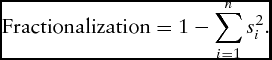
The nakas have some variation with respect to the distribution of workers belonging to various states. For instance while workers from Maharashtra have substantial representation across all the nakas, about 60% of migrants from Telangana and about 70% of migrants from Bihar are in the Kharghar naka. Thus, each naka is characterised by varying degrees of diversity in terms of the native languages, castes, and the states of origin for the workers. In order to gauge the extent of this diversity, we calculate the fractionalisation index (Alesina et al., Reference Alesina, Baquir and Easterly1999), defined as the following:
 $$\begin{equation*}
{\rm Fractionalization} = 1 - \sum\limits_{i = 1}^n {s_i^2 } .
\end{equation*}$$
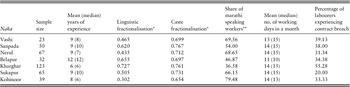
Where si denotes the share of workers belonging to category ‘i’ in the naka. The index measures the probability that two randomly drawn people from a naka belong to different castes, or speak different languages (Alesina et al., Reference Alesina, Baquir and Easterly1999). Thus, higher values of the index indicate greater diversity in the composition of the naka. We calculate the linguistic and caste based fractionalisation for each naka and find that Kharghar has the greatest diversity while Kohinoor naka, which has 72% of its constituents from Maharashtra, has the least. Table 1 summarises various naka level characteristics.
Summary statistics at the naka level

Note: *See the previous page for the definition and interpretation of the fractionalisation index.
**The figures denote the percentage of labourers in each naka who migrated from within Maharashtra or its neighbouring districts of Bidar, Bijapur, and Gulbarga in Karnataka.
Labour market characteristics
Employment and wages
As mentioned above, labourers in our sample are predominantly employed in construction and allied activities such as painting, plumbing, carpentry, etc. On average, workers get employment for about 14 days in a month (median of 15 days), reflecting the irregular availability of work in these markets. There is no significant variation in the average working days across nakas with the exception of Belapur which has the lowest average (median) at 11 days (10 days). Although these markets are located in the same city, there is not much mobility of workers across them with about 83% of the sample reporting that they do not visit other nakas. While distance between the nakas is reported to be a significant factor hindering the movement, workers also mentioned other factors such as lack of friends and acquaintances in other nakas.
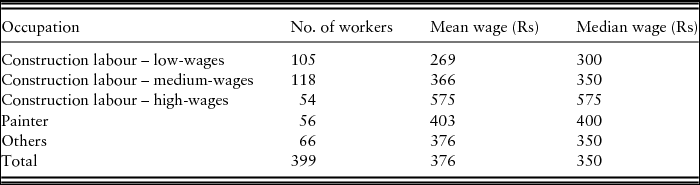
Table 2 gives the average and median daily wages earned by workers belonging to various occupations. Since construction workers are a heterogeneous group with different levels of skill sets, we classify them further into three groups: low, medium, and high wage workers. The average wages across these categories range from about Rs 270 to Rs 575. Painters are paid the next highest daily wage after high-wage construction workers. Those classified as others include plumbers, carpenters, head load workers, etc.
Daily wages by occupation type
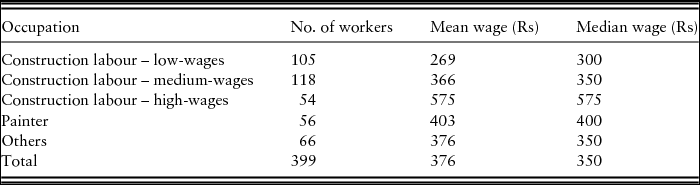
Note : Construction workers are classified into the three categories in the following way: Low wage workers are defined as those earning a daily wage of Rs. 300 or less; Medium-wage workers are those earning a daily wage of greater than Rs. 300 but less than Rs. 500; and High-wage workers are defined as those earning a daily wage of Rs. 500 and above.
Moreover, we find that, except for 5% of the sample (i.e., 20 workers), the wages reported by the workers are higher than the official minimum daily wage of around Rs 250 for construction work in the state of Maharashtra.Footnote 14
One point of concern is whether these workers are sufficiently aware of the market wages such that the contractors can strategically choose to underpay those workers who are relatively less informed. However, this does not seem to be a problem in these markets as, after controlling for the workers’ occupation, the dispersion of the wages reported is minimal, with the coefficient of variation ranging between 0.16 and 0.36, implying that the workers seem to be reasonably aware of the market wages.
Although the workers are classified as daily wage labourers, their wages are usually paid at the end of their entire work assignment with the contractor, which, in some cases, might last up to a few weeks. In the meantime, the labourers might be paid a small fraction, known as kharchi, to meet their immediate expenses.
Reneging on wage payments
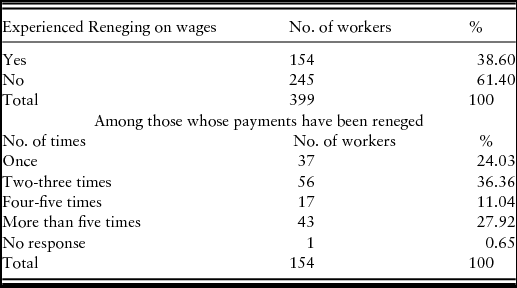
As given in Table 3, there is a significant problem of contract enforcement in these markets with 154 labourers or about 39% of the sample reporting that their wage payments were reneged at least once since they started working here. Moreover, 39% of those who experienced reneging have reported that this has occurred more than four times.
Incidence of reneging on wage payments
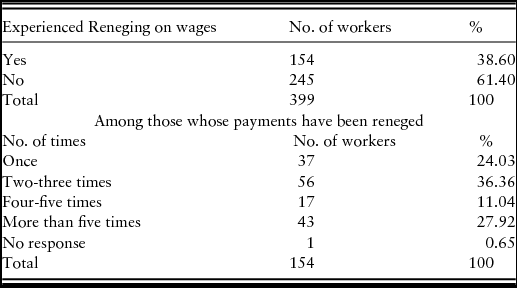
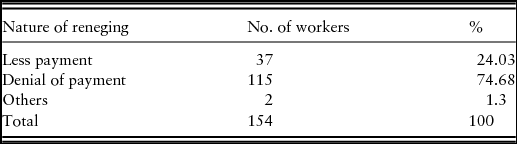
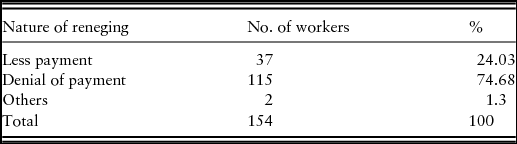
Broadly, reneging on wages could take two forms. The employer could make partial payment or he could completely deny payment. It can be argued that partial payment could also result from an inefficient job done by the labourer. Denying the payment altogether, however, can be seen as symptomatic of opportunism by the employers. Table 4 shows that the nature of reneging in these markets is predominantly in the form of avoiding the payment altogether (about 75% of those who experienced reneging).
Nature of reneging
Case studies conducted by YUVA reveal that the opportunistic contractors siphon-off the amount given by the principal employers towards wage payments. When the labourers ask for their wages, contractors resort to various strategies including blaming the principal employer for the delay, intimidating the workers with threats of physical or sexual violence, or going untraceable altogether.Footnote 15
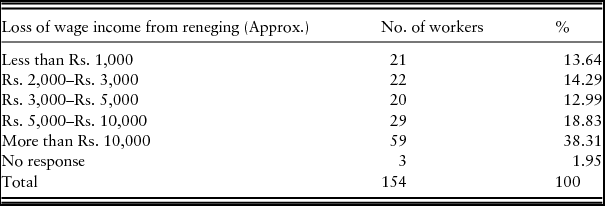
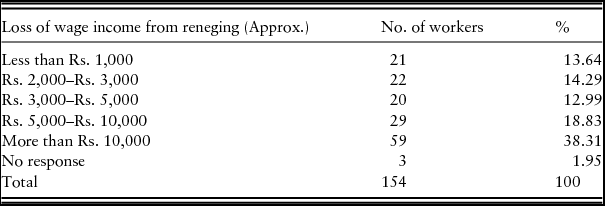
Loss of wages as a result of reneging has cost the labourers considerably: Table 5 shows that about 38% of those who’ve experienced reneging have reported to have lost more than Rs. 10,000, a significant loss for a daily wage labourer with no other substantial assets to smoothen his consumption. The large sums can be explained by the fact that these represent cumulative losses of wages over multiple instances of reneging. In some cases, we also observed that labourers worked for up to three months without payment for a particular contractor when they eventually realised that their wages were going to be reneged.
Loss from reneging
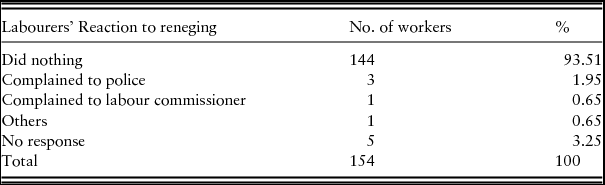
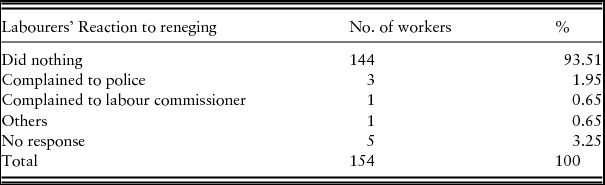
However, in spite of the magnitude of the problem, we see from Table 6 that the labourers have not approached any formal redressal mechanisms, with as many as 94% reporting to have not done anything after their wages were reneged.
Labourers’ redressal mechanism
Our conceptual framework provides us with several insights into this problem. As outlined in Section 2, the exogenous mechanisms through which enforcement can take place involve coercion: both legitimate as well as illegitimate. Here, it is worth noting that Mumbai has had a history of political antagonism towards migrant labour from outside Maharashtra. Politicians often resort to the rhetoric that Marathis are losing out on job opportunities to the migrants from the rest of India, which on some occasions has even led to attacks on the latter (see Times of India, 2008). Migrants in low-skilled occupations are especially vulnerable to this adverse political climate. Given this, for an employer, ceteris paribus, the cost of reneging on payments to migrants from outside Maharashtra is likely to be lower than the same for local (Marathi speaking) labourers.Footnote 16
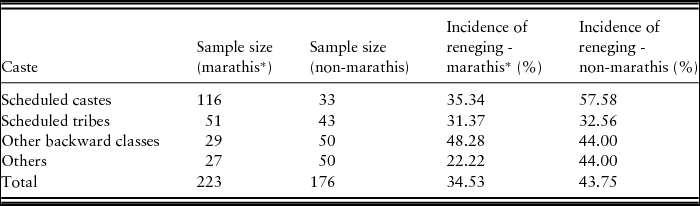
Table 7 provides the incidence of reneging by the caste-group of the labourers for MarathisFootnote 17 and non-Marathis respectively. While the incidence of reneging for Marathi workers is considerable (35%), it is lower than the same for the non-Marathis (44%). Also, except for the OBCs, incidence of reneging among Marathis is lower than that of non-Marathis for all the other caste groups, although the difference is marginal for the STs. Among Marathi OBCs, about 50% of those who experienced a contract breach have reported to have been paid partially, the highest proportion among all workers. Although it is not clear if partial payment is a reflection of the quality of work done, higher incidence of reneging among Marathi OBCs (as compared to non-Marathi OBCs or other Marathi speaking labourers) needs to be seen in the light of this observation.
Incidence of reneging – caste wise – marathis and non-marathis
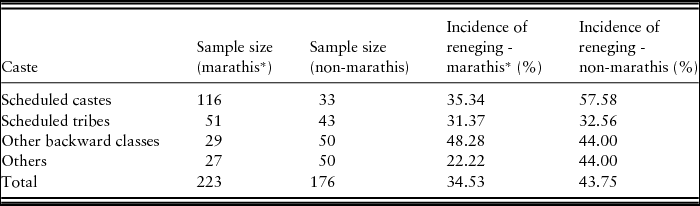
Note : *Marathi migrants include those who migrated from within Maharashtra or its neighbouring districts of Bidar, Bijapur, and Gulbarga.
An important requirement for invoking legitimate third-party mechanisms is the verifiability of claims. In our setting, a formal job contract between the labourer and the employer would have been helpful. Nevertheless, as noted by Fafchamps (Reference Fafchamps1996), even if no formal agreements are written, if there are documents that ease the burden of proof of work done, it becomes easier to impose the coercion costs on the reneging employer. Thus, employers are less likely to renege on payments to labourers who have some proof of the work done. In our sample, about 11% of the labourers have reported to have maintained records of work done. Although these records might not always be legally enforceable, they might at least help the aggrieved labourers approach a private redressal mechanism such as an NGO, etc.Footnote 18 Confirming the benefits of this record keeping, we see that incidence of reneging is lower among those who have a work record (30%) as compared to those who do not (40%). It could be possible that maintenance of work records are correlated with other factors that also contribute to reduction in wage reneging and hence confound the impact of work records. In order to rule this out, we checked for the association between maintenance of work records with each of the various socio-economic characteristics of the workers using the Pearson's chi-squared test, and find that the association is not statistically significant for caste, education, and Marathi-speaking variables. On the other hand, maintaining work record is significantly associated with the type of occupation, with painters seeming to be particularly more likely to maintain them. This can partly be explained by the informational requirements of this occupation: multiple layers of paint are required to be done and it is difficult to verify the layers after the entire job is completed. Given the risk that the contractor can deny payments owing to this non-verifiability, painters tend to maintain records at each stage of the process.
Turning towards endogenous enforcement mechanisms, we note that the nature of the day labour market is such that it consists of a large pool of migrant labourers, who come to these markets from various regions of the country. To the extent that the nature of the work is low or semi-skilled, and does not require significant training, the employer need not be dependent on a particular labourer to get his work done, especially because of the labour glut conditions prevailing in these markets. Given this, the value that an employer attaches to maintaining his relationship with a particular labourer is low in these markets. This implies that while the employer can enforce his claim through the credible threat of unemployment, the likelihood of the labourer resorting to endogenous bilateral strategies such as effort rationing seems implausible.
On the other hand, the effectiveness of multilateral mechanisms depends on the scope for information transmission among the workers about opportunistic employers. Thus, labourers with access to better information networks are less likely to experience reneging on wage payments as this might help them in choosing trustworthy employers. About 62% of our sample has reported to have come to these markets through friends and relatives. We see that payments to labourers who came through social networks are slightly less likely to be reneged than to those who came by themselves (37% versus 41%).
In addition, we intend to capture the effect of the distance over which the workers have migrated through a measure of the distance of their native district from Mumbai. Ex-ante, this could go either way: it could be argued that migrants who come from far-off places have weak community bonding at their destination in the initial phases of migration and hence are more vulnerable (see Mukherjee et al., Reference Mukherjee, Paul and Pathan2009); on the other hand, long-distance migrants might choose to migrate to a place precisely because they have pre-existing networks.
We find that the benefits of access to social networks are more pronounced among workers who migrated from non-Marathi speaking districts, which are farther away from Mumbai. In particular, we see that Marathi-speaking migrants in our sample predominantly come from districts that are within a radius of about 550 Kms from Mumbai: only 2 out of the 223 Marathi-speaking labourers come from districts that are farther than 550 Kms from Mumbai. Similarly, out of the 176 non-Marathi speakers in the sample, only 5 come from districts that are less than 550 Kms away from Mumbai.
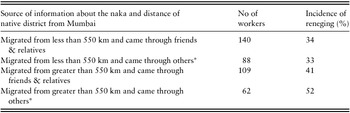
Defining long-distance migrants as those whose native district from Mumbai is farther than 550 Kms, we see that while, on the whole, they have higher incidence of wage reneging (45%) than those who come from shorter distances (34%), among long-distance migrants, payments to those who came through social networks are less likely to be reneged (41%) than to those who did not (52%). Interestingly, for short-distance migrants (who are almost entirely composed of Marathi speakers), social networks do not seem to matter and they seem to be doing better than the long-distance migrants regardless of the presence of social networks (see Table 8).Footnote 19
Incidence of reneging – social networks

Note : *’Others’ corresponds to migrants who learnt about these markets on their own (30% of the sample), or through a contractor (2% of the sample).
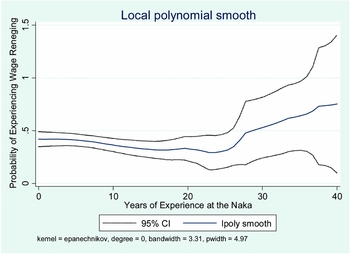
Further, as noted in Section 2, the more experienced a labourer, the better informed he is likely to be of opportunistic employers. However, it is also plausible that longer the time a labourer spends in the market the more likely it is that he might have experienced wage reneging at some point in time. Since our survey asked whether the labourers have ever been reneged, experience in these markets is likely to have these two opposite effects on the incidence of reneging. We capture these in Figure 1, through a ‘U’ shaped pattern in the incidence of reneging with respect to the experience of workers.Footnote 20 In the multivariate regression framework, we intend to capture this non-linearity by considering years spent working at the naka along with its square term. We also consider if the migrant has any previous experiencing of migrating and working elsewhere before coming to these nakas.
Incidence of reneging with respect to workers’ experience at the Naka.

With regard to market level determinants of the effectiveness of multilateral mechanisms, it is to be noted that as large and diverse markets reinforce anonymity among the labourers, limiting their capacity to share information about opportunistic employers, the efficacy of the reputation mechanism is likely to be weaker in such markets. We capture this effect by naka level characteristics such as size, linguistic fractionalisation, and caste fractionalisation.
4. Empirical results
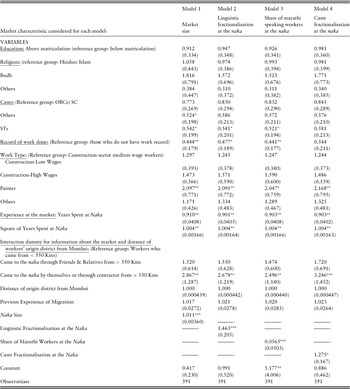
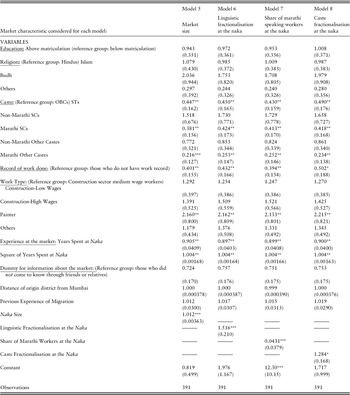
In Tables 9 and 10, we provide the odds-ratio estimates for two sets of models of logistic regression predicting the incidence of reneging on wage payments in these markets. Each set has four different specifications capturing market level characteristics of size, linguistic fractionalisation, caste fractionalisation, and share of Marathi-speaking workers, respectively.Footnote 21 The specifications in Table 9 differ from those in Table 10 in the following way: in Table 9, we provide the estimates of the effect of social networks among long-distance migrantsFootnote 22 and do not consider the ‘Marathi-speaking’ status of the workers. In Table 10, on the other hand, we differentiate between Marathis and non-Marathis within SCs and Others castesFootnote 23 and do not have the social network and distance interaction dummy.Footnote 24
Logistic regression predicting chances of wage payments being reneged – capturing effect of social network among long-distance migrants (Odds Ratio)

Note: Robust standard errors in parentheses *** p < 0.01, ** p < 0.05, * p < 0.1.
Logistic regression predicting chances of wage payments being reneged – interacting caste and marathi status (Odds Ratio)

Note: Robust standard errors in parentheses *** p < 0.01, ** p < 0.05, * p < 0.1.
We see that while education and religion do not have a significant impact on the odds of facing a contract breach in either set of models, when a distinction is not made between Marathis and non-Marathis (Table 9), caste is not statistically significant, except for STs who have about 45 to 50% lower odds of facing a contract breach than the reference category (i.e., OBCs), however this effect is weak (similarly for ‘Others’ in Model 1). In Table 10, where we distinguish between Marathis and non-Marathis among SCs and Others, we see that the odds of contract breach for Marathi SCs are about 60% lower and those for Marathi Others are about 75 to 80% lower than the same for the reference category (i.e., OBCs). For Non-Marathi SCs and Others, the odds of a contract breach are not statistically different from those facing OBCs. On the other hand, the odds of contract breach for STs are about 50 to 55% lower than the same for OBCs. The deterrence effect of dealing with a Marathi worker is also captured at the market level, where we find, in both sets of models, that greater the share of Marathi speaking workers in a naka, lower is the incidence of contract breach.
We see that, ceteris paribus, the odds of experiencing a contract breach for those who maintain a record of work done are lower by about 50 to 60% (depending on the various specifications in Tables 9 and 10) than that of those who do not maintain a work record.Footnote 25
With respect to occupations, Painters seem to be particularly more vulnerable than others. Ceteris paribus, the odds of wage payments being reneged to a painter is about 100 to 120% higher than the same for the reference category. Issues with respect to verifiability of work done, that we discussed in the previous section, could be contributing to the painters’ vulnerability.
Looking at the impact of experience, we find that years spent at the naka has an odds ratio of less than one, whereas square of years spent has an odds ratio of greater than one, confirming the ‘U’ shaped pattern. We also see that long-distance migrants who came to these markets without any social networks are more vulnerable. In particular, ceteris paribus, the odds of wage payments being reneged to these workers are about 150 to 220% higher than the short-distance migrants. On the other hand, for long-distance migrants who come through social networks, the odds of facing a contract breach are not statistically different from the short-distance migrants.
With respect to market level characteristics, we see that, ceteris paribus, larger the size of the market, greater the odds of contract breach of the labourers. Similarly, higher the language and caste fractionalisation indices, greater are the odds of experiencing wage reneging. Thus we find that experienced workers as well as those with access to social networks and work records are less vulnerable than others. Moreover, as the size and diversity of a market increase, it becomes difficult to sustain multilateral contract enforcement.Footnote 26
Some caveats regarding our study are in order. While our results seem to suggest that the labour contractors are strategically exploiting the anonymous nature of large and diverse markets, since we do not model employer behaviour in particular, we do not explicitly capture the precise mechanisms through which this might be taking place. In particular, we recognise that the evolution of large, diverse markets could be a complex, endogenous process and the cross-sectional nature of our study does not capture this adequately. However, despite these caveats, we note that our results are broadly in conformity with the literature on the limits of informal contract enforcement.
5. Conclusion
In this paper, we have looked at contract enforcement mechanisms in a specific setting of India's urban informal sector – the day labour market for construction labour in Navi Mumbai. We find that formal mechanisms of enforcement are virtually non-existent here. In their absence, workers face considerable risk of loss of their wages. Although the workers seem to be relying on informal mechanisms (such as social networks) to negotiate these markets, their effectiveness in large and diverse settings such as these is found to be limited. Our findings suggest that market interventions that address information asymmetries between workers and employers and promote reputational mechanisms to punish opportunistic agents might reduce contract enforcement problems. Such interventions already exist in developed economies. Singh (Reference Singh2002) discusses the role of a government operated labour office in Germany, called ‘arbeitsamt’, which performs the role of liaison between the daily wage labourers and the potential employers each of whom gather at the office every morning. Measures that enhance the bargaining power of the workers (such as maintenance of work records) would help them in accessing either formal or quasi-formal institutions of enforcement (such as courts, labour commissioners, NGOs, etc.).
State interventions in these markets are especially important because workers themselves are unable to form trade unions, although a significant proportion of them acknowledged that the presence of a union would have reduced reneging (about one-third of those who have experienced this problem). In addition to the time and costs involved, high regional fractionalisation within nakas also implies that collective action to organise into a union might be difficult. However, given that more than 95% of the sample does not have political voice (in the form of a vote) in Navi Mumbai, the prospects for state intervention appear bleak. It is hoped that advocacy among the workers, either by the government or by an NGO, about the effectiveness of certain mechanisms in reducing contract breach (such as maintaining work records) would lead to adoption of measures that deter employers’ opportunism.
Acknowledgements
I would like to thank the two anonymous referees whose invaluable comments have considerably improved the paper. This paper builds on a chapter of my PhD dissertation at the Indira Gandhi Institute of Development Research. For their guidance and support, I would like to thank Sripad Motiram, S. Chandrasekhar, and Sudha Narayanan. Support from Vinita Balekundri, Gopal Dubey, Ratna Mane, and the team at YUVA is gratefully acknowledged. For helpful discussions and comments, I would like to thank E. Somanathan, Geoffrey Hodgson, Upasak Das, Sumit Mishra, Ajay Sharma, participants at the INET-YSI workshop at Antalya, and at the Centenary Research Scholars Workshop, University of Calcutta. This paper is written as part of the ‘Strengthen and Harmonize Research and Action on Migration in the Indian Context’ SHRAMIC, an initiative by Sir Dorabji Tata Trust and Allied Trusts (SDTT &AT).