‘It would have been easy’, writes Christopher Dingle, the editor of The Cambridge History of Music Criticism (henceforth CHMC), ‘to start with the rise of the press in northern Europe, broadly coinciding with the Industrial Revolution, and concentrate on the principal centres of Western art music’. Instead, he has chosen, he says, a path of greater effort and reward, its purview expanded to encompass whatever may be described as ‘the chronicle and discourse of music’, so that it might potentially ‘cover all music, of all times, all places and all types where there is evidence of discussion and reflection upon it’. Conceived in this broader way, he writes, ‘a history of music criticism itself becomes an alternate history of music, considering those who do the observing, chronicling and critiquing rather than the object of their musings’ (p. 3).
I wish he had taken the easy path. Confinement to the area of music reviewing – which (as the editor admits) is what we mean by ‘music criticism’ in usual parlance – would have defined it as an activity with a traceable history, tellable in terms of material and social affordances, institutions, issues and consequences, and one that will be of special interest and relevance to readers of this journal. Widening the scope to indefinable infinity produces haze and confusion, ensures a largely anecdotal coverage with an unwarranted though irresistible emphasis on individual personalities (‘those who do’, etc.), and, of course, one that is doomed to failure, like any attempt to encompass the unencompassable. So the book must begin with an editorial disclaimer – ‘All histories are partial. All histories are simplifications’ (p. 1) – which rehearses a truism that could have gone without saying, and probably would have but for the editor's evident bad conscience about his governing decision. And it leaves authors as well as readers in a quandary of inclarity as to what to provide or expect. One author, Mark Berry, actually spoofs the situation, beginning his chapter (‘The Feuilleton and Beyond: Criticism in the Federal Republic of Germany and Austria after the Second World War’) with three pages of Hamletic maundering (what to include? where to begin?) that might not amuse readers as much as it did author and editor (pp. 590–92). But it does underscore the volume's most persistent problem: continually deferring an answer to the question, Is this a thing?
There are precedents. The large, multiply authored article ‘Criticism’ in the New Grove 2 has a preamble by Fred Everett Maus that chimes almost faultlessly with the introduction to CHMC:
Music criticism may be defined broadly or narrowly. Understood narrowly, it is a genre of professional writing, typically created for prompt publication, evaluating aspects of music and musical life. Musical commentary in newspapers and other periodical publications is criticism in this sense. More broadly, it is a kind of thought that can occur in professional critical writing but also appears in many other settings.Footnote 1
And, like Prof. Dingle's Introduction, it goes on to announce that it will travel the broad way ‘in order to see the continuity among various activities of musical interpretation and evaluation’. But that continuity, something not observed but merely asserted, is fictitious. It gives rise not to a narrative but to an arbitrary list (or parataxis, if that makes you feel better) – which may do for a dictionary article, but not for a book that calls itself a history, not even if its components are ordered chronologically. Prof. Dingle has assembled the contents of CHMC into six Parts, enumerated with Roman numerals, plus a Postlude contemplating the possible future. Part I (‘The Early History of Music Criticism’) comprises six chapters devoted to periods antedating ‘The Rise of the Press’ (Part II), following which the subject actually does effectively narrow down in the main to what we all know as music reviewing. Thus it was for the sake of these earliest chapters, on writings that were never called criticism in their day, that all the disclaimers had to be made and clear definitions sacrificed. (The earliest use of the actual term seems to have been Mattheson's in his journal Critica musica, from 1722.) As it turns out, moreover, only two of them – ‘Speaking of Plainsong in the Middle Ages’ by Christopher Page, and ‘Music Criticism in the Late-Medieval and Renaissance Era’ by Stefano Mengozzi – in fact precede the rise of the press. Were they truly worth their price?
Why plainsong to begin with? Just because it is the traditional starting point for ‘histories of Western music’? The best the very resourceful author can do to justify the chapter he was assigned is to ferret out words like dulcedo (sweetness) and lascivia (gratification) in descriptions of liturgical chanting. He works hard to educe from them a dialectical pair, portending an early round in the contest between ethics and aesthetics (but where is St Augustine?), or perhaps, more improbably, a scuffle, centuries avant la lettre, in the name of aesthetic autonomy. Meanwhile, I thought it strange that while mentioning Boethius, who died about two decades before Pope Gregory I was born, as an early model of ‘musical teaching and codification’ (p. 11), Prof. Page neglects to tell his readers what I would have expected to be his chapter's big news, that at the top of the musical food chain – above the citharode who plays or sings the song, and above the poeta who makes the song, both of whom a musicae scientiae intellectu seiuncti sunt (‘are shut off from an understanding of musical science’) – this late-classical philosopher placed the one quod judicandi peritiam sumit (‘who can judge from experience’), and who is therefore the true musicus (musician). In a word as yet uncoined, he means a critic. Never again would that third one – he's talking, dear reader, about the likes of you and me – be rated so high. But Prof. Page never mentions him or defines his role.
It is Prof. Mengozzi who, almost in spite of himself, manages to broach a workable definition of CHMC's titular subject, by first proposing and then shaking off the notion, popular among composers and theorists, that music criticism is ‘closely aligned’ with their domains – even to the extent that (as Mengozzi paraphrases Maus), ‘the very act of assembling tones to create a melody implies a conscious act of self-criticism on the part of the musician’, since any selection implies rejection (p. 25). But if that is all it is, then music criticism as a separate activity would seem devoid of a raison d'être (as theorists and composers might readily agree). Happily, Prof. Mengozzi's very next sentence, albeit intended as amplification, finally narrows things down usefully: criticism properly so-called does not concern the making alone (that being grammar), but is motivated by ‘the awareness of the affective power of organized sound upon listeners’, so that it becomes study of ‘meticulous quantifications of the structures of musical pitch (scales, intervals, proportions, temperament, etc.) in conjunction with a consideration of the psychological and social effects of those same structures’ (p. 25).
Criticism, in short, and in keeping with Molino's once-popular tripartition sémiologique, requires, and is defined by, responsiveness to ‘esthesic’ concerns.Footnote 2 And, it also follows, though no author says so outright within the covers of CHMC, theory (like censorship) can be a priori, while criticism, whether positive or negative, is necessarily a posteriori. Thus, to pick two evaluative texts that Prof. Mengozzi offers as examples of criticism, Pope John XXII's bull Docta sanctorum, warning prescriptively against minims and hockets, does not really qualify according to his criterion, while Tinctoris's Liber de arte contrapuncti, with its obiter dicta on solecisms in specific compositions by Faugues, Caron or Busnoys (not to mention its blanket dismissal of any music more than 40 years old), can be fairly so called, as can Glareanus's Dodekachordon, with its enthusiastic Wunderkabinett of a last chapter, De symphonetarum ingenio (‘On the Skilfulness of Composers’).
So much for prehistory. As early as the third chapter, the press starts surreptitiously to rise, and we get the first of several surveys dealing with writings that are (on unspecified terms) dubbed ‘musical discourse’ or ‘music criticism’ in Italy, France, Britain and the germanophone lands up to the eighteenth century. That division of the material by countries or languages will recur many times; but alongside this potential superfluity there remain shortages to report. The bane of random or haphazard coverage is never dispelled. I was surprised to find that, once the period of actual music reviewing is reached, there is virtually no attempt to cover those other kinds of ‘chronicle and discourse, . . . discussion and reflection’ on which the editor so insists in his introduction, including some very conspicuous types that have actually been called ‘criticism’ since the nineteenth century.
There is, for example, no treatment, nor is cognizance even taken, of what the nineteenth century termed Stilkritik, or ‘style criticism’, which came to musicography with the founding documents of Musikwissenschaft, and which over the next century and a half produced a huge literature that is still current, if attenuated. Its chief early protagonist, Guido Adler, who introduced it as a curricular subject in 1885, and who 50 years later authored an article on it that was still prescribed to musicology novices when I was one, appears only once in CHMC, when Kelly St. Pierre, the author of a chapter on Czech and Slovak music criticism, casually records his appointment to the faculty of the German University in Prague (p. 443).
Nor is there any discussion of a querelle through which many of the older readers of this review will have lived, when Joseph Kerman, first in an article called ‘A Profile for American Musicology’ (1965), and then in a book called Contemplating Music: Challenges to Musicology (1985), made strenuous efforts to get American musical scholarship to incorporate the type of ahistorical (or transhistorical) evaluative and explicative writing that in literature went, beginning in the 1940s, under the name of New Criticism (‘the way of looking at art’, in Kerman's definition, ‘that tries to take into account the meaning [music] conveys, the pleasure it initiates, and the value it assumes, for us today’Footnote 3). Kerman is mentioned only twice in CHMC, both times in passing, first as a commentator on musical canon-formation (‘repertoires are determined by performers, canons by critics’, quoted on pp. 232–3) and the other time with a reference to his ‘influential and controversial’ book of 1985, in what Kerman would surely have regarded as the bizarre context of Soviet critical debates, and without any description of the controversies it inspired at home (p. 581).
I thought for a moment that new-critical modes were being adumbrated as early as CHMC's third chapter, Carrie Churnside's ‘Musical Discourse in Italy, 1500–1800’, when Baldassare Castiglione's Il cortegiano (Book of the Courtier, 1528) and Cosimo Bartoli's gloss on Dante (Ragionamenti accademici sopra alcuni luoghi difficili di Dante, 1567) are adduced as ‘discussions that took place between music-loving amateurs’ (p. 44) and I recalled R. P. Blackmur, Kerman's secret mentor, whose celebrated, ‘winsomely snobbish’ definition of criticism was ‘the formal discourse of an amateur’.Footnote 4 But no, Dr Churnside makes straight for Luigi Dentice's Duo dialoghi della musica (1552) ‘because’, she writes, ‘it contains an early concert review’ (p. 45); and from then on it is the nascent professional commentariat (alongside the still ill-fitting theorists) that commands her interest, and that of practically all her fellow authors.
Finally, discussion of the vast congeries of viewpoints and methods that travels under the umbrella of Critical Theory, which has informed so much public and academic writing about music in the past half century, is confined to a single chapter, Mark Berry's on West German and Austrian music criticism in the aftermath of the Second World War, as if that were the extent of its relevance. T. W. Adorno gets one additional mention, when Raffaele Pozzi, in a chapter on Italy in the twentieth century, credits him with ‘an important role in the renovation of music criticism in Italy’, though without specifying its nature.
II
The editor might have forestalled these complaints had he only announced that CHMC would omit coverage of academic criticism. But such an announcement, it seems, would have contradicted too flatly the brave assertions on which the enterprise had been staked; and so unresolved issues bedevil the book's range of topics and their treatment at every turn. In the end, the unannounced and unjustified limitations are dwarfed by much more conspicuous redundancy and supererogation, by-products of what probably seemed a self-evident principle by which to subdivide and organize the contents and commission the chapters.
That principle is nationality. Nations – ‘national schools’ – are the primary categories into which art has been sorted (concert programmes constructed, museums hung, anthologies compiled) since the late eighteenth century, when concerts, museums and printed anthologies began proliferating. Ironically enough, its conceptual source is Stilkritik, one of the critical practices so conspicuously scamped in CHMC, first theorized by Johann Joachim Winckelmann and already taken for granted in the earliest mappings of music history. It would seem only natural, then, that if you are constructing ‘an alternate history of music’, as the editor of CHMC has described it, you will proceed analogously. But in a multiply-authored book that combines the national principle with a periodized chronology, this turns out to have been a major miscalculation. With one exception, every section of the book is repetitively subdivided into chapters representing nations, among which, as in a United Nations council, there are permanent members and a random assortment of transients. We have already seen that the first section of the book contains chapters on Italy, France, Britain and Germany. The second (‘The Rise of the Press’) has chapters on Italy, France, Britain, Germany and Russia. The fourth (‘Entering the Twentieth Century’) has chapters on France, Britain, Germany, the United States and Canada, Portugal, Spain, Norway, Hungary and Czechoslovakia. The fifth (‘New Areas’) introduces new musical genres as they begin to be written about, but the nationality principle persists, with chapters on the United States, Cuba, and Singapore. The sixth and last (‘Developments since the Second World War’) reverts to chapters on Italy, France, Britain, Germany/Austria, the USSR, and the United States. The third section (‘Critical Influence and Influences’) is the exceptional one, organized by issues rather than nations: canon formation (Laura Hamer), recordings (the editor), and women (Hamer again), first as critics and then as objects of critique.
That exceptional section is also, not by accident, exceptionally interesting and rewarding to read. Elsewhere, wheels are constantly re-invented as author after author tells the same stories of burgeoning public spheres, exploding (later receding) print cultures, mushrooming nationalism, political and commercial pressures, factions, aesthetic and stylistic disputes, critical role-playing, gatekeeping, canon constructing, ethical dilemmas, contests over authenticity and so on, none of them coterminous with national boundaries – especially not nationalism. And though invented again and again, none is a complete and viable wheel, for in their confinement to a single bailiwick (and their probable – quite reasonable – assumption that basic matters will have been attended to up front) the various authors give partial and (inevitably) contradictory views, passing along to readers the task of synthesis that a single author would have been obliged to perform. It is really too much to ask of a reader to negotiate a narrative of such inefficiency. The more I slogged, the more insistently the question nagged, how else might the book have been structured?
One of the ‘national’ chapters unexpectedly suggested an alternative model, but only, in apparent paradox, when the nation was filtered out of it. Paulo Ferreira de Castro's short chapter on Portugal, a country whose inclusion I would not have predicted, and whose critics (and composers) I would be hard-pressed to name, is assigned to the section on the early twentieth century; but it is actually concerned with the whole history of Portuguese music-critical activity from its nineteenth-century beginnings to the present, and is therefore, despite its compactness, one of the few chapters to raise a full range of historical issues. Its author, a Portuguese musicologist trained in Great Britain (and with an interest, as I have reason to know, in Russian music), has sufficient international perspective to see the situation in his small country as typical (or perhaps synecdochical) rather than distinctive. ‘In Portugal’, he writes, ‘as elsewhere the development of music criticism has been closely linked to the flourishing of the periodical press’ (p. 318; my italics), and that sense of pars pro toto is maintained throughout. Possibly because he recognizes his country (at least since the time of Domenico Scarlatti) as receiving territory, devoid of bulking and distracting personalities, he allows big general themes – ‘questions of authorship and readership’, as he puts it (p. 310) – to emerge the more saliently. As a result, his chapter, which is more likely than most to be overlooked by those who consult this book as an adjunct to the study of their favourite musical repertoires, actually provides a better introduction to the main issues than the editor's Introduction.
The chapter's analysis is especially illuminating because it is deconstructive, in the precise and technical meaning of that grossly overused adjective. ‘Whatever form it may assume’, de Castro writes, ‘music criticism tends to thrive on the production of differential schemata (beautiful versus ugly, imitation versus imagination, foreign versus national, traditional versus modern, serious versus frivolous, etc.’. (p. 319). He has a bit of fun adding binaries as he goes along, establishing increasing distance, either by the use of scare quotes (‘artificial’ versus ‘expressive’), or by actual decoding: ‘“Italianism” versus “Germanism” as easily politicized ciphers for “routine” (conservatism) and “progress” (evolution, “the future”) respectively’, or most generally, casting the role of the critic ‘either as a reinforcer of prejudice or as a producer of difference’, then adding that ‘the fact that these and other polarities often disguise larger issues of authority and power should come as no surprise’ (p. 330).
He thus broaches what I have always regarded as the most important difference among critics, the ancient contest between those who regard themselves as the public's preceptor – or what Simon Frith, the sociologist of popular music, defines hundreds of pages later as ‘critics who see their task as giving shape to a potential taste community’ (p. 525, n.80) – and those who see themselves as the voice or public spokesperson for existing communities, a dichotomy that grew directly out of the old dialogues of ancients and moderns (as reported as early as the third chapter of CHMC, e.g. in disputes between Pietro della Valle and Lelio Giudiccioni over the merits of Frescobaldi (p. 49)).
It is, in any case, always a good question to ask of critics, regardless of time or place, whether they come before or after the taste communities for which they purport to speak. Not that they will always answer truthfully or correctly, or even know the answer; and not that one can always tell the difference. But the question is clarifying. Neither position is necessarily to be preferred; either can be abused, and abuse often takes the form of a false flag. Take, for example, ‘Muddle Instead of Music’ (Sumbur vmesto muzyki) on Shostakovich's The Lady Macbeth of the Mtsensk District, the unsigned Pravda editorial of 28 January 1936, probably the twentieth century's most famous music review, which Peter J. Schmelz analyses in his chapter, ‘Music Criticism in the USSR from Asafyev to Cherednichenko’. For whom did it speak? Pravda was the voice of the Soviet Communist Party, but the Party claimed to speak for the people. Maxim Gorky fastened on precisely this point in a complaint about the article he addressed directly to Stalin, in a letter that became public in 1993, writing that ‘critics should give a technical assessment of Shostakovich's music’, so as to instruct and educate listeners and thus create a proper taste community for socialist realist art. Instead, ‘what the Pravda article did was to authorise hundreds of talentless people, hacks of all kinds, to persecute Shostakovich’, (quoted on p. 576), and this because it couched its complaint on behalf not of qualified preceptors but – falsely – on behalf of the existing audience (ignoring the fact that the opera had had a wildly successful two-year run by the time of the ‘review’). ‘The composer apparently never considered the problem of what the Soviet audience looks for and expects in music’, reads Pravda's indictment (now known to have been by written by the notorious David Zaslavsky, ‘Pravda's journalistic revenge weapon’ in the words of Time magazineFootnote 5), catering rather to ‘the effete “formalists” who had lost all their wholesome taste, ignoring the demand of Soviet culture that all coarseness and savagery be abolished from every corner of Soviet life’.Footnote 6 This pretence, writes Prof. Schmelz, initiated and empowered ‘an attack on the elites in the name of the (anonymous) masses’ (p. 577).
David Iosifovich Zaslavsky (1880–1965), the anonymous author of ‘Muddle instead of Music’, in his Pravda office, c. 1947

The same ploy can of course be used as an incentive as well as a deterrent. The biography of Nikolai Myaskovsky by Alexei Ikonnikov, which has long been available in English, contains an example I have long been dying to quote. It comes, ostensibly, from a peasant (or ‘collective farmer-pensioner’ (kolkhoznik-invalid) as he is identified in the original Russian text) named Sergei Ivanovich Korsakov, who, it seems, wrote a letter to the musicologist Arnold Alexandrovich Alshvang, who passed it along to Myaskovsky, who passed it along to Ikonnikov. After listening to a broadcast of Myaskovsky's folksy, bouncy Eighteenth Symphony (in C major, composed in 1937, the most intense year of Stalinist political terror, and dedicated to the twentieth anniversary of the October Revolution), Korsakov wrote,
I simply can't tell you how much I enjoy it. It's so full of vim and gusto, and brimful of good spirits. Especially in the first movement. There's a particularly fine passage there, you know, which is repeated three or four times, and occurs again in the finale. Of course, you can guess which passage I mean. … That particular passage from the first movement is in my ears all the time.Footnote 7
In his cover letter to the composer Alshvang wrote that his peasant correspondent ‘expresses fresher and more profound opinions than many of our would-be pundits’.Footnote 8
How I would love to see that letter.
This digression into Soviet territory will, I hope, serve to signal the range of fruitful issues broached en passant by Paulo de Castro's unpretentious little chapter on Portugal. Similarly transferable is the chronological trajectory the chapter describes. Of the conditions that summoned the music-critical profession into existence, Prof. de Castro writes that ‘in the inaugural issue of O trovador’, the earliest specialist music periodical in Portugal (1855),
the pianist and composer Emilio Lami denounced the lack of musically authoritative voices in the press, calling for a more professional kind of criticism at a time when, as he put it, music was increasingly regarded as a social necessity rather than a mere pleasure, thus staking out a new position for the musical specialist in the cultural sphere. (p. 322)
Similarly economical is the characterization of Fernando Lopes Graça (1906–94), nominated as the foremost Portuguese critic of the twentieth century, whose writings are said to ‘touch upon virtually all the major issues of Portuguese musical life’, to wit: ‘the social responsibility of the artist, the conflicting forces of nationalism and cosmopolitanism, the impact of modernism on the European periphery, the political uses of folklore and the vexed question of ‘Portugueseness’ in music’ (p. 328).
These pithy sentences sketch a pair of historical Zustände, as the Germans would say, evoking both a situation and its informing conditions; and their juxtaposition gives a sense of the historical movement from the mid-nineteenth century, when the enhanced status of music and of musicians elevated the potential status of a writer on music (who was then positioned to lobby in turn for the musical profession), to the mid-twentieth, when political authority forcibly impinged (as elsewhere) on cultural affairs. A wealth of recurrent themes – power, professionalism, social necessity, social responsibility, social status, pleasurableness, contemporaneity, nationality – that will resurface in practically every chapter of the book, are set forth in an unusually dialectical (i.e. mutually implicative) fashion. (And, once again, this applies particularly to nationality, the author taking care to remind us that – as in all ‘peripheral’ lands – ‘the label “national” was … tantamount to bad publicity for a product of Portuguese art or industry’ (p. 325) – until it became the very opposite.) The chapter's conclusion sketches a third Zustand, the one that every author must confront whose remit extends into the twenty-first century, with its ‘crisis of the traditional press and the expansion of so-called social media’ (p. 330).
In its tandem of comprehensiveness and concision, Prof. de Castro's chapter provides the best general enunciation to be found within CHMC of constant themes (each of them worthy of chapter-length treatment), and it is one of the few that convey a dynamic sense both of temporal evolution and of interaction between agents and affordances. I would prescribe it for perusal alongside whichever other ones individual readers may be prompted by their particular interests to consult. Many such chapters are informative and well written and can profitably serve the adjunctive purpose the editor foresees for them as components within ‘an alternate history of music’, but they will do so the more effectively within the framework de Castro's chapter supplies.
III
Those who follow their prior interests, however, may miss the best fruit on the tree. One of the finest granular descriptions I've read of the critic's actual job of work is a chapter that readers of this journal might be especially prone to overlook: Shzr Ee Tan's ‘Cultural Anxieties, Aspirational Cosmopolitanism and Capacity Building: Music Criticism in Singapore’, a synchronic essay set in what at the time of its writing was the present, and with an Asian purview to boot. But since its actual subject is the globalized musical culture toward which many of the later chapters in CHMC gesture – and its discontents – it amply earns its keep within a historical, chiefly Eurocentric survey. An exercise in retrospective participant-observation by an ethnomusicologist who came to academic work from a journalistic career covering Western classical music for The Straits Times, a Singapore newspaper, it focuses on the quotidian push and pull of working life: pressures and resistance, blandishment and risk, pursuit of livelihood and status, with emblematic twenty-first century precarity looming over all. The opening anecdote recounts the reprisals to which the author was subjected after publishing an insufficiently positive review of a performance by a young violinist with a politically connected mother, and proceeds from there to a general consideration of her job as ‘a negotiation of subjectivities governed by bigger ecosystems of musical, cultural, socio-economic and political activity’ (p. 545).
Having left active employment within these systems and gained some critical distance, she views her former profession in terms of its necessary compromises. In Singapore, one of the world's richest and most international music markets, ‘critics worked with local agents of international record companies for regular supplies of albums to review (and promote) while tapping into networks of local listeners replugged into global conglomerates of distribution and consumption via multinational media companies and the Internet’ (p. 548). Determined to transcend simple binary ‘opposition between industry and critic’, and relying for her initial formulation on the pioneer cultural ecologist John Holden, she ‘posits music criticism within “connections, symbiosis, feedback loops, and flows of people product, ideas and money”’ (p. 545). In effect, she details a contest among critics for fluctuating privilege and prestige, and service to competing masters. I can hardly imagine a better short sociological take on music as public activity, or on music critics as actual mediators of that activity, and I write as one whose eye is always out for such things. No reader should miss it.
It is particularly refreshing because it follows another chapter, ‘Working in the Cool Capitalism Complex: The Role of Critics in the World Music Field’ by Timothy D. Taylor, which treats similar content in the loftiest sociologese, the most immediate effect of which is to finesse agency, the very thing Dr Tan most vividly illuminates.
He defines the writing of ‘critics’ as an ‘attempt to make a product or a commodity more than just a product or a commodity, but a trusted entity that enjoys complex relationships with consumers, involving memories of past experiences of pleasure, community with others, feelings of satisfaction and self-satisfaction, membership in a special club of consumers, and much more’ (p. 538). Such hype, while distinct from what I would call criticism (as a priori is distinct from a posteriori), is certainly not without cultural significance. Prof. Taylor shows it at work, as paratext, in the most interesting part of his chapter, tracing the transformation of the word ‘authenticity’ from a label connoting purity to one connoting hybridity (pp. 533–6 passim). What ultimately defines the ‘critics’ role in what one could call the Cool Capitalism Complex’, as Prof. Taylor sums it up, is their usefulness in marketing, or more precisely, in branding:
since they, and others who discover or create and promote the hip, cool, edgy, trendy, are slowly destabilising cultural hierarchies in the West and, perhaps especially, in the United States, as cultural capital as defined by knowledge of the fine arts declines in importance as a way of displaying and maintaining cultural superiority and dominance. Such knowledge is increasingly replaced by knowledge of the hip and the cool, a new form of capital measured by one's familiarity with the latest indie rock album or independent film, and even, sometimes, knowledge of an obscure world music artist. And with this knowledge increasingly comes cultural capital in the neoliberal world. (p. 541)
But if this transcends the crude ‘opposition between industry and critic’, which Dr Tan's chapter seeks to complicate, it is only because Prof. Taylor sees no contest at all. Once the dread word is out, moreover, and the Cool Capitalism Complex has been properly tainted as ‘neoliberal’, it can be explicitly denounced for its complicity in ‘promotion of musicians thought to be cool, or potentially cool, and its discarding or ignorance of many other musicians’ and morally equated with ‘the well-known Military Industrial Complex’, known for ‘making far too many people far too much money in the United States and promoting endless war’. Really? The one is ‘no less pernicious’ than the other (p. 541)? Such overheated overstatement oversimplifies the problem Prof. Taylor's chapter identifies, that of co-option. Most of us can name prominent critics – Michael Steinberg, Nicholas Kenyon, for two – who have indeed gone over to the other side (Steinberg on behalf of the San Francisco Symphony and later the Minnesota Orchestra, Kenyon to run the London Proms, the BBC music division, and currently the Barbican Centre); but all critics are under pressure to play ball with the moneyed interests of whose products they are the appointed (or self-appointed) judges, and the moneyed interests don't always wear identifying badges when one encounters them in daily life.
Shzr Ee Tan shows us the process and pressures of co-option at ground level and in real time. The paper for which she worked, she reports, recognized four ‘music beats’: (1) Anglo-American Pop/Rock, (2) Chinese/Asian Pop (broken down into ‘Mandopop, Cantopop, K-pop and J-pop’), (3) Classical Music (both Western European and Chinese Conservatory), and (4) Jazz and World Music (one beat, not two), as she lists them. The first and third (not the fourth!) represented ‘supercultures’, and the other two ‘took place under the collective guise of secondary “beats”, with genres taxonomised along class-based hierarchies of listenership and ethnic-based categorisations of “other” musics’ (pp. 554–5). The relative prestige of critics followed that of their beats. But exceptions followed their own rules, which Dr Tan diagnoses according to a criterion she dubs ‘aspirational cosmopolitanism’ (p. 547). Thus, a ‘state or classist agenda could trump potential readership: an editor could privilege print space for a national ensemble over a small community group, or tokenistically highlight projects operating under the nation-building banner of multicultural performance. They could also make space for connoisseur jazz reviews in order to lift the newspaper's cultural “tone”’ (p. 555).
All of which tended to turn critics into promoters, ‘interested in boosting the international reputation of the city as a focal point for the arts’ (p. 552). The pressure was evidently greater in Singapore, a city-state with a sovereign foreign policy, than in the average municipality; as Dr Tan puts it, ‘Singapore's exceptionality can be found in its doubly translocal and international nature’ (p. 548). But critics in the United States are hardly immune to such suasions, and there have been occasional notorious casualties (e.g. Donald Rosenberg of the Cleveland Plain Dealer, who was barred in 2008 from reviewing the Cleveland Orchestra and ultimately, in 2013, laid off). Nor is such conflict necessarily between management and labour: it is easily internalized. Dr Tan quotes a former colleague: ‘If it's a lousy concert, whether local or foreign, I'd rather not review’ (pp. 552–3).
Another sort of internalized pressure that in music criticism still counts as a dirty secret, though it has had a thorough airing in metacritical writing on the visual arts, is the one Dr Tan calls ‘overcomprehension’ after the film theorist Robert B. Ray, a form of subtle (or not-so-subtle) intimidation of critics that leads them ‘to praise everything, because anything could be the next Elvis’ (p. 556). Ray traces it back to Théophile Gautier's review of the 1868 Salon, in which an aging aesthete, well used to the comfortable risk-aversion of snobbery (which counsels omnibus dismissal), reacted with nervous banter to the discourse of an avant-garde that held incomprehensibility and concomitant critical rejection to be infallible earnests of aesthetic value:
Faced with this paradox in painting, one may seem, even without admitting it, to be frightened lest one be taken for a philistine, a bourgeois, a Joseph Proud'homme, a cretin with a fancy for miniatures and copies of paintings on porcelain, or worse still, as an old fogey who finds merit in David's Rape of the Sabines. … It is probable that the pictures of Courbet, Manet, Monet, and others of their ilk conceal beauties that elude us, with our old romantic manes already shot with silver threads.Footnote 9
In classical music one would speak of the next Eroica or Rite of Spring: just ask Nicolas Slonimsky, whose old favourite, the Lexicon of Musical Invective (originally published in 1953 and since reprinted in many editions), is probably the heaviest, most concentrated pre-emptive guilt-trip ever administered to immunize the new from hostile critique.
Dr Tan discusses overcomprehension with cool and humorous detachment, the way she discusses everything. Less self-aware contributors to CHMC often display its symptoms. They show up right on schedule in the opening chapter of Part IV, ‘Entering the Twentieth Century’, when Mark McKnight, the author of the chapter titled ‘Music Criticism in the United States and Canada up to the Second World War’, starts noting, as a means of separating sheep from goats, how ‘receptive to modern trends’ a critic showed himself to be (p. 313). His main sheep, predictably enough, are Carl Van Vechten and Paul Rosenfeld. The major goat, also predictably, is Olin Downes, whose advocacy of Sibelius is held up, just as in the days of René Leibowitz and T.W. Adorno (not to mention Virgil Thomson) as a black mark against him. But the old modernist judgements (especially that one) have lately been giving off a musty smell.
And they can be hasty. Downes is accused of having ‘vehemently denounced’ Stravinsky alongside the inevitable Schoenberg. But the two cases were not comparable, or even contemporaneous. Downes's review of Schoenberg's Five Pieces for Orchestra, long ensconced in Slonimsky's Lexicon, complained of the music's unpleasant depiction of ‘raw and tortured nerves’ – a not-inaccurate report, actually, of the composer's intention and achievement. It dates from 1914, at the very beginning of Downes's career, when he was working at the Boston Post. The Stravinsky review was written 11 years later, when the composer was making his American debut as a conductor with the New York Philharmonic at Carnegie Hall, and Downes was one year into his tenure at the New York Times, where he would serve as chief music critic until his death in 1955. The composition under review was Pulcinella, and the charge was backsliding: ‘there is little question’, Downes wrote, ‘that the bewildering rise of Igor Stravinsky from apparent creative nonentity to the position of composer of the Sacre du printemps has been followed by a decline fully as rapid and destructive of the high hopes of those who believed that in him there was a prophet of a new age’ (quoted on p. 313). What Dr McKnight does not report, and may not know, is that Downes had been among the highest hopers the year before, when Pierre Monteux conducted the Boston Symphony Orchestra in the American première of Le Sacre in the same hall. His rapturous review of that performance puts an altogether different complexion on his aversion to Stravinsky's neoclassicism, which now might seem to anticipate Boulez's by 30 years.Footnote 10 To paraphrase Morton Feldman, chortling at Darmstadt in 1984, ‘The people who you think are sheep might really be goats, and the people who you think are goats might really be sheep’.Footnote 11
Consider, in this light, the fascinating one-off chapter by Caroline Rae on the music criticism of the Swiss-born Cuban novelist Alejo Carpentier (‘Catalysing Latin American Identities: Alejo Carpentier's Music Criticism as a Cuban Case Study’), CHMC's single portrait study. The sudden close-up on this peculiar figure, possibly included for the sake of geographical distribution, gives a precious glimpse of modern-music thinking in the quick, before its ossification into our familiar master narrative. Carpentier (1904–80) had a professional-level training in music theory and composition, worked sporadically as a music journalist both at home and in Paris, and called neoclassicism ‘the most inexplicable, most sterile, most fruitless movement in the history of music’ (quoted on p. 495).Footnote 12 An eclectic cosmopolitan – or, conversely, a universal outlander – Carpentier was both at home and abroad wherever he went. ‘In Cuba’, the author writes, ‘he was considered almost French, but in France he was also a foreigner and an importer of the culturally exotic’ (p. 486). His preferences were often for today's cringeworthies, like Poulenc's opus 1, the Rapsodie nègre (text – if you can call it that –by ‘Makoko Kangourou’). He was a walking embodiment of the paradoxical, long-repressed union of the ultramodern and the neoprimitive.
I received a fine shock of recognition when I learned of Carpentier's zealous reaction to Villa-Lobos, to whom he was obviously affine in so many ways. One of the many composers I have taken heat for excluding from the Oxford History of Western Music (although like many another refusé a composer whose music I frequently enjoy), Villa-Lobos has – I trust we can all agree – fallen completely out of the academic canon. Like most South Americans, he is thought of as a minor back-to-Bacher, or a minor regionalist, or a minor post-Impressionist – in any case minor, wherever he is slotted. But Villa-Lobos was absolutely huge in Paris in the 1920s, whither he was sent by Arthur Rubinstein (and an assist from the Brazilian government) to knock ’em dead – which he unquestionably did in a series of spectacular premières, including the Noneto with chorus (1924), Rudepoema (introduced by Rubinstein in 1927), the ballet Amazonas (1929), and especially a series of Chôros, nos. 8–14, spaced throughout the decade. Carpentier's view of his fellow New-Worlder summed up the general reaction: according to Dr Rae, the critic ‘underplayed the French impressionist colourings of Villa-Lobos's early ballets, preferring to emphasise parallels with Varèse and the Russian works of Stravinsky; he reserved praise precisely for those who escaped what he considered the “dangerous” influence of Debussy’ (p. 495).
Carpentier was not the only one to link Villa-Lobos and Varèse. They shared many programmes, including the concert on 30 May 1929 at the Salle Gaveau at which the conductor Marius-François Gaillard (1900–73), both a neoprimitivist composer in his own right and a friend and promoter of Varèse, scored a succès fou with his pick-up orchestra in the premières of Villa-Lobos's Amazonas and Varèse's Amériques. In that company the Varèse already takes on a different colour from the one now assigned to it, or to him. An earlier piece on Carpentier by Dr Rae fills in many details of Varèse's Parisian interactions with Latin American contemporaries, including Carpentier's countrymen Amadeo Roldán (like Carpentier European-born) and Alejandro García Caturla. ‘Given that the only work Varèse managed to finish during his Paris years was Ionisation for solo percussion (with Cuban instruments)’, she writes, ‘it is interesting to ponder whether, thanks to Carpentier, Varèse also had knowledge of the solo percussion pieces by Roldán [Ritmicas V and VI], which pre-date Ionisation by two years’.Footnote 13
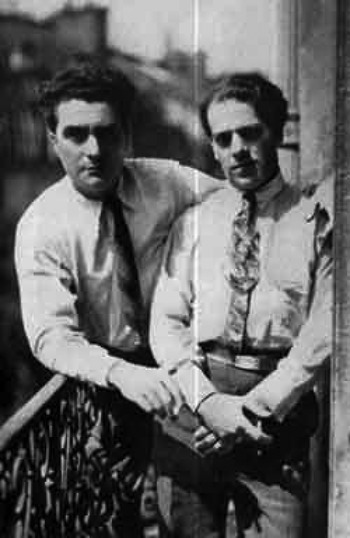
Edgar Varèse (age 44) and Heitor Villa-Lobos (age 40), Paris 1927

I have indeed pondered that – or rather, I have pondered why we don't ponder it, and now I have the perfect pretext to print one of the many pictures I was forced to omit from the Oxford History. It shows our two Vs, looking very much like twins (Fig. 2). It took me by surprise at first encounter, and I have since (as we now say) interrogated my surprise. Nobody puts these two composers in the same box nowadays, although (as the music criticism of the past will prove) they are as ‘natural’ a pair as Debussy/Ravel or Bartók/Kodály. Yet the modernist canon is as unthinkable without Varèse as Villa-Lobos would be unthinkable within it. How they became embedded in separate narratives would be a wonderful topic for investigation. In the Oxford History I made a stab at accounting for Varèse's overcoming of the neoprimitivist taint, partly by dint of his later indelible associations with high technology. Another factor elevating Varèse above Villa-Lobos must have to do with productivity – the latter's, that is (and it is something for which many in the twentieth century – Milhaud, Hindemith, Hovhaness, Persichetti – have paid a price in prestige). A mere dozen pieces by the one (with a legendary dry spell to account for it), versus, according to most sources, ‘about 2,000 works’ (to quote the Encyclopedia Britannica) by the other.Footnote 14 For the one composition was strikingly easy, for the other supremely difficult; and we all know which of the two adjectives is a fetish and which a stigma. Villa-Lobos's catalogue contains, besides the impressive compositions that made his Parisian reputation, a number of popular items (the ‘Aria’ from Bachianas Brasileiras No. 5; the preludes for guitar; ‘The Little Train of the Caipira’ from Bachianas No. 2) that have been known to function as ambient music. (Just try to imagine Varèse that way – though it's not impossible if you know his ‘Dance for Burgess’, which could have furnished theme music for The Twilight Zone.) For one of them, and only one, one must summon one's overcomprehension. For the other, snobbery comes unbidden.
IV
Overcomprehension dominates with particular clarity a pair of consecutive chapters on post-war Britain and France – the first by the editor, the other by Christopher Brent Murray – in which the primary sheep-and-goats gauge turns out to be what Dr Murray calls the ‘perceived divide between composers and the audiences of traditional classical concerts’ (p. 649), with critics classified as if according to the old Pete Seeger song, Which side are you on, boys, which side are you on? ‘Perceived’ is a trusty amulet for writers who want to impugn without saying so. Others are less inhibited. Once past its opening soliloquy, Mark Berry's chapter on West Germany makes no pretence at what the author must regard as the hypocritical stance of disinterested reportage. It ends with a defence of Regieoper by way of a truculent offense against its critical opponents. One has to wonder that the editor condoned such a campaign of ‘just-askin’’ innuendo, in which individual critics are speculatively saddled with the editorial policies of their papers. Of a critic who expresses easily corroborated doubts about the audience-appeal of radical, ideologically didactic restagings of popular operas, Dr Berry asks, ‘Might one draw connections with Die Presse's worship of the free market, the “normal” opera-goer knowing best?’ (p. 605) But neoliberalism is only the mildest dart in Dr Berry's quiver. Suggestions of homophobia are next, together with the imputation that a writer for the Kronen Zeitung must therefore be ‘a supporter of Kurt Waldheim's presidential candidacy’ (p. 606). One sees where all this is headed, but the final paragraph breaks through to a level of insinuation I had not seen since the Shostakovich Wars. First a decoy disclaimer: ‘Whilst we should remain on our guard against too-easy identification of reactionary and/or Radical Right aesthetics and politics, there are, then, strong indications that there would be much to learn from further study of such connections’ (pp. 607–8). And then, of course, a bee-line to the too-easy:
For the moment, … we might remind ourselves why conservative aesthetic stances are long likely to prove more problematic in Germany and Austria than in many other countries, and ask where German-language music criticism had most notoriously heard such claims before. One notorious instance would be Goebbels's insistence that performances be described and not discussed, that they be entertainment, not politically explorative. (p. 608)
Dr. Tan confronts the crypto-political with an analytical rather than an accusing eye. Hers is one of the more discerning dismantlings of the status privileges accorded classical music (as a ‘universal’ or ‘superculture’) among the genres. ‘On the one hand’, she writes, such glossing
operates on the back of an unquestioning stance of its classical reviewers; they are unwilling to confront the postcolonial implications of the genre's widespread entrenchment across the island as shorthand for any kind of formal music education. On the other hand, this seeming historico-cultural amnesia might well be reunderstood as an unashamed declaration of successful Asian postcoloniality in the twenty-first century: why fixate over justifying the presence of any ‘foreign’ musical genre, if listeners and critics on the island were cosmopolitan enough to stake appreciatory claims on it in the name of egalitarianism? (p. 563)
Her discussion adumbrates the reappraisals of white privilege or ‘white framing’ that by now have spread from places like Singapore to countries, like the USA, with longer postcolonial histories, and that have proliferated in the academy. As elsewhere, resistance to the issue in Singapore ‘reflects a circumvention of any discussion of postcolonial historicity and class (heavily implicated in the political and elite nature of Singapore's classical scene), so that readers can focus on potentially loftier concerns of “art for art's sake”’. In particular, she observes, classical reviewers have been uniquely licensed, as elsewhere, to pitch their ‘writing to “insiders” in a style that privileged textual, connoisseurial and genre exclusivity’ (p. 563).
Indeed, that connoisseurial, insider pitch was the tone to which reviewers of other genres began to aspire, once the door was opened (in response to new consumption patterns in the 1960s) to ‘serious’ criticism of categories formerly excluded as commercial. No fewer than four chapters in CHMC (two of them by the editor) cite William Mann's 1963 welcome to the Beatles in the London Times as the defining moment, from which, in the words of Simon Frith, still the most authoritative British scholar of popular music and author of the relevant chapter in CHMC, ‘a new way of writing about music was established in European and North American journalism’ (p. 502). But was it that? Or was it a new application of an old way of writing about music – one that had previously colonized jazz, as early as the 1920s? Laura Hamer had already settled the matter within CHMC in her chapter, ‘Critiquing the Canon: The Role of Criticism in Canon Formation’, hundreds of pages earlier, writing that ‘canonical values which critics developed to describe works contained within the nineteenth-century Austro-German canon still echo strongly in the criticism of other musical canons (especially rock) to this day’ (p. 232).
It is especially evident now, when there is so much political pressure on the traditional canon, that its values are sooner appropriated than contested by those who are exerting the pressure. Prof. Hamer notes the frequency with which honorifics like ‘classic’, ‘model’, or ‘masterpiece’ are applied to pieces in competing genres to elevate them to the high status that critics may think they are challenging (p. 236).
It is the opposite move, down the staircase – like the one canny Philip Ewell has made defending his take on music theory's ‘white racial frame’ (‘Beethoven Was an Above-Average Composer: Let's Leave It At That’) – that gets cultural work done now.Footnote 15 Recognizing these vectors is important, especially if one is interested in contesting ‘classical’ values. After an initial period of high connoisseurship, rock and pop criticism did begin leading the way back from detached elitism to a more engaged mode of address, so that now it is classical reviewing that is pressed to catch up – against strong resistance from fans, I can attest on the basis of my experience in writing for the New York Times. (I will never forget what Robert Commanday wrote about The Death of Klinghoffer in the San Francisco Chronicle: ‘as the authors’ approach to this sensitive subject is classical, no “sides” are taken’.Footnote 16 Those scare quotes!)
Once again, it is Shzr Ee Tan, writing from and about semi-authoritarian Singapore, who best describes the attendant issues. ‘The closely networked nature of the classical music community’ works to limit the viability of ‘alternative discourses’, which must ‘function within the broader conservatism of the scene itself’, discouraging overt contextualization. ‘At most, grumblings are heard about the technicalities of lacklustre performances; commentaries rarely critique cultural impetuses or political implications of creativity’. She juxtaposes this perspective with that of ‘the pop arena’, where freer discussion is facilitated by the rise of digital media. ‘Discussions on these platforms’, she writes, ‘have ranged from the banning of music videos owing to issues of alleged LGBTQ+ agenda, to the promotion of propaganda in national songs, to scandals over the multiple state purchases of Steinway pianos for national music campaigns’ (p. 565).
The old way of writing about music is now everywhere in decline, along with its platforms – and along with the music it was designed to advance. The chapters in the last section of CHMC approach these multiple falls with varying levels of denial. Raffaele Pozzi's, on Italy, ends on a note of ‘crisis’ (p. 628). The next one, the editor's on his home turf, starts right off by seconding the ‘straightforward and disheartening’ picture his predecessor had sketched (p. 629). Sophie Redfern's chapter, ‘Old Divisions and New Debates: Music Criticism in Post-War America’, records the ravages of a zero-sum game ‘[a]s jazz, pop and rock claimed the mainstream, leaving classical music an increasingly marginalised interest’ (p. 671). The editor works hard, both in his British chapter and in the concluding ‘Postlude’, to find mitigation – in dumbing down (citing his own glossy forum, BBC Music Magazine, as an effort ‘to attract the new potential audience for classical music revealed by the success of The Three Tenors’ (p. 633)), in relaxed ethics (promoting and reviewing the same events), and in evidence that classical coverage is not declining any faster than other features in the publications housing it (is that really consoling?) – but the brave face wavers when he concludes, in attempted palliating echo of his gambit, that ‘[t]he story of British music criticism since the Second World War is neither straightforward nor necessarily disheartening’ (p. 647) – the sop vitiated by a too-obvious insertion of another amulet-word, ‘necessarily’. Chapter, and book, end in equivocation.
The mood of the music-reviewing community in the twenty-first century is glum, even among those with the steadiest jobs. Alex Ross, the New Yorker's classical music man, at the very top of his profession, describes himself as participating ‘in an exceedingly dull, slow version of Agatha Christie's And Then There Were None’ (quoted on p. 691). Tom Sutcliffe, a veteran reviewer interviewed in a dissertation quoted by Prof. Dingle, shudders that
editors don't really see any distinction between the different forms of music. … They feel that classical music doesn't have as large an audience, isn't as interesting to their readers, their young readers in particular … so they feel they are still doing a perfectly good job even though the perception among classical music critics of the Critics’ Circle, of which I'm Chairman, is that the situation is a complete disaster. (p. 643)
But readers interested in a serious diagnosis of this situation, or a real analysis of its causes, will have to look elsewhere than in CHMC. Rarely have I seen so elaborate a sweeping of urgent matters under the rug as in the Postlude's final paragraph, which chucks historiography once and for all:
It is tempting to say that whether the arrival of the Internet and subsequent upheavals in the printed press are regarded as disastrous or as creating new opportunities merely reflects whether the observer is a pessimist or optimist, seeing the glass as either half-empty or half-full. However, it is more pertinent to remember that wine was previously drunk out of pewter, clay or leather goblets, cups and tankards. Moreover, as generations of students will testify, if the glass breaks, another receptacle will be found. One lesson of this volume has been that whenever and wherever music is made, in whatever genre, there will be those who wish to discuss, describe and debate it, argue, attack or advocate it, read, reflect and write about it in whatever medium is available. They may or may not be paid or labelled a music critic, they may or may not write or speak eloquently, and they may or may not be perceptive and insightful, but, whether on paper, on the airwaves, on a computer screen or some medium not yet conceived, music criticism will continue. (pp. 705–6)
Which only re-raises the old question: Is this (still) a thing?