Disaster Medical Assistance Teams (DMATs) comprise professional, paraprofessional, and support personnel who are organized to deliver medical relief during and immediately after disasters.Reference Dara, Ashton, Farmer and Carlton1 Essential to the success of a DMAT is its ability to respond in a timely manner and provide appropriate clinical and logistical services. Moreover, DMATs need to integrate into the local response and the greater superstructure of the emergency response.Reference Aitken, Canyon, Hodge, Leggat and Speare2 The international literature on DMATs has considered a number of issues associated with their effectiveness. These issues include coordination, dependency, use of local workers, level and quality of care, cultural acceptance, communication and information management, and leadership.Reference Aitken, Canyon, Hodge, Leggat and Speare2, Reference Bolton and Weiss3 Greater emphasis has been placed on preparedness and training to ensure that DMATs are more appropriately equipped to deal with different and complex emergencies.Reference Sundnes4, Reference Henstra and McBean5 A recent systematic literature review from the Anton Breinl Centre for Public Health and Tropical Medicine, James Cook University, found that
“…all groups acknowledge the need for improved training although, currently, training is generally insufficient. Challenges include retention and application of knowledge and skills a long time after instruction and the ability to apply this in the field, as well as training involving teams and emerging issues such as security. There has been a recent growth in the number of courses available, but there is still a lack of standards. …”Reference Aitken, Canyon, Hodge, Leggat and Speare2
To our knowledge, no evidence-based standards currently exist for health care professional training in disaster response.Reference Hsu, Thomas, Bass, Whyne, Kelen and Green6, Reference Elaine Daily and Padjen7 In the past 10 years, training and education in disaster management have engaged with competency-based training to begin creating evidence-based training and best practices for disaster management. Also, competency-based models have been used to develop and measure behaviorally based, observable, and measurable skills for health professionals.Reference Gebbie and Merrill8
Nontechnical core competencies, also known as nonclinical core competencies, refer to “a combination of cognitive and social skills, which complement knowledge and technical skills and contribute to safe performance.”Reference Willems, Waxman, Bacon, Smith, Peller and Kitto9 These skills are essential to successful disaster management, but their exploration and evaluation have been understudied and underdeveloped.Reference Elaine Daily and Padjen7, Reference Gebbie and Merrill8, Reference Markenson, DiMaggio and Redlener10 The present research was conducted to add to the evidence base of core nontechnical competencies by conducting a qualitative study on the perspectives and experiences of a provincial DMAT in Canada.
This study sought to define and delineate the nontechnical core competencies required for disaster response by exploring the perspectives and experiences of DMAT members in disaster management. We explored interprofessional collaboration and teamwork to develop conceptually generalizable context-specific competencies through the following 3 objectives:
1. Explore the range of nontechnical core competencies perceived by DMAT members as being necessary for effective interprofessional collaboration during disaster response activities.
2. Examine the connection between the identified nontechnical core competencies by DMAT members and the maintenance of interprofessionalism and teamwork in DMAT activities.
3. Examine the facilitators and barriers to the development and application of interprofessional nontechnical core competencies relevant to DMAT activities (eg, training, preparation, and deployments).
Methods
This research project drew on an interpretivist framework,Reference Berger and Luckmann11 which is commonly used in qualitative research. It entailed the in-depth and exploratory study of a phenomena with the intentionReference Berger and Luckmann11, Reference Rolfe12 “to make sense of, or interpret, [the] phenomena in terms of the meanings people bring to them.”Reference Denzin and Lincoln13 The exploratory accounts of participants’ understandings and perceptions of the nontechnical core competencies, observable skills, and measurable skills for health systems professionals to prepare for and respond to disasters and emergencies were collected. In-depth exploratory interviews were conducted to address the research objectives. The University of Toronto Research Ethics Board approved this study.
Sampling
To recruit participants for interviews, purposive criterion-based sampling methods were conducted. Criterion-based sampling selects cases based on their meeting particular criteria that are directly linked to the question or purpose of the study.Reference Britten14 This method was applied to sample people with deployment experience on a single DMAT who have been a member of the DMAT for more than 2 years. Experience was used instead of the number of deployments because this DMAT had few deployments, as it was formed in 2003. Experience included full-scale exercises in conjunction with communities throughout the province and deployments to a flooded northern community, an isolated hospital that experienced a fire in its critical care unit, and as support to host communities where residents were evacuated due to forest fires. This sampling method was used to ensure that people interviewed could reflect on their experiences training and working on a disaster response team. The sample was interprofessional, in that it represented all health care professions that were on the team. A DMAT liaison assisted in the sampling procedures by providing a list of participants on the team and obtaining approval from the organization for this study to be completed.
Data Collection
Face-to-face interviews were conducted with study participants where possible; all other interviews were conducted by telephone. Semistructured in-depth interviews were used. In contrast to standardized interviews or questionnaires, semistructured interviews or thematically grouped open-ended questions allow respondents to talk openly and in depth about their understandings of a particular phenomenon.Reference Flick15 In addition, it allows participants to fully discuss their viewpoints and perceptions.
Interviews were used to gain insights into how DMAT members view nontechnical core competencies and how experiences have influenced their perceptions toward interprofessonalism in disaster response. Interview probes consisted of open-ended questions and critical incident reporting to gather experiential data from study participants.Reference Britten14 Interviews conducted in the data collection phase varied from 30 minutes to 1 hour. A total of 10 interviews were conducted over 7 months.
Data Analysis
The data analysis began concurrently with data collection to develop an emergent understanding of the themes and findings.Reference Walker and Myrick16 A thematic analysis provided an exploratory and descriptive examination of the data.Reference Kitto, Chesters and Grbich17 Moreover, using the interpretivist framework, the analysis explored the meanings and experiences of the study participants related to nontechnical core competencies and interprofessional collaboration.
Three overarching themes were found from the data set: (1) nontechnical core competencies, (2) interprofessional collaboration, and (3) barriers and facilitators to interprofessional collaboration within the DMAT. The themes were coded using thematic coding, which analyzed the data in a comparative way.Reference Flick15 These themes were then broken down into subthemes, which were directly coded in the interview transcripts. As interviews were conducted and coded, the themes were revised iteratively, based on information that emerged from the transcripts. At the end of the data collection period the interview transcripts were recoded to synthesize the themes developing throughout the iterative coding and analysis of the project.
Example Theme and Codes From Data Analysis
Theme One
Nontechnical competency
Subtheme (codes)
Austere environment
Flexibility
Adaptability
Improvisation
Self-care, physical
Self-care, psychological
Innovation
Interpersonal relationships
Communication
Teamwork
Sense of humor
Conflict resolution
Cultural competency
Cognitive
Big picture thinking
Situational awareness
Critical thinking
Problem solving
Creativity
The subthemes for nontechnical core competencies were coded and analyzed through directed content analysis techniques—the coding of specific concepts in transcripts guided by previous research in the area.Reference Liamputtong and Ezzy18 Directed content coding is a more structured approach to extracting and analyzing the dataReference Hsieh and Shannon19; it uses previous research to frame what is being extracted from the interviews (see List). Directed content analysis developed from the research of Willems etalReference Willems, Waxman, Bacon, Smith, Peller and Kitto9 and a literature review in disaster response. In particular, Willems’ framework separated 3 types of nontechnical core competencies: austere environment, interpersonal competencies, and cognitive competencies, which were coded for in the interviews.
Results
DMAT members described the nontechnical core competencies they perceived as important to disaster response and interprofessional teamwork. Based on their responses, several considerations were related to DMAT and disaster response. However, engaging DMAT members in a discussion of what nontechnical core competencies were important to their work was a challenge. Their ability to reflect on nontechnical core competencies appeared to correlate with their level of experience with being deployed on DMAT. Because selected participants, at minimum, had deployment experience on a single DMAT and had been a member of the DMAT for more than 2 years, it was sometimes difficult for less-experienced participants to separate the 2 types of competencies.
The nontechnical core competencies that were discussed were categorized under austere skills, interpersonal skills, and cognitive skills, as based on Willems.Reference Willems, Waxman, Bacon, Smith, Peller and Kitto9
Austere Environment Skills
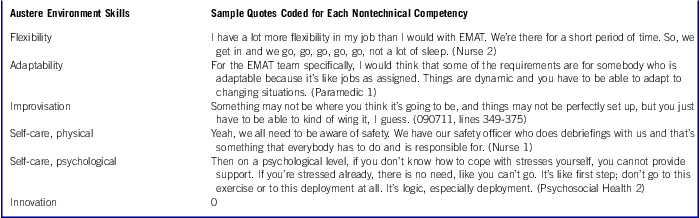
Austere environment skills have been widely cited as important in disaster management literature, and have been discussed in disaster response training and education.Reference Bissell, Becker and Burkle20-Reference McCall and Salama22 They included self-care and survival skills, flexibility, adaptability, innovation, and improvisation. One or more austere environment skills were cited by each participant as being important to disaster response. The most cited nontechnical core competencies among these skills were flexibility and adaptability. This finding corresponds with that in the literature, which also most often cites these as essential and defining characteristics of disaster management and response.Reference Frisch21, Reference Birch and Miller23 Other austere environment skills, such as innovation, were not mentioned.
Table 1 presents an example of each austere environment skill, as coded from the interview transcripts. Flexibility was discussed as a nontechnical core competency for DMAT, but not necessarily a nontechnical core competency needed for daily work. Adaptability was perceived as a nontechnical core competency specific to the DMAT. Improvisation was indirectly understood as a nontechnical core competency for working on the team. Physical and psychological self-care was mentioned as related to being aware of one's safety and coping with stress. Finally, innovation was not cited as a specific skill by any of the participants. Overall, the research participants viewed austere environment skills as important to functioning on the DMAT, particularly because the team did not have the facilities or resources that are available in typical health care settings such as clinics or hospitals.
Examples of Austere Environment Skills Discussed by Research Participants

Abbreviation: EMAT, Emergency Management Association of Texas.
Interpersonal Skills
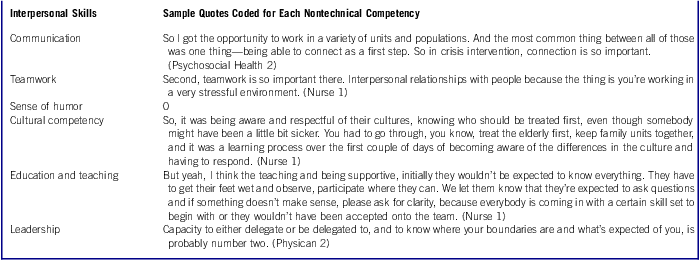
Interpersonal skills, which depict how disaster response teams work together and with patients,Reference Willems, Waxman, Bacon, Smith, Peller and Kitto9 have included communication, teamwork, sense of humor, cultural competency, education and training, and leadership.Reference Aitken, Canyon, Hodge, Leggat and Speare2, Reference Bolton and Weiss3, Reference Moore and Blasser24, Reference Wood25Table 2 provides examples of how interpersonal skills were coded from the interview transcripts. Nontechnical core competencies such as communication and teamwork have been commonly discussed in the literature,Reference Bolton and Weiss3, Reference Moore and Blasser24 and were described by DMAT members.
Examples of Interpersonal Skills Discussed by Research Participants
The communication code reflected that the need to communicate or connect with people was common among different deployments. Teamwork was also cited as important. Sense of humor was not coded as a nontechnical core competency. Cultural competency, leadership, and delegation were perceived as important to working on DMAT. Leadership and education and training were also perceived as important by the participants. Overall, interpersonal skills were deemed important for all disaster response team members.
Cognitive Skills
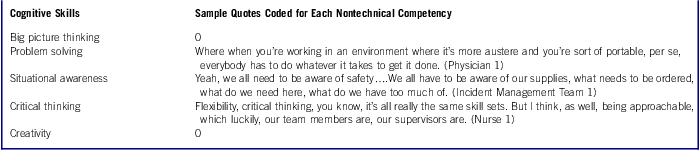
Cognitive nontechnical competenciesReference Hsu, Thomas, Bass, Whyne, Kelen and Green6, Reference Markenson, DiMaggio and Redlener10, Reference Ford and Schmidt26 (including big picture thinking, problem solving, situational awareness, critical thinking, and creativity) were the last of the nontechnical core competencies to be examined and the least discussed skills by study participants. They did not differentiate between the different types of cognitive nontechnical competencies as they did for austere and interpersonal skills. However, these cognitive skills may have been perceived as qualities that people acquired before becoming a team member, and were linked in participants’ minds to technical knowledge and roles.
So, I use a lot of the same skill sets that I developed for years as a crisis worker but it's still responding to people who are distraught, upset, listening, calming, trying to find solutions or point them in the direction of where they need to go for the appropriate help. (Psychosocial Health 1)
Table 3 provides examples of the cognitive nontechnical core competencies discussed by interview participants. These skills were problem solving, situational awareness, and critical thinking. As perceived by the participants, problem solving was important to responding to the austere environment, situational awareness was important to protecting DMAT members and patient safety, and critical thinking was related to flexibility. Big picture thinking and creativity were not mentioned in the interviews.
Examples of Cognitive Skills Discussed by Research Participants
Interprofessional Collaboration
Interprofessional collaboration (IPC) is defined as “an active and ongoing partnership between two or more professions, who work together to solve problems or provide services.”Reference Reeves27 In the health care context, it is characterized as fluid, opportunistic, and informal, and it can range across a spectrum from a loosely coordinated collaboration to well-organized teamwork.Reference Headrick, Wilcock and Batalden28
Study participants defined IPC as the latter; however, it was not viewed as an ongoing partnership. Rather it was characterized as opportunistic, informal, and unpredictable, similar to the definition. Moreover, interprofessional collaboration was closely associated with teamwork, and was centered on working together to achieve the common goal of providing integrated care.
Collaboration. Instead of having parallel or synoptic plans for one person, you have one plan that includes other disciplines with you. So it's not parallel things, it's one thing with different perspectives or different goals. And collaboration it's not only like the plan, having one plan and each one has a date on it, it's more also that there is some interdependence between when there is collaboration. So I built on what you did and you build on what I do and this kind of stuff. (Psychosocial Health 2)
Research participants noted specific nontechnical core competencies important to IPC. Of the 3 categories of nontechnical skills discussed, interpersonal skills, communication, and teamwork were most often reported as important nontechnical core competencies to IPC.
Barriers to and Facilitators of Interprofessional Collaboration
On defining IPC, research participants were asked about the state of IPC on the DMAT. Respondents discussed its facilitators and barriers. Most comments were positive. With respect to facilitators, participants mentioned how well staff bonded, worked as a team, and had similar attitudes. Such characteristics were assumed to result from DMAT's very selective recruitment procedures of highly experienced health care professionals. Also, nontechnical competencies such as communication were described as facilitators to IPC. Moreover, in the DMAT context, IPC was related both to DMAT members working together and the local hospital and infrastructure working with DMAT to achieve a shared goal.
Finally, IPC was associated with well-defined roles of health care professions. The participants viewed DMAT as a place where roles of health care professionals were more expansive than in the hospital context. This perspective facilitated more collaboration between DMAT members. Specifically, because physicians do not see all patients, nurses have more autonomy and are able to perform more tasks related to patient care.
Interview participants discussed 2 barriers to IPC: professional associations and the hierarchy and leadership structures of the DMAT. Professional associations referred to the professional background and training of health care professionals. In this situation, professional training and socialization of health care professionals can act as a barrier to the DMAT members working together.Reference Reeves, Rice, Conn, Miller, Kenaszchuk and Zwarenstein29 Although participants mentioned these as a barrier, they were not viewed as a major factor in their experience.
One professionally based barrier perceived by research participants was the lack of inclusion and acknowledgement of the psychosocial team as a health care profession. DMAT members thought that it was due in part to the fact that psychosocial health care professionals have not always been a part of the DMAT and that their roles were not well understood by other health care professionals.
Sometimes in my area, the psychosocial, we're forgotten about because we are a little bit different than the nurses, the doctors, the medics. They're more the medical, so they get the ICU set up or the critical care area or the ambulatory area, the emergency area. Whereas, we have our psychosocial tent where the families would come to but we're also floaters. So, we're constantly going between all of the areas and don't necessarily belong to one area. So, it can happen where, if they sit down as a group and do a debrief, we may have spent hours working in that area but because we're floaters and we're off somewhere else they sometimes forget that we exist. (Nurse 1)
The second barrier was related to the nature of hierarchy and leadership structures on the DMAT. The team follows the incident command system (ICS) under normal operations and deployments. A generic command structure, the ICS creates an interagency cooperative and organization when responding to a disaster. The ICS organizes disasters into functional areas of activity such as command, operations, planning, logistics, and finance and administration. Moreover, it uses common terminology and criteria to ensure communication and organizes processes to facilitate the exchange of resources. The DMAT viewed communication along the hierarchy, especially between health care professionals and the incident command team, as distant.
On the communication side, how is the communication going to flow from me, the bedside nurse, to the team leader person to the management team to make a decision about well, if we're going to call [provincial air ambulance provider] in to come and pick up a patient from [town], how does that communication process work and who is accountable for it. (Incident Management Team 1)
The literature on disaster response has discussed some barriers to the ICS in the health care setting.Reference Devereaux, Dichter and Christian30 One limitation is that while the improvement of health care services has focused on improving teamwork by breaking down professional-based hierarchical relationships, the ICS structure depends on hierarchy to effectively respond to disasters. As noted in the literature, health care professionals sometimes resist the hierarchical structure of the ICS.Reference Autrey and Moss31
Discussion
Priorities in disaster response and management change based on local context and type of disaster, so it is difficult to define a consistent set of competencies across disciplines and jurisdictions.Reference Aitken, Leggat, Robertson, Harley, Speare and Leclercq32 Moreover, the coordination of disaster services occurs at multiple agency levels and across various organizations, which compounds the unique nature of each event.Reference Dara, Ashton, Farmer and Carlton1, Reference Henstra and McBean5 Context is key in disaster research and disaster management practices, which present specific challenges to research in this field. In the literature, specific case studies of disasters and experiential reports are valuable for sharing best practices and challenges because of the unpredictable and complex nature of disasters.Reference Hsu, Thomas, Bass, Whyne, Kelen and Green6 However, creating evidence-based practices and guidelines for disaster response has not been well instituted in this field. A recent trend in the literature has been for more evidence-based research and development of practical guidelines for disaster response.Reference Arnold33-Reference Smiley, Loboda, Starling and Rubin35 With the development of this trend is a need to ensure that local context is considered when conducting and applying research.
The value of context that is accepted for disasters can be placed on the DMATs, the front-line responders to disasters. A systemic review of DMATsReference Aitken, Canyon, Hodge, Leggat and Speare2 discussed the general structures, processes, and challenges of DMATs associated with their effectiveness in disaster response. DMATs exist and work at international, national, and regional levels.Reference Mace, Jones and Bern36 The literature in disaster management implies that the success of these teams is related to their ability to replace existing medical facilities that have been damaged or closed.Reference Franco, Toner, Waldhorn, Inglesby and O'Toole37 Although differences of DMATs across different countries are discussed, more in-depth views of individual teams in the literature are limited.Reference Aitken, Canyon, Hodge, Leggat and Speare2
The findings from the present study on Canadian DMATs have shown that the teams’ historical development and organizational structure make it unique and best suited for particular types of disasters and local contexts. These feature have implications for nontechnical core competencies that are important to the team and the state of IPC on the team. As in disaster response, local context is essential for understanding DMATs.
DMAT has several unique contextual elements. First, it is a volunteer-based organization; all members have full-time jobs. The literature does not list volunteerism as a nontechnical core competency.Reference Markenson, DiMaggio and Redlener10 However, the findings from this study suggest that volunteerism is a nontechnical characteristic for DMAT members. Participants repeatedly discussed volunteerism as an important attitude or ethos bringing together team members and contributing to their work on the team.
Second, this particular DMAT was created as a direct consequence of an infectious disease outbreak in Canada, which led to a focus on technically advanced equipment for managing critical care patients and outbreaks of communicable diseases rather than general mass casualty incidents. Because the disasters subsequent to the initial event did not have the same clinical focus, DMAT developed primary and emergency care elements (in both personnel and equipment). The interview respondents viewed equipment as a defining characteristic of the DMAT. Therefore, training and education were focused on learning how to use equipment. Similar to the nontechnical core competencies flexibility and adaptability, the DMAT has had to be flexible and adaptable in its role and configuration since its inception. Although DMAT training and education were not assessed for purposes of this study, flexibility and adaptability should be important considerations to help DMAT members prepare for the nature of disaster response in practice.
The findings of this study demonstrated an important relationship for understanding IPC on the DMAT. To be a member, candidates must have full-time positions at hospitals or land or air ambulance systems in the province. The hospital IPC cultures that have been well developed in health care professions are transferred to the DMAT by shaping their IPC interactions and views of nontechnical core competencies. Because of the nature of disaster response, the DMAT convenes only for training, exercises, or deployments, which may present specific challenges for DMAT members working as a team or within the ICS structure. When team relationships cannot be well developed because of spatial and temporal constraints, DMAT members may draw on work experiences to help make both technical and nontechnical decisions and know how to relate to team members and the ICS structure of the DMAT.
Two studies on ICS structure in the hospital note that, for the ICS structure to be used successfully, health care professionals need an understanding of and the ability to communicate across different agencies and teams (eg, governmental organizations, fire, law enforcement). Although health care professionals adequately respond to the medical and clinical aspects of disasters, they are not always prepared or trained to work in the ICS structure, in which communication, flexibility, and adaptability are important.Reference Autrey and Moss31, Reference Zane and Prestipino38
Evidence suggests that ICS structure is not always adequately implemented in the health care context.Reference Devereaux, Dichter and Christian30 Training and education are important for implementing ICS in hospitals,Reference Thomas, Hsu, Kim, Colli, Arana and Green39 and are likely to be important for health care professionals on the DMAT to communicate, coordinate, and collaborate within the ICS structure. Furthermore, the ICS structure outlines vertical relationships, but it does little to define the roles in horizontal relationships between professions such as medical and health care professional specialties, including psychosocial health.Reference Briggs40 Therefore, efforts have been made to determine how best to use clinical expertise on disaster response teams.Reference Briggs40 Because ICS structure is not always adequately implemented in the health care context, whether the ICS structure is adequately implemented on DMATs is questionable.
The present study looked specifically at IPC on DMAT. As described, IPC interactions occurred on a spectrum,Reference Mccallin41 ranging from interdisciplinary health care professionals who work intimately with each other over an extended period to IPC interactions that are loose and infrequent. The structure of DMAT has created an environment in which IPC interactions are generally perceived as loose and infrequent. However, when deployed or training, the team's IPC is interdependent, intimate, and constant during the time that the group is physically together. The unique nature of disaster response has been characterized as infrequent, intense working relationships.Reference Elaine Daily and Padjen7, Reference Gebbie and Merrill8 Therefore, IPC is not necessarily developed when the team is physically working together. As study participants reported, the organizational structure, culture, and IPC in hospitals greatly shape how team members relate to each other.
This inference then questions if the factors that affect IPC in the health care context also play a role in interprofessional disaster response. In health care, IPC is affected by factors including limited time for teambuilding, ambiguous team roles, longlasting effects of professional socialization, differences in professional authority, and vertical management of professionals.Reference Baxter and Brumfitt42, Reference Reeves and Lewin43 Based on our findings, some of the same factors were discussed by DMAT members and, therefore, may have an impact on team functioning during a response. Further exploration of the hierarchy and leadership structures of DMATs could provide valuable insight about information flow, communication, and IPC and serve to provide an opportunity for change and improvement.
Limitations
This study had 2 methodological limitations. First, the sample size for this study was small. The DMAT group being studied was relatively new, and it was unclear what type of data could be collected. The pilot study enabled us to explore this topic with the intention to complete a larger and more focused study. Future research could extend this research topic across multiple DMATs. Second, the interpretivist framework raises questions about the validity of the findings and empirical generalizability of the study. Researcher triangulation is a qualitative strategy that enhances research rigor by allowing validity checks on the coding and data analysis. While qualitative research is not empirically generalizable, future research could augment it by attaining wider and more inclusive sampling procedures (eg, logistics, communications, and information technology personnel).
Conclusions
This study on nontechnical core competencies and IPC on a Canadian province's DMAT provided preliminary insights into the importance of context when developing an evidence base for competency training in disaster response and management. Also, it established a connection between nontechnical core competencies and IPC in DMAT activities. Although barriers and facilitators to the development of these competencies relevant to IPC were not fully examined, preliminary insights into the importance of communication on DMATs team were noted. Moreover, an interesting connection was found between hospital culture and building relationships and IPC with and within the DMAT. Results of this study provide a foundation for future work with the team or a background for research in the area of disaster response and disaster management.