Introduction
Necessity of the Study
Disasters have posed persistent threats to human life and social stability throughout history. In modern times, their forms have diversified—ranging from natural catastrophes such as earthquakes, floods, and typhoons to human-induced crises like terrorism, fires, and industrial accidents. Each disaster type presents distinct patterns of harm and necessitates tailored response strategies. Survivors frequently suffer not only physical injuries but also profound psychological distress, including trauma, anxiety, and stress. Providing comprehensive support for both physical and mental recovery is therefore a central tenet of disaster nursing. The COVID-19 pandemic further underscored the essential role of nurses in disaster response, as recognized by the International Council of Nurses in its Core Competencies in Disaster Nursing report. 1 Nurses were tasked with infection control and patient care while also addressing the emotional needs of patients and their families.Reference Loke, Guo and Molassiotis 2 –Reference Levoy, DeBastiani and McCabe 6 This expanded scope has established disaster nursing as a core competency within the Republic of Korea. In many countries, such as the United States, disaster nursing competencies have long been integrated into curricula, as outlined in the American Association of Colleges of Nursing (AACN) Essentials 7 Domain 3.6: “Advance preparedness to protect population health during disasters and public health emergencies.” Although disaster nursing research has grown, comprehensive evaluations—particularly those examining interventions for psychological support, infection control, and emergency care—remain scarce. This gap calls for evidence-based analysis of nursing contributions in disaster contexts. Moreover, the role of nurses in disasters extends beyond life-saving measures. It encompasses emotional stabilization, mental health promotion, infection prevention, and facilitating community-level recovery.Reference Loke, Guo and Molassiotis 2 Thus, disaster nursing is multifaceted, requiring competencies in technical, emotional, and public health domains.
The importance of disaster nursing has been recognized globally, with international organizations such as the International Council of Nurses and the World Health Organization identifying it as a core nursing competency and promoting standardized education and training across diverse health care systems.
Purpose of the Study
The objective of this study is to systematically review and quantitatively analyze the effectiveness of disaster nursing education programs. By synthesizing existing empirical studies through meta-analysis, this research seeks to clarify the extent to which such interventions enhance learning outcomes across cognitive, affective, and psychomotor domains. The findings aim to provide a strong evidence base to inform the design of future disaster nursing curricula and training programs. While the studies included in this meta-analysis are predominantly from the Republic of Korea, the findings are interpreted within a broader international framework, incorporating evidence from global disaster nursing research to enhance generalizability.
Methods
This study followed the PRISMA (Preferred Reporting Items for Systematic Reviews and Meta-Analyses) guidelines for conducting systematic reviews and meta-analyses.
Literature Search
To ensure methodological rigor, the literature search adhered to the PRISMA protocol, which provides a structured and reproducible approach for identifying relevant studies. A comprehensive search strategy was implemented across both international and domestic electronic databases to capture a wide scope of disaster nursing research.
Six databases were searched: PubMed, Cumulative Index to Nursing and Allied Health Literature (CINAHL), Web of Science, Research Information Sharing Service (RISS), Korean studies Information Service System (KISS), and DBpia. Keywords included “disaster nursing,” “emergency nursing,” and “disaster intervention.” Boolean operators (AND, OR) were used to maximize inclusivity, and Medical Subject Headings (MeSH) terms and relevant synonyms were also reviewed to enhance search sensitivity. For example, the combination “(disaster nursing OR emergency nursing) AND (disaster intervention OR nursing care)” allowed for a comprehensive search across related concepts. The search covered literature published from June 2019 to May 2025 to reflect the most recent developments in disaster nursing, especially those emerging during and after the COVID-19 pandemic. Including contemporary studies strengthens the relevance and reliability of the findings.Reference Islam, Rahman, Kabir, Arif, Arslan and Mallick 4 The classification of learning outcomes into cognitive, affective, and psychomotor domains was guided by Bloom’s taxonomy.Reference Bloom 8 , Reference Krathwohl, Bloom and Masia 9
Eligibility Criteria and Selection Process
Studies were included if they involved nursing interventions in disaster settings and were designed as randomized controlled trials (RCTs) or quasi-experimental studies. For the purposes of this study, nursing interventions refer to structured educational or clinical activities aimed at improving disaster-related competencies in knowledge, attitudes, and skills. The term “disaster nursing education programs” is used consistently throughout the manuscript to maintain clarity. Exclusion criteria included conference abstracts without full text, studies lacking sufficient statistical data to calculate effect sizes, and duplicate publications. EndNote software was used to manage references and eliminate duplicates. A 2-step selection process was employed. First, titles and abstracts were screened for relevance. Second, full-text articles were reviewed based on criteria such as research objectives, target population, intervention type, and outcome measures. Only studies meeting all criteria were included in the final meta-analysis. This multistage process ensured a transparent and reproducible selection of high-quality evidence and the conduct of a meta-analysis on the effectiveness of disaster nursing education programs. By synthesizing the results of prior research, this meta-analysis seeks to provide robust evidence of the impact of disaster nursing, thereby offering an empirical foundation for future nursing education and training. While previous studies have reported the outcomes of disaster nursing individually, this study aims to present a comprehensive analysis that clearly delineates the efficacy of disaster nursing education programs.
Data Extraction and Variable Definition
Relevant data were systematically extracted from each of the included studies. The extracted information included the study title, authors, publication year, study design, participant characteristics, intervention details, and key outcome variables. This approach allowed for a consistent and structured analysis of each study’s contribution to the meta-analysis. Data extraction was conducted by reviewing titles and abstracts to assess inclusion eligibility, followed by full-text review to capture detailed study design, participant characteristics, intervention descriptions, and outcome measures. Special attention was given to how each intervention impacted knowledge, attitude, and skills. The outcome variables were standardized for comparability across studies. The primary variables were knowledge (e.g., understanding of disaster protocols), attitude (e.g., perception of preparedness), and skills (e.g., simulation performance or emergency procedures). These standardized variables were used as the basis for effect size calculation and subsequent synthesis in the meta-analysis.
Quality Assessment
The quality of the included studies was assessed using the Joanna Briggs Institute (JBI) Critical Appraisal Checklist for Quasi-Experimental Studies. This tool is widely used to evaluate the methodological quality of such studies. Two researchers independently assessed each study for methodological rigor, including study design, participant selection, intervention consistency, outcome measurement, confounding control, and ethical approval. Discrepancies between reviewers were resolved through discussion with a third reviewer. Evaluation results were recorded descriptively according to the criteria described above. Each study was rated on a series of criteria with “Yes” or “No” responses, and total scores were derived by summing affirmative responses. This multi-stage process ensured a transparent and reproducible selection of high-quality evidence.
Statistical Analysis
This meta-analysis aimed to comprehensively evaluate the effectiveness of disaster nursing education and training. All statistical analyses were conducted using Review Manager (RevMan) software. The effect size was calculated using Hedges’ g, which adjusts for small sample bias and provides a standardized mean difference. This metric allows for consistent comparison across studies with different scales.
Heterogeneity was assessed using Cochran’s Q and the I2 statistic. The I2 value represents the proportion of total variation across studies due to heterogeneity rather than chance. I2 values of 0%, 25%, 50%, and 75% indicate no, low, moderate, and high heterogeneity, respectively. The Q statistic, derived from the chi-square test, evaluates whether the observed variability among effect sizes exceeds what would be expected by chance. A P value less than 0.05 was considered statistically significant. Subgroup analyses were performed to explore differential effects across outcome domains.
Learning outcomes were categorized into 3 domains: cognitive, affective, and psychomotor, following Bloom’s taxonomy.Reference Bloom 8 , Reference Krathwohl, Bloom and Masia 9 The cognitive domain refers to the acquisition of knowledge and intellectual skills, such as understanding disaster protocols and epidemiology. The affective domain involves the development of attitudes, values, and emotional readiness, such as motivation for disaster preparedness and ethical decision-making. The psychomotor domain encompasses the acquisition and refinement of practical skills, including triage performance, emergency equipment use, and first aid techniques.
-
• Cognitive domain: Variables related to disaster knowledge, reflecting the ability to understand and retain critical information during emergencies.
-
• Affective domain: Variables representing attitudes such as disaster preparedness or mental health competence, assessing emotional engagement and readiness.
-
• Psychomotor domain: Variables reflecting practical performance such as disaster competency, emergency skills, and disaster nursing ability.
To assess publication bias, visual inspection of a funnel plot was conducted, and Egger’s regression test was used for statistical confirmation. A symmetrical funnel plot indicates minimal publication bias, while asymmetry suggests possible bias. Egger’s test results with P < .05 were interpreted as evidence of statistically significant publication bias.
Ethical Considerations
This study involved a systematic review and meta-analysis of previously published literature and did not involve any direct research on human participants. As such, it qualifies for exemption from Institutional Review Board (IRB) review, and no ethical approval was required or obtained.
Results
Study Selection
A total of 1200 studies were initially identified through the database search. After screening titles and abstracts and removing duplicates and irrelevant studies, 45 articles were selected for full-text review. Following the eligibility assessment, 11 studies met the inclusion criteria and were ultimately included in the meta-analysis (Table 1). The study selection process is outlined in the PRISMA flow diagram (Figure 1), which also summarizes reasons for exclusion at each stage. The included studies primarily targeted nursing students and registered nurses and evaluated the effectiveness of disaster nursing education programs. In total, 11 studies comprising 713 participants were analyzed in the meta-analysis.Reference Kim, Kong and Choi 10 –Reference Lan, Zhou and Wang 20 The participant populations included undergraduate nursing students and professional nurses. Intervention formats varied across studies, including simulation-based training, online education, infection control training, and first aid programs. Each intervention aimed to enhance outcomes across knowledge, attitude, and skills domains.
Characteristics of included studies

PRISMA flow diagram for study selection process.

Overall Effect Size
The meta-analysis of 11 studies revealed a pooled effect size of Hedges’ g = 1.80 (95% CI: 1.491-2.399), indicating a statistically significant and large effect (P < .001). Studies were categorized based on study design: those using experimental vs. control groups and those using single-group pre-post comparisons.
For studies with control groups, effect sizes were calculated using the following formula: Hedges’ g = (M_exp − M_ctrl)/SD_pooled, where SD_pooled = √[(SD_exp2 + SD_ctrl2)/2]. For single-group studies, pre- and postintervention means were compared using: Hedges’ g = (M_post − M_pre)/SD_pooled, where SD_pooled = √[(SD_pre2 + SD_post2)/2].
These standardized calculations enabled consistent comparison of intervention effects across different study types and outcome measures (Figure 2).
Forest plot of the effect sizes of included studies.

Heterogeneity Analysis
To assess consistency across studies, heterogeneity analysis was conducted using Cochran’s Q and the I2 statistic. The Q statistic was 377.91 (df = 10, P < .001), indicating that the observed variation among effect sizes was unlikely due to chance. The I2 value was 97.4%, which represents a very high level of heterogeneity. This suggests that the variation in effect sizes among the included studies may be attributed to substantive differences in study characteristics or interventions rather than sampling error alone. As a result, subgroup analyses were performed to further explore potential sources of heterogeneity.
Subgroup Analysis
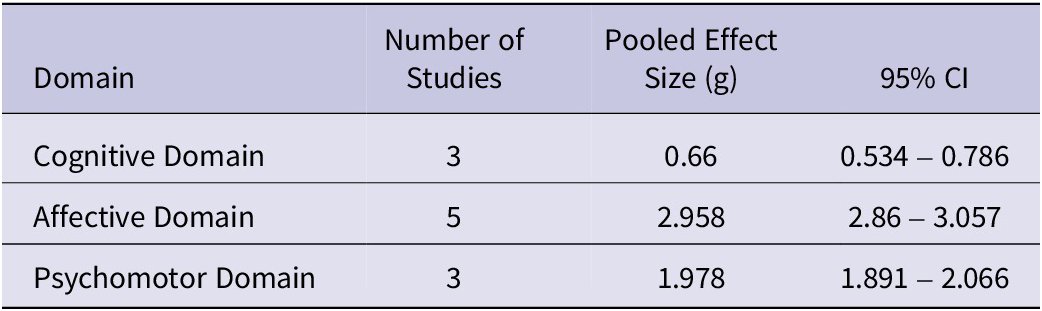
To further clarify the effectiveness of disaster nursing education, subgroup analyses were conducted by categorizing outcomes into 3 learning domains: cognitive, affective, and psychomotor. Each domain was analyzed separately using standardized effect sizes (Hedges’ g).
-
• Cognitive Domain: This domain included variables such as Disaster Knowledge and Cultural Knowledge. The pooled effect size was g = 0.66 (95% CI: 0.534-0.786), indicating a moderate improvement in knowledge acquisition related to disaster preparedness.
-
• Affective Domain: Variables in this domain included Disaster Preparedness, Mental Health Competence, and Readiness for Disaster Response. The pooled effect size was g = 2.96 (95% CI: 2.860-3.057), reflecting a very strong positive impact on emotional and psychological preparedness.
-
• Psychomotor Domain: This domain covered Disaster Competency, Disaster Nursing Ability, and First Aid Skills. The effect size was g = 1.98 (95% CI: 1.891-2.066), suggesting a highly significant improvement in practical and hands-on capabilities.
These findings suggest that disaster nursing education programs are not only effective in transferring knowledge but also particularly strong in fostering attitudinal change and skill development across a range of educational strategies (Table 2).
Subgroup meta-analysis by learning domain

Publication Bias
Publication bias was evaluated using both visual inspection of a funnel plot and Egger’s regression test. The funnel plot was constructed based on Hedges’ g and standard error for each of the 11 included studies. The distribution appeared generally symmetrical, suggesting a low risk of publication bias. In the upper region of the funnel (i.e., studies with smaller standard errors), effect sizes clustered around the overall mean (g ≈ 1.80), and no substantial asymmetry was observed in the lower region. This pattern indicates consistent findings even among smaller studies.
Overall, the results suggest that the meta-analysis was relatively free from selection bias associated with the nonpublication of negative or nonsignificant findings. These findings support the robustness and reliability of the pooled effect size. The funnel plot is shown in Figure 3. Egger’s regression test indicated no significant publication bias (P > .05).
Funnel plot of publication bias using effect size (Hedges’ g) and standard error.

Discussion
This meta-analysis demonstrated that disaster nursing education programs significantly improve overall learning outcomes among nursing students and professionals. The pooled effect size (Hedges’ g = 1.80, 95% CI: 1.491-2.399) was large, suggesting that these programs contribute not only to knowledge acquisition but also to attitudinal shifts and skill development. These findings align with previous studies highlighting the role of disaster nursing education in equipping learners with competencies essential for real-world emergency situations.Reference Loke, Guo and Molassiotis 2 , Reference Kim and Kim 3
The affective domain showed the largest effect size (g = 2.96), indicating a strong impact on learners’ emotional readiness and psychological resilience—skills increasingly emphasized in post-COVID-19 health care contexts.Reference Noh, Song and Kang 5 According to Bloom’s taxonomy and related works, the affective domain refers to “the manner in which we deal with things emotionally, such as feelings, values, appreciation, enthusiasms, motivations, and attitudes.”Reference Krathwohl, Bloom and Masia 9 In this study, Disaster Preparedness was categorized within the affective domain because it primarily reflects attitudes, motivation, and readiness to respond, rather than factual recall of procedures, which aligns more closely with the cognitive domain.Reference Islam, Rahman, Kabir, Arif, Arslan and Mallick 4
The psychomotor domain also yielded a substantial effect (g = 1.98), supporting the value of experiential learning such as simulation and emergency response training. The cognitive domain reported a moderate but significant effect (g = 0.66), reinforcing the importance of structured educational content in disaster preparedness curricula.
The high heterogeneity observed (Q = 377.91, I2 = 97.4%) may reflect variability in interventions, populations, and outcome measures across studies. Nonetheless, visual inspection of the funnel plot suggested minimal publication bias, and subgroup analysis clarified distinct strengths across domains.Reference Levoy, DeBastiani and McCabe 6 Several Korean studies echo these findings. Although numerous international studies on disaster nursing education exist, this meta-analysis intentionally focused on studies conducted in the Republic of Korea and those published in Korean-language sources. This focus was chosen to address the specific policy, curricular, and cultural contexts of Korean nursing education, while recognizing that the findings may also have broader applicability in global settings.
Han et al. conducted a content analysis of disaster nursing education in Korean and Japanese universities, identifying gaps in coverage across cognitive, affective, and psychomotor domains.Reference Han, Lee and Kim 21 Lee and Kim similarly reported that domestic disaster nursing programs for nurses and nursing students often lacked comprehensive competency coverage, particularly in affective and psychomotor skills.Reference Lee and Kim 22 Kang and Ha identified a tendency toward knowledge-focused interventions in domestic nursing education, emphasizing the need for greater attention to affective and psychomotor dimensions.Reference Kang and Ha 23 Jung highlighted the complex psychological responses of nurses in disaster situations, suggesting that theoretical instruction alone is insufficient.Reference Jung 24 Oh and Lee proposed modular, practice-oriented disaster nursing programs, reinforcing the significance of integrated, real-world preparedness strategies.Reference Oh and Lee 25
This study focused on nursing-specific interventions and did not include outcomes for interprofessional or long-term training effectiveness. Future research should explore comparative studies of diverse educational models, investigate digital and hybrid platforms, and assess sustained impacts in clinical practice. Above all, structured, domain-integrated disaster nursing education remains essential to ensure not only cognitive learning but also emotional resilience and hands-on competency.Reference Loke, Guo and Molassiotis 2 , Reference Noh, Song and Kang 5 , Reference Han, Lee and Kim 21 These findings echo recent work published in Disaster Medicine and Public Health Preparedness, where public health nurses were trained using a flipped classroom format. This innovative approach significantly enhanced learners’ knowledge, practical skills, and confidence in disaster shelter care, reinforcing the value of domain-based educational strategies.Reference Nishizaki, Kimura and Hasegawa 26
Beyond the pooled effect sizes observed across the cognitive, affective, and psychomotor domains, it is important to consider how these competencies can be applied in real-world disaster contexts and embedded into nursing curricula. In the cognitive domain, education should focus on disaster-related knowledge, such as understanding emergency protocols, epidemiology of disaster-related diseases, and resource allocation strategies. These can be integrated into theoretical courses and assessed through scenario-based written examinations. In the affective domain, training should emphasize attitudes, motivation, and emotional readiness, including psychological resilience and ethical decision-making under pressure. This may be achieved through role-playing exercises, reflective journaling, and mentorship programs that simulate emotional challenges encountered during disaster response. In the psychomotor domain, skill-based competencies such as triage, use of emergency equipment, and first aid procedures can be developed through high-fidelity simulation, field drills, and interprofessional training exercises.
Nursing programs can implement a structured, domain-based disaster preparedness curriculum that progresses from foundational knowledge to applied skills and attitude shaping. Embedding such a framework into undergraduate and continuing education programs will ensure that both student nurses and practicing nurses are ready to respond effectively to diverse disaster scenarios.
Conclusion
This meta-analysis confirmed the significant educational benefits of disaster nursing programs across knowledge, attitude, and skill domains. While these findings are derived largely from studies conducted in the Republic of Korea, they align closely with international research on disaster nursing education, contributing to the broader global discourse on disaster preparedness in nursing. The particularly high effect sizes observed in the affective and psychomotor domains suggest that these interventions foster not only knowledge acquisition but also emotional stability and clinical competency. Despite substantial heterogeneity among included studies, the overall consistency and low publication bias strengthen the reliability of the findings. These results provide solid evidence supporting the integration of disaster nursing education into formal nursing curricula. Beyond short-term training, programs should evolve into structured, multidimensional models that include psychological resilience training and disaster simulations.
Future research should compare educational models across diverse populations and assess long-term impact and transferability to clinical practice. Importantly, the results emphasize the value of enhancing affective outcomes, such as disaster awareness and self-efficacy, which play critical roles in nurses’ ability to act as holistic caregivers during large-scale public health emergencies. Standardized disaster nursing education, incorporating simulation, team-based learning, and mental health competencies, should be recognized as an essential national priority. Moreover, the findings suggest that disaster nursing education is not merely about emergency response skills but also about enhancing psychological recovery, disaster awareness, and professional self-efficacy. In light of global health crises like COVID-19, nurses’ roles extend beyond patient treatment to encompass psychosocial support for families and communities. Thus, disaster education should include realistic simulations, team-based exercises, and mental health interventions—and be recognized as a core nursing competency at the national policy level.
Data availability statement
The data supporting the findings of this study are available from the corresponding author upon reasonable request.
Author contribution
Hwa Sun Kim solely designed, coordinated, and conducted the entire meta-analysis. She developed the research framework, performed the comprehensive literature search, extracted and analyzed the data, calculated the effect sizes, and interpreted the results. She also wrote and revised all sections of the manuscript independently.
Funding statement
This research received no external funding.
Competing interests
The author declares no competing interests.