
I. INTRODUCTION
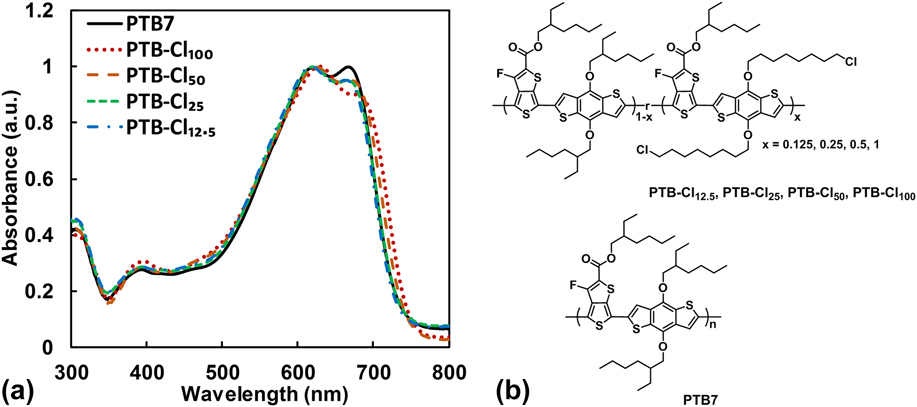
Solution-processed organic solar cells based on conjugated polymers and fullerenes are potentially cost-effective alternatives to conventional inorganic solar cells.Reference Espinosa, Hösel, Angmo and Krebs1–Reference Søndergaard, Hösel, Angmo, Larsen-Olsen and Krebs3 The active layer of a polymer solar cell (PSC) is typically composed of a bulk heterojunction of polymer and a fullerene.Reference Yu, Gao, Hummelen, Wudl and Heeger4 Bulk heterojunctions ideally contain finely separated, bicontinuous phases of polymer and a fullerene, which provide interfaces for exciton dissociation and percolating pathways for charge transportation.Reference Yang and Loos5–Reference Heeger7 The formation of bulk heterojunctions during casting is kinetically driven rather than thermodynamically favored. The as-cast morphologies are thus subject to further phase segregation, which are typically caused by fullerene’s tendency to diffuse and crystalize.Reference Yang, van Duren, Janssen, Michels and Loos8,Reference Cardinaletti, Kesters, Bertho, Conings, Piersimoni, D’Haen, Lutsen, Nesladek, Van Mele, Van Assche, Vandewal, Salleo, Vanderzande, Maes and Manca9 The change in morphology is exacerbated at high temperature and leads to increased charge recombination of the photoexcited state.Reference Bertho, Haeldermans, Swinnen, Moons, Martens, Lutsen, Vanderzande, Manca, Senes and Bonfiglio10–Reference Bergqvist, Lindqvist, Bäcke, Ma, Tang, Tress, Gustafsson, Wang, Olsson, Andersson, Inganäs and Müller13 As a consequence, thermally stable bulk heterojunctions are desired because excessive thermal energy is generated during device operation.Reference Pickett and Sargent14,Reference Haillant, Dumbleton and Zielnik15 Strategies explored to achieve stable bulk heterojunctions include seeking a reduction in the rate of fullerene diffusion.Reference Cardinaletti, Kesters, Bertho, Conings, Piersimoni, D’Haen, Lutsen, Nesladek, Van Mele, Van Assche, Vandewal, Salleo, Vanderzande, Maes and Manca9 One strategy consists of synthesizing block copolymers where one of the blocks is capable of bonding fullerenes.Reference Sommer, Huettner and Thelakkat16,Reference Topham, Parnell and Hiorns17 These block copolymers are usually mixed in the bulk heterojunction to act as a compatibilizer and increase thermal stability without compromising the photoconversion efficiency (PCE).Reference Lai, Ohshimizu, Takahashi, Hsu, Higashihara, Ueda and Chen18–Reference Lin, Lim, Wei, Mannsfeld, Briseno and Watkins20 In another strategy, thermally cleavable sidechains are introduced to the backbones of a conjugated polymer. The sidechains can be subsequently thermally removed prior to device operation.Reference Bundgaard, Helgesen, Carlé, Krebs and Jørgensen21 The cleavage of sidechains significantly increases the glass transition temperature of the polymer (T g) and impedes the diffusion of the fullerenes.Reference Krebs and Spanggaard22–Reference Vahdani, Li, Zhang, Holdcroft and Frisken25 Cross-linking is another strategy used to stabilize the morphology of bulk heterojunctions.Reference Wantz, Derue, Dautel, Rivaton, Hudhomme and Dagron-Lartigau26,Reference Rumer and McCulloch27 Functional groups that can crosslink upon thermal annealing or UV-irradiation have been incorporated in the sidechains of polymers,Reference Miyanishi, Tajima and Hashimoto28–Reference Yau, Wang, Treat, Fei, Tremolet de Villers, Chabinyc and Heeney33 fullerenes,Reference Diacon, Derue, Lecourtier, Dautel, Wantz and Hudhomme34,Reference Chen, Huang and Chuang35 and small molecules,Reference Derue, Dautel, Tournebize, Drees, Pan, Berthumeyrie, Pavageau, Cloutet, Chambon, Hirsch, Rivaton, Hudhomme, Facchetti and Wantz36–Reference Cheng, Yan, Lau, Mai, Lu and Zhan39 to form linkages among polymers,Reference Miyanishi, Tajima and Hashimoto28–Reference Griffini, Douglas, Piliego, Holcombe, Turri, Fréchet and Mynar30,Reference Yau, Wang, Treat, Fei, Tremolet de Villers, Chabinyc and Heeney33,Reference Cheng, Yan, Lau, Mai, Lu and Zhan39 among fullerenes,Reference Diacon, Derue, Lecourtier, Dautel, Wantz and Hudhomme34–Reference Rumer, Ashraf, Eisenmenger, Huang, Meager, Nielsen, Schroeder, Chabinyc and McCulloch38 or between polymers and fullerenes.Reference Kim, Han, Cho, Kang, Cho, Lee, Fréchet, Oh and Kim31,Reference Nam, Qin, Park, Hlaing, Lu, Ocko, Black and Grubbs32 In all cases, the diffusion of fullerenes is greatly hindered in the film and thermally stable morphologies have been achieved. Photocrosslinking has the advantage of avoiding an initial heat treatment step, which may negatively affect the device performance.Reference Rumer, Ashraf, Eisenmenger, Huang, Meager, Nielsen, Schroeder, Chabinyc and McCulloch38,Reference Gholamkhass and Holdcroft40 Photocrosslinking with alkyl halides, especially alkyl bromide, has been demonstrated to be an effective method to stabilize bulk heterojunction morphologies in both P3HT and low band gap polymer devices.Reference Kim, Miyamoto, Ma and Fréchet29,Reference Griffini, Douglas, Piliego, Holcombe, Turri, Fréchet and Mynar30,Reference Yau, Wang, Treat, Fei, Tremolet de Villers, Chabinyc and Heeney33 In this paper, we report a series of polymers based on poly(benzo[1,2-b:4,5-b′]dithiophene-thieno[3,4-b]thiophene) (PTB) incorporating photocrosslinkable alkyl chloride sidechains (Fig. 1). PTBs have a band gap of ∼1.6 eV and a strong optical absorption that extends into the near-infrared region.Reference Liang and Yu41–Reference Lu and Yu43 One of the most promising derivatives, poly({4,8-bis[(2-ethylhexyl)oxy]benzo[1,2-b:4,5-b′]dithiophene-2,6-diyl}{3-fluoro-2-[(2-ethylhexyl)carbonyl]thieno[3,4-b]thiophenediyl}) (PTB7, Fig. 1), has been used to achieve a PCE of 9.2% in an inverted device structure with PC71BM as the fullerene acceptor.Reference He, Zhong, Su, Xu, Wu and Cao44 The high performance of PTB7 has been, in part, attributed to the incorporation of the fluorine substitution on the electron-deficient thieno[3,4-b]thiophene (TT) unit that promotes a high open circuit voltage (V oc) and efficient charge separation between PTB7 and PC71BM.Reference Lu and Yu43,Reference Liang, Xu, Xia, Tsai, Wu, Li, Ray and Yu45,Reference Son, Wang, Xu, Liang, Wu, Li and Yu46 However, the as-cast morphology of a PTB:PC71BM device is metastable and undergoes phase segregation upon heating.Reference Guo, Liang, Szarko, Lee, Son, Rolczynski, Yu and Chen47 We report that short UV exposure of a cross-linkable derivative of PTB7 produces thermally stable PV devices with a high initial PCE. Moreover, polymer films are insolubilized by photocrosslinking, allowing for photolithography with micrometer-scale resolution. The mechanism of the photocrosslinking is herein reported.
Absorption spectra of PTB7 and PTB-Cls (120 nm thin films) (a); chemical structures of PTB-Cl and PTB7 (b).

II. EXPERIMENTAL SECTION
A. Materials
4,8-Dihydrobenzo[1,2-b:4,5-b′]dithiophen-4,8-dione (1) and 2-ethylhexyl-4,6-dibromo-3-fluorothieno[3,4-b]thiophene-2-carboxylate (3) were purchased from SunaTech Inc., Suzhou, China. (4,8-bis((2-ethylhexyl)oxy)benzo[1,2-b:4,5-b′]dithiophene-2,6-diyl)bis(trimethylstannane) (BDT-EH) and PTB7 were synthesized according to literature procedures.Reference Liang, Xu, Xia, Tsai, Wu, Li, Ray and Yu45,Reference Liang, Feng, Wu, Tsai, Li, Ray and Yu48 1,8-Dichlorooctane was purchased from TCI America, Portland, Oregon. 2-Ethylhexyl bromide, n-butyl lithium (2.5 M in hexanes), and trimethyltin chloride (1.0 M in THF) were purchased from Sigma-Aldrich, St. Louis, Missouri. ITO glasses were purchased from Colorado Concept Coating Inc., Loveland, Colorado with a sheet resistance of 15 Ω/□. PEDOT:PSS (Clevios P VP AI 4083) was purchased from Heraeus GmbH, Hanau, Germany. PC71BM was purchased from American Dye Source Inc., Baie d'Urfé, Quebec, Canada. All materials were used as received without further purification, unless otherwise stated.
B. Synthesis
1. 4,8-Bis((8-chlorooctyl)oxy)benzo[1,2-b:4,5-b′]dithiophene (2)
1 (5 g, 22.7 mmol), activated zinc power (3.3 g, 49.9 mmol), sodium hydroxide (13.6 g, 0.34 mol), and 100 mL of distilled water were added to a 250-mL round-bottom flask and refluxed for 2 h. 1,8-dichlorooctane (10.35 g, 56.5 mmol) and tetrahydroammonium hydrogen sulfate (0.77 g, 2.27 mmol) were added, and the reaction was refluxed overnight. The reaction mixture was extracted several times with diethyl either, and the organic phase was filtered and dried over anhydrous sodium sulfate. The organic phase was concentrated and loaded onto a column packed with silica. Gradient elution with hexanes:ethyl acetate (4:1 to 2:1) yielded the titled compound as a white solid (2.99 g, 26%). 1H NMR (400 MHz, CDCl3): 7.48 (d, 2H), 7.36 (d, 2H), 4.28 (t, 4H), 3.54 (t, 4H), 1.88 (tt, 4H), 1.79 (tt, 4H), 1.58 (tt, 4H), 1.46 (tt, 4H), 1.40 (m, 8H).
2. (4,8-Bis((8-chlorooctyl)oxy)benzo[1,2-b:4,5-b′]dithiophene-2,6-diyl)bis(trimethylstannane)
2 (2.97 g, 5.76 mmol) was dissolved in 100 mL of THF in a 250-mL round-bottom flask equipped with a magnetic stir bar under an argon atmosphere. The solution was cooled to −78 °C, and 5.76 mL of n-butyl lithium solution (2.5 M in hexanes) was added dropwise. After 2 h of stirring at the same temperature, 17.28 mL of a trimethyltin chloride solution (1.0 M in THF) was added dropwise to the mixture. The reaction was allowed to warm to room temperature and stirred overnight before it was quenched with water and extracted with diethyl ether. The organic phase was dried over anhydrous sodium sulfate and the solvent was evaporated. Recrystallization in hexanes, twice, afforded the titled product as white needles (4.22 g, 87%). 1H NMR (400 MHz, CDCl3): 7.50 (s, 2H), 4.29 (t, 4H), 3.54 (t, 4H), 1.88 (tt, 4H), 1.79 (tt, 4H), 1.60 (tt, 4H), 1.47 (tt, 4H), 1.41 (m, 8H), 0.45 (t, 18H).
3. PTB-Cl100
3 (138.7 mg, 0.294 mmol), (4,8-bis((8-chlorooctyl)oxy)benzo[1,2-b:4,5-b′]dithiophene-2,6-diyl)bis(trimethylstannane) (BDT-Cl) (271.7 mg, 0.323 mmol), 8 mL of toluene, and 2 mL of N,N-dimethylformamide (DMF) were added into a 25-mL round-bottom flask equipped with a magnetic stir bar. The mixture was subjected to three freeze–pump–thaw cycles before being refilled with argon. Tetrakis-(triphenylphosphine)-palladium(0) [Pd(PPh3)4 11 mg, 9.5 × 10⁻³ mmol] was added, and the reaction was heated at 120 °C for 8 h. After the reaction cooled, the crude product was precipitated in methanol and then filtered into an extraction thimble. After Soxhlet extraction with methanol, hexanes, and chloroform, the chloroform solution was passed through a column packed with Celite. The final product was obtained by precipitation into methanol, yielding 240.7 mg of a dark blue solid (93%). GPC: M n = 48 kg/mol, PDI = 3.3. 1H NMR (500 MHz, C2D2Cl4): 8.0–7.0 (br, 2H), 4.5 (br, 6H), 3.6 (br, 4H), 2.4–0.9 (br, 39H).
4. PTB-Cl50
3 (76.5 mg, 0.162 mmol), BDT-EH (62.6 mg, 0.081 mmol), BDT-Cl (68.1 mg, 0.081 mmol), 8 mL of toluene, and 2 mL of DMF were added to a 25-mL round-bottom flask equipped with a magnetic stir bar. The mixture was subjected to three freeze–pump–thaw cycles before being refilled with argon. Pd(PPh3)4 (9 mg, 8.1 × 10⁻³ mmol) was added, and the reaction was heated at 120 °C for 8 h. The purification process was the same as that for PTB-Cl100. Yield: 110.3 mg, 86%. GPC: M n = 152 kg/mol, PDI = 2.8; 1H NMR (500 MHz, C2D2Cl4): 8.0–7.0 (br, 2H), 4.4 (br, 6H), 3.6 (br, 2H), 2.4–0.9 (br, 42H).
5. PTB-Cl25
3 (76.5 mg, 0.162 mmol), BDT-EH (93.8 mg, 0.122 mmol), and BDT-Cl (34.1 mg, 0.041 mmol) were used as the reactants. The rest of the procedure was the same as that for PTB-Cl50. Yield: 89.5 mg, 71%; GPC: M n = 208 kg/mol, PDI = 3.4; 1H NMR (500 MHz, C2D2Cl4): 8.0–7.0 (br, 2H), 4.4 (br, 6H), 3.6 (br, 1H), 2.4–0.9 (br, 43.5H).
6. PTB-Cl12.5
3 (76.5 mg, 0.162 mmol), BDT-EH (109.5 mg, 0.142 mmol), and BDT-Cl (17 mg, 0.020 mmol) were used as the reactants. The rest of the procedure was the same as that for PTB-Cl50. Yield: 76.5 mg, 62%; GPC: M n = 208 kg/mol, PDI = 3.2; 1H NMR (500 MHz, C2D2Cl4): 7.0–8.0 (br, 2H), 4.4 (br, 6H), 3.6 (br, 0.5H), 2.4–0.9 (br, 44.25H).
7. TTBDTTT-Cl
A 50-mL, 2-neck round-bottom flask equipped with a magnetic stir bar was charged with 3 (377.8 mg, 0.8 mmol), 20 mL of toluene, and 4 mL of DMF. The flask was evacuated and refilled with argon several times before Pd(PPh3)4 (23.1 mg, 0.02 mmol) was added. BDT-Cl (168.2 mg, 0.2 mmol) was dissolved in 10 mL of toluene and purged with argon for 1 h. The reaction mixture was heated to 100 °C, and the solution of BDT-Cl was gradually added using a syringe over 2 h. The reaction was monitored by TLC and terminated by adding water when BDT-Cl was fully consumed. The crude product was extracted with methylene chloride (DCM) and dried over MgSO4. The desired trimer TTBDTTT-Cl was separated from higher oligomers by flash chromatography eluted with hexanes: DCM (2:1) to yield 16.8 mg of a sticky purple solid (6%). 1H NMR (400 MHz, CD2Cl2): 7.56 (s, 2H), 4.29 (m, br, 8H), 3.58 (t, 4H), 1.91 (m, 4H), 1.83 (m, 4H), 1.76 (m, 2H), 1.64 (m, 4H), 1.56–1.35 (m, br, 28H), 1.02 (t, 6H), 0.97 (t, 6H).
C. General characterization
NMR spectroscopy was performed on a Bruker AVANCE III 400 MHz spectrometer and a Bruker AVANCE III 500 MHz spectrometer, Bruker Co., Billerica, Massachusetts. The molecular weights of the polymers were measured using gel permeation chromatography (GPC) composed of a Waters 1515 HPLC pump, Waters Co., Milford, Massachusetts, a 2487 dual absorbance detector, and three Styragel columns with THF as the eluent. The GPC was calibrated against polystyrene standards.
UV-vis spectroscopy was performed on a Cary 300 Bio (Varian Inc., Palo Alto, California) spectrophotometer. Cyclic voltammetry (CV) measurements were carried out in a 0.1 M acetonitrile solution of tetrabutylammonium tetrafluoroborate (Bu4NBF4) under an inert N2 atmosphere. Polymer films were drop cast onto the working electrode made of glassy carbon. A platinum wire was used as the counter electrode, and a saturated calomel electrode was used as the reference electrode. The scan rate was set to 50 mV/s. The potential of ferrocene/ferrocenium (Fc/Fc+) was used as a calibration and was found at 0.4 V under the same experimental condition. The reported absolute potential of Fc/Fc+ is 4.80 V.Reference Pommerehne, Vestweber, Guss, Mahrt, Bässler, Porsch and Daub49 Therefore, the energy levels of the highest occupied molecular orbital (HOMO) and the lowest unoccupied molecular orbital (LUMO) of the polymer were calculated by
 $$E = \left( { - 4.4 - \varphi } \right)\;{\rm{eV}}\quad {\rm{,}}$$
where E represents the energy level of either the HOMO or the LUMO and φ is the onset potential of the corresponding oxidation or reduction peak. X-ray photoelectron spectroscopy (XPS) was performed using a Kratos Analytical Axis ULTRA spectrometer containing a DLD detector, Kratos Analytical, Manchester, United Kingdom. Film thicknesses were measured using an Alpha-Step IQ profilometer (KLA-Tencor, Milpitas, California). Optical microscopy was performed using a Nikon Eclipse 50i microscope equipped (Nikon Instruments Inc., Melville, New York) with a QICAM FAST 1394 camera (QImaging, Surrey, British Columbia, Canada).
D. Cross-linking
ITO glasses were cleaned by consecutive sonication in detergent, 2-propanol, acetone, and deionized water for 15 min each, and then treated with UV/ozone for 30 min. The polymer films (∼120-nm thick) were spin-coated from chlorobenzene (CB) solutions (25 mg/mL, stirred at 50 °C overnight) onto the ITO glass substrates in a nitrogen-filled glove box. A hand-held UV lamp (manufacturer: UVP, LLC, Upland, California; model: UVGL-15) was used to provide a mild 254-nm (650 μm/cm2) UV irradiation from 1 cm above the samples to initiate cross-linking. After UV exposure, all films were immersed in CB for 10 min, rinsed in acetone, and dried with a flow of nitrogen. For the demonstration of photolithography, specimen support grids for transmission electron microscopy (G200-Cu, Electron Microscopy Sciences, Hatfield, Pennsylvania) were placed on top of the polymer films during a 30-min UV exposure inside of a nitrogen-filled glove box. The films were removed from the glove box, immersed in CB for 10 min, rinsed in acetone, and dried with a flow of nitrogen.
E. PV device fabrication, characterization, and stability
Patterned ITO glasses were cleaned by consecutive sonication in detergent, 2-propanol, acetone, and deionized water for 15 min each, and then treated with UV/ozone for 30 min. PEDOT:PSS was spin-coated onto the ITOs from its stock solution at 5000 rpm for 1 min. The resulting slides were annealed at 140 °C in air for 10 min in a preheated oven, and immediately placed in a nitrogen-filled glove box. Dichlorobenzene (DCB) solutions of polymer/PC71BM (1:1.5 w/w, 25 mg/mL) were stirred overnight at 50 °C in the glove box prior to spin-coating. The solutions were filtered through a 0.45-mm PTFE syringe filter and then applied to PEDOT:PSS-coated substrates (0.2 μL for each slide) and spun at 1000 rpm for 1 min. Photocrosslinking was initiated by exposing the spin-coated films under a hand-held UV lamp (UVGL-15, UVP) for various periods of time. Subsequently, the devices were transferred into a thermal evaporator, where ∼20 nm of Ca and subsequently ∼100 nm of Al were evaporated through a shadow mask at ∼10−7 torr. The devices were mounted onto a test fixture equipped with a mask and sealed in a homemade vacuum chamber featuring a quartz window. PV measurements were performed under an AM 1.5G spectrum delivered by a xenon arc lamp source (Newport model 66983, Newport Co., Irvine, California) with a power density of 100 mW/cm2 and calibrated with an NREL calibrated reference diode. J–V curves were measured using a Keithley 2400 source meter, Keithley Instruments, LLC, Solon, Ohio. Monochromatic light for EQE measurements was provided by a Newport CS-260 monochromator (Model 74100; Newport Co., Irvine, California). Evaluation of the device stability was carried out by heating the devices on top of a hotplate inside the glove box in the dark at either 120 or 150 °C for up to 20 h. PV measurements and optical microscopy of the devices were performed at given intervals during the thermal treatment.
III. RESULTS AND DISCUSSION
A. Synthesis and characterization
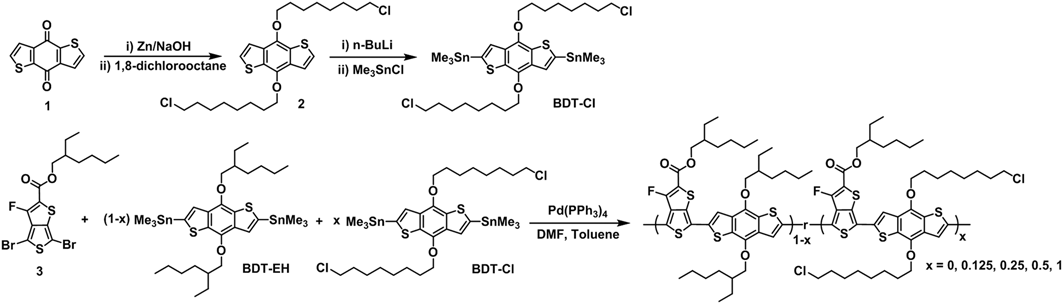
The synthesis of BDT-Cl and the general polymerization procedure are illustrated in Scheme 1. Compound 2 was synthesized via a one-pot Williamson ether synthesis.Reference Leclerc, Najari and Zou50 The yield of this reaction is low (25%) due to the dual reactivity of dichlorooctane.Reference Griffini, Douglas, Piliego, Holcombe, Turri, Fréchet and Mynar30 Although bromine is more widely used in UV cross-linking, the chlorine-terminated n-octyl sidechain was chosen as the cross-linkable sidechain in this work because the chlorine radical is more reactive than the bromine analogue and improves cross-linking efficiency.Reference Mcmurry51 Substituting the cross-linking sidechains on the benzodithiophene unit preserves the fluorine on the thienothiophene unit; preparing a fluorinated thienothiophene monomer with a cross-linkable sidechain is synthetically unfeasible.Reference Qian, Xu, Hou, Wang, Hou and Tan52,Reference Chen, Chen and Chen53
Synthetic procedures of the monomer BDT-Cl and the polymers, PTB-Cls, with different numbers of chlorooctyl sidechains.

By substituting a given number of photocrosslinkable BDT-Cl monomers for BDT-EH monomers of PTB7 in the Stille polycondensation reactions, four cross-linkable PTB polymers, with 12.5, 25, 50, and 100% of BDT-Cl were synthesized.Reference Liang, Feng, Wu, Tsai, Li, Ray and Yu48 The polymerizations yielded molecular weights greater than 150 kDa, as measured by GPC (Table I). Due to the high population of linear sidechains, PTB-Cl100 obtained in a 1:1 feed ratio of thienothiophene and benzodithiophene exhibited limited solubility in common PV processing solvents, such as CB and DCB. Therefore, the feed ratio of thienothiophene and benzodithiophene was adjusted to 1:1.1 for PTB-Cl100 to decrease the molecular weight. The other polymers were prepared from 1:1 thienothiophene:benzodithiophene ratios as these are soluble in CB and DCB due to the solubilizing 2-ethylhexyl groups on the BDT-EH unit.
Structural characterization and optoelectronic properties of PTB7 and PTB-Cl.

a Integration ratio determined by 1H NMR, acquired at 120 °C.
The structures of the polymers were confirmed by NMR spectroscopy. The broad resonance peak at ∼4.4 ppm is assigned to –O–CH2– protons, and the peak at ∼3.5 ppm is assigned to the –CH2–Cl group (Figs. S1 and S2). For every 2-ethylhexyl substituent replaced by an n-chlorooctyl group, two –CH2–Cl protons are introduced and the number of –O–CH2– protons remains the same. Therefore, the ratio between these two peaks increases from 6:0 for PTB7 to 6:4 for PTB-Cl100 (Table I).
B. Optoelectronic properties
The absorption spectra of PTB7 and PTB-Cls in the form of thin films are presented in Fig. 1. All polymers exhibited similar absorption profiles with a strong absorbance at 650 nm, which is typical for PTB derivatives.Reference Liang and Yu41 λonset of PTB-Cl100 was ∼15 nm red-shifted than PTB7, and red-shifts further as the BDT-Cl content increases. As a result, the optical band gap (E gopt) decreases from 1.70 eV for PTB7 to 1.66 eV for PTB-Cl100 (Table I). A similar trend was observed for other PTB derivatives.Reference Liang and Yu41,Reference Liang, Feng, Wu, Tsai, Li, Ray and Yu48 The difference in the sidechain structure likely contributes to the red-shift, as polymers with linear sidechains adopt a closer π–π stacking morphology than those possessing branched sidechains, allowing intermolecular excitations to be activated with lower energy photons.Reference Ho, Boudouris and Segalman54 The sidechains on the BDT unit govern the π–π stacking distance of PTB. Therefore, the introduction of linear sidechains results in a closer packing and red-shifted optical absorptions for PTB-Cls. Electrochemical band-gaps of 1.7–1.8 eV were determined by CV (Table I). These results are in good agreement with the reported values for other PTB derivatives.Reference Liang and Yu41,Reference Liang, Xu, Xia, Tsai, Wu, Li, Ray and Yu45
C. Cross-linking studies
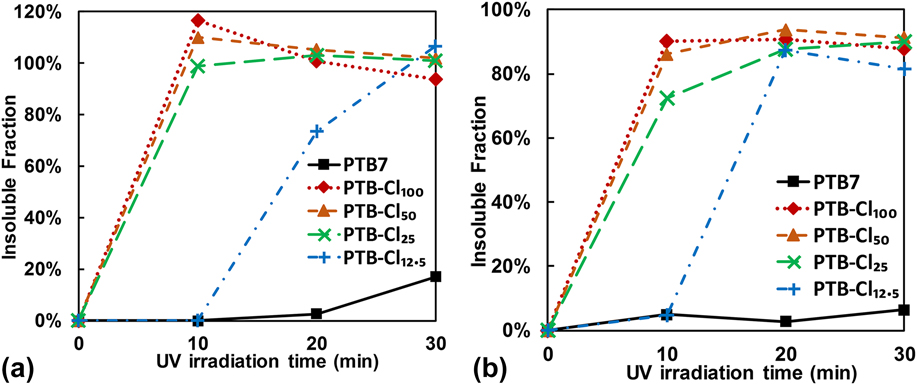
Photocrosslinking and insolubilization of cast films were evaluated by measuring the changes of the absorption spectra and the film thickness after UV-irradiation and immersion in the casting solvent, CB (Fig. 2). Thin films cast from their neat CB solutions were subjected to UV exposure followed by an immersion in CB to remove any soluble polymer. All PTB-Cl films were completely insolubilized after 30 min of UV exposure. Those polymers with high contents of cross-linkable groups (i.e., PTB-Cl100, PTB-Cl50) required only 10 min exposure. By contrast, PTB7 remained soluble, even after long UV exposures. With insufficient UV exposure, PTB-Cl films peeled away from the ITO substrates and broke into insoluble pieces upon immersion into CB. The cross-linking process is represented here by the films of PTB-Cl12.5: as UV exposure increased from 10 to 30 min, the detached, insoluble film fragments became larger with increasing irradiation dose and ultimately the film remained attached to the substrate, intact after 30 min irradiation (Fig. S5). This suggests that photocrosslinking was homogeneously initiated throughout the film and propagates laterally and vertically until a cross-linked network is formed. The surface temperature of the UV irradiation platform increased to only 26 °C (slightly above room temperature) after 30 min of continuous UV irradiation, indicating that cross-linking was photochemically activated, not thermally activated.
Photocrosslinking of PTB-Cls evaluated using (a) UV-vis spectroscopy and (b) profilometry of the remaining film after irradiation and immersion into solvent.

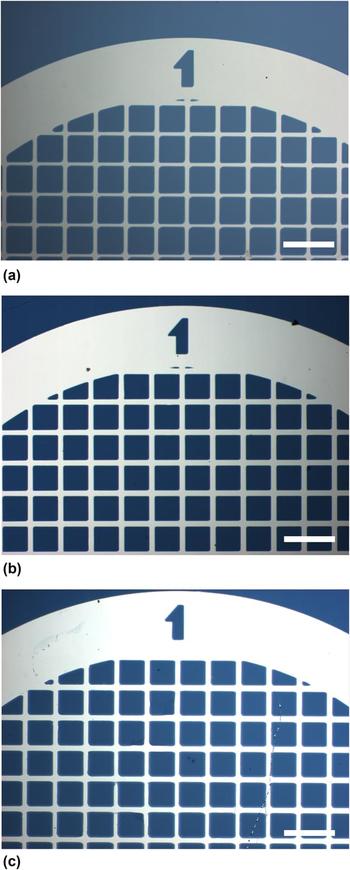
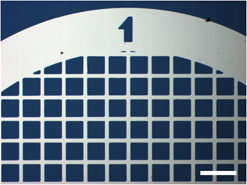
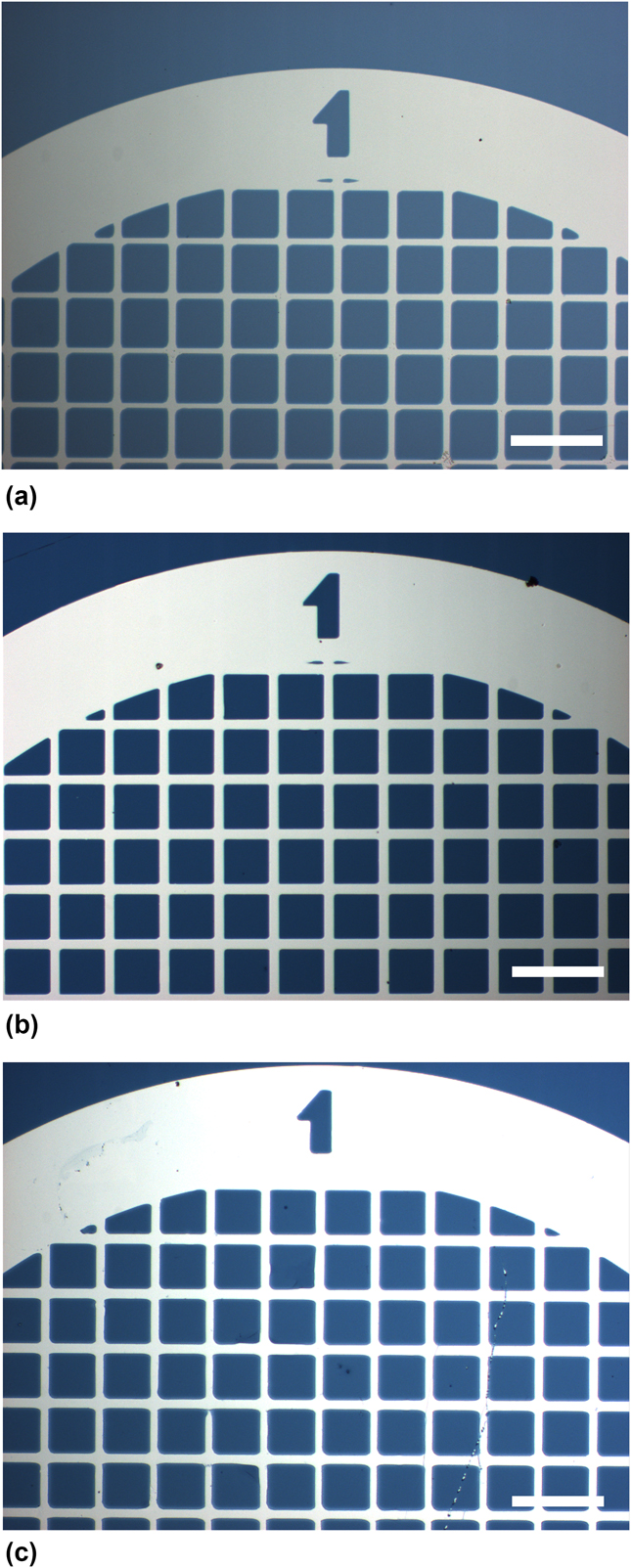
To demonstrate photoinduced cross-linking, photolithography was performed using PTB-Cl films. The UV exposure and solvent immersion processes were similar to cross-linking studies except masks (TEM copper grids, bar width: 35 μm) were placed on these polymer films to create patterns. Optical microscopy images of photolithographed films reveal that clear images of the copper grid were obtained with the PTB-Cl polymers, with PTB-Cl100 displaying the sharpest edges (Fig. 3). These preliminary results demonstrate the potential to fabricate high-performance microcircuits using cross-linked PTB derivatives.
Optical microscopy images of patterned PTB-Cl100 (a), PTB-Cl50 (b), and PTB-Cl25 (c). Scale bar: 200 μm.
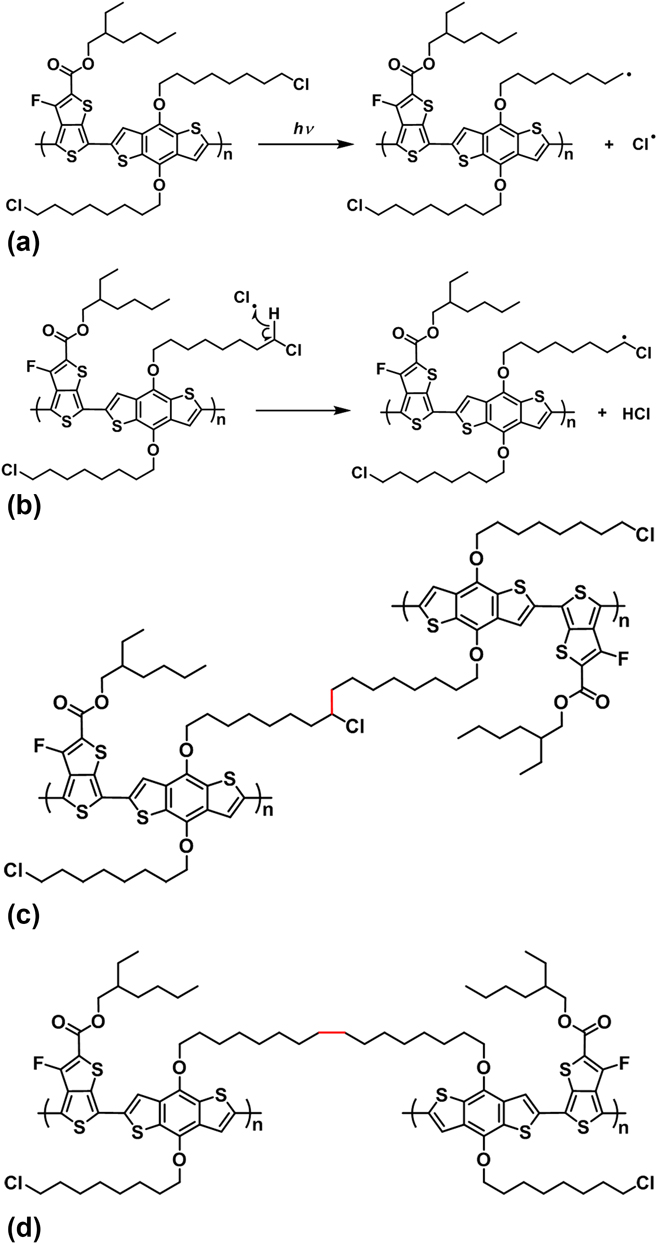
The mechanism of photocrosslinking of PTB-Cl is believed to be free radical in nature. Similar hypotheses have been proposed in photocrosslinking studies of conjugated polymers bearing bromine-functionalized sidechains.Reference Kim, Miyamoto, Ma and Fréchet29,Reference Yau, Wang, Treat, Fei, Tremolet de Villers, Chabinyc and Heeney33 The photochemical process likely involves a series of chain reactions that begin with UV-initiated chlorine-free-radical formation.Reference MacKenzie and Harrison55 The proposed mechanism is illustrated in Scheme 2. Upon UV irradiation, homolysis of the C–Cl bond generates a chlorine radical, leaving a radical species on the end of the sidechain. The highly reactive chlorine radical may randomly attack another alkyl chain by abstracting a hydrogen from the C–H bond. The radical species on the alkyl chains can terminate by forming new carbon–carbon bonds, which constitutes cross-linking.
Possible mechanism of photocrosslinking for PTB-Cl: (a) homolytic photolysis of the C–Cl bond; (b) hydrogen abstraction; (c) and (d) termination of two radical species.

XPS was performed to verify the hypothesized mechanism. PTB-Cl films were examined before and after 30 min of UV exposure. UV exposure was performed while the samples were affixed to the XPS sample holder, and measurements were carried out on the precise same regions before and after UV exposure. XPS revealed a decrease of the chlorine peaks after UV exposure while other peaks remained unchanged (Fig. S6). The loss in chlorine is most prominent in the PTB-Cl100 sample, where 20% was lost after 30 min of UV irradiation.
D. Photovoltaic properties
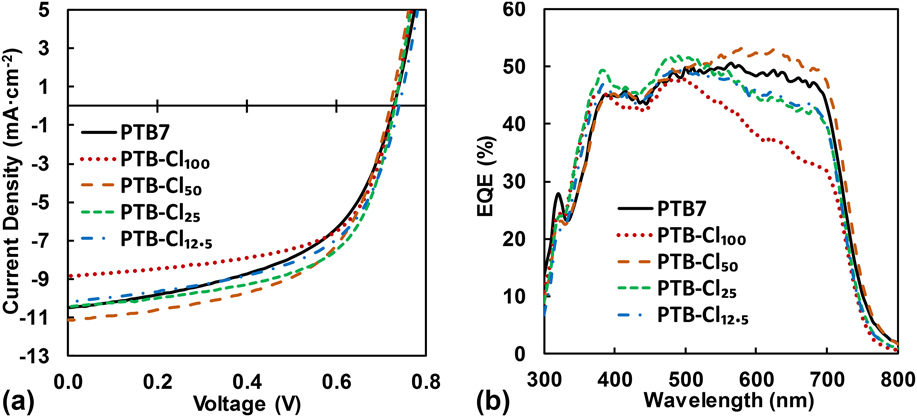
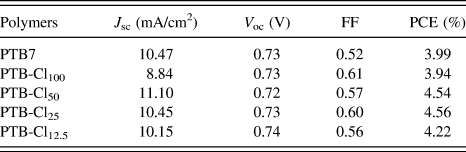
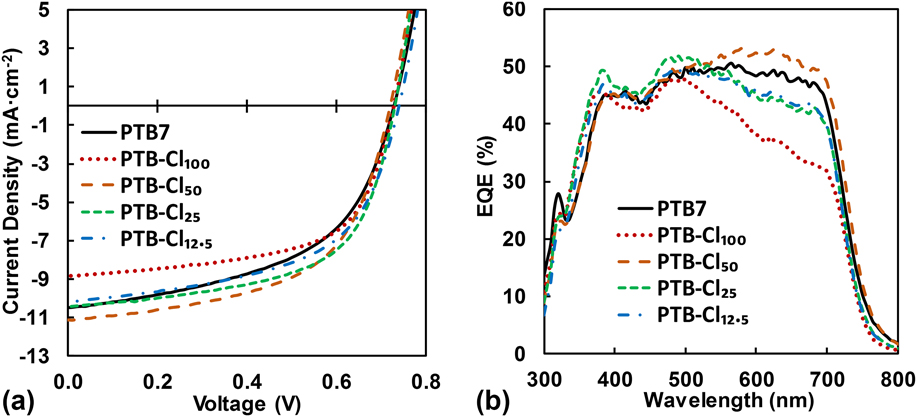
Bulk heterojunction photovoltaic devices of PTB7 and PTB-Cls were fabricated in a conventional ITO/PEDOT:PSS/polymer:PC71BM/Ca/Al configuration and tested under standard 1 sun AM 1.5G illumination. The active layers were spin-coated from a DCB solution of polymer:PC71BM with a thickness of ∼110 nm. J–V curves and EQE curves are presented in Fig. 4, and PV parameters are tabulated in Table II. PTB-Cl devices showed similar PCEs to PTB7 devices at around 4.0–4.5% with similar FF, V oc, and J sc values. This result indicates that the introduction of photocrosslinkable sidechains on the BDT unit did not significantly alter the PV performance of the polymers.
J–V curves (a) and EQE curves (b) of PTB7 and PTB-Cl devices cast from DCB.
Photovoltaic characteristics of PTB7 and PTB-Cl devices.

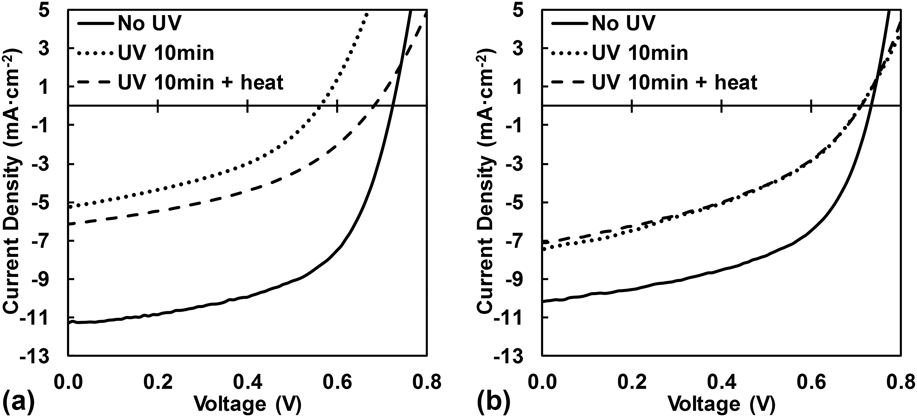
The influence of photocrosslinking on the PV performance was investigated. For all the PTB-Cl polymers, 10-min UV exposure had a significant impact on the J–V characteristics. Both J sc and V oc values fell dramatically after UV irradiation (Fig. 5). This effect is most severe in PTB-Cl100 devices, for which photocrosslinking is the heaviest. Interestingly, J sc and V oc increased slightly after thermal annealing following the UV exposure. The same effect has been observed in other photocrosslinkable polymers with bromine-terminated sidechains.Reference Griffini, Douglas, Piliego, Holcombe, Turri, Fréchet and Mynar30,Reference Yau, Wang, Treat, Fei, Tremolet de Villers, Chabinyc and Heeney33 Indeed, conjugated polymers can be reversibly p-doped with oxygen radical anions, forming a charge-transfer complex (CTC),Reference Abdou, Orfino, Son and Holdcroft56,Reference Desiraju and Steiner57 which induces trapping sites and causes misalignment of energy levels between the polymer and the fullerene, leading to losses of J sc and V oc.Reference Schafferhans, Baumann, Deibel and Dyakonov58–Reference Aygu, Hintz, Egelhaaf, Distler, Abb, Peisert and Chassé60 The formation process of CTC is accelerated by illumination while the dissociation process is activated by thermal annealing.Reference Abdou, Orfino, Son and Holdcroft56,Reference Seemann, Sauermann, Lungenschmied, Armbruster, Bauer, Egelhaaf and Hauch59,Reference Liao, Yang, Liu, Horng, Meng and Shy61–Reference Aguirre, Meskers, Janssen and Egelhaaf64 Therefore, we attribute the UV degradation and thermal recovery of performance to reversible p-type doping of the polymer by chlorine radicals. To compare, a PTB7 device was also subjected to 10 min of UV irradiation followed by thermal annealing. Unlike the PTB-Cls, the UV degraded J sc and V oc were not recovered upon thermal annealing. Therefore, the partially recoverable UV degradation of PTB-Cl devices was a combined effect of the reversible p-doping and certain permanent degradations.
J–V curves of (a) PTB-Cl50 and (b) PTB7 devices: as-cast (solid), after 10-min UV exposure (dotted), and subsequently thermally annealed (dashed).

E. Stability of PV devices
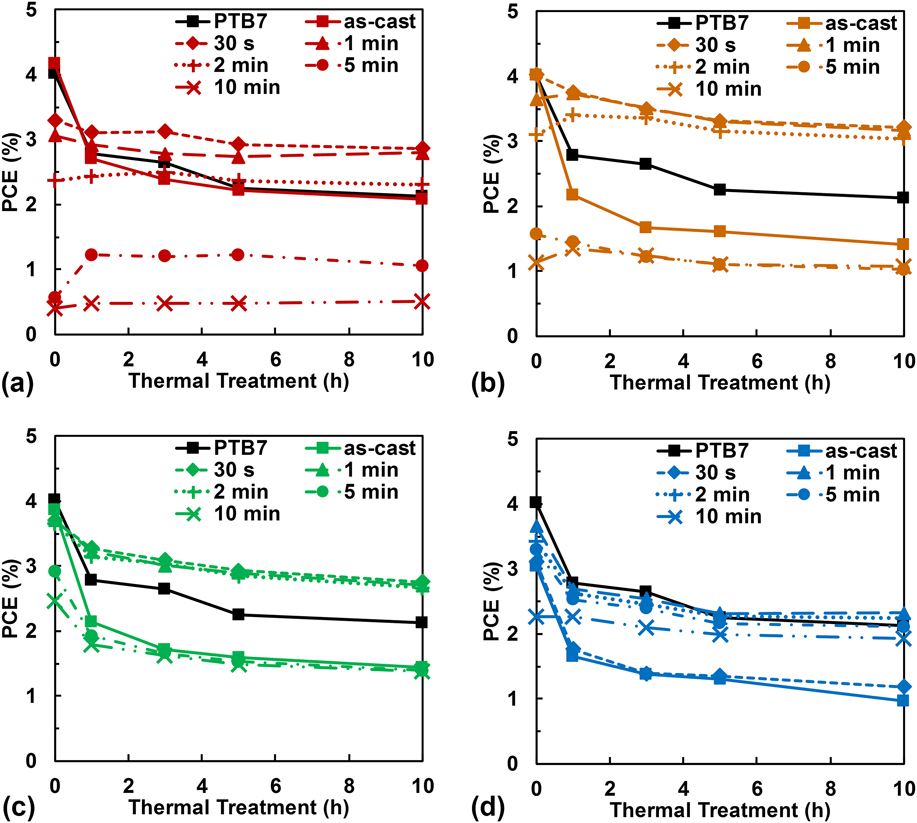
Evaluation of stability of PV devices was carried out by accelerated aging at 120 °C inside the glove box and measuring the PV parameters at the end of 1, 3, 5, and 10 h of heat treatment. To find an optimal photocrosslinking condition that introduces sufficient cross-linking to stabilize the cell performance without a negative impact on the PV parameters, UV exposure times of less than 10 min (e.g., 30 s, 1 min, 2 min, and 5 min) were investigated. PCE profiles plotted against the time of thermal treatment are shown in Fig. 6. The PCE of a PTB7 device degraded from 4.01 to 2.13% after 10 h at 120 °C. PTB-Cl100, PTB-Cl50, and PTB-Cl25 devices with 30 s, 1 min, and 2 min UV exposures exhibited more stable PCEs. The UV degradation became significant as the UV exposure was extended beyond 5 min, leading to poor PCEs. PTB-Cl50 devices with short UV exposures exhibited the highest stable PCEs among all devices. The slight increase of PCE of the 1 and 2 min UV-exposed PTB-Cl50 devices after 1 h at 120 °C is associated with the thermal recovery of UV degradation. With short UV exposure, the UV degradation is fully recoverable because no permanent damage is caused. The high stability of the UV irradiated samples is a combined result of stable J sc and FF (Figs. S7 and S9). By contrast, non-crosslinked PTB-Cl films showed poor thermal stability, caused by a rapidly decreasing FF.
PCE as a function of thermal treatment time at 120 °C of PTB-Cl100/PC71BM (a), PTB-Cl50/PC71BM (b), PTB-Cl25/PC71BM (c), and PTB-Cl12.5/PC71BM (d) devices with various amounts of UV exposure, compared to the PTB7/PC71BM device.

F. Morphological stability
Optical microscopy was performed on solar cell devices to investigate the correlation between the evolution of morphology and the degradation of PCE. No PCBM crystallization was observed on any of the devices thermally treated at 120 °C for 10 h. Hence, the degradation of PV parameters observed is not caused by the crystallization of PCBM, as determined by optical microscopy. However, nanoscale phase segregation that is not in the form of PCBM crystallization has been found to result in degradation of PV devices.Reference Schaffer, Palumbiny, Niedermeier, Jendrzejewski, Santoro, Roth and Müller-Buschbaum65
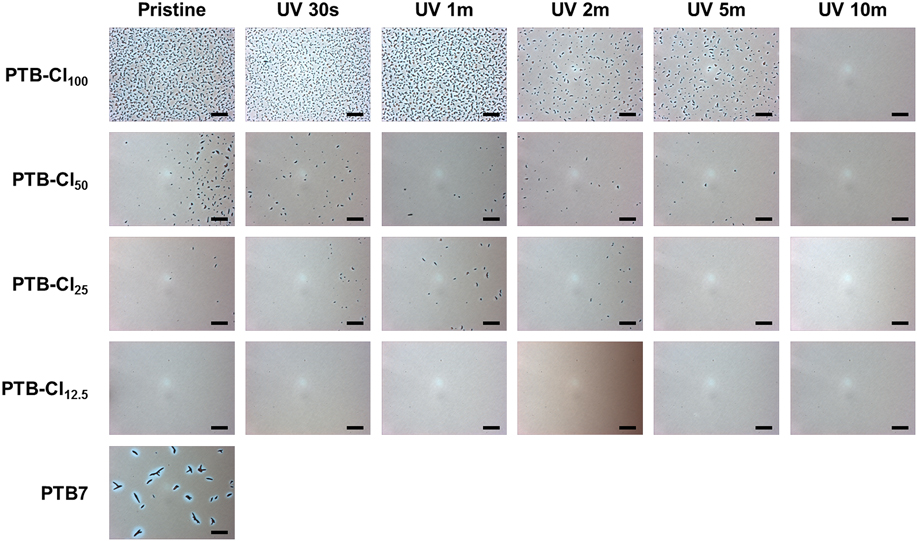
To examine whether cross-linking inhibits gross, microsized phase segregation—the end result of nanoscale phase segregation—optical microscopy was performed on cross-linked films exposed at a higher temperature, 150 °C, for up to 20 h. The “active layer” morphologies of the polymer/PC71BM devices after 20-h thermal treatment are presented in Fig. 7. For pristine PTB-Cl devices, a large density of PCBM crystallites is observed after 20 h at 150 °C, which increases as the BDT-Cl content increases. However, only 10-min UV exposure was sufficient to completely inhibit the crystallization of PCBM in all PTB-Cl devices. Shorter UV exposure times are more effective as the BDT-Cl content decreased. In PTB7/PC71BM devices, only sporadic crystallites were found after 10 h at 150 °C (Fig. S10). Extending the heating to 20 h produced large crystallites with dimensions of 10–20 μm in length. The blue halos surrounding the crystallites represent regions depleted of PCBM.Reference Zhong, Yang, deWith and Loos66,Reference He, Germack, Joseph Kline, Delongchamp, Fischer, Snyder, Toney, Kushmerick and Richter67
Optical microscopy images of the active layers of pristine and UV exposed PTB-Cl devices and PTB7 device after 20 h at 150 °C. Scale bar: 20 μm.
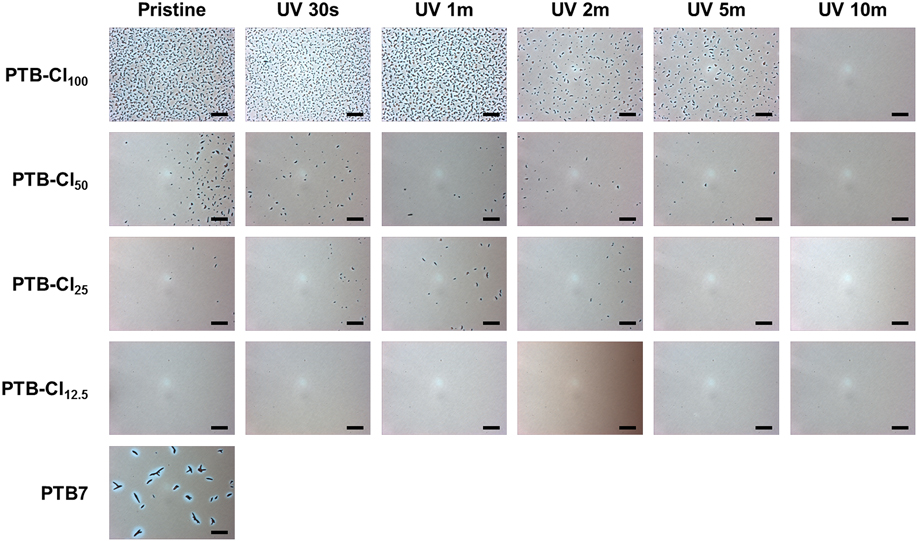
The differences in crystallite size, number, and onset time for crystallite formation are noticeable between PTB7 and PTB-Cl100 devices. Densely populated small crystallites (∼2 μm) were found in PTB-Cl100 devices. This observation indicates that the nucleation rate is greater than the growth rate, such that the PCBM molecules tend to form new nuclei rather than adding to existing crystallites. By contrast, the crystallization of PCBM in the PTB7 device is nucleation limited, i.e., the growth rate is higher than the nucleation rate, resulting in large, sparsely populated crystallites. We attribute the difference in the PCBM crystallization kinetics of PTB7 and PTB-Cl100 films to the structural dissimilarity of the sidechains on the BDT unit. PTB-Cl100 with linear chlorooctyl sidechains permits tighter π–π stacking than PTB7 with its branched 2-ethylhexyl sidechains. The closely packed PTB-Cl100 expels the PCBM molecules from the mixed phase to form nuclei, whereas the loosely packed PTB7 hinders this process.
While light-density cross-linking in PTB-Cl12.5 is sufficient to retard nucleation, as evidenced by the absence of PCBM crystallites after 20 h at 150 °C, this was not effective to counterbalance the increased nucleation rate as the BDT-Cl content was increased. Noticeably, no PCBM crystallite was observed near the top electrode for all samples after the 20-h thermal treatment (Fig. S11), suggesting that the electrode inhibits crystallization of PCBM, which corroborates with the confinement effect of the top electrode.Reference Yang, Alexeev, Michels and Loos68,Reference Watts, Belcher, Thomsen, Ade and Dastoor69
IV. CONCLUSION
Photocrosslinking via chlorooctyl sidechains was demonstrated using a series of low band-gap, PTB-based polymers. The four polymers, containing varying amounts of chlorooctyl sidechains, namely PTB-Cl12.5, PTB-Cl25, PTB-Cl50, and PTB-Cl100, were synthesized. PTB-Cls exhibited similar optoelectrical properties to PTB7 with those possessing a higher ratio of chlorooctyl sidechains (e.g., PTB-Cl100) showing red-shifted absorption profiles, which are attributed to increased π–π stacking. Photocrosslinking initiated by deep-UV irradiation insolubilizes films prepared from PTB-Cls. Utilizing this property, photolithography was demonstrated with micrometer-scale patterning. The mechanism of photocrosslinking is radical in nature. PV devices made of PTB-Cl/PC71BM displayed PCEs that were comparable to that of PTB7/PC71BM devices. For devices UV irradiated for 10 min, a reduction in J sc and V oc were observed, which partially recovered upon thermal treatment. Photocrosslinking introduced by UV exposure for less than 5 min improved the device stability without reducing the initial PV performance. The stable PCE was attributed to an optimal nanoscale morphology stabilized by photocrosslinking. However, at a higher temperature where PCBM crystallites start to form, photocrosslinking with <10 min exposure did not stabilize the morphology against PCBM crystallization promoted by the introduction of the linear chlorooctyl sidechains. Only PTB-Cl12.5 exhibited a stable morphology against PCBM crystallization with mild photocrosslinking. This work demonstrates the possibility to fabricate thermally stable PSCs by incorporating photocrosslinkable chloroalkyl sidechains onto the polymer backbone.
Supplementary Material
To view supplementary material for this article, please visit https://doi.org/10.1557/jmr.2018.78.
ACKNOWLEDGMENT
We would like to thank the National Sciences and Engineering Research Council of Canada (NSERC) for funding.