Political debates over immigration policy have been rising in volume and intensity in recent years in almost all Western economies. On the one hand, immigration is seen by many as an economic and cultural lifeline that can supply firms in key industries with skilled workers, relieve strains on tax-funded pension systems threatened by the graying of the local population, and inject new artistic and intellectual life into the nation. On the other hand, there are concerns that immigrants may take jobs away from local workers, subtract more from the government in the form of social services than they give back in taxes, and create ethnic enclaves that balkanize the nation, undermine traditional culture, and lead to crime and other social ills. These latter concerns have encouraged the recent imposition of much tighter immigration controls in several countries while also nurturing the growth of extremist anti-immigrant political movements in many parts of Europe and increasing the incidence of hate crimes directed toward immigrants. The debate seems certain to continue in the years ahead, and grow fiercer.
A great deal of new research has examined survey data on individual attitudes toward immigration, focusing on the determinants of anti-immigration sentiments.1
Some of the most recent and prominent studies have concluded that realistic fears about the economic effects of labor-market competition among low-skilled, blue-collar workers lie at the heart of much anti-immigration feeling.2 These studies all rest their analysis on economic models of the distributive effects of immigration anticipating that low-skilled (that is, less-educated) native workers will lose out when forced to compete for jobs with low-skilled immigrants.3 The key supporting evidence for their claims is that opposition to immigration among survey respondents in advanced industrialized countries is negatively and significantly associated with individual levels of educational attainment. Viewed from this perspective, the immigration debate is to a large extent about economics, and a critical battle line is the one that separates high-skilled and low-skilled workers.But this account does not fit well with the growing body of evidence, available from a variety of studies of European and American labor markets, showing that the effects of immigration flows on income, employment, and unemployment actually appear to be quite small.4
See Friedberg and Hunt 1995; Bhagwati 2000 and 2002; Dustmann et al. 2004; and Card 2005; although see Borjas 2003.
Which of these interpretations is more correct? Is the main motivator for opposition to immigration the threat of economic competition, felt most acutely among the less educated? Or is it a deeper animosity toward foreigners and foreign cultures, felt least strongly among the more educated? The answer to this question is critical to our understanding of the politics of immigration and the treatment of ethnic minorities. It is crucial, too, for policymakers and others who support immigration and worry about the growth of extremist, often violent, anti-immigrant movements. If anti-immigration sentiments are based primarily on economic calculations, there are some very direct ways in which policymakers might address them: for instance, by targeting forms of adjustment assistance and job creation programs toward the communities or industries in which the economic impact is felt most heavily. If opposition to immigration is motivated by more deep-seated cultural factors, on the other hand, these types of adjustment assistance are unlikely to be effective and it is much more difficult to imagine simple, short-run measures that would mitigate the political tensions.
We examine new data on attitudes toward immigration available from the 2003 European Social Survey (ESS). Unlike other sources of survey data on attitudes toward immigrants, the 2003 ESS provides a rich, detailed set of questions about the immigration issue, probing respondents' views about immigrants from different countries. The detailed data allow us to provide new tests of the labor-market competition explanation for anti-immigration sentiments among European voters. We focus, in particular, on the complex relationship between education and attitudes toward immigration. Our results indicate that, in contrast to predictions based on the conventional arguments about labor-market competition, which anticipate that individuals will oppose immigration of workers with similar skills to their own but support immigration of workers with different skill levels, people with higher education levels are more likely to favor immigration regardless of where the immigrants come from and their likely skill attributes. Across Europe, higher education means more support for all types of immigrants. This is true for alternative measures of education in all twenty-two ESS countries. The same relationship holds for direct (occupational) measures of respondent skill levels: higher skills are associated with greater support for all types of immigration. These relationships are almost identical among those in the labor force and those not in the labor force.
The findings thus suggest that, contrary to the conventional wisdom, the connection between the educational or skill attributes of individuals and their views about immigration appears to have very little, if anything, to do with fears about labor-market competition. The conventional story appears to be based on a fundamental misinterpretation of the available evidence. We find that a large component of the effect of education on individual attitudes toward immigrants is associated with differences among individuals in cultural values and beliefs. More educated respondents are significantly less racist and place greater value on cultural diversity; they are also more likely to believe that immigration generates benefits for the host economy as a whole. Together, these factors account for around 65 percent of the estimated relationship between education and support for immigration.
Explaining Individual Attitudes Toward Immigration
Which individuals are most likely to oppose immigration? Standard economic models of the income effects of immigration emphasize the importance of the different types of productive factors people own. What is critical in this respect is the impact that immigration has on relative supplies of factors of production in the local economy. In the most commonly analyzed scenario, it is assumed that immigrants have relatively low skill levels when compared with native workers. Immigration thus increases the supply of low-skilled labor relative to other factors (land, capital, and high-skilled labor). In a simple closed-economy model in which new (low-skilled) immigrants can price themselves into employment only by lowering the wages of native low-skilled workers, as more low-skilled labor is applied to fixed amounts of the other factors, the real wages of the less skilled will decline while the earnings of owners of land, capital, and skills will rise.6
Standard models assume full employment and wage flexibility, so that the distributional effects are reflected in wages. In models that permit labor-market imperfections, these effects can also take the form of changes in local unemployment rates (see Razin and Sadka 1995; and Angrist and Kugler 2003). Alternative models also allow for geographic differences within national labor markets so that the wage and employment effects of immigration may be concentrated in “gateway communities” where immigrants tend to settle in large numbers (see Card 1990; LaLonde and Topel 1991; and Borjas 1999a, 10–11).
There has been a good deal of research on public attitudes toward immigration that has looked for signs that economic concerns related to job security do lie behind anti-immigrant sentiments, with mixed results.8
See, for example, Studlar 1977; Harwood 1986; Simon 1987; Gang and Rivera-Batiz 1994b; Citrin et al. 1997; Burns and Gimpel 2000; Fetzer 2000; and Dustmann and Preston 2001.
Mayda 2006.
There are several reasons to be cautious about how we interpret these findings. One issue is whether immigration, in practice, has actually had the distributional effects anticipated by the standard closed-economy models. A growing set of empirical studies dedicated to this question has found only small wage and employment effects attributable to immigration flows into European labor markets (there is still much debate about the evidence in the American case).11
For general reviews, see Friedberg and Hunt 1995; and Bhagwati 2000 and 2002. For evidence on the impact of immigration in European labor markets, see Zimmerman 1995; Hunt 1992; DeNew and Zimmerman 1994; Hartog and Zorlu 2005; and Dustmann et al. 2004. Evidence on immigration effects on wages in the United States is discussed in Card 1990; Gang and Rivera-Batiz 1994a; Borjas, Freeman, and Katz 1997; and Borjas 1999a. Two recent studies of the effects of immigration on wages and employment in the United States, Borjas 2003 and Card 2005, reach opposing conclusions about the magnitude of these effects.
Angrist and Kugler 2003, 16, report “considerable overlap between the immigrant and native schooling distributions” for thirteen European countries in 1995 and 1999. Borjas, Freeman, and Katz 1997 and Borjas 1999a present evidence from U.S. census data indicating that, on average, immigrants to the United States had approximately two fewer years of education than natives in 1998. According to Bhagwati 2002, 310, however, the evidence of a large native versus immigrant skill difference is less clear judging from data from the Immigration and Naturalization Service.
See Bauer, Pool, and Dexter 1972.
More fundamentally, the most sophisticated economic models are actually quite equivocal about whether immigrants will have an adverse impact on the wages or employment opportunities of local workers with similar skills.14
In the following we briefly summarize the theoretical predictions of current open-economy models of immigration; we provide a detailed technical description in a separate Web appendix to this article.15This appendix and other supplements referred to in later sections are available for download at the authors' Web site at 〈http://www.people.fas.harvard.edu/∼jhainm/research.htm〉.
Leamer and Levinsohn 1995.
The theoretical picture becomes no clearer if we allow that the skills of workers can be highly “specific” to particular industries—the standard approach taken in most theoretical recent work on international trade.17
If all goods are traded, so that prices are fixed in world markets, it can be shown that inflows of low-skilled workers will indeed lower real wages for low-skilled natives while raising real wages for high-skilled workers in all industries. (The latter benefits will be larger for high-skilled workers in sectors that use low-skilled labor more intensively.) On the flip side, inflows of any type of high-skilled workers will raise real wages for low-skilled workers while lowering real wages for all high-skilled workers (the latter losses being larger for those who own the same specific skills as the immigrants). While these distributive effects match the predictions generated by the simple closed-economy FP model, they are overturned with the inclusion of nontraded goods in the model. If immigration can lead to a reduction in the price of nontraded goods (that is, if it raises the output of such goods more rapidly than it raises aggregate demand for them), it is unclear whether native workers with skills similar to those of immigrants will be worse off in real terms. (The outcome will depend in part on their consumption tastes.) The effects of immigration inflows on real earnings are similarly ambiguous in the specific-factors model when the country in question is large relative to world markets.18Note that, while we have concentrated on the labor-market effects here, there is also considerable debate over the impact of immigration on government spending and tax revenues. One common concern is that low-skilled immigrants, because they tend to earn less and thus pay less in taxes than natives, and because they are more likely to draw unemployment and other welfare benefits from government, are a net drain on government coffers. Economists are divided on whether this is actually the case (see Krugman and Obstfeld 2000, 166). Notice, however, that to the extent it is true, since the added tax burden of immigration would fall disproportionately on richer, more highly skilled native workers, these distributional effects would run counter to (and thus mitigate) the types of distributional wage effects emphasized in closed-economy FP models of labor-market competition.
Other types of general equilibrium models raise more doubts about the impact we should expect immigration to have on the wages of similarly skilled native workers. If we allow for economies of scale in production in the industries employing immigrants, inflows of new workers can be shown to generate higher real wages for native workers with similar skills in an open-economy model.19
See Brezis and Krugman 1993.
Bhagwati 2000.
If the economic impact of immigration is actually quite small, as both theory and empirics tend to suggest, then what explains the strong negative association between education and anti-immigration sentiments? One clear explanation is provided by theories that relate education to higher levels of ethnic and racial tolerance among individuals and to a preference for cultural diversity. This is an interpretation favored by many scholars who have made note of the connection between education and individual support for immigration.21
See, for example, Betts 1988; Espenshade and Calhoun 1993; Espenshade and Hempstead 1996; Citrin et al. 1997; Fetzer 2000; Chandler and Tsai 2001; and Gang, Rivera-Batiz, and Yun 2002.
See, for example, Campbell et al. 1960, 475–81; Erikson, Luttbeg, and Tedin 1991, 155–56; McClosky and Brill 1983; and Schuman, Steeh, and Bobo 1985.
Gang, Rivera-Batiz, and Yun 2002, 13.
Betts 1988.
Note that one might simply suggest that the actual economic effects of immigration are less relevant than people's perceptions of those effects, and that stories reported by the media or statements made by politicians perhaps lead people to believe that immigration poses a larger economic threat to blue-collar workers than it actually does.26
This type of assertion seems quite plausible, but it begs for a theoretical explanation of how and why individuals misperceive the threat posed by immigration. The most obvious explanation for people—and especially less-educated individuals—being prone to see immigrants as an economic threat no matter what the actual labor-market effects, would seem simply to be an argument that links low education levels with xenophobic or racist predilections. That is, such an argument would seem ultimately to rest on the same (noneconomic) cultural or ideological factors just discussed, and these factors become the critical determinants of anti-immigrant sentiments rather than the real economic effects of immigration.Besides tolerance and support for cultural diversity, of course, there are a variety of other noneconomic variables that have been identified as predictors of attitudes toward immigrants (and which are not so closely connected to education levels). Age tends to be negatively associated with support for immigration, for instance, and women seem generally more opposed to immigration than do men.27
Children of foreigners are predictably more supportive of immigration, as are members of minority ethnic groups.28 The latter finding would appear to support claims that members of marginalized groups often form common political bonds.29 Meanwhile, individuals with right-wing or conservative political ideologies, and those evincing more national pride, are generally more likely to oppose immigration.30Chandler and Tsai 2001.
Gang, Rivera-Batiz, and Yun 2002.
New Data from the European Social Survey
We draw our data from the fifth edition of the recently administered European Social Survey.32
See Stoop, Jowell, and Mohler 2002. A detailed description of the survey can be found at 〈http://www.europeansocialsurvey.org〉. Accessed 2 February 2007.
The majority (55 percent) of the questionnaires were administered in face-to-face interviews. For a full discussion of the EES methodology, see Stoop, Jowell, and Mohler 2002.
The questionnaire consists of a “core” module that contains a large range of socioeconomic and demographic questions and several rotating, topic-specific modules, one of which focuses on the issue of immigration. Our primary empirical tests involve individual responses to a set of questions taking the following form:
To what extent do you think [respondent's country] should allow people from [source] to come and live here?
- Allow many to come and live here
- Allow some
- Allow a few
- Allow none
- Don't know
There are four different versions of this question in which the source of the immigrants is identified alternatively as:
- The richer countries in Europe
- The poorer countries in Europe
- The richer countries outside Europe
- The poorer countries outside Europe
For each of the questions we created a dichotomous variable that equals 1 (pro-immigration) if the answer was “allow many” or “allow some” and 0 (anti-immigration) if the answer was “allow a few” or “allow none.”34
We excluded the few “don't know” and missing answers from the sample. Including these observations as either pro- or anti-immigration answers does not change any of the substantive results we report since only 4 to 5 percent of the answers to each question fall in this category.
The crucial advantage gained from examining these ESS data, compared to data from alternative surveys used in previous research, is that separate questions have been posed about specific categories of immigrants that are likely to have very different skill characteristics. These distinctions allow for a much more direct test of the arguments about labor-market competition. Prior studies have rested on the assumption that respondents must always have low-skilled immigrants in mind when answering a general survey question about immigration.35
See Scheve and Slaughter 2001a, 135.
To verify this we examined evidence on the skill levels of immigrants compiled in the International File of Immigration Surveys (IFIS) database by van Tubergen.36
van Tubergen 2004.
All surveys were harmonized and pooled by van Tubergen into a cross-national data set that provides comparable individual-level information on immigrants, classified by country of origin, for the period 1980–2001. To our knowledge this represents the most comprehensive data set on immigrant populations currently available. We are indebted to Frank van Tubergen for allowing us to use these data here.
The fourteen European destination nations in the IFIS database are Austria, Belgium, Denmark, Finland, France, Germany, Greece, Ireland, Luxembourg, Netherlands, Portugal, Spain, Sweden, and the United Kingdom. In addition to these fourteen, the European origin countries included Albania, Bulgaria, Ex-Czechoslovakia, Ex-Yugoslavia, Hungary, Iceland, Italy, Malta, Norway, Poland, Romania, and Switzerland. The non-European origin nations are Algeria, Argentina, Australia, Brazil, Cambodia, Canada, China, Cyprus, Egypt, Ex-Russia, India, Indonesia, Japan, Lebanon, Mexico, Morocco, New Zealand, Pakistan, Philippine, South Africa, Thailand, Tunisia, Turkey, the United States, and Vietnam.
These categories match the educational attainment measure in the ESS data that we employ below with the exception that van Tubergen also includes phds in the high education category rather than coding them separately.
This supplement is available at the authors' Web site at 〈http://www.people.fas.harvard.edu/∼jhainm/research.htmI〉. It provides a detailed breakdown of education levels in each ESS country and compares these with education levels of immigrants to ESS countries using the van Tubergen data.
Education levels of immigrants from richer/poorer countries and natives

Thus, if concerns about labor-market competition are critical determinants of immigration preferences, given the large gap in average skills between immigrants from richer and poorer countries, we should expect that respondent skill levels should have a substantially different effect on answers to the ESS questions about immigration from richer and poorer countries. Respondent skill levels should have a large and positive effect on support for immigration from poorer countries, since these are predominantly low-skilled immigrants who compete for jobs with low-skilled natives. This is in line with the proposition tested in previous studies. But respondent skill levels should have a substantially smaller, and perhaps even a negative, effect on support for immigration from richer countries, since these are predominantly high-skilled immigrants who are substitutes (rather than complements) to native workers with high skills. In Table 1 we have reported education levels of natives (the ESS sample) to compare with those of different types of immigrants. By this simple measure, immigrants from poorer countries (both from within and outside Europe) are, on average, less skilled than the ESS natives, while immigrants from richer countries are more highly skilled than natives. While these relationships can vary according to the education levels of natives within each particular ESS country, the large skill gap between immigrants from richer versus poorer nations is abundantly clear and the implications are straightforward: if labor-market concerns are critical, the effects of individual skills levels on attitudes toward these different categories of immigrants should be markedly different. This is a simple, critical test for the labor-market competition account of anti-immigration sentiments.
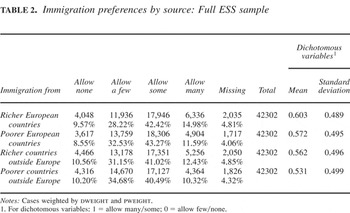
Asummary of the ESS data on immigration preferences is reported in Table 2.41
Following the official ESS recommendation, we applied the design weight (dweight) to all estimations that examine single countries (all country-specific averages and probit estimations) and both the design weight and the population weight (pweight) to all estimations where data are pooled across countries (full sample averages and probit estimations). See the ESS guidelines “Weighting European Social Survey Data” at 〈http://ess.nsd.uib.no/files/WeightingESS.pdf〉. Accessed 10 November 2006.
Difference-of-mean tests indicate that these differences for both the Europe versus outside comparisons and for both of the rich versus poor comparisons are highly significant (the lowest t-value in the four tests is 8.98), although the substantive differences are of course rather small.
Immigration preferences by source: Full ESS sample

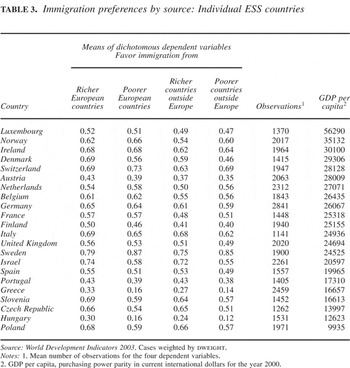
Table 3 reports immigration preferences by country of respondent. Here we just provide the mean of each dichotomous dependent variable (indicating whether respondents supported immigration from each different source), and we have ranked the ESS countries according to per capita GDP. Overall, Sweden seems to be the most pro-immigrant country across the board, while Hungary is the most anti-immigrant. Interestingly, respondents in Germany and Italy, nations often regarded as fertile soil for chauvinism and antiforeigner movements (such as the Republikaner and the National Democratic Party in Germany or the Lega Nord party in Italy), appear to look more favorably on immigration, in general, than citizens in many other European nations. Other countries yield less of a surprise as, for example, Austria, with its strong right-wing party (the Freiheitlichen), shows rather low support for immigration. Another interesting result is that respondents in Denmark appear to differentiate most strongly between types of immigrants, preferring “rich” over “poor” immigrants by larger margins than respondents elsewhere. (Given the recent success of the right-wing Folkeparti in Denmark, campaigning largely on opposition to poor immigrants, perhaps this should not be surprising.)
Immigration preferences by source: Individual ESS countries

The general pattern in preferences is again rather inconsistent with the labor- market competition argument. Assuming the skill level of the average respondent is increasing in per capita GDP across these countries, we should expect that (average) attitudes would become markedly less supportive of immigration from richer versus poorer nations at higher levels of per capita GDP. While it does seem to be the case that the preference for immigrants from richer versus poorer nations is largest in ESS countries with the lowest levels of per capita GDP, that same preference still appears in many of the most developed ESS countries (such as Luxembourg, Denmark, Italy, United Kingdom, Germany, or Finland). In fact, in all countries except Sweden, the Netherlands, Norway, and Switzerland, richer immigrants are preferred to poorer ones or people (on average) are essentially indifferent between the two.
Previous studies of opinion data on immigration have typically been severely constrained by the absence of good measures of key variables and theoretically relevant controls, since the surveys generating the data were not focused explicitly on the immigration issue. The ESS allows us to overcome these problems to a substantial degree, since it provides multiple measures of a wide array of critical socioeconomic, demographic, and attitudinal variables. In the next sections we incorporate a large variety of these variables when estimating the probability of support for different types of immigration among individual survey respondents. Our principal goal, which we address immediately in the next section, is to provide a rigorous new set of tests of the labor-market competition explanation for anti-immigration sentiments. We also investigate alternative explanations of attitudes toward immigration that focus on cultural conflict.
Labor-Market Competition and Anti-Immigration Views?
Benchmark Model
To provide a basic test of the conventional labor-market competition argument, we estimate a series of probit models for the dichotomous dependent variables described above (indicating support for immigration from different types of source countries). We employ the two indicators of individual levels of education that have been applied as proxy measures of individual skill levels in previous studies: the first measure, years of schooling, simply counts the total number of years of full-time education completed by the respondent; the second measure, which we label educational attainment, is a categorical indicator of the highest level of education attained by the respondent, adjusted by the ESS to allow for differences between the various European educational systems so that the results are comparable across countries.43
The coding is: 0 = not completed primary education; 1 = completed primary or first stage of basic education; 2 = completed lower secondary or second stage of basic education; 3 = completed upper secondary; 4 = postsecondary, nontertiary; 5 = first stage of tertiary; and 6 = completed second stage of tertiary education.
We include the standard socioeconomic and demographic control variables in an otherwise streamlined “benchmark” model. These variables include the respondent's age (in years), gender (1 = female, 0 = male), and income (measured on a categorical scale from 1 to 12).44
Since individual income is correlated with education, one could make the case for excluding it from the benchmark model when assessing aggregate effects of educational attainment on attitudes toward immigrants. Mayda 2006; and Scheve and Slaughter 2001a estimated models with and without an income control. We report estimations including income here but have replicated all the analysis after excluding the income variable—the results (available from the authors) are virtually identical. The coding for income is: 1 = less than €150 monthly; 2 = €150–30; 3 = 300–500; 4 = 500–1000; 5 = 1000–1500; 6 = 1500–2000; 7 = 2000–2500; 8 = 2500–3000; 9 = 3000–5000; 10 = 5000–7500; 11 = 7500–10000; 12 = >10000.
This is based on the question asking respondents: “How would you describe the area where you currently live?” Answers are coded: 1 = almost nobody (of minority race or ethnic group); 2 = some; 3 = many.
The ESS question is: “In politics people sometimes talk of ‘left’ and ‘right.’ Using this card, where would you place yourself on this scale?” The answers are coded on a scale from 0 (left) to 10 (right). A potential problem with this variable is that what “left” and “right” mean in Britain might differ markedly from what those same terms mean in, say, Poland. However, as we discuss in sensitivity analysis (see the section below on robustness tests) none of our substantive results are affected by the inclusion, exclusion, or recentering of this control (by country means).
We estimate all models using robust standard errors, adjusted for potential within-region clustering. We also reestimated all models clustering standard errors by countries only (omitting the fixed effects), and the results are substantively identical.
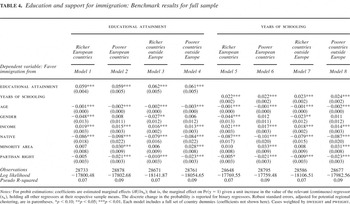
Education and support for immigration: Benchmark results for full sample

Recall that if the labor-market competition effects are critical determinants of immigration preferences, and education measures respondents' skill levels, then education should be strongly and positively linked with support for immigration from poorer countries, but much more weakly (and perhaps even negatively) related to support for immigration from richer countries. The critical finding from the estimations of the benchmark model is that, contrary to these expectations, people with higher education are more likely to favor immigration regardless of where the immigrants come from. The estimated effects of education are always positive, statistically significant, and quite large in magnitude across all the dependent variables. For example, a shift from the lowest to the highest level of educational attainment increases the predicted probability of favoring immigration from poorer European (non-European) countries by 0.35 (0.35), holding all other variables at their sample means. Contrary to expectations, the corresponding effect is even slightly larger for immigration from richer European (non-European) countries, with the increase in educational attainment raising the predicted probability of support for immigration by 0.35 (0.36). But the critical finding is that the positive relationship between education and attitudes toward immigrants from richer versus poorer nations is virtually identical (all the four 0.90 confidence intervals overlap for both educational attainment and schooling). These results raise serious questions about the importance of labor-market considerations in shaping individ-ual attitudes toward immigration. The evidence fits much better with alternative accounts that relate the effects of education on support for immigration to greater tolerance and improved understanding of foreign cultures and a taste for cosmopolitanism and cultural diversity, and expect that such effects are always positive and are not sensitive to expected immigrant skill levels.
The estimated marginal effects of the control variables are significant at the 0.99 confidence level in the majority of cases and enter the model with signs anticipated based on previously reported findings. The respondent's age is generally negatively related to support for immigration, although this relationship is not terribly robust.48
Following Dustmann and Preston 2001, we also experimented with a second-order polynomial term here. We found some indication that the age effect may indeed be weakly U-shaped. However, this effect was so small that we excluded it from the benchmark model. Adding it does not change any of our results.
See Estevez-Abe, Iversen, and Soskice 2001.
A reviewer suggested that the female preference for immigration from poorer nations may be driven by feelings of compassion for poorer migrants that are felt more acutely by women than by men. On the other hand, it may reflect greater demand among women for (low-skilled) household help. We have experimented with a gender-income interaction term in hopes of testing the “household help” proposition, finding that, contrary to what it presumably implies, the gender gap in attitudes toward immigrants does not vary significantly across levels of income.
Country-Specific Estimations
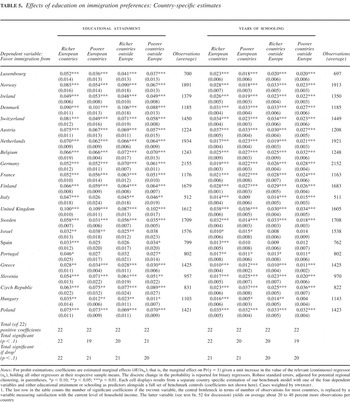
One possible objection to the analysis of the benchmark model above is that it does not allow the relationship between individual skill levels and immigration preferences to vary with national factor endowments (that is, the local abundance of skilled relative to unskilled labor). The ESS data are extensive enough that we can address this issue directly: we can estimate a full series of country-specific models of immigration preferences and obtain quite precise estimates of the link between education and attitudes in each of the twenty-two individual ESS countries. Table 5 summarizes the results from these estimations. It reports the marginal effects for years of schooling and educational attainment when the benchmark model is estimated using responses to the immigration questions in each ESS country.51
Detailed results from all country-specific regressions as well as replication data and accompanying code for all other results shown in this article are available at the authors' Web site at 〈http://www.people.fas.harvard.edu/∼jhainm/research.htm〉.
Effects of education on immigration preferences: Country-specific estimates

If labor-market competition is a critical determinant of attitudes toward immigration, we should expect the positive relationship between respondent skill levels and support for immigration from poorer countries to be stronger in magnitude in ESS countries with higher levels of GDP per capita (that is, those with greater skill abundance), since the standard models suggest that any distributional effects associated with inflows of low-skilled labor should be larger where low-skilled labor is more scarce. But again we should expect the relationship between individual skill levels and support for immigration from richer countries to be much smaller in magnitude in all cases, if not actually negative. The findings do not fit well with these expectations. All (that is, 176 out of 176) of the estimated marginal effects of the education variables are positive. All but thirteen (that is, almost 93 percent) are statistically significant, most of them at the 0.99 level, and most are quite large in terms of their estimated increase in the probability of support for immigration.52
The last row in the table counts the number of significant coefficients if the income variable, the central bottleneck in terms of number of observations for most countries, is replaced by a variable measuring satisfaction with the current level of household income. The latter variable yields on average about 20 to 40 percent more observations per country. (The question reads: “Which of the descriptions on this card comes closest to how you feel about your household's income nowadays?” Coding: 1 = living comfortably on present income; 2 = coping on present income; 3 = finding it difficult on present income; 4 = finding it very difficult on present income). According to this specification, even 166 or 94 percent of the estimated marginal effects are significant at conventional levels, due to the larger number of observations.
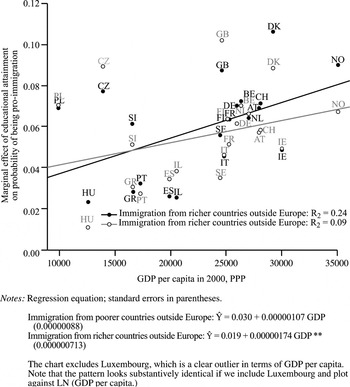
The job competition argument fares no better when we examine variation in the magnitude of the education effects across the ESS countries. Figure 1 plots the marginal effect of education on immigration preferences in each country against per capita GDP.53
Here we follow the approach used by Mayda 2006, who argued that the positive association between the size of the education effect and GDP per capita across countries supported the job competition account.
The correlation between the magnitude of the education effect (based on educational attainment) and GDP per capita is 0.24 (0.19) in the case of immigration from richer European (non-European) countries. These correlations increase to 0.45 (0.48) if the GDP per capita outlier Luxembourg is excluded from the sample. The respective correlations for immigration from poorer European (non-European) countries are 0.02 (0.07) for the full sample and 0.22 (0.31) excluding Luxembourg.
Further research might examine whether in fact the country-specific effects of education are related in any systematic way to immigration policies across European countries, or to the actual skill (or ethnic) composition of immigration inflows, labor-market regulations, welfare policies, or educational systems. One clear possibility is that education differs in political content across nations in ways that matter for immigration policy preferences.

GDP per capita and the effect of education on attitudes toward immigration: Marginal effects of educational attainment on support for immigration
Alternative Measures of Individual Skill Levels
Perhaps using education as a general indicator of labor-market skills, rather than more specific measures related to the occupations of individual respondents, creates a problem for tests of the labor-market competition argument? We can address this concern by substituting the measures of education we have used above with alternative measures of skills. The most straightforward approach involves using the occupations of currently employed respondents—coded by ESS according to the International Labour Organization's ISCO88 classification scheme—to distinguish individual skill levels. The ISCO88 scheme groups specific occupations into four skill categories: (1) elementary occupations or manual labor; (2) plant and machine operators and assemblers, craft and related trades workers, skilled agricultural and fishery workers, service workers and shop and market sales workers, and clerks; (3) technicians and associate professionals, and; (4) professionals. We follow O'Rourke and Sinnott in using the ISCO88 occupational codes to identify a fifth skill category—legislators, senior officials, and managers—that presumably includes only highly skilled individuals.56
O'Rourke and Sinnott 2002. The few (179) members of the armed forces are excluded since no ISCO88 skill level is defined for this group.
Note that this is the same variable Mayda 2006 used in her analysis of the ISSP survey data. Rather than using occupational distinctions themselves, Scheve and Slaughter 2001a tried a measure of the average wage for each respondent's occupation (assuming average wages reflect skill levels) in place of education.
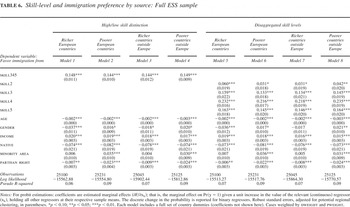
Table 6 reports the results when we reestimate the benchmark model, substituting the measures of education with skill345 and then with the four skill* dummy variables. Again, the results run counter to what a job competition account would expect. Higher skills are robustly associated with greater support for all types of immigration regardless of whether we use the dichotomous variable or the individual skill dummies, and this relationship is not sensitive to expected immigrant skill levels. Again, contrary to expectations, the relationships between individual skills and support for immigrants from richer countries are not significantly different (and are actually slightly larger) than the corresponding relationship between education support for immigration from poorer countries.58
We also estimated the effect of skill level (based on skill345) for individual countries and found substantively identical results: the skill variable has a positive impact in all countries (eighty-four of eighty-four estimated coefficients are positive) and in 89 percent of cases the effect is statistically significant. In no case is the effect of education on support for immigrants from richer nations significantly smaller (at the 0.99 level) than the corresponding effect for immigrants from poorer nations. Note that France is omitted here due to missing occupational data (hence we end up with twenty-one countries and eighty-four coefficients). Full results are available from the authors.
Skill-level and immigration preference by source: Full ESS sample

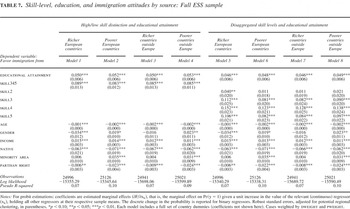
We get substantively identical results if we include measures of education and (occupational) skill levels in the same estimates. These measures are strongly correlated, as expected, but they are not identical: the pair-wise correlation between years of schooling and skill345 is 0.47, while the correlation between educational attainment and skill345 is 0.52. The correlation breaks down in the higher skill categories, as a considerable number of people with low levels of formal education possess jobs classified as high skilled (for example, managers without university degrees). The results from the amended form of the benchmark model are shown in Table 7. Again, the effects of individual education and skill levels on support for immigrants from richer countries are not significantly different than the corresponding effects on support for immigration from poorer countries.59
As expected, multicollinearity does seem to produce a small increase in the standard errors for the estimated effects when both education and skill variables are included together in the same models (compare to standard errors in Tables 4 and 6), but this makes no difference to the findings: the 95 percent confidence intervals would be overlapping across the models even if the standard errors were reduced by half!
All these, and other results reported below, are substantively the same if we use years of schooling as the education proxy.
Recall that in the models without skill, the total shift in probability associated with a change from the lowest to highest level of educational attainment was 0.35 (0.35). See Table 4. We do need to exercise some caution with this direct comparison, as the estimations reported in Table 7 have slightly fewer observations than those in Table 4 (due to missing data for the skill345 variable). However, when we reestimate the models shown in Table 4 using just the subsample available for the analysis shown in Table 7, we get substantively identical results.
Skill-level, education, and immigration attitudes by source: Full ESS sample

The same holds true if individual skill dummies are included instead of skill345. Again, all except one of the skill dummies enter positively and highly significant across all models. It is clear that, when we include the more fine-grained indicators of skills, the estimated association between educational attainment and attitudes is not substantively different than when we employed the dichotomous skill345 measure.
Additional Tests: Employment Status and Nonlinear Education Effects
One additional test of the labor-market competition account, following Scheve and Slaughter and Mayda, involves examining whether the effects of education (or skill) levels on the attitudes of respondents in the labor force differ significantly from the effects of these variables among those not currently in the labor force.62
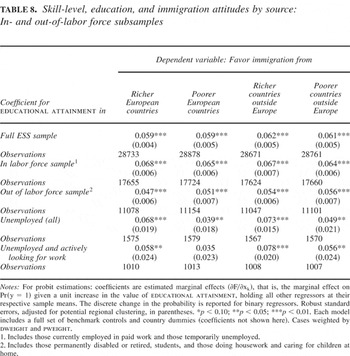
In particular, we might expect that concerns about labor-market competition should be observable only among those currently in the labor force and thus sensitive to the immediate effects of immigration on wage rates. To check for this possibility we split the ESS sample into subsamples, distinguishing those in the labor force (including the temporarily unemployed) from those not in the labor force (students, the disabled, those who are retired, and those caring for children at home). We also break down the labor force subsample to examine just those who are unemployed and those among the unemployed who say they are actively looking for work—these last two groups of respondents are the ones, presumably, in which concerns about the impact of immigrants on competition for jobs should be the most acute. We estimated our benchmark model for all these subsamples. The results are reported in Table 8, which displays just the estimated education effects in the different subsamples.Skill-level, education, and immigration attitudes by source: In- and out-of-labor force subsamples

Comparing the results across subsamples, as well as those for the full ESS sample, we find no meaningful or significant differences in the estimated relationship between education and attitudes toward immigration. Comparing in-labor-force and out-of-labor-force respondents, and looking at the estimated effects for each model, the point estimates are similar in each case and the 0.90 confidence intervals for all the marginal effects are overlapping.63
Here our results clash directly with those reported by Scheve and Slaughter 2001a, 142; and Mayda 2006, 13, who find that the education effect on attitudes toward immigration is significantly larger among respondents in the labor force than among those not in the labor force. Beyond the difference in data sets, it is difficult to speculate about possible reasons for this divergence. We have experimented with various specifications and with various ways of defining the subsamples (for example, including or excluding all students and all unemployed individuals from the labor force subsample, comparing those in work with only retirees), but the substantive findings remain the same. The results are the same, too, when we estimated all these models including both education and skills measures.
Finally, following Chandler and Tsai, we have reestimated our benchmark model while allowing for nonlinearities in the relationship between education and attitudes.64
Chandler and Tsai 2001.
Details can be found at 〈http://www.uis.unesco.org/TEMPLATE/pdf/isced/ISCED_A.pdf〉. Accessed 28 December 2005.
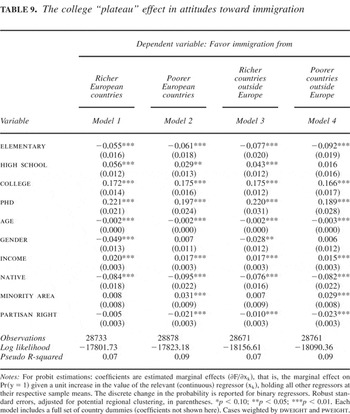
The college “plateau” effect in attitudes toward immigration

It seems clear that there are substantial nonlinearities in the relationship between education and attitudes toward immigrants. Confirming the results Chandler and Tsai report using separate data on U.S. respondents,66
Chandler and Tsai 2001.
This plateau effect associated with exposure to university education seems out of place with the common labor-market competition argument that posits a linear relationship between pro-immigration attitudes and education/skill levels. In contrast, the plateau effect appears to fit much better with alternative approaches to explaining attitudes toward immigration that focus on cultural values and identity and the way they are related to education: college curricula and the intellectual and social environment cultivated in most modern universities do typically emphasize the virtues of tolerance and cultural diversity and provide students with access to a cosmopolitan network of teachers and fellow students.67
Education, Cultural Values, and Attitudes Toward Immigration
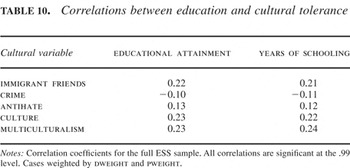
The tests above indicate that the clear association between education levels and individual support for immigration (of both high- and low-skilled workers) is simply not consistent with the standard labor-market competition argument. We now explore whether the relationship might be better accounted for by alternative claims about the way education generates greater ethnic and racial tolerance among individuals and more cosmopolitan outlooks. To do so, we employ an array of different measures of individuals' values and beliefs available in the ESS data. We choose a set of measures most similar to those used in previous studies that have examined the importance of values.68
We employ a measure we call antihate (coded from 0 to 10), reflecting the degree to which respondents would support a general law against actions promoting racial or ethnic hatred.69The ESS question is: “How good or bad are each of these things for a country? … A law against promoting racial or ethnic hatred.” The answers are coded on a scale from 0 = extremely bad, to 10 = extremely good.
The ESS question is: “Please tell me how much you agree or disagree with each of these statements…. It is better for a country if almost everyone shares the same customs and traditions.” The answers are coded on a scale from 1 = agree strongly, to 5 = strongly disagree.
This measure is based on the question: “Do you have any friends who have come to live in [respondent's country] from another country?” The answers are originally coded: 1 = yes, several; 2 = yes, a few; 3 = no, none at all. We have recoded these along more intuitive lines.
The ESS question is: “Would you say that [respondent's country's] cultural life is generally undermined or enriched by people coming to live here from other countries?” The answers are coded on a scale from 0 = cultural life undermined, to 10 = cultural life enriched.
The question is: “Are [respondent's country's] crime problems made worse or better by people coming to live here from other countries?” The answers are originally coded on a scale from 0 = crime problems made worse, to 10 = crime problems made better. We have recoded these along more intuitive lines.
Correlations between education and cultural tolerance

Next we reestimate our benchmark model, incorporating each of these new “values” variables one at a time and examining both how they are related to immigration preferences and the degree to which adding each new variable reduces the residual effect of education levels on attitudes. One issue here is whether it is appropriate to think of these new variables as exogenous causes of opposition to immigration. This concern is perhaps clearest when considering whether respondents have immigrants as friends and if they believe that immigrants enrich the culture and have no effect on crime. These may simply be regarded as characteristics or attitudes that, while associated with pro-immigration preferences, do not actually generate or affect such preferences. In any case, we do not attempt here to provide a conclusive test of the alternative causal theories74
Cited above in the section on individual attitudes toward immigration.
To provide more rigorous tests of causal arguments, it would seem imperative to have multiyear panel data on individuals so that one could examine the sequenced effects of changes in values on attitudes toward immigrants in a differences-in-differences design. Using the available (cross-sectional) ESS data, one could presumably try to identify instrumental variables for the values in question, but we doubt whether reliable exogenous instruments could be found here.
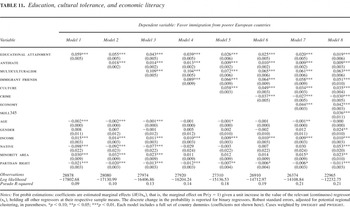
Table 11 presents the results of the new estimations. We have estimated these models for all of the dependent variables, but for brevity here we report only the results for attitudes toward immigrants from poorer European countries.76
Full results from all the estimations are available from the authors.
Education, cultural tolerance, and economic literacy

The results indicate that the division between more- and less-educated natives over support for immigration is primarily a distinction in values. As each cultural variable is added to the model the estimated relationship between education and pro-immigration attitudes decreases in magnitude while the explanatory power of the model increases. In the most extensive model (column 6), the magnitude of the (residual) education effect is decreased to the extent that shifting from a respondent with the lowest to the highest level of education (with all other variables at their means) increases the probability of being pro-immigration by only 0.15, as compared with 0.35 for the benchmark model (column 1). The measured differences in cultural values across respondents thus appear to account for some 57 percent of the uncontrolled education effect.
What else, besides these types of values, might be reflected in the residual effect that education is having on attitudes toward immigration? One strong possibility is that it may reflect the fact that more educated respondents are more informed about the overall efficiency gains associated with economic integration in general.77
The ESS includes a good proxy that seems to capture beliefs about the general welfare effects of immigration. The measure is based on the degree to which each respondent thinks immigration is good for his or her country's economy as a whole (coded on a scale from 0 to 10).78The question is: “Would you say it is generally bad or good for [respondent's country]'s economy that people come to live here from other countries?” The answers are coded on a scale from 0 = bad, to 10 = good.
Table 11 (column 7) reports the results when we include this additional variable in the most extensive of the “values” models estimated above, again focusing on immigration from poor European source countries.79
Again, one might raise the question here about whether these measured beliefs about the welfare effects of immigration should be considered as causes of preferences regarding immigration inflows, rather than as simple correlates of those preferences. Given the available (cross-sectional) data, we do not claim to demonstrate causal effects here but aim to show the plausibility of an informational account for some of the link between education and on attitudes toward immigration.
Overall, the measured differences in cultural values and economic literacy across respondents thus appear to account for some 65 percent of the uncontrolled education effect. The residual education effect is even further reduced (and falls to 0.11) once we also add our skill345 proxy to the model (column 8).80
Note that while the independent effect of skills (as measured by skill345) is still significant here, it is minuscule: a shift from low to high skills is associated with an increase in the probability of favoring immigration by only 0.03. And as we have reported above, this link is always positive (and almost identical in magnitude) regardless of where the immigrants come from. This finding does not fit with the simple labor-market competition account.
Robustness Tests
We have conducted a large variety of additional tests. We focused on two issues: whether the various indicators of cultural values and beliefs are actually endogenous to concerns about the labor market; and whether the core findings are robust to changes in the specification of the model, including the addition of a larger variety of controls.81
Results, replication data, and code for all sensitivity tests reported here are available in a supplement to this article at the authors' Web site at 〈http://www.people.fas.harvard.edu/∼jhainm/research.htm〉.
Endogenous Values and Beliefs?
One possibility we have also examined is that the connection noted above between education levels and cultural variables such as racism and tolerance might itself be, at least in part, a function of labor-market concerns. Perhaps fear of competition for jobs with foreigners and minorities makes less-educated individuals generally more racist and less tolerant, and thus more opposed to immigration, without regard for how likely it is that particular types of immigrants will actually compete for the same jobs as them. To test this idea, we examined whether the effects of education (or skill) levels on racism and tolerance among respondents in the labor force differ significantly from the effects of these variables among those not currently in the labor force. If the connection is influenced by concerns about labor- market competition, it should be significantly stronger among those currently in the labor force than among other groups. We again split the ESS sample according to whether people are currently in “paid work” or not and then estimated levels of the antihate and multiculturalism variables using educational attainment and skill345 as predictors for both subsamples. We found no significant difference in the size or significance of the estimated effects of education and skills on these cultural variables across the subsamples. This finding strongly suggests that concerns about job competition are not a primary factor in explaining the connection between education levels and racism or tolerance.
Alternative Specifications
We have performed a variety of additional tests to gauge whether our key findings are robust to alternative specifications of the model, alternative measurements of a range of variables, and for various subsamples of survey respondents. One straightforward test involves removing the restriction that the economic threat posed by immigration will be felt equally by respondents, regardless of where they live in their home country. If we allow that the labor market can be segmented into geographically separate local markets, the wage effects of immigration may be significantly larger in immigrant “gateway communities” than elsewhere. To allow for this possibility, we interacted each of the education variables with the minority area variable, which reflects the concentration of ethnic and racial minorities in the area in which the respondent resides. The results are inconclusive at best.82
Scheve and Slaughter 2001a tested for similar effects using data on immigration preferences (and the geographic concentration of immigrants) in the United States, finding no significant area effects.
We also estimated a series of ordered probit models to check whether our results are sensitive to the choice of the cutoff point specified for the dichotomous dependent variables. The results show that this possibility can be clearly rejected: the estimated effects of education remain positive, statistically significant, and substantively large in magnitude across all estimations of the benchmark model. We also simply reran all the analysis reported above using all alternative cutoff points for dichotomization of the dependent variable and found that none of the core results were altered.83
We also experimented with dependent variables measuring for each individual respondent the differences in attitudes toward immigrants from richer and poorer countries. At first glance this might seem to provide the simplest approach testing the labor-market competition argument: individuals more in favor of immigration from rich versus poor countries (that is, more in favor of high- versus low-skilled immigration) should have relatively lower levels of skills (education). But we found these variables rather more difficult to interpret and analyze than the basic pro- versus anti-immigration dependent variables we used in the main analysis. The major problem came with making assumptions about the intervals between response categories. Should one assume that the difference between an answer of, say, “allow many” and “allow some” immigrants is the same as the difference between “allow few” and “allow none”? There seemed to be a wide range of ways to proceed here, with no obvious best approach.
Finally, we tested whether the core results reported above were affected when we added a comprehensive set of additional control variables to the main benchmark variables and the measures of cultural values we incorporated in the estimations in the previous two sections. We experimented with a variety of “belief” variables (including respondents' concerns about refugees, free market attitudes, altruism, traditionalism, and the importance attached to equality). We controlled for indicators of trade union membership, religion, and various proxies of social capital and interpersonal trust. Finally, we controlled for various measures of economic insecurity or risk, including skill specificity, occupational unemployment, past unemployment, current unemployment, and (an inverse measure of risk) job mobility. Perhaps most significantly, we found that while more educated respondents are less likely to be unemployed or to have experienced unemployment in the recent past, and they are also more mobile in the labor market (measured by their self-assessed chances of finding a new job with another employer), these relationships are quite small in magnitude, and controlling for such measures of economic risk had no impact on the results of our tests. We also reestimated all full-sample estimations and all single-country models including regional fixed effects (in addition to the country fixed effects) to control for unobserved characteristics of location (for example, proximity to a border, economic recession) that might potentially affect attitudes toward immigration. None of the additions to the model affected the main findings: most importantly, all estimated coefficients for the education variables retained their (positive) signs and their significance in all the full-sample estimations.
Conclusions
The main question we have addressed in this article is whether opposition to immigration in Europe, most apparent among the less educated, is driven to a large degree by fears of labor-market competition. This interpretation—applied to Europe and to other advanced economies—is fast becoming an accepted, political-economy wisdom.84
The best available survey evidence, the 2003 ESS, does not support this explanation at all. Our results indicate that, in contrast to what would be expected from conventional arguments about labor-market competition, people with higher education levels are more likely to favor immigration regardless of where the immigrants come from and their likely skill attributes. The same relationship holds if we consider the occupational measures of the skill levels of respondents rather than their educational qualifications, and it is essentially unchanged regardless of whether we examine respondents who are in the labor force or those not in the labor force. The findings thus suggest that the relationship between education and views about immigration actually has little to do with competition for jobs. This conclusion should not really be a surprise given that the most sophisticated economic models are equivocal about whether immigrants will have an adverse effect on the real earnings of native workers, and a growing body of empirical research shows that the actual effects of immigration flows on income, employment, and unemployment are quite small. From this perspective, our findings actually fit well with expectations from the best available economic theory and evidence.This conventional belief about labor-market competition and anti-immigration sentiments appears to rest on an unfortunate misreading of the available evidence. We find more support for alternative claims that anti-immigration sentiments are associated instead with values and beliefs that foster animosity toward foreigners and foreign cultures and that are most prevalent among less educated individuals. The data indicate that more educated respondents are significantly less racist and place far greater value on cultural diversity in society, and they are also more likely to believe that immigration generates benefits for their national economy as a whole. Together, these associated values and beliefs account for around 65 percent of the estimated link between education and support for immigration.
For those who support immigration and worry about the growth of extremist, often violent, anti-immigrant movements in Europe, the conclusions from this study are not encouraging. If anti-immigration sentiments were primarily a function of economic fears among native workers, it would be reasonably easy to imagine ways to mitigate them by targeting financial assistance and job-creation programs toward the individuals (and communities) facing the greatest potential costs. But this is not a conclusion supported by the evidence. Anti-immigration sentiments appear to be far more powerfully associated with cultural values that have more to do with conceptions of national identity than they do with concerns about personal, economic circumstances. Others have reached broadly similar conclusions using different types of measures from survey data gathered in particular countries.85
See, for example, Citrin et al. 1997; Dustmann and Preston 2001; Burns and Gimpel 2000; Hooghe and Marks 2003; and Sniderman, Hagendoorn, and Prior 2004.
The next logical step for further study would be to examine how deep this cultural division goes. It would be trite and misleading to suggest that more or better education is “the answer” for those interested in alleviating anti-immigration and anti-foreigner sentiment. To the extent that these types of attitudes are due to misunderstandings and misperceptions about foreigners (that is, incomplete or biased information), then certainly we can expect that improvements in education may help to reduce support for exclusionary policies and alleviate tensions between natives and immigrants. To the extent that education actually transforms the values held by individuals, encouraging them to have more tolerant, pro-outsider views of the world, focusing on the education system for long-term solutions to cultural conflict is wise. But we must be careful not to understate the cultural gap that the data in this research reveals. Immigration brings to the fore very different conceptions of national identity—involving different views about the importance of ethnicity, religion, and language—which may be, to degrees still unknown, immutable, and irreconcilable. The educational differences we can observe between those individuals holding more pro- and anti-outsider views of the world may be more of a symptom of the cultural divide between the two groups than they are a cause.
Appendix: Summary Statistics
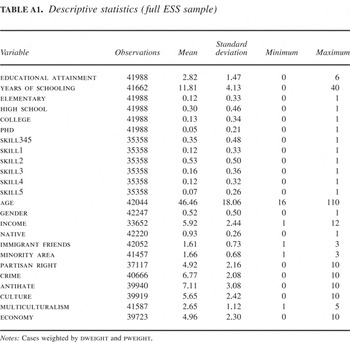
Descriptive statistics (full ESS sample)

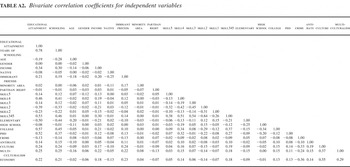
Bivariate correlation coefficients for independent variables