Introduction
In recent years there has been a rapid increase in organic animal production in many countries. This development was in response to increased consumer demand for products that are perceived to be fresh, wholesome and flavoursome, free of hormones, antibiotics and harmful chemicals, and produced in a way that is sustainable environmentally without the use of gene-modified (GM) crops (Blair, Reference BLAIR2008). However, there is the issue of animal welfare, as the rules state that animals should be raised under conditions which allow them to perform a wide range of social behaviours (Berg, Reference BERG2002). As a result, international regulations have been developed to ban or restrict the use of conventional systems and greater use has been made of free-range systems (Berg, Reference BERG2002; American Veterinary Medical Association, Reference AMERICAN VETERINARY MEDICAL ASSOCIATION2010; Lay et al., Reference LAY, FULTON, HESTER, KARCHER, KJAER, MENCH, MULLENS, NEWBERRY, NICOL, O'SULLIVAN and PORTER2011). Despite the wide increase in the use of the outdoor poultry production systems, studies with various genotypes under different managerial conditions and various climatic zones, particularly in the tropics to avoid production seasonality, still remain to be done. This review discusses the findings of the existing research related to the topic of outdoor egg production using local forages. The utilisation of some leaf meals in laying hen diets, the importance of forage for chicken welfare and the various methods used in measuring forage intake of outdoor chickens are presented. Besides, the welfare of outdoor hens, behaviours and recommendations for increasing the range utilisation by free range hens are also discussed.
Potential for alternative poultry production systems in developing countries
Alternative poultry production is growing due to consumer demand for specialty products from cage free and free range birds. Organic poultry production is globally considered as a type of outdoor production (Fanatico, Reference FANATICO2006). Free range system allows animals and poultry to perform natural behaviour and provides sun-light, fresh air and access to ample space, which can support better health and provide a low-stress environment (Fanatico, Reference FANATICO1998; Berg, Reference BERG2002; Lomu et al., Reference LOMU, GLATZ and RU2004). Free range producers should keep in mind the reasons that made producers in the nineteenth century move from production systems based on outdoor access to indoor production only. This was due to concerns about predators, diseases (e.g. coccidiosis and roundworms), injuries due to pecking and production on an intensive scale with automated feeding and watering (Soil Association, Reference SOIL ASSOCIATION2004a; Reference SOIL ASSOCIATION2004b; Fanatico, Reference FANATICO2006; American Veterinary Medical Association, Reference AMERICAN VETERINARY MEDICAL ASSOCIATION2010). In the light of this historical turning point, free- range producers must focus their efforts on flock safeguarding, disease control and avoiding practices that historically caused outdoor problems (Soil Association, Reference SOIL ASSOCIATION2004a; Reference SOIL ASSOCIATION2004b).
Developing countries, of which the majority are situated in tropical regions, have challenges in meeting the animal protein requirements for humans (Sarmiento, 2001). Therefore, the use of intensified poultry production is of great importance as a rapid protein source to meet this need. For instance in Mexico, poultry participation amounted to 63.48% (33.8% Broilers, 29.52% eggs and 0.15% Turkeys,) of the total livestock production in 2010, versus 36.52% participation of beef, sheep, pork and honey bees (Union Nacional de Avicultores, Reference UNION NACIONAL DE AVICULTORES2010). Indeed, the current acute short supply of animal protein in most developing countries is a major obstacle in banning of conventional poultry production systems. This makes it difficult to implement organic production.
Increasing organic production dedicated for export purposes could be profitable for producers in developing countries. Mexico is a good example of countries following this strategy. Although their organic production is increasing progressively, they use only 10% of their total organic products, while the other 90% is destined for export markets, primarily the USA and some European countries (GAIN Report, Reference GAIN REPORT2006; Blair, Reference BLAIR2008). For that reason, they depend on certifying their organic products by following the recommendations announced by internationally recognised organisations in order to seek the import approvals from the destination country.
Importance of forage for sustainable poultry production
Organic farming is defined as the approach to agriculture in which the aim is to create integrated, humane, environmentally and economically sustainable agricultural production systems. Therefore, reliance is placed on local or farm-derived resources (Blair, Reference BLAIR2008). In addition, the acute short supply of animal protein, especially in developing countries, necessitates several investigations into the potentials of some novel feed resources for livestock (Agbede, Reference AGBEDE2003). Utilisation of forage as a feedstuff for livestock is considered a sustainable and natural feed resource which has gained increasing attention in poultry production. In addition, forage crops were reported to have a major role in improving the productivity of smallholder farming systems and breaking the cycle of poverty and source degradation in many countries and regions in the world, such as Central America, West Africa, Colombia, China, Costa Rica, Bolivia (Peters et al., Reference PETERS, HORNE, SCHMIDT, HOLMANN, P.C., TARAWALI, SCHULTZE-KRAFT, LASCANO, ARGEL, STÜR, FUJISAKA, MÜLLER-S.MANN and WORTMANN2001). Besides, higher utilisation of forages as a local feed resource is important as a factor to facilitate the transition to 100% organic feed supply for organic egg producers (Horsted, Reference HORSTED2006).
Feed represents about 70% of all costs involved in poultry enterprises worldwide. The main two ingredients involved in poultry diets worldwide are maize and soybean meal. Maize represents about 60 – 70% and soybean meal represents about 20-25% of poultry diets. Unfortunately, such ingredients are usually expensive and there is a continuous competition with other livestock for feed or a human food. This problem is increased in developing countries which import most of their feedstuffs. In this regard, there is an increasing interest in using the non-conventional feedstuffs. Seemingly, forage-based leaf meals are good alternative sources of protein for commercial livestock and poultry where they are easily available and inexpensive (Makkar and Becker, Reference MAKKAR and BECKER1997; Agbede, Reference AGBEDE2003; Kaijage et al., Reference KAIJAGE, SARWATT and MUTAYOBA2004; Kakengi et al., Reference KAKENGI, KAIJAGE, SARWATT, MUTAYOBA, SHEM and FUJIHARA2007; Atawodi et al., Reference ATAWODI, MARI, ATAWODI and YAHAYA2008). Poultry may be fed fresh forages inside their pens, leaf meals incorporated into their diets or as stand plants in case of outdoor production.
Digesting forage materials
In adult chickens, the caeca (which is very short) is the unique place where digestion of plant fibre takes place and where the major concentration of intestinal micro-organisms and volatile fatty acids are found. It has been shown that no more than 25% of the total dry matter passing through the intestines enters the caeca (Son et al., Reference SON, RAGLAND and ADEOLA2002). Chickens lack the anatomical adaptation and have a lower microbial mass to support fermentation, which is necessary for efficient utilisation of fibrous feeds that could support part of their nutrient needs from forages, as compared to those placed in ruminants or even in the omnivorous like swine (Esonu et al., Reference ESONU, OPARA, OKOLI, OBIKAONU, UDEDIBIE and IHESHIULOR2006; Ige et al., Reference IGE, ODUNSI, AKINLADE, OJEDAPO, AMEEN, ADERINOLA and RAFIU2006). Some other avian species, such as geese and turkeys can obtain more nutrients from forage because they are better suited to digest fibre. Therefore, the low capacity of the chicken digestive system to utilise high fibre materials limits the use of leaf meals in poultry diets to a high degree. Also, Nyman et al. (Reference NYMAN, SCHWEIZER, TYREN, REIMANN and ASP1990) suggested that the lower digestibility of crude protein reported in high fibre diets may be due to the indigestible cell wall material which reduces the digestion and absorption of protein overall. Similarly, grass was reported to be high in indigestible organic matter and up to 20% of the nitrogen in dry matter may be present as non-protein compounds (Bolton and Blair, Reference BOLTON and BLAIR1974).
Conversely it has been reported that when chickens consume forage, their caeca retain microbes with the capacity to digest fibre and become enlarged compared to the caeca of chickens that do not eat forage. For instance, Sarmiento et al. (Reference SARMIENTO, MCNAB, PEARSON and BELMAR-CASSO2002) reported that the length and weight of the caeca, both as absolute and relative measurements, from broilers fed on a control diet were lower than those of birds fed on diets containing 15 or 25% Chaya leaf meal. Similarly, Leeson et al. (Reference LEESON, ZUBAIR, SQUIERES and FORSBERG1997) reported that caecal mass and total bacterial counts increased in high crude fibre (CF) diets. On pasture, birds may consume enough forage to replace 5-10% of diet; however, when formulating rations, it may be best to assume zero contribution from pasture because it is difficult to determine what nutrients will be supplied and what amount (Mattocks, Reference MATTOCKS2002; Fanatico, Reference FANATICO2006; Blair, Reference BLAIR2008). In free-range broilers, Rivera-Ferre et al. (2007) showed that broilers consumed 10.7 g DM forage per bird per day, which met 7% and 3% of their daily protein and energy requirements, respectively.
Leaf meal utilisation in poultry production
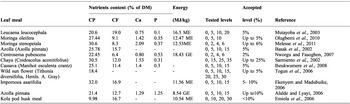
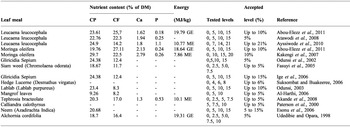
Over the last three decades, there is increased interest in the use of fodder tree and shrub leaf meals as a source of protein and other nutrients for non-ruminant animals. The recommendations of some research on the use of leaf meals in diets of laying hens and growing chickens are listed in Tables 1 and 2. Leaf meals are distinguished by their high crude protein content and contain high amounts of vitamins, minerals (Ca and P) and have a good profile of amino acids, in addition to an average content of metabolisable energy for poultry. The leaf meals have an important role in mitigating the regional shortage of protein sources for non-ruminant animals where they are easily available and inexpensive.
Chemical composition and accepted incorporation levels of some leaf meals in broiler and growing pullet diets.

Chemical composition and the accepted incorporation levels of some leaf meals in laying hen diets.

Research has indicated that leaf meals could be acceptable in chicken diets in limited amounts. This limitation is due to the high fibre content, which results in increased diet bulkiness and low digestibility of crude protein, energy and sulphur-amino acids. The presence of certain anti-nutritive substances in some leaf meals is a contributing factor in their poor utilisation observed in chickens. Most researchers (Tables 1 and 2) indicated that leaf meals from various forages could be incorporated and used safely up to 5% in broiler diets and up to 10% in layer diets. Even though these recommended levels are low, but they would have a noticeable impact in reducing production costs (D'Mello et al., Reference D'MELLO, ACAMOVIC and WALKER1987; Mattocks, Reference MATTOCKS2002; Horsted, Reference HORSTED2006). Previous studies showed that the leaf meals of Leucaena leucocephala, Moringa oleifera, Gliricidia sepium, Cnidoscolus aconitifolius, Sesbania sesban, Azadirachta Indica are the most popular types that have been widely used in poultry feeding.
Importance of Leucaena leucocephala and Moringa oleifera leaf meals
Leucaena leucocephala
Leucaena leucocephala is a well-known leguminous tree, which is estimated to cover 2-5 million acres worldwide (Brewbaker and Sorensson, Reference BREWBAKER and SORENSSON1990). During the 1970s and early 1980s, L. leucocephala was known as the 'miracle tree' because of its success as a long-lived and highly nutritious forage tree (Shelton and Brewbaker, Reference SHELTON and BREWBAKER1994). As well as forage, leucaena can provide firewood, timber, human food, green manure, shade and erosion control and other environmental services. It has its origins in Central America and the Yucatan Peninsula of Mexico where its fodder value was recognized over 400 years ago by the Spanish Conquistadors (Brewbaker et al., Reference BREWBAKER, HEGDE, HUTTON, JONES, LOWRY, MOOG and BELDT1985). From there, it has spread to most countries of the tropical and sub-tropical regions, as Leucaena is well adapted for various regions and sites outside its natural distribution area (Parrotta, Reference PARROTTA1992). Botanically, leucaena belongs to the family Mimosaceae. Formerly known as L. glauca, it is a thornless long-lived shrub or tree which may grow to heights of 7-18 m. Leaves are bipinnate with 6-8 pairs of pinnae bearing 11-23 pairs of leaflets 8-16 mm long (Shelton and Brewbaker, Reference SHELTON and BREWBAKER1994).
The chemical analysis of L. leucocephala leaf meal (LLM) reported by Abou-Elezz et al. (Reference ABOU-ELEZZ, SARMIENTO-FRANCO, SANTOS-RICALDE and SOLORIO-SANCHEZ2011) showed that it comprised of 91% DM, 24% CP, 256% ADF, 40% NDF, 1.6% Calcium, 0.2% phosphorus, 8% ash and 19.8 MJ/kg gross energy. Atawodi et al. (Reference ATAWODI, MARI, ATAWODI and YAHAYA2008) showed similar analyses of LLM, reporting 7% moisture, 23% crude protein, 22% crude fibre, 5% Fat, 10% ash, 37% nitrogen free extract, 1.9 mg/g calcium and 0.25 mg/g phosphorus. Similarly, D'Mello and Taplin (Reference D'MELLO and TAPLIN1978) found that it contains 26, 12 and 2.8 of crude protein (% DM), fibre (% DM) and metabolisable energy (MJ/kg DM), respectively. In addition, the carotene content of three cultivars of LLM produced in Malawi were in the range 227-228 mg/kg DM. Berry and D'Mello (Reference BERRY and D'MELLO1981) showed that LLM could be used as an effective yolk pigment, when fed at levels ranging from 10 – 25 g/kg in laying hen diets.
However, LLM contains concentrations of Mimosine which is considered toxic for poultry in amounts of 5-7% of the total protein (DM basis) (Meulen et al., Reference MEULEN, STRUCK, SCHULKE and EL-HARITH1979; D'Mello and Acamovic, Reference D'MELLO and ACAMOVIC1982). Interestingly, detoxification of LLM is possible by mixing it with ferric sulphate which complexes mimosine and therefore eliminates its effects (D'Mello and Acamovic, Reference D'MELLO and ACAMOVIC1989; Ayssiwede et al., Reference AYSSIWEDE, DIENG, CHRYSOSTOME, OSSEBI, HORNICK and MISSOHOU2010).
Moringa Oleifera
Moringa oleifera is a multipurpose tree native to Himalaya but which has spread almost world-wide (Kakengi et al., Reference KAKENGI, KAIJAGE, SARWATT, MUTAYOBA, SHEM and FUJIHARA2007). M. oleifera is a fast-growing leguminous tree which can reach 12 m in height at maturity, yielding up to 120 t DM/ha/yr when planted very densely for use as forage (Makkar and Becker, Reference MAKKAR and BECKER1997; Price, Reference PRICE2000). The structure of Moringa oleifera leaves was described by Morton (Reference MORTON1991); it consists of two or three pinnate leaves growing mostly at the branch tips. They are 20-70 cm long, grayish-downy when young, with long petioles with 8-10 pairs of pinnate each bearing two pairs of opposite, elliptic or obviated leaflets and one at the apex, all 1-2 cm long with glands at the base of the petioles and pinnate.
The proximate analysis of M. oleifera fresh leaves was reported by Elkhalifa et al. (Reference ELKHALIFA, AHMED and SARA2007) whereby it contained 74% moisture, 17% CP, 3.5% crude fibre, 8% ash, 1.7% oil, 0.20 mg/100 calcium, 0.13 mg/100g magnesium, 0.08 mg/100g potassium and 0.03 mg/100g phosphorus. Similarly, the chemical analysis of M. oleifera leaf meal (MOLM), reported by Abou-Elezz et al. (Reference ABOU-ELEZZ, SARMIENTO-FRANCO, SANTOS-RICALDE and SOLORIO-SANCHEZ2011), showed that it contained 91% DM, 20% CP, 27% ADF, 44% NDF, 2.1% calcium, 0.24% phosphorus, 10% ash and 18.6 MJ/kg gross energy. Kakengi et al. (Reference KAKENGI, KAIJAGE, SARWATT, MUTAYOBA, SHEM and FUJIHARA2007) reported that MOLM showed 86% dry matter, while crude protein, crude fibre, ash, ether extract, calcium, phosphorus, and nitrogen free extract were 297, 225, 147.7, 43.8, 27.9, 2.6, and 106 g/kg DM, respectively and metabolisable energy was 7.9 MJ/ kg DM basis. Laboratory analysis made by Makkar and Becker (Reference MAKKAR and BECKER1997) showed that the protein concentration in M. oleifera leaves was about 27% with negligible amounts of tannins (1-23 g/kg DM) in all fractions of the M. oleifera plant, and high levels of sulphur-containing amino acids. Saponin content was similar to that present in soybean meal, while no trypsin inhibitors or lectins were detected, and the phytate content was 3%.
Estimation of chickens' forage intake
Having an accurate technique for investigating the actual forage amounts consumed by hens has proven difficult to obtain. In addition, the amount of forage consumption is globally affected by some factors; i.e. quality of supplemented forage, type of supplementary feed, feeding system, genetics, and birds age. Besides, forage intake varies depending on the length of adaptation period (Horsted, Reference HORSTED2006).
the Sward method (herbage removal)
The ‘Sward method’ depends on measuring the herbage amount found in some range plots and comparing it to the corresponding amounts found in other similar plots visited by hens. The difference is then considered to have been consumed by the hens.
Among the investigations following the idea of herbage removal technique was that of Hughes and Dun (Reference HUGHES and DUN1983), who estimated that layers consumed 25–48 g/DM per hen daily of grass when their nutrient requirements were met through ad libitum balanced feed. Similarly, Danielsson et al. (Reference DANIELSSON, SJELIN and CISZUK1994) estimated that daily grass intake ranges from 10-30 g DM/hen for hens fed ad libitum home mixed diet. In a more recent study, Horsted et al. (2006) estimated similar values of herbage intake by outdoor hens, which ranged from 9-31 g DM/hen. However, they reported a huge variation. In another experiment they obtained 51-73 g DM/hen/day of chicory removal when hens were fed on complete feed or wheat, respectively. In free range broilers, Rivera-Ferre et al. (2007) estimated 10.7 g DM herbage intake per broiler per day, irrespective of vegetation type.
There are some disadvantages of this method which may contribute to unreliable values. For instance, the low amounts of chicken grass intake along with the different growth rates of plants between the tested plots would make it difficult to detect accurately by the Sward method. Besides, Horsted et al. (2006) has suggested that not all the removed herbage had been eaten by hens, since the uprooting and discarding of herbage by hens could not be quantified.
the crop content method
As digestion of feed progresses, it is easy to identify the feed items existing in the crop. Analysing the crop content has been reported to be the most reliable method in studying the feeding habits of hens in the outdoor run (Jensen and Korschgen, Reference JENSEN and KORSCHGEN1947; Horsted et al., Reference HORSTED, HERMANSEN and RANVIG2007). Antell and Ciszuk (Reference ANTELL and CISZUK2006) found 1.66 g DM of grass in the crop, which represented 11% of the total content found in the layers crop at 9.00 pm. They also reported that the amount of grass found in the crop at the end of the day was significantly correlated with the total intake of grass. Consequently, they proposed the equation y = 0.144x – 0.178; where y is the amount of grass found in the crop and x is grass intake (on an air-dried basis) during the last day before slaughter, which consequently estimates to 13 g/hen/d. According to that equation, Horsted et al. (Reference HORSTED, HERMANSEN and RANVIG2007) found that the herbage intake amounted 12.7 and 13.4 g DM in both groups fed on concentrate with access to either grass/clover or mixed herbs, respectively. Indeed, studying the crop content has an additional advantage when compared with the Sward method, as it gives better knowledge about the other feed items that may be obtained from the range, such as insects, earth worms, snails, oyster shells, grit stones or soil.
forage refusals methods
This method could be used for introducing a meal of fresh forage to the hens inside their pens. In this method, the added and refused forage is weighed. In addition, the dry matter of each added and refused forage samples is measured in order to calculate the actual dry matter consumed where forage DM intake = DM added – DM refused. Following a similar method, Steenfeldt et al. (Reference STEENFELDT, KJAER and ENGBERGE2007) estimated the intake from maize silage, barley-pea silage, and carrot intake by indoor-raised laying hens amounted to 59, 58, 108 g/day respectively, which represented 33, 35 and 48% of the total intake (layer diet + forage material) on as fed basis, respectively. The same authors reported 32, 22, 8-12.5% dry matter content of those tested forages, respectively.
Importance of forage for hens' welfare
Roughage material is commonly recommended as a supplement for welfare reasons and for improving chicken's behaviour (Wechsler and Huber-Eicher, Reference WECHSLER and HUBER-EICHER1998; Mattocks, Reference MATTOCKS2002; Horsted, Reference HORSTED2006). Chickens have an innate attraction to forage and they have been reported to be motivated to consuming forage even when provided with adequate food (Cooper and Albentosa, Reference COOPER and ALBENTOSA2003). Feeding hens on foraging material (bulky ingredient) typically results in them having fuller crops and gizzards for a longer time. This makes the birds feel more satiated and calmed, which consequently reduces the incidence of pecking. In addition, the hens may spend more time in feeding and consequently less time pecking (Steenfeldt et al., Reference STEENFELDT, KJAER and ENGBERGE2007). Interestingly, various investigations reached the conclusion that forage alleviated the incidence of cannibalism and feather pecking (Wechsler and Huber-Eicher, Reference WECHSLER and HUBER-EICHER1998; Aerni et al., Reference AERNI, EL-LETHY and WECHSLER2000; El-Lethy et al., Reference EL-LETHY, AERNI, JUNGI and WECHSLER2000; Kjaer and Sorensen, Reference KJAER and SORENSEN2002; Mahboub et al., Reference MAHBOUB, MULER and VON-BORELL2004; Horsted, Reference HORSTED2006; Steenfeldt et al., Reference STEENFELDT, KJAER and ENGBERGE2007).
Other feed items obtained from the range area
Various feed items were reported to be obtained by the outdoor hens, such as insects, worms, larvae, and snails which were reported to be rich in protein and metabolisable energy (Lomu et al., Reference LOMU, GLATZ and RU2004; Horsted et al., Reference HORSTED, HERMANSEN and RANVIG2007). The common house fly (Musca domestica) was reported to contain about 60% CP and 2500 kcal ME/kg. Mormon cricket meal contains 58% CP, grass hopper meal 76% CP, and snail meal 60% CP and 3400 kcal ME/kg. These feed items were consumed by chickens when used either live or dried as a protein source resulting in performance comparable to that of chickens fed on commercial diets (Calvert, Reference CALVERT1979; Cresswell and Komplang, Reference CRESSWELL and KOMPLANG1980; Togoba, Reference TOGOBA1980; Reddy and Qudratullah, Reference REDDY and QUDRATULLAH2004). In addition, laying hens could obtain high amounts of oyster shells and grit stones, which are usually used by birds as a source of calcium and in enhancing the mechanical digestion in the gizzard, respectively (Adeniji, Reference ADENIJI2010).
The use of range by laying hens
A majority of investigations reported that a low percent of hens used the range area, which reduces the expected benefits of the free range system (Harlander-Matauschek et al., Reference HARLANDER-MATAUSCHEK, FELSENSTEIN, NIEBUHR and TROXLER2006). Low range utilisation by outdoor hens was reported by other studies, for instance 12% by Bubier and Bradshaw (Reference BUBIER and BRADSHAW1998), from 11 to 23% between 7 and 11 weeks of age reported by Mirabito and Lubac (Reference MIRABITO and LUBAC2001), 9% by Hegelund et al. (Reference HEGELUND, SORENSEN, KJAER and KRISTENSEN2005) and an average of 18% with a range between 7 to 38% reported by Hegelund et al. (Reference HEGELUND, SØRENSEN and HERMANSEN2006).
Maximizing the benefits of the outdoor system is highly correlated with the range utilisation by hens. Outdoor and organic poultry producers, especially in tropical regions, should keep in mind that any production system should be easy to use continuously all year, not only during a specific season. Therefore, producers should focus their efforts on avoiding factors that reduce the range utilisation by hens and seek new ways to attract more hens to use the range area.
Good management, especially protection from bad weather is the most important factor in avoiding production seasonality, especially in the tropics. In a study by Hegelund et al. (Reference HEGELUND, SORENSEN, KJAER and KRISTENSEN2005), they showed that the number of hens on the range increased until temperature reached about 17˚C, after which the number decreased. At this point they preferred to stay inside in shadow. Therefore, providing outdoor hens with adequate natural or artificial shed structures is of great importance especially in the tropical regions. Besides the safeguarding of the birds, age, strain and poor management affects range utilisation (Keeling et al., Reference KEELING, HUGHES and DUN1988; Mahboub, Reference MAHBOUB2004; Hegelund et al., Reference HEGELUND, SORENSEN, KJAER and KRISTENSEN2005). In addition, Bubier and Bradshaw (Reference BUBIER and BRADSHAW1998) recommended avoiding the use of feed restriction, which would prevent the hens from staying in or near the house in anticipation of specific feeding times. In addition, they suggested using a combination of vegetation, including shrubs or trees which would make the range more attractive and increase outdoor activity.
The availability of high quality plant vegetation was reported to be an attracting factor for free range hens. The results of Harlander-Matauschek et al. (Reference HARLANDER-MATAUSCHEK, FELSENSTEIN, NIEBUHR and TROXLER2006) indicated that the hens observed outside amounted to 38% for the hens with vegetation cover versus 31% for the hens with almost no cover. Genetically, Mahboub et al. (Reference MAHBOUB, MULER and VON-BORELL2004) reported differences in range utilisation between the laying hen strains. The movement (frequency of changes) between the indoor and outdoor areas amounted to 45% versus 29% for White Lohman Selected Leghorn (LSL) versus Brown Lohman Tradition (LT) hens, respectively. However, LT hens spent more time in grassland than LSL hens.
Space and distance for outdoor hens
Access to forage materials is dictated by movement of the birds across the available foraging area. There are recommendations for free range hen densities, i.e. European recommendations specified the stocking densities at 1.2 ft2 per hen or 250 cm2 (38.8 in2) of litter area. Maximum stocking density for outdoor areas are 1 hen/4m2 (1 hen/43 ft2), which is equivalent to 2500 hens/hectare or 1000 hens/acre). Similarly, for free range meat-type chickens, the maximum density for outdoor area is one chicken per 10.8 ft2, which is equivalent to 4033 chickens per acre. Whilst ‘sufficient outdoor access’ is required by the USDA it does not give a specific space requirement for free-range poultry (Fanatico, Reference FANATICO2006).
There are no specific recommendations regarding adequate range for laying hens. The literature showed that a majority of free range hens where observed to concentrated closest to the house. Therefore, it should be kept in mind how far hens would regularly move across the range. The results obtained by Zeltner and Hirt (Reference ZELTNER and HIRT2003) indicated that the hens which used the whole range area represented 22%, and the percent of hens that stayed in closer quarter to the poultry house (69.5%) was higher than the percent found in the farther quarters, the second (15.7%), third (8.7%) and fourth (6.8%). The range distance visited by hens could be increased by the increased range familiarity. Mirabito and Lubac (Reference MIRABITO and LUBAC2001) showed that mean distance visited by hens increased from 20 to 36 m between the period of 7 and 11 weeks, representing greater numbers than those within the nearest 10 m from the house than expected. Similarly, the findings of Hegelund et al. (Reference HEGELUND, SORENSEN, KJAER and KRISTENSEN2005) indicated that the majority of hens stayed in the closest and middle distances to the house, while almost no hens were seen in the farthest areas. In another study, using the data from 13 Danish commercial organic egg-producing flocks consisting of 1200–5000 hens, Hegelund et al. (Reference HEGELUND, SØRENSEN and HERMANSEN2006) showed that in most cases over 40% of the hens stayed very close to the hen house, while, in four flocks, the farmer succeeded in attracting the hens away from the direct vicinity of the hen house (less than 40% of the hens were the zone 0–5 m), but even then less than 20% of the hens was more than 35 m from the house. Only one flock showed a more or less equal distribution of hens over the four zones in the outdoor run. In free range broilers, Rivera-Ferre et al. (2007) suggested that 20 meters could be a critical distance, which was seldom surpassed by broilers even when provided by extra shelters.
Conclusions
This review discusses and interprets the findings of existing research surrounding outdoor egg production using local forages partly in tropical regions. Several observations are worthwhile remembering. Firstly, several leaf meals contain a high protein percent and could be incorporated up to 5% and 10% in broilers' and layers' diets, respectively. Secondly, whilst conventional poultry production systems are important in developing countries with animal protein shortages, the organic production destined for export is gaining more interest in countries such as Mexico. Thirdly, estimating the forage intake by analyzing the crop content of free range hens (ranges12.7 to 13.4g DM/hen/d) is considered the most reliable and informative method and gives better knowledge about the other items obtained from the range area. And finally, protecting outdoor raised hens from extreme weather and predators as well as the availability of good quality vegetation, is very important to ensure good utilisation percentage of the range area in the tropics. If the hens do not adequately use the range they are given, their foraging opportunities for consumption of these alternative feeds will be limited.