Introduction
The operation of fossil-fuel-based power plants currently has to be scaled up or down, depending on the consumer demand for energy; this process is not efficient. With an economical and efficient electrical energy storage (EES) technology, power plants can operate at a constant level and more efficiently. Also, renewable energy sources will not have the anticipated impact unless we find an economical and efficient way to store and deliver the electricity they produce.
Among the various technologies available, EES—batteries and supercapacitors—are the most viable options for electrical grid storage. In addition, compared to the different alternative energy technologies—solar, wind, nuclear, hydro, and fuel cells—batteries are still the best near-term option for transportation (electric vehicles) applications. However, widespread adoption of battery technologies for both grid storage and electric vehicles continue to face challenges in their cost, cycle life, safety, energy density, power density, and environmental impact, which are all linked to critical materials challenges. Reference Goodenough and Manthiram1,Reference Manthiram2
Accordingly, this article provides an overview of the materials challenges and prospects of battery technologies. First, an overview of the current status of lithium-ion battery technologies with insertion-compound electrodes is presented, together with suggestions for the prospects for compositional modifications of insertion-compound electrodes. The challenges and prospects of conversion-reaction electrodes with Li+ as the working ion are then discussed. Finally, a summary of battery chemistries involving a Li+ working ion, along with future directions involving solid electrolytes and other working ions, is given.
Lithium-ion batteries
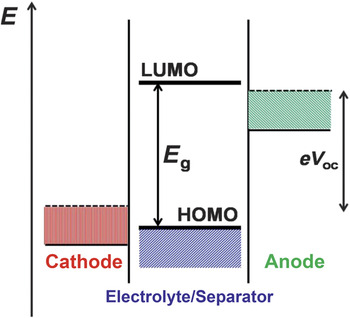
The energy density (W h kg–1) of an electrochemical cell is a product of the voltage (V) delivered by a cell and the amount of charge (A h kg–1) that can be stored per unit weight (gravimetric) or volume (volumetric) of the active materials (anode and cathode). Among the various rechargeable battery technologies available, lithium-ion technology offers higher energy density per unit weight or per unit volume—and therefore, longer user times between charges—as compared to other rechargeable battery technologies. This is primarily due to at least a doubling of the cell voltage (∼4 V), which arises from the use of a nonaqueous electrolyte with a larger electrochemical stability window (bandgap of the electrolyte), Reference Goodenough and Manthiram1,Reference Manthiram2 as shown in Figure 1 .
Schematic of the redox energies of the anode and cathode in relation to the highest occupied molecular orbital (HOMO) and the lowest unoccupied molecular orbital (LUMO) of the electrolyte in a cell. Note: E g, bandgap energy; e, electronic charge; V OC, open-circuit voltage; E, energy.

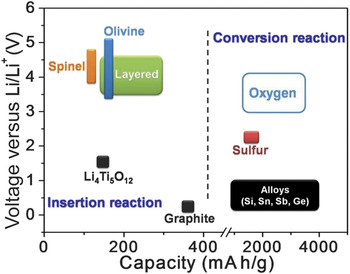
Currently, lithium-ion technology is based on insertion-compound electrodes, into/from which lithium ions can be reversibly inserted/extracted ( Figure 2 ). The capacity of insertion-compound electrodes is limited by the number of crystallographic sites available to reversibly store Li+ ions. Also, experiencing more than one electron change per transition-metal ion in an insertion-compound electrode during the charge-discharge process often results in a large volume change and sometimes structural transitions or a large voltage step when proceeding from one redox couple to another. This hinders the increase in charge-storage capacity. On the other hand, a further increase in cell voltage beyond the current levels is limited by the electrolyte-stability window as the redox energies of the anode and cathode have to ideally lie within the bandgap of the electrolyte (Figure 1).
Comparison of the operating voltages versus Li/Li+ and the lithium-ion-storage capacities of various insertion-compound and conversion-reaction electrodes. Reference Goodenough and Manthiram1 The insertion-compound electrodes, such as the graphite anode and the spinel and layered oxide cathodes, exhibit much lower capacities than the conversion-reaction electrodes, such as the silicon anode and the sulfur cathode. The dashed vertical line represents a separation between the insertion-compound and conversion-reaction electrodes.

These difficulties have prompted interest in conversion-reaction electrodes, which during discharge form compositions with structures different from that of the initial material, as they often offer an order of magnitude higher charge-storage capacity than the insertion-compound electrodes. However, they have their own challenges. The following sections provide an overview of the insertion-reaction electrodes, followed by conversion-reaction electrodes, with Li+ as the working ion.
Insertion-reaction electrodes
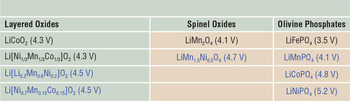
Graphite is the sole insertion-reaction anode used, as the operating voltage of graphite is close to that of Li/Li+, Reference Basu3 so on coupling with a cathode in a lithium-ion cell, it helps to realize a high cell voltage (Figure 2). Also, graphite has a high theoretical capacity of 372 mA h g–1. However, the reaction of the graphite surface with the liquid electrolyte results in the formation of a solid-electrolyte interphase (SEI) layer, which could cause plating of lithium metal in the form of dendrites, particularly under conditions of fast charge or at lower operating temperatures, resulting in internal shorts and safety concerns. This has generated interest in Li4Ti5O12 crystallizing in the spinel structure as an anode because it operates at a higher voltage of ∼1.5 V versus Li/Li+ with a capacity of ∼170 mA h g–1. Reference Ferg, Gummoow, de Kock and Thackeray4 However, the higher operating voltage and lower capacity sacrifice the energy density. The cathodes are largely based on layered LiCoO2, spinel LiMn2O4, or olivine LiFePO4 (Figure 2 and Table I ). Each of these has advantages and disadvantages, which we will address.
List of cathode materials for lithium-ion batteries.

The cathodes currently used are indicated in black and those under development are highlighted in blue. The operating voltages or the upper operating voltage limits indicated for each material are versus Li/Li+.
Layered oxide cathodes
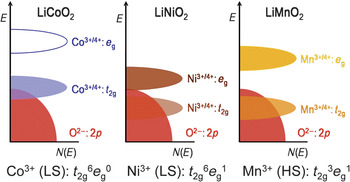
LiCoO2 crystallizing in a layered structure was the first to be employed in a lithium-ion cell. Reference Mizushima, Jones, Wiseman and Goodenough5–Reference Yoshino7 LiCoO2 offers good structural stability during synthesis with perfect ordering of the Li+ and Co3+ ions on alternate layers as well as during the charge-discharge process due to the high stability of Co3+/4+ in an octahedral site. However, it suffers from chemical instability upon charging more than 50% (x > 0.5 in Li1–x CoO2 or capacity > 140 mA h g–1) due to an overlap of the low-spin Co3+/4+:t 2g Reference Yoshino6 band with the top of the O2–:2p band (see Figure 3 ). Reference Venkatraman, Shin and Manthiram8 In contrast, the high-spin Mn3+/4+ couple offers good chemical stability, as it lies well above the top of the O2–:2p band, but suffers from poor structural stability during charge-discharge due to the tendency of Mn3+ ions to diffuse from the octahedral sites of the transition-metal layer to the octahedral sites of the lithium layer through a neighboring tetrahedral site. Also, Co is more expensive and toxic compared to Mn.
Comparison of the positions of the Co3+/4+:3d, Ni3+/4+:3d, and Mn3+/4+:3d energies (E) relative to the top of the O2–:2p band in layered LiMO2 (M = Mn, Co, and Ni) oxides. (left) The overlap of the Co3+/4+:3d band with the top of the O2–:2p band (left) results in chemical instability (oxygen release from the lattice), limited practical capacity (∼50% of the theoretical capacity), and safety concerns for LiCoO2, while the Mn3+/4+:3d band lying well above the top of the O2–:2p band (right) provides better chemical stability and safety for LiMnO2. The Ni3+/4+:3d band, on the other hand, barely touches the top of the O2–:2p band (middle), so the chemical stability of LiNiO2 is in-between that of LiCoO2 and LiMnO2. Note: LS, low-spin configuration; HS, high-spin configuration; N(E), density of states.

Nickel, on the other hand, is intermediate between Co and Mn in all the above respects. Moreover, only LiCoO2 becomes metallic on charging due to the direct Co–Co interaction, involving overlap of the partially filled t 2g orbitals, across the shared CoO6 octahedral edges. In contrast, both LiNiO2 and LiMnO2 remain semiconductors throughout the charge-discharge process as e g electrons with a 90° metal–oxygen–metal bond are involved in the redox process. To make the best out of the three elements in play (Mn, Co, and Ni), the industry is now largely using a solid-solution cathode with compositions close to LiNi1/3Mn1/3Co1/3O2. Reference Ohzuku and Makimura9
While the conventional LiMO2 (M = Mn, Co, and Ni) oxides mainly involve oxidation/reduction of transition-metal ions, the recently developed lithium-rich layered oxides, such as Li[Li0.2Mn0.6Ni0.2]O2, involve an oxidation of a fraction of the O2– ions to O2 gas during the first charge, following the initial oxidation of the transition-metal ions to M4+. Reference Lu, Beaulieu, Donaberger, Thomas and Dahn10,Reference Armstrong, Kang, Holzapfel, Nova, Thackeray and Bruce11 Although such an involvement of O2– ions during the first charge leads to a large reversible capacity of 250–300 mA h g–1 in subsequent cycles, the lithium-rich layered oxides suffer from the inevitability of a transition from the layered to a spinel-like structure during cycling, resulting in a continuous voltage decay. Despite significant efforts, the voltage fade problem remains a daunting challenge to overcome; the larger the capacity, the greater the number of oxygen and lithium vacancies formed in the structure, and the greater the tendency of the Mn ions to migrate to the lithium layer and form a spinel-like phase. Reference Lee and Manthiram12
More recently, the Ni-rich layered oxides LiNi1–y–z Mn y Co z O2 with Ni content >0.5 have become more appealing, as they have the potential to deliver capacities >200 mA h g–1. Reference Sun, Chen, Noh, Lee, Jung, Ren, Wang, Yoon, Myung and Amine13 The major issues with Ni-rich oxides are the high surface reactivity with the organic electrolytes to form a thick SEI layer, structural degradation on the surface to form a rock-salt type NiO phase due to the high chemical reactivity of Ni3+/4+, and its tendency to be reduced to a lower oxidation state. The instability of Ni3+/4+ also leads to thermal runaway and safety concerns. Use of nickel-rich layered oxides with a concentration-gradient structure, in which the interior is richer in Ni and the exterior is richer in Mn, shows promise in minimizing surface reactivity and enhancing the cycle life. Reference Sun, Chen, Noh, Lee, Jung, Ren, Wang, Yoon, Myung and Amine13 Similar surface-conditioning approaches could make the nickel-rich layered oxide compositions viable in practical cells. The industry is now focusing on nickel-rich layered oxides as a potential next-generation cathode.
Spinel oxide cathodes
LiMn2O4 crystallizing in the spinel structure with fast three-dimensional lithium-ion diffusion along with the low cost of Mn is appealing for large-scale battery applications requiring fast charge-discharge. Reference Thackeray, David, Bruce and Goodenough14 However, the dissolution of Mn from the lattice due to the disproportionation of Mn3+ into Mn4+ (remains in the solid) and Mn2+ (leaches out into the electrolyte) plagued the adoption of LiMn2O4 for decades. Despite intensive efforts to overcome this problem, the research community has ultimately been forced to use LiMn2O4 in combination with a layered oxide composition in an approximate weight ratio of 1:2 in electric vehicles to minimize the Mn dissolution. The capacity of LiMn2O4 is also limited to <120 mA h g–1 at ∼4 V, involving less than one Li insertion/extraction per two Mn into/from the 8a tetrahedral sites as the second Li insertion/extraction into/from the empty 16c octahedral sites occurs at a lower voltage of ∼3 V with a cubic to tetragonal transition (Jahn-Teller distortion) accompanied by a severe capacity fade.
Recently, the LiMn1.5Ni0.5O4 spinel has become appealing due to its higher operating voltage of ∼4.7 V and its higher capacity of ∼135 mA h g–1 (Figure 2). Reference Manthiram, Chemelewski and Lee15 However, its practical utility is hindered by the unavailability of an electrolyte that is capable of remaining functional and stable at such a high voltage. In addition, its performance is sensitive to synthesis and processing conditions, which influence electronic conductivity, depending on the ordering between Mn4+ and Ni2+ in the lattice and Mn3+ content; SEI layer formation depending on the surface planes (atomic arrangements); and the formation of the Ni1–x Li x O impurity phase. Reference Manthiram2,Reference Manthiram, Chemelewski and Lee15
Olivine cathodes
The LiFePO4 olivine structure provides important advantages of higher thermal stability and better safety, as compared to the layered and spinel cathodes, because the oxide ions are tightly held by the covalently bonded PO4 groups. Reference Padhi, Nanjundaswamy and Goodenough16 However, the Fe2+/3+ couple, as compared to the M3+/4+ couples in the other systems, not only lowers the operating voltage to ∼3.4 V with a capacity of ∼170 mA h g–1 (Figure 2), but also introduces electron localization, which results in poor electronic conductivity. In addition, the one-dimensional lithium-ion diffusion limits lithium-ion transport. To overcome the electronic and ionic conductivity limitations, the material must be fabricated with nano-sized particles and coated with carbon, reducing the volumetric energy density, introducing the possibility of inconsistencies, and increasing the processing cost. Reference Manthiram, Vadivel Murugan, Sarkar and Muraliganth17 The lower operating voltage and volumetric energy density make it unattractive for portable and vehicle applications, but the good thermal stability and abundance of Fe make it appealing for stationary grid storage.
The analogous LiMnPO4 operates at an ideal voltage range of ∼4.1 V, but is plagued by inferior cycle life caused by even higher electron localization and the typical problems of Mn3+ (e.g., Mn dissolution). LiCoPO4 and LiNiPO4 operate at much higher voltages of 4.8 and 5.1 V, respectively, but they suffer from a lack of electrolytes capable of operating at such high voltages.
Conversion-reaction electrodes
The charge-storage capacity of insertion-reaction electrodes is limited by the number of crystallographic sites available in the lattice. This limitation has generated immense interest in conversion-reaction electrodes. In this regard, silicon, tin, antimony, and phosphorous have become appealing as anodes while sulfur and oxygen have become attractive as cathodes, which are briefly discussed.
Conversion-reaction anodes
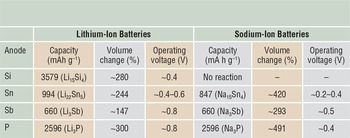
Si, Sn, Sb, and P offer much higher theoretical capacities (∼660–3600 mA h g–1) compared to graphite ( Table II and Figure 2). Reference Nitta and Yushin18–Reference Kim, Ha, Oh and Lee20 However, they undergo large volume changes during the charge-discharge process (see Table II). These are too huge to maintain interparticle contact and electrode integrity during cycling, leading to severe capacity fade. Several strategies have been adopted to overcome the volume change issue, such as mixing the active material with other active or inactive components to form a nanocomposite, and nanoengineering through novel synthesis approaches to leave enough space to accommodate the volume change. Reference Obrovac and Chevrier19,Reference Yoon and Manthiram21 These approaches help minimize the problem, but result in a significant decrease in volumetric capacity or often in an increase in processing costs. In addition, most of these materials have low-operating voltages, resulting in significant SEI layer formation and a large irreversible capacity loss in the first cycle and thus, consuming lithium ions from a cathode that already has severely limited capacity values. Furthermore, the stress induced by the volume changes causes continuous breaking and reforming of an SEI layer, resulting in a decrease in Coulombic efficiency, which is the ratio of the discharge capacity to the charge capacity.
Theoretical capacities and volume changes of Si, Sn, Sb, and P anodes in lithium-ion and sodium-ion batteries.

Among the various conversion-reaction anodes, Sb and P anodes offer a particular advantage as they operate at a slightly higher voltage of ∼0.8 V versus Li/Li+ (Table II), which could help suppress lithium plating and dendrite formation, offering safety advantages. Several Sb-based nanocomposites, such as Sb-Al2O3-C and M x Sb-Al2O3-C (M = Fe, Ni, and Cu), have been made by simple high-energy mechanical milling (HEMM) of Sb2O3 with Al, M, and C, where the reaction involves a negative free-energy change. Reference Yoon and Manthiram21 Similarly, M x Sb-TiC-C nanocomposites have also been synthesized by the HEMM of appropriate metal alloys with carbon. Reference Allcorn and Manthiram22 For instance, ball-milling of Cu x Sb y Ti z with carbon gives Cu x Sb y and conductive TiC. The nanocomposites exhibit good cycle life as the Al2O3-C or TiC-C buffer matrix helps minimize the agglomeration or growth of the active nano-size particles during cycling. However, the irreversible loss in the first cycle still needs to be overcome. Similar ball-milling approaches have also been extended to other nanocomposite systems, such as Bi1–x Sb x -C Reference Zhao and Manthiram23 and CuP2-C, Reference Kim and Manthiram24 which show good cycle life. These nanocomposite anodes also have good performance in sodium-ion cells. Reference Kim, Allcorn and Manthiram25
Sulfur cathodes
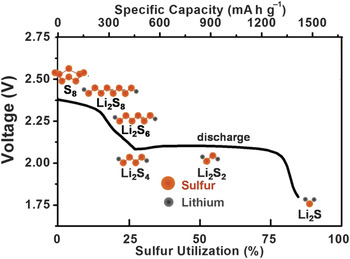
Elemental sulfur electrodes that undergo a two-electron transfer per atom offer an order of magnitude higher theoretical capacity (1672 mA h g–1) than currently available insertion-compound cathodes (Figure 2 and Figure 4 ). Reference Manthiram, Fu and Su26–Reference Manthiram, Chung and Zu28 However, both sulfur and the end discharge product Li2S are poor electronic and lithium-ion conductors, and the charge-discharge process involves volume change. This necessitates the incorporation of a significant amount of conductive species such as carbon, which reduces the sulfur content (wt%), loading (sulfur mass per unit area), and the practical capacity. The reduction in capacity along with a lower operating voltage of ∼2.1 V significantly lowers the practical energy density. Also, with an initial eight-membered ring structure, sulfur forms a series of intermediate polysulfides, Li2Sn, as seen in Figure 4, where some of those with higher n values are soluble in the electrolytes used in Li-S cells. The dissolved polysulfides diffuse through the polymer separator from the cathode to the anode, resulting in poor cycle life, self-discharge, and low efficiency. Finally, since elemental sulfur does not contain any lithium, metallic lithium needs to be employed as an anode, which brings additional complications, such as continuous SEI layer formation, poor cycle life, dendrite formation, and safety concerns.
Charge-discharge profiles of the Li-S cell, with the various species formed during the charge-discharge process indicated. During discharge, the eight-membered ring structure of sulfur breaks to form a series of polysulfides Li2Sn, followed by the end product Li2S. While sulfur and the end discharge product Li2S are insoluble in the electrolyte, the higher-order polysulfides Li2S8 and Li2S6 are soluble in the electrolyte and diffuse from the cathode to the anode through the polymeric separator, limiting cycle life and increasing self-discharge.

Several innovative approaches have been adopted in recent years to overcome the limitations in electrochemical utilization, volume change, and polysulfude migration to the anode, including sulfur-carbon nanocomposites, polymer-carbon nanocomposites, and novel cell designs with a carbon-paper interlayer between the sulfur cathode and the separator Reference Su and Manthiram29,Reference Su, Fu, Cochell and Manthiram30 or coating the separator with carbon on the sulfur cathode side. Reference Chung and Manthiram31 These approaches have helped to reduce the problems with sulfur cathodes. However, the addition of a significant amount of porous carbon to form a sulfur-carbon composite, use of a carbon-paper interlayer or a carbon-coated separator, and the formation of soluble polysulfides necessitate the use of a significant amount of liquid electrolyte as compared to that used with insertion-compound cathodes. This leads to a further reduction in practical energy density. Moreover, the continuous formation of an SEI layer on the lithium-metal anode depletes the electrolyte during cycling, resulting in drying out and cell failure. Unless an acceptable approach is found to reduce the amount of electrolyte used, it will be challenging to realize the anticipated energy density advantages of Li-S cells.
To overcome the problems with the lithium-metal anode, several approaches, such as forming an artificial SEI layer that is conductive to lithium, are being pursued. For example, the initial addition of a small amount of copper acetate along with lithium polysulfide to the electrolyte appears to form a favorable layer in situ on the lithium-metal surface and thereby helps maintain better surface morphology during cycling. Reference Zu and Manthiram32 Other similar novel approaches could help stabilize the lithium-metal anode and make other battery systems based on lithium-metal anodes viable.
Oxygen cathode
Ambient air can serve as a constant source of oxygen, which offers a high theoretical capacity of ∼1675 or 3350 mA h g–1, depending on whether peroxide or oxide is the discharge product (Figure 2), hence there has been enormous interest in developing lithium-air cells. Reference Abraham and Jiang33,Reference Bruce, Freunberger, Hardwick and Tarascon34 However, nonaqueous lithium-air cells have been plagued by poor cycle life and low efficiency, caused by the clogging of the air cathode by insoluble discharge products, degradation of the organic electrolytes by the electrocatalysts, contamination of the organic electrolytes by moist air, and the large polarization loss during the oxygen reduction reaction (ORR) and the oxygen evolution reaction (OER). Attempts to eliminate these problems have met with little success so far.
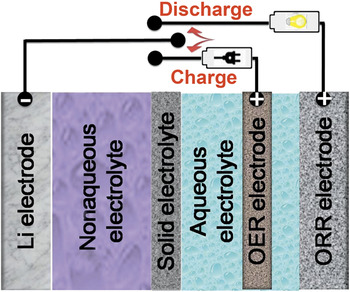
Some of the problems could be overcome by adopting a hybrid lithium-air cell configuration with a dual electrolyte in which the lithium-metal anode in a nonaqueous electrolyte is separated by a solid lithium-ion electrolyte from an aqueous catholyte containing the air electrode ( Figure 5 ). Reference Visco, Nimon and Katz35 With this approach, the critical issue is that the solid electrolyte should be capable of providing the following: Reference Li, Cai, Dai and Manthiram36,Reference Manthiram and Li37 high enough conductivity to minimize the area-specific resistance, compatibility with nonaqueous and aqueous environments on both sides with good chemical stability, and supporting the transport of the working ion Li+. Other considerations include the air electrode should be low cost, durable, and an efficient electrocatalyst for ORR and OER; and the lithium-metal anode should be cyclable and free of dendrite formation and safety concerns. In addition, carbon corrosion is a major issue at high voltages during the OER.
Schematic of a hybrid dual-electrolyte lithium-air cell in which the lithium-metal anode in a nonaqueous electrolyte is separated by a solid lithium-ion conductor from the air electrode consisting of decoupled oxygen evolution reaction (OER, charge) and oxygen reduction reaction (ORR, discharge) electrodes in an aqueous catholyte. Reference Visco, Nimon and Katz35

With such a hybrid lithium-air system, a decoupled cell configuration with one electrode free from carbon for the OER and another electrode containing carbon for the ORR has shown promise. Reference Li and Manthiram38 Spinel oxides such as Co3O4 or NiCo2O4 grown directly on a nickel foam without any carbon, and optimized macro-/meso-/micropores have been found to be durable with high OER activity comparable to the conventional IrO2 catalyst. Similarly, nitrogen-doped carbons with optimized macro-/meso-/micropores have shown ORR activity comparable to the conventional Pt/C catalyst, but with much better durability. Full cells fabricated with a decoupled cell configuration, Co3O4 grown onto nickel foam as the OER catalyst, and nitrogen-doped carbon as the ORR catalyst along with optimized pore structures have demonstrated long cycle life for approximately 1200 cycles without an apparent decline in cell efficiency, while the cells fabricated with the conventional Pt/C as the ORR catalyst and IrO2 as the OER catalyst exhibit a continuous decrease in efficiency during cycling due to an increasing charge voltage and a decreasing discharge voltage with cycling. Reference Li, Liu, He, Fan and Manthiram39
Oxides such as the spinel oxides previously presented exhibit high catalytic activity for the OER, but their catalytic activity is sensitive to the morphology and surface planes or surface atomic arrangements. For instance, with spinel oxides, crystals with surface {111} planes exhibit higher OER activity compared to crystals having {111} planes and truncated {100} planes. Reference Maiyalagan, Chemelewski and Manthiram40 Design and development of catalysts with optimal surface atomic arrangements have the potential to enhance the catalytic activity further and lower the polarization losses. Furthermore, the development of carbonless bifunctional catalysts that can offer both high ORR and OER activities can simplify the cell design and configuration. Reference Maiyalagan, Jarvis, Therese, Ferreira and Manthiram41
Future directions
The challenges mentioned necessitate new strategies with innovative ideas, some of which are pointed out in the following as good examples for future directions.
Solid electrolytes
The instability of currently available organic liquid electrolytes above ∼4.3 V versus Li/Li+ prevents the utilization of cathodes with higher operating voltages. The formation of lithium dendrites in contact with the organic-liquid electrolytes prevents the use of lithium-metal as an anode, in addition to limiting the charge rates of other anodes, such as graphite and silicon that have operating voltages close to that of Li/Li+. Replacing the liquid electrolytes, in conjunction with a polymeric polypropylene separator, with a solid lithium-ion conducting separator can overcome these problems. Reference Quartarone and Mustarelli42 However, the solid electrolyte should have acceptable lithium-ion conductivity to keep the area-specific resistance low, with good interfacial stability and low interfacial impedance in contact with the anode and cathode with a large enough electrochemical stability window, and good mechanical properties and compatibility with ambient air for handling and assembling the cells.
It is often difficult to find a solid electrolyte that satisfies all of these requirements. Development of potential solid electrolytes with acceptable characteristics could also enable new battery chemistries and cell configurations (e.g., the hybrid lithium-air cells previously discussed, various flow-battery systems, and cells with a “messenger ion” like the recently shown acidic zinc-air batteries), Reference Li and Manthiram43 since the solid electrolyte can prevent chemical crossover between the cathode and anode. With enormous advantages and potential, future work in this area is beginning to focus on the development of new solid-electrolyte separators.
Multi-electron transfer hosts
With the aim to increase the charge-storage capacity, there is immense interest in identifying insertion hosts that can support more than one electron per transition-metal ion. However, most transition-metal ions exhibit a large voltage step on traversing two redox couples. For example, LiVOPO4 is known to accommodate two lithium ions reversibly per vanadium, involving the V4+/5+ and V3+/4+ redox couples, but the two redox energies are separated by ∼2 V. Reference He, Bridges and Manthiram44 At the present time, among the 3d-transition-metal ions, only the Ni2+/3+ and Ni3+/4+ redox couples are known to operate without a step in the voltage profile, as in the 4.7 V spinel LiMn1.5Ni0.5O4, Reference Manthiram, Chemelewski and Lee15 but no host is available with Ni, the only metal ion that can support more than one electron transfer. Intuitive synthesis approaches and stabilization of new structures could potentially be pursued with an exploratory exercise to identify new hosts. Conversion-reaction cathodes such as sulfur and oxygen are the most studied multi-electron transfer cathodes.
Cells with other working ions
Considering the limited global lithium resources and their geographical locations, more attention is being paid to batteries with other working ions, such as Na+, Mg2+, Zn2+, and Al3+. With a Na+ working ion, both insertion-reaction and conversion-reaction electrodes are being pursued, building on the extensive knowledge base available on the analogous lithium-ion chemistry. For instance, many of the conversion-reaction anodes described in Table II for lithium-ion batteries are also active for sodium-ion batteries. However, the larger size of Na+ ions compared to Li+ and differences in their preference for coordination geometries introduce complexity with insertion-reaction electrodes. Additionally, the strategies discussed with lithium-sulfur batteries can be extended to ambient-temperature sodium-sulfur batteries. Reference Manthiram and Yu45,Reference Yu and Manthiram46
The hybrid lithium-air concept discussed can also be employed with a sodium-ion solid electrolyte to realize hybrid sodium-air batteries. To lower the cost and potentially increase the capacity, cells with divalent working ions (Mg2+ and Zn2+) and trivalent working ions (Al3+) are also being pursued. However, the strong electrostatic repulsion encountered by the multivalent ions with the neighboring ions in the crystal lattice, particularly with materials with sufficient ionicity, poses problems for using close-packed structures (e.g., spinel MgMn2O4 and ZnMn2O4) that are analogous to the well-known lithium-insertion host LiMn2O4. Reference Knight, Therese and Manthiram47,Reference Knight, Therese and Manthiram48 The multivalent working ions also limit the charge-discharge rates and the cell voltage. Lack of adequate electrolytes for multivalent ions poses additional challenges.
Summary
This article presented a brief account of various battery chemistries with Li+ as the working ion. The choice of battery chemistry will depend on the application (portable versus vehicle versus grid storage) and will need to consider tradeoffs among the various parameters: cost, cycle life, safety, energy density, charge-discharge rate, and environmental impact. Although graphite is often the sole anode, it has its drawbacks: slow charging rate, lithium-dendrite formation, and safety concerns. Operation of insertion-compound cathodes beyond ∼4.3 V is limited by the lack of an available electrolyte with adequate interfacial stability. Moreover, insertion-reaction cathodes are limited in capacity (<300 mA h g–1).
Conversion-reaction anodes such as Si, on the other hand, offer huge capacity but suffer from large volume change, continuous formation of the SEI layer, irreversible capacity loss in the first cycle, and capacity fade during cycling while maintaining adequate active material loading. The conversion-reaction cathode sulfur suffers from dissolved polysulfide migration from the cathode to the anode, reduced active material content and loading, and the necessity of large amounts of electrolyte. The conversion-reaction cathode oxygen suffers from organic electrolyte decomposition, air electrode clogging, and contamination by moist air. Hybrid lithium-air cells with a solid electrolyte and dual electrolyte overcome some of the problems associated with nonaqueous lithium-air cells, but bring additional challenges associated with solid electrolytes; for example, they need mechanically robust solid-electrolyte separators with sufficiently high conductivity and good interfacial stability. New materials development and innovative materials processing along with novel cell configurations could help overcome some of the hurdles associated with the electrodes and electrolytes.
Acknowledgments
This work was supported by the Welch Foundation Grant F-1254 and the US Department of Energy, Office of Basic Energy Sciences, Division of Materials Sciences and Engineering under Award Number DE-SC0005397. A.M. thanks Sheng-Heng Chung for his assistance with the figures.

Arumugam Manthiram is a professor and holder of the Cockrell Family Regents Chair in Engineering in the Department of Mechanical Engineering at The University of Texas at Austin. He is also the director of the Texas Materials Institute and the Materials Science and Engineering Program. His research interests are in the area of materials for rechargeable batteries, fuel cells, and solar cells, including novel synthesis approaches. He has authored more than 600 journal articles with more than 29,000 citations. Manthiram can be reached by email at manth@austin.utexas.edu.