INTRODUCTION
Fruit consumption by birds occurs in practically all terrestrial environments, but is prevalent in tropical regions (Fleming et al. Reference FLEMING, BREITWISCH and WHITESIDES1987, Kissling et al. Reference KISSLING, BÖHNING–GAESE and JETZ2009), where most species of angiosperm develop zoochorous fruits (Howe & Smallwood Reference HOWE and SMALLWOOD1982). Birds are the most important vectors in seed dispersal due to their species diversity, abundance, range of sizes (Fleming & Kress Reference FLEMING and KRESS2011) and the fact that, in several cases, they eliminate the seeds undamaged (Traveset Reference TRAVESET1998, Traveset et al. Reference TRAVESET, ROBERTSON, RODRÍGUEZ-PÉREZ, Dennis, Schupp, Green and Westcott2007).
In spite of being easily digested, fruits are irregularly distributed, both spatially and temporally, and tend to be a nutritionally inferior class of food (Fleming et al. Reference FLEMING, BREITWISCH and WHITESIDES1987). Because of this, fruit-eating birds usually consume fruits of various species (Muller-Landau & Hardesty Reference MULLER-LANDAU, HARDESTY, Burslem, Pinard and Hartley2005, Pizo & Galetti Reference PIZO, GALETTI, Von Matter, Straube, Accordi, Piacentini and Cândido2010), not specializing in a specific species or families (Githiru et al. Reference GITHIRU, LENS, BENNUN and OGOL2002), and consuming other resources such as insects to supplement their diet (Corlett Reference CORLETT2011, Izhaki & Safriel Reference IZHAKI and SAFRIEL1989). In the Brazilian savanna, for example, most fruit-eating birds are omnivorous, with only part of their diet being composed of fruits (Gottsberger & Silberbauer-Gottsberger Reference GOTTSBERGER and SILBERBAUER-GOTTSBERGER2006, Macedo Reference MACEDO, Oliveira and Marquis2002).
In general, a coterie of frugivores (set of species that eats the fruit of a specific species; Fleming et al. Reference FLEMING, VENABLE and HERRERA1993) includes a broad taxonomic, trophic and morphological diversity (Foster Reference FOSTER1987, Melo & Oliveira Reference MELO and OLIVEIRA2009, Pizo Reference PIZO1997). Such variety of species eating the same resource suggests niche overlap and potential competition between them (Terborgh & Diamond Reference TERBORGH and DIAMOND1970). The competition between animals for nutritional resources (Fleming Reference FLEMING1979, Guix et al. Reference GUIX, RUIZ and JOVER2001) and among plant species for seed dispersers (Herrera Reference HERRERA1981, Howe & Estabrook Reference HOWE and ESTABROOK1977) may influence fruit selection and the proportion in which they are consumed by different fruit-eating species.
This study tested whether the overlap in coteries of fruit-eating birds is different than would be expected at random. For this, we conducted a comparison with randomizations generated through a null model. This method allows us to test whether a pattern is similar to that observed in the absence of some mechanism (Gotelli & Graves Reference GOTELLI and GRAVES1996), by generating a control treatment for observational data (Connor & Simberloff Reference CONNOR and SIMBERLOFF1986).
Through the null model, three hypotheses were formulated about the occurrence of overlap between the coteries of fruit-eating birds. The null hypothesis (H0) is that the overlap between the coteries does not differ from that expected by the model. The first alternative hypothesis (HA1) suggests a scenario where interspecific competition influences the composition of the coteries, generating niche partitioning and overlap smaller than that generated by the model. The second alternative hypothesis (HA2) expresses a scenario with a lack of competition in the formation of the coteries and shared resource utilization, generating an overlap index larger than predicted by the null model.
METHODS
Study site
The study was carried out in an area of 127ha (18°55′S, 48°17′W) in Uberlândia city, central Brazil. Brazilian savanna (cerrado) is the dominant phytophysiognomy in the area where the data collection occurred. This vegetation is dominated by 3–8m-tall trees and shrubs with more than 30% crown cover, but with a fair amount of herbaceous vegetation between them (Oliveira & Marquis Reference OLIVEIRA, MARQUIS, Oliveira and Marquis2002). The climate in the region, according to Köppen (Kottek et al. Reference KOTTEK, GRIESER, BECK, RUDOLF and RUBEL2006), is characterized as Aw, the annual rainfall is around 1500 mm and the average temperature is 22 ºC (Silva & Assunção Reference SILVA and ASSUNÇÃO2004).
Observations and characterization of birds
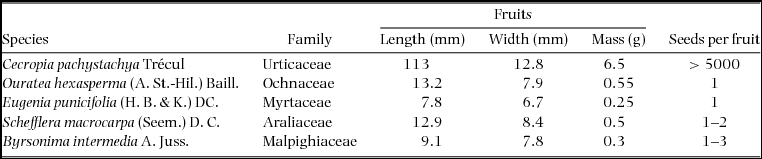
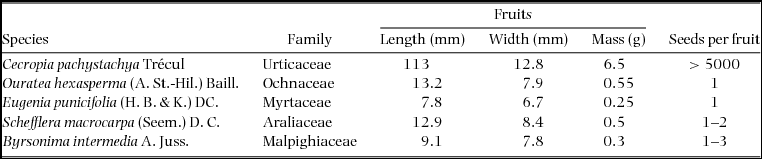
Between June 2011 and February 2012, four individuals of five sympatric plant species producing fruits dispersed by birds were selected (Table 1): Cecropia pachystachya, Ouratea hexasperma, Eugenia punicifolia, Schefflera macrocarpa and Byrsonima intermedia. These species were selected because they were among the ones with the most abundant fruiting in the area and offered fruits that were potentially consumed by most birds, due to their size and softness. This choice was with the aim of ensuring that differences in the coteries of fruit-eating birds were not influenced by morphological limitations. To minimize non-independence of samples, each plant included in the observations was at least 50m away from any other, regardless of species.
Fruit morphological traits (length, width and mass) and number of seeds per fruit of the five savanna plant species chosen for focal-plant observation, Uberlândia city, Brazil.
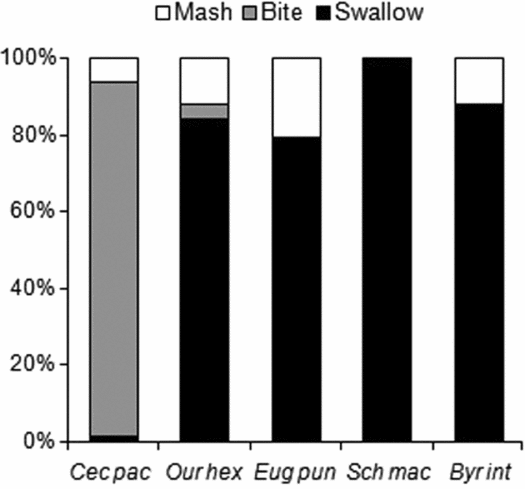
Focal-plant observation sessions were conducted between 06h30 and 11h30, totalling 300 h of observation, with 60 h spent on each plant species. At each visit by birds including fruit consumption, the following data were recorded: (1) bird species that made the visit followed by consumption; (2) number of fruits consumed during the visit (in cases of large infructescences, such as C. pachystachya, each piece plucked was recorded as a fruit); and (3) fruit handling behaviour, differentiated as: swallow, when the whole fruit is ingested without seed breakage; bite, where bits of pulp are removed by biting or pecking a fruit, and can or cannot swallow the seed; and mash, where the fruit is manipulated by damaging or dropping the seed (adapted from Schupp Reference SCHUPP1993). When there was more than one individual of the same species visiting the plant simultaneously, only one was chosen randomly.
The bird visitors were identified and classified in relation to their trophic guild (Motta-Junior Reference MOTTA-JUNIOR1990, Sick Reference SICK1997) to determine which ones are most representative as fruit-eaters in the plant species included in the study.
Coterie overlap
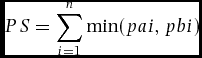
To obtain the overlap between the coteries of fruit-eating birds from each plant species, we used the Proportional Similarity index (PS) between each pair of coteries of fruit eaters of the plants species (Fuentes Reference FUENTES1995, Githiru et al. Reference GITHIRU, LENS, BENNUN and OGOL2002, Jordano Reference JORDANO1994):
 \begin{equation*}
PS = \sum\limits_{i = 1}^n {\min (pai, pbi)}
\end{equation*}
where n is the number of bird species in the largest coterie, and pai and pbi the relative proportion of fruits removed by the bird species i on plant species a and b, respectively. The PS is calculated by determining the smallest relative abundance of eating of each bird species over each pair of plant species (pai, pbi), ranging from 0 (no overlap between coteries) to 1 (complete overlap). The term ‘overlap’ was used in reference to the proportion of bird species in common between each pairs of plant species (Githiru et al. Reference GITHIRU, LENS, BENNUN and OGOL2002). This similarity index has advantages over those using only binary data because it takes into regard the relative abundance (Balmer Reference BALMER2002) in the proportion of fruits removed.
A matrix with values of relative frequency of fruit removed by all bird species on each plant species was generated, from which 10000 randomized matrices were generated. In each of these matrices, a proportional similarity index was applied. The mean of all values of PS was compared with the observed distribution of values of average PS generated from randomizations to verify the difference between the observed results and those expected by chance.
We used the Randomization Algorithms 3 (RA3; Winemiller & Pianka Reference WINEMILLER and PIANKA1990), which is the most suitable for the detection of non-random patterns of overlap. This algorithm retains the niche breadth of each species, but randomizes particular resource states, which are the zero states reshuffled. To generate this model we used the software EcoSim 7.
RESULTS
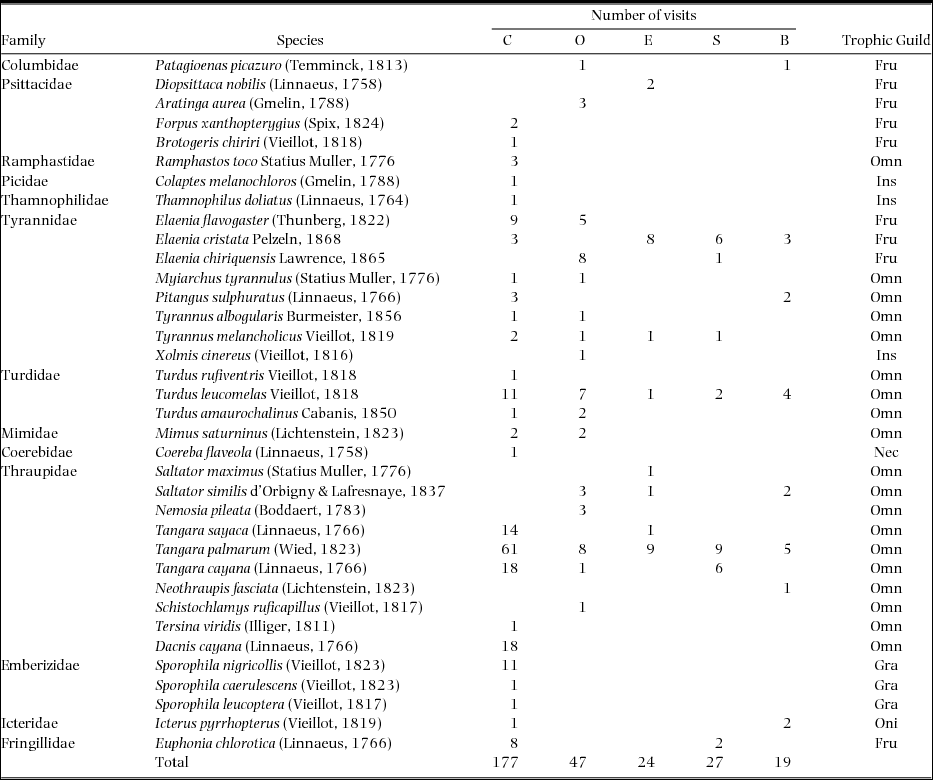
Thirty-six bird species were recorded (distributed in four orders and 13 families) eating fruits in the selected plant species (Appendix 1). Thraupidae were the family with the greatest number of species (n = 10; 27%), followed by Tyrannidae (n = 8; 22%). About 56% (n = 20) were omnivorous species, with 25% (n = 9) being predominantly frugivorous, 8% (n = 3) granivorous and 8% (n = 3) insectivorous.
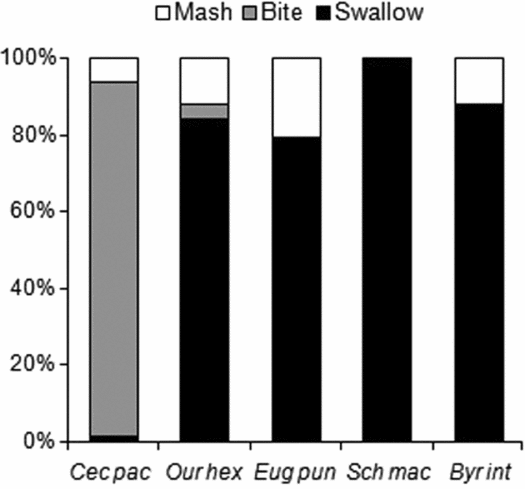
However, frugivores of the Psittacidae (n = 4) were predominantly predatory, either damaging or dropping the seeds during fruit handling. For Cecropia pachystachya, except Ramphastos toco, which consumed the whole fruit, all consumptions was partial (biter; 92%) or predatory (masher; 6%). Consumption of the whole fruit was prevalent for all of the other fruit species (swallower; 79–100%; Figure 1). The visitation rate ranged from 0.33 visits h−1 in Byrsonima intermedia to 2.95 visits h−1 in C. pachystachya.
Relative proportion of the fruit handling behaviour (mash, bite and swallow) by bird species that ate some of the five savanna plant species included in the study. Cec pac = Cecropia pachystachya, Our hex = Ouratea hexasperma, Eug pun = Eugenia punicifolia, Sch mac = Schefflera macrocarpa and Byr int = Byrsonima intermedia.
Tangara palmarum and Turdus leucomelas were the only bird species to consume all fruit species. Over 80% of the birds consumed only one (n = 19) or two (n = 11) species. Tangara palmarum accounted for most fruit removal in four of the five species: C. pachystachya (n = 547; 33% of total) Ouratea hexasperma (n = 25; 20%), Eugenia punicifolia (n = 29; 38%) and Schefflera macrocarpa (n = 25; 29%).
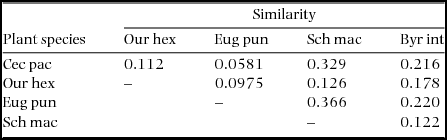
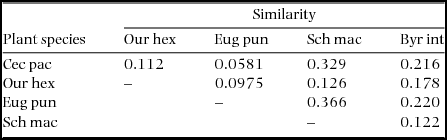
Cecropia pachystachya had the largest coterie of fruit-eating birds, with 25 species, and S. macrocarpa had the smallest, with eight species. Coteries of S. macrocarpa and E. punicifolia (Table 2) had the highest similarity (PS = 0.366) and E. punicifolia and C. pachystachya the lowest similarity (PS = 0.058).
Proportional similarity between the relative amount of each fruit taken by birds in coteries of five plant species in a savanna woodland in Uberlândia, Brazil. Cec pac = Cecropia pachystachya, Our hex = Ouratea hexasperma, Eug pun = Eugenia punicifolia, Sch mac = Schefflera macrocarpa and Byr int = Byrsonima intermedia.
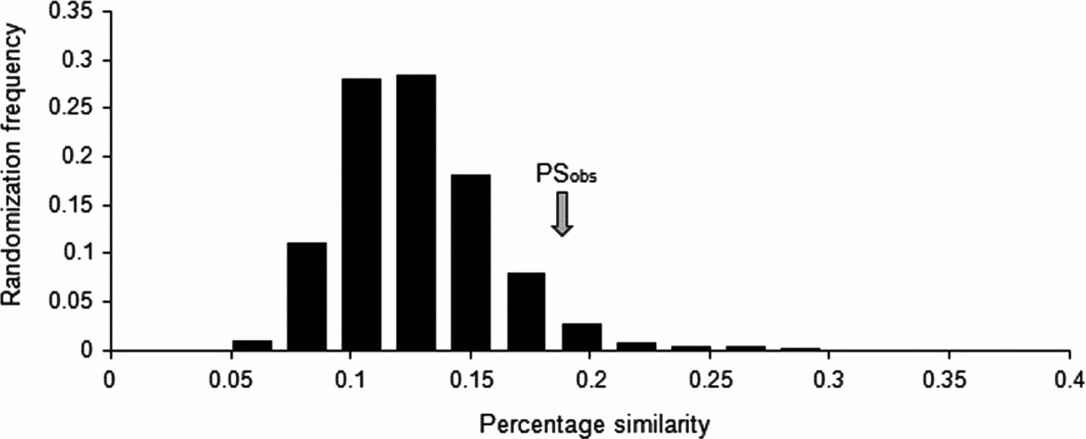
The overlap generated by the model ranged from 0.0695 to 0.306, with an average of 0.183. This value is significantly higher (P = 0.032) than the mean overlap between the coteries of fruit-eating birds generated by the null model (PS = 0.123), consistent with the second alternative hypothesis (Figure 2). The average observed variance (0.0102) did not differ (P = 0.585) from that expected by the models.
Distribution value of the observed Proportional Similarity (PS = 0.183) between the coteries of frugivores in a savanna woodland in Uberlândia, Brazil, compared with the frequency of randomizations generated from the null model. The observed similarities were significantly higher than the values generated by the model (P = 0.032).

DISCUSSION
Observations and characterization of birds
Tangara palmarum, a common species in various types of natural and disturbed environments (Ridgely & Tudor Reference RIDGELY and TUDOR1989, Sick Reference SICK1997), was the most important bird species in the removal of zoochoric fruits of plants included in the study. It is an omnivorous species that has the habit of foraging in small flocks (Gwynne et al. Reference GWYNNE, RIDGELY, ARGEL and TUDOR2010) and has more than half of the diet consisting of insects (Collins & Watson Reference COLLINS and WATSON1983, Snow & Snow Reference SNOW and SNOW1971). Although few fruits were taken per visit, Tangara palmarum is an abundant species (A. M. Silva pers. obs.) and compensates for the proportion of fruit in the diet by making numerous visits, resulting in a large quantity of seeds being taken from the parent plant. As the amount of fruit removed by a species is the product of the number of visits by the number of fruits taken per visit (Schupp Reference SCHUPP1993), a species can achieve a high rate of fruit removal with different combinations of numbers of visits and numbers of fruits per visit (Schupp et al. Reference SCHUPP, JORDANO and GÓMEZ2010).
In Cecropia pachystachya, the number of species and feeding records were much higher than the other species included in the study. It is a pioneer species with a prolonged fruiting period, the seeds are dispersed by a variety of animal vectors and it is one of the most abundant tree species in the Brazilian savanna (Bocchese et al. Reference BOCCHESE, OLIVEIRA and LAURA2008). It can be considered a ‘frugivory hub’, which has a higher probability of visitation than the other species and captures a large share of frugivory and dispersal services (Carlo et al. Reference CARLO, AUKEMA, MORALES, Dennis, Schupp, Green and Westcott2007).
By being taller in relation to other savanna woodland species, this tree stands out in the landscape, which can facilitate the meeting and access to a greater number of disperser species (Toh et al. Reference TOH, GILLESPIE and LAMB1999). By presenting large infructescences that are more than 10 cm long, but do not have a thick coating, the smaller birds easily bite off pieces of the infructescences. Since most birds recorded in the study have a small body size, the fruits of C. pachystachya have been partially consumed. However, that does not mean that the seeds cannot be effectively dispersed, because, due to their small size, they can be ingested intact by birds of various sizes (Snow Reference SNOW1981).
Coterie overlap
As competition influences the use of resources, the niche overlap in communities with the presence of competition should be lower than in communities with a lack of competition (Pleasants Reference PLEASANTS1990, Schoener Reference SCHOENER1974). Studies that found niche overlap greater than expected by chance concluded that, at that time, the competition would not be important in structuring these communities (Griffiths Reference GRIFFITHS1987, Tokeshi Reference TOKESHI1986).
The high overlap between the coteries of the plant species included in the study suggests that there is sharing of resources, and that the competition among fruit-eaters is not a determining factor in interactions between frugivorous birds and fruits. The low influence of competition in the establishment of this interaction may be due to the combination of factors such as: (1) a greater availability of fruits in relation to demand of consumers; (2) a low specificity of the plant–frugivore interactions; and (3) a low dependence of birds for the fruits.
The strength of competition is related to resource availability (Tilman Reference TILMAN1982), and in general, the fruit availability exceeds the demand of consumers (Carlo et al. Reference CARLO, AUKEMA, MORALES, Dennis, Schupp, Green and Westcott2007). This investment excess in seed production is typical of plants that produce generalized fruits (Howe & Estabrook Reference HOWE and ESTABROOK1977, Fleming et al. Reference FLEMING, VENABLE and HERRERA1993), which produce a lot of seeds, but with a reduced chance of individual reproductive success (Howe Reference HOWE1993). The investment excess is a strategy that can reduce competition among consumers, generating coteries of more diverse dispersers (Howe & Smallwood Reference HOWE and SMALLWOOD1982), which contribute to the seeds being dispersed into a wider variety of habitats, so the plants do not rely on a small range of seed dispersers (Howe & Estabrook Reference HOWE and ESTABROOK1977).
With the exception of Cecropia pachystachya, the rate of fruit removal was low (about 1 h−1). This indicates that the quantity of fruit was not a limiting factor, as evidenced by the large number of fruits that are not removed (Foster Reference FOSTER1977), and agonistic interactions were not motivated by the consumption of fruits, signalling a lack of interference competition (Gherardi & Cioni Reference GHERARDI and CIONI2004).
The Brazilian savanna has a pronounced seasonality, having a higher concentration of zoochoric species fruiting during the rainy season (Oliveira & Gibbs Reference OLIVEIRA, GIBBS, Oliveira and Marquis2002), however, during the peak months of drought, June and July, there is a shortage of zoochoric plant species offering fruits (Batalha & Martins Reference BATALHA and MARTINS2004). During these periods, the reduced fruit availability may not be greater than consumer demand, but most bird species adopt alternative diets. Irregular availability may be one factor that precludes the occurrence of exclusively frugivorous diets in open areas, having a domain of omnivorous in the composition of the coteries of fruit eaters.
About 14% of land-bird species consume fruits, but only 4% have a diet that is predominantly frugivorous (Kissling et al. Reference KISSLING, BÖHNING–GAESE and JETZ2009), so omnivorous birds can be important in seed dispersal in many environments (Howe Reference HOWE1993). In studies of frugivory by birds in savanna woodlands, the omnivorous bird species were quantitatively most important in seed removal (Francisco & Galetti Reference FRANCISCO and GALETTI2001, Francisco et al. Reference FRANCISCO, LUNARDI and GALETTI2007, Motta-Junior & Lombardi Reference MOTTA-JUNIOR and LOMBARDI1990, Oliveira Reference OLIVEIRA2009) and that even the non-specialist frugivorous species can provide effective seed dispersal (Carlo et al. Reference CARLO, AUKEMA, MORALES, Dennis, Schupp, Green and Westcott2007, Moermond & Denslow Reference MOERMOND and DENSLOW1985).
About half of the bird species recorded consumed only one plant species and 12 species made only one visit during the sampling. This demonstrates that the number of species that perform regular consumption is small, while 12 species were responsible for more than 75% of the fruits removed. Important species in the removal of fruits such as Tangara palmarum, T. cayana and Turdus leucomelas do not rely exclusively on fruit, also making use of invertebrates (Lopes et al. Reference LOPES, FERNANDES and MARINI2005).
The overlap between the coteries of frugivores and the resource sharing are related to the low specificity of plant–frugivore interactions. Most fruit–frugivore interactions involve the sharing of many frugivorous species and frugivores consuming multiple plants (Carlo et al. Reference CARLO, AUKEMA, MORALES, Dennis, Schupp, Green and Westcott2007), generating a functional redundancy, reducing the impact of an individual species in seed removal and increasing the weight of the interactions within the group (Loiselle et al. Reference LOISELLE, BLENDINGER, BLAKE, RYDER, Dennis, Schupp, Green and Westcott2007). Even with species that are more important than others, the absence of some of them can be compensated by other species that exert an equivalent function, increasing the resilience of the community against species loss (Rosenfeld Reference ROSENFELD2002).
It was concluded that plant–frugivore interactions in the savanna woodlands are not regulated by the interaction between consumers. The overlap between coteries is a sign that there was no selective pressure to generate niche partitioning among consumers, indicating a sharing of resources. This may be because of the low specificity of interactions and low degree of dependence on fruits by bird species, which means that the fruit resources do not limit this interaction.
ACKNOWLEDGEMENTS
We thank CAPES for the scholarship offer to AMS, to Programa de Pós-Graduação em Ecologia e Conservação de Recursos Naturais of Universidade Federal de Uberlândia, to Paulo Eugênio Oliveira and Marco Aurélio Melo for the criticism of the thesis that resulted in this paper and to the team of the Laboratório de Ornitologia e Bioacústica.
Characteristics of the bird species that ate some of the five plant species in a savanna woodland in Uberlândia, Brazil. C = Cecropia pachystachya, O = Ouratea hexasperma, E = Eugenia punicifolia, S = Schefflera macrocarpa and B = Byrsonima intermedia. Fru = frugivorous, Omn = omnivorous, Ins = insectivorous, Nec = nectarivorous and Gra = granivorous.