


The traditional partisan theory of policy outcomes predicts that left wing and right wing parties propose and adopt drastically different budgets. Because the Left prefers more government control of the economy and the Right advocates reliance on the market, leftist governments are expected to produce a bigger government in general and increased welfare (including health and education) spending in particular than rightist parties. The empirical research on advanced, mostly Western European democracies generally supports this theory (see, e.g., Alesina and Roubini Reference Alesina, Roubini and Cohen1997; Blais, Blake, and Dion Reference Blais, Blake and Dion1993; Castles Reference Castles1989; Hibbs Reference Hibbs1977, Reference Hibbs1992; Lange and Garrett Reference Lange and Garrett1985; Schmidt Reference Schmidt1996; see also Imbeau, Petry, and Lamari Reference Imbeau, Petry and Lamari2001 for a review).
In the context of dual transition to democracy and market economy—experienced in post-Communist Europe—the traditional partisan theory might not apply. In this article, we argue that in the post-Communist transition countries, leftist parties were more likely to adhere to fiscal austerity and tighter budgets, whereas rightist parties spent more freely in order to alleviate economic hardships resulting from market reforms.Footnote 1
Our argument consists of two parts. First, leftist parties in post-Communist Europe had a stronger incentive to implement fiscal austerity because they needed to prove their disassociation from socialism and their ability to operate in a democracy and market economy. This task was especially challenging because leftist ideology in general was highly discredited. Second, not only did leftist parties have an incentive to pursue rightist economic policies, but they also had better opportunities to do so. Leftist parties could count on a loyal electorate, and therefore, policy reversals did not constitute a major threat to the stability of their electoral base. Their voter loyalty resulted from three reasons: (1) the traditional prowelfare image of leftist parties provided a safeguard against voter punishment because budget cuts by the Left, unlike those by the Right, could be interpreted as absolutely essential; (2) leftist parties in the region were much more conscientious about building strong party organizations with the goal of insulating supporters from the appeals of opponents; and (3) the Left was much less fragmented than the Right, leaving the leftist voters with few alternatives; furthermore, the sometimes extensive and hostile efforts of decommunization by rightist parties in the region affixed the voters with Communist past firmly to the leftist, especially to the former Communist parties. We explain each part of this argument in turn.
Incentives for Fiscal Austerity: Economic and Social Pressures
The transition to democracy and a market economy in post-Communist countries meant a complete overhaul of how the economy was politically managed. Haggard and Kaufman (Reference Haggard and Kaufman2008) argue that the legacies of the previous regime and the dual transition—factors absent from the literature on advanced democracies as irrelevant—have significantly shaped policy choices of all parties in the new democracies of Latin America, East Asia, and Eastern Europe. The consequences of a large-scale economic transition—high (in some cases astronomical) unemployment and inflation rates, low growth, and the consequential decrease in tax revenues—generated strong pressures for all governing parties, regardless of their left–right leanings, to pursue fiscal austerity rather than directly follow preferences stemming from party ideology.
However, although the large-scale economic transition creates incentives for parties to pursue a reform agenda and be fiscally responsible, the very same economic policy creates a serious strain on large parts of the population. The transformation of a centrally steered economy with an extensive welfare system into a liberal free market economy created large groups of citizens who lost jobs, were deprived of regular income, and faced serious decline in living standards. Vote-seeking parties were therefore also pressured to pursue populist and high expenditure policies of redistribution and protectionism at the expense of reforms, to meet the public's expectation—inherited from the previous regime—of state assistance and “socialist justice” (Cook, Orenstein, and Rueschmeyer Reference Cook, Orenstein and Rueschmeyer1999; Kluegel, Mason, and Wegener Reference Kluegel, Mason and Wegener1999; Lipsmeyer Reference Lipsmeyer2002). In sum, parties were facing contradictory pressures—economic conditions called for fiscal responsibility, while spreading economic adversity demanded extending social assistance (Cook Reference Cook2007).
These conflicting pressures generated stronger incentives for leftist than for rightist parties to pursue fiscal austerity. Leftist parties, representing socialist or social democratic ideologies, faced a necessity to prove to the electorate in order to win a sizeable number of votes, and to their competitors in order to avoid pariah status when in parliament, that they were suitable for and committed to a democratic capitalist system. The commitment of the rightist parties was largely uncontested because most were founded on the legacy of opposition toward the Communist regime.
This necessity to prove themselves was undoubtedly the guiding principle for the leftist parties with a Communist past (Grzymala-Busse Reference Grzymala-Busse2002)—a common type of a leftist party in the region. After having been ousted from power, former Communist parties were publicly discredited and rendered into pariah status by other parties (Ishiyama Reference Ishiyama1995; Mahr and Nagle Reference Mahr and Nagle1995). In such an environment, Grzymala-Busse (Reference Grzymala-Busse2002) finds, the successful strategy of regeneration of the Left entailed avoiding appeals to nostalgia and socialist ideology. Pursuing a welfarist and anti–market reform agenda over fiscal responsibility and market liberalization would signal an attempt to return to the old system, and thus would undermine the party's reinvention. Not simply advocating, but actively engaging in, tough economic reforms was the strategy to follow for the far-sighted vote- and office-seeking leftist parties. To gain credibility in the eyes of the public, political competitors, and the international community, these parties needed to show that their officials were pragmatic leaders and managers rather than ideologues.
Such a need to prove themselves as suitable political players in the new regime was not restricted to the former Communist Left. Indeed, the task of the non-Communist “new” Left was not less daunting. They, too, had to stay away from strong socialist policy positions to avoid being associated with the former regime. In sum, because it was a matter of political survival and of building long-term credibility, it is not surprising that the leftist parties’ first and foremost incentive was to pursue fiscal responsibility and to avoid giving in to pressures to follow populist policies of redistribution and protectionism.
Opportunity for Fiscal Austerity: Voter Loyalty and Party Organization
In addition to strong pragmatic incentives to do so, leftist parties could also afford to implement tough economic reforms, including tightening budgets because they had a more stable and loyal electorate than the parties of the Right. Leftist parties were not only able to attract new voters as a result of regenerating their image by rejecting the traditional leftist economic policies and ideology, but they were also able to avoid losing their old adherents. Such voter acceptance and loyalty stemmed from three advantages.
First, the traditional protectionist image of both the reformed Communist and non-Communist Left helped these parties avoid serious electoral punishment for their drastic turnaround on economic policy. Literature on Western Europe, for example, has noted that economic policy reversals, including dismantling of the welfare state, are better accepted by the public if these policies are pursued by leftist parties (Ross Reference Ross2000; see also Cukierman and Tommasi Reference Cukierman and Tommasi1998).Footnote 2 This is because voters trust leftist economic reform to be genuine, well justified, and carefully exercised—why else would a party with a prowelfare image take an electorally suicidal policy turn? If a party with a traditional antireform image undertakes economic policy reform, then the perception is that there must be an absolute necessity for it, and voters are therefore forgiving and sympathetic.
Second, the reformed Communist parties enjoyed the loyalty of their old adherents and members from before the regime change. Because of the often open hostility toward anybody associated with the previous regime, these old members saw the reformed Communist Party as the only potential protector of their interests. For the sake of the survival and long-term success of the party—its acceptance by the wider electorate and other parties—these voters were willing to tolerate a major policy turn by their party without abandoning it at the polling booth (Grzymala-Busse Reference Grzymala-Busse2002). In sum, the loyal electoral base of the leftist parties removed the threat that any gains the party hoped to make as a result of the policy reversal would be offset by the leftist voters abandoning the party.
The leftist parties did not just count on voter loyalty but cultivated it actively. A strong party organization was one of the main factors that helped stabilize the leftist parties’ electoral support base and maintain voters even in the face of major policy reversals (Grzymala-Busse Reference Grzymala-Busse2002). This included widespread local presence and a relatively sizeable membership that helped reach and appeal to voters on a personal level, as well as professional management that helped keep the extensive organization unified and disciplined. It is generally acknowledged that former Communist parties had considerably stronger and more extensive organizations than their rightist competitors, especially in the beginning of the transition (Kostelecky Reference Kostelecky2002; Lewis Reference Lewis1994; van Biezen Reference van Biezen2003). In countries where Communists did not regenerate, the non-Communist Left was also quicker to start building party organizations than the rightist parties (Enyedi and Linek Reference Enyedi2008).
Widespread local presence gave leftist parties an advantage over their rightist competitors in grassroots campaigns, which was crucial for maintaining the support of old adherents (Curry Reference Curry, Curry and Urban2003; Morlang Reference Morlang, Curry and Urban2003). Professional management, in contrast, helped display experience, competence, and professionalism—characteristics visibly lacking among the right wing opposition (Bakke and Sitter Reference Bakke and Sitter2005; Curry Reference Curry, Curry and Urban2003)—and thereby generate widespread public acceptance of leftist economic reform and leftist parties in general. By acting more professionally and competently than the rightist parties, the Left simply gained more credibility as the group that could implement the tough but necessary reforms effectively, with the least amount of social cost (Grzymala-Busse Reference Grzymala-Busse2002).
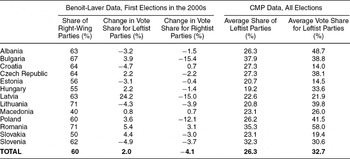
Finally, the fact that the left side of the ideological spectrum was far less fragmented than the right side across all Central and Eastern European countries (Bakke and Sitter Reference Bakke and Sitter2005; Szczerbiak and Hanley Reference Szczerbiak and Hanley2006) also helped the Left maintain support because the leftist voters did not have many realistic alternative choices. As mentioned previously, the old adherents of the transformed Communist parties were especially strongly constrained, with no other electoral choice in sight (Grzymala-Busse Reference Grzymala-Busse2002; Mahr and Nagle Reference Mahr and Nagle1995). The choice was limited for other leftist voters as well. According to Benoit and Laver (Reference Benoit and Laver2006), experts have classified about 60% of all parliamentary parties in thirteen post-Communist countries as rightist (Table 1).Footnote 3 On average, there were six rightist and three leftist parties in any post-Communist country.
Leftist and Rightist Parties in Postcommunist Europe

CMP, Comparative Manifesto Project.
Empirical evidence confirms that the leftist parties maintained the support of their previous adherents, as well as significantly broadened their electoral base despite avoiding socialist policies in the beginning of the transition (Grzymala-Busse Reference Grzymala-Busse2002). For example, leftist parties in Poland and Hungary maintained 80% to 90% of their previous voters throughout the 1990s, whereas the rightist parties were able to maintain only 15% to 40% of their previous voters (Curry Reference Curry, Curry and Urban2003; Markus Reference Markus, Lawson, Römmele and Karasimeonov1999; Morlang Reference Morlang, Curry and Urban2003; Raciborski Reference Raciborski, Lawson, Römmele and Karasimeonov1999).
A further illustration that the voters of leftist parties were more loyal than those of rightist parties is presented in Table 1. Columns 2 to 4 compare the change in vote share from one election to the next for leftist and rightist parties at the turn of the twenty-first century.Footnote 4 On average, leftist parties gained about two percentage points of votes, whereas rightist parties lost about four percentage points; the difference is statistically significant at the 5% level. Although this is not a definitive test, it highlights the fact that the electorate of right wing parties has been less loyal.
As an alternative to the snapshot view provided by the Benoit and Laver data, we also looked at data from the Comparative Manifesto Project (CMP) (Klingemann et al. Reference Klingemann, Volkens, Bara, Budge and McDonald2006), which provides information about the ideological emphasis of the major parties since the first democratic election. Using their classification of parties into families, we calculated the average share of Communist, Social Democratic, and Green parties (i.e., all leftist families) in a given party system across all elections, and the average share of votes for these parties. The respective numbers are presented in the last two columns of Table 1. With the exception of Croatia, Estonia, Latvia, and Slovakia, left wing parties received, on average, more or significantly more votes than their numerical share in the party system. This confirms that the leftist parties have been, on average, electorally stronger than other parties throughout the post-Communist period. The second to last column of Table 1 also confirms that there are fewer leftist than rightist parties.Footnote 5
In sum, few competitors on the Left, the safeguard of a traditional prowelfare image, and strong organization helped the leftist parties in the region build a loyal electorate and an image of professionalism and competence. This, in turn, allowed the parties to pursue policies that traditionally would be considered political dynamite for leftist contestants.
The Right's Response to Conflicting Incentives and Opportunities
Rightist parties lacked as strong of an incentive to adhere to fiscal austerity: they did not have to prove their prodemocracy and promarket credentials. Their ancestry in Communist opposition largely legitimized the Right as ideologically suitable for the new regime. Furthermore, even if right wing parties rhetorically advocated reforms and fiscal responsibility, they could not always afford to follow through with necessary policies. Their initial electoral success, and social support for their role in bringing in democracy and free market, made rightist parties take electoral support for granted and focus on power bargaining rather than building party organization and creating a stable electoral base. Therefore, they lacked the loyal electorate to protect them from electoral defeat resulting from the voters’ disenchantment with the high cost of reforms and fiscally responsible policy.
Perhaps paradoxically, the electorally vulnerable rightist parties faced stronger incentives to attend to economic hardship and refrain from fiscal austerity in order to avoid losing votes. Indeed, some existing studies have argued that right wing parties in the region have not systematically pursued economic liberalization (Kitschelt Reference Kitschelt, Mansfeldova, Markowski and Toka1992; Szczerbiak and Hanley Reference Szczerbiak and Hanley2006), but have instead often resorted to populist economic policies, come out in support of state intervention in the economy and social provision, and claimed to defend the people against the economic reforms (Vachudova Reference Vachudova2008).
In sum, the need for tough economic reforms and fiscal austerity early in the transition, together with the incentive and capacity by leftist rather than rightist parties to implement these reforms, led to the Left rather than the Right taking the more liberal policy option. Furthermore, such behavior by the Left pushed rightist parties toward economic populism. Because of these developments, we expect that the policies of the Left on economic issues were more “right wing” than those of the rightist parties. Our goal is to demonstrate that policies may not always reflect party labels and manifestos, especially if parties operate in an environment that provides strong incentives to act counter to their traditional ideological positions.
ILLUSTRATIVE CASE STUDIES: HUNGARY AND POLAND
To provide an initial plausibility probe of our argument, including its causal mechanisms, or to simply better illustrate our theoretical line of reasoning, we present two case studies from post-Communist Europe—Hungary and Poland.
Hungary
The Left in post-Communist Hungary was dominated by the former Communist Hungarian Socialist Party (MSzP). In the beginning of the regime transition, the party “was constantly rejected, often with hostility, by other parliamentary forces, as ‘crypto communist’“ (Racz Reference Racz1993, 657). Such political marginalization generated strong incentives for the vote-seeking party to overcome its pariah status—to convince the voters and other parties that MSzP was not Communist, but committed to democracy and market economy (Grzymala-Busse Reference Grzymala-Busse2002; Morlang Reference Morlang, Curry and Urban2003).
The MSzP strategy to break out of pariah status was a pragmatic reorientation on economic policies. The party realized that not only were reforms necessary to avoid the collapse of the economy, but also that pursuing reforms provided the only viable long-term strategy for party development (Grzymala-Busse Reference Grzymala-Busse2002; Morlang Reference Morlang, Curry and Urban2003). Consequently, having become the governing party in 1994, the MSzP implemented forceful and far-reaching economic reforms that the preceding right wing government had failed to accomplish leaving the country in an increasingly dire economic situation (Racz Reference Racz2000). The MSzP government implemented a stabilization package that cut spending and accelerated privatization (Morlang Reference Morlang, Curry and Urban2003)—policies that, according to a traditional understanding of leftist economic policies, the party should have adamantly rejected. The liberal (i.e., free market–oriented) image and policies of the MSzP were further reinforced by its coalition with the liberal Alliance of Free Democrats (SzDSz) and the MSzP self-portrayal as the original initiator of liberal economic reforms in 1989.
Leftist voters remained loyal to the party regardless of the fact that their interests were hurt and their values disregarded by most of the Socialists’ public policies (Markus Reference Markus, Lawson, Römmele and Karasimeonov1999). Indeed, MSzP maintained about 80% of its previous voters despite the harsh economic reforms pursued by the party. Furthermore, about 70% of the party members approved and supported the reform policies pursued by the party, and only about 13% favored returning to a more welfarist course (Morlang Reference Morlang, Curry and Urban2003). Such voter loyalty, and even a steady increase of support for Socialists, cannot be explained away simply by the success and popularity of economic reforms. In fact, there was large-scale public discontent with the economic reform process. However, rather than punishing MSzP, voters took it out on its coalition partner, the liberal SzDSz (Morlang Reference Morlang, Curry and Urban2003). The Free Democrats were blamed for the hardships of liberalization, and their vote share plummeted from about 20% before to about 7% after the reforms.
Part of voter loyalty to MSzP can be accredited to the fact that, unlike rightist parties (including SzDSz at the time), Socialists had no serious leftist competitors. However, another crucial factor set MSzP apart from its coalition partner and right wing competitors: the party consciously built and maintained its support base by strengthening and developing the party organization. Morlang (Reference Morlang, Curry and Urban2003) reports that not only did the MSzP have the widest network of local branches, but it was also using these branches for active outreach to communities, which provided it with loyal and politically involved supporters.
The Hungarian right wing parties, however, were markedly nonrightist in their economic policies. The first post-Communist government in Hungary consisted of three right wing parties—Hungarian Democratic Forum (MDF), Independent Party of Smallholders (FKgP), and Christian Democratic People's Party (KDNP). The MDF-led government was unwilling to undertake difficult economic reforms despite the fact that the country was on the brink of economic collapse. Instead, “the government attempted to calm public dissatisfaction by increasing government spending” (Morlang Reference Morlang, Curry and Urban2003, 70). The right wing parties were also quick to criticize and condemn the economic reforms implemented by the Socialists (Racz Reference Racz2000). They employed populist rhetoric claiming to protect the common people against the antisocial reforms pursued by the MSzP (Morlang Reference Morlang, Curry and Urban2003).
This can be seen as a survival strategy of an increasingly unstable and fragmented Right (Bakke and Sitter Reference Bakke and Sitter2005; Fowler Reference Fowler2004). Contrary to the MSzP, the right wing parties lacked a loyal electorate. This disadvantage was magnified, if not caused, by two factors. First, unlike the MSzP's voters, rightist voters had a choice between four to five rightist parties—a fact that made the electoral fate of any given rightist party anything but certain. Second, in the beginning of the transition, the rightist parties had considerably weaker organizations than the MSzP (Fowler Reference Fowler2004). The main difference was not so much in the number of members and branches (although the MSzP was superior on these indicators as well) (Enyedi and Linek Reference Enyedi2008), but in whether and how these resources were used to build a loyal support base for the party. For example, the right wing Fidesz was known as the “answering machine party” because it had offices but no staff or volunteers to fill them (Waterbury Reference Waterbury2006). Other rightist parties were similarly unable to manage and unify their organizations to their advantage and witnessed continuous internal rifts with conflicting groups peeling off in every direction (Fowler Reference Fowler2004).Footnote 6 In this context, the rightist parties had strong electoral incentives to lure voters with populist economic policies, especially in the beginning of the transition when large parts of the electorate suffered economic hardship.
Poland
The Polish experience was very similar. Curry (Reference Curry, Curry and Urban2003) reports that after the regime change, people associated with the former Communist Social Democracy of Polish Republic (SdRP) were discredited, local party offices were robbed or attacked, and local members assaulted. In the post-1991 pluralist Sejm, no party wanted to cooperate with the SdRP, and individual politicians from the party were shunned and ignored by others (Grzymala-Busse Reference Grzymala-Busse2002). The party was treated as “a bunch of Polish People's Republic [. . .] orphans with no future” (Kubiak Reference Kubiak, Lawson and Merkl2007, 61), and it was stripped of most resources it had acquired before the transition.
To prove that they were not communist, SdRP voted in favor of drastic economic reform measures right after the regime change (Curry Reference Curry, Curry and Urban2003). When gaining government status after the 1993 elections, the SdRP implemented legislation that led to job losses, bankruptcies, and cutbacks in social service funding and state budget in general—consequences that hurt the most those segments of the society that were traditional supporters of the left—the “losers of transition.” Curry (Reference Curry, Curry and Urban2003) notes, “No matter how much voters were hurt by the economic reforms and wanted to return to the social guarantees and economic benefits of the communist regime, the social democrats were too concerned about not being tarred as being ‘still communist’ to advocate social welfare or to criticize the economic reforms” (28).
As was the case with the MSzP in Hungary, SdRP maintained a loyal support base and even increased its electorate despite economic hardships exacerbated by the economic policies that it supported and implemented. About 90% of its 1990 (presidential election) and 1991 (Sejm election) voters remained loyal to the party in subsequent elections (Raciborski Reference Raciborski, Lawson, Römmele and Karasimeonov1999).
Early in the transition, such loyalty was understandable given that the open hostility toward party members and supporters made SdRP the only possible haven for them (Curry Reference Curry, Curry and Urban2003). However, just like the Hungarian MSzP, SdRP was also consciously cultivating the loyalty of its supporters by investing in building and maintaining a strong organization. Curry (Reference Curry, Curry and Urban2003) explains that although the state allocated resources to the parliamentary deputies of all parties, the leftist SdRP was the only one to use these resources to build up branch offices. Because of such strategic use of resources, the SdRP ended up with a better infrastructure than its competitors, although it commanded only marginally more assets (Grzymala-Busse Reference Grzymala-Busse2002). Local structures and membership served as the primary vehicle for its cohesive and effective campaign activities (Grzymala-Busse Reference Grzymala-Busse2002; Szczerbiak Reference Szczerbiak2001).
In addition to membership and local structures, SdRP also maintained a high-capacity central office, which helped keep the party disciplined and pragmatic rather than ideological (Kubiak Reference Kubiak, Lawson and Merkl2007). Organizational strength helped SdRP build loyalty among their core supporters and was at least partially responsible for improving the party position in subsequent elections (Grzymala-Busse Reference Grzymala-Busse2002). Furthermore, the efficiency and professionalism with which the party governed and implemented the harsh economic reforms increased the acceptance of these reforms by the wider public (Curry Reference Curry, Curry and Urban2003).Footnote 7
At the same time, the numerous right wing parties in Poland lacked pressure to prove their suitability for the new regime. Even though the first post-Communist rightist government started the “shock therapy” economic reforms, the Right was too fragmented and internally conflicted to consistently and efficiently pursue the new policies. When the SdRP took over and continued the policies, the Right resorted to condemning rather than approving the Left. Furthermore, the rightist parties also called for “a return to the welfare state that had been provided under communism” (Curry Reference Curry, Curry and Urban2003, 32).
The rightist parties were simply not able to efficiently implement the reforms and manage public discontent at the same time. This was plainly clear during the 1991–1993 Solidarity government, which was swiftly rejected at the polls, as well as during the 1997–2001 coalition of post-Solidarity parties (Solidarity Election Action [AWS]) government, which also led to large-scale public protests against government policies, a crushing electoral defeat for the Right, and disintegration of AWS. Unlike the SdRP, which was able to maintain the loyalty of 90% of its voters, each of the post-Solidarity parties commanded, on average, the loyalty of only about 25% of its original supporters (Raciborski Reference Raciborski, Lawson, Römmele and Karasimeonov1999).
As was the case in Hungary, the social democratic label of the post-Communist SdRP served as a legitimizing mechanism for the policies it introduced. The Right lacked such legitimization. The rightist parties were also characterized by general organizational weakness, which caused endless splits and reconfigurations between parts of parties, while providing a serious obstacle to the building of a stable support base (Grzymala-Busse Reference Grzymala-Busse2002; Szczerbiak Reference Szczerbiak2004). Populist economic policies became the life vest for the electorally troubled Right that was unable to lure and maintain voters by other means.
In sum, the cases of Hungary and Poland give some credence to our argument. Although case studies provide a good method to explore the plausibility of causal mechanisms, a large N analysis is necessary to establish any systematic effects of party ideology on policy. Our theoretical argument provides clear and testable implications on budgetary policy and fiscal austerity. Specifically, we expect that state budgets in general and spending on social policies more specifically are likely to be smaller under leftist rather than rightist governments in countries undergoing dual transition to democracy and market economy.
The only quantitative cross-national study of partisan effects on policy in post-Communist Europe so far supports our conclusion. Considering the partisan composition of parliaments (share of rightist parties) across a number of post-Communist states in 1989–1996, Lipsmeyer (Reference Lipsmeyer2002) finds no partisan effect on overall welfare spending, but a positive effect of the size of the rightist presence in parliament on pension spending.Footnote 8 The author finds it puzzling and interprets it as a short-term effect of increased social costs of the economic reforms introduced by the Right. In the next section of this article, we take a fresh look at the partisan effects on policy. We use improved measures and consider a significantly longer time period (1989–2004). If the same pattern exists in our models, then the association between right wing ideological orientation and left wing policy behavior must be interpreted as a more systematic feature of post-Communist party system than suggested by Lipsmeyer.
DATA, MEASURES, AND MODELS
We have collected political, budgetary, and economic data from 13 Central and Eastern European countries from 1989 to 2004. We used Freedom House score of 5 (the average of the political rights and civil liberties scores) as the basis of case selection. Such a rule for case selection is justified given that partisan theory is explicitly applicable only to democratic systems (Hibbs Reference Hibbs1992). We were also constrained by data availability in our case selection.Footnote 9 The unit of analysis is a country-year. As we explain later in this section, our measure of government ideology is sensitive to changes in government composition between elections, which justifies using yearly data. The measurement and modeling follows as closely as possible the existing studies of the partisan theory of spending.
We consider three different dependent variables, all of which are budgetary indicators and are measured as a percentage of gross domestic product (GDP) (Castles Reference Castles1989; Lipsmeyer Reference Lipsmeyer2002; Pampel and Williamson Reference Pampel and Williamson1988; Swank Reference Swank1988). Total spending indicates the total public domestic spending (i.e., total government outlays minus defense spending) (Blais, Blake, and Dion Reference Blais, Blake and Dion1993). The other spending measures include Health spending and Education spending. Data for all spending measures originate from the TransMONEE 2006 data set. Unfortunately, we were unable to locate reliable and comprehensive data on social welfare spending.
The main independent variable is Cabinet ideology, where higher values indicate a more right wing cabinet. By considering the composition of cabinet rather than parliament, we again follow the standard approach (Blais, Blake, and Dion Reference Blais, Blake and Dion1993). Given that all countries included are parliamentary democracies, the ultimate policy-making power in these systems is located in the cabinet.
The variable was constructed as follows. First, we obtained information on the ideological positions of all government parties in these 13 countries across time. The most comprehensive cross-national data set that provides such information is the CMP, the most recent version of which has been published in Klingemann et al. (Reference Klingemann, Volkens, Bara, Budge and McDonald2006). The CMP has analyzed and coded information on the election programs for all significant parties in all post-Communist countries included in our study. The CMP data set records party support for and prioritization of a set of issue positions.Footnote 10 In addition to party placements on multiple individual issue dimensions, Klingemann et al. provide an overall left–right placement of each party (see also Laver and Budge Reference Laver and Budge1992). That left–right scale combines party positions on a variety of economic and social issues (see Klingemann et al. Reference Klingemann, Volkens, Bara, Budge and McDonald2006, 163). The theoretical range of CMP placements is from −100 (most leftist) to +100 (most rightist). For current purposes, we are mostly interested in party placement on the left–right scale in terms of economic issues relevant in the context of post-Communist transformation. Therefore, although we use the same method of calculating party scores as Klingemann et al., we analyze a different set of items. We include only items that concern economic policy, welfare state expansion or limitation, and the items introduced in the CMP specifically with the post-Communist context in mind: privatization and property restitution.Footnote 11
After obtaining information on the placement of individual parties, the next step was to calculate the placement of each cabinet. We combined the left–right placement score with the information on parties’ share of government seats and number of days in power. Most governments in the period under analysis were coalition governments, and their composition tended to change frequently not only across but also within years. To properly assess the government's “composite” ideological position, it was necessary to create weights based on each government party's share of parliamentary support and duration of the period this party was in power. This was calculated using information from the Comparative Data Set for 28 Post-Communist Countries 1989–2004.Footnote 12 Each government party's ideological score was therefore weighted by the party's strength and longevity in government, and the total government ideological position was calculated as a sum of the scores of all participating parties.
Such a method of calculating the “total” government economic policy position is the most accurate because it is sensitive to government duration and changes in government composition between elections. However, substantive results do not change when more general measures are used, such as Klingemann et al.'s (Reference Klingemann, Volkens, Bara, Budge and McDonald2006) method of adding the ideological scores of parties in government, weighted by their share in cabinet, or even simply the share of cabinet posts held by right wing parties (i.e., parties that received a positive score on the economic left right dimension using CMP data).
In addition to cabinet ideology, there are several other factors that may influence fluctuations in government spending. Not all previous studies include exactly the same controls, but there is a set of variables that is traditionally included. These comprise, first, measures of economic performance, on the premise that it sets a limit as to how much revenue the government can raise and determines the level of demand for government services. Thus, the performance of the economy significantly constrains governments’ budgetary choices. The most commonly included economic performance measures are GDP growth, Unemployment rate, Inflation rate, FDI (the amount of foreign direct investment), and Trade openness. The latter is measured by the sum of imports and exports as a percentage of GDP, and it is an important source of expansion of the public economy (Cameron Reference Cameron1978). Budget deficit may also seriously condition how expansionary government policy can be, making it thus a relevant control for spending measures (Blais, Blake, and Dion Reference Blais, Blake and Dion1993).
Demographic variables capture the level of demand for governmental services. It is common to control for Dependency ratio (i.e., the share of population younger than 15 and older than 65 years). Many government welfare services are targeted toward demographic groups (Blais, Blake, and Dion Reference Blais, Blake and Dion1993; Lipsmeyer Reference Lipsmeyer2002), which makes including this variable in the models predicting total and health spending as well as fiscal policy especially relevant. For the model estimating education expenditure, we replace the dependency ratio with the share of Population under 18 to capture the demand for education. In alternative analyses, we also controlled for primary and secondary school enrollment (Castles Reference Castles1989), but did not find any difference in results.
Institutional factors constitute another set of variables frequently controlled for in studies of government budgetary policy. Existing studies argue that multiparty cabinets require bargaining and compromises between different parties, which may lead to log rolling and thereby increase government spending (Blais, Blake, and Dion Reference Blais, Blake and Dion1993; de Haan and Strum Reference de Haan and Strum1997). We therefore have also included a variable measuring the Number of governing parties.
In addition, we control for the length of Democracy measured by the number of years the country has been democratic. Huber, Mustillo, and Stephens (Reference Huber, Mustillo and Stephens2008), whose measurement technique we borrow, argue that the length of democracy significantly influences social spending in Latin America. Cook (Reference Cook2007) and Orenstein (Reference Orenstein2008) make a similar argument about the post-Communist region. We also tried other measures of democracy, such as Freedom House scores of political freedoms and civil liberties, but did not find any differences in results.
We employ pooled data, combining information across countries and multiple years. Such cross-sectional, time-series setting poses potential statistical problems of serial correlation and heteroskedasticity (Beck and Katz Reference Beck and Katz1995). The Wald test for groupwise heteroskedasticity and Phillips-Perron test of panel unit root confirmed that both problems were present in the data (albeit not in all panels). To account for them, we follow the technique proposed by Beck and Katz (Reference Beck and Katz1995) and use panel-corrected standard errors. We further correct for the fact that the data are nonstationary by differencing the dependent variable. Because the magnitude of the change in spending may depend on the spending level, we also control for lagged spending.Footnote 13 We added country dummies to account for potential omitted variable bias (Beck and Katz Reference Beck and Katz1996)—a decision supported by the results of the Hausman test. In alternative analysis, we also included year dummies, which did not change the substantive results. Because the Hausman specification test suggested no difference between models with or without year dummies, for the sake of parsimony we decided to exclude time dummies from the analyses presented here.
RESULTS
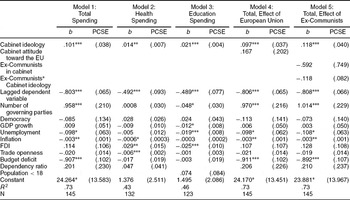
Table 2 presents three separate models considering (1) total government spending, (2) health, and (3) education spending, respectively. The partisan composition of the cabinet has considerable influence on spending in all models. Specifically, the more left wing the cabinet, the lower the total spending and social spending on health and education. These findings corroborate our theoretical expectation that, in the context of dual transition, leftist rather than rightist parties may have more incentive to deliver fiscal responsibility, whereas rightist parties may feel more pressure to give in to populist demands for social provision. The strength of the ideological effects is especially noteworthy given that the models include powerful controls such as the lagged dependent variable, country fixed effects, and variables capturing economic performance and budgetary constraint. The high R 2s point to a well-specified model, which further increases our confidence in the reported findings about the effect of government ideology on policy.
Time-Series Cross-Sectional Analysis of Effect of Cabinet Ideology on Government Spending

Note: Table entries are unstandardized regression coefficients with panel-corrected standard errors (PCSE) in parentheses. Country dummies are included in the models.
EU, European Union; FDI, foreign direct investment; GDP, gross domestic product.
*Significant at 10% level; **significant at 5% level; ***significant at 1% level, two-tailed test.
Cabinet ideology scores are not directly interpretable, but one can get a sense of the substantive impact of this variable by considering the effect of one standard deviation change in the cabinet ideology on spending measures. The average change in total spending from one year to the next is about 0.4%. One standard deviation change in cabinet ideology produces a change of 0.8% (i.e., twice the average change in total spending). That is, if a cabinet becomes more left wing by one standard deviation, the total expenditure is expected to decrease by 0.8% as a result. We can compare this effect to that of other statistically highly significant effects. For example, one standard deviation change in the number of parties produces a comparable change in total spending: about 1%.Footnote 14 Similarly, the average year-to-year change in health spending is about 0.01%. One standard deviation change in cabinet ideology translates into about 0.1% change in health spending—a 10- fold increase from the mean. The average change in education spending is 0.07%. One standard deviation change in cabinet ideology is associated with about 0.16% change in education spending. These substantive results further indicate that the partisan effects are substantial and relevant.Footnote 15
In sum, left wing governments in post-Communist Europe are associated with systematically smaller total budgets as well as lower spending on health and education than right wing governments. This finding is consistent with our theoretical expectation, but runs counter to the traditional partisan theory of policy outcomes. The finding suggests that a party's policies do not always reflect its ideological preferences and that they are significantly conditioned by contextual factors. The post-Communist political and economic reality necessitated as well as provided opportunities for leftist parties to outperform their rightist competitors in implementing rightist economic policies, even if in their stated ideology they remained more left wing than those competitors.
The results reported in Table 2, Models 1 to 3, remain robust against various alternative estimations, some of which—using alternative measures of cabinet ideology and “demand for education spending” were already mentioned previously. The substantive results are also unaltered when additional institutional variables such as coalition and minority cabinets, as well as cabinet duration in months, are added into the models (Blais, Blake, and Dion Reference Blais, Blake and Dion1993; de Haan and Strum Reference de Haan and Strum1997); when only one economic performance variable is included in the models at a time; when the variables that had a weaker theoretical justification, such as Democracy and Dependency ratio, are excluded; when country fixed effects are removed; and when only the ten post-Communist members of the EU are included in the analysis.
ALTERNATIVE EXPLANATIONS
We explain our results by focusing on the stronger incentives and better opportunities of leftist rather than rightist parties to pursue fiscal conservatism. However, our results could potentially be due to other causal explanations. First, we have so far largely ignored the international dimension of post-Communist politics, especially the prospects of accession to the EU. The more favorable a party toward the EU membership, the more likely is that party to follow policies that please the EU, including fiscal conservatism. To control for this possibility, we estimated additional models where we include an additional ideology variable—Cabinet attitude toward the EU. This variable is calculated in the same manner as the cabinet economic ideology variable, using items 108 and 110—both measuring attitude toward European integration—from the CMP data. Model 4 in Table 2 reports the results of this estimation using total expenditure as the dependent variable. As the results indicate, the effect of cabinet attitude toward the EU integration has no significant effect on spending, whereas the effect of cabinet economic ideology remains statistically significant. The results are similar when health spending is used. The attitude toward the EU variable is statistically significant and positive when education spending is used, but the effect of economic ideology remains positive and significant as well. This further strengthens our argument: the relationship between economic policy and ideology does not occur simply because leftist parties might be more pro-Europe and therefore adhere to fiscal conservatism.Footnote 16
Another objection to our interpretation of the findings concerns the nature of the leftist parties in post-Communist Europe, many of whom are former Communist parties. The relationship between leftist ideology and decreased spending may occur because the elites of these former Communist parties are not ideologues but pragmatists–some argue that Communist parties were always more concerned with fiscal prudence, and therefore, we may simply observe legacy effects (Grzymala-Busse Reference Grzymala-Busse2002). Showing that the results hold equally well for the non–ex-Communist Left undermines this claim. We identified all ex-Communist parties using information from Ishiyama (Reference Ishiyama2001) and constructed a dummy variable coded “1” if ex-Communists were in the cabinet, “0” otherwise. We then interacted that variable with cabinet ideology. The results of the interaction model, using total spending as the dependent variable, are presented in Table 2, Model 5. The effect of cabinet ideology on spending for those cabinets that do not include ex-Communists (i.e., the ex-Communist dummy is 0) is the coefficient for the cabinet ideology variable reported in Table 2, Model 5. This effect is positive and statistically significant, indicating that the relationship between ideology and policy is not driven by the ex-Communist Left. The results hold when health and education spending are used.
One might also consider the role of interest groups in determining parties’ policy choices. However, it is generally acknowledged that interest groups in post-Communist Europe are not well organized, possibly due to “Leninist legacies” (Geddes Reference Geddes1995). Employer groups are considered to be especially noninfluential (McMenamin Reference McMenamin2002). Ost (Reference Ost1993; see also Geddes Reference Geddes1995) claims the same about workers’ interest representation. Even if employer groups and trade unions were better organized, they are natural allies of rightist and leftist parties, respectively, and therefore cannot be the driving force behind the policy reversal of the Left. There is no obvious organized interest group associated with leftist parties in the region that would support rightist economic policies.
In addition to the civic interest groups, special interest groups, such as enterprise managers, “red directors,” or oligarchs, may also exist. However, it is not clear whether these interests are associated with or benefit from any specific party ideology. Rather, if present, they tend to influence governing parties of any ideological bent in the form of state capture. Furthermore, these special interests are likely to only benefit from partial reforms that maintain their access to state funds and guarantees (Hellman Reference Hellman1998; Shleifer and Treisman Reference Shleifer and Treisman2000) rather than from full economic liberalization. Therefore, even if these interests were more likely to be associated with ex-Communist parties, they are not likely to support serious budget cuts by these parties. Moreover, our results hold equally well for the non-Communist Left, with whom such special interests are less likely to be associated. In sum, interest group influence does not seem to pose a viable alternative explanation.
A FURTHER EXPLORATION OF THE CAUSAL MECHANISMS
The examples of Hungary and Poland illustrated the proposed causal mechanism, but these countries may be exceptional in the post-Communist context. One option to partially test some of the causal arguments for all countries would be to look at party behavior over time: electoral loss should prompt leftist parties to behave in a more fiscally conservative manner. Unfortunately, performing such a test is complicated because parties’ revealed policy behavior can systematically only be observed for governing parties by considering the nature of adopted policies and the budget decisions as we do. It is impossible to know what a nongoverning party would have actually done in office. Moreover, no systematic information on policy positions revealed in parliamentary behavior is available.
We analyze whether parties’ actual policy has changed following expert rankings of parties, which presumably at least somewhat reflect the actual behavior not just programs. The 1999–2006 Chapel Hill expert survey has information about party placement in nine post-Communist EU member states for 2002 and 2006 (Hooghe et al. Reference Hooghe, Bakker, Brigevich, de Vires, Edwards, Marks, Rovny and Steenberg2008; Steenberg and Marks Reference Steenberg and Marks2007).Footnote 17 These data allow some tentative testing of the previous proposition about electoral loss being associated with fiscal conservatism for leftist parties, although we recognize that (1) expert placements may not only necessarily reflect party behavior, but also their promises; and (2) the data come from very recent years, whereas the theory refers to continuous developments since the infancy of the post-Communist Party systems. Nevertheless, these conditions pose a significant challenge to finding the proposed relationship, but should not bias the results.
For all parties included in both 2002 and 2006 surveys, we calculated the difference in their economic left–right score between these two years (the scores range from 0 = most leftist to 10 = most rightist). We also recorded the vote share for each party in the national lower house election most prior to the given survey year and took the difference in the vote shares between the two elections. We further used the economic left–right scores in both years to classify each party as leftist or rightist, using the mean of 5 as the cutoff point and including only those parties that stayed on the same side of the cutoff point for both years.Footnote 18 The resulting data set had information for 45 parties. Using the change in the policy position as the dependent variable and change in vote share (i.e., vote loss) as the independent variable, the results of an ordinary least squares estimation showed that for leftist parties, electoral loss was indeed associated with movement to the right—the effect was statistically significant at the 2% level. For rightist parties, the effect was statistically insignificant. These results are presented in Appendix B.
It is also informative to briefly consider—in a qualitative manner—whether the causal story remains valid for cases that are relatively different from Hungary and Poland. The Baltic states had significantly different historical experiences, most notably due to their incorporation to the Soviet Union, yet the main argument still seems to hold. For example, in Lithuania, the most significant left wing party—the Lithuanian Democratic Labor Party (LDLP)—also adhered to fiscal conservatism while in office (Krupavičius Reference Krupavičius, Lawson and Merkl2007). Indeed, their rivals “rightly posed questions about the lack of social democratic principles in the policies actually carried out by LDLP” (Krupavičius Reference Krupavičius, Lawson and Merkl2007, 111) because the party presided over market reform, privatization, and disintegration of the welfare system deviating from its election program and ignoring social policies (Krupavičius Reference Krupavičius, Curry and Urban2003). In the beginning of transition in Lithuania, the opposition portrayed LDLP as “a relic of the Soviet past” (Clark and Pranevičiūte Reference Clark and Pranevičiūte2008, 457). Pragmatism was the way out of potential isolation of LDLP—the party realized that it was in its interest to implement the right wing economic policies, even more eagerly than the opposition might have, “in order to legitimize itself” (Clark and Pranevičiūte Reference Clark and Pranevičiūte2008, 458). Furthermore, as the leftist parties in Hungary and Poland, LDLP benefited from having loyal and forgiving voters—as Krupavičius (Reference Krupavičius, Curry and Urban2003) notes, voters tended to accept LDLP's argument that economic reform was necessary and social concerns had to be sacrificed; hence, the party constituency remained relatively stable.
In Estonia, where former Communists did not survive as significant players, the Left has still been explicitly right wing in its actual economic policy behavior. Both Arter (Reference Arter1996) and Toomla (Reference Toomla1999) describe the Social Democratic Party (SDE) (formerly called Moderates) in the 1990s as very much oriented toward free market (as opposed to state intervention), placing the party together with the liberal Reform Party, the Rightwingers, and the market reform champion Pro Patria on the far right of the economic left–right scale. Indeed, social democratic ideology was not dominating SDE policies (Hunag Reference Hunag2000). Party leaders referred to pragmatism to justify supporting right wing economic policies while in government in 1992–1995 and 1999–2002 (Saks Reference Saks2002)—after all, anything social democratic or socialist was strongly stigmatized and considered Soviet at the time. The party leaders were reluctant to even adopt the name “Social Democratic Party” until 2003 because of the possible negative connotation it might carry (Mattheus Reference Mattheus2003). SDE lacked organizational strength, but its core voters remained relatively loyal despite the opportunistic behavior by the party. Furthermore, although not the most successful party, SDE is one of the most resilient ones.
Slovakia is relatively different from Hungary, Poland, and the Baltics due to its incorporation in Czechoslovakia and authoritarian tendencies after transition. However, the basic mechanism proposed still works. In 1990, the leftist ex-Communist Party of the Democratic Left (SDL) was the most objectionable party in Slovakia (Grzymala-Busse Reference Grzymala-Busse2002). This prompted the party to stress pragmatism and commitment to democracy and market reform. Out of fear of losing its promarket and prodemocracy image, the party even avoided being lured into the authoritarian government of the Movement for a Democratic Slovakia (HZDS) in the mid-1990s (Deegan-Krause Reference Deegan-Krause2006). Indeed, the strongly nationalist HZDS implemented only partial economic reforms, whereas SDL “stood out as technocrats and advocates of reform” in the cabinet formed in 1998 (Vachudova Reference Vachudova2008, 391). With such behavior, SDL gained the desired acceptance as a legitimate party, but unlike the other examples, it was not able to translate that into a long-term electoral viability.
The general causal logic proposed here also applies in Slovenia, a country with a different history from the other examples given. The main left wing party in Slovenia is the former communist Social Democrats (SD) (formerly also called the Party of Democratic Renewal and United List of Social Democrats). The party strongly criticized the Communist system and supported market economy to maintain party legitimacy (Fink-Hafner Reference Fink-Hafner, Bukowski and Racz1999). Indeed, Fink-Hafner notes that whenever the party built explicitly on its left orientation, it lost electoral support. The party gained electoral support by adopting “center right or even rightist policies” (Fink-Hafner Reference Fink-Hafner, Bukowski and Racz1999, 116). The same was true about their leftist rival—the Social Democratic Party (SDS)—which also started gaining electoral support only after adopting liberal economic policies. In 2003, the party even changed its name to Slovenian Democratic Party and is now identified as a right wing formation. Adopting rightist economic policies was a successful survival strategy for both parties: Fink-Hafner (Reference Fink-Hafner, Bukowski and Racz1999) reports that both preserved their core supporters despite the right wing turn, and both are the biggest parties in Slovenia today.
The cases where leftist parties did not adopt rightist economic policies further help illustrate the plausibility of our causal mechanism. In Bulgaria, for example, the former Communist Bulgarian Socialist Party (BSP) was reluctant to start economic reforms and maintained explicitly leftist orientation on economic affairs at the beginning of the transition. Unlike the other countries covered, Bulgaria lacked democratic actors capable of opposing BSP, and the party was not stigmatized or in need of proving its legitimacy and suitability to the new regime (Grzymala-Busse Reference Grzymala-Busse2002). The party was in power most of the time through 1997, and after 1994, even commanded absolute majority. It was only after the crushing electoral defeat in 1997—as a result of dire economic conditions that the BSP government had caused—that the party felt the need to reorient itself (Karasimeonov Reference Karasimeonov2004). As part of the recovery effort, the party accepted free market capitalism and adopted increasingly rightist economic policies. Indeed, while in government again after 2005, BSP implemented drastic economic measures, including reducing pensions, cutting social benefits, and introducing a flat tax (BTA News Agency 2007; PARI Daily 2005). Although BSP did not follow economically right wing policies before 1997, some authors point out that no party in Bulgaria really did, and argue that that the country did not really experience transition before 1997 (Giatzidis Reference Giatzidis2002; Stanchev Reference Stanchev2001). Thus, although BSP did not follow exactly the same trajectory as other parties considered previously, its electoral insecurity and need to redeem itself as a significant player after a disastrous term in office provided the impetus to be more fiscally conservative, consistent with our theoretical argument.
Another negative case is Romania. Its former communist Social Democratic Party (PSD) (formerly called the National Salvation Front and Socialist Democratic Party of Romania) also implemented no genuine economic reforms. As in Bulgaria, the party held on to power after regime change and did not have to fight for its legitimacy because the opposition was weak (Gallagher Reference Gallagher2005). Indeed, because of the dictatorial nature of the Ceausescu regime, PSD was able to “personalize the demonization” of the dictator and “cast itself as having delivered Romania from his grasp” (Maxfield Reference Maxfield2006, 94). This helped legitimize the party as suitable for the new order (Pop-Eleches Reference Pop-Eleches2008). Despite the fact that the party consisted of technocrats and not ideologues, and although its voters were generally considered loyal (Pop-Eleches Reference Pop-Eleches2008), the party promised and delivered slow and partial reforms (Murer Reference Murer and Ishiyama1999; Rady Reference Rady1992). As in Bulgaria, the PSD in Romania did eventually change its position and became promarket, but only in the early 2000s, after suffering electoral downturn. In sum, the Romanian case also suggests that an incentive to prove the party's legitimacy is crucial for leftist parties to adopt fiscally conservative policies.
CONCLUSION
In this article, we have argued that in the context of transition from socialism to democracy, the standard expectations of partisan theory of policy outcomes are not likely to hold. Specifically, our study shows that in post-Communist countries, the leftist parties are more likely to pursue rightist policies of fiscal responsibility and economic reform than the rightist parties themselves.
We explain the seemingly paradoxical finding by arguing that leftist parties in post-Communist Europe had stronger incentives to adhere to market reform and fiscal austerity in order to rid themselves of pariah status and convince voters and other parties of their commitment to democracy and market economy. This stronger incentive was coupled with an opportunity for the leftist parties, more so than for the rightist ones, to follow through with their desired policies. The Left was simply much more successful and strategic in cultivating and maintaining a loyal electorate. Reforms introduced by the Left were also legitimized by these parties’ socialist image, which shielded them against disenchantment of the groups most negatively affected by the economic transformation. Rightist parties, in contrast, had a more volatile electorate and weak organizations. Because of the electoral and organizational instability, the Right was forced to cater more to the pressures of alleviating economic hardship than to the pressures of fiscal responsibility. Offering populist economic policies reflected in inflated budgets became the strategy by which the Right tried to manage its electoral instability.
Our findings call for further exploration of the substance of the conventional Left and Right ideologies, especially in new empirical contexts, such as nascent democracies. For example, the ideological adaptation and evolution stemming from the incentive and opportunity of the Left to gain issue ownership of economic liberalization may extend beyond budgetary policies and shape the nature of party competition more generally. Several studies of post-Communist Party politics have argued that rightist parties in the region have attempted to downplay the significance of the economic issue dimension and focused more on sociocultural issues such as nationalism, religiosity, decommunization, and minority rights (Hanley Reference Hanley2004; Kitschelt et al. Reference Kitschelt1999; Marks et al. Reference Marks, Hooghe, Nelson and Edwards2006; Tworzecki Reference Tworzecki2003; Vachudova Reference Vachudova2008). It is these issues that define parties in post-Communist countries despite the fact that economy has remained the most important issue in the eyes of the public (Enyedi Reference Enyedi and Linek2005). Such an elite-constructed policy space may be a result of the developments of party competition described here: the success of the Left in taking over the traditional identifying feature of the Right—fiscal conservatism—may have led the Right to refocus the way in which parties are defined from economic to sociocultural issues by increasing the salience of the latter. On these explicitly anti-(post-Communist) Left issues, rightist positions are likely to be more secure against leftist takeover.
The results of our study also have broader theoretical implications. First, the findings contribute to the literature on party positioning by showing that parties’ stated policy positions and their actual behavior are not necessarily equivalent. This is contrary to the conventional wisdom received from the studies of Western democracies and cautions against using stated positions as substitutes for actual behavior. Studies using stated policy preferences to study party policy positioning, policy movement, coalition bargaining, and other such phenomena may be misleading if the actual policies adopted are not reflecting these preferences. Indeed, stated ideology may clearly predict policy only in the unique setting of stable economic and political development of Western democracies in the postwar period. Research on Latin America, for example, has also demonstrated that parties may not always behave according to their stated policy positions (Johnson and Crisp Reference Johnson and Crisp2003; Stokes Reference Stokes2001).
Second, our results also contribute to a general understanding of policy reversals. Major policy reforms are likely to be considered more acceptable when perceived as policy reversals (i.e., when proposed by parties who are not the natural proponents of such policy decisions) because it is considered harmful to their constituency and their reelection prospects. This is in line with findings in the social psychology literature: messengers who appear to be speaking against their own best interests are significantly more persuasive and trustworthy (Walster, Aronson, and Abrahams Reference Walster, Aronson and Abrahams1966). This general logic helps us understand why some policy reforms are more successful and why policy switches are not necessarily electorally harmful.
APPENDIX A: CONSTRUCTION OF THE ECONOMIC LEFT–RIGHT DIMENSION

Note: Party economic left–right score = (per401 + per402 + per407 +per409 + per410 + per505 + per507 + per4011 + per4012 + per4013) – (per403 + per404 + per406 + per412 + per413 + per503 + per504 + per506 + per4123 + per4124 + per4131 + per4132).
APPENDIX B: EFFECT OF ELECTORAL LOSS ON ECONOMIC POLICY

Notes: The dependent variable is Ideological change. Table entries are unstandardized regression coefficients with standard errors in parentheses. The effect of vote loss for leftist parties was reported in the regression output. To get the effect of vote loss for rightist parties and the corresponding standard error, we used the lincom command in Stata 10.
**significant at 5% level, two-tailed test.



Comments
No Comments have been published for this article.