Introduction
Observers of the welfare state in rich countries often stress the combat of poverty at old age by the establishment of pension systems with a broad coverage as a major achievement. For example, in an often-quoted survey of the literature on the welfare state, one can read: ‘The Swedish pension system is spectacularly successful in pulling almost all older persons out of poverty’ (Barr Reference Barr1992: 775).Footnote 1 In contrast, this paper demonstrates that such a description does not apply to a rapidly increasing number of residents in Sweden, one of the most advanced welfare states. We are specifically referring to late-in-life migrants, particularly those originating from middle- or low-income countries.
Poverty at an older age among migrants to Sweden should be a relatively new problem. Most migrants who arrived in the 1950s, 1960s and 1970s came as labour migrants, were typically under 30 years of age and originated from other European countries. Most found jobs and could, over a long working life, accumulate sizeable pension rights, making most of them unlikely to be poor at an older age. However, such a description does not apply to increasingly larger groups of migrants. In recent decades, Sweden has received an increasingly large number of middle-aged and older migrants, many originating from middle- and low-income countries. Consequently, 233,412 non-Swedish-born persons aged 65 years or over were living in Sweden in 2015, where they made up 12 per cent of the population of that age category (Statistics Sweden 2017). Many of these entered as refugees or for family reasons and many have not found jobs in Sweden. Consequently, at an older age they are receiving only limited pension incomes and can be expected to be at a high risk of poverty. This is especially the case for migrants who exceed the general retirement age when they arrive in Sweden.
In this paper we ask: what is the risk of being poor at an older age among migrants born in low-, middle- and high-income countries versus among native-born Swedes? Due to migrants’ lower participation in the Swedish labour market when of active working age, we hypothesise that migrants born in low-income countries will have the highest poverty risk, while those born in high-income countries will have a poverty risk most similar to that of natives. We also hypothesise that the probability of being poor at an older age is positively related to one's age at immigration. The answers to our research questions should be of wider interest as it is highly likely that the number of older migrants in the developed world regions will grow substantially during the coming half-century and that older migrants face special disadvantages which have attracted little research or policy attention.
Little has been written about poverty at an older age among migrants to rich countries, as our literature survey demonstrates. This paper contributes to the study of immigrant poverty at an older age by probably being the first to investigate the importance of age at immigration for the probability of being poor at an older age. It is also the first addressing the economic situation of older migrants arriving in Sweden since 1970. While researchers in many countries must base their studies on surveys of a limited number of households and individuals, with attendant problems of non-response, we analyse tax data for Sweden's entire population aged 65 and older, both Swedish-born and non-Swedish-born. When defining poverty status, two criteria are applied: a household and its members are deemed ‘twice poor’ if they have both low income and few net assets. Such a definition of poverty has previously been applied in a few cases, but is not standard in the literature. This approach is particularly relevant to studying poverty among older persons, many of whom receive low incomes but also possess not-trivial net assets.
Literature review
Although extensive research examines the economic conditions of migrants of working age, relatively little research using quantitative methods has investigated the economic wellbeing of older migrants. However, social inclusion of late-in-life migrants has been given attention in qualitative studies, see e.g. Torres (Reference Torres2002, Reference Torres2006), Forssell and Torres (Reference Forssell and Torres2012) and Forssell, Torres and Olaison (Reference Forssell, Torres and Olaison2015).
We first discuss the international literature on pension incomes among older migrants and their native counterparts, taking examples from various high-income countries. Previous research surveyed here demonstrates the significance of the immigrant's previous integration into the labour market, as well as long permanent residence for pension income and thereby household income. There are also indications that the country of destination matters. In a recent study, Heisig, Lancee and Radl (Reference Heisig, Lancee and Radl2017) showed that the retirement income gap between immigrants from non-European countries and natives in 16 Western European countries investigated is substantial. Their results also indicate that income gaps are smaller in countries where the pension system is more redistributive.
Canada has a pension system similar to Sweden's at present, in that it requires residency for a minimum of 40 years, starting at age 18, to be eligible for a full old-age pension. Marier and Skinner (Reference Marier and Skinner2008) scrutinised income inequality among recent migrant men and women in Canada using the Survey of Labour and Income Dynamics (SLID) for 1994 and 2004. The results indicate lower pensions among migrants, especially women, mainly due to lower working-age incomes and too short a period of income receipt to attain full rights for public benefits. The findings of Hum and Simpson (Reference Hum and Simpson2010), also based on SLID, indicate the significance of longer residency for present and future pensions. The results indicate a gap relative to natives of 43 per cent for private pensions at age 55 or more years. The authors also found that the difference in income relative to natives was larger among more recently arrived immigrant cohorts.
Turning to the United States of America (USA), Sevak and Schmidt (Reference Sevak and Schmidt2007) studied how migrants fared in retirement relative to their native counterparts by inspecting gaps in retirement resources available at retirement. Data from the Health and Retirement Study were used. The results indicate that migrants earn lower wages than do US-born workers with the same characteristics, which may have implications for their economic wellbeing in old age, and that pre-retirement migrants have lower expected Social Security benefits than do native-born workers. Similar to the results of Hum and Simpson (2008) for Canada, the study confirms that working migrants are less likely to have private pension savings.
Regarding the United Kingdom (UK), Vlachantoni et al. (Reference Vlachantoni, Feng, Evandrou and Falkingham2017) focused on pension protection in later life among black and minority ethnic (BME) elders by investigating factors correlated with three pension income sources: state pension, occupational/private pension and pension credit. The authors demonstrated that BME elders are more likely to receive pension credit and less likely to receive state or occupational/private pensions. These results as well as those from other studies indicate the importance of length of residence for pension level. People who had lived in the UK for between ten and 39 years were less likely than those born in the UK to receive state pensions.
It should be noted that in many countries, the risk of poverty at an older age is higher for women than men. In a study of poverty at an older age in Belgium, Peeters and De Tavernier (Reference Peeters and De Tavernier2015) used register data on approximately 9,000 randomly selected women aged 65–71 years living in Belgium in 2008 to examine the interaction between work history, family history and pension regulations for women. The results indicate that married and widowed women had the lowest risk of poverty, and that married women's advantaged situation could not be explained by pension regulations; instead, income derived from capital in the form of jointly accumulated household assets was a possible explanation.
The only study we are aware of that explicitly looks at poverty among older migrants relative to native older adults is by Chan and Chou (Reference Chan and Chou2016). They investigated how living arrangements are related to poverty among older adults (aged 65 or more years) who had migrated from mainland China to Hong Kong relative to poverty among older adults born in Hong Kong. The authors used a 5 per cent sample from census data consisting of 29,987 migrants and 9,398 natives. The poverty line was defined as 50 per cent of the median income for all living in Hong Kong, a definition used in official studies of poverty in Hong Kong. The results of the bivariate analysis indicate that even after over 20 years of residency, migrants were at higher risk of poverty than were their native counterparts (43% versus 38%). The association between living arrangements and relative poverty was examined by estimating a logistic regression model relating poverty status to education, employment, residence duration, language proficiency, age and gender. The authors found that the probability of poverty in old age decreased with the existence of earners in the household. It follows that a substantial proportion of older persons in Hong Kong were not deemed poor because they lived in households with younger persons who were working.
Moving to the Nordic context, Jakobsen and Pedersen (Reference Jakobsen and Pedersen2017) studied the incidence and determinants of relative poverty for immigrants from Turkey, Iran, Pakistan, Vietnam and Danes aged 60–74 in 2011 using register data. All four categories of immigrants were found to have considerably higher poverty rates than natives, particularly when making assessments based on the nuclear family, and not the extended family. Estimated probability models showed, for example, that being out of the labour market at age 55 increased the probability of being poor for all five categories, and most so for the immigrants.
Nygård et al. (Reference Nygård, Härtull, Wentjärvi and Jungerstam2017) investigated differences in the prevalence of objective and subjective poverty among older persons in Finland and Sweden. The study was based on the Gerda Survey, which gathered cross-sectional data on 65-, 70-, 75- and 80-year-olds living in the Finnish region of Österbotten and the Swedish region of Västerbotten. The findings indicate a higher prevalence of both objective and subjective poverty among women after controlling for variables measuring education, age, civil status, self-rated health and education.
Flood and Mirtrut (Reference Flood and Mitrut2010) investigated the future pension income of migrants to Sweden, expected to have weak attachment to the labour market, using statistical simulations. Persons born outside countries belonging to the Organisation for Economic Co-operation and Development were considered such a group and were the focus of the study. Comparisons were made between men and women and between birth cohorts, and future pensions were calculated based on data from 2007. The findings indicate that women's pensions are below what the authors regard as a reasonable standard of living.
Ekberg and Lindh (Reference Ekberg and Lindh2016) studied average income among non Swedish-born persons aged 65 or more years who had immigrated to Sweden no later than 1970 and lived in Sweden as of 2008. The analysis compared those migrants with their native Swedish counterparts who were employed in 1970 and were similar also in various other respects. Average incomes were found to be somewhat lower for migrants aged 65–66 years than for their native counterparts, while the opposite was the case for most categories of women aged 70 or more years. These differences between migrants of different ages can be attributed to changes in the Swedish public pension system in combination with the fact that the income age profile of many immigrant workers was often shorter than for natives, who could have more years of high income. The authors argued that their results could not be generalised to later-arrived migrants, as many migrants who arrived after 1970 have had long periods of no economic activity and therefore have accumulated more limited pension rights than did the migrants studied in the paper.
Finally, we mention that Harrysson, Montesino and Werner (Reference Harrysson, Montesino and Werner2016), who using qualitative interviews, explored how older migrants to Sweden reflect on how to navigate and form the retirement and pension context in which they currently or soon will live. The study illustrated the obstacles that obstruct migrants from entering the Swedish labour market, greatly influencing their future pension rights. One example is limited access to labour market policy activities.
Context
In contemporary Sweden, most health care and services for older people are often provided and largely funded by the public sector, while out-of-pocket payments typically play a very limited role. An individual typically receives an old-age pension from the age of 65 years. The old-age pension system in Sweden comprises several components. The first is the public pension system, comprising an income-related part funded by social security fees paid by employers and a guaranteed pension funded by the state. A second component is occupational pensions funded by contributions from employers according to agreements between trade unions and employer associations. The third component of the pension system is voluntary private pensions financed by individual contributions. In addition, there is the system of widows’ pensions (see below).
Older persons can receive income from more than one source. A report based on 2002 tax data found that various forms of pensions together made up not less than 78 per cent of the average total income of people aged 65 or more years (Statistics Sweden 2004). The second largest income component was capital income (12%) followed by earnings (6%) and means-tested housing allowances (4%). Statistics Sweden (2017) showed, based on data for 2004–2007, that average net household assets is increasing by age up to the age category 65–74.
This paper examines the situation of persons aged 65 or more years as of 2007, that is, born in 1942 or earlier. Those born in 1937 and earlier received public pensions according to rules where pensions comprised two components: an earnings-related pension (ATP) and a basic pension (Folkpension). The earnings-related pension was based on the average number of pension points accumulated during the 15 years of highest real income. A worker earned pension points by receiving earnings and from receiving parental leave allowances, sickness payments and unemployment insurance benefits. Full rights to ATP required 30 years with positive pension points. The formula favoured people with relatively few years in labour market activity and a short period of high work income. With the major reform of the Swedish pension system in 1998, pensions became more closely linked to the lifetime earnings of the individual.Footnote 2 The formula for the pension adds pension points earned each year under 65 years of age up to a ceiling at 7.5 times a base amount. As in the previous system, the reformed system consists of an earnings-related part (Inkomstpension) and a base pension (Garantipension). People born in 1954 and later accumulate pension rights solely based on the new system, while those born between 1938 and 1953 accumulate pension rights from both systems according to proportions depending on their year of birth. This means that persons born between 1938 and 1942 included in our study have pension rights predominately accumulated within the old system.
Of particular interest when studying poverty among migrants to Sweden is their entitlement to a base pension. This is because many migrants, due to short histories of employment in Sweden, qualified for only a small or no income-related pension. The rules on length of residence in Sweden regulating a person's entitlement to a full base pension have become more restrictive over time. This means, for example, that people born abroad in 1939 or later are not entitled to a full base pension unless they have lived in Sweden for 40 years. In the case of a shorter period of residence, the guaranteed pension is reduced proportionally. Less strict requirements applied to persons born earlier; for details, see Swedish Government (2000/01:136). The hole in the income safety net led to the 2003 introduction of the means-tested income support for older persons, which we discuss below.
Many countries have systems of widows’ pensions protecting married women from severe income loss due to the death of their spouse. However, since the end of the 1950s, Sweden has moved from a system of single-earner to double-earner households and its system of widows’ pensions has gradually been phased out. Nevertheless, some of the women studied, Swedish-born as well as non-Swedish- born, may be entitled to widows’ pensions. This can be the case if a woman was married to the deceased at the end of 1989 and was still married to him at the time of his death; for further details, see European Commission (2013).
The discussed rules mean that in Sweden the number of years of residence and the number of working years in the country before age 65/67 years are critical for both the income-related and base pensions. A recent study demonstrates that the number of years before becoming established in the Swedish labour market as a worker increases rapidly with age at immigration among migrants from middle- and low-income countries (Gustafsson, Mac Innes and Österberg Reference Gustafsson, Mac Innes and Österberg2017). Consistent with this, statistical information indicates that up to 80 per cent of those who migrate to Sweden at the ages of 45–64 years receive a base pension (Statistics Sweden 2012a: 41).
Old people with low pension income residing in Sweden can apply for support from one or several means-tested public systems: housing allowances (Bostadsbidrag), social assistance (Ekonomiskt bistånd) and income support for older persons (Äldreförsörjningsstöd). While social assistance is typically means tested monthly, the income support for older persons is typically means tested annually and the level is slightly higher, as it is assumed that it will be paid for a longer period (Albertsson Reference Albertsson2008). National Board of Health and Welfare (2015) statistics indicate that not more than 2 per cent of older migrants received social assistance in 2014, with the corresponding proportion among Swedish-born persons being under 0.5 per cent. However, available evidence indicates substantial non-use among older persons when it comes to housing allowances and income support for older persons (Riksrevisionen 2013) and the same applies to social assistance (Gustafsson Reference Gustafsson2002).
Defining poverty
There are many ways to define and measure poverty. In the European Union (EU), ‘poverty’ is based on computing household income, adjusting it with an equivalence scale and assigning this number to each household member, then the number is compared to a poverty line. Most often the poverty line is placed at 60 per cent of median equivalent income in a given country as observed in a given year. Such rates of income poverty for Sweden are reported by Statistics Sweden; see also Jonsson, Mood and Bihagen (Reference Jonsson, Mood and Bihagen2016) and Gustafsson, Johansson and Palmer (Reference Gustafsson, Johansson and Palmer2009), who studied how income poverty among older persons in Sweden developed between 1991 and 1995–2004.
Several researchers have developed ways also to consider a household's wealth situation when assessing its poverty status. The logic of this approach is that wealth holdings can be used to smooth consumption over time, so taking account of them provides a broader understanding of household economic conditions. Households and their members can be classified as poor according not only to income but also to the net asset dimension. Some studies taking this approach have focused on those who are poor according to both criteria. In this ‘intersectional approach’, a number of households classified as poor according to income only are not classified as ‘twice poor’ as their assets make it possible for them to cope with low income for limited periods. In contrast, the analyst could be interested in those considered poor according to at least one of the criteria, the ‘union approach’.
An early study taking the intersectional approach was that of Wolff (Reference Wolff1990), who investigated the relative wealth holdings of families below and above the poverty line in the USA. The results indicate that the studied families below the poverty line were better off in terms of wealth than were the families above the poverty line, and that a high percentage of home-ownership (38%) was found among families below the poverty line. The results also indicate that average income-poor older persons were better off in terms of wealth than were the younger poor. Van der Bosch (Reference Van der Bosch1998) examined the extent of financial wealth holdings among households below the poverty line, how income and wealth can be aggregated into one measure and, finally, the effect of such a measure on reported poverty rates. Data from the Belgian Socio-Economic Panel Wave, 1992, were used. The results indicate that many income-poor households were home-owners. Poverty rates were substantially lower when the value of the home was considered, especially among older adults, though the author noted that it was not usual to spend the wealth embodied in one's home. Heady (Reference Heady2008), who measured three aspects of economic wellbeing in Australia and considered low consumption a criterion of poverty, demonstrated that estimated poverty rates are much lower when, in addition to income, wealth and consumption are taken into account.
In line with Wolff (Reference Wolff1990), Azpitarte (Reference Azpitarte2012) examined to what extent families can smooth consumption in periods of low income in a comparison of the USA and Spain. Households were categorised into four groups: the twice poor (income-poor households with no or very limited net assets), protected poor (income-poor households that have net assets), the vulnerable non-poor (non-income-poor households that have no net assets) and the non-poor. The results indicate that the sizes of these groups varied between the two countries and that the risk of belonging to either group varies over the lifecourse. Households consisting of persons aged under 35 years face the highest risk of being twice poor, while the risk decreases for households of persons aged 50 or more years. Furthermore, household composition matters: single and single-parent households are more likely to be twice poor. A recent study by Kuypers and Marx (Reference Kuypers and Marx2016) compared Belgium and Germany, two countries with similar living standards and income poverty rates but with very different levels and distribution of wealth. The study shows how sensitive several results are with regard to various plausible alternative assumptions.
Data and assumptions
We use data from Statistics Sweden originating from several registers. We consider all persons registered as residing in Sweden aged 65 and older. Thus, asylum seekers as long as they have such status are not covered. Note, too, that our data do not constitute a sample. For those persons, we obtained information from the population register on demographic variables such as year of birth, country of birth and number of years since immigration. Educational-level information used in the multivariate analysis originates from the education register, which includes detailed administrative records of education completed in Sweden and information on education completed outside Sweden obtained from questionnaires or validated certificates.Footnote 3
The information on disposable income is derived from the income and tax register, which in turn receives its information from the tax authority and various authorities paying transfers to households. Disposable income includes earnings, capital income (e.g. interest and dividends), realised capital gains from selling stocks and real estate, and public-sector transfers (e.g. pensions, housing allowances and social assistance). Household disposable income is measured net of income taxes by summing the income of all adult household members. In these data, by definition a household has one or two adult members. We then adjust the disposable income according to an equivalence scale often used by Statistics Sweden.Footnote 4
For many years Sweden had a wealth tax, but this was abolished from 2008. Before that year, and gradually improving over the years, the tax authorities collected a large amount of information on the assets and debts of the entire population, and Statistics Sweden has access to this information. Total household assets include the tax value of housing, land and firms; also included is the market value of financial wealth as reported by banks and other financial institutions. Not included in total assets is the value of consumer durable goods and household members’ rights to future pensions.
Here we use information on assets and debts to determine whether a household's net assets are less than SEK 10,000. Why this amount? There seems to be no consensus in the poverty assessment literature on how to define a net asset threshold for assessing poverty based on income as well as net assets. SEK 10,000 is a very frugal level, meaning that even a household exceeding it could experience difficulties meeting unexpected expenditures, for example, those of dental care.Footnote 5
In statistically analysing persons aged 65 or more years, we work with four samples: the first sample is 1,330,060 people born in Sweden. The second sample is 114,274 people born in other high-income countries, the largest sub-categories being older persons born in Finland (56,790) and Germany (17,101). The third sample is 52,339 people born in middle-income countries, the largest sub-categories being people born in the former Yugoslavia (11,562) and Poland (6,173). The fourth sample is 15,012 people born in low-income countries, the largest sub-categories being people born in Iran (3,517) and Iraq (3,189).
It is appropriate to discuss one measurement problem that might affect our analysis and its results more than others. The classification of a household and its members based on income and wealth might contain errors due to incomes and net assets not being recorded in the registers at Statistics Sweden. The separation of market activities and money sent between family members can make it difficult to get an overall picture of the individual's financial situation (Baldassar and Merla Reference Baldassar and Merla2014). Perhaps most important is the fact that some persons receive pension income from abroad. Such information should, according to the Swedish tax code, be provided to the tax authority by the recipient. However, the recipients have no or negative incentive to do so. In contrast, pensions paid from Swedish sources is automatically registered. This kind of under-reporting is probably larger for the estimate of poverty among foreign-born persons originating from countries with developed and well-functioning pension systems than for the estimate of poverty among natives.
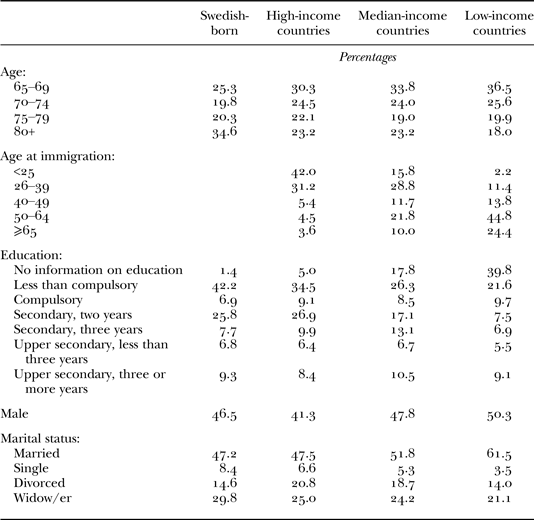
Table 1 presents descriptive statistics for the four analysed categories.Footnote 6 A large difference in age at immigration across the three categories stands out. About three out of four older persons born in high-income countries arrived in Sweden before 40 years of age, compared with slightly less than half of those born in middle-income countries and as few as 13 per cent of those born in low-income countries. Arriving in Sweden as an older individual from a rich country was uncommon among those aged 65 or more years, fewer than 10 per cent of whom came to Sweden after age 50, versus up to 70 per cent of those aged 65 or more years born in low-income countries. Still, among those investigated here, i.e. persons over age 65 years, those born in low-income countries were younger than Swedish-born persons and more likely to be married.
Descriptive statistics for the four samples

Source: Authors’ computations based on data presented in the section Data and Assumptions.
Poverty rates
For each of the four studied categories, we report here the proportion of individuals classified as poor based on low income, based on low or no net assets, as well as based on the combination of low income and no or low net assets. Our definition of income poor is that the equivalent household income is below 60 per cent of the median for Sweden. By combining the criteria, we can also identify the proportions falling into the following four categories: (a) ‘non-poor’, who are neither income poor nor asset poor; (b) ‘protected poor’, who are income poor but have assets amounting to more than SEK 10,000; (c) ‘the vulnerable’, who are not income poor but do not have assets amounting to SEK 10,000; and (d) the twice poor, who are both income and asset poor. Paying attention to that while the assessments are based on the situation of the entire household in which the person lives, following what is now the practice in this kind of analysis, we perform the analysis based on individuals as the unit of analysis.
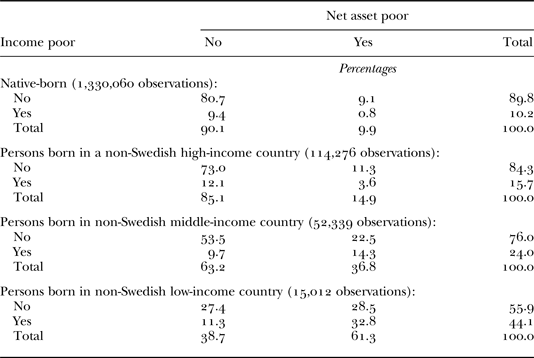
Let us first discuss the proportions of people classified as poor according to one criterion only, beginning with the conventional income poverty category. Starting with Swedish-born older persons, we see that 10 per cent are classified as poor versus 16 per cent of those born in other high-income countries, 24 per cent of those born in middle-income countries and up to 44 per cent of those born in low-income countries. According to this criterion, poverty among older persons born in low-income countries is 4.3 times as prevalent as among older Swedish-born persons.
Regarding the net asset poor, 10 per cent of Swedish-born older people and 15 per cent of non-Swedish-born from high-income countries are net asset poor, rates similar to those of income poverty in those categories. However, among older persons born in middle- and low-income countries, 37 and 62 per cent, respectively, are net asset poor, somewhat higher than the corresponding proportions of income poor. Net asset poverty is therefore 6.1 times as prevalent among older persons born in low-income countries as among Swedish-born older persons.
We now turn to information in the cells of Table 2. Those not deemed poor by either criteria are 81 per cent of older people born in Sweden, 73 per cent of those born in high-income countries, 54 per cent of those born in middle-income countries and only 27 per cent among those born in low-income countries. There is little difference across the country of birth categories in the proportions of older people classified as protected poor, as the proportions are around 10 per cent in all categories. More persons are classified as vulnerable among those born in middle- and low-income countries than among those born in Sweden or other high-income countries.
Rates of poverty among elderly in Sweden, 2007

Note: For classification of countries of birth, see Note 7.
Source: Authors’ computations based on data presented in the text.
However, we see very large differences across countries of origin in the percentages classified as poor according to both criteria (i.e. the twice poor). As few as 1 per cent of Swedish-born older persons are twice poor by our criteria, versus 4 per cent of those born in other high-income countries, 14 per cent of those born in middle-income countries and up to 33 per cent of those born in low-income countries. This also means that ‘twice poverty’ is 33 times more prevalent among migrants born in low-income countries than among Swedish-born older people. The more demanding the poverty criterion applied, the greater the difference between those born in low-income countries and the Swedish-born.
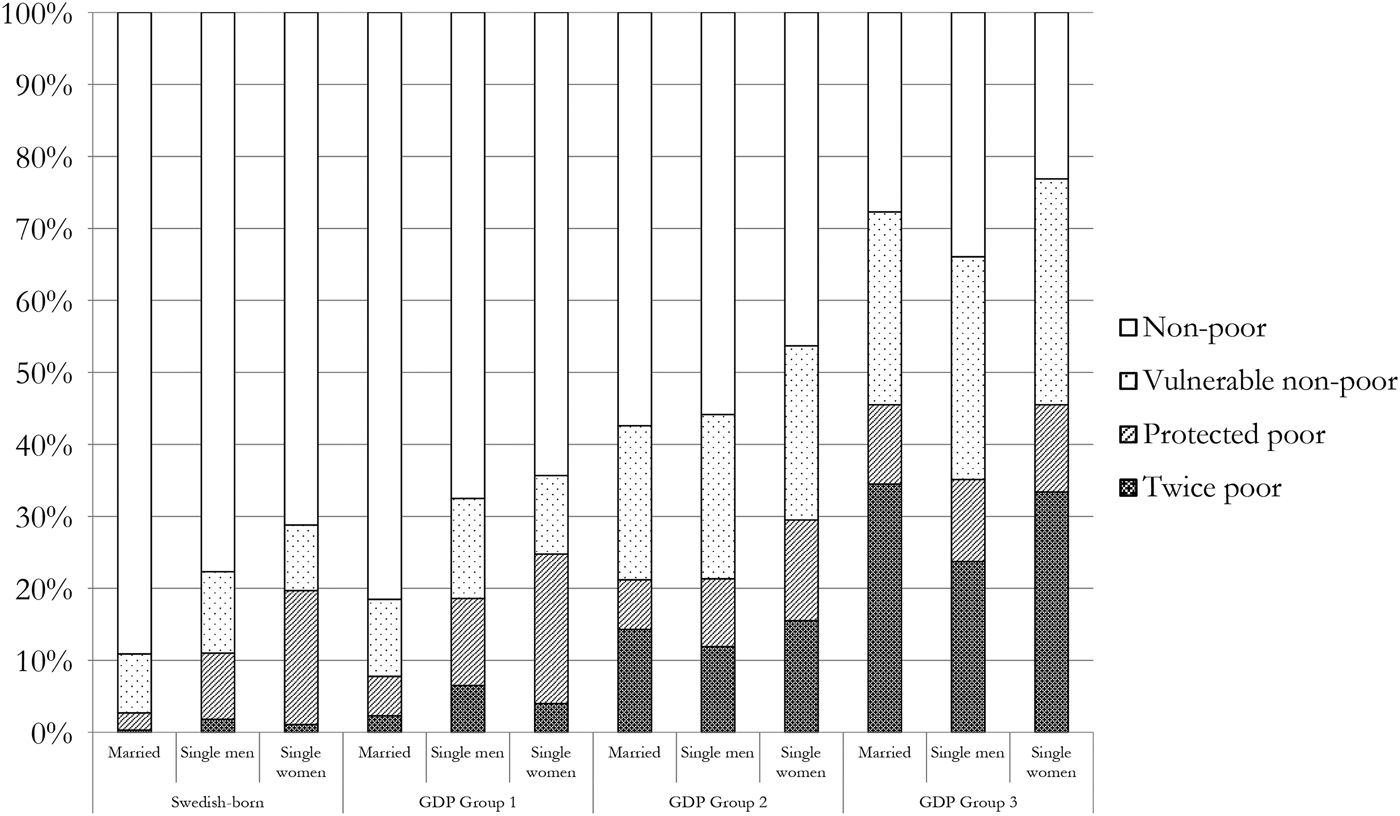
Being an older person and single is considered a risk factor for poverty. This is apparent in Figure 1, where we report how poverty status varies by marital status across the four country of birth categories. Among Swedish-born, the proportion of twice poor is the lowest among the married, followed by single females and then single males. The same ranking of marital status categories is also apparent for people born in other high-income countries. In contrast, among persons born in low-income countries, the rate of twice poverty is similar among married and single women but somewhat lower among single men.
Rates of poverty by family status and country of birth, 2007.

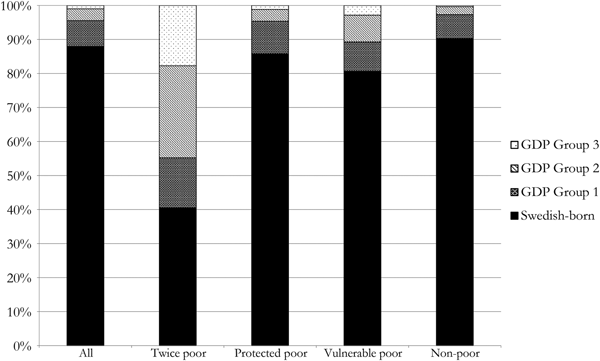
Although the non-Swedish-born constitute a clear minority of all older people living in Sweden, they make up a majority of the twice poor. This is shown in Figure 2, which presents the four categories twice poor, protected poor, vulnerable and non-poor by country of birth categories. The Swedish-born constitute large majorities of three of the categories but not among the twice poor.
Compositions of various categories of poverty by country of birth, 2007.

Model estimates
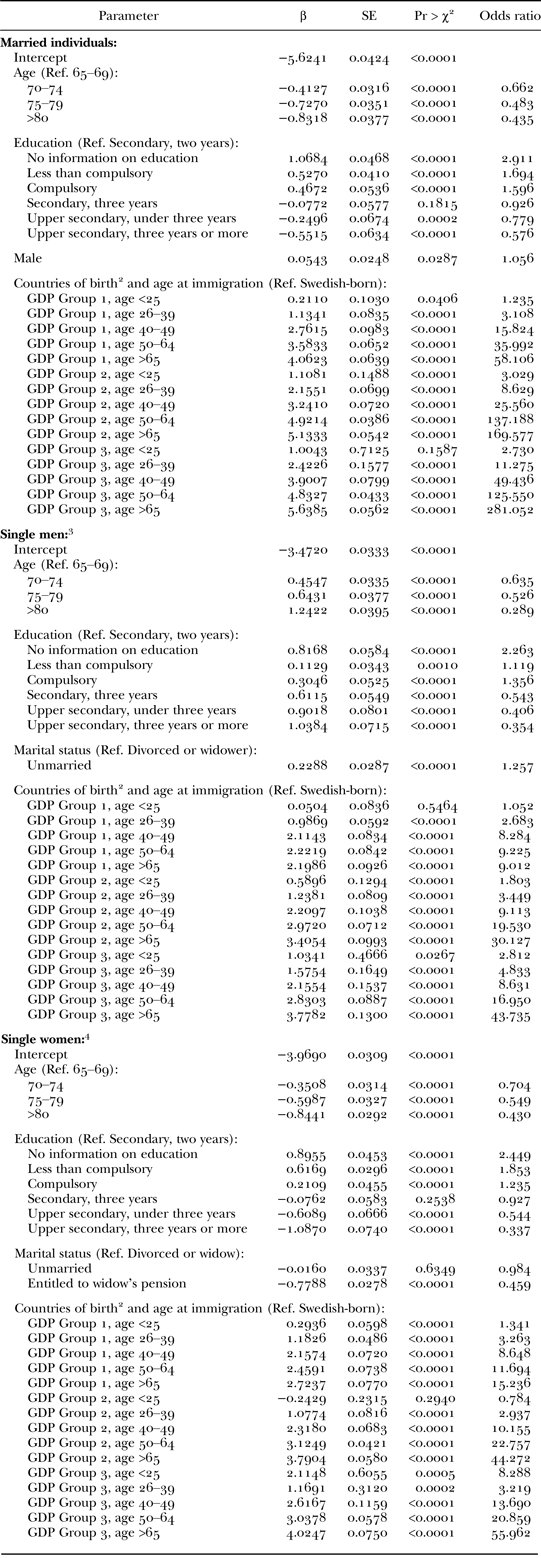
In this section, we investigate factors associated with being classified as twice poor and not belonging to any of the three other categories introduced above by estimating logistic models. Our focus is to study to what extent age at immigration is a strong predictor of being twice poor. We specify and estimate separate models for married people (born in Sweden or abroad), single females (born in Sweden or abroad) and single males (born in Sweden or abroad). The specifications include the following characteristics: age at immigration interacted with category of country of birth (15 dummy variables), education (six dummy variables including one indicating that no education information is available) and three dummy variables for age. We define three categories of countries based on their level of Gross Domestic Product (GDP) per capita.Footnote 7 For single females, we add a variable indicating whether they were entitled to a widow's pension in 2007.Footnote 8
We report the parameter estimates in Table 3 and, based on them, illustrate the main findings using figures that predict the risk of being twice poor. A first comment is that the probability of being twice poor was negatively associated with age in 2007. This should be understood from the fact shown in our data that among older persons, the proportion having net assets below SEK 10,000 is negatively associated with age. This is in contrast to the proportion having income below 60 per cent of the median, which is positively associated with age.
Logistic regression estimating the risk of being twice poor

Notes: SE: standard error. Pr: probability. Ref.: reference category. 1. N = 718,723; −2 log likelihood = 58,652.190. 2. For classification of countries of birth, see Note 7. 3. N = 253,628; −2 log likelihood = 53,905.463. 4. N = 539,378; −2 log likelihood = 83,255.324.
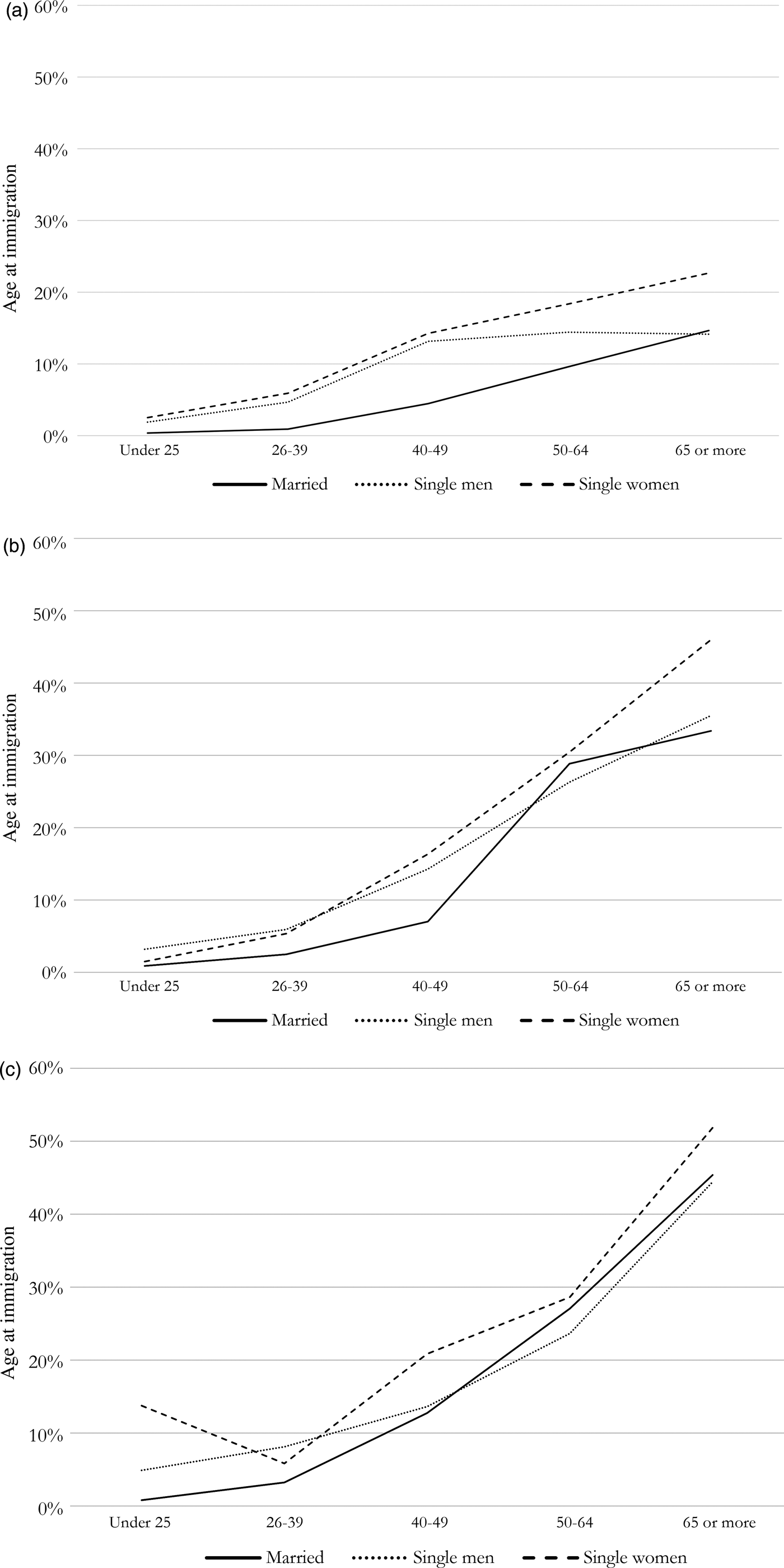
Figure 3a illustrates, using the model estimates, the relationship between age at immigration and the predicted probability of being twice poor for a person born in another high-income country. The person is assumed to be 75–79 years old and to have less than compulsory education (the most frequent level among people 65 or more years old). Similar predictions for married people, single males and single women are derived from the three different estimated equations. The figure clearly shows that immigrating after 40 years of age increases the probability of being twice poor at an older age. The probability tends to be slightly lower for those married as of 2007 than for single males or females (single females are in the predictions not assumed to be entitled to widow's pensions). When immigration takes place after the general retirement age, the predicted probability of being twice poor is about 20 per cent.
Predicted relationship between age at immigration and being twice poor; persons born in countries in various Gross Domestic Product (GDP) groups and who immigrated at different ages. (a) GDP Group 1 (high GDP); (b) GDP Group 2 (medium GDP); (b) GDP Group 3 (low GDP).

When we move to persons with the same education and age but born in middle-income (Figure 3b) versus low-income countries (Figure 3c), similar relationships are found. However, the relationship between age at immigration and the probability of being twice poor is stronger, meaning that the probability of being twice poor among those who arrived after age 65 years is over 30 per cent (if born in a middle-income country) and over 40 per cent (if born in a low-income country).
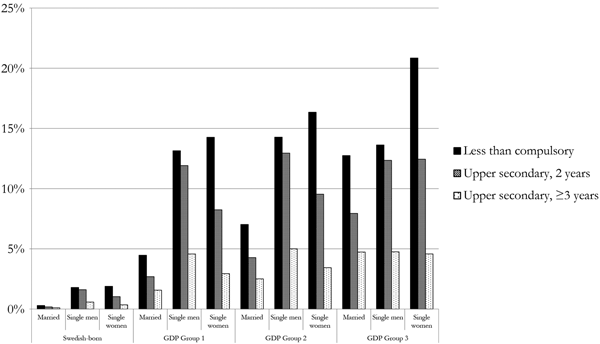
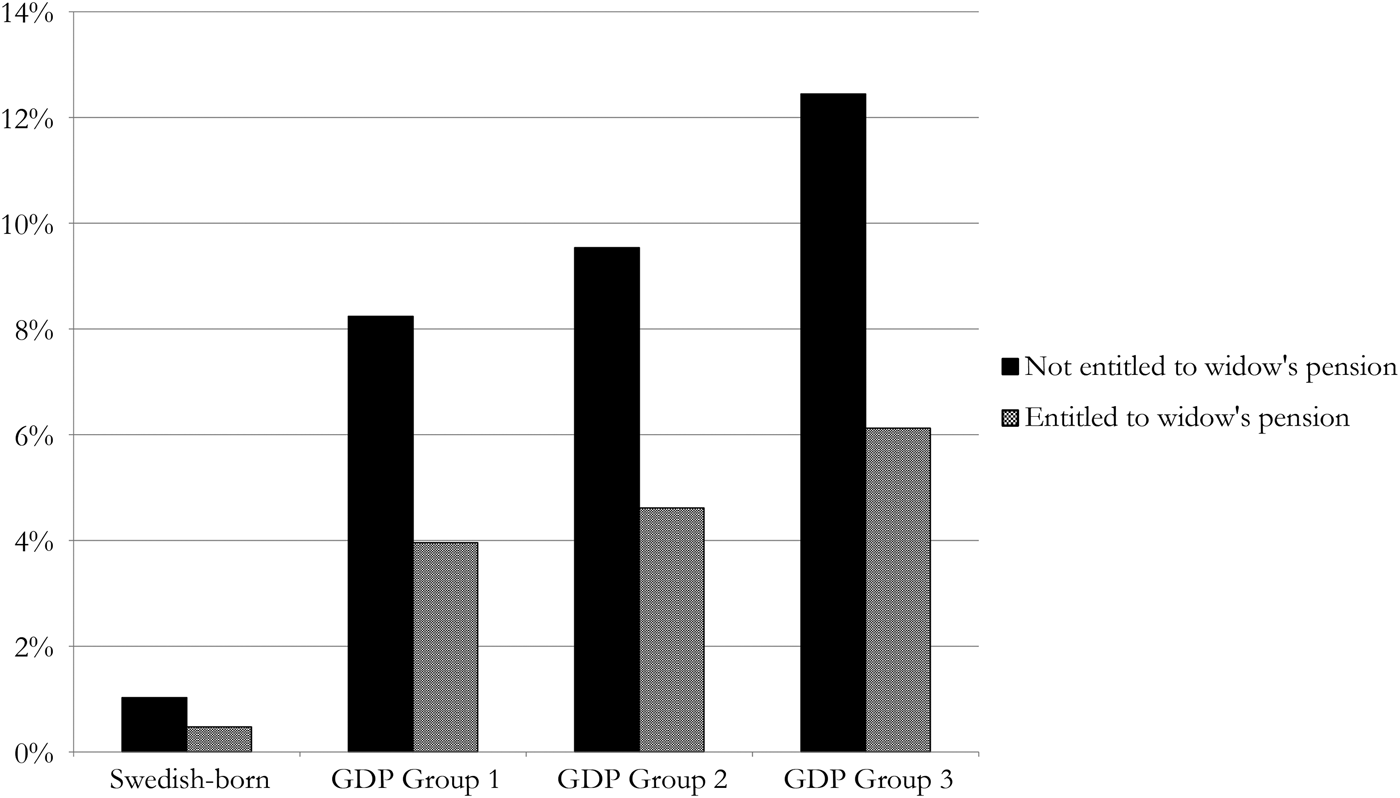
In addition to age at immigration being related to the probability of being twice poor, the estimates indicate that education matters, as does being entitled to a widow's pension. Figure 4 reports the risk of being twice poor at age 75–79 years for persons who immigrated at age 40–49 but have different levels of education. The risk is considerably lower if the non-Swedish-born person has had a long post-secondary education compared to having a shorter education. This is likely because the longer-educated migrants have been more successful at finding employment, thereby accumulating better pension rights.Footnote 9 However, the poverty risk is still higher than for Swedish-born persons with a short education. Figure 5 shows that a single woman's entitlement to a widow's pension approximately halves her risk of being twice poor. Clearly, lifecourse events in interaction with the pension system design have implications for the risk of being twice poor at an older age.
Predicted probability of being twice poor at age 75–79 years; age at immigration: 40–49 years by education.

Predicted probability of being twice poor for single women.

Discussion
A first comment on our results is that this study refers to the situation in 2007, the last year for which information on net assets is available. We argue that since then the issue of immigrant poverty at an older age has become even more relevant to policy. At the time of writing, a considerably larger number of older persons born in middle- and low-income countries are residing in Sweden than in 2007. This growth can be attributed to the ageing of persons who were living in Sweden in 2007 and to a sizeable inflow of older migrants.
The most recent enumeration by Statistics Sweden reports that 243,402 persons aged 65 or more years and born abroad were living in Sweden as of 2015. This represents an increase of 33 per cent since 2007, during a period when the Swedish population as a whole increased by no more than 9 per cent. Furthermore, the number of non-Swedish-born older persons will expand even further according to projections by Statistics Sweden (2017). This projected increase is small among those born in EU countries (including Norway), but very rapid for the category of people born in countries with medium and low human development: from 27,000 in 2016 to 104,000 in 2030. Thus, the number of older persons born in medium or low Human Development Index countries is projected to be as many as four times as many in 2030 as in 2015.
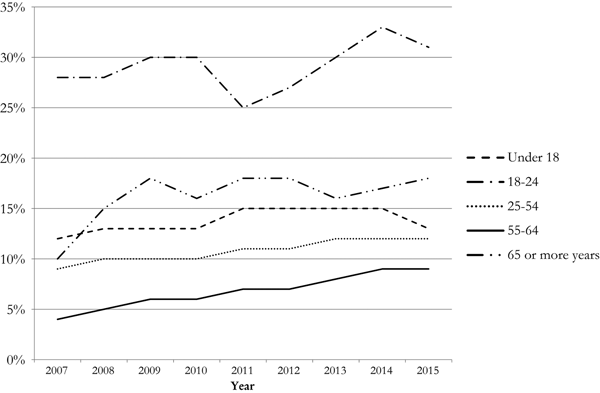
Furthermore, poverty at an older age in Sweden has been increasing since 2007. This is illustrated in Figure 6, which shows that income poverty rates among those aged 65 or more years increased by more than eight percentage points between 2007 and 2015, from about 10 to 18 per cent. How should this be understood? One relevant fact is that the purchasing power of the base pension has not kept pace with the increase in the median income in Sweden. In addition, the transition to more restrictive residence requirements might have contributed to the increased rate of income poverty among older people living in Sweden.
At risk of income poverty (i.e. <60% of median income) in Sweden by age.

What can policy makers do to alleviate the increasing problem of poverty at an older age among migrants? A first and obvious comment is that the results attest to the importance of migrants being better integrated into the Swedish labour market. With an expected general retirement age of nearly 70 years in the future, this applies to most migrants who arrive after the age of 30. Successful labour market integration measures will reduce the future inflow into the category of old-age poor.
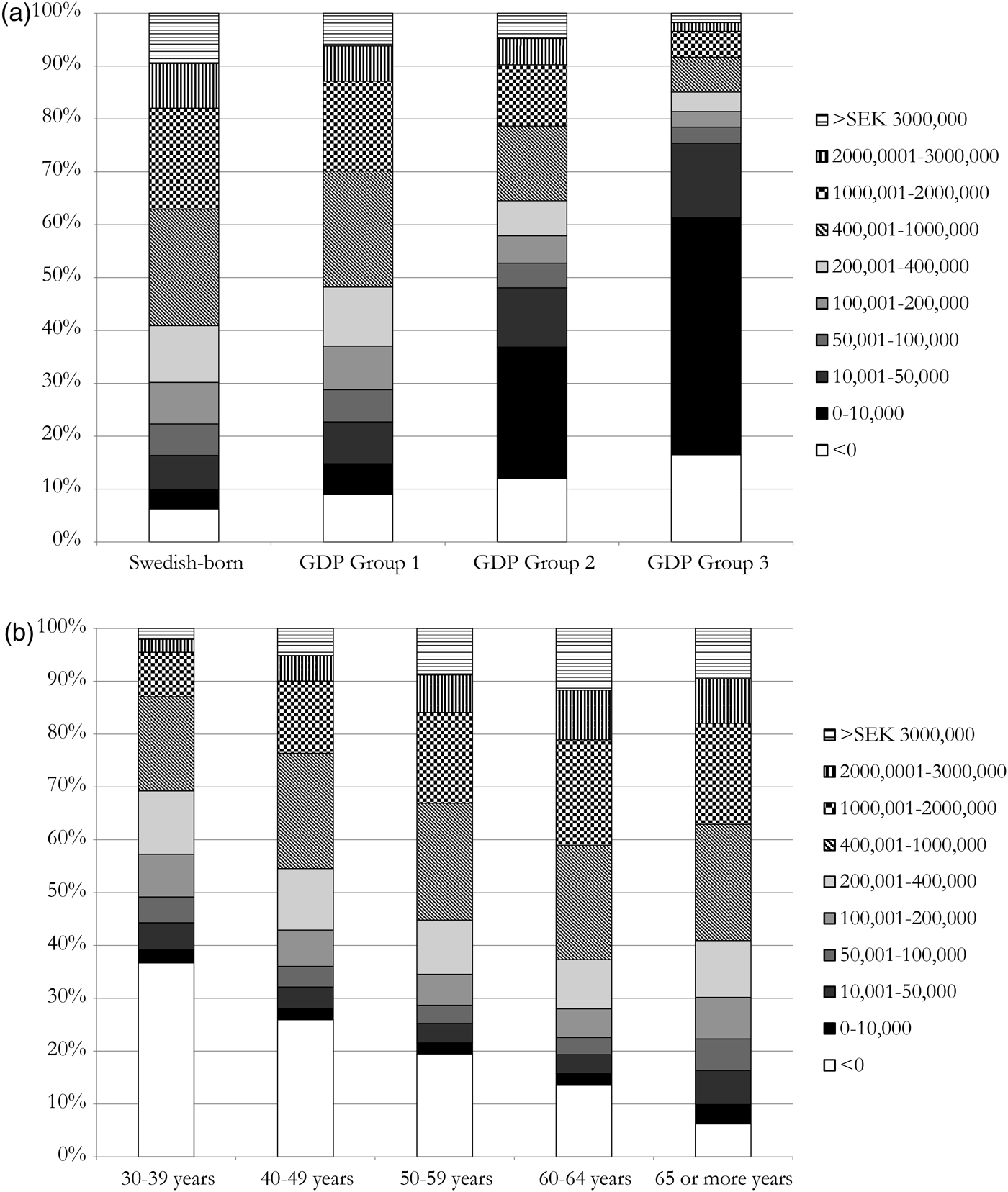
A second comment is that most pension systems are set up to induce individuals to work for as many years as possible, as fewer years in the labour force result in lower pension income. With a growing share of older persons, we face new challenges regarding the pension systems. Many older migrants have not gained a foothold in the Swedish labour market. Many pension schemes also assume that individuals have saved in the form of real assets or private pension schemes. It is true that older persons are a relatively well-off segment of the population. In Sweden in 2007, it was actually the richest age group on average, measured by the amount of net assets. Figure 7 shows that among Swedish-born individuals aged 65 or more years, nearly 40 per cent have net assets totalling at least SEK 1 million, while this was the case for only one in five Swedish-born individuals aged 40–49 years. Those proportions can be compared to that among older migrants from low-income countries, under 10 per cent of whom had net assets of at least SEK 1 million.
(a) Distribution of net assets for those aged 65 or more years. (b) Distribution of net assets for Swedish-born persons in different age groups.

With those facts as background, we conclude that in order to alleviate poverty among the present cohort of old-aged migrants in Sweden, it might be better to rely on income-tested transfers that include an asset test rather than on transfers that do not include such a test. Such a strategy would favour increasing benefit levels in the housing allowance system or old-age support for older persons rather than the base pension. It should also be acknowledged that the systems of housing allowance and income support for older persons also have their limitations: not all eligible persons apply for them and the information on assets has to be reported by applicants, who have clear incentives to under-report.
Summary and conclusions
This paper was intended to shed new light on immigrant poverty at an older age in Sweden with an emphasis on late-in-life migrants. Sweden has received an increasingly large number of middle-aged and older migrants originating from middle- and low-income countries. They have typically entered Sweden as refugees or for family reasons. Many of them do not find jobs in Sweden and receive only limited pension incomes at an older age and can therefore be expected to be at high risk of poverty. This is in contrast to most migrants who arrived in the 1950s, 1960s and 1970s as labour migrants, who were typically under 40 years of age and originated from other countries in Europe.
We have analysed tax data for the entire population aged 65 and older, Swedish-born as well as non-Swedish-born. The poverty status of a household and its members is assessed by applying two criteria: the disposable income of the household in which the person lived in 2007 should be below 60 per cent of median equivalent income for Sweden's entire population; to be classified as twice poor, in addition household wealth should be below SEK 10,000. Our study should be the first ever that has applied both criteria to study poverty among immigrants. In the analysis, we distinguish between migrants born in high-, middle- and low-income countries. The results indicate that such a disaggregation of the non-Swedish-born population makes sense when studying poverty at an older age.
The results indicate that three of four Swedish-born older persons were not classified as poor by either of the criteria and only 1 per cent by both criteria. In contrast, among older persons born in low-income countries, almost three out of four were classified as poor according to one of the criteria and one in three according to both criteria. The results of estimating logistic models indicate that the risk of being poor according to both criteria is strongly positively related to age at immigration, particularly among persons born in middle- or low-income countries. There are probably several reasons for this, e.g. the design of the pension system, that age at immigration is negatively related to the number of years after immigration until a migrant gains a foothold in the Swedish labour market, type of job, etc. We also report that being entitled to a widow's pension reduces the risk of being poor as assessed by the combination of both criteria.
The results illustrate how including information on both income and assets could play a large role in comprehending the problem of poverty at an older age. Adding the criterion of being net asset poor to the much more frequently applied criterion of being income poor increases the proportion of migrants in the pool of persons deemed poor. Here we report that a majority of older persons deemed twice poor were born abroad: the problem of severe poverty at older age in Sweden is very much a problem of the immigrant population.
In this paper we have also discussed measures to alleviate poverty at an older age among migrants. We have stressed that it is crucial that migrants, particularly those who arrive after age 40, be better integrated into the Swedish labour market, and successful measures to accomplish this will reduce future inflow into the category of old-age poverty. To alleviate poverty among those migrants who are already of an older age, increased transfers are probably the only possible alternative. However, it is not easy to design such measures so that they effectively reach their targets, because the vast majority of those receiving a base pension are Swedish-born, most of whom have amassed considerable assets.
Acknowledgement
Earlier versions of this paper were presented at the FISS 2016 Conference ‘Poverty and Inequality and its Impacts Following the Financial Crisis’, Sigtunahöjden Conference Centre, 19–21 June 2016 and at the Ratio Institute, Stockholm, 5 February 2017. Funding from the Swedish Research Council for Working Life and Welfare and from the Gothenburg University Centre for Ageing and Health (AgeCap), grant number 2013–2300 made this study possible.