In a series of autobiographical writings, the labouring poet John Clare recounted his struggles pursuing a career in literature. He lived much of his early life in ‘extreeme poverty’ with his parents and siblings in the parish of Helpston, Northamptonshire.Footnote 1 John described his father Parker as an industrious labouring man, who had ‘often [been] crippled for months together with rumatics’, yet had a spirit that ‘was strongly knitted with independence and…so he stubbornly strove with infirmitys and potterd about the roads putting stones in the ruts’.Footnote 2 Parker persistently avoided visiting his local overseer to ask for help, believing that ‘bend[ing] before the frowns of a Parish…was the greatest despair’.Footnote 3 Eventually, Parker was forced to apply for assistance. John stated that ‘as soon as he went to the parish for relief they came to clap the town brand on his goods and set them down in their parish books because he shoud not sell or get out of them’. John bitterly resented this policy, lamenting that he ‘felt utterly cast down for I coud not help them sufficient to keep them from the parish’.Footnote 4 The subject of appraising parishioners’ goods also appeared in one of John Clare's most well-known poems, The parish: a satire:
The writings of John Clare raise a number of questions, including: how widespread was this policy of inventorying recipients’ belongings? Did parish authorities intend to appraise pauper goods to punish individuals? How often did parishes brand people's possessions? Did parishes tend to appraise the belongings of sick people or was the policy applied to all paupers who requested assistance?
The inventorying of paupers’ goods was clearly a formative part of some people's experience of poor relief and could leave lasting and humiliating memories with their families. It signalled to paupers that they would soon lose their worldly goods and that they could not use makeshift economies such as the selling and pawning of their possessions to make ends meet.Footnote 6 Surprisingly little research, however, has been conducted to examine this facet of poor relief. There exist only a few scattered pages in the secondary literature which consider why inventories of paupers’ belongings were made.Footnote 7 Most authors simply reiterate that parishioners’ belongings were appraised by authorities in exchange for support and that the goods generally reverted to the parish once the pauper died. Some historians have taken this further and explained how the policy may have been used by authorities and perceived by recipients. Anthea Newman, for example, claimed that the inventorying of parishioners’ goods ‘must have acted as a powerful deterrent to accepting parish relief’.Footnote 8 Joan Kent argued that the appraising of paupers’ goods illustrates that the middling sort were increasingly ‘displaying a hard-nosed, money-conscious attitude toward inhabitants who were unable to maintain themselves’.Footnote 9 Steven King used fifty-six inventories such as pauper and rent-arrear inventories to assess negotiation and entitlement to relief. He argued that numerous parishes would step in to help the poor while they still owned a decent collection of possessions, suggesting that paupers did not need to be materially destitute before they were entitled to assistance.Footnote 10 Pauper inventories have most commonly been used to consider the consumer behaviour of the poor. In 1997, Peter King used fifty-one pauper inventories to argue that the material lives of paupers in Essex improved over the eighteenth and early nineteenth centuries.Footnote 11 King's work included a valuable critique of the diverse range of inventories that are found among parish records, yet stressed that much more work was needed to understand the process of negotiation between the parish and indigent, and the lifecycle-related backgrounds of the people that had their goods inventoried by overseers.Footnote 12 Unfortunately, few have taken up this challenge.
Our understanding of pauper inventories is based solely on handfuls of inventories from a selection of parishes and areas, meaning that existing studies are not nationally and regionally representative during the entire length of the old poor law (1601–1834). Furthermore, it is important to examine pauper inventories as it helps us to understand other historical issues, including relations between the parish and indigent, the local and regional nature of poor relief, entitlement, the socio-legal application of the poor law, and how specific subgroups of the poor, such as the elderly and women, experienced poor relief.
An additional and unfortunate result of this lack of research is that there are now misconceptions and inaccuracies in the literature. Giorgio Riello, for example, claimed that it was ‘common practice’ for paupers to place all their possessions in one room when a parish official came to make an inventory of their goods.Footnote 13 However, upon collecting hundreds of pauper inventories and contextualizing them using thousands of overseers’ accounts and vestry minutes, there is no evidence to suggest that this happened. Rather, it is more likely that paupers obstructed rather than helped the process. Adrian Green recently studied Norfolk ‘pauper inventories’, but did not appreciate that the inventories needed to be checked against wider parish sources to determine to whom the goods in the inventories belonged or why the inventories had been made. Consequently, around one third of his sample was made up of non-pauper inventories and included wealthier members of society who did not receive any relief.Footnote 14 Several writers have indicated that pauper inventories were made as soon as somebody started to receive support from the parish.Footnote 15 Conversely, a considerable number were made of the goods of people who had been in receipt of parish assistance for many years.Footnote 16
This article is based on 434 pauper inventories from Dorset, Kent, Norfolk, Lancashire, and Leicestershire/Rutland made between 1679 and 1835. This is the largest and most regionally diverse collection of pauper inventories ever assembled. Handfuls of inventories from other counties and overseers’ accounts, vestry minutes, justice notebooks, newspapers, and contemporary writings are also used. The article starts by examining the various types of inventories that are found in parish archives, before moving on to assess the legality of taking inventories of parishioners’ goods in exchange for poor relief. The familial and lifecycle-related backgrounds of the paupers in the sample and the reasons why poor law officials made pauper inventories is examined in sections III–IV. In the penultimate part, regional differences in the making of pauper inventories are considered. From this, the article addresses a significant gap in the historiography and enriches our understanding of people's experience of poor relief, entitlement, and social relations.
I
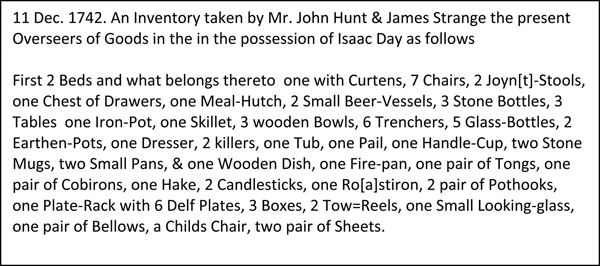
Poor law officials made pauper inventories to record the possessions that a pauper on outdoor relief owned at one point in time. People would then continue to use their goods and at a later date, usually when they died, the goods would be passed to the parish after which they might be sold, given to other paupers, or be used to furnish the parish pesthouse, poorhouse, or workhouse. Some parishes also took paupers’ lands and homes,Footnote 17 though much more rarely since few claimants owned their own properties. Most pauper inventories were written by overseers, sometimes assisted by churchwardens or members of the vestry. Figure 1 shows a relatively representative example of a pauper inventory from Redenhall with Harleston and Wortwell in Norfolk. Most pauper inventories start with introductions that identify to whom the goods in the inventory belonged, where it was made, when it was made, and who assessed the goods. The goods are then listed by the appraiser, but valuations of the belongings and rooms in which the items were located are rarely noted.Footnote 18 No pauper inventories or mention of the policy has been found before the 1650s, suggesting that the practice was not used or was only rarely applied during the first fifty years or so of the old poor law.Footnote 19
Pauper inventory of Isaac Day, Redenhall with Harleston and Wortwell, 1742

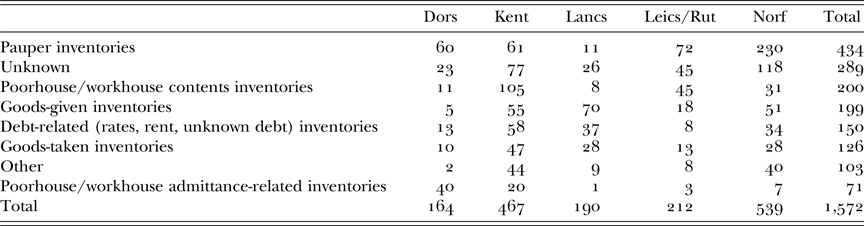
Pauper inventories are the principal focus of this investigation, but it is important to point out that there is a considerable range of other inventories that can be found among parish records and other archival collections such as estate and quarter sessions papers (Table 1). Each inventory was cross-referenced to other sources such as overseers’ accounts and vestry minutes to determine why they were made and whose belongings they were made of. It was important to do this as many of the inventories looked similar to one another, but once they were checked against other sources many were clearly made for very different reasons. Of the 1,572 inventories in Table 1, 244 are classed as ‘unknown’ as relevant background information could not be found to classify them and determine whose goods were appraised. Goods-given inventories list the items given to people by the parish. Poorhouse/workhouse contents inventories were made to catalogue the goods that were held in poorhouses/workhouses. Among workhouse records, there are also inventories of inmates’ belongings which were taken in the period immediately before they entered the poorhouse/workhouse (poorhouse/workhouse admittance-related inventories).Footnote 20 Debt-related inventories were made for distraining somebody's possessions to pay back a debt of some sort, such as rent. Goods-taken inventories were made to record the possessions that the parish took from paupers. They have commonly been mistaken as pauper inventories by historians as they sometimes record the final process when the goods of a deceased pauper, which had previously been promised to the parish in a pauper inventory, were taken. However, goods-taken inventories could be made for a variety of reasons and so should be viewed as distinct from pauper inventories. Over half of these inventories were made of the goods of people who were still alive, and so were not made to record the final stage of the pauper inventory process when the parish took a deceased pauper's belongings. Some goods-taken inventories record the parish taking back the items that they had previously given to a pauper.Footnote 21 On occasion, goods could be taken from one pauper and given to another in exchange for being looked after.Footnote 22 Sometimes, the parish only took a small number of goods to pay the funeral expenses of a spouse or child.Footnote 23
Inventories found among various archival collections, c. 1643–1841

The fact that there is such a large range of inventories among parish records is important as it shows that there could be significant procedural variations among communities.Footnote 24 Some parishes were active in the making of numerous types of inventories relating to the goods of paupers and other inhabitants, while some appear not to have been involved in the making of any inventories or have left no records to show that they did so. Such differences could be borne out of local context and had no statutory basis. Goods-given inventories, for example, were made to help authorities keep track of the items that they had given to people. Other inventories had legal foundations and were made to help protect people and their interests. The practice of making rent-arrears inventories of tenants’ goods was commonly used by landlords and landladies to recoup unpaid rents lawfully.Footnote 25 These various inventories also have wider implications on our understanding of social worth. According to Alexandra Shepard, there was a ‘culture of appraisal’ in early modern England in which people's moveable goods acted as the bedrock of creditability, but by the late seventeenth century myriad other factors became more important, such as an individual's reputation, occupation, ability to pay taxes, and the rental/sale value of their homes.Footnote 26 The appraising and inventorying of parishioners’ goods in these various ways reminds us that people's belongings continued to be an important measure of worth during the long eighteenth century, particularly among the poorest and most vulnerable in society. The remainder of the article concentrates on the sample of pauper inventories. It argues that local and regional context was important in determining which parishes appraised the goods of paupers, and when and why they did this.
II
The belongings of paupers who had been declared insane or had abandoned their families could be legally seized by authorities.Footnote 27 However, under the old poor law there was no direct legal statute which allowed parishes to inventory and later take paupers’ goods in return for support. In fact, there were more laws which allowed authorities to seize the goods of parish officials than there were laws relating to the possessions of paupers. Overseers, for example, could have their goods distrained to pay fines if they were charged with neglecting their duties, not making paupers wear badges, not keeping accurate accounts, or refusing somebody relief who had an order from a justice.Footnote 28 The impetus to make pauper inventories instead came from local practices and policies, created from the discretion and initiative of individual officials, ratepayers, and vestrymen.Footnote 29
Parishes often felt that they were legally justified in taking paupers’ goods, despite having little authority to do so. Some parish officials, for example, among the opening lines of inventories wrote that the goods were appraised in a ‘lawful’ or ‘legal’ manner. The pauper inventory of Francis Karrington of Shelton, Norfolk, was apparently made ‘as ye Law requires’.Footnote 30 Occasionally, parishes made paupers sign legal documents which stated that they were entitled to their goods because they had given them relief. One document relating to Francis Windswift of Lenham in Kent stated that ‘in Consideration of the severall Kindnesses & moneys Received of[f] Rich Wakley Churchwarden and Wm: Belcher Gent: overseer…[she] have Bargained Sold: Set over & Deliver[ed]’ her goods to them.Footnote 31 Samuel Hunt had a similar written agreement with St Mary's in the Marsh in Norwich. It was made when he started receiving casual relief, declaring that:
I do hereby Acknowledge that ye above Goods Furniture and Things are in my Possessions and that the same are the property of the Officers of ye Parish of St Mary in ye Marsh in ye Close and I do promise not to Embezzle any [goods] thereof and that I will deliver up ye same to ye Officers of ye said Parish of St Mary in ye Marsh when I am call'd upon so to do.Footnote 32
This was clearly a device that some authorities used to take parishioners’ goods legally and avoid prosecution.
Most parishes did not go to the trouble of creating legal agreements, and some justices of the peace even supported the inventorying of pauper goods, even though parishes lacked the requisite legal authority to do so. Though probably referring to workhouse admittance-related inventories, Deal borough quarter sessions in 1722 recorded that
It is ordered that wee person or persons whatsoever applying to the proper officers of the s[ai]d Town of Deal for Releife Shall receive any Weekly Allowance untill that the said Officers shall have taken an account of what Goods and Effects Such persons have and there order be reccieved to the Town house appointed for the Same[?] up and then Ecched into a Book there kept & belong to the said house and the persons there to be kept according to the Rules of the said house.Footnote 33
The frequency with which the poor appealed to local justices to complain about their goods being inventoried probably varied regionally and depended upon how understanding claimants thought their local justice was.Footnote 34 Moreover, it is possible that some of the poor were not aware of their legal right to petition justices or may have been fearful of retribution or an unfavourable decision, such as the refusal of relief or being forced into the workhouse, if they complained to a justice.Footnote 35 Nonetheless, where evidence has survived, it appears that many justices helped to protect paupers’ belongings, and that overseers wanted to avoid disputes over goods reaching justices. In 1814, for example, the justice Samuel Whitbread stopped the parish of Wilstead, Surrey, from taking ‘an old bed and sheets’ from John Monday.Footnote 36 The autobiography of the labourer Joseph Mayett records one instance when the parish took his deceased brother's possessions. Instead of letting this happen, Mayett went to the overseer and ‘told him if he did not deliver everything into my hands the next morning I would put the law in force against him’. The threat of the law worked, and the following morning the overseer ‘Came and delvered them up to me and my youngest brother.’Footnote 37 Justices were only rarely listed as one of the appraisers or witnesses in the pauper inventories as they may have stopped the process.
A detailed example of a justice stopping a parish from taking a pauper's belongings has survived from Wingham in Kent. It was written by a local justice, Edward Mills, and concerned the pauper John Beach, who had received a weekly allowance of 1s 6d or 2s from the parish of Wingham for twenty years. John's daughter Ann and her husband forced John out of his home and took his possessions following Ann's constant abuse and beatings of him. The parish claimed that Ann had no right to the goods as they had been promised to the parish around ten to twelve years ago. An inventory had been made to prove this.Footnote 38 The justice ruled that Ann could not keep John's belongings, but also questioned whether the parish had the right to take these goods in the first place. Mills decided that parishes had no right to inventory and take pauper possessions to reimburse themselves for some of the money that they had previously paid out in relief. He also said that parishes could not use the act of 5 Geo. I c. 8, 1718–19, which allowed parishes to distrain the goods of runaway parents or partners, to justify the taking of paupers’ goods.Footnote 39 This example is particularly interesting as it shows that some justices were aware that the appraising and taking of paupers’ goods was illegal, and indicates that if they saw such abuses sometimes they stopped them. The fact that Mills had to point out that parishes were not allowed to use the act of 5 Geo. I c. 8, 1718–19, to take paupers’ belongings, indicates that some parishes manipulated existing statute to justify their actions. Furthermore, it shows that assistance could be conditional and withheld if claimants did not allow the parish to inventory their possessions.
III
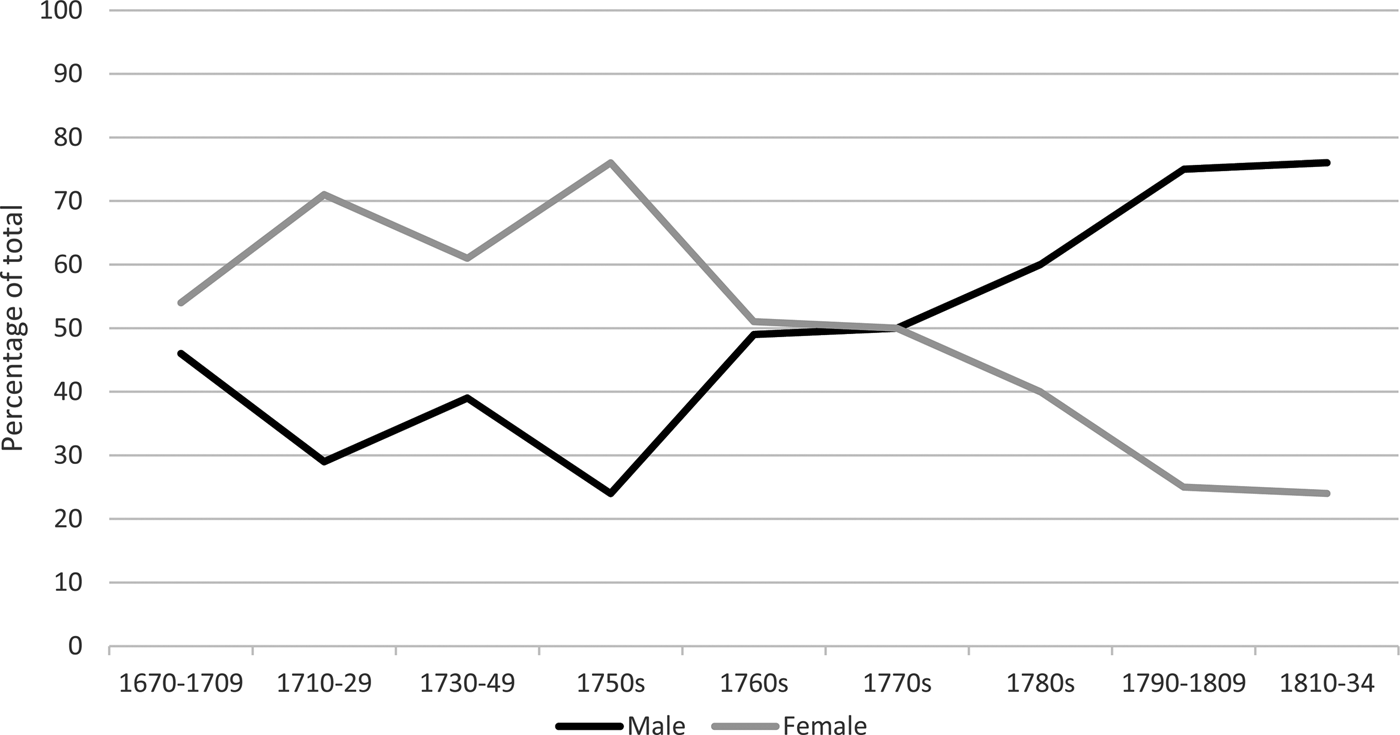
This section examines the types of paupers that had inventories made of their possessions. It is important to do this as parishes rarely appraised the goods of everybody who received relief. Instead, officials tended to choose which parishioners they inventoried based on factors such as gender, age, and cost. Figure 2 shows the gender distribution of people from the Dorset, Kent, Norfolk, Lancashire, and Leicestershire/Rutland pauper inventories. The results indicate that women's pauper inventories were most common from the late seventeenth century to the 1770s. Greater numbers of inventories were probably made of the possessions of women because they tended to earn less money than men and were viewed as more vulnerable and deserving of support by authorities.Footnote 40 From the 1770s, however, this trend was reversed as men's pauper inventories became more common. The poor law had reached its ‘crisis’ years and men became more dependent on relief due to the decline in cottage industry and widespread enclosure of commons and open fields. Coupled with severe agricultural and manufacturing depressions and an over-stocked labour market, particularly after the Napoleonic Wars in 1815, men further struggled to remain independent and provide for their families.Footnote 41 The proportions of men and women who received support inevitably varied from parish to parish, but the results in Figure 2 nevertheless broadly reinforce other studies which show that men were increasingly given help by overseers during the final decades of the old poor law.Footnote 42
Distribution of pauper inventories by gender over time, c. 1670–1834

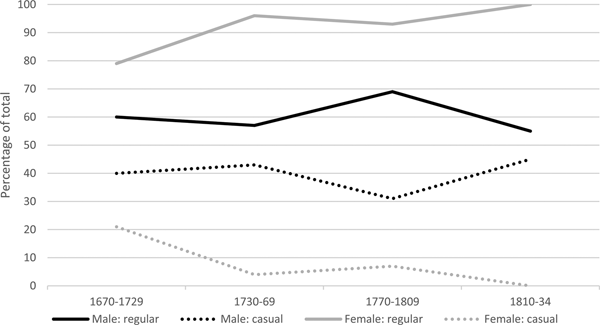
Figure 3 records the types of relief that men and women from the pauper inventories received. Regular relief is defined here as a pension paid to a parishioner in weekly, fortnightly, or monthly instalments.Footnote 43 Casual relief, such as the giving of small sums of money and relief in kind, was infrequent and mostly only used for short periods of time. It was not possible to discern whether people were on regular or casual assistance in around one third of the pauper inventories. For example, sometimes the overseers’ accounts were poorly written and it was not possible to tell if the support that people received was regular or casual.Footnote 44 Nonetheless, based on the inventories that could be accurately tracked alongside other sources, 79 per cent of women from the pauper inventories received regular relief and 21 per cent received casual relief between 1670 and 1729. From 1730 to the end of the old poor law, this gap had widened and nearly every woman in the sample (95 per cent) was on regular assistance. The results from the male-headed inventories equally indicate that more pauper inventories were made of the goods of men who received regular relief. The gap, however, is much narrower and over the long eighteenth century 61 per cent of men from the pauper inventories received a pension and 39 per cent received casual relief.
Types of poor relief that inventoried men and women received, c. 1670–1834

As most pauper inventories were made of the belongings of people who received regular relief, this strongly suggests that parishes tended to inventory the goods of paupers who cost the most money. On average, male pensioners whose goods were appraised received 1s 9d per week between c. 1679 and 1769, and 2s 10d per week between c. 1770 and 1834. Female pensioners received 1s 6d per week c. 1679–1769 and 3s per week c. 1770–1834. These amounts of money could be sizeable over a period of time, since most of these paupers received pensions for many years before their goods were appraised by parish authorities. There was overall little point in inventorying the goods of people on casual relief, since the amounts of money that they claimed from the parish was generally relatively small and only short term. Rather, overseers would have mostly targeted paupers who they thought were taking more from the parish fund and would need support until they died, when the parish could then seize their goods. Men who received casual relief were probably more likely to have their goods inventoried than women in the same position as they were generally seen as less deserving by officials, meaning that the authorities felt more justified listing men's belongings with the aim of later taking them to compensate the parish.
The majority of paupers who had an inventory made of their possessions received support from the parish due to lifecycle-related problems, such as the death of a partner and sickness.Footnote 45 The sample appears to represent a large number of paupers who were at the end of their working lives and on regular relief due to old age and infirmity. Occasionally, pauper inventories were made of the goods of people in their twenties or thirties; however, most of the time there was little point in appraising the belongings of young people, since it could potentially be decades until they died (unless they were unwell) and their belongings reverted to the parish. At this point, their belongings might have also become too old and worn to be sold or recycled around the community. As such, although the ages of only seventeen people who had their goods inventoried could be determined, the average age is relatively high at sixty-one.Footnote 46 Moreover, four of these people with a recorded age were in their eighties and ten were aged between sixty and eighty-six years old. People who lacked adequate wages or employment and received allowances from the parish through Speenhamland, the roundsman system, and labour rate generally did not have inventories made of their possessions. This is probably because these people were usually young or middle-aged able-bodied men who were only intended to be helped by the parish for short periods of time.
At least 76 per cent of the women in the sample were widows or spinsters. Around 2 per cent were married and it is likely that the remaining 22 per cent of women were widows and spinsters.Footnote 47 Unfortunately, the marital statuses of 43 per cent of the men in the sample could not be determined, since parish officials tended not to describe men in this way. Of these, 16 per cent were widowers or bachelors and 84 per cent were married. At least 21 per cent of the men and women from the pauper inventories lived with children.Footnote 48 This figure is likely to be a considerable under-representation since it came from assessing wider overseers’ papers where children were not always mentioned. Nevertheless, around 52 per cent of households which had children were female headed and 48 per cent were male headed. The structures within these households could vary considerably. Sometimes, these children lived with a single or widowed mother or father, and sometimes they resided with both of their parents. Occasionally, they lived with one or more of their grandparents. The livelihoods of the people from the inventories are very difficult to find; however, when known, this information shows that most paupers came from low-skilled labouring backgrounds. The two most common occupations were labourers and weavers.
IV
The question of why parishes made pauper inventories is difficult to answer, since every inventory was made at a local level under the initiative and discretion of parish officials and vestrymen. Despite this, two key reasons emerge which developed organically through disputes, worries, and shared values among overseers, ratepayers, vestries, and paupers. The first of these reasons is financial. Many of these paupers cost considerable amounts of money to help and so the inventorying of their goods was a method that parishes used to recoup money and get them to contribute towards their own relief. While the amounts that parishes received from pauper belongings were generally small, symbolically these sums of money were very important to many ratepayers. Secondly, the attitudes of parish officials and ratepayers appear to have been crucial in underpinning their decisions to inventory the goods of paupers. Although the practice was illegal, sometimes paupers’ goods were appraised for benevolent reasons, as it guaranteed many people parish assistance until they died and it meant that they did not have to sell off their possessions before they were seen as deserving. However, although there is some chronological overlap, parishes appear to have increasingly inventoried people's belongings in a more punitive manner and used it as a method to control the numbers of people on poor relief by the late eighteenth century.
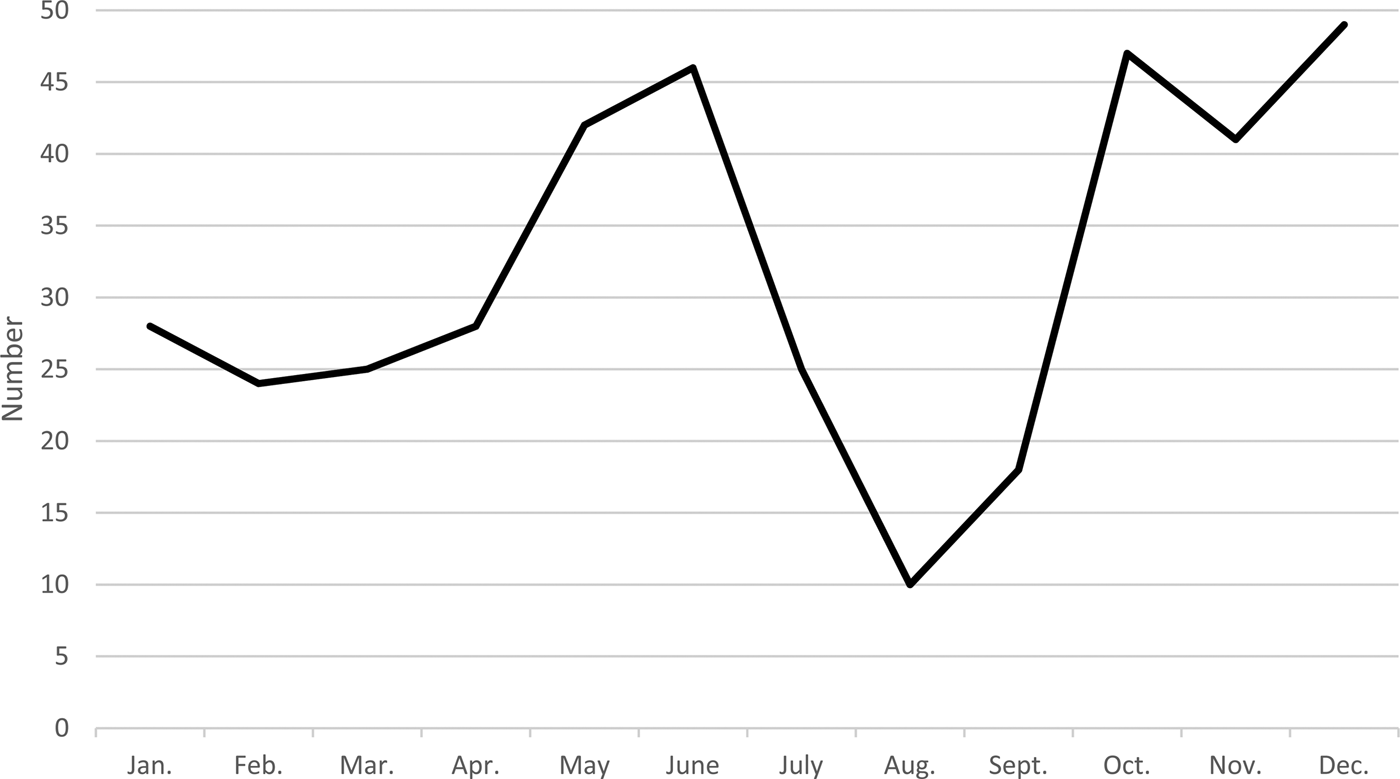
Figure 4 shows the months when the pauper inventories from Dorset, Kent, Lancashire, Leicestershire, Rutland, and Norfolk were made. The fewest pauper inventories were made in August. This possibly stems from seasonal reasons, as the vast majority of inventories came from rural areas and August was when agricultural seasonal unemployment was generally lowest and when there was less pressure on parish funds. If the overseers were farmers, this was also the time in the year when they were preoccupied with other things. From October, seasonal unemployment increased and more people tended to apply for relief, which may explain the growth in the number of pauper inventories until the end of the year.Footnote 49 May/June are also very prominent months when pauper inventories were made. Taken alongside the spike in inventories during October, this is particularly interesting as it was around these times in the year when rates were assessed and collected. Vestries checked overseers’ accounts around these months and sometimes they realized that they had spent too much money or that they needed additional funds to support the poor over the next six to twelve months. Likewise, it was around these months when most new overseers were appointed, and many of these would have had ideas of their own to reduce the amounts of rates that people paid. Many overseers would have also been eager to make inventories of parishioners’ goods for personal reasons, as they may have ended up using their own money if they overspent parish funds while they were in charge. These sums of money could be considerable and if the vestry thought that they were irresponsible then they could be out of pocket for months or not receive their money back at all.Footnote 50 Justices could also force overseers to spend more money than they intended if pauper appeals to them to over-ride parish decisions were successful.Footnote 51 Arguments, disagreements, conflicts, and negotiations over money at vestry meetings were ubiquitous.Footnote 52 Overseers and many larger ratepayers appear to have consequently often welcomed the inventorying of pauper goods in the hope that it would reduce rates, diminish the chance that they would get into debt, and ensure that the poor contributed something towards their own relief.
Months when the pauper inventories were made, c. 1670–1834

Appraisers sometimes mentioned in vestry minutes or the inventories themselves how the money expended on somebody had influenced their decision to appraise their goods. Such evidence indicates that because paupers were given relief the parish felt entitled to their possessions. In Staplehurst, Kent, the goods of Hannah Bean were appraised ‘for Money Rec:d of[f] of them [the overseer and churchwarden] in the time of Sickness’.Footnote 53 In the same parish, an inventory was made of Widow Taylor's possessions ‘for money Recd of[f] them in time of Need’.Footnote 54 In Swanage, Dorset, the inventory of Widow Haysham's goods was ‘founded On Relief given her Husband in his lifetime and still continued to be Given to His Family’.Footnote 55 In Powerstock, Dorset, inventories were to be made of paupers’ belongings ‘as soon as they shall become chargeable’ to the parish.Footnote 56 In Little Baddow, Essex, inventories were made ‘of the poor which Receive Weekly Colection’ in 1766.Footnote 57 Parishes would thus appraise the possessions of paupers at a range of lifecycle points: some were made of the goods of people who had received poor relief for long periods of time; some were made of the possessions of people as soon as they started to receive support from the parish; and some were made because the parish expected to pay out large sums of money in the near future. In total, 32 per cent of pauper inventories were made around when people started receiving regular or casual relief from the parish, and 68 per cent were made of the belongings of paupers who were already on regular or casual assistance.Footnote 58
The income from selling pauper belongings was mostly small, but symbolically it was very important to parish officials and larger ratepayers who wanted the poor to contribute towards their own relief. Frampton in Lincolnshire, for instance, raised over £126 from selling the possessions of parishioners over a 118-year period. This, however, only equated to an average income of around £1 1s 4d every year.Footnote 59 In Eaton Socon, Bedfordshire, the goods of John Cooper were worth £2 18s 2d at his death, but this figure made up only 16 per cent of the total money that the parish had paid out to relieve him.Footnote 60 In Burton Bradstock (Dorset) in 1766, the parish collected a total of £84 9s 7d from rates, but only recorded proceeds of £4 2s from selling pauper goods.Footnote 61 In most cases, parishes experimented with this policy for several years but then stopped. Sometimes, parishes ceased making inventories when justices prohibited them from doing so;Footnote 62 however, most of the time it appears that the practice stopped when a new overseer decided that they did not want to apply the policy, or when parishes realized that they did not make as much money from it as they hoped. This means that in a single parish the making of pauper inventories usually did not continue for more than a few years.Footnote 63 One should not, however, use this as evidence to suggest that the policy was insignificant. As the remainder of the article argues, it was a highly formative part of claimants’ experience of poor relief when applied, and had a considerable influence on notions of entitlement and how paupers and officials interacted with one another.
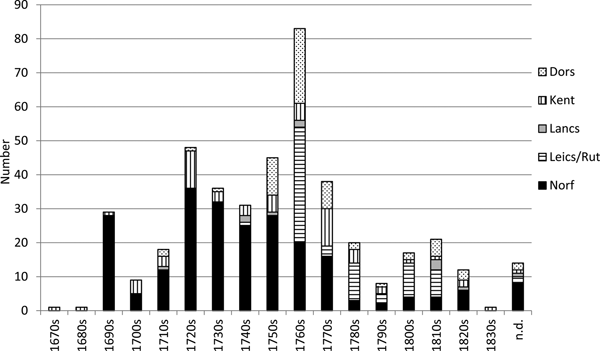
Historians such as Keith Snell and Mark Blaug have characterized southern and eastern rural parishes as ‘miniature welfare states’ in the decades before 1780, as support was generally more benevolent, generous, and encompassing at this time, helping people in a number of creative and pragmatic ways.Footnote 64 By the late eighteenth century, however, the poor law system was seen to be in ‘crisis’ as rates significantly increased and growing numbers of able-bodied men applied for relief.Footnote 65 The making of pauper inventories can be related to this more general chronology. Most pauper inventories were made between the 1720s and 1770s (Figure 5). As these were the years when parishes were often flexible and generous, this may suggest that parishes were inventorying the goods of paupers for benevolent reasons, as well as financial purposes. Having one's goods inventoried essentially guaranteed most paupers relief until they died. Their possessions gave the poor a bargaining chip which they could use to negotiate support, and when their goods were inventoried this essentially acted as official recognition that they were deemed worthy of parish assistance. Moreover, inventorying paupers’ goods but allowing them to use them until they died was a better option from the poor's point of view than making them sell their belongings before they were entitled to relief. The lines between paying rates and ending up on the parish could be very thin.Footnote 66 Consequently, many lesser ratepayers would not have supported a policy that could have forced them to sell off their possessions immediately if they ever ended up on relief themselves.
Chronological distribution of the pauper inventories, c. 1670–1834

Parishes appear to have inventoried the goods of parishioners less often from 1780. Despite this, the evidence suggests that by the late eighteenth and early nineteenth centuries the appraising of paupers’ goods was closely linked to a negative shift in the attitudes of ratepayers and parish officials, who increasingly wanted to pay less towards the support of the poor, dissuade people from applying for relief, and help only the most deserving and desperate of people. The infamous Royal Commissioners’ report of 1834 praised the practice of taking paupers’ goods. They wrote that the application of the policy in Northumberland ‘frequently has a salutary effect, as instances occur of poor persons returning what they had received, when they discovered that they had been paid from the assessment, saying, “I would sooner want it than have my goods looked over, and seized when I die.”’Footnote 67
Some parishes branded paupers’ goods with the initials or name of the parish after they were inventoried by authorities. Examples of parishes branding parishioners’ belongings are surprisingly difficult to find before the late eighteenth century, suggesting that the practice was not very common even though most pauper inventories were made between 1720 and 1770 (Figure 5). Recipients’ goods were branded to stop paupers from selling or pawning their belongings. Parishes also used the practice to build up a stock of goods that could be given to other claimants or be used to furnish the parish pesthouse, poorhouse, or workhouse. The branding of paupers’ goods, however, could also advertently or inadvertently act as a way in which to identify, discriminate, and shame the poor. As the work of Steve Hindle has shown, for example, when paupers were made to wear badges on their clothing to show that they were dependent on poor relief, they were used as a mark of shame and discrimination. It was also hoped by parishes that wearing them would dissuade further people from applying for assistance unless they really needed it.Footnote 68 In a similar manner, as we saw above when the parish of Helpston in Northamptonshire came to inventory the labouring poet John Clare's father's goods during the early nineteenth century, he was especially disgusted when the parish branded each item. In Cowpe Lenches, New Hall Hey, and Hall Carr parish in Lancashire, the goods given to paupers were branded with a ‘P’ or ‘CLP’ during the 1810s.Footnote 69 In 1821, in East Harling, Norfolk, the belongings of Edward Wretham and Widow Whitehead were marked ‘EHP’.Footnote 70 If any of these paupers were caught selling or pawning their branded possessions, the parish might withhold relief. It is also possible that some people were prosecuted if they sold their goods or if others were caught handling them. Though there were no laws which allowed parishes to brand paupers’ goods, there were laws which protected parish property. Under these regulations, people were fined or imprisoned if they were caught selling or handling stolen branded workhouse goods.Footnote 71 Parishes could have potentially manipulated this law to apply to people on outdoor relief, as pauper goods were viewed as parish property after they were inventoried, even though the indigent continued to use them.
Opponents argued that the appraising and seizing of pauper goods was malicious. In 1773, the Quaker poet and writer John Scott wrote that
In some of those few parishes, where allowance out of the workhouse is permitted, an unkind and indelicate practice frequently obtains. The parish vouchsafes a trifling pittance of a pension; and an industrious son or daughter, from the earnings of their industry, supplies the remainder of the maintenance of the aged or decrepit parent. In such cases, an inventory of what little household furniture may be in the pauper's possession is immediately taken, in order that it may revert to the parish at his decease. The poor have sensibility; and it is really cruel to treat as criminals, whose property is confiscated, those who in this respect have no crime but inevitable poverty.Footnote 72
As we saw above, Joseph Mayett also opposed the system and threatened to report the overseer to a justice.Footnote 73 Occasionally, some paupers even tried to hide their goods, showing that they resisted the policy.Footnote 74
V
This section examines the geographical distribution of pauper inventories and relates the findings to the wider literature on the regional nature of poor relief. Evidence has been found that the inventorying of pauper goods happened in various parishes in most English counties during the old poor law. The system also probably operated in parts of Wales where poor law statutes were identical to England. Proof that a similar practice happened in Denmark, Prussia, and New Jersey has also been found.Footnote 75
It is very difficult to determine the extent to which inventories exist today as a result of chance or whether they can be taken to reflect actual regional differences. A number of these documents, for example, were written on loose pieces of paper and thrown away once they were not needed by authorities. Despite this, examining the survival of inventories from different regions potentially has very important implications on our understanding of the regional nature of poor relief. The figures suggest that despite the evidence that pauper inventories were made around England, the frequency with which the practice happened could vary considerably (Table 1). For Norfolk, 230 pauper inventories were found. Large numbers of pauper inventories were also drawn up in nearby Essex.Footnote 76 For the northern county of Lancashire, on the other hand, only 11 pauper inventories were located. Similarly, very few inventories (of any kind) were found from Durham in Green's study on the households of the poor.Footnote 77 Poor law officials made pauper inventories in Dorset (60), Kent (61), and Leicestershire/Rutland (72), but not to the same extent as parishes in Norfolk and Essex. These differences are especially striking when one considers the methodology that was used for searching the archives. For Dorset, Kent, Lancashire, and Leicestershire/Rutland, nearly every poor law record that could be located was searched through to find categorized and uncategorized inventories. However, because the inventories were so abundant for Norfolk, the decision was taken to be more selective and concentrate on the inventories which were listed in the archive catalogue. This is a clear regional difference between the counties and cannot be explained purely by arbitrary record survival. These findings overall suggest that parishes more commonly inventoried the goods of paupers in the east of England, followed by the south. Then moving northwards and westwards, the practice became gradually less common.
Historians have generally found that poor law practice was different between the south and north of England. In the south, paupers could expect to receive more support from a better-funded system particularly before 1780, while in the north people generally appear to have received lower allowances and found it harder to get relief.Footnote 78 Of course, the picture is not uniform and some parishes, such as Woodplumpton in Lancashire, were arguably very generous.Footnote 79 Nonetheless, the results from this study corroborate this broad regional picture that the application of poor relief varied regionally and provisions were better for the poor in the south. Having one's goods inventoried essentially guaranteed many people support and allowed people to retain their goods until they no longer needed them. In the north, parishes did not generally inventory parishioners’ belongings in the same way. Rather, they appear to have either taken items that they perceived as superfluous or made people sell off their possessions before they were entitled to relief. ‘Goods-taken’ inventories (28), for example, were more common than pauper inventories (11) in Lancashire (Table 1), suggesting that parishes more often chose to take and/or sell pauper goods. Margaret Hanly found similar trends in her detailed study of Lancashire. She argued that the poor ‘would have a minimum of possessions which they would be expected to sell or pawn in times of difficulty’ by the parish.Footnote 80 In southern, eastern, and midland counties, on the other hand, pauper inventories (423) considerably outnumber ‘goods-taken’ inventories (98), suggesting that northern paupers were generally not allowed to keep and use their goods in the same way as most of their counterparts further south. This overall suggests that local context was important in determining how parishes treated paupers, and that broader regional differences arose from these local activities.
From these findings, the provision of relief can arguably be seen as more benevolent in the south, as recipients’ belongings were used as a pledge which secured individuals parish assistance. It showed overseers that people had been subject to checks and bounds by their predecessors, and that the recipients were going to contribute something, albeit small, towards the parish pot once they passed away. It meant that paupers could keep their possessions and would generally only lose their goods when they had no use for them. Of course, this meant that families missed out on their inheritance and the policy may have even acted as a way in which to punish beneficiaries of the estate such as adult children for leaving the care of their parent(s) to the parish. It also meant that paupers could not use makeshift economies such as the selling and pawning of their possessions. However, it also meant that would-be beneficiaries did not have the burden of supporting an elderly and infirm relative on their limited resources, and that if the pauper had material or money needs they were entitled to call on the parish. Many paupers unsurprisingly disliked the system, but compared to their northern counterparts, who appear to have often had to sell their belongings before they were seen as deserving, it was a more generous policy. Although often motivated by a perceived need to control or reduce parish levies, the policy was not particularly intended to punish paupers before the late eighteenth century, but to maintain the system and allow people to preserve their independence. However, with growing opposition to the poor laws and overbearing financial pressures on ratepayers from the late eighteenth century, officials increasingly turned to using the policy more punitively to control, monitor, and regulate the numbers and types of people on relief.
VI
Through the assessment of the largest collection of pauper inventories ever assembled, this article has examined how and why parishes inventoried paupers’ goods and the effect that this had on relations between the parish and indigent. This has furthered our understanding of the local and regional patterns of poor relief, entitlement, the legal application of the poor law, and the end of the old poor law and the coming of the new. Although parishes generally did not appraise the goods of everybody who received relief and the policy was often only applied for short periods of time, it was a formative part of many paupers’ experience of the poor law and could dissuade people from applying for assistance. The results show that overall women were most likely to have their possessions appraised by the parish, but that by the late eighteenth century inventories were increasingly made of goods in male-headed households. Parishes tended to make inventories of the goods of longer-term recipients, who received pensions for lifecycle-related problems including sickness, old age, and infirmity. The evidence suggests that the practice of inventorying paupers’ goods had no legal basis and that some justices of peace reprimanded parishes for making them. The system conversely developed organically through disputes, worries, and shared values among local overseers, ratepayers, vestries, and paupers.
Broader regional differences in the application of the policy arose from these local activities. It was argued that the practice became more common in the south and east of England, while in the north parishes tended either to seize parishioners’ goods or make them sell them before they were entitled to parish benefits. The appraising of paupers’ goods thus formed one of the many relatively creative and flexible ways in which numerous southern parishes helped the poor before 1770, as it helped parishioners to obtain relief, guaranteed many paupers assistance until death and allowed people to keep their possessions. As the work of Beverly Lemire and others has shown, it was common for people's goods to be used as a form of saving and to go through cycles of being acquired and pawned or sold to purchase food, pay bills, and address cashflow problems.Footnote 81 Thus, when parishes inventoried parishioners’ goods, it was not an unfamiliar concept for people to exchange their goods for something else. At least this way they could acquire relief, keep their belongings a little longer, and create a more comfortable home than would have otherwise been possible.
By the late eighteenth century when the costs of poor relief spiralled, the appraising of paupers’ goods became less common. However, when it was applied it was closely tied to a negative shift in the attitudes of larger ratepayers and parish officials, who increasingly wanted to dissuade people from applying for relief and pay smaller levies. Parishes, for example, increasingly branded parishioners’ goods which constantly reminded them that they were dependent upon poor relief. Voices of opposition also became particularly vocal during these years and there was an increase in men, who were often seen as undeserving and viewed with suspicion by authorities, having their goods appraised by the parish. In this sense, the inventorying of paupers’ goods during the final fifty years of the old poor law can be linked to calls for a harsher system, which eventually culminated in the passing of the new poor law in 1834.