Introduction
Araucaria Juss. or monkey puzzle (Araucariaceae) is an iconic conifer genus with 19 accepted species (Farjon, Reference Farjon2010). Two of these occur in South America, three in Australia and/or New Guinea and one on Norfolk Island; the remaining 13 are endemic to New Caledonia. New Caledonia is a gymnosperm ‘hotspot’, all the conifers (43 species: Farjon, Reference Farjon2010) being endemic. The 19 Araucaria species are classified in four sections. The New Caledonian species all belong to section Eutacta (Link) Endl. (Endlicher, Reference Endlicher1847), which also includes Araucaria cunninghamii Mudie (Australia and New Guinea) and A. heterophylla (Salisb.) Franco (Norfolk Island). De Laubenfels (Reference de Laubenfels, Wilcox and Bielelski2009) recently resurrected the genus name Eutassa Salisb. for this section, making 13 new combinations (one of them not validly published), leaving only six species in Araucaria. However, because of the monophyly of Araucaria, as demonstrated in all recent molecular phylogenetic studies (e.g. Setoguchi et al., Reference Setoguchi, Osawa, Pintaud, Jaffré and Veillon1998; Escapa & Catalano, Reference Escapa and Catalano2013), and the widely understood nature of the genus, we do not accept the splitting off of a portion of the genus, preferring to use Araucaria in its customary, wider sense for all 19 currently recognised species.
Molecular phylogenetic studies have recovered three clades within New Caledonian Araucaria section Eutacta, namely the ‘small-leaved clade’ [four species, corresponding to ‘groupe II’ of Manauté et al. (Reference Manauté, Jaffré, Veillon and Kranitz2003), excluding A. humboldtensis: adult branchlet leaves mostly 1–6 mm long (but up to 9 mm in one species), 1–3.5 mm wide], the ‘coastal clade’ (three species, corresponding exactly to ‘groupe I’ of Manauté et al., Reference Manauté, Jaffré, Veillon and Kranitz2003: adult branchlet leaves 1.3–16 mm long, 1.3–8 mm wide) and the ‘large-leaved clade’ (six species: adult branchlet leaves 4–35 mm long, 2–20 mm wide) (Gaudeul et al., Reference Gaudeul, Rouhan, Gardner and Hollingsworth2012; Ruhsam et al., Reference Ruhsam, Rai, Mathews, Ross, Graham, Raubeson, Mei, Thomas, Gardner, Ennos and Hollingsworth2015). The ‘large-leaved clade’ presently includes Araucaria biramulata J.Buchholz, A. humboldtensis J.Buchholz, A. laubenfelsii Corbasson, A. montana Brongn. & Gris, A. muelleri (Carrière) Brongn. & Gris and A. rulei F.Muell. (Ruhsam et al., Reference Ruhsam, Rai, Mathews, Ross, Graham, Raubeson, Mei, Thomas, Gardner, Ennos and Hollingsworth2015). It corresponds to ‘groupe III’ of Manauté et al. (Reference Manauté, Jaffré, Veillon and Kranitz2003) plus Araucaria humboldtensis, which those authors included in their ‘groupe II’. Of these six species, Araucaria muelleri, A. rulei and to a lesser degree A. laubenfelsii have leaves distinctly to considerably larger than the other three.
Gaudeul et al. (Reference Gaudeul, Rouhan, Gardner and Hollingsworth2012) hypothesised that some cryptic taxa might be awaiting discovery among genetically divergent populations of certain New Caledonian Araucaria species. One of these comprises the populations of what has up till now been regarded as Araucaria muelleri that grow on the Goro Plateau and neighbouring areas of Yaté commune in Province Sud. For several years, these have been recognised informally by staff at the Royal Botanic Garden Edinburgh (E) as the ‘Goro form of Araucaria muelleri’, or simply Araucaria ‘Goro form’, because of various morphological differences between them and typical A. muelleri. These morphological differences have now been found to be supported by genetic divergence (Ruhsam et al., Reference Ruhsam, Rai, Mathews, Ross, Graham, Raubeson, Mei, Thomas, Gardner, Ennos and Hollingsworth2015, Reference Ruhsam, Clark, Finger, Wulff, Mill, Thomas, Gardner, Gaudeul, Ennos and Hollingsworth2016).
Both genetically and morphologically, Araucaria ‘Goro form’ more resembles another New Caledonian species, A. rulei, than it does A. muelleri, but its leaves are much larger than those of A. rulei, being similar in size to those of A. muelleri. The latter species, together with Araucaria ‘Goro form’, have the largest leaves of all the New Caledonian species of Araucaria. It was possibly the large leaves of Araucaria ‘Goro form’ that influenced collectors and earlier workers such as de Laubenfels (Reference de Laubenfels, Aubréville and Leroy1972), Manauté et al. (Reference Manauté, Jaffré, Veillon and Kranitz2003) and Farjon (Reference Farjon2010) to regard these plants as belonging to A. muelleri. We here now formally describe Araucaria ‘Goro form’ as an additional, fourteenth accepted species of the genus on the island.Footnote 1
Materials and Methods
The distinctiveness of Araucaria ‘Goro form’ was first recognised by RBGE staff in the field in 2001, and expeditions to collect further material of it for DNA analysis and assess its conservation status were made in 2002, 2005, 2008 and 2011. Herbarium specimens from all these expeditions are conserved at E, and some are duplicated at P. Besides the 16 full-size herbarium sheets of the new taxon at E, many additional single-leaf vouchers of material used in morphometric and/or DNA analysis (Ruhsam et al., Reference Ruhsam, Clark, Finger, Wulff, Mill, Thomas, Gardner, Gaudeul, Ennos and Hollingsworth2016) are conserved there; some of these are from trees photographed in the field, and a selection of these are illustrated in this paper. During a visit to P by R.R.M. and A. Farjon (K) in 2005, all material of Araucaria muelleri and A. rulei (as well as of the rest of the genus) was examined, and some historical collections of Araucaria ‘Goro form’ were found. All the Araucaria specimens at NOU were photographed, revealing one additional collection and two duplicates of other collections of the new taxon. A further duplicate of a collection of Araucaria ‘Goro form’ was found when searching the online database of Z (Zürich Herbaria, no date). All known New Caledonian Araucaria type specimens at B, BM, E, FLAS, GOET, HNT, HO, ILL, K, LE, MIN, MO, NY, P, RSA, S, TEX and WIS (herbarium codes according to Thiers, continuously updated) were examined physically or (in most cases) as online images available at JSTOR Global Plants (no date) to confirm the morphological novelty of the taxon here described. The genetic distinctiveness of the new taxon was confirmed by Ruhsam et al. (Reference Ruhsam, Clark, Finger, Wulff, Mill, Thomas, Gardner, Gaudeul, Ennos and Hollingsworth2016).
ImageJ version 1.51a (Rasband, Reference Rasbandno date) was used to measure images of herbarium material and prepare Figures 1, 2 and 4, the finished versions of which were created in Adobe Photoshop. Geospatial coordinates were converted from degrees, minutes and seconds (as given on the herbarium labels) to decimal degrees using an online converter (Federal Communications Commission, no date); these geospatial data were used in the creation of Figure 3, for which ArcGis version 9.3 (ESRI, 2008) was employed. In the description given below, the abbreviation dbh signifies ‘diameter at breast height’. Nomenclatural acts are in accordance with McNeill et al. (Reference McNeill, Barrie, Buck, Demoulin, Greuter, Hawksworth, Herendeen, Knapp, Marhold, Prado, Prud'homme van Reine, Smith, Wiersema and Turland2012). The conservation assessment of the new taxon and the reassessment of Araucaria muelleri were prepared using version 12 of the Guidelines for Using the IUCN Red List Categories and Criteria (IUCN Standards and Petitions Subcommittee, 2016).
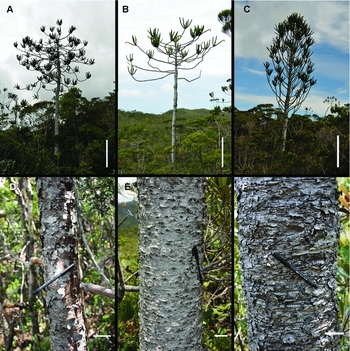
Araucaria goroensis habit and bark. A, Mamié (SNCA 27). B, Mamié (SNCA 28). C, Col de Yaté (not collected). D, Col de Yaté (SNCA 456). E, Col de Yaté (SNCA 444). F, Col de Yaté (SNCA 453). Scale bars: A–C, 2 m; D–F, 5 cm. (Photographs by RBGE staff.)

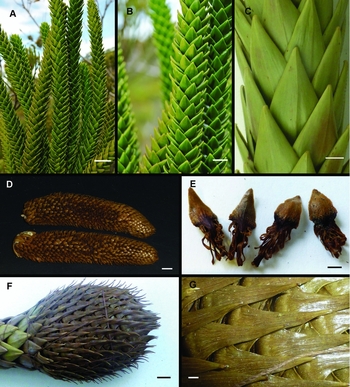
Araucaria goroensis vegetative and reproductive characters. A and B, Foliage (in field: SNCA 475). C, Foliage (dried: Hollingsworth et al. 446). D, Male cones (Hollingsworth et al. 28). E, Microsporophylls and pollen sacs (Hollingsworth et al. 27). F, Immature seed cone with mm scale (from holotype, Gardner et al. 62). G, Female cone bracts (from holotype, Gardner et al. 62). Scale bars: A, 50 mm; B, 20 mm; C, 5 mm; D, 10 mm; E, 2 mm; F, 10 mm; G, 2 mm. (Photographs A–C by M. F. Gardner, and D–G by R. R. Mill.)

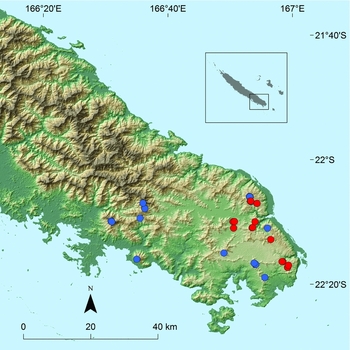
Map of Southeast New Caledonia, showing distributions of Araucaria goroensis (red dots) and A. muelleri (blue dots). The area of the main map is indicated by the black rectangle in the inset. Some of the smallest populations have been omitted or amalgamated as a single dot. For more details, including population sizes, see Figure 6 of Ruhsam et al. (Reference Ruhsam, Clark, Finger, Wulff, Mill, Thomas, Gardner, Gaudeul, Ennos and Hollingsworth2016).

Taxonomic Treatment
Araucaria goroensis R.R.Mill & Ruhsam, sp. nov. Sect. Eutacta. Figs 1 – 4 .
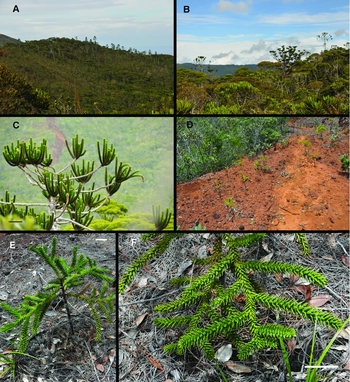
Araucaria goroensis: habitat and reproduction. A and B, Col de Yaté (location of SNCA 475); note numerous trees in distance in A. C, Upper part of tree with old male cones (SNCA 28). D, Trackside regeneration, Col de Yaté. E, Sapling, Col de Yaté (SNCA 447). F, Detail from E. Scale bars: C, 20 cm; E, 80 mm; F, 50 mm. (Photographs by RBGE staff.)

Araucaria goroensis is similar to Araucaria muelleri (Carrière) Brongn. & Gris but can be distinguished by the adult leaves more strongly incurved and much more lustrous abaxially, with the abaxial stomatal rows confined to the base and extreme apex (sometimes only base) instead of extending the length of the leaf, and by the denticulate (not erose or entire) margins of the microsporophylls, which are not rugose proximally and have a much longer, acute (not short and broadly rounded) tip. From Araucaria rulei F.Muell., the new species can be distinguished by its larger adult leaves (normally at least 25 mm long), the largest ones being near the middle of the branchlet, rather than in its lower third, and with a less acute (often rounded) apex, the different shape of the microsporophyll lamina (ovate, not broadly lanceolate or caudate, and with its margins almost straight, not broadened into a shoulder-like basal area), and by the shorter, less caudate and less strongly reflexed female cone bracts. – Type: New Caledonia, Province Sud, Yaté commune, Goro Plateau above Rivière Kuébini, 22°17′19.4′′S 166°53′06.8′′E, 254 m, 27 xi 2005 (female), M.F. Gardner, M. Gaudeul & P.M. Hollingsworth 62 (holo E [E00215452]: sheet with attached female cone).
Tree to 30 m tall but more typically to 15 m; dbh to at least 30 cm; monoecious. Trunk straight, leafless except in uppermost part, even in young saplings (Fig. 1A–C). Crown in mature trees candelabriform, open. Outer bark light grey to almost white, occasionally reddish grey, exfoliating in horizontal strips; inner bark dark red (Fig. 1D–F). Branching Rauh model; generally two orders of branching but primary branches rarely biramulate below tip; primary branches in pseudowhorls of 4, on younger trees ascending, when more mature spreading horizontally or the lower ones declinate and finally caducous (Fig. 1A–C). Foliage branchlets (secondary branches) assurgent to erect, bunched at tips of branches in groups of 9–17, slightly incurving, narrowly cylindrical and broadest near the middle (Fig. 4C). Leaves present on first- and second-order branches, and uppermost part of trunk, but retained only on the ultimate branchlets (Fig. 4C). Leaves on young seedlings acicular, curved inwards towards tip, abaxially keeled, acute, longest in middle part of branchlet. Leaves on saplings (Fig. 4E,F) divergent from axis, ovate-lanceolate, subacute to acute with the extreme tip rounded, bright green and glossy, keeled abaxially, the stomata confined to the base and tip. Adult leaves on trunk brown and very soon caducous (present only in uppermost part, even on saplings), arising from non-contiguous, transversely elliptic attachment bases, the lamina subappressed, narrowly triangular-lanceolate from a wider base, acute, considerably shorter and narrower than leaves of primary branches. Adult leaves of ultimate branchlets (Fig. 2A–C) broadly lanceolate to ovate, (22–)26–33 × (8–)11–16 mm, not decurrent, widest just above their base (the widest point obscured by adjacent overlapping leaves), slightly divergent but appearing appressed especially in dried material, tapering to a slightly incurved, subacute apex, weakly convex. Stomatal rows (adult foliage leaves): abaxial (0–)13–71 at base of leaf with longer and shorter rows alternating to form multiple peaks, giving an ‘A’, ‘double A’ or ‘multiple A’ arrangement of rows, typically only at the centre and/or keel region and with all or most rows not extending to the widest point of the lamina; 0–11 short rows at apex; adaxial 90–140 rows, typically in several alternating stomatiferous bands of several rows each separated by green non-stomatiferous bands, the stomatiferous bands most often extending beyond the middle of the lamina. Leaves subtending pollen cones similar to adult ones but slightly shorter, themselves all subequal in length but the innermost ones much narrower and lingulate (Fig. 2D, lower cone). Leaves subtending seed cones: lowermost ones slightly broader than the branchlet leaves immediately below but otherwise similar; those of inner spirals gradually becoming narrower and more like the cone bract tips. Pollen cones (Fig. 2D) terminal on ultimate foliage branches, erect when shedding pollen, declinate when old, cylindrical, green at first, pinkish brown or brown when old, 11–21 × 2.7–4 cm, straight or curved, slightly tapering towards apex. Microsporophylls (Fig. 2E) attached to a stout rachis, imbricate; stalk linear, 3.5–6 × 1–1.2 mm, lamina ovate-lanceolate, tapered but with the edges nearly straight and not abruptly broadening into a shoulder-like base, c.5–6.5 × 3–4 mm, base thick and adaxially blackish, abaxially keeled and glossy, on both surfaces with a few intermittent rows of stomata extending to the apex, tapered to an acute, shortly pungent-mucronate apex (mucro c.1 mm), margins finely denticulate. Pollen sacs (Fig. 2E) 12–14, in three unequal rows, linear, 2–4(–5) mm, somewhat contorted after dehiscence, those nearest the stalk with an incurved cucullate or hooked apex, the longest ones with somewhat spathulate tips. Female cones (only immature seen: Fig. 2F) terminal on short branchlets, solitary, erect, green, ellipsoid, c.10 × 7.5 cm, densely covered with recurved bract tips; bract-scale complexes c.250. Bracts (Fig. 2G) flabellate, ending in a caudate, upward-curved, acute and shortly pungent tip; abaxial surface with (7–)11–15 intermittent rows of stomata, some of which extend to near the apex. Seeds not seen.
Etymology
The epithet refers to the Goro Plateau in southern New Caledonia, the type locality.
Phenology
On the basis of the limited sexual material seen, male cones of Araucaria goroensis appear to mature in early July. This is earlier than in both Araucaria rulei, in which pollination takes place in August and September (Sarrailh et al., Reference Sarrailh, Chauvin, Litaudon, Dumontet and Pieters2004), and A. muelleri, in which they are mature from September to December (unpublished data, from herbarium collections). As in many other Araucaria species, the old, spent male cones of A. goroensis remain on the tree for several months after shedding of pollen, as in Hollingsworth et al. 28 (E), collected in late October (Fig. 4C). The single female specimen seen (designated as the holotype) was collected in late November; the attached cone is fairly mature. Numerous young seedlings were also observed in November 2008 by P. M. Hollingsworth et al. (Fig. 4D–F).
Distribution
Southeast New Caledonia (Grande Terre, Province Sud); endemic and apparently known only from Yaté commune, where it occurs at three main sites: the Goro Plateau, the Rivière des Lacs and the Mamié area (Fig. 3). Bioregion: New Caledonia. Ecoregion: AA0113 New Caledonia rain forests (World Wildlife Fund, no date).
Habitat and ecology
Araucaria goroensis occurs as an emergent in open forest and maquis vegetation (maquis minier) on acidic ultramafic substrates at altitudes of c.150–550 m (Fig. 4A,B). The soil is a lateritic iron-crust oxisol of a type known as cuirasse (McCoy et al., Reference McCoy, Kurpisz and Newedou2002; Robineau et al., Reference Robineau, Berthault and Christmann2011), and the underlying rock type is peridotite (cf. the relevant geological map: Sevin et al., Reference Sevin, Maurizot and Vendé-Leclerc2012). Dominants of the canopy layer include Dacrydium araucarioides Brongn. & Gris (Podocarpaceae) and Gymnostoma deplancheanum (Miq.) L.A.S.Johnson (Casuarinaceae). Other associates include Dracophyllum ramosum Pancher ex Brongn. & Gris and Styphelia pancheri (Brongn. & Gris) F.Muell. (both Ericaceae) and Solmsia calophylla Baill. (Thymelaeaceae) (Wilcox & Platt, Reference Wilcox and Platt2002). The research on seedling recruitment and mortality and stress-tolerator leaf traits in Araucaria ‘muelleri’ by Enright et al. (Reference Enright, Miller, Jaffré, Wilcox and Bielelski2009, Reference Enright, Miller, Perry, Goldblum and Jaffré2014) was largely based on various study sites on the Goro Plateau, and therefore much of the ecological information in their 2009 paper and most of the results in the 2014 one pertain to A. goroensis, not A. muelleri.
Conservation status
For Araucaria goroensis we here propose a preliminary IUCN conservation assessment of EN B1ab(ii,iii,iv,v)+2ab(ii,iii,iv,v). The extent of occurrence is estimated to be about 100 km2, with an area of occupancy estimated to be considerably less than 500 km2. There are fewer than five locations sensu IUCN. One of the principal threats is expansion of mining activities, especially on the Goro Plateau, where a nickel processor has been constructed; however, habitat restoration is also being initiated there (Cornu et al., Reference Cornu, Sarrailh and Marion2001). None of the sites is in a protected area, and except at Mamié, population sizes at each site are small to very small (five to usually < 50 individuals). About 200 individuals of Araucaria goroensis are known at Le Trou, and a mixed population of 500–1000 individuals of A. muelleri and A. goroensis at Mamié (Ruhsam et al., Reference Ruhsam, Clark, Finger, Wulff, Mill, Thomas, Gardner, Gaudeul, Ennos and Hollingsworth2016).
Additional specimens examined. NEW CALEDONIA. Province Sud: Yaté commune : Plateau de Goro, 20 i 1915, Franc 1951 (P). Plateau de Goro, 150 m, 6 v 1964, MacKee 11504 (P). Plateau de Goro, 250 m, 2 vii 1968, Corbasson (hb. MacKee 19105) (P). Goro Plateau above Rivière Kuébini, 22°16′22.5′′S 166°58′20.2′′E, 285 m, 27 xi 2005, Gardner et al. 51 (E); ibid., Gardner et al. 52 (E); ibid., 27 xi 2005, Gardner et al. 53–61 (E, single-leaf vouchers). Road to Xeré Wapo between Le Trou and Nuu Mwadre, 22°16′24′′S 166°58′29′′E, 260 m, 31 v 2001, Gardner et al., New Caledonia Araucaria Exped. 870 (E); Vallée des Lacs (pont), 6 x 1950, Guillaumin & Baumann-Bodenheim 6597 (P, Z–image); Route de Yaté, en aval du pont de la Rivière des Lacs, 150 m, 7 vii 1968, Lavoix (hb. MacKee 19108) (P); Rivière des Lacs, tributary creek near mouth of river, 22°10′S 166°51′E, 170 m, 9 xi 2005, Farjon & Moore 677 (P, NOU–n.v.); Rivière des Lacs, 100 m downstream from second turning off main road (after bridge) towards Chûtes de la Madeleine, 22°09′58′′S 166°50′42′′E, 170 m, 29 xi 2002, Gardner et al., Third New Caledonia Araucaria Exped. TNCA 5006 (E); ibid., 24 xi 2005, Gardner et al. 49 (E); Mamié, 22°07′03′′S 166°54′19′′E, 480 m, 9 vi 2001, Gardner et al., New Caledonia Araucaria Exped. 331 (adolescent), 332 & 333 (all E); Mamié, between Ointapoin and Tiova, 22°06′42.4′′S 166°53′15.5′′E, 526 m, 26 x 2008, Hollingsworth et al. SNCA 27 (E, sheet and separate male cones); 22°06′40.2′′S 166°53′18.2′′E, 539 m, 26 x 2008, Hollingsworth et al. SNCA 28 (E, male); 537 m, 26 x 2008, Hollingsworth et al. SNCA 76–78, 80–88 (E, single-leaf vouchers). Col de Yaté, above road to Yaté, above cross on hill top, 22°10′S 166°54′E, 494 m, Farjon & Moore 676 (P, NOU–n.v.); S of Col de Yaté on ridge leading to Ka Yé Wagwé, 22°10′53.5′′S 166°53′36.7′′E, 423 m, 11 xi 2008, Hollingsworth et al. SNCA 444 (E); ibid., 22°10′53.8′′S 166°53′37′′E, 418 m, 11 xi 2008, Hollingsworth et al. SNCA 446 (E + male cones in E carpological coll.); ibid, 22°10′57.3′′S 166°53′33.1′′E, 417 m, 11 xi 2008, Hollingsworth et al. SNCA 453 (E, male cones in carpological coll.; P); ibid., 22°10′56.6′′S, 166°53′32.2′′E, 423 m, 11 xi 2008, Hollingsworth et al. SNCA 463 (E); ibid., 11 xi 2008, Hollingsworth et al. 447–452, 454, 456, 459–462, 465–468, 473 and 475 (E, single-leaf vouchers). Sources de la Kuébini, 22 ix 1965, Veillon 436 (NOU, 2 sheets–photos).
Araucaria muelleri (Carrière) Brongn. & Gris, Bull. Soc. Bot. France 18: 141 (1871: Brongniart & Gris, Reference Brongniart and Gris1871a); Nouv. Arch. Mus. Hist. Nat. 7: 219, t. 15 & 16 (1871: Brongniart & Gris, Reference Brongniart and Gris1871b); Ann. Sci. Nat., Bot., Sér. 5 13: 362 (1871: Brongniart & Gris, Reference Brongniart and Gris1871c). – Eutacta muelleri Carrière, Rev. Hort. 37: 392 (Reference Carrière1866, ‘Muellerii’). – [Eutassa muelleri (Carrière) de Laub. in Bieleski & Wilcox (eds), Araucariaceae: 42 (2009), nom. inval. (ICN Art. 41.5: McNeill et al., Reference McNeill, Barrie, Buck, Demoulin, Greuter, Hawksworth, Herendeen, Knapp, Marhold, Prado, Prud'homme van Reine, Smith, Wiersema and Turland2012; bibliographic reference given for Araucaria muelleri instead of a full and direct reference to the place of publication of the basionym)]. – Lectotype (designated by de Laubenfels, Reference de Laubenfels, Aubréville and Leroy1972: 88 and reaffirmed here; see notes on typification below): illustration of Eutacta muelleri in Carrière, Rev. Hort. 37, t. 3 (Reference Carrière1866). Epitype (designated here): New Caledonia, Baie de Prony, ix 1868, B. Balansa 1868: 188 (epi P [P00190550]; isoepi P [P00190551], BM, K).
Eutassa latifolia de Laub., Novon 24: 130 (2015), syn. nov. – Type: New Caledonia, Montagne des Sources, 19 xi 1964, D. J. de Laubenfels P371 (holo ?P, not located; iso A, BRI, HNT–n.v., RSA–n.v.). De Laubenfels (Reference de Laubenfels2015) stated that the holotype repository for this name was P, but this specimen was not located during a visit to the P herbarium in 2005 and an image is not available online; however, the isotypes at A and BRI have been confirmed. The number was cited by de Laubenfels (Reference de Laubenfels, Aubréville and Leroy1972: 89) under Araucaria muelleri.
Typification and nomenclature
De Laubenfels (Reference de Laubenfels2015) recently published the name Eutassa latifolia de Laub. to replace Araucaria muelleri (his circumscription of which included the plants segregated by us as A. goroensis) and retypified its basionym, Eutacta muelleri Carrière, by Vieillard 1276. In that paper, he incorrectly believed that the basionym of Eutacta muelleri Carrière had been misapplied in its protologue (Carrière, Reference Carrière1866), which mentioned an unpublished manuscript name, ‘Araucaria Rulei grandifolia Muell.’, in synonymy. This ‘name’ was published without indication of rank, but because it appeared in 1866, it may be deemed to have been published at the rank of variety (ICN Art. 37.4: McNeill et al., Reference McNeill, Barrie, Buck, Demoulin, Greuter, Hawksworth, Herendeen, Knapp, Marhold, Prado, Prud'homme van Reine, Smith, Wiersema and Turland2012), as was in fact indicated on the label of one example of Vieillard 1276 (P00190643; see below). De Laubenfels (Reference de Laubenfels2015) also cited one of several sheets of Vieillard 1276 at P as ‘holotype’ of Araucaria muelleri, although in 1968 he had annotated the same sheet stating categorically that “this specimen is referred to in error as the type for Eutacta muelleri”. All specimens at P numbered Vieillard 1276 taxonomically belong to Araucaria rulei; the one chosen as ‘holotype’ of Eutassa latifolia was determined as A. rulei both by de Laubenfels in 1968 and by one of us (R.R.M., with A. Farjon) in 2005. The fact that this example of Vieillard 1276 bears a label with the name Araucaria rulei var. grandifolia F.Muell. might have prompted de Laubenfels (Reference de Laubenfels2015) to overturn his original lectotypification of Araucaria muelleri (de Laubenfels, Reference de Laubenfels, Aubréville and Leroy1972) by Carrière's illustration (Carrière Reference Carrière1866: t. 3) and select an example of Vieillard 1276 as type instead. However, his most recent actions are inappropriate and incorrect for several reasons, as enumerated below.
-
1. The ‘name’ Araucaria rulei var. grandifolia cited in the protologue of Eutacta muelleri is an unpublished manuscript name. It has never been validly published, by either Carrière (Reference Carrière1866) or anyone else, and no attempt should have been made to either typify it or use it to try to typify Eutacta muelleri. It has no nomenclatural status under the ICN (Art. 12: McNeill et al. Reference McNeill, Barrie, Buck, Demoulin, Greuter, Hawksworth, Herendeen, Knapp, Marhold, Prado, Prud'homme van Reine, Smith, Wiersema and Turland2012) and should therefore have been ignored.
-
2. No specimen was cited in Carrière's protologue of Eutacta muelleri, only the unpublished manuscript name mentioned above, and therefore there cannot be a ‘holotype’ (ICN Art. 9: McNeill et al., Reference McNeill, Barrie, Buck, Demoulin, Greuter, Hawksworth, Herendeen, Knapp, Marhold, Prado, Prud'homme van Reine, Smith, Wiersema and Turland2012); de Laubenfels (Reference de Laubenfels2015) has in effect chosen a new lectotype to replace his earlier 1972 designation.
-
3. De Laubenfels (Reference de Laubenfels2015: 130) specified the specimen newly designated as ‘holotype’ of Eutacta muelleri as ‘Canala, 1861, E. Vieillard 1276 (holotype, P)’. There are, however, five sheets, bearing numerous examples, of Vieillard 1276 at P, barcoded P00190642, P00190643, P00190644, P00190645 and P00190646. Only one of these, that barcoded P00190643, is labelled Araucaria rulei var. grandifolia in accordance with de Laubenfels’ argument, and we therefore assume that this sheet is the one to which he was referring; its label is numbered Vieillard 1276, like the other four, but for some reason the number was wrongly listed in the Paris image database as ‘1274’ when it was consulted on 6 September 2016. This sheet, however, is in serious conflict with Carrière's protologue of Eutacta muelleri (ICN Art. 9.19(b): McNeill et al., Reference McNeill, Barrie, Buck, Demoulin, Greuter, Hawksworth, Herendeen, Knapp, Marhold, Prado, Prud'homme van Reine, Smith, Wiersema and Turland2012) and lectotypification by it must therefore be rejected. Carrière's protologue described the leaves of Eutacta muelleri as being 35–45 mm long and 15–18 mm wide, whereas on that example of Vieillard 1276 they are only 16–21 × 6.3–7.5 mm; the protologue described the leaves of Eutacta muelleri as ‘légèrement [slightly or gently] concaves’, whereas on that example of Vieillard 1276 they are strongly concave. Additionally, the protologue described them as straight (droite, which Carrière emphasised in italics, in contrast to Araucaria rulei, in which they arch inwards towards the branch axis, as emphasised by the word arquées in italics in Carrière's description of Eutacta rulei in the same work), whereas on that example of Vieillard 1276 they are curved. De Laubenfels (Reference de Laubenfels, Aubréville and Leroy1972) believed that the actual specimen on which Carrière based his description of Eutacta muelleri was missing, and as mentioned above, a search of the P herbarium by R.R.M. in 2005 also failed to find it.
-
4. All examples seen of Vieillard 1276 at P were collected at ‘Kanala’ (= Canala, Province Nord), where Araucaria muelleri as currently understood has never been recorded (it is restricted to the southern part of Province Sud: Fig. 3) but A. rulei does occur there. All except the one erroneously chosen as ‘holotype’ of Eutacta muelleri by de Laubenfels (Reference de Laubenfels2015) are named ‘Araucaria intermedia Vieill.’, whereas the one bearing the label Araucaria rulei var. grandifolia has that label overwritten, “Araucaria que j'avais envoyé sous le nom d'intermedia”, suggesting that someone, possibly Vieillard himself, regarded the sheet as mislabelled.
-
5. The sheet of Vieillard 1276 barcoded P00190643, here assumed to be the specimen de Laubenfels designated ‘holotype’ of Eutacta muelleri, also bears a label indicating that it was donated to the Paris herbarium in 1894, more than 30 years after Carrière published Eutacta muelleri. Therefore this sheet could not have been seen by Carrière when the protologue was written.
For these reasons, we therefore reject de Laubenfels’ Reference de Laubenfels2015 holotype designation of Eutacta muelleri, his synonymisation of that name with Eutassa rulei (F.Muell.) de Laub. (de Laubenfels Reference de Laubenfels2015, i.e. Araucaria rulei) and his renaming of what is normally called Araucaria muelleri as Eutassa latifolia. The latter name becomes a synonym of Araucaria muelleri, as indicated above. Because the illustration of Eutacta muelleri chosen as lectotype by de Laubenfels (Reference de Laubenfels, Aubréville and Leroy1972) only depicts leaves and lacks any indication of scale that would allow ready separation from the similarly shaped but much smaller leaves of Araucaria rulei, and no corresponding contemporary specimen has been traced, we here designate the male specimen Balansa 1868: 188 at P as epitype of Araucaria muelleri. This specimen, mounted on two sheets (now barcoded P00190550 and P00190551), was used by Brongniart & Gris (Reference Brongniart and Gris1871a–Reference Brongniart and Grisc) to illustrate their description of Araucaria muelleri, which was the first to include details (all three works, Brongniart & Gris, Reference Brongniart and Gris1871a, apparently being earliest, because the other two publications refer to it) and illustrations (only Brongniart & Gris, Reference Brongniart and Gris1871b) of the male and female cones of the species. Taking account of the lateral inversion that occurs in lithography, it is clear that the example barcoded P00190550 provided the source of the leafy shoot depicted in plate 15 of Brongniart & Gris (Reference Brongniart and Gris1871b), whereas the right-hand cone on the sheet barcoded P00190551 appears to have been the source of the illustration of the male cone on the same plate. Brongniart & Gris (Reference Brongniart and Gris1871a: 139, Reference Brongniart and Gris1871b: 220, Reference Brongniart and Gris1871c: 363) mentioned that the female cones were described from detached cones collected at Koghis by Pancher, but we have not seen these. Typical Araucaria muelleri still occurs at Koghis (e.g. Ziarnik 40, NOU; Gardner et al. NCA 919 and NCA 1025, E); A. goroensis does not occur there, and it may therefore be safely assumed that Brongniart & Gris’ description of these female cones applies to those of A. muelleri as circumscribed here.
Description and distribution
For a description of Araucaria muelleri, Farjon (Reference Farjon2010: 207–208) may be consulted, but excluding all references to plants with lustrous leaves ± lacking abaxial stomata – these are A. goroensis. Map: this paper, Figure 3 (also see Ruhsam et al., Reference Ruhsam, Clark, Finger, Wulff, Mill, Thomas, Gardner, Gaudeul, Ennos and Hollingsworth2016, Fig. 6).
Conservation status
Araucaria muelleri is currently listed as Endangered EN B1ab(i,ii,iii,iv,v)+ 2ab(i,ii,iii,iv,v) on the basis of an assessment by Thomas (Reference Thomas2010). The removal of the Goro populations from Araucaria muelleri to A. goroensis will not change this status even though they account for about 40% of the plants previously thought to belong to A. muelleri (Ruhsam et al., Reference Ruhsam, Clark, Finger, Wulff, Mill, Thomas, Gardner, Gaudeul, Ennos and Hollingsworth2016), because the remaining populations cover an area that is still within the thresholds for EN. The assessment of LC (Least Concern) given to Eutassa latifolia (= Araucaria muelleri sensu lato including A. goroensis) by de Laubenfels (Reference de Laubenfels2015) is entirely inappropriate and discounts the serious threats facing this species.
Discussion
Although Araucaria goroensis has hitherto been confused with A. muelleri (e.g. Jaffré, Reference Jaffré2000; Chazeau et al., Reference Chazeau, Jourdan, Bonnet de Larbogne, Konghouleux and Potiaroa2004; Enright et al., Reference Enright, Miller, Jaffré, Wilcox and Bielelski2009, Reference Enright, Miller, Perry, Goldblum and Jaffré2014), both genetically and morphologically it has more in common with A. rulei. Araucaria rulei is widespread throughout much of New Caledonia except the extreme south, where it is replaced by A. muelleri. Both species occur in their pure form at Mamié, where Araucaria goroensis has also been collected. The possibility of Araucaria goroensis being of hybrid origin cannot be discounted, but both male and female examples of it have been seen and it therefore appears to behave as a biologically distinct entity that, on the evidence of photographs seen, produces prolific seedlings. Therefore, we here award it species status. It has features of both male and female cones that are different from the character states found in either Araucaria muelleri or A. rulei. In Araucaria rulei, the laminar part of the microsporophyll is shield-shaped with the edges broadening outwards in the lower third, giving a shouldered appearance, whereas in A. goroensis this shoulder is lacking and the edges are nearly straight and taper evenly from very close to the base of the lamina. In Araucaria muelleri, the microsporophyll lamina is shorter than in either A. goroensis or A. rulei and has a very rounded (although minutely mucronate) tip. The cone bracts of the female cones of Araucaria goroensis are shorter and in consequence less caudate than those of A. rulei and are less strongly reflexed. Araucaria muelleri has even shorter cone bracts in which the laminar part, which is hooked at the tip, is little longer than the much broader base.
With the addition of Araucaria goroensis, the ‘large-leaved clade’ of the genus, as defined by Gaudeul et al. (Reference Gaudeul, Rouhan, Gardner and Hollingsworth2012) and Ruhsam et al. (Reference Ruhsam, Rai, Mathews, Ross, Graham, Raubeson, Mei, Thomas, Gardner, Ennos and Hollingsworth2015), now comprises seven New Caledonian endemics. A key to all these species is given below.
Key to the ‘large-leaved clade’ of New Caledonian Araucaria species, based chiefly on adult foliage characters
This key covers the six species previously included in the ‘large-leaved clade’ of New Caledonian Araucaria species as defined by Ruhsam et al. (Reference Ruhsam, Rai, Mathews, Ross, Graham, Raubeson, Mei, Thomas, Gardner, Ennos and Hollingsworth2015), as well as the new species described in this paper. It is based primarily on characters of the adult foliage leaves that can be utilised in the field with a good hand lens (× 15 or × 20). Araucaria montana is a variable species and has therefore been keyed out twice.
-
1a. Abaxial surface of branchlet leaves with at least some rows of stomata extending to leaf apex, without a clear stomata-free gap in the middle of the lamina_________________________2
-
1b. Abaxial surface of branchlet leaves with stomata either proximal only or proximal and distal, with none in the central region of the lamina_________________________4
-
2a. Branchlet leaves > 10 mm wide_________________________A. muelleri
-
2b. Branchlet leaves < 10 mm wide_________________________3
-
3a. Leaves 5.5–10 mm wide; stomata organised in bands of 3–5 rows each_________________________A. laubenfelsii
-
3b. Leaves 3.5–5 mm wide; stomata not organised in bands_________________________A. biramulata
-
4a. Branchlet leaves > 5 mm wide_________________________5
-
4b. Branchlet leaves < 5 mm wide_________________________7
-
5a. Abaxial stomatal rows proximal and distal, the proximal ones organised into bands; leaves abaxially very strongly convex, slightly but not highly glossy A. montana
-
5b. Abaxial stomatal rows more or less confined to proximal end of lamina, with distal rows absent or very few and very short, the proximal rows not organised in bands; leaves less convex abaxially and highly glossy_________________________6
-
6a. Leaves usually 26–33 mm long, usually 5 in both adaxial and abaxial half-spirals; microsporophyll laminas with more or less straight edges, lacking a shouldered base_________________________A. goroensis
-
6b. Leaves (8–)13–25 mm long, 6 in both adaxial and abaxial half-spirals; microsporophyll laminas abruptly broadened in lower third into a shoulder-like base_________________________A. rulei
-
7a. Branchlet leaves usually 1.5–3.5 mm wide, ovate, the marginal papillae sparse or absent_________________________A. humboldtensis
-
7b. Branchlet leaves (4.5–)5 mm in width, the marginal papillae numerous (look along inrolled edges)_________________________ A. montana
Acknowledgements
We would like to thank the Société Le Nickel, especially Claire Nicolas-Gueunier and Frédéric Bart, for their involvement in and financial help towards this project. We are also grateful to IRD Nouméa, in particular Tanguy Jaffré and Jérôme Munzinger, for logistical support in the field, and to the Province Sud and Province Nord authorities of New Caledonia for granting collection permits. We also acknowledge the considerable help of Myriam Gaudeul (P) in the fieldwork, which resulted in the collection of the material of Araucaria goroensis. The photographs of Araucaria goroensis in the field were taken by staff of the Royal Botanic Garden Edinburgh (RBGE). Mark Hughes (RBGE) kindly created composite publication-ready figures from the individual images, and the map that forms Figure 3 was created by Vanezza Morales. Mai-Lan Kranitz photographed Araucaria specimens at NOU. RBGE is supported by the Scottish Government's Rural and Environment Science and Analytical Services Division.