Introduction
Enlargement of the pituitary gland has been reported in schizophrenic psychoses and patients with an at-risk mental state for psychoses (ARMS).Reference Garner, Pariante and Wood 1 – Reference Nordholm, Krogh and Mondelli 3 Cross-sectional studies indicate that pituitary volume (PV) is increased at psychosis onsetReference Pariante, Dazzan and Danese 4 and even in the prodromal stage of the disease.Reference Garner, Pariante and Wood 1 , Reference Büschlen, Berger and Borgwardt 5 This enlargement seems to be more pronounced in ARMS with later transition to psychosis compared to ARMS without transition to psychosis.Reference Büschlen, Berger and Borgwardt 5 PV seems to be further increased by most antipsychoticsReference Pariante, Vassilopoulou and Velakoulis 6 through lactotroph hyperplasia.Reference Markianos, Hatzimanolis and Lykouras 7
Studies with chronic schizophrenia patients suggest that initial enlargement is followed by a decrease of PV.Reference Pariante 2 , Reference Pariante, Vassilopoulou and Velakoulis 6 The decrease following the initial enlargement has not only been found in treatedReference Pariante, Vassilopoulou and Velakoulis 6 but also in untreatedReference Upadhyaya, El-Sheikh, MacMaster, Diwadkar and Keshavan 8 patients and might be caused, among other factors, by a chronic activation of the HPA axis.Reference Pariante, Vassilopoulou and Velakoulis 6 , Reference Sassi, Nicoletti and Brambilla 9
Results of longitudinal MRI studies are less consistent than those of cross-sectional studies due to different types of medications at baseline and during follow-up, as well as to the length of the follow-up. To our knowledge, only 4 longitudinal MRI studies on PV changes in first-episode psychosis (FEP) patients have been conducted. MacMaster etalReference MacMaster, El-Sheikh and Upadhyaya 10 found a 12% increase in an originally antipsychotic-naïve population with schizophrenia, possibly driven by the prolactin-elevating antipsychotic risperidone (follow-up period 12 months). Takahashi etalReference Takahashi, Zhou and Nakamura 11 also found an enlargement over time in 18 FEP and 13 schizotypical disorder patients (all on antipsychotic treatment at baseline and follow-up) over a follow-up period of approximately 2.7 years. The third studyReference Nicolo, Berger and Garner 12 showed a dose-dependent reduction of PV in patients with atypical antipsychotic medication during a 3-month follow-up. Because in this study mostly quetiapine was used, which does not induce hyperprolactinemia, this might reflect the “natural course” of PV development. A recently published study in 55 FEP patients did not find changes in PV following antipsychotic treatment.Reference Gruner, Christian and Robinson 13
However, to date, there are no longitudinal studies on PV changes in ARMS individuals. Hence, this study aimed to elucidate how PV changes develop during emerging psychosis. Specifically, we aimed to investigate PV changes associated with the onset of psychosis by comparing subjects with an ARMS with later transition to psychosis (ARMS-T) versus those without transition (ARMS-NT). In a longitudinal analysis, we expected to find a progression of PV enlargement in ARMS-T compared to ARMS-NT, as stress is known to trigger the transition to psychosis and also to increase PV due to activation of adrenocorticotropic hormone (ACTH) and prolactin synthesis.Reference Pariante 2 , Reference Büschlen, Berger and Borgwardt 5 , Reference Riecher-Rössler, Rybakowski and Pflüger 14 – Reference Holtzman, Shapiro, Trotman and Walker 18
Methods
Study design
This imaging study was embedded in the Früherkennung von Psychosen (FePsy) study, which is an open, prospective, clinical study of all consecutive referrals to a specialized clinic for the early detection of psychosis.Reference Riecher-Rössler, Gschwandtner and Aston 19 , Reference Gschwandtner, Pflueger and Semenin 20 From March 1, 2000, to February 29, 2004, individuals with suspected ARMS were identified and investigated in various modalities, including psychopathology and neuropsychology. Follow-up assessments of all ARMS individuals were conducted at regular intervals (see section “Measures”).
Setting
Subjects were recruited through the FePsy Early Detection Clinic at the University Psychiatric Outpatient Department, Basel, Switzerland, a clinic specifically designed to identify ARMS. To encourage early, low-threshold referrals, widespread information campaigns that targeted potential referring professionals and laypeople were conducted.Reference Riecher-Rössler, Gschwandtner and Aston 19 All referrals to the clinic during the study period were screened as described below.
The study was described comprehensively to the subjects, and written informed consent was obtained as per approved guidelines from the University of Basel local ethics committee (EKBB).
Inclusion criteria
Inclusion as ARMS required one or more of the following: (a) “attenuated” psychotic symptoms (scores of 2 or 3 on the hallucination item, 3 or 4 on the unusual thought content or 3 or 4 on the suspiciousness items of the Brief Psychiatric Rating Scale (BPRS)Reference Lukoff, Liberman and Nuechterlein 21 for at least several times a week and persisting for more than 1 week); (b) brief, limited, intermittent psychotic symptoms (BLIPS) (scores of 4 or above on the hallucination item, or 5 or above on the unusual thought content, suspiciousness or conceptual disorganization items of the BPRS, with each symptom lasting less than 1 week before resolving spontaneously); (c) a first-degree relative with a psychotic disorder plus at least 2 indicators of a clinical change, such as marked decline in social or occupational functioning; or (d) minimal amount and combination of unspecific risk factors according to the Basel Screening Instrument for Psychosis (BSIP)Reference Riecher-Rössler, Aston and Ventura 22 and proficiency in the German language.
Exclusion criteria
Exclusion criteria were as follows: age below 18 years; insufficient knowledge of German; IQ<70; previous episode of diagnosed and treated schizophrenic psychosis or treatment with antipsychotics for more than 3 weeks (lifetime) equivalent to a chlorpromazine dose of 2500 mgReference Woods 23 ; psychosis due to organic brain disease, including substance dependency, or psychotic symptoms within a clearly diagnosed affective disorder or borderline personality disorder. For this part of the study, only patients with normal thyroid function were included. When it was not suitable to perform an MRI (eg, pacemaker, metal in the body), subjects were excluded from the imaging part of the FePsy study.
Measures
Screening instrument
The ARMS was assessed using the BSIP, which was specifically developed for this purpose.Reference Riecher-Rössler, Aston and Ventura 22 The BSIP is based on the Diagnostic and Statistical Manual of Mental Disorders, Third Edition, Revised (DSM-III-R) prodromal symptoms and other prodromes as derived from the literature, as well as social decline, drug abuse, previous psychiatric disorders, and genetic risk; 4 psychosis items of the expanded version of the BPRSReference Lukoff, Liberman and Nuechterlein 21 for assessing (pre-) psychotic phenomena were incorporated. The BSIP allows for the rating of individuals regarding inclusion/exclusion criteria corresponding to the Personal Assessment and Crisis Evaluation (PACE) criteria,Reference Yung, Phillips and McGorry 24 , Reference Yung, McGorry and Francey 25 and has been shown to have a good inter-rater reliability for the assessment of the main outcome category “at risk for psychosis” and a high predictive validity.Reference Riecher-Rössler, Aston and Ventura 22
Entry examination
All subjects selected for the study by screening subsequently underwent an extensive entry examination, which included the BPRS and the Scale for the Assessment of Negative Symptoms (SANS).Reference Andreasen 26
Follow-up
Each ARMS individual was followed up at regular intervals. During the first year of follow-up, high-risk individuals were assessed monthly using BPRS and SANS. During the second and third years, all individuals were assessed every 3 months and thereafter once annually. Transition to psychosis was monitored by applying the transition criteria of Yung etal.Reference Yung, Phillips and McGorry 24
Subjects
For this study, 23 antipsychotic-naïve individuals with an ARMS were included. By applying the above mentioned transition criteria, 10 of the 23 ARMS individuals made the transition to psychosis (ARMS-T) during follow-up period, and 13 did not transition to psychosis during the follow-up period (ARMS-NT). The relatively high transition rate (43%) is explained by the method by which we chose the patients. Of our original sample of ARMS patients,Reference Büschlen, Berger and Borgwardt 5 we chose the first 10 patients with transition to psychosis (ARMS-T) and invited them for a follow-up scan. The group of ARMS-NT was then matched to the group of ARMS-T in terms of age, gender, and education. Mean follow-up periods were 1034 and 1689 days in ARMS-T and ARMS-NT, respectively.
Baseline MRIs are part of our cross-sectional hippocampal volume study,Reference Buehlmann, Berger and Aston 27 and the sample partly overlaps with the sample of our longitudinal hippocampal volume study in ARMS.Reference Walter, Studerus and Smieskova 28
Image acquisition
Subjects were scanned at the time of study inclusion and were re-scanned after the onset of psychosis or at the end of the follow-up (approximately 5 years after inclusion to the study) if they did not develop psychosis.
All patients at baseline had 1.5 T scanning, and part of the follow-up scans were done with the 3 T scanner. Head movement was minimized by foam padding and Velcro straps across the forehead and chin. A three-dimensional volumetric spoiled gradient recalled echo sequence generated 176 contiguous, 1-mm thick sagittal slices. Imaging parameters were as follows for the 1.5 T scanner: time-to-echo, 3.04–4.00 ms; time-to-repetition, 1.9–9.7 ms; flip angle, 12–15°; matrix size, 200 × 256; field of view, 25.6 × 25.6 cm matrix; voxel dimensions, 1 × 1 × 1 mm. Imaging parameters were as follows for the 3 T scanner: time-to-echo, 3.37 ms; time-to-repetition, 2 ms; flip angle, 8°; matrix size, 256 × 256; field of view, 25.6 × 25.6 cm matrix; voxel dimension, 1 × 1 × 1 mm.
Image analysis
Original DICOM data were then converted to Analyze 7.5 format in axial direction, coded to ensure blindness of the investigator and patients’ confidentiality, and finally imported into the image-analysis software AMIRA.Reference Kappos, Antel and Comi 29
The pituitary glands were manually traced in the interactive public domain software program AMIRA using a method described by Sassi etal.Reference Sassi, Nicoletti and Brambilla 9 The pituitary stalk was excluded, but the posterior pituitary was included. We traced around the borders of the pituitary in the same way as previously describedReference Garner, Pariante and Wood 1 , Reference Pariante, Vassilopoulou and Velakoulis 6 , Reference MacMaster, El-Sheikh and Upadhyaya 10 , Reference Nicolo, Berger and Garner 12 : the diaphragma sellae superiorly, the sphenoid sinus inferiorly, and the cavernosus sinus laterally. First, the pituitary was traced in all coronal slices where it could be visualized. In addition to the method of Sassi etal,Reference Sassi, Nicoletti and Brambilla 9 the tracing was then corrected in sagittal and axial dimensions to be finally controlled on the coronal slices again. The software calculates the traced ROI volume in mm3 by summing the number of voxels of each traced slice.
All measurements were carried out by a trained and blinded rater (AW). The intra-rater intra-class correlation coefficient in a subset of 10 randomly selected brains was 0.81. All of our baseline scans have been part of the sample that was published in a cross-sectional investigation of our group.Reference Büschlen, Berger and Borgwardt 5 Inter-rater reliability was estimated based on 10 randomly selected cases measured in our previously published studyReference Büschlen, Berger and Borgwardt 5 and remeasured for this research by the first author of this article. The inter-rater intra-class correlation was 0.718.
The whole brain volume was measured to correct for differences in head size, as previously described.Reference Walter, Studerus and Smieskova 28 , Reference Borgwardt, McGuire and Aston 30 – Reference Haller, Borgwardt and Schindler 32
Statistical analysis
Analyses were performed using the R environment for statistical computing. 33 Clinical and demographic differences between groups were examined with Fisher's Exact test and Welch Two Sample t-test. PV changes over time were analyzed by using a linear mixed effects model that included a random intercept factor for the subjects and fixed effects for time, group (ARMS-T vs ARMS-NT), age, gender, medication, whole brain volume (baseline), scanner, and time by group and time by medication interactions. P-values of the fixed effects parameters were estimated by using Markov Chain Monte Carlo (MCMC) simulations using the pvals.fnc function in the languageR package. 34
Results
Demographic and clinical data
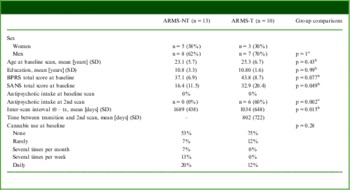
Regarding sex, age, education, and current cannabis use at baseline, there were no significant differences between ARMS with subsequent transition and ARMS without later transition to psychosis. However, there was a significantly higher SANS score and a trend toward higher BPRS scores at baseline in ARMS-T compared to ARMS-NT (Table 1). All patients were antipsychotic-naïve at baseline, but 6 of the ARMS-T patients had been treated with antipsychotics (2 olanzapine, 1 risperidone, 1 amisulpride, 1 perphenazine) at the second scan. This can be explained by the fact that these patients at transition often had to be treated before they could be scanned. The average time between transition and the second scan was 802 days. All ARMS-NT subjects were still antipsychotic-naïve at the follow-up scan. Compared to ARMS-T, the inter-scan (t0 – tx) interval was slightly longer in ARMS-NT (p = 0.015) as we wanted to be sure not to miss a transition.
Sociodemographic and clinical sample description

ARMS-NT = at-risk mental state without transition to psychosis; ARMS-T = at-risk mental state with transition to psychosis; SANS = Scale for the Assessment of Negative Symptoms26; BPRS = Brief Psychiatric Rating Scale.21
a Fisher's Exact test
b Welch Two Sample t test.
Pituitary volume
The mixed effects model revealed significant main effects of sex (p ≤ 0.001) and medication (p = 0.005): PVs were significantly larger in women and in patients treated with antipsychotics at the second scan.
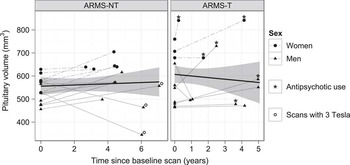
We found no significant main effects of group, age, whole brain volume, scanner, and time by group and time by medication interactions. Thus, PV did not change over time in either group when corrected for confounders as described above (ie, including medication) (Figure).
Volume changes of the pituitary gland in patients with an ARMS without transition (ARMS-NT) and with transition to psychosis (ARMS-T). Values of baseline and follow-up scans in each subject are connected with a straight line.

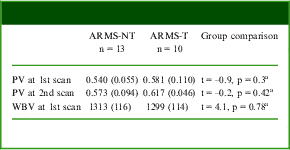
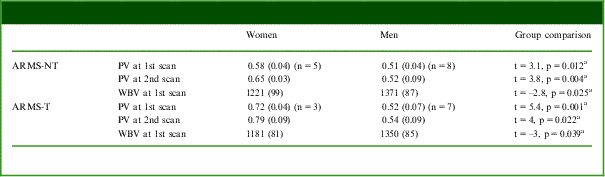
Whole brain volume was not significantly different between ARMS-T and ARMS-NT (Table 2) but significantly smaller in women than in men (Table 3). We also found no significant association of whole brain volume with PV (p = 0.104), and the above mentioned results did not change whether we considered whole brain volume or not.
Pituitary and whole brain volume by group

Data are presented as mean [mL] (SD); ARMS-NT = at-risk mental state without transition to psychosis; ARMS-T = at-risk mental state with transition to psychosis; PV = pituitary volume; WBV = whole brain volume.
a Welch Two Sample t test.
Gender differences: pituitary and whole brain volume by group

Data are presented as mean [mL] (SD); ARMS-NT = at-risk mental state without transition to psychosis; ARMS-T = at-risk mental state with transition to psychosis; PV = pituitary volume; WBV = whole brain volume.
a Welch Two Sample t test.
Correlational analyses
In a next step, we tested whether PV was associated with the severity of psychopathological symptoms. PV did not significantly correlate with BPRS total score (r = 0.1, t = 0.44, df = 18, p = 0.662) or SANS total score (r = 0.12, t = 0.51, df = 18, p = 0.61), even if we only included ARMS-T (r = –0.06, t = -0.16, df = 8, p-value = 0.874 and r = 0.07, t = 0.21, df = 8, p-value = 0.838, respectively).
Discussion
To our knowledge, this is the first longitudinal study that has investigated PV in an antipsychotic-naïve ARMS population comparing ARMS with subsequent transition to psychosis versus ARMS without transition.
We studied 23 antipsychotic-naïve individuals with an ARMS within the FePsy study at baseline. Patients were followed up until transition to psychosis (ARMS-T) or, if they did not develop psychosis (AMRS-NT), until the end of the study.
In contrast to our hypothesis, we did not find a time-dependent longitudinal PV increase in the ARMS-T group from baseline to transition. Cross-sectionally, we had shown a stronger PV enlargement in ARMS with later transition to psychosis than in ARMS without later transition and compared to healthy controls (HC) in a previous study conducted by our group.Reference Büschlen, Berger and Borgwardt 5 The sample partly overlaps with the one presented here. A recently published cross-sectional study found no difference between ARMS with and without later transition to psychosis.Reference Takahashi, Nakamura and Nishiyama 35 We had hypothesized that the enlargement at baseline was due to stress-induced ACTH and prolactin synthesis. Based on our current finding of no further PV increase during actual transition to psychosis, one might conclude that the perceived level of stress in ARMS patients is already high at first presentation to a special early detection clinic and remains constantly high thereafter. As we have no objective measures of stress in our study, this remains speculative.
Alternatively, the lack of a further longitudinal PV increase might be due to methodological limitations. Due to the long period [on average 802 (±722) days] between transition to psychosis and follow-up scan in ARMS-T, we might have missed the expected additional stress-induced peak of PV at the time of transition. A decrease of PV during the later course of schizophrenic psychoses has been described before in medicatedReference Pariante 2 , Reference Pariante, Vassilopoulou and Velakoulis 6 and unmedicatedReference Upadhyaya, El-Sheikh, MacMaster, Diwadkar and Keshavan 8 patients.
Currently, the stress-vulnerability model is commonly accepted in psychotic disorders.Reference van Os, Kenis and Rutten 36 – Reference Borges, Gayer-Anderson and Mondelli 38 The literature provides some evidence that the onset of psychotic disorders may be associated with a higher rate of stress. One biological system triggered by stress exposure is the hypothalamic–pituitary–adrenal (HPA) axis. There is evidence for dysfunction of this system in schizophrenic diseases.Reference Aiello, Horowitz, Hepgul, Pariante and Mondelli 16 , Reference Phillips, McGorry and Garner 39 – Reference Belvederi Murri, Pariante and Dazzan 43 We assume that pituitary volume is a structural means of its activity in patients with psychosis.Reference Nicolo, Berger and Garner 12 Indeed, pituitary volume has been used as an indirect index of HPA axis activity because it is thought to increase with the number or size of corticotrophin-releasing cells (ie, corticotrophs) in the pituitary gland.Reference Garner, Pariante and Wood 1 , Reference Pariante, Vassilopoulou and Velakoulis 6 , Reference Krishnan, Doraiswamy and Lurie 44 – Reference Takahashi, Suzuki and Velakoulis 46 Volumetric abnormalities of the pituitary gland in psychotic disorders strengthen this theory.Reference Klomp, Koolschijn, Hulshoff Pol, Kahn and Van Haren 47 Nonetheless, there are some contradictory results,Reference Nicolo, Berger and Garner 12 but most studies showing smaller PVs were conducted in patients with a chronic type of schizophrenic psychosis.Reference Pariante, Vassilopoulou and Velakoulis 6 , Reference Upadhyaya, El-Sheikh, MacMaster, Diwadkar and Keshavan 8 , Reference Tournikioti, Tansella and Perlini 48
We hypothesize that prolactin as a stress hormone can be involved in the increase of PV, but its cause and consequence remain unclear. Previously, PV enlargement in schizophrenic psychoses has only been associated with prolactin-increasing antipsychotics.Reference Pariante, Dazzan and Danese 4 , Reference MacMaster, El-Sheikh and Upadhyaya 10 However, even before antipsychotics were discovered, gonadal dysfunction in schizophrenic patients has been reported (for a review see Riecher-Rössler and HäfnerReference Riecher-Rössler and Hafner 49 ). This fact could indicate that hyperprolactinemia, which suppresses gonadal function, could be a stress-induced phenomenon in schizophrenic psychoses that is independent of antipsychotics.Reference Büschlen, Berger and Borgwardt 5 , Reference Aston, Rechsteiner and Bull 15 , Reference Riecher-Rössler, Häfner, Dütsch-Strobel and Stummbaum 50 – Reference Tsigkaropoulou, Peppa and Zompola 52 As prolactin is produced in the lactotroph cells of the pituitary gland, this could also explain PV increase in unmedicated ARMS individuals. Hyperprolactinemia in antipsychotic-naïve ARMS individualsReference Aston, Rechsteiner and Bull 15 and first-episode psychosis patientsReference Riecher-Rössler, Rybakowski and Pflüger 14 , Reference Aston, Rechsteiner and Bull 15 , Reference Lee and Kim 53 , Reference Garcia-Rizo, Fernandez-Egea and Oliveira 54 has been shown before.
There are only 4 longitudinal studies on PV in patients with schizophrenic psychoses,Reference MacMaster, El-Sheikh and Upadhyaya 10 , Reference Nicolo, Berger and Garner 12 , Reference Gruner, Christian and Robinson 13 , Reference Takahashi, Suzuki and Tanino 55 but none in ARMS individuals and none with a follow-up period of more than 2.7 years. The strength of our study is that we did the first longitudinal study of PV in ARMS. Also, all patients at baseline were unmedicated, and the follow-up period was very long, so we can be quite sure not to have missed a transition to psychosis.
PVs were significantly larger in patients who were treated with antipsychotics at the time of follow-up; this result is consistent with previous results.Reference Pariante, Vassilopoulou and Velakoulis 6 , Reference Markianos, Hatzimanolis and Lykouras 7 It has been assumed that the pituitary gland is especially sensitive to prolactin-elevating antipsychotics.Reference MacMaster, El-Sheikh and Upadhyaya 10 , Reference Mondelli, Dazzan and Gabilondo 56 Some results have also shown that “atypical” antipsychotics—not further differentiated—correlate with a less severe pituitary enlargement.Reference Takahashi, Zhou and Nakamura 11 We have controlled statistically for the influence of antipsychotic intake. However, our sample was too small to differentiate between different types of antipsychotics. Other causes of pituitary enlargement, such as hypothalamic tumor, pregnancy, and primary hypothyroidism,Reference Elster 57 were excluded in our sample.
In this study, women had larger PVs than men. These findings are consistent with previous reports of sex differences in PV, with PVs being larger in healthy women than in men.Reference Suzuki, Takashima and Kadoya 58 – Reference MacMaster, Keshavan and Mirza 60
According to the stress hypothesis, we would have expected a positive relationship between a higher BPRS or SANS total score, implying a higher level of stress to be associated with increased PV. However, we did not find significant correlations between clinical symptoms (BPRS and SANS) and pituitary volume, which has previously been described also by others.Reference MacMaster, El-Sheikh and Upadhyaya 10 , Reference Takahashi, Suzuki and Velakoulis 46 In our case, this might be because we measured BPRS and SANS only at baseline and psychopathology can change rapidly.
Many previous studies,Reference Pariante 2 , Reference MacMaster, El-Sheikh and Upadhyaya 10 , Reference Abech, Moratelli, Leite and Oliveira 61 , Reference Grams, Gempt, Stahl and Forschler 62 but not all,Reference Terano, Seya, Tamura, Yoshida and Hirayama 63 have provided evidence that pituitary volume reflects hormonal activity. Hence, we chose a volumetric approach to evaluate the hormonal function. Other studies have provided no evidence for a relation between PV and current basal levels of anterior pituitary hormones.Reference Terano, Seya, Tamura, Yoshida and Hirayama 63 We did not measure hormone levels at the time of scan acquisition and therefore do not know if HPA and HPG activity at the time of MRI was really abnormal, but we know from another study in our FePsy sample that 24% of our antipsychotic-naïve ARMS patients and 33% of our antipsychotic-naïve FEP patients suffered from hyperprolactinemia.Reference Aston, Rechsteiner and Bull 15
In line with other recent studies,Reference Klomp, Koolschijn, Hulshoff Pol, Kahn and Van Haren 47 , Reference Habets, Collip and Myin-Germeys 64 we did not distinguish between the anterior and posterior part of the pituitary. This might be seen as a potential limitation of our study, but the posterior part of the pituitary constitutes only a very small part of the whole gland, and no conditions are known to influence it in the examined age group.Reference Krishnan, Doraiswamy and Lurie 44 Thus, it has been hypothesized that the whole pituitary volume is representative for the anterior lobe.Reference Zipursky, Whittle and Yucel 65
Another limitation might be that the cycle state of the women included in our study was not taken into account. However, a recent study has shown that cycle phase, number of given births, and onset or duration of menopause have no effects on pituitary size.Reference Grams, Gempt, Stahl and Forschler 62
Last but not least, small effects might have been overlooked due to our obviously small sample size and limited power. In order to estimate the likelihood of a type II error, we would have to conduct a formal power analysis. However, since there are no longitudinal studies on pituitary volume changes in ARMS patients, letalone meta-analyses, we cannot make a reliable assumption about the pituitary volume change in the population of ARMS patients in a specific amount of time and thus are unable to do a proper power analysis. Doing a post hoc power analysis by taking the effect size that we have measured in our own sample as a population effect size estimate would be very inappropriate and has strongly been criticized.Reference Ellis 66 Hopefully, our study can still contribute to the detection of small effects in the future if data are included into meta-analyses.
Further studies should include the following: anatomical scanning at the time of transition, additional measurements of hormones (prolactin, cortisol), comparisons with other diseases, a healthy control group with longitudinal measurements, and larger samples.
Conclusions
Pituitary enlargement has been reported in individuals with schizophrenic psychosis or an at-risk mental state for psychosis (ARMS). To our knowledge, this is the first longitudinal study to investigate PV in an antipsychotic-naïve ARMS population comparing ARMS with subsequent transition to psychosis versus ARMS without transition. Only partly supporting our hypothesis, we did not find a time-dependent PV increase in the ARMS-T group from baseline to transition. This might indicate that the perceived level of stress in ARMS patients is constantly high from very early onward. Further studies should include anatomical scanning at the time of transition, additional measurements of hormones (prolactin, cortisol), comparisons with other diseases, a healthy control group with longitudinal measurements, and larger samples.
Disclosures
SB reports having received lecture fees from Eli Lilly, and research funding from the University of Basel, the EU, and the Swiss National Science Foundation (grant number 3232BO_119382). ARR reports having received research funding from the Foundation Alamaya, the “Österreichische Forschungsförderungsgesellschaft mbH, Wien,” the EU, the Stanley Foundation (grant number #07TGF-1102), the Swiss National Science Foundation (grant numbers 320033_1275443/1; 320030_127323/1), and the Bruderer-Stiftung. RS reports having received funding from the Swiss National Science Foundation (grant number 3232BO_119382). The other authors report no potential conflict of interest.