Introduction
One of the most challenging tasks in the cognitive assessment of older adults is the differentiation of normal from pathological cognitive aging. Mild cognitive impairment (MCI) with deficits reported in one or more cognitive domains, including episodic memory, executive functions, verbal abilities, visuospatial skills, attention, and perceptual speed is often found to reflect preclinical Alzheimer's disease (AD) and other dementias (Masur et al., Reference Masur, Sliwinski, Lipton, Blau and Crystal1994; Backman et al., Reference Backman, Jones, Berger, Laukka and Small2005). However, there is growing interest in identifying novel cognitive paradigms that might help detect preclinical dementia even earlier, particularly as new, potentially disease-modifying treatments appear on the horizon for AD.
In addition to episodic memory, it has been postulated that AD is also associated with altered structure of semantic memory, an individual's concept-based knowledge of the world (Hodges et al., Reference Hodges, Salmon and Butters1992). Buschke et al. (Reference Buschke, Sliwinski, Kuslansky and Lipton1997) have argued that early AD is characterized by specific deficits that prevent effective use of semantic cues. On tests requiring recall of remembered words, mildly impaired AD patients are specifically prone to semantic intrusions that suggest incomplete processing of the target (Loewenstein et al., Reference Loewenstein1991). Semantic intrusions include substituting the target item for a semantically similar exemplar (e.g. “lighter” for “matches”) or for the superordinate semantic category to which the target belonged (e.g. “jewelry” for “ring”). These intrusions reflect an underlying deficit in inhibiting the activation of competing semantic exemplars within a general semantic category (e.g. “objects that start a fire” in the case of the first example). Therefore the use of an interference paradigm, in which semantically similar objects compete for expression in memory, may further highlight the specific information processing deficits associated with AD. This line of work has shown remarkable potential for distinguishing between individuals with normal cognition and mild dementia in case-control studies of specialty clinical samples of AD patients and research volunteers (Loewenstein et al., Reference Loewenstein, Acevedo, Luis, Crum, Barker and Duara2004; Reference Loewenstein, Acevedo, Agron and Duara2007). However, it has yet to be determined how broadly this experience will generalize to dementia in the community at large.
The Semantic Interference Test (SIT) is a selective reminding task that employs two semantically related groups of household objects. It is based on a modification of the Fuld Object Memory Evaluation (OME) (Fuld, Reference Fuld1981) and involves actual common objects as stimuli which are tactually, visually and aurally encoded. Unlike the original OME which had five learning trials, the SIT paradigm presents the initial group of OME objects for three learning trials, followed by presentation of a new group of objects semantically related to the first group (e.g. cup is semantically related to bowl; key to lock; playing card to domino), and followed by an immediate recall and then a delayed recall of the initial list of objects. In addition to semantic intrusions from one list to another, this paradigm allows for evaluation of interference effects: proactive interference, in which new learning is inhibited by the competing effects of old learning, and retroactive interference, in which recall of previously learned material is impeded by competing intervening information. Loewenstein and colleagues found that a SIT composite measure of vulnerability to semantic interference was highly sensitive (84.6%) and specific (96.2%) in differentiating mild AD patients from healthy older adults. Vulnerability to proactive interference, specifically, was most discriminative between patients with mild cognitive impairment (MCI) and healthy control participants (Loewenstein et al., Reference Loewenstein, Acevedo, Luis, Crum, Barker and Duara2004). Further work showed that vulnerability to proactive interference on the SIT was highly predictive of progression to dementia within three years among older adults with MCI, more so than traditional neuropsychological measures of delayed recall (Loewenstein et al., Reference Loewenstein, Acevedo, Agron and Duara2007).
Here we report the performance of this novel memory paradigm, which examines vulnerability to semantic interference, in a population-based epidemiologic study of older adults. Specifically, we examined associations between scores of the SIT (Loewenstein et al., Reference Loewenstein2003) and demographic characteristics, hypothesizing that better test performance would be associated with younger age and higher education. Further, we hypothesized that SIT performance would be associated with level of decline in cognitively driven everyday functioning, as independently measured by the Clinical Dementia Rating (CDR) scale (Hughes et al., Reference Hughes, Berg, Danziger, Coben and Martin1982). Additionally, we provide normative data for the SIT stratified by age level in five-year bands that can be used by clinicians or researchers in future investigations.
Methods
Study area, sampling, and recruitment
The small-town area selected for the study surrounds the confluence of the Monongahela and Youghiogheny rivers, in southwestern Pennsylvania in the U.S.A. The study cohort was named the Monongahela-Youghiogheny Healthy Aging Team (MYHAT). As previously described (Ganguli et al., Reference Ganguli, Snitz, Vander Bilt and Chang2009), the cohort was recruited by age-stratified random sampling from the voter registration lists for the selected towns. Given the history and stability (low rates of in- and out-migration) of the region's elderly residents, it is considered representative of the population. All procedures were approved by the University of Pittsburgh Institutional Review Board. Recruitment criteria were (a) aged 65 years or older, (b) living within the selected area, and (c) not already in a long-term care institution. Individuals were considered ineligible if they (a) were too ill to participate, (b) had severe vision impairment, (c) had severe hearing impairment, or (d) were incapacitated in decision-making ability. Over the approximately two-year recruitment period, a total of 2036 individuals were recruited.
Assessment (overview)
A single-stage assessment was employed to avoid both delays and potentially non-random attrition between screening and definitive assessment stages (Prince, Reference Prince2000). The Mini-mental State Examination (MMSE) (Folstein et al., Reference Folstein, Folstein and McHugh1975) was administered and scored on the spot, applying a standard correction for age and education (Mungas et al., Reference Mungas, Marshall, Weldon, Haan and Reed1996). Fifty-four individuals scoring < 21/ 30 (age-education corrected) were classified as having moderate to severe cognitive impairment and therefore not part of the target population for the MYHAT study. These individuals were not assessed further. The remaining 1982 participants, who scored ≥ 21 on the age-education corrected MMSE, proceeded to the full assessment, which included several components. Among the neuropsychological tests in the full assessment battery was the Wide Range Achievement Test (3rd edition) Reading subtest (WRAT-3 Reading), used to estimate literacy or academic reading level and as a proxy for quality of education (used in analyses below) (Manly et al., Reference Manly, Jacobs, Touradji, Small and Stern2002). The remainder of this report is focused on one specific test from the neuropsychological assessment, the SIT, and the Clinical Dementia Rating.
Fuld OME / Semantic Interference Test (SIT)
All participants were first administered the SIT as the first task in the neuropsychological battery. In this test, the objects are placed inside opaque black cloth bags before presentation to the participant, who is first required to identify, by touch alone, the contents of the first bag (Bag A). These are 10 common household objects (button, scissors, ball, ring, matches, cup, playing card, nail, key, and bottle). After attempting to identify the objects by touch, the participant is allowed to view them as well; if still unable to name the object by touch or vision, the interviewer then provides the name. This learning trial is followed by a 60-second verbal fluency distracter task and then the participant is asked to recall the 10 objects. Selective reminders are only provided for the unrecalled objects. The testing then alternates between recall trials with selective reminders and 30-second verbal fluency tasks for two additional trials. The sum of the three learning trials for Bag A reflects episodic encoding and retrieval.
Next, the semantic interference paradigm requires the participant to identify, by touch, 10 new common household items (belt, knife, whistle, bracelet, lighter, bowl, domino, screw-driver, lock, and can) inside Bag B. As with Bag A objects, after identifying the new Bag B objects by touch, the objects are both visually and tactually presented. If the object cannot be identified by touch or vision, its name is provided by the examiner. Participants then complete a 60-second verbal fluency distracter task, and are then asked to recall Bag B objects (Bag B-Immediate Recall). This recall trial is susceptible to proactive interference (i.e. old learning of the previous Bag A items interferes with new learning of Bag B items). The participant is then asked to recall the Bag A objects (Short-Delay Recall), a recall trial that is vulnerable to retroactive interference (i.e. new learning of Bag B items interferes with retrieval of previously learned information). The Combined Interference Score consists of the sum of Bag B Immediate Recall score (Proactive Interference) and Bag A Short-Delay Recall score (Retroactive Interference). After a 20-minute delay, during which non-memory tests in the battery are administered, participants are asked to recall Bag A items (Long-Delay Recall). Intrusions (retrieval of any item other than the to-be-remembered targets) during all learning and recall trials were recorded and summed.
As described in Lowenstein et al. (Reference Loewenstein2003), Bag B objects belong to the same semantic categories as those in Bag A. They were carefully selected on the basis of a prior study examining the type of intrusive errors made by several hundred AD patients compared to healthy elderly controls (Schram et al., Reference Schram, Rubert and Lowewenstein1995). For example, among AD patients, the most frequently occurring intrusion for ring was a bracelet or other type of jewelry; therefore, a bracelet, an exemplar of the category jewelry was selected as a Bag B item. Similarly, the remaining items in Bag B are all exemplars of the categories to which Bag A items belong.
Further scores were derived from SIT performance to evaluate proactive and retroactive interference effects after controlling for memory performance per se. A Proactive Interference Ratio (PIR) was calculated by dividing the score from Bag B recall by the average recall score of the three learning trials (reflecting episodic encoding and retrieval). A Retroactive Interference Ratio (RIR) was also calculated by dividing Bag A-Short Delay Recall score from the last recall of Bag A, before the introduction of Bag B, to determine any decrements in performance associated with the semantically related set of Bag B objects. Lower PIR scores and RIR scores would indicate greater proactive and retroactive interference, respectively. The Total Interference Ratio (TIR) was computed by summing the PIR and RIR ratios.
Clinical Dementia Rating
Participants were rated on the CDR scale (Hughes et al., Reference Hughes, Berg, Danziger, Coben and Martin1982; Morris et al., Reference Morris, McKeel, Fulling, Torack and Berg1988), without reference to the neuropsychological measures. All MYHAT interviewers have undergone CDR training and been certified by the Washington University online training module. Interviewers performed these ratings based on participants’ self-reports, informant reports when available, and their own impressions of the participants’ functional level, including, for example, participants’ understanding of and adherence to their prescribed medication regimens, knowledge of their own and family information, etc. Although the assessments were conducted by one interviewer, the CDR ratings were carried out after the visit with review and discussion with at least one other interviewer. The rating was based on an assessment protocol composed of standardized questions, as well as observation, regarding the participant's daily functioning in the six areas of memory, orientation, judgment, home and hobbies, community affairs, and personal care. Each of the six areas was rated on a scale of 0 through 0.5, 1, 2, and 3, and a standard algorithm was used to generate a summary CDR rating of 0 (no dementia), 0.5 (possible dementia), 1.0 (mild dementia), 2.0 (moderate dementia), and 3.0 (severe dementia).
Statistical methods
None of the SIT variables were normally distributed and so to assess the association between each SIT variable and the CDR scores, we first dichotomized each SIT variable based on the 10th percentile. The association was then examined using simple logistic regression (unadjusted) and multiple logistic regression (adjusted) models with the CDR global score as the dependent variable and the dichotomized SIT variable as the main independent variable. Age, gender, education and race were the adjusting confounders in the multiple logistic regression models. In these models, age was categorized into three groups: 65–74, 75–84, and ≥85 years old at baseline; educational levels were categorized into three groups: less than high school, high school graduate, and more than high school; and race was dichotomized into white and non-white groups. All interaction terms between the four demographic variables and all SIT variables were examined in the multiple logistic regression models.
Unadjusted association between dichotomous SIT scores and demographic variables as well as the association between dichotomous SIT scores and WRAT-3 Reading were examined using simple logistic regression only with participants with CDR = 0. In addition, Spearman correlation coefficient was used to investigate the rank correlation between each original continuous SIT score and education in years, age in years, and WRAT-3 Reading. The association between CDR global score and each demographic characteristic wase assessed by simple logistic regression.
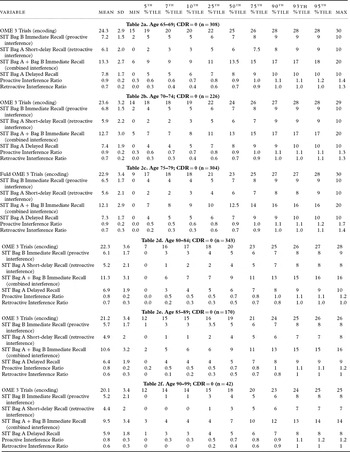
For participants with CDR = 0, the distributions of the SIT variables were assessed by mean, SD, minimum, maximum, 5th, 7th, 10th, 25th, 50th (median), 75th, and 90th, 93rd, and 95th percentiles.
Of the 1982 participants who completed the full baseline assessment, 1959 had either normal cognitive functioning or mild deficits measured by the CDR scale. Among 1959 individuals, only 38 (1.9%) refused any component of the SIT. In the analyses, the sample size was restricted to the 1921 participants without dementia who had complete data on all tests. Analyses were performed using SAS version 9.1 (SAS Institute Inc, Cary, NC) and Stata version 9 (StataCorp, College Station, TX).
Results
The current report is restricted to 1921 participants with complete SIT data and CDR global score < 1; of these, the majority (1393) individuals received CDR scores of 0 and 528 individuals received CDR scores of 0.5. Mean age was 77.51 (SD 7.38), with n = 668 (34.8%) age 65–74, n = 896 (46.6%) age 75–84, and n = 357 (18.6%) age 85 years and older. Mean education in years was 12.87 (SD 2.41), with 259 (13.5%) reporting having less than a high school education, 868 (45.2%) were high school graduates, and 794 (41.3%) reported greater than high school education. The number of males was 743 (38.7%) and 1823 (94.9%) participants were self-reported as “white.” The mean MMSE score was 27.04 (SD 2.29) with a range of 17–30.
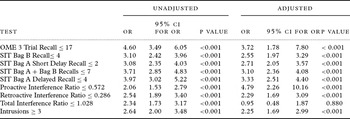
Table 1 presents the summary of unadjusted and adjusted logistic regression models predicting a CDR rating of 0.5 from SIT variables, based on 10th percentile cut-points. The simple logistic regression models show that the unadjusted association between CDR global score and SIT variables were significant for all (p < 0.001). The multiple logistic regression models present that all adjusted odds ratios (ORs) of the main predictor were significant except for the Total Interference Ratio. The ORs indicate increased odds of belonging to the CDR 0.5 group with worse test performance. For instance, there is an approximately a three times greater likelihood of receiving a CDR 0.5 rating with poor performance on the Combined Interference measure of Bag A + Bag B Recalls. Of note, the confidence intervals of the measures with significant effects are overlapping, indicating little reliable distinction between the ORs of the test variables.
Associations of OME/SIT test variables with Clinical Dementia Rating (N = 1921)

OME = Fuld Object Memory Evaluation; SIT = Semantic Interference Test.
Notes:
Multiple logistic regression models with CDR = 0.5 as outcome and OME/SIT variable as predictor, adjusted for age, education, gender, and race.
Cutoffs based on 10th percentile of total distribution of the OME/SIT variables.
Non-white race, older age, and male gender are significantly associated with 0.5 CDR global score.
Significant interactions are Fuld OME 3 trials × Age, PIR × Age, and TIR × Education.
The multiple logistic regression models only included significant interactions in the final models, and the odds ratios of the main effect are presented in Table 1. Interactions between the test variables and demographic characteristics were significant for the following: OME 3 Trial Recall × Age, PIR × Age, and TIR × Education. With regard to age, for OME 3 trials the association with CDR score was statistically significant in all three age groups although the strength of the association varied across age groups (p ≤ 0.001); PIR was significantly associated with CDR only in those aged 65–74 (p < 0.0001). With respect to education, TIR was significantly associated with CDR only in those with at least high school education (p = 0.01). There were no interactions of any subtests with gender or race.
Associations between SIT and demographics were examined using simple logistic regression models in a sample of 1336 individuals with CDR = 0 and complete data on the variables of interest. Associations between better performance on SIT measures and higher education were mostly significant (≥HS vs. < HS: ORs from 0.32 to 0.59, all p values < 0.05 except for SIT Bag A Short Delay Recall and RIR). Positive correlations between SIT performance and WRAT-3 Reading standard scores were small in magnitude with all significant associations (ORs from 0.96 to 0.98, p < 0.05) except for SIT Bag B Recall, RIR, and intrusion. SIT performance was more highly associated with younger age (≥75 vs. 65–74, ORs from 1.58 to 8.39, all p values < 0.05). Women outperformed men on OME 3 Trial Recall, Bag B Recall, Bag A Recall, sum of Bag A + Bag B Recall and Bag A Delayed Recall (OR 0.60–0.71, p < 0.05). In addition, Spearman correlation was used to assess the rank correlation. Correlations between better performance on SIT measures and higher years of education were mostly significant (all p values < 0.05 except for SIT Bag A Short Delay Recall, SIT Bag A Delayed Recall, and RIR) but uniformly small in magnitude (r from 0.06 to 0.11). Positive correlations between SIT performance and WRAT-3 Reading standard scores were similarly small in magnitude, with the following associations significant (p < 0.01): OME 3 Trial Recall (r = 0.14), SIT Bag B Recall (r = 0.13), SIT Bag A Short Delay Recall (r = 0.09), SIT Bag A and Bag B Recalls (r = 0.13) and SIT Bag A Delayed Recall (r = 0.08). SIT performance was more highly associated with younger age (r from –0.10 to –0.32, all p values < 0.001).
Regarding associations between demographic characteristics and CDR score, participants with CDR 0.5 (n = 528) were older (75–84 vs. 65–74 and ≥ 85 vs. 65–74: OR (95% CI of OR) = 1.53 (1.21, 1.95) and 2.73 (2.05, 3.62), had less education ( = HS vs < HS and > HS vs < HS: OR (95% CI of OR) = 0.57 (0.43, 0.77) and 0.55 (0.41, 0.74)), were more likely to be male (female vs. male: OR (95% CI of OR) = 0.72 (0.59, 0.89)) and more likely to be non-white (white vs. non-white: OR (95% CI of OR) = 0.53 (0.35, 0.80)) compared to participants with CDR 0.
Tables 2a–f present normative distributions of selected SIT variables for CDR = 0 participants in age bands of five years, from 65 to 99 years.
Fuld OME and SIT score distributions among participants with CDR = 0

Discussion
This study examined the distribution characteristics of a novel testing paradigm evaluating semantic interference and episodic memory in a large, population-based cohort of older adults without dementia. To our knowledge, this is the first description of the use of the semantic interference model of assessing memory at the population level. Our results demonstrate concurrent validity of the test. Almost all specific measures of the SIT were strongly associated with independently rated CDR score; i.e. they significantly differentiated participants with rated normal functioning (CDR 0 global score) from those with mild cognitive difficulties affecting daily functioning (CDR 0.5). In addition, SIT indices were minimally affected by degree of educational attainment or estimated premorbid function. Better SIT performance was associated with younger age and being female, but with age showing a much stronger effect than gender. These associations are in line with other memory tests (Mitrushina et al., Reference Mitrushina, Boone, Razani and D'Elia2005). Normative data stratified by age are provided.
The original Fuld OME (Fuld, Reference Fuld1981) was developed to assess several aspects of learning and retrieval in older adults, based on the selective reminding method introduced by Buschke (Reference Buschke1973). The modification of the Fuld OME and addition of the SIT by Lowenstein et al. (Reference Loewenstein2003) added the component of semantic interference to the assessment of episodic memory, with the goal of improved prediction of incipient dementia. The SIT capitalizes on the increased vulnerability observed in AD patients to competing information in the environment during learning (interference). In effect, the SIT functions as a “stress test” for this vulnerability by imposing an additional list of semantically-related objects to be learned, and this leads to depressed subsequent recall and recall errors (intrusions).
The SIT has many potential advantages. First, its conceptual novelty expands our current understanding of memory and aging by focusing on the dimension of relative vulnerability to semantic interference. It has been previously shown to discriminate between healthy older volunteers and patients with AD and MCI in clinical settings; we have now shown that it is also associated with independently scored rating of cognitively driven daily functioning (CDR) in a large, representative population-based cohort. Second, we have also shown that this relatively complex clinic-based test with non-standard stimuli is feasible to administer in a large-scale epidemiological study in the homes of older participants in small towns. The refusal rate of any component of the SIT was very low (less than 2%). Third, the test has appeal related to its novel presentation, using objects inside mysterious black bags which individuals have to touch, see, name, and remember; a perhaps welcome alternative to the standard paper and pencil tasks which older adults may view as boring or even threatening in their similarity to school “tests.” Fourth, the SIT has potential utility for assessment of persons who may be illiterate or of low educational attainment. In contrast, performance on standard neuropsychological measures of verbal learning and memory tend to show relatively strong associations with educational attainment in healthy older adults (Mitrushina et al., Reference Mitrushina, Boone, Razani and D'Elia2005). The SIT requires no reading, encoding of items is multi-modal (tactile, visual, and aural), and the objects to be encoded are commonly encountered in daily life. As we report currently, the influence of educational attainment and of reading ability (suggested as a proxy for quality of education, Manly et al., Reference Manly, Jacobs, Touradji, Small and Stern2002), on SIT performance is insufficiently large to be clinically significant. By comparison, Delis et al. (Reference Delis, Kramer, Kaplan and Ober2000) reported a correlation of 0.46 between total recall trials on the California Verbal Learning Test – II, one of the more commonly used verbal memory tests, and vocabulary scores. Finally, the test conditions of the SIT are such that no translation and back-translation are required for adapting to different linguistic/cultural groups.
Comparison of the SIT scores from our population cohort (CDR 0) with those from 98 cognitively screened, healthy memory clinic controls reported in Lowenstein et al. (Reference Loewenstein, Acevedo, Luis, Crum, Barker and Duara2004) reveals that the means and standard deviations are remarkably similar for all test variables. This further supports the premise that the SIT transfers well from clinic to “real-world” settings and is relatively resistant to the influence of different population characteristics (e.g. educational/cultural background, screened vs. unscreened health history, propensity to volunteer for research studies, etc.).
Strengths of the present study include the large size and representativeness of the cohort. The study also has some limitations. Since by design the MYHAT cohort excludes individuals with moderate to severe cognitive impairment, we cannot provide data on dementia or dementia subtypes such as AD. Since the data are cross-sectional at this stage, we cannot yet report whether SIT performance will predict future development of dementia. Its population-based design precludes the detailed clinical assessments of individuals and reliable informants that are standard in specialized memory disorder centers; however, those studies in turn suffer from selection bias. Finally, we observed no statistically reliable differences among specific semantic interference measures in the strength of their associations with CDR ratings in the present study. Nevertheless, it is perhaps suggestive that the variable with the highest OR was the Proactive Interference Ratio, as vulnerability to proactive interference was highly predictive of progression to dementia within three years among older adults with MCI in the Lowenstein et al. (Reference Loewenstein, Acevedo, Agron and Duara2007) study. In clinical settings, difficulties with semantic interference can be observed in the absence of initial list learning performance. As such, the potential predictive validity of measures of semantic interference as measures of early cognitive dysfunction and progression of decline can only be addressed by the longitudinal follow-up of our current cohort.
In sum, we present initial validity data in a population-based cohort for the SIT, a novel paradigm evaluating semantic interference with the aim of increased sensitivity for mild cognitive changes associated with early dementia. Future analyses will investigate the utility of the SIT and its specific semantic interference measures in discriminating between individuals with normal cognition and MCI in a population-based setting, and its predictive validity for progression to dementia.
Conflict of interest
None.
Description of authors’ roles
B. Snitz conceptualized and designed the study, interpreted the results, and helped write the paper. D. Loewenstein conceptualized and designed the study, interpreted the results, and helped write and edit the paper. C-C. Chang and C-W. Lee undertook data analysis and interpretation, and helped write and edit the paper. J. Vander Bilt supervised data collection and management, conceptualized and designed the study, and helped edit the paper. J. Saxton interpreted the results and helped edit the paper. M. Ganguli was responsible for overall project design, obtaining grant support, conceptualization and design of the study, interpretation of the results, and writing and editing the paper.
Acknowledgments
This study was supported by the following grants from the National Institutes of Health: R01 AG023651 and K24 AG022035.