INTRODUCTION
The choice between working as an employee and owning a small business is influenced by prevailing constraints and opportunities. A “push, pull” dynamic has continually shaped and reshaped the minority business community in America as constraints have evolved in changing historical circumstances and new opportunities have arisen (Bates Reference Bates1997; Waldinger et al., Reference Waldinger, Aldrich and Ward2006). Barriers limiting opportunities for wage work have often pushed minorities toward embracing self-employment, even among individuals preferring to work as employees. Alternatively, many preferred to own their business ventures and chose to give up paid employment when attractive opportunities became available; in this sense, they were pulled into business ownership. In the case of African Americans, social scientists often disagree about both the evolution of these constraints and opportunities and the relative importance of constraints blocking the entrepreneurial path as opposed to opportunities pulling entrants into small-firm ownership. Our historical understanding of why the entrepreneurial path is chosen—or avoided—has thus been slow to emerge.
This study focuses on a time period during which key constraints historically limiting entrepreneurial alternatives began to change dramatically. Small-business loan access, in particular, expanded substantially in the late 1960s and 1970s. Faced with reduced credit constraints, a community of larger-scale, industrially more diverse African American-owned firms emerged in industries where Black presence had historically been minimal. During this period, educational and employment opportunities expanded as well. This study analyzes long-run impacts of this changing opportunity structure on the scope of entrepreneurship among Black Americans.
Historically, most Black-owned businesses were small-scale operations concentrated in a few lines of personal services and retailing. Although they had existed for decades, the notion that expanding Black business presence could spur local economic development and job creation first became prominent in the late 1960s (Allen Reference Allen1969; Green and Faux, Reference Green, Faux, Pugh and Haddad1969; McKersie Reference McKersie1968). African American-owned businesses as agents of advancement for economically stressed communities—this was the new idea pushing Black entrepreneurship into the national spotlight. The historical literature emphasized lack of financial capital (Pierce Reference Pierce1947) and specific skills and expertise appropriate for building viable Black-owned firms (Brimmer Reference Brimmer and Davis1966) as obstacles to successful business creation and operation. Thus, key issues in the debate over encouraging new business creation were whether aspiring entrepreneurs would create firms having substantive local economic development potential and, if so, would these firms and their owners possess the expertise and capital necessary to build enduring ventures that created jobs for Black workers? The ensuing debate was long on rhetoric and short on empirically grounded studies of business entry and job generation.
AFRICAN AMERICAN OWNERS OF SMALL BUSINESSES IN HISTORICAL CONTEXT
Prevailing stereotypes about small-firm ownership as a career choice suggest that America is a land of opportunity where those with initiative who are willing to work hard and take chances can prosper (Light and Bonacich, Reference Light and Bonacich1988). Applicability of this stereotype to minorities has been controversial, and sociologists have emphasized constraints as dominant factors shaping business ownership patterns (Waldinger et al., Reference Waldinger, Aldrich and Ward2006). Sociologists have most often focused not upon African Americans but, rather, upon immigrant minorities. The consensus is that lack of English language fluency, transferable education and work skills, limited access to mainstream employment networks, and racial prejudice blocked most immigrant minorities from attractive jobs in the mainstream economy. Facing limited opportunities, minorities crowded into the least remunerative, most competitive types of business, particularly small-scale retailing (Bankston and Zhou, Reference Bankston and Zhou2002; Bates Reference Bates2011; Kwong Reference Kwong1987; Min Reference Min1984).
Economists typically analyze the ownership decision as an exercise whereby entrepreneurial candidates assess the relative attractiveness of wage/salary work versus owning one’s own firm. When the expected profits forthcoming from ownership exceed employee earnings, one is a strong candidate for starting a firm. Since owning a business is generally riskier than the employee alternative, the confident and venturesome are expected to opt most often for the entrepreneurship path, while the doubtful and timid remain employees (Knight Reference Knight1921; Parker Reference Parker2009). Riskier businesses offering highly profitable opportunities, furthermore, attract abler individuals than safe fields like hairdressing (Bhide Reference Bhide2000; Roy Reference Roy1951). True entrepreneurs avoid low-risk situations because they seek challenge (Meredith et al., Reference Meredith, Nelson and Neck1982). They assess the alternatives, and depending upon one’s aversion to risk, pick the most attractive one. Deciding to become a business owner is an exercise in freedom of choice made on the basis of one’s self interest, inclinations, and preferences.
Social proscription does not entirely rule out attractive entrepreneurial opportunities. In the antebellum South, free Blacks were prominent in personal service ventures utilizing skills acquired under slavery. Indeed, in trades connoting servility, Whites were reluctant to create firms, leaving Blacks a near monopoly in some fields (Harris Reference Harris1936). However, this meant that entrepreneurial African Americans were relegated to owning businesses only in low-status fields deemed appropriate for them—preparing and serving meals, ironing shirts, and shining shoes (Leiberson Reference Lieberson1980).
Moreover, explicit barriers were erected to prevent African Americans from entering higher-status areas of business. Most southern states, for example, had passed laws by the 1850s prohibiting Blacks from engaging in businesses requiring knowledge of reading and writing. South Carolina in 1865 enacted a law requiring self-employed Black artisans, mechanics, merchants, and peddlers to purchase licenses—at ten to one hundred dollars annually—which Whites were not required to buy (Wilson Reference Wilson1965).Footnote 2 In northern states, Black merchants were routinely denied the right to file lawsuits, thus sharply limiting their ability to seek legal remedies to business disputes or to enforce contractual obligations (Litwack 1961; Middleton Reference Middleton2005).
The threat of violence reinforced the barriers against entrepreneurial African Americans at the turn of the century—in much the same way that violence underpinned segregation and disfranchisement during the Jim Crow era. In southern cities, mob violence was often directed against the most visibly successful African American entrepreneurs. Turn of the century Atlanta, for example, was home to a cluster of prosperous Black businessmen, none more so than Alonzo Herndon, a barber who had invested his profits in real estate. Born a slave, by 1900 Herndon had amassed a substantial net worth. Herndon was not shy about his wealth. His flagship barbershop had imposing front doors of solid mahogany and plate glass, and a chandelier. During the Atlanta riot of 1906, prompted by a newspaper-driven scare about alleged Black criminality, White vigilantes made a point of hacking through Herndon’s barbershop doors and they smashed his chandelier (Dorsey Reference Dorsey2004).
The risk that Black businessmen might suffer violence precisely because of their success was well known at the time—and undermined Booker T. Washington’s assertion that racial tension would decrease as African Americans demonstrated economic prowess. Indeed, Ida B. Wells, the foremost critic of lynching, started her campaign in response to the March 9, 1892 lynching of “energetic business men who had built up a flourishing grocery business” (Wells-Barnett Reference Wells-Barnett and Harris1991, p. 79) in Memphis. This business was the People’s Grocery. The energetic businessmen were Thomas Moss, president of the grocery, Will Stewart, secretary, and Calvin McDowell, the manager. As Wells put it, Moss “owned his little home, and having saved his money he went into the grocery business with the same ambition that a young white man would have had” (Wells-Barnett, Reference Wells-Barnett and Harris1991, p. 79). Moss had started up the grocery in 1889, a co-operative venture whose investors included educators, pastors, and carpenters. The grocery was one of 147 independent Black businesses in Memphis in 1890, up from ninety-two in 1880. Crucially, it was also a rival to a White grocery located on a busy corner opposite People’s Grocery (Giddings Reference Giddings2008; Wells Reference Wells1970).
The trouble had begun some days before the lynching, with a fight between a White and a Black child outside the grocery, before escalating into a fight between adults, arrests, and then murder. However, even the White press conceded that the murders were a result of economic rivalry—although local newspapers also exclaimed that the African American businessmen were “bad niggers” (Waldrep Reference Waldrep2002). As Wells insisted, though, the reason for the lynchings was as straightforward as it was contemptible: their “business had prospered and that of a rival White grocer … had declined” (Wells-Barnett Reference Wells-Barnett and Harris1991, p. 79). The story quickly became widely known among African Americans. The local funeral home displayed the bodies in open caskets to expose the extent of the mutilation. Wells would frequently refer to the case, in print and speeches across the United States and beyond, insisting that lynching was not a response to rape scares. While it is impossible to quantify what effects such stories had on potential entrepreneurs, it is clear that assaults on Black businesses made a deep impression on leading African Americans, including Frederick Douglass. Lynching, Wells (Reference Wells1970) maintained, was “an excuse to get rid of Negroes who were acquiring wealth and property and thus keep the race terrorized…” (p. 64).
Thus, although Black-owned businesses of size did exist in the nineteenth century (Walker Reference Walker1999), they were rare. By the 1890s, “a few enterprises of consequence began to take shape…” (Harmon et al., Reference Harmon, Lindsay and Woodson1929, p. 7). The National Negro Business League, organized in 1900 by Booker T. Washington, sought to publicize the accomplishments of Black entrepreneurs. Washington (Reference Washington1969) estimated that in 1900, 9,838 Blacks nationwide owned businesses requiring capital, a number that did not increase substantially until World War I. Rising urbanization was responsible for some of this slight increase in African American business ownership.
Newly ghettoized populations often supported African American-owned firms as explicit expressions of racial solidarity. The World War I era was a turning point in terms of re-orienting Black businesses toward serving urban Black—as opposed to an affluent White—clients. Because restrictive laws limited European migration after World War I, expanding manufacturing firms—steel and meatpacking in Chicago, cigarettes in Durham, and autos in Detroit—often relied heavily upon Black workers to staff entry-level positions. The ensuing “Great Migration” drove rapid population growth in industrial centers: Chicago’s Black population grew from 44,103 in 1910 to 233,903 in 1930 (U.S. Bureau of the Census 1935).
Migration from the rural South to industrial centers generated increased competition for a limited affordable housing stock in growing industrial cities, thus encouraging concentration of Black migrants in constricted areas (Spear Reference Spear1967; Weaver Reference Weaver1948). To many working-class Whites, Blacks were competitors for scarce housing and manufacturing jobs, and these perceptions helped fuel in 1919 the largest wave of race riots ever experienced in U.S. cities, including Chicago, where rioting produced thirty-eight deaths and left over 1,000 homeless (Spear Reference Spear1967). It also meant that Black workers were routinely excluded from unions and entry into many northern industries (Tuck Reference Tuck2010). Coming together for mutual help and protection amidst growing racial antagonism, Black urbanites built and supported their own institutions—churches, places of amusement, professional service providers, unions, and stores. A prominent example of community building amidst rising racial consciousness was the growth of Black-owned newspapers. A “buy Black” sentiment often prevailed, reflecting community solidarity in a racially intolerant urban environment (Harris Reference Harris1936; Myrdal Reference Myrdal1944; Pierce Reference Pierce1947). From many urban pulpits, specific business owners were identified to congregations as worthy of support, and virtues of buying from Black businesses were stressed: “Tomorrow I want all of you to go to these stores. Have your shoes repaired at a Negro shop, buy your groceries from a Negro grocer… (I) urge upon you to patronize your own for that is the only way we as a race will get anywhere” (Drake and Cayton, Reference Drake and Cayton1945, pp. 430–431).
While ghettoization provided new sources of opportunity in the North, ironically it was the rise of formal segregation in the South—and particularly the segregation of some aspects of the marketplace—that buttressed some Black businesses from competition with better-resourced White competitors. For example, African Americans in the funeral industry benefitted from the early twentieth century shift to “Whites only” in many areas of southern life, including the process of burial (Rabinowitz Reference Rabinowitz1978). Coupled with White southerner’s disregard of Black mortuary and memorial needs, segregation allowed African Americans to develop an insulated, parallel industry to serve the funeral needs of their own community.
Indeed in the early twentieth century the funeral business became recognized as the industry offering the most protection to African American entrepreneurs, especially in the South (Myrdal Reference Myrdal1944). W. E. B. Du Bois and Booker T. Washington both began to see funeral directing as unique in its potential to thrive in a racially segregated marketplace (Smith Reference Smith2010). In 1925, African Americans established an Independent Negro Funeral Directors Association (Kruger-Kahloula Reference Kruger-Kahloula, Fabre and O’Meally1994). By 1930, the census listed some 1,558 Black funeral directors out of 24,469 in total (U.S. Census 1931). In 1944, the sociologist Gunnar Myrdal observed that funeral homes represented one of the most solid and flourishing Negro businesses. In southern towns, the Black funeral director was often the wealthiest person in the community. In 1894, Lucy Crump Jefferson, for example, became the first African American to own and operate a funeral home in the state of Mississippi (Kranz Reference Kranz2004).
The development of separate Black funeral homes was particularly significant because it coincided with rising prestige—and income—for the profession. The success of well-known individual White undertakers at the turn of the century raised the status of the industry more generally to an accepted business-professional group (Wilson Reference Wilson1983). In particular, the skill of embalming led to the creation of dedicated funeral homes that were independent from health-related businesses. By 1920, for example, 135 of 597 registered embalmers in Georgia were Black (Kranz Reference Kranz2004). During the early twentieth century, the increasing use of technology, including motorized ambulances, raised the status of the profession still further (Wilson Reference Wilson1983). As a result of their prestige, African American funeral directors were often at the helm of broader civil rights initiatives, (Smith Reference Smith2010; Thornton Reference Thornton2002; Tuck Reference Tuck2003).
It would be wrong to overemphasize the benefits of segregation, because the Jim Crow urban South and rising ghettoization in the North provided more constraints than opportunities for African American entrepreneurs. Although funeral directors had an interlocking relationship with doctors, the clergy, and especially insurance companies, (Fairclough Reference Fairclough1995; Weems Reference Weems1994) the prosperity of this group of professionals was the exception rather than the rule. Even so, taken together, racial antagonism in the urban North and segregation in the South spurred the growth of firms serving Black households. By the 1920s, a vibrant Black business community had emerged. Crude estimates of non-farm Black-owned business numbers suggest roughly 70,000 firms were active in 1930 (Pierce Reference Pierce1947).
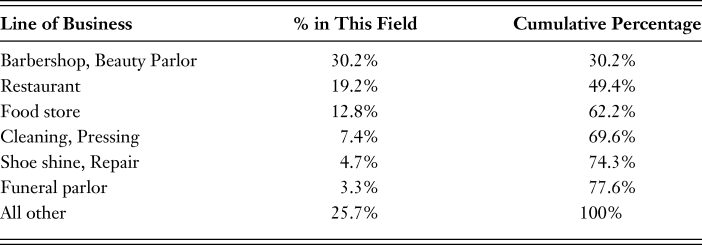
Impacts of the Great Depression destroyed this growth trajectory (Bates Reference Bates1973a). Joseph Pierce’s (Reference Pierce1947) pioneering 1944 survey of Black businesses operating in twelve large southern, mid-western and east-coast cities revealed a community of small firms heavily concentrated in retail and personal services.Footnote 3 Of the most common kinds of business: 1) barber shop/beauty parlor, 2) restaurant, 3) food store, 4) cleaning/pressing, and 5) shoe shine/repair—four utilized owner skills historically rooted in slave occupations (Table 1). Median initial firm capitalization, according to Pierce, was $549, derived largely from owner personal savings. When owners ranked the greatest obstacles to successful business operation, lack of financial capital—by a wide margin—was most often cited; lack of skilled personnel was second and limited Black patronage was third. In scope and substantive findings, the Pierce study stood as the definitive work in the field until the 1970s.
Pierce Survey; Urban Black-Owned Business in 1944

Source: Twelve-city survey; cities in which Black-owned firms were surveyed included Atlanta, Baltimore, Cincinnati, Durham, Houston, Memphis, Nashville, New Orleans, Richmond, Savannah, St. Louis, and Washington, D. C. (Pierce Reference Pierce1947).
Commanding more capital than the typical Black entrepreneur, observed Myrdal (Reference Myrdal1944), White ghetto merchants always had a competitive edge. “The Negro businessman encounters greater difficulties than Whites in securing credit. This is partially due to the marginal position of Negro business. It is also partially due to the prejudicial opinions among Whites concerning business ability and personal reliability of Negroes. In either case, a vicious circle is in operation keeping Negro business down” (p. 308). Meanwhile, the older model of Black business—providing services for affluent Whites—was in decline by the 1930s. “The Negro caterer has slowly been losing ground, probably through loss of personal contact with the fashionable group whose first thought used to be for the Negro when ‘service’ of any kind was to be done” (Fleming and Sheldon, Reference Fleming and Sheldon1938, p. 114). Lieberson’s (Reference Lieberson1980) theory of ethnic stratification postulates that racial discrimination affects Black and Asian entrepreneurs differently. The tasks Whites viewed as suitable for minorities to perform in service of Whites—ironing shirts, preparing meals—varied in status. Because Asians had risen higher in the ethnic queue, they found it easier to penetrate the White market than did Blacks. White perceptions of various minority groups—servile (Asian) versus threatening (Black)—were the crux of the matter.
Well into the twentieth century, distinct traces of a caste system shaped business ownership and employment opportunities (Pierce Reference Pierce1947). The reality of a Black business community concentrated in personal services and small-scale retailing explained why African American college graduates traditionally avoided business ownership, choosing instead to concentrate in the teaching and preaching occupations. Thus, 73% of Black college graduates nationwide between 1912 and 1938 became teachers or preachers (Holsey Reference Holsey1938). The few entering professional fields served an all-Black clientele. Caterers, shoe shiners, even barbers might serve White clients, but Black professionals rarely did. Merit still mattered in this American variant of the caste system, but the career choices open to the entrepreneurially inclined were greatly narrowed (Bates Reference Bates1997).
In the 1960s, most firms—restaurants, food stores, barbershops, and beauty parlors—were still geographically concentrated in Black residential areas where they served neighborhood clienteles (Bates Reference Bates2011). In an exhaustive 1964 survey, The Drexel Institute found 4,200 Black-owned firms in Philadelphia, 46% of which were barbershops, beauty parlors, or restaurants (Foley Reference Foley, Parsons and Clark1966). An Indiana University study in 1968 surveyed Black-owned firms in Gary, Indiana, revealing a profile of small firms engaged in personal services and several retail fields; none were in manufacturing. The most widely voiced owner complaint—as Pierce had observed a generation before—was the inability to obtain credit (Farmer Reference Farmer1968). In 1969, the Census Bureau (1971) estimated 163,000 Black firms were active nationwide, 38,304 of which had paid employees.
Although African American entrepreneurs have always had a presence in twentieth-century Black neighborhoods, these communities were more often noted for their “underemployment, a consequent fluctuating income base, low-quality education and educational facilities, inadequate transportation, deteriorated housing, a poor quality of public services …” (McNeish Reference McNeish, Pugh and Haddad1969, pp.85–86; see also, Fusfeld Reference Fusfeld1973). Civil disorders in large cities in the mid-1960s drew national attention to these socio-economic conditions, thus providing the context for heightened interest in Black entrepreneurship. In his 1968 presidential campaign, Richard Nixon made promotion of Black capitalism the centerpiece of his civil rights platform. (Kotlowski Reference Kotlowski1998). Blacks, stated Nixon, must have “the economic power that comes ownership, and the security and independence that comes from economic power” (McClaughry Reference McClaughry, Pugh and Haddad1969, p. 38). Heightened awareness of both the plight of Black Americans and their potential for urban disruption brought the topic of Black business into the national spotlight. A proliferation of programs to promote formation and growth of Black-owned ventures was forthcoming from government and corporate America (Allen Reference Allen1969; Henderson and Ledebur, Reference Henderson, Ledebur, Cash and Oliver1975; Skala Reference Skala, Pugh and Haddad1969).
Into the 1970s, nonetheless, most Black-owned firms were small food stores, restaurants, beauty parlors, and barbershops (Bates Reference Bates1973a). Business owners were capital constrained, and lacking in higher education and training in skilled occupations; however, the most fundamental constraint continued to be White stereotypes about suitable roles for African Americans in U.S. society. Given the reality of business owners running marginal enterprises, it was difficult to claim that Black entrepreneurship was a major route to upward mobility (Bates Reference Bates2011). Census data suggested that the self-employed nationwide had lower average earnings in 1959 than Black employees.Footnote 4 Indeed, self-employment mean earnings among all minorities—as a percentage of nonminority self-employment earnings nationwide—stood at 45.3% in 1959 (Bates Reference Bates1987). If indeed policies designed to encourage Black business creation merely generated marginal ventures, then the question provocatively posed by Andrew Brimmer and others was “why bother”? (Booms and Ward, Reference Booms and Ward1969; Brimmer and Terrell, Reference Brimmer and Terrell1971).
Black capitalism seemed an unlikely vehicle for revitalizing economically depressed communities and creating jobs for local residents. Its proponents nonetheless envisioned a dynamic business community selling products not only to neighborhood households but to corporate America as well (Green and Faux, Reference Green, Faux, Pugh and Haddad1969). According to Assistant Secretary of Commerce Davis, “When ghetto residents have substantial full-time jobs in businesses owned and managed by Black people, I believe that many of the social and economic problems of our cities will be solved” (Booms and Ward, Reference Booms and Ward1969, p. 19). Critics of this optimistic scenario were skeptical, and foremost among these critics was economist Andrew Brimmer. Due to his position as the first African American member of the Board of Governors of the Federal Reserve System, Brimmer’s analysis was widely influential. His exploration of entrepreneurial choices ignored such constraints as limited access to financial capital and focused heavily on the advantages prevailing discriminatory patterns provided to Black entrepreneurs.
Because the typical Black business owner, in Brimmer’s (Reference Brimmer and Davis1966) view, lacked the technical, managerial, and marketing competence needed to compete successfully in the mainstream economy, firms flourished—as they had earlier in the century—only in market niches protected by segregation.
Behind the wall of segregation which cut off Negroes from many public services, there grew up a whole new era of opportunity. Behind this wall of protection emerged the Negro physician, the Negro lawyer, and above all, the Negro businessman. The latter was not a manufacturer; he did not operate a construction business; and he did not operate even small-scale transportation systems (Brimmer Reference Brimmer and Ginsberg1968, p. 34).
Brimmer’s analysis had merit. As we have shown, the traditional sector developed under perverse racial segregation and its vitality was partially maintained by racial discrimination. Declining discriminatory barriers, according to Brimmer (Reference Brimmer and Davis1966), would have little impact on the types of business ventures chosen by entrepreneurially inclined Blacks. Erosion of segregation merely undermined these businesses by giving consumers wider access to shopping options; White-owned firms were catering to customers with less regard to race (Weems Reference Weems1994). Pursuit of business ownership would therefore make Blacks worse off by discouraging many from participating in the mainstream economy (Brimmer and Terrell, Reference Brimmer and Terrell1971).
RELAXING THE HISTORICAL CONSTRAINTS
How did Black entrepreneurs respond when historical constraints shaping firm viability and growth prospects eased? This section first explores impacts of 1960s-era programs that generated a substantial increase in business loan availability. Brimmer viewed these programs as unlikely to generate economic revitalization or job creation. In a simulation of the potential of an expanding Black business community under “optimistic assumptions,” Brimmer and Terrell (Reference Brimmer and Terrell1971) estimated that achievable job creation of all new firms likely to open between 1971 and 1980 was minimal. Their employment creation estimates assumed no new jobs would be forthcoming from firms in manufacturing, construction, or transportation. “This omission was not accidental; rather it resulted from the fact that there were few Negro-owned firms competing in these types of businesses” (Brimmer and Terrell, Reference Brimmer and Terrell1971, p. 304–305). They simply assumed that Black firms commencing operations in the 1970s would be in those industries “where they were already concentrating.” These were, after all, the preferred fields chosen by business owners in the past. Concluding that Black-owned firms faced bleak prospects, government assistance targeted to Black entrepreneurs was viewed as a foolish strategy.
Predictably, Brimmer’s analysis was widely criticized.Footnote 5 An alternative interpretation of both the marginality of Black business and its development potential stressed barriers limiting their scale and scope, particularly their minimal access to capital (Bates Reference Bates1973a; Pierce Reference Pierce1947). The obvious flaw in Dr. Brimmer’s analysis was his assumption that emergent Black-owned firms would be replicas of the existing species. His claim that segregation protected Black businesses did not consider the possibility of evolution and progress in a world of declining discriminatory constraints. An alternative approach entails exploring causal relations between discriminatory practices and the stunted state of Black business. Labor market discrimination, for example, made it difficult for potential entrepreneurs to generate the initial equity investment needed to start a business (Bradford and Osborne, Reference Bradford and Osborne1976). Limited educational, training, and employment opportunities similarly thwarted many potential business owners in fields requiring specific skills (Bates Reference Bates1997). Yet, Brimmer had raised a legitimate policy issue, the validity of which was worthy of investigation. The key issue, simply stated, is whether eroding discriminatory barriers would, on balance, undermine Black entrepreneurship or usher in a new era of opportunity.
Easing Capital Constraints
Government programs launched in the late 1960s eased traditional capital constraints by providing unprecedented numbers of loans at moderate interest rates targeted explicitly to Black businesses in major cities (Bates and Bradford, Reference Bates and Bradford1979). The U.S. Small Business Administration (SBA) began providing direct loans to business borrowers. Banks were encouraged to finance Black businesses by SBA’s loan guarantees, whereby future loan losses, if they arose, were 90% reimbursed by the SBA, while earnings generated from repaid loans were entirely retained by the banks.
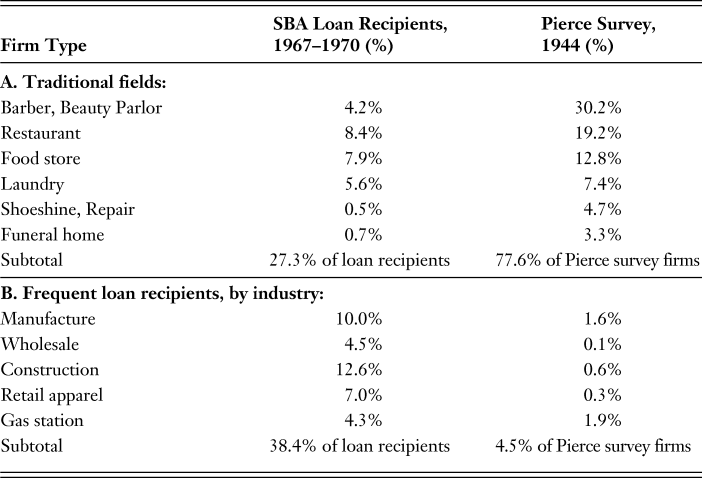
Our analysis measures impacts of SBA loans made to Black-owned firms upon the industry composition of those businesses. Data describing borrowers in Chicago, New York, and Boston receiving either SBA direct or guaranteed loans in this period revealed 559 loan recipients, including established Black-owned firms and startups. These data, collected from loan applications, included audited financial statements, credit reports, and income-tax returns (Bates Reference Bates1973b).Footnote 6 Among the established firms, mean sales and profits, respectively, were $74,101 and $7,000 at the time of loan application, while mean loan size was $27,740 (in 1970 dollars). The analysis proceeds by contrasting two opposing views of the likely industry composition of firms actually receiving these loans. Following Brimmer, firms receiving SBA loans are assumed to be heavily concentrated in personal services and restaurant/food store fields where Black firms traditionally concentrated. Alternatively, easing of capital constraints facilitated by SBA’s lending programs may induce a disproportionate response from capital-intensive lines of business, e.g., manufacturing, where business presence has historically been minimal. The hypothesis that limited capital access restricted the scope of Black entrepreneurship is investigated by comparing the industry distribution of SBA loan recipients to Pierce’s data describing the industrial composition of urban Black-owned firms (Table 2).
Comparison of Black-Owned Firms Receiving SBA Loans versus Firms Surveyed by Pierce in 1944, by Industry
Source: SBA loan data were compiled by the author.
Table 2 statistics contrasting the industry distribution of loan recipients to that of Black firms in the cities described by Pierce (Reference Pierce1947) indicate that borrowing firms were disproportionately concentrated in non-traditional industries like manufacturing. The two most common firm types—barber/beauty and restaurant—documented by Pierce (Reference Pierce1947) accounted for 12.6% of the SBA loan recipients. While firms in manufacturing and construction (viewed as inconsequential by Brimmer) were 22.6% of the SBA loan recipients, traditional Black-owned businesses were underrepresented (Table 2). Borrowing firms, instead, concentrated in capital-intensive fields where efficient operation often required operating capital and investment in equipment and inventory. These patterns of concentration are consistent with the hypothesis that borrowers would concentrate in industries where capital constraints held down Black business presence in the past.
Selection bias possibly impacted Table 2’s distribution of borrowing firms because eligibility for SBA-guaranteed loans required borrowers to have personal equity of at least 15% of the loan amount, thus disqualifying applicants lacking household wealth. Yet, they were eligible to apply for SBA direct Economic Opportunity Loans (EOL) targeting low-income borrowers, and 42.6% of the actual loan recipients did so. Since low-net worth borrowers were thus rarely disqualified from loan eligibility, selection bias was minimized (Bates and Bradford, Reference Bates and Bradford1979). Although the EOL loan recipients were more likely to default than their counterparts receiving guaranteed loans, their industry distribution was quite similar.
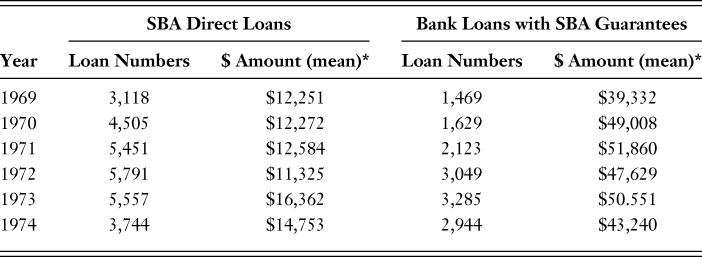
To achieve measurable impacts upon the industry distribution of Black businesses nationwide, expanded loan access would have to persist for years and most borrowers would have to repay their loans, thus avoiding being liquidated for defaulting. Table 3 data summarizing nationwide SBA 1969–1974 loan approvals indicate that lending to MBEs grew rather substantially in terms of loan frequency and average size. Among SBA-guaranteed bank loans in particular, annual loan numbers in 1969 had roughly doubled by the 1972–1974 period, while average loan amount increased. Loans to African American borrowers, furthermore, were more numerous than loans to other minorities (Bates and Bradford, Reference Bates and Bradford1979). After 1974, loan growth slowed (Bates Reference Bates, Horvitz and Pettit1984). The commercial banks’ tradition of minimal contact between loan officers and minority entrepreneurs nonetheless eroded in the 1970s in response to SBA’s loan programs. Lending discrimination did not disappear, but its intensity lessened (Cavalluzzo and Wolken, Reference Cavalluzzo and Wolken2005).
SBA Loan Approvals for Minority Borrowers, by Loan Type (Nationwide)
* All dollar amounts are expressed in 1969 dollars. Although the share of minority loan numbers and loan dollars received by Black-owned firms was not compiled by the SBA in the period, comprehensive data for all loans in five large cities—Boston, New York, Philadelphia, Washington D.C., and Chicago—indicate that 5,073 SBA loans (totaling $149.1) to minority borrowers were approved between 1968 and 1973; in terms of numbers of loans, 3,725 of the 5,073 approvals (73.4% of them) were received by Black-owned firms, and these same borrowers received 76.7% of the aggregate loan dollars. Most of the balance was received by Hispanic borrowers.
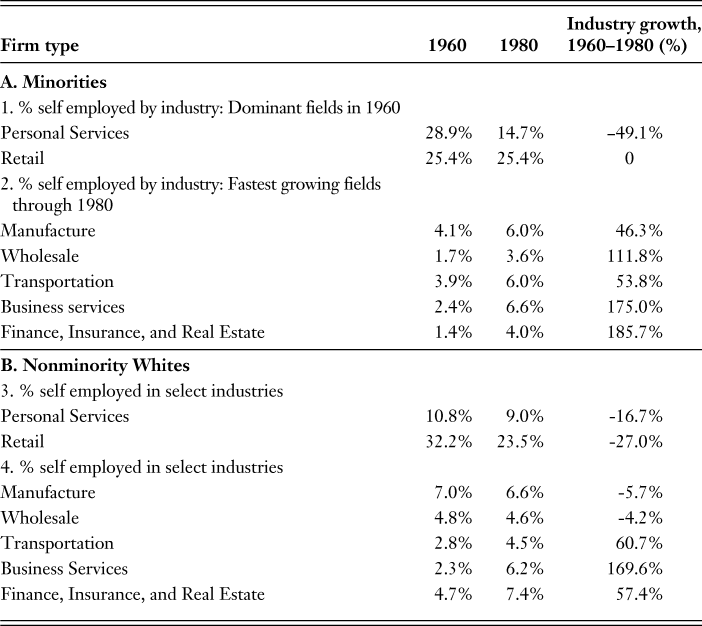
To investigate whether expanded loan access had appreciable long-term impacts on the industry composition of minority businesses, census data describing nationwide trends in self-employment incidence by industry over the 1960 to 1980 period are summarized in Table 4. Although these data do not permit detailed disaggregation by racial subgroups, they are nonetheless starkly revealing. While in 1960, the majority of MBEs active in the United States were personal services or retail businesses, over the next two decades all of the growth—measured by the proportions of MBEs operating in various industries—took place outside of these fields.Footnote 7 The decline in personal services was particularly pronounced. Personal services were both the least profitable and least capital-intensive of the major industry groups; declining constraints apparently encouraged minorities to pursue more rewarding entrepreneurial opportunities. The industries in which MBE presence expanded most rapidly were finance, insurance and real estate (FIRE), business services, wholesale, transportation, and manufacture.
Time Trends in the Incidence of Self-employment: Percent in Select Industry Groups, 1960–1980 (Nationwide Data)
Source: The percentage figures reported above were compiled by the author, using Decennial Census of Population, PUMS files for 1960 and 1980.
Proportions of Whites self employed in service industries like FIRE and business services also grew during this period. In FIRE, the proportion of non-minority White self-employment grew by 57.4% from 1960 to 1980, versus 185.7% among minorities. In each of the expanding industries, Black presence grew more rapidly than Asian presence (Bates Reference Bates1997). 1980 decennial census data indicate, further, that self-employed male minorities nationwide under age sixty-five reported mean 1979 earnings of $16,105; corresponding earnings figures among wage and salary workers were $11,235. Mean self-employment earnings of minorities as a percentage of non-minority self-employment earnings rose from 45.3% in 1960 to 92.8% in 1979. The relative earnings gains experienced by self-employed Black women were particularly impressive. Comparing Black and White males, the former, on average, earned 68.5% as much as Whites in 1979 (Bates Reference Bates1987).
How much of this improvement over the twenty-year span is attributable to expanded access to bank/government loans? Grappling with this question entails identifying the capital-intensive industries most likely to benefit from access to capital markets. In the small-business universe, Census Bureau sources identify manufacturing as the most capital intensive; wholesale ranks second, followed by FIRE, business services, and professional services (Bates Reference Bates2011). Most of these industries stand out (Table 4) as fast growing lines of minority enterprise, the exception being professional services. While this list suggests a likely link between expanding access to capital and subsequent business entry patterns, it is noteworthy that neither FIRE nor business services stood out as fields where SBA loan recipients were frequent (Table 2).
This missing link is partially explained by the nature of SBA’s EOL loan program that targeted low-income borrowers, and the fact that over 40% of the borrowers described in Table 2 received such loans. These loans, however, were phased out after 1974 and loan access shifted overwhelmingly to guaranteed bank loans (Bates and Bradford, Reference Bates and Bradford1979). FIRE and business services, noteworthy for their high capital requirements, stand out as well as lines of business attracting college graduates, few of whom qualified for SBA EOL loans. A reasonable presumption is that banks extending loans to Black entrepreneurs favored college-graduate loan applicants, both because of their higher long-term development potential as bank customers and their lower likelihood of loan default. But we cannot document this. Rapid growth of Black-owned firms in FIRE and business services highlights another building block of business viability—possessing appropriate education and expertise facilitates building viable firms. Possessing these attractive traits also facilitates receiving bank loans large in dollar amount (Bates Reference Bates1973a).
Easing Barriers to Advanced Educational Opportunities
College-educated African American entrepreneurs since the 1970s have largely avoided traditional lines of business, preferring instead to enter into larger-scale ventures, the most popular of which have been skill-intensive services (FIRE, business, and professional services). Nationally representative small-business data from the Census Bureau’s Characteristics of Business Owners (CBO) database illustrate why traditional fields were avoided: among college-educated Black firm owners working full-time in 1987, mean profits in traditional fields were only 62.1% as much as profits in all other lines of business (Bates Reference Bates1997). Traditional fields like barbershops generated profit levels insufficient to attract college-educated owners. Facing multiple options in the labor market, highly educated entrants must be lured into entrepreneurship by attractive opportunities. Popular choices include skill-intensive services, and these firms often compete for customers not simply in minority neighborhoods, but in the mainstream economy, where targeted clients were often corporations or government entities (Bates Reference Bates1997). As industry diversity in the Black business community expanded, college-educated entrepreneurs became the norm in skilled service lines of businesses. In Atlanta, Boston and Ross (Reference Boston, Ross, Boston and Ross1997) observed, a new African American entrepreneur has emerged, “This new entrepreneur is young, well educated, operating increasingly in non-traditional industries…” (p. 339).
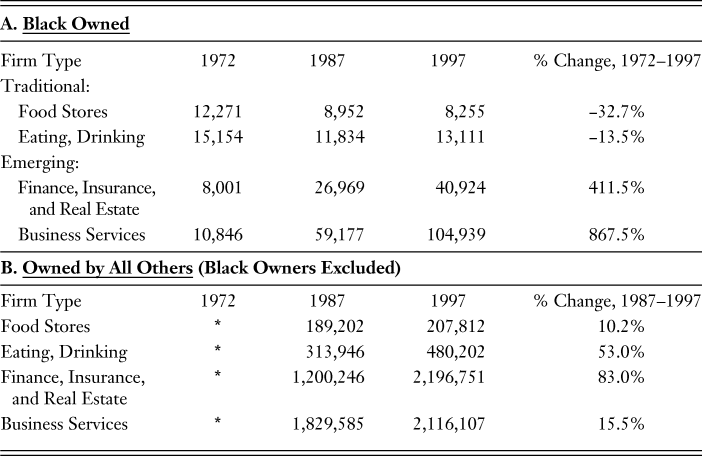
Nationwide census data tracking firms in two traditional fields, restaurants and food stores, and two lines of skilled services, FIRE and business services, illustrate the dominant trends of growth and decline reshaping the Black business community. From 1972 through 1997, numbers of restaurants and food stores declined absolutely: while food store numbers dropped by 33%, business-service firm numbers grew nearly ten-fold from 10,846 to 104,939 (Table 5). By 1997, Black business-service firms employed 156,974 workers, a fifteen-fold increase over their nationwide employee numbers in 1972 (U.S. Bureau of the Census 1975; U.S. Bureau of the Census 2001). Among small firms not owned by Blacks, firm numbers from 1987 to 1997 grew more rapidly in food store and restaurant fields and less rapidly in business services (Table 5). The totality of evidence suggests the declining fortunes of traditional Black businesses stem from the same broad forces, lower discriminatory barriers, permitting emerging firms headed by college-educated owners to penetrate new industries and markets (Bates Reference Bates1997). Although marginal operations are still numerous, time trends indicate a growing presence of larger scale, more capital- and skill-intensive firms.
Numbers of Firms in Selected Industries over the 1972–1997 Period, Nationwide
Sources: U.S. Bureau of the Census Survey of Minority-Owned Business Enterprises (SMOBE), 1972, 1987, and 1997, and Characteristics of Business Owners, 1987 (U.S. Census, 1975, 1991, 2001). Data for finance, insurance, and real estate firms are for the 1972–1992 period. The above data suffer from minor inconsistencies and tend to overstate firm numbers in 1972, yet they are adequate for describing broad time trends in firm numbers (Bates Reference Bates2006).
* Data on firm numbers do not exist. Because the original designers of the SMOBE survey, initially conducted in 1969, viewed minority business enterprises as typically very marginal ventures, they designed a sampling frame to find such firms. The SMOBE sampling frame was drawn from federal income tax returns (form 1040 schedule C most often, as well as partnership and subchapter S returns) and minorities reporting gross revenues of $50 or more in 1969 were included. The fact that many in the sampling frame were independent contractors who did not view themselves as self employed, or, alternatively, full-time employees with occasional non-wage income (professors reporting honoraria, for example) was overlooked. If you reported $50 gross, you were, by definition, a small business. Non-minority Whites were excluded from the sampling frame and finding comparable White-owned small firms was impossible (until 1987). They existed in census databases but, because they were thought of as typically substantive, they were spotted using different criteria. The Economic Census, for example, was based on the establishment concept (not firms) and they were most often tracked by checking for quarterly payroll data filed with the IRS (ES 202 forms). On the population side of the Census Bureau, the self-employed were identified by asking respondents to identify their primary labor-force attachment. In CPS data, for example, the self employed were those reporting self-employment /business ownership as their primary attachment. White samples were sufficiently large to derive estimates of the self employed, broken into industry-specific groups; Black samples were not. Thus, one could find an empirical basis for Black/White comparisons but not a valid or useful basis.
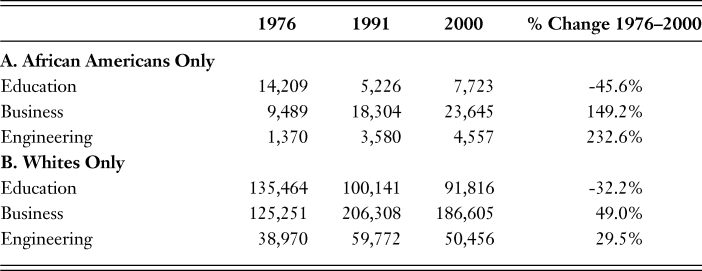
Importantly, capital access is not the only ingredient driving Black business growth and development. Gains in higher education illustrate how declining barriers have translated into wider opportunities. Fewer than 300,000 African Americans were enrolled in colleges and universities nationwide in 1965 (Trent Reference Trent1984). By 1980, the corresponding enrollment figure was 1,107,000. Careers in corporate America had, by the 1970s become increasingly popular career choices among college-educated Blacks. Whereas African Americans receiving bachelor’s degrees in 1976 majored most often in education, education degrees declined in the 1980s and 1990s, while interest in business and engineering rose substantially. While White college graduates similarly shifted from education to business and engineering, the changing patterns of undergraduate degrees were far more pronounced among African Americans. Thus, the number of undergraduate degrees in business earned by Blacks rose by 149.2% from 1976 to 2000, while the corresponding increase among Whites was 49.0% (Table 6). Selective figures on degrees awarded demonstrate the staying power of this transformation in the educational pursuits into the twenty-first century: as career options widened, teaching and preaching gave way to business and technical fields. MBA degrees awarded annually have grown particularly, by nearly 500% from 1976 to 2007.
Bachelor’s Degrees Awarded Nationwide to Whites and African Americans
Sources: Carter and Wilson, Reference Carter and Wilson1992; Harvey Reference Harvey2002; Ryu Reference Ryu2010.
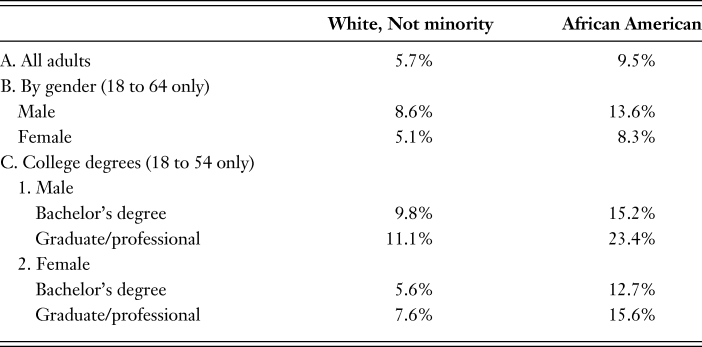
The changing fields of concentration among Black college graduates have coincided with growing interest in entrepreneurship as an occupational choice. Interest in entrepreneurship—measured by nationwide nascent entrepreneurship prevalence rates—is nearly twice as high among Black graduates, in comparison to Whites (Reynolds et al., Reference Reynolds, Carter, Gartner and Greene2004). Nascent entrepreneurs include, by definition, individuals interested in owning a small business who are actively working currently to turn their expressed interest into reality. Particularly at high levels of educational attainment (graduate and professional), Black men and women are over twice as likely as their White counterparts to self identify as nascent entrepreneurs (Table 7). It is the qualitative change from preacher/teacher career prospects to students preparing for careers in business and technical fields in conjunction with expanded access to capital, that underlies the growing industry diversity of businesses owned by African Americans.
Nascent Entrepreneurship Prevalence Rates by Race/Ethnicity
These data measure “two criteria” nascent entrepreneurship rates: “nascents” have responded affirmatively to the question, “are you, alone or with others, now trying to start a new business?” and met two additional criteria—1) they are currently active in the startup effort and 2) anticipate full or part ownership of the new venture. Source: Panel Study of Entrepreneurial Dynamics, national longitudinal sample, cited in Reynolds et al. (Reference Reynolds, Carter, Gartner and Greene2004).
CONCLUSION
All minorities—Asians and Hispanics as well as Blacks—have prospered in entrepreneurial occupations in recent decades in direct proportion to the degree to which they moved away from traditional fields like personal services (Bates Reference Bates2011). Firms in these industries are most often small and hire few employees. This business marginality reflects the fact that owners most often are not highly educated or skilled, invest little capital into their businesses, and serve low-income clients in highly competitive, even saturated markets where too many firms are competing for the business of customers who have too few dollars to spend (Bates and Robb, Reference Bates and Robb2008; Fairlie and Robb, Reference Fairlie and Robb2008; Kwong Reference Kwong1987). Growth areas, in contrast, are most often found in non-traditional lines of fields attracting well-educated owners. The resulting larger scale, better capitalized firms fail less often, hire more employees at higher average wages, and frequently compete in the broader economy, not simply in minority neighborhood markets (Bates Reference Bates2006).
How much of this expanding scale and growing industry diversity typifying the Black business community can be attributed to declining discriminatory barriers generally and to improvements in access to capital specifically? No existing database comes even close to providing an empirical foundation for answering this question precisely. A simpler question has been answered. Do declining barriers, on balance, strengthen or weaken the size and scope of the nationwide Black business community? Dr. Brimmer believed the lessening of segregation and discrimination would weaken Black entrepreneurship because he expected Blacks to remain in traditional lines of business. This position is untenable in light of the post-1960s changing industrial composition of Black enterprise and the emergence of the new African American entrepreneur (Boston and Ross, Reference Boston, Ross, Boston and Ross1997). Dr. Brimmer was wrong.
Economists correctly note that the decision to enter into small-business ownership is an exercise in freedom of choice made on the basis of one’s inclinations and preferences. This was certainly Brimmer’s belief. What they often fail to appreciate is that entry decisions are also made in specific socio-economic and political contexts, and that changes in the prevailing context alter entry decisions. Freedom of choice is trivialized in an environment where one’s choice is to be hanged or shot. Genuine freedom of choice is achieved, instead, by removing barriers, thus widening the options available to aspiring entrepreneurs, be they White or Black. Faced with fewer constraints, prospective Black entrepreneurs since the 1960s have on balance chosen to abandon fields offering low remuneration, choosing instead to enter into industries where creation of viable firms requires investment of capital by owners possessing appropriate expertise.
A vibrant and growing small-business community is one where talented individuals are pulled into entrepreneurship by attractive opportunities. Blacks, in contrast, historically were more often pushed into marginal firms by constraints limiting their alternatives in both small-business fields and salaried employment. These constraints, reflecting racial stereotypes and social custom, were sometimes formalized through legal restrictions. In the South in particular, the violence inflicted on successful businessmen when they moved into competition with Whites showed just how severe these constraints could be. Black businessmen, then, were restricted to low-status fields or ghettoized markets, although the rise of a Black business community that took advantage of the opportunities provided by segregation of the marketplace presaged the growth of Black entrepreneurship later in the twentieth century.
Thus although Dr. Brimmer feared that the desegregation of the marketplace would disadvantage most Black entrepreneurs, it should have come as no surprise that lower constraints transformed a generally stagnant Black business community into a profoundly different, more dynamic one. Overall, this gradual decline of discriminatory barriers has been beneficial. However, the trend of a growing, increasingly prosperous, community of African American businessmen and women cannot be uncritically extrapolated into the future. The history of Black entrepreneurship suggests that future prospects will be shaped by the evolution of the barriers facing African Americans, barriers that may either decline or reassert themselves in new, ever changing, and unpredictable circumstances.