

Introduction
Papaya (Carica papaya L.) is the most economically important fruit in the Caricaceae family and is believed to be native to southern Mexico and neighbouring Central America (De la Cruz Medina et al., Reference De la Cruz Medina, Gutiérrez and García2003). With the development of better cultivation and post-harvest technologies across the globe, papaya is now recognized as one of the most important tropical fruits and is cultivated in many tropical and subtropical countries. In Africa, the biggest producer of papaya is Nigeria (773,000 t) followed by the Democratic Republic of Congo (225,000 t) and Kenya (120,000 t) (FAOSTAT, 2013). Huge potential exists for expansion of production in Ghana, Mozambique and South Africa (GEPC, 2000; De la Cruz Medina et al., Reference De la Cruz Medina, Gutiérrez and García2003; Asudi, Reference Asudi2010).
In many African countries, papaya hosts a variety of tephritid fruit fly species, including Bactrocera dorsalis (Hendel), Ceratitis capitata (Wiedemann), Dacus ciliatus (Loew) and Zeugodacus cucurbitae (Coquillett) (Mwatawala et al., Reference Mwatawala, De Meyer, Makundi and Maerere2006; Ekesi and Billah, Reference Ekesi and Billah2007). Globally, all these fruit fly species are regarded as major quarantine pests (Ekesi and Billah, Reference Ekesi and Billah2007; Ekesi et al., Reference Ekesi, De Meyer, Mohamed, Virgilio and Borgemeister2016), thus papaya is subjected to quarantine regulations unless appropriate post-harvest treatments are applied to the produce before export. The purpose of the regulatory quarantine actions is to prevent transport of infested commodities and to reduce the risk of introducing fruit fly species of quarantine concern into pest-free areas.
Because phytosanitary considerations are the major barriers to trade in fresh fruit and vegetables, the need to accurately determine non-host status is crucial for market access. In this regard, studies of non-host status or infestation-resistant fruit and cultivars or stages of maturity of hosts are important to maintain quarantine security. Armstrong and Jang (Reference Armstrong, Jang, Allwood and Drew1997) defined a non-host for a given pest as “a fruit which is not attacked during any stage of growth or maturity by that pest”. For example, ‘Smooth Cayenne’ pineapple is a non-host for B. dorsalis and Z. cucurbitae (Flitters et al., Reference Flitters, Miyabara, Nakagawa and Dresner1953). Fruits may also have a non-host stage of maturity. For example, fruits such as papaya and avocado that are hosts for fruit flies are not infested in the early stages of ripening (Nguyen et al., Reference Nguyen, Gillis and Harris1993; Aluja et al., Reference Aluja, Diaz-Fleischer and Arredondo2004; Aluja and Mangan, Reference Aluja and Mangan2008). Thus, the non-infested stage of fruit maturity can be used as a reason to avoid expensive quarantine treatment (Armstrong, Reference Armstrong, Sharp and Hallman1994).
In a series of studies in the USA and Asia, various workers have demonstrated that infestation rates of papaya by fruit flies increased with increase in the degree of fruit ripeness (Armstrong, Reference Armstrong1983; Liquido et al., Reference Liquido, Cunningham and Couey1989; Nguyen et al., Reference Nguyen, Gillis and Harris1993; Aluja and Mangan, Reference Aluja and Mangan2008; Dong et al., Reference Dong, Song, Chuang, Chiang, Wu, Cheng and Chen2011). No such studies have been carried out in Africa for papaya, and export restrictions are limiting trade of the produce from the continent to lucrative markets abroad (M. Steinigeweg, unpublished data). However, Hennessey et al. (Reference Hennessey, Knight and Schnell1995) opined that when attempting to determine the host status of fruit flies, it is crucial to identity the cultivars and their different levels of susceptibility to infestation. When cultivars are unidentified in non-host status studies, there is the danger that all cultivars of a commodity could be classified as a host and quarantined without exception (Aluja et al., Reference Aluja, Diaz-Fleischer and Arredondo2004). The objectives of this study, therefore, were to (1) determine the field infestation rate of papaya according to degree of fruit ripeness in Kenya and identify a ripening stage that is non-susceptible to infestation; (2) assess the susceptibility of different export cultivars of papaya to B. dorsalis in relation to the degree of fruit ripeness in Mozambique and (3) evaluate the effect of volatiles emanating from macerated tissues of different papaya cultivars on egg viability of B. dorsalis in relation to the degree of fruit ripeness in Kenya.
Materials and methods
Field survey for fruit fly infestation of papaya according to the degree of ripeness in Kenya
Sampling sites
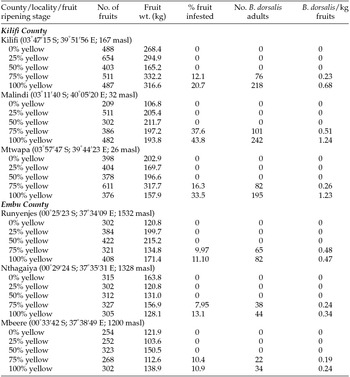
A papaya fruit survey was carried out from March 2013 to December 2014 in two counties (Kilifi and Embu) in Kenya where papaya production has been predominant (Asudi, Reference Asudi2010). At each location, approximate latitude, longitude and altitude were taken using a Global Positioning System (GPS) device (Table 1).
Papaya fruit infestation indices for Bactrocera dorsalis in two counties of Kenya during March 2013−December 2014

Fruit collection, handling and processing
Fruits were collected strictly from cultivated fields and backyard gardens. Fruit samples collected were categorized using the Neofresh (Pty) Ltd, South Africa papaya fruit maturity chart: (1) 0% yellow: mature green fruits that are entirely green with no streaks of yellow; (2) 25% yellow: fruits at colour break with a patch of yellow around the calyx; (3) 50% yellow: half of the fruit is yellow; (4) 75% yellow: three-quarters of the fruit is yellow and (5) 100% yellow: a fully ripe fruit that is completely yellow. Fruit sampling was carried out bi-weekly. During each sampling, fruits of different categories as described above were collected. The number of fruits collected at a given time from each category of ripening was variable, and depended on the number of available fruits at various sampling sites. Fruit collections of the different categories of ripeness were placed separately in perforated polyethylene bags in the field for transport to the rearing facility. Fruit samples collected in Kilifi County were processed at the International Centre of Insect Physiology and Ecology (icipe)—Muhaka Field Station, Kwale County, Kenya and those from Embu County were processed at the icipe Headquarters, Nairobi County, Kenya.
At the rearing facility, fruits were counted, weighed and held individually in 2-litre rectangular plastic containers (21.5 × 15.0 × 14.5 cm). Containers were covered with a fine netting material held in place by the perforated lid of the containers capable of retaining adult flies. Fruits were placed on 50−60 mm moistened sterilized sand placed at the bottom of the rearing containers. The sand served both as the pupation medium for the larvae that exited the fruit and as an absorptive medium for the excess liquid from the fruit. Fruit was held at ambient conditions for 4 weeks. The rearing cages were checked daily and fruit fly pupae picked from the sand with a pair of soft forceps, counted, and placed in Petri dishes with moistened filter paper. In some cases, pupation occurred inside the fruit, in which case, the rotting fruits were dissected to completely recover all remaining pupae. The Petri dishes with pupae were then held in small-ventilated transparent cylindrical plastic cages (5.5 × 12.5 cm) until eclosion. Emerging fruit flies were provided with an artificial diet that consisted of a volumetric mixture of 1:3 yeast hydrolysate enzymatic ultrapure (USB Corporation, Cleveland, OH) and sugar. Water was provided on pumice granules. Flies were allowed to feed for 4 days until full adult development and body colorations were attained. The flies were then killed by placing them in a freezer, and later preserved in 70% alcohol for identification.
Field cage infestation of papaya cultivars in relation to the degree of fruit ripeness in Mozambique
Papaya cultivars and source
Field cage experiments were carried out at Vanduzi Company (Chitundo Farm), Central Manica Province, Mozambique. Neofresh (Pty) Ltd, South Africa supplied the four papaya cultivars ‘Papino’, ‘Neo-Essence’, ‘Tainung No. 1’ and ‘Tainung No. 2’. Vanduzi Company, Mozambique supplied the fifth cultivar (Sunrise Solo) used in the experiment. Cultivar ‘Papino’ is a red-fleshed F1 hybrid cultivar developed and registered by Neofresh. Fruit weight ranges from 450 to 550 g with firm flesh and °Brix level of 11−12%. Cultivar ‘Neo-Essence’ is a red-fleshed F1 hybrid also developed by Neofresh. Fruit weight ranges from 500 to 600 g with a °Brix level of 12−13%. Cultivar ‘Sunrise Solo’ is a red-fleshed cultivar and originated from Hawaii, USA. It has a fruit weight of 350–450 g and °Brix level of 11−12%. Cultivar ‘Tainung No. 1’ is a Taiwanese hybrid. Fruit weight varies from 600 to 1400 g with firm flesh and °Brix level of 11−12%. The flesh of cultivar ‘Tainung No. 2’ is softer than that of ‘Tainung No.1’ with fruit weight of 600−1000 g and average °Brix level of 10%. Seedlings of cultivar ‘Papino’ and ‘Neo-Essence’ were directly shipped from Neofresh, South Africa to Mozambique after meeting regulatory approval. Cultivars ‘Papino’, ‘Neo-Essence’ and ‘Sunrise Solo’ were planted on 2 December 2013 in 3 blocks of a 0.6 ha grove at Chitundo, Vanduzi Company. Cultivars ‘Tainung No. 1 and Tianung No. 2 were directly seeded on 24 November 2014 on a 0.4 ha grove in the same location. At the time of experimentation, ‘Papino’, ‘Neo-Essence’ and ‘Sunrise Solo’ had grown to a height of 2.5−3.6 m whilst ‘Tainung No. 1’ and ‘Tianung No. 2’ were 1.2−1.6-m tall. The trees were irrigated weekly by overhead microjet, and the plants treated with metalaxyl-M at the rate of 0.5 kg active ingredient per hectare against powdery mildew as required.
Artificial infestation of the papaya cultivars with B. dorsalis
For each cultivar, 30 trees with fruits of varying degree of ripeness were caged. Fruit ripeness was categorized using the Neofresh papaya fruit maturity chart as previously described. Each of the selected trees that were caged had at least 1−3 fruits that were at 75−100% yellow and several fruits at 0, 25 and 50% yellow. The papaya trees were caged with mosquito netting (120 × 200 × 200 cm) and secured to the trunk of the tree using a string. Papaya trees were trimmed as necessary to fit the nets to the tree. For each cultivar, the 30 caged trees were infested with 10−14-day old B. dorsalis at the following densities: 50 flies (20 males and 30 females), 100 flies (40 males and 60 females) and 150 flies (60 males and 90 females) per cage. Ten trees were used per infestation density. Bactrocera dorsalis was mass reared at the National Fruit Fly Laboratory (NFFL), Chimoio, Manica Province, Mozambique on a carrot-based diet using the methodology described by Ekesi et al. (Reference Ekesi, Nderitu and Chang2007). Insects were fed on a diet consisting of three parts sugar and one part enzymatic yeast hydrolysate ultrapure (USB Corporation, Cleveland, OH), and water provided on pumice granules. After 48 h of exposure, 30 fruits of different ripeness categories were harvested from the cages across the different infestation densities and placed individually in paper bags labelled with the various ripeness categories and fruit fly infestation densities. Thereafter, food and water were removed from the cages and the insects allowed to starve to death for an additional 72 h before the netting was dismantled. The experiments were replicated three times between September and November 2014 for cultivars ‘Papino’, ‘NeoEssence’ and ‘Sunrise Solo’ and November 2015−March 2016 for ‘Tainung No. 1’ and ‘Tainung No. 2. Fruits were transported to the rearing facility at the NFFL in Chimoio. At the laboratory, fruits were counted, weighed, and individually placed in 2-litre rectangular plastic containers (21.5 × 15.0 × 14.5 cm). All other fruit processing methodologies were as described above.
Effect of volatiles emanating from different papaya cultivars on egg hatchability of B. dorsalis
Eggs of B. dorsalis used in this study were obtained from cultures maintained on a carrot-based diet using the methodology described by Ekesi et al. (Reference Ekesi, Nderitu and Chang2007). To assess effects of volatiles on egg viability of B. dorsalis, four papaya cultivars commonly grown in Kenya, namely ‘Sunrise Solo’, ‘Red Lady’, ‘Papayi’ and ‘Apoyo’ (Asudi, Reference Asudi2010) of varying degrees of ripeness were freshly harvested from various backyard gardens at Embu County, Kenya. Interviews with the gardens’ owners revealed that no form of pest management had been applied to the papaya tree that the fruits were harvested from. The various ripening categories used are as previously described. The fruits from the five ripeness categories were peeled and the seeds removed from the pulp. Thereafter, this pulp was homogenized using a NutriBullet blender (Capital Brands LLC, CA, USA) for 5 min. Ten grammes of the mixture of each cultivar and ripeness category were immediately transferred into a Petri dish. The Petri dish and its contents were then placed in an inverted glass chamber (30-cm diameter, 15-cm high). Within this glass chamber was another Petri dish containing 20 eggs of B. dorsalis arranged singly on the surface. Eggs of test insects were exposed to the volatiles arising from the papaya cultivar at different ripening stages for 24 h, after which the materials were removed from the glass chamber. The control batch of eggs had no exposure to volatiles of the plant materials. Hatchability was determined both in the experimental and control batches of eggs after 3 days. The experiment consisted of 20 eggs per replicate with five replications per treatment.
Statistical analysis
Data for field surveys are presented according to county, location, number of papaya fruits collected, weight, % fruit infested and number of adults. Similarly, field cage data are given as fruit weight, % fruit infested and number of B. dorsalis pupae recovered. Infestation by B. dorsalis was calculated as the ratio of number of pupae or adults/kg of fruit collected (infestation index) following the methodology of Cowley et al. (Reference Cowley, Baker and Harte1992). Field cage and laboratory data were tested for normality and homogeneity of variance by transforming to natural logarithms (pupal recovery and pupae/kg fruit) and angular transformation (% egg hatch) before subjecting to analyses. Data were subjected to analysis of variance (ANOVA) using the generalized linear model (Proc GLM) and means separated by Tukey's (HSD) test (P = 0.05). All analyses were performed using the SAS statistical software package (2001).
Results
Field survey for fruit fly infestation of papaya according to the degree of ripeness in Kenya
Results of the field infestation of papaya fruits by fruit flies in two counties in Kenya are presented in Table 1. The only fruit fly recorded attacking papaya during the survey was B. dorsalis. In all the locations in the two counties surveyed, no fruit fly infestation was recorded in the 0, 25, and 50% stages of ripeness (Table 1). In Kilifi County, the highest infestation was recorded in Malindi in the 100% yellow stage of ripening (43.8%; 1.24 B. dorsalis per kg fruit), followed by Mtwapa (33.5%; 1.23 pupae per kg fruit) and Kilifi (20.7%; 0.68 B. dorsalis per kg fruit) (Table 1). In Embu County, infestation was generally lower than in Kilifi. The highest infestation at the 100% stage of ripening was at Nthagaiya (13.1%; 0.34 B. dorsalis per kg fruit), followed by Runyenjes (11.1%; 0.47 B. dorsalis per kg fruit) and then Mbeere (10.9%; 0.24 B. dorsalis per kg fruit) (Table 1).
Field cage infestation of papaya cultivars in relation to the degree of fruit ripeness in Mozambique
Cultivar ‘Papino’
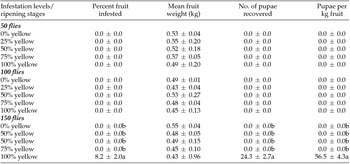
At infestation densities of 50 and 100 flies per cage, no B. dorsalis adult emerged from fruits exposed to the insect and processed in the laboratory for all ripeness indices used in the experiments (Table 2). However, at the density of 150 flies per cage, 8.2% fruits were infested only at 100% yellow (F = 141.8; df = 4,12; P = 0.0001). Of the infested fruits, 56.5 pupae per kg fruit were recovered from the fruits (F = 167.8; df = 4,12; P= 0.0001) (Table 2).
Mean infestation indices for Bactrocera dorsalis in papaya, cultivar ‘Papino’ following artificial infestation in the field

Means (± SE) within a column followed by the same letter do not differ significantly by Tukey (HSD) test (P = 0.05).
Cultivar ‘Neo-Essence’
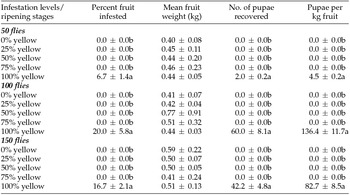
In cultivar ‘Neo-Essence’, B. dorsalis was recovered at all the infestation densities but only when the fruits were at the 100% yellow stage of ripening (Table 3). Percent fruit infested at the various fly densities was 6.7% at 50 flies (F = 132.8; df = 4,12; P = 0.0001), 20% at 100 flies (F = 101.6; df = 4,12; P = 0.0001) and 16.7% at 150 flies (F = 216.2; df = 4,12; P = 0.0001) (Table 3). The respective number of pupae recovered per kg of fruits was 4.5, 136.4 and 82.7 (Table 3). No pupa was recovered at the 0, 25, and 50% stages of ripening for all the infestation densities (Table 3).
Mean infestation indices for Bactrocera dorsalis in papaya, cultivar ‘Neo-Essence’ following artificial infestation in the field

Means (± SE) within a column followed by the same letter do not differ significantly by Tukey (HSD) test (P = 0.05).
Cultivar ‘Sunrise Solo’
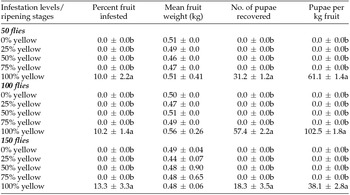
Results obtained with cultivar ‘Sunrise Solo’ were similar to ‘Neo-Essence’ in that B. dorsalis was only recovered from the 100% yellow ripening stage at all the infestation densities (Table 4). At this stage, fruit infestation was 10% at the density of 50 flies (61.1 pupae per kg fruit) (F = 111.8; df = 4,12; P = 0.0001), 10.2% at the density of 100 flies (102.5 pupae per kg fruit) (F = 187.5.2; df = 4,12; P = 0.0001) and 13.3% at 150 flies (38.1 pupae per kg fruit) (F = 275.4; df = 4,12; P = 0.0001) (Table 4).
Mean infestation indices for Bactrocera dorsalis in papaya, cultivar ‘Sunrise Solo’ following artificial infestation in the field

Means (± SE) within a column followed by the same letter do not differ significantly by Tukey (HSD) test (P = 0.05).
Cultivar ‘Tainung No. 1’
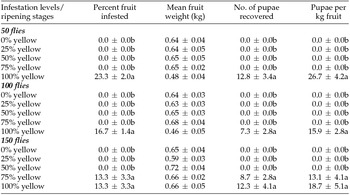
At infestation densities of 50 and 100 flies, B. dorsalis only infested fruits at the 100% yellow stage of ripening: 50 flies (23.3%, 26.7 pupae per kg fruit) (F = 242.1; df = 4,12; P = 0.0001 and F = 128.6; df = 4,12; P = 0.0001, respectively) and 100 flies (16.7%, 15.9 pupae per kg fruit) (F = 201.4; df = 4,12; P = 0.0001 and F = 162; df = 4,12; P = 0.0001, respectively) (Table 5). At 150 flies, infestation occurred at 75% yellow (13.3%, 13.1 pupae per kg fruit) and 100% yellow stage of ripening (13.3%, 18.7 pupae per kg fruit) (F = 119.7; df = 3,12; P = 0.0001 for percent infestation and F = 201.2; df = 4,12; P = 0.0001 for pupae per kg fruit) (Table 5).
Mean infestation indices for Bactrocera dorsalis in papaya, cultivar ‘Tainung No. 1’ following artificial infestation in the field

Means (± SE) within a column followed by the same letter do not differ significantly by Tukey (HSD) test (P = 0.05).
Cultivar ‘Tainung No. 2’
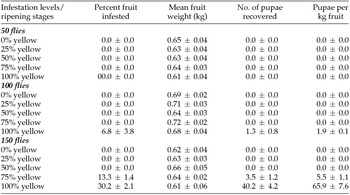
No infestation was recorded at the density of 50 flies per cage for all the ripening stages of this cultivar (Table 6). However, at 100 flies per cage, 6.8% of the fruits were infested at the 100% yellow stage (F = 218.2; df = 4,12; P = 0.0001) with 1.9 pupae per kg fruit recorded (F = 186.4; df = 4,12; P = 0.0001) (Table 6). At the density of 150 flies per cage, B. dorsalis infested the cultivar both at 75% (13.3% infestation; 5.5 pupae per kg fruit) and 100% ripening stage (30.2% infestation; 65.9 pupae per kg fruit) (Table 6) (F = 205.2; df = 3,12; P = 0.0001 for percent infestation and F = 112.7; df = 4,12; P = 0.0001 for pupae per kg fruit) (Table 6).
Mean infestation indices for Bactrocera dorsalis in papaya, cultivar ‘Tainung No. 2’ following artificial infestation in the field

Means (± SE) within a column followed by the same letter do not differ significantly by Tukey (HSD) test (P = 0.05).
Effect of volatiles emanating from different cultivars of papaya on egg viability of B. dorsalis
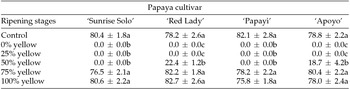
For each of the papaya cultivars tested, there was a significant difference in egg viability of B. dorsalis amongst the various ripening stages following exposure to volatiles: ‘Sunrise Solo’ (F = 88.4; df = 5,24; P = 0.0001), ‘Red Lady’ (F = 42.8.4; df = 5,24; P = 0.0001), ‘Papayi’ (F = 106.2; df = 5,24; P = 0.0001) and ‘Apoyo’ (F = 56.8.4; df = 5,24; P = 0.0001). In the control treatment, egg hatchability ranged from 78.2 to 82.1% (Table 7). Volatiles emanating from cultivar ‘Sunrise Solo’ and ‘Papayi’ at 0, 25 and 50% stages of ripening completely inhibited egg hatchability by B. dorsalis (Table 7).
Mean egg hatch (% ± SE) of Bactrocera dorsalis after exposure to volatiles emanating from different cultivars of papaya

Means (± SE) within a column followed by the same letter do not differ significantly by Tukey (HSD) test (P = 0.05).
Discussion
Papaya collected across two different fruit production counties of Kenya were uninfested by fruit flies at the 0, 25 and 50% yellow stages of fruit maturity. However, fruit fly infestations were observed in fruits when they were 75 and 100% yellow in most of the locations. The only fruit fly observed attacking papaya in all the locations was B. dorsalis. This is surprising given that B. dorsalis is reported to co-exist with Z. cucurbitae on papaya (Back and Pemberton, Reference Back and Pemberton1917; Syed, Reference Syed1971; Liquido et al., Reference Liquido, Cunningham and Couey1989) and the latter has been recorded from Africa since 1936 (De Meyer et al., Reference De Meyer, Delatte, Mwatawala, Quilici, Vayssières and Virgilio2015; De Meyer and Ekesi, Reference De Meyer, Ekesi, Ekesi, Mohamed and De Meyer2016). Our results contrast with similar studies in Hawaii that demonstrated that B. dorsalis or Z. cucurbitae infested papaya of different ripening stages described as mature green, one-fourth ripe, half ripe, three-quarters ripe and fully ripe at various locations on the island (including Kalapana, Keaau, Nanawale and Pahoa) (Liquido et al., Reference Liquido, Cunningham and Couey1989). Infestation by B. cucurbitae at the mature green stage was only observed in Nanawale location. The reason for such a contrasting difference (in particular for B. doralis) is unclear, especially because the volume of fruits collected is somewhat within a similar range (136−679 fruits in Hawaii and 252−654 fruits in Kenya). It is probable that the African populations have not fully adapted to infesting mature green papaya (being a fairly recent invader, as it was first detected on the continent in 2003; Lux et al., Reference Lux, Copeland, White, Manrakhan and Billah2003) or there are other factors contributing to the lack of infestation, for which the explanation is elusive). Nevertheless, Nguyen et al. (Reference Nguyen, Gillis and Harris1993) reported that when similar fruit ripening stages of ‘Sunrise Solo’ papaya cultivar were exposed to Anastrepha suspensa (Loew), infestation was observed only at the fully ripe stage. Our field results in Kenya are in agreement with this report.
The field cage exposure studies in Mozambique further substantiated the fruit collection studies in Kenya. In the five cultivars tested, namely ‘Papino’, ‘Neo-Essence’, ‘Sunrise Solo’, ‘Tainung No. 1’ and ‘Tainung No. 2’, no fruit fly infestation was observed in fruits that were at the 0, 25 and 50% yellow stages of ripening, irrespective of the density of insects used in the field cages. Nguyen et al. (Reference Nguyen, Gillis and Harris1993) reported that no larvae or pupae of A. suspensa were recovered from ‘Sunrise Solo’ papaya at varying fruit ripening stages categorized as quarter-ripe, half-ripe, colour-break or mature green after 48 h of exposure to the insect. Most recently, Dong et al. (Reference Dong, Song, Chuang, Chiang, Wu, Cheng and Chen2011) assessed the frequency of oviposition of B. dorsalis and Z. cucurbitae on two papaya cultivars, ‘Tainung No. 2’ and ‘Sunrise’, in relation to the degree of ripeness and infestation densities of 5, 10 and 20 pairs of flies. In cultivar ‘Tainung No. 2’, ripeness was categorized as mature green, 1–2, 2–3 and 5 yellow-stripe, and mature yellow, whilst for cultivar ‘Sunrise’ the degree of ripeness was categorized as mature green, quarter-, half-, and mature-yellow. The results showed that on cultivar ‘Tainung No. 2’, B. dorsalis laid eggs only in the mature yellow stage (21.5 eggs) whilst Z. cucurbitae laid eggs on stages 5 yellow-stripe and mature yellow (8.9−37.8 eggs). The workers reported that in cultivar ‘Tainung No. 2’ the 2–3 yellow-stripe is the ripeness stage at which export papaya are harvested and fruits are therefore assured of quarantine security, since fruits were uninfested by either flies at this stage. On cultivar ‘Sunrise’, B. dorsalis laid eggs at the half yellow and mature yellow stages (2.2−44.4 eggs) whilst Z. cucurbitae laid eggs at all ripening stages (5.4−131.6 eggs), except the mature green stage. Although we did not measure eggs developed to pupae and adult stage, our results support previous findings that B. dorsalis does not infest papaya cultivars ‘Tainung No. 2’ and ‘Sunrise Solo’ at mature green (i.e. 0% yellow) to the stage at which the fruits are harvested for export (i.e. < 40% yellow); and hence, this non-infested stage of fruit maturity does not require quarantine treatment before the fruits are exported.
In determining non-host status of fruits to fruit flies, varying levels of infestation densities have been used by various workers. On avocado, infestation densities ranged from 5 to 50 gravid females per fruit (Willard et al., Reference Willard, Mason and Fullaway1929; Armstrong, Reference Armstrong1983; Aluja et al., Reference Aluja, Diaz-Fleischer and Arredondo2004). On banana, densities ranged from 100 to 1000 gravid females per 80−100 fingers (Armstrong Reference Armstrong2001; Cugala et al. Reference Cugala, Ekesi, Ambasse, Adamu and Mohamed2014). On papaya, infestation densities ranged from 5 to 35 gravid females per 1−2 fruits of specific maturity stage (Nguyen et al., Reference Nguyen, Gillis and Harris1993; Dong et al., Reference Dong, Song, Chuang, Chiang, Wu, Cheng and Chen2011). Exposure durations in these studies usually varied from 24 to 48 h. The densities of fruit flies used in our study, therefore, represented a worst-case scenario, and the 48 h exposure duration is within the range that these previous workers reported. Indeed, higher fly densities and longer exposure period should favour successive oviposition within the same oviposition punctures, which is typical of B. dorsalis (Christenson and Foote, Reference Christenson and Foote1960). However, despite the high number of flies used in our study and the 48 h exposure duration, no infestation was observed at 0, 25 and 50% yellow ripening stages of the five papaya cultivars tested. Overall, this again substantiates the reason why papaya at 50% yellow should not be subjected to post-harvest treatment for B. dorsalis before export for the cultivars tested here.
One caveat with our study is that we did not remove ripened fruits from the trees that were caged in the field trials in Mozambique. Rather, fruits at 100% yellow were left on the caged trees; thus, it is possible that these flies may have been attracted only to the fully ripe fruits and not to the other fruit maturity stages. Despite this shortcoming, and contrary to the observation of Nguyen et al. (Reference Nguyen, Gillis and Harris1993), we observed many flies landing, and attempting to oviposit, on fruits of all the ripening stages that were on the experimental trees. In some cases, flies spent a considerable amount of time cleaning their ovipositor of fruit latex after various oviposition attempts, and continuing to explore several surface areas to lay their eggs. In separate trials, we also marked oviposition sites and dissected the fruits to observe for eggs, and several eggs of B. dorsalis were found in fruits of different maturity status (results not shown). It is, therefore, unlikely that leaving the 100% yellow fruits on the trees affected the results presented here.
The present study also showed that volatiles of papaya at 0, 25 and 50% ripening stages of the four papaya cultivars tested, namely ‘Sunrise Solo’, ‘Red Lady’, ‘Papayi’ and ‘Apoyo’, had a detrimental effect on egg hatchability of B. dorsalis. Flath and Forrey (Reference Flath and Forrey1977) identified linalool and benzyl isothiocyanate (BITC) as two major volatile compounds in fresh papaya. The concentration of BITC in macerated tissues of papaya has been reported to inversely correlate to the ripeness of fruits (Tang et al., Reference Tang, Syed and Hamilton1972). Seo and Tang (Reference Seo and Tang1982) demonstrated that a BITC concentration of 847.0 ppm in artificial latex killed 50 or 99.9% of B. dorsalis eggs in 10.4 or 37.0 min, respectively. The workers, however, cautioned that variations may occur in biological characteristics of fruits, and generalization to lift quarantine security is not recommended. Nevertheless, our results suggest that the effect of volatiles on eggs of fruit flies is present in many cultivars of papaya. Although we did not measure the different volatile profiles in the four cultivars of papaya tested in our study, it is appropriate to speculate that BITC compound present in the cultivars may be responsible for the high mortality of eggs of B. dorsalis at the 0, 25 and 50% yellow stages of ripening. BITC has been described as an effective germicidal compound and isothiocyanates in general are believed to be a naturally occurring pesticide (Lichtenstein et al., Reference Lichtenstein, Strong and Morgan1962). In fact, Seo et al. (Reference Seo, Tang, Sanidad and Takenaka1983) demonstrated that a high concentration of BITC in the vicinity of physically damaged tissues of green papaya deter fruit fly oviposition.
Conclusion
Our results demonstrate that papaya fruits collected from the various orchards in Kenya are not attacked by fruit flies at the 0, 25 and 50% yellow stages of ripening. Absence of infestation at these ripening stages was demonstrated in field cages in five cultivars under extreme infestation levels in Mozambique, and results showed that these stages of papaya ripening are resistant to attack by B. dorsalis. The mechanism of resistance seems to be dependent on volatiles released from the fruits, which may be toxic to eggs of the fruit flies. Because the < 40% yellow stage of fruit ripening is the maturity stage at which most fruits destined for export are harvested, our results suggest that the cultivars evaluated here should not be subjected to post-harvest treatments before export to quarantine-sensitive markets, since this is a non-host stage of maturity specifically for B. dorsalis.
Acknowledgements
The financial support of Neofresh (Pty) Ltd South Africa to the field cage experiments is gratefully acknowledged. We appreciate the assistance of Magriet Steinigeweg in all aspects of papaya R&D and for providing all the cultivars tested in the study. Special thanks go to Mr Augusto Jaime, Mr Abdul Latif and Vanduzi Company for providing the experimental sites and all the field assistance necessary for the trials in Mozambique. Several technical staff at the National Fruit Fly Laboratory (NFFL) in Chimoio assisted in fruit processing and fruit fly supply for the field infestation. We thank Subramanian Sevgan, Komi Fiaboe and two anonymous reviewers for their input to an earlier draft of the manuscript, and Greg Stevens for statistical advice and analysis. We also gratefully acknowledge core support to icipe, Kenya provided by UK Aid from the UK Government, Swedish International Development Cooperation Agency (Sida), the Swiss Agency for Development and Cooperation (SDC), Federal Ministry for Economic Cooperation and Development (BMZ), Germany and the Kenyan Government. The views expressed herein do not necessarily reflect the official opinion of the donors.