INTRODUCTION
If a solid target is hit by a high-intensity (>1010 W/cm2) particle or laser beam, a plasma is created on the surface of the target. This may be the case for the production target of the Super FRagment Separator (S-FRS) at Gesellschaft für Schwerionenforschung (GSI) Darmstadt, or currently at the lasers nhelix (Hoffmann et al., Reference Hoffmann, Blazevic, Ni, Rosmej, Roth, Tahir, Tauschwitz, Udrea, Varentsov, Weyrich and Maron2005, Schaumann et al., Reference Schaumann, Schollmeier, Rodriguez-Prieto, Blazevic, Brambrink, Geissel, Korostiy, Pirzadeh, Roth, Rosmej, Faenov, Pikuz, Tsigutkin, Maron, Tahir and Hoffmann2005) and phelix (Kuehl et al., Reference Kuehl, Ursescu, Bagnoud, Javorkova, Rosmej, Cassou, Kazamias, Klisnick, Ros, Nickles, Zielbauer, Dunn, Neumayer and Pert2007) at GSI, where plasmas with temperatures of about 200 eV (1 eV ≈ 1.16 × 10⁴ K ≈ 1.60 × 10⁻¹⁹ J) and electron densities of 1027 m−3 are established. But also the development of X-ray lasers is closely connected with the study of very dense and highly ionized plasmas where hydrogen-like systems play a major role. With X-ray lasers (Kuehl et al., Reference Kuehl, Ursescu, Bagnoud, Javorkova, Rosmej, Cassou, Kazamias, Klisnick, Ros, Nickles, Zielbauer, Dunn, Neumayer and Pert2007), electron densities above 1027 m−3 (Fortmann et al., Reference Fortmann, Bornath, Redmer, Reinholz, Röpke, Schwarz and Thiele2009) seem to be reachable.
Considering the interaction of ion beams with matter, and in high-energy ion-beam experiments, the interaction of the beams with the target material, the excitation of the target electrons, and the ionization of the target matter are of large importance. The projectiles transmit momentum and energy to the target particles by Coulomb interaction. There, the energy loss of the projectil depends on the ionization energy of the targets.
The ionization energy of a target particle, that means the work necessary to strip an electron from the target particle, depends on the density and temperature of the plasma. With increasing plasma temperatures and pressures, one obtains a lowering of the ionization energy. This lowering was already intensively investigated by many authors (Ebeling et al., Reference Ebeling, Kraeft and Kremp1976, Reference Ebeling, Meister, Sändig and Kraeft1979, Reference Ebeling, Leike and Leonhardt1991, Reference Ebeling, Blaschke, Redmer, Reinholz and Röpke2009, Reference Ebeling, Blaschke, Redmer, Reinholz, Röpke, Redmer, Holst and Hensel2010; Fisher et al., Reference Fisher, Henis, Eliezer and Meyer-Ter-Vehn2006a, Reference Fisher, Henis, Eliezer and Meyer-Ter-Vehn2006b; Kraeft et al., Reference Kraeft, Kremp, Ebeling and Röpke1986, Reference Kraeft, Kremp, Kilimann and De Witt1990; Kremp et al., Reference Kremp, Schlanges and Kraeft2005; Meister, Reference Meister1982) using quantum physics and performing Jacobi-Padé approximations. The plasma considered was especially the hydrogen one, but some studies were also made for hydrogen-like systems consisting, for instance, of bound-states of one-fold ionized helium atoms and five-fold ionized carbon atoms (see, e.g., Ebeling et al., Reference Ebeling, Leike and Leonhardt1991). Such matter made up of protons, alpha particles, and ionized carbon plays an important role in astrophysics. It occurs especially in stellar material (see, e.g., Endres, Reference Endres2010; Meister et al., Reference Meister, Staude and Pregla1999, Reference Meister, Endres and Hoffmann2010), but also in the interiors of giant planets like Jupiter, Saturn, and Uranus (Ebeling, Reference Ebeling and Leike1991a; Hoffmann et al., Reference Hoffmann, Tahir, Udrea, Rosmej, Meister, Varentsov, Roth, Schaumann, Frank, Blazevic, Ling, Hug, Menzel, Hessling, Harres, Günther, El-Moussati, Schumacher and Imran2010). It is investigated in laboratory experiments too, e.g., in the GSI FAIR experiment (Nardi et al., Reference Nardi, Maron and Hoffmann2009; Tahir et al., Reference Tahir, Kim, Matvechev, Ostrik, Shutov, Lomonosov, Piriz, Lopez Cela and Hoffmann2008a, Reference Tahir, Weick, Shutov, Kim, Matvechev, Ostrik, Sultanov, Lomonosov, Piriz, Lopez Cela and Hoffmann2008b, Reference Tahir, Schmidt, Brugger, Shutov, Lomonosov, Piriz and Hoffmann2009a, Reference Tahir, Matveichev, Kim, Ostrik, Shutov, Sultanov, Lomonosov, Piriz and Hoffmann2009b, Hoffmann et al., Reference Hoffmann, Blazevic, Ni, Rosmej, Roth, Tahir, Tauschwitz, Udrea, Varentsov, Weyrich and Maron2005, Reference Hoffmann, Tahir, Udrea, Rosmej, Meister, Varentsov, Roth, Schaumann, Frank, Blazevic, Ling, Hug, Menzel, Hessling, Harres, Günther, El-Moussati, Schumacher and Imran2010), in shock wave experiments (Knudson et al., Reference Knudson, Desjarlais and Dolan2008), and in capillary discharge plasmas (Förster et al., Reference Förster, Beule, Conrads and Ebeling1998). But also plasmas of other warm dense materials including copper, aluminium, tungsten, tantalum, sapphire, and uranium dioxide are studied by intense heavy ion beam experiments (Ni et al., Reference Ni, Kulish, Mintsev, Nikolaev, Ternovoi, Hoffmann, Udrea, Hug, Tahir and Varentsov2008).
In case of stellar plasmas, astroseismology may already resolve thermodynamic functions like the plasma pressure and the polytropic index with an accuracy below one percent. Thus, one needs also a thermodynamic theory describing the plasmas with high accuracy, and the density and temperature dependence of the energy levels of the plasma particles should be known with a high accuracy too. In the present paper, it is attempted to estimate modifications of the energy shifts of hydrogen-like ions in carbon plasmas with densities on the order of 1027–1029 m−3 at temperatures of 106–108 K because of screening and quantum-physical effects. There special attention is paid to the introduction of the wave functions of the ions in momentum space and to their treatment.
EBELING-KILIMANN-KRAEFT-RÖPKE FORMALISM TO ESTIMATE ENERGY SHIFTS
If an atom is imbedded into a plasma, the influence of the surrounding plasma on the energy levels of the atom has to be taken into account. Kraeft et al., (Reference Kraeft, Kremp, Kilimann and De Witt1990) divided the influence into four different parts:
(1) Both electron and nucleus of a test bound-state particle are sitting in a potential field formed by all other surrounding charged particles. This gives rise to the so-called dynamic self-energy effects.
(2) The bare Coulomb forces are screened by the plasma. This leads to a Debye-type interaction between electron and nucleus. The corresponding energy shifts are called Debye shifts.
(3) If the surrounding system is composed of particles of the same species as those forming the bound-state pair, it may happen that an external electron cannot penetrate into the bound-state due to the Pauli exclusion principle. States that are already occupied by plasma electrons have to be avoided in all interaction and scattering processes. This leads to the Pauli-shifts, which are of special importance for excited states.
(4) Due to collisions of the bound-state electron with the surrounding plasma, the bound-state has a finite life-time.
To calculate energy levels in a plasma, one may start with the Bethe-Salpeter equation (Kilimann et al., Reference Kilimann, Kraeft and Kremp1977; Zimmermann et al., Reference Zimmermann, Kilimann, Kraeft, Kremp and Röpke1978; Kraeft et al., Reference Kraeft, Kremp, Ebeling and Röpke1986) describing bound-states of a quantum-physical two-body-system in a plasma,
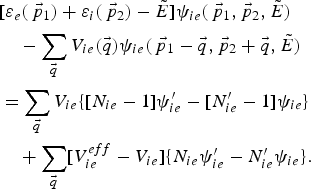
ψie is the wave function of the electron-ion bound-state without plasma environment, V ie designates the bare Coulomb potential, V ieeff describes the effective electron-ion interaction potential determined by the plasma environment (in first approximation it equals the Debye potential), and N ie is the occupation function. The dashes present arguments shifted by the influence of the plasma environment. Ẽ equals the energy of the bound-state in state ψie′ in the plasma environment. ɛe = p 21/(2m e) is the kinetic energy of an electron, and ɛi = p 22/(2m i) is the kinetic energy of an ion. Thus, the terms of the right-hand side of Eq. (1) describe the dynamical self-energy, the exchange self-energy, the dynamical screened Coulomb interaction and the phase-space occupation.
Approximations without Pauli blocking
Without Pauli effects, one has in a static Debye approximation for the bound-state of an ion carrying Z−1 protonic charges (it consists of a Z-fold charged ion and an electron)

Δe and ΔZ are the self-energies of the electrons and ions, which may be expressed by the derivatives of the interaction part of the free-energy density f int,
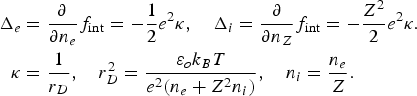

is the Debye shift of the energy level. Developing the function in the brackets < > on the right side of Eq. (1) with respect to κr, one obtains in first order with respect to κ

a 0=0.529 · 10−10 m is the Bohr radius. Eq. (5) is applicable for the ground-state of hydrogen-like bound-states (k describes the main quantum number n = 1 and the orbital angular quantum number l = 0), but if n > 1, κ<r nk> is large, and Eq. (5) is not valid anymore. <r nk> presents the expectation value of the orbit k corresponding to the eigenstate k.
Ebeling et al. (Reference Ebeling, Leike and Leonhardt1991) estimated the continuum edge of the energy spectum using the Jacobi-Padé approximation by Ebeling and Kilimann (Reference Ebeling and Kilimann1989),
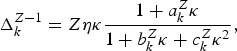
where
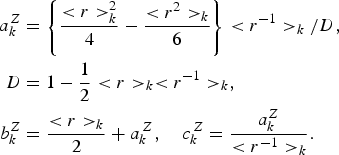
As the Padé approximation Eq. (6, 7) overestimates the shifts at high densities by about 100%, Ebeling et al. (Reference Ebeling, Förster, Fortov, Gryaznov and Polishchuk1991) took for c Zk half of the earlier found value, a Zk/(2<r −1>k), and obtained

In comparison to the ground-state energy level, the continuum edge is strongly density dependent. Thus, taking into account Eqs. (5) and (8), the effective ionization energy of an ion carrying Z − 1 protonic charges approximately satiesfies the relation (see e.g., Ebeling et al., Reference Ebeling, Kraeft and Kremp1976, Reference Ebeling, Meister, Sändig and Kraeft1979, Reference Ebeling, Leike and Leonhardt1991)

It follows that multiply charged ions are ionized at smaller densities than singly charged ions. The ionization energy of an ion in a state k may be represented by

in the same approximation. Therefore, excited levels disappear at lower densities than the ground-state ones.
Ebeling and Leike (Reference Ebeling and Leike1991) expressed the Taylor series of the energy shifts ΔnlZ−1 of hydrogen-type bound states by
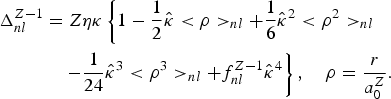
In Eq. (11), the coefficient f nlZ−1 was determined taking into account the merging of the bound-state n, l with the continuum at the Mott parameter  . The values of X nl were found by numerical calculations. For the ground-state of hydrogen, one has for instance X 10 = 1.19 (Rogers et al., Reference Rogers, Graboske and Harwood1970). Introducing the mean values of ρ, ρ2, and ρ3 in case of the electron “orbits” corresponding to the energy eigenstates (n, l),



one obtains
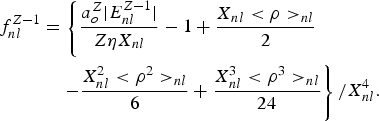
In this way, f nlZ−1 is expressed in terms of the critical value X nl where the energy level n, l merges into the continuum. Thus, the level shift ΔnlZ−1 may be approximately presented as function of  only


The applicability of Eq. (16) is limited. It is valid only if  . Besides Pauli blocking has been neglected.
Approximations considering Pauli blocking
As, according to the Pauli principle, states occupied by the “orbiting” electron can not be occupied by electrons of the bound-states' environment, it has been attempted to estimate energy level shifts due to Pauli blocking with the “concept of excluded volume”: Bound-states in plasmas need some space, which is not available for other electrons. Knowing that a particle of radius R, which is imbedded into a plasma, shows up in the second virial coefficient approximation the shift of the chemical potential

and following the general philosophy that shifts of energy levels correspond to shifts of the chemical potential, Kilimann and Ebeling (Reference Kilimann and Ebeling1990) concluded, that the shift of the energy level E nl due to Pauli blocking may be estimated by (n e = Zn Z)
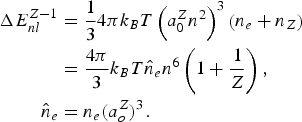
That means, at high main quantum numbers n and, according to the model also high temperatures, Pauli blocking effects may play the essential role. Contrary to the self-energy contribution to the energy level shifts, Pauli shifts are different for different quantum numbers. Thus, they are involved in the so-called “relative” energy level shift. In the years 1998–2005, the “concept of excluded volume” was used to derive an expression for the free energy of dense hydrogen (Beule et al., Reference Beule, Ebeling, Förster, Juranek, Nagel, Redmer and Röpke1999a,Reference Beule, Ebeling, Förster, Juranek, Redmer and Röpkeb, Ebeling et al., Reference Ebeling, Hache, Juranek, Redmer and Röpke2005).
The influence of Pauli blocking effects on the properties of dense hydrogen with electron densities of 3 × 1029 m−3 and temperatures between 4000 K and 20000 K is studied in (Ebeling et al., Reference Ebeling, Redmer, Reinholz and Röpke2008, Reference Ebeling, Blaschke, Redmer, Reinholz and Röpke2009, Reference Ebeling, Blaschke, Redmer, Reinholz, Röpke, Redmer, Holst and Hensel2010). There the energy shifts due to Pauli blocking and the Mott effect are discussed solving an effective Schrödinger equation for strongly correlated systems. The authors find a softer Mott transition than was predicted in earlier works. But in the paper, concerning the Pauli blocking, only, the ground-state of the hydrogen atom is considered. The corresponding energy shift is thus (Ebeling et al., Reference Ebeling, Redmer, Reinholz and Röpke2008, Reference Ebeling, Blaschke, Redmer, Reinholz and Röpke2009)
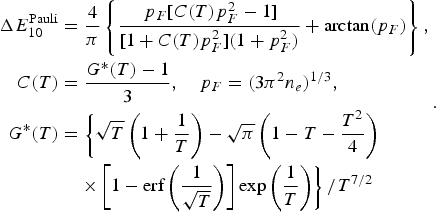
Eq. (20) is applied for the case of very dense hydrogen (n e ≲ 3.3 · 1029 m−3) in Ebeling et al. (Reference Ebeling, Blaschke, Redmer, Reinholz, Röpke, Redmer, Holst and Hensel2010). There, the remarkable fact was obtained that the temperature dependence of ΔE 10Pauli is indeed quite weak in the interval with 5000 K < T > 15000 K and can be neglected.
The development of a more fundamental approach based on an effective Schrödinger equation began already with the works by Röpke et al. (Reference Röpke, Kilimann, Kremp and Kraeft1978) and Zimmermann et al. (Reference Zimmermann, Kilimann, Kraeft, Kremp and Röpke1978).
It became clear that Pauli blocking should be described within the momentum space rather than in configuration space. But applicable simple analytical expressions for wave functions in the momentum space, even in the case of hydrogen-like particles, are hardly to be found. Thus in Ebeling et al. (Reference Ebeling, Blaschke, Redmer, Reinholz, Röpke, Redmer, Holst and Hensel2010) only variations of the ground-state of hydrogen by Pauli blocking are considered. The ground-state wave function in momentum space is found using the Ritz variational principle.
Further it should be noted here, that if one is looking for differences between bound-states, dynamic calculations have to be performed (Ebeling et al., Reference Ebeling, Leike and Leonhardt1991). The basic results of such dynamic calculations are formulae linear in the plasma density, Δk − Δk* = A kk*n e (Hitzschke & Röpke, Reference Hitzschke and Röpke1988; Günter et al., Reference Günter, Hitzschke and Röpke1991). However, the numerical coefficients A kk* are not consistent with Eqs. (16) and (17) (Ebeling et al., Reference Ebeling, Leike and Leonhardt1991).
For practical purposes, in 1990, Bornat and co-workers (1991) found a Jacobi-Padé approximation for the relative shift Δnl = Ẽ nl − E nl − Δe − Δz of the energy levels of hydrogen-like atoms as function of temperature and density based on Eq. (1). Up to now, this formula was only applied for quantum-physical states with orbital angular quantum number l = 0. The formula reads (see Ebeling et al. (Reference Ebeling, Leike and Leonhardt1991))

where


and ψnlm l is the energy eigenfunction in momentum space. m l describes the quantum number of the projection of the orbital angular momentum.

On the other hand, in the case of the low-density plasmas, the relative line shift should be approximatable by the sum of the expressions Eq. (16) and Eq. (19) (Ebeling et al., Reference Ebeling, Leike and Leonhardt1991)

As follows from Eqs. (21) and (25), the relative shift Δnl of the energy level n, l contains two energetic contributions, the first one is related to the difference between Coulomb and Debye potential, and the second is caused by the kinetic energy of the particles.
APPLICATION OF THE PADÉ APPROXIMATION BY EBELING ET AL. (Reference Ebeling, Leike and Leonhardt1991) TO THE HYDROGEN-LIKE CARBON PLASMA
In the following, the Padé approximation Eqs. (21)–(23) by Ebeling et al. (Reference Ebeling, Leike and Leonhardt1991) will be applied for the calculation of relative energy level shifts of bound-states of fivefold-ionized carbon atoms.
Further simplification of the model
Assuming that 
 in the denominator of Eq. (21), the factor 1/(1 + ζ) of Eq. (21) may be approximately expressed by 1 − ζ + ζ2. Then, one finds that terms proportional to
 of Eq. (21) have the coefficient 5/12, and contributions proportional to
 possess the coefficient (−1/6). This is in contradiction to the coefficients 1/12 and 5/12 in the low-density case presented by Eq. (25). Thus, in the following, calculating energy level shifts, the term
 is neglected in the denominator, which is approximately possible as only
 -values below unity are of interest. At
 , even the ground-state of the hydrogen plasma (Z = 1) does not exist anymore. Accordingly, at
 , the ground-state of a (Z-1)-fold ionized ion shoud merge into the continuum. The plasma is then fully ionized.
To calculate the relative energy shifts of hydrogen-like plasmas, one has to express the A nl-function (Eq. (22)) describing the Pauli blocking part of the shifts by the energy eigenfunctions of the plasma particles in momentum space  . This may be done by different methods, e.g., applying the Ritz variational principle to obtain
 directly (Ebeling et al., Reference Ebeling, Blaschke, Redmer, Reinholz and Röpke2009, Reference Ebeling, Blaschke, Redmer, Reinholz, Röpke, Redmer, Holst and Hensel2010), or solving the Schrödinger equation in configuration space and transforming known energy eigenfunctions in configuration space
 into those in momentum space. Here the second approach is used, and for A nl finally a rather simple expression is found which contains only one momentum integral. In Appendix, the derivation of the expression is shown in detail, it reads (A18)

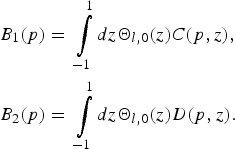
B 1(p) and B 2(p) satisfy the relations (A30)
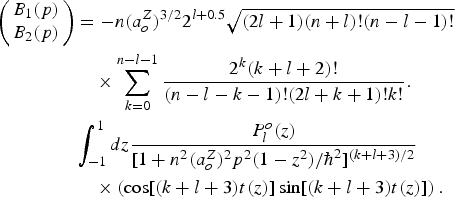
Here

and P ol(z) designates the spherical polynomial (eq. (A6)).  is the Planck constant.
Results of the numerical calculation
Calculations of the relative energy level shifts are performed for five-fold ionized carbon ions with densities on the order of 1027 – 1029 m−3 at temperatures of 106 – 108 K using Eqs. (21), (23), (24), (27). There the term proportional to  in the denominator of Eq. (21) is neglected. The chosen plasma parameters occur in the inner parts of stars like the Sun, but they should also be (soon) reachable in laboratory experiments with high energy density beams and X-ray lasers.
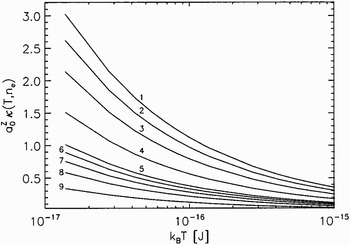
Figure 1 shows the Mott parameter  of the studied carbon plasma as function of the temperature. The Mott parameter is proportional to the square root of both the plasma density and the inverse temperature (Eq. (5)). Therefore,
 is larger for larger electron densities at constant temperature. In Figure 1, the values of the Mott parameter are presented for the whole intervals of temperature and electron density studied in the present paper.
Mott parameter of a plasma of fivefold-ionized carbon ions as function of temperature times Boltzmann constant. 10−17 J = 62.5 eV. (1) n e = 8 × 1031 m−3, (2) n e = 6 × 1031 m−3, (3) n e = 4 × 1031 m−3, (4) n e = 2 × 4 × 1031 m−3, (5) n e = 9 × 1030 m−30, (6) n e = 7 × 1030 m−3, (7) n e = 5 × 1030 m−3, (8) n e = 3 × 1030 m−3, (9) n e = 1030 m−3.

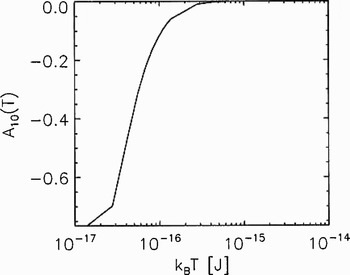
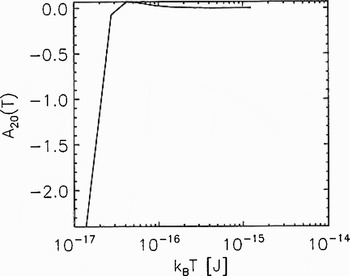
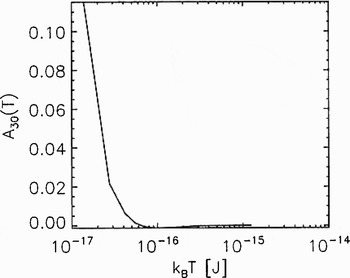
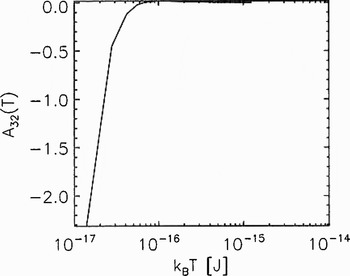
The function A nl(T) (multiplied by h 3) is presented in Figures 2–5 for the main quantum numbers n = 1, 2, 3 and the orbital angular momentum quantum numbers l = 0, 2 in case of the bound-states of five-fold-ionized carbon as function of the temperature. In the present approximation, A nl does not depend on the plasma density, and in the case of l = 1, A nl equals zero. In case of B 21(p) − B 22(p) > 0, the integrand of the p-integration of A nl increases with increasing temperature at constant p. It has a maximum at T = p 2/(5m ek B), and then it decreases again. This easily follows from Eqs (23) and (26). Thus, near its maximum the integrand of A nl decreases with the plasma temperature approximately proportional to T −5/2. Consequently, also, the function A nl decreases with growing temperature. Analogously, in case of B 21(p) − B 22(p) < 0, the integrand grows with increasing temperature. Altogether one may conclude that generally the absolute value of A nl decreases with increasing temperature. Indeed, the sign of B 21(p) − B 22(p) depends on the electron momentum and the quantum numbers n and l, as easily follows from Eqs. (A33)–(A43).
A 10 as function of temperature T.

A 20 as function of temperature T.

A 30 as function of temperature T.

A 32 as function of temperature T.

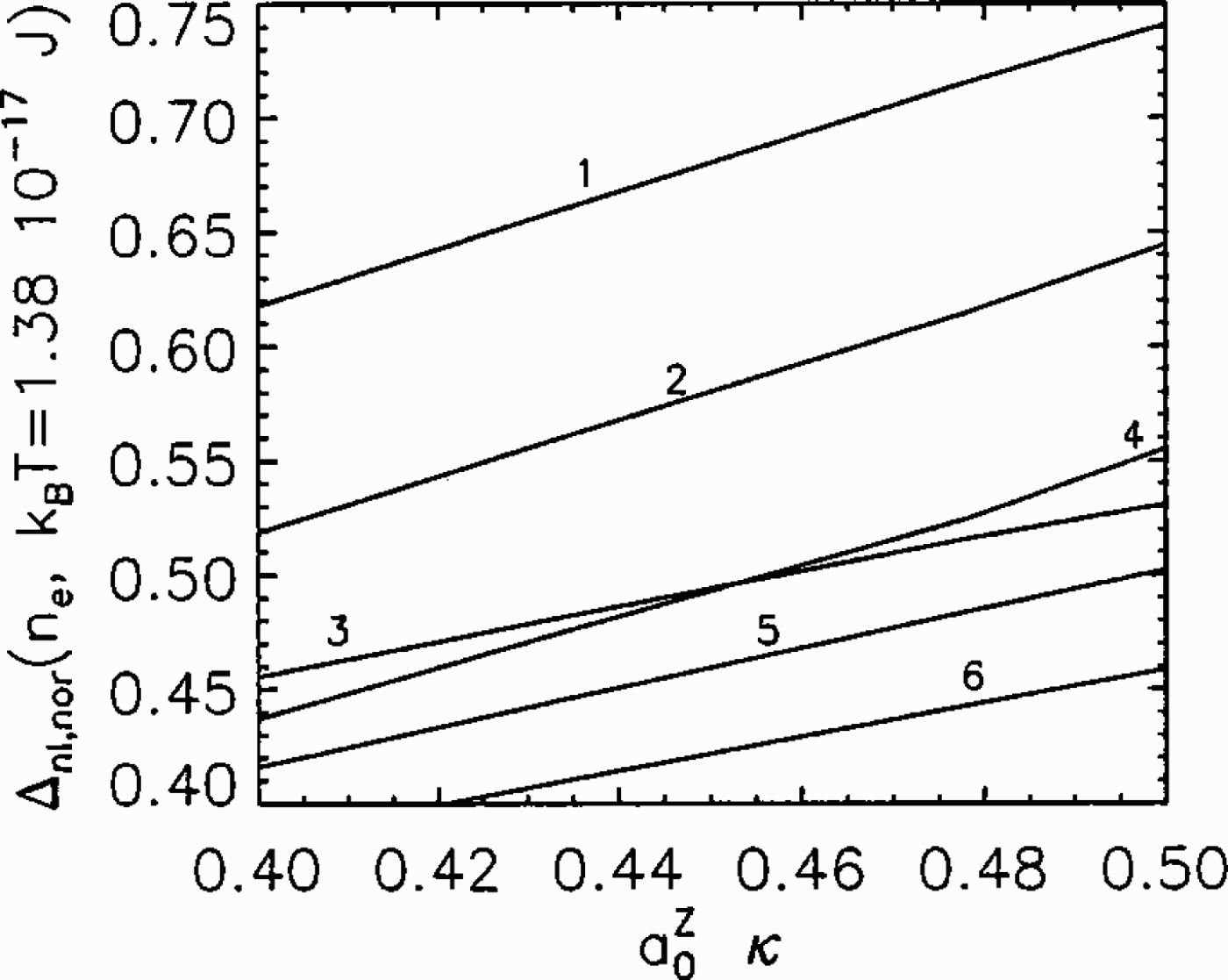
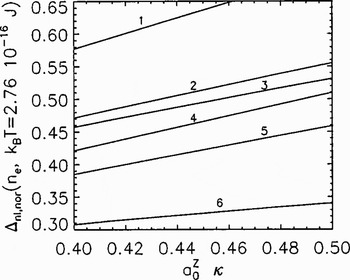
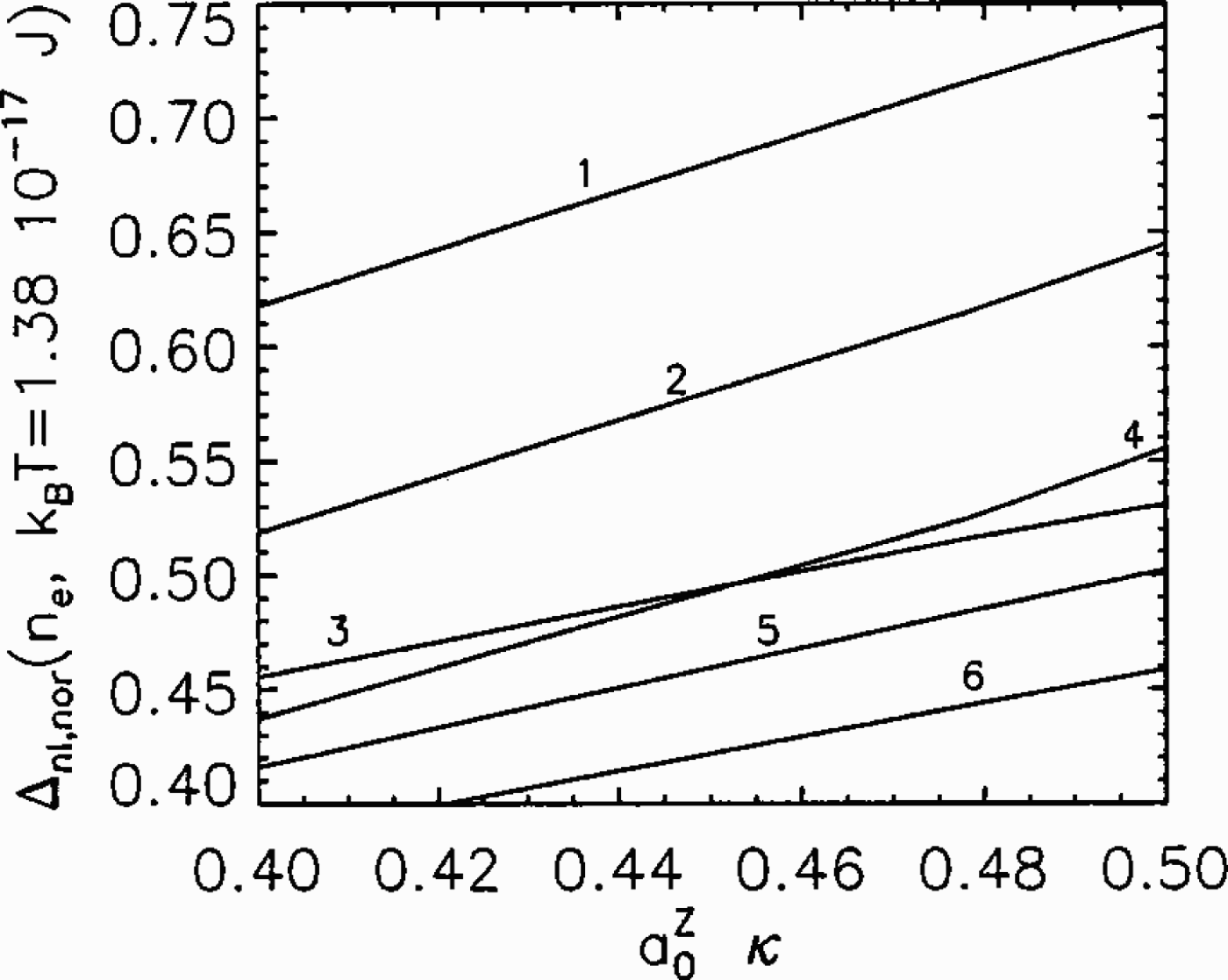
Relative energy level shifts of the bound-states of the five-fold-ionized carbon ions are shown in Figures 6 and 7. There all shifts are normalized to the ground-state energy of the carbon ions. The chosen interval of Mott parameters (the whole interval is shown in Fig. 1) was selected in such a way so that the splitting of the curves for different orbital angular momentum quantum numbers l is to be seen at constant main quantum number n. Besides, it is concentrated on results for shifts of levels before the merging of the ground state with the continuum starts. As the terms proportional to A nl in the nominator and denominator of Eq. (21) are on the order or smaller than the other terms, respectively, the shifts may be presented — on a first sight — as a function of the Mott parameter  only. In comparison to Figure 6, in Figure 7, level shifts for 10 times larger plasma temperatures are presented. It is found, that within the studied temperature region, the relative energy level shifts for given n and l increase with increasing
 . At constant n and constant Mott parameter
 , the energy shift decreases with growing l, and at constant l and
 , the shift gets smaller with increasing n. Curves presenting shifts at constant n and l may cross with increasing
 . So, at
 , the shifts for n=2, l=1 are larger than those for n = 3, l = 0. But under the condition
 , the contrary behaviour is obtained. For one and the same
 -value, the level shifts in case of the higher temperature (Fig. 7) are somewhat smaller than those in case of the lower temperature (Fig. 6).
Relative energy shifts Δnl,nor of hydrogen-like carbon bound states as function of the Mott parameter  at k BT = 1.38 × 10⁻¹⁷ J. The energy shifts are normalized to the energy of the ground state of the carbon ions. (1) n = 1, l = 0, (2) n = 2, l = 0, (3) n = 2, l = 1, (4) n = 3, l = 0, (5) n = 3, l = 1, (6) n = 3, l = 2. n - main quantum number, l - orbital angular momentum quantum number.
Relative energy shifts Δnl,nor of hydrogen-like carbon bound states as function of the Mott parameter  at k BT = 2.76 × 10⁻¹⁶ J. The energy shifts are normalized to the energy of the ground state of the carbon ions. ions. (1) n = 1, l = 0, (2) n = 2, l = 0, (3) n = 2, l = 1, (4) n = 3, l = 0, (5) n = 3, l = 1, (6) n = 3, l = 2. n - main quantum number, l — orbital angular momentum quantum number.

CONCLUSIONS
In connection with the strong interest in the thermodynamics of dense carbon plasmas in astrophysics and laboratory experiments, a careful recalculation (accuracy below one percent) of the partition function of hydrogen-like warm dense matter is necessary. Here, an attempt is presented to review and to contribute to the density and temperature dependence of static energy level shifts in dense matter. At the same time, some small misprints in former papers of other authors are corrected or, at least, noted.
The article especially considers the relative shift of energy levels based on Jacobi-Padé approximations developed by Ebeling, Kilimann, Kraeft, and Bornath at the end of the last century. In these approximations, the shifts depend on the energy eigenfunctions of the systems in momentum space. Here, to a large extent, an analytical method is developed to calculate the level shifts starting with the energy eigenfunctions in configuration space. This approach makes it possible to distinguish between shifts for different orbital angular momentum quantum numbers in case of the same main quantum number. The method developed will be practicable also in case of future improved Padé approximations of energy level shifts. It will be also useful for improved calculations of shifts basing on solutions of the Schrödinger equation.
In this work, nine-fold integrals describing relative energy level shifts are analytically reduced to two-fold integrals. In the case of the main quantum numbers n = 1, 2, and 3, even reductions to one-dimensional momentum integrals are found. These results are very useful to check currently being developed numerical codes for energy shifts. At the University of Technology Darmstadt they are applied to construct a new model for the partition function of warm dense matter.
For the case of a plasma of five-fold ionized carbon ions, the relative energy level shifts are calculated for a rather large density-temperature region. Although the general Padé approximation for the relative shifts has to be further developed to improve the description of the plasma thermodynamics approaching the region of the Mott transition, the overall behaviour of the relative energy level shifts as function of the Mott parameter is obtained. The relative shifts increase with increasing Mott parameter, but approaching the merging of the energy levels with the continuum, the growth of the shifts becomes weaker. Dependencies of the shifts on main quantum numbers and orbital quantum numbers are also discussed.
ACKNOWLEDGMENTS
C.-V. Meister gratefully acknowledges financial support by the project 06 DA90331 of the Bundesministerium für Bildung und Forschung. M. Imran thanks the organisation Deutscher Akademischer Austauschdienst for financial support.
APPENDIX: CALCULATION OF THE A nl-FUNCTION
In the following, for the A nl-function (Eq. (22))


describing the influence of Pauli blocking on the relative energy level shifts of hydrogen-like plasmas a practically applicable expression is derived. In Eqs. (A1), (A2) ψnlm l describes the energy eigenfunction of the bound-state in momentum space. E nl is the energy eigenvalue with the quantum numbers n and l. n designates the main quantum number, l — the angular momentum quantum number. m l shows the quantum number of the projection of the orbital angular momentum (magnetic quantum number). p and m e denote momentum and mass of an electron of the plasma. T is the temperature of the system, k B — the Boltzmann constant.
In the case of hydrogen-like plasmas, the solution of the Schrödinger equation reads


r, θ, and φ are the coordinates of the electron in the spherical coordinate system the centre of which coincides with the mass center of the hydrogen-like particle.
The radial part of the solution of the Schrödinger equation
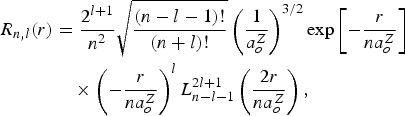
is determined by the associate Laguerre polynomials

The angular dependent part of the solution contains spherical polynomials (Abramowitz & Stegun, Reference Abramowitz and Stegun1970, pp. 333, 774)


and the azimuthal part reads

 may be related to
 by

where h is the Planck constant. Analogeously, one has

Using Eqs. (A10), (A11) in the expression for A nl (Eq. (A1)) and integrating over the azimuthal angles φ and φ 1, one gets
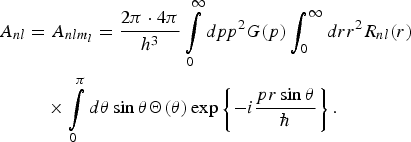

Further, using

one may derive the relations (z = cos θ)




That means

Thus, concerning the integration over the radii  and
 , one has to solve only two integrals

and

where
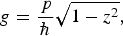
Substituting the radial part of the wave function (Eqs. (A5), (A6)) into Eqs. (A19), (A20) and using the relations (Gradshteyn & Ryzhik, Reference Gradshteyn and Ryzhik1994)
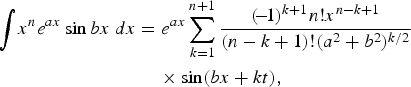
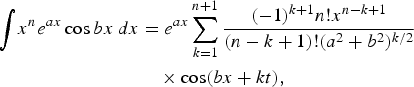

that means


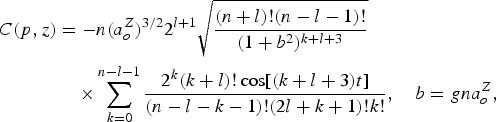
one has for C(p, z) and D(p, z)
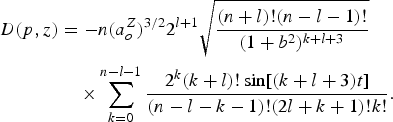
Using these expressisons, one obtains for B 1(p) and B 2(p) the relations
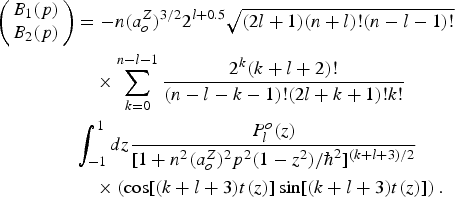
Further, taking into account
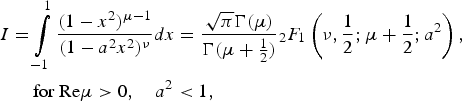
(expression 7.136, p. 611 in (Gradshteyn & Ryzhik, Reference Gradshteyn and Ryzhik1994) contains a misprint) and
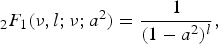
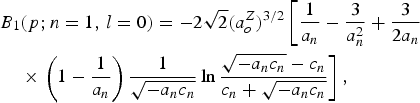
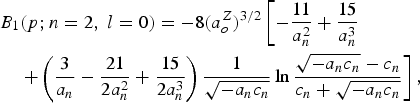
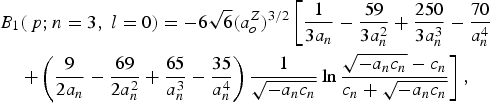
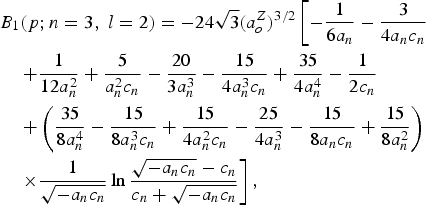
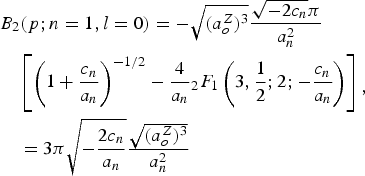
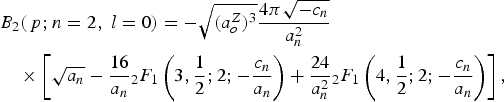
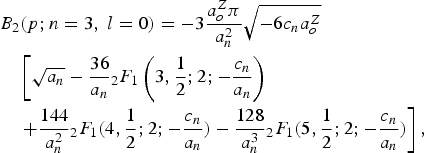
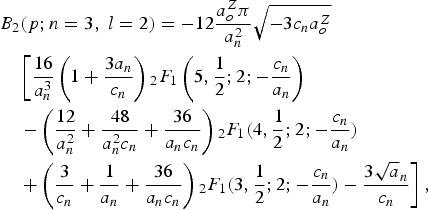
one finds for main quantum numbers n = 1, 2, 3 at l=0, 1, … n − 1

where
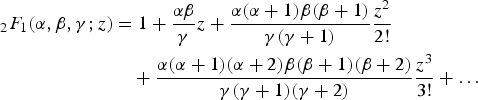
is the hypergeometric function.

The relations Eqs. (A33)–(A43) for B 1(p) and B 2(p) are checked comparing results for special values of p with numerical results found using Eq. (A30).