Introduction
Quality of Life (QoL) has become increasingly renowned as a meaningful outcome measure in patients with dementia. Progress has been made both in its definition and measurement. Nevertheless, the study of QoL in people with dementia in long-term care settings has aroused less interest, and there is only scarce evidence about which features of the provided care and attention relate to residents’ QoL (Moyle, Reference Moyle2010). This issue seems particularly striking since the percentage of people with dementia in residential settings is high and progressively increasing (almost two-thirds of residents in nursing homes in Spain have dementia; López-Mongil and López-Trigo, Reference López-Mongil and López-Trigo2007). Only recently some studies have focused on QoL of residents with dementia, identifying predictors of their QoL by means of multivariable procedures (González-Salvador et al., Reference González-Salvador2000; Samus et al., Reference Samus2005; Hoe et al., Reference Hoe, Hancock, Livingston and Orrell2006; Reference Hoe, Katona, Orrell and Livingston2007; Reference Hoe2009; Beer et al., Reference Beer2010; Barca et al., Reference Barca, Engedal, Laks and Selbaek2011) or using a qualitative approach (Moyle et al., Reference Moyle2011).
The study by Hoe et al. (Reference Hoe, Katona, Orrell and Livingston2007), which includes both community-living dementia patients and nursing home dementia residents, suggests that living at home is associated with higher patients’ QoL, both when rated by themselves and by their caregivers. Hoe et al. (Reference Hoe, Katona, Orrell and Livingston2007) showed that the relationship between lower QoL and living in a 24-hour care setting may be related to higher levels of dependence and behavioral problems among residents, and also to people's preference for living at home. Nevertheless, among patients living in residential settings, QoL seems not to be affected by some of the facility variables, such as a more homelike environment (Samus et al., Reference Samus2005). While Sloane et al. (Reference Sloane, Zimmerman, Walsh, Zimmerman, Sloane and Eckert2001) suggest a moderating effect of environmental variables (e.g., security, orientation, privacy, etc.) on neuropsychiatric symptoms, Samus et al. (Reference Samus2005) found only a weak moderating effect of the facility size on the relationship between agitation and QoL.
Alternatively, the data showed that residents’ report of their own QoL was mainly associated to their emotional status, mostly depression symptoms, while both proxies’ (family or staff members) ratings were associated to behavioral disturbances and functional impairment, and to a lower degree to depression symptoms. Moreover, Winzelberg et al. (Reference Winzelberg, Williams, Preisser, Zimmerman and Sloane2005) found that although the attitudes of nursing assistants were related to their QoL ratings, the most significant predictor of the staff-rated QoL was the resident's clinical status. Specifically, greater dependence in activities of daily life (ADL) and severe cognitive impairment were associated with lower QoL scores, as well as depression and behavioral symptoms.
Nevertheless, none of the previous studies have included the three perspectives (i.e., resident, family, and staff); data were particularly lacking about the family-rated QoL of patients living in long-term care facilities. This seems relevant since data from multiple perspectives are encouraged when assessing QoL in people with dementia (cf. Moyle, Reference Moyle2010). The only exception is the recent study by Beer et al. (Reference Beer2010), which, however, does not take into account potentially relevant variables for resident's QoL (e.g., functional status and frequency of family visits).
Consequently, the aim of the present study is to explore QoL of nursing home residents with dementia using three rating sources (the residents themselves, a close relative, and the key staff member in charge of their care). In order to find out the factors associated with each perspective, we considered the following: (a) facility variables; (b) residents’, relatives’ and staff members’ characteristics; (c) patients’ care needs and clinical variables (cognitive, functional, and emotional status); (d) family caregivers’ emotional status; and (e) staff members’ job conditions and satisfaction.
Based on the data from previous studies, we propose the following hypotheses: (a) factors associated with the self-rated QoL will be different from those associated with proxy rating (either family or staff); (b) depression in the person with dementia will be the main factor associated with the self-rated QoL; (c) the staff-rated QoL will be mainly related to patient's dependence for ADL (greater dependence meaning lower QoL) and to behavioral disturbances; and (d) family ratings of QoL in the person with dementia will be associated with patient's level of autonomy for ADL and with family member's emotional status (i.e., depression and burden).
Methods
Participants
Data were collected in 11 nursing homes in five Spanish cities (Madrid, Córdoba, León, Murcia, and Soria). For every city, a fixed number of residents (50) were set; then, for each city, each nursing home was surveyed for a proportional number of residents, depending on its size. Residents were randomly selected among those who (a) were aged over 60 years; (b) lived permanently in the center and had been living there for at least three months; (c) met criteria of the American Psychiatric Association (DSM-IV) for “probable” or “possible” dementia; (d) had a Mini-Mental State Examination (MMSE) score of under 27.
For every selected resident, a close relative and a member of staff were also chosen. The inclusion criteria for family members were (a) first-degree relatives or the patient's next of kin; and (b) paying regular visits to the resident (at least one visit weekly for 2 or more hours). For the staff members, following Hoe et al. (Reference Hoe, Hancock, Livingston and Orrell2006), who recommend taking the reports of the “key” person in the resident's care, we focused on the worker that provided direct attention and care to the selected resident. Consequently, one member of the staff could assess the QoL of several residents.
Thus, three different sets of data (self-rated QoL, relative-rated QoL, and staff-rated QoL) should be available for every patient in the study. When for a single case less than two sets of data were gathered, the case was discarded.
Design and measures
The present paper describes a prospective exploratory study of different perspectives on QoL in residents with dementia in nursing homes.
The Quality of Life-Alzheimer Disease (QoL-AD) (Logsdon et al., Reference Logsdon, Gibbons, McCurry and Teri1999; Reference Logsdon, Gibbons, McCurry and Teri2002) was selected because it is a brief instrument, it has shown sensitivity to change, it relates to health measures, it is designed to provide both patient and caregiver reports, and can be used with people with mild/moderate and severe dementia. We used the adaptation by Edelman et al. (Reference Edelman, Fulton, Kuhn and Chang2005) for people in residential settings. Overall scores were computed separately for the patient, the family member, and the staff caregiver reports by summing up of 15 items (higher scores indicating higher QoL). The instrument was translated into Spanish by the authors.
Predictor variables were assessed by three batteries of instruments applied to the resident, the family member, and the staff member, respectively, including the following:
Patients’ battery: (a) Sociodemographic data; (b) MMSE to verify the inclusion criteria and also to obtain an overall level of current cognitive profile; and (c) The Cornell Scale for Depression in Dementia (patient version) (Alexopoulos et al., Reference Alexopoulos, Abrams, Young and Shamoian1988), a quantitative measure of depressive symptoms in dementia patients.
Family members’ battery: (a) Sociodemographic variables and features of their relationship with the resident record; (b) Caregiver Burden Interview (CBI) (Zarit et al., Reference Zarit, Reever and Bach-Peterson1980); and (c) Beck Depression Inventory-II (BDI-II) (Beck et al., Reference Beck, Steer and Brown1996) to assess depressive symptoms and the global level of depression.
Staff members’ battery: It had two sections. The first one, focused on resident-related variables as assessed by the staff member, included the following: (a) Ad hoc record of the residents’ needs and the kind of care provided to them; (b) Barthel Index of Activities of Daily Living (Mahoney and Barthel, Reference Mahoney and Barthel1965) to measure residents’ functional abilities; (c) The Global Deterioration Scale (GDS) (Reisberg et al., Reference Reisberg, Ferris, de Leon and Crook1982) to measure the level of cognitive impairment in the patient; (d) Cohen-Mansfield Agitation Inventory (CMAI) (Cohen-Mansfield, Reference Cohen-Mansfield1986) to assess agitation and other disturbing behaviors in elderly people; and (e) The Cornell Scale for Depression in Dementia (informant version) (Alexopoulos et al., Reference Alexopoulos, Abrams, Young and Shamoian1988). The second part focused on the staff members themselves, considering (a) sociodemographic variables and work-related information; (b) Job Satisfaction Questionnaire S21/26 (Cuestionario de Satisfacción Laboral S21/26) (Meliá, Reference Meliá1998); and (c) Maslach Burnout Inventory (MBI) (Maslach et al., Reference Maslach, Jackson and Leiter1996) to assess job-related burnout.
Procedure
Consent was directly obtained from residents. For those who were too cognitively impaired to give consent, a guardian or a responsible party was approached for consent. Then the residents were interviewed individually in a quiet room. Once the residents had been selected and interviewed, the manager was asked to identify the key family member and the key worker. Subsequently, the resident's key worker and the family member completed the assessment battery.
Data analysis
When scoring the QoL-AD, and according to Logsdon et al. (Reference Logsdon, Gibbons, McCurry and Teri2002), up to two missing items were replaced with the mean score of the remaining items. If more than two items were missing, the entire measure was discarded. Cronbach's α internal consistency coefficient was calculated for each of the three versions of the scale (i.e., resident, family member, and staff member). Comparisons of QoL scores among these three different sources were carried out by means of repeated measures ANOVA. Moreover, in order to assess pairwise agreement of scale scores, the Intraclass Correlation Coefficient (ICC), using one-way random effects analysis of variance, was calculated.
Correlations between the predictor and dependent variables (i.e., QoL reported by residents, family, and staff) were calculated using Pearson Correlation Coefficient for Quantitative Variables and point-biserial correlation coefficients for dichotomous variables. Qualitative variables with more than two possible values were dichotomized. Variables with correlations (p < 0.01) were then introduced in stepwise multiple linear regression analyses (one for each QoL-AD rating). To avoid multicollinearity problems, variables with inter-correlations higher than 0.80 were excluded from the analysis and condition indexes were considered, including only variables with indexes ≤15. In addition, the Durbin–Watson test was examined.
Results
Characteristics of facilities and participants
The 11 nursing homes in the study sample had a mean of 119.64 beds (range 39–220). The majority (63.6%) were for-profit facilities, and half (54.5%) had dementia special care units. Nearly half (45.5%) had been opened for more than 10 years, 18.1% had been operating from 5 to 10 years, and 36.4% for less than 5 years.
We selected 209 residents, whose mean age was 86.07 years (SD = 6.46), range 67–100 years. These were mostly women (79.4%). The mean MMSE score was 13.3 (SD = 5.88), indicating moderate dementia, range 0 (severe dementia) to 25 (mild dementia). In addition, 184 measures from relatives and 197 from 92 staff members were collected. Family participants had an average age of 58.85 years (SD = 12.22). The majority of family members were also females (62%), and were residents’ sons or daughters (67%), spouse (10.8%), and nephews or nieces (10.3%). They visited the resident daily (34.8%), more than once a week (35.9%), or once a week (22.3%). Since one member of the staff could assess the QoL for several residents, the QoL-AD staff version was completed by 92 staff members with a mean age or 39.8 years (SD = 9.96). Staff members were also mainly females (96.7%) and worked as care or nursing assistants (88.1%). The mean duration of working in the nursing home was 47.34 months (SD = 49.52).
Resident's QoL
Internal consistency for the different versions of the QoL-AD was as follows: residents 0.89, family 0.88, and staff 0.86, all of them in excellent range.
For the QoL-AD, the completion rate for residents was 48.8% (i.e., 102 of 209 contacted residents) whereas close to 100% for participants who had proxy versions completed (99.46% and 98% for family and staff respectively). The residents who were not able to complete the QoL-AD showed greater cognitive impairment than those who completed it (t (128) = –6.54, p < 0.001).
Residents’ self-rated QoL scores (M = 2.51; SD = 0.71) were higher than those made by proxies, independent of family members (M = 1.95; SD = 0.82) or staff members (M = 2.06; SD = 0.83) (F(2,132) = 21.86 p < 0.001). More specifically, significant differences were found between residents’ and family members’ ratings, and between residents’ and staff members’ ratings (in both cases, p < 0.001), both showing higher QoL levels in residents’ ratings. There were no significant differences between both proxy groups.
Correlation among the three total scores was low, reaching statistical significance only in the family–staff pair, ICC = 0.331 (95% CI: 0.097–0.505), F(171) = 1.495, p = 0.004. Further information about inter-rater reliability of the QoL-AD in this sample has been described previously (cf. Crespo et al., Reference Crespo, de Quirós, Gómez and Hornillos2012).
Factors associated with residents’ QoL
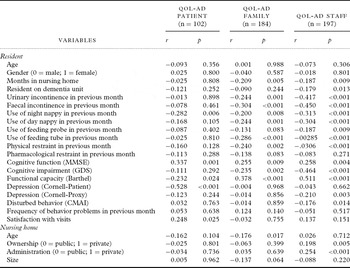
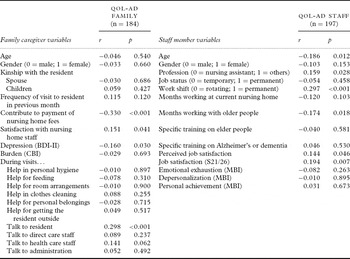
For each set of QoL scores (resident, family member, and staff member), its correlations with resident variables (sociodemographic characteristics and functional and emotional status) and facility features were calculated (Table 1). In addition, further correlations were calculated between the family-rated QoL and relative variables (i.e., sociodemographic characteristics, caregiver depression and burden, and activities done during visits to the resident), and between the staff-rated QoL and personal and job-related features (i.e., sociodemographic, job position, job satisfaction, and burnout; Table 2). Hence, all significantly correlated resident and facility variables went into the self-rated QoL analysis; all significant facility, resident, and family variables went into the family analysis; and all significant facility, resident, and staff variables went into the staff analysis.
Correlations between the self-rated, relative-rated, and staff-rated QoL scores and resident and facility variables

Correlations between the relative-rated and staff rated QoL scores and family caregiver and staff member variables

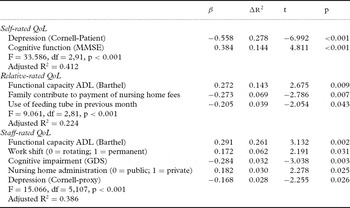
The self-rated QoL reached no significant correlation with facility features or resident's sociodemographic variables (Table 1). Statistical significance was achieved by association between the self-rated QoL and cognitive function, depression level and no use of night nappies in the last month. Regression analysis performed on these variables offered good condition indexes (highest value: 4.398), and the Durbin–Watson test value (1.755) was near 2. Residents’ perception of their QoL was significantly predicted by the depression and the cognitive function scores: Higher QoL levels related to low depression and high cognitive function (Table 3). This model accounted for 42.5% of the variance with good generalizability (R2-adjusted R2 difference = 0.013).
Stepwise multiple linear regression analysis for self-rated, relative-rated and staff-rated QoL scores

Correlation analyses for the relative-rated QoL showed no significant association with facility features, or with their own stress and emotional status (Tables 1 and 2). Significant correlations mainly referred to the resident's clinical status: higher scores in QoL were associated with less time of the resident living in the nursing home, with better cognitive functioning and less cognitive impairment, better functional capacity to carry out ADL, absence of urinary and faecal incontinence in the previous month, and no use of day and night nappies, feeding tubes, and physical restraint in the previous month. In addition, two variables concerning family members’ contact with the nursing home also reached significant correlations: the presence of regular talks with the resident during family members’ visits, and their contribution to the payment of the nursing home fees. Regression analysis performed on these variables offered good condition indexes (highest value: 3.043), and the Durbin–Watson test value (1.741). No variables were excluded due to high inter-correlation. Results showed that family perception of the residents’ QoL was significantly predicted by the residents’ functional capacity for ADL, by no contribution of the family member to the payment of the nursing home fees, and by no use of feeding tubes (see Table 3). Nevertheless, this model accounted for only 25.1% of the variance, although its generalizability was good (R2-adjusted R2 difference = 0.027).
Finally, analyses for the staff-rated QoL showed significant correlations with facility features (private administration and ownership of the nursing home) and with two job-related variables (job satisfaction of the staff member and work shift). However, significant correlations referred mainly to resident variables: higher QoL scores were significantly related with higher cognitive functioning and less cognitive impairment, higher capacity to carry out ADL, lower resident's depression, absence of urinary and faecal incontinence in the previous month, and no use of day and night nappies, feeding tubes, and probes, and of physical restraint in the previous month (Tables 1 and 2). No variables were excluded for the regression analysis due to high inter-correlation. The resulting model offered good condition indexes (highest value 15.081), and the Durbin–Watson test value (1.724). Results showed that staff members’ perception of the residents’ QoL was significantly predicted by the residents’ functional capacity to carry out ADL, cognitive impairment and depression, by the employee work shift, and by the type of administration of the nursing home (Table 3). This model accounted for 41.3% of the variance, with good generalizability (R2-adjusted R2 difference = 0.027).
Discussion
Firstly, as it has been debated elsewhere (Crespo et al., Reference Crespo, de Quirós, Gómez and Hornillos2012), the data show that people with dementia are aware of and able to report their own QoL and that various sources of data provide different perspectives on resident's QoL. Furthermore, this study shows that factors associated with the ratings of QoL are also different for residents and proxies, both family and staff members, at least mostly in female samples. Nevertheless, it is worth mentioning that the gender proportion in the sample in the study corresponds with that among residents, staff, and family caregivers in long-term care in Spain (López-Mongil and López-Trigo, Reference López-Mongil and López-Trigo2007).
Lower depression levels and better cognitive function predict higher self-rated QoL. Actually, depression level is the variable accounting for most of the variance (28%), as was found in other studies (Hoe et al., Reference Hoe, Hancock, Livingston and Orrell2006; Reference Hoe, Katona, Orrell and Livingston2007), which supports the influence of emotional state on self-perceived QoL. These data are in line with those by Sands et al. (Reference Sands, Ferreira, Stewart, Brod and Yaffe2004), and Conde-Sala et al. (Reference Conde-Sala, Garre-Olmo, Turró-Garriga, López-Pousa and Vilalta-Franch2009) among Day Care Alzheimer's patients in Spain. Nonetheless it has to be taken into account that the relationship between QoL and depression reaches significance only when depression is assessed through the patients’ report, but not when a key staff member reports on the residents’ mood. This could reflect some kind of overlapping between the residents’ self-report on both depression and QoL.
More controversial is the relationship between QoL and cognitive impairment. Data found here show that better self-rated QoL is associated with better cognitive function. These data are at odds with those of Logsdon et al. (Reference Logsdon, Gibbons, McCurry and Teri2002) in community patients, where such a relationship was not found, and with those of Hoe et al. (Reference Hoe, Hancock, Livingston and Orrell2006), who found a significant direct correlation between QoL and cognitive impairment in dementia residents (this relationship, however, loses significance when multiple regression analysis is applied). However, more recent results are in agreement with the data found in the current study. Barca et al. (Reference Barca, Engedal, Laks and Selbaek2011) have shown the association between diagnosis of depression and low MMSE scores with low QoL in dementia patients, while Hoe et al. (Reference Hoe2009) in a 20 weeks follow-up study considering individual and staff perception have found that reduction in residents’ QoL was related to an increase in depressive symptoms and cognitive deterioration at follow-up.
An outstanding result of the study is the high percentage of self-rated QoL variability (42.5%) accounted for by this two-variable model, which clearly exceeds that found in previous studies: 13% in Beer et al. (Reference Beer2010); 19% in Hoe et al. (Reference Hoe, Katona, Orrell and Livingston2007), where community patients were also included; and 34% in Hoe et al. (Reference Hoe, Hancock, Livingston and Orrell2006).
On the other hand, the relative-rated QoL is influenced mainly by the resident's level of autonomy, which shows both in direct measures (Bathel Index) as well as in less direct ways (through variables showing patient's functional status, such as use of feeding tubes). These two variables account for 18.2% of the QoL variance. These data match those by Conde-Sala et al. (Reference Conde-Sala, Garre-Olmo, Turró-Garriga, López-Pousa and Vilalta-Franch2009) in Spain in an outpatient sample, as well as those by Hoe et al. (Reference Hoe, Katona, Orrell and Livingston2007) in the United Kingdom. Nevertheless, they are at odds with the study by Logsdon et al. (Reference Logsdon, Gibbons, McCurry and Teri2002), which found no difference in the relative-rated QoL in relation to functional and behavioral impairment. However, the sample in that study consisted of dementia patients living at home; impact of cognitive and functional impairment on QoL might be greater when assessed in nursing homes.
According to Logsdon et al. (Reference Logsdon, Gibbons, McCurry and Teri2002) and Novella et al. (Reference Novella2001), family caregivers’ scores may be influenced by their own experiences and psychological state (mostly burden and depression); this is not so in the current study, but it should be taken into account that caregiver burden was overall low, probably because of the patient being institutionalized. The variable “contributing to payment of nursing home fees,” which does show a significant relationship with QoL, could be considered a proxy indicator of burden levels in this given situation.
The variables included in the analysis account as a whole for a modest 25% of the variance. Comparison with previous studies is difficult, since the relative-rated QoL is primarily used in community settings (e.g., Conde-Sala et al., Reference Conde-Sala, Garre-Olmo, Turró-Garriga, López-Pousa and Vilalta-Franch2009; Reference Conde-Sala, Garre-Olmo, Turró-Garriga, Vilalta-Franch and López-Pousa2010; León-Salas et al., Reference León-Salas, Olazarán, Muñiz, González-Salvador and Martínez-Martín2011) and not in nursing homes as in the current study, which reflects the paucity of data assessing ratings of QoL made by family of persons with dementia living in residential facilities (Beer et al., Reference Beer2010). Thus, one should not disregard the possibility that further family member variables, other than the ones considered in this study (depression and burden), could have a significant impact on the perception of QoL of their relative with dementia (as pointed out by León-Salas et al., Reference León-Salas, Olazarán, Muñiz, González-Salvador and Martínez-Martín2011). Besides, the burden scale used is relevant to caregivers at home, but may lose validity once the patient is institutionalized. Consequently, further analysis of the effect of the family caregiver's psychological characteristics is required.
The staff-rated QoL is mainly associated with the patients’ level of autonomy (Barthel Index scores account for 26% of the variance). These results are in line with previous research showing direct relationship between functional capacity and QoL (González-Salvador et al., Reference González-Salvador2000; Sloane et al., Reference Sloane, Zimmerman, Walsh, Zimmerman, Sloane and Eckert2001; Hoe et al., Reference Hoe, Hancock, Livingston and Orrell2006; Reference Hoe, Katona, Orrell and Livingston2007). Patients’ better cognitive functioning has some influence on QoL too, although its predictive power is much lower (3%), which could mean that residential settings moderate the impact of this variable. Previous studies show relationship between QoL and depression, as well as behavioral disturbances (González-Salvador et al., Reference González-Salvador2000; Sloane et al., Reference Sloane, Zimmerman, Walsh, Zimmerman, Sloane and Eckert2001; Samus et al., Reference Samus2005; Hoe et al., Reference Hoe, Hancock, Livingston and Orrell2006; Reference Hoe, Katona, Orrell and Livingston2007). The current study finds support only for the first claim, as aggressive behaviors were no longer significant after multivariate analysis. It is worth noting that cognitive impairment and depression show statistical significance when assessed by a staff member but not when assessed by residents themselves. This could show some overlapping or interdependence in scoring by a staff member in different tests.
Finally, the staff-rated QoL is directly associated with two facility and caregiver variables (private administration of the center, and having a permanent work shift). The first one is in accordance with results found in other European countries, where private nursing homes are positively associated with assistential care (Gage et al., Reference Gage, Knibb, Evans, Williams, Rickman and Bryan2009), although its explanatory power is low (3%). The second one could have to do with the fact that nursing assistants report higher job satisfaction when working in permanent shifts than in rotating shifts (Burgio et al., Reference Burgio, Fisher, Fairchild, Scilley and Hardin2004), which could have an effect on the care they render to elderly patients.
All together these variables account for 41% of the observed variability in staff-rated QoL, which is in line with previous studies: 47%, Beer et al. (Reference Beer2010); 36%, González-Salvador et al. (Reference González-Salvador2000); 25%, Samus et al. (Reference Samus2005); and 43%, Hoe et al. (Reference Hoe, Hancock, Livingston and Orrell2006).
As a whole, our results agree to a great extent with previous research and show that (1) there is no relationship between QoL (from any rating source) and environmental features of the nursing home or the patients’ or proxies’ characteristics; (2) the best predictor of QoL is residents’ clinical status (depression and functional capacity), although perspectives of residents and their proxies are not congruent: higher self-perceived QoL relates to low depression, while higher proxy-rated (family or staff) QoL associates mainly with better functional capacity and autonomy; and (3) the role of cognitive impairment is not fully understood yet and needs further research, although current data support a direct relationship between cognitive capacity and QoL. Thus, it can be concluded that differences in QoL are mostly due to differences in residents’ status, and not in the facilities or proxies’ features.
Nevertheless, results show the need to include more variables in future analysis, as there is still a large proportion of variance that remains unaccounted for. On the other hand, the transversal character of the study does not allow for causal links between variables. Moreover, since the sample consists mostly of female patients and caregivers, future research should explore the generalizability of results for male patients and caregivers as well as spouses and elder caregivers.
However, the study highlights several practical implications toward reaching a higher QoL in elderly patients in nursing homes: (a) attention should be paid to residents’ emotional needs (mainly mood), since emotional status seems essential in their self-perceived QoL; (b) residents’ autonomy should be fostered whenever possible; and accordingly (c) mood and functional dependence ought to be a priority in research and assessment of new treatments for persons with dementia in long-term care.
Conflict of interest
This research was sponsored by AFALcontigo (Alzheimer's Association of Spain) and was supported by a grant from the Foundation Centre for Research on Neurological Diseases (Fundación Centro Investigación Enfermedades Neurológicas – Fundación CIEN) in their programme of 2008–2010.
Description of authors’ role
M. Crespo led the research project, designed the present study, and carried out the redaction of the text and the data analysis. C. Hornillos assisted with the study design, the database and data analysis, and the English translation of the text. M. Bernaldo de Quirós supervised the data collection.
Acknowledgments
The authors would like to thank the following Alzheimer's Associations in Spain for their help and support for this study: AFALcontigo, AFA Córdoba, AFA León, ALZHEIMUR Murcia, and AFA Soria; Cesar Rodriguez for his help in the translation and correction of the submitted paper.