Introduction
There is a wide-ranging belief that people with severe mental illnesses (SMI) are violent or dangerous. Most patients with schizophrenia are not chronically aggressive or violent; among patients with schizophrenia, there is a small increase in violence and violent offending on average compared with general population standards in the USA and Europe.Reference Fazel, Gulati and Linsell 1 , Reference Witt, van Dorn and Fazel 2 However, violence on the part of people with SMI has several features that differentiate it from violence in the general population. First, it is less likely to be motivated by financial reasons. Second, it can be unpredictable and directed toward strangers. Not being financially motivated, it is more challenging for the general public to avoid. While few people would walk alone in a dark and deserted part of a large city, most people in general would not feel like they need to avoid standing on a subway platform. However, most people who push strangers off subway platforms, leading to fatal injuries, have mental illness and generally have no connection with the people that they attack.Reference Martell and Dietz 3 In fact, in 20 of 20 cases with available background information reviewed by Martell and Dietz, the offenders and the victims did not know each other, and the offenders were psychotic.Reference Martell and Dietz 3
Despite the fact that random violence can occur with people with SMI, during the period that was surveyed in the study, 1977–1991, there were at least 1600 and up to 2605 murders per year in New York when this survey was conducted. 4 Thus, 20 out of approximately 30,000 murders were attributable to random subway platform pushing. As a result, although the offenses were striking, random, and terrifying, these are extremely uncommon. This still does not reduce the sensationalism of violence in the media and resulting stigmatization.Reference Torrey 5
Most victims of aggressive behavior on the part of people with SMI are family members, fellow patients, and mental health professionals who are injured while attempting to treat members of the SMI group. So, much like violence in general, most violence in people with SMI stays within the patient’s social network and needs to be viewed accordingly. The most common cases of violence in SMI are violent acts directed at people with whom the patient is very familiar. This may not be different from the general population, wherein physical abuse of family members is very common, and the majority of homicides are still committed by people who know the people that they kill. For example, among male homicide victims, only 29% were killed by someone they did not know, and assaults were committed by someone known to the victim in 64% of cases as well.Reference McQuade and Albanese 6
Aggressive and violent behavior, including both verbal and physical aggression, have considerable adverse consequences for people with SMI. For example, most state hospital beds in America are occupied by forensically committed people with SMI. In California, for example, there are five state hospitals where no more than 10% of the residents are nonforensic cases. 7 Even for state hospital patients who are not committed, aggression and violence are the primary reason for long hospital stays. For example, White et al.Reference White, Parrella and McCrystal-Simon 8 reported on the reasons that prevented discharge from a state hospital during a period of aggressive downsizing. Out of a total of 894 patients considered for discharge, only 27% could be discharged, with the primary reasons preventing discharge, in order of importance, being impulsivity, hostility, excitement, and uncooperativeness. Cognitive performance, hallucinations, and negative symptoms did not predict the likelihood of discharge, although delusions did. As a result, several of the features of individuals with specific treatment-resistant symptoms, despite pharmacological therapies, prevent discharges even when the hospital management is highly motivated to empty the hospital. Considering that verbal aggression is also a barrier to successful discharge from long-term care, actual physical violence is not required to prevent discharge to less restrictive settings.Reference Bowie, Moriarty and Harvey 9
Determinants of aggression and violence
There are several potential causes of violent behavior on the part of people with SMI, based on correlational studies. These include intellectual, cognitive, and social-cognitive deficits, psychopathic/antisocial traits, skills deficits, substance abuse, and specific psychotic features. Each of these potential causes will be briefly addressed before we discuss potential treatments that target these symptoms.
Cognitive impairments
Although cognitive impairments are common in SMI and are clearly correlated with many elements of disability, the research on cognitive impairment as a determinant of violence has yielded some highly specific findings. Although people with SMI do not commonly manifest comorbid intellectual disability (ID), the research on violence in SMI, particularly among state hospital patients, suggests that this is more common in violent patients.Reference Puri, Richardson and Higgins 10 Global cognitive performance deficits are commonly found to be associated with risk for violence, although the patterns of specific cognitive impairments, however, are somewhat inconsistently associated. For example, Ahmed et al.Reference Ahmed, Richardson and Buckner 11 found an overall difference between violent and nonviolent state hospital inpatients on the MATRICS Consensus Cognitive Battery, but only working memory and verbal learning were subscales significantly worse in aggressive patients. In contrast, Serper et al.Reference Serper and Beech Dr 12 found that impairments in executive functioning predicted increased violence during acute admissions, and Krakowski and CzoborReference Krakowski and Czobor 13 found more executive functioning impairments in lower aggression cases.
Social-cognitive deficits
There are several different domains of social cognition, including understanding the mental states of others, recognizing emotions, and making attributions for the reasons that others act the way that they do.Reference Pinkham, Penn and Green 14 These elements of social cognition diverge in their functional importance. Understanding mental states and recognizing emotions appear to be related to impairments in everyday social functioning, while attributions fail to predict these types of disability.Reference Pinkham, Penn and Green 15 However, attribution style predicts the presence of paranoid ideation, which, particularly when delusional in severity, is associated with unprovoked attacks on others.Reference Pinkham, Harvey and Penn 16 Thus, attributional style may contribute to a belief that others are mistreating you, leading to attempts to contravene and reduce threats. In fact, a recent study suggested a direct impact of social-cognitive deficits on violent behavior, while neurocognition’s effects were mediated through social-cognitive functioning and deficits in everyday functioning.Reference O’Reilly, Donohoe and Coyle 17
Antisocial traits
Scores on the Psychopathy Checklist (PCL) have been compared across aggressive and nonaggressive patients with SMI. The results are quite consistent, in that PCL scores were the best predictor of community violence on the part of people with SMI in the MacArthur risk assessment study.Reference Skeem and Mulvey 18 A series of studies of hospitalized inpatients have generated similar findings. For example, Krakowski and CzoborReference Krakowski and Czobor 13 found that PCL scores were the best predictor of high levels of aggression, and VolavkaReference Volavka 19 reviewed the research literature and suggested that psychopathic traits were responsible for more violent assaults in patient units compared with psychotic symptoms.
Skills deficits
Skills deficits in schizophrenia include reduced ability to perform everyday social and functionally skilled acts.Reference Harvey, Velligan and Bellack 20 These deficits can lead to considerable frustration because tasks that are easily completed by others are challenging, time-consuming, and poorly performed. Further, social skill deficits can also lead to problems in interacting with others, which can interact with negative attributions and lead to negative interactions. As noted above, deficits in real-world functioning were found to be associated with violent acts.Reference O’Reilly, Donohoe and Coyle 17 Further evidence for this argument is provided by Martínez-Martín et al.,Reference Martínez-Martín, Fraguas and García-Portilla 21 who found that impairments in the ability to perform everyday activities and social competencies were associated with increased aggressive behavior.
Specific psychotic symptoms
Both paranoid delusions and command hallucinations have been found to be associated with violent acts.Reference Keers, Ullrich and Destavola 22 , Reference Shawyer, Mackinnon and Farhall 23 The relationship between these symptoms and violence is face-valid, in that it is easy to understand why an individual could become violent upon hearing voices directing him/her to engage in violent acts. However, in addition to paranoia and hallucinations, lack of insight is clearly required. If the individual were aware that the voices or ideas constituted a psychotic symptom, they would be considerably less likely to act on them.Reference Ekinci and Ekinci 24
Substance abuse
Violence in nonhospitalized people with SMI is more common in individuals with concurrent substance abuse.Reference Haddock, Eisner and Davies 25 Abuse of several different drugs is common in schizophrenia and is estimated to have a prevalence as high as 50%.Reference Hunt, Large and Cleary 26 The most commonly abused substances are alcohol, cannabis, and cocaine. Individuals with comorbid schizophrenia and substance abuse are found to have the highest rates of violent behaviorReference Van Dorn, Volavka and Johnson 27 ; so reducing substance abuse might have a beneficial effect.Reference Ntounas, Katsouli and Efstathiou 28
Interventions Targeting Cognitive and Social-Cognitive Deficits
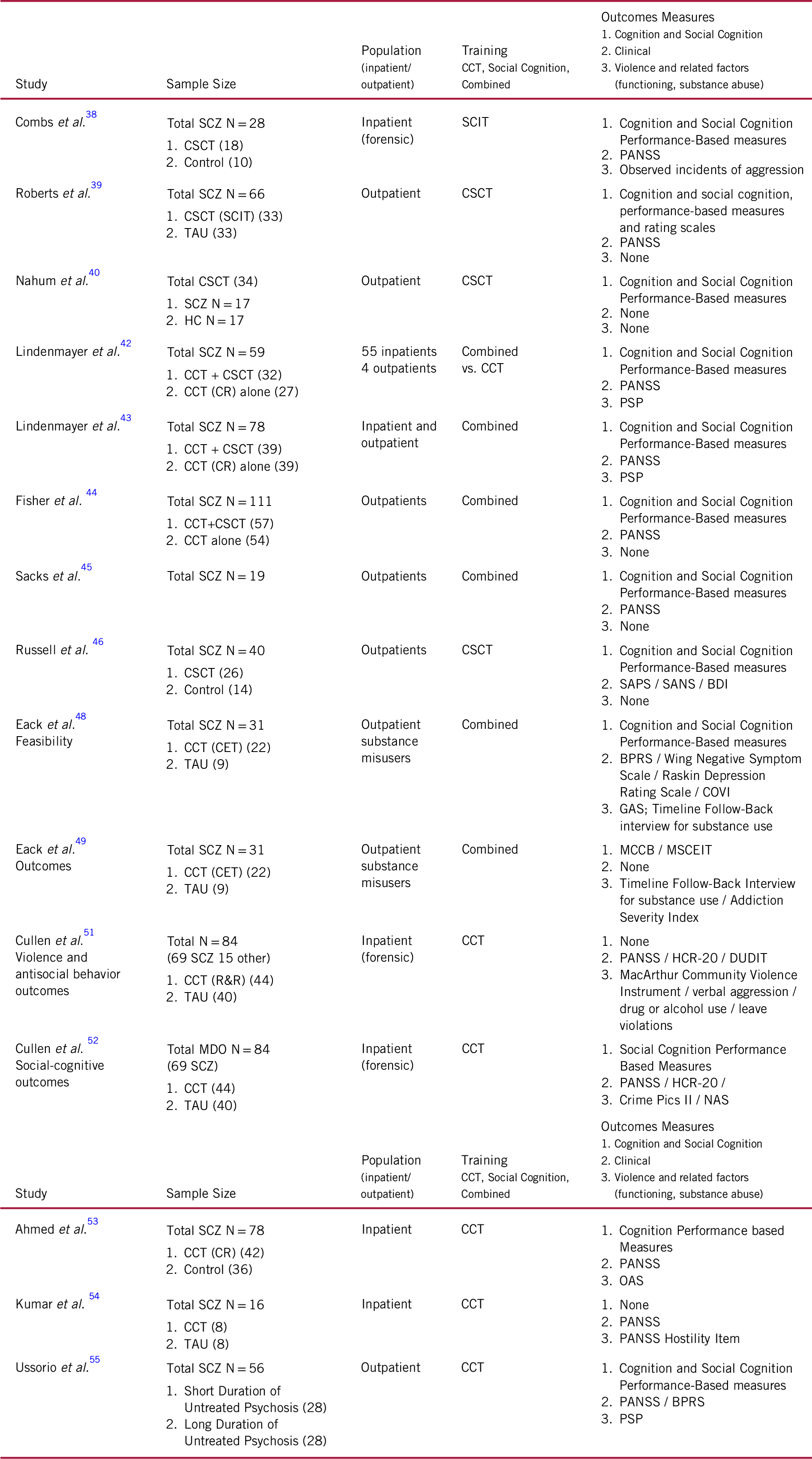
As the treatments for psychosis as a violence reduction strategy are presented elsewhere in this special issue, we will focus on the treatment of cognitive and social-cognitive deficits and their potential for violence reduction. Further, there have been several treatment efforts targeting cognition that have been applied to substance abuse in dual diagnosis populations. Pharmacological treatments aimed at cognition and social cognition have been disappointing,Reference Keefe, Buchanan and Marder 29 , Reference Bradley and Woolley 30 and so herein we focus on Computerized Cognitive Training (CCT) and Computerized Social-Cognitive Training (CSCT). An overview of the CCT and CSCT evaluation studies that we discuss is presented in Table 1.
Results of Cognitive and Social Cognitive Training on Violence and Determinants of Violence

Training interventions aimed at cognition and social cognition
Despite the failures of pharmacological interventions for cognition and social cognition in schizophrenia, there are very encouraging results from computerized training interventions. The ultimate aim of cognitive interventions for patients with schizophrenia is to improve social and everyday functioning. To evaluate such interventions, it is important to investigate multiple levels of efficacy, including near transfer of skills to improved performance on similar nontrained tasks, far transfer of skills to improved performance on more demanding tasks, and generalizable, or environmental, transfer of skills to improved real-world everyday functioning. While there has been debate over the efficacy of CCT due to overstated commercial claims,Reference Simons, Boot and Charness 31 , Reference Harvey, McGurk and Mahncke 32 several meta-analyses of CCT efficacy have found that it has small-to-moderate effect sizes.Reference McGurk, Twamley and Sitzer 33 , Reference Wykes, Huddy and Cellard 34 The largest meta-analysis to date encompassing 40 independent studies involving 2104 participants showed that CCT provides small-to-moderate benefits in generalizable cognitive domains, particularly within relatively stable patients in both inpatient and outpatient settings.Reference Wykes, Huddy and Cellard 34 Further concurrent psychosocial interventions were found to lead to functional gains.
Since social-cognitive deficits are separable from neuropsychological deficitsReference Harvey and Penn 35 and social cognition has been found to predict social functioning better than other neurocognitive domains in patients with schizophrenia,Reference Brekke, Hoe and Long 36 , Reference Fett, Viechtbauer and Dominguez 37 Social Cognition and Interaction Training (SCIT)Reference Combs, Adams and Penn 38 and CSCT have also been developed in recent years following the success of CCT in the treatment of cognitive impairment and resultant functional deficits in SMI. Combs et al. developed SCIT, which is a group intervention based upon a manual whose content a group must progress through at its own pace in weekly 1-h sessions.Reference Combs, Adams and Penn 38 It includes a combination of psychoeducation, drill-and-repeat skill practice, strategy games, heuristic rehearsal, and homework assignments in which participants are encouraged to practice with a family member or acquaintance outside of the group. The results suggested modest benefits in improving social functioning and negative symptoms, but not in the realm of social cognition. This was slightly surprising because SCIT was expected to have downstream effects on functioning and symptoms through improvement in social cognition. It was also demonstrated that greater dosages of SCIT might lead to greater outcomes. Later, larger-scale studies have confirmed the efficacy of the training and again suggested that dose effects are important.Reference Roberts, Combs and Willoughby 39
Considering that a greater dosage leads to better outcomes and the fact that the SCIT program requires a trained clinician team, long treatment durations, and organized patient groups, there are limits to the practicality of applying these treatments in clinical settings. To address this, Nahum et al. evaluated the feasibility of SocialVille, an online program designed to treat social cognition deficits in patients with schizophrenia by specifically targeting the domains of affect perception, social cue perception, theory of mind, and self-referential processing, through 19 computerized exercises.Reference Nahum, Fisher and Loewy 40 While the design of the experiment prevented any claims of efficacy, it did conclude that CSCT would be feasible in this patient population and may help with some of the practicality limits facing SCT.
With the established success of CCT on cognition, the success of SCT on both social cognition and neurocognition, and the confirmed feasibility of CSCT, programs were eventually developed to augment cognitive training with social-cognitive training. Kurtz et al. performed a meta-analysis to investigate the effects of SCT programs alone, as well as combined cognitive training and SCT on social cognition and functioning.Reference Kurtz and Richardson 41 The meta-analysis found that SCT demonstrated improvement in the social cognition domains of facial affect recognition and theory of mind, but no improvements were seen in attributional style or social perception.Reference Kurtz and Richardson 41 Most significantly, the meta-analysis found that moderate-to-large effects on improvement were confirmed by observer-rated measures of functioning for both inpatients and outpatients, suggesting that social-cognitive training provides benefits to patients that are generalizable to their overall functioning. They did not find any changes in patients’ positive or negative symptoms or any relationship between dosage and increased effects.
While Kurtz et al. investigated the effects of multiple types of programs, they did not investigate whether SCT in isolation or in combination with cognitive remediation (CR) had differential effects on social or neurocognition. Lindenmayer et al.,Reference Lindenmayer, McGurk and Khan 42 however, did examine whether CR alone had a different effect on social cognition from CR combined with CSCT. A program originally developed for autism spectrum patients – Mind Reading: An Interactive Guide to Emotions – was used as CSCT intervention, while COGPACK was used as CR intervention. The study found that combined CR and CSCT resulted in greater improvement than CR alone in measures of social cognition, social functioning, and neurocognition. Since CR alone did, however, still contribute to some improvements on its own, the results suggest that improved neurocognition may be a necessary prerequisite for improved social-cognitive ability in treatment, but not sufficient to account for all potential improvement. The design of the study did not include a CSCT-only group, so no conclusions could be made on whether CSCT alone would have been sufficient to obtain improvements in social cognition. However, the combined CR and CSCT program did have a unique impact on generalization of social functioning skills, whereas CR alone did not.
In a replication of these findings in a separate sample of patients, Lindenmayer et al. reported that combined CCT and CSCT led to greater gains in social cognition and neurocognition.Reference Lindenmayer, Khan and McGurk 43 Further, the combined intervention led to the greatest gains in everyday functioning, indexed by work performance. A similar study by Fisher et al. evaluated targeted cognitive training, specifically auditory and visual processing training and CSCT compared with targeted cognitive training alone.Reference Fisher, Nahum and Howard 44 These authors did not find that a combined intervention demonstrated significantly more improvement in most domains of cognition and functioning, although they did find that combined training resulted in greater improvements in reward processing, specifically increased consummatory and anticipatory pleasure, which have been linked to motivated and goal-directed behavior, as well as prosody identification. This was significant because of past findings suggesting that the relationship between social cognition and social functioning is mediated by the level of motivation, with more support for the theory that poor social-cognitive abilities impeded motivation, leading to poor functioning.
Another study by Sacks et al. looked at a similar combination of auditory cognitive training and computerized social-cognitive training and found that the training resulted in significant gains in neurocognition, certain domains of social cognition (emotion identification, social perception, and self-referential source memory), as well as a decrease in positive symptoms.Reference Sacks, Fisher and Garrett 45 They were also able to show that the effects of CSCT were generalized to more complex social-cognitive abilities outside of what was targeted during training, where other studies failed to demonstrate the generalization of skills.Reference Russell, Green and Simpson 46 , Reference Penn, Roberts and Combs 47 This study showed that a cost-effective, efficient, and scalable combined CCT and CSCT program could improve generalizable cognition skills and reduce positive symptoms in patients with schizophrenia.
With results demonstrating the ability of CT and SCT to reduce positive symptoms. but mixed results with regard to other symptoms and overall real-world functioning, studies also began to investigate the feasibility of CT and SCT for more specific groups of patients with schizophrenia, specifically substance abusers. Eack et al. looked at whether Cognitive Enhancement Therapy (CET) could improve cognitive impairments in patients with schizophrenia who misuse substances.Reference Eack, Hogarty and Greenwald 48 The study found mixed results regarding feasibility and efficacy of the training in patient population due to difficulty engaging and retaining participants. In many cases, this was due to positive symptom instability leading to a withdrawal from the study and ambivalence from the patients toward additional treatment approaches. Even with considerable attrition, intent-to-treat analyses demonstrated that CET resulted in significant improvements in neurocognitive, social-cognitive, and functional outcomes. Thus, the study demonstrated that cognitive remediation can be feasibly applied to substance-using patients with schizophrenia. Another report by Eack et al. published additional results from the same study that included the substance use trajectories for patients with schizophrenia who received CET compared with those who received usual care.Reference Eack, Hogarty and Bangalore 49 Patients receiving CET demonstrated significantly greater and faster reductions in alcohol use that was associated with cognitive improvements in processing speed, visual learning, and problem-solving. And, while patients only demonstrated greater, faster reductions in alcohol use and not cannabis use, cognitive improvements were associated with overall less likelihood of alcohol and cannabis use over the 18-month trial. This is highly relevant to the issue of violence, wherein substance abuse is consistently associated with violent acts on the part of people with schizophrenia as described above.
Cognitive and social-cognitive training and violence reduction
As noted above, violence can be associated with deficits in everyday functional and social skills, which may be the end-product of cognitive impairments or ID. Social-cognitive impairment appears to be directly associated with violent behavior, and substance abuse coupled with SMI is associated with the highest risk of violent behavior. Thus, the studies reviewed above suggest that both CCT and CSCT improve, directly or indirectly, some of the major risk factors for violent behavior. There is currently a gap in therapeutic resources designed to adequately address the frequency and severity of violent behaviors in patients with schizophrenia. Given the success of CR and SCT programs at improving neurocognition and social cognition, these programs could directly reduce violence and aggression in patients with schizophrenia.
Several studies have directly examined the impact of training in social-cognitive and neurocognitive abilities and their impacts on violent behavior as an outcome variable. These have included studies of neurocognitive and social-cognitive interventions alone, and in combination. These have also used quite wide-ranging patient populations, including those specifically selected for being incarcerated. Darmedru et al. performed the first systematic review to investigate whether CR and SCT are effective in managing violent and aggressive behaviors.Reference Darmedru, Demily and Franck 50 They identified 11 relevant studies: 2 investigated nonspecific cognitive remediation interventions, 2 investigated SCIT, 5 investigated Reasoning and Rehabilitation (R&R) or Revised Reasoning and Rehabilitation, and the final 2 investigated Metacognitive Training (MCT). All 11 studies showed reduced violence and aggression in various ways, including reduced violent thinking and behavior, reduced physical and violent assaults, and reduced disruptive and aggressive behaviors. The effects were seen in both inpatient and outpatient settings at both early and later stages of disease.
A series of studies by Cullen et al. presented detailed results on both social-cognitive outcomes as well as violent and antisocial outcomes in offenders with SMI at a forensic hospital.Reference Cullen, Clarke and Kuipers 51 , Reference Cullen, Clarke and Kuipers 52 The social-cognitive outcomes demonstrated moderate improvements in impulsive/carelessness style subscale of the SPSI (Social Problem-Solving Inventory), the avoidant style subscale of the SPSI, and small improvements in the total SPSI score.Reference Cullen, Clarke and Kuipers 52 When analyzing the impacts on behavior, the R&R group showed significant reduction in verbal aggression and leave violations compared with the control group following treatment, with reduced verbal aggression being maintained during the 12-month follow-up, though the reduction did not sustain statistical significance.Reference Cullen, Clarke and Kuipers 51
Ahmed et al. evaluated the benefits of a nonspecific cognitive remediation program within a mixed sample of forensic and mental health patients at a state hospital.Reference Ahmed, Hunter and Goodrum 53 The study looked at neurocognition and psychotic symptoms as primary outcomes and functional capacity, experiential recovery, and aggression as secondary outcomes.Reference Ahmed, Hunter and Goodrum 53 Those who completed CR showed improvements in the attention, working memory, verbal learning, and overall cognitive functioning domains of neurocognition.Reference Ahmed, Hunter and Goodrum 53 Furthermore, the cognitive remediation group demonstrated greater reductions in verbal and physical aggression compared with the control group.Reference Ahmed, Hunter and Goodrum 53
There were no statistically significant differences in WASI IQs between forensic and mental health patients in Ahmed et al.’s study, although forensic patients had IQs that were five points lower and they also had 1 fewer year of education (approximately 9 years) than standard mental health patients. Interestingly, forensic participants did show greater deficits in working memory and verbal learning relative to mental health patients, as well as increased verbal, object, self, and physical aggression at baseline. The fact that the group with reduced working memory and verbal learning at baseline also had increased aggression at baseline, in addition to the findings that improved working memory and verbal learning skills accompanied reduced aggression following a CR program, further supports the concept that CR reduces aggression through its effects on cognition. It was not possible to further examine whether there were improvements in everyday functioning, because the entire sample was hospitalized at a state psychiatric facility.
The SCIT intervention that reported on changes in aggression was also administered to forensic inpatients.Reference Kumar, Zia Ul Haq and Dubey 54 The intervention demonstrated improvements in social cognition, improvements in self-reported social relationships, and fewer aggressive incidents. All changes were independent of clinical symptoms over time, supporting the effectiveness of SCIT as well as the generalization of SCIT to the patients’ behaviors. However, the experiment was not a randomized controlled trial, and participants were recruited based on their interest in SCIT, so that motivation or insight may have impacted external validity.
MCT targets active positive symptoms, particularly delusions, as a variant of Cognitive Behavioral Therapy. While studies have shown an improvement in total PSP (Personal and Social Performance scale), which includes a subscale on disturbing and aggressive behaviors, neither of the studies looked specifically at reductions in violence or aggression.Reference Kumar, Zia Ul Haq and Dubey 54 , Reference Ussorio, Giusti and Wittekind 55 This appears to be a promising area for future work.
What Are the Mechanisms That Lead to Violence Reduction Following Social-Cognitive and Neurocognitive Training?
Cognitive and social-cognitive training has been shown to reduce violence in schizophrenia patients across multiple environments, including forensic settings. While some cognitive training focuses on problem-solving, some of the other most effective cognitive training strategies improve multi-tasking, which likely makes the world easier to manage and less confusing for patients. This is probably particularly important for patients with ID who may be more easily overwhelmed with managing concurrent demands. In addition to reducing violence, social cognition training does also improve social-cognitive functioning. Cognitive training has been shown to augment progress in social-cognitive training, producing faster social-cognitive gains, faster cognitive gains, and greater functional gains. Thus, the effect of social cognition training on violence reduction appears to be direct, with improvements in violence related to the extent of improvement in social cognition.
So, there are several substrates of possible treatment-related reductions in violence.
-
• Improving neurocognition can lead to reduced stress in functional domains.
-
• Specific neurocognitive improvements (e.g., impulsivity, problem-solving) can be directly related to reductions in impulsive aggressive actions.
-
• Improving social-cognitive abilities can lead to direct reductions in aggression based on interpersonal suspiciousness.
-
• Neurocognitive improvements in areas such as problem-solving can lead to reduced substance abuse.
There are some remaining issues to be addressed. For example, the studies to date have not defined treatment response for violence reduction in terms of criterion-referenced outcomes, nor examined the rates of treatment response for violence reduction. Thus, at this time we cannot specify the number needed to treat in order to estimate the likelihood of an individual with schizophrenia manifesting a good response to neurocognitive or social-cognitive treatment. Further, the predictors of treatment response are as yet undefined, and we do not know, for example, whether there are some factors, such as antisocial tendencies or elements of substance abuse, that would preclude a beneficial response to treatment if these are present. Antisocial tendencies do not seem to be particularly responsive to prior treatments. A final concern is whether treatment programs should be tailored to individual social cognition or neurocognitive domains or whether structured curriculum-based interventions are preferable. Some studies targeting other outcomes, such as employment, have found that combined treatments with a social and neurocognitive focus have greater benefits.Reference Lindenmayer, McGurk and Khan 42
Conclusion
The current state of research suggests that combined intervention programs targeting neurocognitive, social-cognitive, and everyday functional skills lead to the best outcomes for traditional rehabilitation targets such as work. Similarly, it appears likely that a broad-spectrum approach, combining CCT, CSCT, and skills-based approaches targeting social and everyday functional skills, would have the greatest potential for violence reduction. Additionally, as CCT and CSCT are easily delivered on computers and to groups of patients, these approaches have the potential to be highly cost-effective, especially when the cost of incarceration is considered in comparison to the use of these treatments.
Disclosures
Ms. Jones has nothing to disclose. Dr. Harvey reports personal fees from Alkermes, personal fees from Allergan, personal fees from Akili, personal fees from Boehringer-Ingelheim, personal fees from Forum Pharma, personal fees from Genentech, personal fees from Intra-Cellular Therapies, personal fees from Jazz Pharma, personal fees from Lundbeck, personal fees from Minerva, personal fees from Otsuka, personal fees from Sanofi, grants and personal fees from Takeda, personal fees from Teva, other from Verasci, outside the submitted work.