Introduction
Chronic rhinosinusitis is defined as symptomatic inflammation of the mucosa of the nasal cavity and paranasal sinuses, the fluid within these sinuses, and/or the underlying bone lasting for more than 12 weeks.Reference Lanza and Kennedy 1 The term sinusitis was supplanted by rhinosinusitis after evidence showed that the nasal mucosa is almost universally involved in the disease process.Reference Bhattacharyya 2 Sinusitis is a complication of approximately 5–10 per cent of upper respiratory tract infections in children.Reference Wald 3
Paediatric chronic rhinosinusitis is clinically defined by the presence of two or more symptoms, one of which should be nasal blockage (obstruction or congestion) or nasal discharge (anterior or posterior nasal drip), along with facial pain or pressure, cough, endoscopic evidence of sinus disease, or relevant changes upon computed tomography of the sinuses.Reference Fokkens, Lund, Mullol, Bachert, Alobid and Baroody 4
The aetiology of paediatric chronic rhinosinusitis is under debate, but generally results from interactions of local and systemic host factors with environmental factors. Anatomical abnormalities such as adenoid hypertrophy, deviated nasal septum, concha bullosa and Haller cells are the usual causes. Systemic diseases such as gastroesophageal reflux disease, mucociliary dysfunction such as cystic fibrosis, primary ciliary dyskinesia and Kartagener syndrome, congenital immunodeficiencies, and passive smoking also play major roles in the pathogenesis of chronic rhinosinusitis.Reference Wu and Shapiro 5 In children, the adenoids act as mechanical barriers that can cause obstruction and the biofilm covering the adenoids acts as a reservoir for antibiotic-resistant bacteria, both of which contribute to disease pathogenesis.Reference Tuncer, Aydogan, Soylu, Simsek, Akcali and Kucukcan 6 Biofilms are specialised complex aggregates of microorganisms which adhere to one another via extracellular polymeric substances. The multispecies nature of biofilm communities gives them an advantage in overcoming the effects of antibiotics and host defences.Reference Harvey and Lund 7 Moreover, biofilms intermittently shed planktonic micro-organisms which act as a reservoir of bacterial pathogens resistant to standard antibiotics.Reference Zuliani, Carron, Gurrola, Coleman, Haupert and Berk 8
Diagnosing chronic rhinosinusitis in children is challenging because the symptoms overlap with those of common childhood diseases such as upper respiratory tract infections, allergic rhinitis and asthma. Further, physical examination involving direct visualisation of the nasal cavity and other structures cannot be performed in all children. A 2012 European position paper on rhinosinusitis and nasal polyps stated that it is almost impossible to differentiate chronic rhinosinusitis from adenoid hypertrophy or adenoiditis.Reference Fokkens, Lund, Mullol, Bachert, Alobid and Baroody 4 Nevertheless, chronic rhinosinusitis has a huge impact on quality of life (QoL) for both the child and the family. Repeated visits to the clinic leads to absence from school and parental days off work. It causes an economic burden to the family from loss of wages and the increased cost of medication. Other issues include behavioural problems in the other siblings.Reference Goldsmith and Rosenfeld 9
Attitudes to chronic rhinosinusitis treatment in children have recently changed: early recognition and optimal medical or surgical treatment are now recommended.Reference Ramadan 10 Broad-spectrum antibiotics such as amoxicillin–clavulanic acid and second-generation cephalosporins for three to six weeks are recommended. Macrolides are prescribed if there is a history of allergy or if necessitated by the local antibiotic profile of the geographical area or institution. If there is no response after three to six weeks of maximal medical therapy, the disease is classified as refractory.Reference Fokkens, Lund, Mullol, Bachert, Alobid and Baroody 4 , Reference Goldsmith and Rosenfeld 9 , Reference Lieser and Derkay 11 – Reference Cazzavillan, Castelnuovo, Berlucchi, Baiardini, Franzetti and Nicolai 15 In such cases, steroid nasal spray is used to decrease inflammation, and saline nasal irrigation, oral antihistamines and mucolytic agents are used to provide symptom relief.Reference Goldsmith and Rosenfeld 9 Adenoidectomy and functional endoscopic sinus surgery (FESS) are the usual surgical treatments for refractory chronic rhinosinusitis.Reference Wu and Shapiro 5 , Reference Shin, Cho, Kim, Tae, Lee and Park 16 Although FESS has proven more effective than adenoidectomy for symptom relief, adenoidectomy is recommended as the first step in managing the disease because of its relative simplicity, lower cost and potential effectiveness. Improving the QoL and symptom relief are the foremost goals of surgery.
Materials and methods
A prospective interventional study was performed in a tertiary care paediatric otorhinolaryngology referral centre between November 2014 and March 2016. All children aged 4–12 years who underwent adenoidectomy or adenotonsillectomy for chronic rhinosinusitis refractory to medical treatment with amoxicillin–clavulanate or second-generation cephalosporin for four weeks were included. Only children with adenoid hypertrophy grades II–IV with or without other symptoms such as recurrent otitis media, obstructive sleep apnoea, excessive snoring and mouth breathing were evaluated. Exclusion criteria were: craniofacial abnormalities such as cleft palate, submucous cleft palate and marked anatomical abnormalities of the nose; the presence of systemic diseases such as cystic fibrosis, immunodeficiency, primary ciliary dyskinesia and chronic respiratory or cardiac disease; known allergies, nasal polyps or asthma; and Down's syndrome and other neurological syndromes. The study protocol was approved by the ethics committee of Lady Hardinge Medical College, New Delhi, and the study was performed according to the declaration of Helsinki of 1975, as revised in 2008. Informed consent was obtained on behalf of all patients for inclusion in the study.
A detailed medical history was taken and an ENT examination was performed for all participants, and caregivers were asked to fill in a pro-forma (containing patient details, symptoms, symptom scores and QoL scores). Symptoms were clinically graded using the global assessment of rhinosinusitis symptom severity score of Peyton Manning Children's Hospital (modified for the Indian context), as previously reported.Reference Sethi and Chakravarti 17 The Lund–Mackay scoring system was used to assess non-contrast computed tomography (CT) and nasal endoscopy images. A visual analogue scale and the Sinus and Nasal Quality of Life Survey (‘SN-5’) were used to evaluate QoL in five domains (sinus infection, nasal obstruction, allergy symptoms, emotional distress and activity limitation). All children were followed up at one, three and six months; changes in symptom, endoscopic appearance and QoL scores were assessed at six months. Statistical analysis using paired Student's t-tests was performed with IBM SPSS Statistics software version 16.0 (Chicago, Illinois, USA).
Results
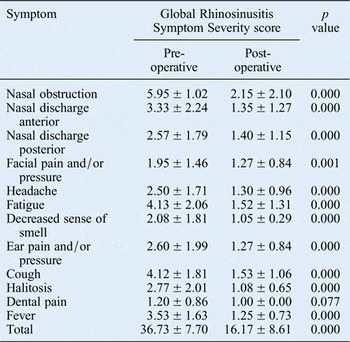
In all, 42 boys (70 per cent) and 18 girls (30 per cent) completed follow up and were included in the analysis. The proportions of participants in the different age groups were: 4–6 years, 45 per cent; 7–9 years, 33.3 per cent; and 10–12 years, 21.7 per cent. The mean ± standard deviation (SD) age of the study population was 7.32 ± 2.39 years. The longest lasting symptom was nasal obstruction (duration: mean ± SD, 5.95 ± 1.02 months), followed by fatigue (duration: mean ± SD, 4.1 ± 2.1 months) and cough (duration: mean ± SD, 4.1 ± 1.8 months). A global assessment of rhinosinusitis symptom severity scores is shown in Table I.
Global assessment of the rhinosinusitis symptom severity score

Data are means ± standard deviation.
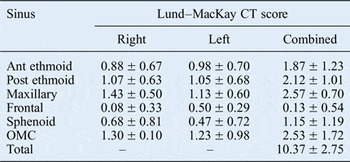
The minimum and maximum scores for CT images were 5 and 19, respectively. The maxillary and ethmoid sinuses were most frequently involved, along with ostiomeatal complex blockage. The most severe disease was present in the maxillary sinuses (mean score 2.57 ± 0.70), followed by the posterior ethmoid sinuses (score: mean ± SD, 2.12 ± 1.01; Table II). There were no significant differences in scores between different sexes and age groups.
Lund–mackay computed tomography score

Ant = anterior; post = posterior; OMC = ostiomeatal complex
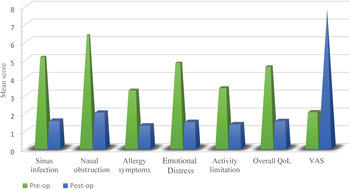
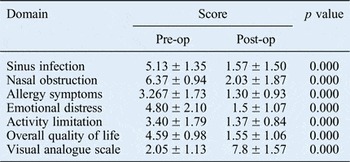
Nasal endoscopy showed varying degrees of oedema and discharge in all children. No child had nasal polyps (an exclusion criterion), scarring or crusting. A total of 53 children (88 per cent) had improved QoL scores at the end of follow up. The difference between the overall pre-operative (4.59 ± 0.98) and post-operative (1.55 ± 1.06) total scores and differences for each domain were significant (Table III). A significant improvement was seen for all QoL domains. The visual analogue scale showed a significant improvement in QoL after surgery: mean pre-operative score, 2.05 ± 1.13; and mean post-operative score, 7.8 ± 1.57 (Figure 1).
Graph showing pre- and post-operative Sinus and Nasal Quality of Life Survey (by domain and overall) and visual analogue scale (VAS) scores. Pre-op = pre-operative; post-op = post-operative QoL = quality of life

Sinus and nasal quality of life survey

Pre-op = pre-operative; Post-op = post-operative
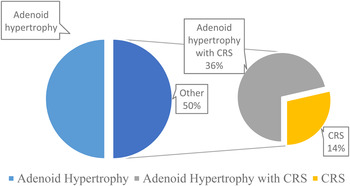
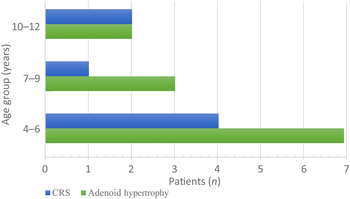
Of the 60 children, 22 (37 per cent) underwent adenoidectomy only and 38 (63 per cent) underwent adenotonsillectomy. All patients were followed up at one, three and six months after surgery. No major complications were observed in any child. Recurrence of adenoid hypertrophy was seen in 12 (20 per cent) children, of whom 5 (8 per cent) also had chronic rhinosinusitis. Two children (3 per cent) had chronic rhinosinusitis symptoms only and underwent FESS at a later date. The highest recurrence rate (58 per cent) was seen in the youngest age group (Figure 3). The chronic rhinosinusitis recurrence rate was greater in children who underwent adenoidectomy only than in those who underwent adenotonsillectomy.
Pie charts showing the pattern of symptom recurrence after surgery. CRS = chronic rhinosinusitis

Graph showing disease recurrence by age group and surgical procedure.

Discussion
Paediatric chronic rhinosinusitis is a complex disease and its pathogenesis is still under debate. About 6–13 per cent of childhood upper respiratory tract infections progress to rhinosinusitis,Reference Bachert, Pawankar, Zhang, Bunnag, Fokkens and Hamilos 13 which commonly coexists with other airway diseases such as allergic rhinitis and asthma. Children with known allergies and asthma were excluded from the study to enable post-adenoidectomy improvement to be estimated in children without coexisting disease.
The adenoids can cause secondary nasal obstruction and the surface biofilm may form the nidus of secondary bacterial sinusitis. Therefore, even if the airway is not completely compromised by adenoid hypertrophy, adenoid removal may be beneficial by clearing the reservoir of infection.
Despite the inherent radiation exposure, CT is commonly used in chronic rhinosinusitis patients to provide high-resolution imaging of complex bony and soft tissue anatomy. The Lund–McKay scoring system is a standard method for quantifying disease symptoms; a score of up to 5 is considered normal in growing children. However, in routine clinical practice, CT should be restricted to patients requiring FESS. Magnetic resonance imaging and ultrasonography have not proven useful for diagnosing chronic rhinosinusitis. However, diagnostic nasal endoscopy has proven useful for evaluating the nasal mucosa, quantifying nasal obstruction, grading adenoid hypertrophy and identifying contributory factors.
Treatment for paediatric chronic rhinosinusitis has been controversial due to lack of an appropriate treatment protocol. Although both medical and surgical treatments have been studied extensively, an evidence-based protocol has yet to be formulated. Children with disease that is refractory to medical treatment are scheduled for surgery. Available surgical options range from a simple maxillary sinus wash, adenoidectomy or FESS to advanced procedures such as sinus balloon dilatation. Although studies have been conducted to assess the efficacy of different treatment modalities, adenoidectomy is still considered the first-line therapy for managing chronic rhinosinusitis in the presence of adenoid hypertrophy. Other modalities are only considered for cases of recurrence.
Children aged between 4 and 12 years were included in this study because chronic rhinosinusitis is mainly due to adenoid hypertrophy in this age group. The adenoids grow rapidly compared with the nasopharynx between three and five years of age,Reference van Cauwenberge, Bellussi, Maw, Paradise and Solow 18 reaching their maximum size at about seven years of age.Reference Vogler, Ii and Pilgram 19 Spontaneous regression in adenoid size has been seen in adolescents after the age of 15 years.Reference Anfuso, Ramadan, Terrell, Demirdag, Walton and Skoner 20 Hence, upper respiratory tract infections in this age group are more prone to nasal obstruction. This study used the standard symptom scoring system of the Peyton Manning Children's Hospital; a similar scoring system is lacking in other studies. Nasal endoscopy and non-contrast CT of paranasal sinuses were performed pre-operatively. Nasal endoscopy is an important tool for investigating mucopurulent discharge emanating from the middle meatus and for ruling out polypoidal tissue or adenoid hypertrophy in chronic rhinosinusitis patients. Pneumatisation and involvement of the sinuses can be documented by CT.
In this study, symptom scores improved for all domains and the overall score improved in 88.3 per cent of children. The improvement was significant in all domains except for dental pain. Bahadir et al. and Tuncer et al. reported improvement in 88–89 per cent of children, with nasal obstruction and nasal discharge the two most common findings.Reference Tuncer, Aydogan, Soylu, Simsek, Akcali and Kucukcan 6 , Reference Bahadir, Caylan, Bektas and Bahadir 21 Brietzke and Brigger reported symptom improvement in 69.3 per cent of children in a meta-analysis that used random effects modelling to assess inter-study variance.Reference Brietzke and Brigger 22 A prospective review of data for 143 children by Ramadan and Tiu reported a treatment failure rate of 50 per cent in children who underwent adenoidectomy for refractory chronic rhinosinusitis and later required FESS, with a mean duration of 23.7 months between procedures.Reference Ramadan and Tiu 23 Ramadan and Cost reported improvements in 60.7 per cent and 87.5 per cent of patients with refractory chronic rhinosinusitis after adenoidectomy with and without a maxillary sinus wash, respectively.Reference Ramadan and Cost 24 However, the difference was not significant for children with low CT scores. Differences in the improvement rate may be because the mean CT score was higher in the adenoidectomy with maxillary sinus wash group (7.9) than in the adenoidectomy alone group (3.0). Ramadan reported an analysis of 183 children with refractory chronic rhinosinusitis stratified into three groups: those who underwent FESS plus adenoidectomy, those who underwent FESS alone and those who underwent adenoidectomy alone.Reference Ramadan 10 In 51.6 per cent of children who underwent adenoidectomy alone, there was overall symptom improvement.
In the paediatric age group, chronic rhinosinusitis has a very high negative impact on QoL, resulting from frequent hospital visits, high medication costs, and effects on the child's behaviour and school performance. Various scoring systems have been used for estimating QoL in children. However, the Sinus and Nasal Quality of Life Survey has been validated for this purpose.Reference Kay and Rosenfeld 25 Most severely affected domains in our cohort were nasal obstruction and sinus infection followed by emotional distress, activity limitation and allergic symptoms. Improvement in the average QoL score was seen in 83.3 per cent of children. Very few studies have assessed post-adenoidectomy QoL in refractory paediatric chronic rhinosinusitis. Rudnick et al. conducted two studies in 2006 and 2007 in 22 children undergoing adenoidectomy or FESS for refractory chronic rhinosinusitis, and observed a significant change in post-operative QoL assessed using the Sinus and Nasal Quality of Life Survey.Reference Rudnick and Mitchell 26 , Reference Rudnick and Mitchell 27 Further, they noted nasal obstruction and emotional distress domains had the greatest improvement whereas allergic symptoms had the least improvement, consistent with the present study.
Asthma, young age, smoking exposure, recurrent respiratory tract infections and allergy are the main factors contributing to post-adenoidectomy symptom recurrence. Tuncer et al. reported that 5 out of 27 patients (11 per cent) still had rhinosinusitis-related symptoms at follow up.Reference Tuncer, Aydogan, Soylu, Simsek, Akcali and Kucukcan 6 Ramadan and Tiu reported that of children who underwent adenoidectomy for chronic rhinosinusitis, those with treatment failure within 24 months of surgery had a mean age of 6 years, while those with treatment failure after 24 months had a mean age of 8 years.Reference Ramadan and Tiu 23 The reasons for treatment failure in these children were concurrent asthma and a young age. These data suggest that adenoidectomy has a better outcome for children without asthma and for those aged over seven years. The symptom recurrence rate was variously reported as 25 per cent, 19.1 per cent and 7 per cent in children who underwent adenoidectomy for refractory chronic rhinosinusitis requiring FESS.Reference Lesinskas and Drigotas 28 – Reference Ramadan 30 It is notable that studies excluding children with concurrent allergy and asthma had better outcomes than those including children with these conditions. However, randomised controlled trials are needed to provide better insight into the differences between these two patient groups.
-
• Chronic rhinosinusitis has a great impact on the quality of life of children and their families, but diagnosis is challenging
-
• Adenoidectomy is the first-line surgical management for chronic rhinosinusitis
-
• This is the first study to assess quality of life after adenoidectomy in an Indian population
-
• In all, 88 per cent of children had a significantly improved quality of life after adenoidectomy
-
• Compared with similar studies, this study reports a better quality of life outcome for children without coincident asthma or allergies
Randomised control trials with a larger sample size are also necessary to assess patient QoL. The presence of coexisting upper respiratory infections prevented the inclusion of paediatric chronic rhinosinusitis patients with adenoid hypertrophy alone in this study. Hence, children who underwent both adenoidectomy and adenotonsillectomy were included. This study therefore provides the information necessary to establish an evidence-based protocol for managing refractory paediatric chronic rhinosinusitis.
Conclusion
This study showed significant post-operative symptom and QoL improvement for children with refractory chronic rhinosinusitis after adenoidectomy. Thus, adenoidectomy is a simple, cost-effective procedure which should be considered the first-line surgical treatment for improving the QoL of children with chronic rhinosinusitis refractory to maximal medical therapy. Children with chronic rhinosinusitis but no known allergy or asthma have better outcomes after adenoidectomy. Hence, pre-surgical testing of children for allergies and asthma may help to provide a better QoL and fewer interventions. Co-ordination between paediatricians and otolaryngologists is needed to ensure the timely referral of such patients to a paediatric otolaryngologist for effective management.