


Wherever enslaved people worked on large plantations in the antebellum South, white men were typically hired as overseers to supervise and discipline them. Crops, soil types and topographies varied across the southern states, but professional overseers were permanent fixtures of the plantation landscape from the colonial era to the Civil War. The overseer's performance in crop and labour management corresponded with the profits of the plantations. No field in American history has produced a larger body of scholarship or undergone such constant substantial revisions as American slavery. Surprisingly, plantation overseers have remained peripheral to scholarly studies and consequently little is known specifically about Irish overseers.Footnote 1 William E. Wiethoff's Crafting the overseer's image (2006) examines ‘the plantation overseer's image as constructed by friends and enemies, neighbors and strangers’.Footnote 2 It is a history of the image of the overseer, not a history of overseers. Wiethoff puts forward evidence that poor rural working-class whites faced competition from enslaved blacks for managerial positions on the plantations in many parts of the antebellum South. In doing so, Wiethoff has been the first to consider the role of foreign-born plantation overseers. He argues that the complexity of black–white labour relations and the unique problems caused by immigrant overseers illuminate rivalries that confound conventional wisdom about southern overseers.Footnote 3 Wiethoff states that overseers faced a ‘greater struggle for affirmation if they were strangers in a strange land’, and Irish overseers ‘faced a bias analogous to the discrimination against Africans’.Footnote 4
Following the scholarship of whiteness studies that proliferated in the 1990s, Wiethoff's limited discussion of immigrant overseers contends that the Irish overseer was ‘an inside-out black immigrant’.Footnote 5 However, whiteness as a racialised political category meant something quite different in the antebellum South than in the antebellum North. The relatively small number of Irish immigrants and the overriding importance of the defence of slavery allowed the Irish to fit into the slave states’ regional identity, where they often gained greater acceptance in society than they did in the North. David Gleeson argues that the reality for Irish immigrants in the South was that they ‘always were “white” and had no major problems with the dominant racial system in the region’.Footnote 6 The true mark of distinction in the antebellum U.S. South was not white skin, but an individual's wealth, gender, family connections and community standing. For example, David Brown argues that propertyless white men ‘were more likely to encounter planters in court than in church or at a political gathering’.Footnote 7
Keri Leigh Merritt has further highlighted how poor white southerners were jailed throughout the antebellum period ‘for small amounts of debt’, publicly whipped ‘for nonviolent crimes such as bastardy and simple larceny’, and how poor white convicts and debtors were auctioned off ‘(for their labor) to the highest bidder’.Footnote 8 Enslavers exploited African American slaves and poor whites in different ways, but they were part of a more comprehensive exploitation system that characterised the emerging global and capitalist division of labour. Indeed, for many of the struggling non-slaveholders throughout the antebellum South, there was ‘no work beneath the dignity of white skin, degrading to women, insulting to a free person, or unsuited to a child’.Footnote 9 Poor working whites were often looked down upon by elite southerners. Prince Johnson, a former enslaved person from Mississippi, recalled ‘a sad thing’ happened on the plantation when ‘My young Mistis, de one named for her ma, ups an’ runs off wid de son o’ de Irish ditch digger an’ marrie ’im’. By doing so, the enslaver's daughter had committed class suicide and ‘Old Mis’ wouldn’ have nothin’ more to do wid ‘er, same as if she warnt her own chil’’.Footnote 10 Personal wealth mattered much more than white skin when determining southern social status.
By studying the work of Irish overseers, this article aims to understand further the Irish immigrant experience with American slavery. Throughout this work, the term ‘Irish’ is used inclusively to embrace people born in Ireland regardless of their religious convictions. Even though many early Irish immigrants were Protestants, contemporary American accounts tended not to distinguish between Irish and ‘Scots Irish’.Footnote 11 Irish people's views on southern slavery were varied, though most who stayed in the slave states accepted the reality of black servitude and treated slavery as a means of economic mobility. While most Irish immigrants in the antebellum U.S. South settled in the towns and cities, Irish labourers also worked on plantations. Some Irish immigrants succeeded in becoming enslavers; others found opportunities as plantation overseers.Footnote 12 In the U.S., Irish immigrants were not a monolithic group. This study recognises the widespread regional variations and understands the diversity and interconnectedness of the Irish immigrants’ experiences in the South. By examining the work of plantation overseers, this article demonstrates that Irish overseers were not categorically different from their native-born counterparts and had to be just as ruthless. Their ability to become plantation overseers demonstrates the essential whiteness of the Irish in the South.
The work of the antebellum Irish overseer needs to be understood in the context of enslavers’ responses to market changes and world economic transformations. The demands and performance pressures placed on overseers resulted from enslavers’ attempts to modernise their economic practice by rationally managing their lands, adopting improved agricultural techniques and investing in infrastructural developments. Throughout the Americas, in the nineteenth century, the nature of slavery evolved into an aggressive profit- and market-oriented mode of production. Dale Tomich has termed this historic transformation ‘the second slavery’.Footnote 13 The end of slavery in Haiti, combined with the French Revolutionary and Napoleonic wars’ economic disruptions, created space and opportunities for new crops from regions of slave-based agriculture to enter and dominate world markets: demand for products like American cotton, Brazilian coffee and Cuban sugar surged.Footnote 14 These regions witnessed ‘the rise of highly centralized and organized forms of slave management that shared common features with modern industrial capitalist practices’.Footnote 15 The formation of increasingly larger and more powerful slave systems in turn impacted on the expectations and responsibilities of plantation overseers. In the U.S., the rise of the second slavery was ‘directly linked to developments related to the Industrial Revolution’.Footnote 16 Cotton's identification as the primary raw material of the first Industrial Revolution enabled U.S. enslavers to conquer a subcontinent, creating one of the most significant staple-commodity production zones of the nineteenth century.Footnote 17 The profitability of cotton resulted in a transnational flow of commodities and people (including Irish immigrants) between the South and the Euro-American world.
Despite the rigorous demands on the overseer, some Irish immigrants were willing to undertake such work. The first section of this article explores Irish immigrants’ experiences in interacting with the institution of slavery. They entered a society where the economic and political order rested on the firm commitment slavery. Many came to the South for seasonal work and returned to the northern states. However, for those who resided permanently in the South, the material benefits of slavery seemed obvious. Working as an overseer provided a better-paid alternative for Irish immigrants in the rural antebellum South who wished to avoid labouring on levee and railroad construction projects. The second section details the experiences of immigrants who gained employment as overseers. While foreign-born immigrants represented a minority of all overseers, the study of Irish overseers provides insights into Irish attitudes towards race and slavery in the antebellum U.S.. Violence was inherent in the plantation system, and overseeing was a brutal and hazardous occupation. The article also explores how interactions between overseers and enslaved people were dominated by distrust, hostility and violence. Some elite enslavers did not regard Irish overseers as respectable men. Indeed, as foreigners, Irish overseers helped reinforce enslavers’ views of the ‘degrading function,’ which overseers performed. However, these contemptuous attitudes concerning Irish overseers were part of the southern propertied elite's broader disdain towards working-class whites.
I
Soaring profits for cotton resulted in the spread of its production in the Lower Mississippi Valley. This expansion of upriver cotton production required immense land clearing, draining and levee construction, transforming the landscape into profitable plantations. David Gleeson notes that the only rural counties in the South with any significant Irish population between 1845 and 1860 were the ones through which railroads passed or where levee builders and ditchers were required.Footnote 18 During the 1850s, southern cities such as Baltimore, St Louis and New Orleans enjoyed construction booms, providing a wide array of jobs for immigrants. In such cities, Irish labourers could receive wages in certain trades that were equivalent to or even higher than those in some of the leading industrial northern states.Footnote 19 The great boom in levee and railroad construction in the 1850s coincided with, and accommodated, the rising number of post-Great Famine Irish immigrants. Employment for non-specialist labourers was often sporadic and labourers followed work wherever it was available. Many came to the South for seasonal work. For example, in 1853, a weary Irish farm labourer in the township of Binbrook, Canada West, Charles H. Locke, informed his sister Fanny Pierce that he intended to ‘work my way to the southern states[.] [M]y constitution is too much broken to stand another Canadian winter.’ Locke believed, ‘if I can't get any other employment, I can get good wages as a nigger driver’.Footnote 20 The birthplace of Irish immigrants’ children living in the South recorded in the 1860 federal census also reveals a pattern of Irish families moving from the northern states to the South. For example, Thomas McGrann was a twenty-eight-year-old Irish-born overseer in Hinds County, Mississippi, and his only son, four-year-old Willie McGrann, was born in New York.Footnote 21
The Irish who came to the South found a society where the economic and political order rested on the firm commitment to the institution of slavery. Initially, Irish immigrants had to accept that ‘'tis as customary … to set up and sell Negroes at auction as it is horses in Ireland’.Footnote 22 Writing to a friend from New Orleans in 1819, the Irish-born William Brown struggled to accept the complex contradictions of the American republic. He understood the importance of cotton and sugar as ‘a source of great wealth to the country’, but he believed that slave labour was ‘incompatible with justice and humanity’. Yet, ‘[i]n this land of freedom where equal rights and universal emancipation are the theme of every tongue and the boast of the community ― Slavery ― detested Slavery prevails’. Brown observed that, for the American slave, ‘every white man is his enemy ― Surely there will be a day of fearful retribution.’ He had come to the U.S. to make money, but success required him to become one of the ‘constant notaries at the shrine of avarice, all generous feelings and better principles of the heart are sacrificed to this great object’.Footnote 23 In 1854, while traveling from New Orleans to Lafayette on top of an omnibus, Frederick Olmsted heard ‘an Irishman somewhat over-stimulated, as Irishmen are apt to be, loudly declare himself an abolitionist: a companion endeavoured in vain to stop him, or make him recant, and finally declared he would not ride any further with him if he could not be more discreet’.Footnote 24 Discretion was necessary for anyone who believed in abolition in the slave states. Enslavers avidly protected their human property and did not tolerate overt declarations against their means of wealth. For example, in 1859, in Hamburg, South Carolina, Tom Bruch, an Irish bricklayer and plasterer, was accused of using ‘seditious’ language among slaves. The local minutemen (militia members) whipped Bruch and shaved one side of his head, for he was a man ‘whose tongue had been running too freely with the colored population’. They then drove Burch out of the state.Footnote 25
To fully appreciate the true nature of Irish attitudes towards race and slavery is to acknowledge the contradictory nature and messy reality of their experiences. Life at the lower level of society in the antebellum slave states was full of multiple types of biracial interactions.Footnote 26 Poor whites, including Irish immigrants, often drank, gambled, stole and slept with enslaved and free blacks. Reports of Irish immigrants fraternising with blacks provoked the indignation and suspicion of native southerners, especially when they read such accounts as the 1836 cases of the runaway slave Ruben, who ‘went off with a man named David McDowell, an Irishman’, or another runaway, Bill, whose enslaver stated he had ‘good reason to believe that said boy was decoyed off by an Irishman who was at work on the same road, who calls himself Anderson Carroll’.Footnote 27 In 1860, John McGuiggin, an immigrant in Vicksburg, Mississippi, was found guilty and sentenced to twenty years of hard labour for ‘Inducing Slaves to Run Away’. John Roach, another Irish man, was responsible for turning McGuiggin over to the authorities, while Urich French testified against him, and a third Irishman, John O'Reilly, served on the jury that convicted him.Footnote 28 There was never an organized collective of poor whites to challenge the status quo during the antebellum period. Often at the bottom of white society, some immigrants grew disenchanted with the southern social order and returned to the northern states. Some Irish immigrants found it an ‘unnatural sight to see our fellow creatures sold’, but adapted to the reality of the southern racial order to advance their economic interests.Footnote 29 Indeed, in 1840, one Irish immigrant noted that one was ‘obliged to own niggers to make money’ in the South. Footnote 30
II
During the 1850s, the total number of overseers doubled in the slave states. The 1850 U.S. federal census enumerated 18,859 overseers but by 1860, this figure stood at 37,883. William Scarborough credits this increase to the continued ‘expansion of the plantation system into the Southwest’ and the ‘consolidation of existing holdings into larger units in the older agricultural regions’.Footnote 31 The Irish-born population in the slave states also expanded between 1850 and 1860, going from 54,551 to 84,853 in the eleven states that would secede to form the Confederacy. Most of these new arrivals lacked the financial means to become enslavers and therefore had to work as manual labourers to survive. Many Irish immigrants’ desperation for work created a cheap and dispensable pool of labourers for enslavers to exploit.
In 1860 the Irish-born population represented 1.56 per cent of the white population in these states.Footnote 32 And it is important to note that the Irish constituted a similarly small minority of antebellum overseers. James Benson Sellers examined the birthplace of overseers found in the 1850 federal census for Dallas, Greene, Marengo, Madison and Tuscaloosa counties in Alabama. In Madison and Tuscaloosa counties, all recorded overseers were southern-born. One lone Irish man was the exception to Dallas County's southern-born overseers. Three Irish overseers were recorded in Greene County, and six Irish and one German-born overseer were found in Marengo county.Footnote 33 A review of 842 overseers’ birthplaces in the 1860 federal census for six productive sugar and cotton counties and parishes in Louisiana and Mississippi reveals a similar pattern. Out of the 842 overseers reviewed, seventeen were foreign-born, seven of them Irish. The expansion of the second slavery and the Southwest's cotton frontier created a new type of global entanglement, transforming the lives and landscapes of the Lower Mississippi River Valley. It was in these regions of expanding commodity frontiers that immigrant overseers were more likely to be employed. The small numbers might suggest that the subgroup of Irish overseers do not warrant the effort of a scholarly investigation. The paucity of surviving source material relating to Irish plantation overseers stands as another obstacle. Despite the challenges, the study of Irish overseers provides a unique line of inquiry for understanding Irish attitudes towards race and slavery in the antebellum U.S..
Sample of 842 Overseers from the 1860 census
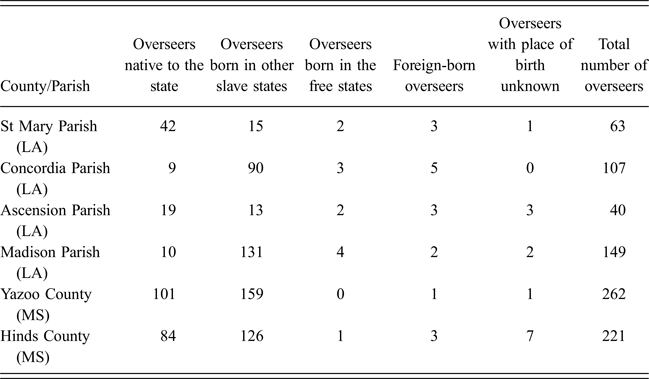
Sources: Calculated from the Eighth census of the United States, 1860, National Archives and Records Administration, Washington, D.C., NARA microfilm publication, M653. Those enumerated as managers and agents were not included in the above figures.
Breakdown of the seventeen foreign-born overseers from the sample of 842 overseers in the 1860 census

Sources: Calculated from the Eighth census of the United States, 1860, National Archives and Records Administration, Washington, D.C., NARA microfilm publication, M653. Those enumerated as managers and agents were not included in the above figures.
Southern-born overseers tended to come from the ‘yeoman or middling classes’. Basic arithmetic and literacy were essential but were skills which many poor southerners lacked.Footnote 34 The period between 1815 and 1860 witnessed a flourishing of agricultural societies and journals committed to scientific agricultural practices.Footnote 35 Southern enslavers, like many among the landed elites throughout Europe at the time, turned to agronomy. The transnational agronomic movement of the 1840s flourished where commercial agriculture was practiced, including Ireland. Indeed, some immigrants who arrived in the South during the 1840s and 1850s were familiar with Irish landlords’ agronomic improvements.Footnote 36 Books, journals, agricultural institutions and conventions all circulated information that ‘encouraged better farming techniques, efficient plantation management, crop diversification and technological progress’.Footnote 37 Southern periodicals occasionally cited Irish sources such as the Irish Farmers’ Gazette.Footnote 38 Cotton planters experimented with seed types and different planting techniques such as drilling methods similar to those used in grain cultivation, which contributed to higher crop yields.Footnote 39 Steven G. Collins outlines how southern reformers ‘transformed new industrial ideas of system, technology, organization, and control into a unique vision of modernization based on agriculture and slave labor’.Footnote 40 Improvement in the managerial skills of overseers was deemed necessary by agronomic enslavers.Footnote 41 In 1855, DeBow's Review stated that ‘the time has passed when the overseer was valued solely for the number of bales of cotton, hogs-heads of sugar, or tierces of rice he had made, without reference to his other qualifications’. Such ‘qualifications’ included good husbandry skills, the knowledgeable ability to increase the self-sufficiency of the plantation and the sustainable use of its resources, and the ability to improve the productive qualities of the soil.Footnote 42 Commercially-minded enslavers kept detailed records and relied on tools such as Affleck's cotton plantation record and account book to track productivity.Footnote 43
David Roediger and Elizabeth Esch argue that the agronomic periodicals of the South praised ‘the managerial virtues of white masters, and indeed of whites as a race, so that the broad idea of “whiteness-as-management” received emphasis’.Footnote 44 This prescriptive literature of enslaver elitism maintained that every white male (that would have included Irish immigrants) could manage enslaved black people. The rapid expansion and restructuring of the southern economy under the rise of the second slavery, especially during the 1850s, created more significant opportunities for aspiring Irish immigrants to gain employment as overseers. However, as a foreign-born outsider, the Irish immigrant who gained employment as an overseer had to make a significant impression upon their employer. The overseer was the pivot of large plantation enterprises. Enslavers were aware that those who ignored or failed to implement the requirements of controlling slave labour risked encumbering their estate with substantial debt. For instance, in 1830 when Davidson McDowell, an Irish-born enslaver, visited his Asylum rice plantation in Georgetown County, South Carolina, he discovered his overseer ‘Mr. McCarty has been intoxicated for some time past. The plantation all in disorder. Must part with for his conduct.’Footnote 45 Reports and complaints of poor overseers were common throughout the antebellum South.
In 1861, County Monaghan-born Patrick Lynch, the Catholic bishop of the diocese of Charleston, owned ninety-five slaves. The bishop depended on his brother Dr John Lynch to administer his slaves and landholdings in the Columbia area. On 27 August 1861, John Lynch informed his brother that he had received an application from Michael Bresnahan seeking work as an overseer. Bresnahan had good qualities; he was ‘an Irishman, a good Catholic, sober, industrious and appears to have a full share of common sense.’ The forty-five-year-old was a quiet man who worked ‘at the state house as [a] polisher’, but his wife and children resided in Baltimore. Anxious to get the position, Bresnahan stated that he was ‘raised to farming in the Old Country and was on a farm in Virginia for two years’, and was willing to leave his potential wages at the bishop's discretion. However, Dr Lynch feared that the Irish man might not take ‘sufficient control over the negroes if it became necessary to use harsh means’.Footnote 46 Nonetheless, other Irish immigrants who sought employment as overseers had no qualms in profiting from racial slavery. The 1843 case of Bob Hull and his family, whose arrival in New London, Connecticut, received considerable media attention, effectively illustrates the willingness of Irish immigrants to profit from slavery. Hull, a manumitted slave, had purchased his family in Georgia, an act prohibited under state law. The family was forced to flee after ‘an overseer (an Irishman)’ on a nearby plantation notified the authorities who sought to ‘seize Bob's moveable property, alias his wife and children, and sell it for the benefit of the state, one-half the proceeds going to the informant [the Irishman]’.Footnote 47 Irish overseers upheld the racial order to advance their economic prospects.
Hired overseers were counselled to carry out their employer's orders, ‘strictly, cheerfully, and to the best of your ability’.Footnote 48 Employers and overseers signed contracts that contained the terms of their agreement. In these contracts, enslavers outlined the overseer's duties and privileges, and they often included rules for governing slave management.Footnote 49 Overseer wages varied according to individual contracts: no consistent pattern of pay existed. Several factors influenced the wages received, including the plantation's size, the number of slaves, the length of tenure, the overseer's experience and the plantation's geographic locationFootnote 50. For example, in 1822, Davison McDowell offered the following contract for the position of overseer of his Contra plantation:
By agreement with you to superintind my Plantation as an overseer from this to the 1st of Jan. next at the rate of $150 P ͬ year & from that time to the 1st Jan. 1824 for the sum of $150 ― to obey me in all thing to treat my people with humanity during my absence & to do the best you can for my interest according to the best of your judgment.Footnote 51
In contrast, in 1821 Dublin-born Antonio Patrick Walsh, a cotton plantation owner in Louisiana, offered a contract worth ‘Four hundred Dollars’, with the possibility of a fifty dollar bonus if the overseer could make the enslaved workforce produce ‘75 to 80 bales’ of cotton with an average weight of 375 pounds by ‘the first day of January, next 1822’.Footnote 52 The bonus arrangement was used mainly by planters on the Southwest's new cotton lands who required quick returns on their investments.
Established Irish overseers received substantial incomes in comparison to other rural occupations. Though some overseers found that their wages were insufficient considering the job's performance pressure and managerial responsibilities, others appreciated its rewards. Irish immigrant James McCann and his family moved to rural Mississippi to start farming, but his son John remained in South Carolina ‘he as overcer’, where he was ‘geten 300 Dollars per yer’.Footnote 53 With free accommodation and minimal expense, overseeing was a means to earn and save money for the McCann family. In Natchitoches, American-born Jefferson McKinney informed his brother that he could not, at present, return to farming ‘to use the plough and hoe myself. I cannot think of such a way of making a support for my family as long as I can git a situation as an overseer.’ He realised the difficulty of finding an alternative position to earn ‘$500 or 600 a year’.Footnote 54 In 1856, Jefferson purchased ‘a negro girl which I give $1000 for one third cash and the balance one and two years from the first of may’. He noted, ‘it is a big prise but I have bin trying for several years to lay up money and find that at the end of every year that I have saved but little’ due to previous debts. However, he believed that if the sixteen-year-old slave ‘should breed she wil be cheap in a few years’.Footnote 55 A strategy among overseers was to build up their slave property to hire out to their employers subsequently. For example, Maunsel White, an Irish-born enslaver in Louisiana, offered to hire his overseer's slaves at ‘$120 a year for Men & $100 for women’.Footnote 56 John Reynolds, a successful Irish overseer for Mary Stower in Warren County, Mississippi, managed Stower's sixty-eight enslaved people while owning ten enslaved men who also worked on the plantation.Footnote 57 By becoming enslavers, overseers gained more respect in potential employers’ eyes as individuals well-practiced in dominating others. It was difficult for an overseer to improve his social and economic standing, but some managed to become independent landowners and planters. Key among the difficulties in acquiring land was that it was generally purchased on credit by speculators. John Connolly was the overseer at Woodlands Plantation in Cass County, Georgia, the estate of Savannah exporter Godfrey Barnsley. When a neighbouring farm was up for auction, Connolly was ‘very thankful indeed Sir to you for proposing to advance me money to buy it’. Although Connolly was unsuccessful at the auction, he was fortunate to enjoy a cordial relationship with his employer. John Ross was another Irish overseer who enjoyed an amicable relationship with his longtime employer, David Rogerson Williams, in South Carolina. When Ross became ‘impaired’, he was furloughed for two months to Sulphur Springs of Virginia to recuperate. Few enslavers were as generous in their treatment of their overseers.Footnote 58 Overseers who had a good working relationship with their employer, had more secure tenure and income.
III
Overseeing was a hazardous occupation, and many overseers lost their lives on the plantations due to disease, accidents and acts of resistance by the enslaved workforce. In 1854, an Irish immigrant living in Charleston, David Thomson, noted in a letter that there were three ‘negroes to be hung up at Abbeville on 15 September for killing their overseer’ who had punished one of them the day before the murder. The three enslaved men ‘cut him on the head & neck with their axes and then ended his life by throwing him in a creek and drowning him’.Footnote 59 There were few plantations where enslaved people worked attentively and willingly for a sagacious overseer. Enslaved people confronted overseers, and the relationship between overseer and the enslaved was dominated by distrust and hostility. Indeed, overseers were advised by agronomic journals that the ‘only way to keep a negro honest is not to trust him’.Footnote 60 Overseers found themselves exposed to the same environmental conditions as the slaves in the fields. Thomas David Smith McDowell, a North Carolina enslaver and legislator, and his brother John McDowell, employed Patrick Carr as an overseer on their Purdie plantation in Bladen County, North Carolina. Carr had to manage the production of naval stores and keep the plantation self-sufficient in foodstuffs.Footnote 61 The Purdie plantation relied on river transportation, and Carr noted, for instance, that he had ‘to get the timber on the Elwell land as soon as I can and Raft it and send it down.’Footnote 62 In 1853, after four years working on the plantation, Patrick Carr drowned in an accident.
Despite the loss of his brother Patrick, John Carr of Enniscorthy, County Wexford, was delighted at the opportunity to replace his brother in North Carolina: ‘Dear Sir there is nothing would give me greather pleasher than to live with you.’Footnote 63 By December 1854, John Carr was the working overseer on the Purdie plantation. It was unusual for the McDowell brothers to hire their new overseer from Ireland when more qualified candidates were available in the Carolinas. The McDowells do not appear to have been related to the Carrs, and perhaps it was a sense of guilt over Patrick's death that influenced the appointment. A letter from Ellener Carr, the mother of Patrick and John, to Thomas McDowell survives. She thanked him for ‘the Bill of ten pounds’ that he had sent her and expressed her happiness at John ‘being with you knowing you were so kind to my children and myself’.Footnote 64 John succeeded in managing the plantation's enslaved workforce and perfected the production of turpentine. There are some hints of his methods in his correspondence. For example, in one case, when an enslaved man refused to ‘go to the timber wood’ John ‘whiped him’ to ensure that the slave ‘would do his work for the time to come’.Footnote 65
The threat of violence was a significant factor in the increase in the productivity and efficiency of antebellum southern plantations.Footnote 66 DeBow's Review informed readers that the whip's use was ‘necessary’ and should be applied ‘slowly and deliberately’.Footnote 67 Irish enslavers and overseers accepted violence against enslaved people as a natural part of the southern social order. Maunsel White, an Irish-born enslaver in Louisiana, accepted slavery as an ‘immutable’ part of nature.Footnote 68 Albert Patterson, who was born into slavery and was legally owned by White, recalled in 1940 how ‘De Frenchmen an’ de Dutchmen were mean, but the Irishmen was good. I see de blood cut out o’ niggers … but not Col. White. He not cruel, he wouldn't whip.’Footnote 69 White, however, did whip his slaves. For example, on 11 April 1856, ‘Caty by my own hand got a pretty good whipping for wilful lieing [sic]’.Footnote 70 White insisted on strict discipline and was happy to congratulate his overseer for his violent actions, ‘I notice what you say of the Negroes and I am indeed glad that you have got them “straightened up.” Ironing and whipping a little, has made a great change.’Footnote 71 The influential Affleck's cotton plantation and account book recommended putting disobedient slaves in stocks rather than to chastising them with whipping.Footnote 72 The abolitionist James Redpath found on his travels in the South in the late 1850s that Irish immigrants had ‘acquired the reputation, both among the Southerners and Africans, of being the most merciless of negro task-masters’.Footnote 73 Violence was inherent in the plantation system, and Irish overseers were aware that the foundation of southern wealth rested on controlling and chastising the bodies of the enslaved.
The role of the overseer and his whip were an essential feature in plantation production. They had as much bearing on the crops’ success as the weather. In 1835 in Mississippi, Israel Campbell, who was born into slavery in Kentucky, was hired out to a cotton planter. Campbell recalled that it was here ‘I entered on a new way of life, that of the plantation system, that is, every day one had to be up with the blowing of the horn, and be in the field by day light.’ The overseer on the plantation was an Irishman and when harvesting the cotton crop, each enslaved person was given an expected quota of cotton to be picked daily. Those who did not meet their quota received as many lashes as they were pounds of cotton short. Campbell had never picked cotton before, yet he was expected to pick a hundred pounds each day. In the field, the overseer noticed that Campbell was struggling, and ‘he exclaimed, to hurry me up, “Jatherous, Jatherous, by the holy and just God, Israel, you will have to buy the rabbit agin [to] night,” meaning that I would get a whipping’. The working day ended when the sunset and the overseer could be heard shouting ‘All ye's, all ye's gather up your baskets and away to the cotton-house’. The enslaved workers’ cotton baskets were weighed by the overseer who ‘kept a slate with each hand's name on it, and would put each draft of cotton down as they brought it in.’ To save his back from being ‘cut to pieces’, Campbell hid watermelons in his basket to make up the weight deficit. He successfully concealed his trick, but had he been caught, he would have suffered terribly.Footnote 74
Constant surveillance by the overseer made it difficult for Campbell and the other enslaved workers to successfully complete or cheat in their tasks: one boy ‘was whipped nearly every day’.Footnote 75 Campbell believed the surveillance of the Irish overseer exemplified ‘how little mercy the overseers have upon the slaves’. This overseer even shot the husband of an enslaved woman who had tried to prevent him from whipping his wife: ‘He did not kill him, but he was laid up a long time.’ Yet, Campbell also noted that the same overseer had in the slave quarters ‘a fine black woman for a wife, he not having as much prejudice against color as many of our northern brethren’.Footnote 76 Campbell's Irish overseer experience illustrates the complexity and conflicting nature of southern racial relations that Irish immigrants navigated. While some enslavers feared that some Irish immigrants behaved as if they were either ignorant or dismissive of southern racial etiquette, most southerners openly acknowledged Irish dislike of blacks. In 1844, for example, the Daily Picayune printed an anecdote about ‘Biddy’ and ‘Ann’, two Irish women who extolled the virtues of New Orleans. Praising the opportunities to find work, Biddy declared New Orleans ‘a fine city, in troth it is’; Ann replied ‘Barrin’ the nagurs’.Footnote 77 James Redpath believed there was a tendency in the South to view Englishmen, Scotsmen and Germans as ‘secret abolitionists or silent neutrals’. However, Redpath noted that most Southerners considered the Irish as ‘devoted supporters of Southern slavery’.Footnote 78
With the ever-present fear of severe punishment, establishing rules and strict routines allowed enslavers and overseers to maintain order and increase plantation output.Footnote 79 When an overseer failed to dominate the enslaved workers, he failed to keep his job. In 1834, The Farmers’ Register declared that ‘negro women are harder to manage than the men’. An overseer who failed to control enslaved women undermined his ability to dominate the enslaved men and raised questions about his capability. The best way to deal with troublesome female slaves, argued The Farmers’ Register, was the use of ‘kind words and flattery. If you want to cure a sloven, give her something nice occasionally to wear and praise her up to the skies whenever she has on anything tolerably decent.’Footnote 80 Some overseers may have heeded such advice. However, many of them resorted to violence, sexual assault and the rape of enslaved women to assert their dominance and power. The sexual abuse of enslaved women by overseers went mostly unchecked.
Many overseers regarded the sexual abuse of enslaved women ‘as nothing less than a perk of the job’.Footnote 81 In Louisiana, when on the plantations of the Irish-born John Burnside, William Howard Russell, the Dublin-born correspondent for The Times (London), noted some ‘exceedingly fair’ slave children, the overseer, Mr Seal, ‘murmured something about the overseers before Mr. Burnside's time being a rather bad lot’. Russell found that Seal did not believe there ‘was any particular turpitude in the white man who had left his offspring as slaves on the plantation’.Footnote 82 Most overseers cared little for the consequences of their sexual relations with enslaved people, but the children born from these relations left a legacy.Footnote 83 One former slave, Casper Rumple, was born in Lawrence County, South Carolina. His father, Casper recalled:
was a white man ― Irishman. Show I did know him. He didn't own no slaves. I don't guess he have any land. He was a overseer in Edgefield County. His name was Ephraim Rumple. What become of him? He went off to fight the Yankees.Footnote 84
Despite this, Casper decided to keep his father's surname. Another former slave from South Carolina, John C. Brown, stated that his wife Adeline Brown's father was ‘a full blooded Irishman’ who was the overseer on the Clowney plantation. John spoke of how the Irish overseer:
took a fancy for Adeline's mammy, a bright ’latto [mulatto] gal slave on de place. White women in them days looked down on overseers as poor white trash. Him couldn't git a white wife but made de best of it by puttin’ in his spare time a honeyin’ ’round Adeline's mammy. Marse Bob stuck to him, and never ’jected to it.Footnote 85
Enslavers tolerated overseers’ sexual violence as it often resulted in the birth of children such as Adeline, a natural increase in their property. However, some enslavers preferred to hire married overseers and cautioned against over-familiarity with the enslaved workforce. Rachel O'Connor, the widow of an Irish enslaver in West Feliciana Parish, Louisiana, tired of overseers who went ‘sneaking about after those Negro girls’. O'Connor believed that ‘mean low white men’ were the chief source of trouble and disobedience among enslaved people.Footnote 86
Many Southerners held poor working-class whites in contempt. Despite their technically middling status, overseers, too, were deemed as socially inferior by a segment of the southern upper class. They did the dirty work that the enslavers wished to avoid, and by undertaking this work, their reputation was tainted in the eyes of the enslaver elite.Footnote 87 On her Irish father-in-law's plantation, in Mecklenburg County, North Carolina, Juliana Margaret Courtney Conner observed that ‘everyone is welcome and receives the same hospitality’, provided they were an ‘honest man (I do not include the laboring class such as overseers etc.)’.Footnote 88 Most large enslavers treated their overseers ‘politely but with condescension’.Footnote 89 Indeed, the relations ‘between classes of white southerners were often riddled with mistrust, if not outright conflict’.Footnote 90 The wealth gap between slaveholders and non-slaveholders widened during the 1850s, as rising slave prices put slave ownership out of most Southerners’ reach. Enslavers often hired not only white southern men but also poor white women to labour on their plantations, often alongside slaves.Footnote 91 This biracial work and the poverty of poor whites led to comparisons between them and the slaves. Observing their masters’ contempt for poor whites, many plantation slaves embraced, by association, some sense of superiority over white workers. Meanwhile, the contrast between the status of the enslaver and the overseer was clear to the slaves. The material comfort and diet of the overseer often differed very little from that of the slaves.Footnote 92 Thus, when enslaved workers referred to overseers in derogatory terms, sometimes calling them ‘poor white trash’, they demeaned their ‘character and reputation by comparing [them] to “mean” and “low” whites’.Footnote 93
Enslaved peoples’ contempt for poor whites became a safe method of expressing contempt for all southern whites, including overseers. Discontented enslaved workers on plantations overseen by Irish men may also have strategically drawn on stereotypes about the Irish that they shared with their enslavers. Eugene D. Genovese argues that, through the medium of songs, stories and jokes, enslaved people could lambast whites. Enslaved people ‘poured out scorn on the Irish in jokes that sent masters into fits of appreciative laughter’.Footnote 94 The masters’ class and ethnic prejudice made these jokes acceptable, even though they were ridiculing white men. In 1851, the Irish priest James Kelly spent eight months among the ‘rascally Negroes and infidel creoles’ near Natchitoches, Louisiana; he informed Bishop Blanc of New Orleans that he and other Irishmen in the area received ‘Nothing But Insolence from the worst kind of Negroes’, who were defended by masters who willingly believed any story about Irish stupidity.Footnote 95
The sayings and stories of enslaved people about the Irish were not necessarily always negative. J. Vance Lewis, recalling his childhood as a slave in in Terrebonne Parish, Louisiana, stated that the plantation overseer appointed just after emancipation, Jimmie Welch, proved ‘a hard taskmaster’ who had ‘many peculiar characteristics’. ‘It was no fault of his that he was born an Irishman, but very inconvenient,’ said Lewis, since though he claimed the ‘Negroes’ usually considered that ‘An Irishman is only a Negro turned inside out’ ― a saying that stressed similarities rather than differences ― they disliked Welch ‘almost to the extent of hatred’. Understanding this, Welch set about winning the employees over with an oration on freedom, an announcement of gifts to all and proved himself ‘a true friend’ by setting up a school for the plantation's children, which Lewis got enough benefit from to allow him to attend college.Footnote 96 During the American Civil War, Welch, like many Irish immigrants, were ambiguous Confederates who welcomed the victory of the Union as conditions deteriorated on the homefront. As shortages increased and the war progressed badly, Irish immigrants focused on surviving. During the federal occupation of Louisiana, Welch understood he needed to adopt, and he, like many Irish immigrants, accepted early federal attempts to reconstruct the South. However, as David Gleeson has expertly illustrated, the Irish in the South ‘opposed Radical Republican efforts to ensure African American rights’. Indeed, when white racial superiority was challenged in the post-war era, the Irish found ‘a firmer common ground with native whites’.Footnote 97
IV
Irish overseers provide a useful line of inquiry for understanding Irish attitudes towards race and slavery in the antebellum US. These were immigrants who accepted the institution of slavery and took advantage of enslaved people. The contradictory nature of the enslavers’ desires to increase plantation productivity and protect slave property led to overseers being labelled as incompetents or tyrants. The profits of planting often depended on the character of the overseer. Edward Baptist notes that overseers were the ones to put the ‘system of violent labor rationalization into hour-by-hour practice’. Irish overseers had to be as ruthless as their American counterparts if they hoped to enjoy any success. The enslavers’ and overseers’ professional and managerial ethos ensured that slave labour on cotton plantations mirrored the new rhythms of industrial labour.Footnote 98 Despite the hardship and rigorous demands on overseers, some Irish immigrants were willing to undertake such work, and the expansion of the southern economy created more significant opportunities for Irish immigrants to become overseers.
As foreign-born outsiders, Irish immigrants had to accommodate the slaveholding culture of the South. They enjoyed the freedom and fundamental rights that were denied by law to the enslaved population. In the antebellum South, the Irish were exploiters and exploited, and these realities coexisted awkwardly. Contemptuous remarks about Irish overseers were part of a broader disdain towards working-class whites by the southern propertied elites and their enslaved workers. Nonetheless, as overseers, Irish immigrants exercised a high level of white power and mastery over enslaved people. Most Irish immigrants were willing to uphold the social order, and by accepting slavery and bolstering its rationale, they eased their assimilation into the society of ‘hard-drinking, gambling, horse-racing, cock-fighting and tobacco-chewing Southerners’.Footnote 99



